Showing posts with label spotted hyena. Show all posts

Monday, July 05, 2010

A California Hello and a New York Hyena


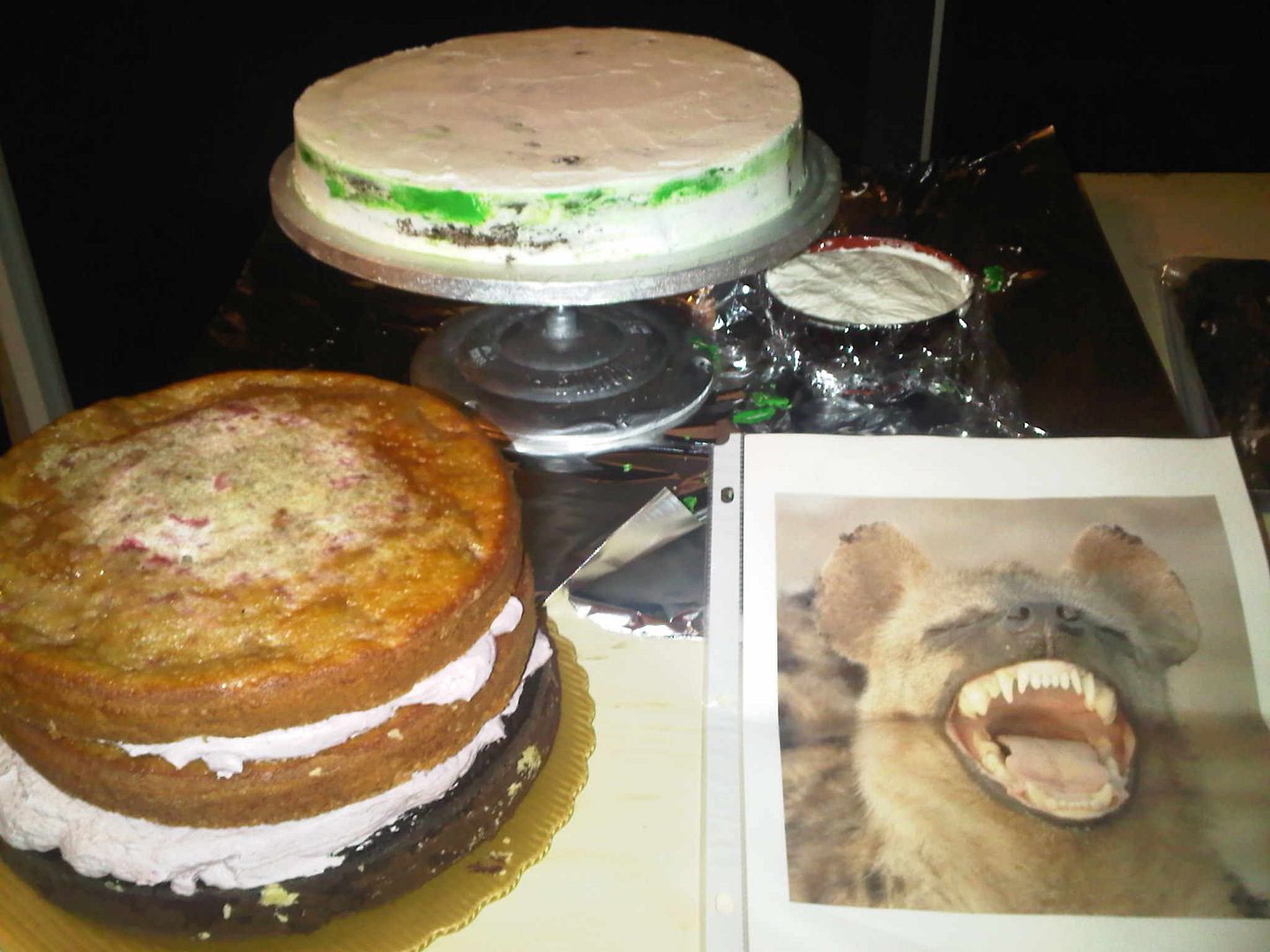
Robyn Winston's spotted hyena cake in progress

This past Thursday, Elizabeth and I safely completed our cross country drive, and with negligible damage to any of the art, furniture, books, tchotchkes, or other objects we loaded into the back of Cheryl, our Penske rental truck. Now that I'm a San Francisco resident, however, I must settle in, find a part-time job, and land happily on my art-making feet in a new and exciting environment. In other words, please understand if HH posts are irregular.

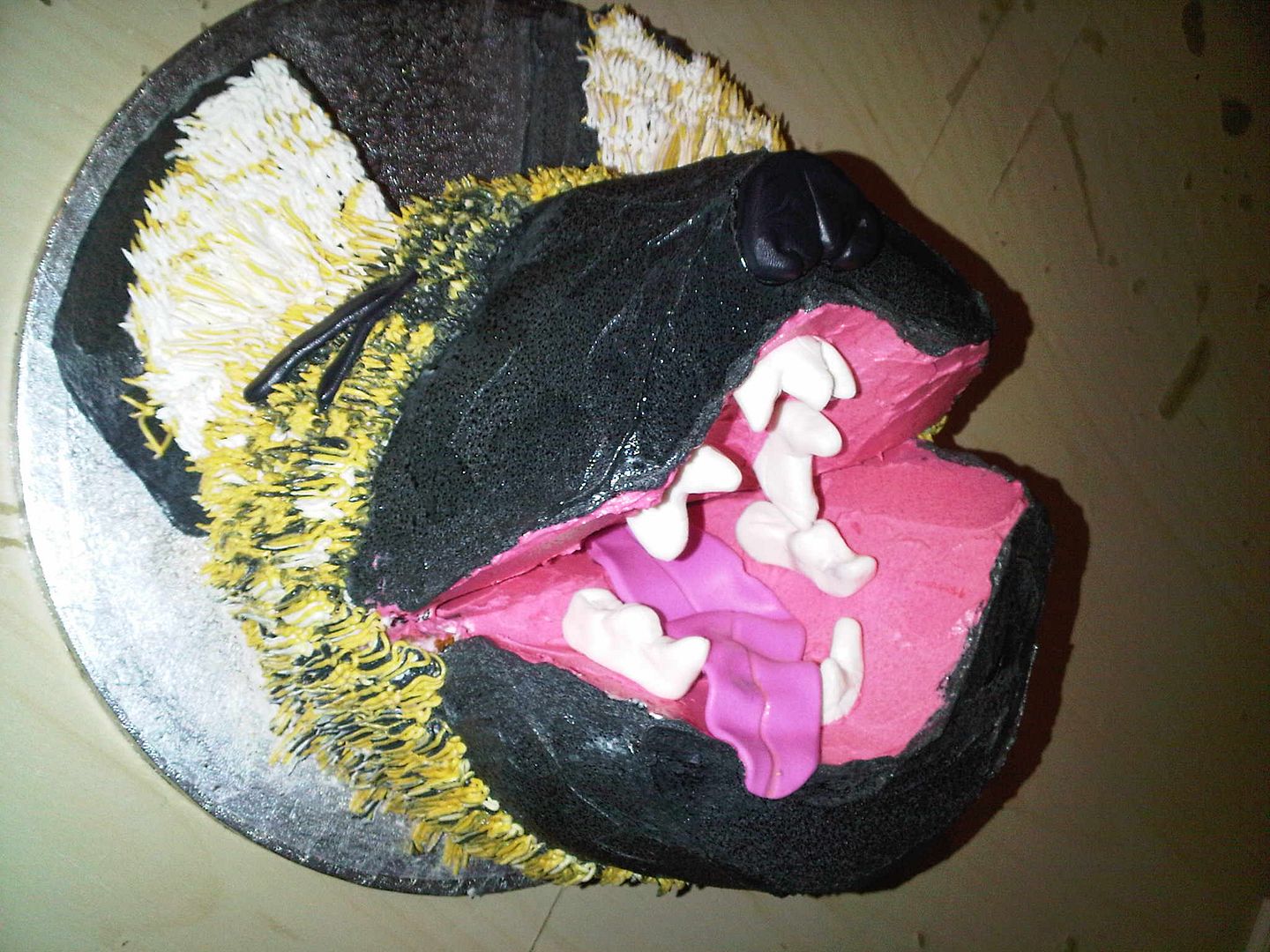
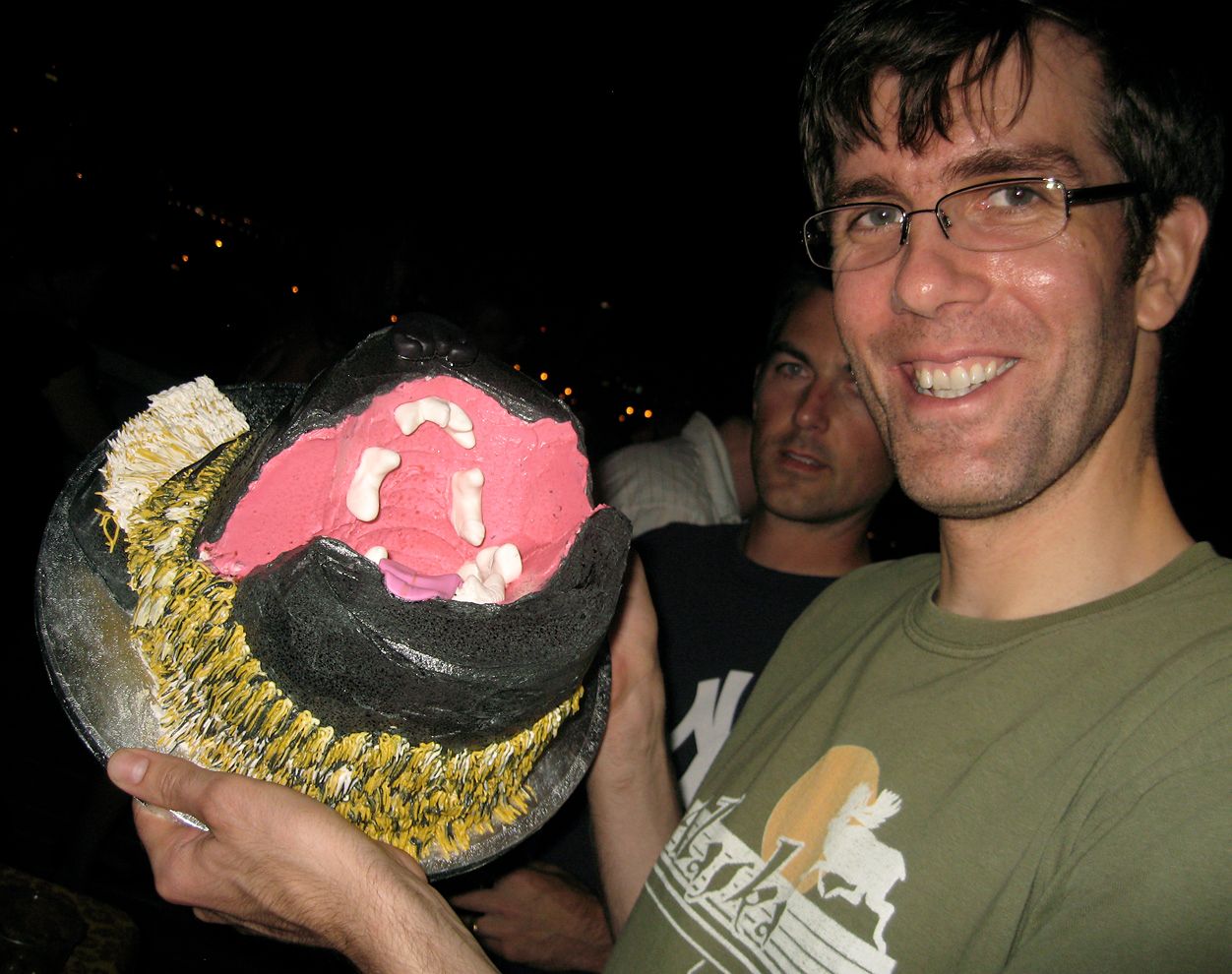
In the coming weeks, I hope to sort through the many drive-by snapshots Elizabeth took from the shotgun seat, including tremendous storms brewing over Kansas, vast wind farms in Colorado, and the stunning salt flats of Utah. In the meantime, I'm posting several photographs of the amazing spotted hyena cake that my friend and talented artist Robyn Winston made for my NYC send-off. I'm delighted to think that I may be one of a very few people who has been presented with a hyena shaped cake! Thank you, Robyn!


Robyn's finished cake


My happy mug with the hyena maw

Photo credits: Robyn Winston, 2010

Sunday, February 25, 2007

Michael's Project

Friend and artist Michael McDevitt is working to answer questions that haunt every artist. What happens to my work after it is sold? What does my painting look like in its new home? What is it hanging next to? McDevitt put out a call to all of his collectors:
"If you own some of my art, please help me by emailing me an image showing the piece as it exists today. I am interested in the space in which the art resides and how it interacts with your life. Also, please tell me if you'd prefer to remain anonymous. I greatly appreciate your help."
As it happens, I own five artworks by McDevitt, and I dutifully photographed each of them. To see them (and other of McDevitt's work in collectors' homes), check out three related posts on Michael's blog. No surprise; my collection is under the heading "Queens, New York."

Two related notes:

- One of McDevitt's paintings, an orange "Beastie," hangs next to an Alice Neel lithograph. I like some of Neel's work a great deal. In my early undergraduate days, the figure paintings of Neel and Egon Schiele excited me and I continue to admire both artists. Unfortunately, like most of us, I don't have enough money to afford her prints and, given her present condition (dead and famous), I can't very well email her to propose a trade...so how did I come to be in the possession of one?

At the risk of getting myself into some trouble here, I should come clean. I stole the lithograph. Or, rather, I saved it. Six years ago, in a former job as a gallery preparator, I was asked to destroy a number of lithographs that had developed slight foxing on verso. I was horrified by the request. I asked if I might have the prints instead of attacking them with a box cutter. The answer was a definitive, "Absolutely not." Try as I might, I didn't understand the gallery's reasoning. Sure, a serious collector probably won't want to buy a slightly damaged print, but why destroy them?

Upset, I nevertheless began hacking and slicing through the print pile, feeling badly for the artists and the unfortunate fate of their art. When I came to this particular Neel print, however, I just couldn't do it. I rolled the print up, slipped it into a cardboard tube and stashed it under a tool bench for later retrieval. A few days later I headed to work with a portfolio of my drawings, supposedly for a curatorial visit that evening; before leaving the gallery at closing time, I added a new piece to the portfolio.

If the gallery owners should stumble upon this blog and read the above admission, I'd only have them know, as I'm sure they must (since our relationship was always a good one despite my constant pranks and general mischief), that the theft wasn't meant as a personal slight or a sign of any dissatisfaction in my job. I just couldn't kill a print I so liked...and, yes, coveted. (If you must, please contact me and we can work something out. Although, really.....if you're only going to reclaim it to destroy it, please consider how happy and settled it appears next to McDevitt's "Beastie.")

- In another photograph on Michael's blog, a drawing of a Barred owl (Strix varia) by McDevitt hangs just outside the door to my studio. Through that door, you glimpse an in-progress painting that has since then been finished, just last week in fact. I thought I'd post it here...after all, it features three spotted hyenas, as well as a pair of African fish eagles (Haliaeetus vocifer).


Christopher Reiger
"a cruel and beautiful faraway place"
2007
Watercolor, gouache, sumi ink and marker on Arches paper
32 x 27 inches


It is part of the Hysterical Transcendentalism series that I began last year, but it is, by far, the most visually assaultive - in terms of palette and composition - of those works to date. I quite like it, but I've now begun work on two paintings that are more subdued. I needed an interlude after the relentless all-overness of "a cruel and beautiful faraway place."

Monday, May 15, 2006

Hyaena Holmes


Artist and good friend Michael McDevitt was so offended by the quality of my original spotted hyena image (see here), that he whipped up the above piece. This noir Hyaena Holmes is a definite improvement over the unforgivably primitive mouse work in the original. Thanks, Michael!

Monday, May 23, 2005

Crocuta crocuta: Part 2

"Even the grass..."


If the spotted hyena had a signature phrase, it might well be the same of that as the late comedian, Rodney Dangerfield: "I can't get no respect." Long characterized as craven and stupid, the species is considered a villainous thief, a money-for-nothing scavenger that creeps onto the scene only after the real work has been done. In Disney's "The Lion King," the hyenas are slobbering, giggling fools. Likewise, in many a dated nature documentary the lowly hyenas are most often seen being run off by the "proud and noble lions."

Much of this disrespect is a result of our human aesthetic preferences. Rarely do I ask someone to describe a hyena and not hear the words "ugly," "disgusting," or "dirty." Yann Martel, in his terrific novel, Life of Pi, gives the reader a fair assessment of spotted hyena behavior, but the animal is still described as "ugly beyond redemption."
"Its thick neck and high shoulders that slope to the hindquarters look as if they've come from a discarded prototype for the giraffe, and its shaggy, coarse coat seems to have been patched together from the leftovers of creation. The colour is a bungled mix of tan, black, yellow, grey, with the spots having none of the classy ostentation of a leopard's rosettes; they look rather like the symptoms of a skin disease, a virulent form of mange. The head is broad and too massive, with a high forehead, like that of a bear, but suffering from a receding hairline, and with ears that look ridiculously mouse-like, large and round, when they haven't been torn off in battle. The mouth is forever open and panting. The nostrils are too big. The tail is scraggly and unwagging. The gait is shambling. All the parts put together look doglike, but like no dog anyone would want as a pet."
So what is this strange animal? Why does it seem to be "patched together from the leftovers of creation" and what is it actually like? Dogs, bears, raccoons, weasels, and badgers are all members of sub-order Caniformia. The physical appearance and greeting behaviors of the Hyaenidae family - four species: spotted hyena (Crocuta crocuta), striped hyena (Hyaena hyaena), brown hyena (Hyaena brunnea), and aardwolf (Proteles cristata) - lead many to assume that they belong to Caniformia as well. In fact, hyenas are more closely related to the house cat sleeping on the ground next to me; they are members of sub-order Feliformia. Of the four living hyena species, the aardwolf and spotted hyena represent the more ancient lineages, the spotted hyena being the sole survivor of a "diverse, very successful and advanced carnivore/scavenger that ranged from Europe to Indonesia."(1) The other members of the Crocuta genus were much larger animals, some of them bear-size, and the smaller build of the spotted hyena enabled them to persevere while larger relatives perished. Excepting the aardwolf, hyenas have incredibly tough digestive systems, capable of digesting mammal bones in a few hours and teeth in a few days. They have even been known to consume and digest semi-poisonous compounds with no observed ill effects. Considering the bone crushing strength of the hyena jaw and the speed with which they consume food, such an adaptation is rather vital. As Martel writes, "It is not their gastric juices that limit hyenas, but the power of their jaws, which is formidable."

I am fascinated by all of the hyena species, but I find the spotted hyena most curious by far. The complex social architecture of a spotted hyena clan is notably different from that of its closest relatives. The striped hyena, for example, is a relatively solitary animal. Adults do not tolerate members of the same sex, so males and females come together to mate and raise offspring but spend much their time alone. The brown hyena typically shares a home range with only a small number of close relatives. The spotted hyena, however, can live in clans of up to 100 animals (in some cases, where food is plentiful, the clans can even exceed this number, though an 80 adult clan is extremely rare). Understandably, such large groups require some degree of socialization. Until recently, however, the sophisticated social dynamics of spotted hyenas remained unknown.

Inherited social status - an animal born of a high-ranking parent is automatically considered superior to those from a lesser lineage - is uncommon among group-living mammals. Usually size, strength, and other physical abilities determine rank. A weak or timid elk (Cervus elaphus), or wapiti, is unlikely to build a harem and be a good breeder, just as a smaller, less offensive grey wolf (Canis lupis) will be subservient to the more aggressive, powerful males. Primates were long believed to be the only exception to the rule, but biologists have learned that spotted hyenas also break the mold. Crocuta crocuta lives in large matriarchal clans with a rigid hierarchy. Rank passes directly from a mother to her cubs. Oddly, a male cub, no matter how highly ranked his mother is, will eventually leave his clan (at between 2 and 5 years of age). By contrast, all females remain with their "birth clan." The lone male spotted hyena faces a hard life and must hope for acceptance into a new clan. Should he be accepted, he will start at the absolute bottom of the hierarchy. Ranking even lower than the lowliest of cubs, he must greet them with a submissive posture. Reduced in this way, the immigrant male will also be forced to feed last. If the clan he has joined is large, feeding last can sometimes mean gnawing on bones or surviving on the feces of your clan mates.

Zoologist Kay Holekamp, of Michigan State University, studies the spotted hyena in Kenya. Holekamp wondered why males would choose to leave their clan and suffer such a fate. The answer she found is surprising. Holekamp discovered that immigrant males father an astounding 97 percent of cubs, "even though they are outranked by younger native males." Curiously, the tenure of an immigrant male is significant. A newly arrived immigrant is unlikely to find receptive females, but those that have been with the clan for some time will have sex offered more often, despite the fact that they remain at the bottom of the pecking order. This arrangement makes good genetic sense (limiting inbreeding), but some readers may wonder why the males are so willing to play by the matriarchal society's rules, why they don't "take" the females as is common in so many other mammalian species?

The answer, as with most things Crocuta crocuta, is very unusual. Not only are the females the dominant sex, they are also physically larger (on average, 12% heavier) and more aggressive than the males.
"This female dominance comes by way of a rare degree of masculinization. Female hyenas...have higher concentrations of the typically male hormone androstenedione in early life and are host to some bizarre genital morphology. The hyena clitoris is an elongated structure that resembles the male's penis. The females urinate, mate, and give birth through this highly elastic pseudopenis."(2)
Because of this peculiar morphology, female hyenas are in complete control of the sex act. In order for the male hyena to mate successfully, the female must retract the clitoris inside of her, as if inverting a sock, allowing the male to insert his smaller penis. Also of note, the birthing process is incredibly difficult on female hyenas. Imagine a human female giving birth through an enlarged clitoris, and you begin to get a sense of the excruciating pain the mother hyenas experience when giving birth, especially the first time! Biologist Laurence Frank (University of California, Berkeley) says of the spotted hyena birthing experience, "It's the only time I've ever heard hyenas cry out in pain."(3) In fact, many first-time mothers die after giving birth.

There have been many fine articles on Crocuta crocuta in the last decade (the two quoted articles are good places to start) and what I have written above should serve as a springboard. If you have any questions about the species, feel free to ask. Odds are I know the answer and, if I don't, I'm sure I'll have fun finding out.

I'll close with another selection from Life of Pi.
"These were not cowardly carrion-eaters...Hyenas attack in packs whatever animal can be run down, its flanks opened while still in full motion. They go for zebras, gnus and water buffaloes, and not only the old or the infirm in a herd - full-grown members too. They are hardy attackers, rising up from buttings and kickings immediately, never giving up for simple lack of will. And they are clever; anything that can be distracted from its mother is good. The ten-minute-old gnu is a favourite dish, but hyenas also eat young lions and young rhinoceros. They are diligent when their efforts are rewarded...Nothing goes to waste; even the grass upon which blood has been spilt will be eaten."
(1) The Kingdon Field Guide To African Mammals. Jonathan Kingdon, Academic Press, 1997
(2) "Rebranding the Hyena," John Pickrell, Science News, April 27, 2002
(3) "Sex and the Spotted Hyena," Robin Meadows, Smithsonian ZooGoer 24(3), 1995

Photo credit: The Lion King, Walt Disney Pictures

Saturday, May 21, 2005

Crocuta crocuta: Part 1


Anything I write about the spotted hyena (Crocuta crocuta) has to be prefaced with backstory. In the summer of 1997, my father took me along on a trip to South Africa and Botswana. As with many of my father’s assignments, this one was a marriage of environmental tour and traditional safari. To many readers this will seem an awkward coupling, but conservation, as opposed to preservation, encourages a controlled take of some species in order to better “manage” the populations and the ecosystem. Just as the U.S. Fish & Wildlife Service sets bag limits on hunted animals here in the United States, so too do the governmental organizations in Africa. (In the States, it is clear that not every legal species is really in need of “management,” and much of the justification for the annual “harvest” (i.e., regulated hunt) is financial. Though hunting and fishing licenses continue to account for the lion’s share of money spent on conservation causes in the U.S., some decisions seem wrong-headed, more interested in revenue than biodiversity. One presumes the same is true of African countries.)

The first week of the trip was spent in an ecotourism camp. Camp Abu was incredibly posh – overwhelmingly so! – and visitors lived in the lap of luxury despite being hundreds of miles from the nearest town. During the day, clients rode trained African elephants (Loxodonta africana) into the Okavango Delta. On elephant back, one can get much closer to other species and the only threats are wild elephants, especially young bulls. For the purpose of discouraging conflict, several members of the camp staff would travel alongside the elephants on foot. If wild elephants took an interest in our little group, a staff member would fire his rifle into the air to scare them off. The time at Camp Abu offered some terrific wildlife viewing, but I saw only one hyena. Some distance from our group, it raised its head above the tall grasses for a brief moment; then it was gone.

After a week at Abu, we headed 25 miles south to the hunting camp. My father and I were the first guests to be hosted, and the camp had only recently been constructed. This being the case, wildlife encounters were spectacular, even unsettling. Sitting around the campfire on the first evening, lions (Panthera leo) coughed (they rarely roar) and hyenas whooped just beyond the play of firelight. That night, I was awakened by a screeching bird and, turning on my flashlight and casting the beam through my mosquito net, I realized my tent was surrounded by a pride of lions. Not eight feet away a lioness stood looking directly into the light. Just behind her, a fully maned male lounged on the ground where I had unpacked my bag that afternoon. In the three seconds before I clicked off the flashlight, I noticed more lions moving about on either side of these two cats. I remained in the same position, holding my breath, for what seemed like ten minutes. I was certain death was imminent. Although the thoughts one has at such a moment are, in retrospect, quite funny, at the time I was as solemn as a 19-year-old can be, excepting perhaps unfortunate teens caught up in a war.

Our week in the hunting camp was to continue in this vein. A lunch would be interrupted by a matriarchal herd of twenty-three elephants quickly cruising by the camp. I would awake at night in agony from the sharp bite of some unknown variety of spider or jump to attention when I felt a scorpion scurrying up my back and over my shoulder. On a morning outing, we came across two male warthogs (Phacochoerus aethiopicus) fighting over territory or breeding rights, tearing each other open with their sharpened tusks. A black mamba (Dendroaspis polylepis) lived in the camp and, though I was not lucky enough to see it myself, it was spotted several times during my stay. Yet three days into our stay at the hunting camp, I had only heard hyenas.

My encounter came mid-week. That morning, I was stalking a male impala (Aepyceros melampus) with the PH (professional hunter). We had followed the animal for a couple of miles and now found ourselves atop a hillock. The impala was roughly a hundred yards away and an opportunity presented itself. Peter, the PH, set me next to a tree against which I could stabilize the big rifle. He told me to fire when I felt comfortable. The truth is, I wasn’t comfortable. I had come to Africa understanding that I would not hunt with a rifle, but with a camera. Unbeknownst to me, however, one impala permit had been purchased in my name and, though I’m still not convinced he didn’t know in advance, my father was elated at this news. Realizing how very important this was to my father, I bowed to the pressure and now shouldered the 30.06 and sighted the crosshairs on the “boiler room,” the area of an animal that houses the heart, liver, and lungs. When I pulled the trigger, the rifle kicked back and the barrel pitched up. I was certain that I had fired over the impala. Indeed, the antelope continued to pick at grasses, seemingly unaware of the lead projectile which had just screamed by. Peter was visibly discouraged by my poor shooting. Rather than have me reload and fire again, he thought it best that I scratch this animal and await another stalk later in the week.

We made our way down the steep slope of the hillock. Reaching the bottom, Peter grabbed my arm. “Don’t move,” the Englishman said. Ten or fifteen feet from us, three impressive creatures lifted their heads from the grasses. So broad and muscular were their chests, I was every bit as terrified of these intimidating spotted hyenas as I had been of the lion pride. The closest animal stared at Peter and me, its great head steady atop a powerful neck. She was gorgeous in her way, despite the matted fur and odd proportions. After ten seconds, she lowered her head, made a quiet chortle to her companions, and all three moved off. Peter let go of me and said, “Follow me…quickly now.” The instruction was unnecessary.

What made that moment so remarkable was circumstance. I was at the mercy of this predator. While the same is true of the lion experience, I didn’t feel so considered by the cats; Tiki and Tsonga, two camp trackers, later explained that the lions had surrounded the tent because of my father’s loud snoring and, having already made a kill that evening, were merely curious. The three hyenas might also be described as curious, but Peter had grabbed my arm for a reason. We were, for a moment, potential prey. (The only other instance of such primal vulnerability I've known was during my time working in a tent camp on Costa Rica's Osa Peninsula. Doing trail work in the rainforest one afternoon, I became convinced that a jaguar (Panthera onca) was stalking me and spent the better part of a frightening hour making my way down to the beach and relative safety.)

Though I appreciate animist myths and fairy tales, I’m not much for spiritual mumbo-jumbo. That said, I have had a few experiences in my life which leave me feeling intimately connected to another species or place. In Botswana, two moments stand out. On my last day in the tent camp, I went for a walk on my own. Emerging from an island of trees I looked out over the savannah. As I wrote of the experience at the time, “…the sun sank behind islands of incredible beauty, painting the trees black and the savannah grasses gold. I stood on my own and felt at peace because there, as in very few places anymore, one is immersed completely in nature. In the distance, a lion roared and Africa seeped into my soul.” Curiously, the power of that moment has faded with time, whereas the hyena meeting has only become more profound.

(Part 2 of this post will focus on the natural history of the spotted hyena.)

Photo credit: ripped from eTravelPhotos.com

Thursday, May 19, 2005

"Misjudged Hyenas"


I would be remiss were I not to draw attention to the June 2005 issue of National Geographic. "Misjudged Hyenas" showcases photographs of Crocuta crocuta.

The Latin name drips off the tongue; equal parts sensuality and mystery, it sounds almost vampiric, but the animal itself is anything but sensual. In fact, it is in part the raw ugliness of the animal that so attracts me to them. Muscular and equipped with impressive jaws, these slope-backed animals have long been characterized as pathetic, stupid scavengers. This couldn't be more inaccurate an assessment. Biologists have known for years that hyenas are excellent predators. More recently, we learned that they have an extremely complex social hierarchy, far more sophisticated than that of lions and, according to some biologists, approaching that of ape species.

More closely related to the mongoose than to the bear or dog, hyaenas belong to the cat-like superfamily (or suborder, depending on your preference) of carnivores, Feliformia. Curiously, the spread on pages 62-63 of the June issue makes clear this relationship. In the image, a hyaena has been trapped in a bog by a pair of male lions and they are preparing to kill the smaller predator. The hyaena is covered with glistening mud and rears back in a futile defensive display. Muddied as he is, the physiological similarities between the mongoose and the hyaena are made clear.

At any rate, when I began this blog, I promised a longer post on this fascinating animal. One is forthcoming.

Photo credit: Anup and Manoj Shah, 2004

Tuesday, March 01, 2005

Alice and the Hyaena


I'm a fan of "Alice in Wonderland" or, more specifically, I'm a huge fan of Alice's insatiable curiosity. Her wide-eyed approach continues to influence children and adults alike and, in my opinion, is a prerequisite for any worthy artist or scientist.

It is both my love of Alice and my fondness for the spotted hyaena (Crocuta crocuta) that inspired me to name this blog Hungry Hyaena. "But what does that have to do with Alice," you may wonder.

Below, I have excerpted from "Through the Looking Glass."
And here I wish I could tell you half the things Alice used to say, beginning with her favourite phrase `Let's pretend.' ...And once she had really frightened her old nurse by shouting suddenly in her ear, `Nurse! Do let's pretend that I'm a hungry hyaena, and you're a bone.'
Ever since I came over a hillock in Botswana and found myself "face-to-face" (in fact, the distance was closer to ten yards) with a large female spotted hyaena, I have felt a close tie to this species. They are brutal looking animals but, though most people consider them ugly, filthy creatures, I see something of myself in them.

I'm sure to go on about spotted hyaenas in a later post, but what matters here is the image of Alice, that most creative and curious of souls, gnawing on a bone with her powerful hyaena jaws.

She will be through to the marrow in no time.