Showing posts with label technology. Show all posts

Monday, September 23, 2013

Stop That Train, I Wanna Get Off

On the heels of yesterday's post about the staggering number of images we wade through...this.

Civic Center Muni Station advertising
September 2013

Photography credit: Christopher Reiger, 2013


Sunday, September 22, 2013

Navigating the Flood (Of Images)

I recently visited "A Sense of Place," Pier 24's current exhibition. It's a strong show with a broad purview that, typical of Pier 24 productions, is elegantly and thoughtfully installed. Long after I left the space, I found myself reflecting on the relationship between two of the "A Sense of Place" galleries.

Erik Kessels' installation, "24 HRS in Photos," a "room filled - floor to ceiling - with printed versions of every picture uploaded to Flickr during a 24-hour period," has generated some online buzz. The Pier 24 press release states that Kessels' provides the viewer with an opportunity "to both visually and physically experience the overwhelming number of photographs shared online." Indeed, he does.
Erik Kessels
"24 HRS in Photos"
Installation view at Pier 24
2013

I entered "24 HRS in Photos" a few minutes after leaving another room of the exhibition, one devoted to Stephen Shore's "Uncommon Places." The contrast between the spaces was jarring. The simple framing of Shore's work -- broad mats provide ample quiet space around the prints -- isolates each picture and draws the viewer in. Accordingly, I spent long minutes with each of Shore's photographs, pouring over details and "reading" the pictures like a short story. Every Main Street, bowling alley, parking lot, and road sign in Shore's photographs has a rich tale to tell.

My "read" of "24 HRS in Photos" couldn't have been more different. Upon entering Kessels' installation, I didn't know where to begin. I knew I was looking at an accumulation of individual photographs, but I could take in the work only as a whole, as a swell of blues, whites, and blacks with occasional bursts of yellow or red. As Ariel Rosen writes over at SFAQ, Kessels' "mountain of photos" is "antithetical to any careful choosing." The installation reminds us that the vast majority of images being produced today are neither intended nor received as pictures to be pondered; they are snapped, uploaded, shared, consumed, and forgotten.

Sunday, July 14, 2013

Homicidal toys, dot matrix printers, and the 3D printing vanguard

Man with dot matrix printer and computer, circa 1985

Sometime in the late 1980s, I started taking writing seriously. Given my age (I was ten or eleven years old) and the content of my stories, I probably took it too seriously.

Wednesday, June 26, 2013

Sci Foo On My Mind

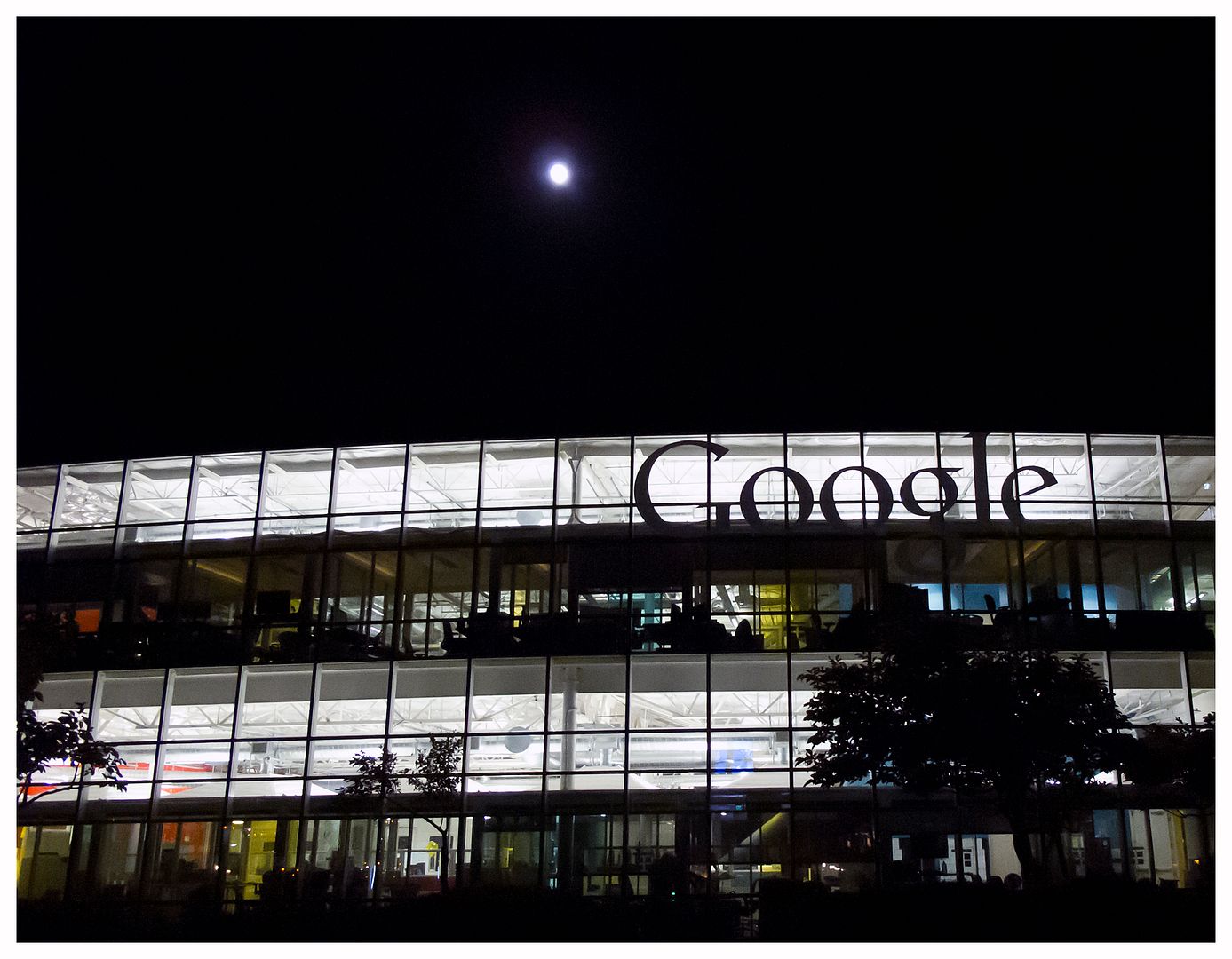
Summer solstice moon over the Googleplex; Mountain View, CA; June 2013

My father-in-law is a glass-half-full kinda guy. In the midst of any conversation about science, medicine, or technology, it's not uncommon for him to proclaim, "This is an exciting time to be alive." Indeed, it is. But when I fell into bed early on Sunday morning, my head giddy with ideas from the first full day of Sci Foo Camp, my father-in-law's optimism seemed understated. Spend 48 hours with -- to list just a few of the approximately 250 participants -- a computer scientist studying machine learning and music, a theoretical physicist turning the idea of gravity on its head, a marine biologist eager to solve the mysteries of whale sharks, a genomic epidemiologist intent on elucidating outbreak transmission dynamics, and a national security strategist currently implementing the White House's terrorism-related information sharing priorities and...well, you come away with much to ruminate on and a lot of notes to parse. In short, Sci Foo Camp made for an extraordinary weekend!

Monday, June 17, 2013

Off to Sci Foo this weekend!

I'm excited to head to the Googleplex this coming weekend for Science Foo Camp! Usually referred to as Sci Foo, the eight-year-old invitation-only "unconference" is organized by Google, the science journal, Nature, Digital Science, and O'Reilly Media. Sci Foo brings together "between 200 and 300 leading scientists, technologists, writers, and other thought-leaders at the Googleplex for a weekend of unbridled discussion, demonstration, and debate." (You can learn more about SciFoo here.)

Selene and I were invited because of the BAASICS mission, and I'm pleased to see that one of the proposed SciFoo sessions is titled "Building Better Art-Science Partnerships." Naturally, we're looking forward to engaging in lively, informative conversations with other participants about the art-science interface and to explaining what it is we aim to do with BAASICS and why we feel it's so important. That said, while BAASICS got me invited, I'm super jazzed about attending (and perhaps participating in) many of the other sessions that have been proposed. A few of my favorites:
- Using Emerging Technologies to Advance Conservation
- Science Advocacy
- Rethinking National Security
- Defragging Government (How Can Scientists and Engineers Help?)
- Science and Popular Skepticism
To my way of thinking, Sci Foo's interdisciplinary angle and relaxed format are outgrowths of Bay Area culture, a place where idealism, art, science, and technology commingle, often with exciting results. I'm encouraged to see sessions like "DeFragging Government" on the list, and I have the impression that many of the Sci Foo participants recognize our responsibility -- both that of the individual and the group -- to be active beyond our more particular spheres.

BAASICS will be live tweeting from the event and I'll provide a short update -- with photographs -- after my return.

Image credit: ripped from the Sci Foo Camp website

Tuesday, October 02, 2012

Picturing Awe

Frame from "Wind Map"
Martin Wattenberg and Fernanda Viegas

Last night, I attended the second presentation in this season's Art, Technology, and Culture Colloquium series at UC Berkeley. Martin Wattenberg and Fernanda Viegas, artists and researchers who often work as a team, presented "Visualization and the Joy of Revelation," an engaging survey of their greatest hits (to date) supplemented by tidbits about their process and working philosophy.

From the ATC listing:
"Fernanda Viegas and Martin Wattenberg explore the joy of revelation: the special electricity of seeing a city from the air, of hearing a secret, of watching a lover undress. Their medium is data visualization, a technology developed by computer scientists to extract insights from raw numbers. They'll show what happens when this technology is aimed at data sets that range from tropical storms to social networks, from arguments on Wikipedia to expressions of carnal desire."

Friday, November 04, 2011

Announcing BAASICS

I'm very excited to announce that artist-curator Selene Foster and I have received a Southern Exposure Alternative Exposure Grant award for our Bay Area Art & Science Interdisciplinary Collaborative Sessions (BAASICS) proposal! BAASICS is a series of San Francisco-based evening programs that bring together local visual artists, choreographers, composers, scientists, and interdisciplinary thinkers to present engaging, multi-media lectures and performances that consider a given theme. The programs are free and open to the public.

In conjunction with A Live Animal, a group exhibition that Selene and I co-curated at Root Division in July 2011, we assembled 4 visual artists, 3 scientists, and 1 choreographer in San Francisco's ODC Theater to further explore the exhibition's theme in a program of TED Talk-like lectures and performances. The evening was a terrific success, drawing a capacity crowd and generating excited conversation during the reception that followed. Many of the attendees enthusiastically requested more such events.

With BAASICS, Selene and I hope to foment creative exchange and even long-term, mutually beneficial relationships between artists and scientists. Despite much talk of commonality between the disciplines, there is little substantive dialogue. Laudably, there are an increasing number of efforts to cultivate interdisciplinary, art-science projects; unfortunately, the lion's share of these result in vaguely "sciency" artworks or analyses of aesthetics rooted in cognitive neuroscience or sociobiology.

BAASICS isn't goal or project oriented; after all, there are many important differences between art and science, but one undeniable likeness is that the best discoveries are often stumbled upon, not planned for. We hope that BAASICS will provide a forum for artists and scientists to come together to share the ideas and practices that animate their lives and work. A principal aspiration of BAASICS is that we will learn from and be inspired by one another.

Even more important than facilitating relationships and the sharing of ideas, however, is the possibility of engaging a general audience. In the United States, the contemporary fine arts and sciences are generally set apart from popular discourse. Because BAASICS programs are free and open to the public, we hope to make the fine and performing arts and sciences less esoteric, inspiring guests to think about how art and science relate to one another and to society at large.

FYI: The theme of the second BAASIC event -- albeit the first associated with the name -- will be technology and notions of "the future." The roster of presenters hasn't been determined (it will take place in May or early June 2012), but speakers and performers might ponder, for example, robotics, artificial intelligence, medical advances and human nature, how our globalizing culture will shape technology, or dystopian versus utopian prospects. If HH readers know of Bay Area visual artists, composers, choreographers, scientists, or general smarty-pants who are engaging technology in some way and might be interested in participating, please put them in touch with me. Selene and I want to review as large a pool of applicants as possible.

Saturday, September 24, 2011

Acknowledging Exceptionality

"As glass office and condominium towers have proliferated in the last decade, so, too, have calls to make them less deadly to birds. The San Francisco Planning Commission adopted bird-safety standards for new buildings in July, and this month that city’s Board of Supervisors will vote on making it law. Legislation is pending in Washington that would require many federal buildings to incorporate bird-friendly designs. The United States Green Building Council, a nonprofit industry group that encourages the creation of environmentally conscious buildings, will introduce a bird-safety credit this fall as part of its environmental certification process, called LEED."
- "A City of Glass Towers, and a Hazard for Migratory Birds," New York Times, September 14, 2011
I enjoyed reading "A City of Glass Towers, and a Hazard for Migratory Birds," a recent New York Times article about bird-building collision mortality. Lisa Foderaro's piece is a hopeful account of how a confluence of activism, technology, and regulation can improve the lot of animals, especially in cases where a particular species has been adversely affected by human development.

The comments that follow the article, however, are predominated by doom-and-gloom attitudes. A representative survey follows:
All that matters are people and every little whim. We're a doomed species.
-Karma Every Moment, NY, NY

The people who tell us that evolution and climate change are just unproved theories have no idea how life formed this planet since its inception and no understanding whatsoever of the role of extinction in maintaining the climate within habitable bounds when any one plant or animal breaks the equilibrium. They convinced me long ago that there is no future for my own children.
-Steve Bolger, NY, NY

Yet another example of the consequences of man's selfish and destructive behavior. So sad.
-agetibi, Carrboro, NC
No wonder over 50% of Americans polled by The Nature Conservancy caricatured environmentalists as preachy reactionaries. In the words of the Conservancy's Chief Scientist, Peter Kareiva, most people see members of the environmental movement as "misanthropic, anti-technology, anti-growth, dogmatic, purist, zealous, exclusive pastoralists." Unsurprisingly, this negative stereotype has led to a dwindling of the movement's ranks.

I consider myself an environmentalist, but I distinguish between preservation and conservation (placing myself in the latter camp) and, more critically, I believe that environmentalism needs to embrace a "can do" attitude. If the majority of my fellow Times readers identify as environmentalists, their comments suggest that they're a well-intentioned pox. Wholesale condemnation of our species is as wrongheaded and malignant as exclusive glorification. In order to decry humanity as a "selfish and destructive" brute, one must stubbornly overlook all the evidence to the contrary. I wrote about such oversight in an essay included in the catalog for "A Live Animal," a group show that Selene Foster and I co-curated at Root Division.
"Although 'deep ecologists' and animal rights activists bemoan conservation approaches that prioritize human interests, the fact remains that human beings are exceptional animals. Skeptics and naysayers need only consider our species' biological and imaginative success to find evidence of our unprecedented faculty. But of all our remarkable features and feats, among the most notable examples of humanity's anomalous nature is our interest in and empathy for other species. Although there is growing scientific agreement that some other species possess self-awareness and even a capacity for empathy -- whales, dolphins, elephants, and our ape relatives are especially interesting in this regard -- humans are the only animal striving to learn about and better the lot of other creatures and environments. It's true that we often prioritize short-term, anthropocentric interests and it's also clear that reckless human activity has contributed to dramatic climate change and the ongoing Holocene extinction (our geological epoch's staggering loss of biodiversity), but conservation efforts and legislation, as well as our burgeoning interest in sustainability, speak to another, more hopeful human impulse; we possess an innate ability to see ourselves in other animals and, in turn, to recognize our capability as their stewards and representatives."
In short, we're not all bad. If you believe that we are, then you're guilty of sapping our species' potential. Christopher Cokinos is excellent on this point. I've quoted his terrific "Consolations of Extinction" essay before; I'll do it again.
"Too much grief for the world means less energy to help it along. [When] you find yourself free of the poisons that too much angst can cultivate, then something marvelous happens. You can sense how very old the planet is, how very old life and death are, and you can keep going on, you can keep doing the work you do in this universe, feeling despair when you feel despair, feeling - amazing - joy when you feel joy."

Friday, January 14, 2011

Artifacts


Butt Johnson
"Various Video Game Controllers, Maps, and a Robotic Accessory"
2007
Ballpoint pen on paper
15 X 19 inches

It's been five years since I owned a video game console. It's been even longer since I abandoned myself to a game, a happy pastime (read: addiction) of my teens and early twenties. Just as I made a teenaged vow that I would always be knowledgeable about new music -- Damn it, I wouldn't be the adult who plays the same John Denver tape on the car stereo, day after day! -- I also promised myself that I'd always own a technologically sophisticated gaming system. Although I accepted the cruel fact that my body would age and degrade, I believed that I'd remain young at heart if I remained a serious gamer. In retrospect, this latter, already broken vow seems laughably naive. If I were still gaming (even casually), I'd be hard-pressed to juggle my art-making with my writing, my volunteer commitments with earning a living, my solitary "thinking time" with my relationship; where would gaming fit!?

In any case, artist Butt Johnson's drawing "Various Video Game Controllers, Maps, and a Robotic Accessory" strikes a nostalgic chord. Over the years, I've owned or used all of the controllers depicted (with the exception of the unfamiliar robot). Today, a little more than twenty-five years after the release of the tremendously popular Nintendo Entertainment System (NES) console, we consider the system's controller (top row, third from the right) an artifact of a bygone gaming era. And the Atari joystick? A fossil! It's curious to feel wistful about technology so recently outmoded.

On a tangentially related note, I recommend Nick Paumgarten's New Yorker profile of Shigero Miyamoto, one of the creative minds behind Nintendo's success and the creator of revolutionary games like Super Mario Bros., The Legend of Zelda, and Star Fox. He's also one of the idea men behind the industry-dominating Wii console. Like Paumgarten, I find it revealing that Miyamoto cites his active imagination and the outdoors as the foundation of his creative success.
"When Shigeru Miyamoto was a child, he didn’t really have any toys, so he made his own, out of wood and string. He put on performances with homemade puppets and made cartoon flip-books. He pretended that there were magical realms hidden behind the sliding shoji screens in his family’s little house. There was no television. His parents were of modest means but hardly poor. This was in the late nineteen-fifties and early nineteen-sixties, in the rural village of Sonobe, about thirty miles northwest of Kyoto, in a river valley surrounded by wooded mountains. As he got older, he wandered farther afield, on foot or by bike. He explored a bamboo forest behind the town’s ancient Shinto shrine and bushwhacked through the cedars and pines on a small mountain near the junior high school. One day, when he was seven or eight, he came across a hole in the ground. He peered inside and saw nothing but darkness. He came back the next day with a lantern and shimmied through the hole and found himself in a small cavern. He could see that passageways led to other chambers. Over the summer, he kept returning to the cave to marvel at the dance of the shadows on the walls.

Miyamoto has told variations on the cave story a few times over the years, in order to emphasize the extent to which he was surrounded by nature, as a child, and also to claim his youthful explorations as a source of his aptitude and enthusiasm for inventing and designing video games. The cave has become a misty but indispensable part of his legend, to Miyamoto what the cherry tree was to George Washington, or what LSD is to Steve Jobs. It is also a prototype, an analogue, and an apology -- an illuminating and propitious way to consider his games, or, for that matter, anyone else’s. It flatters a vacant-eyed kid with a joystick (to say nothing of the grownups who have bought it for him or sold it to him) to think of himself, spiritually, as an intrepid spelunker. The cave, certainly, is an occasion for easy irony: the man who has perhaps done more than any other person to entice generations of children to spend their playtime indoors, in front of a video screen, happened to develop his peculiar talent while playing outdoors, at whatever amusements or mischief he could muster. Of course, no one in the first wave of video-game designers could have learned the craft by playing video games, since video games didn’t exist until people like Miyamoto invented them. Still, there may be no starker example of the conversion of primitive improvisations into structured, commodified, and stationary technological simulation than that of Miyamoto, the rural explorer turned ludic mastermind."
My solitary, television-deprived childhood was akin to Miyamoto's, an enchanted, wondrous world of books and nature. That changed during my sixth grade year, when my parents purchased a television. A few years later, they presented me with a Nintendo console. For years after that purchase, I spent more time with a console controller in my hand than I did exploring or contemplating the world around me.

It's misguided to dismiss video games as artless or to condemn them as escapism, but I wonder whether my connection to natural history and my investment in ecology would be so concrete had my early, formative years included television and gaming. What if I'd been born eight years later, after the introduction of the NES and home computers?

I have a positive view
of humanity; an overview of our species' short history reveals a social animal that takes two steps forward for every step back. Technology is an essential part of this gradual and steady improvement. Psychologically, however, we're growing ever more distant from our fellow species; our contemporary songlines resonate more in the virtual world than in natural history. Technology is no less a part of that unfortunate development.

Image credit: ripped from Butt Johnson's website

Monday, September 14, 2009

Kimmel Harding Nelson Residency: Day 8


1884 Button steam engine; Museum of FireFighting; Nebraska City

Appreciating Varieties of Evolution

"Life," writes Loren Eiseley, Nebraska's latter day Thoreau, "is multitudinous and emergent in the stream of time." Considering the evolution of flowering plants, Eiseley explains,
"The true flower - and the seed that it produced - was a profound innovation in the world of life. In a way, this event parallels, in the plant world, what happened among animals. Consider the relative chance for survival of the exteriorly deposited egg of a fish in contrast with the fertilized egg of a mammal, carefully retained for months in the mother's body until the young animal (or human being) is developed to a point where it may survive. The biological wastage is less - and so it is with the flowering plants. [...] The true flowering plants (angiosperm itself means 'encased seed') grew a seed in the heart of a flower, [...] but the seed, unlike the developing spore, is already a fully equipped embryonic plant packed in a little enclosed box stuffed full of nutritious food. [..] The ramifications of this biological invention were endless. Plants traveled as they had never traveled before. [...] The well-fed, carefully cherished little embryos raised their heads everywhere."
Reading Eiseley, I'm struck by how applicable the language he uses to elucidate plant evolution - innovation, wastage, development, invention - is to the maturation and proliferation of human technology. Our machines of steel and plastic are, like the angiosperms, natural and transient shapes of life's eternal striving; they are imperfect adaptations of the moment.


Antique Tractor; Mayhew Historical Village; Nebraska City

We humans are foolishly arrogant, and often conceive of ourselves as the zenith of physical evolution. The sacred books of our species' major religions claim that we are "made in God's image," and, because most folks are literal-minded, unimaginative, or loathe to admit their own cosmic insignificance, that claim is usually understood to mean that God looks like us, and that we look like God. That's a shame, because the claim's power is metaphorical; humanity is "made in God's image," as is the flower or the carpenter bee or the black bear. For all of these species and, indeed, for God, evolution rolls on.

Humans are unable to outwardly observe our continuing development because we are too close to it, and too short-lived a species. Nevertheless, it is happening. Our technological shifts are the most apparent evidence of this ceaseless process. And what technological transitions each modern human is witness to! Like the growth of a child to a parent, the metamorphosis appears a slow, steady progression, but a retrospective survey reveals an astonishing pace. I periodically marvel at the evolution of computer and video games in (roughly) my own lifetime, from the home version of "Pong" to "Halo," but what of the computers themselves or, for that matter, the Internet?

Consider, for a moment, the technological, political, and social revolutions undergone by our country during Mike Bauer's tenure with the Nebraska City Fire Company #1 and the Great Western Fire Company #1. Bauer joined the company in 1865, at the close of the American Civil War. At that time, "bucket brigades," lines of volunteers passing leather buckets from hand to hand, were the primary way of combating blazes. Bauer climbed the fire fighter ranks, from engineer, to foreman, to chief, and served the growing town through the Spanish-American War, the First World War, and the federal introduction of Prohibition and women's suffrage, in 1920. During this time, the fire department's methods evolved from the "bucket brigade," to horse-drawn pumps, to steam-powered pump engines (like the Button engine; pictured above), to, finally, gasoline-motor pumper trucks (like the 1926 Seagrave pumper; pictured below). All of this change, in Bauer's 67 years of active service! It's a happy wonder to contemplate!


1926 Seagrave Pumper Engine; Museum of FireFighting; Nebraska City

Photo credits: all photos, Hungry Hyaena, 2009

Thursday, September 10, 2009

Kimmel Harding Nelson Residency: Day 4


Oregon Trail Marker; Nebraska City

Manifest Destiny

On the eastern edge of Nebraska City's Central Avenue stands a simple cairn with a plaque, a monument to the Oregon Trail. The plaque reads, in part,
"Official Oregon Trail Marker: [...] overlaid branch of the Oregon Trail, 1849, from the steamboat landing thousands started westward to Pike's Peak, Salt Lake, California and Oregon."
My gaze drifts from this humble memorial to Central Avenue, Nebraska City's main thoroughfare. Today, automobiles move east and west on the two-laned, paved drag. 160 years ago, families traveling by covered wagon set west on a dirt path, intent on making a better life for themselves.

Just think of it; that was 160 years ago! The territories of the western United States were then largely unsettled by immigrants of European extraction. The notion of Manifest Destiny, the Providential assumption that all of North America belonged to a white, male God and, in turn, to His European sons and daughters, was only introduced in 1845. At the time, the American Civil War had yet to be fought, electricity had yet to be harnessed as a popular power source, and human flight was only a hopeful diagram in a sketchbook. 160 years is just three human lifetimes, a drop in history's bucket, a nearly invisible mark on the geologic timeline.


Nebraska City, circa 1860

As I scribble down these thoughts, a small slug moves over the concrete by my left foot. 300 million years ago, our human face was not so dissimilar from the slug's. As Loren Eiseley describes it in The Immense Journey, the steady march of time, whether surveying a span of 300 million or 160 years, is "life reaching out, [...] that magnificent and agelong groping [...] still in progress. [...] Content is a word unknown to life; it is also a word unknown to man."


Oregon Trail Marker and Central Avenue view; Nebraska City

The Windmill Shop

Early this morning, fellow KHN resident Manya Fox and I were granted access to the now closed Kregel Windmill Company shop, located on Central Avenue. For the most part, the shop's interior is just as the employees left it, a time capsule testament to the labor and ingenuity that allowed for the settling of the American west. As our gracious host put it with a grin, "Some people say the six gun settled the west, but it was really the windmill."

Early explorers, Lewis and Clark included, characterized the land that would become the Nebraska Territory as the "Great American Desert," an area unfit for human habitation. But, because of windmills, the plains would soon become some of the most fertile farming land in the United States. Homesteaders needed water to survive, of course, and the windmill was the only efficient way to draw water up from wells 100 feet deep. Wood and, later, metal blades were cut, shaped, and hammered in the Nebraska City shop, an outfit run by the "taskmaster" Kregel brothers, immigrants from Germany.

The brothers are dead now, the Windmill Company is closed and in need of preservation, and water-pumping windmills have, in most places, been replaced by electric pumps. Technology and livelihoods gone with, as it were, the wind.


Accounting desk; Kregel Windmill Company; Nebraska City

Or are they? Today, towering windmills of steel and aluminum, better known as turbines, are being erected the world over. These turbines are an effective means of energy collection that also offer promise of a thriving, low impact industry. In the windmill shop, as I admired a lathe built in the early 1860s, Eiseley's words echoed; the "magnificent and agelong groping" continues.

Beyond Manifest Destiny

Nebraska City's Morton-James Public Library has a small NASA exhibition on display now. As I shuffled around the library gallery this morning, I marveled that the Space Shuttle Orbiter, the "vehicle that carries the crew and payloads to and from Earth orbit," must reenter Earth's atmosphere and land without power. It "glides back to Earth and lands on a runway. [...] Careful guidance control is needed to assure that it is properly positioned to reach the desired landing site." This astonishing feat of engineering and science is made that much more impressive if we consider that it was first realized just 130 years after the homesteaders and pioneers disembarked from Nebraska City's steamboat landing.

To those individuals who emphasize humanity's bloody excesses and potentially catastrophic exuberance above all else, I can only express my bafflement. Truly, to study evolution and the progress of history and science is to be necessarily possessed by eudaimonia. What great feats are forthcoming? The sun is shining; the crickets and katydids are singing; the world is electric with possibility.


Refurbished blades; Kregel Windmill Company; Nebraska City

Photo credits: all photos, Hungry Hyaena, 2009; Nebraska City illustration, ripped from Richard Gehling's "The Pike's Peak Gold Rush"

Tuesday, June 09, 2009

Offerings, Tallies, Records


Christopher Reiger
"cost benefit analysis"
2008
Pen and sumi ink, gouache, watercolor and marker on Arches paper
12 x 12 inches
"What if, while you read the last few paragraphs, something in the world has changed? What if, during the past five minutes, someone, somewhere, sent you a text? Shouldn’t you go and check?

Being addicted to the wired universe might be perfectly healthy, of course, and it’s certainly defensible beneath the triumvirate of technology, curiosity, and progress. I’m the first to admit that there’s something enchanting and invigorating about my computer. There’s magic in reading a note from a friend in Rome and clicking through Halloween pictures from New Jersey and verifying John Steinbeck’s birth date in two clicks. The Internet is indeed its own strange, blessed fountain of light.

[...I'm] not the first to wonder about all this, [...] not the first to sense that maybe our shared life is rushing by too quickly, too feverishly. [I'm] not the first to feel as if [I'm] scrambling to make [my voice] heard against an infinite and obliterating silence.

During the five days [...] I spent in the mountains, [I] saw lots of Shoshone pictographs, paintings made in caves mostly, and under overhangs: finger-painted elk and owls and dogs and triangle-bodied hunters with bows. Many of the pictographs in that area include hash marks, like rows of fence posts scratched downhill, but it’s anyone’s guess as to what these marks originally meant. Maybe they were offerings to the spirit world, or tallies of successful hunts, or records of vision quests. Maybe they were the consequence of someone sitting beside a fire and thinking happily away.

Whatever they once meant, they mean something else now. They mean memories are fragile, beliefs are tenuous, contexts are temporary. They mean nothing is stable—not mountains, not species, not cultures, not e-mail."

- Anthony Doerr, "Am I Still Here?" (from the January/February issue of Orion Magazine)

Tuesday, October 09, 2007

Gallery Report: September 26th, 2007

Paul Villinski at Morgan Lehman Gallery


Paul Villinksi
"Ardor"
2007
Found aluminum, wire, lead and soot
60 x 60 x 11 inches

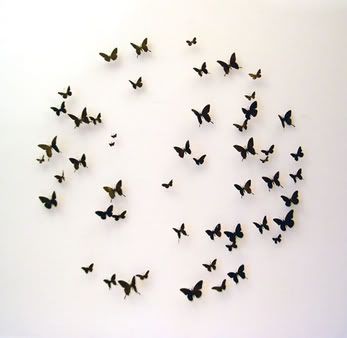
Morgan Lehman Gallery: Paul Villinski's solo outing, "metamorphosis," proves true the maxim that one can have too much of a good thing. The works Villinski includes - groupings of wall-mounted butterflies, "cut by hand from discarded aluminum cans," and a similar installation using vinyl LPs - are part of a series I was introduced to in July of 2006, when the artist included one sculpture, "Departure," in a summer group show at Morgan Lehman. At the time, I applauded Villinski's willingness to flirt with preciousness. I wrote, "[the sculpture] risks being dismissed as a one-note, kitsch celebration of reincarnation or transformation," but concluded that the work was stronger for taking that risk. "Departure" toed the line successfully, forcing the viewer to question his jaded mistrust of a sincere, simple gesture.

Unfortunately, when the gallery space includes only Villinski's butterfly sculptures, the work takes a sad tumble from sincerity into saccharinity. Butterflies, butterflies, everywhere! Even those visitors who rightly cling to the notion of the gallery as a cultural shrine will be forced to admit that an art gallery is first and foremost a boutique. This context undermines Villinski's labors. I left the show wishing I could view each sculpture apart from the rest because, on their own, they are quite nice.

+++++

Julie Heffernan at P.P.O.W. Gallery


Julie Heffernan
"Self Portrait as Booty"
2007
Oil on canvas
68 1/2 x 65 inches

P.P.O.W.: Julie Heffernan's large, lush canvases are a treat for contemporary painting aficionados. The works on display in her current solo show, "Booty," at P.P.O.W., provide ample evidence of her virtuosity, but are psychologically off-putting.

The paintings function as contemporary Vanitas pictures. Heffernan replaces the oft-used laden table with naked women - all self portraits - and gone, too, are the hourglass and silverware. The works are less meditations on life's temporality than restrained celebrations of ego and excess.

The press release states that the figure "does not stoop under the weight of it all" and possesses "extraordinary grace," but that grace can also be interpreted as ambivalent disregard. Did these women achieve their position, or is this merely their circumstance? In either case, the women are obscene; at best, they are quiet collaborators and, more likely, queenly orchestrators, present-day scepter bearers lording over choked empires and rampant consumption. I am saddened - even made uncomfortable - by these pictures. The artist is looking out at us. We're implicated.

+++++

Daniel Rozin at bitforms gallery


Daniel Rozin
"Weave Mirror"
2007
768 laminated C-ring prints, motors, circuits, custom software and microcontroller
57 x 76 x 8 inches
Edition of 6

bitforms gallery: Daniel Rozin includes three interactive sculptures in "Fabrication," his third solo exhibition with bitforms gallery. One of these, "Snow Mirror," is relatively forgettable, but "Peg Mirror" and "Weave Mirror" may well prove to be among the most engaging works I will see this year.

As their titles suggest, all three of Rozin's computerized sculptures are unconventional mirrors, limning the viewer in plastic rings, wooden pegs, or digitized "snow." The "reflected" images are fragmented or wraith-like. The reflection offered by "Weave Mirror," for example, more closely resembles a shadow than the familiar face in the medicine cabinet mirror. This "other" shadow has a power that our own, neglected shadow no longer possesses. "The Shadow knows," the popular 1930s radio program reminded Americans, and "Weave Mirror" emphasizes our corporeality by summoning the confrontational vestige, a hi-contrast Doppelganger that stares back at us as it mimics.


Daniel Rozin
"Weave Mirror"
2007
768 laminated C-ring prints, motors, circuits, custom software and microcontroller
57 x 76 x 8 inches
Edition of 6

All of Rozin's "mirrors" are playfully mysterious, but "Weave Mirror" is especially so. I circled the construction, and approached its face from all angles, low and high, trying to figure out its whining, clacking workings. I felt I was in the presence of something special, something at once "new" and ancient, magical and mundane. It is remarkable, too, for the method of its magic. It breaks apart the "whole" to transformative effect: revelation through pixelation.

The back of "Weave Mirror" is a plexiglas panel under which all the gears and wires can be seen. Even though Rozin reveals the mechanics of the piece, you need to be a contemporary tinkerer, engineer, or programmer to understand what's happening behind Oz's curtain. For the rest of us, the work remains invested with magic, what Julian Dibbell, writing on contemporary technology, calls "the logic of the incantation." I am, admittedly, something of a technophobe, but Rozin's engineering has all the appeal of steampunk alternatives.

+++++

Photo credits: Villinski and Heffernan images ripped from gallery websites (only due to time constraints); "Weave Mirror" images, Hungry Hyaena, 2007

Saturday, March 17, 2007

More Spam Fun

Check out the two animated shorts below. A friend of mine drew my attention to these videos after reading the previous post. They're terrific, and certainly worth sharing.


+++++

Tuesday, March 13, 2007

Dubya Issues Alerts About Bunnies and Elfkins

I'm impressed with how surreal and amusing spam has become, especially in the last three or four months. Below, I present Exhibits A and B, excerpts from two emails that I received this morning.

+ + + + +

Exhibit 1:
Subject Line:
I unleash a lampoon so pretentious, so crass and so inane that no one in their right mind will understand or appreciate it.

Body:
Voting machines have always caused you Earth-monkeys problems. "Things almost got crazy for a minute there." But it could have been, oh sweet, slim and sassy Jesus, it could have been.

Come on, bunnies that eat your manhood or womanhood? So when an advanced alien craft from another dimension crash landed in Euro Disney we took the opportunity to make things right. Actually, can we puke on both? That way, the heat is taken off the fact that America is turning into a fascist state.

+ + + + +

Exhibit 2:
Subject Line:
i'm trying to do two things at once.

Body:
While these gentlemen are at least more respectable than the outright gay haters, they still are quite homophobic. Winter fishing is almost over while spring fishing has not yet started. But it no longer mattered, she would be with him soon.

"We can't figure out if they are real or not, but, they should be taken seriously because we received them on MySpace as a bulletin which is official." President George Bush continued, "Elfkins are really small elfs that lodge themselves in our efficient agencies and create more bureaucracy, creating more red tape. Then their exploded bunny parts were buried but the bunny parts turned into smaller bunny babies and clawed their way from the ground and attacked people who have unprotected sex. You could even hate the pain caused by their body massage."

George the Dragon Slayer tailed the Yellows and found a shadowy hole to hide in before the battle started.

+ + + + +


Ah, yes, the elfkins and the fundamentalist bunny babies...always f*cking my sh*t up. I want to hate the pain caused by their body massage, but it hurts so good. Paging Terry Gilliam.

Friday, November 11, 2005

Photoshop Play

"It appears likely that there are about ten times as many artists in the U.S. today as there were in 1950 while the population of the country as a whole has only doubled. Are Americans five times as talented as they were in 1950? Or does this increase in quantity merely reflect demand, and correspond to a dilution in quality?"
-Piri Halasz, The New York Art World (July/August 2005)
Step #1:
Open Adobe Photoshop and create a new file. (My example below is 120 dpi; 4 x 4 inches.) Insert a few randomly chosen blocks of color. It doesn't matter how you place these blocks or the colors that you choose. You can even use a brightly colored photograph or, better yet, an anime still.


Step #2:
Using the Wave command (found under the Filter/Distort drop-down menu), make the following selections:
Type: Sine
Generators: 6
Wavelength: 230 - 575
Amplitude: 220 - 490
Horiz: 70%
Vert: 30%
Click "OK."

The results will look something like this:


Step #3:
Again use the Wave command, but play with the setting as you see fit this time. Don't be afraid to use the "Randomize" button to preview possible results.


Step #4:
Repeat Step #3 until you are satisfied with what you see on the screen. If you want to add the illusion of depth, you might create more layers, but remember to be careless about any and all editing you do. Just point-and-click until something strikes your fancy.

Before you know it, you will have produced a study for a Shirley Kaneda painting.


Step #5:
Congratulate yourself and then compare your mini masterpiece to an original Shirley Kaneda (see below).


Shirley Kaneda
"Untitled #5"
2003
Mixed media on watercolor paper
16 x 12 inches


Granted, Kaneda's watercolor is more subtly colored and dynamic than my toss-off exercise, but you get the idea. A painting by Shirley Kaneda is, for the most part, produced by using one Photoshop filter repeatedly!

I'm not pulling back any curtains in this post. In her recent artist statements, Kaneda makes clear her indebtedness to Photoshop. She asserts that her work "investigates the relationships between the 'photographic' and the painted or between the unique and the reproducible, as well as how new technologies might be employed to supplement traditional form."

I'm no proponent of modernism, with it's misplaced faith in forward progress, the original or the new, but Kaneda's statement would suggest that her questions are more successfully limned by James Rosenquist and Marcel Duchamp, among many others. By all means, take an existing concept/genre and mine it again, in your own fashion, but please do so thoughtfully. Making a boring, if colorful "drawing" in Photoshop and painting directly from the print? That's a shallow excavation, Ms. Kaneda, and I can't help but think you're capable of better.

Lest readers think I'm being a cranky doctrinaire, slavishly championing handicraft over content and aesthetic delight, I should explain myself. I wince when I spot obvious Photoshop techniques used in contemporary painting because I have relied on some of the same tricks in the past. In graduate school, I produced a number of abstract watercolors and digital prints using exactly the same process Kaneda does. I also created many studies - and a few paintings - that resemble David Salle's new "vortex" series (see image below).


So what's up with established artists turning to Photoshop to generate bad paintings? Young, searching artists commonly experiment with digital filters but they usually outgrow these tools. The filters themselves are created by a team of talented designers, engineers and programmers deserving of kudos, but when abused by painters, the same filters become crutches.

Photo credit: Hungry Hyaena, Feigen Contemporary, Hustler of Culture

Tuesday, September 20, 2005

Notes on Japan


It’s difficult to summarize a first visit to another country. The challenge is compounded when the country in question is culturally and geographically "on the other side of the world." Any thoughts that I put down on paper are too neat. They're in no way comparable to the messy musings of this traveler when I was still abroad.

Unfortunately, if I do not write about such trips, my experiences quickly become vague, fading to the point of inapplicability or cocktail party conversation – “Oh, Christopher went to Japan a couple of years ago, didn’t you?” For me, the best trips are an education (as opposed to a vacation) and I'd rather risk forwarding an especially obvious observation than abandon the memory.

I’ve long been fascinated by Japanese culture and was therefore eager to see the country and the people for myself. Many of my assumptions proved accurate – no great feat in the age of globalization – but it would be disingenuous of me to claim that everything I was presented with - custom, food, place - was unsurprising or even to my liking.


Cleanliness:

Japan is a very clean country populated by a very clean people. Several times, I saw loose paper or plastic chased down and pocketed, presumably for proper disposal. The first time that I saw a subway employee scraping discarded gum off the sidewalk, I was struck by two things.

1) This was the first "litter" that I'd seen in Japan.

2) A foreigner must have dropped the gum. (This isn't necessarily true, of course, but the idea of a Japanese person carelessly dropping garbage on the ground is anathema.)

The relative absence of litter is that much more impressive when one realizes how few public trash receptacles are readily available in Japanese cities. Granted, I'm used to New York City, where most street corners are home to a trash bin. In Tokyo, on the other hand, I sometimes carried empty cans or plastic trash for hours before spotting a receptacle.

That said, plastic drink bottles are easy to dispose of. Most vending machines - the usual source of the bottles - have a recycling container positioned nearby. I was also impressed by the recycling ethic; I rarely saw a receptacle that was for "general" rubbish. Most bins are labelled; plastic bottles, steel cans, plastic, combustibles, and paper all find separate homes.

Timeliness:

An unsurprising confirmation of an established stereotype: many Japanese people adhere to a strict schedule. Lateness is unacceptable. While I find this altogether refreshing, it isn't necessarily a social good. Two of my Japanese friends, both of whom have also lived in the United States, view the timeliness obsession with ambivalence. A friend told me of a recent accident involving an agitated, young subway conductor. Having fallen behind schedule (by just a minute or two), this conductor attempted to make up the difference by racing the train to the next stop. In doing so, he gained enough speed to derail the train, which then crashed through the basement of an apartment building. A number of the commuters on board were killed. According to some recent studies, schedule related stress also takes a toll on Japanese city dwellers. (Of coruse, I assume that the effects of stress on urbanites everywhere are similarly negative.)

Convenience Stores:

Daily Yamazaki, Family Mart, AM/PM, Sunkus and Circle K all became regular stops for me. In these one-stop shops, you can buy just about anything you need. These stores are not your standard-issue 7-Elevens, another chain which has colonized Japan.

The "combini," as they are called, offer more variety than their American cousins, even though the total stock is equivalent in size. In the States, convenience stores usually allow us to choose between junk food, junk food and, well, junk food. At combini, I could buy junk food, fresh sushi, or balanced box lunches which would cost a pretty penny here in the States. And buy them I did. When I wasn't eating at a restaurant, combini offered an inexpensive, healthy option.

True vegetarian dishes were hard to find, unfortunately. I would buy a rice wrap, for example, thinking it was simply rice wrapped in seaweed, only to be surprised by the salmon hidden in the middle. As a result, I several times (unwittingly) broke my dietary restrictions.


Population and Sprawl:

The Japanese have devised aesthetically pleasing ways of dealing with concentrated population, but the small living spaces and stacking necessary for such a feat often strike Westerners as curious. For my part, I like small houses and small rooms, but the notion of a "back yard" doesn't seem to exist in the suburban sprawl surrounding Nagoya or Tokyo. In fact, "front yards" are absent, too. You do see small, immaculate gardens, however, which make the neighborhoods quite inviting despite their similarity to our own American brand of suburbia. Strip malls, chain stores and unnecessary traffic signals are also common.

Cities like Kyoto and Nagoya felt no more crowded than Boston or Atlanta, but Tokyo is a nightmare for those folks, myself included, who don't care to find themselves set down in a sea of humanity sans greenery.

From the viewing tower of the Tokyo Municipal Government Building I realized just how large Tokyo is; it dwarfs New York City both in population and area. Tokyo, with an area of about 2200 square kilometers, has 8 million full time residents and, during the workday, a total population of 12 million. The workday population of New York City, having an area of just 1200 square kilometers, tops out around 8 million.

"Ticket Punchers":

A good friend describes the Japanese as a “nation of pointers” and the stereotype of the Japanese tourist/photographer suggests that my friend is not alone in his assessment. I prefer the term "ticket puncher." During each of my trips to Central America, I met compulsive birders on a quest for certain species they "needed" to add to their "life list." I enjoy birding immensely, but I've never appreciated this competitive, cataloging approach, as it lessens the likelihood for real learning and substantive communion. Whatever the case, there are many birders of this stripe; some of them actually call themselves "ticket punchers." They'll say, for example, "Well, I finally saw a Resplendent Quetzal today...got my ticket punched on that one. Gonna head to the coast tomorrow and see about knocking off a Magnificent Frigatebird."

The Japanese experience isn't so much different. Whether "knocking off" a monument with a photograph or pointing excitedly at a zoo animal, they seem to take very little interest in any signage or prolonged observation. Point, click, shuffle on to the next "sight." Once there, it's point, pose, peace sign, click, shuffle on to the next "sight." And so on. Of course, this approach is largely shared by contemporary Westerners, too, especially in our global culture of distraction, but I condemn it in us and therefore see no reason not to condemn it in the Japanese. It's fundamentally thoughtless and incurious.


Telephone Lines:

One sometimes hears recent travelers to Japan remarking on the oddity of the country's above ground telephone system. In a country as technologically advanced as Japan, it seems strange that so much land should be covered with a haphazardly constructed spider-web of communications lines.

This arrangement contrasts sharply with the United States and most of Europe, where communications lines are usually buried, especially in urban locales. Looking up, one doesn't see dangling wires and lines crisscrossing the blue canyons of New York City, for example. In Japan, even lounging in an outdoor onsen in the small mountain town of Toei, I gazed up at tall, steel telephone towers. Wires are strung tightly from one tower to the next, and these towers march over and around the country's mountains.

Surprisingly, I didn't find Japan's above-ground communications system aesthetically troubling. (In some areas, it's even attractive!) But I believe I'm in the minority. Furthermore, aesthetics aside, the installation and maintenance of all these towers plays havoc with the already stressed mountain slopes.


Erosion of hillsides/mountains:

It seems that every mountain and hill in Japan - with the exception of Fuji - has been manhandled. The principal culprits are road construction and the ever-expanding communications network. The activity causes the mountainsides to erode at an alarming rate. In response, trees are cut down and stacked to serve as barriers. When these barriers fail, as they eventually do, local engineers cover the eroding slope with wire mesh or spray it with a plaster-like mixture to halt further subsidence.

Japan's equivalent to U.S. "pork barreling" results in a lot of federal funding for local works projects, devised to inject money into rural economies and keep constituents happy. Not surprisingly, many of these projects are thoroughly unnecessary and only further degrade sensitive areas.

Hybrid/Bio-diesel and the Marketed Greening Revolution:

While I can't confirm (and don't believe) that all Japanese cities have taken the same steps that Kyoto has, all buses and taxis in Kyoto are either hybrid or biodiesel vehicles. I saw some evidence of a similar transition in Tokyo and Nagoya, but I'm not sure implementation is "across the board" in these cities. Though encouraging, I hope Japan won't rest on it's laurels; it has an opportunity to lead the world in this arena.

Throughout the country, the "green" PR spin was in effect. Signs announcing the dawn of a ecologically harmonious age dotted city blocks. This may be the result of the 2005 World Expo, currently being held in Nagoya. The Expo's theme is the environment. At the Expo, I visited several corporate pavilions ostensibly devoted to "green" research and technology. Not surprisingly, Toyota led the pack, featuring new fuel-cell vehicles alongside their robots and walking human carriers, but other companies also championed the push for "green" reform. One couldn't help but be suspicious. I fear such doubts are well founded; the pavilions stunk of snake oil.

Vending Machines, Panties and Porn:


With some sorrow, I have to relate that one of my favorite Japanese peculiarities is either true no longer or altogether apocryphal. Vending machines selling used panties were nowhere to be found! While you can buy a great many things from Japanese vending machines, I found none of the items offered particularly surprising. Sure, it's unusual for an American to see beer and cigarettes available so readily - insert Yen and out pops a brew - but it's not exciting. I asked several people - guys and girls both - about the rumored "pantie machines." Everybody laughed off the notion as a popular myth. Alas, that photo I so wanted to take will have to remain unrealized.

In any case, I'm sure it would have been a short-lived thrill. The first time that I noticed a Japanese business man looking at a porn magazine next to me on Tokyo's public transit system, I thought only, "Huh...well there you have it."


Proximity of Suburbia and Localized Agriculture:

On my first evening in Japan, I took a stroll with my friend Ben in his Nagoya suburb, Seto. The landscape's most striking feature were the many rice paddies, everywhere butting up against apartment buildings and roads. We walked along dikes that divided broad fields surrounded by houses, restaurants and combini stores.

This sort of localized agriculture is very much a part of the Japanese landscape, whether urban or rural. Excepting city centers, it is not uncommon to see planted fields and vegetable gardens throughout Japan, even in areas dominated by commercial ventures. In the United States, an equivalent scenario would set corn and wheat fields amidst suburban population centers like Alexandria, Virginia, Westchester County, New York, Cambridge, Massachusetts or Berkeley, California.

Because of this comfortable relationship between "cultured" human settlement and agriculture, the nighttime noises of suburban Japan are not that much different from those of the countryside. Many species of amphibian, bird and insect frequent the edges of Japanese cities and suburban neighborhoods. While some readers may feel the same can be said of the United States, our brand is absent the biodiversity I observed in Seto.

Bad teeth:

"British people have terrible teeth." We've all heard it said and most of us (especially Americans) agree with the generalization. Most Brits counter that Americans have an unhealthy, frivolous obsession with the cosmetic. In other words, we're all vain fools.

Despite having had braces briefly as a young boy, my wisdom teeth (still intact) shoved several of my front teeth out of place. Though it may be considered unsightly by some, I couldn't care less...so long as I have clean, healthy gums and no cavities. Admittedly, I'm not a good example of your everyday American; many of us are obsessed with cosmetic concerns.

Still, most dentists, British or otherwise, agree that much of the British oral "problem" is due to negligence. In the States, a dental visit every six months is considered normal, almost mandatory, whereas many older Brits pride themselves on having gone for a cleaning only a few times in their lives.

Well, the Brits ain't got nothing on the Japanese. Crooked teeth and odd bridges - crude looking metal installations - are considered "cute" in Japan. This is an understandable reaction to an unfortunate reality. Japanese children often experience extensive tooth decay and, while medical care in Japan is very good, the same can not be said of the country's dental care. I was shocked by the gross crowding, discoloration and fillings I observed. Having traveled to several very poor countries, I've spent time with people who have received no dental care in their lives; their teeth were healthier than many, if not most, of the Japanese people I saw.

Halitosis is also a serious problem in Japan, owing to the poor oral care. As Dr. Kazumi Ikeda, a practicing orthodontist in Tokyo, puts it, "The Japanese have much poorer oral conditions than not only westerners but people in less economically developed nations."

Thankfully, this is changing. Future generations of Japanese will have increasingly healthy teeth. Go, go globalization!

Trust:

The Japanese are a trusting, honest people. As evidence, I submit the following examples.

I rarely had my JR Railpass (Japan's equivalent to a EuroRail Pass) inspected by train conductors or station personnel - even when I mistakenly boarded the reserved "super express" train - and when I couldn't locate my friend's keys after he left for work, he suggested I just leave the apartment door unlocked when I left.

The crime rate in Japan is very low and "good faith" stories abound. For example, a wallet forgotten on a restaurant table is usually in the same place when the panicked owner returns. More noteworthy still, a couple from Singapore I met told me that a Japanese woman had covered their station locker storage fee ($5.50) when the first locker machine they tried had proven faulty. Without another 600 Yen between them, they didn't know what to do. As I understood it, the Japanese woman intervened because she realized the couple was planning to leave the country that afternoon. They wouldn't have time to straighten things out with the locker company, so she payed for a new locker and gave them her address! Then she was on her way.

Interestingly, I several times found myself in a position where I could have elected to "pull one over on the man." Often in New York City one feels good about finding a five dollar bill on the sidewalk or getting a free subway ride. In Japan, though, I did not feel like taking advantage of such situations. (Of course, I did keep my mouth shut about the "super express" train, because had I been caught I would have been out a considerable sum and my transgression was totally innocent, a result of my poor Japanese.)


Photo credits: all images, Hungry Hyaena, 2005

Friday, June 17, 2005

Context Is A Curious Thing

Image hosted by Photobucket.com
When I first heard Daft Punk's popular single, "Technologic," I assumed the French duo intended to satirize or critique our contemporary, wasteful attitudes. Over a straightforward marching guitar and bass line, a robotic voice fires commands at us relentlessly.
"Buy it, use it, break it, fix it,
Trash it, change it, melt - upgrade it,
Charge it, pawn it, zoom it, press it,
Snap it, work it, quick - erase it,
...
Name it, rate it, tune it, print it,
Scan it, send it, fax - rename it,
Touch it, bring it, obey it, watch it,
Turn it, leave it, stop - format it."
Intrigued by the simple, catchy track, I found the associated music video online. The video's concept confirms that Daft Punk intend "Technologic" as a condemnation of our consumptive ways. In the video, a skeletal robot with human gums and teeth watches itself on television. The televised robot delivers the track's "lyrics" from a pulpit-like position in a geometric world dominated by red skies and black mountains. The minimal treatment and the color choices call to mind fascist regimes, making explicit the critique.

Enter Apple. Once a relatively small company sustained by a devoted minority of computer users, Apple is now an industry Big Boy, thanks to the success of its iPod. The colorful iPod television commercials are by now familiar to most of us living in the United States or Europe. Currently, Apple is using Daft Punk's "Technologic" as the accompanying music for one of these television spots. Watching silhouettes of hip, urban youth dance to a song about disposability, the track no longer critiques; it now celebrates.

iPods are not known for their durability. Distressingly, most iPod owners of several years are working on their second or third unit. Sure, I'm holding on to my old, broken model until I can find a way to recycle its parts safely, but I have a feeling that many people just toss broken iPods into the trash. Not only is such a practice dangerous - iPods, like computers, are filled with toxins and metals that, once leaked, have been linked to environmental problems and human illness - but the very act itself represents a turn towards carelessness. Just as the slob who drops litter on the subway tracks or tosses an empty soda can out the car window accepts less responsibility with each such action, so too does the contemporary consumer of disposable technology. This is precisely the sort of irresponsible behavior Daft Punk highlights with "Technologic," but Apple turns the message on its head, making it a gleeful anthem for those who don't give a shit about anything except their entertainment. I can't help but think of the lyrics to another, more dated pop song, "Smells Like Teen Spirit."
"With the lights out it’s less dangerous
Here we are now
Entertain us
I feel stupid and contagious
Here we are now."
Photo credit: Top, still from Daft Punk's "Technologic" video; Bottom, still from Apple iPod commercial

Thursday, June 16, 2005

Technology, Dullardism, & Climate Change

"The problem of modern man isn't to escape from one ideology to another, nor to escape from one formulation to find another; our problem is to live in the presence and in the attributes of reality."

-Frederick Sommer, The Poetic Logic of Art and Aesthetics
Although surveys suggest that most of the American public still believes that climate change is a future threat, many thousands of species are already threatened by shrinking environmental ranges and changing precipitation patterns; some of these species are on the verge of extinction. The negative impact of climate change occurs now and later.

I encourage those readers curious about the subject, particularly those who believe that we will "solve" the problem via improved technologies, to read "Climate Change is Totally Awesome," a recent post at Organic Matter. The author dissects a Telegraph article by Robert Matthews, entitled, "Warmer, wetter and better (or the good news that the climate change lobby doesn't want you to hear)."

Interviewed for the Telegraph piece, Professor Philip Stott of the University of London argues that reducing emissions will not alleviate the threat, and that the steps required to significantly reduce emissions would render us technologically impotent.
"Even if we shut every fossil-fuel power station, crushed every car and grounded every aircraft, the Earth's climate would still continue to get warmer, according to Prof Stott. 'The trouble is, we would all be too impoverished to cope with the consequences.'"
I agree that the warming trend is natural and that, even were we to de-industrialize, the world would continue to warm. But anthropogenic action accelerates climate change to such a devastating degree that biodiversity and, ultimately, human stability are in peril.

Furthermore, Stott's concept of technological impoverishment is misguided. To be sure, if we First Worlders are to transition to sustainable development, we must give up many of the conveniences that we now take for granted. It remains to be seen whether we will make this sacrifice of our own volition or if we will do nothing until Nature demands it of us. In either case, the sacrifice will not make us incapable of coping with climate change.

It will, however, demand a significant restructuring of our cultural and technological priorities. Our taste for spectacle and distraction must be unlearned. Cultural critic and anthropologist Morris Berman, in his outstanding book Wandering God: A Study in Nomadic Spirituality, dubs the social spirit of contemporary, industrialized nations "dullardism."
"With dullardism, the goal is simply to go unconscious, by means of tranquilizers, alcohol, TV, spectator sports, organized religion, compulsive busyness and workaholism, and so on (even though many of these do provide a short-term 'high')."
Dullardism is not endemic to contemporary, industrialized societies. Equivalent symptoms were documented in the late years of the Roman and Mayan civilizations, and I suspect that they also existed in Sumer and other early civilizations.

The human animal is not evolutionarily equipped to flourish in society; our brains remain "wired" for the Pleistocene, and the rapid transition to an agrarian, sedentary, and "civil" existence has been rapid and fraught. We therefore exhibit displacement behavior, seeking escape via fundamentalism, sports, entertainment, and drug abuse.

Does this mean that advanced civilization makes us ill-equipped to deal with environmental catastrophe? Not necessarily (we have to hope not!), but we must reexamine our social mores in order to create something akin to a new social order, one that balances our primitive lusts for progress and power with pragmatism and stewardship. It's a tall order, to be sure, but one that we must fill.

Wednesday, June 15, 2005

Journal Scraps: Punk Wigs and Prom Dresses

"Those who think that the world of today is more gentle and graceful than the primeval and predatory passions from which [the great] myths spring are either not aware of reality or do not wish to see it in art."

- Adolph Gottlieb and Mark Rothko in a statement attempting to explain abstract expressionism, June 7, 1943

+++

"The more modern and technological we become - the more our lives become a mechanized routine against instinct - the more the most instinctual forces within us rebel. And in those places that fail to compete technologically, many young men may become ancient warriors, raping and pillaging and wearing tribal insignia rather than uniforms..."

- Robert D. Kaplan, "The Return of Ancient Times"

+++

"My casual routine ended on the fourth day, when Lendu warriors first appeared on the streets. I saw them walking down Lumumba Boulevard with a sickening swagger, drinking beer outside the gates of the Hotel Musafira and getting stoned on the milky potions contained in ampoules that dangled from their bandoliers. They carried taped-up Kalashnikovs across their shoulders and slid their fingers across their throats as they passed young Hema girls. Some wore clear-plastic masks on their faces, sequined prom dresses that glittered in the sun, and punked-out yellow wigs on their heads.

Little by little, they took a piece of Bunia each time the sun went down. After it was all over, they would own a small piece of everyone who had been there, or leave what they had taken on the boulevard to rot in the equatorial sun. They had taken a piece of my interpreter, Johnny, when they murdered his father two years ago; they shot him in the back as he tried to run away during a raid north of town. His body had lain in the street for three days while Johnny hid in the bush."

- Bryan Mealer, "In the Valley of the Gun: A Massacre Unfolds in Eastern Congo"


Image hosted by Photobucket.com


Photo credit: "The Porcelain War Museum Project," guns made of porcelain by artist Charles Krafft; UPC child soldier in Bunia, Congo; Karel Prinsloo, AP (Ostensibly, the UPC fights against the Lendu and protects the Hema, but as with so many other ethnic battles, boundaries are blurred; everyone seems to kill everyone else.)