Showing posts with label wonder. Show all posts

Wednesday, June 26, 2013

Sci Foo On My Mind

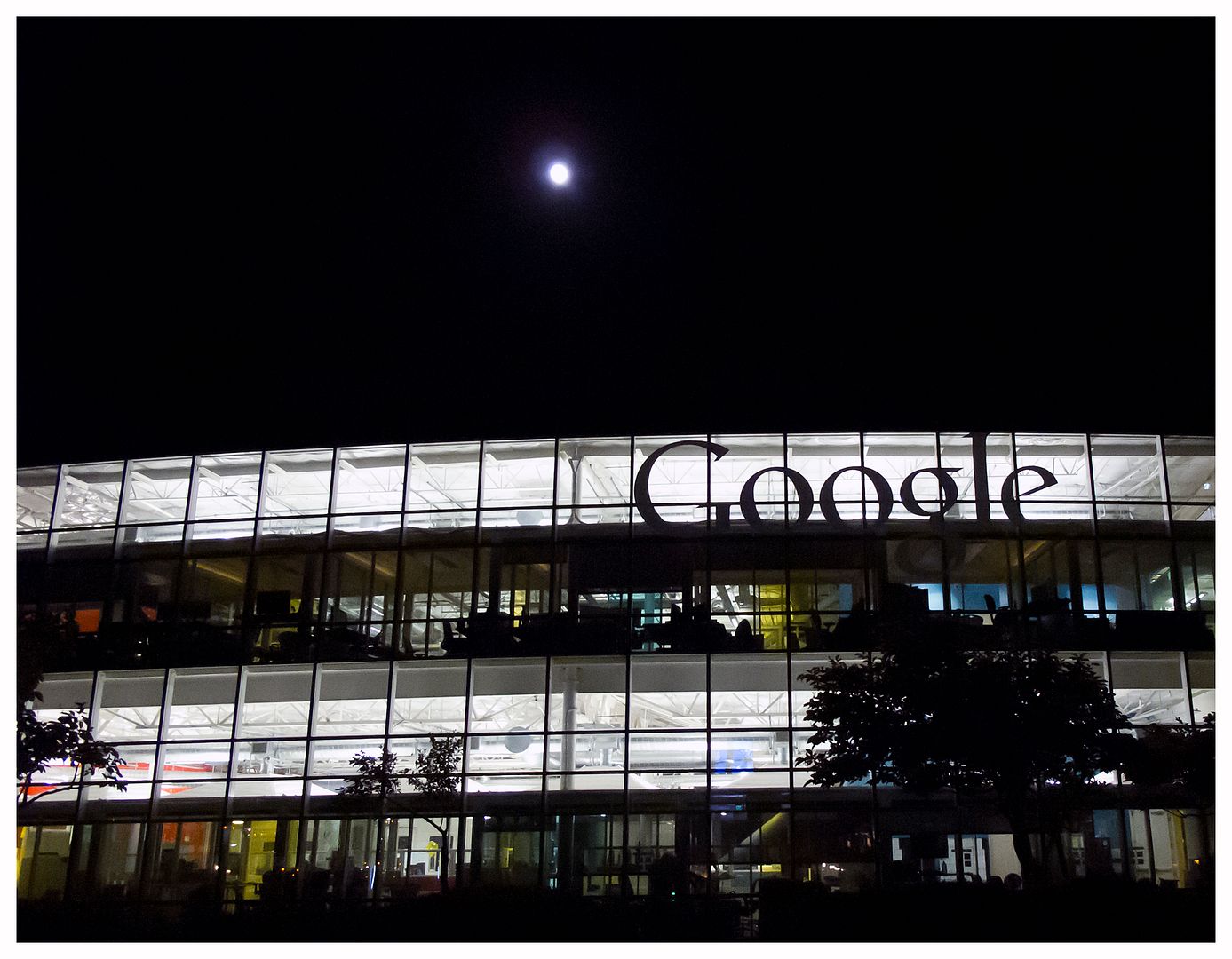
Summer solstice moon over the Googleplex; Mountain View, CA; June 2013

My father-in-law is a glass-half-full kinda guy. In the midst of any conversation about science, medicine, or technology, it's not uncommon for him to proclaim, "This is an exciting time to be alive." Indeed, it is. But when I fell into bed early on Sunday morning, my head giddy with ideas from the first full day of Sci Foo Camp, my father-in-law's optimism seemed understated. Spend 48 hours with -- to list just a few of the approximately 250 participants -- a computer scientist studying machine learning and music, a theoretical physicist turning the idea of gravity on its head, a marine biologist eager to solve the mysteries of whale sharks, a genomic epidemiologist intent on elucidating outbreak transmission dynamics, and a national security strategist currently implementing the White House's terrorism-related information sharing priorities and...well, you come away with much to ruminate on and a lot of notes to parse. In short, Sci Foo Camp made for an extraordinary weekend!

Tuesday, March 05, 2013

Help Make BAASICS.3: The Deep End Possible


In 2011, I co-founded BAASICS (Bay Area Art & Science Interdisciplinary Collaborative Sessions), a series of San Francisco-based evening programs that brings together artists, scientists, and interdisciplinary thinkers to present engaging multi-media lectures and performances. Each BAASICS program is built around a particular theme, with participants given the green light to express their brilliance and share their passions in ways that don't always involve a Powerpoint presentation and a microphone. All BAASICS programs are free and open to the public on a first-come, first-served basis. We aim to make the contemporary arts and sciences more accessible and less esoteric, thereby inspiring guests to think about how the two spheres relate to one another and to society at large. To date, we've put on two successful programs, BAASICS.1: A Live Animal (July 2011) and BAASICS.2: The Future (June 2012). Our third program, BAASICS.3: The Deep End, will take place at the ODC Theater on May 6, 2013.

Monday, December 31, 2012

A Rainbow at Milestone 35

On January 1, 2008, five years ago tomorrow, I posted "A(nother) New Year," a short meditation on my 30th birthday and the passage of time. The piece closes with the following paragraph.
"It's a rare, curious thing when one's perception of life transitions from the regular line of past, present, and future to an ambiguous cycle of individual moments. This mode is necessarily fleeting, so difficult is it to reconcile with contemporary life. We flip through scrapbooks and retell stories of our youth; the ball drops, the clock counts down and the crowd's vague, anticipatory energy crescendos; a mark is made, the number changed; the owl falls on the quivering chaff. Ring in the year of the brown rat. I'll also ring in another decade."

Friday, October 26, 2012

The Mystics Downtown

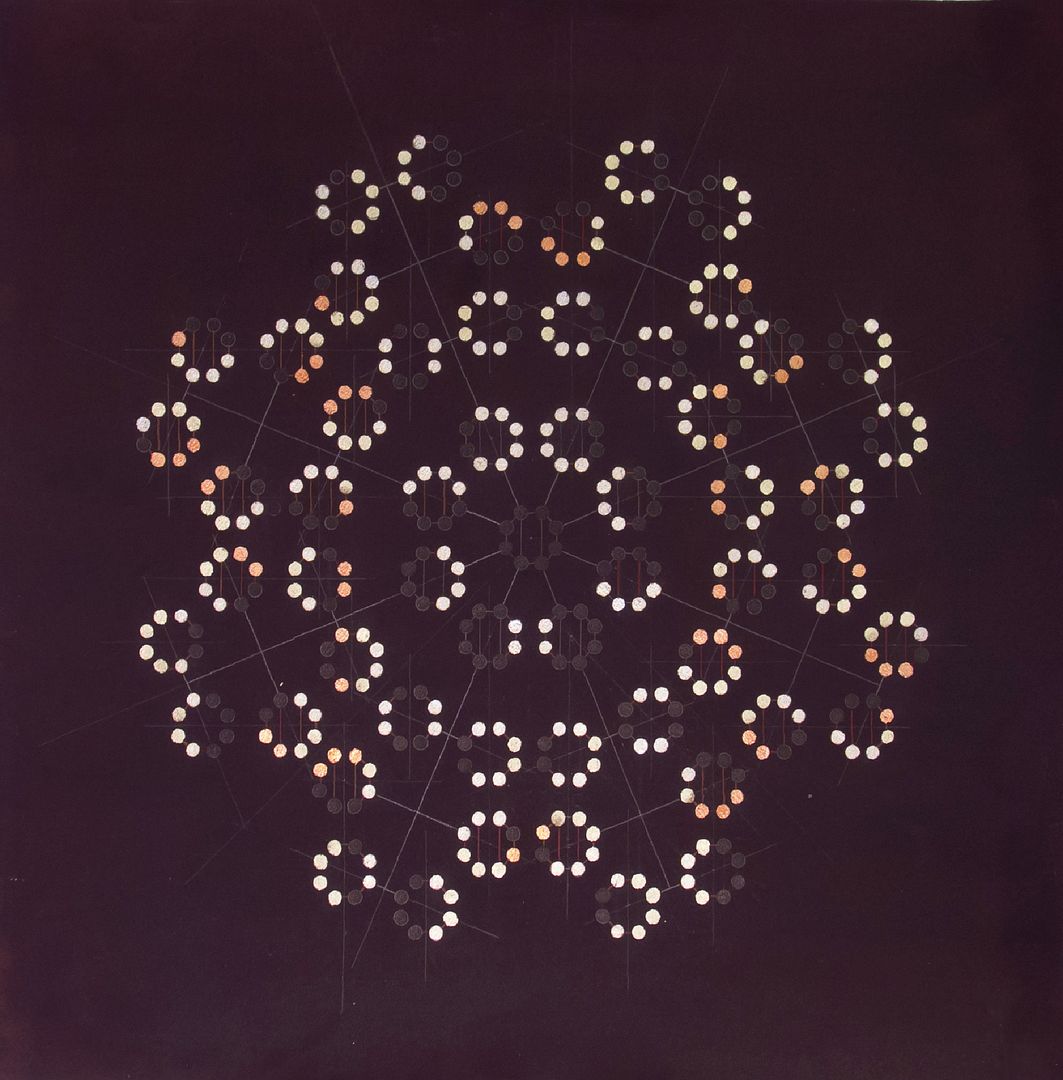
Owen Schuh
"Two Folds"
2012
Graphite, gold copper and silver leaf, and sumi ink on paper
32 x 32 inches
Due to time constraints, I've provided only brief remarks about three terrific, tangentially related downtown shows. All three are on view for just one more day, so rush out to see them, if you can.

+++++

"Uncharted," a handsome group show of works on paper at Cain Schulte Gallery, "explore[s] the concept of mapping as the visual and conceptual categorization and organization of relationships, systems, and interactions." Remarkably, the works included in "Uncharted" all relate well to one another (rare for a group show with such a broad theme), and the exhibition is compelling both visually and conceptually, but a few artists' contributions stand out.

Owen Schuh's "Two Folds" is an elegant diagram illustrating all of the possible ways a piece of paper can be folded in two. Schuh is a precise craftsman, and his circles and lines add up to a kind of mathematical sublime. Without the aid of the press release, I wouldn't have recognized what it is that Schuh has mapped, but that isn't necessarily a problem. "Two Folds" also works as an arcane design, calling to mind the complicated but specific hierarchies of, say, a Kabbalist. That Schuh has produced an image that is as readily associated with mathematics as it is esoteric mysticism shouldn't surprise; just ask your neighborhood theoretical astrophysicist to discuss notions of beauty.

Tuesday, October 02, 2012

Picturing Awe

Frame from "Wind Map"
Martin Wattenberg and Fernanda Viegas

Last night, I attended the second presentation in this season's Art, Technology, and Culture Colloquium series at UC Berkeley. Martin Wattenberg and Fernanda Viegas, artists and researchers who often work as a team, presented "Visualization and the Joy of Revelation," an engaging survey of their greatest hits (to date) supplemented by tidbits about their process and working philosophy.

From the ATC listing:
"Fernanda Viegas and Martin Wattenberg explore the joy of revelation: the special electricity of seeing a city from the air, of hearing a secret, of watching a lover undress. Their medium is data visualization, a technology developed by computer scientists to extract insights from raw numbers. They'll show what happens when this technology is aimed at data sets that range from tropical storms to social networks, from arguments on Wikipedia to expressions of carnal desire."

Friday, August 10, 2012

Platte Clove Residency: John Muir and the View From the Precipice

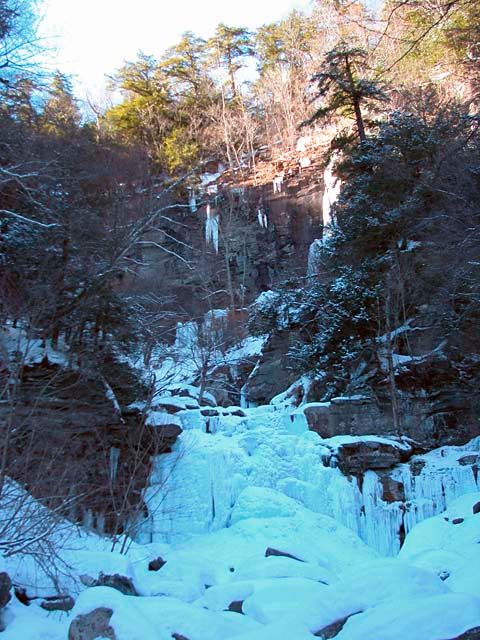
Winter view of Platte Clove's Bridal Veil Falls;
Catskills; NY
“Many people have been killed after falling and sliding off the edge. Especially in areas where there are pine needles. Dangerous conditions exist in many locations. The number of deaths over the years is staggering. Be overly cautious when in this region, and do not take un-necessary risk.”

- “Upper Platte Clove” page of Catskill Mountaineer website
I hesitated before deciding to investigate the unmarked spur of the Platte Clove Nature Preserve's Plattekill Falls Trail. Having recently read a bit about the geology and topography of the Catskill Escarpment, I knew that the preserve is located near the top of a deep ravine that tumbles suddenly down and eastward to meet the Hudson Valley (clove is the Dutch word for a mountain gorge). I’d also learned that each year a handful of foolhardy or unlucky hikers fall to their deaths on Platte Clove area trails. An online trail guide I’d browsed prior to the residency urged hikers to be “overly cautious.” Nevertheless, once I’d stepped off the main path and advanced a few steps down the spur, I was self-assured; I wouldn’t be one of 2012’s casualties. Prudent types like me don’t fall off cliffs.

Wednesday, July 25, 2012

Platte Clove Residency: Some Remove

Plattekill Falls; Platte Clove Nature Preserve;
Catskills; NY; July 2012
On the first afternoon of my residency at Platte Clove, after settling into the cabin and familiarizing myself with local trail maps, I decided to explore a short path that begins a few steps from the cabin's porch and winds its way down one of the valley's uppermost gorges to Plattekill Falls. It was a lovely reintroduction to the Catskills. Late afternoon sunlight filtered through the mixed forest's overstory, unevenly illuminating a floor decorated with eastern hemlock cones. Hidden from view in the canopy above, red-eyed vireos ceaselessly repeated their lilting questions.

Tuesday, May 01, 2012

"Giving Witness"

Common Snapping Turtle; Main Road; Everglades National Park; October 2011
I originally posted the above photograph of a common snapping turtle at the edge of the main road in Everglades National Park in October 2011, while I was an AIRIE program participant.

I thought of the turtle portrait when I read Ted Levin's informative and compelling "The Staying Power of Snapping Turtles," published in the March/April 2012 issue of Audubon Magazine.

The selection below emphasizes the fact that Chelydra serpentina is an elder member of our extended fauna family.
"The snapping turtle family, Chelydridae, evolved in North America and has haunted our wetlands almost unchanged for nearly 90 million years. Ancestors spread to Eurasia about 40 million years ago and then disappeared from that continent in the late Pliocene, about two million years ago. Chelydrids have been sequestered in the Western Hemisphere ever since, which makes them among our truest and oldest turtles. They were present when dinosaurs lived and died, and had been laying round, white, leathery eggs in sandy loam and glacial till for millions of years when the first Amerindians wandered over the Bering Land Bridge. Snapping turtles have witnessed the drift of continents, the birth of islands, the drowning of coastlines, the rise and fall of mountain ranges, the spread of prairies and deserts, the comings and goings of glaciers."
When I think in terms of the life of a species (rather than that of an individual representative), my pulse slows and I'm suddenly calm....and deeply appreciative to be a part of so grand an experience.

Photo credit: Hungry Hyaena (Christopher Reiger), 2011

Friday, February 10, 2012

Chris McCaw: Drawing Time

Chris McCaw
"Sunburned GSP#420 (Arctic Circle, Alaska)"
2010
Unique gelatin silver paper negative
12 x 20 inches
Chris McCaw created the arresting pictures on view in "Ride Into the Sun," the artist's winter 2011 solo show at Stephen Wirtz Gallery (San Francisco, CA), using an unconventional technique. The artist loads handcrafted view cameras as large as 30 x 40 inches with expired silver gelatin photographic paper, tilts the camera lenses skyward, and opens the shutters for hours. Even on cloudy days, the photo paper is soon overexposed. As time wears on, however, the light-sensitive chemicals that coat the paper are solarized, and the prints' tones are transmuted in curious ways. In many of McCaw's works, the sun appears as a dark, arcing streak and the landscape and sky as shades of grey. During some of McCaw's longer exposures, the sun's brilliance, laser-like, burns through the paper, tracing its progress as a charred tear.

Tuesday, January 24, 2012

Oh, Starlings!


A few months ago, a friend shared the above video with me. You might have seen or read about it before; it went "viral" late last year. The two friends who appear in the clip are treated to an intimate encounter with a large murmuration, or flock of European starlings. Murmurations of such substantial size are natural phenomena that, no matter how familiar, retain their capacity to inspire wonder, even awe. As one, the birds sweep and dance in an astonishing and fluid choreography; the rush of their wingbeats and many bodies pushing through the air produces a sound that accounts for the name. Because the audible component of a murmuration is impressive in its own right, I wish a version of the video were available without the hokey music, but the giddy joy that the canoeing friends experience is palpable, especially near the short film's end, when one of the women looks at the camera with marveling, wide eyes, and they both begin to laugh.

Tuesday, January 10, 2012

Her Colorful Obliteration

Yayoi Kusama
"Obliteration Room"
2011-12
Yayoi Kusama calls herself an "obsessive artist." Indeed, she's obsessed with polka dots; her paintings, sculptures, and constructed environments are almost always speckled with them. But Kusama's singular commitment to circles and pattern isn't her only "outsider artist" qualification. Since the mid-1970s, the artist has voluntarily committed herself to a Tokyo mental hospital, where she continues to create new work.


I recalled this last fact when I first saw photographs of Kusama's "Obliteration Room," an installation included in her "Look Now, See Forever" solo exhibition at Australia's Queensland Art Gallery of Modern Art. "Obliteration Room" began as a completely whitewashed interior space. The room's couches, bookshelves, kitchen table, cupboards, house plants, and piano were all colorless. When the museum exhibition opened, colorful stickers were distributed to installation visitors, and children were especially encouraged to cover whatever they pleased. Over time, the whitewashed installation has exploded in vibrant color, its once discernible space transformed into a perception-warping experience. The room, as the installation's title predicted, has been obliterated.

Wednesday, October 05, 2011

The Bike Tree


After being featured in the September/October 2011 issue of Sierra, the Sierra Club's magazine, the above photograph of a pine tree that has grown around a child's bicycle has been making Internet rounds.

Berkeley Breathed, a one-time hero of mine, apparently created a children's book about this very "bike tree." I'll have to pick up a copy of Red Ranger Came Calling.

Image credit: Photo by Ethan Welty/Tandem

Thursday, September 22, 2011

Kija Lucas' Stars & Pillows


NASA and the European Space Agency
"Hubble Ultra-Deep Field"
2004

Glow-in-the-dark star stickers dotted the ceiling of my childhood bedroom. Every night, before sleep, I marveled at the phosphorescent firmament. Over time, however, the stickers' charge diminished and the ceiling's constellations grew dim. Likewise, the burgeoning egocentrism of adolescence dulled my capacity for wonder; for years, I gave little consideration to the night sky. By the time I'd matured enough to be awed anew, adult life had carried me from rural locales to the electric glow of New York City, where all but the brightest celestial bodies were swallowed by our species' illumination.

Today, whenever I find myself in sparsely populated areas at night, I'm startled and humbled by the brilliance of the stars and my relative insignificance. The famous Hubble Ultra-Deep Field (HUDF) image evokes a similar awe. The HUDF was produced by compositing visual data from the Hubble Space Telescope, and the colorful result provided astronomers with a 13.2 billion-year-old picture of our universe. The orange, yellow, blue, and purple marks that spot the HUDF are primordial galaxies that formed shortly after the Big Bang. The photograph is attractive, but it appeals more to our imagination; it's capable of elating a viewer as much as the heavens can an enthusiastic amateur astronomer or glow-in-the-dark star stickers can a child. The incomprehensible grandeur of the cosmos is intoxicating.


Kija Lucas
"Origin Story No. 4"
2011
Silver gelatin prints, tape
30 x 40 inches

The HUDF came to mind as I admired Kija Lucas' "Origin Story No. 4," a photogram collage included in Root Division's "Introductions 2011" exhibition, the non-profit's annual survey of a dozen Bay Area emerging artists. Although the abstract imagery of "Origin Story" appears cosmic, the galaxies and gases of Lucas' picture are more earthly. The artist gathered dust from her studio floor, placed it on light-sensitive photo paper, and then exposed the paper. Afterward, she cut the resulting photograms into 2x2 inch squares and rearranged them; the seams of the collage create an unsteady grid, adding to the impression of an extraterrestrial survey. But the white-specks and smears might also be construed as microscopic lifeforms near the deep-sea floor, the products of a particle accelerator's "God-particle" collision, or documentation of activity in another sphere invisible to the human eye. The photogram's easy transition between the unfathomably vast (i.e., the universe) and the subatomic speaks to the mystical notion that scale is Ouroboros-like, that infinite travel "inward" (i.e., moving ever smaller) eventually leads to the infinitely large.


Kija Lucas
"Pillow No. 4"
2011
Archival pigment print
23 x 30 inches

Does Lucas intend "Origin Story No. 4" as a rumination on such matters? I don't know. But the artist also includes another body of work in "Introductions 2011" that invites a complimentary interpretation: a series of photographs of old pillows, presented specimen-like on black backgrounds. The pillows' patterned fabric, stained with mold and sweat, is testimony to their years of service. In the context of "Origin Story," it's hard not to think of these well-used pillows cradling the craniums of people transitioning between waking life and dream, a liminal state conducive to contemplative insight into the incomprehensible. Yet the beautiful photographs are also anthropological documents; Lucas treats mundane pillows as artifacts worthy of sustained consideration. What do they tell us about ourselves? What do the patterns mean: the fleur-de-lis, the crop of diamonds? Specific answers will be provided by viewers, but Lucas' overarching project attests to the human inclination to collect and interpret, to grope for understanding.


Kija Lucas
"Pillow No. 6"
2011
Archival pigment print
23 x 30 inches

Image credits: HUDF, courtesy of NASA; Kija Lucas images, courtesy the artist

Thursday, September 15, 2011

The Beautiful / Palace Prayers

OLD MOONS

Old moons now are dried and crusty
Brittle and as uninteresting as history is
To my fingers and lips.

And yet also, it cannot be denied
That each man
King of his home-throne
Misses something of eternity
When he chomps down on lamb chops
(Which are his reward
For winning the bread)

Each of us misplace the universe
And lose the word
When we get our desires
On plates before us.

There is a grain of rice on the table.
Around it, oil has bled
And spreads

In this way does our egodeath
Halo around us
  And puncture the beauty
    Of clouds
- Yusuf Misdaq

Two years ago this month, I highlighted the poet, musician, artist, and author Yusuf Misdaq's Palace Prayers project. August 21st - September 19th, 2009, was Ramadhan, and Misdaq, a practicing Muslim who, as I noted at the time, "shares my universalistic mystical inclination," created a new work of art for every day of the month-long fast and period of Muslim introspection.

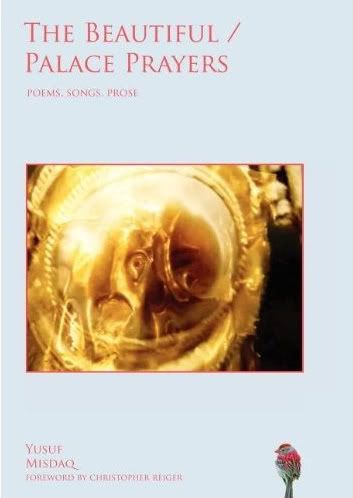
Some months later, Misdaq invited me to contribute a forward to a book of his poetry, prose, and lyrics. That book, The Beautiful / Palace Prayers, was published this year. Visit Misdaq's website for more information.

+++++

"Dissolution Is The Whole Show"

When Yusuf invited me to contribute a foreword to The Beautiful / Palace Prayers, I was at first surprised. Although I enjoy reading poetry, my education in literature is wanting, and my tastes run to work that most "serious" critics and scholars deem pedestrian. Who am I to comment on this young artist's latest collection? With characteristic enthusiasm, however, Yusuf's invitation quelled my self-doubt, insisting that The Beautiful is made up of poems "for normal people who do not normally read poetry." Well, in that case, it is a privilege and a joy for this normal person to introduce a collection of poems, verse, and prose written "for normal people"!

        They are a good species.
        Clean and caring;
        Made mostly of water and forgiveness
              - from "The Beautiful"

Normal people are very much in need of poetry, and perhaps especially so today, when the art is generally neglected. Words are powerful entities, every one an invocation, yet we too often use them carelessly. Poetry, like prayer, can serve as a corrective, reminding us that words conjure meaning and that they have a felt, physical component. As critic and philosopher George Steiner writes, "the meanings of poetry and the music of those meanings...are also of the human body." Appropriately, Yusuf refers to the italicized and apparently random words that he includes in some of his poems as "body echoes." "Carbunkle. Crellis. / Pulse-if. peaces." or "Que Que" are not intelligible formulations but, when read aloud, they aren’t exactly jibberish either. They supply somatic meaning, as do the poems’ rhythms. Yusuf's strongest poetry or verse has a perceptible pulse; in some cases, I notice my head slowly bobbing as I read. This is not insignificant. Beat and rhythm are primal properties, manifestations of the infinite, unfathomable being within which we reside and of which we are composed.

        Echoes
        of the original
        Voice
        From the original
        Breath
              - from "Ramadhan 26"

Ludwig Wittgenstein insisted that earnest philosophers should "descend into primeval chaos and feel at home there" if they expect to produce worthy work. I extend the same requisite to artists. Yusuf draws pictures, makes films, and writes poems, novels, and songs, but he is, above all, a mystic. And mysticism, in its quest to directly experience elemental truths, necessitates Wittgenstein's appreciation of the primeval and the chaotic; ancient disorder is at the root of everything. In most cases, the mystical perspective is merely an uncommon one; mystics survey and respond to the same earthly, material realm that the rest of us do. But they disregard accepted classifications and train themselves to mindfully observe and reinterpret their surroundings. They locate the extraordinary in the mundane. As Henry David Thoreau, a 19th century mystic, lamented, "All this [splendor] is perfectly distinct to an observant eye and yet could easily pass unnoticed by most." Mystics reawaken their capacity for reflective wonder and, in doing so, experience a kind of rebirth into a vaster dimension of human experience.

        On perfect Spring mornings
        God puts a clear blue sky in our pockets
        Pats us a few times and says
        'On your way!'
              - from "The Merciful Cheerful"

So reborn into sublime beauty, mystics strive toward the transcendent. Both Wittgenstein and Thoreau can be described as transcendentalists; Yusuf qualifies, too. Like the two philosophers, he finds in his observations of the world cause for a fundamental optimism. Unlike them, his writing is generally informal and devoid of pretension. His poems give readers the impression of a devout Sufi Muslim happy at play in our waking, sensual dream. In the collection's title poem, Yusuf writes "Awake in this dream / Where abstract clouds calmly keep us. / Where birds secretly make love in public and / Give voice to the current of joy which / Slices through us in a day." Again, in "Back Amongst Men (Drowned)," he references this dreamed life: "Or as I have also interpreted it / .God is a laughing dream." No doubt, the poems’ author, laughing, singing, eyes wide and sparkling, would appear mad to many of his fellows. This is to their discredit. They have forgotten (or failed to learn) how to look. Mystics, like many philosophers and artists, are too easily dismissed as lunatic or eccentric. Yusuf's ability to see through the veil of our cultural forgetfulness informs his aesthetic imagination and invigorates his art.

        Silk veils, dark and weightless
        Are being removed from her countenance
        Time after Time

        Each day I ready myself to know her better
        Each day, closer
              - from "Wahad"

But not all that Yusuf observes is felicitous. The most biting poem included in The Beautiful, "Ramadhan 23: Only To Be With You And No-one Else," is a reaction against the politicization of Islam and a celebration of his intimate relationship with Allah. After rejecting the "bloody bridge builders / Shmoozers or politicians" and others who "come to the Mosque smiling in your suit," Yusuf writes, "I wish to be alone / And serious / And deeper in love / With the only one who ever matters." The striking seriousness of his personal communion with G-d is important; discipline is one of the central currents running through the poems included in The Beautiful. In “Waiting (A Song for Guitar),” Yusuf writes, “I do believe in magic but first you gotta work at it.” Hope and love, he reminds readers, are nurtured through dedicated ritual and practice.

        Understand, thee
        That tenderness comes not of softness
        But of a firmness
        And of a discipline

        Understand that of discipline
        -Say, the discipline of prayer-
        Comes an enjoyment of that same thing.
        Discipline to run breeds a love for running
        Discipline to practice ones instrument brings forth a love
        for playing it
        Discipline to speak good breeds a love of horses
        And love of all refined things
        Whatever you may find them to be.
              - from "Ramadhan 12: The Vows Revolve"

A visual artist, I appreciate the centrality of discipline in a life committed to aesthetics. Like Yusuf, though, I am also mystically inclined. Paintings, sculptures, and other hand-crafted objects are among my adored icons but, if I work at it, I can find occasion for worship in every place, in every form, in every moment. The European starling that paraded on the sidewalk in front of me this morning warranted exaltation. In his iridescent dream coat and brilliant yellow bill, I see cause for startling, smiling celebration. For some other pedestrians, the bird, a representative of a despised species, may be ignorable or irrelevant. For others, my viewing the starling as a manifestation of the Divine amounts to idolatry. So, too, might the dirty, discolored Queens sidewalk be deemed a cement calf by unimaginative or close-minded "believers." Yet, striding on such a sidewalk today, my thoughts range through eons of geologic time to consider the ancient rock and mud, precursors to and components of the concrete that I now tread upon, from which our kind eventually emerged on crude limbs as a gasping, fish-reptile thing.

        The salt-pepper sugar mills on this table look like planets.
        I want to know the word for planet in as many different
        languages as possible.
              - from "Celestial"

Doubtless some of those who consider themselves religious don't share my enthusiasm for our scaled, long-snouted ancestors. But I'm not concerned with narrow definitions of religion. I believe that humility, wonder, gratitude, and communion are the four pillars of genuine religious practice, and the mental stretching engendered by the work of scientists, philosophers, and artists is an integral part of any intellectually rigorous, honest religious life. And, love, too, is a bit like religion. The same four pillars are fundamental to it. As Douglas Thorpe writes, "[love] demands of us a new way of being in our old world." Religious mysticism is a love affair with The All. It's not always easy, but religious attunement can turn each day, each hour, or each instant, into "a new way of being." Reading Yusuf's poetry, I'm reminded that every step is a psalm, every directed gaze is a prayer.

        Dot-Dot-Purple and Palaces
        Says the starling in approximate translation.
        Star-Star-Chandeliers and
        Bread on the wind-ind-ind.
              - from "The Beautiful"

I'm also reminded that we both enjoy watching starlings.

- Christopher Reiger, May 1, 2010

Sunday, September 04, 2011

"Secret Garden"


Christopher Reiger
"living, moving, in the space between"
2009
Gouache, watercolor, and marker on Arches paper
15 x 14 7/8 inches

Four paintings and drawings of mine from 2010 and 2009 are included in "Secret Garden," a group exhibition opening later this week at Denise Bibro Gallery, in New York City.

From the exhibition's press release:
"Nature plays the perpetual muse for the six contemporary artists in this exhibition. Featuring work by Roberley Bell, Peter Bynum, Sara Crisp, Erica-Lynn Huberty, Ysabel Le May, and Christopher Reiger, each artist offers their own innovative, distinctive response to the sublime wonder of the landscape, flora, and fauna, inviting the viewer into their own secret garden. [...] Contemplating man's mutable conception of nature and our place in it, Christopher Reiger's works on paper incorporate scientific and mathematical symbols, hieroglyphs, animals, and plant life. Mysterious equations are drawn, creatures peer out from unlikely vegetation, and the garden becomes curiouser and curiouser."
I won't be in NYC for the exhibition, unfortunately, but if you're in that neck of the woods, please visit the show.

Denise Bibro Fine Art
529 West 20th Street, #4W
New York, NY 10011

Exhibition dates: September 8 - October 8, 2011
Opening reception: September 15, 2011; 6-8pm

Friday, August 26, 2011

Gregory Ito's "Point of Vision"

Gregory Ito
"Untitled (Time Diagram Set B)"
2011
Acrylic and gouache on wood panel, acrylic on handmade wood object, and table

Like it or not, context informs our experience and interpretation of artworks. We generally think of context as a work's physical situation (e.g., how and where it is installed) or its social and art historical framework, but most important is the context provided by an individual viewer. What is the viewer's profession? What book is she reading? Who was she talking to an hour ago, and what about? Of course, artists can't control for these subjective factors, and many craft artist statements that provide viewers with what the artists believe is appropriate context for the artwork. Too often, though, these statements tell viewers what the "take away" should be, thereby forfeiting the most vital and collaborative element of the artistic enterprise, the creation of meaning by the viewer.

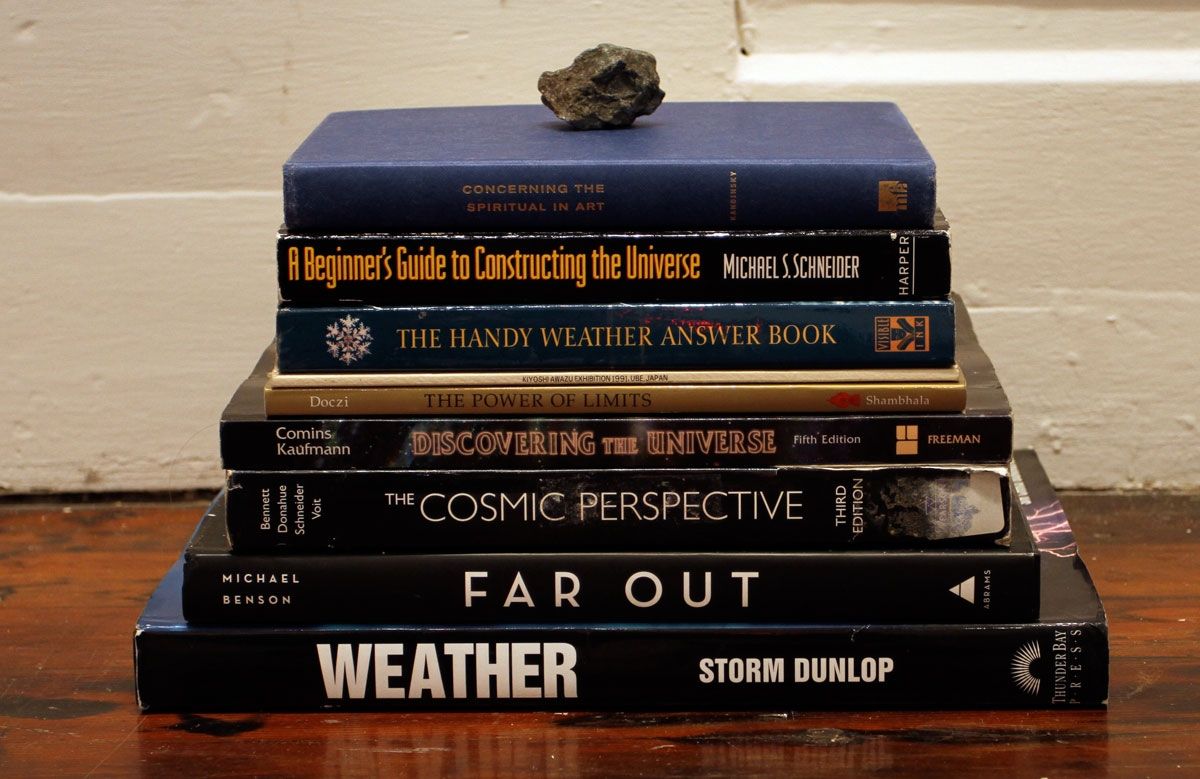
How refreshing, then, to find Gregory Ito's healthy twist on the artist statement in his terrific "Point of Vision" exhibition at Gallery Hijinks. While the artist and gallery provide a press release (usually an artist statement reworked and edited by the gallery staff), Ito also includes "Sources," a tidy stack of books on the floor, spines out so that the titles are easily read. Is "Sources" intended as a found object sculpture? Kinda sorta (after all, it's titled, is situated among Ito's other work, and is included on the exhibition price list, albeit "NFS"), but its principal valuable is as an alternative to the formal statement. It provides viewers with context without bullying them into a particular conclusion.

Gregory Ito
"Sources"
2011
Book collection

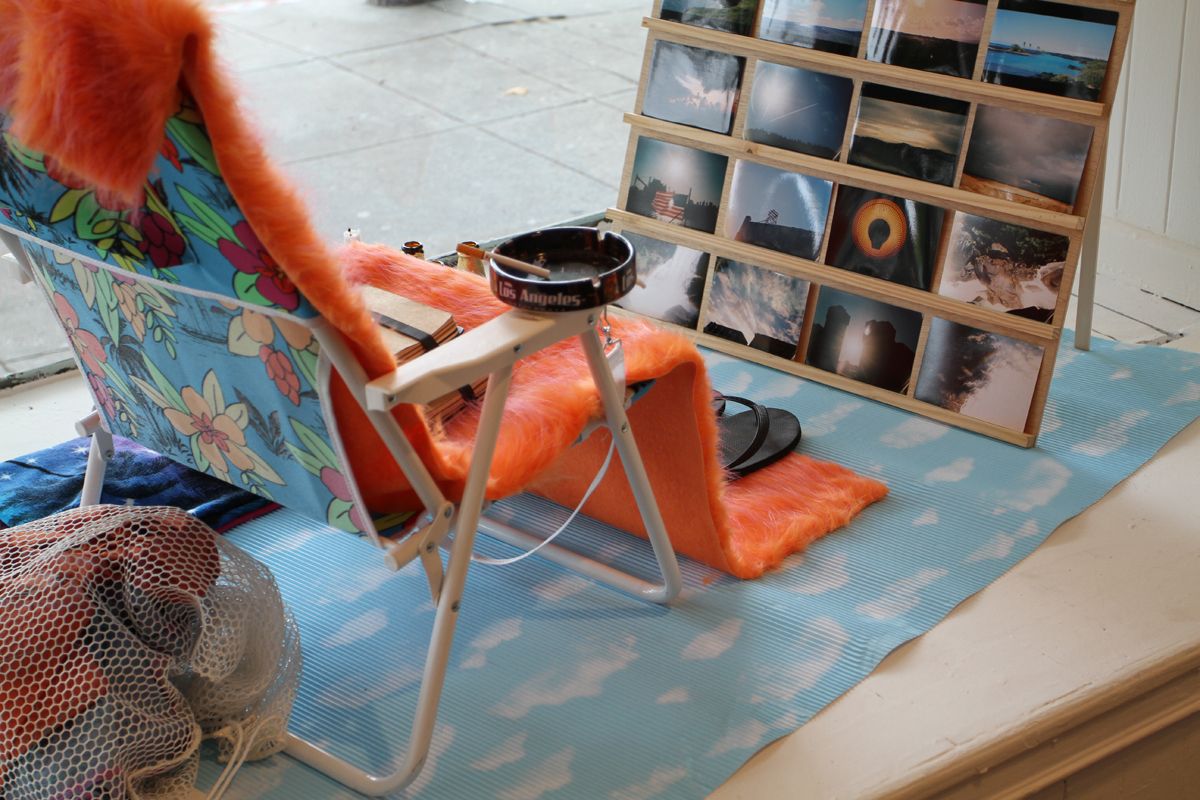
"Sources" is something of a companion piece to "Self Portrait (Object Collage)." Installed in one of the gallery windows, "Self Portrait" includes a beach chair, flip flops, a towel, a pile of diary-like journals, an ashtray, empty beer bottles, a candle, and 28 snapshots mounted on a board that faces the chair. One imagines the artist in his chair, sipping beer and smoking as he contemplates his collection of isolated observations. The photographs are mostly of clouds and sun-soaked skies, but there are also landscapes, some abstract imagery, a rainbow, and an illuminated light fixture. These pictures complement Ito's reading list. A Beginner's Guide to Constructing the Universe, by Michael Schneider, Concerning the Spiritual In Art, by Wassily Kandinsky, The Cosmic Perspective, Third Edition, by Bennett, Donahue, Schneider, and Voit, The Handy Weather Answer Book, and other titles included in Ito's book pile suggest that the artist is preoccupied with sublime, existential mysteries and celebrating our species' impulse to solve them.

Gregory Ito
"Self Portrait (Object Collage)"
2011
Window installation with 28 photographs and wood display

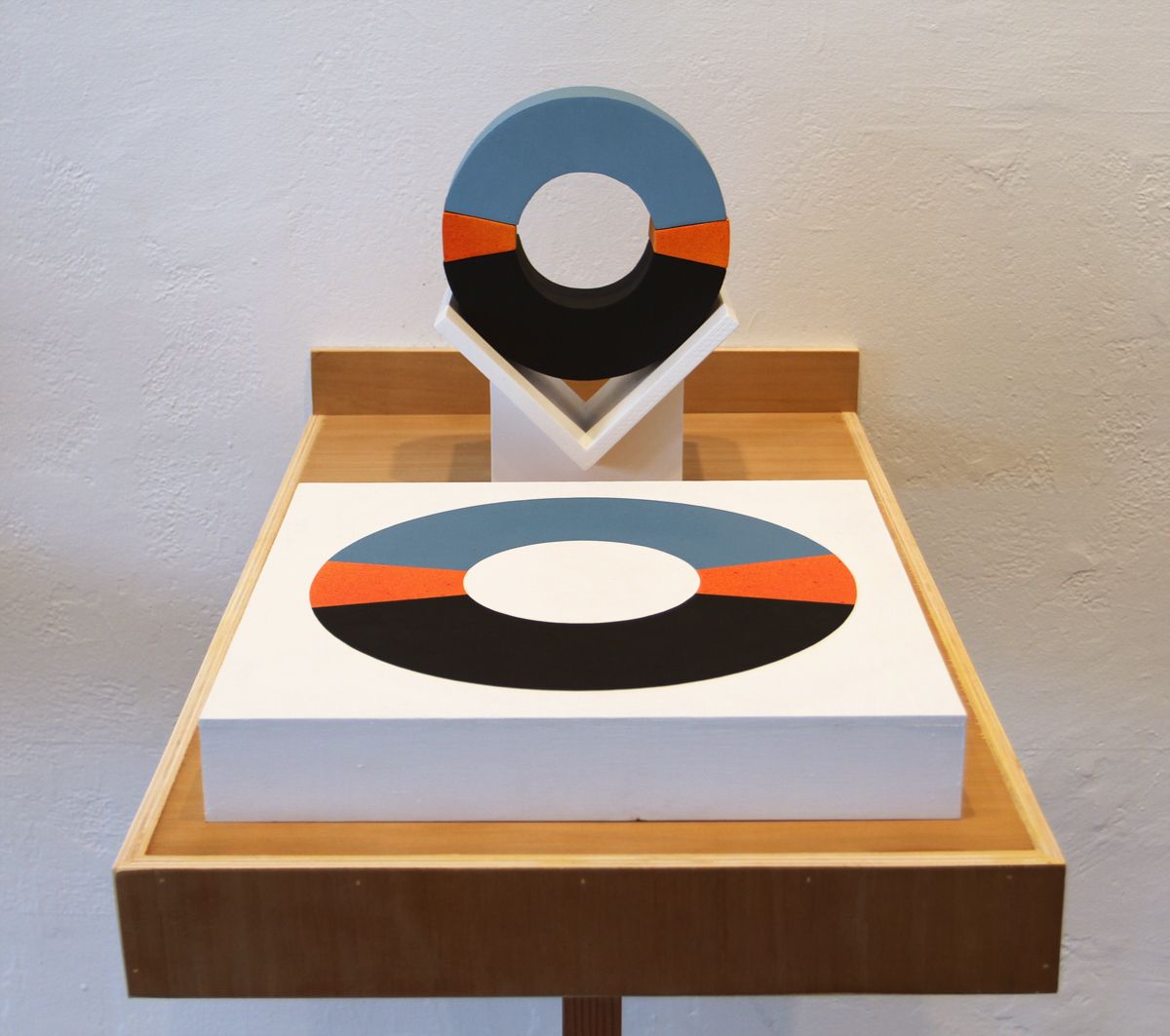
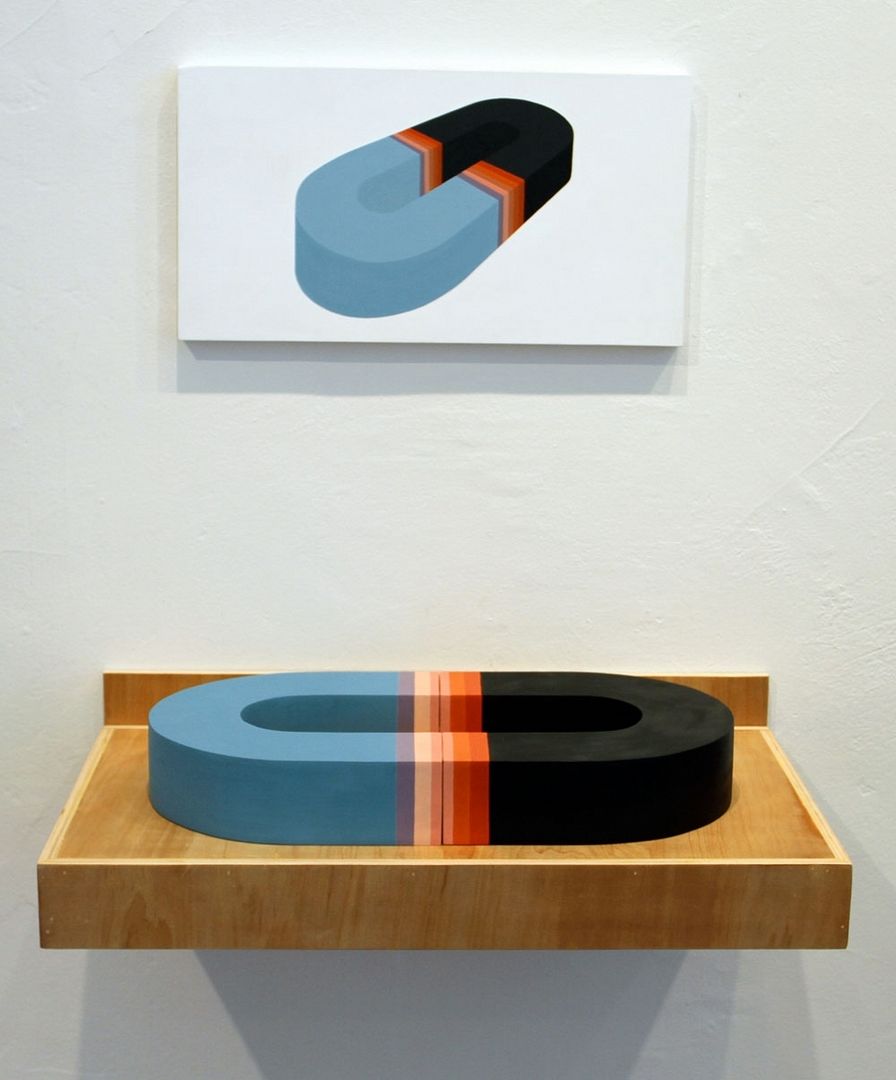
Ito's sculptures, paintings, and installations reflect this focus. Especially in the gallery's "white cube" setting, they read as speculative objects and diagrams as much as they do aesthetic entities. The artist is well aware of this; he titles the two most compelling installations on view, "Untitled (Time Diagram Set A)" and "Untitled (Time Diagram Set B)." He pairs a painting with a sculpture in each. The paintings are straightforward illustrations of the sculptures, but, displayed in the gallery setting with the three-dimensional objects they depict, the images read as icons, potent stand-ins for the "real" or "true" object. Curiously, by virtue of having been depicted, the sculptures also gain in significance. The meaning of these pictures and objects remains somewhat esoteric. I infer, based on the works' titles and Ito's "Sources," that these are representations of space-time's nature or shape, but that's a rather general interpretation. Still, the sculptures resonate as totems and the paintings as their icons. This reciprocal dynamic is compelling, and serves as an oblique reminder that all artwork exists in relationship to the world and ideas outside of the gallery and studio, a fact too often overlooked since the advent of modernism.

Gregory Ito
"Untitled (Time Diagram Set A)"
2011
Acrylic on wood panel, acrylic on handmade wood object, and shelf

In other works, Ito more directly highlights what I've elsewhere described as "the wonder current." In "Human Euphoria," a disembodied ceramic head of a girl in a big-brimmed, yellow hat rests on top of a block of adobe clay, apparently gazing at an ocean sunset. The piece is a winking, contemporary tribute to Caspar David Friedrich's Romantic masterpiece, "Wanderer above the Sea of Fog," but Ito's head is better-suited to contemplation than the vigorous morning constitutionals of Friedrich's dapper hero. Is this a comment on the continued dominance of conceptual concerns over aesthetic and material considerations in contemporary art? Perhaps; perhaps not. Ito's better pieces excel precisely because they can be interpreted as "art for art's sake" or, taking a hint from his "Sources," as art about the stupefying magnificence of being.

Gregory Ito
"The Embrace Installation"
2011
Acrylic and gouache on wood panel, found book with handmade page holders, and petrified object on shelf

Image credits: all images, courtesy Gallery Hijinks and Gregory Ito, 2011

Saturday, February 19, 2011

"The Air That Touched Things"


Claude Monet
"La Pie (The Magpie)"
1868-69
Oil on canvas
35 x 51 inches
"Monet once revealed that he wanted to paint not things in themselves but the air that touched things - the enveloping air. The enveloping air offers continuity and infinite expansion. If Monet can paint the air, he can follow it like following a thought. Except that the air operates wordlessly and, when painted, is visibly present only in colors, touches, layers, palimpsests, shades, caresses, scratches."

- John Berger, "The Enveloping Air," Harper's Magazine, January 2011
I'm not sure which I like more, Monet's wonderfully quixotic desire to paint "the air that touched things" or Berger's evocative prose. In any case, Monet nailed the light in his magpie painting.

Image credit: ripped from SeineValley.com

Friday, January 07, 2011

Jeffrey Simmons' Sacred Circles


Jeffrey Simmons
"Apparent Horizon VI"
2010
Watercolor on paper
12.5 x 9 inches

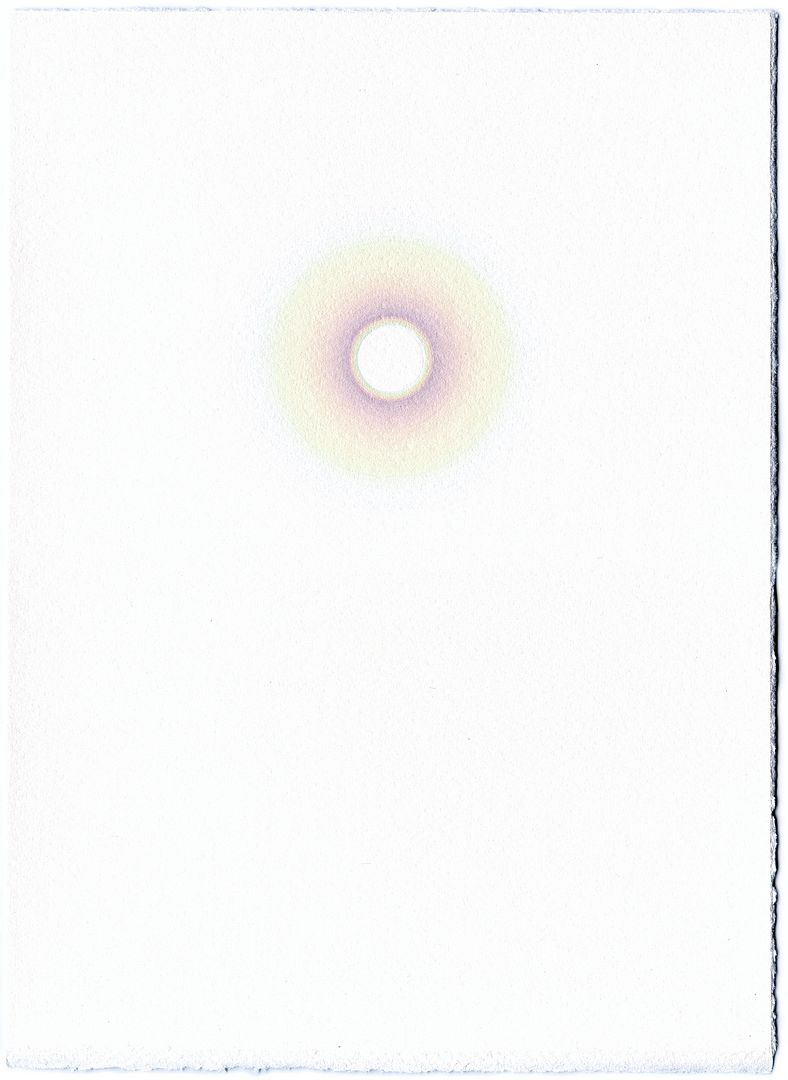
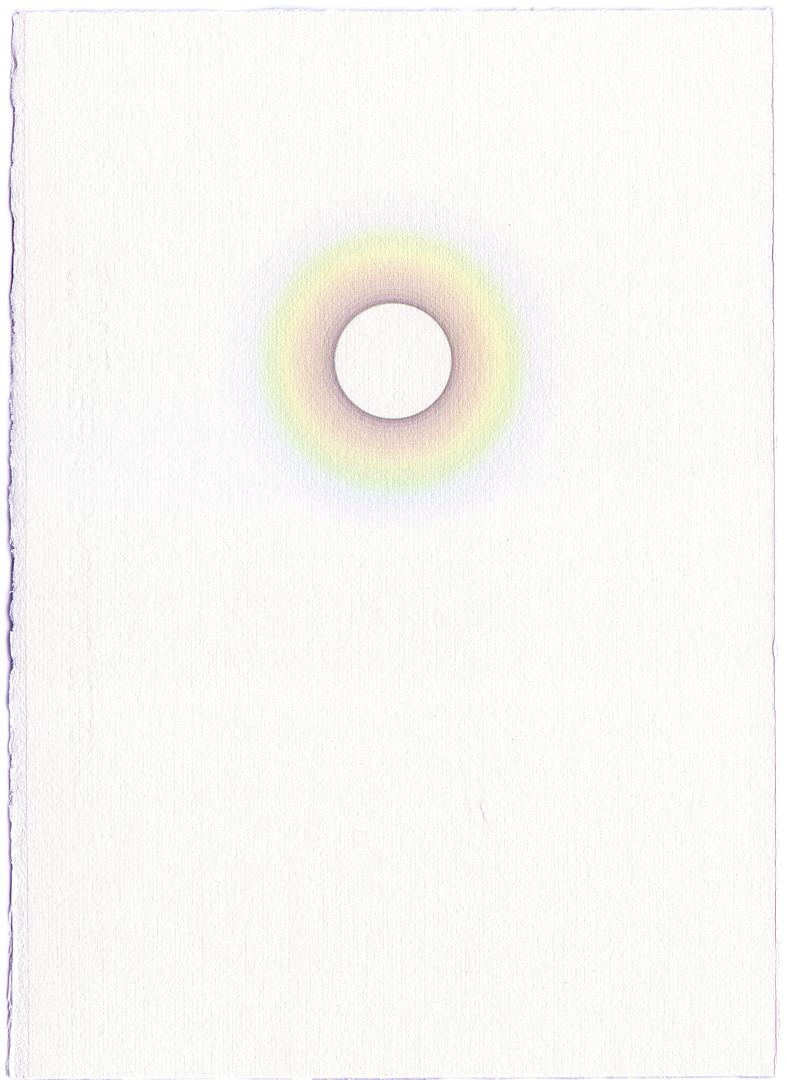
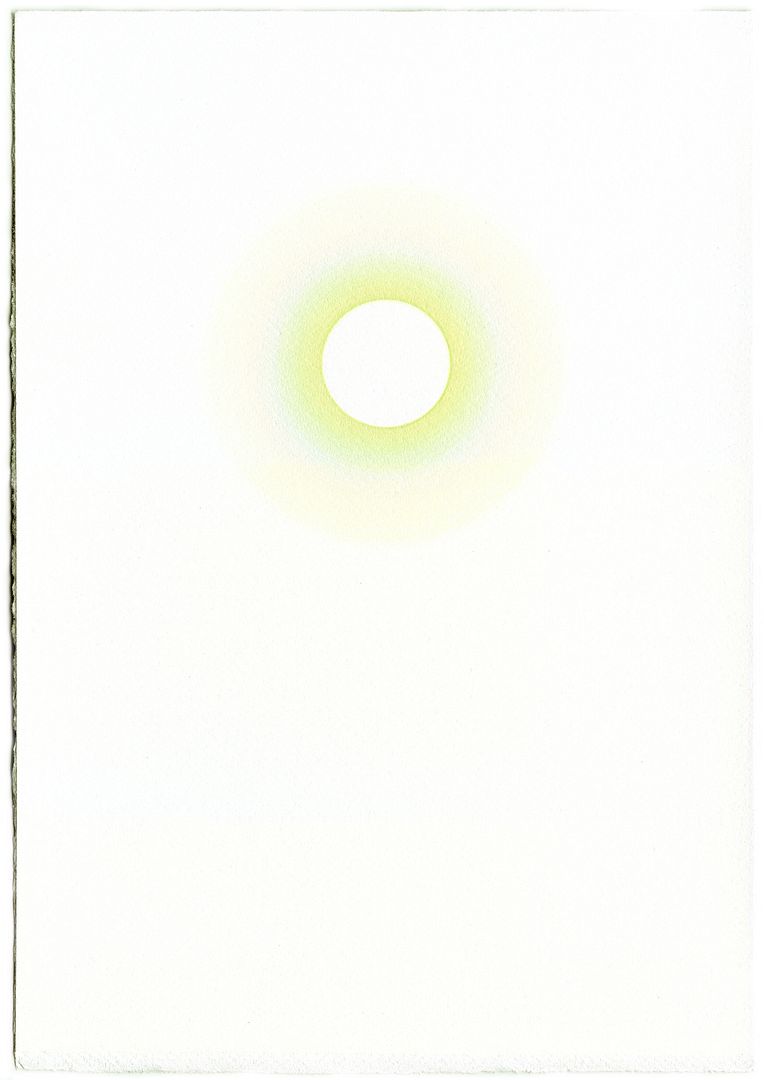
If you're in the Bay Area this January, I encourage you to visit "Apparent Horizons," Jeffrey Simmons' solo show of watercolor paintings at Baer Ridgway. Most of the works on view feature "semi-transparent concentric circles [...] with subtle color variations between each light-hued ring." That description, taken from the gallery's press release, is perfectly accurate, but it fails to convey the other-worldly experience of Simmons' pictures. Radiant and diaphanous, the circles vibrate and murmur on the paper's surface. Calling to mind minimalist Buddhist mandalas or Hindu yantras, the paintings could well serve as objects of sacred utility, focal points for meditation and, for those who dabble in mysticism, gateways into the sublime.


Jeffrey Simmons
"Apparent Horizon I"
2010
Watercolor on paper
15.75 x 11.25 inches

The Bear Ridgway press release describes Simmons' work as "painstakingly engineered." Indeed, like those of the mandala-making monk, the artist's processes require meticulous control. To produce the paintings, Simmons uses a rotating easel, situating his brush hand so that it remains stationary while the paper moves, turntable-like, beneath it. I get a kick out of knowing this; artists like to peer over one another's shoulders because we're as curious about the 'how' as we are enthused by the 'what.' When appreciating artwork, however, technique should be a secondary concern; if the machinations of the man behind the curtain are more important than the smoke and light show he endeavors to produce, he won't wear the wizard mantle for long. Happily, Simmons' shimmering, ethereal pictures prove him an adept; I look forward to seeing more of his work.


Jeffrey Simmons
"Apparent Horizon III"
2010
Watercolor on paper
15.75 x 11.25 inches

Imaged credits: all images, courtesy Baer Ridgway Exhibitions

Monday, January 03, 2011

Karl Cronin's Experiencing Forms


Karl Cronin
"Populus tremuloides (Aspen)"
2009

In late November, I visited "Ecoarchive: Meditations on Time and Nature," a group show on view at Intersection for the Arts 5M, in San Francisco. All of the work included in the exhibition (on view through January 22, 2011) is intelligent and commendable, but I most appreciated Matthew Moore's video, "Lifecycles," Sam Easterson's video, "The Museum of Animal Perspectives," and Karl Cronin's video sampler of his "Somatic Natural History Archive."

I spent most of my time with Cronin's project. For his "Somatic Natural History Archive," Cronin aims to "document with his own body representational expressions of 10,000 U.S. plants and animals," an undertaking that the artist estimates will take 50 years to complete. To date, Cronin has made "expeditions" to Nashville (TN), Santa Fe (NM), Yosemite (CA), Raleigh (NC), Plainfield (MA), and the Grand Canyon, and he's earned the well-deserved support of the Santa Fe Art Institute, Movement Research, and the Puffin Foundation. The documents of his "representational expressions" are archived in the SNHA Catalogue, each labeled with the observed species' Latin name and common name (e.g., "Populus tremuloides (Aspen)").


Karl Cronin
"Awaiting identification"
2009

With so very many plants and animals to imitate (only 66 of the 10,000 have so far been cataloged online), it's not surprising that Cronin's earnest attempts are uneven; generally, I find his embodiment of plants more intriguing and successful than his animals, but even the less-realized "expressions" made me smile, giddily impressed by the artist's wonderfully quixotic efforts.

Importantly, however, Cronin's endeavor is not mere whimsy. The project may seem simple enough, but I'm certain that it provides the artist with a fundamentally new understanding of (and relationship with) the creatures he studies. Cronin first observes the plant or animal subject, then he perceives it physically, with his body. Watching the artist sway and lean with the breeze in a stand of a grass (an as yet unidentified species, perhaps related to switchgrass), it occurred to me that Cronin is something of a latter-day shaman. "Shaman" is a term abused by new-age prophets and their ranks of well-intentioned, but ill-informed followers, but the philosopher and cultural ecologist David Abram is one of a handful of writers who have given shamanism the thoughtful consideration that it deserves. As I watched Cronin channel a heron, Abram's definition of magic came to mind.
"We are human only in contact, and conviviality, with what is not human. [..] Magic is participating in a world of multiple intelligences with the intuition that every form one perceives - from the swallow swooping overhead to the fly on a blade of grass, and indeed the blade of grass itself - is an experiencing form, an entity with its own predilections and sensations that are very different from our own."
In essence, magic is empathy with other "experiencing forms"; it's communion with other facets of the animate world. Happily, by documenting his work with video, Cronin allows the viewer to participate in the magic. I'm grateful for that.


Karl Cronin
"Caelifera sp. (Grasshopper)"
2009

Note: As a proud natural history geek, I was disappointed that Cronin titled the last of the three videos above "Caelifera sp. (Grasshopper)." In fact, the insect that Cronin imitates in this video is actually a katydid, a species more closely related to crickets than to grasshoppers. Still, while I presume Cronin will make the correction when he adds this video to the SNHA Catalogue, I don't envy him the task of trying to secure a definitive ID on many of the species he works with. Without the help of a entomology expert, he'll be hard pressed to determine the species of katydid in the video above.)

Image/artwork credit: all videos, courtesy Karl Cronin

Wednesday, December 29, 2010

Relative Birthday Abundance


Tundra (or Whistler) swans; Heron Hope; Locustville, VA; December 2010

As an enthusiastic amateur naturalist living in New York City, I grew fond of the hearty, adaptive species that populated the boroughs' streets, parks, and waterfronts: pigeons and gulls, rats and red-tailed hawks, starlings and squirrels. When I felt out of step with my urban friends and neighbors, as I occasionally did, I found that watching the animals helped. Chittering around the base of a corner garbage can, the sparrows and starlings chastised me for moping. The herring gull's shrill shout over the East River exhorted me to shake off my self-conscious alienation. All of these species were part of my urban wildlife support network. Watching them reminded me to get on with the business of grateful L-I-V-I-N', no matter where I might be. Now that I live in San Francisco, a town with greater biodiversity than NYC, I'm happy to have Steller's jays, Brewer's blackbirds, and ravens keeping me company, too.

Today, however, my girlfriend and I are visiting my parents on the Eastern Shore of Virginia. Dumped on by the latest "snowpocalypse," we've been locked in for most of our visit. Not that I mind. Yesterday morning, I trudged through the snow drifts around my home ground, eyes squinted in the dazzling winter light. In the space of an hour, I saw thousands of snow geese rise noisily from a partially exposed barley field; turkey vultures sweep across the sky, scenting for an unfortunate victim of the biting weather; a woodcock flush from a hedge; coyote tracks that skirted a small cemetery; mouse tracks that emerged from under a snow-covered plow and lightly skipped across the snowfall's surface to a patch of open grass; a yellow-rumped warbler and a Carolina wren vying for position atop a perch; two tundra (or whistling) swans flying low overhead; Canada geese and green-winged teal gathered in the open water of the estuary; a cottontail peer from a tangle of grasses. It occurred to me, as I contemplated such abundance and diversity, that my urban wildlife support network, whatever its personal value, is but a shadow of what I witnessed this December morning.


Sunset; Heron Hope; Locustville, VA; December 2010

Last year, at this time, I wrote, "32 years on this Earth, and still I feel like I am opening my eyes for the first time." Now 33, that statement is no less true. Given my stubborn optimism, I presume that it will be true at 43, 53, or 83 (should I survive so long). Still, I wish that I could open my eyes to greater species diversity in the cities that I call home. We humans are an increasingly urban species, and we must take care not to forget about the world's collapsing biodiversity. It isn't just the country folks that benefit from it; we all do, whether we appreciate that fact or not.

All the same, I'm looking forward to hearing the belated birthday croaks from the ravens above the Inner Sunset.

Happy 2011, friends. May it be a rich, sweet, and happy year!


Snow Geese; Heron Hope; Locustville, VA; December 2010

Photo credit: Hungry Hyaena, 2010