 |
| Chris McCaw "Sunburned GSP#420 (Arctic Circle, Alaska)" 2010 Unique gelatin silver paper negative 12 x 20 inches |

Showing posts with label extinction. Show all posts
Showing posts with label extinction. Show all posts
Friday, February 10, 2012
Chris McCaw: Drawing Time

Friday, December 03, 2010
Red Wolf ESPP Prints Released!

Christopher Reiger
"Constellation (Canis rufus)"
2010
Pen and sumi ink, gouache, and watercolor on Arches paper
15 x 12 inches
My 2010 drawing "Constellation (Canis rufus)" has been made into a limited edition print for the Endangered Species Print Project (ESPP). The drawing features the red wolf (Canis rufus), a critically endangered wolf species.
I wrote the following description of the red wolf and its plight for the ESPP website:
"The Red Wolf (Canis rufus) is a medium-sized North American canid, generally larger than a coyote but smaller than the gray wolf. As the common name suggests, red wolves often have reddish fur on and around their ears, neck, and legs. Like other wolves, the Red Wolf is a social species that lives in packs, groups typically comprised of a mated pair and their offspring (of multiple generations). Red Wolves are crepuscular predators, most active at dusk and at dawn. They prey on white-tailed deer, raccoons, opossums, rabbits, and rodents, but are also known to scavenge.As per the ESPP model, this is a limited edition of 100 prints, the number determined by the featured animal's current wild population. The print measures 8 x 10 inches, and costs a mere $50.00. ALL proceeds from sale of the prints will be donated to the Port Defiance Zoo & Aquarium Red Wolf Recovery Program.
The Red Wolf once occupied a range that extended over the forests, swamps, and coastal plains of the southern and eastern areas of the United States, as far west as Texas and as far north as New York. As with most non-domesticated canines, however, the Red Wolf was vilified as a dangerous competitor of man (and, erroneously, a "man-eater"). These entrenched, negative attitudes gave rise to aggressive predator control campaigns; wolves were poisoned, shot, and trapped. This persecution was compounded by habitat loss and disease, taking a terrible toll on red wolf populations. By 1980, the species was extinct in the wild.
Today, though, there is good news. Thanks to several focused preservation and reintroduction programs, and especially to the efforts of the Point Defiance Zoo & Aquarium (PDZA) and the United States Fish & Wildlife Service (USFWS), in conjunction with programs like that at Mill Mountain Zoo, the Red Wolf is staging a small, isolated recovery. There are now approximately 100 wolves living wild in eastern North Carolina and up to 250 individuals in zoo-based captive breeding programs."
As I explain in the ESPP artist notes, my fascination with taxonomy increased my interest in researching this particular species:
"Ecology, wildlife biology, and natural history are subjects that I'm passionate about, and I'm especially intrigued by taxonomy, the classification of different species. The ever-evolving field's binomial nomenclature is chock-a-block with curious etymological backstories and, more importantly, taxonomists are endlessly debating species classification. Names change, species become subspecies (and vice versa), and protected animals become unprotected animals on what seems to be a month-to-month basis! The red wolf is no exception. It's an honor to produce an artwork that may, in some small way, help save a keystone predator from extinction and genetic isolation; I must admit, however, that I also planned to use the print as an excuse to learn more about the particulars of the red wolf taxonomic debate.Visit the ESPP site to learn more and, during this holiday season, please consider helping the species by buying a print as a gift.
Some wildlife biologists insist that the red wolf's scientific name is Canis lupus rufus and that the animal is a subspecies of gray wolf (Canis lupus). Another camp, one that the US Fish & Wildlife Service concurs with, believes the wolf to be a species distinct from the gray wolf. It is their classification, Canis rufus, that I use in the species description above. Frankly, both groups make valid arguments; the different verdicts depend on whether the red wolf is classified according to the biological classification rule (i.e., if Wolf A can make viable pups with Wolf B, the two wolves belong to the same species) or the phenotypic/phylogenetic approach to classification, based on distinct physiological or genetic characteristics. Because the phenotypic/phylogenetic approach leads to a great many more species, it remains a source of contention within wildlife biologist communities and complicates conservation politics, for better and for worse.
Of primary importance, though, are the animals. Whether red wolves are ultimately deemed their own species or a subspecies of gray wolf, they're on the brink of extinction. There is ample cause for hope, however, and you can make that hope a little more concrete by purchasing a print!"
Sunday, September 05, 2010
ESPP at Chicago's Renegade Craft Fair

The Endangered Species Print Project will be exhibiting at the Renegade Craft Fair, taking place this September 11th and 12th, in Chicago.
Co-founders Jenny Kendler and Molly Schafer will be selling prints to raise funds for all of the fourteen species so far featured in ESPP prints, as well as some upcoming print subjects, including my red wolf (Canis rufus).
I'm pleased to report that, to date, the ESPP has raised $4,000 for critically endangered species, and hopes to raise another $6,000 at Renegade! If you're in or around the Windy City, please pay them a visit.
Wednesday, July 21, 2010
ESPP Anniversary

"Moldavian Meadow Viper"
2010
Archival giclee print (Edition of 2000)
8 x 10 inches
The Endangered Species Print Project recently celebrated their one year anniversary! To mark it, they released three new prints.
I'm especially fond of the two newly available limited editions created by the project's co-founders, Molly Schafer and Jenny Kendler...and I'm most drawn to the Moldavian Meadow Viper (Vipera ursinii ssp. moldavica). This, for three reasons: Molly rendered the animal beautifully; I adore serpents, and Molly evidently does, too; I have an irrational attachment to Hungary, since my paternal great-grandparents hail from the country, and sales of the print benefit the Hungarian Meadow Viper Conservation Center, a conservation organization based there.
Visit the ESPP site to see the other prints.
Image credit: Courtesy the Endangered Species Print Project
Friday, April 09, 2010
Javan Rhinoceros ESPP Prints Available

"diminishing returns"
2010
Pen and sumi ink, gouache and watercolor on Arches paper
15 x 12 inches
My 2010 drawing "diminishing returns" has been made into a limited edition print for the Endangered Species Print Project. The drawing features the Javan Rhinoceros (Rhinoceros sondaicus), a species on the very brink of extinction.
From the ESPP website:
"The Javan, or Sunda, Rhinoceros, is one of five extant rhinoceros species. The species was once widespread throughout Asia but is today critically endangered. There are currently between 37 and 44 Javan Rhinos in Ujung Kulon National Park, in West Java Indonesia, and no more than 5 in Cat Tien National Park, in Vietnam. Sadly, with only two known populations in the wild and none in captivity, this rhino species may be the rarest large mammals on our planet."As per the ESPP model, this is a limited edition of 49 prints, the number determined by the featured animal's current population. The print measures 8 x 10 inches, and costs a mere $50.00. ALL proceeds from sale of the prints will be donated to the International Rhino Foundation.
The drawing was something of a first for me. As I explain for the ESPP artist notes,
"Animals figure prominently in my drawings and paintings. Usually, however, there is plenty of photographic art scrap to use as source material. In the case of the Javan Rhinoceros, this is definitely not the case!Visit the ESPP site to learn more.
In order to minimize stress for the critically endangered rhino, researchers study the species via fecal sampling and camera traps; the animals are rarely encountered or observed. As a general rule, the Javan Rhino is wary of humans and retreats into dense forests when they sense our presence. When humans do approach, whether intentionally or by mistake, the Javan Rhino becomes aggressive and will often attack, stabbing with the incisors of its lower jaw while thrusting upward with its head. Of course, such wariness and aggression are good survival tactics, but it makes the rhinos extremely difficult to study. (Interestingly, some researchers contend that these behaviors are a recent adaptation to population stresses. Historical records indicate that the species was once more gregarious.)
Because so little photographic documentation is available, this drawing marked the first time I've had to work from both images and written descriptions. It was a very curious process, and I hope that I've done the Javan Rhino justice!"
Tuesday, February 16, 2010
Endangered Species Condom Project

I'm happy to help spread word about The Center for Biological Diversity's terrific Endangered Species Condom Project. The organization is addressing human overpopulation in a novel, fun way.
Such approaches are vital to opening a floor for further discussion. Even though our species' population is a clear-and-present threat to hundreds of thousands of other species (as well as to the Earth's limited natural resources), population control remains a fiercely debated and sensitive subject.
From the CBD's press release:
"At 6.8 billion people, the human race is not only the most populous large mammal on Earth but the most populous large mammal that has ever existed. Providing for the needs and wants of this many people — especially those in high-consumption, first-world nations — has pushed Homo sapiens to absorb 50 percent of the planet’s freshwater and develop 50 percent of its landmass. As a result, other species are running out of places to live.I'm certainly no fan of the tribalistic and despicable practices of groups like Quiverfull, but the general population needs to be better educated about the dangers of overpopulation, too. I'll be distributing the condoms around New York City during the next two weeks.
To help people understand the impact of overpopulation on other species, and to give them a chance to take action in their own life, the Center is distributing free packets of Endangered Species Condoms depicting six separate species: the polar bear, snail darter, spotted owl, American burying beetle, jaguar, and coquí guajón rock frog.
The beautifully designed packages, featuring clever slogans, are being distributed by a network of 3,000 volunteers ranging from ministers to grandmothers to healthcare providers to college students and biologists. The condoms will be handed out at concerts, bars, universities, spiritual groups, local events, and farmer’s markets. Along with two condoms, each package contains original artwork and information on the species, facts about overpopulation and the extinction crisis, and suggestions on how the human population can be stabilized."
If you know me, be sure to ask for one of the handsome packages, each of which is adorned with artwork by Molly Schafer or Jenny Kendler, of Endangered Species Print Project renown.
For more information on the Endangered Species Condom Project, please visit the website.
Friday, January 29, 2010
Climate Change, Dullardism, and What We Can Do About It
Below, I've reposted my most recent guest contribution to the Endangered Species Print Project Blog. Because it is pertinent, I've also included the National Resource Defense Council Action Fund's "This Is Our Moment" public service announcement.
Please devote three minutes to the PSA. The celebrity cast is definitely "of the moment," and some of their references won't make sense five years from today, but that's the point. We need to be calling our senators now! (Or, if you prefer, email them, as the PSA suggests. Click here.)
Legislative action on these issues is long overdue...and our ailing country will benefit from the new jobs and the display of a little moral backbone. Let's not pass up the opportunity. Call. Email. Rally. Please.
+++++
When the post below originally appeared on Hungry Hyaena, in June of 2005, polls suggested that the American public were increasingly aware of the fact that climate change (or "global warming") posed a serious threat to our environmental status quo. In fact, the number of Americans that favored legislative action to curb anthropogenic greenhouse emissions and to mitigate the negative effects of climate change continued to grow into 2008.
Recent studies, however, reveal a troubling trend: Americans' concern about climate change diminished in the last year, so much so, according to some polls, that a majority of United States citizens today doubt that climate change is a threat, and dismiss global warming as a fantasy. Whatever the actual numbers, the up-tick in skepticism is real, even in the face of overwhelming scientific consensus. The frightening anxiety of the burgeoning global village, our contemporary economic upheaval, and the requisite priorities of our elected legislators notwithstanding, action on climate change is no less a moral and ethical imperative today than it was five years ago.
+++++
I encourage those readers curious about the subject, particularly those who believe that we will "solve" the problem via improved technologies, to read "Climate Change is Totally Awesome," a recent post at Organic Matter. The author dissects a Telegraph article by Robert Matthews, entitled, "Warmer, wetter and better (or the good news that the climate change lobby doesn't want you to hear)."
Interviewed for the Telegraph piece, Professor Philip Stott of the University of London argues that reducing emissions will not alleviate the threat, and that the steps required to significantly reduce emissions would render us technologically impotent.
Furthermore, Stott's concept of technological impoverishment is misguided. To be sure, if we First Worlders are to transition to sustainable development, we must give up many of the conveniences that we now take for granted. It remains to be seen whether we will make this sacrifice of our own volition or if we will do nothing until Nature demands it of us. In either case, the sacrifice will not make us incapable of coping with climate change.
It will, however, demand a significant restructuring of our cultural and technological priorities. Our taste for spectacle and distraction must be unlearned. Cultural critic and anthropologist Morris Berman, in his outstanding book Wandering God: A Study in Nomadic Spirituality, dubs the social spirit of contemporary, industrialized nations "dullardism."
The human animal is not evolutionarily equipped to flourish in society; our brains remain "wired" for the Pleistocene, and the rapid transition to an agrarian, sedentary, and "civil" existence has been rapid and fraught. We therefore exhibit displacement behavior, seeking escape via fundamentalism, sports, entertainment, and drug abuse.
Does this mean that advanced civilization makes us ill-equipped to deal with environmental catastrophe? Not necessarily (we have to hope not!), but we must reexamine our social mores in order to create something akin to a new social order, one that balances our primitive lusts for progress and power with pragmatism and stewardship. It's a tall order, to be sure, but one that we must fill.
Please devote three minutes to the PSA. The celebrity cast is definitely "of the moment," and some of their references won't make sense five years from today, but that's the point. We need to be calling our senators now! (Or, if you prefer, email them, as the PSA suggests. Click here.)
Legislative action on these issues is long overdue...and our ailing country will benefit from the new jobs and the display of a little moral backbone. Let's not pass up the opportunity. Call. Email. Rally. Please.
When the post below originally appeared on Hungry Hyaena, in June of 2005, polls suggested that the American public were increasingly aware of the fact that climate change (or "global warming") posed a serious threat to our environmental status quo. In fact, the number of Americans that favored legislative action to curb anthropogenic greenhouse emissions and to mitigate the negative effects of climate change continued to grow into 2008.
Recent studies, however, reveal a troubling trend: Americans' concern about climate change diminished in the last year, so much so, according to some polls, that a majority of United States citizens today doubt that climate change is a threat, and dismiss global warming as a fantasy. Whatever the actual numbers, the up-tick in skepticism is real, even in the face of overwhelming scientific consensus. The frightening anxiety of the burgeoning global village, our contemporary economic upheaval, and the requisite priorities of our elected legislators notwithstanding, action on climate change is no less a moral and ethical imperative today than it was five years ago.
"The problem of modern man isn't to escape from one ideology to another, nor to escape from one formulation to find another; our problem is to live in the presence and in the attributes of reality."Although surveys suggest that most of the American public still believes that climate change is a future threat, many thousands of species are already threatened by shrinking environmental ranges and changing precipitation patterns; some of these species are on the verge of extinction. The negative impact of climate change occurs now and later.
-Frederick Sommer, The Poetic Logic of Art and Aesthetics
I encourage those readers curious about the subject, particularly those who believe that we will "solve" the problem via improved technologies, to read "Climate Change is Totally Awesome," a recent post at Organic Matter. The author dissects a Telegraph article by Robert Matthews, entitled, "Warmer, wetter and better (or the good news that the climate change lobby doesn't want you to hear)."
Interviewed for the Telegraph piece, Professor Philip Stott of the University of London argues that reducing emissions will not alleviate the threat, and that the steps required to significantly reduce emissions would render us technologically impotent.
"Even if we shut every fossil-fuel power station, crushed every car and grounded every aircraft, the Earth's climate would still continue to get warmer, according to Prof Stott. 'The trouble is, we would all be too impoverished to cope with the consequences.'"I agree that the warming trend is natural and that, even were we to de-industrialize, the world would continue to warm. But anthropogenic action accelerates climate change to such a devastating degree that biodiversity and, ultimately, human stability are in peril.
Furthermore, Stott's concept of technological impoverishment is misguided. To be sure, if we First Worlders are to transition to sustainable development, we must give up many of the conveniences that we now take for granted. It remains to be seen whether we will make this sacrifice of our own volition or if we will do nothing until Nature demands it of us. In either case, the sacrifice will not make us incapable of coping with climate change.
It will, however, demand a significant restructuring of our cultural and technological priorities. Our taste for spectacle and distraction must be unlearned. Cultural critic and anthropologist Morris Berman, in his outstanding book Wandering God: A Study in Nomadic Spirituality, dubs the social spirit of contemporary, industrialized nations "dullardism."
"With dullardism, the goal is simply to go unconscious, by means of tranquilizers, alcohol, TV, spectator sports, organized religion, compulsive busyness and workaholism, and so on (even though many of these do provide a short-term 'high')."Dullardism is not endemic to contemporary, industrialized societies. Equivalent symptoms were documented in the late years of the Roman and Mayan civilizations, and I suspect that they also existed in Sumer and other early civilizations.
The human animal is not evolutionarily equipped to flourish in society; our brains remain "wired" for the Pleistocene, and the rapid transition to an agrarian, sedentary, and "civil" existence has been rapid and fraught. We therefore exhibit displacement behavior, seeking escape via fundamentalism, sports, entertainment, and drug abuse.
Does this mean that advanced civilization makes us ill-equipped to deal with environmental catastrophe? Not necessarily (we have to hope not!), but we must reexamine our social mores in order to create something akin to a new social order, one that balances our primitive lusts for progress and power with pragmatism and stewardship. It's a tall order, to be sure, but one that we must fill.
Saturday, August 01, 2009
The Endangered Species Print Project
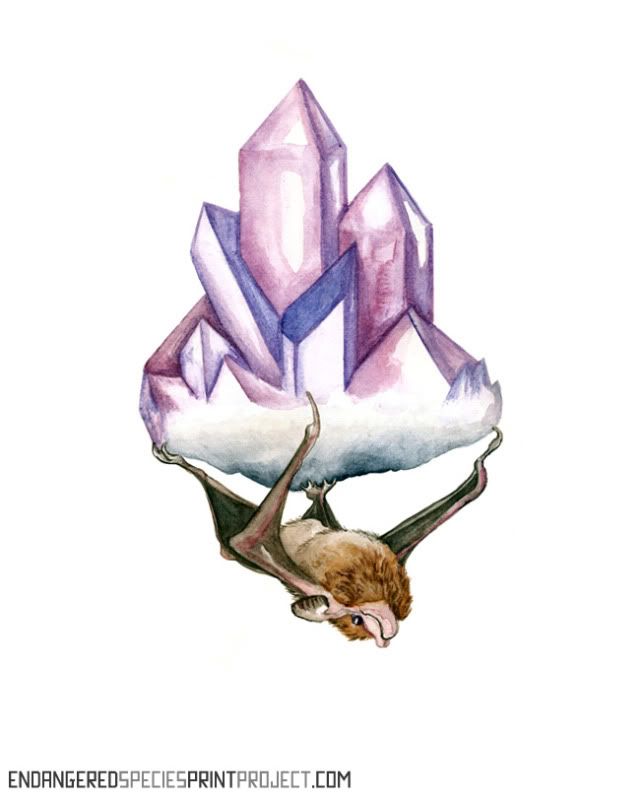
"The Seychelles Sheath-tailed Bat"
2009
Archival giclee print (Edition of 37)
8 x 10 inches
Chicago-based artists Jenny Kendler and Molly Schafer recently launched the Endangered Species Print Project. The ESPP offers limited edition prints of critically endangered species for sale to collectors, and ALL proceeds are donated to conservation programs working to perpetuate the featured species. For each print edition, the total number of prints corresponds to the featured animal's current population. For example, only 37 Seychelles Sheath-tailed bats remain in the wild, so for that edition, 37 prints will be produced.
The ESPP is already generating buzz. The Center for Biological Diversity and The Sierra Club are both promoting the project and have expressed interest in collaborating with Schafer and Kendler. I'm not surprised. The ESPP is a terrific undertaking, a fine example of the sort of environmentally and socially responsible efforts that I dearly wish more contemporary artists would involve themselves with.
As such, I'd promote ESPP even if I weren't planning to produce some prints for the project. I expect to produce two original drawings that will be turned into prints before the end of this year. My subjects will be the Javan, or Sunda, rhinoceros (Rhinoceros sondaicus) and the red wolf (Canis rufus). Also, in 2010, I hope to produce prints featuring other endangered species, including some birds, reptiles, and plants.
Prints of the following species are already available: the Panamanian Golden frog (Atelopus zeteki); the Vancouver Island Marmot (Marmota vancouverensis); the Seychelles Sheath-tailed bat (Coleura seychellensis); and the Indri lemur (Indri indri). Visit the ESPP site to learn more.
Friday, July 10, 2009
Paradise: Here and Now (and To Come)
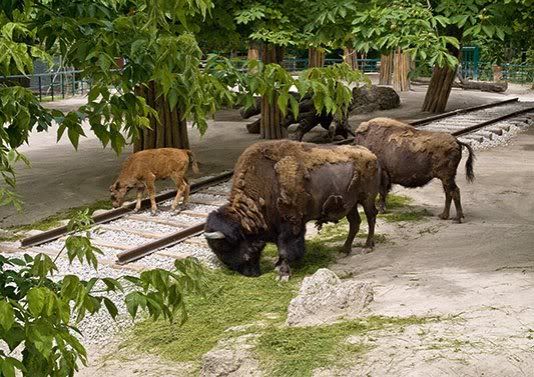
Steinbrener/Dempf
"Trouble in Paradise"
Alan Weisman's The World Without Us is an imaginative and engaging consideration of what a "post-human" Earth might look like. The popular success of Weisman's book suggests that a great many readers are willing to entertain an End Times quite unlike that forecast by eschatological messianism.
Still, in the United States, a significant percentage of the populace (maybe even a slim majority!) insist that dinosaurs coexisted with early man and that Judgment Day will involve supernatural intervention. For the rest of us, however, Weisman's predictions are more tenable than messianic adjudication and, because we're living through what scientists now dub the Sixth Great Extinction, his vision of mass extinction is also more pertinent.
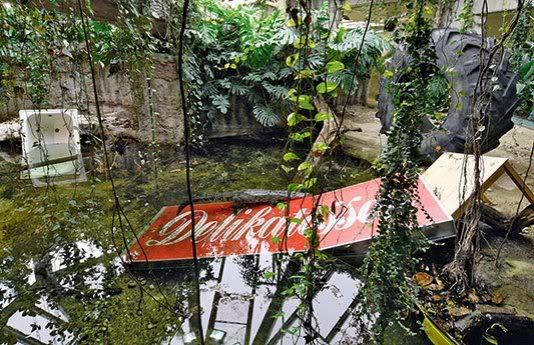
Steinbrener/Dempf
"Trouble in Paradise"
I thought of The World Without Us when viewing photographic documentation of Steinbrener/Dempf's intervention at Vienna's Schonbrunn Zoo, an institution celebrated as "the oldest zoo in the world." Not all of the installation images impress me, but a few are coolly beautiful. The best of them serve as both a celebration of life's ambivalent persistence and a critique of our romantic notions of wilderness.
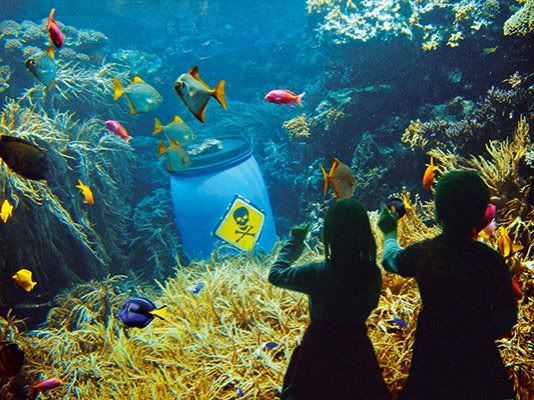
Steinbrener/Dempf
"Trouble in Paradise"
Note: Thanks to RSA Arts & Ecology blog for the heads up
Thursday, June 16, 2005
Technology, Dullardism, & Climate Change
"The problem of modern man isn't to escape from one ideology to another, nor to escape from one formulation to find another; our problem is to live in the presence and in the attributes of reality."Although surveys suggest that most of the American public still believes that climate change is a future threat, many thousands of species are already threatened by shrinking environmental ranges and changing precipitation patterns; some of these species are on the verge of extinction. The negative impact of climate change occurs now and later.
-Frederick Sommer, The Poetic Logic of Art and Aesthetics
I encourage those readers curious about the subject, particularly those who believe that we will "solve" the problem via improved technologies, to read "Climate Change is Totally Awesome," a recent post at Organic Matter. The author dissects a Telegraph article by Robert Matthews, entitled, "Warmer, wetter and better (or the good news that the climate change lobby doesn't want you to hear)."
Interviewed for the Telegraph piece, Professor Philip Stott of the University of London argues that reducing emissions will not alleviate the threat, and that the steps required to significantly reduce emissions would render us technologically impotent.
"Even if we shut every fossil-fuel power station, crushed every car and grounded every aircraft, the Earth's climate would still continue to get warmer, according to Prof Stott. 'The trouble is, we would all be too impoverished to cope with the consequences.'"I agree that the warming trend is natural and that, even were we to de-industrialize, the world would continue to warm. But anthropogenic action accelerates climate change to such a devastating degree that biodiversity and, ultimately, human stability are in peril.
Furthermore, Stott's concept of technological impoverishment is misguided. To be sure, if we First Worlders are to transition to sustainable development, we must give up many of the conveniences that we now take for granted. It remains to be seen whether we will make this sacrifice of our own volition or if we will do nothing until Nature demands it of us. In either case, the sacrifice will not make us incapable of coping with climate change.
It will, however, demand a significant restructuring of our cultural and technological priorities. Our taste for spectacle and distraction must be unlearned. Cultural critic and anthropologist Morris Berman, in his outstanding book Wandering God: A Study in Nomadic Spirituality, dubs the social spirit of contemporary, industrialized nations "dullardism."
"With dullardism, the goal is simply to go unconscious, by means of tranquilizers, alcohol, TV, spectator sports, organized religion, compulsive busyness and workaholism, and so on (even though many of these do provide a short-term 'high')."Dullardism is not endemic to contemporary, industrialized societies. Equivalent symptoms were documented in the late years of the Roman and Mayan civilizations, and I suspect that they also existed in Sumer and other early civilizations.
The human animal is not evolutionarily equipped to flourish in society; our brains remain "wired" for the Pleistocene, and the rapid transition to an agrarian, sedentary, and "civil" existence has been rapid and fraught. We therefore exhibit displacement behavior, seeking escape via fundamentalism, sports, entertainment, and drug abuse.
Does this mean that advanced civilization makes us ill-equipped to deal with environmental catastrophe? Not necessarily (we have to hope not!), but we must reexamine our social mores in order to create something akin to a new social order, one that balances our primitive lusts for progress and power with pragmatism and stewardship. It's a tall order, to be sure, but one that we must fill.
Wednesday, May 11, 2005
Miscellany
1) Bill Maher has a short interview transcript posted at the Sierra Club's newsletter, "Planet." Maher's precious perspectives and anti-rural bias often find him championing anti-management stances and making fun of "country boys," neither of which ingratiate him to someone like me. In this interview, though, we are on common ground. He boils down the lack of American environmental responsibility to the following observation, "People are just going to have to wake up."
2) In another interview transcript, Grist Magazine sits down with Edward Norton to talk about environmental activism. I respect Norton a great deal, both for some of his more impressive acting turns and for his intelligence. Unfortunately, he sometimes comes across as an arrogant prick - listen to the "Fight Club" commentary if you want to realize just how very much this guy loves waxing poetic about his own abilities - but some of hisarrogance confidence is warranted.
3) James Howard Kunstler forecasts extremely dire futures for the First World, particularly our own country (and parts of neighboring Canada), but this recent adaptation of the introduction to his new book, The Long Emergency, is a very important read. It can be married to the excellent Stephen M. Meyer article (about extinction and wildlife conservation) to make you feel really good about the 21st century. I try to remain as optimistic as I can, but I find myself agreeing with Kunstler when he writes,
Read it here.
2) In another interview transcript, Grist Magazine sits down with Edward Norton to talk about environmental activism. I respect Norton a great deal, both for some of his more impressive acting turns and for his intelligence. Unfortunately, he sometimes comes across as an arrogant prick - listen to the "Fight Club" commentary if you want to realize just how very much this guy loves waxing poetic about his own abilities - but some of his
3) James Howard Kunstler forecasts extremely dire futures for the First World, particularly our own country (and parts of neighboring Canada), but this recent adaptation of the introduction to his new book, The Long Emergency, is a very important read. It can be married to the excellent Stephen M. Meyer article (about extinction and wildlife conservation) to make you feel really good about the 21st century. I try to remain as optimistic as I can, but I find myself agreeing with Kunstler when he writes,
"It has been very hard for Americans - lost in dark raptures of nonstop infotainment, recreational shopping and compulsive motoring - to make sense of the gathering forces that will fundamentally alter the terms of everyday life in our technological society. [...] Suburbia will come to be regarded as the greatest misallocation of resources in the history of the world."Kunstler predicts, as the Pentagon did in their 2003 forecast, a complete economic collapse of the United States by 2050. The result will be a country in which train travel is the only economically feasible option and the southern 1/2 is torn apart by drought, disease, and racism. He thinks the northern half of the United States will fare better, but he neglects to address the "white flight" that would surely follow such a "long emergency."
Read it here.
Friday, May 06, 2005
Extinction Debt: Weeds, Relics and Ghosts
"A great many of the plants and animals we perceive as healthy and plentiful today are in fact relics and ghosts. This seeming contradiction is explained by the fact that species loss is not a simple linear process. Many decades can pass between the start of a decline and the collapse of a population structure, especially where moderate-to-long-lived life forms are involved.The above selection is taken from a terrific (and terrifically depressing) article by Stephen M. Meyer, professor of political science at MIT, published in the Boston Review. Meyer addresses ideas all too familiar to those of us following the extinction crisis, but he succinctly describes the current quandary far better than most writers have. Meyer focuses on the concept of trophic generalists (or weedy species), relics, and ghost species. He also explains how “extinction debt” works, a concept not foreign to economists or ecologists, but apparently difficult for almost everyone else to comprehend.
Conservation biologists use the term 'extinction debt' to describe this gap between appearance and reality. In the past century we have accumulated a vast extinction debt that will be paid, with interest, in the century ahead. The number of plants and animals we 'discover' to be threatened will expand out of control as the extinction debt comes due."
I highly recommend this article if you're interested in reviewing or learning the basics of the extinction crisis.
Thursday, April 28, 2005
Ivory Ghosts

Some environmental battles are emblematic of the movement at large. At the turn of the last century, John Muir’s Hetch Hetchy Valley crusade was such a story. Today, the proposed drilling in the Arctic National Wildlife Refuge generates plenty of ink and airtime. But cases where no battle took place, where the melancholy howl of extinction went unheeded, are often passionately eulogized and become emblems themselves. They serve as unpleasant reminders of what inaction might wrought. The passenger pigeon (Ectopistes migratorius) and the Ivory-billed woodpecker (Campephilus principalis) are icons of extinction.
So it is with great excitement and happiness that I learned, early Thursday morning, of confirmed Ivory-billed woodpecker sightings in Arkansas. (CNN report here. NPR report here.) For the last five years I have followed the search for Campephilus principalis, North America’s largest woodpecker, with much interest. Like the search for mountain lions (Puma concolor) in the mountains of West Virginia and Pennsylvania, the likelihood of discovering remnant Ivory-billed populations, particularly viable ones, was minimal at best.
In the 1930s, Campephilus principalis was confined to one or two remnant populations in Louisiana and Florida. Some biologists believe each population (if there was more than one) numbered 10 or fewer birds. Because of the Ivory-billed woodpeckers’ refined dietary needs – the species has evolved to specialize on cerambycid beetle larvae most commonly found “under the bark of recently dead or dying hardwoods” – heavy logging pressure through the 1930s and 1940s devestated the birds.
Upon waking for work on an April morning in 2005, over 60 years after the last confirmed sighting (in the United States; one was spotted in Cuba in 1986), my Inbox was crowded with emails from various biologists (members of any number of listservs that I subscribe to) relating the news. In spite of some skepticism, the news elated me. My good spirits were only slightly dampened by the reaction of my co-workers, which ranged from “Oh, that’s nice,” to “Have you seen my umbrella?” One office-mate did seem interested, and he told me that he has spotted numerous Ivory-billed woodpeckers in his life. I attempted to explain the visual similarities between the Ivory-billed and the smaller, more common Pileated woodpecker (Dryocopus pileatus), but when I opened my bird book – I keep one on hand at work due to the many migratory flights heading up the East River – to show him the difference, I realized there was no Ivory-billed woodpecker depicted. The bird, after all, was thought to be extinct. The import of the discovery sank in!
While the exact location of the confirmed sightings will not be released (in an effort to prevent poaching or undue stress from a crowd of over-eager birding enthusiasts trying to add to their “lifelist”), several conservation groups are already working to extend legal protections on the area in question. Not only will legislation and land purchases help to save the surviving woodpecker population, they will likely aid all the flora and fauna in these woods. Today, unlike the 1930s and 1940s, suitable Ivory-billed habitat exists in many places; some biologists suggest the Ivory-billed woodpecker could turn into a success story along the lines of the California condor (Gymnogyps californianus).
The only dark spot marring an otherwise encouraging discovery is the fear that certain powerful lobbyists will use the Ivory-billed woodpecker to highlight Nature’s resilience. Nature is resilient and wonderful, but one recovery – if, indeed, such a thing is possible for Campephilus principals – does not mean we should continue to plunder the natural world in an immoral and unsustainable fashion.
Photo credit: John James Audubon, "Birds of America"
Wednesday, April 13, 2005
i taut i taw a putty tat

This Duluth News Tribune article was published in early March, but was only recently brought to my attention. Apparently a Wisconsin fire-fighter and hunter, Mark Smith, proposed that the state classify free-roaming domestic cats (also called “feral” cats) as an “unprotected” species. If the state were to do so, Felis catus could be legally killed by any hunter in possession of a small-game license.
Smith states, “I get up in the morning and if there’s new snow, there’s cat tracks under my bird feeder…I look at them as an invasive species, plain and simple.”
He's correct. In the United States alone, domestic cats are responsible for the death of hundreds of millions of birds, billions of small mammals and millions of reptiles and amphibians each year. Many wildlife biologists contend that cats are responsible for more extinctions worldwide than any other cause, with the exception of habitat destruction.
Yet my cat-loving friends contest these facts, pointing out that the numbers are “just estimates.” Or they will highlight my willingness to damn the domestic cat when I don’t condemn other superb predators such as mountain lions (Puma concolor) or red foxes (Vulpes vulpes). Estimates are often useful tools but, more importantly, there is a substantial difference between a native predator and the introduced variety. (Conservation-minded Puerto Ricans do not appreciate the mongoose (Herpestes javanicus) presence and few folks on Guam find the brown tree snake (Boiga irregularis) praiseworthy. Other than our association with house cats as just that, there is no difference between it and other feral, introduced species.)
Compounding matters is the protection and attention offered Felis catus. What other predator species has access to a dependable source of food and protection from disease? Also, unlike many other predators, the domestic cat does not demonstrate a marked decrease in hunting desire when already sated. Felis catus is a killer that enjoys the killing.
I grew up on a farm where any cat spotted without a collar fell victim to a .22 rifle. Most of these animals were large, filthy tomcats that had been living feral for months or years, but a few were groomed and well-fed. No matter. On a 300-acre farm designed to attract and protect wildlife, the appearance of an “unattached” cat meant dead or threatened wildlife.
The concept of predator control troubles many people, myself included. The balance is delicate; not every raccoon (Procyon lotor) or fox that a land owner or refuge manager spots should be killed, especially if the animal will not be utilized - eaten, worn - in a respectful manner. But when discussing an “invasive” species, the choice becomes more clear-cut. Why then, does Mark Smith’s Wisconsin proposal engender such an angry response all over the United States, especially when Minnesota and South Dakota already allow such kitty culling?
When I Google the topic, I find a link to this hateful blog. The author writes,
“So Mr. Mike Smith lets make a deal, we will allow open cat season just for you as long as you allow us to have an open season to hunt your ass down."He also points out, astutely, that "birds can fly away from a bird" (one assumes he meant to write 'cat') whereas a cat has no chance against a 12-gauge shotgun. The writer clearly knows nothing about firearms or the hunting prowess of a cat. No individual seriously trying to kill a feral cat would use a shotgun unless they were confident in their ability to stalk within range, a difficult feat for even seasoned scouts. And, even outfited with a collar bell, a cat will learn to stalk so as not to let the bell ring, until the pounce...and bye-bye, birdy.
On another website discussing the issue, post after post bemoans Mark Smith’s proposal, suggesting we pursue “more humane” ways of controlling the cat population. The most often proposed alternative is a three-step process: live trapping, neutering, and release. Proponents of this approach argue that, within several generations, the feral cat population would plummet as a result. While true, what may be more humane for the cat does not afford other animal species much help – with an estimated 12% of the world’s bird species in danger of extinction this century, such measures do little to help sustain biodiversity – but, more pragmatically, tax payers aren’t very willing to foot the hefty bill for such birth control programs. As a result, The Humane Society of the United States and PETA have been encouraging cat owners to spay/neuter their pets and keep them indoors for years now, but many, if not most, cat owners continue to ignore this advice. On the one hand, then, pet owners are unwilling to take responsiblity for their pets and, on the other, they are unwilling to pay taxes which will help alleviate the problems their negligence contributes to. That's the attitude, America!
The only sound alternative to legalized hunting of cats, as I see it, involves trapping the cats, offering them up for adoption at a shelter (to be spayed/neutered at the client’s expense) and euthanizing them if they are not claimed within a given time. This method is undoubtedly more humane than shooting, as the needle will less often “miss its mark,” and it doesn't put the "murderers back out on the streets," but again we are faced with an intimidating price tag. I'm willing to add a few hundred dollars to my yearly tax burden to help alleviate Felis catus pressure. Are you? (Based on my informal poll at the office today, most people aren't. In fact, my much beloved co-worker tells me her parents' cats, which only come into the house at night, don't kill other animals but more than once every two years. Unfortunately, living in denial doesn't help biodiversity.)
In an ideal world, the hunters interested in shooting the cats would be steady marksman and the country’s biodiversity could be done a great service in a relatively humane fashion – a bullet through the brain or heart is only marginally less humane than a lethal injection. On the other hand, in a truly ideal world, pet owners would take responsibility for the creatures they choose to purchase or adopt, keeping cats indoors and dogs closely monitored while taking care to spay or neuter the animals. In this ideal scenario, we would also learn how to take better care of our own fellow man and approach human population, land use, and economic growth with some degree of thoughtfulness. Oh, wait...those continue to seem like unrealistic short-term goals? Well, then, lock-and-load, because the cat problem is far more pressing than the more socially acceptable white-tailed deer (Odocoileus virginianus) "scourge."
Do not misunderstand. I adore house cats and cherish the good times I have spent with my own (pictured above). Discovered on the side of the road as a kitten, Mr. Misi had not yet opened his eyes when I adopted him. He had to be fed warm milk from a baby bottle and, for those first months, he slept on my pillow, curled in the crook of my neck and shoulder. Would I weep were Misi shot by a hunter? Of course. Would I understand why? Yes. For that reason, Misi is not allowed outside and he was neutered years ago. When he visits a rural area, I put a collar around his neck, making him easily identifiable as a “pet” if he should manage to slip outside.
Note: As of this afternoon, I learn that the Wisconsin public has given the go-ahead for the cat hunting. It will be taken to the state legislature next.
Photo credit: Hungry Hyaena, 2004
Thursday, March 10, 2005
Natural Disasters, Icebergs, and Cockroaches

I didn't expect much from the Roland Emmerich film, "The Day After Tomorrow.” Because of my interest in global warming, the televised trailers caught my eye initially, but the sour reviews convinced me to skip the film in theaters. Two months after it was released on DVD and video, however, I decided to rent it.
The movie features a young, blind chemotherapy patient who clings to his copy of "Peter Pan.," much of the dialogue is ham-fisted, and the central father-son story line is threadbare. Still, “The Day After Tomorrow” is markedly better than I expected. The special effects, lampooned by some critics, are excellent and the acting, contrary to critical consensus, is fine. It’s no triumph of cinema, but it does make the viewer ask some tough questions about how we spend our days here.
And while the movie does greatly exaggerate the speed of a sudden onset ice age, is it really deserving of the vitriolic criticism it received? Anthony Lane, writing in The New Yorker, proclaims that he is “determined to double his consumption of fossil fuels” after seeing the film. Perhaps such negative reactions (even those shrouded in half-jest) are a result of the film’s proposal that civilization, movie criticism included, will be wiped away, whether by water, wind, fire, or deep shaking?
Such a humbling possibility should not be taken lightly. Organic Matter recently brought this BBC article on “supervolcano” risks to my attention. In the article, geologist Stephen Self says, “We don't want to be sensationalist about this, but it's going to happen. We just can't say exactly when.” This statement could be applied to any number of natural disasters.
Even in our age of technological wizardry, one in which we litigate to postpone death, clone half-breeds to "save" endangered species, and play video games to wage war, Nature remains our master and commander. It is often said that the cockroach will survive long after humanity expires, after our achievements are covered and meaningless. Perhaps the statement has lost some of its impact through repetition, but I always find myself returning to the chestnut.
The cockroach will survive long after humanity expires. It's a humbling thought, and quite something to consider. An old “artist statement’ of mine comes to mind:
"Whenever I attempt to “explain” my work I find myself thinking of desolate highways or an empty bed with strewn sheets. Long, lonely stretches of highway make me think of icebergs and the tenuous nature of humanity’s accomplishments. To some extent, everything makes me think of our imminent demise: the dust under the sofa, the stars above, pencil shavings, my computer screen. This acceptance of death, whether it be that of an individual or a species, results not in nihilism but in optimistic pessimism. Though we will continue to make mistakes until our end, Nature, herself, will learn from our efforts."In short, as scary as “The Day After Tomorrow” or supervolcanos are, as helpless as we would be in the face of such natural wrath, we are but part of the greater whole. Though our accomplishments and temples may corrode and crumble, though no one will be here to appreciate them, our energy will live on. The great experiment will continue. Dear, flawed Albert got it right: E=MC2.
Photo credit: ripped from Manaaki Whenua Landcare Research website
Subscribe to:
Posts (Atom)