I'm pleased to report that, to date, the ESPP has raised $4,000 for critically endangered species, and hopes to raise another $6,000 at Renegade! If you're in or around the Windy City, please pay them a visit.
I'm especially fond of the two newly available limited editions created by the project's co-founders, Molly Schafer and Jenny Kendler...and I'm most drawn to the Moldavian Meadow Viper (Vipera ursinii ssp. moldavica). This, for three reasons: Molly rendered the animal beautifully; I adore serpents, and Molly evidently does, too; I have an irrational attachment to Hungary, since my paternal great-grandparents hail from the country, and sales of the print benefit the Hungarian Meadow Viper Conservation Center, a conservation organization based there.
Such approaches are vital to opening a floor for further discussion. Even though our species' population is a clear-and-present threat to hundreds of thousands of other species (as well as to the Earth's limited natural resources), population control remains a fiercely debated and sensitive subject.
From the CBD's press release:
"At 6.8 billion people, the human race is not only the most populous large mammal on Earth but the most populous large mammal that has ever existed. Providing for the needs and wants of this many people — especially those in high-consumption, first-world nations — has pushed Homo sapiens to absorb 50 percent of the planet’s freshwater and develop 50 percent of its landmass. As a result, other species are running out of places to live.
To help people understand the impact of overpopulation on other species, and to give them a chance to take action in their own life, the Center is distributing free packets of Endangered Species Condoms depicting six separate species: the polar bear, snail darter, spotted owl, American burying beetle, jaguar, and coquí guajón rock frog.
The beautifully designed packages, featuring clever slogans, are being distributed by a network of 3,000 volunteers ranging from ministers to grandmothers to healthcare providers to college students and biologists. The condoms will be handed out at concerts, bars, universities, spiritual groups, local events, and farmer’s markets. Along with two condoms, each package contains original artwork and information on the species, facts about overpopulation and the extinction crisis, and suggestions on how the human population can be stabilized."
I'm certainly no fan of the tribalistic and despicable practices of groups like Quiverfull, but the general population needs to be better educated about the dangers of overpopulation, too. I'll be distributing the condoms around New York City during the next two weeks.
I'm fascinated by leopard seals (Hydrurga leptonyx). They're charismatic creatures, and beautiful, too. They are also brutal and fearsome. Their power, underwater grace, and remarkable jaws make them one of the world's supremely adapted predators. Watching documentary footage of a leopard seal hunting penguins, it's impossible not to marvel at the bloody ballet, even if you quietly mourn the death of the seal's popular and plump prey.
My "experience" of the leopard seal is all secondhand and mediated, yet I'm stricken with a quiet awe when I contemplate a film of the seal shadowing through its submarine realm. Imagine, then, how National Geographic photographer Paul Nicklen felt during his remarkable Antarctic encounter (and ensuing relationship) with a seal whose "head is twice as wide as a grizzly bear's head."
Oh, and think about investing in some ESPP prints for the holidays! If you do so, you'll be giving two gifts: a limited edition print to a happy recipient, and a financial boost to one of the worthy non-profit organizations working to protect endangered species and critical habitat.
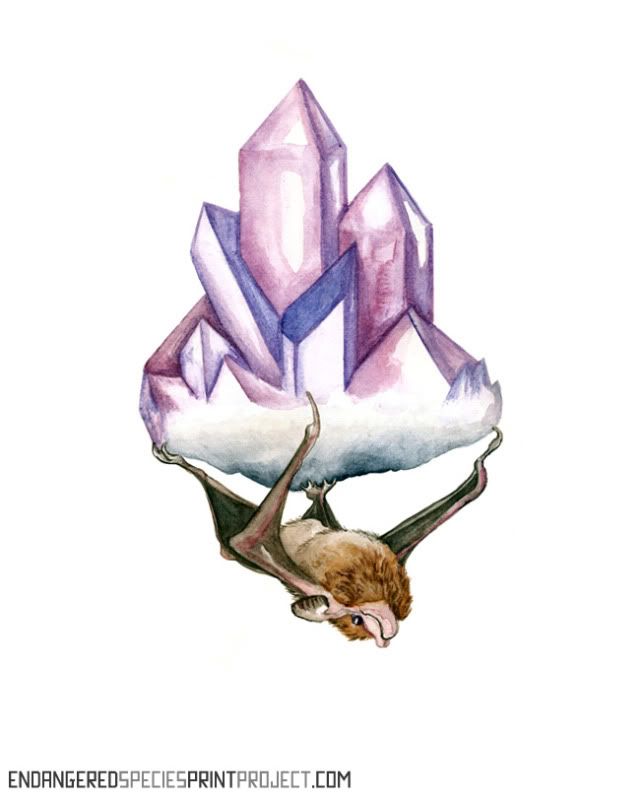
Molly Schafer "The Seychelles Sheath-tailed Bat" 2009 Archival giclee print (Edition of 37) 8 x 10 inches
Chicago-based artists Jenny Kendler and Molly Schafer recently launched the Endangered Species Print Project. The ESPP offers limited edition prints of critically endangered species for sale to collectors, and ALL proceeds are donated to conservation programs working to perpetuate the featured species. For each print edition, the total number of prints corresponds to the featured animal's current population. For example, only 37 Seychelles Sheath-tailed bats remain in the wild, so for that edition, 37 prints will be produced.
The ESPP is already generating buzz. The Center for Biological Diversity and The Sierra Club are both promoting the project and have expressed interest in collaborating with Schafer and Kendler. I'm not surprised. The ESPP is a terrific undertaking, a fine example of the sort of environmentally and socially responsible efforts that I dearly wish more contemporary artists would involve themselves with.
As such, I'd promote ESPP even if I weren't planning to produce some prints for the project. I expect to produce two original drawings that will be turned into prints before the end of this year. My subjects will be the Javan, or Sunda, rhinoceros (Rhinoceros sondaicus) and the red wolf (Canis rufus). Also, in 2010, I hope to produce prints featuring other endangered species, including some birds, reptiles, and plants.