Showing posts with label postmodernism. Show all posts

Tuesday, September 27, 2011

Finding Unicorns


someguy
"9 Unicorns"
2011
Individual vintage bible pages

Large, juried shows are usually confused affairs. "Proof," the latest rendition of Southern Exposure's annual "entry-fee free juried exhibition of Northern California artists," is no exception. Of the 47 artworks (by as many artists), 5 pieces stand out: Kelly Falzone Inouye's "Tagging Sequence 1"; Robert Larkin's "Original Art"; Summer Mei Ling Lee's "Les preuves fatiguent la verite"; Kate Nartker's "West Main 1984"; and Someguy's "9 Unicorns."

"9 Unicorns," in particular, provided much to mull over. Someguy displays 9 pages from vintage Bibles; on each of these, all text except for the page heading and the word "unicorn" is blacked out. On his website, the artist states, "it's not commonly known, but the Bible mentions unicorns 9 times." I suspect that Someguy intends his handsomely presented editing job as a winking critique of religious literalism. By highlighting the occurrence of the word, the artist reminds viewers that mythological creatures populate the tome that literalists insist is non-fiction and most U.S. president-elects place their hands upon when they're sworn into office. Little girls notwithstanding, most of us are informed and sensible enough to dismiss unicorns as harmless hokum. Why, then, doesn't an overwhelming majority also view the Abrahamic narrative as an epic myth (i.e., fiction)?

Religious apologists point out that the Hebrew Bible makes no mention of unicorns. Instead, readers will find an ox, auroch, rhinoceros, or bison, depending on the edition. These more mundane creatures are indicated by the ancient Hebrew term re'em. The word was first translated as "unicorn" by the Greeks who, between 250 BCE and 100 CE, crafted the immensely important Septuagint, bringing the Hebrew scriptures to the Western world. Still, lest we too hastily ascribe an elevated rationality to the Jews of antiquity, scholars believe that re'em was not meant to describe an ordinary animal. The oral traditions of the Israelites and early Jews spoke of a powerful, monstrous auroch, a creature of gargantuan proportion, large enough to be mistaken for a mountain. Because they were unfamiliar with this monster bull, it's only sensible that the Greek translators and editors of the Septuagint substituted another fanciful creature, one better known to their audience; enter the unicorn.

Point being, the Bible, no matter the translation, is chock-a-block with fantasy. Most epic stories (and especially those with the staying power to warrant inclusion in a sacred narrative) are tall tales. Fictional or exaggerated narrative often pushes reality out of popular memory. The rhinoceros becomes a unicorn and the large crocodile becomes a dragon in the same way that the angler's fish grows through successive tellings; generations after the big mackerel was caught, it's Leviathan. But knowing how unicorns came to appear in some translations of the Bible doesn't justify easy dismissal of the sacred canon. Even for secular culture, the ancient stories are the closest approximation of universal myths, and they have much to offer readers with a critical bent -- much more, in fact, than they afford literalists.


someguy
Detail of "9 Unicorns"
2011
Individual vintage bible pages

But "9 Unicorns" isn't just about the relationship between religious texts and fairy tales; it's also a critique of our postmodern malady. Today, technology and globalization expose us to a heretofore unprecedented quantity of information. As a result, it's progressively more difficult to wrest fact from fiction. As the late Senator Daniel Patrick Moynihan quipped, "Everyone is entitled to their own opinions, but not their own facts." Disappointingly, most of us reject Moynihan's gospel, instead opting to go at our texts with a Sharpie, making of them whatever we wish. This willful shirking of intellectual responsibility is amply on display in the fractious debate about the meaning of the United States Constitution and the legacy of our "founding fathers." Benjamin Franklin, one of those very prophets, smartly observed, "so convenient a thing it is to be a reasonable creature, since it enables one to find or make a reason for everything one has a mind to do."

Someguy's "9 Unicorns" evidences our species' taste for selective reading, subjective "truths," and rationalizations. Ever more interconnected, such an unhealthy disposition can become dangerous. Someguy's piece is a visual fable of sorts, cautioning us to master our appetites.


someguy
Detail of "9 Unicorns"
2011
Individual vintage bible pages


Image credits: all someguy images, courtesy the artist

Monday, February 28, 2011

So Many True Colors


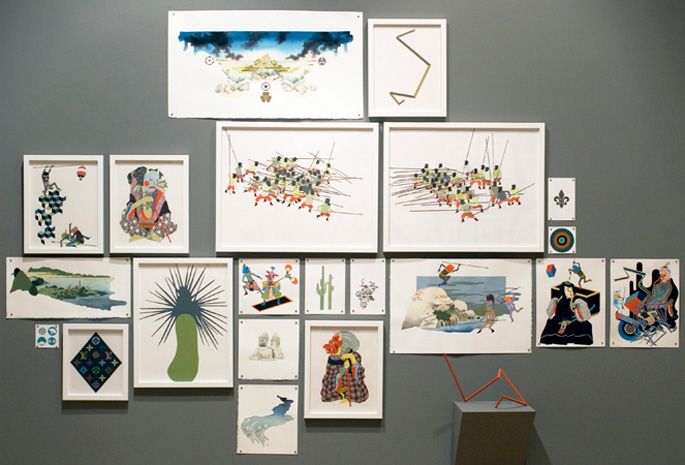
Installation at Haines Gallery
"Studies for La Destitution de la Jeune Fille"
2010
Gouache on paper and wood
Dimensions Variable

French artist Katya Bonnenfant has adopted the moniker The Old Boys' Club. TOBC's current exhibition at Haines Gallery - a scaled-down version of the recent wallpaper and sculptural installation at the Yerba Buena Center for the Arts - is titled "La Destitution de al Jeune Fille (The Deposition of the Young Girl)." According to the gallery's press release, the title references a "post-Situationist theory [...] initially put forth by the anonymous collective, Tiqqun." Apparently, Tiqqun "advances the notion of the young girl as embodiment of the capitalist machine and the meaninglessness of modern life." Further research reveals that the preponderance of content published in Tiqqun's now defunct journal is jejune and impotent pseudo-philosophy, the sort of tripe that too many artists mistake for genuine thoughtfulness. Happily, despite her meager inspiration, TOBC puts on a good show.


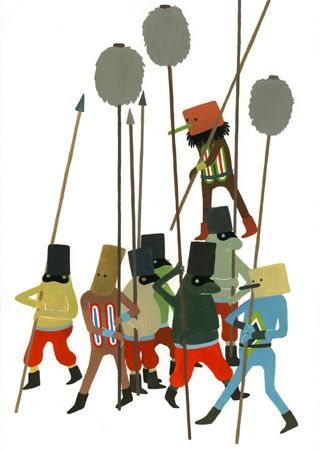
"Study for La Destitution de la Jeune Fille #41"
2010
Gouache on paper
12 x 9 inches

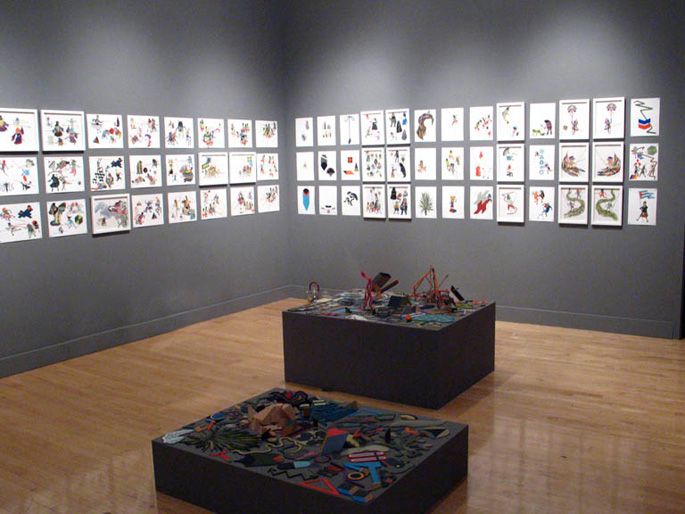
The back gallery at Haines is pleasantly crowded with TOBC's colorful and riotous gouache drawings and sculptures. Bonnenfant's cast of cartoon characters is diverse; celebrities like Darth Vader and Waldo appear, but most of the artist's spear-wielding insurgents are humble and unfamiliar. What treasure or ideology are they fighting over, exactly? Narrative particulars are few and no critical players or turning points are obviously apparent; it's a ceaseless and meaningless melee (like Tiqqun's conception of modern life!).

The opaque, vivid colors of TOBC's gouaches call to mind the advertising industry's heraldry and, in combination with the masks and costumes of Bonnenfant's characters, emphasize the combatants' ethnic or cultural differences. The effect is gestalt; Bonnenfant's oddball cast of warrior mascots is a manifestation of the physical and economic violence of globalization. That's also what Tiqqun aimed to communicate but, where they failed, TOBC succeeds artfully and without pretension.


Installation at Haines Gallery
"Studies for La Destitution de la Jeune Fille"
2010
Gouache on paper and wood
Dimensions Variable

Image credits: all images from the artist's website and Haines Gallery website

Sunday, May 16, 2010

Susan Silas' Heroic Living


Susan Silas
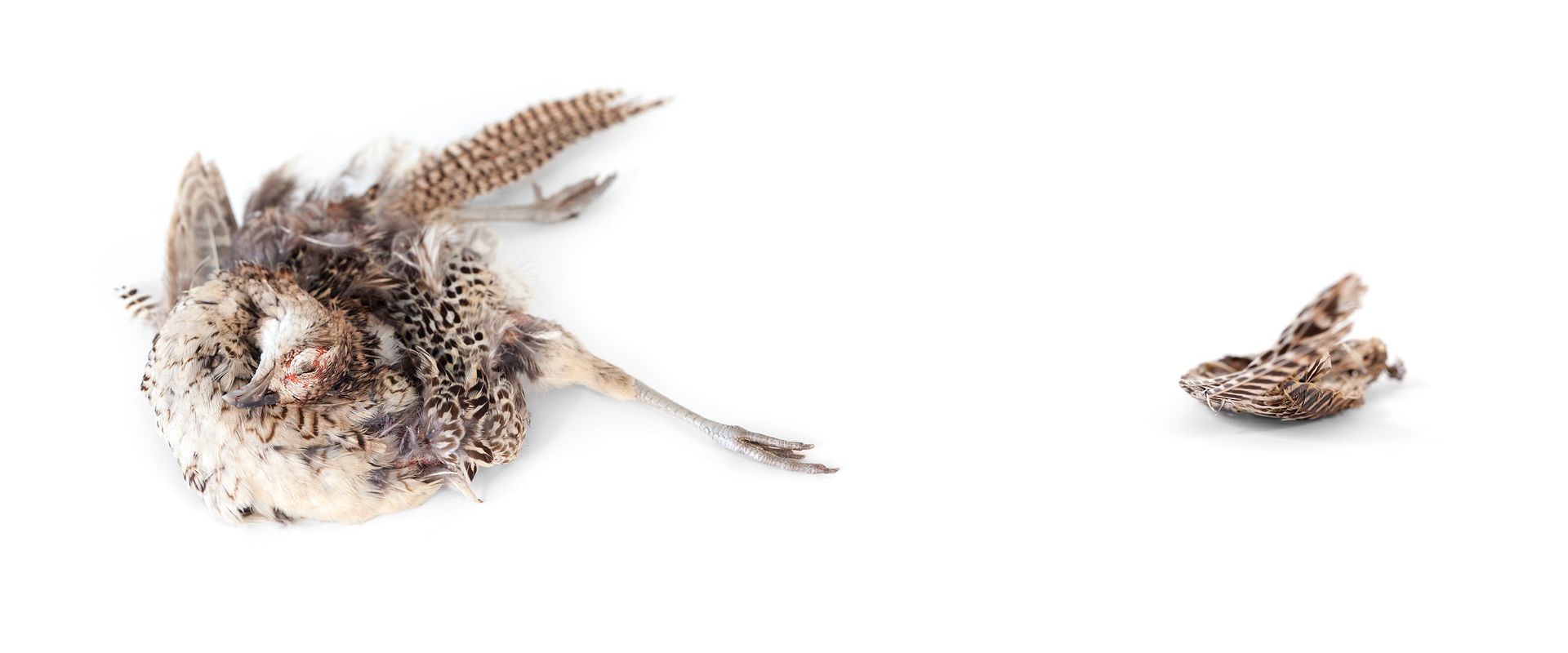
"found birds; 2000 - the present"
(Image 17 of 23 from the portfolio "eyes wide shut")
2010
Archival ink jet prints on Hahnemühle photo rag paper
22 x 17 inches

Until recently, I was unfamiliar with Susan Silas' artwork. She is perhaps best known for projects memorializing the Shoah, but it wasn't an awareness of her Holocaust work that led me to "Helmbrecht's Walk, 1998-2003." Instead, it was a photograph of a dead American kestrel that Silas emailed me in March.

I have only an inkling of what essay or artwork of mine inspired the artist to send me the image, but I'm grateful that she did. I shamelessly admit to being the sort who finds soulful beauty in images of death, and I was touched by the striking and contemplative photograph. A month after I received the picture, I visited Silas in her Brooklyn home, to look at prints from her "found birds" series. Still pondering her work a week after that visit, I headed to Hebrew Union College's Jewish Institute of Religion Museum, eager to compare what I saw and sensed in "found birds" to Susan's more easily classifiable (though by no means "easy") Shoah work.


Susan Silas
"found birds; 2000 - the present"
(Image 3 of 11 from the portfolio "what remains")
2010
Archival ink jet prints on Hahnemühle photo rag paper
20 x 48 inches

The HUC press release for "Helmbrecht's Walk" describes the project succinctly.
"On April 13, 1945, more than 700 women were forced to march 225 miles in 22 days from the Helmbrecht's Labor Camp, a small satellite unit of the Flossenburg Concentration Camp in Germany, to the Czech city of Volary. [...] During the course of this forced march the women were ill fed, inadequately clothed, denied shelter, and capriciously beaten. On the sixth day of the march, the non-Jewish prisoners were separated from the group, leaving the remaining 580 Jewish women to continue until May of 1945.

With determination and sensitivity, Silas traced the march in 1998 on the 53rd anniversary of the event by walking along the same path as the Helmbrecht's women for 22 days in Germany and the Czech Republic. She documented her journey in Helmbrecht's Walk, a collection of 48 archival color prints presented as an unbound book. [...] The images contextualized by Silas' daily commentary of her own experiences are coupled with news reports of event occurring elsewhere in the world on that same day in 1998. This juxtaposition, she says, functions 'to heighten our awareness of the fact that we are all presently witnesses to unspeakable events and extreme suffering for which we take no more responsibility than did many witnesses to the Holocaust.'"
Silas' project addresses the complicated relationship between place and time or, as cultural critic and historian Simon Schama's consideration of the topic framed it, "landscape and memory." When Silas conceived of the Helmbrecht's project, she believed (or maybe hoped) that walking the same path that the Helmbrecht's women had would allow her some intimate experience of or insight into the terrible march. In fact, this didn't prove so. Silas describes her walk as "relatively mundane and unexceptional." She continues, "My feet hurt. I get tired. [...] I found it more, rather than less difficult to understand how these women made this journey once I was out on the road."


Susan Silas
"Helmbrecht's Walk, 1998 - 2003"
(Day 1, Monday 13 April 1998, Helmbrechts to Schwartzenbach Saale, 1998)
Archival ink jet prints on Hahnemühle photo rag paper

Yet many of the captions she includes with the photographs reference artists and thinkers such as Werner Herzog, who understand "walking as a sacrament." Such language calls to mind the Australian Aborigines' songlines, mnemonic stories that are spoken or sung as the Aborigine walks over the referenced terrain. In his marvelous book Spell of the Sensuous, David Abram relates a striking, relevant anecdote.
"A similar tale is told by [Bruce] Chatwin. He was traveling in a Land Cruiser with several friends, including an Aboriginal man nicknamed Limpy whom they were driving to a particular place on his songline. Limpy, whose clan Ancestor was the Native Cat, or tjipla (a small marsupial with a long, banded tail), had never been to this place along the Native Cat songline, yet he now wished to go there in order to see some distant relatives who were dying there. During the course of seven hours driving through the back country, bumping across shallow rivers and under gum trees, the Aboriginal man sat motionless in the front seat, squeezed between the driver, Arkady, and another passenger, except for a short burst of action when the truck crossed part of his songline. Later,
'[w]e came to the confluence of two streams: that is, we met the stream we had crossed higher up on the main road. This lesser stream was the route of Tjilpa Men, and we were joining it at right angles. As Arkady turned the wheel to the left, Limpy bounced into action. Again he shoved his head through both windows. His eyes rolled wildly over the rocks, the cliffs, the palms, the water. His lips moved at the speed of a ventriloquist's and, though them, came a rustle: the sound of wind through branches.

Arkady knew at once what was happening. Limpy had learnt his Native Cat couplets for walking pace, at four miles an hour, and we were traveling at twenty-five. Arkady shifted into bottom gear, and we crawled along no faster than a walker. Instantly, Limpy matched his tempo to the new speed. He was smiling. His head swayed to and fro. The sound became a lovely melodious swishing; and you knew that, as far as he was concerned, he was the Native Cat.'"
I believe that what was missing for Silas was a story line, the narrative informed by the landscape (and vice versa) that, among indigenous groups such as the dwindling Aboriginal population of Australia, is traditionally passed from generation to generation. In some respects, "Helmbrecht's Walk" is an attempt to locate such a story, an earnest effort to discover in the landscape the marks of what happened decades before. In our postmodern, peripatetic culture, nations and traditions do not generally fare well. In some respects, this is a positive development, as our tribal perspectives and prejudices erode into some variety of tentative, liberal pluralism. On the other hand, it's ever more difficult to feel confident about one's identity and how it relates to landscape, vocation, and nation.

My time with "Helmbrecht's Walk" confirmed my supposition, however, that Susan's art is not primarily interested in cultural identity or particular histories. Instead, she is most concerned with "the big questions." To one degree or another, all art wrestles with or reacts to these existential imponderables, but Susan's exploration is more focused and urgent than most. Fortunately, even though her work is preoccupied with mortality and meaning, she manages to avoid the pitfalls of such terrain; her work is neither macabre nor aestheticized to the point of anesthetization.


Susan Silas
"found birds; 2000 - the present"
(Image 1 of 21 from the portfolio "blackbird")
2010
Archival ink jet prints on Hahnemühle photo rag paper
22 x 17 inches

Two days after I visited "Helmbrecht's Walk," I read "Eudaimonia, existentialism, and the practice of medicine," an essay by Dr. Andrew Radu included in the Spring 2010 issue of The Pharos of Alpha Omega Alpha Honor Medical Society. In his essay, Dr. Radu describes the existentialist ideal of tragic optimism. He writes of it, "even in the face of imminent death, we have the ability to reevaluate life." He goes on:
"A crucial concept held by many existentialist philosophers is that of heroic living. All humans have the ultimate freedom to live boldly in the face of tragedy. Living with this concept makes attaining a goal of eudaimonia less important than simply striving to do so. [...] The concept of tragic optimism proposes that in a life that can be circumscribed by pain, guilt, and death, one should say 'yes to life in spite of everything.'"
Indeed, as I wrote in "Eudaimonia," a January 2009 essay that explored my then nascent optimism,
"Acknowledging our species' precarious position is not defeatist; on the contrary, accepting the inevitable nourishes the individual's desire to contribute. Faced with an impossibly difficult prospect, only individual effort can sustain us. As Albert Camus concluded in The Myth of Sisyphus, 'The struggle itself is enough to fill a man's heart. One must imagine Sisyphus happy.'"
The Shoah is bleak history, a subject watered by the blood of millions, and it is fertile soil for such "big questions." Silas' "found birds" remind us that so, too, is the striving and passing of a blackbird. The artist's reckoning with death is her own form of "heroic living."

Image credits: all artwork, courtesy Susan Silas

Friday, February 19, 2010

Originality and (Re)cognition


Xie Zhiliu (Chinese, 1910–1997)
"Ducks and Blossoming Branches"
Pencil and ink on paper
20 1/2 x 30 3/4 inches

In his recent review of the Metropolitan Museum of Art's exhibition of works on paper by the late Chinese artist Xie Zhiliu ("Tracing the Path to Chinese Finesse," New York Times, February 14, 2010), art critic Ken Johnson reminds readers that imitation is often a prerequisite for originality. Johnson's piece begins with a Western commonplace,
"Copying is bad; originality is good. That’s what we learn from toddlerdom on. In art as in life, be yourself. Don’t pretend. Nobody likes phonies, fakes or frauds. Forgery is illegal. Authenticity is holy.

But wait. Copying and imitating have been the rule for most of the history of human civilization. In the West artists from Raphael to Picasso have profited from copying the works of others. In art there is no such thing as pure originality."
Or is there?

I suppose it depends on one's definition of originality. Having recently come under the intellectual sway of George Steiner, I wholeheartedly endorse the philosopher-critic's distinction between originality and novelty, detailed in his book Real Presences.
"Originality is antithetical to novelty. The etymology of the word alerts us. It tells of 'inception' and of 'instauration,' of a return, in substance and in form, to beginnings. In exact relation to their originality, to their spiritual-formal force of innovation, aesthetic inventions are 'archaic.' They carry in them the pulse of the distant source."
Put another way, novelty is self-conscious invention or difference for the sake of invention or difference (that is, mere newness), whereas originality is an individual's expression of a primordial and universal resonance.

What better way to absorb the lessons of your predecessors (to better prepare yourself for originality) than by reproducing the work of those artists? More from Johnson's article:
"Maxwell K. Hearn, the exhibition’s organizer and a curator of Chinese painting and calligraphy at the Met, explained in an interview that the show’s main significance is in what it reveals about methods used by traditional artists. It turns out that the kind of graceful naturalism that Xie achieved in his best works came not from extensive study of nature but by tracing over and over the works of other artists on sheets of semitransparent paper. [...] Repeatedly tracing the works of old masters as Xie did might be compared to a pianist practicing a composition by Bach. This may sound suffocating for a modern artist, but it is not unlike how many young artists learn to draw: by copying their favorite comic-book characters over and over."
I was no exception. I spent countless teenage hours copying comic strips and, later, comic book characters. The graphic line and compositional sense that I learned from emulating those comic artists significantly informs my artwork today.

Johnson is correct, however; these ideas "may sound suffocating for a modern artist." That copying (a casual form of apprenticeship) might offend contemporary sensibilities is further evidence of the excesses of modernism and postmodernism. Too much was purged in the revolution of modern aesthetics; the rabble is today without coherence.

Fortunately, the art world is undergoing a sea change. The majority of artists under 40 years of age (and an increasing number of those over 40) do not mistake novelty of expression for originality, and they will readily acknowledge the value of copying, especially for the young artist. In fact, we realize the genuineness of Steiner's insistence that such activity is vital in all aesthetic disciplines.
"To learn by heart is to afford the text or music an indwelling clarity and life-force. Ben Johnson's term, 'ingestion,' is precisely right. What we know by heart becomes an agency in our consciousness, a 'pace-maker' in the growth and vital complication of our identity.

[...] Accurate recollection and resort in remembrance not only deepen our grasp of the work: they generate a shaping reciprocity between ourselves and that which the heart knows. As we change, so does the informing context of the internalized poem or sonata. In turn, remembrance becomes recognition and discovery (to re-cognize is to know anew)."
Image credit: Metropolitan Museum of Art

Wednesday, February 03, 2010

"Inherited Purpose and Pattern"


William Kentridge
Still from "History of the Main Complaint"
Animation
1996

I enjoyed reading Calvin Tomkins' recent profile of William Kentridge ("Lines of Resistance," The New Yorker, January 18, 2010). Tomkins includes some fascinating details about Kentridge's background and family, and I especially appreciated some of the remarks made by the artist. The following quotation was particularly resonant.
"[Working in South Africa,] I was aware of Joseph Beuys - Beuys and his honey pump, which was supposed to be political art. But politics is not spreading honey around the main building at the Documenta art exhibition. It's putting electrodes on people's testicles, locking them up, putting them in fear of their lives."
Kentridge acknowledges his South African perspective (the artist was born into a state of apartheid and is today living through its often grim aftermath), but his observation also speaks to the general disconnect between so much 20th century fine art and "the real world."

Both modernism and postmodernism prioritize iconoclasm and individual achievement over "a system of inherited purpose and patterns."(1) It's thoughtless to dismiss the sibling -isms (both offer valuable insights and fundamentally inform our contemporary world), but the march of globalization is revealing the societal impotence of the philosophies. Absent "inherited purpose" and narrative, postmodern community is soulless, a mere facade. One of many casualties, the artist is but a mote in a vast and turbulent sea of competing sentiments and ideologies. Graphic design and advertising occupy the popular position once given to fine art, but, excellent though some of both may be, these are commodity driven disciplines; as such, they can make no genuine claim to political or moral coherence.

Still, I don't believe that we should bemoan our station as the end of the line. Globalization is in its infancy, and the 21st century will likely see a new concept of cosmopolitan citizen emerge, one that could usher in an era of shared mythos. Back to the future, so to speak.

(1) This definition of pre-modern art is drawn from Adam Gopnik's fantastic essay, "Van Gogh's Ear." (The New Yorker, January 4, 2010)

Sunday, January 31, 2010

The Logical Consequence

"'Art for art' is a tactical slogan, a necessary rebellion against philistine didacticism and political control. But pressed to its logical consequences, it is pure narcissism."

- George Steiner

Saturday, March 17, 2007

More Spam Fun

Check out the two animated shorts below. A friend of mine drew my attention to these videos after reading the previous post. They're terrific, and certainly worth sharing.


+++++

Saturday, April 29, 2006

Progeny


Trenton Doyle Hancock
"Las Luces, Looses, and Losses"
2005
Mixed media on canvas
60 3/4 X 60 3/4 X 4 inches

An inordinate amount of Trenton Doyle Hancock buzz was generated and disseminated this February and March. Hoping the coverage would die down and/or that my recollection of it would dim, I put off a visit to Hancock’s recent solo effort, "In The Blestian Room," at James Cohan Gallery, for as long as I could. Galleries aren't in the business of humoring persnickety calendar demands, however, and I found myself studying Hancock's handiwork with the hoopla still on my mind.(1)


Trenton Doyle Hancock
"In The Blesstian Room"
2005
Mixed media on canvas
90 x 108 x 6 inches

Clearly, I’m a biased viewer, but I found "In The Blestian Room" disappointing. My dissatisfaction is rooted in suspicion of motive, not, as one might assume, in aesthetics. That is to say, while some of Hancock's decisions - attaching studio detritus to the paintings, for example - seem self-conscious, fraught denotations of race, attitude, or spontaneous process, I was more disturbed by the sense that Hancock is dangerously close to becoming an art world personality. That is to say, his work seems calculated, more akin to Warhol than Darger or Dubuffet. Hancock turns his uncouthness into a commodity. As Donald Kuspit writes, "The artist outsider is well rewarded in our society - so long as he is an insider in art society."(2)


Trenton Doyle Hancock
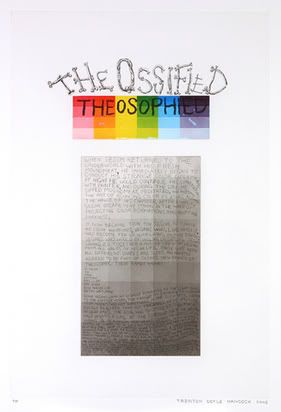
“The Ossified Theosophied, (Title Page)”
2005
Color etching, Edition of 35
19 1/2 X 25 inches

Hancock's use of narrative scaffolding seems more like a marketing tactic than an essential ingredient in the artist's process. While it is not uncommon for contemporary artists to invent a cosmology on which to base a body of work - Matthew Ritchie is a notable example - most keep the details of their created worlds largely private. Hancock, by contrast, not only cooked up the Mounds saga, a picaresque epic with vaguely religious resonance, he also makes sure viewers know about it. “In The Blestian Room” includes a limited edition print (see above) that amounts to little more than a sloppy, hand-written chapter of the chronicle. Hancock is making up the story as he goes along – this, at least, is how it is presented to the viewer – giving it the appeal of a zany soap opera. (What is Sesom up to now? Come find out! What will he get into next? What crazy characters will he meet tomorrow? Will we witness a great war between the Mounds and the Vegans? You'll have to wait until the next installment/exhibition! Don’t miss it, ‘cuz the art world doesn’t do Tivo!)

Before I continue, it should be noted that I cheer for those making art away from established cultural centers; I enjoy comic books, graphic novels, and cartoons(3); I hold dear much fantasy and myth, from Kipling's "Just So Stories" and Aesop's Fables to The Lord of the Rings; I am fascinated by religious narrative and the clever weaving of historical "fact" with spiritual rendering in such tellings. Given this laundry list of likes, I expected to find a confederate in James Cohan Gallery. What I discovered instead was calculation.


Lee Baxter Davis
"Family Tree"
2005
Ink, watercolor & collage
36 x 44 inches

What's more, Hancock’s still unrecognized debt to the artist who spawned him, Lee Baxter Davis, raises eyebrows. If I were not already an admirer of Davis, I very much doubt I would know of their relationship. The CUE Art Foundation recently exhibited about twenty of Davis’s drawings and paintings. Long overdue, the show was the artist’s first in New York. Early in the associated press release, the writer draws attention to Davis' influential role.
“A regional icon, Davis’ thirty-years of teaching printmaking and drawing at East Texas State University (now called Texas A & M, Commerce) has influenced the careers of some of his very prized students including exhibition curator, Gary Panter, along with Whitney Biennial artists Trenton Doyle Hancock, Robyn O’Neil, and Christian Schumann, among others.”
An Internet search for “Lee Baxter Davis” turns up little, whereas “Trenton Doyle Hancock” nets many relevant articles and websites. In pieces about Hancock, the names William Blake, Hieronymus Bosch, Philip Guston, Max Ernst, and Gary Panter are repeatedly cited as influences, but Davis is nowhere credited. This is a curious oversight, the result of Davis' being a relative unknown in the New York art world. Closer to home - his home - he looms large.
"In the 1970s, The Lizard Cult was a vaguely derogatory term applied to East Texas State University (as it was known then)'s Art Professor Lee Baxter Davis and many of his most talented students. It was called that because so much of their work closely approximated his - rife with comic sensibility, lush textures and lurid details....Once viewed with condescension, The Lizard Cult has not only grown up, many of Davis' students have prospered and become regionally and nationally prominent." (J R Compton, "Lee Baxter Davis and The Lizard Cult Grows Up," Dallas Arts Review)
With the exception of Gary Panter, Davis' celebrated proteges are all much younger (by thirty or more years, typically) and, therefore, more attractive (for the moment) to the youth-obsessed art market. Furthermore, whereas Davis is a retired art professor now working as an assistant pastor of St. William the Confessor Catholic Church in Greenville, Texas, his former students manage to bridge the divide between "living and working" in Texas and, well, living in Texas. In other words, though Hancock and O'Neil still live in the state (Paris and Houston, respectively), they have attached themselves to the larger art world in a way that Davis has not. Why, one wonders, have so many of Davis' students achieved art world success while he remains a regional icon? In part, the answer lies with the man himself, with a desire to remain unrecognized, but I can't shake the sense that a more perverse process is also at work.


Lee Baxter Davis
"Big Bear"
2005
Pen, ink, watercolor & collage
21" x 29 inches

In his recent indictment of postmodern art, The End of Art, Kuspit describes two artist archetypes. The first is a "reclusive alchemist struggling to purify the dross of everyday reality," and the second, an "entertainer representing a mass audience's everyday wishes." Although Kuspit argues that the monkish model is exclusively modern and, today, extinct, this is not the case; both are alive and well. As a general rule, however, it is the second type, those interested in "having an audience that will make them popular, giving them the celebrity and charisma they believe they are entitled to as artists," that finds success in the art world.

Lee Baxter Davis is the very picture of Kuspit's reclusive alchemist. Not only are his paintings alchemical, but his lifestyle and approach to art-making fit the bill, too.
"Like a hermit practicing his art in millennia past, Davis is isolated. He has chosen to separate himself from society, locating his studio, home and family life far from the hustle and bustle of Dallas, Houston, San Antonio, or Austin. Davis finds peace and purity of existence in the quietude of a rural existence. Instead of reaping and sowing the land for its hearty edibles, he reaps and sows the earth for intellectual nourishment. It is a type of sustenance that could only come from the coupling of separation and deliberation - from self-willed banishment to the silent wilds of a life found deep in the nowhere lands of Texas." (Charissa N. Terranova, "Alchemist of Imagination," ARTL!ES, Issue 43)
Furthermore, Davis is as invested in (or consumed by) his contemplation of philosophy, religion, and pop culture as he is the local environment.
"Growing up in the small towns of Texas, Davis' boyish pursuits included immersing himself within the complex sagas told by great Southern writers, the harrowing poems of Edgar Allen Poe, and a dizzying array of post WWII popular comic books and newspaper strips such as BlackHawk, Pogo Possum, and Mad Magazine. Largely raised by his Methodist minister grandfather, and having read the bible since childhood, Davis has long harbored a deep-rooted fascination with the more mysterious elements of faith...Believing laughter and prayer to be close to the same thing, he creates illusions whose idiosyncrasies harbor nervous fits of laughter as buffers against existential angst."(Gary Panter, "Lee Baxter Davis," CUE Art Foundation press release)


Davis' layered pastiche is, for him, a metaphysical search, one that ties vulgar realities to marvelous visions, the profane to the sacred. Viewers - western viewers, in particular - will recognize many of the embedded symbols, but they must interpret the work subjectively, nurturing their own hybrid narrative. Thus, something approaching the intrinsic alchemy of the making - Davis' journey - is experienced by the viewer. To an extent this is true of all visual art, but Davis' symbolic content elevates the exchange.

Hancock's Mounds fiction, on the other hand, is altogether different. Viewers must learn about the Mounds before the narrative becomes meaningful. We are given a choice: disregard the mythology and treat the work as illustrative reverie, or become an initiate of Hancock, learning the magic words, the symbols, and the gestures. In essence, Hancock offers viewers a cult of personality. Davis allows us a subjective experience by drawing on shared myth; Hancock gives us an opportunity to participate in his manufactured, flimsy one.

Yet the son has surpassed the father, at least in terms of renown. Hancock is more savvy than Davis. Whether by virtue of his nature or the waving of an agent's wand, he presents us with the "high art" version of an "outsider"/low-brow aesthetic. His awareness of the supposed division between these two orbits is clear. For many, this makes the work more easy to digest, but also more intelligent and contemporary. For others, myself included, that awareness results in self-conscious painting, work that excels at distraction and affirmation, but fails to address universal experience. Many critics (many friends) disagree, arguing that Hancock melds rich narrative, magic, superstition, faith, and popular culture to produce an original experience, a distinct and contemporary remix. But the father's artwork suggests that same union is less an artistic assertion of individuality than a way of life, an approach allowing us to cope with and consider deeply disturbing axioms.


Lee Baxter Davis
"Sideshow"
2005
Pen, ink & collage
28" x 20 inches

(1) Museum exhibitions have a longer lifespan, allowing the details of the 2006 Whitney Biennial coverage, for example, to fade before I finally visit (in late May).

(2) Donald Kuspit, The End of Art, Cambridge University Press, 2004

(3) In fact, I feel Hancock is better served when he sticks to comics - there were some strong pages on display in the rear gallery - and the like. His book, "Me A Mound," is a far more interesting artifact that his paintings or prints, though it, too, suffers for a certain amount of ostentation.

Photo credits: All images ripped from James Cohan Gallery and CUE Art Foundation websites

Thursday, March 16, 2006

The Human Face: Ambivalence As Objectivity

"Gaiety and glee are usually twinned with misery, however, which sneaks up on you like an ocean wave, filling your mouth with seawater, and can almost take you under, like a nether beast risen from below."
-Edward Hoagland, Compass Points

Image hosting by Photobucket
Woody Allen and the Voyager 1 disc

In moments of profound sorrow, my chest collapses, as if compressed by some exterior force. Air escapes my lungs and a temporal vertigo consumes me. Such absolute heartache is, thankfully, extremely rare. In my twenty-eight years, it has been summoned twice by women and, on several occasions, by the realization that, though all existence is fleeting, humanity must continue to strive. Contemplation of this proposition has, in the extreme, led to sobbing, but the tears are ambivalent, like the sentiment itself, simultaneously borne of intense joy and pathos.

Most recently, I was thus overcome while contemplating an image of the Voyager 1 disc in the pages of National Geographic. The gold-plated, copper record, placed on board the interstellar bound spacecraft in 1977, is, to my mind, the culmination of modern art. NASA's Jet Propulsion Laboratory describes the record as follows:
"...a phonograph record...containing sounds and images selected to portray the diversity of life and culture on Earth. The contents of the record were selected for NASA by a committee chaired by Carl Sagan of Cornell University. Dr. Sagan and his associates assembled 115 images and a variety of natural sounds, such as those made by surf, wind and thunder, birds, whales, and other animals. To this they added musical selections from different cultures and eras, and spoken greetings from Earth-people in fifty-five languages, and printed messages from President Carter and U.N. Secretary General Waldheim.

Each record is encased in a protective aluminum jacket, together with a cartridge and a needle. Instructions, in symbolic language, explain the origin of the spacecraft and indicate how the record is to be played. The 115 images are encoded in analog form. The remainder of the record is in audio, designed to be played at 16-2/3 revolutions per minute. It contains the spoken greetings, beginning with Akkadian, which was spoken in Sumer about six thousand years ago, and ending with Wu, a modern Chinese dialect. Following the section on the sounds of Earth, there is an eclectic 90-minute selection of music, including both Eastern and Western classics and a variety of ethnic music.

Once...Voyager...leave[s] the solar system (by 1990, [it] will be beyond the orbit of Pluto), [it] will find [itself] in empty space. It will be forty thousand years before [it] makes a close approach to any other planetary system. As Carl Sagan has noted, 'The spacecraft will be encountered and the record played only if there are advanced spacefaring civilizations in interstellar space. But the launching of this bottle into the cosmic ocean says something very hopeful about life on this planet.'"
If aliens should happen upon the Voyager 1 spacecraft and discover the disc, they are expected to play the record and learn something of our species' history. In this sense, the engraved disc is a tool and, as such, it will one day be considered an artifact, if it isn't already. (A reproduction will more likely find a home at the Smithsonian Institution than the Metropolitan Museum of Art.) But the disc is an object of abstract utility, a symbol representative of modern philosophy's crest. It was manufactured moments before the Enlightenment wave began to break: part Scientific Revolution, part postmodern doubt. Given this transitional moment of conception, the record is an embodiment of contradiction. It is a leap of faith taken by the faithless - the late twentieth century being the pinnacle of secularism - and a tool, crafted with aesthetics in mind, that is unlikely to be put to use. But, above all, the contradictory power of the Voyager 1 disc resides in the recorded content. An attempt to limn a collective portrait of humanity, the disc is at once a gesture of hopeful optimism and naive hubris.

Image hosting by Photobucket
The Necker Cube

I'm preoccupied by such ambivalence. Most people think of the word, ambivalent, as a pejorative. Without question, it can be used in a disparaging way, especially when interpreted only to mean indecision, but what of the word's other meaning, "the coexistence of opposing attitudes or feelings"? This latter usage accurately describes the balance sought by yogis, the Chinese yin-yang symbol, and the quantitative and qualitative possibilities figured in E=MC2. Contradiction, in this sense, is an altogether natural, even positive, phenomenon.

From my late teens on, I've been obsessed with another symbol of contradiction and ambivalence, the Necker Cube. The drawing figured prominently in the margins of my undergrad notebooks and throughout old sketchbooks; it was of particular interest to me during the peak of my drug experimentation. Flipping through an old "trip journal," I came across the hallucinogen-inspired rant below, proof that, if you keep pen and paper handy, not everything flashing through a chemically-addled mind is worthless (even if poor motor control makes it nearly illegible).
"A good idea will always contradict itself or, at least, the person exploring this idea will accept the reverse to be true as well. There are always multiple truths (2 symbolically, many more literally). It is the impossible middle-ground that is important. This is the yearning chasm, the heart, the Meadowlands. The yearning chasm must never be achievable, but does provide something to aim for. This target is our quaquaversal. At the peak of this quaquaversal - at the point of slope's origin - is the ylem. We can never reach the ylem; we can not even claim to know of it's existence, except on faith. Therefore, I have already arrived at a prime contradiction, making my logic sublimely impotent."
Unfortunately, when sober, humans are not programmed to readily accept such ambivalence; we prefer "empirical" truth, assigning meaning, often moral in nature, to our observations. Our data gathering can be objective, but our interpretation and the resulting intellectual constructs are rarely so. As a species, we are reluctant to give ourselves over to ambivalence. When faced with doing so, our bodies react in unusual, sometimes surprising ways; hence, my involuntary sobbing while contemplating the Voyager 1 disc. To contemplate the ambivalent universe is to be simultaneously overcome by wonder and mired in tragedy.
"...the idiosyncratic surfaces of the other orbs floating serenely in space; the pristine interstellar vacuum; the inscrutable emptiness of intergalactic space, that immense, echoing, absolutely featureless void enveloping the spinning galaxies: it all serves as a perfect philosophical mirror image, reflecting back the quandry of the species, the limitations of human knowledge. The frail architecture defined by our distant tools, which places the human race at the center of 'what's known,' is actually our own map of ourselves - a chart that we'll hand down to successive generations, who one day may see a charming primitivism, or even an prescience, in our view of all that."

-Michael Benson, "A Space In Time" (Atlantic Monthly, July/August 2002)
Many artists vacillate between the poles of glee and misery, of joy and sorrow, but one of my favorites, Woody Allen, is firmly entrenched in the tragic camp. In a recent Manchester Guardian profile ("Master of Neurosis," Guardian Weekly, Jan. 6-12, 2006), Allen tells Emma Brockes that, although he wouldn't trade his sense of humor for physical beauty, he "would've exchanged being funny for being a tragedian." He continues, "I always would've done that, from day one, to now, I mean, I always would have preferred that. [...] I wish my career could have been one in which film after film has not been comedies, but been dramas and tragedies." Reading the profile, one gets a sense of Allen's general melancholy; as he describes it, "I'm almost burning on a low flame of depression." I used to associate such a temperament with keen intelligence - and there is no denying Allen's brilliance, whether or not you like his films - but, lately, I feel depressives, like Allen, are denying the opposing pull, choosing the one-directional shrug of apathy over the contradiction of ambivalence.

Near the end of the piece, Brockes asks Allen, after having listened to him bemoan the pointlessness of it all, "Isn't having children a consolation of some sort?"
"No. There's no sense of continuity. No sense of, no sense of...I always used to think that art is the intellectual's Catholicism. You think that because your work may be seen after your death, or read, after your death, that it's compensation. But it's not. Not kids, or art or anything. There is nothing compensating about your own death."
Allen's bleak world view reminds me of a character I created for a screenplay I never completed, an angst-ridden twenty-something with a penchant for drug-fueled conversation and navel gazing - a thinly veiled reflection of myself at twenty-one. At one point, early on in the action, this character stands in a salt marsh with a friend and delivers a rambling monologue. Near the end of it, he says,
"I don't know...I think our answers - if you can call them that - are no more sensible than...I don't know...a mole. I mean, sometimes I like to think about...you know....'future man,' like, poking his fingers around in a human skull, my skull. But then I realize how far fetched that is. I mean, I won't be lucky enough to be a fossil. I've never even won at Bingo."
Presumably, this character would share Allen's feeling about children and art. With good reason: the idea that immortality may be achieved via lineage or the leavings of a creative career is short-sighted, as both, eventually, will be buried and forgotten, long before humanity vanishes. But Allen and my unfinished proxy are wrong to believe death offers nothing in the way of compensation. As our bodies rot, the contained energy - your concentrated mass - is released into the humus and the ether. Again, E=MC2 or, as Galway Kinnell, my favorite contemporary poet, puts it in "The Quick and the Dead," "the crawling of new life out of the old, which is what we have for eternity on earth." In this sense, even after our species is gone and other lifeforms populate the planet, each of us remains an essential piece of the weave, recycled and reconstituted.

Contrary to Woody, I feel there is much joy in accepting our inevitable decomposition, even if our conscious minds yearn for permanence, making eulogistic joy rather wistful. Meanwhile, Voyager 1 continues it's interstellar journey to boldly go where no man has gone before.

Photo credits: images ripped from Nature Publishing Group, lnx.indajaus.com, and The Focusing Institute website

Friday, February 10, 2006

The Art of the Con


"February 26, 2000

Dear Mr. Van Strad,

Please excuse me if I have misspelled your name. It was difficult to understand on our answering machine.

Unfortunately, [the painting you expressed interest in acquiring] has been sold.

I have been trying to reach you since we received your first call regarding [the piece in question]. I tried to contact you continually, at different times of the day, but the number you left on the machine was one that never rang through. All I would get is a recording of a woman's voice saying that the 'number you have reached is either busy or you have entered an incorrect number.' This always happened before it rang.

I am faxing this reply to you now because the number you left this time doesn't seem to take a voice message.

If I can be of any further assistance, please do not hesitate to call me.

Best regards,

[X], Co-director of SoHo Gallery"
+++++


In the fall of 1999, when I first moved to New York City, I found work as a preparator and jack-of-all-trades in an art gallery that I'll call SoHo Gallery. I liked the job well enough, but the daily routine lost its luster by the five month mark. No matter how many paintings I framed, crates I packed, or lights I changed, the job seemed ever more tedious. Something had to be done.

The answer to my work woes presented itself on a typical Saturday night in early 2000. I was hanging out at a friend's apartment in the East Village, drinking beer and bullshitting, when conversation turned to my SoHo Gallery job and the exhibition then on display. Knowing how frustrated I'd been with work, a friend suggested that we prank call the gallery.

Enter Alexander von Stradtt, an eccentric, European art collector. This impressive man, known for his generous spirit and colorful presentation, stopped by SoHo Gallery during an art buying trip to New York City and Los Angeles. One of the paintings on display - by a now well-known artist/illustrator who shall remain anonymous here - caught his eye. von Stradtt was enamored of the work, but felt that it was missing that special something, that je ne sais quoi. Distracted, or perhaps lost in thought, he left the gallery without introducing himself to the dealers. He didn't even sign the registry.

One week later, on a particularly blustery Saturday evening, von Stradtt attended a grand party at a mansion in Prague, Czech Republic. Still preoccupied with the painting he had seen at SoHo Gallery, he made his way to an alcove, where he could only just be heard over the din, and placed a call to information. Moments later, he was connected with the gallery. Because it was such a late hour, even in New York, von Stradtt was forced to leave a message identifying himself and conveying his interest in the piece. Though I do not recollect von Stradtt's exact wording, the thrust of the message is below.
"Hello, this is Alexander von Stradtt calling. I am an established collector and I recently saw a painting in your gallery which I am very interested in acquiring. [Here, von Stradtt named and described the piece.] I do, however, have one request...a request that may initially seem rather unorthodox. I would gladly pay twice the asking price, maybe more, but I will need your staff, or the artist himself, to spray paint a purple 'Q' on the center of the painting. I will be in touch. Good evening to you."
And so a drunken goof, a prank call with a brief back story, was the beginning of the Alexander von Stradtt saga.

On Monday morning, when I arrived at work, the gallery staff were already abuzz with talk of a mysterious caller and his absurd request. I stood alongside the gallery owners/dealers as they replayed the message for me, repeatedly, exchanging baffled looks and shaking their heads slowly. Fighting the urge to double over in laughter, I mustered a passable performance as Surprised Gallery Preparator #1. (Requisite to being a good liar is first convincing everyone that you're a terrible one.)

There were so many questions. Why had von Stradtt left no telephone number? Why had he not called during gallery hours? What in the world was the significance of the letter "Q"? And so it went...but it seemed clear to me that the dealers wanted to believe in von Stradtt. I decided that the calls should continue.

And so, over the next couple of months, Alexander von Stradtt was rendered more distinct. A website was produced, featuring a photograph of the collector and art aficionado giving one of his "impromptu, guided tours of the Louvre" along with a narrative biography and a listing of his many honors. His pseudo-celebrity was made clear: according to the site's text, numerous magazines had lauded von Stradtt with praise, "most notably Paris Match." (The choice of this "notable" magazine was the brainchild of a good friend; it still makes me chuckle.)

An assistant named Gunter (pronounced: goon-ta) was also invented. This short, excitable German placed calls to SoHo Gallery on two occasions. The painter of the piece von Stradtt expressed interest in was contacted at his California studio, drawing him into the hoax's orbit and resulting in a hilarious exchange between the artist and the gallery directors. ("Who in the hell is this guy? Is he for real? You can't do that to my painting!")

The fax that heads this post was sent after Gunter "mistakenly" provided the gallery with a fax number instead of a working phone. The gallery's response, above, resulted provoked an incensed message from von Stradtt, assuring the gallery that "the incompetent Gunter," had been "dealt with" and that, furthermore, he was unaware of any trouble with his phone service.

The highlight of the project, for that is what it had become for my friends and me, was a casual remark von Stradtt dropped in the midst of yet another late-night voice message. "I'll call you when I next head to New York, but I've been just crazy as of late. I'm in Munich, of course. A-huh...I think you know why." Upon receiving this message, the gallery owners frantically began searching the Internet, looking for information on current events in Munich. Was von Stradtt attending some sort of bacchanal? An insider only art fair? Why didn't the gallery know about this event? Desks were pounded, feathers ruffled and, me....well, I no longer found the work day so tedious.

Frankly, I don't recall why the project ended. I suppose my friends and I started socializing more, and our lives filled with commitments and concerns other than beer, ladies and juvenile entertainment. The painting was finally sold to a collector who didn't demand a purple "Q" and, not long thereafter, von Stradtt quietly faded into the background. Even the URL of his publicity website provided only a broken link.

While the von Stradtt project was in its prime, however, many people suggested we document our chicanery. In the eyes of some, particularly those folks familiar with the art world, von Stradtt represented an exhibition opportunity. The leavings of the hoax - phone calls, photographs of involved parties, writings, web sites, news clippings, etc. - could easily be presented in a gallery context, a performance history of sorts. The notion was tempting, but in the end I thought better of it.

Having never intended the affair to be more than a lark, my friends and I hadn't created a fully formed character. Furthermore, we had already turned von Stradtt's eccentricity into over-the-top silliness - the verbal abuse he dealt Gunter, for example. It would be difficult, if not impossible, to marry the messages on SoHo Gallery's answering machine to the humanitarian celebrated in Paris Match and elsewhere. Most importantly, to make the hoax believable we would need to enlist the services of others; a crackerjack production team would need assembling if we intended to work up convincing news articles and presentable magazine layouts. With what little material we had, our mischief didn't warrant a show. Or did it?

Six years later, the art world has proven to be a rather undiscerning arena when it comes to von Stradtt-like experiments. The truly successful hoaxes - I'm thinking particularly of The Museum of Jurassic Technology (though this is a more loving, complex enterprise and something truly special), Andy Kaufman's antics, or Jose Alvarez's "Carlos" - are those that "go all the way." The artists involved in such hoaxes are intimately tied to their asserted realities; the hoax, in effect, consumes them, at least for a time. As Lawrence Weschler suggests in his book, Mr. Wilson's Cabinet of Wonder, the critical component of a successful hoax is the perpetrator's willingness to abandon irony. A hoax is only believable when those confronted with the fiction believe that the bluffer is sincere. In such cases, even those in the know will second-guess themselves.

Keeping this in mind, what are we to make of the recent Binary show at Postmasters Gallery? (See my earlier remarks on the show here.) Sincerity plays no part in the creation and marketing of "United We Stand," a fictional "Hollywood-style blockbuster." I hope Eva and Franco Mattes, the artists behind the 1s and 0s, are having fun with their fake promotional campaign, but, ultimately, "United We Stand" is a lazy, puerile project, a Grade D, acerbic response to the state of the world. Standing in Postmasters, I felt expected to nudge other viewers in a self-congratulatory manner. The message conveyed: "We cognoscenti should be proud of our clever artist friends...and of ourselves. Why? Because we're educated and in on the joke."

But it's not only Binary's superior, acrid message that rubs me the wrong way. I also react against the show because I'm a product of our replacement culture. Philosophically, the global zeitgeist resides somewhere between embracing tradition - to a fault, in the case of the strengthening fundamentalist streak - and tearing down existing foundations. Most of us pay lip service to tradition and revolution, but our day-to-day actions reflect our consumerism and our willingness to render obsolete products and ideas that are still valuable, all in the name of progress.

Advertising does this better - or worse, depending on your perspective - than any other industry, although technology and fashion don't lag far behind. A hip commercial is considered tired two months after it first airs. As a result, advertisers constantly tweak their approach to make certain their product appeals to the younger demographic. Ad companies one-up one another by injecting dialogue even more barbed than the competiting spot or randomness even more "clever" (the Sony PSP television spots airing now, for example: "It's cheese you can listen to outside!").

Living and performing in front of our individual blue screens, we're eager to see what improvements will be made to our existing background. "What's next, man? C'mon. Let me see it. Cycle it! Now!" It's a sad state of affairs, and one the smart kids, Binary included, comment on. Unfortunately, their brand of arch critique - the self-assured, fuck-all posturing of hipsters and matriculating English majors - no longer sits well with me. Like nerd rock, I'm so totally over it.

I want the irony turned down and the crooked smiles pried open into gaping wonder. I don't want to deal with the hoax as wry commentary, rather I want - and I think the world needs - the lines blurred, I seek experiential abandonment.

I was twelve the first time I watched the 1984 film satire, "This Is Spinal Tap," and I believed it. I didn't laugh much; for most of the movie I just stared, dumbfounded. What's wrong with these morons?, I thought. After it was over, I asked friends of mine if they had ever heard of the band; this provided them with quite a few laughs at my expense. There are plenty of clues in the film; even at twelve, I should have recognized it as satire, but like the owners of SoHo Gallery, bent over the office answering machine, I wanted to believe. Christopher Guest provided the actors with a screenplay they could immerse themselves in and the rest is history. It's no surprise that a cult of Spinal Tap blossomed following the film's release. The movie doesn't ridicule its subjects, rather it endears their stupidity and arrogance to the viewer. Even if Guest didn't intend his "mockumentary" as a proper hoax - at least not in the same way that Orson Welles intended his 1938 radio "play," "War of the Worlds" - the ingredients were all present and the art persists.

So where are these competent con artists in the contemporary art world? There are clowns and jesters aplenty, but the working magicians, the cultural alchemists, are hard to find. Maybe they're just quiet for now? I'm hoping this is because we're not supposed to hear them. After all, if the con artist is uncertain of where commentary or character ends and reality begins, then the rest of us should be unsure, too. Perhaps, like David Wilson (of the MJT), the best con artists are those who have ceased conning, those who have entered into, or been consumed by, their own creations. As Wilson writes on the MJT Membership page, "Here at the Museum we feel a strange affinity for these first exceptional, earth-born creatures to leave our planet. Like the dogs, we feel ourselves to be lonely vanguards in a rarefied and unknown atmosphere." Amen. All hail the space cadet and a toast to those who keep our day jobs interesting.

Photo credit: image of Andy Kaufman, www.bodyslamming.com

Thursday, December 01, 2005

Blog Against Racism Day


Racial prejudice is an unfortunate reality. Fortunately, like the action of a river on course stone, fair-minded people can wear down and smooth away racist inclinations. But doing so is no mean task. Catchy slogans - I'm reminded of t-shirts that demand, "ERASE HATE!," a command that does little to assuage tension - and awareness campaigns are not enough. Humans are programmed to classify; we segregate our world into a hierarchy of Us and Them. To "Beat Racism" we must overcome a genetic predisposition, thoughtless and unimaginative though it may be, and, as I see it, this can happen in two ways.

The long term solution relies on multi-generational, social evolution, the "wearing down" I already mentioned. Alternatively, increased "interbreeding," or miscegenation, offers some hope. But what of the middle path, the one we will likely walk? And what exactly does "racist" mean in an increasingly plural world? These questions (coupled with my interest in wildlife) led me to the topic of my B.A.R.D. post.

I am a member of many environmental groups, some large (The Sierra Club, Natural Resources Defense Council) and others small (The Greater Yellowstone Coalition, American Wildlands, The Wildlands Project). All of these groups rely on and trust in the veracity of wildlife biologists. But because taxonomy, the classification of species, is a hotly debated subject, uncertainty creeps into the equation whenever environmental groups rally to protect a frog, duck or bear that is closely related to a healthy population. Personally, I enjoy the ever increasing complexity of phylogenetic trees, but the furor surrounding such issues can lead to practical disaster.

For example, in the Fall 2005 issue of "On The Wild Side," the quarterly publication of American Wildlands, Lauren Oechsli (AW's GIS Water Specialist) writes the following.
"Two hundred years after Lewis and Clark first encountered the species in Montana, genetically pure westslope cutthroat trout inhabit only 2 to 4 percent of their historic range in the U.S. Northern Rockies. In May 2005, American Wildlands and its conservation partners filed its fourth lawsuit against the U.S. Fish & Wildlife Service (FWS), seeking protection for the westslope cutthroat under the Endangered Species Act.

The FWS contends that the westslope cutthroat is widely distributed and does not warrant listing as a threatened species under the Endangered Species Act. Included in the assessment were all westslope cutthroat populations that were at least 80 percent genetically pure despite crossbreeding with other trout species. American Wildlands contends that a westslope cutthroat trout is only a westslope cutthroat when it is genetically pure, not hybridized with rainbow trout, Yellowstone cutthroat trout or any other trout subspecies."
Understandably, readers unfamiliar with the language of wildlife biology may be surprised by the xenophobic slant of the excerpt. The championing of genetic purity runs counter to things educated liberals hold dear. Unfortunately, such a black-and-white response - "Me moral, xenophobic biologist bad." - is inappropriate.

To address the issue more completely, one needs to understand the current divide within taxonomy. The established system of classification, called the biological species concept (BSC), distinguishes species by their ability, or inability, to breed. As a result, a mute swan (Cygnus olor) is distinct from the tundra swan (Cygnus columbianus), despite their belonging to the same genus, Cygnus. A rottweiler, on the other hand, belongs to the same species as the chihuahua, both Canis familiaris. A coupling of these two dog breeds might be awkward, but it will usually be successful. The BSC is widely accepted.

The new kid on the block, the phylogenetic species construct (PSC), has fewer cheerleaders, but is rapidly growing in popularity and application. The PSC classifies species not based on reproductive compatibility, but on distinct physical or genetic characteristics. According to the PSC, the mallard duck (Anas platyrhynchos) and the American black duck (Anas rubripes) are distinct species, even though they regularly interbreed. Furthermore, by PSc standards, their offspring, the mottled duck (Anas fulvigula), represents another species; I've read several papers suggesting the mottled duck should be further subdivided based on genetic and regional variation.

I believe that, in time, the PSC will replace the BSC as the dominant taxonomic system, resulting in innumerable battles between environmentalists and developers, corporations and property owners. Some biologists fear that taxonomy will ultimately become the enemy of conservation, particularly because, as a group of distinguished biologists wrote in their paper, "The Impact of Species Concept on Biodiversity Studies," the PSC is "subjective and possibly inconsistent." (Relativism may be the essential ingredient in postmodern thought, but there is little room for it in scientific methodology.) Moreover, there are worries that the PSC will simply lead to too much diversity.
"The increasing use of the PSC could thus lead to an apparent increase in extant species numbers, producing 'new' groups with more restricted geographic ranges and decreased abundance....[Therefore,] reclassification under the PSC will lead to an apparent rise in the number of endangered species. This is due not only to the detection of 'new' species but also to an increase in the proportion that are endangered due to a reduction in the distributional area of the inferred species range."
But what about the more wide-ranging implications of the PSC? If we're ready to apply it to every other species, shouldn't we turn the lenses round? By PSC standards, humans and domestic dogs would be further divided. Just as the westslope cutthroat trout (Oncorhynchus clarki lewisi) is separated from the coastal cutthroat trout (Oncorhynchus clarki clarkii), so too would I be deemed a species distinct from Allen Iverson. More dramatically, I would likely be classified apart from a contemporary Spaniard; we are both Caucasian, but there exists sufficient genetic (and perhaps physiological) difference for us to be divided. At the very least, I would be considered a different subspecies.

Clearly, such distinctions conflict with politically correct perspectives. Where morality meets science, it is important to consult philosophy and ethics. I've addressed similar issues before, so I won't waste space reiterating my concerns, but Timothy Burke's thoughts on alien/invasive species are equally applicable to the recent taxonomic shifts.
"...its rhetoric and tropes sometimes seem uncannily familiar, reminding me very much of ideas about race, miscegenation and nativism in modern colonialism, in post-colonial nationalism, and in identity politics. There’s some similar desire to stop the forward motion of change, to fix environments (human or natural) in their tracks, the same suspicion of dynamism."
Evolution is a remarkable process. Species change and mix in unexpected ways; flora and fauna are breathing as one, forever reinventing themselves as do the cells of our bodies. My appreciation of contemporary taxonomic craziness is linked to my faith in dynamism and my tolerance for uncertainty. For me, the arguments of waterfowl biologists regarding the relationship of mallards, black ducks and mottled ducks are as volatile as those about the relationship of African American, Native American, and Asian American. BSC simplification gives us one species of duck, one species of human, and one species of dog. Distinction via the PSC would lead to three (or more) species of duck and many species and sub species, maybe hundreds, of humans and dogs.

As I see it, all this confusion proves racial prejudice absurd. Sure, we're all different on some level. Some racial stereotypes are based in fact. It's true that, for example, that white men can't jump (relative to their black counterparts); African Americans and Caucasian Americans have significantly different physiologies, particularly noticeable when comparing bone and muscle structure in the leg.

I see no reason why we can't acknowledge these differences as phylogenetic moments, individual points on the infinite time line. These points are erased when one pans out from the present, electing instead to survey the mess at the geologic or universal level. At such a distance, distinctions between black and white or red and yellow become irrelevant. Even the separation between dog and cat appear insignificant. The whole universe just breathes.

Photo credit: Mottled duck image, CLPhotoDesign.com

Friday, November 18, 2005

Betrayed by Philosophers!

I learned yesterday that Gilles Deleuze and Felix Guattari are wrong. At least, one of their most often employed "real world" examples of multiplicity (their concept of the Rhizome, or rhizomatic thought) is misleading.

The two philosophers famously claim that a blade of grass grows always from the middle out, and is therefore an embodiment of pluralistic, non-linear thinking. In fact, a blade of grass does not grow in this way. It grows from the base up!

Where the blade attaches to the plant stem, the intercalary meristem resides. (This meristem is distinct from the apical meristem, which is usually found at the tip of a stem or root.) The intercalary meristem generates new cell growth and, by doing so, extends the blade of grass from the bottom up, not from the middle out. Thus, when you cut grass, new growth occurs.

Damn it, Deleuze and Guattari! How many years have I been using this flawed analogy, thinking it was so exact? Well, the more you know...

Thursday, October 27, 2005

Considering Excavations


On Tuesday night I attended a cocktail reception at Mixed Greens' new Chelsea digs, a nice, contemporary space with a comfortable flow. The reception was billed as a private affair and there were only twenty to thirty people in attendance, making art viewing and navigation easy.

The affair was pleasant enough; I sipped white wine and shuffled about the room, chatting with an artist friend of mine who had spent the day studying for the Graduate Record Exam (GRE). When I applied to art graduate programs in 1999, no schools requested GRE scores, so I was surprised to learn that Stanford, a program on my friend's list, does so. In most respects, I feel that the requirement is a good one; too many artists lack a liberal arts grounding. My friend, however, but pointed out that the GRE isn't a reliable measure of general knowledge, even if it does provide review committees with some sense of an applicant's aptitude. We moved to the bar area, refilled our empty plastic cups and the conversation moved in some other direction.

Still, this is a concern that I return to regularly. Many contemporary artists, despite the impressive sums they (or their family) have spend on graduate schooling, are un(der)educated, ignorant especially of literature, science, and history. This cultural and intellectual illiteracy compromises their work. Little wonder so many artists draw only on their immediate experience or the events of the day without regard to context beyond art world borders!

Some of the onus for this failure must be placed on the art world itself. When applying to art graduate programs, prospective students have a better chance of being accepted if they are familiar with "the system." Attending an undergraduate program with a "fine arts" focus, rather than a general liberal arts college with multi-disciplinary requirements, makes the applicant more art world savvy. These fine arts undergrad programs are essentially high-priced trade schools; the young artist is an apprentice. Their time in these stepping stone institutions prepares them well for many aspects of the art world - whether graduate school applications, grant writing, or mastery of art speak - but it leaves them unable to discuss the similarity between Shakespeare and H. L. Mencken or the political factors which led to the twentieth century's European nationalism. In fact, some of the artists I know deride such knowledge as esoteric (or "nerdy") and conversations about these subjects as self-consciously "heady." (Last week's "The Significance of Pluto to the Waterboy" essay addresses this anti-intellectual posturing.)

But what serious artist wouldn't want to learn as much as possible and, more importantly, apply it? T.H. White's Merlin, in "The Once and Future King," puts it well.
“You may grow old and trembling in your anatomies, you may lie awake at night listening to the disorder of your veins, you may miss your only love, you may see the world about you devastated by evil lunatics, or know your honour trampled in the sewers of baser minds. There is only one thing for it then—to learn. Learn why the world wags and what wags it. That is the only thing that the mind can never exhaust, never alienate, never be tortured by, never fear or distrust, and never dream of regretting.”
Personally, I agree with the wizard's prescription, but it doesn't apply universally. A great many ignorant people are perfectly happy! Still, the work of even the happiest, un(der)educated artist risks cultural irrelevance because it is too tied to art world insularity.

The celebrated art critic Donald Kuspit insists that most contemporary art "reifies innovation into novelty and upsets the balance, leaving a disspirited intellectuality in its wake." Indeed, the art world's decision to prioritize innovation is an imaginative failure. Moreover, the work produced in the quest for novelty is usually (and paradoxically) unoriginal, overly indebted to art world and auction house trade winds.

The variety of art world artist that I'm critiquing might be characterized as Archilochus's hedgehog, the creature that knows only one "big thing." The hedgehog is a specialist, in the context of the art world, shaped by trade school and the market. The fox, according the Archilochus, is a generalist, an animal that knows many things, but nothing so well as the hedgehog knows his or her one. Not surprisingly, I gravitate toward artwork made by foxes whose excavations are broad, even if their digs are more shallow. Digging deeply in just one spot will eventually make your work irrelevant to all but those who share your particular focus.

Bear in mind that, compared to most contemporary artists, I'm an intellectual conservative. I might even be labelled something of a traditionalist. Although I champion cultural relativism, I detest postmodern approaches to philosophy or morality; I'm as much a realistic pragmatist as I am a progressive dreamer, and I'm often out of step with contemporary aesthetic thinking. When I find a work of art frivolous, cloying or stupid, it's likely that other artists and critics will agree that it is superior, possibly even historically important!

Alvin Lustig, the twentieth century designer, believed that
"modernism reflected larger social goals of integrating art and life, blurring the boundaries that had separated high art and utilitarian object. As he put it, 'If I seem to place a heavy mantle of responsibility on the shoulders of those who are really only expected to make nice shapes and colors, it is because history demands it. Every act that allows productive facilities to serve only itself, contributes inevitably to the threat of destruction that already looms on the horizon.'"
That a work engages the intellect or is truly utilitarian is important to me. Lustig may have considered only architecture and graphic design capable of fulfilling these requirements, but I feel strongly that the best contemporary painting, drawing and sculpture can communicate in as vital a way as the walls of Lascaux. Centuries have complicated our interpretation of images, and necessitated that we process a great deal more information than our forebears, but we remain the essential ape.

Photo credit: ripped from mathscareers.org