I'm very excited to announce that artist-curator Selene Foster and I have received a Southern Exposure Alternative Exposure Grant award for our Bay Area Art & Science Interdisciplinary Collaborative Sessions (BAASICS) proposal! BAASICS is a series of San Francisco-based evening programs that bring together local visual artists, choreographers, composers, scientists, and interdisciplinary thinkers to present engaging, multi-media lectures and performances that consider a given theme. The programs are free and open to the public.
In conjunction with A Live Animal, a group exhibition that Selene and I co-curated at Root Division in July 2011, we assembled 4 visual artists, 3 scientists, and 1 choreographer in San Francisco's ODC Theater to further explore the exhibition's theme in a program of TED Talk-like lectures and performances. The evening was a terrific success, drawing a capacity crowd and generating excited conversation during the reception that followed. Many of the attendees enthusiastically requested more such events.
With BAASICS, Selene and I hope to foment creative exchange and even long-term, mutually beneficial relationships between artists and scientists. Despite much talk of commonality between the disciplines, there is little substantive dialogue. Laudably, there are an increasing number of efforts to cultivate interdisciplinary, art-science projects; unfortunately, the lion's share of these result in vaguely "sciency" artworks or analyses of aesthetics rooted in cognitive neuroscience or sociobiology.
BAASICS isn't goal or project oriented; after all, there are many important differences between art and science, but one undeniable likeness is that the best discoveries are often stumbled upon, not planned for. We hope that BAASICS will provide a forum for artists and scientists to come together to share the ideas and practices that animate their lives and work. A principal aspiration of BAASICS is that we will learn from and be inspired by one another.
Even more important than facilitating relationships and the sharing of ideas, however, is the possibility of engaging a general audience. In the United States, the contemporary fine arts and sciences are generally set apart from popular discourse. Because BAASICS programs are free and open to the public, we hope to make the fine and performing arts and sciences less esoteric, inspiring guests to think about how art and science relate to one another and to society at large.
FYI: The theme of the second BAASIC event -- albeit the first associated with the name -- will be technology and notions of "the future." The roster of presenters hasn't been determined (it will take place in May or early June 2012), but speakers and performers might ponder, for example, robotics, artificial intelligence, medical advances and human nature, how our globalizing culture will shape technology, or dystopian versus utopian prospects. If HH readers know of Bay Area visual artists, composers, choreographers, scientists, or general smarty-pants who are engaging technology in some way and might be interested in participating, please put them in touch with me. Selene and I want to review as large a pool of applicants as possible.

Showing posts with label Southern Exposure. Show all posts
Showing posts with label Southern Exposure. Show all posts
Friday, November 04, 2011

Tuesday, September 27, 2011
Finding Unicorns
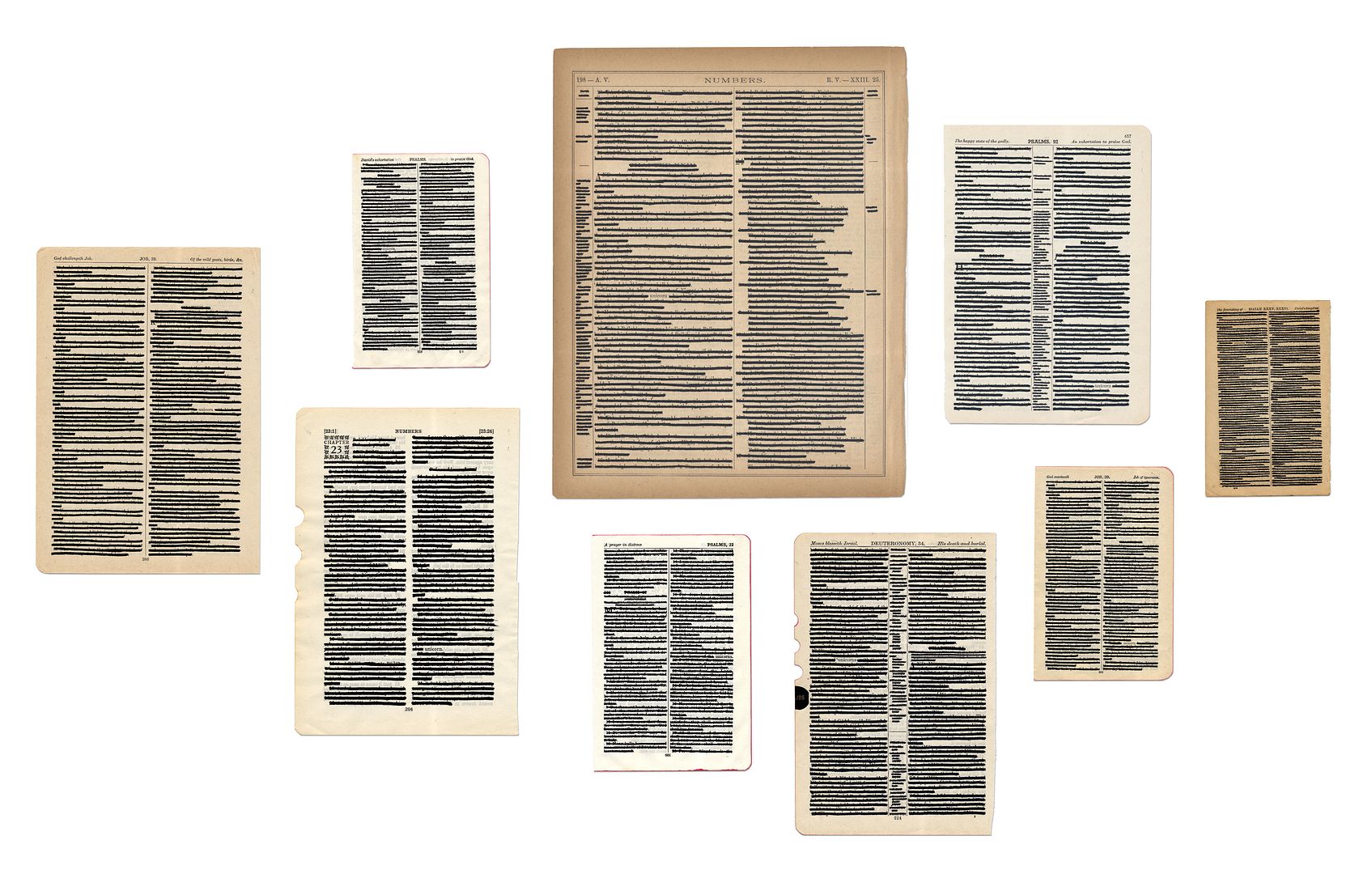
"9 Unicorns"
2011
Individual vintage bible pages
Large, juried shows are usually confused affairs. "Proof," the latest rendition of Southern Exposure's annual "entry-fee free juried exhibition of Northern California artists," is no exception. Of the 47 artworks (by as many artists), 5 pieces stand out: Kelly Falzone Inouye's "Tagging Sequence 1"; Robert Larkin's "Original Art"; Summer Mei Ling Lee's "Les preuves fatiguent la verite"; Kate Nartker's "West Main 1984"; and Someguy's "9 Unicorns."

"9 Unicorns," in particular, provided much to mull over. Someguy displays 9 pages from vintage Bibles; on each of these, all text except for the page heading and the word "unicorn" is blacked out. On his website, the artist states, "it's not commonly known, but the Bible mentions unicorns 9 times." I suspect that Someguy intends his handsomely presented editing job as a winking critique of religious literalism. By highlighting the occurrence of the word, the artist reminds viewers that mythological creatures populate the tome that literalists insist is non-fiction and most U.S. president-elects place their hands upon when they're sworn into office. Little girls notwithstanding, most of us are informed and sensible enough to dismiss unicorns as harmless hokum. Why, then, doesn't an overwhelming majority also view the Abrahamic narrative as an epic myth (i.e., fiction)?
Religious apologists point out that the Hebrew Bible makes no mention of unicorns. Instead, readers will find an ox, auroch, rhinoceros, or bison, depending on the edition. These more mundane creatures are indicated by the ancient Hebrew term re'em. The word was first translated as "unicorn" by the Greeks who, between 250 BCE and 100 CE, crafted the immensely important Septuagint, bringing the Hebrew scriptures to the Western world. Still, lest we too hastily ascribe an elevated rationality to the Jews of antiquity, scholars believe that re'em was not meant to describe an ordinary animal. The oral traditions of the Israelites and early Jews spoke of a powerful, monstrous auroch, a creature of gargantuan proportion, large enough to be mistaken for a mountain. Because they were unfamiliar with this monster bull, it's only sensible that the Greek translators and editors of the Septuagint substituted another fanciful creature, one better known to their audience; enter the unicorn.
Point being, the Bible, no matter the translation, is chock-a-block with fantasy. Most epic stories (and especially those with the staying power to warrant inclusion in a sacred narrative) are tall tales. Fictional or exaggerated narrative often pushes reality out of popular memory. The rhinoceros becomes a unicorn and the large crocodile becomes a dragon in the same way that the angler's fish grows through successive tellings; generations after the big mackerel was caught, it's Leviathan. But knowing how unicorns came to appear in some translations of the Bible doesn't justify easy dismissal of the sacred canon. Even for secular culture, the ancient stories are the closest approximation of universal myths, and they have much to offer readers with a critical bent -- much more, in fact, than they afford literalists.

Detail of "9 Unicorns"
2011
Individual vintage bible pages
But "9 Unicorns" isn't just about the relationship between religious texts and fairy tales; it's also a critique of our postmodern malady. Today, technology and globalization expose us to a heretofore unprecedented quantity of information. As a result, it's progressively more difficult to wrest fact from fiction. As the late Senator Daniel Patrick Moynihan quipped, "Everyone is entitled to their own opinions, but not their own facts." Disappointingly, most of us reject Moynihan's gospel, instead opting to go at our texts with a Sharpie, making of them whatever we wish. This willful shirking of intellectual responsibility is amply on display in the fractious debate about the meaning of the United States Constitution and the legacy of our "founding fathers." Benjamin Franklin, one of those very prophets, smartly observed, "so convenient a thing it is to be a reasonable creature, since it enables one to find or make a reason for everything one has a mind to do."

Someguy's "9 Unicorns" evidences our species' taste for selective reading, subjective "truths," and rationalizations. Ever more interconnected, such an unhealthy disposition can become dangerous. Someguy's piece is a visual fable of sorts, cautioning us to master our appetites.

Detail of "9 Unicorns"
2011
Individual vintage bible pages
Image credits: all someguy images, courtesy the artist
Subscribe to:
Posts (Atom)