Showing posts with label Selene Foster. Show all posts

Monday, June 17, 2013

Off to Sci Foo this weekend!

I'm excited to head to the Googleplex this coming weekend for Science Foo Camp! Usually referred to as Sci Foo, the eight-year-old invitation-only "unconference" is organized by Google, the science journal, Nature, Digital Science, and O'Reilly Media. Sci Foo brings together "between 200 and 300 leading scientists, technologists, writers, and other thought-leaders at the Googleplex for a weekend of unbridled discussion, demonstration, and debate." (You can learn more about SciFoo here.)

Selene and I were invited because of the BAASICS mission, and I'm pleased to see that one of the proposed SciFoo sessions is titled "Building Better Art-Science Partnerships." Naturally, we're looking forward to engaging in lively, informative conversations with other participants about the art-science interface and to explaining what it is we aim to do with BAASICS and why we feel it's so important. That said, while BAASICS got me invited, I'm super jazzed about attending (and perhaps participating in) many of the other sessions that have been proposed. A few of my favorites:
- Using Emerging Technologies to Advance Conservation
- Science Advocacy
- Rethinking National Security
- Defragging Government (How Can Scientists and Engineers Help?)
- Science and Popular Skepticism
To my way of thinking, Sci Foo's interdisciplinary angle and relaxed format are outgrowths of Bay Area culture, a place where idealism, art, science, and technology commingle, often with exciting results. I'm encouraged to see sessions like "DeFragging Government" on the list, and I have the impression that many of the Sci Foo participants recognize our responsibility -- both that of the individual and the group -- to be active beyond our more particular spheres.

BAASICS will be live tweeting from the event and I'll provide a short update -- with photographs -- after my return.

Image credit: ripped from the Sci Foo Camp website

Thursday, April 25, 2013

Hannah Addario-Berry: Brain Food/Music

Hannah Addario-Berry


Cello Bazaar, the cello-centric monthly music series founded and directed by BAASICS.3: The Deep End performer and presenter Hannah Addario-Berry, is named after its principal venue, Bazaar Cafe. The Richmond District coffee shop and event space is not far from Hannah's home, and Selene and I met her there on a particularly warm San Francisco morning to discuss her contribution to The Deep End program.

Hannah describes herself as "a fierce advocate of the music of today," and, like Selene and me, she is passionate about exposing a wide audience to that which she cares about; in her case, that's music and food. Along with Cello Bazaar, Hannah founded and runs Locaphonic, an organization dedicated to "connect[ing] Bay Area residents with our local musicians, food, and culinary artists, promoting sustainable livelihoods for artists and farmers and uniting our community through food and music."

Tuesday, April 23, 2013

When It All Comes Together

Christopher Reiger
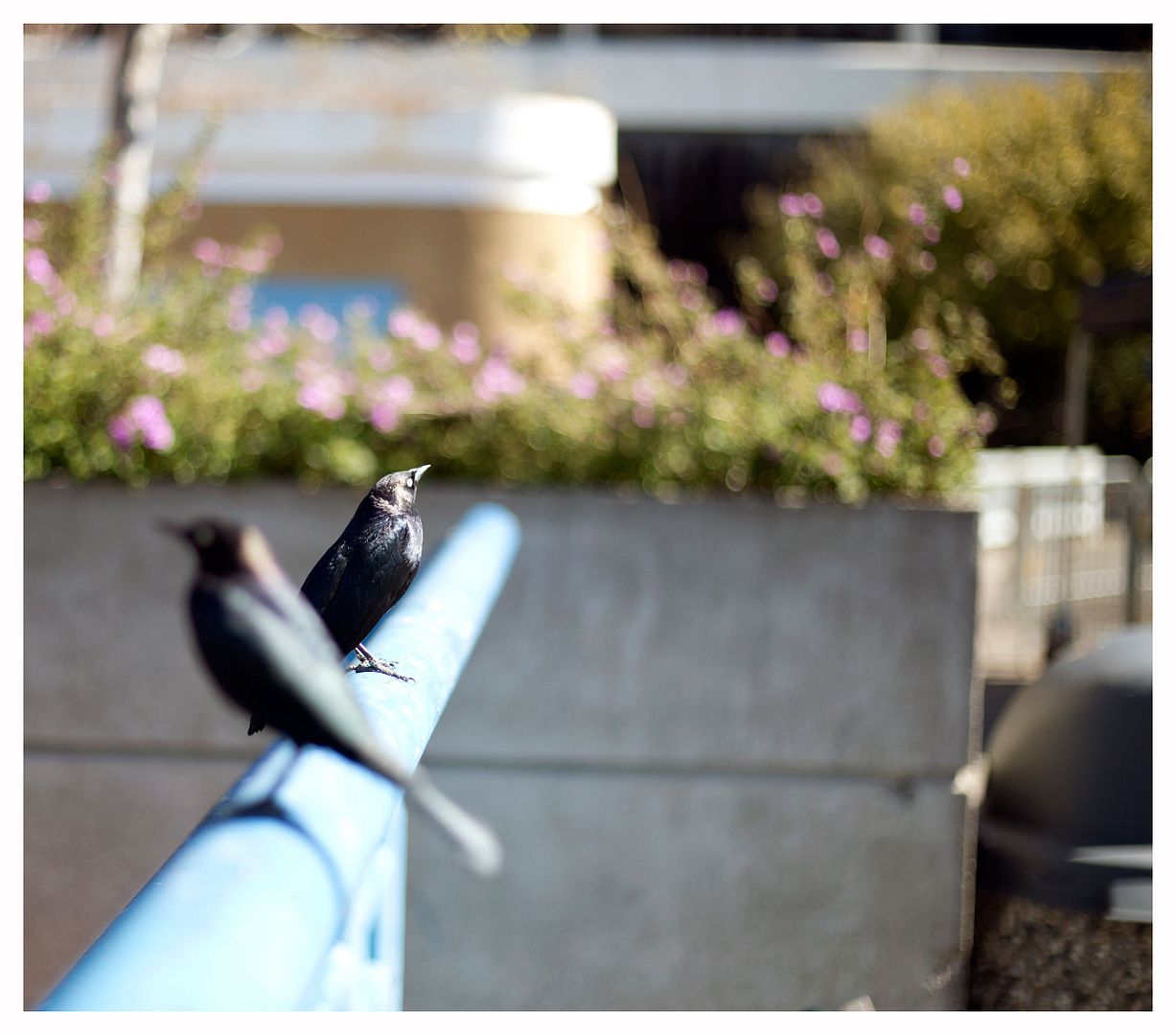
"Brewer's blackbirds"
2013
I recently promised this blog's monthly email digest subscribers that I would begin sharing updates about BAASICS (Bay Area Art & Science Interdisciplinary Collaborative Sessions), the non-profit organization that I co-founded and co-direct. Indeed, most of April's Hungry Hyaena posts are synopses of conversations had with some of the artists and scientists participating in BAASICS.3: The Deep End, our upcoming program on neurodiversities, mental illness, and creativity. (Readers can expect more of these vignettes in advance of the Monday, May 6 event.)

I've come to regard BAASICS as an important arm of my creative endeavor; it's a long-term project that provides me with a platform to help make contemporary art and science relevant and exciting to a broad audience. In many respects, BAASICS is a descendant of Synoddity, the cross-disciplinary organization I co-founded with my friend Michael McDevitt during our undergraduate years at The College of William & Mary. Synoddity made a case for conversation and interaction across professional boundaries and was, like BAASICS, animated by curiosity and wonder, something both Michael and Selene Foster, my BAASICS collaborator and co-founder, have in spades. Working on a project you're passionate about is invariably a good thing, but it's a particular pleasure when you team up with fantastic people.

Wednesday, April 17, 2013

Leeza Doreian & Creativity Explored

Leeza Doreian at work in her West Oakland studio
A few weeks ago, Selene and I met BAASICS.3: The Deep End presenter Leeza Doreian at her home in West Oakland. She and her partner, John, an artist, furniture maker, and contractor, have lived in the house for three years, and are remodeling it in their limited spare time. Shortly after moving to the Bay Area from Brooklyn five years ago, Leeza began working at Creativity Explored, a Mission-based non-profit organization dedicated to "provid[ing] artists with developmental disabilities the means to create, exhibit, and sell their art."

We sat around Leeza's dining room table, chatting, admiring reproductions of artwork, and sipping coffee in a brightly lit room that opens to her backyard; the liquid warble of a House finch punctuated our conversation. Leeza suggested that Creativity Explored and similar organizations -- Creativity Explored, Creative Growth, and NIAD Art Center are all Bay Area organizations dedicated to working with artists with developmental and/or physical disabilities, and all three were founded by Florence and Elias Katz -- aim to help people "access their own abilities."

Thursday, April 11, 2013

Dr. Walter Freeman III's chaos and creativity

Dr. Walter J. Freeman
"One profound advantage chaos may confer on the brain is that chaotic systems continually produce novel activity patterns. We propose that such patterns are crucial to the development of nerve cell assemblies that differ from established assemblies. More generally, the ability to create activity patterns may underlie the brain's ability to generate insight and the 'trials' of trial-and-error problem solving."

- Walter J. Freeman

On a sunny Tuesday morning when most of the University of California, Berkeley student body was away from campus for Spring Break, Selene and I had the pleasure of visiting Dr. Walter Freeman in his Donner Lab office. He provided us with a simple introduction to neurodynamics -- brain waves are a "special kind of noise," he explained -- before expounding on the theoretical outgrowth of his neuroscience research. Many of Walter's conclusions about the workings of the brain have an unexpected antecedent, the philosophy of the 13th century theologian, St. Thomas of Aquinas (Walter prefers the Italian formulation, Tommaso, so I will use it here).

Sunday, April 07, 2013

Dr. Indre Viskontas and the reshuffled brain

Dr. Indre Viskontas with the the "Painted Ladies"
A couple of weeks ago, Selene and I met Dr. Indre Viskontas for coffee in the Fillmore District. Although Indre's BAASICS.3: The Deep End presentation, "Release from Inhibition: The creative impulse in patients with dementia," draws primarily on her neuroscience research experience, she is a scientist and an artist. She earned a PhD from UCLA as well as a Master of Music degree from the San Francisco Conservatory of Music, where she now serves on the faculty.

In the course of our conversation, we learned how Indre's experiences as co-host of OWN's Miracle Detectives buttressed her commitment to secular humanism, and about several exciting art and music projects she's currently working on. Mostly, though, we learned about the research Indre did into the workings of creativity in patients with frontotemporal dementia.

Tuesday, March 05, 2013

Help Make BAASICS.3: The Deep End Possible


In 2011, I co-founded BAASICS (Bay Area Art & Science Interdisciplinary Collaborative Sessions), a series of San Francisco-based evening programs that brings together artists, scientists, and interdisciplinary thinkers to present engaging multi-media lectures and performances. Each BAASICS program is built around a particular theme, with participants given the green light to express their brilliance and share their passions in ways that don't always involve a Powerpoint presentation and a microphone. All BAASICS programs are free and open to the public on a first-come, first-served basis. We aim to make the contemporary arts and sciences more accessible and less esoteric, thereby inspiring guests to think about how the two spheres relate to one another and to society at large. To date, we've put on two successful programs, BAASICS.1: A Live Animal (July 2011) and BAASICS.2: The Future (June 2012). Our third program, BAASICS.3: The Deep End, will take place at the ODC Theater on May 6, 2013.

Friday, November 04, 2011

Announcing BAASICS

I'm very excited to announce that artist-curator Selene Foster and I have received a Southern Exposure Alternative Exposure Grant award for our Bay Area Art & Science Interdisciplinary Collaborative Sessions (BAASICS) proposal! BAASICS is a series of San Francisco-based evening programs that bring together local visual artists, choreographers, composers, scientists, and interdisciplinary thinkers to present engaging, multi-media lectures and performances that consider a given theme. The programs are free and open to the public.

In conjunction with A Live Animal, a group exhibition that Selene and I co-curated at Root Division in July 2011, we assembled 4 visual artists, 3 scientists, and 1 choreographer in San Francisco's ODC Theater to further explore the exhibition's theme in a program of TED Talk-like lectures and performances. The evening was a terrific success, drawing a capacity crowd and generating excited conversation during the reception that followed. Many of the attendees enthusiastically requested more such events.

With BAASICS, Selene and I hope to foment creative exchange and even long-term, mutually beneficial relationships between artists and scientists. Despite much talk of commonality between the disciplines, there is little substantive dialogue. Laudably, there are an increasing number of efforts to cultivate interdisciplinary, art-science projects; unfortunately, the lion's share of these result in vaguely "sciency" artworks or analyses of aesthetics rooted in cognitive neuroscience or sociobiology.

BAASICS isn't goal or project oriented; after all, there are many important differences between art and science, but one undeniable likeness is that the best discoveries are often stumbled upon, not planned for. We hope that BAASICS will provide a forum for artists and scientists to come together to share the ideas and practices that animate their lives and work. A principal aspiration of BAASICS is that we will learn from and be inspired by one another.

Even more important than facilitating relationships and the sharing of ideas, however, is the possibility of engaging a general audience. In the United States, the contemporary fine arts and sciences are generally set apart from popular discourse. Because BAASICS programs are free and open to the public, we hope to make the fine and performing arts and sciences less esoteric, inspiring guests to think about how art and science relate to one another and to society at large.

FYI: The theme of the second BAASIC event -- albeit the first associated with the name -- will be technology and notions of "the future." The roster of presenters hasn't been determined (it will take place in May or early June 2012), but speakers and performers might ponder, for example, robotics, artificial intelligence, medical advances and human nature, how our globalizing culture will shape technology, or dystopian versus utopian prospects. If HH readers know of Bay Area visual artists, composers, choreographers, scientists, or general smarty-pants who are engaging technology in some way and might be interested in participating, please put them in touch with me. Selene and I want to review as large a pool of applicants as possible.