Showing posts with label anthropology. Show all posts

Sunday, September 22, 2013

Navigating the Flood (Of Images)

I recently visited "A Sense of Place," Pier 24's current exhibition. It's a strong show with a broad purview that, typical of Pier 24 productions, is elegantly and thoughtfully installed. Long after I left the space, I found myself reflecting on the relationship between two of the "A Sense of Place" galleries.

Erik Kessels' installation, "24 HRS in Photos," a "room filled - floor to ceiling - with printed versions of every picture uploaded to Flickr during a 24-hour period," has generated some online buzz. The Pier 24 press release states that Kessels' provides the viewer with an opportunity "to both visually and physically experience the overwhelming number of photographs shared online." Indeed, he does.
Erik Kessels
"24 HRS in Photos"
Installation view at Pier 24
2013

I entered "24 HRS in Photos" a few minutes after leaving another room of the exhibition, one devoted to Stephen Shore's "Uncommon Places." The contrast between the spaces was jarring. The simple framing of Shore's work -- broad mats provide ample quiet space around the prints -- isolates each picture and draws the viewer in. Accordingly, I spent long minutes with each of Shore's photographs, pouring over details and "reading" the pictures like a short story. Every Main Street, bowling alley, parking lot, and road sign in Shore's photographs has a rich tale to tell.

My "read" of "24 HRS in Photos" couldn't have been more different. Upon entering Kessels' installation, I didn't know where to begin. I knew I was looking at an accumulation of individual photographs, but I could take in the work only as a whole, as a swell of blues, whites, and blacks with occasional bursts of yellow or red. As Ariel Rosen writes over at SFAQ, Kessels' "mountain of photos" is "antithetical to any careful choosing." The installation reminds us that the vast majority of images being produced today are neither intended nor received as pictures to be pondered; they are snapped, uploaded, shared, consumed, and forgotten.

Wednesday, February 09, 2011

"Scavenged Image (Remixed)"

"The price which man had to pay for his culture and civilization was the severing of this bond which had to be torn to give him his specific freedom of will. But our infinite longing for paradise lost is nothing else than a half-conscious yearning for our ruptured ties.”

-Konrad Lorenz, King Solomon’s Ring
I enjoy using Adobe Photoshop's basic tools to tweak JPEGs that I've collected online. Occasionally, my tinkering provides inspiration for a drawing. More often, the crude experiments are saved to my hard-drive on the off chance that I might later find some happy use for them.

A couple of weeks ago, while pondering a quick collage of a young man wearing a howling-wolf-with-moon t-shirt, I realized that my Photoshop amusements more plainly evidence the humor implicit in the ideas and questions that preoccupy me. Very few people comment on this aspect of my drawings and paintings; if they do, they assume the humor is unintended.

I believe this is partly a function of the artist's character informing the viewer's read of his or her art; people who don't know me well usually describe me as earnest, pensive, and not a kidder. Compounding matters, the pictures' principal mediums, watercolor and gouache, are considered the province of the Sunday painter. For many viewers, then, the drawings and paintings are either too heady or too precious.

By contrast, the Photoshop works are unpretentious "one-noters" that demand little from the viewer, yet still speak to some of the same existential questions that my works on paper do. What is our relationship to the rest of the animal kingdom and to nature, at large? How does our cataloging impulse inform those relationships? How do we reconcile imaginative myth with science, or our base animal with our spiritual aspirations?

But the Photoshop works also ask questions that my drawings and paintings do not. In what ways have we turned other species into commodities? What are the contemporary totem animals for an increasingly urban humanity? More profoundly, is the contemporary human condition one of contradiction? Although self-consciousness, advanced socialization, and technology make us exceptional and allow for the creation of culture and civilization, is it not those very developments that our inner animal rages against? Might many of our contemporary behaviors be analogues of the displacement exhibited by animals living in zoo enclosures?

Because these are related, but different questions and because the Photoshop works are more playful and wry, I've decided to present them on Hungry Hyaena. The first picture in my "Scavenged Image (Remixed)" series will follow this post. I will add more regularly.

Note: A thank you to Joy Garnett; her ongoing "Found Art/Unmonumental" series, posted on her long-running and consistently excellent blog, NEWSGrist, is, in some respects, cousin to this project.

Friday, June 11, 2010

Rescuing Hokget and Everybody Else


Several months ago, I read "The Problem With Human Compassion," an excerpt from Shankar Vedantam's book The Hidden Brain, printed in the February 19th issue of The Week. I include a lengthy selection here.
"On March 13, 2002, a fire broke out in the engine room of an oil tanker about 800 miles south of Hawaii. The fire moved so fast that the Taiwanese crew did not have time to radio for help. Eleven survivors and the captain’s dog, a terrier named Hokget, retreated to the tanker’s forward quarters with supplies of food and water.

[...] Drawn by wind and currents, the Insiko got within 220 miles of Hawaii. It was spotted by a cruise ship, which rescued the crew. But as the cruise ship pulled away, a few passengers heard the sound of barking.

The captain’s dog had been left behind on the tanker. A passenger who heard the barking dog called the Hawaiian Humane Society in Honolulu. [...] The Society alerted fishing boats about the lost tanker and soon media reports began appearing about Hokget.

[...] Money poured in to fund a rescue. Donations eventually arrived from 39 states and four foreign countries. One check was for $5,000. 'It was just about a dog,' Pamela Burns, president of the Hawaiian Humane Society, told me. 'This was an opportunity for people to feel good about rescuing a dog. People poured out their support. A handful of people were incensed. These people said, ‘You should be giving money to the homeless.’' But Burns thought the great thing about America was that people were free to give money to whatever cause they cared about, and people cared about Hokget.

The problem with a rescue was that no one knew where the Insiko was. The U.S. Coast Guard estimated it could be anywhere in an area measuring 360,000 square miles. Two Humane Society officers set off into the Pacific on a tugboat. The Society paid $48,000 to a private company called American Marine to look for the ship.

[...] The U.S. Coast Guard had said it could not use taxpayer money to save the dog, but under the guise of training exercises, the called the U.S. Navy began quietly hunting for the Insiko.

[...] Human beings from around the world came together to try to save a dog. The vast majority of people who sent in money would never personally see Hokget. It was, as Pamela Burns suggested to me, an act of pure altruism and a marker of the remarkable capacity human beings have to empathize with the plight of others.

There are a series of disturbing questions, however: Eight years before the Hokget saga began, the same world that showed extraordinary compassion for a dog sat on its hands as hundreds of thousands of human beings were killed in the Rwandan genocide.

The philosopher Peter Singer once devised a dilemma that highlights a central contradiction in our moral reasoning. If you see a child drowning in a pond—and you would ruin a fine pair of shoes worth $200 if you jumped into the water—would you save the child or save your shoes? Most people react incredulously to the question; obviously, a child’s life is worth more than a pair of shoes. But if this is the case, Singer asked, why do large numbers of people hesitate to write checks for $200 to a reputable charity that could save the life of a child halfway around the world—when there are millions of children who need our help?

The answer is that our moral responsibilities feel different in these situations; one situation feels visceral, the other abstract. We feel personally responsible for one child, whereas the other is one of millions who need help - there are many people who could write that check.

[...] The brain is simply not very good at grasping the implications of mass suffering. Americans would be far more likely to step forward if only a few people were suffering or a single person were in pain. Hokget did not draw our sympathies because we care more about dogs than people; she drew our sympathies because she was a single dog lost on the biggest ocean in the world. [...] We are best able to respond when we are focused on a single victim."
Vedantam and Singer are correct; we humans act more compassionately when we are able to put a face to a cause, yet too many faces dull our response.

I've noticed such a benumbing in myself recently, an unexpected consequence of my transitioning from New York City to San Francisco. Both cities have substantial homeless populations, but panhandling in San Francisco is far more common. My street charity policy, modeled on the approach of a rabbi I heard lecture, is simple enough: I give change to any panhandler who says that he or she will use the money for food (or cites hunger as their reason for begging). I don't give change to those individuals requesting money for any other reason. In New York City, confronted with a few beggars each day, I typically gave change two or three times every week. In San Francisco, however, beggars ask for handouts on every other block, and a good number of them say that they're hungry. If I hold to my standard, I'll give change two or three times a day, if not more often! Shamefully, I've noticed that I've almost ceased giving during my visits to San Francisco.

This is a personal failure that I must address. Each of those many faces is an individual, a single person in need, despite the fact that their larger numbers and concentration counter-intuitively make them relatively anonymous or invisible. The rabbi's rule should be no less applicable in San Francisco than it is in New York. I'm confronted, then, with more need, and I must respond in kind; a hungry person is a hungry person.

But what about a hungry dog? Is Vedantam right to suggest that the thousands of people who contributed money to the Hokget search did not "care more about dogs than people"? Not exactly.

Our species' evolved, inborn behaviors haven't made our adaptation to the globalized world easy. In fact, it seems that contemporary humans are increasingly suspicious of other humans, especially of those outside our respective tribe, whereas animals (and perhaps especially dogs) are seen as uncomprehending innocents. I don't mean to suggest that no one cares about miners trapped in a coal mine, but it's clear that the little girl trapped in a well sells more newspapers, and that the little dog trapped on an abandoned tanker not only sells newpapers, but also inspires a flood of unsolicited donations and generates public outcry.
"Facing intense public pressure to save Hokget, government officials concluded that asking the Navy to sink the tanker—750 miles from Hawaii and drifting away from the distant U.S. mainland—posed unacceptable environmental risks. The Coast Guard finally agreed to access $250,000 in U.S. taxpayer funds to recover the Insiko. It wasn’t officially called an animal-rescue effort. Instead it was authorized under the Oil Spill Liability Trust Fund, based on the argument that if the aimless Insiko managed to drift westward for 250 straight miles, it might run aground on Johnston Atoll and harm marine life.

[...] On April 26, nearly a month and a half after the dog’s ordeal began, the tugboat’s crew found the Insiko and boarded the tanker. Hokget was still alive, hiding in a pile of tires. [...] Hokget arrived in Honolulu on May 2 and was greeted by crowds of spectators, a news conference, banners welcoming her to America, and a red Hawaiian lei."
What a marvelously strange species we are!? I applaud our ability to extend compassion to other animals (we're one of handful of species that have demonstrated such empathic ability), but I wonder at our brains' curious moral calculus.

I suppose all I can do is begin with myself, and humbly pledge to keep my pockets filled with coins.

Image credit: ripped from Corbis Images

Saturday, January 23, 2010

Quantity or Quality?


Nathan Abels
"Passage"
2009
Acrylic on Panel
24 × 48 inches
"The world we inhabit is not, in this sense, a determinate set of objective processes. It is our larger flesh, a densely intertwined and improvisational tissue of experience. It is a sensitive sphere suspended in the solar wind, a round field of sentience sustained by the relationships between the myriad lives and sensibilities that compose it. We come to know more of this sphere not by detaching ourselves from our felt experience, but by inhabiting our bodily experience all the more richly and wakefully, feeling our way into deeper contact with other experiencing bodies, and hence with the wild, intercorporeal life of the Earth itself.

[...]

In truth, it’s likely that our solitary sense of inwardness (our experience of an interior mindscape to which we alone have access), is born of the forgetting, or repressing, of a much more ancient interiority that was once our common birthright: the ancestral sense of the surrounding earthly cosmos as the voluminous inside of an immense Body, or Tent, or Temple.

[...]

Experiential qualities once felt to be proper to the surrounding terrain—feeling-tones, moods, the animating spirits-of-place known to reside in particular wetlands and forests—all lost their home with the dissolution of the enclosing, wombish character of the pre-Copernican cosmos. Such qualities now had no place in the surrounding world, itself newly conceived as a set of objects connected by purely external, mechanical relationships: a world of quantities. Unlike quantities, qualities are fluid, mercurial realities arising from the internal, felt relations between beings. Qualities—these ephemeral and fluid powers—require at least a provisional sense of enclosure to hold them. When they could no longer be contained by the visible world (no longer encompassed and held within the curved embrace of the spheres), these ambiguous, ever-shifting qualities quit the open exteriority of the physical surroundings, taking refuge within the new interiority of each person’s 'inner world.' Henceforth they would be construed as merely subjective phenomena."

- David Abram, "The Air Aware", Orion Magazine, September/October 2009
David Abram's essay "The Air Aware" eloquently expands on ideas that I attempt to present succinctly in my artist statement. Brevity is difficult, however, for those of us who are preoccupied with the exciting interchange of anthropology, ecology, ethology, phenomenology, and theology.

It's interesting, then, that the work of visual artists who explore this conceptual terrain is often quietly awesome. Interesting...and yet so natural.


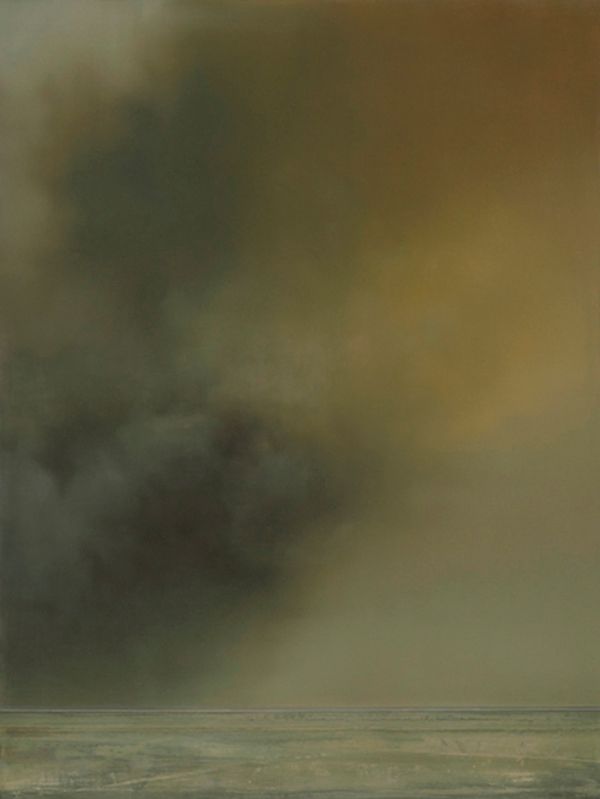
Christopher Saunders
"Whitenoise Suite no.6"
2009
Oil on linen
24 x 18 inches

Image credits: both painting reproductions, courtesy the artists

Saturday, September 19, 2009

Again, into the gloaming

The spiral of time has come round on itself, slightly displaced from this point a year gone.

It is Rosh Hashanah today, the Jewish New Year, and I'm in a pensive mode. Below, I repost a selection from "Almost Twilight," last year's musing on autumn's advent, creative inspiration, twilight, crepuscular animals, hallucinogens, and reflection.

But, first, I'd like to highlight two projects relevant to the season.

- Yusuf Misdaq is an artist, poet, and musician who shares my universalistic mystical inclination. Almost a month ago, he began Palace Prayers, "the aim [of which] is to create a new work of art for every day of Ramadhan, 2009."

A blog-like site presents each day's original work. I encourage readers to visit. You can also listen to a National Public Radio interview with Yusuf here.

- New Yorker editor Ben Greenman has co-organized, with writer Nicola Behrman and Reboot's Amelia Klein, 10Q, a Yamim Noraim project for people of all faith (or lack of faith) backgrounds. From the website:
"10Q was inspired by the traditional ten days of reflection that occur between the Jewish holidays of Rosh Hashanah and Yom Kippur, a period of time that’s long been considered an opportunity to look at where you're at, where you've come from, and where you're heading. Whether you're Jewish or not, though, 10Q is a great way for anyone to look back at the year that’s past, look ahead at the year to come, and take stock. That’s a beautiful thing in any language."
Sign up here.

Shana tova!

+++++


"Darkness within darkness.
The gateway to all understanding."
-Lao tzu, "Tao Te Ching"

In New York, recent mornings have greeted us with a pleasant chilliness. Fall is almost here, and winter is just around the corner. For most folks, the prospect is daunting. Not so for me. Each year at this time, a bounce finds my step and I'm happily overwhelmed by a spate of ideas. I know, however, that the creative juices will before long transmute into keen brooding. Late fall and winter nurture a pensive mind.

When the afternoons darken and the mercury dips, I like to take bundled winter strolls through the streets of Manhattan or Queens. Other pedestrians hustle about, intent on achieving their respective indoor destinations, but I find my thoughts best served by a steady pace, one forgiving of some intentioned aimlessness. I spend these walks looking up to where the melancholic sky meets the buildings that scrape it, admiring the resilience of foraging House sparrows, taking note of the way traffic lights glow more brightly in crisp, cold air and marveling over the many lives that move around me. I like to think of this mindful meandering as a form of prayer, or perhaps a communion, and I treasure the insights that are sometimes happened upon.


Curious about the rites, beliefs, and texts of various religions (and particularly those of Judaism), I've been thinking this week about the coming high holy days. Next Monday is Rosh Hashanah, the first of Judaism's ten "days of awe," or Yamim Noraim. Like my winter walks, the Yamim Noraim are given over to contemplation. During the ten high holy days, an observant Jew should meditate on the actions of his last twelve months and, then, on Yom Kippur, the last of the "days of awe," fast and repent for any wrongdoing. In other words, a conscientious Jew begins the new year by reckoning with his past. Although Rosh Hashanah is only one of four Jewish New Years, each attached to a specific set of guidelines and meaning, I find the holiday's position with regard to the seasons of particular interest.

Considered the New Year for humans, animals, calendar calculation, and contracts, Rosh Hashanah arrives with the ploughing of summer into fall. If one considers fall equivalent to dusk and winter to night, then the Jewish New Year, like the Jewish day, begins at twilight in the northern hemisphere. The notion of a day extending from sunset to sunset runs slightly counter to the popular conception of morning time as a birthing, or spring, with the hours moving through summer at mid-day, fall in the evening, and finally into winter, night and death. But the Judeo-Christian tradition is pastoral, founded on an agricultural reckoning. It makes sense, then, that the day should end when the sun falls away. The new day begins with night; the beginning is darkness, a time when all man can do is rest and await the return of the sun's workable hours. In rural farming communities, this pattern holds today, though the blue glow of television has altered habits in even the most rustic counties. Still, the consummate urbanite Oscar Wilde's quip that "people in the country get up early because there's so much to do, [and] they go to bed early, because there's nothing to talk about" remains generally accurate.


Growing up in such a community, I learned early that if twilight is a conclusion for the farmer, it is a commencement for many other creatures. A patient hunter who remains in his deerstand as the final light retreats might see bats dart and dip in aerial pursuit of insects. He may also see an opossum, fox, raccoon, skunk, or even his intended quarry, deer, though it is not legal to shoot after the sun sets. Driving or biking on "backroads," these animals reveal themselves by reflecting light from a car's headlights or a bike's front beam. The tapetum lucidum, a layer of tissue behind the retina of crepuscular and nocturnal species, allows the animal to see better in near or total darkness, but this layer also produces eyeshine that discloses the creature's presence to human torch bearers. Depending on the species and the angle of approach, we can identify the animal by the color of its eyeshine: the white-yellow lights at knee height belong to the red fox; the orange orbs in the low branches of a tree are an opossum; the yellow beams tall over the road are white-tailed deer; the brilliant white spots that appear so near the ground expose a resting whippoorwill.

Imagine the shock of the early humans when they first noticed the glowing embers that moved just outside the reach of their warm firelight. The agricultural tribes that would become the people of the Torah, having abandoned much of their nomadic, hunter-gatherer roots, were particularly afraid of the dark, creeping world outside that circle of light. To be caught in the gloaming, away from a human settlement or encampment, was surely a terrifying possibility.

Indeed, the dark months, like those black, antediluvian nights, remain an ordeal for many people . But they can also be understood as a gateway opportunity. It is fitting, I think, that Jews begin their new year by taking stock, a formidable task if undertaken with thoroughness and honesty. I approached my experiences with hallucinogenic drugs in an analogous way; what most people would call a "bad trip," I viewed as an opportunity for introspection. 'Why has my brain created this awful idea?,' I asked myself. 'What does that tell me about my relationship to x or y, or about my fear of a, b, or c?' The cold, gloomy months, like bad trips, nightfall, and deep melancholy, can be challenging, even endangering, but in an increasingly mediated and accelerated world culture, the difficult passages are of premium value.


But whatever religious label I eventually pin to my lapel (or discard), periods of solemn self-examination are likely to remain a critical part of my identity and annual experience, and these have so far coincided with winter and come on the heels of a fall surge in the creative impulse. Although modernity misunderstands fall to be the beginning of an end, it is only another beginning. Shana tova umetukah, folks. My favorite season is moving in, and our shadows grow longer.

Photo credits: "Athens Park, Astoria," "Central Park, Manhattan," "Heron's Foot Moon, Virginia," "Branches," all by Christopher Reiger, 2007 and 2008

Monday, September 14, 2009

Kimmel Harding Nelson Residency: Day 8


1884 Button steam engine; Museum of FireFighting; Nebraska City

Appreciating Varieties of Evolution

"Life," writes Loren Eiseley, Nebraska's latter day Thoreau, "is multitudinous and emergent in the stream of time." Considering the evolution of flowering plants, Eiseley explains,
"The true flower - and the seed that it produced - was a profound innovation in the world of life. In a way, this event parallels, in the plant world, what happened among animals. Consider the relative chance for survival of the exteriorly deposited egg of a fish in contrast with the fertilized egg of a mammal, carefully retained for months in the mother's body until the young animal (or human being) is developed to a point where it may survive. The biological wastage is less - and so it is with the flowering plants. [...] The true flowering plants (angiosperm itself means 'encased seed') grew a seed in the heart of a flower, [...] but the seed, unlike the developing spore, is already a fully equipped embryonic plant packed in a little enclosed box stuffed full of nutritious food. [..] The ramifications of this biological invention were endless. Plants traveled as they had never traveled before. [...] The well-fed, carefully cherished little embryos raised their heads everywhere."
Reading Eiseley, I'm struck by how applicable the language he uses to elucidate plant evolution - innovation, wastage, development, invention - is to the maturation and proliferation of human technology. Our machines of steel and plastic are, like the angiosperms, natural and transient shapes of life's eternal striving; they are imperfect adaptations of the moment.


Antique Tractor; Mayhew Historical Village; Nebraska City

We humans are foolishly arrogant, and often conceive of ourselves as the zenith of physical evolution. The sacred books of our species' major religions claim that we are "made in God's image," and, because most folks are literal-minded, unimaginative, or loathe to admit their own cosmic insignificance, that claim is usually understood to mean that God looks like us, and that we look like God. That's a shame, because the claim's power is metaphorical; humanity is "made in God's image," as is the flower or the carpenter bee or the black bear. For all of these species and, indeed, for God, evolution rolls on.

Humans are unable to outwardly observe our continuing development because we are too close to it, and too short-lived a species. Nevertheless, it is happening. Our technological shifts are the most apparent evidence of this ceaseless process. And what technological transitions each modern human is witness to! Like the growth of a child to a parent, the metamorphosis appears a slow, steady progression, but a retrospective survey reveals an astonishing pace. I periodically marvel at the evolution of computer and video games in (roughly) my own lifetime, from the home version of "Pong" to "Halo," but what of the computers themselves or, for that matter, the Internet?

Consider, for a moment, the technological, political, and social revolutions undergone by our country during Mike Bauer's tenure with the Nebraska City Fire Company #1 and the Great Western Fire Company #1. Bauer joined the company in 1865, at the close of the American Civil War. At that time, "bucket brigades," lines of volunteers passing leather buckets from hand to hand, were the primary way of combating blazes. Bauer climbed the fire fighter ranks, from engineer, to foreman, to chief, and served the growing town through the Spanish-American War, the First World War, and the federal introduction of Prohibition and women's suffrage, in 1920. During this time, the fire department's methods evolved from the "bucket brigade," to horse-drawn pumps, to steam-powered pump engines (like the Button engine; pictured above), to, finally, gasoline-motor pumper trucks (like the 1926 Seagrave pumper; pictured below). All of this change, in Bauer's 67 years of active service! It's a happy wonder to contemplate!


1926 Seagrave Pumper Engine; Museum of FireFighting; Nebraska City

Photo credits: all photos, Hungry Hyaena, 2009

Thursday, September 10, 2009

Kimmel Harding Nelson Residency: Day 4


Oregon Trail Marker; Nebraska City

Manifest Destiny

On the eastern edge of Nebraska City's Central Avenue stands a simple cairn with a plaque, a monument to the Oregon Trail. The plaque reads, in part,
"Official Oregon Trail Marker: [...] overlaid branch of the Oregon Trail, 1849, from the steamboat landing thousands started westward to Pike's Peak, Salt Lake, California and Oregon."
My gaze drifts from this humble memorial to Central Avenue, Nebraska City's main thoroughfare. Today, automobiles move east and west on the two-laned, paved drag. 160 years ago, families traveling by covered wagon set west on a dirt path, intent on making a better life for themselves.

Just think of it; that was 160 years ago! The territories of the western United States were then largely unsettled by immigrants of European extraction. The notion of Manifest Destiny, the Providential assumption that all of North America belonged to a white, male God and, in turn, to His European sons and daughters, was only introduced in 1845. At the time, the American Civil War had yet to be fought, electricity had yet to be harnessed as a popular power source, and human flight was only a hopeful diagram in a sketchbook. 160 years is just three human lifetimes, a drop in history's bucket, a nearly invisible mark on the geologic timeline.


Nebraska City, circa 1860

As I scribble down these thoughts, a small slug moves over the concrete by my left foot. 300 million years ago, our human face was not so dissimilar from the slug's. As Loren Eiseley describes it in The Immense Journey, the steady march of time, whether surveying a span of 300 million or 160 years, is "life reaching out, [...] that magnificent and agelong groping [...] still in progress. [...] Content is a word unknown to life; it is also a word unknown to man."


Oregon Trail Marker and Central Avenue view; Nebraska City

The Windmill Shop

Early this morning, fellow KHN resident Manya Fox and I were granted access to the now closed Kregel Windmill Company shop, located on Central Avenue. For the most part, the shop's interior is just as the employees left it, a time capsule testament to the labor and ingenuity that allowed for the settling of the American west. As our gracious host put it with a grin, "Some people say the six gun settled the west, but it was really the windmill."

Early explorers, Lewis and Clark included, characterized the land that would become the Nebraska Territory as the "Great American Desert," an area unfit for human habitation. But, because of windmills, the plains would soon become some of the most fertile farming land in the United States. Homesteaders needed water to survive, of course, and the windmill was the only efficient way to draw water up from wells 100 feet deep. Wood and, later, metal blades were cut, shaped, and hammered in the Nebraska City shop, an outfit run by the "taskmaster" Kregel brothers, immigrants from Germany.

The brothers are dead now, the Windmill Company is closed and in need of preservation, and water-pumping windmills have, in most places, been replaced by electric pumps. Technology and livelihoods gone with, as it were, the wind.


Accounting desk; Kregel Windmill Company; Nebraska City

Or are they? Today, towering windmills of steel and aluminum, better known as turbines, are being erected the world over. These turbines are an effective means of energy collection that also offer promise of a thriving, low impact industry. In the windmill shop, as I admired a lathe built in the early 1860s, Eiseley's words echoed; the "magnificent and agelong groping" continues.

Beyond Manifest Destiny

Nebraska City's Morton-James Public Library has a small NASA exhibition on display now. As I shuffled around the library gallery this morning, I marveled that the Space Shuttle Orbiter, the "vehicle that carries the crew and payloads to and from Earth orbit," must reenter Earth's atmosphere and land without power. It "glides back to Earth and lands on a runway. [...] Careful guidance control is needed to assure that it is properly positioned to reach the desired landing site." This astonishing feat of engineering and science is made that much more impressive if we consider that it was first realized just 130 years after the homesteaders and pioneers disembarked from Nebraska City's steamboat landing.

To those individuals who emphasize humanity's bloody excesses and potentially catastrophic exuberance above all else, I can only express my bafflement. Truly, to study evolution and the progress of history and science is to be necessarily possessed by eudaimonia. What great feats are forthcoming? The sun is shining; the crickets and katydids are singing; the world is electric with possibility.


Refurbished blades; Kregel Windmill Company; Nebraska City

Photo credits: all photos, Hungry Hyaena, 2009; Nebraska City illustration, ripped from Richard Gehling's "The Pike's Peak Gold Rush"

Friday, August 21, 2009

A Practice of Naming


Christopher van Donkelaar
"Adam Naming the Animals"
Handmade pigments and mixed media
2008
"Praise to the first man who wrote down this joy clearly, for we cannot remain in love with what we cannot name."

- Robert Bly
A lover of etymology and taxonomy, one of my most cherished reference books is Arthur Frederick Gotch's Latin Names Explained: A Guide to the Scientific Classification of Reptiles, Birds and Mammals. In it, Gotch catalogs and dissects the scientific names of some 4,000 animal species. That number appears relatively insignificant when we consider that biologists estimate 25,000 species of bird, mammal, and reptile currently exist on Earth, but Gotch's record is so far unparalleled. Each entry provides the animal's common and scientific names, followed by an explication of the Latin and Greek and, sometimes, a blurb about the species' range and habitat.

For example, consider Gotch's entry on one of my very favorite North American snake species:
Copperhead Agkistrodon contortrix
agkistrodon (Gr) a fish-hook; odon (Gr) a tooth; a reference to the curved fangs, though of course they are not barbed; contorqueo (L) I twist, turn; contortus (L) full of turns, twisted; contortrix (L) one that is able to turn, twist. Inhabiting the south-eastern part of the USA including Florida. The top of the head is reddish brown.
Although the range information suggests that the copperhead is more confined to the southeastern United States than the species and subspecies actually are - they thrive in New York State, for example - Gotch's entry informs readers that the snake commonly called a copperhead is universally and technically named Fish-hook shaped tooth twister or, if you prefer, The Twisting One With Hook Shaped Teeth. Knowledge of this name allows me to appreciate the beautiful reptile from another angle.

But what's in a name, really?

Although I'm generally baffled by Biblical literalism, I appreciate the Genesis accounts of creation for their gratifying metaphor. In particular, I'm drawn to rabbinic and Jewish mystics' interpretations of the conjoined, aboriginal narratives. More so than their Christian counterparts, Jewish theologians and mystics endow language and names with ontological significance. The Hebrew alphabet is understood as a powerful code: the written word is creative potential, and the spoken word, procreative. The god of Genesis 1 creates neither with a wave of the hand nor by shaping raw material, but by speaking the world into being; annunciation and incantation are the means of creation. Because of the vocative nature of naming, observant Jews place great value on words and speech. (They are even prohibited utterance of the tetragrammaton, the four-letter Hebrew name of God, transliterated as Yahweh. Appropriately enough, the colloquial name for God is Hashem, or "the word.")

In Genesis 2, the creator god is anthropomorphized and physically involved with creation, shaping man and the other animals from earth. Yet the power of language and names remains significant in this account. God asks Adam, the first naked ape, to name all of the other animal species. That's no mean task, and apparently Adam died before he finished the job. His descendants, at least the taxonomists among them, are still working at the task of naming.

But even those individuals who do not share my affection for taxonomy will find value in a practice of observation and naming. As Carol Kaesuk Yoon writes in her recent New York Times paean to taxonomy, "Reviving the Lost Art of Naming the World,"
"Even when scads of insistent wildlife appear with a flourish right in front of us, and there is such life always — hawks migrating over the parking lot, great colorful moths banging up against the window at night — we barely seem to notice. We are so disconnected from the living world that we can live in the midst of a mass extinction, of the rapid invasion everywhere of new and noxious species, entirely unaware that anything is happening. Happily, changing all this turns out to be easy. Just find an organism, any organism, small, large, gaudy, subtle — anywhere, and they are everywhere — and get a sense of it, its shape, color, size, feel, smell, sound. Give a nod to Professor Franclemont and meditate, luxuriate in its beetle-ness, its daffodility. Then find a name for it. Learn science’s name, one of countless folk names, or make up your own. To do so is to change everything, including yourself. Because once you start noticing organisms, once you have a name for particular beasts, birds and flowers, you can’t help seeing life and the order in it, just where it has always been, all around you."
Beautiful. Let's name something.

See also "The Plant Whisperer," another brief HH essay considering similar ideas.

Image credit: van Donkelaar painting ripped from the Nurturing Faith website

Tuesday, June 09, 2009

Offerings, Tallies, Records


Christopher Reiger
"cost benefit analysis"
2008
Pen and sumi ink, gouache, watercolor and marker on Arches paper
12 x 12 inches
"What if, while you read the last few paragraphs, something in the world has changed? What if, during the past five minutes, someone, somewhere, sent you a text? Shouldn’t you go and check?

Being addicted to the wired universe might be perfectly healthy, of course, and it’s certainly defensible beneath the triumvirate of technology, curiosity, and progress. I’m the first to admit that there’s something enchanting and invigorating about my computer. There’s magic in reading a note from a friend in Rome and clicking through Halloween pictures from New Jersey and verifying John Steinbeck’s birth date in two clicks. The Internet is indeed its own strange, blessed fountain of light.

[...I'm] not the first to wonder about all this, [...] not the first to sense that maybe our shared life is rushing by too quickly, too feverishly. [I'm] not the first to feel as if [I'm] scrambling to make [my voice] heard against an infinite and obliterating silence.

During the five days [...] I spent in the mountains, [I] saw lots of Shoshone pictographs, paintings made in caves mostly, and under overhangs: finger-painted elk and owls and dogs and triangle-bodied hunters with bows. Many of the pictographs in that area include hash marks, like rows of fence posts scratched downhill, but it’s anyone’s guess as to what these marks originally meant. Maybe they were offerings to the spirit world, or tallies of successful hunts, or records of vision quests. Maybe they were the consequence of someone sitting beside a fire and thinking happily away.

Whatever they once meant, they mean something else now. They mean memories are fragile, beliefs are tenuous, contexts are temporary. They mean nothing is stable—not mountains, not species, not cultures, not e-mail."

- Anthony Doerr, "Am I Still Here?" (from the January/February issue of Orion Magazine)

Thursday, May 07, 2009

It's official...again!


The debate over the classification of Homo floresiensis as a new species was settled four years ago.....or so we thought.

Although The Guardian article I highlighted at the time (March 4, 2005) declared the "hobbit saga ended" and suggested that the small hominid was indeed a new species, today's Guardian announces that "new evidence has emerged to show that [the] extinct, diminutive people known as 'hobbits' from the Indonesian island of Flores belonged to a new species of primitive humans."

So the "new species" classification is official.....again? Did The Guardian and, along with it, most of the popular press jump the gun in 2005?

In all fairness, the recent headline's claim of finality is more true than that asserted by The Guardian in 2005. The new evidence is both anatomical and cerebral, prompting many previously skeptical scientists to accept Homo floresiensis as a distinct species. Still, some respected anthropological researchers remain unconvinced. Their skepticism is given fair due in leading scientific journals like Nature, but it doesn't receive much (if any) attention in the popular press.

In recent months, Bioephemera has been covering the often frustrating divide between scientific research and science reporting. Her posts are excellent; I encourage interested readers to check them out. (Here, here, and here.)

Saturday, March 21, 2009

The Fertile Crescent


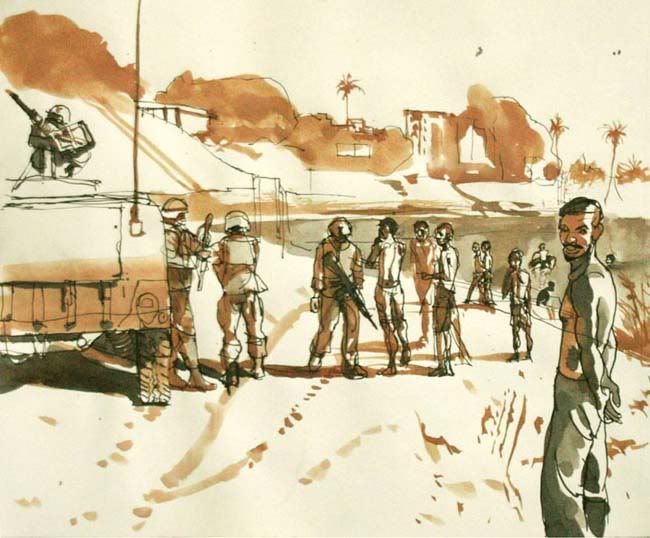
Steve Mumford
"Soldiers and Bathers, Tigris River, 2003"
2003
Ink on paper
From Mumford's Baghdad Journal


What a marvel to consider the historical and global reverberations of human activity in the Fertile Crescent! Few regions of the globe remain untouched by the profound ideologies and prejudices birthed between the rivers...

...and still the fighting continues.

Photo credit: Artwork reproduction ripped from artnet

Thursday, September 25, 2008

Almost Twilight


"Darkness within darkness.
The gateway to all understanding."
-Lao tzu, "Tao Te Ching"


In New York, recent mornings have greeted us with a pleasant chilliness. Fall is almost here, and winter is just around the corner. For most folks, the prospect is daunting. Not so for me. Each year at this time, a bounce finds my step and I'm happily overwhelmed by a spate of ideas. I know, however, that the creative juices will before long transmute into keen brooding. Late fall and winter nurture a pensive mind.

When the afternoons darken and the mercury dips, I like to take bundled winter strolls through the streets of Manhattan or Queens. Other pedestrians hustle about, intent on achieving their respective indoor destinations, but I find my thoughts best served by a steady pace, one forgiving of some intentioned aimlessness. I spend these walks looking up to where the melancholic sky meets the buildings that scrape it, admiring the resilience of foraging House sparrows, taking note of the way traffic lights glow more brightly in crisp, cold air and marveling over the many lives that move around me. I like to think of this mindful meandering as a form of prayer, or perhaps a communion, and I treasure the insights that are sometimes happened upon.


Curious about the rites, beliefs and texts of various religions (and particularly those of Judaism), I've been thinking this week about the coming high holy days. Next Monday is Rosh Hashanah, the first of Judaism's ten "days of awe," or Yamim Noraim. Like my winter walks, the Yamim Noraim are given over to contemplation. During the ten high holy days, an observant Jew should meditate on the actions of his last twelve months and, then, on Yom Kippur, the last of the "days of awe," fast and repent for any wrongdoing. In other words, a conscientious Jew begins the new year by reckoning with his past. Although Rosh Hashanah is only one of four Jewish New Years, each attached to a specific set of guidelines and meaning, I find the holiday's position with regard to the seasons of particular interest.

Considered the New Year for humans, animals, calendar calculation and contracts, Rosh Hashanah arrives with the ploughing of summer into fall. If one considers fall equivalent to dusk and winter to night, then the Jewish New Year, in the northern hemisphere, like the Jewish day, begins at twilight. This interpretation does not hold with regard to the geography and climate of the Torah's narrative; Palestine is (and was) a land with only two notable seasons, called in the Talmud "the days of sun" and "the days of rain," but our understanding of scripture, be it theological or scientific, must change with context if it is to remain relevant to our contemporary lives. The notion of a day extending from sunset to sunset runs slightly counter to the popular conception of morning time as a birthing, or spring, with the hours moving then through summer at mid-day, fall in the evening and finally into winter, night and death. But the Judeo-Christian tradition is pastoral, founded on an agricultural reckoning of the lunar and solar cycles. It makes sense, then, that the day should end as light fades or vanishes, and begin again while it remains dark. In rural farming communities, this pattern holds today, though the blue glow of television has altered habits in even the most rural of counties. Still, as Oscar Wilde, a consummate urbanite, quipped, "people in the country get up early because there's so much to do. They go to bed early, because there's nothing to talk about."


Growing up in such a community, I learned early that if twilight is a conclusion for the farmer, it is a commencement for many other creatures. A patient hunter who remains in his deerstand as the final light retreats might see bats dart and dip in aerial pursuit of insects. He may also see an opossum, fox, raccoon, skunk or even his intended quarry, deer, though it is not legal to shoot after the sun sets. Driving or biking on "backroads," these animals reveal themselves by reflecting light from a car's headlights or a bike's front beam. The tapetum lucidum, a layer of tissue behind the retina of crepuscular and nocturnal species, allows the animal to see better in near or total darkness, but this layer also produces eyeshine that discloses the creature's presence to human torch bearers. Depending on the species and the angle of approach, we can identify the animal by the color of its eyeshine: the white-yellow lights at knee height belong to the red fox; the orange orbs in the low branches of a tree are an opossum; the yellow beams tall over the road are white-tailed deer; the brilliant white spots that appear so near the ground expose a resting whippoorwill.

Imagine the shock of the early humans when they first noticed the glowing embers that moved just outside the reach of their warm firelight. The agricultural tribes that would become the people of the Torah, having abandoned much of their nomadic, hunter-gatherer roots, were particularly afraid of the dark, creeping world outside that circle of light. To be caught in the gloaming, away from a human settlement or encampment, was surely a terrifying possibility.

Indeed, the dark months, like those black, antediluvian nights, remain an ordeal for many people . But they can also be understood as a gateway opportunity. It is fitting, I think, that Jews begin their new year by taking stock, a formidable task if undertaken with thoroughness and honesty. I approached my experiences with hallucinogenic drugs in an analogous way; what most people would call a "bad trip," I viewed as an opportunity for introspection. 'Why has my brain created this awful idea?,' I asked myself. 'What does that tell me about my relationship to x or y, or about my fear of a, b or c?' The cold, gloomy months, like bad trips, nightfall and deep melancholy, can be challenging, even endangering, but in an increasingly mediated and accelerated world culture, the difficult passages are of premium value.


I'm neither Jewish nor properly Christian, despite an Episcopal baptism. I wouldn't describe myself as lapsed, either; from early adolescence, I proudly labelled myself an atheist. Today, however, I prefer the term pantheist, and I find my interest in faith choices and spirituality reinvigorated, though my conception of God is fundamentally unchanged from my Nietzsche-Nine Inch Nails days.

I've taken particular interest in Jewish practice, both historical and contemporary, although the concept of an omniscient, interventionist creator is anathema. Unitarian Universalism, a relatively young sect that grew out of Unitarianism, is also exciting to me, though it is so all-inclusive and plural - Christian, Muslim and Jewish believers sit in UU pews alongside Buddhists, atheists and agnostics - that it might be more fairly deemed an ethical community than a religious sect. But whatever label I eventually pin to my lapel (or discard), periods of solemn self-examination are likely to remain a critical part of my identity and annual experience, and these have so far coincided with winter and come on the heels of a fall surge in the creative impulse.

Although modernity misunderstands fall to be the beginning of an end, it is only another beginning. Shana tova umetukah, folks. My favorite season is moving in, and our shadows grow longer.

Photo credits: "Athens Park, Astoria," "Central Park, Manhattan," "Heron's Foot Moon, Virginia," "Branches," all by Christopher Reiger, 2007 and 2008

Tuesday, July 03, 2007

Gallery Report: June 27, 2007

Part Two : Totemic Art


"Power Figure: Nkondi" (detail)
Wood and metal
approx. 24 3/4 x 8 x 8 inches

* * * * *


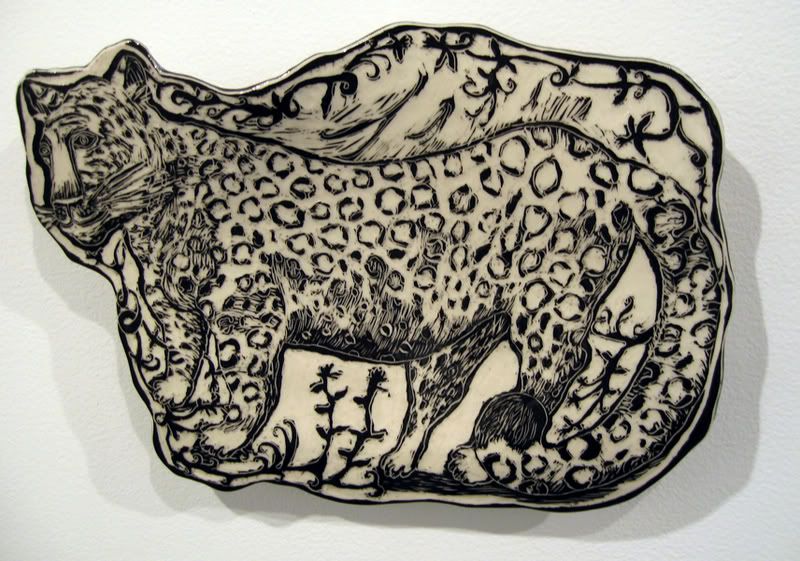
Kate Horne
"The Escape"
2006
Glazed porcelain & mason stain
9 x 12 x 1 inches

RARE: Artist collectives are a curious affair. The creative communion offered by a collective is appealing to many artists, yet so many of us would just as soon close the studio door and be left to our own devices. But that isolationist inclination makes the concept of a collective more valuable, particularly when the group concerns itself with a set of values or ideas, whether abstract or rigidly delineated, rather than some stylistic mode.


Amie Cunningham
"The Steadfast Warrior (Totem)"
2007
Maple wood, stain
78 x 17 1/2 x 20 inches

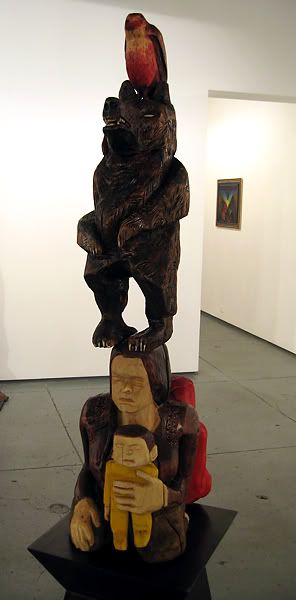
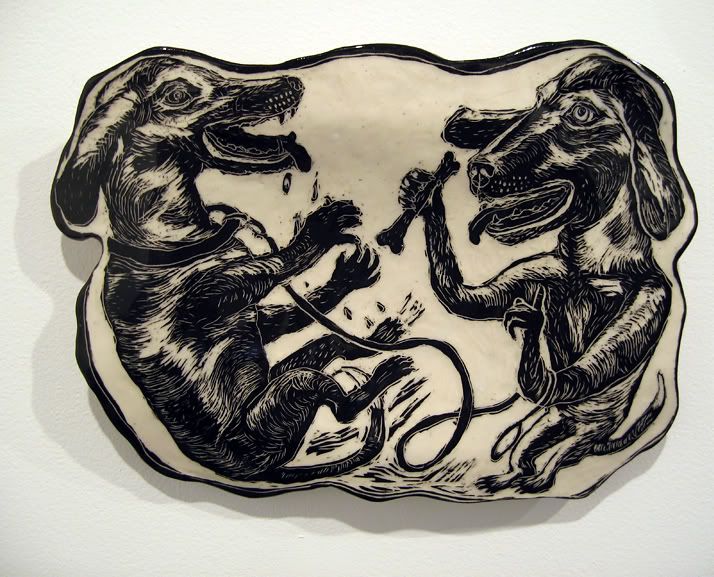
The Orchestra does just that. Pat Berran, Amie Cunningham, Candice Hoeflinger, and Kate Horne "[explore] the creation of modern-ray relics with a sensitivity to history, craft, and humans' precarious relationship with nature." An increasing number of young artists, myself among them, are setting up shop in this territory, an unsurprising migration given the complicated, fractured interdependency of modern man and the rest of it. The exemplary pieces in the RARE exhibition, "The Steadfast Warrior (Totem)," by Cunningham, and a series of porcelain relief paintings by Kate Horne, return to a totemic representation of Nature to "search for modern spiritual significance."


Kate Horne
"No Cookie"
2007
Glazed porcelain & mason stain
9 x 12 1/2 x 1 inches

Several months ago, I wrote about the paintings of Tom Uttech, a painter central to my pantheon. In that essay, I described totemic Nature as "a world of symbol and ecstatic interpretation" borne of sensual experience. That may seem a fanciful description to attach to Cunningham's totem or Horne's plates, but their work seems driven in part by a desire for natural reciprocity, a wanting to be alive as part of the greater weave. So many of us today yearn for this forgotten language, straining to apprehend the words despite our tongue's unfamiliarity. A rural childhood attunes the ear more than one spent in suburbia or the city; as we become an increasingly urban species, will we hear our history or taste our present without technological mediation?

* * * * *


"Bamana, Kore Hyena Mask, Mali, Africa"
Late 19th century
Wood, metal and leather
approx. 17 x 9 x 8 inches

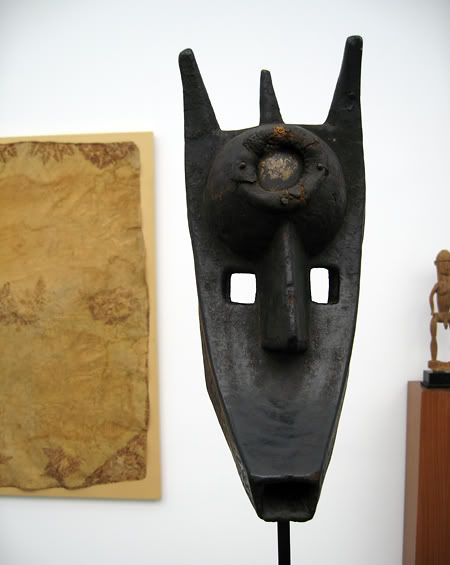
Betty Cuningham: I can not say for sure whether or not the members of The Orchestra spent a lot of time outdoors as youngsters, but the artists responsible for the masks, clubs, statues, daggers, shields, and blankets included in "It's All Spiritual: Art from Tribal Cultures" definitely did. The show's curator, Alan Steele, writes, "The title...reflects the belief that all great art - to some degree or another - has a spiritual component and that nowhere is this seen better than in the tribal arts from remote cultures."

The spiritual component of these works - which, by the way, would be vetted even by the likes of John Dewey, as they are beautiful and utilitarian - removes the need for dressy conceptual underpinning. (Discouragingly, the reverse is also true; an alarming majority of contemporary art is largely short on "spirit." As contemporary humanity's relationship to Nature has become more clouded and distressed, so too has our awareness of the immediate, animating forces been thoroughly abstracted. We are no longer, then, satisfied with what is, and we develop a greater dependency on the theatre of possibility and promises of progress, in turn denying the present and the social body, and so exhibiting more pretense, anxiety, and depression. But this is a whole 'nother can of worms.)


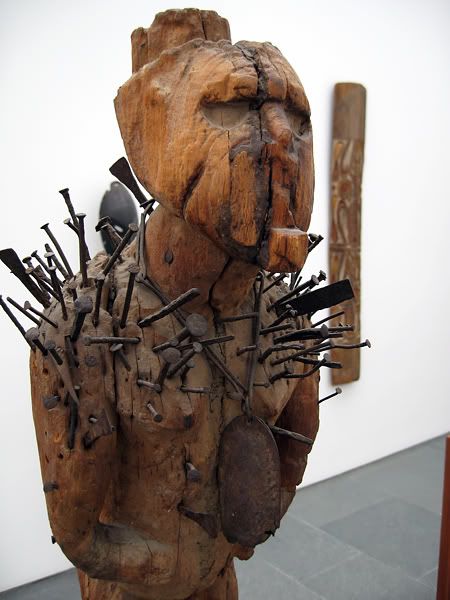
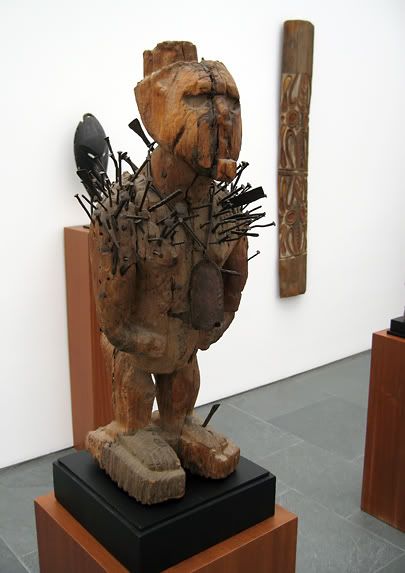
"Power Figure: Nkondi"
Wood and metal
approx. 24 3/4 x 8 x 8 inches

One could argue, however, that the tribal works are conceptual in that they draw on the myths and magical narratives central to each culture, but those narratives are themselves the product of a local hunter-gatherer lifestyle, and the iconography is rooted in direct involvement with the resources and ecosystems from which the materials are drawn. I've long felt that the "primitive" works from the Africa, Oceania, and Americas collection at the Metropolitan Museum of Art are among the most inspiring under that roof. But seen in the context of so impressive and vast a hoard, those objects are most easily read as artifacts, as historical channel markers; the education offered by the museum presentation, while valuable, can distract from direct experience of the work, making it less edifying. This is one reason why we hear so much griping about the museum as mausoleum(1), and why the Betty Cuningham Gallery exhibition, smaller and more random in organization, allows viewers to experience the objects in much the same way they would contemporary works of art. Their vitality and relevance is immediately clear.

"It's All Spiritual" is a hopeful show. On the W train back to Queens I wondered if museums shouldn't start partnering with galleries on a more regular basis. Contemporary artists - indeed, all gallery goers - would be well served by it.


"Human/Prairie Dog Fetish, Southern Plains"
Last quarter of 19th century
Wood, green pigment, brass tacks
approx. 9 1/2 x 5 x 4 inches

* * * * *

Photo credit: all images, Hungry Hyaena

(1) Mausoleum or not, the Met is a true marvel. If you stop and think for a moment about what is housed inside...you gotta pinch yourself. Frankly, I don't spend nearly enough time there.

Wednesday, December 14, 2005

Linkage

I don't have time to write much today, but I thought I would provide a few links, all of which merit a looksee. In case you're a reader from a particular camp, though, I've broken these down into three categories:

For the artsy-fartsy readers:

Read the latest Art Fag City post, a review of/reaction to last week's The Believer Event at P.S.1. I disagree with some of AFC's ideas - most vehemently with the notion that "there has never been a time where civilizations wanted to be reminded of their mortality" - but there is a lot of good grist for the mill in the post.

Also, check out Winkleman's post on purity in photography. The subject explodes in several directions, all of interest, in the Comments section. This is yet one more example of a Winkleman post turning into a enjoyable, insightful forum. Good stuff.

For the science mavens:

I highly recommend this post at Vitriolic Monkey. In it, Devo proposes a novel way to integrate Intelligent Design into our high school biology curriculum. His solution is sure to produce a why-didn't-I-think-of-that moment in any self-respecting science nerd.

And for the conservationists and environmentalists:

I encourage readers interested in debating the morality and ethics of hunting to visit Sphere. Tom Andersen writes about the hunting of white-tailed deer (Odocoileus virginianus) in Darien, Connecticut. He summarizes the correlative relationship between suburban sprawl and increasing deer populations, the connection of wealth and private landownership, and the often wide gap between sustainable practice and the average hunter's approach. All of this is a few short paragraphs!

Wednesday, June 15, 2005

Journal Scraps: Punk Wigs and Prom Dresses

"Those who think that the world of today is more gentle and graceful than the primeval and predatory passions from which [the great] myths spring are either not aware of reality or do not wish to see it in art."

- Adolph Gottlieb and Mark Rothko in a statement attempting to explain abstract expressionism, June 7, 1943

+++

"The more modern and technological we become - the more our lives become a mechanized routine against instinct - the more the most instinctual forces within us rebel. And in those places that fail to compete technologically, many young men may become ancient warriors, raping and pillaging and wearing tribal insignia rather than uniforms..."

- Robert D. Kaplan, "The Return of Ancient Times"

+++

"My casual routine ended on the fourth day, when Lendu warriors first appeared on the streets. I saw them walking down Lumumba Boulevard with a sickening swagger, drinking beer outside the gates of the Hotel Musafira and getting stoned on the milky potions contained in ampoules that dangled from their bandoliers. They carried taped-up Kalashnikovs across their shoulders and slid their fingers across their throats as they passed young Hema girls. Some wore clear-plastic masks on their faces, sequined prom dresses that glittered in the sun, and punked-out yellow wigs on their heads.

Little by little, they took a piece of Bunia each time the sun went down. After it was all over, they would own a small piece of everyone who had been there, or leave what they had taken on the boulevard to rot in the equatorial sun. They had taken a piece of my interpreter, Johnny, when they murdered his father two years ago; they shot him in the back as he tried to run away during a raid north of town. His body had lain in the street for three days while Johnny hid in the bush."

- Bryan Mealer, "In the Valley of the Gun: A Massacre Unfolds in Eastern Congo"


Image hosted by Photobucket.com


Photo credit: "The Porcelain War Museum Project," guns made of porcelain by artist Charles Krafft; UPC child soldier in Bunia, Congo; Karel Prinsloo, AP (Ostensibly, the UPC fights against the Lendu and protects the Hema, but as with so many other ethnic battles, boundaries are blurred; everyone seems to kill everyone else.)

Sunday, May 15, 2005

Hung-over and Thinking


For the most part, New York City’s subways are subterranean, but some lines in the outer boroughs are elevated. The Queensbound N/W subway line emerges from under the East River and rises over the rooftops before turning north up 31st Street to Astoria, where I live.

Yesterday, as white sunlight made unnecessary the green fluorescent glow of the subway car lighting, I looked up from my magazine and noticed a young Colombian boy playing with his father’s cell phone. Standing by a window, the boy had selected the phone’s camera mode and was captivated by the cityscape, pixilated and bleached, as it cruised by on the phone's small viewfinder.

'There is something here,' I thought. Is this a nice metaphor for our First World disconnect, I wondered? Does a preference for a digitized interpretation of the world suggest a break with the unmediated rest of it? Is the child really exhibiting such a preference or is this cigar just a cigar? For that matter, is the “real” world anything more than a neurological interpretation itself, our own personal computer translating strings of chemical 1s and 0s?

Suddenly, I found myself recalling something Antoine de Saint-Exupery, author of The Little Prince, wrote in 1945.
“It seems to me that something new is in formation on our planet. The material progress of modern times has indeed linked mankind by a sort of nervous system. The contacts are innumerable. The communications are instantaneous. We are materially bound like the cells of the same body. But this body does not yet have a soul. This organism has not yet grown conscious of itself. The hand does not feel itself a part with the eye.”
His observation still rings true today, at least to psuedo-luddites like myself.

Hung over and splintered, my mind made a seemingly disparate connection between the Exupery quote and a poem I wrote five or six years ago.
Sunset is chilly
on the shores of Southampton,
the water creeping closer
to the foundations of second or third homes.
Hiding in a tangled mass
of beached seagrass,
the tiny coffins of unborn skates
catch our attention.
Tearing open one of the leathery wombs,
a yolk falls into my palm.
Still attached, still feeding,
is a squirming embryo.

Next morning now,
The clouds heavy with rain
sag and burst like
too full mammaries.
The rain chases my train
to New York City.
The father reached over and pried the phone out of the boy’s hands. The boy looked up in protest before turning his attention to his shoes.

Photo credit: 1995-2001, Chao-Hwa Che

Monday, March 21, 2005

Impulsive Behavior, Free Enterprise, and Sustainability


Todd Schorr
“The Hunter Gatherer"
1998
“We have in the past been forced into reluctant change by weather, calamity, and plague. Now the pressure comes from our biologic success as a species. We have overcome all enemies but ourselves.”

-John Steinbeck, Travels with Charley, 1962
I read about an “impulsiveness” study conducted by researchers at the University of Minnesota a few weeks ago. It’s a good example of “Duh science,” one of those experiments that must be executed in order to prove an already widely accepted hypothesis. Of course impulsive behavior is connected to our animal antecedence; before modern conveniences and health care, split-second decisions literally meant the difference between life and death. Whether electing to gorge on berries when available or to flee from the serpent-like shape in the grass, Homo sapiens increased their likeliood of survival and genetic legacy by being thoughtlessly reactionary. But that was 12,000 years ago. Today, although such instinctive actions won't typically decrease our reproductive success, we are often better rewarded via a more considered approach. The University of Minnesota study only confirms this obvious fact.

But is it so obvious to everyone? I read Paul Driessen’s article, “Sustainable Development=Sustained Poverty,” in CNS News yesterday (thanks to Creek Running North). Driessen, a senior fellow with the Committee For A Constructive Tomorrow and Center for the Defense of Free Enterprise, argues that:
“Environmentalists airbrush and sanitize, ‘sustainable development,’ dressing it up in fancy verbal raiment about pristine nature, indigenous cultures and future generations. But the result remains unchanged. ‘Sustainable development,’ is being used to justify blocking energy and economic development, and keeping the world's most destitute people mired in misery.”
He concludes,
“For its part, the environmental movement needs to do some serious soul-searching, and began to abide by the same rules of honesty, transparency, morality, accountability - and concern for people's lives - that it demands of everyone else.”
Honesty? Transparency? Morality? Accountability? Given the current political climate, Driessen must be terribly deluded to write such an article. The environmental movement is no paragon of virtue – it attracts as many ciphers and radical morons as any vaguely religious movement – but free enterprise crusaders are infamous for back-room dealings, dishonesty, and moral narcolepsy.

It shouldn’t be surprising that a man who calls the Kyoto Protocol “draconian,” as Driessen does, also believes that “poor countries need sustained development, not sustainable development.” (Emphasis mine.) The principal difference between sustainable and sustained development is the time horizon. A time horizon is “the interval during which an investment program is to be completed. An investor's time horizon is very important in determining the types of investments that should be selected.” So, whereas sustainable development concerns itself with reducing individual and societal impact to lessen the energy burden and improve future odds of success, sustained development seeks immediate return upon which to build more infrastructure so that one can generate yet more immediate return. The former is a model of short-term sacrifice for long-term gain, the latter a regular addition of short-term gain to short-term gain, always on the look out, so to speak, for the next tasty berry, and without regard for what may come of too much berry eating. Both approaches have eloquent champions and, sadly, those firmly entrenched on the sustained development side of the line will need more than informed debate to be convinced that their eternal-present, Pleistocene approach is fundamentally unethical and practically untenable.

Driessen does ask a tough question of the sustainable development camp, though. How can we begin to convince the people of “developing countries” (another term I’m not particularly fond of) that their short-term gain will come at too great an economic and ecoogical cost generations from now? It’s not an easy question to answer and it reminds us that the sustainable lifestyle must start right here at home, where our challenges and goals won’t be interpreted as subjugation or eco-colonialism.

Image credit: ripped from toddschorr.com

Note: Definition of "time horizon" from "Wall Street Words," copyright 2003

Friday, March 18, 2005

Hobbits and Dwarves? Was J.R.R. onto something?


Anthropologists bicker about the relationship between Homo sapiens and Homo neanderthalis. Some believe that the two species co-existed and interbred prior to the extinction of the Neanderthal. Others propose that Homo sapiens descended from Homo neanderthalis via natural selection, a hypothesis that suggests Neanderthal genes are still shaping us today. Another camp contends that the two primates occupy distinct branches of the evolutionary tree, thereby making impossible successful reproduction and direct descent.

A recent "Frankenstein" skeleton built by anthropologists at the American Museum of Natural History may help quell the debate. Apparently, the skeleton has a poorly defined waist and a wide, heavy rib cage. The scientists describe it as dwarf-like in build, though the height of the primate is comparable to our own species. Based on the discrepancies, Gary Sawyer "doesn't believe that modern humans could have evolved from Neanderthals."

But we're talking anthropology here, a scientific arena known for its long-running intellectual battles. We might have to wait a long time for any consensus.

Speaking of anthropological discoveries, one famous Indiana Jones, Professor Reiner Protsch von Zeiner, has been proven a fraud. This article in the Guardian Weekly is as amusing as it is depressing. Personally, those individuals working in the scientific community who prioritize ambition over methodology (and fact) horrify me. By falsifying the dates of his "important" discoveries, Protsch has done his field a great disservice.
"Anthropology is going to have to completely revise its picture of modern man between 40,000 and 10,000 years ago," said Thomas Terberger, the archaeologist who discovered the hoax. "Prof Protsch's work appeared to prove that anatomically modern humans and Neanderthals had co-existed, and perhaps even had children together. This now appears to be rubbish."
Photo credit: ripped for MSNBC article; copyright, John Wiley & Sons Inc.

Friday, March 04, 2005

Lions, Tigers, and Hobbits, Oh, My!


In the 80s and early 90s, taxonomy was a quiet field. There were some debates about classification of particular dinosaur species, but, all in all, things were passive. Today we're entering a period of accelerated species discovery. In coming decades, taxonomists are going to have their hands full; many presently accepted scientific classifications will be amended or overturned. This is as exciting as it is intimidating.

A related debate has recently been making headlines, but the Homo floresiensis classification is at last settled. The little people are, indeed, a new species. I have to admit to some initial skepticism. Too many biologists are eager to "discover" new species and, along with the pressure of the publish or perish system, their eagerness can lead to flawed conclusions.

In the case of Homo floresiensis, however, Professor Peter Brown has been proven correct. Now anthropologists and biologists can begin working together to hypothesize how Homo floresiensis shrank while simultaneously developing a more complex brain.

Photo credit: copyright Nature, 2005

Wednesday, March 02, 2005

What's Your Dialect, Boy?

I found the intriguing link below on Pharyngula.

A rural Virginia boy transplanted to New York City in my early twenties, I was curious what the results would be. Apparently, I am "barely into the Yankee category," with a score of 44%.

It's a fun, quick little test for anyone, no matter where you've spent most of your life.