Showing posts with label art market. Show all posts

Monday, December 12, 2011

I Can See The Whole Emperor!


In a 2006 post titled "Lichtenstein the Ingrate," I bemoaned Roy Lichtenstein's elitism. I explained that I was bothered less by the famous artist's "questionable sampling" of newspaper and comic book artists' work than I was by his disregard for the skill of those he copied. In a 1963 interview, Lichtenstein distinguished between his source material and his paintings.
"What I do is form, whereas the comic strip is not formed in the sense I'm using the word; the comics have shapes but there has been no effort to make them intensely unified...The difference is often not great, but it is crucial."
Throughout my late teens and twenties, Lichtenstein's comic-inspired artworks inflamed my sense of righteous indignation. I don't get especially worked up about Lichtenstein's appropriation anymore, but I still believe the man was a charlatan. Had he acknowledged his indebtedness to the artists he imitated, his comic panel paintings could be interpreted as a cynical project highlighting the role of class and money in the appraisal of culture (i.e., it's not fine art if it's in a newspaper, but if it's in a gallery and the "right" person will pay a lot of money for it, it is). That still wouldn't make it particularly thoughtful artwork, but Lichtenstein could have been remembered as a winking champion of the comic artists that nourished him.


Left: William Overgard original
Right: Lichtenstein's rendition

In 2006, I believed that Lichtenstein was "turning into a cultural blip." I took comfort in that presumption, but it's no longer so clear to me that Lichtenstein will be forgotten. A recent ArtInfo article by Judd Tully compares last month's Christie's auction sales price of Lichtenstein's "I Can See The Whole Room!...And There's Nobody In It!" to the EBay auction sales price, last August, of the William Overgard artwork that was the source of Lichtenstein's painting. The former sold for $43,202,500; the latter, for $431. According to the art market, then, the Lichtenstein version is worth more than 100,000 times what the Overgard original is worth! Sure, Lichtenstein's is a bigger picture, but the enormity of the price difference is testament to the intangibles in play in the art market. I love looking at, writing about, and making art, but contemplation of the art market is a depressing affair.

Image credit: "The Emperor's New Clothes" illustration, ripped from My Fresh Plans site (illustrator uncredited); Overgard and Lichtenstein reproductions "appropriated" from The Daily Cartoonist

Thursday, March 24, 2011

Communicating Art's Relevance (Or Not)


Science journalists have penned a profusion of articles about the scientific community's failure to communicate effectively with the general public. The articles bemoan how un- or misinformed Americans are about the science of vaccination, global climate change, mass extinction, and myriad other subjects. But the journalists don't blame the great unschooled for their ignorance; instead, they point the finger at scientists and, almost as often, at themselves. As a result, there are a growing number of journals, graduate programs, and institutions devoted to tackling the science literacy problem.

The aptly named Center for Communicating Science, at Stony Brook University, is one of these. It's mission is straightforward: "to enhance understanding of science by helping train the next generation of scientists and health professionals to communicate more effectively with the public." It's an uphill battle, but we must all hope that their efforts (and those of similar institutions or programs) succeed. Presuming (hopefully) that the majority of the world's states remain liberal democracies, the future health of the planet and our species may be contingent on a greater popular appreciation of science.

Although it is a matter of less urgency and consequence, the contemporary American art world should consider a comparable movement. We also need programs dedicated to training "the next generation of [curators and art] professionals to communicate more effectively with the public." I'm not being facetious. There are brilliant, sensitive art writers and curators working today, but they are a small minority who, despite their talents, generally fail to reach a popular audience. Just as so much good science is shrugged off (or even angrily rejected) by the public, so, too, with art. Most Americans see science as extraneous esoterica crafted by white-coated wonks. Similarly, contemporary art is seen as the province of effete Onanists devoid of "family values."

But the respective responses of the two realms to these ugly public perceptions is critically different. The scientific community has confronted the issue head-on, spilling ink, hosting panel discussions, and building programs. Whether or not this conscientious approach will change things for the better remains to be seen, but scientists and science academics can't be criticized for inaction. Should an art writer or organization assert, however, that negative popular sentiment indicates the art world is faltering, they won't receive donations for a new graduate program or institution dedicated to improving the art world's communication skills. In fact, many (if not most) professionals in the art world rankle at the suggestion that fine art should even consider appealing to the masses. They believe that popularity debases art because, in order to achieve it, the artist must cater to the interests and intellect of the lowest common denominator. This stance is obviously elitist but, more importantly, it's also defeatist. Shouldn't those of us who care about art's role in society strive to make it accessible to the general public? After all, unlike those skeptical of science, "Joe the Plumber" isn't the only one who dismisses contemporary art! The large majority of my college-educated friends -- scientific researchers, English professors, political journalists, doctors, lawyers, actors, musicians -- make no space for contemporary art in their lives. Contrary to the avant garde aspirations and claims of so many artists, curators, collectors, and critics, most of America views the contemporary art world as a cultural backwater; it has become functionally irrelevant (excepting its role as a luxury commodity market).

But the art world is not irrelevant; there is vital, inspiring contemporary artwork being produced, work that the public can be in dialogue with (and even without initiation into our art cult)! But the onus is on us, as representatives of the art world, to make a case for why fine art matters today. If curators and artists (or dealers writing press releases) can't express why an artwork or body of work is vital, then they need to ask themselves hard questions. Is this work really and truly meaningful? Is it made with intent to improve, in whatever way, the world (i.e., not intended merely as an exercise in critique)? Clinging to the myth of the avant garde is unacceptable unless the "vanguard" work is, in the view of the curator, artist, or dealer, essential. Art professionals shouldn't be making or promoting work that they can't make an impassioned case for and, in order to do so, they have to be able to speak about art intelligently and plainly.

I'm interested in hearing reader's thoughts on this subject. Barring the introduction of requisite communication courses in American art programs, what are some ways to begin to chip away at the wall between the art world and the rest of it? Can we be as relevant and respected as pop music or Hollywood, creative industries that produce both edifying brilliance and schlock, but that are not maligned by the general public? Can the American art world play as much of a role in the lives of citizens as does the European art world, an orbit in which the educated classes regularly visit galleries and recognize the names of prominent fine artists? What do you think?

Update: Jessica Palmer, ever erudite, remarks on this post at Bioephemera. I encourage readers to jump over to BioE for her take; Jessica is an artist, writer, and science communicator...though she wears other hats, too.

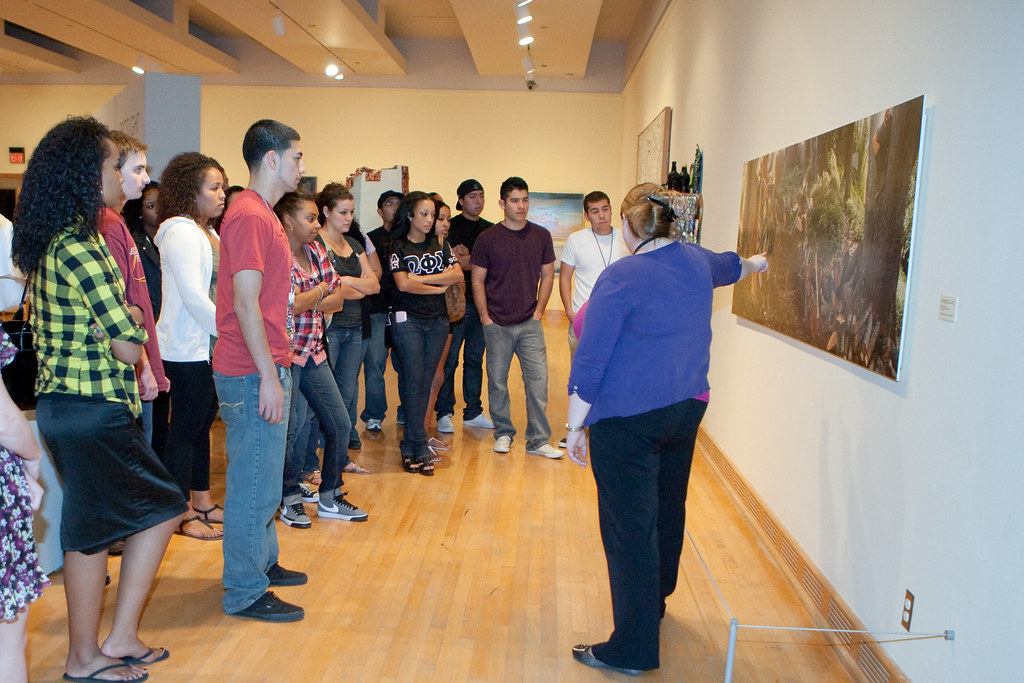
Photo credit: copyright 2009, Diane Wallace, ASU Art Museum

Sunday, October 10, 2010

Winner Take All?


My father recently sent me a clipping from the Hampton Roads Daily Press that highlighted some curious research presented at my alma mater, the College of William & Mary.

Biologists have determined that "the maximum length of a duck's penis depends not on genetics but rather [on] the males he keeps company with." Dr. Maydianne Andrade, of the University of Toronto Scarborough, explained that ducks "are essentially engineering their own phallus in response to social challenges." This is fascinating evolutionary biology, to be sure, but I find it remarkable that ducks have penises at all, given that most birds do not. (Apparently, a cloaca just won't cut it in duck world!) Dr. Patricia Brennan, of Yale University, believes that the heightened intensity of male-male competition among waterfowl has resulted in the development and size fluctuation of their sex organs.

The evolving duck penis battle came to mind when I read Ashley Mears' article about Coco Rocha, the popular fashion model. Early in his piece, Mears summed up the competitive dynamics of creative industries revealingly.
"Rocha is what economists would call a winner in a 'winner-take-all market,' prevalent in culture industries like art and music, where a handful of people reap very lucrative and visible rewards while the bulk of contestants scrape together meager livings before they fade into more stable and far less glamorous careers."
As with the bulk of would-be daddy (or uncle) ducks, most artists, designers, musicians, writers, and other creatives will not be prolific and celebrated. There are many intangibles in play, of course, but, like the drake duck whose penis twists to extraordinary lengths to impregnate a hen, "winning" in a creative industry often depends on who you're keeping company with.

Once vetted, however, the successful creative becomes, like Coco Rocha, a known label; his or her career is likely to be a fruitful one. That label is what the blog "Is It Art or Fart?" trades on. As the blog's co-founders explain,
"The blog began as a conversation between two friends living on opposite coasts who shared an undying passion for contemporary art. Both friends have the habit of seeing as much contemporary art as they possibly can, and this habit has uncontrollably spilled over into the recognition of 'fart'--coincidental moments in everyday life that, when isolated and [attached to the name of an] artist, bear uncanny resemblance to art seen in museums and galleries around the globe. Back and forth the two friends would point to the 'fart' that seemed to be just about everywhere. Now the humor of their findings is for all to enjoy. Remember, the world is your readymade!"
Part of the humor of their project is that the "fart" is often as good as or better than the "art" it might be confused with. Unfortunately, for the "fart," as for many drake ducks and coulda-been-a-contender creatives, it's a winner-take-all world.

Image credit: Scrooge McDuck, copyright Walt Disney Company

Sunday, February 28, 2010

Art Questions


Installation view of #class, at Winkleman Gallery

Sculptor and performance artist Dominique Mazeaud recently proposed on her blog a "second round of 'Les Magiciens de la Terre,' an exhibition held at the Centre Pompidou in Paris in 1989, that asked one hundred artists to define art along with showing their work." Mazeaud, however, throws a curve ball: "I would simply change the question and ask artists to offer a definition of 'what is the spiritual in art.'"

Defining the spiritual in art is no mean task. The curators of Mazeaud's proposed show would likely receive as many different responses to the question as there were artists participating. Contemporary spirituality, after all, is understood to be an individual quality or experience. But a diverse field of responses doesn't make the question any less interesting, and I agree with Mazeaud that such an exhibition would be exciting and insightful, especially in light of recently reinvigorated conversations about the role of art, artists, and the art market.

Presently, at the Winkleman Gallery, artists Jennifer Dalton and William Powhida offer a platform for this conversation. They've created a temporary "think tank" for "guest artists, critics, academics, dealers, collectors, and anyone else who would like to participate to examine the way art is made and seen in our culture and to identify and propose alternatives and/or reforms to the current market system." I readily admit that I'm more interested in talking philosophy and "ultimate meaning" than I am in discussing practical approaches to the contemporary art market, and I believe that my charitable sales model implicitly announces my ambivalence about (and proposes a viable alternative to) our day's dominant system. That said, only naive artists truly believe that contemporary art can exist completely disconnected from the market (while still finding an audience).

Unfortunately, I arrived late to James Leonard's performance piece on Thursday night (thanks to the snowfall some news sensationalists dubbed "the snowicane"), and I had a conflict that kept me from attending the presentation by Barry Hoggard and James Wagner last night, but I hope to make at least a few more of the sessions that Dalton and Powhida have lined up. You can view the calendar at the exhibition/think tank blog, Hashtagclass."

Image credit: ripped from the Winkleman Gallery website

Saturday, January 09, 2010

The Art Community and Common Sense


Ryan Trecartin
"I-BE AREA"
2007
"Everybody gets so much information all day long that they lose their common sense."

- Gertrude Stein
We're a week-and-a-half into 2010, and I'm hoping that the din produced by so much fin-de-decade media will soon die down. It's no secret that we citizens of the United States (and all other essentially "Americanized" peoples) are principally defined by our consumption. What's more, after decades of adaptation to the consumer role, we've become so fond of the talk surrounding our consumer products that the consumer reviews themselves have become another kind of consumable. Regrettably, this is no less true in the arts.

I've made a contrarian effort this year to avoid most of the "Top" lists and their Op-Ed equivalents, but I've not been totally chaste. The diviners of social, political, or cultural trends have been working furiously to meet their deadlines, and the surplus of art-related stock-taking is in large part responsible for the dearth of new HH content. Anything that I write here will only add to the pervasive and stupefying hubbub; it is further distraction from the business of life well-lived.

And yet, here I sit, writing this post. Like all the other commentators, I'm guilty of editorializing and contextualizing that which is better meditated upon individually or mulled over with our loved ones. And I'm guilty of adding one more perspective to the countless millions already vocalized, furthering the unfortunate and wrong-headed belief that subjectivity reigns. What I'm engaging in, then, is dangerous. While post-modern notions of relativism are valid and philosophically valuable, our globalized culture must strive to sort, such that we can, the wheat from the chaff. That is to say, in a time of increasing cross-cultural interaction, the need for some consensus, some agreed upon hierarchy of moral, ethical, and aesthetic value, is acute. It is a dangerous and exciting era; as such, it is a good time to be a artist.

I agree with Roberta Smith's contention that "the years 2000 to 2009 saw the emergence of a tremendous number of really good, interesting, promising artists." My list of "really good" artists, however, is very different from hers, and Ryan Trecartin, one of the artists that the New York Times' critic celebrates in her recent article, "Make Room for Video, Performance and Paint," is definitely not on it. I don't know Trecartin personally, and he may be a well-meaning, pleasant enough person, but his artwork is poisonously self-absorbed. In this respect, at least, Smith is right to assert that he is an important representative of the decade past. The art world, and especially that of New York City, the community to which I'm most attached, has seen an explosion of navel gazing.

To be fair, most artists engage in some level of narcissism. At the end of the 1990s, when I was in my early twenties, I had puerile aspirations to produce "art videos" of my ejaculating penis (paging Sterling Ruby), and my paintings were dominated by angst-ridden self-portraits and hyper-sexualized imagery. The few paintings of that period that survive are today stacked in my parents' Virginia garage, partly covered by a plastic tarpaulin and years of accumulated mouse shit and winter-killed wasp corpses. Such is the fate of personal history. Serpent-like, we periodically shed our skins and move on, hopefully a little more wise. Some of us, however, put our sheddings and bruises on display, mistaking personal exposure for bravery. Indeed, in some contexts it is brave, but when the sharing is marshalled in service of a cult of personality, it is a celebration of individual dysfunction. And when such exhibitionism is mistaken for art, it is an indication of critical and cultural dysfunction.

Believing that art is fundamental to humanity, and that it is transformative and sacred, I don't accept Freud's famous contention that the artist is a neurotic who seeks to attenuate or postpone confrontation of his or her mature psyche. In fact, for most of our species' tenure, the role of the artist was precisely the opposite; we were called upon to ground our brethren is real experience, be it material or metaphysical. Yet Freud's categorization accurately describes much of the juvenalia that passes for contemporary art. Certainly, we artists should be embarrassed by this trend, but you can't kill the messenger, as the saying has it; Trecartin and others creating hysterical or megalomaniacal artworks are reflections of the dominant (and apparently yet ascendant) iCulture. It is instead the critics and the gallerists, the purveyors of taste, that should be most ashamed of themselves.

Essayist, critic, and philosopher George Steiner is far more intelligent and incisive than I, so I include a pastiche of pertinent excerpts from his 1989 book, Real Presences.
"The usages and values predominant in the consumer societies of the West today [are] the secondary and the parasitic[...]. Literate humanity is solicited daily by millions of words, printed, broadcast, screened, about books which it will never open, music it will not hear, works of art it will never set eyes on. A perpetual hum of aesthetic commentary, of on-the-minute judgments, of pre-packaged pontifications, crowds the air. Presumably, the greater part of art-talk or literary reportage, of music reviews or ballet criticism, is skimmed rather than read, heard but not listened to. None the less, the effect is antithetical to that visceral, personal encounter[...]. There is little 'ingestion'; it is the 'digest' that prevails.

[...]

The journalistic vision sharpens to the point of maximum impact every event, every individual and social configuration; but the honing is uniform. Political enormity and the circus, the leaps of science and those of the athlete, apocalypse and indigestion, are given the same edge. Paradoxically, this monotone of graphic urgency anaesthetizes. The utmost beauty or terror are shredded at close of day. We are made whole again, and expectant, in time for the morning edition.

[...]

Two principal impulses energize the American spirit: immanence and egalitarianism. The crux of American time is now. The past matters in direct reference to its usability in and by the present. [...] No other culture has so dignified the immanent. [...] Poets, novelists, choreographers, painters of the most derivative or passing interest, are made the object of seminars and dissertations, of undergraduate lectures and post-doctoral research. The axioms of the transcendent in the arts of understanding and of judgment [...] are invested in the overnight."
Steiner, I presume, frowns on the Top Ten lists and "best of the decade" summaries as much as I do. I also believe that he would dismiss as "derivative or [of] passing interest" most (though not all) of the artists that Smith praises in her article. The cultural longevity of most on Smith's list is questionable, certainly alongside the likes of Alec Soth, Bill Viola, Matthew Day Jackson, Omer Fast, or Tom Uttech, all contemporary artists crafting intelligent and soulful artworks.

Smith writes, at the article's close, "In all, we are confronted with the distinct possibility that quantity and quality may not be so mutually exclusive after all. More means more better." That's very true. But more also means more bad, of course, which is why we today have an urgent need for critics, curators, and gallerists who, like Steiner and Donald Kuspit, are willing to reside outside the community, to avoid political entanglements, and to judge, sometimes harshly. To those critics, artists, and gallerists already plugged in, let's begin this decade, this arbitrary but useful marker in our human journey, with a renewed commitment (a resolution, if you prefer) to be more rigorous, contemplative, and socially committed. The art world, like the world at large, needs fixing, and responsible action is the only thing for it.

Happy Twenty-Ten. Here's hoping that it's healthy and auspicious.

Image credit: Ryan Trecartin, 2007

Sunday, December 06, 2009

Why Some Of Us Resist Miami

"The problem is no longer that artworks will end up as commodities, but that they will start out as such. Expanded scale and intensified pace have cast over the art arena a veneer of glamor that further imbalances it all."

-Thomas McEvilley, Art & Discontent: Theory at the Millennium


"Most of what the...art world has to offer is glamour. Glamour, like the art world itself, is a highly fickle and commercially driven enterprise that contributes to...the 'humdrum.' It appears and disappears."

-Robert Morgan
Image credit: picture of Pulse Miami 2008 ripped from e-flux website

Friday, November 06, 2009

A Bitter Ode to Hermes

Anatomy of a Creative Funk


Christopher Reiger
"Mannequin"
2009
Pen and sumi ink, gouache, watercolor and marker on Arches paper
15 1/4 x 15 1/2 inches

I apologize for the lack of regular HH content. Writing is as much a part of my creative process as is art-making, and, for weeks now, I've been creatively out-of-sorts. Fairly or not, I attribute this bout of artistic malaise to my solo show.

Visual artists often speak of the funk that descends when a solo show is on view. My first solo exhibition, "Mongrel Truth," at Brooklyn's AG Gallery, gave rise to minimal tsoris, but "Some Species of Song" has played havoc with my head. I've little or no inclination to write, and I've had to force myself to work on studies for future paintings and drawings.

I've heard many explanations for the funk put forward. Most often, artists will say something along the lines of "the batteries need to recharge." That seems natural enough, but, why, I wonder, does this requisite recharge always seem to coincide with a solo show?

I discussed my condition with a writer friend, and her hypothetical explanation of the solo show funk is convincing, at least with respect to my experience of the malady. She contends that, before the solo show, the artist works happily in the studio because he is fully present in his creative labor. In this "process mode," the artist understands the artwork and the art-making as an extension of self, a soulful and intimate activity. Once the artwork is displayed in a commercial gallery, however, the artist must conceive of the artwork anew. In the "product mode," the art is commodified and abstracted, effectively reduced to paper currency, worthless without social consensus. In transitioning from studio space to market space, the artist has crossed over a Hermetic boundary, leaving behind the eroticism of Eros for the commercial quantification of Hermes.

I've quoted from and alluded to Lewis Hyde's fascinating book The Gift before; it's again pertinent. Hyde's foundational position is that all art is a ceremonial gift, that the creative act is part of a free and open dialogue of spiritually nourishing exchange. Once the market commodifies art, however, "a part of the [artist's] self is inhibited and restrained," and the greater community suffers for it. Sadly, this inhibition and incompleteness is, in our capitalistic world view, assumed to be natural; the artist's worth is counted in coinage rather than spirit. One manifestation of this corruption appears in notions of gender.
"[T]he nineteenth century saw a decline in faith coincide with the remarkable success of a secular, mercantile, and entrepreneurial spirit. The story has been told many times. By the end of the century, to be 'self-made' in the market, or to have successfully exploited the natural gifts of the New World, were the marks of a Big Man, while attention to inner life and the community (and to their subtle fluids - religion, art, and culture) was consigned to the female sphere. The division of commerce by gender still holds. As a character in Saul Bellow's novel Humboldt's Gift remarks in regard to creative artists, 'To be a poet is a school thing, a skirt thing, a church thing.' In a modern, capitalist nation, to labor with gifts (and to treat them as gifts, rather than exploit them) remains a mark of the female gender."
Considering muscular capitalism, Hyde calls Hermes the most contemporary of the Greek pantheon. He is the god of the self-made man, the trafficker in goods, pure and soiled.
"Hermes is an amoral connecting deity. When he's the messenger of the gods he's like the post office: he'll carry love letters, hate letters, stupid letters, or smart letters. His concern is the delivery, not what's in the envelope. He wants money to change hands, but he does not distinguish between the just price and a picked pocket. [...] Hermes can't be trusted, of course. The say 'he either leads the way or guides astray.' [...] In a Hermetic mood we will make a hundred intellectual connections only to find, when we check them with a less restless god, that ninety-nine of them are useless.

Homer tells us that Zeus gave Hermes 'an office...to establish deeds of barter amongst men throughout the fruitful earth,' and he has done his job well. He may be the twentieth century's healthiest Greek god. He is present wherever things move quickly without regard to specific moral content, in all electronic communication, for example, or in the mails, in computers and in the stock exchange (especially in international money markets)."
Indeed, the amorality of global capitalism was spectacularly revealed in the recent hemorrhaging of the financial markets. Still, as a people, we've given ourselves to the worship of Hermes, and we champion the good news that he carries over the bad. The art market is no exception. There are, of course, some very positive aspects of the contemporary art market, just as there are some wonderful individuals participating in it, but a dark cloud shadows all contemporary commerce...and luxury commerce, in particular.

In a short passage, mid-way through the book, Hyde offers readers a striking condemnation of the contemporary art market.
"The more we allow such commodity art to define and control our gifts, the less gifted we will become, as individuals and as a society. The true commerce of art is a gift exchange, and where that commerce can proceed on its own terms we shall be heirs to the fruits of gift exchange: in this case, to a creative spirit whose fertility is not exhausted in use, to the sense of plentitude which is the mark of all erotic exchange, to a storehouse of works that can serve as agents of transformation, and to a sense of an inhabitable world - an awareness, that is, of our solidarity with whatever we take to be the source of our gifts, be it the community or the race, nature, or the gods. But none of these fruits will come to us where we have converted our arts to pure commercial enterprises."
I hope that my charitable sales model can, in some small way, act as a corrective to the market's distortions, and serve as inspiration for other artists. We are empowered to change the system. We only need to become enthusiastic about doing so.

Image credit: Christopher Reiger, 2009

Thursday, August 13, 2009

Lowbrow Meets Highbrow


Issue of Juxtapoz Magazine
Cover art by Shepard Fairy
"A frog is either lowbrow or highbrow.

If you catch it, it's low. If you order it in a French restaurant, it's high."

-Unidentified chef, from Burkhard Bilger's Noodling for Flatheads
In 2007, commenting on the blog PaintersNYC, artist Kelli Williams observed that it's hard to be a Juxtapoz artist "in an ArtForum world." Juxtapoz is a popular magazine dedicated to showcasing contemporary "lowbrow art." It was founded by the artist Robert Williams in 1994. The "ArtForum world" of Kelli William's statement references the magazine of that name, but also the "high art" scene it covers, of which New York City, for the time being, remains an - if not the - epicenter. Until recently, the artwork featured in ArtForum was very different from that seen in the pages of Juxtapoz. Juxtapoz is representative of the Los Angeles art scene, and the U.S. west coast scene more generally, where the aesthetics of pop surrealism, folk art, post-graffiti, or street art are wholly embraced.

But artwork infused by Juxtapoz's colorful spirit is no longer uncommon in New York galleries. Andrew Schoultz, Tim Biskup, and Jeff Soto, talented west coast artists regularly lauded in the pages of Juxtapoz, today exhibit with the Morgan Lehman and Jonathan Levine galleries, and influential post-graffiti artist Barry "Twist" McGee is represented by the renowned Deitch Projects. Jonathan Levine makes plain his dedication to the post-graffiti aesthetic; his gallery's website states that its mission is to exhibit "work influenced by illustration, comic books, graffiti art and pop imagery." Perhaps it's no longer so hard, then, to be a Juxtapoz artist "in an ArtForum world"?

But, more importantly, does lowbrow art require the affirmation of the "high art" world - for easy contrast, let's call it highbrow art - in order to be considered mainstream or legitimate? If so, what exactly is the cultural significance of highbrow art to the world at large?


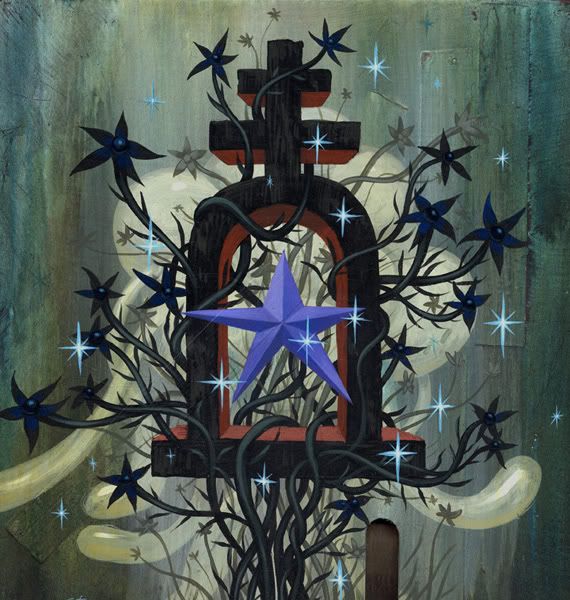
Jeff Soto
"Purple Heart"
2007
Acrylic on wood
12 x 12 inches

The commercial success of books like Beautiful Losers: Contemporary Art and Street Culture and Wall and Piece, the latest offering from the infamous British artist, Banksy, suggest that pop surrealism, post-graffiti, and street art succeed in connecting with the multitudes. On the other hand, it's an uncontroversial fact that highbrow art generally doesn't move the masses (with the exception of its remarkable ability to offend the religious sensibilities of the Christian Right and certain mayors). But highbrow art doesn't simply fail to connect with the general population; the fact is, most folks sneer at, mistrust, or resent ArtForum's world.

Perhaps because they feel beleaguered by popular tastes, many players in the world of highbrow art - artists, gallerists, critics, and curators alike - reject the influx of pop surrealism and post-graffiti flavor. But their objections will inevitably prove inconsequential; as the Borg of "Star Trek" put it, "resistance is futile." Even if some of the more esoteric subcultures of the Juxtapoz arena - Tiki culture, for example - are unlikely to find a toehold in the world of "high art," the graphic influences common to post-graffiti work already inform the paintings of contemporary art world darlings like Dana Schutz, Marcel Dzama, Trenton Doyle Hancock, Ryan McGuinness, Lisa Yuskavage, Yoshitomo Nara, and Jules de Balincourt. (In fact, Dzama and McGuinness have been featured in Juxtapoz; it won't be long before other celebrated highbrow artists are, too. One wonders if the lowbrow label will be applicable for much longer.) And then there are artists like Judith Schaechter, whose stained glass works were lauded in the pages of Juxtapoz years before her work hung in the Whitney Museum or before she received Guggenheim and National Endowment for the Arts Fellowships.


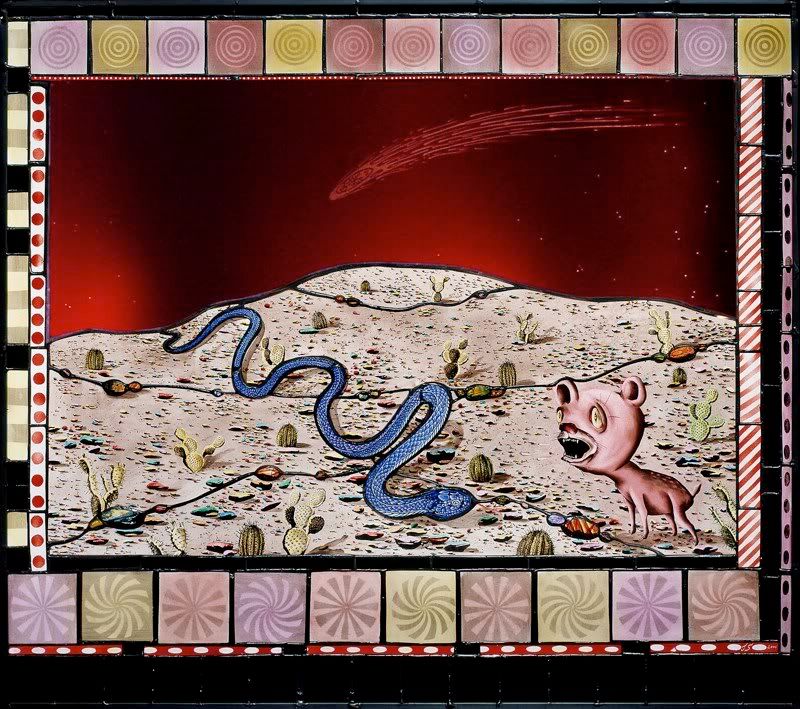
Judith Schaechter
"Hyena Snake Comet"
2004-2008
Stained glass
30 x 33 inches

Much of the highbrow resistance to pop surrealism and post-graffiti is rooted in the self-identified elites' distrust of populism. Comic books and strips are intended for mass consumption, but graffiti is unquestionably the most populist of the lowbrow tributaries. No art form has fewer barriers to entry; all you need is a can of spray paint and a little chutzpah. Ask someone knowledgeable about the subject to relate the history of modern graffiti, and you'll likely hear an abridged version, one that begins in the 1970s, in and around New York City's Bronx River Houses, and runs parallel to the development of hip hop. City funding for arts and culture programs was pitifully low at the time, and enterprising teens looked for new ways to entertain and express themselves. As Lady Pink, an influential graffiti artist of the late 1970s and 1980s, explains, graffiti was the most available "forum for free speech."

Of course, the human urge to make marks predates the Bronx River Houses by millennia. Our ancestors depicted their quarry on cave walls and, more recently, citizens of ancient Rome scribbled their political opinions on market stalls (hence the word's etymology, from the Italian graffiare, meaning "to scratch or scribble.") But during the early days of modern graffiti's ascendancy, practitioners prioritized ego over observation or socio-political commentary. The pioneers of the 1970s and 1980s graffiti scenes in New York City and Philadelphia - Taki 183, StayHigh 149, Cat 161, and Cornbread, among others - were primarily known for their "tags," stylized monikers spray painted on walls and subway cars. They vied for renown by tagging as many surfaces as they could, and walls that were difficult to access had a special cache. The competitive behavior of these early graffiti "artists" might be best described as base scent marking, activity essentially indistinguishable from the industry of the bored high school student who scratches "(x) was here" on the wall of the bathroom stall. Fortunately, as more artists entered the nascent graffiti scene, such adolescent "battling" became insufficient impetus; soon, the egotistical tag evolved into something more colorful and complex. Artists added characters, often comic in nature, a result of their limited palettes and time frame, and, before long, these characters evolved into "pieces" (short for masterpieces). The best graffiti artists came to value style and artistry as much as placement.

The conceptual and social strengths of graffiti and street art are rooted in the artists' acceptance of temporality and his or her desire to engage the environment and citizenry directly. As Simon Hattenstone, a features writer for The Manchester Guardian, writes, "Since spotting my first few Banksies I have been desperately seeking out more. They make me smile and feel optimistic about the possibilities of shared dreams and common ownership." Insofar as it is truly democratic, the street artist's approach is fundamentally distinct from that of those who aspire to "high art" success. "Fine artists" are essentially aristocratic in inclination. They are the elites who operate within the context of "high art" institutions; their work is most often viewed in semi-sacred, unlived in spaces, by people who talk about the work in reverent whispers. Street art, by contrast, is viewed by everybody who happens past the artwork. But, today, as the post-graffiti movement sees many of its more celebrated artists entering the "high art" sphere, the populist flavoring of the culture is eroding.


Banksy
"Balloongirl"
Artwork on West Bank barrier between Israel and the West Bank
2005

Is the aesthetic melting pot a bad thing? The answer depends on your perspective, of course; personally, I'm all for it. Like many contemporary artists, I'm not alone in feeling that my artwork and aesthetic inclinations plant a standard somewhere between the poles of Juxtapoz and ArtForum. Just as I feel torn between my rural roots and the creative community and energy of city life, so too am I drawn to elements of both art orbits, east and west, highbrow and lowbrow. I live and work in New York, so I've cultivated an appreciation for the importance of conceptual heft. But I'm also an erstwhile subscriber to Juxtapoz who, in my youth, eagerly thumbed through the pages of the Advanced Dungeons & Dragons Monster Manual, read fantasy novels and comic books, and honed my drawing chops by copying from comic strips. Perhaps I'm biased, then, but it seems that aesthetic commingling introduces hybrid vigor into otherwise "inbred" scenes.

Too many circles of the "high art" world are poisoned by intellectual pretension, obscurantism, and exclusivity. The ArtForum world is principally concerned with auction results and art historical significance. In east coast MFA programs, the mills of the contemporary "high art" world, a common question asked of students is, "Where does your work fit in the historical trajectory?" Indeed, at great cost to social legitimacy, the "high art" world has prioritized originality and artistic genealogy.

Much of the "lowbrow" scene, by contrast, is blighted by the artists' focus on disposable pop culture, their willingness to cozy up to the marketing machine, and their populist posturing. In an interview with Juxtapoz, one young artist said,
"When it comes right down to it, I draw the stuff I like, and people can take it all for whatever they want. I would say that 95 percent is liking big boobs and butts, the other five percent is brain farts that end up in a sketchbook that later ends up as a painting or whatever."
Although I wrote down this quotation without recording the artist's name, I do recall appreciating some of his graphic skill. Still, when I'm confronted with such a thoughtless statement, I can appreciate the animus that brooding, theory-oriented types have for lowbrow art. Where is the evidence of this young artist's vocational mindfulness, his rigorous passion, his poetic sensibility? Of course, his defenders would likely praise his candor, but, in truth, he's posturing as much as the bespectacled, black-clad fellow who insists in his jargon-laden artist statement that Jacques Derrida informs all of his output.


Marcel Dzama
"Untitled"
2005
Watercolor on paper
14 x 11 inches

Despite haughty sneers from individuals on both sides, it seems to me that the transition that so many post-graffiti artists are making, from the streets to the galleries, could (and should) help create a less sectarian art world. The selfish pretensions of the highbrow art world could be tempered by an influx of no-nonsense, illustrative exuberance, and the lowbrow art world could jettison some of their conceptual superficiality by taking the philosophical and moral obligations of their vocation more seriously. That is, in any case, my hope.

Image credits: Juxtapoz cover image ripped from Rotofugi.com;; Jeff Soto image ripped from the Jonathan Levine Gallery website; Judith Schaechter image ripped from the artist's website; Banksy image ripped from the Brian Sewell Art Directory; Marcel Dzama image ripped from David Zwirner website

Tuesday, June 30, 2009

Is it art?


Ceal Floyer
"Monochrome Till Receipt (White)"
2009
Supermarket receipt
Dimensions variable


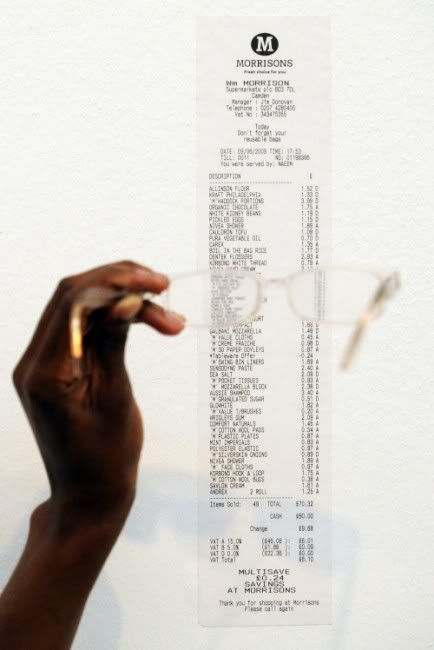
London's Tate Britain recently purchased a curious piece of conceptual art for the Tate's permanent collection. Artist Ceal Floyer's work is, in fact, a grocery receipt, and the museum's acquisition of the piece is generating a wide range of response from the greater art community.

From The Daily Mail:
"Pakistani-born Miss Floyer, 41, who graduated from Goldsmith's art college in London in 1994, describes the work as a modern still life where objects are imagined rather than shown.

[...] Exhibition curator Andrew Wilson [...] called the piece 'an imaginative leap of faith from the daily drudge of going to the supermarket to the idea of the domestic still life painting, but also with the supposed purity of Modernist monochrome abstract painting'."
Read the full article here.

In our celebrity-obsessed world, any press, as the saying goes, is good press...but is Ceal Floyer's receipt art? And, if so, is it good art?

You make the call.

Photo credit: photograph, copyright CA; ripped from The Daily Mail website

Tuesday, June 16, 2009

Passing on our gifts


Jason Middlebrook
"The Endless Outpouring Of Support"
2008
Acrylic, ink and pencil on paper
57 7/8 x 70 7/8 inches framed


For a number of years, friends have recommended that I read Lewis Hyde's The Gift. I'm finally getting around to doing so and, just forty pages into the text, I see why friends thought the book would so appeal to me. Hyde picks apart the contemporary market, particularly as it relates to commerce in art objects and other creative "commodities." In the introduction, he writes,
"A work of art is a gift, not a commodity. [...] Every modern artist who has chosen to labor with a gift must sooner or later wonder how he or she is to survive in a society dominated by market exchange. And if the fruits of a gift are gifts themselves, how is the artist to nourish himself, spiritually as well as materially, in a age whose values are market values and whose commerce consists almost exclusively in the purchase and sale of commodities?

Every culture offers its citizens an image of what it is to be a man or woman of substance. There have been times and places in which a person came into his or her social being through the dispersal of his gifts, the 'big man' or 'big woman' being the one through whom the most gifts flowed. The mythology of the market society reverses the picture: getting rather than giving is the mark of the substantial person, and the hero is 'self-possessed, 'self-made.' So long as these assumptions rule, a disquieting sense of triviality, of worthlessness even, will nag the man or woman who labors in the service of a gift and whose products are not adequately described as commodities.

[...]

A man in another tribe that [anthropologist] Wendy James has studied says, in speaking of the money he was given at the marriage of his daughter, that he will pass it on rather than spend it himself. Only, he puts it this way: 'If I receive money for the children that God has given me, I cannot eat it. I must give it to others.'"
Reading the last bit of the above excerpt, I couldn't help but think of my charitable sales model. The income that I receive from the sale of art objects I've produced is fundamentally no different from the tribe representative's "money for the children that God has given me." In this respect, it is not merely ethical, but also natural that some significant percentage of each sale be passed on, invested in turn in the good works of a non-profit organization or another conscientious individual.

Hyde points out that this pass-it-on approach is in keeping with the cycles of nature. Indeed, the words "ecology" and "economy" are etymologically connected for good reason. As I explained in an HH post in August of 2005,
"'Ecology' translates as 'study of the household' and 'economy' as 'management of the household.' Any good scientist (or thoughtful citizen, for that matter) should study the household before managing it. Thanks in no small part to my father's influence, I began to see many ecological issues as economic concerns (and vice versa). Given my environmentalist leanings, I suppose my [engagement] with economic theory was inevitable. It was also inevitable, or at least quite likely, that I would become disenchanted with our current boom-and-bust paradigm."
Moreover, Hyde points out that "the language of gift exchange has procreation at its root. Generosity comes from genere (Old Latin: beget, produce), and the generations are its consequence, as are the gens, the clans." Indeed, by damming wealth in concentrated pools, the demon market of our capitalistic culture halts the cycle of generations. The natural flow stopped, dispossessed peoples are condemned to hunger for physical nourishment and the wealthy are condemned to hunger for nourishment of the soul.

As Hyde stresses, "what is given away feeds again and again, while what is kept feeds only once and leaves us hungry." Or, as my mom always puts it, "Love and live with an open hand."

Image credit: Jason Middlebrook image ripped from the Sara Meltzer Gallery website

Tuesday, February 17, 2009

Holland Cotter's Unknowns


I enjoyed reading "The Boom Is Over. Long Live the Art!," Holland Cotter's sometimes scathing New York Times farewell to contemporary art's reckless past decade. Cotter describes the art world as a "full-service marketing industry [built] on the corporate model," and he sees art schools as a branch of this money-hungry industry. In his estimation, critics, curators and other art world operators are "public relations specialists who provide timely updates on what desirable means." With these stark observations in mind, Cotter asserts that "a financial scouring can only be good for American art."

"The Boom Is Over" likely raised the ire of many artists and dealers. A commenter on Edward Winkleman's blog characterized Cotter as "out of touch" and guilty of perpetuating a "fabled myth," and I wouldn't be surprised if more online dismissals and condemnations of Cotter's article appear in coming days. That's a shame. I don't believe that the article is intended to titillate or to offend.

Cotter's description of our prodigal art world brings to mind artist and critic Robert Morgan's caution not to mistake glamour for substantive beauty.
"Beauty is not glamour. Most of what the...art world has to offer is glamour. Glamour, like the art world itself, is a highly fickle and commercially driven enterprise that contributes to...the 'humdrum.' It appears and disappears...No one ever catches up to glamour."
Because I call on Morgan's rather romantic position, some readers will immediately decide that, like Cotter, I'm guilty of perpetuating a myth. If so, it is a vital myth. The beauty that Morgan exalts is complicated and profound. I have in mind philosopher poet John O'Donohue's conception of beauty.
"Beauty induces atmosphere and spirit: wonder, delicious turbulence, love, longing and a trembling delight....Beauty inhabits the cutting edge of creativity - mediating between the known and the unknown, light and darkness, masculine and feminine, visible and invisible, chaos and meaning, sound and silence, self and others."
O'Donohue defines a soulful beauty, a beauty that springs from generous attempts to be and to belong.

Although many of the artworks offered for sale at art fairs or on auction blocks are born of beautiful striving, art fairs and auctions are never, themselves, beautiful. And because fairs and auctions are the events most representative of the contemporary art world, Cotter's harsh language seems reasonable. He's right; "during the present decade [art] has become a diminished thing."

I sense that Cotter wants the Times article, a dismal record of a profligate art world, to serve as license for artists, dealers, curators and critics (Cotter's own tribe) to ruminate on their standing. He hopes that the result of that rumination would be an open-hearted embrace of the artist's vital social role (and the art world's part in facilitating that). It is edification, above all, that interests Cotter.
"With markets uncertain, possibly nonexistent, why not relax this mode, open up education? Why not make studio training an interdisciplinary experience, crossing over into sociology, anthropology, psychology, philosophy, poetry and theology? Why not build into your graduate program a work-study semester that takes students out of the art world entirely and places them in hospitals, schools and prisons, sometimes in in-extremis environments, i.e. real life?...Such changes would require new ways of thinking and writing about art, so critics would need to go back to school, miss a few parties and hit the books and the Internet....[If] there is a crisis, it is not a crisis of power; it's a crisis of knowledge. Simply put, we don't know enough..."
Amen.

But I think that Cotter should have included an addendum. Speaking in generalities can be valuable, but the excess and superficiality of the art world's recent history hasn't tainted all artists, dealers, curators and critics. Certainly, there are "thousands of groomed-for-success [art school] graduates" who have made contemporary art into something "proliferating but languishing," but there are also, as ever, many individuals pushing toward O'Donohue's complicated beauty. Some admirable artists and dealers experienced great success in the boom market of the late nineties and oughties. Perhaps they wouldn't have flourished without the opportunities afforded them by the fattened industry? Artists have always had an uneasy relationship with commodity, and there's little sense in championing lean times over relative abundance.

We're now living through an socio-economic upheaval that is quite nearly global. Such rapid and widespread change should, as Cotter expects, force a significant number of artists to conscientiously reexamine their ideals. But let's not delude ourselves. The opportunity for reflection and mindful action wasn't precluded by the excesses and superficialities of boom time. Although some artists, dealers, curators, critics and hangers-on acted improperly because the environment encouraged bad behavior, most did so because they wanted to. So even as I cheer Cotter's call for us to "[imagine] the unknown and the unknowable," to raise up "new ways of thinking and writing about art," and to see artists blazing unexpected paths, I remind myself that the burden of proof falls foremost on the individual.

Image credit: ripped from Daily Serving

Thursday, August 21, 2008

Hype and fashion

First, there was Courbet. Now, there is Emin.

"Courbet 'paved the way for modernism in art,' Chu writes in the last sentence of her book...[Courbet] 'demonstrated that controversy need not be harmful to an artist’s reputation, as it was just another form of publicity.'

Hooray? Variations on those terms, often employing the shorthand 'hype and fashion,' pop up perennially both in conservative denunciations of new wrinkles in art and in leftish critiques of capitalist culture. Baudelaire[, by contrast]...saw that the fate of true artists would henceforth involve forms of internal exile, even in bright circles of cosmopolitan fame. That sort of compunction was lost on Courbet, and it is hard to imagine, let alone detect, in the conduct of the art world today...Dirty laundry has become the emperor’s new clothes."

-Peter Schjeldahl, "Painting by Numbers," The New Yorker, July 30, 2007


"This may explain why the [Emin retrospective at the Scottish National Galleries] is already proving hugely popular. Many visitors probably expect a voyeuristic thrill; others look forward to confessional, titillating outpourings by a damaged victim/beneficiary of dysfunctional contemporary society. That is why Emin is, after all, noteworthy. What gives her work its consequence is what she unwittingly reveals of the world we inhabit. There, celebrity is more important than real achievement, self-revelation more gripping than anything created by talent and a considerable imagination. For the artist herself, the chief purpose of art is as a means of achieving fame. God help us."

-Frank Whitford, "Fame Academician," The Sunday Times, August 10, 2008


"Hooray?," indeed.

Writing in The New Yorker in 1967, Pauline Kael hailed the arrival of "trash cinema." "Bonnie and Clyde" served as the prototype, a titillating film rife with violence and produced to appeal to viewers on a visceral level. At the time of the film's theatrical release, Kael rightly celebrated the movie as a populist challenge to critical snobbery. Late in life, however, she would bemoan the changing face of Hollywood's offerings. "When we championed trash culture we had no idea it would become the only culture," she said.

I share Kael's distaste for the typically self-conscious, intellectually defensive work of the avant garde, but Tracey Emin's crude publicity stunts are equally distasteful.

Celebrity alone is meaningless and empty...but, depressingly, it seems that just ain't actually so.

Friday, August 08, 2008

An Inner Untidiness Too Vast...

...to be tamed by secular means


Most professional art critics accept modernism's conceit that art progresses linearly, movement begetting movement. Their promulgation of this outmoded precept is surprising and disappointing.

Art, as with all other forms of cultural development, moves in random hiccups and circles. It resembles more the wanderings of a drunken homebody than modernism's straight line ideal.

In "Feeling Blue" (The New Yorker, August 4, 2008), Peter Schjeldahl's recent review of "After Nature," a group show currently installed at The New Museum, the critic observes "something...happening in artists' studios: a shift of emphasis, from surface to depth, and a shift of mood, from mania to melancholy, shrugging off the allures of the money-hypnotized market and the spectacle-bedizened biennials circuit." He goes on to declare that younger artists are assuming "a backward crouch preceding a forward leap" because "[a]bruptly, once-settled views and values have unsettled themselves and stalk the mind."

His suggestion that a loosely defined trend is indicative of imminent sea change is tidy and exciting but, like the notion that avant-gardism is central to a healthy culture, it is misguided. Many artists - including some of those participating in "After Nature" - have been making deep, melancholic work for years. The shift of emphasis is not in their studios, but instead on the curatorial front, where the administrators of the arts industry, themselves unable to shake off the modern canon and dreams of Life magazine covers, are responding to the media frenzy around all things "eco-": ecology and economy. How many open-calls for "green-themed" group shows have we seen of late? And how many new gallery or non-profit side-projects devoted to addressing "issues of the environment"? I'm buoyed by these developments, but the impetus is managerial and directorial; the artists embraced by these new shows and venues have, for the most part, been there all along.

Near the article's end, Schjeldahl calls for a hero. "What we want now is a major artist - a Manet, Picasso, Pollock, Warhol, or Beuys - who will manifest durable truths at the core of inevitable hypes and hyperboles. If none such appears, that will be a valuable datum. It will help us adjust to the happenstance that, once and finally, our particular civilization is spent." Ignoring the rhetorical overstatement, I appreciate the anxiety that Schjeldahl and other intellectuals feel. Amos Oz describes globalization as "a sort of infantilization of the entire human race." The prominent cultural historian Morris Berman argues in his book "The Twilight of American Culture" that most of what ails the contemporary world - social and economic inequality, xenophobia, declining resources and literacy, and a debilitating spiritual void - grows from our pandemic culture of superficiality and postmodern dullardism. Both Berman and Oz are right but they're also wrong. To characterize an inevitable process as infantile is itself infantile, and although the Enlightenment and it's fascist successor modernism both allowed for the championing of reason and so-called progress, the shrinking world is simply too complex for a strictly left-brained approach. It's proving difficult for our dualistic brains to accept that the good guys don't necessarily wear white.

But if Schjeldahl and the arts industry insist on a standard bearer for this flood of anxious melancholy, they needn't wait for one to appear. Werner Herzog, whose 1992 film "Lessons of Darkness" is included in "After Nature," is an influential hero to a great many younger artists, myself included. The German director and writer combines Manet's keen observation and social sensitivity with Pollock's violent, self-destructive embrace of the chthonian and Beuys' playful intellect and deep faith in the spiritual value of art. He is the "major artist" Schjeldahl calls for.

When I feel the poison mercury of misanthropy rise in me, I revisit this clip from the 1982 film "Burden of Dreams." Though Herzog's language is harsh, his observations are essentially celebratory. Sometimes, his comments are laughably bleak: "There is some sort of harmony; it is the harmony of overwhelming and collective murder." Even so, his tone, posture and face betray a wounded sensitivity.


Watching the excerpt, I'm reminded that other people are emotionally stirred by the terrible, indifferent beauty of nature's doings. I want to embrace Herzog and his complicated mess of a mind...and I'd wager that a great many other artists do, too.

Note: The title of the post is stolen from another contributor to The New Yorker: Don Chiasson wrote of T.S. Eliot possessing "an inner untidiness too vast to be tamed by ordinary secular means" in "Fire Down Below," a review of Les Murray's poetry in the June 11, 2007 issue.

Photo credit: Still from "Lessons of Darkness," 1992, Werner Herzog; Excerpt from "Burden of Dreams," 1982, Les Blank

Sunday, September 23, 2007

And so the Artist Arts


Matthew Offenbacher
"Recognizing the diligence with which death approaches, and trying to recognize also the desirability of her arrival, and to take advantage of such recognition"
2007
Oil, acrylic and pieced canvas on canvas
52 1/2 x 32 inches


Six years ago, a roommate's girlfriend brought home the following Frank Gehry quotation, drawn from his essay "The Relationship Between Art and Architecture."
"The true artist is like a drug addict; he dwells in a tight little dream world all his own, and the men about him, whom he observes obliviously spending their days pursuing money and power, genuinely puzzle him, as he doubtless does them. He prides himself on being an unbribed soul. So he is byway of being a philosopher, too, and sometimes he makes art not because he suspects that so many of the other concerns of men are equally unimportant. Under his smiling coat of tan there often lurks a layer of melancholy and disillusion, a quiet awareness - and acceptance - of the fugitive quality of man and all his enterprises. If he must chase a will-o'-the wisp he prefers that it be art. And so the artist arts. It is at once an act of humility and small rebellion. And it is something more. To him his art is an island of reality in a world of dream and shadow."
The girl remarked that, although most of the artists she knew didn't fill Gehry's bill, she'd thought of me when reading the quote. I was flattered. But rereading the passage with the two preceding posts in mind, I'm a bit ashamed.

Art became a commodity in 5th century BC Athens, when particular works by celebrated artisans sold for vaulted prices. Ever since that time, the responsible artist must doubt her calling. Working principally in the service of money, with frayed or broken connections to community, ritual and utilitarian purpose, is an unnerving affair.

It is true, as Gehry states, that the "true artist" is melancholic and disillusioned, but it is not only because he considers the absurdity of existence. He is also aware that art making is now divorced from its root impetus.

Photo credit: courtesy the artist

Sunday, September 16, 2007

Flapping Wings


On the whole, I've been rather hopeful for the last two years. But perhaps it was naive of me to believe that the First World was at last recognizing the western model of political and economic "progress" as an undemocratic, globalized burden? Is it not clear that super-capitalism punishes, starves and buries the less fortunate "lower" classes along with the "lesser" species? Do the present-day "winners" not understand that, eventually, when the structural interior is rotted out, the upper echelon will come crashing down?

A friend gave me a copy of the Time Magazine Style & Design Supplement last week. I wish that I hadn't read it; the supplement's articles have only contributed to my intensifying skepticism of and despair for the art market.

Consider, for example, Karen Katz, Neva Hall, and Ann Stordahl, so-called "power players" at Neiman Marcus. Kristina Zimbalist, one of the supplement's writers, calls the three women "Magical Thinkers" because they've "orchestrated America's current luxury boom, lifting the consumer ever higher."
"And the world is primed for what Neiman Marcus president and CEO Katz calls 'high luxury'; the number of households worth more than $5 million is greater than ever before...'It's even more luxurious, more unique, harder to get. We want to sit at the top of the luxury mountain,' [Katz] says. 'We're pushing higher, to find that even rarer air.'"
The attitudes of people like Katz are irredeemable...and awfully depressing.

Publications like the Time Style & Design Supplement prove my optimism misguided; we are not yet recognizing the gravity of our trespasses. Even as wealthy dilettantes bemoan the tenuous station of the polar bear, they celebrate news of the "Global Luxury Survey: China, India, Russia," another article included in the Time supplement.
"Ask any seasoned luxury-goods executives what excites them most about the future of the category, and they will undoubtedly launch into a lengthy discourse on emerging markets. For some, China holds the most promise, with its double-digit yearly growth and the expectation that it will surpass the U.S. in luxury-goods consumption by 2015...In this, the first installment of a four-part series, Time measures the affluent consumer's appetite for luxury brands in these exciting markets."
China? Russia? Regular readers of ArtNews and other industry glossies know that these "market opportunities" aren't far from the minds of art world movers and shakers. The art world is, after all, just another arm of the global luxury market.

When Edward Winkleman argued recently, in his post, "Blinded by Blood Lust," that good art can coexist with a strong market, I didn't find fault with his assertion. Yet I'm troubled by the pain that radiates outward from a thriving market. Dealers and artists may not be directly assaulting the environment or the poverty stricken, but they're happily trading in bloody money, and all the while identifying themselves as "liberal," "progressive" and "caring."

As Edward contends, the "art market death watch cheerleaders" - I include myself in their ranks - are deluded if they cheer because they believe that "we'd have better or more interesting art if only" the market collapsed. I hope that most of them, like me, are instead cheering for change (for alternatives). The thriving art market is one more indication that our species, propelled by the west's thoughtless economic imperatives, is in a frightening position, every bit as tenuous as that of brother polar bear.

A successful man that I know, someone affiliated with the art world, recently purchased a watch for $11,500. This acquisition disturbs me for two reasons. First, even a limited awareness of the social and ecological ravages of luxury markets should discourage an educated individual from making such a purchase. Second, I was forced to acknowledge that his buying the watch is essentially no different from his buying a painting.

The watch wasn't encrusted with diamonds; outwardly, it didn't even look particularly expensive. If you didn't know the brand, you'd likely mistake it for an inexpensive model and make. It's a status symbol and, as such, is designed to be recognized only by other people of status. Considering the watch, I concluded that it (like the bought-and-sold artworks in Chelsea) is an artifact of contemporary "high luxury," a branded investment that is grafted to the market, useful only as a wealth signifier.

Daniel Quinn
's allegory of the airman, taken from his renowned novel "Ishmael," is pertinent to this discussion. Our civilization knows well that the laws of aerodynamics, physical realities that we had to identify in order to construct serviceable planes and helicopters, don't defy gravity. Quinn writes,
"There is no escaping [gravity], but there is a way of achieving the equivalent of flight - the equivalent of freedom of the air. In other words, it is possible to build a civilization that flies."
But before we understood aerodynamics, would be aviators built "pedal-driven contraptions with flapping wings, based on a mistaken understanding of avian flight."
"As the flight begins, all is well. Our would-be airman has been pushed off the edge of the cliff and is pedaling away, and the wings of his craft are flapping like crazy. He's feeling wonderful, ecstatic. He's experiencing the freedom of the air. What he doesn't realize, however, if that this craft is aerodynamically incapable of flight. It simply isn't in compliance with the laws that make flight possible - but he would laugh if you told him this. He's never heard of such laws, knows nothing about them. He would point at those flapping wings and say, 'See? Just like a bird!' Nevertheless, whatever he thinks, he's not in flight. He's an unsupported object falling toward the center of the earth...in free fall.

Fortunately - or, rather, unfortunately for our airman, he chose a very high cliff to launch his craft from. His disillusionment is a long way off in time and space...There he is in free fall, experiencing the exhilaration of what he takes to be flight...However, looking down into the valley has brought something else to his attention. He doesn't seem to be maintaining his altitude. In fact, the earth seems to be rising up toward him. Well, he's not very worried about that. After all, his flight has been a complete success up to now, and there's no reason why it shouldn't go on being a success. He just has to pedal a little harder, that's all."
As the extremes of wealth and poverty continue to grow at home and abroad, we point to our contraption's flapping wings, grin madly and pedal away.

The Time supplement tells readers that Russia's growing millionaire class has "[forgotten] about stealth wealth. The Russia luxury consumer wants to flaunt economic status." Of course they do. As the globe's upper 5% becomes increasingly burdened by a concentration of wealth, they will begin to in-fight, one-upping one another in ostentatious displays. The rest of us will suffer for it; governments will be bought and sold and human rights will be tread upon. So long as western culture continues to celebrate the individual over community, the economic pilots can keep pointing at their flapping wings...at least until we all slam into the valley floor.

Today, however, there seem to be more intrepid, deluded airmen than ever before. Priya Tanna, editor of Indian Vogue proudly relates the news: "At a very micro level, I think every Indian woman who is now financially independent is realizing the joys of guilt-free consumption. We are kind of moving from a 'we' culture to a 'me' culture." Oy, vey!

Why, then, am I a "death watch cheerleader"? Because no other species has acted this irresponsibly and survived. We are pushing the limits of natural law. I don't know if the poisonous labors of our hubris can be mended, but each of us, as citizens and moral animals, needs to make some significant, individual choices that will spill over, one hopes, into a renewed sense of community. For artists, these choices must affect how they eke out a living, and what sort of creative dialogue they are willing to participate in.

Again, I'm hoping to engender some sort of discussion about these ideas. I don't have any solutions jotted down.

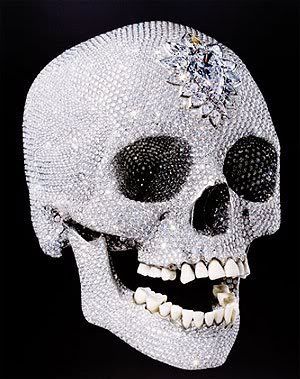
Photo credit: unattributed picture of Damien Hirst's "For The Love of God"

Friday, September 14, 2007

The Demon Market?


The below excerpt was drawn from the comments section following a June 2007 Winkleman post, entitled "What's an Artist? Take 459."
"[The] problem is [this particular artist] doesn't know how to communicate her art to the gallerinas or curators and doesn't have an agent (yet) to help her do it. Generally, if you can't talk up your art in the commercial world of biennales, etc, you're out. When she finds [a gallerist] that perhaps also advises her on some crops, frames and gallerina lingo, she will accrue art-value."

-Stefan
Ah, yes, lest any of you idealistic creatives forget it, the measure of an artwork is rooted not in how accomplished, thoughtful or socially impactful the art is, but in the spin!

I'd like to scoff at Stefan's assertion, but he's right. Strong artwork will sometimes generate a lot of buzz, but the chatter is sustained only if the artist is appreciated by the greater machine. This machine is socially driven and fickle, not unlike the popular high school clique that (most of) us artsy types steered clear of.

Art world arbiters are no more scrupulous than their film, publishing or recording industry counterparts. Ignoring my personal struggle to come to terms with the "industrial" aspect of any creative realm - the word alone makes me cringe - I don't condemn successful art world players for their machinations. The recording industry generates buzz via MTV and billboard radio, the publishing industry with Oprah's Book Club and the NY Times Book Review, and the art industry via ArtForum, ArtNews and other glossies. All of these outlets are designed to sell or promote, and, with the exception of Top 40 radio, they're disguised as critical texts or cultural mediators. Sure, it's relatively transparent, but most of us play along. And why not? Who can blame the players?

Well, among others, Robert Reich, Professor of Public Policy at Berkeley and the former Secretary of Labor blames the players. The talent agents, gallerists, publicists and critics are but a small piece of what Reich calls the "supercharged global economy," but he acknowledges that this greater beast is a blind half-wit, intent on devouring its feet even as it continues to grow at an alarming rate. In the process, governments, communities and spirits are destroyed.

In his recently published book, "How Capitalism Is Killing Democracy," Reich contends that, by acting as consumers and investors rather than politically engaged citizens, "we've made this compact with ourselves." Likewise, by shrugging off the ethical ugliness and superficiality of the art market (among others), I've willfully ignored a sinister presence in my life. I wish that I could convince myself otherwise, but the Stefan's of the art world can not be ignored.

As an advocate of the Steady State Economy, local and reduced agricultural yields and population control incentives, I see our continued insistence on a "healthy economy" leading only to a more entrenched corporate oligarchy, increased cultural homogeneity, a host of new mental and physical disorders (and related diagnoses), and an exploding human population (at the expense of our animal brethren and the ecological niche we evolved to fill). But what does this dire forecast have to do with the art world? Not so much, if you compartmentalize thought as we now fence our borders. But if the art making process remains an essential part of efforts to live well, in accord with our moral values and the lessons of the planet, the willful ignorance of such an arrogant and annihilative system must be addressed, no matter the difficulty.

The question, then: In this attempt to live well, can you step outside the system without abandoning the idea that an artist can earn a living at their trade?

It would seem not. When my ancestor drew on the wall of her cave, or when we tag a truck, the act is "pure," communication is intended and self-gain ignored, but one does not "make a living" in this way. Is art only "sustainable" and vital when it touches a local community, likely serving some utilitarian purpose, too?

I'm interested in readers responding to this question. The last few months have been good for my art sales, which only accents the fact that each time I sell a piece, I'm tearing away at my own ideals...yet I continue to feel good about putting money in the bank.

Photo credit: image ripped from Houston's Clear Thinkers

Wednesday, September 05, 2007

Daily Conversation


Christopher Reiger
"some shambles of apology"
2002
Pencil, watercolor, gouache, acrylic, sumi ink and marker on stretched Arches paper
25 1/4 x 30 inches
"We opt for what we want as daily conversation in the privacy of our minds, and whether on most days we get to watch the sunrise and listen to a snatch of the genius of Bach. It's not expensive to pay attention to the phases of the moon, to transport lemon lilies, and watch a garter snake birthing thirty babies and a catbird grabbing some, or listen to the itchy-britches of the Canada geese as autumn waxes. We will be motes in the ocean again soon, leached out of the soil of some graveyard, and everlastingly rocking."

-Edward Hoagland, "Compass Points"
Tomorrow night the New York art world will kick start another season. I've been trying to get charged up about the September frenzy, but when I visit Artcal's "Openings : Next 7 Days" listing, I'm daunted by the number of shows. This, despite the fact that I look forward to seeing a great many of them.

After eight years in New York, my stomach still tightens when I anticipate attending openings. Whether taking the polite chit-chat route or opting for an intoxicated art party approach, I'm out of my element. People tell me that I handle myself well enough; I suppose I do - I'm not a misanthrope - but the anxiety and the resulting physical discomfort rarely seem worth it. I prefer to be alone when I'm looking at art.

So, this year, as usual, I plan to attend only my friends' openings. All well and good, except that the reclusive temperament isn't well suited to an art career. Curiously, I'm less worried about this fact than I once was. Work is going well in the studio and, most importantly, I'm happy. As William Gaddis wrote in "The Recognitions,"
"What's any artist, but the dregs of his work? The human shambles that follows it around. What's left of the man when the work's done but a shambles of apology."
This being the case, listening to those Canadas is all that much more important.