Showing posts with label economy. Show all posts

Wednesday, April 28, 2010

Revisiting the Steady State Economy

On the heels of not one, not two, but three Republican blockades of financial regulatory legislation in the U.S. Senate this week, I thought it worth reposting the below essay on the concept of a Steady State Economy. The essay was originally posted on HH in April 2005; five years later, there's only that much more reason for thoughtful, comprehensive reform.

+++


Environmentalism is becoming something of a religion. Those who subscribe to most or all of the tenants of the environmentalist doctrine are among the movement’s acolytes, composting and recycling, canvas bagging it and buying organic, living what they consider “healthier,” less “impactful” lives. A thoughtful environmentalist should recognize these actions to be sacraments grounded in a hybrid moral code. “I am doing my part to rectify the mess made by the sinners around me.” How persuasive is this feeling of self-worth and moral superiority? Like all religious conviction, it is undeniably powerful and fulfilling, but it comes at a cost. Too often this fetal “religion” ignores fact in favor of that which is deemed morally superior. For example, radical environmentalists demand a wilderness without humans, ignoring the fact that management (stewardship) is now an unfortunate necessity given our exuberant use of natural resources and our continued sprawl. Reason must enter into the equation. Thoughtful environmentalism of the secular variety is possible, as long as we don’t allow ourselves to become vain.

This brings me to the concept of the Steady State Economy.

I first heard wind of Brian Czech’s Center for the Advancement of the Steady State Economy (CASSE) project a year ago. My initial reaction was positive, though I feared support for the concept would be relegated to left-wing environmental groups of the “religious” variety. Surprisingly, I am hearing the term used with more frequency these days, sometimes by folks with little interest in preserving biodiversity or encouraging ecological sustainability.

I am a proponent of the philosophy (read this .pdf for an excellent summary). The front page of the CASSE website states:
Economic growth is an increase in the production and consumption of goods and services. It entails increasing population, per capita consumption, or both. Economic growth leaves a larger ecological footprint, causing civil strife and bringing nations into conflict.”
This simplifies, for the sake of dramatic impact, the arguments made by the economists behind the SSE. For me, the heart of the matter is touched on in the following selection.
“…Wildlife biologists know that a wide variety of social structures may produce stable populations. The same holds true for a steady state economy. For example, a steady state economy with long human life spans entails low birth and death rates. In our opinion this is preferable, within reason, to a steady state economy with short life spans, high birth rates, and high death rates. The same concept applies to capital and durable goods such as automobiles. We opine that a relatively slow flow of high-quality, long-lasting goods is preferable to a fast flow of low-quality, short-lived goods.”
The SSE will not take hold in the United States anytime soon, but in more socially-minded democracies, like Sweden or England, the approach is not so alien. The truth is, however, such a transition from market-driven capitalism to stability-driven capitalism is unlikely to occur unless the populous desires as much. In the United States, our stock market would require overhaul, making it “less of a casino,” by decreasing its volatility and demand for liquidity. This seems unlikely, especially in the immediate future. In fact, were the transition to begin today, the market would likely hemorrhage. Making things even more unattractive for the “powers that be,” implementation of the Steady State Economy requires, for countries like the United States, a marked decrease in Gross Domestic Product. As a result, I believe the SSE can not become a concrete reality in the foreseeable future, but that we should strive for it no less.

As the selection below suggests, there is much to be gained from the sustainable lifestyle.
“Nor would any cultural stagnation result from a steady state economy. John Stuart Mill (1806-1873), one of the greatest economists and political philosophers in history, emphasized that an economy in which physical growth was no longer the goal would be more conducive to political, ethical, and spiritual improvements.”
Ah, yes, ethical and spiritual improvement… So we’re back to individual action and lifestyle choices, rubbing shoulders with the “religious” environmentalists. Where do I sign up to feel superior to the rest of the heathens? I already recycle, canvas bag it, and eat only meat that I have caught or killed myself. I’m a few sacraments shy of donning a robe and shuffling off to the commune. Why shouldn’t I begin buying everything carefully and, in my own way, push for the adoption of the SSE at a local level?

Well, the truth is I should.

I self-consciously poke fun at the problematic aspects of environmentalism only because it is so close to my heart. I am not a religious man in the popular or traditional understanding of the word. Biology, anthropology, paleontology, history: these are my holy tomes. Yet I firmly believe that through careful consideration, research, and political pressure we can arrive at a more complete conservation ethic, one which addresses not only biodiversity and “wilderness” (my principal areas of interest), but also global poverty and human rights.

Photo credit: ripped from the World Food Programme website

Sunday, November 29, 2009

Picturing Alternative Futures


James Griffioen
From the "Feral Houses" series

Last week, Flavorpill's Flavorwire newsletter introduced me to James Griffioen's photography. "Feral Houses," the series featured by Flavorpill, focuses on abandoned houses in Detroit, Michigan. Griffioen writes,
"For a few beautiful months every summer, some of the tens of thousands of abandoned houses become feral in every sense: they disappear behind ivy or the untended shrubs and trees planted generations ago to decorate their yards. As the city of Detroit disappears, nature is flourishing."
Considered as a whole, the "Feral Houses" series is a record of our complicated relationship with the land upon which we live and depend, as well as of our ailing community roots.


James Griffioen
From the "Feral Houses" series

Detroit's Rust Belt era history is generally bleak. Today, much of the city is classified as a food desert. Sitting down for a hearty meal with friends and family this Thanksgiving evening, I recalled Rebecca Solnit's inspiring Harper's Magazine article, "Detroit Arcadia" (July 2007). Solnit writes,
"Detroit is a cautionary tale about one-industry towns: it shrank the way the old boomtowns of the gold and silver rushes did, as though it had been mining automobiles and the veins ran dry, but most of those mining towns were meant to be ephemeral. People thought Detroit would go on forever. [...] I took many pictures on my visits to Detroit, but back home they just looked like snapshots of abandoned Nebraska farmhouses or small towns farther west on the Great Plains. Sometimes a burned-out house would stand next to a carefully tended twin, a monument to random fate; sometimes the rectilinear nature of city planning was barely perceptible, just the slightest traces of a grid fading into grassy fields accented with the occasional fire hydrant. One day after a brief thunderstorm, when the rain had cleared away and chunky white clouds dotted the sky, I wandered into a neighborhood, or rather a former neighborhood, of at least a dozen square blocks where trees of heaven waved their branches in the balmy air. Approximately one tattered charred house still stood per block. I could hear the buzzing of crickets or cicadas, and I felt as if I had traveled a thousand years into the future."
Yet the central focus of Solnit's essay are the heroic, local reclamations of Detroit's abandoned lots for community gardens or small-scale farming enterprises.
"I also saw the lush three-acre Earth Works Garden, launched by Capuchin monks in 1999 and now growing organic produce for a local soup kitchen. I saw a 4-H garden in a fairly ravaged east-side neighborhood, and amid the utter abandonment of the west side, I saw the handsome tiled buildings of the Catherine Ferguson Academy for Young Women, a school for teenage mothers that opens on to a working farm, complete with apple orchard, horses, ducks, long rows of cauliflower and broccoli, and a red barn the girls built themselves. I met Ashley Atkinson, the young project manager for The Greening of Detroit, and heard about the hundred community gardens they support, and the thousands more food gardens that are not part of any network. The food they produce, Atkinson told me, provides food security for many Detroiters. 'Urban farming, dollar for dollar, is the most effective change agent you can ever have in a community,' she said. Everywhere I went, I saw the rich soil of Detroit and the hard work of the gardeners bringing forth an abundant harvest any organic farmer would envy."
Similar projects are gaining momentum in American cities that aren't suffering as acutely as Detroit. Community garden and farmer's market movements are thriving in many urban centers, and urbanite hunters are no longer unheard of. Last week, the New York Times reported on the growing number of locavores taking up hunting, but, unlike Charlottesville, Virginia's "Deer Hunting for Locavores" class and San Francisco's Bull Moose Hunting Society, ventures made possible by relative privilege and foresight, Detroit's repurposing and enterprise is born of pressing need.


James Griffioen
From the "Feral Houses" series

Contemplating Griffioen's handsome photographs, it's impossible not to think of Detroit's economic and health struggles. Still, his subjects, the "feral houses" themselves, don't strike this Eastern Shore boy as that unusual. All regions marked by poverty offer up monuments to the ceaseless action of Nature and time. Recent studies show that Accomack, the Virginia county that I was raised in and that my parents call home, is "the fattest" county in the state. It is also one of the poorest. Abandoned houses and overgrown automobiles figure as prominently in my mental portrait of the Shore as do salt marshes and the rich smell of freshly turned earth.

Unlike the citizens of Detroit's urban environment, Eastern Shore folks are not strangers to hunting, fishing, or farming. One might therefore assume that food desertification and obesity are unlikely. Unfortunately, access to fresh, healthy foods doesn't mean that locals won't instead opt for fast food! Furthermore, community ties might be even weaker on the Shore than they are in Detroit, eroded in part by an epidemic reliance on the automobile and big-box stores.

What does the future portend for Detroit and Virginia's Eastern Shore? Taking the long view, I'm optimistic. A decade hence, Detroit might well provide a more sustainable model for beleaguered urban communities. The Eastern Shore, however, is a different type of community, and one still on the decline; recovery will come more slowly.


Don Amadeo
House on White's Neck Road; Parksley, Virginia

Like Griffioen's pictures, Don Amadeo's photographs of the Eastern Shore remind us of the slow creep of geologic time, the long long view. Human communities may rise and fall and rise again, but all eventually succumb. So, too, with species. There is an ambivalent beauty in overgrown ruins; they celebrate the wonder of life's eternal striving even as they proclaim mortality.


Don Amadeo
Ole Rusty; Parksley, Virginia

Photo credit: "Feral Houses" photographs, courtesy James Griffioen; ShoreRebel photographs, courtesy Don Amadeo

Friday, November 06, 2009

A Bitter Ode to Hermes

Anatomy of a Creative Funk


Christopher Reiger
"Mannequin"
2009
Pen and sumi ink, gouache, watercolor and marker on Arches paper
15 1/4 x 15 1/2 inches

I apologize for the lack of regular HH content. Writing is as much a part of my creative process as is art-making, and, for weeks now, I've been creatively out-of-sorts. Fairly or not, I attribute this bout of artistic malaise to my solo show.

Visual artists often speak of the funk that descends when a solo show is on view. My first solo exhibition, "Mongrel Truth," at Brooklyn's AG Gallery, gave rise to minimal tsoris, but "Some Species of Song" has played havoc with my head. I've little or no inclination to write, and I've had to force myself to work on studies for future paintings and drawings.

I've heard many explanations for the funk put forward. Most often, artists will say something along the lines of "the batteries need to recharge." That seems natural enough, but, why, I wonder, does this requisite recharge always seem to coincide with a solo show?

I discussed my condition with a writer friend, and her hypothetical explanation of the solo show funk is convincing, at least with respect to my experience of the malady. She contends that, before the solo show, the artist works happily in the studio because he is fully present in his creative labor. In this "process mode," the artist understands the artwork and the art-making as an extension of self, a soulful and intimate activity. Once the artwork is displayed in a commercial gallery, however, the artist must conceive of the artwork anew. In the "product mode," the art is commodified and abstracted, effectively reduced to paper currency, worthless without social consensus. In transitioning from studio space to market space, the artist has crossed over a Hermetic boundary, leaving behind the eroticism of Eros for the commercial quantification of Hermes.

I've quoted from and alluded to Lewis Hyde's fascinating book The Gift before; it's again pertinent. Hyde's foundational position is that all art is a ceremonial gift, that the creative act is part of a free and open dialogue of spiritually nourishing exchange. Once the market commodifies art, however, "a part of the [artist's] self is inhibited and restrained," and the greater community suffers for it. Sadly, this inhibition and incompleteness is, in our capitalistic world view, assumed to be natural; the artist's worth is counted in coinage rather than spirit. One manifestation of this corruption appears in notions of gender.
"[T]he nineteenth century saw a decline in faith coincide with the remarkable success of a secular, mercantile, and entrepreneurial spirit. The story has been told many times. By the end of the century, to be 'self-made' in the market, or to have successfully exploited the natural gifts of the New World, were the marks of a Big Man, while attention to inner life and the community (and to their subtle fluids - religion, art, and culture) was consigned to the female sphere. The division of commerce by gender still holds. As a character in Saul Bellow's novel Humboldt's Gift remarks in regard to creative artists, 'To be a poet is a school thing, a skirt thing, a church thing.' In a modern, capitalist nation, to labor with gifts (and to treat them as gifts, rather than exploit them) remains a mark of the female gender."
Considering muscular capitalism, Hyde calls Hermes the most contemporary of the Greek pantheon. He is the god of the self-made man, the trafficker in goods, pure and soiled.
"Hermes is an amoral connecting deity. When he's the messenger of the gods he's like the post office: he'll carry love letters, hate letters, stupid letters, or smart letters. His concern is the delivery, not what's in the envelope. He wants money to change hands, but he does not distinguish between the just price and a picked pocket. [...] Hermes can't be trusted, of course. The say 'he either leads the way or guides astray.' [...] In a Hermetic mood we will make a hundred intellectual connections only to find, when we check them with a less restless god, that ninety-nine of them are useless.

Homer tells us that Zeus gave Hermes 'an office...to establish deeds of barter amongst men throughout the fruitful earth,' and he has done his job well. He may be the twentieth century's healthiest Greek god. He is present wherever things move quickly without regard to specific moral content, in all electronic communication, for example, or in the mails, in computers and in the stock exchange (especially in international money markets)."
Indeed, the amorality of global capitalism was spectacularly revealed in the recent hemorrhaging of the financial markets. Still, as a people, we've given ourselves to the worship of Hermes, and we champion the good news that he carries over the bad. The art market is no exception. There are, of course, some very positive aspects of the contemporary art market, just as there are some wonderful individuals participating in it, but a dark cloud shadows all contemporary commerce...and luxury commerce, in particular.

In a short passage, mid-way through the book, Hyde offers readers a striking condemnation of the contemporary art market.
"The more we allow such commodity art to define and control our gifts, the less gifted we will become, as individuals and as a society. The true commerce of art is a gift exchange, and where that commerce can proceed on its own terms we shall be heirs to the fruits of gift exchange: in this case, to a creative spirit whose fertility is not exhausted in use, to the sense of plentitude which is the mark of all erotic exchange, to a storehouse of works that can serve as agents of transformation, and to a sense of an inhabitable world - an awareness, that is, of our solidarity with whatever we take to be the source of our gifts, be it the community or the race, nature, or the gods. But none of these fruits will come to us where we have converted our arts to pure commercial enterprises."
I hope that my charitable sales model can, in some small way, act as a corrective to the market's distortions, and serve as inspiration for other artists. We are empowered to change the system. We only need to become enthusiastic about doing so.

Image credit: Christopher Reiger, 2009

Thursday, October 22, 2009

Acting Out (Peacefully) Against the Culture of Competition


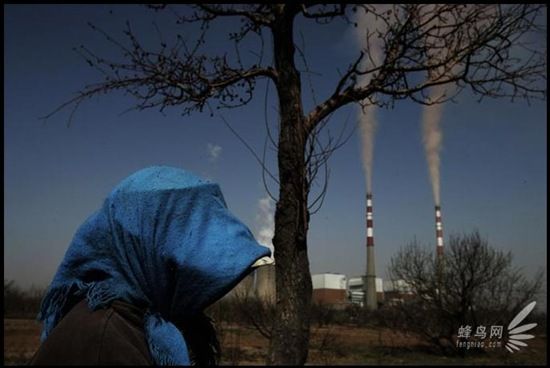
Shizuishan Industrial district in Ningxia. Residents cover themselves against the falling dust when going outside.
April 22, 2006

This Saturday, October 24th, I'll join a mob of peaceful activists and march across the Brooklyn Bridge, from Manhattan to Brooklyn, in hopes of further raising public awareness about the reality of climate change and the need for a comprehensive international climate treaty. The march is associated with 350.org's Day of Action.
"350.org is an international campaign dedicated to building a movement to unite the world around solutions to the climate crisis--the solutions that science and justice demand. Our mission is to inspire the world to rise to the challenge of the climate crisis—to create a new sense of urgency and of possibility for our planet. Our focus is on the number 350--as in parts per million, the level scientists have identified as the safe upper limit for CO2 in our atmosphere. But 350 is more than a number--it's a symbol of where we need to head as a planet. [...] This December, world leaders will meet in Copenhagen, Denmark to craft a new global treaty on cutting emissions. The problem is, the treaty currently on the table doesn't meet the severity of the climate crisis—it doesn't pass the 350 test. In order to unite the public, media, and our political leaders behind the 350 goal, we're harnessing the power of the internet to coordinate a planetary day of action on October 24, 2009. We hope to have actions at hundreds of iconic places around the world - from the Taj Mahal to the Great Barrier Reef to your community - and clear message to world leaders: the solutions to climate change must be equitable, they must be grounded in science, and they must meet the scale of the crisis."
350.org was founded by author and environmentalist Bill McKibben and, although some legitimate philosophical criticisms of the project have been raised, I feel strongly that the organization's mission is vital.


Due to long-term consumption of water contaminated by industrial waste, 50 people have cancer and cerebral thrombosis in Kang village of Linfen City, Shanxi Province..
64-year-old Wang Baosheng has fester wounds all over his body, and must sleep sitting, face down on the edge of the bed each day.
July 10, 2005

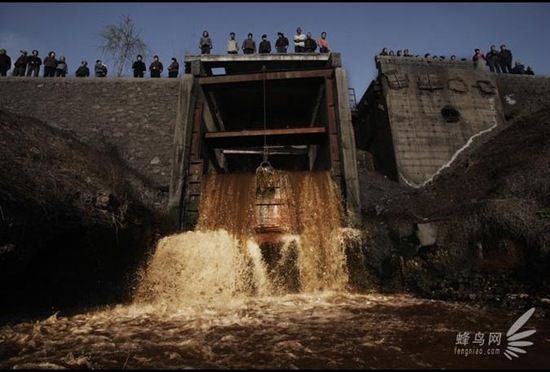
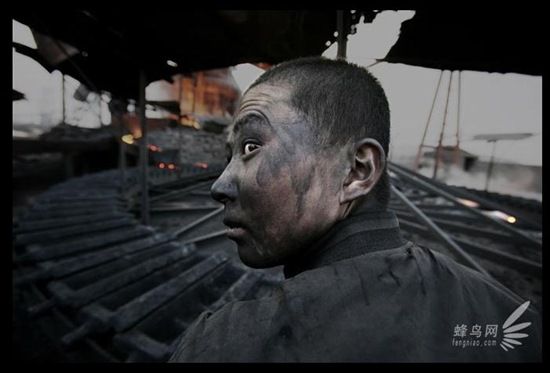
Should you doubt the urgent need for an international climate treaty that demands accountability and systemic change, or should you remain skeptical of the human influence on atmospheric carbon levels, I encourage you to take a look at the distressing pictures that ChinaHush recently published. Photographer Lu Guang's series "Pollution in China" is a testament to the cruel realities of the international, industrial market.

In his book-length essay Life Is A Miracle, the author, poet, essayist, and critic Wendell Berry describes the global, capitalist world view as,
"one culture of division and dislocation, opposition and competition, which is to say the culture of colonialism and industrialism. This culture has steadily increased the dependence of individuals, regions, and nations upon larger and larger collective economies at the same time that is has thrown individuals, regions, and nations into a competitiveness with one another that is limitlessly destructive and demeaning."
The "collateral damage" caused by this monstrous steam engine is not limited to elevated carbon levels, and its poisons don't just affect the dispossessed or the politically and economically powerless.

Nicholas Kristoff reminds us, in a recent New York Times OpEd piece, that the staggering number of "deformed frogs and intersex fish [found in or near United States' waters] — not to mention the growing number of deformities in newborn boys — should jolt us."
"In the Potomac watershed near Washington, male smallmouth bass have rapidly transformed into 'intersex fish' that display female characteristics. This was discovered only in 2003, but the latest survey found that more than 80 percent of the male smallmouth bass in the Potomac are producing eggs. Now scientists are connecting the dots with evidence of increasing abnormalities among humans, particularly large increases in numbers of genital deformities among newborn boys. [...] Apprehension is growing among many scientists that the cause of all this may be a class of chemicals called endocrine disruptors. They are very widely used in agriculture, industry and consumer products. Some also enter the water supply when estrogens in human urine — compounded when a woman is on the pill — pass through sewage systems and then through water treatment plants."
Herpetologists have been sounding the alarm for years, but the policy makers are warm in the pockets of the immoral corporations and the populace, by and large, prefers to escape in celebrity pregnancy updates and corporate-owned sporting events. Amphibians were the ignored canary in the coal mine. Now many animal families (ours included) are paying a terrible price, one that we can not yet fully appreciate.


Henan Anyang iron and steel plant’s sewage flowed into Anyang River. March 25, 2008

Still, it's not too late to stand up to the "culture of colonialism and industrialism." Visit 350.org. Find out how to get involved in the effort. If global warming isn't appealing to your still, small voice, get involved with political activism, volunteer at your local homeless shelter, pledge financial support to non-profit activist organizations working for causes that you feel strongly about; it doesn't matter what you do, but it does matter that you do something. Turn off the television, put down the tabloid. I beg this of you.


Breathing large amounts of dust into their lungs, people become sick after working here for 1-2 years. Most of these migrant workers come from area of poverty.
April 10, 2005

Photo credits: all photographs, Lu Guang; ripped from ChinaHush

Wednesday, September 16, 2009

Kimmel Harding Nelson Residency: Day 10


Jefferson Sculpture
Lewis & Clark Visitors Center; Nebraska City

Naturalists, Puritans, and New Territories
"I think our governments will remain virtuous for many centuries; as long as there shall be vacant lands in any part of America. When they get piled upon one another in large cities, as in Europe, they will become corrupt."

- Thomas Jefferson, 1787
The American polymath Thomas Jefferson ranks highly in my pantheon of heroes. Yeoman farmer, architect, inventor, philosopher, naturalist, Virginia gentleman, and statesman, Jefferson defies easy classification. His political pragmatism and philosophy reflect his broad excavations, and the complex of sometimes contradictory ideas that Jefferson put down over the course of his long life allows his legacy to be fairly claimed by contemporary pundits of every stripe. His name and statements are marshaled to support causes across the political spectrum, including state's rights, internationalism, provincialism, gun control, the right to bear arms, unregulated capitalism, anarchy, secularism, and even the call for the United States to be officially deemed "a Christian nation." It is not, however, Jefferson's nuanced political philosophy that is responsible for his cultural ebb; he was a slave-owner and a patriarchal figure who decried "intellectual women." By today's standards, he was a deeply flawed man. But Jefferson died 183 years ago. It is wrongheaded to dismiss the whole of the man for latter-day sins. In any case, his accomplishments and legacy are profound.

Jefferson was irredeemably curious and hopeful. The man's hunger for knowledge and his faith that the human lot can forever be improved upon vitalize the Jeffersonian heritage. The Enlightenment-inspired, exuberant optimism of Benjamin Franklin, Joseph Priestley, Thomas Jefferson, and others in their mold watered the soil of American social, political, and technological revolution. And, as I wrote two days ago, "it's a happy wonder to contemplate [...] the maturation and proliferation of human technology." But at what price did so much "happy" change come?


Mandan Fort recreation
Lewis & Clark Visitors Center; Nebraska City

President Jefferson, in March of 1803, commissioned Captain Meriwether Lewis to lead the Corps of Discovery with William Clark. Jefferson obtained federal funding for the expedition on the grounds that, if successful, Lewis and Clark might "offer the most direct and practicable water communication across [the] continent for the purposes of commerce," but the president's principal interests were other. He wrote to Lewis,
"The object of your mission is to explore the Missouri River. [...] Objects worthy of notice will be the soil & face of the country, it's growth & vegetable productions, especially those not of the U.S.; the animals of the country generally, & especially those not known in the U.S., the remains or accounts of any which may be deemed rare or extinct; the mineral productions of every kind; but more particularly metals, limestone, pit coal, & saltpetre; salines & mineral waters, noting the temperature of the last, & such circumstances as may indicate their character; volcanic appearances; climate, as characterized by the thermometer, by the proportion of rainy, cloudy, & clear days, by lightening, hail, snow, ice, by the access & recess of frost, by the winds prevailing at different seasons, the dates at which particular plants put forth or lose their flower, or leaf, times of appearance of particular birds, reptiles or insects."
Historians suggest that the excitement Jefferson felt on the eve of this great expedition was quite real. His impetus was curiosity, not Puritan conquest.


Mt. Zion African Methodist Church yard
Mayhew Historic Village; Nebraska City

The Pilgrim settlers of this country had little curiosity about the natural history or native peoples of their "New World." William Bradford, five-time governor of Plymouth Colony from 1621 - 1657, described (what little he knew of) the North American continent as "a hideous and desolate wilderness." Jefferson, by contrast, wrote that "there is not a sprig of grass that shoots uninteresting to me." He saw the natural world as an Eden to be studied and, as author Erik Reece describes it, as "an antidote to the deadening forces" of civilization. For Jefferson, the notion of "God and country" was shaped by topography and the human place in it.

But Lewis and Clark's great voyage of discovery didn't simply educate Americans living east of the Appalachian spine about the continent's interior and western Edens. It paved the way for mass migration, mass slaughter, and mass industry. What happened on this vast continent parallels the greater history of mankind and, indeed, of all life.


Bison diorama
Lewis & Clark Visitors Center; Nebraska City

Historian Daniel Boorstin wrote in 1953 that, "the genius of American democracy comes not from any special virtue of the American people but from the unprecedented opportunities of this continent." Similarly, the remarkable evolution of the human ape, from tree-dweller, to hunter-gatherer, to agriculturist, to civilized man, comes from no special virtue of our species, but from the unprecedented opportunities of this Earth. One thing, as it were, led to another, and our species proved able and willing to exploit to the fullest extent. Loren Eiseley writes, in The Immense Journey,
"The stolen energy that would take man across the continents [as a hunter-gatherer] would fail him at last. The great Ice Age herds were destined to vanish. When they did so, another hand like the hand that grasped the stone by the river long ago would pluck a handful of grass seed and hold it contemplatively. In that moment, the golden towers of man, his swarming millions, his turning wheels, the vast learning of his packed libraries, would glimmer dimly there in the ancestor of wheat, a few seeds held in a muddy hand."
So it was with North America. The "meteoric, messy, and astonishing history" of the United States was fueled, above all, by a distinctly un-Jeffersonian conquest of the land's native peoples, animals, and resources.

Near the end of his sweeping ecological history of North America, The Eternal Frontier, Tim Flannery writes,
"During the nineteenth century, [...] the European Americans were developing a new economy. It was an economy based on systems of mass production and mass exploitation that needed enormous resources to operate. The key decade was 1880-90, for only then did European machinery become sophisticated enough to destroy the great herding and flocking species [the passenger pigeon, the American bison, and the Eskimo curlew]. Their enormous numbers provided an ideal teething rusk for an economic machine that would soon produce cars in the millions and hamburgers in the billions."
We devoured the continent.


Fake Prarie Dog burrows and mural
Lewis & Clark Visitors Center; Nebraska City

What allowed for this? What became of the Enlightened foresight of the founding minds? How did we move, in one hundred years, from Thomas Jefferson to Henry Ford? And could we have made such astounding, "happy" progress in human rights, suffrage, and science without surrendering to this demonic appetite? There is no tidy answer to these questions and, in any case, it's irresponsible to wade in what-might-have-been when you can instead strive toward what-yet-could-be. Still, the history perplexes.

Jefferson bemoaned the Christian scriptures' inclusion of miracles and the emphasis, in Christian doctrine, on the afterlife. Erik Reece explains in An American Gospel that Jefferson realized,
"the more Christian fundamentalism emphasizes that the kingdom of God awaits as a reward in the afterlife, the more it ignores [...] Jesus' teachings of how we should act while we inhabit this earthly realm. [...] The relevance of Christianity to most Americans has far more to do with the promise of eternal salvation from this world."
Jefferson's famous and sensible solution was to edit the Christian New Testament, deleting any and all miracles, including the Virgin Birth and the Resurrection. He called the result "The Life and Morals of Jesus of Nazareth." Today, the book is best known as "The Jefferson Bible." Perhaps, if more good Christians had followed their incarnate God's example and teachings in this life - the one that actually matters! - the west would have been settled in accord with the land. Unfortunately, most in our "Christian nation" don't know of Jefferson's earnest effort to save Christianity from other-worldly supernaturalism, from, as he called Puritanical ministers, "the soothsayers and necromancers."

Neither do most Americans know of Jefferson's effort to temper our faith in industrialism. Jefferson's agrarian dream for America was impossible; the United States was then and is now a burgeoning country, and true pastoralism can only ever be embraced on a small scale. But we would do well to remember Jefferson's vision, to remember that we are part of a greater system, and that the expiration date for America's frontier mentality, its faith in boldly going and exploiting, is past.

Despite our exceptionalist tendencies, our nation is like any other. Every nation is a tiny part of the greater superorganism, and every nation's story is a life cycle. The sprawling, arrogant United States is no longer an adolescent, and it can't afford to continue acting like one, to continue "lighting out for the territories." If we fail to mature, our reckless faith in what lies over the next mountain, in the future and in the afterlife, will prove our nation's undoing. It is faith in what exists here and now, in the place where we stand, that needs resurrection.


Missouri River Overlook
Lewis & Clark Visitors Center; Nebraska City

Most Americans are estranged from their own nature, as well as from the nature all around them. Reece writes,
"[We are estranged from] the sources of our food, the sources of our clothes, and the sources of the energy that run our homes. Beyond these basic needs, money and corporate influence have estranged us from our own government. Our isolation within suburban homes has estranged us from our neighbors and communities. [...] Cars have estranged us from our own bodies. [...] Our modern condition of estrangement has led us to live in ways that show a remarkable abdication of responsibility."
Reece proposes that Aldo Leopold's philosophy "carries us back into an ethic of responsibility." I agree.

Leopold, the godfather of modern conservation, inherited Jefferson's dream. Like Jefferson, he was a Romantic pragmatist, a type as well-suited to diplomacy as to conservation. Leopold acknowledged that resource use, like the economy, can be regulated thoughtfully, but the Romantic in Leopold was dismayed by the dark side of our equating land with money. He wrote,
"I suspect that the forces inherent in...economic evolution are not all beneficent. Like the forces inside our own bodies, they may become malignant, pathogenic. I believe that many of the economic forces inside the modern body-politic are pathogenic in respect to harmony with land."
He deemed his heroically optimistic response to the increasing pressures of population and market a "land ethic." Despite the difficulties of cultivating such an appreciation of the natural world in the twentieth century, Leopold persisted.
"That land is a community is the basic concept of ecology, but that land is to be loved and respected is an extension of ethics. [...] A land ethic, then, reflects the existence of an ecological conscience, and this in turn reflects a conviction of individual responsibility for the health of land. [...] We can be ethical only in relation to something we can see, feel, understand, love, or otherwise have faith in."
The American estrangement from land and from the rest of nature (including the dark, interior wilderness of the psyche) is redressed through cultivation of a land ethic. And, in so far as I am "happy" to contemplate the incredible rate of technological evolution, I am made happier still by the prospect of a mature, tempered America.


Vacant lot on Central Avenue; Nebraska City

This morning, I sat for a while and talked with an older gentleman in Long Home Coffee Shop, on Nebraska City's Central Avenue. A retired physicist, he expressed concern about the future of America and, more generally, of the human species. "It's all terribly depressing," he observed. "I have my good days and my bad," I concurred. "But the bleak pessimism is more rare than it was, just because it's unproductive." He nodded, and his heavy eyes seemed to say both, 'Thank goodness for the optimism of youth!' and 'Bloody damned fool!'

But I'm not a fool, and neither is he. An hour after we talked, as I sat at a table scribbling the notes that became this essay, he attended, in the back room of the coffee shop, a meeting regarding the construction of a community garden at the west end of town. The city has provided the group with a vacant lot, a local corporation will provide the initial revenue for construction, and the garden will be tended and managed by volunteers, providing food for those in need.

Now that, I contend, is positively Jeffersonian!

Photo credits: all photos, Hungry Hyaena, 2009

Thursday, July 02, 2009

Repairing America (and beyond)


Micanopy, Florida


While visiting central Florida last month, an acquaintance told me that all of her Gainesville co-workers are fans of Rush Limbaugh's radio punditry. On the highways around the small city, I saw countless pro-life billboards and a good number of "NObama" bumper stickers on passing pickup trucks. Although the city's populace supported Obama in the 2008 presidential election (as did the state), it was very clear that the city represents a blue dot in a red region.

Contemplating this red state mentality, I recalled Thomas Frank's "Lie Down for America," an excellent, if depressing article published in the April 2004 issue of Harper's Magazine. Frank dissected, in his words, "how the Republican Party sows ruin on the Great Plains."
"Whereas earlier forms of conservatism emphasized fiscal sobriety, the backlash mobilizes voters with explosive social issues - summoning public outrage over everything from busing to un-Christian art - which it then marries to pro-business economic policies. Cultural anger is marshaled to achieve economic ends.

[...] 'Rural America is pissed,' a small-town Pennsylvania man told a reporter from Newsweek. Explaining why he and his neighbors voted for George Bush, he said: 'These people are tired of moral decay. They're tired of everything being wonderful on Wall Street and terrible on Main Street.'"
The same Wall Street-Main Street dichotomy was trotted out by campaigning Republicans four years later, in 2008, to cast the GOP as the party of the people. But did the tactic really work? After all, Obama won the 2008 election. Aren't rural and Middle America coming around, realizing that the Republican party doesn't have their best interests in mind, even in those cases where the social issues of the Right more closely align with their values?

I hope so, but I wouldn't bet on it. Middle America will jab an angry finger at someone, and faithful Rush can't be the enemy. Our country is already waging a war against Islam, so we know that the Muslims are "against us," but they're not pulling America's economic strings. And, as a general rule, black folks don't have too much power, Obama not withstanding. But, wait a second...aren't there a lot of socialist Jews whispering in Obama's ear? Hell, isn't he related to a rabbi!?

The July 2009 issue of Harper's includes two disturbing poll results.
Chance that an American thinks 'the Jews' were moderately or very much to blame for the financial crisis: 1 in 4

Chance he or she thinks they were 'a little' to blame: 1 in 7
This is a shocking statistic! I wonder what percentage of Americans believe that "the Jews" are no more culpable than any other ethnic or religious group?

Oh, but that's a silly question! After all, "the Jews" are the denizens of Wall Street, and Main Street folk like Dubya and Rush don't like that sinful, unAmerican place. It should be clear to me that the current recession - when should we start calling it a depression? - is not the result of the unsustainable, myopic economic policies of the last sixty years (amped up by Ronald Reagan, but embraced by both Democrat and Republican administrations). It's instead the vast Zionist conspiracy! The socialist Jews have teamed up with the capitalist Jews to forge an unholy alliance, and they're running the global economy into the ground!

Would that I could laugh off such frightening ignorance. Unfortunately, the bigotry is not evidenced only on the Right. In fact, the same study cited in Harper's showed that the registered Democrat respondents were 12% more likely than responding Republicans to blame "the Jews" at moderate or higher levels. There is a time-tested, inverse relationship between economic performance and anti-Semitism, and this correlation isn't affected, evidently, by political affiliation.

The New York Times reports today that "U.S. Job Losses Rise and Unemployment Reaches 9.5%."
"The American economy lost 467,000 jobs in June [2009] and the unemployment rate edged up to 9.5 percent in a sobering indication that the most painful downturn since the Great Depression has yet to release its hold."
Things are going to get a lot worse for Middle America. Finger pointing does none of us any good (and certainly not the tiny Jewish minority in the United States).

Still, I remain optimistic. As I wrote in January,
"Call it Obamatism, call it naive idealism, call it what you will...but it's time to participate, to put aside our generation's infantilism and get to Aristotle's happy work. [...] We will pass through our challenging stage of human social development but, fraught as it is, the need for an active and immediate commitment to bettering our world's future is great."
Jews call that tikkun olam, repairing the world. Get to it, people!


Photo credit: Hungry Hyaena, 2009

Tuesday, June 16, 2009

Passing on our gifts


Jason Middlebrook
"The Endless Outpouring Of Support"
2008
Acrylic, ink and pencil on paper
57 7/8 x 70 7/8 inches framed


For a number of years, friends have recommended that I read Lewis Hyde's The Gift. I'm finally getting around to doing so and, just forty pages into the text, I see why friends thought the book would so appeal to me. Hyde picks apart the contemporary market, particularly as it relates to commerce in art objects and other creative "commodities." In the introduction, he writes,
"A work of art is a gift, not a commodity. [...] Every modern artist who has chosen to labor with a gift must sooner or later wonder how he or she is to survive in a society dominated by market exchange. And if the fruits of a gift are gifts themselves, how is the artist to nourish himself, spiritually as well as materially, in a age whose values are market values and whose commerce consists almost exclusively in the purchase and sale of commodities?

Every culture offers its citizens an image of what it is to be a man or woman of substance. There have been times and places in which a person came into his or her social being through the dispersal of his gifts, the 'big man' or 'big woman' being the one through whom the most gifts flowed. The mythology of the market society reverses the picture: getting rather than giving is the mark of the substantial person, and the hero is 'self-possessed, 'self-made.' So long as these assumptions rule, a disquieting sense of triviality, of worthlessness even, will nag the man or woman who labors in the service of a gift and whose products are not adequately described as commodities.

[...]

A man in another tribe that [anthropologist] Wendy James has studied says, in speaking of the money he was given at the marriage of his daughter, that he will pass it on rather than spend it himself. Only, he puts it this way: 'If I receive money for the children that God has given me, I cannot eat it. I must give it to others.'"
Reading the last bit of the above excerpt, I couldn't help but think of my charitable sales model. The income that I receive from the sale of art objects I've produced is fundamentally no different from the tribe representative's "money for the children that God has given me." In this respect, it is not merely ethical, but also natural that some significant percentage of each sale be passed on, invested in turn in the good works of a non-profit organization or another conscientious individual.

Hyde points out that this pass-it-on approach is in keeping with the cycles of nature. Indeed, the words "ecology" and "economy" are etymologically connected for good reason. As I explained in an HH post in August of 2005,
"'Ecology' translates as 'study of the household' and 'economy' as 'management of the household.' Any good scientist (or thoughtful citizen, for that matter) should study the household before managing it. Thanks in no small part to my father's influence, I began to see many ecological issues as economic concerns (and vice versa). Given my environmentalist leanings, I suppose my [engagement] with economic theory was inevitable. It was also inevitable, or at least quite likely, that I would become disenchanted with our current boom-and-bust paradigm."
Moreover, Hyde points out that "the language of gift exchange has procreation at its root. Generosity comes from genere (Old Latin: beget, produce), and the generations are its consequence, as are the gens, the clans." Indeed, by damming wealth in concentrated pools, the demon market of our capitalistic culture halts the cycle of generations. The natural flow stopped, dispossessed peoples are condemned to hunger for physical nourishment and the wealthy are condemned to hunger for nourishment of the soul.

As Hyde stresses, "what is given away feeds again and again, while what is kept feeds only once and leaves us hungry." Or, as my mom always puts it, "Love and live with an open hand."

Image credit: Jason Middlebrook image ripped from the Sara Meltzer Gallery website

Friday, September 19, 2008

Everybody's talking about it...

...but few folks have anything this worthy to contribute.

Bosko Blagojevic
's "Hard to See, Harder to Imagine" post at ArtCal Zine is only a modest taking-stock, but it reads like a prose poem. It isn't just our ailing economy that needs examination; indeed, the capitalistic economic machine always operates in a fugue.
"Financial journalism, and economics since around the mid 17th century, has increasingly been about abstractions: intricate movements of people, money and material described and occasionally visualized, but remaining essentially invisible. They endure, like climate change and remote international conflicts, as that which might inspire excitement, worry, fear, or action - and yet necessarily demand a kind of belief in order to do so. Belief in the economy, as belief in anything else, becomes a certain emotional temperature that elevates a thing from an idea to a fact. It cannot be anything but this. So it may be with a sense of puzzled anxiety, an anxiety without an image or a face, that one reads in today's Times of the $85 billion Federal loan to save A.I.G., the capsizing international insurance giant. Equal puzzlement or slightly chastened awe, perhaps, might be inspired on the same day upon reading, on top of Artforum.com's news page, of Damien Hirst's potentially precedent-setting 2-day primary market auction sale, collecting for the artist $200.8 million in the sale of all but three of the 167 works to see the auction block. These numbers in their excess, of profits or deficits, seem to become less real with each shift in the order of magnitude, or move of the decimal point."

Note: This post follows an auction announcement, albeit a benefit auction. As Alanis would say, isn't it ironic?

Wednesday, October 17, 2007

$$$ and Sense


The Colorado Rockies have secured a spot in the 2007 World Series and the Cleveland Indians are their likely opponents (barring an incredible turnaround by the Boston Redsox). I'm not a fan of either team but I root for underdogs and so am pleased to see these two clubs experiencing success.

My pleasure is dampened, however, by the constant fretting of so many sports commentators and journalists about the "problems" with "small market teams" vying for the championship. Sure, Major League Baseball's executives (and those at the invested television networks) are more worried about "the numbers" than they are a good sports story, but those men and women are the suited vultures, the "money men," a tribe I hold in low regard. Why should the commentators echo their concerns?

I'm not usually one to romanticize sports history - nostalgia is a refuge of the deluded or the defeated - but it wasn't long ago that popular sports mythology was built around icons and iconic achievement at the individual and team level. Frustratingly, our contemporary culture celebrates the sports investors almost as much the records, players, and managers. The much caricatured, beer-gutted fan sprawled in his recliner is today as concerned with salary caps, free agency moves, and team revenue as he is batting average and stolen bases. Off season dealings are as much a subject of water cooler conversation as the break-out rookies or outstanding team efforts. Indeed, contemporary sports talk might be confused for a stock portfolio review.

These are the times we live in, and our mercenary understanding of sports just one more tell, but for a more poignant take on contemporary apathy (and what it represents or portends) link over to James Wagner to read his "Good Germans" post, a response to Frank Rich's op-ed in the October 14th Sunday New York Times.

Friday, September 14, 2007

The Demon Market?


The below excerpt was drawn from the comments section following a June 2007 Winkleman post, entitled "What's an Artist? Take 459."
"[The] problem is [this particular artist] doesn't know how to communicate her art to the gallerinas or curators and doesn't have an agent (yet) to help her do it. Generally, if you can't talk up your art in the commercial world of biennales, etc, you're out. When she finds [a gallerist] that perhaps also advises her on some crops, frames and gallerina lingo, she will accrue art-value."

-Stefan
Ah, yes, lest any of you idealistic creatives forget it, the measure of an artwork is rooted not in how accomplished, thoughtful or socially impactful the art is, but in the spin!

I'd like to scoff at Stefan's assertion, but he's right. Strong artwork will sometimes generate a lot of buzz, but the chatter is sustained only if the artist is appreciated by the greater machine. This machine is socially driven and fickle, not unlike the popular high school clique that (most of) us artsy types steered clear of.

Art world arbiters are no more scrupulous than their film, publishing or recording industry counterparts. Ignoring my personal struggle to come to terms with the "industrial" aspect of any creative realm - the word alone makes me cringe - I don't condemn successful art world players for their machinations. The recording industry generates buzz via MTV and billboard radio, the publishing industry with Oprah's Book Club and the NY Times Book Review, and the art industry via ArtForum, ArtNews and other glossies. All of these outlets are designed to sell or promote, and, with the exception of Top 40 radio, they're disguised as critical texts or cultural mediators. Sure, it's relatively transparent, but most of us play along. And why not? Who can blame the players?

Well, among others, Robert Reich, Professor of Public Policy at Berkeley and the former Secretary of Labor blames the players. The talent agents, gallerists, publicists and critics are but a small piece of what Reich calls the "supercharged global economy," but he acknowledges that this greater beast is a blind half-wit, intent on devouring its feet even as it continues to grow at an alarming rate. In the process, governments, communities and spirits are destroyed.

In his recently published book, "How Capitalism Is Killing Democracy," Reich contends that, by acting as consumers and investors rather than politically engaged citizens, "we've made this compact with ourselves." Likewise, by shrugging off the ethical ugliness and superficiality of the art market (among others), I've willfully ignored a sinister presence in my life. I wish that I could convince myself otherwise, but the Stefan's of the art world can not be ignored.

As an advocate of the Steady State Economy, local and reduced agricultural yields and population control incentives, I see our continued insistence on a "healthy economy" leading only to a more entrenched corporate oligarchy, increased cultural homogeneity, a host of new mental and physical disorders (and related diagnoses), and an exploding human population (at the expense of our animal brethren and the ecological niche we evolved to fill). But what does this dire forecast have to do with the art world? Not so much, if you compartmentalize thought as we now fence our borders. But if the art making process remains an essential part of efforts to live well, in accord with our moral values and the lessons of the planet, the willful ignorance of such an arrogant and annihilative system must be addressed, no matter the difficulty.

The question, then: In this attempt to live well, can you step outside the system without abandoning the idea that an artist can earn a living at their trade?

It would seem not. When my ancestor drew on the wall of her cave, or when we tag a truck, the act is "pure," communication is intended and self-gain ignored, but one does not "make a living" in this way. Is art only "sustainable" and vital when it touches a local community, likely serving some utilitarian purpose, too?

I'm interested in readers responding to this question. The last few months have been good for my art sales, which only accents the fact that each time I sell a piece, I'm tearing away at my own ideals...yet I continue to feel good about putting money in the bank.

Photo credit: image ripped from Houston's Clear Thinkers

Thursday, June 28, 2007

Sustaining Hope


Sebastiao Salgado
Reindeer graze on Russia's Kamchatka Peninsula


After spending decades photographing the machinations of capitalism (and the resulting dereliction of places and peoples), Sebastiao Salgado "lived for about seven years in real desperation." When individuals face formidable adversity or witness untenable horrors, they often turn to religious fellowship for solace. Indeed, the tribal communion of shared faith is a principal reason for religion's evolutionary success. Salgado found hope, however, not in prayer meetings or the Eucharist but in the natural world, in particular the outlying, inhospitable places - the poles, the deserts, the deep rain forests - and the indigenous societies, human and non-human alike, which occupy these regions. His current, on-going series, entitled "Genesis," is a testament to the remarkable restorative powers of Nature.
"I believe that these very political issues are all tied together. When I go to make these Genesis pictures — it’s not that I wanted to become photographer of exotic animals, not that I wanted to do landscape. I worked a lot when I was considering this project with Conservation International, and from them I get [the figure] that 46 percent of the planet is there like the day of Genesis. It is for this that I’m looking. It’s fabulous, to show to the people that live in Los Angeles, San Francisco, New York, anywhere, who imagine that all the planet is destroyed. There is good news, very hopeful news: 46 percent is there yet, not including the oceans. Of course, that is not the majority, the majority we exploit."
Today, Salgado is a glass half-full kinda guy and the Genesis photography project helped rescue him from despair.


Sebastiao Salgado
Sun over Namib Desert


Salgado fortified his hope by turning his attention to the land. A cultivated appreciation of the world that birthed us and sustains us (cultivated, in this case, by shedding many of contemporary culture's prejudices and fears) allows us to more fully adopt an integrated worldview. To do so, we must be honest; we must include strip mines, genocide and industry, all products of our special exuberance, in this cultivated consideration. This is the first step in developing a philosophy that might lead to a fundamental restructuring of our globalized economic system. More importantly, the sort of experience one has when you connect to the whole, or as I call it, the Everything, reminds us that the promises of immortal salvation are irrelevant. This life - indeed, this very moment - is worth innumerable afterlives. If we, as a culture, awaken to that truth, sustainability might yet be, well, sustainable.


Sebastiao Salgado
Himbas mother and child with dog, Namib Desert


Photo credits: all images, Sebastiao Salgado; dates vary

Thursday, June 21, 2007

Colonies collapsing

"But I think we’re the ones suffering from Colony Collapse Disorder. Because although nobody really knows for sure what’s killing the bees, it’s not al-Qaeda, and it’s not God doing some of his Old Testament shtick, and it’s not Winnie the Pooh. It’s us. It could be from pesticides, or genetically modified food, or global warming, or the high-fructose corn syrup we started to feed them. Recently it was discovered that bees won’t fly near cell phones — the electromagnetic signals they emit might screw up the bees navigation system, knocking them out of the sky. So thanks guy in line at Starbucks, you just killed us. It’s nature’s way of saying, 'Can you hear me now?'"

-Bill Maher
Many readers will be at least a little familiar with news of the global collapse of European honeybee (Apis mellifera) populations. I've talked with friends and acquaintances who take this development very seriously, while others who dismiss it offhand. Whatever their attitude, however, most people possess only a superficial understanding of colony collapse disorder (CCD). As with most "natural" declines, the science of the situation is more complex than our major media outlets report.

Consider the following wrinkle. The European honeybee, the species in question, is not native to the United States. While many areas of agricultural production will be adversely affected by their collapse, some entomologists have pointed out that populations of native bee species may rebound as the niche they originally filled (as pollinators) opens up again. On the other hand, those native bee species are not domesticated, and therefore will not pollinate crops as efficiently as European honeybees do. No surprise there; what's good for biodiversity is rarely good for industrialized agriculture.

I'm very curious to learn what (or what confluence of causes) is responsible for the collapse. While I’m pleased to see celebrities like Bill Maher making a popular fuss about an environmental dilemma, the media only chose to issue a red alert regarding this particular environmental issue because it could lead to diminishing economic returns. Given this agrinomics bias, the science side of the news story is generally glossed over or grossly simplified.

Fortunately, there are folks offering more comprehensive summations. Link over to Bioephemera for an excellent roundup of the situation (and one of Cicada's lovely paintings, to boot).

Thursday, May 17, 2007

Economics and equity revisited


Chris Jordan
"Container yard #1, Seattle"
2003
C-print
44 x 59 inches

Edward Winkleman's blog is host to an interesting conversation this week (or, rather, several related conversations). Over the course of four or five recent posts Winkleman and his readers, some of whom are very articulate and opinionated, have weighed in on a number of topics. Principal among them are art and commerce, "high" art versus populist aesthetics/inspiration, and the boundaries of the avant garde. The dialogue is pervaded by market concerns and, as I read through the comments, I found myself considering not only the art market, but also broad cultural attitudes toward commerce, creative responsibility, and the social role of the contemporary artist. Regarding this last point, there seems to be much confusion, even among artists themselves...and perhaps especially among artists. Eleanor Heartney's reaction to P.S.1's "Greater New York, 2005" exhibition came to mind.
“The show suggests that artists are connected to events in the outside world but have little sense of what to do about them, other than to create artworks that incorporate their frustration, rage, apprehension or sense of the absurdity of contemporary life.”
The industry we've built up around contemporary "fine" art may be more thoroughly intellectualized than that of Hollywood or hip-hop (often without good reason), but it is, essentially, the same beast. It is difficult, if not impossible, to make a living in any of these industries without becoming bogged down in a muddy mix of networking, posturing, and promotion. I'm terrible at all of these (hence my choosing words with negative connotations, such as "bogged" and "muddy") and at times I wish for nothing so much as a full-time spin doctor. Most of the successful emerging and mid-career artists that I know excel at navigating the swamp of promotion (they either enjoy it or reconcile themselves to its necessity). The amount of time and energy they commit to such endeavor makes them jealous of our independently wealthy counterparts, artists benefited not only by abundant studio time, but by greater freedom from the system. Certainly some monied artists pursue the nominal celebrity offered by art world success, but because they don't need to sell their work, they can, in effect, choose to work away from the noise and the distraction of "the scene."

While reading through the comments at Winkleman, I begin to feel that the dialogue, interesting though it may be, is just an echo of that scenester noise. Most, if not all, of the conversation taking place is grounded on the assumption that when creativity meets money, competition results, which leads to even greater creativity. That assumption is the bedrock of neoclassical economics and, in turn, free market philosophy, but not every economist embraces it. I recall John Stuart Mill's assertion that a balanced, sustainable economy (as opposed to one that is "growing," "strengthening," or, in the words of President Bush, "getting going") is "more conducive to long term political, ethical and spiritual improvements." I was first introduced to Mill's writing a few years ago, when I began pondering the concept of the Steady State Economy. This economic philosophy received a fair amount of attention on HH in 2005, when I was initially digesting the idea, but I haven't written much about it since; you needn't ruminate so often on that which you wholeheartedly believe, and the benefits offered by economies of scale and measured population dynamics are clear.

As I wrote in "Ecological Economics 101,"
"...[Brian] Czech, [author of "Shoveling Fuel for a Runaway Train" and president of the Center for the Advancement of the Steady State Economy (CASSE)], offers advice for building a healthy alternative to unrestrained, free-market capitalism. In the steady state economic paradigm, growth (or, as Czech calls it, bloating) is discouraged; a balance is sought instead. This balance requires a more simplistic lifestyle, one driven by the quest for 'self-actualization,' a term Czech borrows from Abraham Maslow's "Hierarchy of Needs," rather than self-esteem, which, in today's culture of celebrity and distraction, is tied to bling-bling displays of real estate, clothing, vehicles, expensive dining, and so on."

Chris Jordan
"Crushed cars #2, Tacoma"
2004
C-print
44 x 62 inches

If you feel that the contemporary art world mirrors the prevailing culture of distraction, you're not alone. Innumerable bloggers, several prominent art critics, and theorists have echoed the sentiment in recent months. Counter points have been made, of course, arguing that art and commerce/power have always been bedmates, but that very answer begs the question, why, then, is the volume of dissent so very loud today? I believe it is because more people (both in sheer number and portion) are dissatisfied with the current paradigm. The scope of the problem is far greater than the art world, however, so let me shelve art for now, and elaborate on some of Czech's core ideas, as I promised to do in August of 2005.

Czech's prescription for a Steady State Economy is not original. He is merely playing the role of popularizer and spokesperson. Unfortunately, I don't imagine that "Shoveling Fuel for a Runaway Train" is reaching the audience it so desperately needs to, the American lower and middle classes. My other grievance is Czech's rabid focus on the liquidating class, or top 1% of consumers. He insists that they should be "castigated" whereas the members of the "steady-state class," the lower 80% of consumers, should be thanked. His critique of the liquidating mentality is warranted, but Czech goes too easy on the American majority. Most Americans make $30,000 a year (or less), yet boast of purchasing the latest cellphone, car, or designer shirt. It's no secret that success is measured by consumption. Frugality is no longer considered a virtue and, to my way of thinking, people with such unhealthy consuming patterns - the lion's share of us - are not members of what Czech calls the steady-state class, though members of the middle class undoubtedly have a less dramatic impact than the multi-billionaire, with his or her car fleets, mansion, yacht, and extravagant lifestyle.

Describing the typical "steady-stater," Czech writes,
"...[they] have small houses and lots, taking up less space and leaving more for others. Their small house and lots require less infrastructure and less commuting. Because they drive small cars that get good gas mileage, they leave a greater stock of petroleum to be tapped while scientists grope for a sustainable energy source. They also pollute less. Many of them ride bikes or use public transit. Because they don't have a different warddrobe for every occasion, they require less production of fiber, leather, and fur, which means that they leave more land for wildlife and for the grandkids. They don't accumulate large, wasteful items, thus saving storage space and tempering the traffic in trivial pursuits..."
This doesn't sound like a fair description of the lower 80% of American consumers! With the rare, off-the-grid exception, Americans exhibit r-selected, boom-and-bust tendencies, as did the citizens of the expansive colonial empires that preceded our own. The solution to the bloating and destructive habits must start with individuals and local legislation, eventually leading to critical mass and a paradigm shift that sees us abandon the fictions of neoclassical economics. (To many readers, this may sound idealistic, revolutionary, or just plain naive, but Homo sapiens are a young species and, taking the long view, we can surely arrive at a more equitable system; the troubling question is, will we be around long enough to get there?)

In his critique of neoclassical economic myths, Czech shines. He begins by pointing out popular misconceptions. Among his many examples is Robert Samuelson's article, "Stupid students, smart economy?," in which Samuelson "entertained an argument that despite the education crisis...the fact that economic growth continues is a sure sign of an intelligent, well-educated society." As Czech asks in response, "does a perpetual increase in American consumption of goods and services really mean that its citizens are smarter?"


Chris Jordan
"Scrap metal, Seattle"
2003
C-print
44 x 57 inches

It isn't just economic journalists that associate economic growth with universally good tidings, though. Our government makes the same mistakes. Over a decade ago, the Republican Secretary of Commerce, Barbara Hackman Franklin wrote, "Recognizing that commerce has supplanted military and security issues as the main concern among nations, the 14 diverse agencies that make up the Commerce Department rallied...to advance a seven point agenda for fostering economic growth." What all this growth oriented talk ignores is the most basic principal of economics; all goods and services require input of land, labor, and capital. Actually, neoclassical economics doesn't so much ignore this truth as creatively amend it; its tenants are colonial in nature. Should a wealthy country fail to produce a particular commodity, due to a lack of land, labor, or capital, they can expand their reach, using trade or old-fashioned pillaging to acquire the commodity or the resources required to produce it. Today's celebrated globalization is another manifestation of colonial conquest. Because neoclassical economists observed this expansion (more accurately termed a displacement), they created the concept of substitutability. As Czech explains,
"...the factors of economic production could be substituted among themselves. For example, if land became scarce, more production could be squeezed from it if only more labor was applied, or more capital utilized, or both. The substitutability concept was extended to assert that a resource could not be depleted, because as it was extracted and the pickings got slim, another resource could be substituted for it."
Because supply is finite, however, the end result of such substitution is inevitably importation. When a population exhausts the local wood supply, they might substitute aluminum, but when that supply, too, is exhausted, one or both resources must be imported. There's no way around it...or is there?

This question brings us to the next fallacy of neoclassical economics. Resources are not limited, free market advocates tell us, because substitutability should include what lies over the horizon, new discoveries and technologies. For example, a neoclassical economist might advance the argument that the globe's fresh water supply is not dwindling, as many environmentalists and some (too few) policy makers fear, because new technologies will be developed that allow us to desalinate or otherwise produce potable H2O. Therefore, they argue, we should continue to promote economic growth and forgo any legislation regulating access and use of the existing fresh water supply. Czech says,
"We can reply that these labor- and capital- intensive operations consume their own resources and cause their own pollution, but they will reply that once we get the right technology developed, the problem will be solved. Despite the ludicrousness with which we view such 'solutions,' we can't really win the argument. Not in theory, because until we prove that these solutions are untenable, the theory stands. That is how science proceeds."
But neoclassical economics is not a scientific theory; there has been no rigorous application of scientific methodology. The free market is an experiment itself, one in which all of us are participants, whether we signed up or not.


Chris Jordan
"Pallets #1, Seattle"
2003
C-print
32 x 40 inches

Another neoclassical argument related to the promise of technology suggests that we needn't worry about depleting resources because we are always increasing efficiency. Furthermore, the economists point out, most first-world countries are transitioning into service-based economies, which require less land and raw resources. Czech responds that efficiency, while certainly a good thing, is largely a myth. Most increases in efficiency are a result of new tools, many of which use more energy and require more fuel. In the end, the more efficient production methods save on labor, but use more capital and land, making them ultimately less efficient. If short-term economic growth is the goal, this model is sufficient, but, over time, so-called "efficient production" leads to a breakdown.

Though it remains popular even among the general public, the service-based economy argument hasn't a leg to stand on. A former co-worker of mine sometimes rhapsodized about humanity's "leaving behind the agricultural" economy in favor of a "white collar world where we will all be intellectuals." When I challenged her incomplete Wellsian fantasy, asking what she makes of the millions of blue-collar Americans, the outsourced jobs, and the staggering increase in imported resources, she dismissed my concerns as irrelevant. Overall, she countered, outsourcing and increased trade is better for the world economy, lowering the unemployment rates in other countries and giving "first-world" citizens more time to develop their intellectual capacity. The evident dearth of contemporary American intellectual capacity, our struggling public school systems, and the supremacist ambition of her arguments aside, she ignores the root equation: land + labor + capital = produce/goods. We aren't just the United States of America anymore; although I resist the label generally, we are a "global village." Turning again to Czech,
"The butcher and the candlestick maker depended on the farmer who raised cattle and pigs, while the baker depended on the farmer who grew wheat and oats. To 'produce' more T-bones or candles required more cattle and pigs. To 'produce' more bread required more wheat and oats. It is easy to see why Francois Quesnay and the so-called physiocrats (predecessors of the classical economists, prominent in France in the 1760s) argued that agriculture was the sole source of economic production and growth. That is how Thomas Jefferson saw it, too."
Some of you may have played Sid Meier's computer game, "Civilization." In this game you achieve victory either by a) developing your technology to such a degree that you are able to colonize Mars, b) total conquest of all the other civilizations or c) playing until a set date while keeping all your citizens relatively happy and your culture successful. One of the most effective ways to keep citizens of different cities and towns happy involves "changing" farmers into artists/entertainers. This is a neoclassical concept if ever there was one! In fact, it can be used by economists to "prove" my co-worker's argument regarding the benefits of a service and substitution based economy. In the game, as in neoclassical theory, each painter, dancer, singer, or writer requires notably less resources than does a single farmer. "The conversion of one farmer, whose existence is based on using hundreds of acres of land, makes way for a great many painters, the existence of each being based on a studio and tiny bits of product from the land." In fact, neoclassical economists suggest we can remove one farmer and add many entertainers to obtain a net gain in available resources. This is patently absurd, particularly given the ugly consumption patterns of today's celebrities, but even if we assume that every entertainer will be a steady-state saint, the resource use has only been displaced. The laws of thermodynamics, the theory of relativity, and, well, common sense, all dictate as much. That farmland is reduced on our soil mean broad swaths of Amazon forest will be cleared to make way for arable land in South America. Or, as Czech writes, "Getting back to the services sector, then, we see that only a limited number of farmers are available for conversion to services. The rest will have to stick to farming, or those of us not trained to survive in the wild - assuming there is any wild left - will starve."


Chris Jordan
"E-waste, New Orleans"
2005
C-print
44 x 57 inches

Conservation and humanitarian efforts do not begin and end with the construction of highway underpasses or overseas rice shipments (or sending money to organizations which undertake/fund such enterprises), though these are vital components. They begin, rather, with personal practice, particularly in regards to consumption habits. I'm still not living up (or, more accurately, down) to my target footprint, but I do try to defeat my consumerist impulses. All the same, I just replaced my dying computer - which was purchased in 2001; planned obsolescence, anyone? - with a speedy (for now) laptop and, worse still, after selling a number of paintings and drawings a few months ago, I purchased a wide-screen HDTV to heighten the pleasure of my NetFlix compulsion. The truth is, I'm only marginally less guilty than the consumer who flaunts such acquisitions. Granted, I do a great deal that is considered eco-conscious: paying a premium for "green" power from ConEd, paying carbon offset fees for airline travel, recycling and composting, using canvas totes instead of plastic/paper shopping bags, using energy efficient light bulbs, relying on public transportation, contributing to many environmental policy groups, and so on. But so what?

As Edward Hoagland recently wrote in his essay, "Endgame," published in the June 2007 issue of Harper's Magazine, "People want mobility, yet a hideaway 'off the grid,' and to have the heart muscles of a hunter-gatherer, attained in a gym, though practically living in cyberspace, but still touch the earthly verities through yoga. Meanwhile, the pace and enormity of destruction is paralyzing, as is our general indifference." In this high-speed market world it isn't just creativity and creative dialogue that have been hijacked by the headlong plunge of Czech's runaway train; wise mans' social and biological imperatives are being forgotten.

Photo credits: all images from photographer Chris Jordan