Showing posts with label urban/rural. Show all posts

Wednesday, September 12, 2012

Platte Clove Residency: Encounter On Devil's Path

Devil's Path Trail; Catskills; NY; July 2012
I value solitude, but prefer not to hike alone. In the event of an injury, it's always better to have a companion. Moreover, since moving west, I've learned that even an ambitious mountain lion is unlikely to consider two or more humans fair game. Simply put, a duo or small group is afforded greater peace of mind. Sometimes, though, in order to take advantage of a window of opportunity, hiking solo is the only option.

Frankly, as I set out from the Platte Clove cabin on my first morning in the Catskills, safety concerns were far from my mind. I'm a confident hiker and I was excited to explore the 7.5-mile route I'd plotted the night before. My planning, though, had been cursory. I didn't realize that Wikipedia describesthe longest segment of my loop as "the toughest hiking trail in the Eastern United States." (In retrospect, I should have been clued in to the trail's difficulty by its name, Devil's Path.) I also shrugged off wildlife precautions. Though they may be the region's namesake, mountain lions were extirpated from the Catskills by the early 20th century; American black bears, however, are plentiful, and regional trail guides encourage hikers to wear bells and to talk at a normal volume so as to alert the animals of their presence. That's good advice, but amateur naturalists like myself shun bells and, when on trails, frown upon extended conversation. We don't go into the woods or up mountains for a constitutional. We go to see other animals, be they birds, porcupines, snakes, squirrels, or bears, and the less noise we make, the more creatures we're privileged to see.

Monday, January 30, 2012

Art From Goodland

The view from Meredith Trombles' Holiday Inn room; Goodland, Kansas

Yesterday, Bay Area artist and writer Meredith Tromble launched Art & Shadows, a new blog that received the 2011 Creative Capital/Warhol Foundation Arts Writer Grant in advance of its inception.

In her inaugural post, Tromble introduces several of the challenging questions she plans to ruminate on at Art & Shadows.
"As I look out towards the prairie from my hotel room, it seems right that this first Art & Shadows should come from Kansas, and from a small town. The questions I want to explore in this blog, questions about the art world and about what art is, how we know art when we see it, and what it means in our lives, are my questions in part because of where I grew up. I am passionately involved with contemporary art, but I've never gotten comfortable with the disconnect between art now and art here. For example, there's a lot of talk about 'community' in the works I encounter in my everyday life as an artist, writer, and teacher; but the thinking doesn't always seem to encompass the kind of community consciousness shared by the rural people who live here."
Perhaps I respond so positively to Tromble's Kansas hotel room musings because of my own rural upbringing -- I'm similarly uncomfortable with the disconnect she describes -- but I believe that the questions she raises are urgent and universal, and that they must be part of the general art conversation. If we approach them earnestly -- as objectively as our subjective realm permits, and with as little posturing as our egos will allow -- we could shape a sustainable and robust 21st century art world, one that might even incorporate both "art now" and "art here."

Image credit: Meredith Tromble, 2012

Tuesday, January 24, 2012

Oh, Starlings!


A few months ago, a friend shared the above video with me. You might have seen or read about it before; it went "viral" late last year. The two friends who appear in the clip are treated to an intimate encounter with a large murmuration, or flock of European starlings. Murmurations of such substantial size are natural phenomena that, no matter how familiar, retain their capacity to inspire wonder, even awe. As one, the birds sweep and dance in an astonishing and fluid choreography; the rush of their wingbeats and many bodies pushing through the air produces a sound that accounts for the name. Because the audible component of a murmuration is impressive in its own right, I wish a version of the video were available without the hokey music, but the giddy joy that the canoeing friends experience is palpable, especially near the short film's end, when one of the women looks at the camera with marveling, wide eyes, and they both begin to laugh.

Monday, October 24, 2011

Art Practical: Michelle Fleck


Michelle Fleck
"Picket Fence"
2011
Acrylic on panel
18 x 24 inches

My write-up of artist Michelle Fleck's "Somewhere," her solo exhibition at Park Life Gallery, is included in the most recent issue of Art Practical. The review appears in AP's Shotgun Reviews department. Read it here.

"Landscape in art," writes the English academic Malcolm Andrews, "tells us, or asks us to think about, where we belong." Fleck's paintings are part of this vital tradition, and are on view at Park Life through October 30th.

Image credit: courtesy Park Life Gallery and Michelle Fleck

Wednesday, December 29, 2010

Relative Birthday Abundance


Tundra (or Whistler) swans; Heron Hope; Locustville, VA; December 2010

As an enthusiastic amateur naturalist living in New York City, I grew fond of the hearty, adaptive species that populated the boroughs' streets, parks, and waterfronts: pigeons and gulls, rats and red-tailed hawks, starlings and squirrels. When I felt out of step with my urban friends and neighbors, as I occasionally did, I found that watching the animals helped. Chittering around the base of a corner garbage can, the sparrows and starlings chastised me for moping. The herring gull's shrill shout over the East River exhorted me to shake off my self-conscious alienation. All of these species were part of my urban wildlife support network. Watching them reminded me to get on with the business of grateful L-I-V-I-N', no matter where I might be. Now that I live in San Francisco, a town with greater biodiversity than NYC, I'm happy to have Steller's jays, Brewer's blackbirds, and ravens keeping me company, too.

Today, however, my girlfriend and I are visiting my parents on the Eastern Shore of Virginia. Dumped on by the latest "snowpocalypse," we've been locked in for most of our visit. Not that I mind. Yesterday morning, I trudged through the snow drifts around my home ground, eyes squinted in the dazzling winter light. In the space of an hour, I saw thousands of snow geese rise noisily from a partially exposed barley field; turkey vultures sweep across the sky, scenting for an unfortunate victim of the biting weather; a woodcock flush from a hedge; coyote tracks that skirted a small cemetery; mouse tracks that emerged from under a snow-covered plow and lightly skipped across the snowfall's surface to a patch of open grass; a yellow-rumped warbler and a Carolina wren vying for position atop a perch; two tundra (or whistling) swans flying low overhead; Canada geese and green-winged teal gathered in the open water of the estuary; a cottontail peer from a tangle of grasses. It occurred to me, as I contemplated such abundance and diversity, that my urban wildlife support network, whatever its personal value, is but a shadow of what I witnessed this December morning.


Sunset; Heron Hope; Locustville, VA; December 2010

Last year, at this time, I wrote, "32 years on this Earth, and still I feel like I am opening my eyes for the first time." Now 33, that statement is no less true. Given my stubborn optimism, I presume that it will be true at 43, 53, or 83 (should I survive so long). Still, I wish that I could open my eyes to greater species diversity in the cities that I call home. We humans are an increasingly urban species, and we must take care not to forget about the world's collapsing biodiversity. It isn't just the country folks that benefit from it; we all do, whether we appreciate that fact or not.

All the same, I'm looking forward to hearing the belated birthday croaks from the ravens above the Inner Sunset.

Happy 2011, friends. May it be a rich, sweet, and happy year!


Snow Geese; Heron Hope; Locustville, VA; December 2010

Photo credit: Hungry Hyaena, 2010

Sunday, November 29, 2009

Picturing Alternative Futures


James Griffioen
From the "Feral Houses" series

Last week, Flavorpill's Flavorwire newsletter introduced me to James Griffioen's photography. "Feral Houses," the series featured by Flavorpill, focuses on abandoned houses in Detroit, Michigan. Griffioen writes,
"For a few beautiful months every summer, some of the tens of thousands of abandoned houses become feral in every sense: they disappear behind ivy or the untended shrubs and trees planted generations ago to decorate their yards. As the city of Detroit disappears, nature is flourishing."
Considered as a whole, the "Feral Houses" series is a record of our complicated relationship with the land upon which we live and depend, as well as of our ailing community roots.


James Griffioen
From the "Feral Houses" series

Detroit's Rust Belt era history is generally bleak. Today, much of the city is classified as a food desert. Sitting down for a hearty meal with friends and family this Thanksgiving evening, I recalled Rebecca Solnit's inspiring Harper's Magazine article, "Detroit Arcadia" (July 2007). Solnit writes,
"Detroit is a cautionary tale about one-industry towns: it shrank the way the old boomtowns of the gold and silver rushes did, as though it had been mining automobiles and the veins ran dry, but most of those mining towns were meant to be ephemeral. People thought Detroit would go on forever. [...] I took many pictures on my visits to Detroit, but back home they just looked like snapshots of abandoned Nebraska farmhouses or small towns farther west on the Great Plains. Sometimes a burned-out house would stand next to a carefully tended twin, a monument to random fate; sometimes the rectilinear nature of city planning was barely perceptible, just the slightest traces of a grid fading into grassy fields accented with the occasional fire hydrant. One day after a brief thunderstorm, when the rain had cleared away and chunky white clouds dotted the sky, I wandered into a neighborhood, or rather a former neighborhood, of at least a dozen square blocks where trees of heaven waved their branches in the balmy air. Approximately one tattered charred house still stood per block. I could hear the buzzing of crickets or cicadas, and I felt as if I had traveled a thousand years into the future."
Yet the central focus of Solnit's essay are the heroic, local reclamations of Detroit's abandoned lots for community gardens or small-scale farming enterprises.
"I also saw the lush three-acre Earth Works Garden, launched by Capuchin monks in 1999 and now growing organic produce for a local soup kitchen. I saw a 4-H garden in a fairly ravaged east-side neighborhood, and amid the utter abandonment of the west side, I saw the handsome tiled buildings of the Catherine Ferguson Academy for Young Women, a school for teenage mothers that opens on to a working farm, complete with apple orchard, horses, ducks, long rows of cauliflower and broccoli, and a red barn the girls built themselves. I met Ashley Atkinson, the young project manager for The Greening of Detroit, and heard about the hundred community gardens they support, and the thousands more food gardens that are not part of any network. The food they produce, Atkinson told me, provides food security for many Detroiters. 'Urban farming, dollar for dollar, is the most effective change agent you can ever have in a community,' she said. Everywhere I went, I saw the rich soil of Detroit and the hard work of the gardeners bringing forth an abundant harvest any organic farmer would envy."
Similar projects are gaining momentum in American cities that aren't suffering as acutely as Detroit. Community garden and farmer's market movements are thriving in many urban centers, and urbanite hunters are no longer unheard of. Last week, the New York Times reported on the growing number of locavores taking up hunting, but, unlike Charlottesville, Virginia's "Deer Hunting for Locavores" class and San Francisco's Bull Moose Hunting Society, ventures made possible by relative privilege and foresight, Detroit's repurposing and enterprise is born of pressing need.


James Griffioen
From the "Feral Houses" series

Contemplating Griffioen's handsome photographs, it's impossible not to think of Detroit's economic and health struggles. Still, his subjects, the "feral houses" themselves, don't strike this Eastern Shore boy as that unusual. All regions marked by poverty offer up monuments to the ceaseless action of Nature and time. Recent studies show that Accomack, the Virginia county that I was raised in and that my parents call home, is "the fattest" county in the state. It is also one of the poorest. Abandoned houses and overgrown automobiles figure as prominently in my mental portrait of the Shore as do salt marshes and the rich smell of freshly turned earth.

Unlike the citizens of Detroit's urban environment, Eastern Shore folks are not strangers to hunting, fishing, or farming. One might therefore assume that food desertification and obesity are unlikely. Unfortunately, access to fresh, healthy foods doesn't mean that locals won't instead opt for fast food! Furthermore, community ties might be even weaker on the Shore than they are in Detroit, eroded in part by an epidemic reliance on the automobile and big-box stores.

What does the future portend for Detroit and Virginia's Eastern Shore? Taking the long view, I'm optimistic. A decade hence, Detroit might well provide a more sustainable model for beleaguered urban communities. The Eastern Shore, however, is a different type of community, and one still on the decline; recovery will come more slowly.


Don Amadeo
House on White's Neck Road; Parksley, Virginia

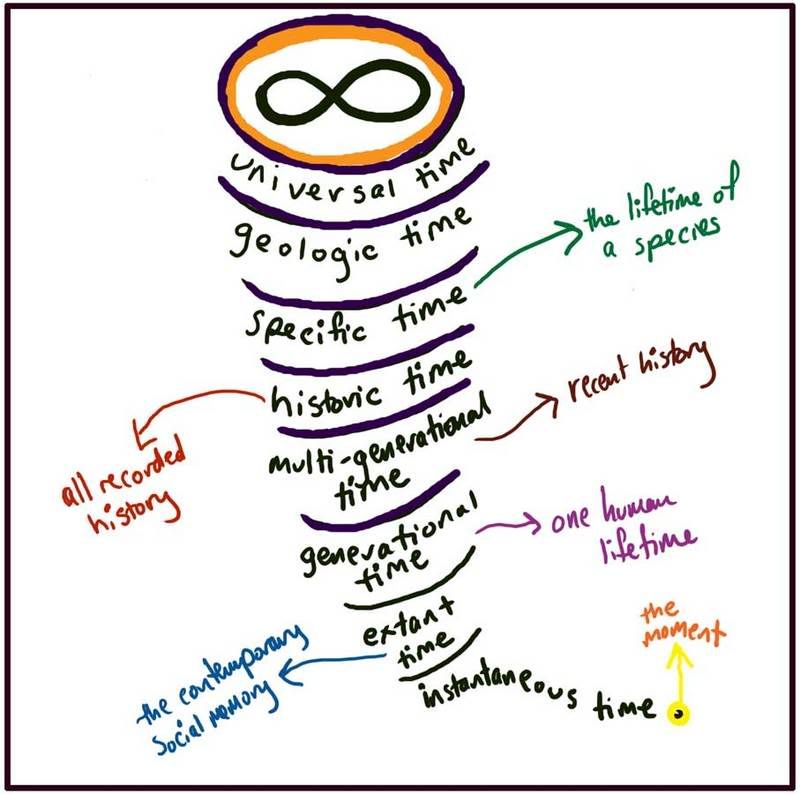
Like Griffioen's pictures, Don Amadeo's photographs of the Eastern Shore remind us of the slow creep of geologic time, the long long view. Human communities may rise and fall and rise again, but all eventually succumb. So, too, with species. There is an ambivalent beauty in overgrown ruins; they celebrate the wonder of life's eternal striving even as they proclaim mortality.


Don Amadeo
Ole Rusty; Parksley, Virginia

Photo credit: "Feral Houses" photographs, courtesy James Griffioen; ShoreRebel photographs, courtesy Don Amadeo

Saturday, September 19, 2009

Again, into the gloaming

The spiral of time has come round on itself, slightly displaced from this point a year gone.

It is Rosh Hashanah today, the Jewish New Year, and I'm in a pensive mode. Below, I repost a selection from "Almost Twilight," last year's musing on autumn's advent, creative inspiration, twilight, crepuscular animals, hallucinogens, and reflection.

But, first, I'd like to highlight two projects relevant to the season.

- Yusuf Misdaq is an artist, poet, and musician who shares my universalistic mystical inclination. Almost a month ago, he began Palace Prayers, "the aim [of which] is to create a new work of art for every day of Ramadhan, 2009."

A blog-like site presents each day's original work. I encourage readers to visit. You can also listen to a National Public Radio interview with Yusuf here.

- New Yorker editor Ben Greenman has co-organized, with writer Nicola Behrman and Reboot's Amelia Klein, 10Q, a Yamim Noraim project for people of all faith (or lack of faith) backgrounds. From the website:
"10Q was inspired by the traditional ten days of reflection that occur between the Jewish holidays of Rosh Hashanah and Yom Kippur, a period of time that’s long been considered an opportunity to look at where you're at, where you've come from, and where you're heading. Whether you're Jewish or not, though, 10Q is a great way for anyone to look back at the year that’s past, look ahead at the year to come, and take stock. That’s a beautiful thing in any language."
Sign up here.

Shana tova!

+++++


"Darkness within darkness.
The gateway to all understanding."
-Lao tzu, "Tao Te Ching"

In New York, recent mornings have greeted us with a pleasant chilliness. Fall is almost here, and winter is just around the corner. For most folks, the prospect is daunting. Not so for me. Each year at this time, a bounce finds my step and I'm happily overwhelmed by a spate of ideas. I know, however, that the creative juices will before long transmute into keen brooding. Late fall and winter nurture a pensive mind.

When the afternoons darken and the mercury dips, I like to take bundled winter strolls through the streets of Manhattan or Queens. Other pedestrians hustle about, intent on achieving their respective indoor destinations, but I find my thoughts best served by a steady pace, one forgiving of some intentioned aimlessness. I spend these walks looking up to where the melancholic sky meets the buildings that scrape it, admiring the resilience of foraging House sparrows, taking note of the way traffic lights glow more brightly in crisp, cold air and marveling over the many lives that move around me. I like to think of this mindful meandering as a form of prayer, or perhaps a communion, and I treasure the insights that are sometimes happened upon.


Curious about the rites, beliefs, and texts of various religions (and particularly those of Judaism), I've been thinking this week about the coming high holy days. Next Monday is Rosh Hashanah, the first of Judaism's ten "days of awe," or Yamim Noraim. Like my winter walks, the Yamim Noraim are given over to contemplation. During the ten high holy days, an observant Jew should meditate on the actions of his last twelve months and, then, on Yom Kippur, the last of the "days of awe," fast and repent for any wrongdoing. In other words, a conscientious Jew begins the new year by reckoning with his past. Although Rosh Hashanah is only one of four Jewish New Years, each attached to a specific set of guidelines and meaning, I find the holiday's position with regard to the seasons of particular interest.

Considered the New Year for humans, animals, calendar calculation, and contracts, Rosh Hashanah arrives with the ploughing of summer into fall. If one considers fall equivalent to dusk and winter to night, then the Jewish New Year, like the Jewish day, begins at twilight in the northern hemisphere. The notion of a day extending from sunset to sunset runs slightly counter to the popular conception of morning time as a birthing, or spring, with the hours moving through summer at mid-day, fall in the evening, and finally into winter, night and death. But the Judeo-Christian tradition is pastoral, founded on an agricultural reckoning. It makes sense, then, that the day should end when the sun falls away. The new day begins with night; the beginning is darkness, a time when all man can do is rest and await the return of the sun's workable hours. In rural farming communities, this pattern holds today, though the blue glow of television has altered habits in even the most rustic counties. Still, the consummate urbanite Oscar Wilde's quip that "people in the country get up early because there's so much to do, [and] they go to bed early, because there's nothing to talk about" remains generally accurate.


Growing up in such a community, I learned early that if twilight is a conclusion for the farmer, it is a commencement for many other creatures. A patient hunter who remains in his deerstand as the final light retreats might see bats dart and dip in aerial pursuit of insects. He may also see an opossum, fox, raccoon, skunk, or even his intended quarry, deer, though it is not legal to shoot after the sun sets. Driving or biking on "backroads," these animals reveal themselves by reflecting light from a car's headlights or a bike's front beam. The tapetum lucidum, a layer of tissue behind the retina of crepuscular and nocturnal species, allows the animal to see better in near or total darkness, but this layer also produces eyeshine that discloses the creature's presence to human torch bearers. Depending on the species and the angle of approach, we can identify the animal by the color of its eyeshine: the white-yellow lights at knee height belong to the red fox; the orange orbs in the low branches of a tree are an opossum; the yellow beams tall over the road are white-tailed deer; the brilliant white spots that appear so near the ground expose a resting whippoorwill.

Imagine the shock of the early humans when they first noticed the glowing embers that moved just outside the reach of their warm firelight. The agricultural tribes that would become the people of the Torah, having abandoned much of their nomadic, hunter-gatherer roots, were particularly afraid of the dark, creeping world outside that circle of light. To be caught in the gloaming, away from a human settlement or encampment, was surely a terrifying possibility.

Indeed, the dark months, like those black, antediluvian nights, remain an ordeal for many people . But they can also be understood as a gateway opportunity. It is fitting, I think, that Jews begin their new year by taking stock, a formidable task if undertaken with thoroughness and honesty. I approached my experiences with hallucinogenic drugs in an analogous way; what most people would call a "bad trip," I viewed as an opportunity for introspection. 'Why has my brain created this awful idea?,' I asked myself. 'What does that tell me about my relationship to x or y, or about my fear of a, b, or c?' The cold, gloomy months, like bad trips, nightfall, and deep melancholy, can be challenging, even endangering, but in an increasingly mediated and accelerated world culture, the difficult passages are of premium value.


But whatever religious label I eventually pin to my lapel (or discard), periods of solemn self-examination are likely to remain a critical part of my identity and annual experience, and these have so far coincided with winter and come on the heels of a fall surge in the creative impulse. Although modernity misunderstands fall to be the beginning of an end, it is only another beginning. Shana tova umetukah, folks. My favorite season is moving in, and our shadows grow longer.

Photo credits: "Athens Park, Astoria," "Central Park, Manhattan," "Heron's Foot Moon, Virginia," "Branches," all by Christopher Reiger, 2007 and 2008

Saturday, September 12, 2009

Kimmel Harding Nelson Residency: Day 6


Cincinnati House; Nebraska City

Working Papers

The Cincinnati House is a charming craft, candle, and home goods store, located not far from the KHN Center. On Friday afternoon, I purchased some Nebraska City postcards there and, at the register, struck up a pleasant conversation with the proprietress. She moved to Nebraska City and opened the boutique after retiring from a career in Omaha.

Upon learning that my time at the residency is principally given to musings on American and natural history, she announced with a smile, "If you're interested in history, you might like to know that this building used to be a brothel." I allowed as how, yes, I would like to know more about that history, and she provided me with the abridged version.

Although the narrative's specifics were not especially titillating, the Cincinnati House story did cause me to wonder why historical prostitution, unlike its present day trade or the institution of slavery, is so often romanticized or discussed with a wink and a smile? This fact seems especially odd considering that, were genealogical records better kept and people more honest, a significant percentage of European Americans would have one or more "working girls" in their family tree.

After bidding the owner a good afternoon, I made my way to the door. Hung on the wall nearby the exit, I noticed a framed license for prostitution, an artifact of the building's 19th century function.


Soybean field; Nebraska City

Suspicious Activity

Living in New York City, I sometimes forget that my not owning a vehicle is patently un-American. New York City's exemplary public transportation system makes carlessness possible (even preferable), and I'm fond of long walks, in any case.

Most Nebraska City residents, by contrast, aren't fond of walking and the town's plentiful dogs aren't accustomed to walkers. I was hounded, yesterday afternoon, as I tramped about the town's eastern edge in search of attractive river views. I walked on city streets or, where it exists, the lonely sidewalk, and I didn't trespass on private property. Still, although dogs failed to chase or bark at any of the passing cars or pickup trucks, they accosted me with sometimes intimidating territorial displays. At least one of the other KHN residents has experienced similar canine antagonism, and I've concluded that the dogs are alarmed, above all, by our unorthodox mode of locomotion.

Similarly, the town's human residents seem a bit suspicious of walkers. I feel, making my way from place to place, as though I shouldn't let my eyes linger on an open garage door or lawn ornament, lest I appear to be "casing the joint." If not burglary, what other reason would I have for walking?


Missouri River landing; Nebraska City

Photo credits: all photos, Hungry Hyaena, 2009

Friday, September 11, 2009

Kimmel Harding Nelson Residency: Day 5


Chicken coop breed variation display; River Center Nature Center; Nebraska City

What accounts for the amplified patriotism that I feel? This American ardor is not specific to my time in Nebraska City. Over the course of the last year, my national pride has swelled, even as I'm daily disappointed by the reactionary ignorance of so many fellow citizens. Still, in this smallish, midwestern town, I am acutely aware of my American identity.

Perhaps Nebraska City's abundant reminders of our nation's meteoric, messy, and astonishing history forefront my appreciation for my peoples' achievements? Or perhaps it is the love of place reflected in the town's twelve museums, each one a heartfelt labor?


Upstairs annex; River Center Nature Center; Nebraska City

Consider, for example, Joe Voges' River Country Nature Center. Voges, born 96 years ago in Nebraska City, began learning the craft of taxidermy in 1933, at 20 years of age. 47 years later, in 1975, he opened the Nature Center, a collection of mounted wildlife - 90 percent of the taxidermy on display is his handiwork - grouped into natural history dioramas and educational exhibits. In 2005, the museum expanded and moved from Nebraska City's old fire hall to a spacious, street level location nearby.

The taxidermy is by turns amateurish and professional, but the information presented is up-to-date and effectively communicated. The best of the Nature Center exhibits are of American Museum of Natural History quality, and, throughout, one senses Voges' driving desire to educate subsequent generations about the importance of preserving biodiversity and conserving natural resources.


Albinism display; River Center Nature Center; Nebraska City

Perhaps Voges' tellurian impetus is part of the reason I feel a particularly "American" pride in Nebraska City? Like our national history, we're a contradictory, complicated lot, but we fundamentally remain a people that identify the "great outdoors" as a reflection of our values and beliefs, and vice versa. Certainly, there is myth involved in that association, but there is some truth, too.

The contemporary character of this American identification with the land is both Romantic and Utilitarian; it incorporates a self-conscious brand of rugged individualism that, on the one hand, allows for George W. Bush's popular appeal, and, on the other, has made the United States an international wellspring of conservation efforts and environmental philosophy. Despite the previous presidential administration's willingness to bend to the will of extractive industry, the United States remains uniquely positioned to foster among the international community a conservation ethic. Indeed, an overwhelming number of internationally active organizations working for preservationist and conservationist causes are American in origin or base; we are yet the vanguard in the environmental arena.

But even - nay, especially - on the streets of Nebraska City, on the banks of the great Missouri River, at the head of the Oregon Trail, I must inoculate my healthy patriotism against the virus of nationalism. I sometimes wish that "America the Beautiful," Katherine Lee Bates' celebratory hymn, were our country's national anthem, instead of Francis Scott Key's "Star Spangled Banner."

Whereas the "Star Spangled Banner," set to the tune of a popular British drinking song, extols military valor and revolution in the name of freedom, Bates' "America" is both a celebration of our vast American landscape and a plea for social justice, pragmatic politics, and humility. Hers is the United States of America that fills my breast with pride; hers is the clay that I am made of.
"O beautiful for patriot dream
That sees beyond the years [...]
America! America!
God mend thine every flaw,
Confirm thy soul in self-control,
Thy liberty in law!"
In 1930, then Secretary of Agriculture Henry Wallace stated, "There is as much need today for a Declaration of Interdependence as there was for a Declaration of Independence in 1776." I agree, and we're overdue, but I'm starting with the anthem. The Brits can take back their drinking and fighting tune.


Missouri River display; River Center Nature Center; Nebraska City

Photo credits: all photos, Hungry Hyaena, 2009

Wednesday, September 09, 2009

Kimmel Harding Nelson Residency: Day 3


Grain Elevator; Nebraska City

Soundtrack

It's a treat to recognize voices that were once familiar enough to be taken for granted. After years of city living, my ears hunger for the soundtrack I knew in childhood.

Yesterday morning, the staccato lament of a mourning dove (Zenaida macroura) greeted me as I dressed. Later, standing beside an overgrown lot, I listened to the rasp-rattle-click of grasshoppers in the tall grass. Nearby, on the same block, the up-and-down whine of cicadas reverberated within me. At mid-day, as I explored the grassy fringes of a grain elevator operation on the western bank of the Missouri River, my progress scattered noisy grasshoppers, large and small, in every direction.

As I type this post, a male field cricket's (Gryllus pennsylvanicus) insistent plea sounds from a dark corner of the studio. I locate and playback a recording of the call on my laptop, hoping that the sound of another male suitor might draw the cricket out of the shadows for some Orthoptera fisticuffs. The aural lure fails, but I'm made happy by the attempt; the cricket cries for a mate and, with a keyboard click, I call back.

Life, I'm reminded by the persistent call of this cricket, and by the grasshoppers, the mourning dove, and the cicadas, is fleeting, yet rich and good. As Nebraska native, anthropologist, and author Loren Eiseley writes of "endlessly reiterated" frog calls,
"I suspect that to some greater ear than ours, man's optimistic pronouncements about his role and destiny may make a similar little ringing sound that travels a small way into the night."
Every creature's song is at once insignificant and grand. The middle school marching band is passing by my studio now, and the cricket and I are quiet.


Middle school marching band practice; Nebraska City

A Kettle of Vultures

Appropriately enough, as I walked past a mortuary two doors west of the KHN Center, I noticed seven turkey vultures circling low above the town. The night before, I'd read Lia Purpura's poetic essay "On Coming Back as a Buzzard" in the September/October issue of Orion. Given my dual love of natural history and language, I'm embarrassed to admit that, before reading Purpura's piece, I didn't realize that a group of vultures on the ground is called a "venue," and a group of vultures in flight is called a "kettle."

Watching the peaceful, unchoreographed aerial dance of this Nebraska City kettle, I recalled Mary Oliver's beautiful poem, "Vultures," as well as some of Purpura's essay, written from the perspective of a vulture.
"As a buzzard, I’d know the end of a thing is precisely not that. Things go on, in their way. My presence making the end a beginning, reinterpreting the idea of abundance, allowing for the ever-giving nature of Nature—I’d know these not as religious thoughts. It’s rather that, apportioned rightly, there’s always enough, more than enough. 'Nothing but gifts on this poor, poor earth,' says Milosz, who understood perfectly the resemblance between dissolve and increase. Rain scours and sun burns away excesses of form. And rain also seeds, and sun urges forth fuses of green."
"On Coming Back as a Buzzard" is a paean to reconstitution. How smart and satisfying to embrace the natural end as another corporeal beginning! I pray that my dead body will be saved from the poisonous excesses of a mortuary, that it will instead be wrapped in a simple cloth, laid in a simple wooden box, and buried without the insult of preserving chemicals and concealing makeup. I pray that the worms and the soil will consume me, will leech me and take me, so that my matter will become energy for other forms. I utter this prayer in silence as I look up at the dark birds.


Turkey vultures on roof; Harborton, VA

Elsewhere, Purpura writes,
"I'd love best the movement of stages and increments, to repeat 'this bank and shoal of time' while below me banks and shoals of a body went on welling/receding, rising and dropping. I'd be perched on a wire, waiting, ticking off not the meat reducing, but how what's left, like a dune, shifts and reconstitutes."
Even when alive, our bodies are forever in flux, forever "shift[ing] and reconstitut[ing]." After death, though, a profound reinterpretation and recycling of "self" takes place.

The biologists, writers, painters, and physicists who worship Nature are enthused by reconstitution because it is plain, profound truth. As the poet Galway Kinnell describes it in his terrific poem, "The Quick and the Dead," "the crawling of new life out of the old, which is what we have for eternity on earth."


St. Mary's Episcopal Church; Nebraska City
First Episcopal church in Nebraska; Founded 1857

But most folks, many of them good, kind people, don't share this enthusiasm for reconstitution. I presume, perhaps wrongly, that Nebraska City is home to many such individuals. On what grounds do I make this presumption? Firstly, it's a safe speculation anywhere in the world. Most humans prefer a supernatural view of afterlife. Secondly, Nebraska City is home to a good number of churches (nineteen, by my present count), and I make assumptions (sometimes wrong) about the stripe of belief held by the majority of American Christians. No doubt there are exceptions to the rule, but most of the religious Christians I know frown upon materialistic interpretations of life everlasting. Some go so far as to reject my panentheistic or panendeistic conceptions of morality and material being as heretical nonsense.

No matter; live and let die. I find the Christian notions of ascension and self-conscious afterlife ridiculous, and most Christians find my cherished reconstitution as a bit of larvae, a bit of root, a bit of this and that, grotesque and even offensive. Neither conception, though, prevents the individual from acting ethically, and that is, above all, what matters. As Purpura puts it,
"[The vulture] gets to reorder your thoughts about troves, to prove the spilled and shoveled-aside to be treasure. To reconfer notions of milk and honey, and how to approach the unbidden."
Put more explicitly, one man's materialistic mess is another man's milk and honey.

Photo credits: all photos, Hungry Hyaena, 2008, 2009

Tuesday, September 08, 2009

Kimmel Harding Nelson Residency: Day 2


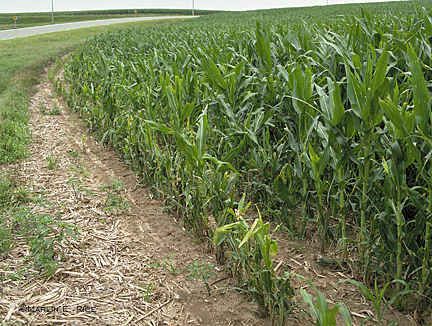
Iowa corn field

The Flying Nun

As our plane approached Omaha, Nebraska, I surveyed the irregular grid of rectangles and squares formed by western Iowa's country roads. Cumulus clouds cast dark shadows of punctuation over the vibrant greens, yellows, and siennas of the state's corn and soybean harvest.

I tend to think of our nation's industrialized monoculture as a rigid corporation of hundreds of thousands of acres of symmetrical fields, but, in practice, even agribusiness can only bend the land so much. At an altitude, one sees that our fields are as shaped by the extant topography as they are by human manipulation. Indeed, some of Iowa's fields, with their rounded edges and calligraphic plow lines, could, from the air, be mistaken for southeast Asian rice paddies.


Aerial view of western Iowa agriculture

My neighbor on the plane was a pleasant Benedictine sister. Dressed in full habit, she was en route to Norfolk, Nebraska, for an assembly of the world's Benedictine Monastic Missionaries. She works and resides in Namibia, Africa, assisting with education and HIV/AIDS prevention. I deeply appreciate the charitable activity and lifelong devotion of such missionaries, but I remain wary of the proselytizing component.

At several points in my conversation with the sister, I felt as though she was soft-selling her faith. She commended me on my given name, Christopher, explaining that I was named after the Catholic saint that supposedly carried the young Yeshua of Nazareth across a river. (Of course, that isn't quite right. The saint, if the man in fact existed, was named for his deed; the Greek word Christophoros translates as "bearer of Christ.") She was also happy to learn that my vocation, my calling, was art, and encouraged me to use my artwork to "usher in Christ's love everlasting." I replied with a noncommital "um hmm," and left it at that.

Perhaps because my response was ambiguous, she persisted. Inspired by my affinity for art, she recollected a visit she made to the Norman Rockwell Museum, where she viewed a sculpture by Rockwell's son, Peter. According to the nun, the sculpture featured a crucifix crowned by devil horns. The piece sounds wholly adolescent, but it evidently upset one of the nun's companions, who couldn't understand why the "symbol of all that is good" would be paired with "the symbol of all that is evil." The nun reassured her friend by pointing out that "at least Peter Rockwell isn't an atheist." She weighted the last word, and shook her head as she pronounced it. I'm not sure what element of the sculpture informed her confident conclusion about Rockwell's metaphysics, but her story made clear her negative feelings for those who doubt or deny her particular faith.

Some minutes after the Rockwell anecdote, she expressed pleasure at Pope Benedict XVI's decision to expand contemporary Catholic use of the Tridentine Mass, a Latin text that vilifies Jews. Considering the nun's clear dislike of atheists and her implied disapproval of non-Christian religious beliefs, I'm happy that I dodged any questions that, squarely answered, would have revealed something of my personal path from a Christian baptism, to agnosticism, to atheism, to my current exploration of and identification with panentheistic or panendeistic Judaism. Part of me was disappointed in myself for not confronting her ecumenical failure, but, frankly, I was more interested in looking out of the plane's window.


Auto repair yard on Central Avenue; Nebraska City

First Impressions of Nebraska City

If you define "city" as a settlement with a large population, Nebraska City is a misnomer. Compared to New York City, my home for almost a decade, Nebraska City is a population blip. New York City's population, estimated at 8.5 million, is 1,200 times Nebraska City's roughly 7,000 residents.

Shortly after we loaded the minivan with our bags and left the Omaha airport, Ron, the owner (and sole employee) of Tree City Taxi Service, said that most Kimmel Harding Nelson Center residents that come to Nebraska City from big cities experience some degree of culture shock. But, although I now live in New York City, I originally hail from Locustville, Virginia. Locustville's population was just 99 when I lived there, and I don't believe that the number has significantly increased or decreased in the years since. Compared to my hometown, Nebraska City is, as its name suggests, a veritable metropolis!


Closed store on Central Avenue; Nebraska City

In conversation with Ron, I gathered that the largest employer in Nebraska City, the American Meter Company, has recently laid off a significant number of its employees. Two other companies that the townspeople depend upon, Cargill Meat Solutions and Diversified Foods & Seasonings, are also facing cutbacks. As a result, many of Nebraska City's citizens are struggling to make ends meet. The economic woes are apparent on the town's main street; it seems as though every block on Central Avenue is home to at least one vacant storefront.

Ron also confirmed my assumption that white-tailed deer, turkey, carp, and channel catfish are major focal points of the region's outdoor recreation. He proudly told me that two of his granddaughters, decked out head-to-toe in camouflage gear, already accompany their dad deer hunting. The image of the camouflaged little girls made me smile, perhaps because I fondly recall the too-big camouflage outfits of my childhood.

Along with hunting and fishing, the major pastimes in eastern Nebraska are high school and college football. This afternoon, from the kitchen window of my residency apartment, I watched the middle school football team practice. I wondered if, compared to their coastal peers, a greater percentage of Nebraska's teenage athletes bank on athletic scholarships and dream of going pro. Many of the players' parents arrived early and watched them from the edge of the practice field.


View on 6th Street; Nebraska City

Photo credits: image of Iowa corn field, ripped from Iowa State website; image of western Iowa fields, ripped from Legacy By Design blog; all photographs of Nebraska City, Hungry Hyaena, 2009

Monday, September 07, 2009

Kimmel Harding Nelson Residency: Day 1


Historical Map of Nebraska City, Nebraska


I subscribe to the Whitmanesque belief that place is presence, that our individual minds are shaped and informed by the ecology, the rhythms, and the atmosphere of our environment. But what can you learn of a place, any place, in just two weeks?

My stay in Nebraska City amounts to a prolonged layover. During this short time, what might I intuit from the town's style and voice, or from the steady push of the great, brown river that draws the town's eastern edge? Certainly, I can look thoughtfully at the people I meet and the birds I encounter; I can listen, as I do now, to the calling of crickets underneath my window; I can contemplate the regional topography and the land's history; I can ask lots of questions and take lots of notes; still, I will not know Nebraska City.

As David Abram writes in "The Air Aware," an essay published in the September/October 2009 issue of Orion,
"Only by living for many moons in one place, my peripheral senses tracking seasonal changes in the local plants while the scents of the soil steadily seep in through my pores, only over time can the intelligence of a place lay claim upon my person."
And what does this notion of place as state-of-mind intimate about my current choice of home? I'm fond of New York City, but how strange that a boy shaped by the salt marshes and fields of the Virginia's coastal plain, and informed by the fishing and farming communities that hold on there, should, as an adult, call home a metropolis with a dominant culture that is almost entirely detached from seasonal turnings of the soil!

Even if I am unable to locate the quintessence of Nebraska City in these two weeks, or to locate myself in it, I look forward to the time away from New York City. I'm eager to look, to listen, and, as David Abram would put it, to breathe in what I can.

Image credit: image ripped, appropriately enough, from Epodunk: The Power of Place website

Sunday, July 05, 2009

Les Seifer's Fairytales


Les Seifer
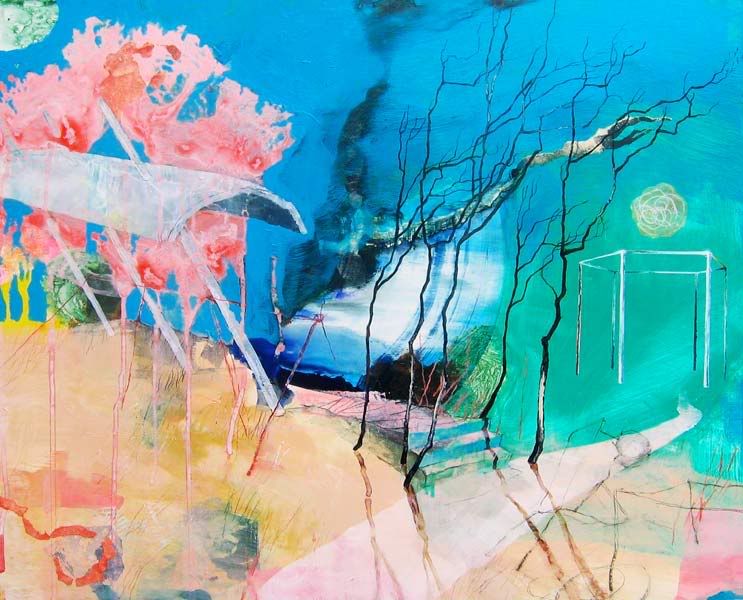
"Shelter"
2009
Acrylic, ink, crayon, pencil, and cut paper on panel
22 x 26 inches

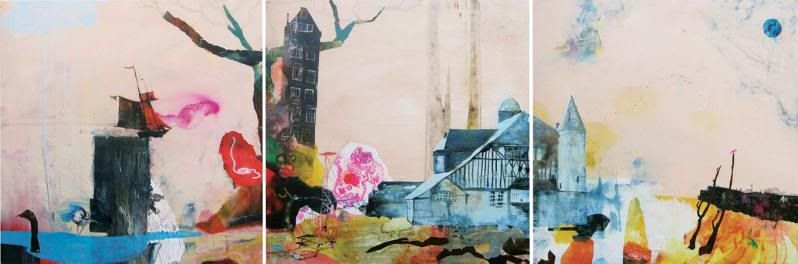
Les Seifer's mixed media paintings evidence a playful disregard for the conventions of painting. The interactions and proclivities of Seifer's varied media inform the pictures' making; as a result, the paintings include unexpected compositional and color choices, even as they manifest the artist's formal command.


Les Seifer
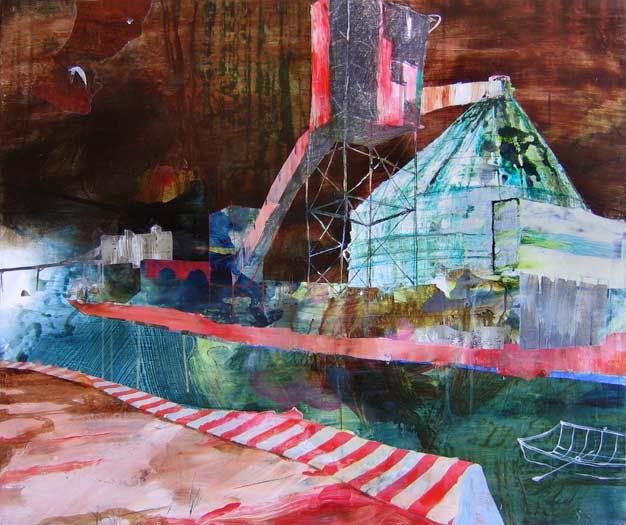
"On These Earthly Shores"
2006
Acrylic, ink, and cut paper on canvas
30 x 36 inches

Atmospheric and often gritty, the pictures also reflect the striking (and similarly unconventional) juxtaposition of past and future in urban settings. The layered imagery of Seifer's works is partially rendered or scrubbed out, a lost and found architecture of our evolving cultural landscape.


Les Seifer
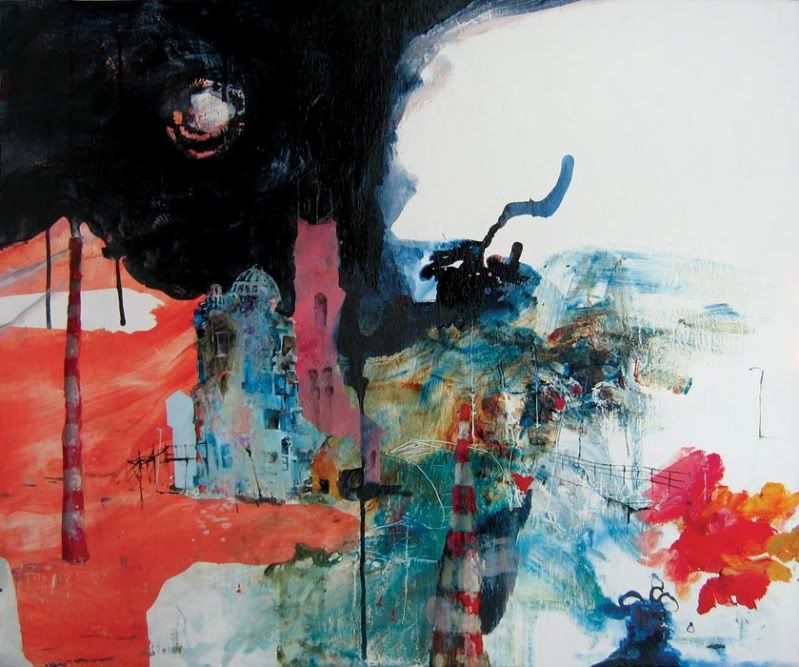
"Beast"
2008
Acrylic, ink, pencil, and cut paper on canvas
30 x 36 inches

A native New Yorker, Seifer is clearly inspired by the diversity and mutability of the city's outer boroughs, but his saturated, pooling colors and hodgepodge approach evoke a less specific sense of nostalgia, one that is universally understood. Even the darkest or most anxious of Seifer's works celebrates human imagination and potential; his pictures are dreamlike and fundamentally optimistic, poetic records of our increasingly plural mythos.

Seifer's next solo exhibition opens on Friday, July 10th, at Ernden Fine Art Gallery, in Provincetown, Massachusetts.


Les Seifer
"Lullaby"
2008
Oil, acrylic, ink, crayon, pencil, lino cut print, and cut paper on canvas
30 x 36 inches


Image credits: all images, courtesy Les Seifer

Thursday, July 02, 2009

Repairing America (and beyond)


Micanopy, Florida


While visiting central Florida last month, an acquaintance told me that all of her Gainesville co-workers are fans of Rush Limbaugh's radio punditry. On the highways around the small city, I saw countless pro-life billboards and a good number of "NObama" bumper stickers on passing pickup trucks. Although the city's populace supported Obama in the 2008 presidential election (as did the state), it was very clear that the city represents a blue dot in a red region.

Contemplating this red state mentality, I recalled Thomas Frank's "Lie Down for America," an excellent, if depressing article published in the April 2004 issue of Harper's Magazine. Frank dissected, in his words, "how the Republican Party sows ruin on the Great Plains."
"Whereas earlier forms of conservatism emphasized fiscal sobriety, the backlash mobilizes voters with explosive social issues - summoning public outrage over everything from busing to un-Christian art - which it then marries to pro-business economic policies. Cultural anger is marshaled to achieve economic ends.

[...] 'Rural America is pissed,' a small-town Pennsylvania man told a reporter from Newsweek. Explaining why he and his neighbors voted for George Bush, he said: 'These people are tired of moral decay. They're tired of everything being wonderful on Wall Street and terrible on Main Street.'"
The same Wall Street-Main Street dichotomy was trotted out by campaigning Republicans four years later, in 2008, to cast the GOP as the party of the people. But did the tactic really work? After all, Obama won the 2008 election. Aren't rural and Middle America coming around, realizing that the Republican party doesn't have their best interests in mind, even in those cases where the social issues of the Right more closely align with their values?

I hope so, but I wouldn't bet on it. Middle America will jab an angry finger at someone, and faithful Rush can't be the enemy. Our country is already waging a war against Islam, so we know that the Muslims are "against us," but they're not pulling America's economic strings. And, as a general rule, black folks don't have too much power, Obama not withstanding. But, wait a second...aren't there a lot of socialist Jews whispering in Obama's ear? Hell, isn't he related to a rabbi!?

The July 2009 issue of Harper's includes two disturbing poll results.
Chance that an American thinks 'the Jews' were moderately or very much to blame for the financial crisis: 1 in 4

Chance he or she thinks they were 'a little' to blame: 1 in 7
This is a shocking statistic! I wonder what percentage of Americans believe that "the Jews" are no more culpable than any other ethnic or religious group?

Oh, but that's a silly question! After all, "the Jews" are the denizens of Wall Street, and Main Street folk like Dubya and Rush don't like that sinful, unAmerican place. It should be clear to me that the current recession - when should we start calling it a depression? - is not the result of the unsustainable, myopic economic policies of the last sixty years (amped up by Ronald Reagan, but embraced by both Democrat and Republican administrations). It's instead the vast Zionist conspiracy! The socialist Jews have teamed up with the capitalist Jews to forge an unholy alliance, and they're running the global economy into the ground!

Would that I could laugh off such frightening ignorance. Unfortunately, the bigotry is not evidenced only on the Right. In fact, the same study cited in Harper's showed that the registered Democrat respondents were 12% more likely than responding Republicans to blame "the Jews" at moderate or higher levels. There is a time-tested, inverse relationship between economic performance and anti-Semitism, and this correlation isn't affected, evidently, by political affiliation.

The New York Times reports today that "U.S. Job Losses Rise and Unemployment Reaches 9.5%."
"The American economy lost 467,000 jobs in June [2009] and the unemployment rate edged up to 9.5 percent in a sobering indication that the most painful downturn since the Great Depression has yet to release its hold."
Things are going to get a lot worse for Middle America. Finger pointing does none of us any good (and certainly not the tiny Jewish minority in the United States).

Still, I remain optimistic. As I wrote in January,
"Call it Obamatism, call it naive idealism, call it what you will...but it's time to participate, to put aside our generation's infantilism and get to Aristotle's happy work. [...] We will pass through our challenging stage of human social development but, fraught as it is, the need for an active and immediate commitment to bettering our world's future is great."
Jews call that tikkun olam, repairing the world. Get to it, people!


Photo credit: Hungry Hyaena, 2009

Sunday, May 17, 2009

A Hermetically Sealed Worldview?


Alton L. Larsen
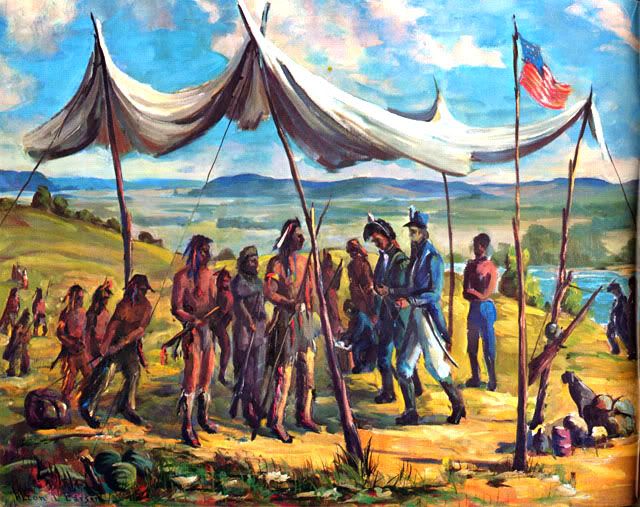
"Lewis and Clark"
Oil on canvas


I'm thrilled to announce that I've been accepted to the Kimmel Harding Nelson Center Artist Residency in Nebraska City, Nebraska. During the two week, September term, I plan to explore Nebraska City and the surrounding land with an eye toward the region's natural history, focusing particularly on the Lewis and Clark Expedition and the legacy of 19th century westward expansion. Most of my time will be spent outdoors, biking and walking around the town's trails, parks and historical sites. In the evenings, I'll use the provided studio space to conduct research, work on painting studies and drawings, and write essays relevant to the residency. (The essays will be posted here.)

I'm very much looking forward to my time in Nebraska, just as I'm eagerly anticipating an upcoming week of birding, herping and bumming about in Florida with two friends. My usually vigorous city disposition has withered in recent weeks, and I long for time in the woods, marshes or mountains. Saturday afternoon, taking a break from helping my girlfriend move some of her belongings, I sat on a stoop, attuned my breathing and appreciated the pompous sidewalk display of a pigeon courtier. A few minutes later, I trembled with a renewed sense of well-being as a curiously bronze House sparrow contemplated me (contemplating it).

These simple encounters with urban wildlife are a joy. I'm grateful for them. This week, however, the sparrows, pigeons, squirrels, starlings and gulls have only whet my appetite for time away from urban and suburban environs.

My sense of urban exile was exacerbated this afternoon, when I listened to a podcast of "The Thomas Jefferson Hour." Historian and Jefferson impersonator Clay Jenkinson described contemporary man's changing relationship to Nature.
"I've been flying over North Dakota lately and North Dakota is just one tiny little place at the top of the continent, but [...] between the Mississippi River and the west coast there is still a gigantic amount of unspoiled land. [...] It's still a pretty light industrial footprint. [...] Of course, you can see human presence there: power lines, contrails from airplanes, mines, vanity houses, ridgeline developments. [...] But [...] there is still a large amount of America [...] in which there are literally hundreds of national and state parks and national monuments and national forests and wildlife refuges which are permanently protected against gross economic, extractive development. [...] We have an enormous amount of Nature which has been designated, officially, by the will of the American people to be off-limits to certain types of activities. [...] I feel that that moment - which begins really with Yellowstone in 1872, but got it's big push from Theodore Roosevelt - that moment kind of culminated around 1975 or 1980 and, since then, there's been a kind of pulling back of national commitment to these issues.

And now there's a generation of people who are growing up with no particular interest in this. They're detached from it. They're a little bored with Nature. They don't want to go camping; they don't even want to go hiking. They only want to be on their iPod and their [...] computer, the Internet, and Facebook, and Twitter. [...] That's their mediation. That's how they see the world, [...] and they're bored with sitting around that campfire. [...] So as this happens, as we move into [...] this incredibly electronically mediated, post-literate, post-natural world, it's frightening to people that still believe that that was the glory of America.

I'm one of them! I believe that the national park system is America's greatest contribution to the world, or at least it's one of the top handful of contributions we've made. [...] The point I'm trying to make is, if the population [of the United States] is 330 million, there are about 300 million who don't care one iota for this, and they're very, very happy to eat their chicken in a hermetically sealed container and not know the first thing about where their lights come from and not care how the natural world works."
I wish that I could claim urbane sophistication, thereby dismissing Jenkinson's melancholy perspective as misguided nostalgia. But I can not. Even though I proclaim a long view optimism (and therefore acknowledge the absurdity of wishing for what once was), I feel that the ignorance of most First World citizens of the natural world is unpardonable. It is an insult not only to my naturalist's sensibility, but also to the philosophical, biological and cultural ground on which thoughtful humans stand (and build).

Despite my fondness for cosmopolitan politics and culture, in at least this respect, I sympathize with Thomas Jefferson's belief that cities are "pestilential to the morals, the health and the liberties of man." By further insulating us from our animal antecedence and the brute realities of Nature, cities slowly erode our practical call to stewardship.

Shortly after Jenkinson's podcast ended, a familiar voice interrupted my painting. I wasn't sure that I'd heard rightly over my headphones, so I peered out of the studio window for confirmation. Sure enough, a mourning dove was perched on the fire escape above me. Periodically, it uttered a nesting call, an abridged version of the plaintive call that many Americans are familiar with (whether or not they can identify the species responsible). I could see no mate or nest, but I'm delighted to learn of this new neighbor.

Unfortunately, this week's creeping cynicism makes me doubt if my human neighbors notice the birds. I hope that this brooding will soon pass. Pessimism does no one good.

Photo credit: image ripped from Blair Congregational Church United Church of Christ website

Tuesday, October 14, 2008

Aitken's not-so-migratory menagerie


Doug Aitken
"Migration"
2008
Production still
25-minute video loop

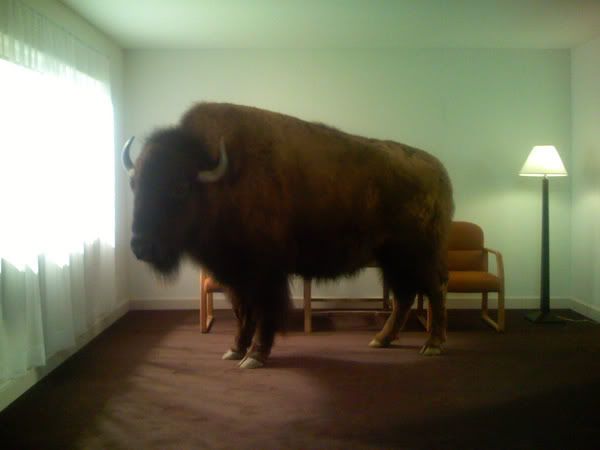
Doug Aitken's haunting film "Migration," currently on view at 303 Gallery's 21st street space, focuses on the behavior of a number of North American animal species, each shown displaced in a banal motel room. "Migration" is a beautiful monument to our transient American existence. Indeed, whether moving homes or traveling for business, Americans are a peregrinating people; we move more often than citizens of any other industrialized nation. Aitken's decision to use wildlife to meditate on this phenomenon is affecting. The film is dream-like and hypnotic, and it was hard to pull myself away, even when the 25-minute loop began again.

But when I picked up the gallery press release, I noticed that it described the critters Aitken filmed as "wild North American migratory animals." This jarred me from any reverie. In fact, of the twelve species that I recall offhand, only three - the American bison (Bison bison), caribou (Rangifer tarandus) and hawk (unidentified sp.) - might be deemed migratory, and it requires an almost comical ignorance of wildlife to think that an American beaver (Castor canadensis) or raccoon (Procyon lotor) will trundle hundreds or thousands of miles in search of more hospitable temperatures. I don't know if the press release mistake is Aitken's doing or that of a gallery employee. Of course, I hope it's the latter, but I'm dismayed either way.

Artists are generally urban animals. We congregate in cities so that we might feel connected to other artists and novel ideas. (Certainly, there are many exceptions, and the rural, more solitary approach to art-making is no less valid or vital. Different strokes for different folks, as the expression goes.) Some of us, though, strive to straddle the urban-rural divide. But those artists who, like me, spent childhood in the country and now reside in the city (or vice versa) often come to feel uneasy in both environments.

In my case, that sense of alienation is felt most acutely when I am reminded of how ignorant most urbanites are of natural history. Even with their relatively impressive academic pedigree, artists and art enthusiasts are no exception. What's more, most city dwellers consider those individuals who do possess a knowledge of or curiosity about other species and ecosystems quaint; natural history is considered an esoteric and incidental subject. Among my friends, I'm the go-to-guy for questions about animal behavior or physiology, but these questions are cast as if the answers are more trivial than celebrity gossip. (My friends are often surprised that I can't name a fifteen-minute celebrity pictured on a newsstand rag, but don't think it odd that they can't identify but one or two of the city's most common bird species.)

Indeed, when I mentioned my fault with the 303 gallery press release, one artist friend chuckled and said, "Only you would even notice that." Sadly, that may be true. If so, it is proof of how divorced urbanites are from the lives and lifestyles outside the proverbial city walls. Such a dismissive urban attitude is not merely an unfortunate reality for natural history buffs; with an increasingly urban global populace, it bodes poorly for the future of ecological stewardship and, in turn, our human station.

Photo credit: image ripped from 303 Gallery website

+++++

Related post: Bioephemera discusses the same here.

Thursday, September 25, 2008

Almost Twilight


"Darkness within darkness.
The gateway to all understanding."
-Lao tzu, "Tao Te Ching"


In New York, recent mornings have greeted us with a pleasant chilliness. Fall is almost here, and winter is just around the corner. For most folks, the prospect is daunting. Not so for me. Each year at this time, a bounce finds my step and I'm happily overwhelmed by a spate of ideas. I know, however, that the creative juices will before long transmute into keen brooding. Late fall and winter nurture a pensive mind.

When the afternoons darken and the mercury dips, I like to take bundled winter strolls through the streets of Manhattan or Queens. Other pedestrians hustle about, intent on achieving their respective indoor destinations, but I find my thoughts best served by a steady pace, one forgiving of some intentioned aimlessness. I spend these walks looking up to where the melancholic sky meets the buildings that scrape it, admiring the resilience of foraging House sparrows, taking note of the way traffic lights glow more brightly in crisp, cold air and marveling over the many lives that move around me. I like to think of this mindful meandering as a form of prayer, or perhaps a communion, and I treasure the insights that are sometimes happened upon.


Curious about the rites, beliefs and texts of various religions (and particularly those of Judaism), I've been thinking this week about the coming high holy days. Next Monday is Rosh Hashanah, the first of Judaism's ten "days of awe," or Yamim Noraim. Like my winter walks, the Yamim Noraim are given over to contemplation. During the ten high holy days, an observant Jew should meditate on the actions of his last twelve months and, then, on Yom Kippur, the last of the "days of awe," fast and repent for any wrongdoing. In other words, a conscientious Jew begins the new year by reckoning with his past. Although Rosh Hashanah is only one of four Jewish New Years, each attached to a specific set of guidelines and meaning, I find the holiday's position with regard to the seasons of particular interest.

Considered the New Year for humans, animals, calendar calculation and contracts, Rosh Hashanah arrives with the ploughing of summer into fall. If one considers fall equivalent to dusk and winter to night, then the Jewish New Year, in the northern hemisphere, like the Jewish day, begins at twilight. This interpretation does not hold with regard to the geography and climate of the Torah's narrative; Palestine is (and was) a land with only two notable seasons, called in the Talmud "the days of sun" and "the days of rain," but our understanding of scripture, be it theological or scientific, must change with context if it is to remain relevant to our contemporary lives. The notion of a day extending from sunset to sunset runs slightly counter to the popular conception of morning time as a birthing, or spring, with the hours moving then through summer at mid-day, fall in the evening and finally into winter, night and death. But the Judeo-Christian tradition is pastoral, founded on an agricultural reckoning of the lunar and solar cycles. It makes sense, then, that the day should end as light fades or vanishes, and begin again while it remains dark. In rural farming communities, this pattern holds today, though the blue glow of television has altered habits in even the most rural of counties. Still, as Oscar Wilde, a consummate urbanite, quipped, "people in the country get up early because there's so much to do. They go to bed early, because there's nothing to talk about."


Growing up in such a community, I learned early that if twilight is a conclusion for the farmer, it is a commencement for many other creatures. A patient hunter who remains in his deerstand as the final light retreats might see bats dart and dip in aerial pursuit of insects. He may also see an opossum, fox, raccoon, skunk or even his intended quarry, deer, though it is not legal to shoot after the sun sets. Driving or biking on "backroads," these animals reveal themselves by reflecting light from a car's headlights or a bike's front beam. The tapetum lucidum, a layer of tissue behind the retina of crepuscular and nocturnal species, allows the animal to see better in near or total darkness, but this layer also produces eyeshine that discloses the creature's presence to human torch bearers. Depending on the species and the angle of approach, we can identify the animal by the color of its eyeshine: the white-yellow lights at knee height belong to the red fox; the orange orbs in the low branches of a tree are an opossum; the yellow beams tall over the road are white-tailed deer; the brilliant white spots that appear so near the ground expose a resting whippoorwill.

Imagine the shock of the early humans when they first noticed the glowing embers that moved just outside the reach of their warm firelight. The agricultural tribes that would become the people of the Torah, having abandoned much of their nomadic, hunter-gatherer roots, were particularly afraid of the dark, creeping world outside that circle of light. To be caught in the gloaming, away from a human settlement or encampment, was surely a terrifying possibility.

Indeed, the dark months, like those black, antediluvian nights, remain an ordeal for many people . But they can also be understood as a gateway opportunity. It is fitting, I think, that Jews begin their new year by taking stock, a formidable task if undertaken with thoroughness and honesty. I approached my experiences with hallucinogenic drugs in an analogous way; what most people would call a "bad trip," I viewed as an opportunity for introspection. 'Why has my brain created this awful idea?,' I asked myself. 'What does that tell me about my relationship to x or y, or about my fear of a, b or c?' The cold, gloomy months, like bad trips, nightfall and deep melancholy, can be challenging, even endangering, but in an increasingly mediated and accelerated world culture, the difficult passages are of premium value.


I'm neither Jewish nor properly Christian, despite an Episcopal baptism. I wouldn't describe myself as lapsed, either; from early adolescence, I proudly labelled myself an atheist. Today, however, I prefer the term pantheist, and I find my interest in faith choices and spirituality reinvigorated, though my conception of God is fundamentally unchanged from my Nietzsche-Nine Inch Nails days.

I've taken particular interest in Jewish practice, both historical and contemporary, although the concept of an omniscient, interventionist creator is anathema. Unitarian Universalism, a relatively young sect that grew out of Unitarianism, is also exciting to me, though it is so all-inclusive and plural - Christian, Muslim and Jewish believers sit in UU pews alongside Buddhists, atheists and agnostics - that it might be more fairly deemed an ethical community than a religious sect. But whatever label I eventually pin to my lapel (or discard), periods of solemn self-examination are likely to remain a critical part of my identity and annual experience, and these have so far coincided with winter and come on the heels of a fall surge in the creative impulse.

Although modernity misunderstands fall to be the beginning of an end, it is only another beginning. Shana tova umetukah, folks. My favorite season is moving in, and our shadows grow longer.

Photo credits: "Athens Park, Astoria," "Central Park, Manhattan," "Heron's Foot Moon, Virginia," "Branches," all by Christopher Reiger, 2007 and 2008