Showing posts with label preservation. Show all posts

Sunday, November 27, 2011

Elisheva Biernoff's "Inheritance"


Elisheva Biernoff
"Inheritance"
2010
80 slides of endangered wilderness areas projected onto mist from a humidifier housed in a plywood and fabric enclosure

Environmental historian William Cronon argues that "only people whose relation to the land was already so alienated could hold up wilderness as a model for human life in nature, for the romantic ideology of wilderness leaves precisely nowhere for human beings actually to make their living from the land." I recalled Cronon's incisive critique of wilderness ideology as I pondered artist Elisheva Biernoff's "Inheritance," a compelling installation included in Eli Ridgway Gallery's recent group show, "Better A Live Ass Than A Dead Lion."

"Inheritance" was installed in a dark side gallery on Ridgway's lower level. A wall-mounted, carousel slide projector cast images of "endangered wilderness areas [...] onto mist from a humidifier housed in a plywood and fabric enclosure." The humidifier's fog billowed out of a television-sized opening cut into the plywood, and the projected photographs reflected by the haze were sometimes -- for an instant, when the mist was just so -- recognizable as landscapes, but rarely as specific environments or locations. Without the artist's accompanying list of "disappearing places," viewers couldn't know they were looking at Alaska's Tongass National Forest, Florida's Everglades, Brazil's Pantanal, China's Gobi Desert, or another of nearly 80 imperiled landscapes.


Elisheva Biernoff
"Inheritance"
2010
80 slides of endangered wilderness areas projected onto mist from a humidifier housed in a plywood and fabric enclosure

Biernoff's installation, which was also included in ProArts Gallery's 2010 "2 X 2 Solos" exhibition program (and, by virtue of its strength, will likely be a part of future exhibitions), is luminous and its effect almost ethereal, but unlike the meditative Light and Space works of James Turrell or Doug Wheeler, Biernoff's installation doesn't provide opportunity for reverie. The transitions between the images are abrupt, and marked by the noisy, mechanical advance of the slide carousel. Ka-jenk, Ka-jenk. Just as we begin to discern the vision roiling in the mist -- 'Is that a jungle? Perhaps a swamp?' -- we're jarred from our musing. Ka-jenk, Ka-jenk. Again, we endeavor to interpret the play of light and color in the vapor, and again: Ka-jenk, Ka-jenk! A contemplative inclination is foiled by the machine's relentless progress, and there's sly humor in Biernoff's frustration of our stubborn need to identify and classify; viewers can see the specters in the mist, but can't make much (if any) sense of them. Even so, we'll continue to plumb the rolling fog for clues.

Our ancestors assigned supernatural qualities to fluid media. They scried smoke to portend future events and viewed it as a vehicle of conveyance, capable of carrying the essence of a sacrifice to the god or spirits of a people. In "The Wizard of Oz," the face of the eponymous wizard appears to the protagonists in a cloud of reddish smoke, causing them to tremble in awe. Seeking a similar experience of wonder, many of the people who visit wilderness areas do so to behold nature's majesty. Their language is often reverent; they speak of the sublime and the transcendent. But what is a wilderness area, exactly? According to the United States Wilderness Act of 1964, wilderness is land that "generally appears to have been affected primarily by the forces of nature, with the imprint of man's work substantially unnoticeable [...that is] designated for preservation and protection in [its] natural condition." Unfortunately, the "imprint of man" is not always readily observable (consider the nuanced affects of climate change or the irradiated, if picturesque Red Forest that surrounds the decommissioned Chernobyl Nuclear Power Plant). More problematically, as Cronon makes clear, the Wilderness Act definition sets man apart from "the forces of nature." This latter move is a Romantic, naive impulse. All habitats are interconnected; even protected landscapes are affected by activities outside their boundaries. Moreover, because many refuges, parks, and wilderness areas are disconnected from other undeveloped lands, the flora and fauna living in these protected areas risk genetic isolation and face an increased risk of local extinction (e.g., the Florida panther and many other critically endangered species). Outside of the Wilderness Act and our collective imagination, then, there is no "original" or "virgin" landscape.

The dreamlike quality of Biernoff's installation is therefore appropriate. The notion of "wilderness" is as indefinite as the mirages the artist creates for us with light and vapor. Some fictions, though, are useful. If the dream of Eden compels us to be better stewards, it's all for the good. Yet Biernoff reminds us that we're more likely to avoid the pitfalls of ideology if we recognize wilderness is an illusion, that the specter before us is manufactured using a humidifier and an outmoded piece of technology. The artist presents us with the wizard's face, but also reminds us of the man behind the curtain.

Elisheva Biernoff's "Inheritance" was on view October 8 - November 5, 2011, at Eli Ridgway Gallery (172 Minna Street, San Francisco).


Elisheva Biernoff
"Inheritance"
2010
80 slides of endangered wilderness areas projected onto mist from a humidifier housed in a plywood and fabric enclosure

Image credits: "Inheritance" installation photographs, courtesy Eli Ridgway Gallery

Note: Due to carelessness, this write-up was originally published as a "Review In Brief." It's longer than the pieces in that series, however, and is no longer associated with it.

Saturday, September 24, 2011

Acknowledging Exceptionality

"As glass office and condominium towers have proliferated in the last decade, so, too, have calls to make them less deadly to birds. The San Francisco Planning Commission adopted bird-safety standards for new buildings in July, and this month that city’s Board of Supervisors will vote on making it law. Legislation is pending in Washington that would require many federal buildings to incorporate bird-friendly designs. The United States Green Building Council, a nonprofit industry group that encourages the creation of environmentally conscious buildings, will introduce a bird-safety credit this fall as part of its environmental certification process, called LEED."
- "A City of Glass Towers, and a Hazard for Migratory Birds," New York Times, September 14, 2011
I enjoyed reading "A City of Glass Towers, and a Hazard for Migratory Birds," a recent New York Times article about bird-building collision mortality. Lisa Foderaro's piece is a hopeful account of how a confluence of activism, technology, and regulation can improve the lot of animals, especially in cases where a particular species has been adversely affected by human development.

The comments that follow the article, however, are predominated by doom-and-gloom attitudes. A representative survey follows:
All that matters are people and every little whim. We're a doomed species.
-Karma Every Moment, NY, NY

The people who tell us that evolution and climate change are just unproved theories have no idea how life formed this planet since its inception and no understanding whatsoever of the role of extinction in maintaining the climate within habitable bounds when any one plant or animal breaks the equilibrium. They convinced me long ago that there is no future for my own children.
-Steve Bolger, NY, NY

Yet another example of the consequences of man's selfish and destructive behavior. So sad.
-agetibi, Carrboro, NC
No wonder over 50% of Americans polled by The Nature Conservancy caricatured environmentalists as preachy reactionaries. In the words of the Conservancy's Chief Scientist, Peter Kareiva, most people see members of the environmental movement as "misanthropic, anti-technology, anti-growth, dogmatic, purist, zealous, exclusive pastoralists." Unsurprisingly, this negative stereotype has led to a dwindling of the movement's ranks.

I consider myself an environmentalist, but I distinguish between preservation and conservation (placing myself in the latter camp) and, more critically, I believe that environmentalism needs to embrace a "can do" attitude. If the majority of my fellow Times readers identify as environmentalists, their comments suggest that they're a well-intentioned pox. Wholesale condemnation of our species is as wrongheaded and malignant as exclusive glorification. In order to decry humanity as a "selfish and destructive" brute, one must stubbornly overlook all the evidence to the contrary. I wrote about such oversight in an essay included in the catalog for "A Live Animal," a group show that Selene Foster and I co-curated at Root Division.
"Although 'deep ecologists' and animal rights activists bemoan conservation approaches that prioritize human interests, the fact remains that human beings are exceptional animals. Skeptics and naysayers need only consider our species' biological and imaginative success to find evidence of our unprecedented faculty. But of all our remarkable features and feats, among the most notable examples of humanity's anomalous nature is our interest in and empathy for other species. Although there is growing scientific agreement that some other species possess self-awareness and even a capacity for empathy -- whales, dolphins, elephants, and our ape relatives are especially interesting in this regard -- humans are the only animal striving to learn about and better the lot of other creatures and environments. It's true that we often prioritize short-term, anthropocentric interests and it's also clear that reckless human activity has contributed to dramatic climate change and the ongoing Holocene extinction (our geological epoch's staggering loss of biodiversity), but conservation efforts and legislation, as well as our burgeoning interest in sustainability, speak to another, more hopeful human impulse; we possess an innate ability to see ourselves in other animals and, in turn, to recognize our capability as their stewards and representatives."
In short, we're not all bad. If you believe that we are, then you're guilty of sapping our species' potential. Christopher Cokinos is excellent on this point. I've quoted his terrific "Consolations of Extinction" essay before; I'll do it again.
"Too much grief for the world means less energy to help it along. [When] you find yourself free of the poisons that too much angst can cultivate, then something marvelous happens. You can sense how very old the planet is, how very old life and death are, and you can keep going on, you can keep doing the work you do in this universe, feeling despair when you feel despair, feeling - amazing - joy when you feel joy."

Sunday, September 05, 2010

ESPP at Chicago's Renegade Craft Fair


The Endangered Species Print Project will be exhibiting at the Renegade Craft Fair, taking place this September 11th and 12th, in Chicago.

Co-founders Jenny Kendler and Molly Schafer will be selling prints to raise funds for all of the fourteen species so far featured in ESPP prints, as well as some upcoming print subjects, including my red wolf (Canis rufus).

I'm pleased to report that, to date, the ESPP has raised $4,000 for critically endangered species, and hopes to raise another $6,000 at Renegade! If you're in or around the Windy City, please pay them a visit.

Wednesday, July 21, 2010

ESPP Anniversary


Molly Schafer
"Moldavian Meadow Viper"
2010
Archival giclee print (Edition of 2000)
8 x 10 inches

The Endangered Species Print Project recently celebrated their one year anniversary! To mark it, they released three new prints.

I'm especially fond of the two newly available limited editions created by the project's co-founders, Molly Schafer and Jenny Kendler...and I'm most drawn to the Moldavian Meadow Viper (Vipera ursinii ssp. moldavica). This, for three reasons: Molly rendered the animal beautifully; I adore serpents, and Molly evidently does, too; I have an irrational attachment to Hungary, since my paternal great-grandparents hail from the country, and sales of the print benefit the Hungarian Meadow Viper Conservation Center, a conservation organization based there.

Visit the ESPP site to see the other prints.

Image credit: Courtesy the Endangered Species Print Project

Tuesday, November 24, 2009

Close Encounters

Three and a half months ago, I heralded the launch of The Endangered Species Print Project. Since then, the ESPP website has undergone a dramatic face lift and two new prints have been released.

Molly Schafer and Jenny Kendler, the project's founders, have also set up an ESPP blog. One of their recent ESPP blog posts intensified my already robust sense of wonder and reverence.

I'm fascinated by leopard seals (Hydrurga leptonyx). They're charismatic creatures, and beautiful, too. They are also brutal and fearsome. Their power, underwater grace, and remarkable jaws make them one of the world's supremely adapted predators. Watching documentary footage of a leopard seal hunting penguins, it's impossible not to marvel at the bloody ballet, even if you quietly mourn the death of the seal's popular and plump prey.

My "experience" of the leopard seal is all secondhand and mediated, yet I'm stricken with a quiet awe when I contemplate a film of the seal shadowing through its submarine realm. Imagine, then, how National Geographic photographer Paul Nicklen felt during his remarkable Antarctic encounter (and ensuing relationship) with a seal whose "head is twice as wide as a grizzly bear's head."

>

Please watch the video.

Oh, and think about investing in some ESPP prints for the holidays! If you do so, you'll be giving two gifts: a limited edition print to a happy recipient, and a financial boost to one of the worthy non-profit organizations working to protect endangered species and critical habitat.

Friday, September 11, 2009

Kimmel Harding Nelson Residency: Day 5


Chicken coop breed variation display; River Center Nature Center; Nebraska City

What accounts for the amplified patriotism that I feel? This American ardor is not specific to my time in Nebraska City. Over the course of the last year, my national pride has swelled, even as I'm daily disappointed by the reactionary ignorance of so many fellow citizens. Still, in this smallish, midwestern town, I am acutely aware of my American identity.

Perhaps Nebraska City's abundant reminders of our nation's meteoric, messy, and astonishing history forefront my appreciation for my peoples' achievements? Or perhaps it is the love of place reflected in the town's twelve museums, each one a heartfelt labor?


Upstairs annex; River Center Nature Center; Nebraska City

Consider, for example, Joe Voges' River Country Nature Center. Voges, born 96 years ago in Nebraska City, began learning the craft of taxidermy in 1933, at 20 years of age. 47 years later, in 1975, he opened the Nature Center, a collection of mounted wildlife - 90 percent of the taxidermy on display is his handiwork - grouped into natural history dioramas and educational exhibits. In 2005, the museum expanded and moved from Nebraska City's old fire hall to a spacious, street level location nearby.

The taxidermy is by turns amateurish and professional, but the information presented is up-to-date and effectively communicated. The best of the Nature Center exhibits are of American Museum of Natural History quality, and, throughout, one senses Voges' driving desire to educate subsequent generations about the importance of preserving biodiversity and conserving natural resources.


Albinism display; River Center Nature Center; Nebraska City

Perhaps Voges' tellurian impetus is part of the reason I feel a particularly "American" pride in Nebraska City? Like our national history, we're a contradictory, complicated lot, but we fundamentally remain a people that identify the "great outdoors" as a reflection of our values and beliefs, and vice versa. Certainly, there is myth involved in that association, but there is some truth, too.

The contemporary character of this American identification with the land is both Romantic and Utilitarian; it incorporates a self-conscious brand of rugged individualism that, on the one hand, allows for George W. Bush's popular appeal, and, on the other, has made the United States an international wellspring of conservation efforts and environmental philosophy. Despite the previous presidential administration's willingness to bend to the will of extractive industry, the United States remains uniquely positioned to foster among the international community a conservation ethic. Indeed, an overwhelming number of internationally active organizations working for preservationist and conservationist causes are American in origin or base; we are yet the vanguard in the environmental arena.

But even - nay, especially - on the streets of Nebraska City, on the banks of the great Missouri River, at the head of the Oregon Trail, I must inoculate my healthy patriotism against the virus of nationalism. I sometimes wish that "America the Beautiful," Katherine Lee Bates' celebratory hymn, were our country's national anthem, instead of Francis Scott Key's "Star Spangled Banner."

Whereas the "Star Spangled Banner," set to the tune of a popular British drinking song, extols military valor and revolution in the name of freedom, Bates' "America" is both a celebration of our vast American landscape and a plea for social justice, pragmatic politics, and humility. Hers is the United States of America that fills my breast with pride; hers is the clay that I am made of.
"O beautiful for patriot dream
That sees beyond the years [...]
America! America!
God mend thine every flaw,
Confirm thy soul in self-control,
Thy liberty in law!"
In 1930, then Secretary of Agriculture Henry Wallace stated, "There is as much need today for a Declaration of Interdependence as there was for a Declaration of Independence in 1776." I agree, and we're overdue, but I'm starting with the anthem. The Brits can take back their drinking and fighting tune.


Missouri River display; River Center Nature Center; Nebraska City

Photo credits: all photos, Hungry Hyaena, 2009

Saturday, August 01, 2009

The Endangered Species Print Project


Molly Schafer
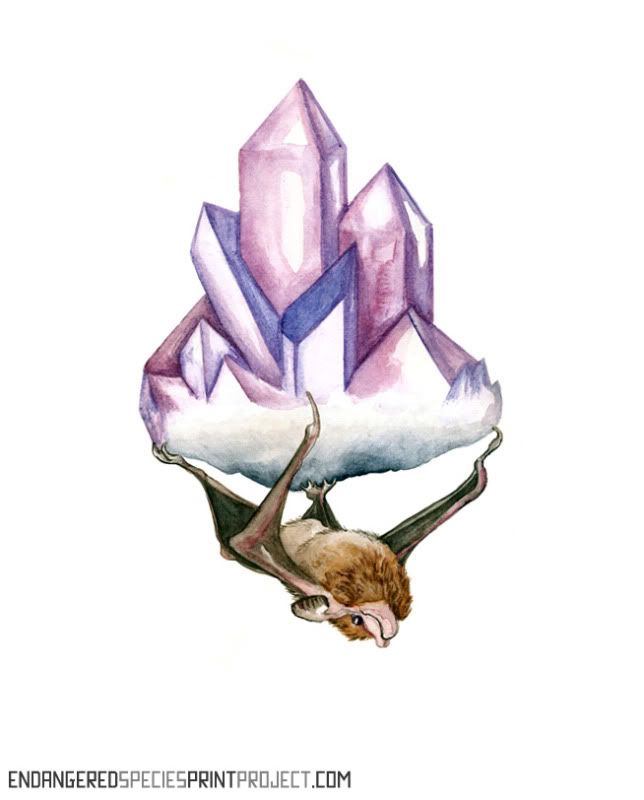
"The Seychelles Sheath-tailed Bat"
2009
Archival giclee print (Edition of 37)
8 x 10 inches

Chicago-based artists Jenny Kendler and Molly Schafer recently launched the Endangered Species Print Project. The ESPP offers limited edition prints of critically endangered species for sale to collectors, and ALL proceeds are donated to conservation programs working to perpetuate the featured species. For each print edition, the total number of prints corresponds to the featured animal's current population. For example, only 37 Seychelles Sheath-tailed bats remain in the wild, so for that edition, 37 prints will be produced.

The ESPP is already generating buzz. The Center for Biological Diversity and The Sierra Club are both promoting the project and have expressed interest in collaborating with Schafer and Kendler. I'm not surprised. The ESPP is a terrific undertaking, a fine example of the sort of environmentally and socially responsible efforts that I dearly wish more contemporary artists would involve themselves with.

As such, I'd promote ESPP even if I weren't planning to produce some prints for the project. I expect to produce two original drawings that will be turned into prints before the end of this year. My subjects will be the Javan, or Sunda, rhinoceros (Rhinoceros sondaicus) and the red wolf (Canis rufus). Also, in 2010, I hope to produce prints featuring other endangered species, including some birds, reptiles, and plants.

Prints of the following species are already available: the Panamanian Golden frog (Atelopus zeteki); the Vancouver Island Marmot (Marmota vancouverensis); the Seychelles Sheath-tailed bat (Coleura seychellensis); and the Indri lemur (Indri indri). Visit the ESPP site to learn more.

Sunday, July 12, 2009

Barry Bruce, waterman


Smith Island, 2008


This short New York Times Audio Slideshow with Chesapeake Bay waterman Barry Bruce offers a lovely portrait of a man and a place.

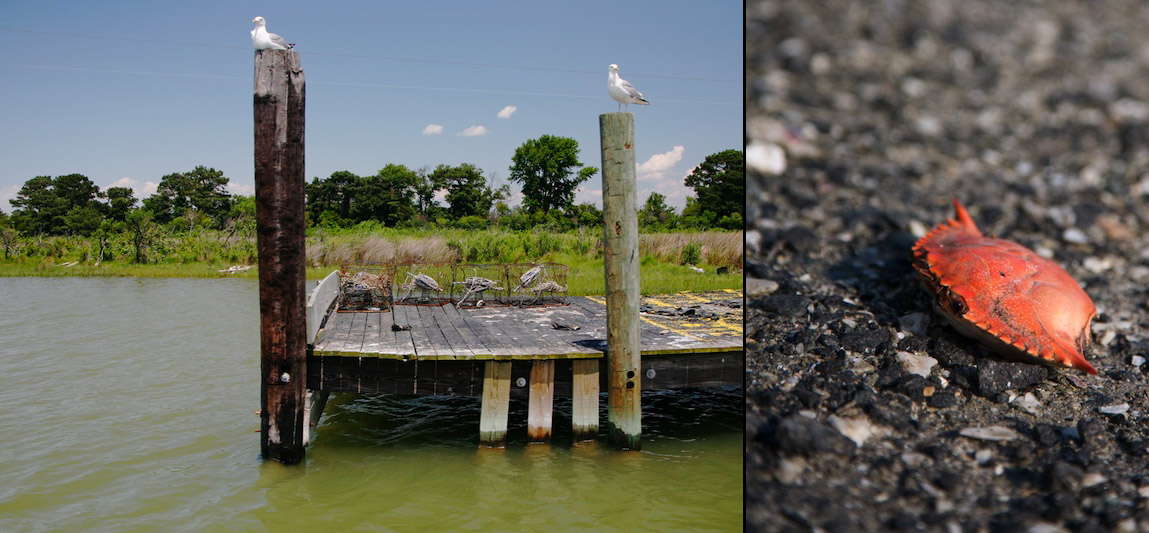
Although I don't know Bruce personally, I recognize him as the hardworking, "salt of the earth" type that crowds the interior of Wachapreague's bait and tackle shop. Around and in Bruce, I also recognize my home ground: the salt marsh and bay landscapes, the docks and crabshacks, the marbles-in-your-mouth accent, the unquestioned appreciation of a providing God tethered to an overarching melancholy of things irrevocably changed.

It's easy to romanticize the sun-baked, hard life of a waterman, but I harbor no illusions. Crabbing is exhausting and painful work. The slideshow provides a sweet aural backdrop of lapping water and muted laughing gulls, but, in life, those pleasant sounds are marred by the irritating whine of the motor, just as the rich smell of the marsh is cut with the stench of gasoline. I don't intend, then, to sentimentalize Bruce's position, but having grown up around folks like him, the farmers and fishermen of the mid-Atlantic, it saddens me to recognize that their kind is nearing extinction. The Shore that shaped me goes with them.

Note: The Bruce slideshow is associated with a New York Times travel piece, "The Crab Houses of Maryland's Eastern Shore." This article is fine, but the slideshow, produced by Miki Meek with photographs by Karen Kasmauski, is the real gem. Watch it here.

Photo credit: Smith Island image ripped from texterella's Flickr photostream

Monday, April 06, 2009

A Simple Idea


View of the Catskills from Mohonk Preserve, NY; March 2009
"Something will have gone out of us as a people if we ever let the remaining wilderness be destroyed...We need wilderness preserved-- as much of it as is still left, and as many kinds-- because it was the challenge against which our character as a people was formed. The reminder and the reassurance that it is still there is good for our spiritual health even if we never once in ten years set foot in it. It is good for us when we are young, because of the incomparable sanity it can bring briefly, as vacation and rest, into our insane lives. It is important to us when we are old simple because it is there -- important, that is, simply as idea."
-Wallace Stegner, 1960
Even those of us who struggle to accept romantic notions of wilderness are moved by appeals such as Stegner's. And with good reason.

Photo credit: Hungry Hyaena, 2009

Thursday, July 12, 2007

Gallery Report: June 27, 2007

Part Three : The Absurd Whole


Michael Light
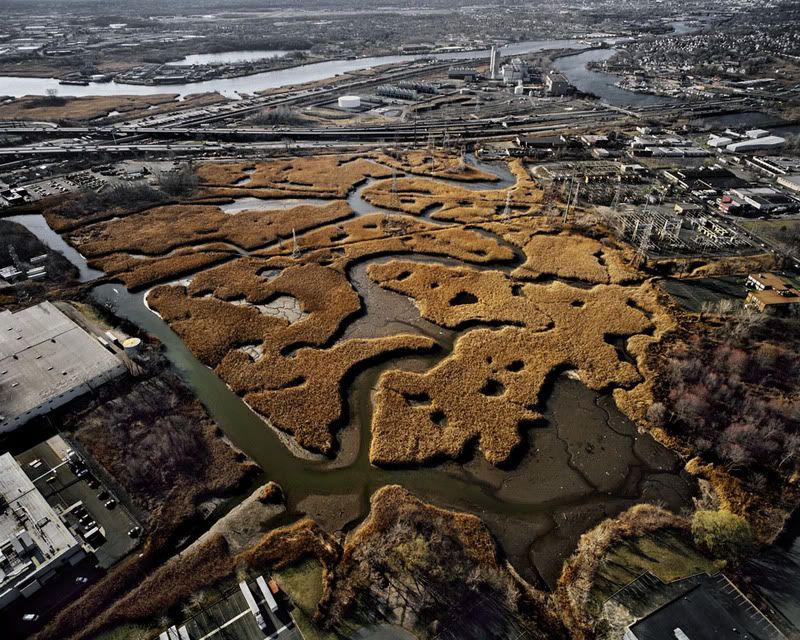
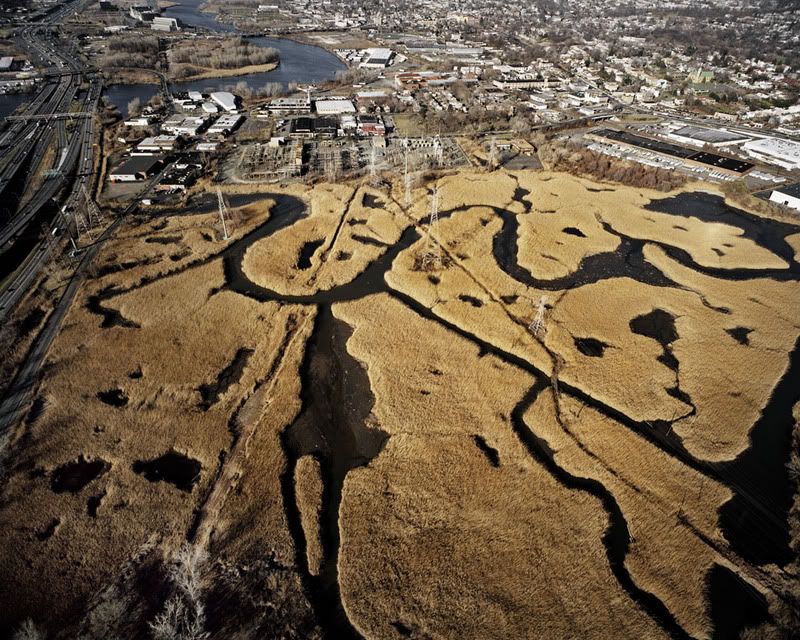
"Bellman's Creek Marsh in the Meadowlands, I-95 and Hackensack River Beyond, NJ, 2007"
2007
Pigment print on aluminum
24 x 30 inches (or 40 x 50 inches)


“The projects of human technology exist wholly within nature, evolving, like anthills, from a set of circumstances that they can neither invent nor transcend.”
-Lewis Lapham, Harper's Magazine (November 2000)

When an airline representative asks if I would prefer an aisle or window seat, I opt for the view. Cramped legs and bathroom trip niceties are a small price to pay. Peering through the reinforced panes as a young boy, I was afforded the perspective required to imaginatively connect a black-and-white aerial survey of my parents’ farm to my ground-level experience of those woods, fields, and marshes. I could at last identify the contours of a pond or stand of trees that I had explored on foot many times. This recognized correspondence thrilled me. A decade on, as a teenage pilot-in-training, I was too enamored of the panorama to mind the specifics of stall recovery procedure, and today all I really recall of the hours logged at the yoke is the exuberant joy I felt looking down on the thin peninsula of farmland separating the Chesapeake Bay from the Atlantic Ocean.

From above, we comprehend land as a cartographer; our mundane conceptions of scale and place are expanded. Michael Light's handsome, handmade Bookworks, on display at Hosfelt Gallery, celebrate this perspectival shift. The artist's books are comprised of aerial photographs shot "with a large-format camera from small, self-piloted aircraft and rented helicopters," each book a document of regional topography, settlement or industrialization. Many photographers aim to "[investigate] the complex landscapes of America," but the aerial aspect of Light's approach elevates his pictures; the images do provide an archaeological record of our culture's contemporary landscape, but the perspective - looking down or across the Earth's flesh from on high - nods to universal and geologic time.


Michael Light
"Deep Springs Valley at 500', 1600 hours, Big Pine, CA
2000
Pigment print on aluminum
24 x 30 inches (or 40 x 50 inches)


The artist states that he is seeking "certain sublimities and timelessnesses and continuities amidst what might commonly otherwise be considered 'wastescapes' or 'nonscapes'" and this search has resulted in the six photographic surveys on display at Hosfelt: "New York Harbor, 03.29.07"; "Rancho San Pedro, 04.28.06"; "Los Angeles, 02.12.04"; "Bingham Mine/Garfield Stack, 04.21.06"; "Some Dry Space, 2003"; "Los Angeles, 07.27.05". His bookworks encourage us to question conventional notions of natural and artificial, and also to consider these environments with respect to the full sweep of time and scale.

"New York Harbor, 03.29.07" is of particular interest to me, and not only because I currently call New York City home. Figuring prominently in this collection is the vast marsh of phragmites, roadways, spartina, telephone poles, landfills, radio towers, and cargo trailers known as the Meadowlands. This is complex terrain, literally and metaphorically. The Meadowlands possess a torn grandeur unrivaled even by the "virgin Nature" we revere in literature and film, on postcards and calendars. Without having traveled to the Grand Canyon, most people have an idea of what they would (or should) "feel" there. They have already experienced it on television.(1) Virgin Nature is neatly labelled and classified, packaged, marketed, and sold. The mess of the Meadowlands, by contrast, resists classification. It reminds us that real Nature - the evolving, ambivalent, often brutal Nature - includes man. Artist and writer John R. Quinn describes the Meadowlands in his book, Fields of Sun and Grass.
"Whether or not the meadows fill any sort of primal need for nature in the eyes of travelers who view them from the Turnpike, wilderness these broad, grassy plains surely are. For though defiled nearly to the utmost, they are yet filled with life - a complex, living biomass that has simply made the best of the industrial juggernaut that has all but overwhelmed it. The meadows have adapted, and endured. And in their own unique way they possess a living beauty that has not been obliterated."

Michael Light
"Bellman's Creek Marsh Looking North, I-95 and Overpeck Creek at Left, Ridgefield, NJ, 2007"
2007
Pigment print on aluminum
24 x 30 inches (or 40 x 50 inches)

Robert Smithson, another artist who, like Quinn, spent his childhood in northern New Jersey and much of his adult life in New York City, wrote, "Even the most advanced tools and machines are made of the raw matter of the earth." Smithson’s statement comes to mind as we speed along the New Jersey Turnpike, passing the industrial detritus that rises up from the reeds or settles into the mud. The tired metal towers, the cinder blocks, the coke bottles, and the discarded tires, the intricate refinery pipeworks, the fat garbage bags, the used condoms, the plastic milk cartons, and the rusty trunks -–all of these things may not be separated from the phragmites, the egret, the turtle, the otter, and the tern. Our existence is woven into past and present, as are the products of our being, a weave which may be dissected only by arrogance or ignorance. To dismiss the Meadowlands as a wasted landscape is to deny humanity. Even though the landscape's relative dearth of biodiversity should distress us. An honest assessment of the region's postmodern ecology and significance requires acceptance of ambiguity and contradiction. Light turns his lens on this heterogeneous landscape and others similarly complex.


Michael Light
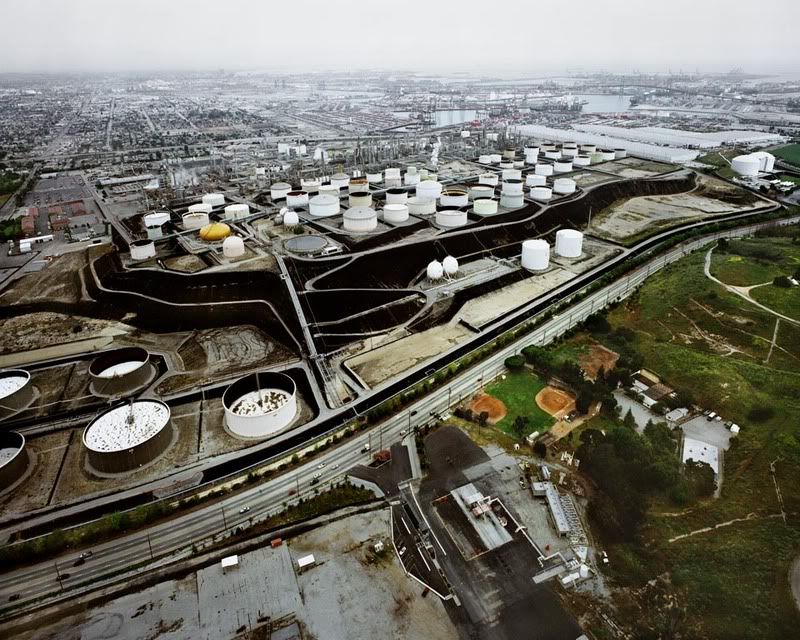
"Conoco Phillips Wilmington Refinery Looking South, 139,000 Daily Barrels, Terminal Island in Distance"
2006
Pigment print on aluminum
24 x 30 inches (or 40 x 50 inches)

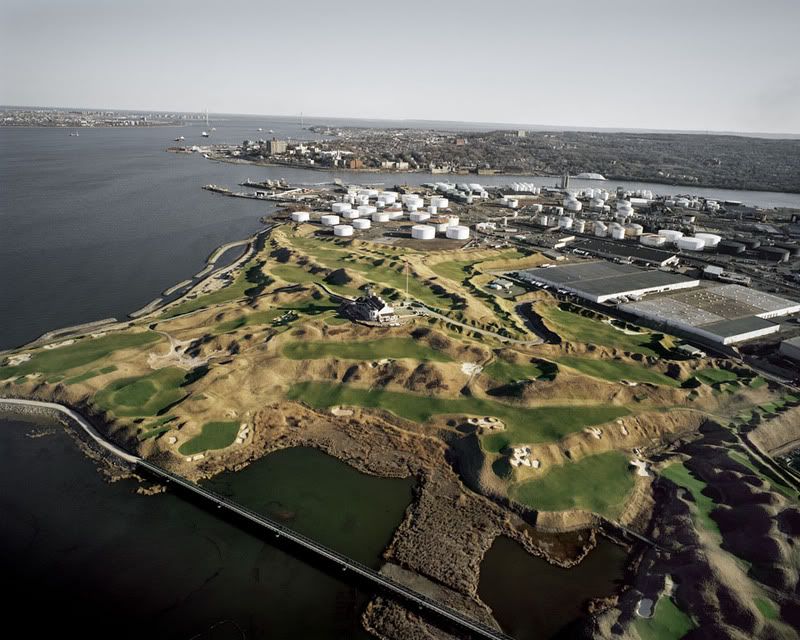
In "Conoco Phillips Wilmington Refinery Looking South, 139,000 Daily Barrels, Terminal Island in Distance," a photo included in the book, "Rancho San Pedro, 04.28.06," a community baseball diamond seems incongruous surrounded by the expansive industrial complex of the southern Los Angeles basin. "Bayonne Golf Club, Former Landfill With A $200,000 Initiation, Old Standard Oil Refinery Beyond, NJ, 2007" pictures one of the Meadowlands' many landfills, in this instance reclaimed as an exclusive club, a manufactured escape in a landscape dominated by what most of us would deem the more mean marks of manufacturing. But the relationship of one to the other is not so dual; this isn't merely attractive versus ugly, good versus bad, or natural versus artificial. Light's photographs remind us that, like the refinery, the golf course and, indeed, even the glacial channel, qualitative judgments are in forever in flux.


Michael Light
"Bayonne Golf Club, Former Landfill With a $200,000 Initiation, Old Standard Oil Refinery Beyond, NJ, 2007"
2007
Pigment print on aluminum
24 x 30 inches (or 40 x 50 inches)

Take, for example, my long-held presumption that Los Angeles is a town with no shared pulse or sense of community. "Los Angeles, 02.12.04" carries Light (and us with him) northward over the industrial sprawl of Long Beach to the grouping of towers that comprise the city's downtown. Monuments to things bought and sold, the tall buildings rise from the city's otherwise low profile, each labelled: BP, Citigroup, Paul Hastings. Moving northwest, Light flies by the hills of Hollywood, dotted with the precariously situated houses of the rich and famous. I've never had a particular urge to explore this city, but as I turned the substantial pages of Light's book, the seismic beauty, fragility, and violence of the landscape were readable. Los Angeles became a romantic notion, an ongoing, astonishing experiment. The prints highlight the tenuous hold humans have on the land and, more generally, on our fate.

There is something freeing in the contemplation of our inevitable annihilation. Christopher Cokinos wrote recently in Orion that viewing extinction as an inevitability (and, therefore, civilization as a temporary exception) "nurtures sanity." I agree. Some readers will undoubtedly feel that this attitude is pessimistic, even nihilistic, but, to the contrary, I believe acceptance of our absurd position nourishes a desire to contribute, to participate directly, even in small ways. Faced with an impossible prospect, it is individual effort and happiness that sustain us. As Albert Camus concluded in The Myth of Sisyphus, "The struggle itself is enough to fill a man's heart. One must imagine Sisyphus happy."


Michael Light
"Carson Sink at 1000', 1600 hours, Fallon, Nevada; July 2000"
2000
Pigment print on aluminum
24 x 30 inches (or 40 x 50 inches)

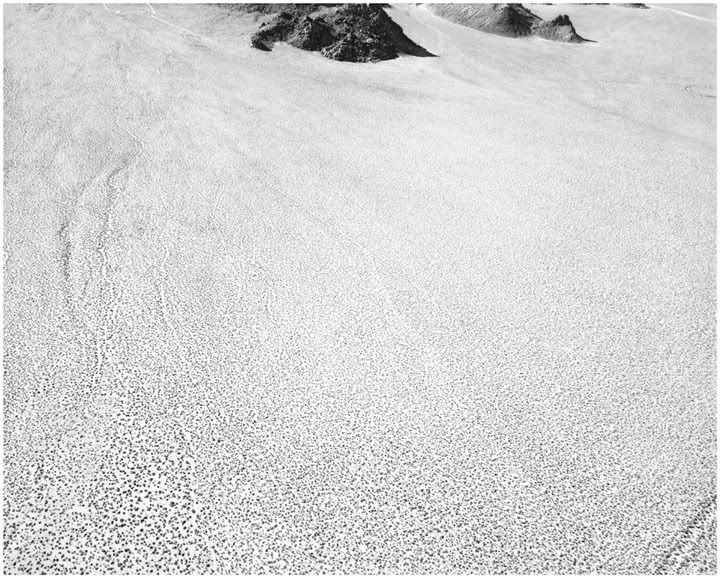
Each of us is part of a greater body. The rest of the material world is part of this body, too. I conceive of this corporate entity as a chaotic harmony. As I consider the pictures included in "Some Dry Space, 2003," serene portraits of one of the more severe, inhospitable ecosystems on our planet, I vacillate between macro and micro world interpretations. I recognize the desert landscape with its dunes, tracts, and other marks of the wind's work, yet the same photograph might also be seen as a cross section of a cell or a tissue slice. Contemplating this analogue, I find myself dusting off the childhood mindblower, “What if our universe, and everything we know, is contained within a marble in an alien universe?”(2)


Michael Light
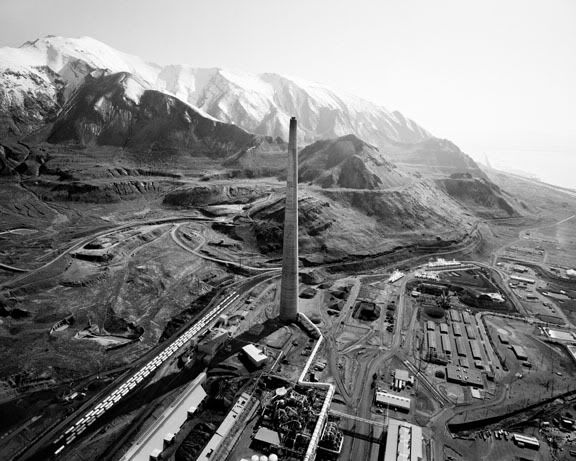
"Bingham Mine/Garfield Stack, 04.21.06"
2006
Hand bound pigment prints, custom box
36 1/2 x 46 1/2 x 1 1/2 inches (open)

But such wonder shouldn't be limited to childhood. These desertscapes, like the spectacles within our bodies or the Hubble views of the vast beyond, present us with stunning beauty. For this reason, the scale of Light's bookworks is important. The viewer can take in the whole picture at once, thereby making it apprehensible and safe, but the book spreads are also large enough to be confrontational. The artist writes that he feels a "tempered awe" when taking these pictures. Remarkably, the bookworks succeed in translating that feeling.

I left Hosfelt Gallery thinking about the ultimate futility of the preservationist impulse. Time moves oblivious. Describing the tenuous state of Louisiana’s coastal wetlands, a civil engineer opined recently that many millions of dollars will be spent “to hold the line in the mud.” Indeed, our situation is literally and metaphorically futile, but Light's images remind us that our desire to hold that line, to preserve the landscape that shapes us (as we shape it in turn), is as natural as the change we react against. This absurd desire is itself part of the holistic landscape. As Howard Bloom wrote, "We are Nature incarnate."


Michael Light
"Garfield Stack, Oquirrh Mountains and Ancient Beach of Great Salt Lake"
2006
Pigment print on aluminum
24 x 30 inches (or 40 x 50 inches)

+++++

(1) And because people watch television indoors, the nature they witness becomes an irrelevant but entertaining outside experience, one external to or apart from contemporary living and ritual.

(2) This "deep thought" is presented well in the animated closing sequence of the comedy, "Men in Black." The camera draws back, out of our solar system and past countless others to reveal that the whole of our galaxy is contained within one marble. The marble is being used in an alien game of marbles, and each of the marbles used to play the game contains countless other solar systems and galaxies. Physically this makes little sense, but it nicely illustrates the scalar continuum.

Photo credits: All images courtesy the artist

Tuesday, February 06, 2007

A Few Minutes Of Complaint


Andy Rooney

I support a number of environmental groups with annual dues. Although I don't like having to cancel such a membership, when I become irked by a particular group's performance or some of their practices, I cease my support. I've been especially irritated about several such issues this past week, and I'm going to use this platform, such that it is, to publicly air my grievances. Perhaps the organizations' representatives will stumble upon this post and feel just a little bit guilty? Whatever the end result of my kvetching, I’m sure to come off sounding like the curmudgeonly “60 Minutes” commentator, Andy Rooney...but so be it.

Firstly, I’m annoyed that some (if not all) of these environmental organizations sell my address and personal information to other not-for-profit groups. I dislike coming home from work to a mailbox stuffed with donation requests. I receive at least eight such envelopes every week, and a fair percentage of these entreaties are from organizations that share very little, in terms of mission, with the groups that I presently contribute to. For example, I support American Wildlands, but is it therefore reasonable to assume that I’ll also donate to the ASPCA or to Operation Help the Children?

(Update Note: The above example is hypothetical. I've been assured by a representative of American Wildlands that the organization has never shared my member information with other groups. For this, I am grateful. Furthermore, I'm always impressed by AW's personal commitment to their members....and, of course, their continuing conservation efforts.)


Unsolicited non-profit support requests

It's most irritating, though, to receive an appeal from a group to which I already contribute! What sort of confidence does that breed in your membership? It’s hard to feel that your well-intentioned contribution is being put to good use if even the organization's member list isn’t managed with some competence.

A couple of months ago, after receiving a renewal notice in the mail, I renewed my WWF membership online. Two or three weeks later, a WWF envelope was in my mailbox. Instead of the expected renewal confirmation, thank you letter, and 501(c)3 tax receipt, the enclosed letter invited me to join the WWF, as if I were not a member, much less one that had just renewed his financial commitment to the organization!

That sort of carelessness is infuriating. In fact, it’s downright insulting!(Moreover, I continue to receive renewal requests for the extant membership! Apparently, the WWF thinks I'm two different members: one in good standing, the other delinquent.)

But an overfull mailbox is merely annoying. More seriously, given the environmental focus of the Sierra Club, the Natural Resources Defense Council, EarthJustice, and the World Wildlife Fund, one wonders how they justify the wasted paper and energy required for these mailings? I assume that many of the recipients, like me, open each envelope and separate the recyclable paper from the complimentary address labels (unfortunately, my name is misspelled on many of these), but this is small consolation! There’s no question that the goals of the environmental non-profits would be better served by minimizing these mailings.


Tree made from junk mailings by artist Dio Mendoza

On a related note, I often wonder why non-profits don’t take better advantage of the web. I’d much rather receive a bi-weekly or monthly email newsletter than fill up yet another blue recycling bag with paper. More importantly, the point-and-click interface of email updates makes it easy for even the lazy members (along with the more busy members) to participate in an organization’s grassroots campaign. A traditional paper letter might more fully relate the most pressing concerns of the moment and recommend ways in which members can help influence political decision making, but I’d wager that a good number of letter recipients do not take time to even open the envelope and, if they do, do not take the time to call their representatives and voice concern.

If, on the other hand, they can link to the organization’s website and, several mouse clicks and a zip code entry later, submit a form letter to the appropriate parties, members are more likely to help the cause and feel connected to the organization, an important part of the effort. The Sierra Club is taking advantage of this approach and, happily, the NRDC and EarthJustice are catching on, too. Many other organizations – especially the smaller, less endowed groups – have yet to transition, however. I believe that this should be a top priority, as we live in an era of lobbying, sad though that fact may be.

When I do receive a printed newsletter from these groups (or a magazine, as is the case with The Sierra Club’s “Sierra Magazine” and the NRDC’s “OnEarth”), I always read them, usually cover to cover.

All of the groups to which I contribute produce handsome publications, but I routinely find errors in “On Focus,” the bi-monthly newsletter of the WWF. (That's strike two for the WWF, if you’re keeping track!) In the most recent issue, two glaring mistakes jump out. In the “Species Spotlight” feature, the text claims that the jaguar (Panthera onca) was “once found from the southwestern U.S. to northern Argentina,” but that “today it inhabits only the rain forests of Central and South America.” In fact, this range is incomplete. The jaguar is present, in small numbers, in regions where it was once extirpated, including the mountains of Sonora, in Mexico, and parts of the American southwest. The more optimistic wildlife biologists believe that the species may be in the early stages of a remarkable recovery, thanks in large part to the habitat linkage efforts of groups like The Wildlands Project. Were the WWF's “On Focus” feature describing an animal about which less is known, I wouldn’t be surprised to read incomplete and misleading information, but they’ve no excuse in this case; the jaguar is an icon.

On the same page, in a blurb describing a new species of snake discovered in Borneo, the text claims that the Russell’s viper (Daboia russelii) is the world’s most dangerous snake. The statement is debatable. At best, it depends on what attributes one uses to determine “dangerous,” but some herpetologists argue that the Russell’s viper is not the most dangerous serpent, by any standard. Although the species is responsible for many deaths - due to its testy temper and liking of human settlement - the venom of this viper is less toxic than that of many other snakes. More importantly, kraits (Bungarus sp.), another genus of snake, annually kill more people in Asia. I don't understand how the World Wildlife Fund fact checkers let this incomplete information go to press without a mention. WWF is, after all, a wildlife organization; hire folks who actually know something about the animals they're supposed to be working for!

I only caught the above errors because I'm relatively well-informed about jaguars and snakes. What of all the other species I know comparatively little about? And what of the many thousands of WWF members who know almost nothing and wish to learn more? Are we being mis-educated by the WWF newsletters? It appears so.

I plan to let my WWF membership lapse. In my two years of membership, I've not been impressed with the organization at all, the importance of their mission aside.

I’m less of a stickler when it comes to the smaller, more local organizations, but among the funded behemoths, such carelessness is deeply discouraging. If any of the organizations' representatives do happen upon this post, please consider it a call to improve your online resources and message delivery, cut back on unnecessarily wasted paper, and fact check, fact check, fact check. Rooney, over and out.

Photo credit: Rooney picture ripped from www.ukuleleman.net; Random junk mail photo ripped from www.redpac.com; junk mail tree ripped from SFEnvironment

Thursday, December 07, 2006

The Whiteness of the Whale

"Is it that by its indefiniteness it shadows forth the heartless voids and immensities of the universe, and thus stabs us from behind with the thought of annihilation, when beholding the white depths of the milky way? Or is it, that as in essence whiteness is not so much a color as the visible absence of color; and at the same time the concrete of all colors; is it for these reasons that there is such a dumb blankness, full of meaning, in a wide landscape of snows- a colorless, all-color of atheism from which we shrink?...And of all these things the Albino whale was the symbol. Wonder ye then at the fiery hunt?

- Herman Melville, Moby-Dick
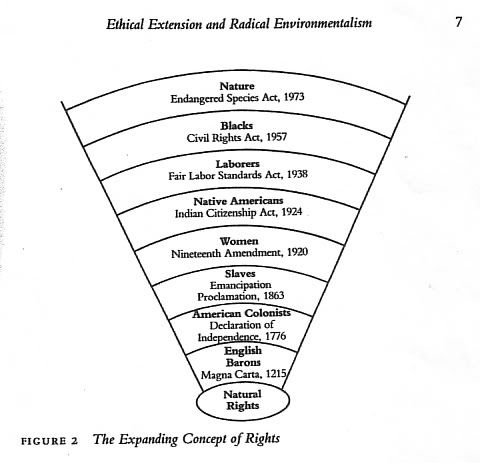
In a post entitled, "The Expanding Ethical Embrace" (March 2005), I expressed skepticism regarding Peter Joost's argument that humanity will adopt a moral code that grants other mammals, birds, reptiles, and even, eventually, bacteria, the same natural rights that we now reserve for ourselves (supposedly irrespective of race, sex, sexuality, or religion). I did not doubt the plausibility of Joost's prediction, but rather his assertion that this ethical evolution portended only happy returns. I wondered, if humans were to transcend the cruel machinations of biological determinism, wouldn't we, in effect, be killing ourselves with kindness? In Joost's neo-Eden, the human population would explode; the increased resource demands would inevitably lead to collapse (that is, if we didn't first find it in our reptilian spines to loathe "the other" as passionately as we have for time immemorial). Attractive though Joost's notion was, I remained ambivalent about the prospect.


Joost's prediction was recently called to mind when, reading Grist, an online environmental news journal, I stumbled upon a provocatively titled Gristmill thread initiated by Jason Scorse.  Many challenging questions are advanced in the dialogue generated by Scorse's "So, environmentalists support whaling?" Notable among them are:
- Is an environmentalist morally obligated to support animal rights?

- Are regulated, luxury hunts that fund conservation projects ethically or morally defensible?

- Are free enterprise and sustainable development mutually exclusive?

- Should the conservation and preservation camps be distinct from one another, promoting different agendas, or should they work together toward a compromised, common goal?
Scorse's answers to the above questions are 'Yes,' 'No,' 'Yes,' and 'Yes/No,' respectively. Yet any approximation of a complete answer to these questions requires some degree of ambiguity, and even contradiction.  Normally I find contradiction and ambivalence agreeable, because they edge closer to objective "truth" than any ideology might; in matters of environmental policy, however, the grey areas trouble me. Apparently, they trouble Scorse, too, as he jettisons nuance in favor of ideological certainty. Prompted to choose between ideology and reasonable pragmatism, I'm tempted to follow Scorse up the moral high road; the ideological path appears straight and true. But while moral certitude, the black hat/white hat conception of life and thought, is the path favored by activists and fundamentalists, I am made uncomfortable by it, particularly when it informs legislation.

Reasonable pragmatism, the preferred approach of post-Enlightenment thought, has its own problems, however. As Benjamin Franklin wrote of his vegetarian experiment(1), "so convenient a thing it is to be a reasonable creature, since it enables one to find or make a reason for everything one has a mind to do." Franklin's observation at once celebrates and skewers reason, revealing it to be a wholly relative enterprise. This chink in reason's armor is worrisome.

So what will it be? Are the complications and sacrifices of reasoned compromise better or more effective than ideology? Or do we have clearly defined "good guys" and "bad guys"?

Craig Nelson's recent biography of Thomas Paine serves as my subway reading these days, and I find the following observation relevant.
"Beginning with Franklin and Washington, every successful American leader would balance the pragmatic with the Utopian.  Where Franklin the master politician would be almost entirely pragmatic, Paine would be too fervidly Utopian in ways that would not just damage him financially, but imperil him physically... Paine would...always be too ardent with his religion of the lights, a Savonarola of reason and liberty, and as inept a political operator as any fervid Christian saint...The success or failure of any leader in U.S. history can be judged through his of her successes or failures at reaching the pragmatic Utopian paradox that remains at the heart of the American experiment."
Nelson's words ring true.  "The pragmatic Utopian paradox" is not uniquely American, but it is central to the American experience.  For confirmation, we need look no further than the glut of contemporary, progressive American politicians striving to develop a decidedly centrist track record, even as they contradict themselves (and their conscience) in doing so.  By contrast, it's easy to discard compromise and contradiction if you are a committed revolutionary, an individual willing to die for your cause, or a monkish loner operating in an intellectual/philosophical vacuum, as did Theodore Kaczynski.  Outside the D.C. beltway, ideologues are a dime a dozen, but exceptionally gifted ideological rhetoricians like Paine or King, Jr. make a sociopolitical impact only rarely.

Not surprisingly, many environmental activists are ideologues, Jason Scorse included.  To be fair, Scorse, a professor of environmental economics at the Monterey Institute, is not so much making a stump speech as he is asking a provocative question. From his "So, environmentalists support whaling?" post:
"I have tried to make what is essentially a straightforward case that environmentalism at its core is about respecting life and that separating this from our behavior towards individual living beings doesn't make much sense. Since many environmentalists reject this notion and insist that environmentalism only includes preserving biodiversity and promoting resource sustainability, this suggests that one of the defining elements of environmentalism no longer holds: an opposition to whaling...So are those who argue for the minimalist view of environmentalism willing to go on record in support of whaling and the killing of other advanced mammals?"
Money can do a lot in the way of protecting individual species and imperiled ecosystems.  Regulated hunting operations and animal farms, worldwide, generate substantial revenue, a healthy percentage of which is used to fund conservation measures.  For example, a buyer pays a tiger rancher (yes, they exist) an impressive sum - $40,000, say, sometimes much more - to obtain tiger parts for use in traditional Chinese medicines.  A substantial percentage of that price is then used for habitat preservation, conservation education, and tiger breeding programs.  It's a simple ethical equation; one animal's death results in improved species survival rates in the long-term (assuming that the habitat can be protected from the trespasses of our burgeoning human population). My short answer to Scorse's question, then, is 'Yes.' The more complete and complicated answer, though, leads down a rabbit hole of uncertainty.

To begin with, I find Scorse's moral framework - do unto your neighboring species as you would have done unto yourself - fundamentally agreeable. I'm troubled by the scalae naturae and other moral or physiological hierarchies. Because human life is, in my estimation, no more or less valuable than that of an earthworm (and, lest you mistake that statement for hyperbole, my inner ideologue assures you otherwise), the farming and killing of a tiger, no matter the result, is immoral. So, too, is the farming and killing for food of any animal species. In a truly enlightened world, then, we would witness a continued shift toward vegetarianism, sustainable consumption, and the extension of natural rights to other species. But the rate at which such values are adopted is of critical importance, and I feel Scorse is not at all pragmatic in his consideration of the real-world application of his moral imperative.  I fretted about this in the earlier post:
"From a strictly pragmatic perspective, morality is a denial of our existential [and by this I meant all species, not just human] sameness; like all other species, our principal drive is one of survival and propagation. Even our human urge to classify, as seen in the periodic table, clothing labels, and taxonomy, is a violent instinct, evolved to make us better able to ward off 'the other' and to flourish as hunter-gatherers, a lifestyle no longer suitable for our global, industrial species. [Therefore], it could be argued that [the] extension of human rights to all races, cultures, and creeds was but one more victory in our campaign to deny human nature.

But an inclusive, caring society, even if inconsistent, results in a population explosion and exaggerated life expectancies. Moreover, as our species’ requirements are increased, so are our demands on the environment. By embracing one another, we in fact make it more difficult for future generations to survive. When even more populations (in this case, other species) enter our moral and ethical peripheral vision, we will find ourselves facing a very interesting philosophical and pragmatic dilemma. Are we overloading of the circuitry?"
It seems clear that we would be "overloading of the circuitry," but there is a more immediate concern, one that does not bode well for Joost's expanding ethics: we have proven incompetent in our attempts to achieve parity among humans.

In the course of the Gristmill conversation, Scorse writes, "Thank goodness...humans aren't treated with the same level of abstract notions about 'sustainability' that you advocate that we subject every other living thing to."  Oh, but how we are! One need look no further than the morass of muddled litigation generated by today's vitriolic debates over abortion, civil rights, or assisted suicide to comprehend just how reluctant we are to treat fellow humans with the respect we reserve for ourselves and for our loved ones. As I wrote in March 2005, "one can barely imagine the ensuing cacophony when considering similar issues for sharks, birds, and turtles."

Ever since Homo sapiens adopted an agrarian lifestyle, we've been a top-down animal, a pyramid ladder of the very few haves and the countless have-nots.  I'm not altogether opposed to the felling of this pyramid in the name of populism and moral ideology (although, let's not kid ourselves punkers, anarchy ain't Utopia), but when similar tinkering and protest is extended to Nature, an entity of which we, as a species and complex-compound social beast, are but an insignificant part, we're not only risking collapse on a Mayan or Roman scale.  We're also gambling with the fate of the human species at large and, importantly, that of the many hundreds of thousands of species inextricably attached to us.  Those who herald the imminent expansion of our ethical embrace would do well to think on this.


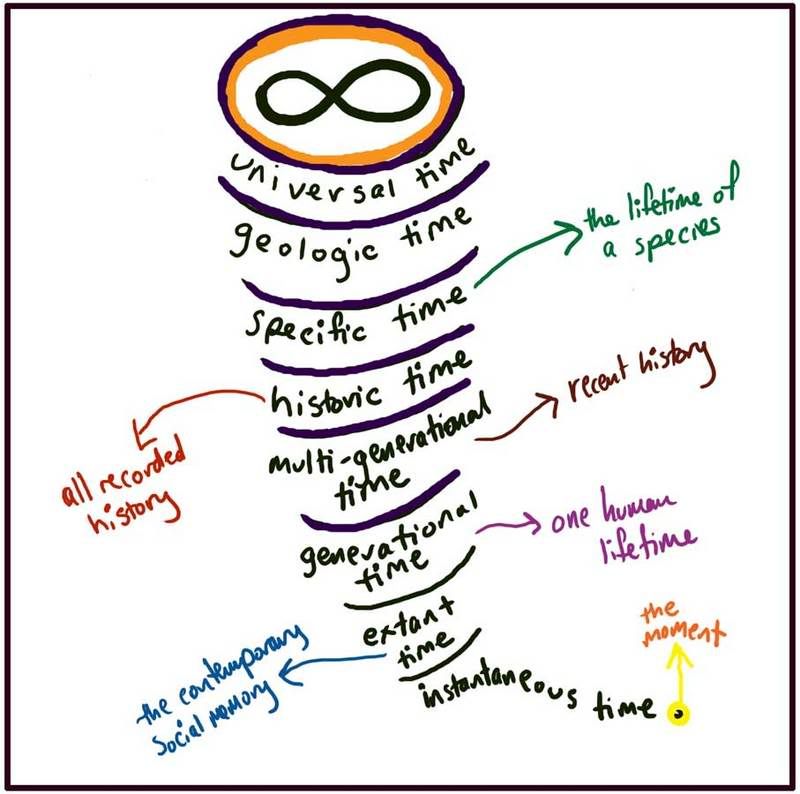
The natural algebra can not evolve apace with our ethical code. Believing this to be true, I suppose I'm something of a determinist. I don't doubt that Earth's carrying capacity will increase as we adopt more sustainable lifestyles, but such a change occurs in geologic time, not generational or historic time. E.O. Wilson, the celebrated Harvard entomologist, makes a similar, if distinct case in his landmark book, On Human Nature.
"Can the cultural evolution of higher ethical values gain a direction and momentum of its own and completely replace genetic evolution? I think not. The genes hold culture on a leash. The leash is very long, but inevitably values will be constrained in accordance with their effects on the human gene pool. The brain is a product of evolution. Human behavior - like the deepest capacities for emotional response which drive and guide it - is the circuitous technique by which human genetic material has been and will be kept intact. Morality has no other demonstrable ultimate function."
I'm inclined to agree...to a point. But what hand really holds the leash? Wilson assigns control to genes, our evolutionary chaperones. Genetics is indeed powerful, but the brain is as much a product of cultural evolution as it is physiological evolution. Therefore, I believe nurture can outpace nature at the societal level. In other words, genes have less control over moral and ethical evolution than Wilson would have us accept. In fact, it is the "eco," the greater whole - the Everything and the No-thing, from which we are inseparable - that grasps the leash. I trend toward the mystical here, but the skeptical scientists in the room can call this leashing by holistic natural law (as opposed to Wilson's evolutionary imperative).


Despite my attraction to the moralistic, and my belief that our ethical purview will inevitably expand, I must conclude that is necessary to distinguish between long-term aspiration and present policy. The American Civil Rights Movement may be portrayed as a historical artifact in high school text books, but racial prejudice and bigotry are no more history than is the Cold War. Our aims are ahead of our practice, and we should take care not to neglect incomplete cultural "mutations." Today being the anniversary of his death, take another listen to John Lennon's "Imagine." The words and images of artists are vital. Without them, our shared cultural imagination (or our memes) would be starved, but we shouldn't ride the moral high horse if it means we won't reach our destination. This is the critical distinction between morality and ethics.

Progress - if loosely defined as our stumbling effort toward the betterment of humanity and the world we belong to - is best served by pragmatic rationalism and a conservative code of ethics. As my father stressed to me from a young age, good economics - literally translated, "management of the household" - begins with good ecology - "study of the household." A promising future awaits humanity if we are imaginative enough to forge our ethics from the moral, the aesthetic, the ecological, and the pragmatic.

Turning to Bill Cronon's writing, as I so often do, and did when considering these ideas before:
"The choice we face is not to leave no marks – that is impossible – but rather to decide what kinds of marks we wish to leave."
So to Jason Scorse, and all ideologues: my heart is with you, but things simply aren't so clear as might like them to be.

Image credits: Ahab illustration by Sam Weber; ethics diagrams from Peter Joost's March 2005 New York Historical Society lecture; timeline diagram by Hungry Hyaena

(1) Franklin abandoned the diet eventually, as the smell of cooked seafoods, particularly fish, proved too much for his dietary resolve. No problem, though, as he was able to use reason to account for why fish were a viable exception!

Tuesday, July 11, 2006

Thinking Like A Mountain?


Erik Reece's eloquent essay, "Death Of A Mountain: Radical Strip Mining and the Leveling of Appalachia," was included in the April 2005 issue of Harper's Magazine. The piece examines and responds to environmentally devastating coal mining practices in eastern Kentucky. Appropriately enough, I read the work while standing in an abominably long line at the World Expo, in Aichi, Japan, the first World's Fair dedicated to "green" thinking or, as the Japanese organizers dubbed it, "Nature's Wisdom."

Every pavilion in the Aichi Expo was sponsored by either a nation or a corporation (a sign o' the times), and they all forecast a happy, healthy, and sustainable future for humanity and for the planet. Reece's melancholy report provided a sobering counterpoint. A "green future" is tenable only if the necessary changes in technology and lifestyle generate an altogether different kind of green: cash money. As the wife of a Kentucky coal miner asks Reece, "What use are the mountains to us other than coal? When are you going to start thinking about us instead of the environment?" Until alternative energy cheerleaders assuage the concerns of those citizens dependent on income provided by companies like Leslie Resources Inc., one of the mining outfits indicted in Reece's article, America's hard-working, blue-collar folks will remain united in opposition to the relatively privileged mouthpieces of environmentalism.

In "Death of a Mountain," Reece describes the minutes of a Kentucky hearing addressing an Environmental Impact Statement on mountaintop removal, the principal method of tapping into buried coal seams. The local coalfield citizens in attendance, many of them employed by the region's energy companies, reacted against "outsiders" telling them what was best for them and for their land. They even hinted "at a conspiracy afoot by the rest of the state to keep eastern Kentucky poor." Not surprisingly, such vehement antagonism to "greening" measures were not highlighted at the Aichi Expo. Likewise, they receive scant attention in environmental publications, even those produced by more thoughtful organizations,including The Sierra Club, Natural Resources Defense Council and EarthJustice. It's clear that most environmentalists don't consider the lives of those people displaced by expanding parkland or laid off by companies under siege from environmental legislation. It's little wonder that "Third World" countries and blue-collar workers like the Kentucky miners or the fishermen of the Galapagos islands object to what they consider do-gooder meddling.

In Aichi, I looked up from the magazine and noticed a Japanese teenager in line not far behind me. He was wilting under a sun umbrella, wearing a t-shirt emblazoned with a picture of the popular American hip-hop duo, Outkast. Fond of connecting seemingly unrelated strands, I thought of the Outkast song, "Return of the G." The lyrics of the song begin, "Every time I try to get peace of mind, niggas try to get a piece of mine, so I gotta grab my piece." The song concisely describes an ugly, myopic cycle, but how much easier for me to characterize it as such when I can afford a plane ticket to Japan and enough over-priced, organic vegetables to fill my canvas grocery sacks?

As a proponent of conservation and environmental protection, I'm necessarily guilty of prioritizing the sustainable long-view over the millions of people vying to put food on their plate. I considered this distressing reality as I entered the air-conditioned Hitachi Pavilion in Aichi to watch an animated feature about the catastrophic - nay, apocalyptic - events brought on by humanity's cavalier approach to natural resource consumption.


A mushroom cap raises a mossy roof

Similar considerations were on my mind this past week, when I traveled to the Monongahela National Forest, in eastern West Virginia, for some camping, hiking, and herping. I know very little about West Virginia, despite having spent several summers at Camp Greenbrier, situated just outside Alderson, in the southern part of the state. During those summers I learned about kayaking, archery, riflery, rock climbing, and the cruel conduct of boys left unsupervised, but I was too young - just nine or ten years of age - to absorb much about the region save the scenic beauty.

Following those camp years, John Denver's song "Country Roads," a particular favorite of my mother, acquired new significance for me. "West Virginia, mountain momma...take me home," Denver sings. Having appreciated the lush splendor of the Appalachian range for myself, Denver's lyrics imparted an aesthetic association as well as the allusion to a mother's buxom embrace. But Denver's paean doesn't only acknowledge West Virginia's awesome landscape. He refers to the state as the "miner's lady...dark and dusty." Even the state's coat of arms, central on the state flag, pictures a miner, pickaxe slung over his shoulder, standing alongside a farmer. But modern miners have largely abandoned the pickaxe in favor of cranes and bulldozers, and evidence of mountain top removal can be seen from the state's highways. Treeless plateaus neighbor intact peaks and, although geologic time will see these scars support trees and other vegetation anew, one can not help but wonder what has become of the once healthy water supply fed by the decapitated mountain streams.

Happily - some might even say selfishly - I was able to avoid despair during my time in Monongahela. Unlike so much of the state, the mountains of the National Forest have been spared extensive surgery. All the same, the park map is peppered with mine sites, demarcated by a pick and shovel. The stream water I drank - after an iodine pill dosing - seemed safe enough (I didn't get sick), but I couldn't quite shake worries about mercury or heavy metal content. Encouragingly, we found plenty of amphibians in the streams, and this suggests that the water is clean.


Salamander hunting near Cheat Mountain Camp

* * * * *

Amphibians: We identified four species of salamander; one example of each is pictured below.


Mountain Dusky Salamander (Desmognathus ochrophaeus)

The Mountain Dusky Salamander (Desmognathus ochrophaeus) was the most common, at least according to our crude census. They seemed to flourish alongside streams, under partially submerged rocks, and on the mountain's face, under woodland detritus - bits of rotten limbs or clumps of moss. The coloration of this species is wide-ranging. Some of the individuals we came upon could have passed for the unrelated redback (Plethodon cinereus), while others appeared more yellow, tan, or even chocolate. Fortunately, one of my companions is an avid herper and he was readily able to distinguish the two species by examining the head and nostrils. When in doubt, I defer to his expertise.


Redback Salamander (Plethodon cinereus)

Comparatively scarce was the redback salamander and, if I'm recalling accurately, we only discovered this species near woodland vernal ponds. Unfortunately, all my photographs of the species turned out poorly. The models, this one included, didn't much take to posing, forcing me to hurry the shots.


Spotted Dusky Salamander (Desmognathus fuscus conanti)

The most unusual discovery of the trip was a Spotted Dusky Salamander (Desmognathus fuscus conanti). The species is not known to live in the region - according to field guide range maps, anyway - but, nevertheless, we encountered this individual under a flat rock in an insignificant stream and spent some time confirming the ID. Proof, once again, that nature is always throwing curve balls, particularly in this time of accelerating climate change. The patterned salamander was strikingly colored and appeared almost translucent, it's distinctive markings discernible beneath a superficial layer of clear skin.


Red-spotted Newt (Notophthalmus viridescens viridescens)

Just up the hill from the Spotted Dusky discovery, we noticed a Red-spotted Newt (Notophthalmus viridescens viridescens) in a puddle of standing water. I was thrilled to see one up close, as it had been the better part of a decade since I last admired this species in person. As it turned out, almost anywhere water pooled in Monongahela, the newts were present. By the time we departed, we'd seen close to a hundred.

Before transitioning into its principally aquatic adulthood, however, the newt spends time on land, as the terrestrial red eft. These attractive little amphibians are perhaps the most charismatic of salamanders. Their stunning outfit is complimented by their not being as retiring as other species. If you find yourself in prime habitat, a keen eye will spot the efts crawling on logs or over leaves, seemingly unperturbed by exposure.


Red-spotted Newt in Red Eft stage (Notophthalmus viridescens viridescens)

Tadpoles, like the newts, could be found in almost every pond or puddle. Although we could not ID the species with certainty, we believe most to be the aquatic larvae of the wood frog (Rana sylvatica), though we did notice a few American bullfrog (Rana catesbeiana) tadpoles. The bullfrog is something of a bully, infamous for out-competing other amphibians and adapting to a wide range of habitats. Biologists designate such a species a trophic generalist. Despite the potential threat to biodiversity, a piece of me admires the pluck of the bullfrog, just as I grudgingly take my hat off to the European starling (Sturnis vulgaris) and the raccoon (Procyon lotor).

Although we saw countless tadpoles, we saw only three adult frogs. One bullfrog, one wood frog, and one upland chorus frog (Pseudacris triseriata feriarum). The upland chorus frog is closely related to, but distinct from, the eastern (or New Jersey) chorus frog (Pseudacris ferairum kalmi), with which I am familiar from my childhood on the Eastern Shore of Virginia.


A Monongahela stream

Reptiles: Our snake hunting forays proved less successful. We shined flashlights into crevices and carefully examined sun-lit leaf litter in hopes of revealing a timber rattlesnake (Crotalus horridus) or a northern copperhead (Agkistrodon contortrix), but neither species graced us with an appearance. I was discouraged, but not surprised. Snake hunting is usually a kettle watching exercise and the animals seem to materialize only once you cease searching.

We found two snakes in Monongahela. Sadly, one of these was a DOR (dead on road) eastern garter snake (Thamnophis sirtalis sirtalis), a victim of the automobile. Given the infrequent use of this remote forest road, I decided the unfortunate snake must have accrued some very shitty karma. At least an unidentified land snail was feeding on the dead snake, a welcome reminder of our shared mortality and interdependence.

The identity of the other snake we observed remains in question, but I'm almost certain it was a juvenile eastern milk snake (Lampropeltis triangulum triangulum). It was a very slender snake, not even pencil-thick, wearing alternating bands of red and white. We noticed the snake on the bottom of a shallow, water-filled ditch. It was attempting to feed on small tadpoles. When we clumsily hurried over for a closer look, it retreated into submerged grasses lining the ditch. After a wait of about fifteen minutes, it emerged from hiding and I attempted to ID it as it zigged and zagged across the bottom. I failed, unfortunately, and we did not see the little reptile again. According to field guides, eastern milk snakes are no stranger to stream bottoms. This knowledge, combined with the distinctive markings, leaves me with little doubt of the species, but, as I say, the verdict it still out.


Snake hunting on the southern exposure

Mammals: I hoped to see a black bear (Ursus americanus) or two, but I had to settle for a smattering of tracks. Because we arrived in Monongahela at the tail end of a long wet spell, the trails and back country were muddy and soft. Although the rain made the first night miserable - we rigged a tarp and pitched the tents after dark, in hard rain - the saturation made spotting animal tracks easy, although in some cases the ground was so wet that fresh prints were already partially obscured. White-tailed deer (Odocoileus virgianus) tracks were plentiful, but we saw more deer in the backyards of the houses fringing the National Forest than we did in Monongahela proper. This isn't surprising, as deer are harder to spot in dense forest and, what's more, they thrive in and around human settlement, as so many suburbanites know. Also abundant was the bouncy eastern chipmunk (Tamias striatus).

Birds: We were ill-prepared for bird watching. Although we were careful to pack everything needed for a camping trip - right down to the campfire utensil sets - we somehow neglected to include binoculars. I'm not sure how this oversight occurred, but none of us had a pair in hand, making anything beyond guessing difficult, especially since most of Monongahela's bird species are relatively small. In the shadowed forests, identification is all but hopeless without ocular assistance. Fortunately, one of my friends has a competent ear and some species were identified by their call.

Slate-colored juncos (Junco hyemalis) were innumerable. It seems spring comes late to the upper elevations, as the rhododendrons had yet to bloom and, on the final afternoon, we were scolded by two adult juncos as we hustled past a fledgling perched on a low-hanging branch. The prize for Most Handsome Bird goes to the Blackburnian warbler (Dendroica fusca), a fire-headed fellow with a striking voice. We thought we heard this bird's song in the woods, and our supposition was verified when an individual landed just above us, in the branches of a spruce tree.

Most exciting for me, however, was the family of American woodcock (Philohela minor) that we startled into awkward flight. I'm used to the jump, flutter, and glide behavior of the woodcock in the open, flat fields of coastal Virginia, but in the mountain woods of Monongahela, the woodcocks' comical eruption from among the leaves and ferns betrayed the provenance of the species nickname, the timber doodle. The first bird to take off flapped and jerked and reared and leaned as it moved all of twenty feet in the air, before pitching hard and vanishing into a mess of fallen limbs. Realizing we had disturbed a family group, we made our way downhill at a good clip, so as to allow the birds to regroup.

Plenty of common ravens (Corvus corvax) and cedar waxwings (Bombycilla cedrorum) were about, but we saw only one American blue jay (Cyanocitta cristata) and one turkey vulture (Cathartes aura), species I certainly expected to see more of. Had we been properly equipped (read: not forgotten the $@*&%!! binoculars), I would have more to report, but I was all too happy to concentrate on reptiles and amphibians, as they are particularly exciting to me.

* * * * *

Rising with dawn's birdsong on the final morning, we quickly packed our gear, lowered the bear bag, and began the five hour drive to Washington, D.C., where I was to catch the Chinatown Bus back to New York City. As we headed east, I slouched in the cramped back seat and admired the mountains of West Virginia, even as I again noted signs of resource extraction. My thoughts returned to Reece's "Death of a Mountain" and I made a mental note to reread it upon returning to New York.

Near the end of the article, Reece quotes Aldo Leopold, the famous American ecologist and conservationist. Leopold bemoaned the fact that "one of the penalties of an ecological education is that one lives alone in a world of wounds." I'm not sure that this is still the case. Those of us who are environmentally conscious do not live alone, even if we do remain surrounded by wounds. More than ever before, "green" sentiments are also popular sentiments; many folks share a penchant for preservation. Leopold would argue, however, that most contemporary environmentalists remain blissfully ignorant of ecological pragmatism. He was a conservationist, not a preservationist, and he understood that protectionism alone rarely leads to long-term sustainability.

Keeping this conservation/preservation dynamic in mind, I think it noteworthy that my companions in the forests of Monongahela were a biology professor and a writer. For our purposes here, the biologist might be characterized as a biological determinist and the writer, as a moral idealist. Though these two characterizations are by no means mutually exclusive, it makes for an interesting contrast in perspective, even though both appreciate the outdoors equally. Rereading "Death of a Mountain," I was surprised to find this divide touched on in the closing paragraphs.
"If our species is to make it through [the 21st] century, the forces of science and technology must be tempered by two other forces - ethics and aesthetics. All ethical philosophies, from Aristotle on down, are based on this ecological principle as stated by Leopold: 'The individual is a member of a community of interdependent parts.' And as the cave art at Lascaux makes brilliantly clear, we are a species that has evolved to find beauty in the natural world. This trait serves - or should serve - an evolutionary purpose: we love what we find beautiful, and we do not destroy what we love. A strip job is more than a moral failure; it is a failure of the imagination. It is time we stopped thinking like those who conquer a mountain and started thinking like the mountain itself."
A strip job, as Reece writes, is a moral and imaginative failure, but what does it mean to think like a mountain? It would seem to me that to think like a mountain requires us to abandon morality and imagination, both exceptional human virtues. Is my ambivalence concerning invasive species control an example of mountainous thinking? Moral ambivalence - that is, amorality - is Nature's way. But isn't ambivalence, too, problematic? Is it not cousin to apathy? Humans, at their best, are moral animals; morality necessitates choice and action. Strict environmental controls, then, are moral, pragmatic, and rational, flailing efforts in our human time scale not at all like the geologic contemplation of a mountain. We humans consider a skewed equation and strive to balance it. This calculus comes at some cost. For the sensitive aesthete, slavishly devoted to what Reece calls beauty, the dualistic thinking of a moral pragmatist - right or wrong, good or evil - can seem an ugly, even unnecessary evolutionary holdover. Where, then, can the conscientious among us stand? It's an impossible question, really, more of a koan than a query, but it nags nonetheless.

Something approaching an answer is wrapped up in the lyrics of Denver's "Country Roads," in the fight bruised arms of young boys, in the remarkable persistence of trophic generalists, in the determined antagonism of the coal miner's wife, in the scarred plateaus, and in the slurried bear tracks. Thankfully, when I'm painting, or when I'm appreciating back country settings like Monongahela, I'm reminded that contentment, for me, requires acceptance of a messy, mongrel truth. For my part, it's both necessary and natural to be both an idealistic aesthete and a moralistic number cruncher.


Fungi thrive in the moist, dense forests

Photo credit: all photos, Hungry Hyaena, 2006