Showing posts with label relativism. Show all posts

Thursday, July 16, 2009

Other Peoples' Lives: The Sundurbans


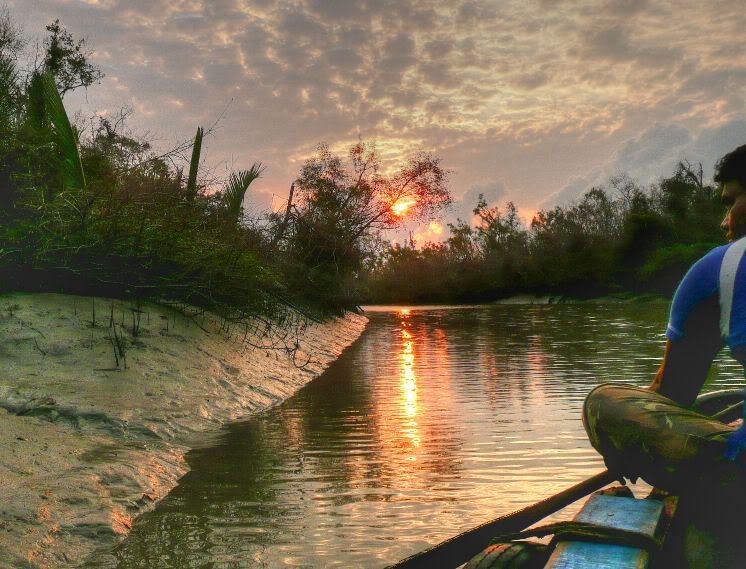
Sundarbans National Park, Bangladesh
"From time to time, we passed solitary women trudging through the water near the shoreline, pulling nets behind them as they trawled for prawn seed. This practice, introduced in the past twenty years or so, has disastrously reduced prawn and other fish populations, and the constant pacing along the fragile shore by the women and children who drag the nets has contributed to erosion. In their flowing saris, the women presented picturesque silhouettes that belied the danger of their work, up to ten hours a day waist high in the murky water. As many as ten fatal crocodile attacks are documented each year, and, I was told, too many shark attacks to report. The most common are by dog sharks, which take a bite of soft tissue—a leg or buttock—but do not kill. 'They are considered minor hazards,' Dr. Sanyal said, with a sympathetic grimace. The Sundarbans's occupational hazards—crocodiles, sharks, cobras, kraits, swimming tigers, and cyclones—make it one of the most dangerous places in the world."
-Caroline Alexander, "Tigerland" (The New Yorker, April 21, 2008)

Photo credit: ripped from joiseyshowaa's Flickr photostream

Tuesday, May 26, 2009

Ward Shelley at Pierogi


Ward Shelley
"Autonomous Art, ver.1"
2007 - 2009
Oil and toner on mylar
24 1/4 x 36 inches


"Who Invented the Avant Garde - and other half-truths," Ward Shelley's recent solo exhibition at Pierogi, is comprised of striking schematic paintings that anatomize the development of intellectual and social streams within the humanities. The artist describes them as "attempts to use real information to depict our understandings of how things evolve and relate to one another, and how this develops over time."

In spirit as well as in appearance, then, Shelley's paintings are cousin to phylogenetic trees, the taxonomic diagrams that biologists use to denote evolutionary relationships among species. But, though Shelley's genealogies look like mappings of biological exuberance, the subjects of his brightly colored, illustrative works are not so scientific: Frank Zappa; Beat Generation writers; nodes of postmodern philosophy; modern art movements.

Importantly, even as Shelley strives to elucidate these cultural begats (whether a seed that becomes a trunk or an ill-fated offshoot), the artist acknowledges that a subjective filtering of "the facts" is central to his paintings. He writes,
"[...] We know this content is mediated in a thousand ways before it takes shape in our awareness. Moreover, content is also shaped by the receiving mind which, as a pre-existing form itself, exerts a strong shaping influence."
Unfortunately, although Shelley's project is intelligent and the stylized diagrams he produces are visually remarkable, his subject matter will appeal to a narrow band of viewers. The afternoon that I visited the Pierogi space, a thirty-something couple contemplated each of the works at length, earnestly discussing an array of topics including the career trajectories of obscure members of Andy Warhol's entourage, Francois Truffaut's filmography, and Nixon-administration flunkies. Their exchange was more a trivial cataloging than a conversation and, in style and substance, they struck me as a sendup of the well-educated hipsters that populate Williamsburg, Brooklyn.

There are far more interesting things to discuss than the 20th century's pop-political canon and Shelley's most rewarding pieces - "Autonomous Art, ver.1" and "Counter Culture, ver.1," for example - consider significant, sweeping lineages. I hope that his lens continues to broaden.


Ward Shelley
"Autonomous Art, ver.1"
2007 - 2009
Oil and toner on mylar
24 1/4 x 36 inches


Image credits: copyright, Ward Shelley

Tuesday, March 24, 2009

Subjective Takes

On Paul Klee and Ali Banisadr

Paul Klee
"Ancient Sound, Abstract on Black"
1925
Oil on cardboard
15 x 15 inches
"The work probes me, reads me, asks me questions, makes demands. If we see and acknowledge this connection between ourselves and works of art, art isn't merely a distraction, it is a means by which we begin to understand ourselves. Marcel Proust wrote, 'In reality, every reader is, while he is reading, the reader of his own self.'"

-Dr. Alan Jones, Reimagining Christianity
This weekend, I pulled G. Di San Lazzaro's biography of Paul Klee off my bookshelf, hoping to draw some inspiration from reproductions of the artist's paintings and drawings. As I thumbed through the book, however, various passages caught my eye, and I ended up reading much of Lazzaro's account.

Lazzaro stresses Klee's desire to achieve a "purity of expression." The artist apparently characterized his art-making as a relationship with "the very heart of the Universe," and Lazzaro provides quotations from art historians and personal associates of Klee that further elucidate the artist's mystical motivation.
"For Klee art was always cast 'in the image of creation'...The artist rummages in Creation's property box. There is nothing which does not serve him, nothing which does not come into his game - art and its oldest remnants such as inscriptions, mosaics, Assyrian tablets, cracked pottery, imaginary ideograms, graffiti; nature with its various processes and chance effects - its striations, strata and maculations, the slow wear of time which in the thinnest fragment of rock imitates the work of the human hand. The hand, in its turn, Klee said, must be 'the instrument of a distant past.'"
-Pierre Volboudt, Kandinsky

"Klee's world is [not] grotesque but mystical...For Klee, as he said to me in 1919, art was not there to reproduce the visible but to render visible what lay hidden beyond the visual world. He remained faithful to this doctrine and brought its deep meaning to fruition until, after passing through many intermediary stages, he achieved in his pictorial world...essential beauty."
-Carola Giedion-Walker
Yet, of the many 20th century artists that heroically championed the unconscious and the archaic, Paul Klee is perhaps the only one that your grandmother loves. Why? Because his paintings are colorful and inoffensive and, when not abstract, feature charming hieroglyphs, animals and stick figures.

Art writers most often describe Klee's work as "whimsical," "precious," even "child-like," but Klee disdained such mundane interpretations of his work. He dismissed "the legend of the childishness of my drawings" as the result of his attempts to "show man [not] as he is but as he might be."


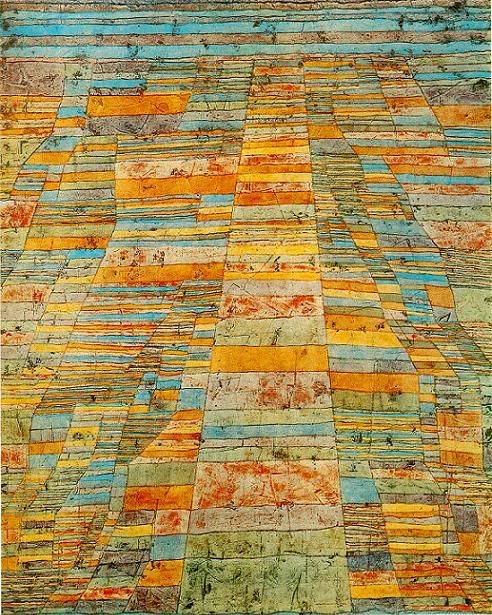
Paul Klee
"Highways and Byways"
1929
Oil on canvas
32 5/8 x 26 3/8 inches


Contemplating the disparity between Klee's stated intention and the general reaction of his viewers, I recalled something that I wrote in the comments section of a recent post.
"Art is subjective...and I feel that a viewer's experience and interpretation of an artwork is as informative and vital as the intention and creation of the artist. It's a conversation."
In short, the viewer plays a substantiative role in the life of an artwork.

Does this mean that Klee was wrong to assert his mystical motivation in the face of popular resistance? Not necessarily. Many artists sense Klee's profound striving. Undoubtedly, Klee would have approved of Bridget Riley's assessment of his paintings as "the process of things coming into being" and, in my art taxonomy, he is more closely related to the mythically-inclined Mark Rothko than he is to the playful Alex Calder.

Nevertheless, the popular response to Klee's work can not be overlooked. Art is a conversation and, in the dialogue generated by Klee, the perspective of artists like myself or Riley is representative of a small minority.


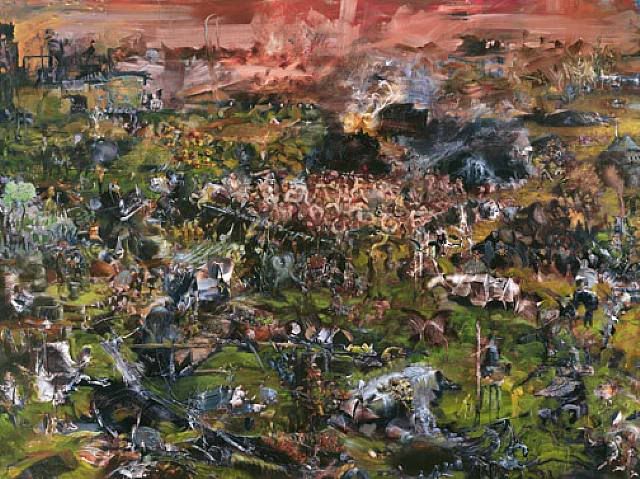
Ali Banisadr
"Target"
2008
Oil on linen
60 x 78 inches


A few months ago, I encountered the young painter Ali Banisadr's artwork for the first time. His riotous pseudo-abstractions compellingly communicate the distortions of violent conflict, yet the artist's all-over compositions also manage to effect a meditative state. Indeed, some of the works are mournfully elegiac. (His 2008 painting "Target" is perhaps the most obvious example; the picture acts as a Yantric focal point despite being dominated by a feral garden scene.)

Banisadr was born in Tehran, Iran, in 1976. His family lived in the city during the Iran-Iraq War and he states that "vivid memories of the bombings that...regularly occurred throughout his childhood" are a principal inspiration for the recent paintings. Banisadr's 2008 solo exhibition at Leslie Tonkonow Gallery received critical praise in a number of outlets, including The Brooklyn Rail, The New York Times, and jameswagner.com. Reviewers usually cited the same forebears and inspirations that the artist lists in the exhibition catalog.
"I want the viewers of my paintings to see history and human behavior at a macro level, by combining a great variety of influences that you can see close-up. Bosch, Brueghel, Persian minatures, memories, literature, history - I want to combine all of these things in my work. When you put all of this in the pot and stir, you create your own mythology."
Indeed, Banisadr combines these ingredients to excellent effect. Looking at the paintings, Banisadr's indebtedness to and admiration for the Dutch masters is immediately apparent, but so, too, is a great heave of ideological love and madness.

But one of Banisadr's paintings provoked an unexpectedly powerful association in this viewer, one that I'm sure Banisadr did not intend to stir into his eclectic pot. I'm fortunate to have neither fought in nor lived in the midst of war. Yet having grown up in the American South, I still identify the American Civil War as "my family's war." That association may seem disingenuous - the war was fought 150 years ago - but my homeground is marked by that terrible conflict in a way that the rest of the country is not. Gravestones in the small cemetery in the front yard of my childhood home speak to the pride Southerners had in their cause. Stonewall Jackson Kellam is among the dead buried in that cemetery. Kellam was a five-month-old baby when he died on October 3, 1868, just a few years after the close of the Civil War. His name honored Thomas "Stonewall" Jackson, the prominent Confederate general.

The Civil War colors Southern identity, and I am not immune. Although my paternal great-grandparents were a Hungarian Jew and Catholic seeking refuge and opportunity in Brooklyn, New York, the other seven branches of my family tree have deep roots in the United States, mostly Scots and Brits who immigrated in the 1600s. At least two of my great-great-grandfathers fought in the Civil War (one for the Confederacy, one for the Union), along with several of their brothers, and the records of their service are rather stirring. My great-great-grandfather Wesley Mayes Dance was fatally wounded several hundred yards away from the site of the "Crater" at Petersburg, Virginia. Wesley fought with The South of Dan Rebels, one of two Virginia regiments that held the Union advance at Petersburg until Southern reinforcements arrived. With bitter pride, I consider the fact that he and his fellow Confederates sealed the defeat of the Union attack on that day, thereby prolonging the war for many months.


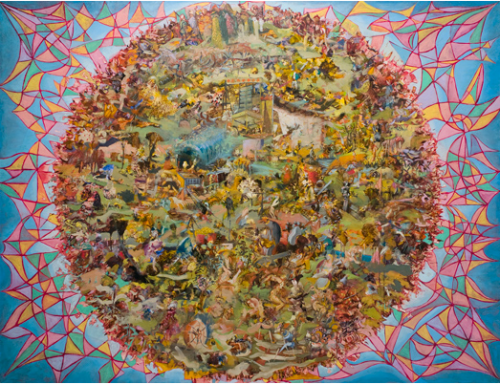
Ali Banisadr
"Amen"
2008
Oil on linen
50 x 66 inches


I don't often think about the Civil War, or even about my Southern identity, but in Leslie Tonkonow's gallery space, Ali Banisadr's painting "Amen" resonated for me, above all, as a picture of that history. I conceived of Banisadr's picture as a depiction of the Battle of Chancellorsville, one of the bloodiest, most frenzied contests in the war. The painting hums with electric life, yet is also a sad testament to our darker inclinations. I responded to the work with unsettling emotion; taking it in, my eyes stung with restrained tears.

As I departed the gallery, it occurred to me that I would be unable to write about the exhibition without raising my Civil War associations. I worried that this was too personal an experience to discuss, too private an interpretation to inform Banisadr's paintings for readers. If the artist didn't intend his paintings to conjure up Chancellorsville, how could I, in good faith, write about storied recollections of my great-great-grandfathers?

But as Proust reminds us, "in reality, every reader is, while he is reading, the reader of his own self." Artworks compel every viewer differently. More vitally, each individual comprehension of the artwork completes the piece anew. Klee's mystical intentions and Banisadr's Iranian memories are only part of the exchange. Art is, after all, a conversation, and a deeply satisfying one at that.

Image credits: Paul Klee reproductions ripped from Peplum and WebMuseum; Ali Banisadr reproductions ripped from artnet and Joann Kim's UpDownAcross

Thursday, December 07, 2006

The Whiteness of the Whale

"Is it that by its indefiniteness it shadows forth the heartless voids and immensities of the universe, and thus stabs us from behind with the thought of annihilation, when beholding the white depths of the milky way? Or is it, that as in essence whiteness is not so much a color as the visible absence of color; and at the same time the concrete of all colors; is it for these reasons that there is such a dumb blankness, full of meaning, in a wide landscape of snows- a colorless, all-color of atheism from which we shrink?...And of all these things the Albino whale was the symbol. Wonder ye then at the fiery hunt?

- Herman Melville, Moby-Dick
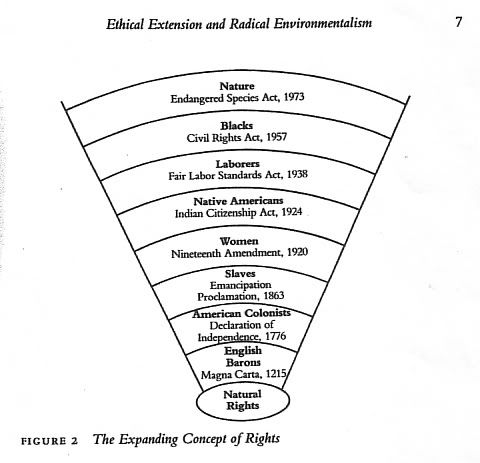
In a post entitled, "The Expanding Ethical Embrace" (March 2005), I expressed skepticism regarding Peter Joost's argument that humanity will adopt a moral code that grants other mammals, birds, reptiles, and even, eventually, bacteria, the same natural rights that we now reserve for ourselves (supposedly irrespective of race, sex, sexuality, or religion). I did not doubt the plausibility of Joost's prediction, but rather his assertion that this ethical evolution portended only happy returns. I wondered, if humans were to transcend the cruel machinations of biological determinism, wouldn't we, in effect, be killing ourselves with kindness? In Joost's neo-Eden, the human population would explode; the increased resource demands would inevitably lead to collapse (that is, if we didn't first find it in our reptilian spines to loathe "the other" as passionately as we have for time immemorial). Attractive though Joost's notion was, I remained ambivalent about the prospect.


Joost's prediction was recently called to mind when, reading Grist, an online environmental news journal, I stumbled upon a provocatively titled Gristmill thread initiated by Jason Scorse.  Many challenging questions are advanced in the dialogue generated by Scorse's "So, environmentalists support whaling?" Notable among them are:
- Is an environmentalist morally obligated to support animal rights?

- Are regulated, luxury hunts that fund conservation projects ethically or morally defensible?

- Are free enterprise and sustainable development mutually exclusive?

- Should the conservation and preservation camps be distinct from one another, promoting different agendas, or should they work together toward a compromised, common goal?
Scorse's answers to the above questions are 'Yes,' 'No,' 'Yes,' and 'Yes/No,' respectively. Yet any approximation of a complete answer to these questions requires some degree of ambiguity, and even contradiction.  Normally I find contradiction and ambivalence agreeable, because they edge closer to objective "truth" than any ideology might; in matters of environmental policy, however, the grey areas trouble me. Apparently, they trouble Scorse, too, as he jettisons nuance in favor of ideological certainty. Prompted to choose between ideology and reasonable pragmatism, I'm tempted to follow Scorse up the moral high road; the ideological path appears straight and true. But while moral certitude, the black hat/white hat conception of life and thought, is the path favored by activists and fundamentalists, I am made uncomfortable by it, particularly when it informs legislation.

Reasonable pragmatism, the preferred approach of post-Enlightenment thought, has its own problems, however. As Benjamin Franklin wrote of his vegetarian experiment(1), "so convenient a thing it is to be a reasonable creature, since it enables one to find or make a reason for everything one has a mind to do." Franklin's observation at once celebrates and skewers reason, revealing it to be a wholly relative enterprise. This chink in reason's armor is worrisome.

So what will it be? Are the complications and sacrifices of reasoned compromise better or more effective than ideology? Or do we have clearly defined "good guys" and "bad guys"?

Craig Nelson's recent biography of Thomas Paine serves as my subway reading these days, and I find the following observation relevant.
"Beginning with Franklin and Washington, every successful American leader would balance the pragmatic with the Utopian.  Where Franklin the master politician would be almost entirely pragmatic, Paine would be too fervidly Utopian in ways that would not just damage him financially, but imperil him physically... Paine would...always be too ardent with his religion of the lights, a Savonarola of reason and liberty, and as inept a political operator as any fervid Christian saint...The success or failure of any leader in U.S. history can be judged through his of her successes or failures at reaching the pragmatic Utopian paradox that remains at the heart of the American experiment."
Nelson's words ring true.  "The pragmatic Utopian paradox" is not uniquely American, but it is central to the American experience.  For confirmation, we need look no further than the glut of contemporary, progressive American politicians striving to develop a decidedly centrist track record, even as they contradict themselves (and their conscience) in doing so.  By contrast, it's easy to discard compromise and contradiction if you are a committed revolutionary, an individual willing to die for your cause, or a monkish loner operating in an intellectual/philosophical vacuum, as did Theodore Kaczynski.  Outside the D.C. beltway, ideologues are a dime a dozen, but exceptionally gifted ideological rhetoricians like Paine or King, Jr. make a sociopolitical impact only rarely.

Not surprisingly, many environmental activists are ideologues, Jason Scorse included.  To be fair, Scorse, a professor of environmental economics at the Monterey Institute, is not so much making a stump speech as he is asking a provocative question. From his "So, environmentalists support whaling?" post:
"I have tried to make what is essentially a straightforward case that environmentalism at its core is about respecting life and that separating this from our behavior towards individual living beings doesn't make much sense. Since many environmentalists reject this notion and insist that environmentalism only includes preserving biodiversity and promoting resource sustainability, this suggests that one of the defining elements of environmentalism no longer holds: an opposition to whaling...So are those who argue for the minimalist view of environmentalism willing to go on record in support of whaling and the killing of other advanced mammals?"
Money can do a lot in the way of protecting individual species and imperiled ecosystems.  Regulated hunting operations and animal farms, worldwide, generate substantial revenue, a healthy percentage of which is used to fund conservation measures.  For example, a buyer pays a tiger rancher (yes, they exist) an impressive sum - $40,000, say, sometimes much more - to obtain tiger parts for use in traditional Chinese medicines.  A substantial percentage of that price is then used for habitat preservation, conservation education, and tiger breeding programs.  It's a simple ethical equation; one animal's death results in improved species survival rates in the long-term (assuming that the habitat can be protected from the trespasses of our burgeoning human population). My short answer to Scorse's question, then, is 'Yes.' The more complete and complicated answer, though, leads down a rabbit hole of uncertainty.

To begin with, I find Scorse's moral framework - do unto your neighboring species as you would have done unto yourself - fundamentally agreeable. I'm troubled by the scalae naturae and other moral or physiological hierarchies. Because human life is, in my estimation, no more or less valuable than that of an earthworm (and, lest you mistake that statement for hyperbole, my inner ideologue assures you otherwise), the farming and killing of a tiger, no matter the result, is immoral. So, too, is the farming and killing for food of any animal species. In a truly enlightened world, then, we would witness a continued shift toward vegetarianism, sustainable consumption, and the extension of natural rights to other species. But the rate at which such values are adopted is of critical importance, and I feel Scorse is not at all pragmatic in his consideration of the real-world application of his moral imperative.  I fretted about this in the earlier post:
"From a strictly pragmatic perspective, morality is a denial of our existential [and by this I meant all species, not just human] sameness; like all other species, our principal drive is one of survival and propagation. Even our human urge to classify, as seen in the periodic table, clothing labels, and taxonomy, is a violent instinct, evolved to make us better able to ward off 'the other' and to flourish as hunter-gatherers, a lifestyle no longer suitable for our global, industrial species. [Therefore], it could be argued that [the] extension of human rights to all races, cultures, and creeds was but one more victory in our campaign to deny human nature.

But an inclusive, caring society, even if inconsistent, results in a population explosion and exaggerated life expectancies. Moreover, as our species’ requirements are increased, so are our demands on the environment. By embracing one another, we in fact make it more difficult for future generations to survive. When even more populations (in this case, other species) enter our moral and ethical peripheral vision, we will find ourselves facing a very interesting philosophical and pragmatic dilemma. Are we overloading of the circuitry?"
It seems clear that we would be "overloading of the circuitry," but there is a more immediate concern, one that does not bode well for Joost's expanding ethics: we have proven incompetent in our attempts to achieve parity among humans.

In the course of the Gristmill conversation, Scorse writes, "Thank goodness...humans aren't treated with the same level of abstract notions about 'sustainability' that you advocate that we subject every other living thing to."  Oh, but how we are! One need look no further than the morass of muddled litigation generated by today's vitriolic debates over abortion, civil rights, or assisted suicide to comprehend just how reluctant we are to treat fellow humans with the respect we reserve for ourselves and for our loved ones. As I wrote in March 2005, "one can barely imagine the ensuing cacophony when considering similar issues for sharks, birds, and turtles."

Ever since Homo sapiens adopted an agrarian lifestyle, we've been a top-down animal, a pyramid ladder of the very few haves and the countless have-nots.  I'm not altogether opposed to the felling of this pyramid in the name of populism and moral ideology (although, let's not kid ourselves punkers, anarchy ain't Utopia), but when similar tinkering and protest is extended to Nature, an entity of which we, as a species and complex-compound social beast, are but an insignificant part, we're not only risking collapse on a Mayan or Roman scale.  We're also gambling with the fate of the human species at large and, importantly, that of the many hundreds of thousands of species inextricably attached to us.  Those who herald the imminent expansion of our ethical embrace would do well to think on this.


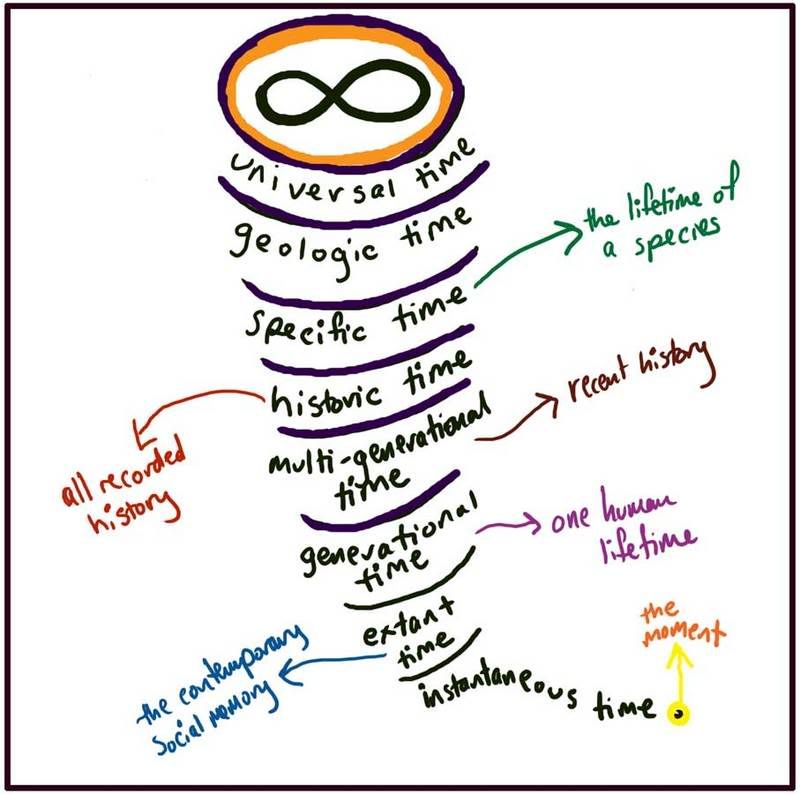
The natural algebra can not evolve apace with our ethical code. Believing this to be true, I suppose I'm something of a determinist. I don't doubt that Earth's carrying capacity will increase as we adopt more sustainable lifestyles, but such a change occurs in geologic time, not generational or historic time. E.O. Wilson, the celebrated Harvard entomologist, makes a similar, if distinct case in his landmark book, On Human Nature.
"Can the cultural evolution of higher ethical values gain a direction and momentum of its own and completely replace genetic evolution? I think not. The genes hold culture on a leash. The leash is very long, but inevitably values will be constrained in accordance with their effects on the human gene pool. The brain is a product of evolution. Human behavior - like the deepest capacities for emotional response which drive and guide it - is the circuitous technique by which human genetic material has been and will be kept intact. Morality has no other demonstrable ultimate function."
I'm inclined to agree...to a point. But what hand really holds the leash? Wilson assigns control to genes, our evolutionary chaperones. Genetics is indeed powerful, but the brain is as much a product of cultural evolution as it is physiological evolution. Therefore, I believe nurture can outpace nature at the societal level. In other words, genes have less control over moral and ethical evolution than Wilson would have us accept. In fact, it is the "eco," the greater whole - the Everything and the No-thing, from which we are inseparable - that grasps the leash. I trend toward the mystical here, but the skeptical scientists in the room can call this leashing by holistic natural law (as opposed to Wilson's evolutionary imperative).


Despite my attraction to the moralistic, and my belief that our ethical purview will inevitably expand, I must conclude that is necessary to distinguish between long-term aspiration and present policy. The American Civil Rights Movement may be portrayed as a historical artifact in high school text books, but racial prejudice and bigotry are no more history than is the Cold War. Our aims are ahead of our practice, and we should take care not to neglect incomplete cultural "mutations." Today being the anniversary of his death, take another listen to John Lennon's "Imagine." The words and images of artists are vital. Without them, our shared cultural imagination (or our memes) would be starved, but we shouldn't ride the moral high horse if it means we won't reach our destination. This is the critical distinction between morality and ethics.

Progress - if loosely defined as our stumbling effort toward the betterment of humanity and the world we belong to - is best served by pragmatic rationalism and a conservative code of ethics. As my father stressed to me from a young age, good economics - literally translated, "management of the household" - begins with good ecology - "study of the household." A promising future awaits humanity if we are imaginative enough to forge our ethics from the moral, the aesthetic, the ecological, and the pragmatic.

Turning to Bill Cronon's writing, as I so often do, and did when considering these ideas before:
"The choice we face is not to leave no marks – that is impossible – but rather to decide what kinds of marks we wish to leave."
So to Jason Scorse, and all ideologues: my heart is with you, but things simply aren't so clear as might like them to be.

Image credits: Ahab illustration by Sam Weber; ethics diagrams from Peter Joost's March 2005 New York Historical Society lecture; timeline diagram by Hungry Hyaena

(1) Franklin abandoned the diet eventually, as the smell of cooked seafoods, particularly fish, proved too much for his dietary resolve. No problem, though, as he was able to use reason to account for why fish were a viable exception!

Tuesday, June 28, 2005

Absolutely Relative


“In his homily to his fellow-cardinals, on the first morning of their conclave, Cardinal Ratzinger had warned that modern society was threatened by a 'dictatorship of relativism.' But it might have been more accurate to say that it is threatened by a dictatorship of absolutisms, including his own. This is a world in the tightening grip of orthodoxy, of literal ‘truths’ and crusading certainties…”
-Jane Kramer, “Holy Orders” (The New Yorker, May 2, 2005
Though Kramer turns a nice phrase in her Talk of the Town piece, her conclusions are too neat. While it's true that the Bush administration is comprised of a veritable Who’s Who of moral absolutists and that the conservative evangelical crusade embraces relative absolutism (i.e., the execution of criminals is morally sanctioned, whereas the abortion of unwanted babies is not), the western world at large is dominated by relativism, not absolutism.

Post-modern thought, the dominant intellectual force in our time, is grounded in relativism. Relativism, of course, can be a very positive thing, allowing for empathy and more complex analysis. As Jean-Paul Sartre argued, relativism grants an individual the moral perspective needed to pass judgment fairly.

Unfortunately, relativism has a dark side, too. Although it's good that a majority of today's youth is more willing than their parents to acknowledge complexity, their doing so often results in feelings of insignificance, even irrelevancy. These feelings engender apathy. How much easier is it to play video games than to design them? Moreover, how much easier is it to design video games than to face the challenging questions of the day? Celebrity and wealth are considered prerequisites for relevance; both are hard to come by, so why should we give a shit? Why shouldn’t we put all our stock into American Idol tryouts and the spread of corporate capital? Such questions are ultimately unanswerable if examined through a post-modern lens.

Apathy outfits the populace with blinders. A woeful lack of popular engagement in politics means that politicians have an easier time passing suspect legislation, legislation that drains the disenfranchised of their funds, opportunities and real estate. Compounding matters, the marketing machine has an easier time selling snake oil, stripping bare the already shallow pockets of the majority. It's a familiar scenario; our political and financial systems continue to bleed those who don’t care to involve themselves. Of late, the bleeding has become a hemorrhage.

I’m simplifying the equation; there are a great many variables that should be considered. Yet I can not disagree with Pope Benedict XVI. Modern society is in danger of becoming feudal and “the dictatorship of relativism” has much blood on its hands. So what is to be done? Can we marry some degree of absolutism with relativism?

Photo credit: uncredited

Tuesday, May 10, 2005

Atheists, Naturalists, and Fundamentalists

This last week, I received a number of angry emails from religious fundamentalists. The writers of these notes were responding to some comments that I made on a conservation listserv. In my opinion, my comments were neither incendiary nor dismissive; in fact, alongside some of what I've written about religious literalists and the Christian right on this blog, the listserv remarks were tame. Happily, I also received a thoughtful letter from a devout Christian woman. The first selection below is taken from my response her email.
“Though I do label myself an atheist, my belief requires as much faith as that of a devout Christian, Muslim, or Jew. After all, what ‘proof’ do we have that there is NOT a God? I can think of nothing definitive. Agnosticism is the more honest choice, perhaps, as it resides in the question, more comfortable with uncertainty and contradiction. I considered myself agnostic for many years and my transition from agnosticism to atheism was in part the result of external pressures. The more ‘religious’ our country became, the more I felt the need to reside at the furthest pole in order to maintain balance. Is this irrational? Perhaps. More importantly, though, I believe there is no “higher power,” at least in the sovereign, interventionist sense – we are but a piece of the weave of universal energy, of the Over-soul – and, no matter how much I prefer questions to answers, this meant I could no longer consider myself agnostic.

I respect all three of the "sibling" religions for the core values and ethics each espouses; the overlaps and base similarities are obvious and numerous: Judaism spawned Christianity spawned Islam. Fundamentalism of any stripe, though, is untenable and given our contemporary global connectivity, that much more volatile. I do not mean to tread on Christianity at large when I rant about the growing influence of the far-right, evangelical community on US policy, but their words make the hairs of any sensible citizen stand at attention.

The text below is drawn from the National Association of Evangelicals' recent document, ‘For the Health of the Nations: An Evangelical Call to Civic Responsibility.’
’We make up fully one quarter of all voters in the most powerful nation in history...Disengagement is not an option...To restrict our stewardship to the private sphere would be to deny an important part of His dominion and to functionally abandon it to the Evil One. To restrict our political concerns to matters that touch only on the private and the domestic spheres is to deny the all-encompassing Lordship of Jesus.’
Little surprise then that this group, 30 million+ strong, vehemently supports Bush, Cheney, Delay and company. The agenda of the Rapturists has landed in the White House. Whereas once many powerful figures in the Republican party were vocal proponents of the conservation cause, now we see a partisan push for environmental action coming only from the Left (with a few notable exceptions, such as John McCain, US Senator, Arizona). I find this distressing and unfortunate.

I believe our greatest hope for environmental sustainability comes from a move toward social democracy, but I remain unsure whether such a system can work in a country as sprawling and asphalt-addicted as our own. Regardless, wildlife corridors, refuges, and reserves stand little chance when the powerful lobbyists emerging from Colorado Springs, the ‘training ground’ for God's ‘warriors,’ ‘harness the forces of free-market capitalism.’ As the celebrity evangelical Pastor Ted states,
‘I teach a strong ideology of the use of power of military might, as a public service...the Bible's bloody. There's a lot about Blood. Globalization is merely a vehicle for the spread of Christianity.’
Or, as one attendee of the New Life Church in Colorado Springs describes the recent tsunami in Indonesia, ‘[I'm] psyched about what God is doing with his ocean.’ (Psyched? Give me ten minutes in a parking lot and I'll show you how psyched I am about what God is doing with my fists.)

I also wish that the ‘Taliban wannabes’ would mind their own business, but their ranks are steadily growing. Whereas two years ago, I dismissed the articles and essays that warned of a coming ‘Christian conflict,’ I now am increasingly convinced that this country faces very difficult times. The twin burdens of racism and fundamentalism will prove substantial hurdles in the early 21st century, distracting us from more pressing matters of economy and environment. I just turned 27 and I feel as though I should still be idealistic and optimistic; instead, I am increasingly anxious. I have to hope that a minority of the evangelicals will interpret the scripture correctly, realizing that God called on us all to be good stewards; some evangelicals are, in fact, arguing for thoughtful environmental policy. Let us hope they are able to influence their leaders and let us hope that their leaders may find some use for sound science. After all, science gave them the radio and where would the contemporary evangelical be without the airwaves?”
My response was shared on the listserv. Afterwards, I received a more friendly response. Interestingly, I learned that the term “fundamentalist” is considered a positive label by many contemporary Christians. "Evangelicals” are the new “fundamentalists,” evidently, although some of the angry folks who emailed me are bad news no matter what they call themselves! Still, I'm bothered by the relativism of some American Christians. If an Islamic fundamentalist is thought of as a baddie, why then should a Christian fundamentalist be deemed a goodie? Oh, wait, I forgot…our nation's leaders are trying to start a Holy War.

I also received a short note from a biologist working in the southwest United States. I’ve had several exchanges with this gentleman and I have come to respect his opinions on a range of conservation issues. I very much like what he has to say about faith, and I include his note below.
“I understand your statement on positioning yourself towards the atheistic pole. I do the same.

For a while I preferred to call myself a ‘provisional atheist’ in the same sense that I'm a ‘provisional Darwinian’ ... unless and until new evidence comes along to make me change my philosophy, this is what I accept.

However, I decided that the term ‘atheist’, although not as evil a word as some theists would like to paint it, just didn't cut it for me. ‘Atheist’ says what one DOESN'T believe, but it doesn't say much about what one DOES believe. It's a negative response to another's position, not an affirmative statement of one's own position ... like calling myself a ‘non-conservative’ when I am unapologetically a liberal.

Nowadays, I prefer the term ‘naturalist’ (in the philosophical sense, although as a biologist I'm also a naturalist in the conventional sense). Naturalist simply says I accept the worldview of naturalism, that everything in the universe can be (or potentially can be) understood and explained by natural laws and processes.”
I may have to start calling myself a Naturalist!