Showing posts with label death. Show all posts

Wednesday, September 18, 2013

Snapshots From Home Ground Chapbook

Snapshots From Home Ground Chapbook, 2013

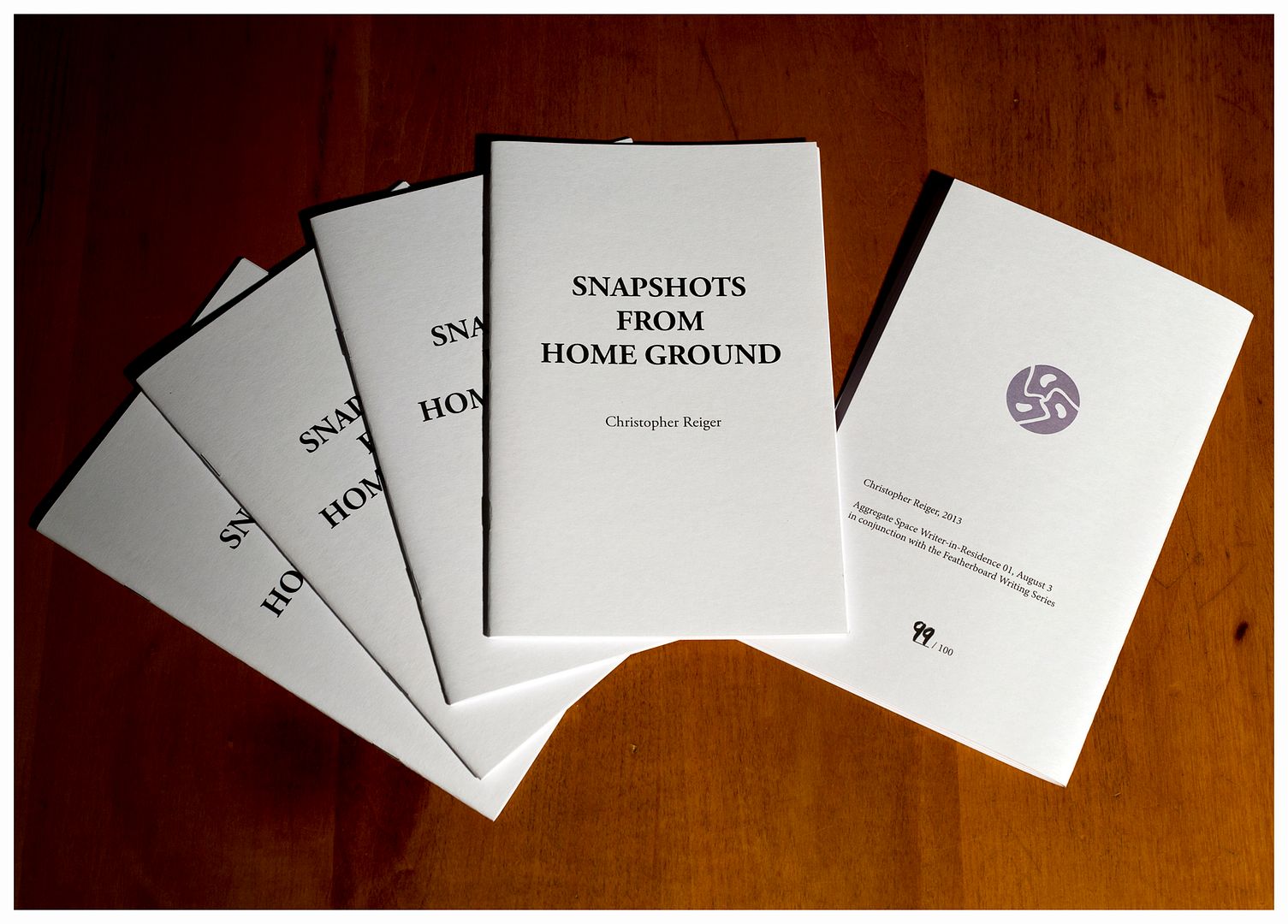
Snapshots From Home Ground, the limited edition chapbook I produced in conjunction with the Aggregate Space Writer-in-Residence and Featherboard Writing Series, was released in early August 2013. A meditation on my rural upbringing on the Eastern Shore of Virginia, the book is comprised of eight vignettes and a selection of photographs taken by either me or my father.

Copies are available through both Aggregate Space and Featherboard. (I also plan to release a free e-chapbook version later this year.)

Below, I've published "Good Boy," the chapbook's opening sketch, and also include a number of "snapshots" of book spreads.

Tuesday, June 11, 2013

Aggregate Space Summer Writer-In-Residence

Miscellaneous chapbooks

I'm delighted to announce that I'll be the Aggregate Space Writer-In-Residence this summer. I'm honored to be the first participant in the artist-run space's new program and I'm looking forward to my time in West Oakland! (For readers unfamiliar with Aggregate Space, I recommend reading Kelly Inouye's interview with Conrad Meyers II and SD Willis in SFAQ. As Inoyue writes, Meyers and Willis "basically created a gallery, artist studios, metal and wood fabrication shop, small theater, and office space out of an empty warehouse.")

Wednesday, July 25, 2012

Platte Clove Residency: Some Remove

Plattekill Falls; Platte Clove Nature Preserve;
Catskills; NY; July 2012
On the first afternoon of my residency at Platte Clove, after settling into the cabin and familiarizing myself with local trail maps, I decided to explore a short path that begins a few steps from the cabin's porch and winds its way down one of the valley's uppermost gorges to Plattekill Falls. It was a lovely reintroduction to the Catskills. Late afternoon sunlight filtered through the mixed forest's overstory, unevenly illuminating a floor decorated with eastern hemlock cones. Hidden from view in the canopy above, red-eyed vireos ceaselessly repeated their lilting questions.

Thursday, October 13, 2011

ROA's Ark


ROA
2010
East Village, New York City

I admire skillful street art, but I rarely feel compelled to photograph it. In early 2010, however, when I came upon the starling mural pictured above, I immediately reached for my camera. At the time, I didn't know anything about the artist; months later, I recognized the muralist's hand in an image I came across online. ROA, a Belgian artist whose animals adorn structures on four continents, is a rising star among street art aficionados.


ROA
2010
London, England

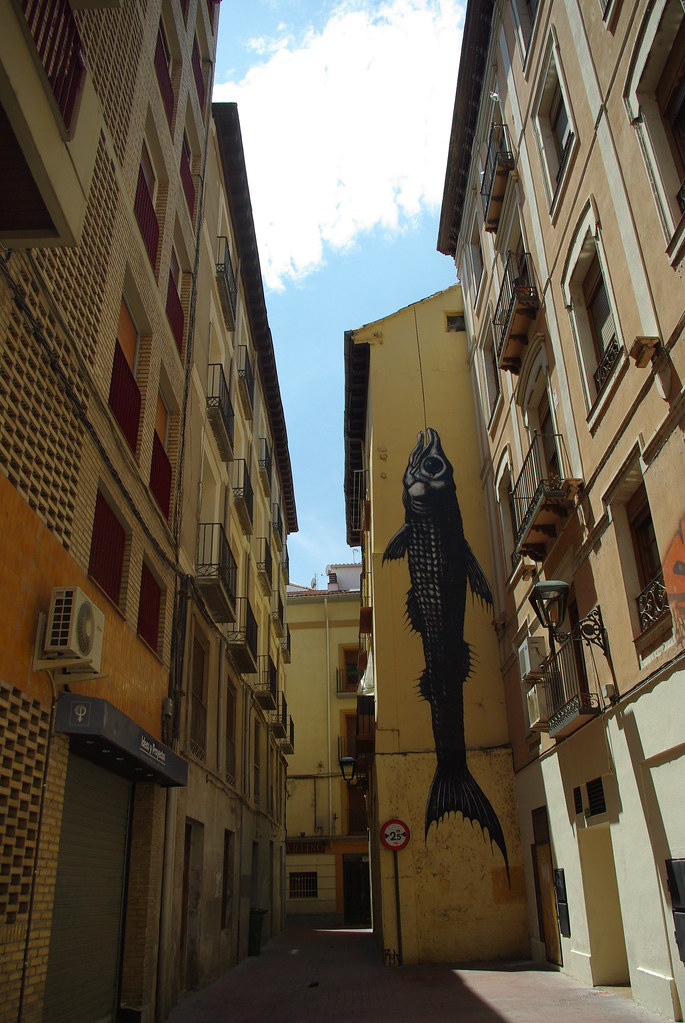
Admittedly, my love of natural history and enthusiasm for animal imagery predispose me to ROA fandom, but the artist's bold, black-and-white technique is distinct and compelling, and most of his mural projects exhibit a clever site-specificity. This attention to location is most often compositional -- for example, the neck of a Limpkin-like bird passes between two windows on a building in Brooklyn, New York, with the bird's body below and the head above -- but ROA's strongest pieces are also conceptually playful: in Ancona, Italy, he painted a disheveled cormorant, a type of water bird, on the side of a large boat; elsewhere, a mole emerges from a pile of bricks; and a desiccated fish is painted on the side of a trailer near California's Salton Sea, a large salt lake in which most fish species are unable to survive. An enthusiastic amateur naturalist, I appreciate the context-appropriate nature of these works.


ROA
2010
Zaragoza, Spain

Unfortunately, ROA doesn't always paint his creatures in or near their natural habitat. I love his giant anteater, pictured trotting along the side of a single-story building in the Mexican state of Guanajuato, but I wonder if the artist realizes that the species is extirpated north of Honduras. Still, because giant anteater fossils have been found in northern Mexico, let's give the artist the benefit of the doubt and interpret this piece as an observation about ecological change. A stylized blue whale rising from a sea of grass outside an abandoned factory in Moscow, Russia, however, is too far from an ocean to be rationalized. Its incongruity is amusing and the image is beautifully crafted, but the piece lacks the impact of ROA's more considerate efforts. No worries. ROA's terrific Virginia opossum in downtown Los Angeles, its prehensile tail wrapped around a stretch of the building's brickwork, more than makes up for the misplaced whale!

While my fondness for natural history makes me an unusually nit-picky viewer, it also means that I'm especially excited by the urban and exurban placement of ROA's rats, squirrels, starlings, herons, raccoons, cormorants, and skunks. These animals are hardy and adaptable, and have proven able to thrive in ecosystems dominated by human habitation. Many people dismiss these creatures as pests, but their presence in our lives is of significant value. As we become an evermore urban species, they are our most immediate connection to the undomesticated, non-human world. In this respect, ROA's murals are portraits of our closest neighbors.


ROA
From the "NUART Landmark Series"
2010
Stavanger, Norway

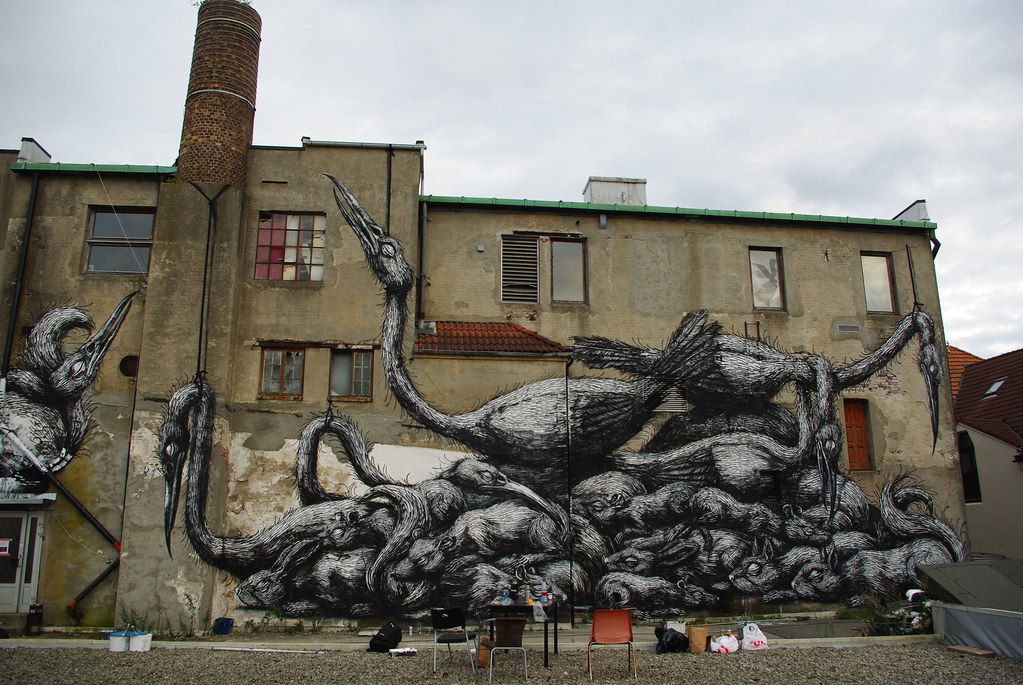
Some of ROA's more elaborate murals depict great piles of dead animals. These call to mind the tables laden with rotting fruit, hunted game, and skulls that appear in many 15th century Northern European vanitas ("emptiness"), memento mori ("remember your mortality"), and ars moriendi ("art of dying") still life paintings. As their names suggest, all of these allegorical works were created as nods to death's inevitability. It seems these themes preoccupy ROA, too. One of his best memento mori works is located in Stavanger, Norway. Lifeless squirrels, rats, rabbits, and herons are heaped at the foot of an old warehouse, with the limp necks of the herons apparently tied to cords on the wall's face (should we call this reverse trompe l'oeil?) In Mexico City, ROA adds a raccoon, armadillo, and skunk.


ROA
2011
Mexico City, Mexico

These murals will seem grotesque and bleak to some viewers, but they aim to inspire by reminding us that life is transitory. The sentiment was expressed well by Steve Jobs during his 2005 Stanford University commencement address, a speech that, in the wake of Jobs' untimely death from cancer, has been making Internet rounds. Jobs said,
"Remembering that I'll be dead soon is the most important tool I've ever encountered to help me make the big choices in life. Because almost everything — all external expectations, all pride, all fear of embarrassment or failure - these things just fall away in the face of death, leaving only what is truly important. Remembering that you are going to die is the best way I know to avoid the trap of thinking you have something to lose."
In many respects, ROA's works are the less refined kin of Walton Ford's paintings. Both artists address mortality and the relationship of humanity to other animal species with humor and finesse, but ROA's pictures are less layered with art historical and natural history references; as a result, they're more accessible and immediately gratifying.

Based on the images he shares on his Flickr photostream, the talented 30-something has at least five murals in San Francisco. Let's hope that he returns to the Bay Area and contributes more of his handiwork to our landscape.

Sunday, September 26, 2010

Update: Jane Hammond's "Fallen"


Jane Hammond
"Fallen"
2010
Dimensions variable

In January 2006, I wrote a short post about Jane Hammond's mixed-media, evolving sculpture "Fallen," a melancholy and beautiful tribute to the lives lost during the (now sort-of-but-not-really-over) Iraq War.

When it was exhibited in 2005, the work consisted of 1,500 paper leaves, each meticulously crafted by the artist and inscribed with the name of an American soldier who met his or her end during the invasion or occupation of Iraq. At the time of my post, I wondered if Hammond had continued to add leaves to the work.

A couple of weeks ago, four-and-a-half years after I wrote about "Fallen," the artist sent me an email telling me more about the life of the sculpture. I share the bulk of her update below, along with some images of the piece as it was in 2005 (below) and as it looks more recently (above, and detail below).
"I make the leaves by hand and each is based on a real leaf which I gather and digitally scan, then there is cutting, hand-painting, a little fiberglassing and more hand-painting, then they are signed by me with sumi ink and a brush pen and molded into a three-dimensional form.

[...A]ll the leaves in the piece you saw at Lelong were from upstate Connecticut, gathered in the Fall of 2004—I have now gathered leaves in Hawaii. Washington State, California, Colorado, Texas, Arkansas, Missouri, Michigan, Mississippi, Alabama, Virginia, Maryland, Massachussetts, Vermont, New Hampshire, Maine and Rhode Island. And adding to the original group from 2004, I have gathered in the Autumns of 2005, 2006, 2007, 2008, 2009. And I am sure I will gather some in 2010 this Fall.

[...]This Fall, ["Fallen"] will [...] be shown at the Taubman Museum in Roanoke, Virginia from September 23rd until January 10th, 2011. It will open with 4,390 leaves."

Jane Hammond
"Fallen" detail
2010
Dimensions variable

Sadly, she does have more leaves yet to add.


Jane Hammond
"Fallen"
2005
Dimensions variable


Image credits: courtesy Jane Hammond

Sunday, May 16, 2010

Susan Silas' Heroic Living


Susan Silas
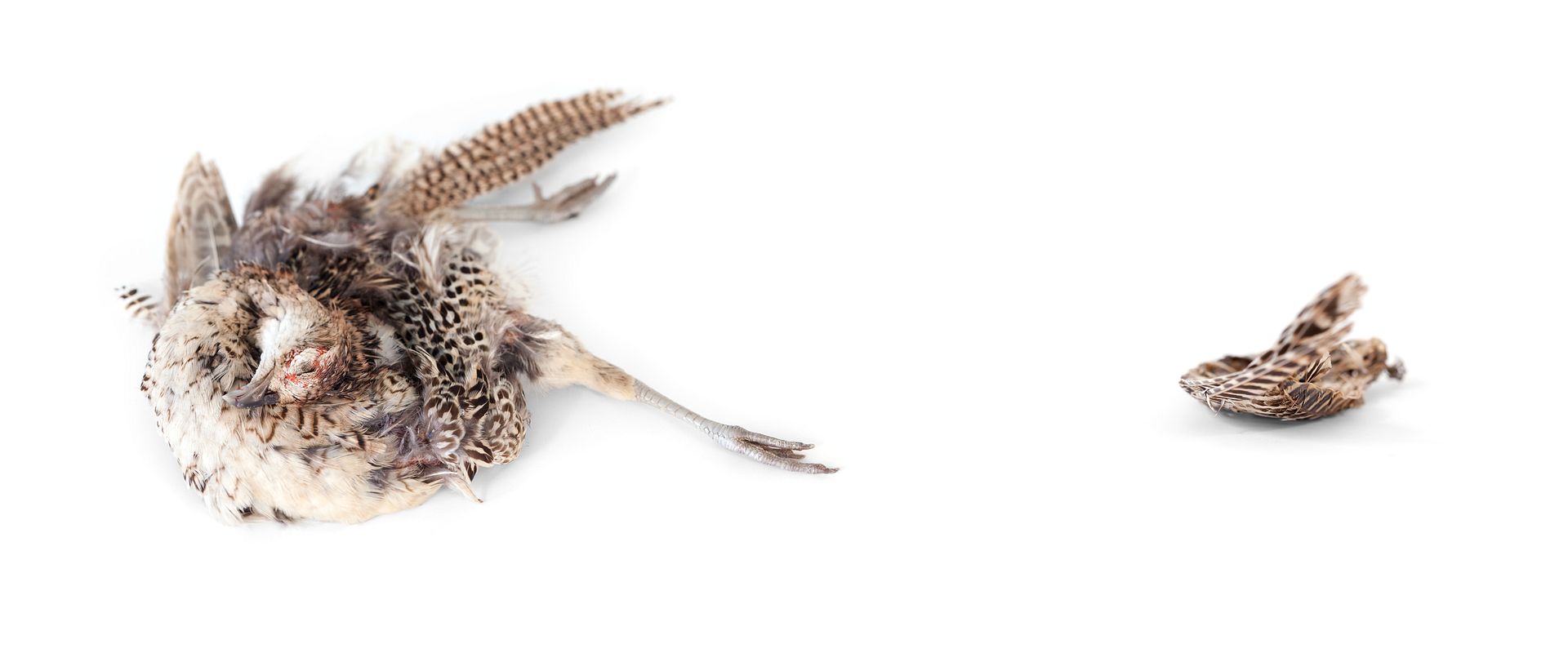
"found birds; 2000 - the present"
(Image 17 of 23 from the portfolio "eyes wide shut")
2010
Archival ink jet prints on Hahnemühle photo rag paper
22 x 17 inches

Until recently, I was unfamiliar with Susan Silas' artwork. She is perhaps best known for projects memorializing the Shoah, but it wasn't an awareness of her Holocaust work that led me to "Helmbrecht's Walk, 1998-2003." Instead, it was a photograph of a dead American kestrel that Silas emailed me in March.

I have only an inkling of what essay or artwork of mine inspired the artist to send me the image, but I'm grateful that she did. I shamelessly admit to being the sort who finds soulful beauty in images of death, and I was touched by the striking and contemplative photograph. A month after I received the picture, I visited Silas in her Brooklyn home, to look at prints from her "found birds" series. Still pondering her work a week after that visit, I headed to Hebrew Union College's Jewish Institute of Religion Museum, eager to compare what I saw and sensed in "found birds" to Susan's more easily classifiable (though by no means "easy") Shoah work.


Susan Silas
"found birds; 2000 - the present"
(Image 3 of 11 from the portfolio "what remains")
2010
Archival ink jet prints on Hahnemühle photo rag paper
20 x 48 inches

The HUC press release for "Helmbrecht's Walk" describes the project succinctly.
"On April 13, 1945, more than 700 women were forced to march 225 miles in 22 days from the Helmbrecht's Labor Camp, a small satellite unit of the Flossenburg Concentration Camp in Germany, to the Czech city of Volary. [...] During the course of this forced march the women were ill fed, inadequately clothed, denied shelter, and capriciously beaten. On the sixth day of the march, the non-Jewish prisoners were separated from the group, leaving the remaining 580 Jewish women to continue until May of 1945.

With determination and sensitivity, Silas traced the march in 1998 on the 53rd anniversary of the event by walking along the same path as the Helmbrecht's women for 22 days in Germany and the Czech Republic. She documented her journey in Helmbrecht's Walk, a collection of 48 archival color prints presented as an unbound book. [...] The images contextualized by Silas' daily commentary of her own experiences are coupled with news reports of event occurring elsewhere in the world on that same day in 1998. This juxtaposition, she says, functions 'to heighten our awareness of the fact that we are all presently witnesses to unspeakable events and extreme suffering for which we take no more responsibility than did many witnesses to the Holocaust.'"
Silas' project addresses the complicated relationship between place and time or, as cultural critic and historian Simon Schama's consideration of the topic framed it, "landscape and memory." When Silas conceived of the Helmbrecht's project, she believed (or maybe hoped) that walking the same path that the Helmbrecht's women had would allow her some intimate experience of or insight into the terrible march. In fact, this didn't prove so. Silas describes her walk as "relatively mundane and unexceptional." She continues, "My feet hurt. I get tired. [...] I found it more, rather than less difficult to understand how these women made this journey once I was out on the road."


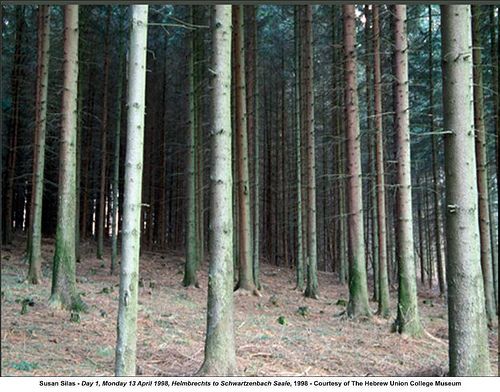
Susan Silas
"Helmbrecht's Walk, 1998 - 2003"
(Day 1, Monday 13 April 1998, Helmbrechts to Schwartzenbach Saale, 1998)
Archival ink jet prints on Hahnemühle photo rag paper

Yet many of the captions she includes with the photographs reference artists and thinkers such as Werner Herzog, who understand "walking as a sacrament." Such language calls to mind the Australian Aborigines' songlines, mnemonic stories that are spoken or sung as the Aborigine walks over the referenced terrain. In his marvelous book Spell of the Sensuous, David Abram relates a striking, relevant anecdote.
"A similar tale is told by [Bruce] Chatwin. He was traveling in a Land Cruiser with several friends, including an Aboriginal man nicknamed Limpy whom they were driving to a particular place on his songline. Limpy, whose clan Ancestor was the Native Cat, or tjipla (a small marsupial with a long, banded tail), had never been to this place along the Native Cat songline, yet he now wished to go there in order to see some distant relatives who were dying there. During the course of seven hours driving through the back country, bumping across shallow rivers and under gum trees, the Aboriginal man sat motionless in the front seat, squeezed between the driver, Arkady, and another passenger, except for a short burst of action when the truck crossed part of his songline. Later,
'[w]e came to the confluence of two streams: that is, we met the stream we had crossed higher up on the main road. This lesser stream was the route of Tjilpa Men, and we were joining it at right angles. As Arkady turned the wheel to the left, Limpy bounced into action. Again he shoved his head through both windows. His eyes rolled wildly over the rocks, the cliffs, the palms, the water. His lips moved at the speed of a ventriloquist's and, though them, came a rustle: the sound of wind through branches.

Arkady knew at once what was happening. Limpy had learnt his Native Cat couplets for walking pace, at four miles an hour, and we were traveling at twenty-five. Arkady shifted into bottom gear, and we crawled along no faster than a walker. Instantly, Limpy matched his tempo to the new speed. He was smiling. His head swayed to and fro. The sound became a lovely melodious swishing; and you knew that, as far as he was concerned, he was the Native Cat.'"
I believe that what was missing for Silas was a story line, the narrative informed by the landscape (and vice versa) that, among indigenous groups such as the dwindling Aboriginal population of Australia, is traditionally passed from generation to generation. In some respects, "Helmbrecht's Walk" is an attempt to locate such a story, an earnest effort to discover in the landscape the marks of what happened decades before. In our postmodern, peripatetic culture, nations and traditions do not generally fare well. In some respects, this is a positive development, as our tribal perspectives and prejudices erode into some variety of tentative, liberal pluralism. On the other hand, it's ever more difficult to feel confident about one's identity and how it relates to landscape, vocation, and nation.

My time with "Helmbrecht's Walk" confirmed my supposition, however, that Susan's art is not primarily interested in cultural identity or particular histories. Instead, she is most concerned with "the big questions." To one degree or another, all art wrestles with or reacts to these existential imponderables, but Susan's exploration is more focused and urgent than most. Fortunately, even though her work is preoccupied with mortality and meaning, she manages to avoid the pitfalls of such terrain; her work is neither macabre nor aestheticized to the point of anesthetization.


Susan Silas
"found birds; 2000 - the present"
(Image 1 of 21 from the portfolio "blackbird")
2010
Archival ink jet prints on Hahnemühle photo rag paper
22 x 17 inches

Two days after I visited "Helmbrecht's Walk," I read "Eudaimonia, existentialism, and the practice of medicine," an essay by Dr. Andrew Radu included in the Spring 2010 issue of The Pharos of Alpha Omega Alpha Honor Medical Society. In his essay, Dr. Radu describes the existentialist ideal of tragic optimism. He writes of it, "even in the face of imminent death, we have the ability to reevaluate life." He goes on:
"A crucial concept held by many existentialist philosophers is that of heroic living. All humans have the ultimate freedom to live boldly in the face of tragedy. Living with this concept makes attaining a goal of eudaimonia less important than simply striving to do so. [...] The concept of tragic optimism proposes that in a life that can be circumscribed by pain, guilt, and death, one should say 'yes to life in spite of everything.'"
Indeed, as I wrote in "Eudaimonia," a January 2009 essay that explored my then nascent optimism,
"Acknowledging our species' precarious position is not defeatist; on the contrary, accepting the inevitable nourishes the individual's desire to contribute. Faced with an impossibly difficult prospect, only individual effort can sustain us. As Albert Camus concluded in The Myth of Sisyphus, 'The struggle itself is enough to fill a man's heart. One must imagine Sisyphus happy.'"
The Shoah is bleak history, a subject watered by the blood of millions, and it is fertile soil for such "big questions." Silas' "found birds" remind us that so, too, is the striving and passing of a blackbird. The artist's reckoning with death is her own form of "heroic living."

Image credits: all artwork, courtesy Susan Silas

Wednesday, September 09, 2009

Kimmel Harding Nelson Residency: Day 3


Grain Elevator; Nebraska City

Soundtrack

It's a treat to recognize voices that were once familiar enough to be taken for granted. After years of city living, my ears hunger for the soundtrack I knew in childhood.

Yesterday morning, the staccato lament of a mourning dove (Zenaida macroura) greeted me as I dressed. Later, standing beside an overgrown lot, I listened to the rasp-rattle-click of grasshoppers in the tall grass. Nearby, on the same block, the up-and-down whine of cicadas reverberated within me. At mid-day, as I explored the grassy fringes of a grain elevator operation on the western bank of the Missouri River, my progress scattered noisy grasshoppers, large and small, in every direction.

As I type this post, a male field cricket's (Gryllus pennsylvanicus) insistent plea sounds from a dark corner of the studio. I locate and playback a recording of the call on my laptop, hoping that the sound of another male suitor might draw the cricket out of the shadows for some Orthoptera fisticuffs. The aural lure fails, but I'm made happy by the attempt; the cricket cries for a mate and, with a keyboard click, I call back.

Life, I'm reminded by the persistent call of this cricket, and by the grasshoppers, the mourning dove, and the cicadas, is fleeting, yet rich and good. As Nebraska native, anthropologist, and author Loren Eiseley writes of "endlessly reiterated" frog calls,
"I suspect that to some greater ear than ours, man's optimistic pronouncements about his role and destiny may make a similar little ringing sound that travels a small way into the night."
Every creature's song is at once insignificant and grand. The middle school marching band is passing by my studio now, and the cricket and I are quiet.


Middle school marching band practice; Nebraska City

A Kettle of Vultures

Appropriately enough, as I walked past a mortuary two doors west of the KHN Center, I noticed seven turkey vultures circling low above the town. The night before, I'd read Lia Purpura's poetic essay "On Coming Back as a Buzzard" in the September/October issue of Orion. Given my dual love of natural history and language, I'm embarrassed to admit that, before reading Purpura's piece, I didn't realize that a group of vultures on the ground is called a "venue," and a group of vultures in flight is called a "kettle."

Watching the peaceful, unchoreographed aerial dance of this Nebraska City kettle, I recalled Mary Oliver's beautiful poem, "Vultures," as well as some of Purpura's essay, written from the perspective of a vulture.
"As a buzzard, I’d know the end of a thing is precisely not that. Things go on, in their way. My presence making the end a beginning, reinterpreting the idea of abundance, allowing for the ever-giving nature of Nature—I’d know these not as religious thoughts. It’s rather that, apportioned rightly, there’s always enough, more than enough. 'Nothing but gifts on this poor, poor earth,' says Milosz, who understood perfectly the resemblance between dissolve and increase. Rain scours and sun burns away excesses of form. And rain also seeds, and sun urges forth fuses of green."
"On Coming Back as a Buzzard" is a paean to reconstitution. How smart and satisfying to embrace the natural end as another corporeal beginning! I pray that my dead body will be saved from the poisonous excesses of a mortuary, that it will instead be wrapped in a simple cloth, laid in a simple wooden box, and buried without the insult of preserving chemicals and concealing makeup. I pray that the worms and the soil will consume me, will leech me and take me, so that my matter will become energy for other forms. I utter this prayer in silence as I look up at the dark birds.


Turkey vultures on roof; Harborton, VA

Elsewhere, Purpura writes,
"I'd love best the movement of stages and increments, to repeat 'this bank and shoal of time' while below me banks and shoals of a body went on welling/receding, rising and dropping. I'd be perched on a wire, waiting, ticking off not the meat reducing, but how what's left, like a dune, shifts and reconstitutes."
Even when alive, our bodies are forever in flux, forever "shift[ing] and reconstitut[ing]." After death, though, a profound reinterpretation and recycling of "self" takes place.

The biologists, writers, painters, and physicists who worship Nature are enthused by reconstitution because it is plain, profound truth. As the poet Galway Kinnell describes it in his terrific poem, "The Quick and the Dead," "the crawling of new life out of the old, which is what we have for eternity on earth."


St. Mary's Episcopal Church; Nebraska City
First Episcopal church in Nebraska; Founded 1857

But most folks, many of them good, kind people, don't share this enthusiasm for reconstitution. I presume, perhaps wrongly, that Nebraska City is home to many such individuals. On what grounds do I make this presumption? Firstly, it's a safe speculation anywhere in the world. Most humans prefer a supernatural view of afterlife. Secondly, Nebraska City is home to a good number of churches (nineteen, by my present count), and I make assumptions (sometimes wrong) about the stripe of belief held by the majority of American Christians. No doubt there are exceptions to the rule, but most of the religious Christians I know frown upon materialistic interpretations of life everlasting. Some go so far as to reject my panentheistic or panendeistic conceptions of morality and material being as heretical nonsense.

No matter; live and let die. I find the Christian notions of ascension and self-conscious afterlife ridiculous, and most Christians find my cherished reconstitution as a bit of larvae, a bit of root, a bit of this and that, grotesque and even offensive. Neither conception, though, prevents the individual from acting ethically, and that is, above all, what matters. As Purpura puts it,
"[The vulture] gets to reorder your thoughts about troves, to prove the spilled and shoveled-aside to be treasure. To reconfer notions of milk and honey, and how to approach the unbidden."
Put more explicitly, one man's materialistic mess is another man's milk and honey.

Photo credits: all photos, Hungry Hyaena, 2008, 2009

Friday, July 10, 2009

Paradise: Here and Now (and To Come)


Steinbrener/Dempf
"Trouble in Paradise"

Alan Weisman's The World Without Us is an imaginative and engaging consideration of what a "post-human" Earth might look like. The popular success of Weisman's book suggests that a great many readers are willing to entertain an End Times quite unlike that forecast by eschatological messianism.

Still, in the United States, a significant percentage of the populace (maybe even a slim majority!) insist that dinosaurs coexisted with early man and that Judgment Day will involve supernatural intervention. For the rest of us, however, Weisman's predictions are more tenable than messianic adjudication and, because we're living through what scientists now dub the Sixth Great Extinction, his vision of mass extinction is also more pertinent.


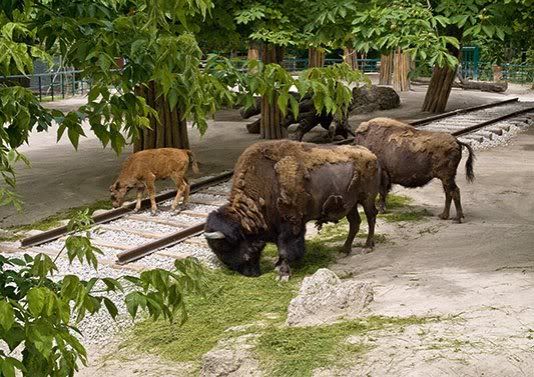
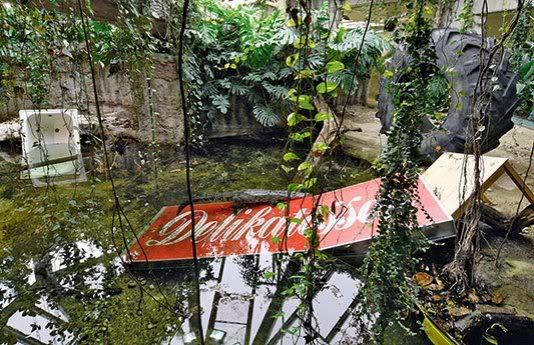
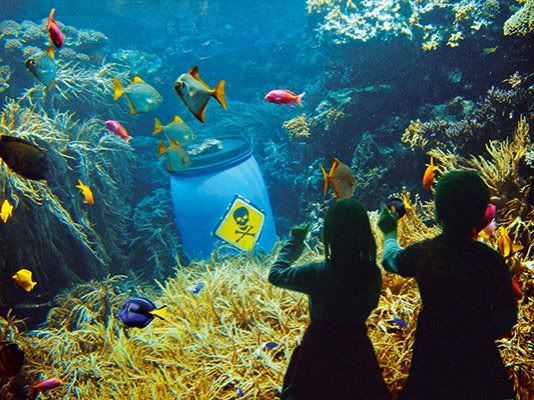
Steinbrener/Dempf
"Trouble in Paradise"

I thought of The World Without Us when viewing photographic documentation of Steinbrener/Dempf's intervention at Vienna's Schonbrunn Zoo, an institution celebrated as "the oldest zoo in the world." Not all of the installation images impress me, but a few are coolly beautiful. The best of them serve as both a celebration of life's ambivalent persistence and a critique of our romantic notions of wilderness.


Steinbrener/Dempf
"Trouble in Paradise"

Note: Thanks to RSA Arts & Ecology blog for the heads up

Monday, March 09, 2009

Revisiting reconstitution


Christopher Reiger
"Continuity"
2007
Sumi ink and watercolor on Arches paper
11 1/2 x 14 1/2 inches

In "Becoming phoebes," I described the satisfaction I feel when contemplating the giving over of contained corporeal energy to the rest of life. I dubbed this process "reconstitution" and, citing the essayist Edward Hoagland as a writer who "speaks to the magic of" this process, included an excerpt from his terrific book On Nature.

A week later, I picked up the most recent issue of Harper's Magazine and read Hoagland's essay "Curtain Calls," an inconsistent and rather bleak take on the contemporary state of things. I later debated the merits of Hoagland's rich pessimism with my father, and decided that older writers must be forgiven some of their bitter steepings; after all, it generally holds that older thinkers long for what once was and younger thinkers dream of what may be.

In any case, Hoagland again dedicated some lovely passages to the notion of reconstitution. In light of the recent, related post, I thought I should share them here.
"If this globe is the only heaven we have, I doubt the trip will be a long one. Downward into the seethe of soil and the sea, we landlubbers become marine again.

I believe in continuity through conductivity: that seething underpinnings of life's flash and filigree, its igniting chemistry, may, like fertilizer, appear temporarily dead, but spark across species like the electricity of empathy, or as though paralleling the posthumous alchemy of art.

Gazing out the window, I see nothing but motion, high and low - scudding clouds, swinging leaves, right down to the millipedes (if I step outside) seething in the soil. Death, be not proud. Plant me when I die so that I can seethe with them."

Tuesday, February 24, 2009

Becoming phoebes


Eastern phoebe (Sayornis phoebe)


The renowned naturalist, entomologist and sociobiologist Edward O. Wilson maintains that belief in the afterlife developed as a human coping mechanism, as a way for our enlarged brains to contend with mortality. He writes,
"Our conscious minds hunger for a permanent existence. If we cannot have everlasting life of the body, then absorption into some immortal whole will serve. Anything will serve, as long as it gives the individual meaning and somehow stretches into eternity that swift passage of the mind and spirit lamented by Saint Augustine as the short day of time."
Today, religious literalists look forward to Pearly gates or seventy-two virgins while most rational secularists, frightened of death's finality, strive to reject it. The first perspective is delusional, the second, incomplete; both are fearful.

Yet there is at least one sensible and beautiful conception of the afterlife, and it is not at all fearful: reconstitution. Most people find contemplation of the body's posthumous decomposition uncomfortable. But the knowledge that my corporeal substance will rot and, in doing so, release energy for use by the rest of things is deeply satisfying.

Poet Galway Kinnell describes reconstitution in his poem "The Quick and the Dead" as "the crawling of new life out of the old, which is what we have for eternity on earth." But beyond the biological, death remains a mystery.

I can not, one way or the other, speak to supernatural transference, though I feel that metaphysical notions of self or soul preservation are misguided. The "me," I think, will rot with my body, but the flow keeps on keeping on, until the end of time.

The author and essayist Edward Hoagland, the writer that inspired this blog's first post, speaks to the magic of reconstitution in his book On Nature.
"In my stint in the army, working at the hospital morgue, I'd noticed how commonly the dead had managed at the last moment a benign or temperate sort of smile. This circularity is neither alarming nor incongruous, but rather seems to make things whole and complete. In the summer, dancing butterflies of pretty colors will congregate where I've gone outside to piss in the grass. The glint of tiger yellow or cobalt blue in their beautiful wings may be enhanced by the minerals that they so crave and that my body has declared surplus. And if a nesting phoebe soon grabs one, she is going to profit also -- which is a foretaste of the myriad uses that more extensive portions of me will be put to eventually."
We are all, then, becoming phoebes, butterflies, mud and gas. I find so much joy in the thought.

Image credit: ripped from Photographs From Virginia section of Kirk Rogers' site

Thursday, September 27, 2007

A Ring-billed Gull

Sitting at my office desk this afternoon, I feel hollow.

A ring-billed gull catches my eye as it dips over the surface of the East River. Mesmerized by the bird's fluid flight, I recall a much pilloried line from the film, "American Beauty." "There's so much beauty in the world. Sometimes I feel like I'm seeing it all at once, and it's too much." Plastic bags, gulls, the little cactus sitting in my windowsill, the riot and filth of the subway platform; all of these things are extraordinary in their very ordinariness.

I learned yesterday afternoon that a friend of mine killed herself. She was a brilliant young philosopher and much sought after in her field. She was also insightful, an excellent observer and counselor of people. Not long ago, on a warm spring evening, she offered me her ear and thoughts when too many bottles of wine had me wrestling with some sad personal history.

Yesterday afternoon, just after I learned of her suicide, I fondly recalled a shared cigarette and conversation on an estuary dock. I also thought of her phobia of cameras, and my torturing her with surreptitious snapshot attempts, she half smiling, even if irritated by my childishness. I remember how fair her skin was, and her subtle smile and little girl's laugh and how I felt cheered by the sight of her curled up in a chair or at one end of a couch with a heavy-spined book and blanket for company.

Yet now there is more to think about. Sometime early Wednesday morning, unknown to so many who care deeply for her, she slipped away and drowned herself.

She was twenty-eight years old. She'd had twenty-eight years of taking in the extraordinary in the ordinary, and I just can't for the life of me understand why she didn't want at least that much more. Contemplating the 'whys' is baffling and sad.

In any case, there is her memory, but the pain she has caused for those who loved her dearly - her husband, her parents, her siblings - is difficult to fathom. I feel fucking sick.

I watch the gulls and the Roosevelt Island tram rocking gently as it carries a load of people from Manhattan.

Sunday, August 19, 2007

Routine Passing


Looking northeast from the dike rim at Heron's Foot, December 2006

"Spitz-spop, Christopher. Rise and shine." My father's familiar refrain. He opens the bedroom door and flicks on the light.

I groan and stagger from my bed to the middle of the room, where my clothes are laid out on the floor like a fallen scarecrow. Sleeves spread out to the side, an undershirt is placed on a thermal top that rests, in turn, on two sweaters and a camouflage button down. Likewise, a pair of tightie-whities rests atop long johns and a pair of camouflage pants. A pair of folded athletic socks is stacked on two heavy, woolen pair.

Absent-minded, I dress.

In the bathroom, I fight through the two undergarment layers before I can relieve myself, reminding myself that, next time, I should remember to visit the toilet before I dress. I wash my hands, splash some water on my face and decide not to brush my teeth.

Downstairs, my father is almost ready, his oatmeal and peeled banana half eaten. I pour milk on a bowl of cereal and eat quickly. Nothing is said. Outside it is still black.

On the dining room table are two shotguns, two boxes of shells (one .20 gauge and one .12), two pairs of wool gloves and two camouflage, wool face masks. My father is already in his boots when I finish my cereal. He is by the backdoor, double-checking the canvas decoy bag and his necklace of duck calls.

"All set?"

"Yes," I reply.

I carry the guns, gloves, shells and face masks to him, then slip on my own boots.

Once outside, my eyes adjust. It isn't black, not really. The moon's blueish glare reveals more than you might expect. My father and I walk in silence down the long clamshell drive, then cross quiet Seaside Road. We move through an opening in the roadside hedge that you'd overlook were it not for a solitary holly planted among the cedar and pine. A stout wooden footbridge spans a deep ditch inside. Another twenty steps and we crest the dike, moving east along the rim.

The decoys shift and bounce in their bag and the duck calls jostle on my father's chest. I can hear his breathing; his footsteps fall heavier than mine. I resent him for this.

At the dike's northeast corner we descend the left bank into the upper marsh, where a cedar tree island ekes out a life drinking brackish water. Around this island the cordgrass lays down in gentle waves. I want to stop, to remain for the morning in this spot, to shed these layers and lay like the cordgrass, to be part of the marsh, part of something not me, something greater. This is what I wanted at ten years of age.

Instead, I followed my father to the duck blind, where he put out the decoys and we awaited the morning flight. Now, almost twenty years later, I lay alongside the island most every time I visit Heron's Foot. It is a good place to lie.

Photo credit: Hungry Hyaena, 2006

Monday, January 01, 2007

Happy (warm) new year!

I'm a cold weather man. Winter days and nights possess an obscure magic that buoys my spirit and heartens my constitution. I'm particularly sensitive to this variety of dark enchantment when I'm alone in winter woods. We humans have grown complacent in our throne atop the food chain, and I enjoy my body's reaction to harsh conditions as I also appreciate occasional haunting by the specter of predation. Both are humbling, gratifying reminders of what we've come from, and of what we are.

But this winter has been unseasonably warm. As always, I traveled south to Virginia to visit my parents. The temperature on the morning of my birthday, December 29th, was 52 degrees Fahrenheit; by late afternoon, it was over 60. Yet still the talking heads on the local news speak of global warming as if it may be a fiction! Skepticism serves its purpose in science, and shouldn't be dismissed offhand, but whether we're attributing warming to human activity or to natural fluctuations, an examination of the data shows that the general trend is all too apparent.

Snow Geese Beyond Morning Trees
A flock of about 800 snows departs the estuary in search of morning food

Because of the warm temperatures, the travels of migratory species are unusual this year. Last Thanksgiving, I watched four or five thousand snow geese (Chen caerulescens) pitch into the salt water estuary alongside my parents' house. The birds arrive in last light to roost, and they depart just after dawn, moving on to feed in the fields of winter wheat.

This year, by contrast, the late December roosts were limited to one thousand birds, give or take a couple hundred. The weather is warm enough that the geese, heading south from their Arctic breeding grounds, don't need to fly so far to find food and refuge. The spectacular flocks that I watched in the fall of 2005 probably took up winter residence this year in Delaware and New Jersey, or points farther north.

+++++

Great Blue Heron Feet Bound 2
Photo of the heron's feet; monofilament already cut away

Walking my Virginia prpoerty two days before my birthday, my father and I came upon the decapitated body of a great blue heron (Ardea herodias). The beheading was likely the work of a fox or raccoon, but the predator was not responsible for the bird's death. The heron's legs and feet were knotted with monofilament fishing line. Two "toes" on the right foot were tied together. More serious was the mass of line that bound the left leg to the knot on the right foot. The bird had eked out a living by hop hunting. This is handicap enough for any animal, but, for a heron, a creature that specializes in water stalking, hopping surely cost the bird a great many meals.

Apparently this individual was tough. Just as a tree grows around a collar left on too long, so had the heron's flesh swollen around the fishing line as the bird continued to grow. I'm not knowledgeable enough to estimate the heron's age with any accuracy, but, by the looks of it, the line had bound the bird for at least a year. My father cut the monofilament away and we placed the heron's body in the middle of a trail, hoping that the vultures already circling above would descend once the two humans moved on.

Oddly, when I returned to check on the progress the following afternoon, the heron's body remained untouched. No raccoon or fox had returned to finish what they began, and the vultures had apprently elected to pass up this meal in favor of more filling options. (This winter's warm weather has left scavengers at ease and relatively heavy-bellied. As a result, they are less thorough in their clean-up efforts.)

Great Blue Heron Foot w/ My Hand
Photo of heron's left foot w/ my hand, for scale


I examined the heron again, this time photographing the bird's marvelous feet. As far as I'm concerned, anyone familiar with both reptiles and birds must accept their common ancestry. The great blue's long toes and legs share much with those of some lizard species. As a friend remarked upon seeing the bird, "It reminds me of an alligator." Indeed. Ain't evolution wondrous?

Great Blue Heron
Photo of heron's left foot w/ my hand, for scale

Photo credits: all by Hungry Hyaena

Tuesday, June 20, 2006

Scale and Time On My Mind


I imagine many readers are already familiar with "The Powers of Ten," the simple, but profound short film produced by Charles and Ray Eames, of Eames design fame.

A few weeks ago, I posted "Vultures," a poem by Mary Oliver. As a throw away lead-in, I suggested that the poem could effectively replace my artist statement, communicating the ideas that I always write around. The subject of "Vultures," like so much of Oliver's work, is the rather messy process of "resurrection" via recycling (or what I prefer to term "reconstitution"). I die today to sustain that which will be tomorrow.

I've long been fascinated by death, compost, and their associated sauces. Much of my writing reflects this interest, but only rarely have I written about issues of scale. Initially scale and resurrection may seem disparate matters, but I believe that infinite regression, or travel within, leads to infinite progression, or travel without. Similarly, the reduction (or the extinguishing) of one life leads to another, new one (or many). With this in mind, "The Powers of Ten" is powerfully resonant.

Riffing on this idea, I recommend a listen to a recent episode of RadioLab. In it, co-host Jad Abumrad interviews Ann Druyan, Carl Sagan's widow and, along with him, one of the creators of the Voyager golden record, which I wrote about at some length here.

If you have some time to kill, watch "The Powers of Ten," and then listen to the RadioLab episode. They make for an exciting combo, and the Radiolab episode reaffirmed my belief that the golden record is "the culmination of modern art." What an arrogant, absurd, beautiful gesture?!

Thursday, April 20, 2006

Undoing The Gordian Knot

Michael Pollan, Hunting, and The Rest Of It

Image hosting by Photobucket
"The fact that you cannot come out of hunting feeling unambiguously good about it is perhaps what should commend the practice to us....If I've learned anything about hunting and eating meat, it's that it's even messier than the moralist thinks. Having killed a pig and...now looking forward (if that's the word) to eating that pig, I have to say there is a part of me that envies the moral clarity of the vegetarian, the blamelessness of the tofu eater. Yet part of me pities him too. Dreams of innocence are just that; they usually depend on a denial of reality that can be its own form of hubris."
-Michael Pollan, "The Modern Hunter-Gatherer"
I'm always pleased when I come across an article that clearly conveys a concept I have been striving to articulate with limited success, so I'm indebted to a co-worker for bringing to my attention Michael Pollan's (relatively) recent essay, "The Modern Hunter-Gatherer," in The New York Times Magazine (March 26, 2006). Pollan, the author of The Botany of Desire, Second Nature, and, most recently, The Omnivore's Dilemma, is a sensitive, thoughtful proponent of hunting. But whereas most writers who wax poetic about the hunt are guilty of romanticizing and simplifying what is, in fact, quite messy(1), Pollan argues that the hunter can not be a moralist. Rather "the grown-up hunter, the uneasy hunter...recognizes the truth" that resides in contradiction, or, as Robert Kimber put it in his excellent Living Wild & Domestic, "the uncompromising romantic has to compromise with the realist."

Image hosting by Photobucket

Before I continue, however, let me provide some background explanation of why Pollan's piece strikes a chord. As I wrote in my March 2005 essay, "Hunting JFK,"
"I consider myself a conscientious hunter. I eat no meat, including fish, unless I catch it or kill it myself. I kill only a few animals a year and catch only ten or so fish. I live on a vegetarian diet otherwise, aiming to minimize my contribution to the environmental degradation wrought by the meat [and fishing] industr[ies]. I will hunt only those species biologists deem to have 'surplus' populations, such as white-tailed deer (does only), mallard ducks (drakes only), cottontail rabbits."
Environmental degradation was not Pollan's principal motivation, but his reasons for picking up a rifle and heading into the woods of northern California to stalk and kill a feral pig (Sus scrofa), an introduced species descended from the European wild hog, are no less significant. The son of "one of the world's great indoorsmen," Pollan had never hunted. He "had long felt that, as a meat eater, [he] should, at least once, take responsibility for the killing that eating meat entails. [He] wanted, for once in [his] life, to pay the full karmic price of a meal." That Pollan should feel this way is admirable. Most well-educated Westerners are now too timid, too cloaked in denial, to address such base issues. Turning again to Kimber, "If the step from hunter to herdsman-plowman was the first great step in the process of alienation from nature and self, then surely the step from herdsman-plowman to city dweller, driver of combines, and feedlot engineer has all but completed that process."

All contemporary omnivores - the vast majority of humans - are necessarily implicated in the grisly business of meat "manufacture." The pork chop on the plate is more than a tasty entree; it was recently a living animal. After stunning, assuming that process goes smoothly, the pig's throat is slit by machine (or man) and the viscera is spilt before meat preparation begins. Every pig-eater who prefers to cast such realities from her mind is afraid of more than blood and gore or even the potential for undue suffering on the part of the animal. She is, above all else, afraid of confronting her own mortality. If, on the other hand, you know what it's like to kill a fellow creature, you consume flesh with full knowledge of what brings the food to the table: execution. Pollan suspects as much, even if he remains suspicious of the "ecstatic" language used by the likes of Ortega y Gasset and Hemingway.(1)

Pollan's account of the boar hunt makes for good reading, but his consideration of the aftermath is especially excellent. He struggles with his confused, intense reaction to the shooting and dressing, a polite term for gutting, of the large animal.
"...the rest of the organs tumbled out onto the ground in a heap, up from which rose a stench so awful it made me gag. This was not just the stink of pig wastes but those comparatively benign smells compounded by an odor so wretched and ancient that death alone could release it. I felt a wave of nausea begin to build in my gut. The clinical disinterest with which I had approached the whole process of cleaning my pig collapsed all at once: this was disgusting."
My upbringing was very different from Pollan's. I grew up assisting in the gutting and preparation of dove, quail, duck, deer, rabbit, squirrel, and other animals. As I told a Scrawled correspondent in a recent interview,
"Some of my early memories are, quite literally, bloody...As a child pondering the blood of a slain animal, I was deeply moved, at once overwhelmed with sorrow, and energized by the realization that the neon red glowing on my trembling hands was spilt life. The more familiar I became with death, the more tied to life I felt. It was an introduction to 'the Circle of Life,' even if it wasn't at all what Disney force-fed us."
Pollan draws similar conclusions, but because his is a new experience, he searches for an explanation where those us accustomed to death do not. This search begins with an examination of his nausea.
"...[W]hat was this attack of revulsion all about, anyway? Disgust, I understood, is one of the the tools humans have evolved to navigate the omnivore's dilemma - the elemental question of what we should and should not eat. The emotion alerts us to things we should not ingest, like rotten meat or feces. And surely that protective reflex figured in what I was feeling as I beheld these viscera, which no doubt did contain microbes that could sicken me. Our sense of disgust, as Steven Pinker has written, is 'intuitive microbiology.'"
Pollan's revulsion is the product of our animal hard-wiring. Routine killing and butchering may arrest or weaken this disgust - repetition dulls all sensation - but it remains an inevitable reaction. Like it or not, we are genetically adapted to the Pleistocene lifestyle Hemingway pined for. Pollan may cope well enough in modern-day California, making a living from selling words, but he still becomes ill at the sight of undesirable innards and, when hunting, turns into what he calls "alert man"(2), a more aware animal, one making full use of its senses. Ever conscientious, though, Pollan probes further and discovers something more than genetic coding in his violent revulsion.
"...there had to be more to it than that, and later, when I did some reading on disgust, I acquired a better idea what else might underlie my revulsion. Paul Rozin, a cultural psychologist at the University of Pennsylvania, points out that many of the things that disgust people do come from animals — bodily fluids and secretions, decaying flesh, corpses. Beyond the sanitary reasons for avoiding certain parts and products of animals, these things disgust us, Rozin suggests, because they confront us with the reality of our own animal nature. So much of the human project is concerned with distinguishing ourselves from beasts that we seem strenuously to avoid things that remind us that we are beasts, too — animals that urinate, defecate, copulate, bleed, die, stink and decompose...Exactly why we would strive so hard to distance ourselves from our animality is a large question, but surely the human fear of death figures in the answer."
Ah, yes, and so we arrive again at existential fear and the reason most folks prefer to distance themselves from the killing of the animals they consume. To "[pay] the full karmic price of a meal," Pollan must not only execute the pig, but also own up to the deed. Coming to terms with killing is far more challenging than pulling a trigger.
"What disgusted me about 'cleaning' the animal was just how messy — in every sense of the word — the process really was, how it forced me to look at and smell and touch and even to taste the death, at my hands, of a creature my size that, on the inside at least, had all the same parts and probably looked very much like me. The line between human and animal I could discern here, gazing into that carcass, was nowhere near sharp...In this, I decided, was one of the signal virtues of hunting: it puts large questions about who we and the animals are, and the nature of our respective deaths, squarely before the hunter, and while I'm sure there are many hunters who manage to avoid their gaze, that must take some doing."
For years I've tried to express as much so simply, but I tend to talk around the core of the matter, relying heavily on co-opted constructs and borrowed phrases. Even when I do feel I'm in the ballpark, most folks still willing to listen dismiss my attempts as little more than morbid rambling. After all, I live in New York City and, as far as most people know, eat a strict vegetarian diet. Why am I interested in championing hunting? What sense does that make? Pollan's remarks on the "signal virtues of hunting," particularly the difficult questions raised by the killing of other animals, suggest an answer.

One sometimes hears hunters - the more literary among them, anyway - say, "I kill to have hunted; I do not hunt to kill." This hackneyed comment refers principally to the heightened sense of immediacy and awareness alluded to earlier. Pollan likens this sense to a marijuana high; in fact, it is merely our inborn predatory instinct at work. But while there is certainly much to be said for the act of hunting itself, it is the killing that for me remains the essential existential experience. The hunt allows us to access our rarely used programming, to make full use of our special abilities, but the kill is like a Zen koan, a Gordian knot undone only by willful ignorance or reliance on moral certitude.

As Pollan suggests, avoiding the animal gaze "must take some doing." To approach a fallen animal, a creature you have just killed, is difficult but transfiguring. In the glazing eyes of the dead beast, you confront your own mortality. Terrifying though this may seem, I associate these moments with a profound sense of oneness with the natural world. In accepting responsibility for the brutal deed and recognizing my connection to the slain animal, my ego is reduced. There is an exhalation of the isolated, confused experience of contemporary life, and an inhalation of the universal(3). Dr. Morris Berman's analogy is pertinent: the experience removes the respectful hunter from the vertical, hierarchical world view and allows him to reside as part of the horizontal stretch, if only for a spell.

Unfortunately, I'm no stranger to the so-called "hero shot," the photograph of a hunter standing or kneeling behind a freshly killed animal. (In the case of smaller game, like rabbit or duck, the hunter proudly displays the creature in his hands.) It's a simple enough composition, dull and undistinguished: hunter, weapon, and prey. Usually the hunter smiles broadly. Open any contemporary "hooks-and-bullets" magazine and you'll find these images on most every page. I've never cared for these photos but, because my father is an outdoor writer, I've grown accustomed to his requests for such pictures. These days, article sales depend on the quality of the accompanying photographs as much as they do the writing, so I dutifully pose and do my best to muster a smile. Judging by my father's regular appeal - "C'mon, Christopher. Let's see a happy face. Look like you're enjoying yourself." - I don't often succeed. Why should I smile? I've just killed an animal. I'm spacey and contemplative. I'd prefer to be left alone, given adequate time to commune with the creature I have killed, minus the backslapping and the misdirected camaraderie. The experience is special, certainly, but not celebratory or joyous.

Image hosting by Photobucket


Apparently, most hunters do not suffer such brooding thoughts. Even Pollan, despite describing his emotions in the first moments after killing his boar as "surging and confused," admits to feeling proud and "unambiguously happy." It isn't until he sees the photograph of himself "kneeling on the ground behind a pig the side of whose head has erupted in blood," "one proprietary hand" placed "on the dead animal's flank," that he realizes how strange his happiness is.
"The man is looking into the camera with an expression of unbounded pride, wearing an ear-to-ear grin that might have been winning, if perhaps incomprehensible, had the bloodied carcass sprawled beneath him been cropped out of the frame. But the bloodied carcass was right there, front and center, and it rendered that grin - there's no other word for it - obscene. I felt as if I had stumbled on some stranger's pornography....No one should ever see this."
Some of the more seasoned hunters I know will write off Pollan's reaction as silly, indicative of a weakness borne of liberal ("sissified") elitism and a life removed from the realities of nature. There is some truth to that, surely, but what of their own unwillingness to consider the situation completely? They are just as guilty of ignoring the knot's complexity; they opt to "undo" it with denial's blade. As I see it, the ignorance of the prideful "sport" hunter is equivalent to that of the staunch anti-hunter(4).

And that brings me to an obvious distinction; Michael Pollan and I are not typical hunters. In fact, the more used to the predominantly vegetarian diet I become - it's been several years since I ate meat regularly - the less often I will hunt or fish in the future; maybe one day I will stop altogether, instead concentrating on a backyard vegetable garden. I am familiar already with the gravity of killing and the associated ego erasure. Given the power of that experience, it will always inform my art making, my writing, and the way I live my life. The insight may, like a tattoo, fade with time, but it will not disappear. Pollan, too, is unsure if he will hunt again, despite only having done so once. I am sympathetic, even if I feel he should try other forms of hunting before abandoning the practice altogether. We - and I mean all of us, not just hunters - need more voices like his, voices that challenge the intellectual hegemony of dullardism, on both the Left and Right. There are no simple answers to complex questions, and there are only so many times the Gordian knot can be cleaved by ignorance or denail.

For more, visit this interview with Michael Pollan.

Photo credits: Gordian Knot image ripped from homepage of Matthew Cadwallader; boar hunt photos ripped from Southeastern Outdoors and Suwannee River Ranch websites

+++++

(1) "I recognize this kind of prose: hunter porn. And whenever I've read it in the past, in Hemingway and Ortega y Gasset and all those hard-bitten, big-bearded American wilderness writers who still pine for the Pleistocene, it never failed to roll my eyes. I never could stomach the straight-faced reveling in primitivism, the barely concealed bloodlust, the whole macho conceit that the most authentic encounter with nature is the one that comes through the sight of a gun and ends with a large mammal dead on the ground..." ("The Modern Hunter-Gatherer," The New York Times Magazine, March 26, 2006)

(2) "Nothing in my experience has prepared me for the quality of this attention. I notice how the day's first breezes comb the needles in the pines, producing a sotto voce whistle and an undulation in the pattern of light and shadow tattooing the tree trunks and the ground. I notice the specific density of the air. But this is not a passive or aesthetic attention; it is a hungry attention, reaching out into its surroundings like fingers, or nerves. My eyes venture deep into thickets my body could never penetrate, picking their way among the tangled branches, sliding over rocks and around stumps to bring back the slenderest hint of movement. In the places too deeply shadowed to admit my eyes, my ears roam at will, returning with the report of a branch cracking at the bottom of a ravine, or the snuffling of a. . .wait: what was that? Just a bird. Everything is amplified. Even my skin is alert, so that when the shadow launched by the sudden ascent of a turkey vulture passes overhead I swear I can feel the temperature momentarily fall." ("The Modern Hunter-Gatherer," The New York Times Magazine, March 26, 2006)

(3)Although some friends tell me they have achieved a similar sensation while practicing yoga, I have not. There have been instances of immediacy, moments when, while in the midst of a yoga session, I feel a vital connection to the world around me, but these experiences are exceptional and, what's more, absent any sense of mortality. Yoga has granted me a connection, but it hasn't erased all sense of self.

(4)"I've looked at Angelo's pictures again, trying to figure out why they should have shamed me so. I realize it isn't the killing it records that I felt ashamed of, not exactly, but the manifest joy I seemed to be feeling about what I'd done. This for many people is what is most offensive about hunting - to some, disgusting: that it encourages, or allows, us not only to kill but also to take a certain pleasure in killing. It's not as if the rest of us don't countenance the killing of tens of millions of animals every year. Yet for some reason we feel more comfortable with the mechanical killing practices, out of view and without emotion, by industrial agriculture." ("The Modern Hunter-Gatherer," The New York Times Magazine, March 26, 2006)

Thursday, March 16, 2006

The Human Face: Ambivalence As Objectivity

"Gaiety and glee are usually twinned with misery, however, which sneaks up on you like an ocean wave, filling your mouth with seawater, and can almost take you under, like a nether beast risen from below."
-Edward Hoagland, Compass Points

Image hosting by Photobucket
Woody Allen and the Voyager 1 disc

In moments of profound sorrow, my chest collapses, as if compressed by some exterior force. Air escapes my lungs and a temporal vertigo consumes me. Such absolute heartache is, thankfully, extremely rare. In my twenty-eight years, it has been summoned twice by women and, on several occasions, by the realization that, though all existence is fleeting, humanity must continue to strive. Contemplation of this proposition has, in the extreme, led to sobbing, but the tears are ambivalent, like the sentiment itself, simultaneously borne of intense joy and pathos.

Most recently, I was thus overcome while contemplating an image of the Voyager 1 disc in the pages of National Geographic. The gold-plated, copper record, placed on board the interstellar bound spacecraft in 1977, is, to my mind, the culmination of modern art. NASA's Jet Propulsion Laboratory describes the record as follows:
"...a phonograph record...containing sounds and images selected to portray the diversity of life and culture on Earth. The contents of the record were selected for NASA by a committee chaired by Carl Sagan of Cornell University. Dr. Sagan and his associates assembled 115 images and a variety of natural sounds, such as those made by surf, wind and thunder, birds, whales, and other animals. To this they added musical selections from different cultures and eras, and spoken greetings from Earth-people in fifty-five languages, and printed messages from President Carter and U.N. Secretary General Waldheim.

Each record is encased in a protective aluminum jacket, together with a cartridge and a needle. Instructions, in symbolic language, explain the origin of the spacecraft and indicate how the record is to be played. The 115 images are encoded in analog form. The remainder of the record is in audio, designed to be played at 16-2/3 revolutions per minute. It contains the spoken greetings, beginning with Akkadian, which was spoken in Sumer about six thousand years ago, and ending with Wu, a modern Chinese dialect. Following the section on the sounds of Earth, there is an eclectic 90-minute selection of music, including both Eastern and Western classics and a variety of ethnic music.

Once...Voyager...leave[s] the solar system (by 1990, [it] will be beyond the orbit of Pluto), [it] will find [itself] in empty space. It will be forty thousand years before [it] makes a close approach to any other planetary system. As Carl Sagan has noted, 'The spacecraft will be encountered and the record played only if there are advanced spacefaring civilizations in interstellar space. But the launching of this bottle into the cosmic ocean says something very hopeful about life on this planet.'"
If aliens should happen upon the Voyager 1 spacecraft and discover the disc, they are expected to play the record and learn something of our species' history. In this sense, the engraved disc is a tool and, as such, it will one day be considered an artifact, if it isn't already. (A reproduction will more likely find a home at the Smithsonian Institution than the Metropolitan Museum of Art.) But the disc is an object of abstract utility, a symbol representative of modern philosophy's crest. It was manufactured moments before the Enlightenment wave began to break: part Scientific Revolution, part postmodern doubt. Given this transitional moment of conception, the record is an embodiment of contradiction. It is a leap of faith taken by the faithless - the late twentieth century being the pinnacle of secularism - and a tool, crafted with aesthetics in mind, that is unlikely to be put to use. But, above all, the contradictory power of the Voyager 1 disc resides in the recorded content. An attempt to limn a collective portrait of humanity, the disc is at once a gesture of hopeful optimism and naive hubris.

Image hosting by Photobucket
The Necker Cube

I'm preoccupied by such ambivalence. Most people think of the word, ambivalent, as a pejorative. Without question, it can be used in a disparaging way, especially when interpreted only to mean indecision, but what of the word's other meaning, "the coexistence of opposing attitudes or feelings"? This latter usage accurately describes the balance sought by yogis, the Chinese yin-yang symbol, and the quantitative and qualitative possibilities figured in E=MC2. Contradiction, in this sense, is an altogether natural, even positive, phenomenon.

From my late teens on, I've been obsessed with another symbol of contradiction and ambivalence, the Necker Cube. The drawing figured prominently in the margins of my undergrad notebooks and throughout old sketchbooks; it was of particular interest to me during the peak of my drug experimentation. Flipping through an old "trip journal," I came across the hallucinogen-inspired rant below, proof that, if you keep pen and paper handy, not everything flashing through a chemically-addled mind is worthless (even if poor motor control makes it nearly illegible).
"A good idea will always contradict itself or, at least, the person exploring this idea will accept the reverse to be true as well. There are always multiple truths (2 symbolically, many more literally). It is the impossible middle-ground that is important. This is the yearning chasm, the heart, the Meadowlands. The yearning chasm must never be achievable, but does provide something to aim for. This target is our quaquaversal. At the peak of this quaquaversal - at the point of slope's origin - is the ylem. We can never reach the ylem; we can not even claim to know of it's existence, except on faith. Therefore, I have already arrived at a prime contradiction, making my logic sublimely impotent."
Unfortunately, when sober, humans are not programmed to readily accept such ambivalence; we prefer "empirical" truth, assigning meaning, often moral in nature, to our observations. Our data gathering can be objective, but our interpretation and the resulting intellectual constructs are rarely so. As a species, we are reluctant to give ourselves over to ambivalence. When faced with doing so, our bodies react in unusual, sometimes surprising ways; hence, my involuntary sobbing while contemplating the Voyager 1 disc. To contemplate the ambivalent universe is to be simultaneously overcome by wonder and mired in tragedy.
"...the idiosyncratic surfaces of the other orbs floating serenely in space; the pristine interstellar vacuum; the inscrutable emptiness of intergalactic space, that immense, echoing, absolutely featureless void enveloping the spinning galaxies: it all serves as a perfect philosophical mirror image, reflecting back the quandry of the species, the limitations of human knowledge. The frail architecture defined by our distant tools, which places the human race at the center of 'what's known,' is actually our own map of ourselves - a chart that we'll hand down to successive generations, who one day may see a charming primitivism, or even an prescience, in our view of all that."

-Michael Benson, "A Space In Time" (Atlantic Monthly, July/August 2002)
Many artists vacillate between the poles of glee and misery, of joy and sorrow, but one of my favorites, Woody Allen, is firmly entrenched in the tragic camp. In a recent Manchester Guardian profile ("Master of Neurosis," Guardian Weekly, Jan. 6-12, 2006), Allen tells Emma Brockes that, although he wouldn't trade his sense of humor for physical beauty, he "would've exchanged being funny for being a tragedian." He continues, "I always would've done that, from day one, to now, I mean, I always would have preferred that. [...] I wish my career could have been one in which film after film has not been comedies, but been dramas and tragedies." Reading the profile, one gets a sense of Allen's general melancholy; as he describes it, "I'm almost burning on a low flame of depression." I used to associate such a temperament with keen intelligence - and there is no denying Allen's brilliance, whether or not you like his films - but, lately, I feel depressives, like Allen, are denying the opposing pull, choosing the one-directional shrug of apathy over the contradiction of ambivalence.

Near the end of the piece, Brockes asks Allen, after having listened to him bemoan the pointlessness of it all, "Isn't having children a consolation of some sort?"
"No. There's no sense of continuity. No sense of, no sense of...I always used to think that art is the intellectual's Catholicism. You think that because your work may be seen after your death, or read, after your death, that it's compensation. But it's not. Not kids, or art or anything. There is nothing compensating about your own death."
Allen's bleak world view reminds me of a character I created for a screenplay I never completed, an angst-ridden twenty-something with a penchant for drug-fueled conversation and navel gazing - a thinly veiled reflection of myself at twenty-one. At one point, early on in the action, this character stands in a salt marsh with a friend and delivers a rambling monologue. Near the end of it, he says,
"I don't know...I think our answers - if you can call them that - are no more sensible than...I don't know...a mole. I mean, sometimes I like to think about...you know....'future man,' like, poking his fingers around in a human skull, my skull. But then I realize how far fetched that is. I mean, I won't be lucky enough to be a fossil. I've never even won at Bingo."
Presumably, this character would share Allen's feeling about children and art. With good reason: the idea that immortality may be achieved via lineage or the leavings of a creative career is short-sighted, as both, eventually, will be buried and forgotten, long before humanity vanishes. But Allen and my unfinished proxy are wrong to believe death offers nothing in the way of compensation. As our bodies rot, the contained energy - your concentrated mass - is released into the humus and the ether. Again, E=MC2 or, as Galway Kinnell, my favorite contemporary poet, puts it in "The Quick and the Dead," "the crawling of new life out of the old, which is what we have for eternity on earth." In this sense, even after our species is gone and other lifeforms populate the planet, each of us remains an essential piece of the weave, recycled and reconstituted.

Contrary to Woody, I feel there is much joy in accepting our inevitable decomposition, even if our conscious minds yearn for permanence, making eulogistic joy rather wistful. Meanwhile, Voyager 1 continues it's interstellar journey to boldly go where no man has gone before.

Photo credits: images ripped from Nature Publishing Group, lnx.indajaus.com, and The Focusing Institute website