Showing posts with label politics. Show all posts

Tuesday, July 16, 2013

Commonplace Book Time Machine #1:
Novus Ordo Seclorum


One of the two chapbooks I initially proposed creating in conjunction with my Aggregate Space & Featherboard Writing Series writing residency will not be produced. Because the residency is only five weeks long, I've decided I must devote the lion's share of the period to the more substantial of the two projects, a meditation on my childhood comprehension of death and killing. Still, rather than let the preliminary work I'd done for the commonplace book chapbook go to waste, I thought I'd share a few of the scanned pages here, on Hungry Hyaena, along with some editorializing. The first of these posts follows.

+++++
2-page spread from one of my commonplace books, 2000

Just after my twenty-second birthday, I began a new commonplace book. At the time, I was living in the basement bedroom of an Alphabet City apartment in Manhattan, laboring five days a week at a Soho art gallery and, nights and weekends, drawing and painting in my bedroom or working on a solipsistic vampire novel titled, appropriately, Me. My income was meagre; I'd grown used to dinners of white rice (generously seasoned with soy sauce) and I socialized just one night a week (not counting too many hours spent watching recorded episodes of Mr. Show with my roommates). Necessarily thrifty, then, I elected not to purchase a new journal to use for the commonplace book; instead, I picked up a journal that I'd cast aside a couple of years prior after filling its early pages with adolescent agitation.

Monday, January 02, 2012

Keep the Flame Alive In 2012


2011 will be best remembered as a year of popular dissatisfaction and uprisings. Lacking a crystal ball, such instability -- especially the prospective political transitions from despotism to democracy in Egypt and Libya -- can cause acute anxiety.

As we enter 2012, it's useful to keep in mind that democracy is a pendulum that forever swings from equilibrium to imbalance and back. The uncertainty and tensions associated with the political and ideological landscape of today's Middle East are also endemic to established democracies. Lewis Lapham described the workings of a democratic government in "Democracy 101," an essay published in the April 2011 issue of Harper's Magazine.
"Democracy is a dangerous business; it allies itself with change, which engenders movement, which induces friction, which implies unhappiness, which assumes conflict not only as the normal but also as the necessary condition of its existence. The idea collapses unless countervailing stresses oppose one another with competing weight - unless enough people stand willing to sustain the argument between the governing and the governed, between city and town, capital and labor, men and women, matter and mind. [...It] is the freedoms of thought that rescue a democracy from its stupidities and crimes, the courage of its dissenting citizens that protects it against the despotism of wealth and power backed up with platitudes and billy clubs and subprime loans."
This description should ignite fire in the belly of all United States citizens, wherever they place themselves on the political spectrum.

In late January 2009, I wrote an essay titled "Eudamonia." The piece explored the possible causes of a "bout of optimism [that] seemed remarkable in both duration and degree." That optimism is tempered today, but it still burns, despite the growth of "triumphant pessimism" among our populace. I remain optimistic because I believe in long term improvement, in two steps forward for one step back.

Let us all be devoted, active citizens in 2012, realistic, but not cynical, hopeful, but not naive, critical, but not destructive.

Image credit: uncredited photograph ripped from Care2 Make A Difference website

Sunday, September 26, 2010

Update: Jane Hammond's "Fallen"


Jane Hammond
"Fallen"
2010
Dimensions variable

In January 2006, I wrote a short post about Jane Hammond's mixed-media, evolving sculpture "Fallen," a melancholy and beautiful tribute to the lives lost during the (now sort-of-but-not-really-over) Iraq War.

When it was exhibited in 2005, the work consisted of 1,500 paper leaves, each meticulously crafted by the artist and inscribed with the name of an American soldier who met his or her end during the invasion or occupation of Iraq. At the time of my post, I wondered if Hammond had continued to add leaves to the work.

A couple of weeks ago, four-and-a-half years after I wrote about "Fallen," the artist sent me an email telling me more about the life of the sculpture. I share the bulk of her update below, along with some images of the piece as it was in 2005 (below) and as it looks more recently (above, and detail below).
"I make the leaves by hand and each is based on a real leaf which I gather and digitally scan, then there is cutting, hand-painting, a little fiberglassing and more hand-painting, then they are signed by me with sumi ink and a brush pen and molded into a three-dimensional form.

[...A]ll the leaves in the piece you saw at Lelong were from upstate Connecticut, gathered in the Fall of 2004—I have now gathered leaves in Hawaii. Washington State, California, Colorado, Texas, Arkansas, Missouri, Michigan, Mississippi, Alabama, Virginia, Maryland, Massachussetts, Vermont, New Hampshire, Maine and Rhode Island. And adding to the original group from 2004, I have gathered in the Autumns of 2005, 2006, 2007, 2008, 2009. And I am sure I will gather some in 2010 this Fall.

[...]This Fall, ["Fallen"] will [...] be shown at the Taubman Museum in Roanoke, Virginia from September 23rd until January 10th, 2011. It will open with 4,390 leaves."

Jane Hammond
"Fallen" detail
2010
Dimensions variable

Sadly, she does have more leaves yet to add.


Jane Hammond
"Fallen"
2005
Dimensions variable


Image credits: courtesy Jane Hammond

Wednesday, September 22, 2010

The RSA's "21st Century Enlightenment"


Sure, the video is 11 minutes long, well over the too-long-to-watch mark for readers casually trolling the blogosphere, but it's worth bookmarking and saving for later. (In fact, I encourage you to watch it on YouTube or the RSA website, as the resolution is better than that of the above embed.)

The ideas articulated are vital and might provide some solace for those of you who, like so many of my friends, suffer from political apocalypse syndrome! Moreover, the animation is terrific and the narrator, like the Royal Society for the Encouragement of the Arts (RSA), is British, satisfying the Anglophile in all of us.

Enjoy.

(Thanks to Michael McDevitt for turning me on to this RSA video.)

Tuesday, February 23, 2010

The Propagandist's Purpose


"The propagandist's purpose is to make one set of people forget that certain other sets of people are human."

-Aldous Huxley, The Independent

Photo credits: ripped from Jim Gogek's blog

Wednesday, February 03, 2010

"Inherited Purpose and Pattern"


William Kentridge
Still from "History of the Main Complaint"
Animation
1996

I enjoyed reading Calvin Tomkins' recent profile of William Kentridge ("Lines of Resistance," The New Yorker, January 18, 2010). Tomkins includes some fascinating details about Kentridge's background and family, and I especially appreciated some of the remarks made by the artist. The following quotation was particularly resonant.
"[Working in South Africa,] I was aware of Joseph Beuys - Beuys and his honey pump, which was supposed to be political art. But politics is not spreading honey around the main building at the Documenta art exhibition. It's putting electrodes on people's testicles, locking them up, putting them in fear of their lives."
Kentridge acknowledges his South African perspective (the artist was born into a state of apartheid and is today living through its often grim aftermath), but his observation also speaks to the general disconnect between so much 20th century fine art and "the real world."

Both modernism and postmodernism prioritize iconoclasm and individual achievement over "a system of inherited purpose and patterns."(1) It's thoughtless to dismiss the sibling -isms (both offer valuable insights and fundamentally inform our contemporary world), but the march of globalization is revealing the societal impotence of the philosophies. Absent "inherited purpose" and narrative, postmodern community is soulless, a mere facade. One of many casualties, the artist is but a mote in a vast and turbulent sea of competing sentiments and ideologies. Graphic design and advertising occupy the popular position once given to fine art, but, excellent though some of both may be, these are commodity driven disciplines; as such, they can make no genuine claim to political or moral coherence.

Still, I don't believe that we should bemoan our station as the end of the line. Globalization is in its infancy, and the 21st century will likely see a new concept of cosmopolitan citizen emerge, one that could usher in an era of shared mythos. Back to the future, so to speak.

(1) This definition of pre-modern art is drawn from Adam Gopnik's fantastic essay, "Van Gogh's Ear." (The New Yorker, January 4, 2010)

Tuesday, November 10, 2009

Falling Down


In the wake of last Thursday's tragic shooting at Fort Hood, the American media have made much of Major Nidal Malik Hasan's religious affiliation and, more specifically, of his connection to a radical Muslim cleric based in Yemen.

Many voices on the right have touted Hasan's heinous actions as the latest evidence of Islam's corrupt and violent core. Most of the commentators on the left, by contrast, insist that Major Hasan was a victim of circumstance, and that his murderous rampage was precipitated by external pressures. Considering the left's reasoning, Michael Douglas's defense contractor turned urban vigilante in the 1993 film "Falling Down" comes to mind. At the time of that film's release, critic Roger Ebert wrote of it,
"What is fascinating about the Douglas character, as written and played, is the core of sadness in his soul. [...] There is no exhilaration in his rampage, no release. He seems weary and confused, and in his actions he unconsciously follows scripts that he may have learned from the movies, or on the news, where other frustrated misfits vent their rage on innocent bystanders."
There is salient insight in the left's response, but generally assessments on both the political left and right are ideological and reductionistic. Media pundits are involved in a fraught game of Pin the Tail on the Donkey. While the right-wing strives to pin the tail on Islam, left-wing pundits do what they can to prevent that stigma from sticking. Precious intellectual and creative energy is expended in the process; these commentators could instead provide a full accounting of what causes people to turn to religious extremism, or to extremism of any sort.

I especially appreciated, then, Dave Belden's "How Do We Understand Major Hasan?," an OpEd-style post at Tikkun Daily. I encourage folks to read it. Belden writes,
"Given that in all of our lives personal pain intersects with cultural narratives, then it is surely no surprise that for the killers it’s rarely ever a simple question of either a sick individual or a follower of extremist ideas. Timothy McVeigh was surely both when he bombed the Oklahoma Federal Building. To mention his personal pain is not to excuse him, but should give pause to all those who demonize others."
In response, I wrote in the comment section of Belden's post,
"In the media frenzy that passes for much contemporary news and politics, the humane aspects of most events or socio-political dynamics are generally overlooked. So, too, are the individuals involved reduced to caricatures and concepts. I wish I had some ideas as to how we, as a community, might address this ugly, dangerous spin. Alas…

As for David Brooks and [those to his right], I frequently marvel at their incomplete assertion that Muslim extremism is the culprit (at Fort Hood, in particular, but globally, too). Why not continue the diagnosis, revealing the imbalanced, immoral global system that produces extreme poverty, social and political disenfranchisement, and national/ethnic resentment/competition as the source of the tsoris that drives so many young men and women to embrace extremism (or, at least, adds to the appeal of a black-and-white, reductionist world view)?

Certainly religious extremism should be condemned and confronted, but addressing the root cause (which is also to address social justice globally) seems more sensible. But, were the conservative commentators to finger that root, they would implicitly condemn their own condemnation, as it, too, is born of a naive, black-hat-versus-white-hat construction of our volatile, shrinking world."
Photo credit: image ripped from Voice of America News

Friday, September 11, 2009

Kimmel Harding Nelson Residency: Day 5


Chicken coop breed variation display; River Center Nature Center; Nebraska City

What accounts for the amplified patriotism that I feel? This American ardor is not specific to my time in Nebraska City. Over the course of the last year, my national pride has swelled, even as I'm daily disappointed by the reactionary ignorance of so many fellow citizens. Still, in this smallish, midwestern town, I am acutely aware of my American identity.

Perhaps Nebraska City's abundant reminders of our nation's meteoric, messy, and astonishing history forefront my appreciation for my peoples' achievements? Or perhaps it is the love of place reflected in the town's twelve museums, each one a heartfelt labor?


Upstairs annex; River Center Nature Center; Nebraska City

Consider, for example, Joe Voges' River Country Nature Center. Voges, born 96 years ago in Nebraska City, began learning the craft of taxidermy in 1933, at 20 years of age. 47 years later, in 1975, he opened the Nature Center, a collection of mounted wildlife - 90 percent of the taxidermy on display is his handiwork - grouped into natural history dioramas and educational exhibits. In 2005, the museum expanded and moved from Nebraska City's old fire hall to a spacious, street level location nearby.

The taxidermy is by turns amateurish and professional, but the information presented is up-to-date and effectively communicated. The best of the Nature Center exhibits are of American Museum of Natural History quality, and, throughout, one senses Voges' driving desire to educate subsequent generations about the importance of preserving biodiversity and conserving natural resources.


Albinism display; River Center Nature Center; Nebraska City

Perhaps Voges' tellurian impetus is part of the reason I feel a particularly "American" pride in Nebraska City? Like our national history, we're a contradictory, complicated lot, but we fundamentally remain a people that identify the "great outdoors" as a reflection of our values and beliefs, and vice versa. Certainly, there is myth involved in that association, but there is some truth, too.

The contemporary character of this American identification with the land is both Romantic and Utilitarian; it incorporates a self-conscious brand of rugged individualism that, on the one hand, allows for George W. Bush's popular appeal, and, on the other, has made the United States an international wellspring of conservation efforts and environmental philosophy. Despite the previous presidential administration's willingness to bend to the will of extractive industry, the United States remains uniquely positioned to foster among the international community a conservation ethic. Indeed, an overwhelming number of internationally active organizations working for preservationist and conservationist causes are American in origin or base; we are yet the vanguard in the environmental arena.

But even - nay, especially - on the streets of Nebraska City, on the banks of the great Missouri River, at the head of the Oregon Trail, I must inoculate my healthy patriotism against the virus of nationalism. I sometimes wish that "America the Beautiful," Katherine Lee Bates' celebratory hymn, were our country's national anthem, instead of Francis Scott Key's "Star Spangled Banner."

Whereas the "Star Spangled Banner," set to the tune of a popular British drinking song, extols military valor and revolution in the name of freedom, Bates' "America" is both a celebration of our vast American landscape and a plea for social justice, pragmatic politics, and humility. Hers is the United States of America that fills my breast with pride; hers is the clay that I am made of.
"O beautiful for patriot dream
That sees beyond the years [...]
America! America!
God mend thine every flaw,
Confirm thy soul in self-control,
Thy liberty in law!"
In 1930, then Secretary of Agriculture Henry Wallace stated, "There is as much need today for a Declaration of Interdependence as there was for a Declaration of Independence in 1776." I agree, and we're overdue, but I'm starting with the anthem. The Brits can take back their drinking and fighting tune.


Missouri River display; River Center Nature Center; Nebraska City

Photo credits: all photos, Hungry Hyaena, 2009

Thursday, July 02, 2009

Repairing America (and beyond)


Micanopy, Florida


While visiting central Florida last month, an acquaintance told me that all of her Gainesville co-workers are fans of Rush Limbaugh's radio punditry. On the highways around the small city, I saw countless pro-life billboards and a good number of "NObama" bumper stickers on passing pickup trucks. Although the city's populace supported Obama in the 2008 presidential election (as did the state), it was very clear that the city represents a blue dot in a red region.

Contemplating this red state mentality, I recalled Thomas Frank's "Lie Down for America," an excellent, if depressing article published in the April 2004 issue of Harper's Magazine. Frank dissected, in his words, "how the Republican Party sows ruin on the Great Plains."
"Whereas earlier forms of conservatism emphasized fiscal sobriety, the backlash mobilizes voters with explosive social issues - summoning public outrage over everything from busing to un-Christian art - which it then marries to pro-business economic policies. Cultural anger is marshaled to achieve economic ends.

[...] 'Rural America is pissed,' a small-town Pennsylvania man told a reporter from Newsweek. Explaining why he and his neighbors voted for George Bush, he said: 'These people are tired of moral decay. They're tired of everything being wonderful on Wall Street and terrible on Main Street.'"
The same Wall Street-Main Street dichotomy was trotted out by campaigning Republicans four years later, in 2008, to cast the GOP as the party of the people. But did the tactic really work? After all, Obama won the 2008 election. Aren't rural and Middle America coming around, realizing that the Republican party doesn't have their best interests in mind, even in those cases where the social issues of the Right more closely align with their values?

I hope so, but I wouldn't bet on it. Middle America will jab an angry finger at someone, and faithful Rush can't be the enemy. Our country is already waging a war against Islam, so we know that the Muslims are "against us," but they're not pulling America's economic strings. And, as a general rule, black folks don't have too much power, Obama not withstanding. But, wait a second...aren't there a lot of socialist Jews whispering in Obama's ear? Hell, isn't he related to a rabbi!?

The July 2009 issue of Harper's includes two disturbing poll results.
Chance that an American thinks 'the Jews' were moderately or very much to blame for the financial crisis: 1 in 4

Chance he or she thinks they were 'a little' to blame: 1 in 7
This is a shocking statistic! I wonder what percentage of Americans believe that "the Jews" are no more culpable than any other ethnic or religious group?

Oh, but that's a silly question! After all, "the Jews" are the denizens of Wall Street, and Main Street folk like Dubya and Rush don't like that sinful, unAmerican place. It should be clear to me that the current recession - when should we start calling it a depression? - is not the result of the unsustainable, myopic economic policies of the last sixty years (amped up by Ronald Reagan, but embraced by both Democrat and Republican administrations). It's instead the vast Zionist conspiracy! The socialist Jews have teamed up with the capitalist Jews to forge an unholy alliance, and they're running the global economy into the ground!

Would that I could laugh off such frightening ignorance. Unfortunately, the bigotry is not evidenced only on the Right. In fact, the same study cited in Harper's showed that the registered Democrat respondents were 12% more likely than responding Republicans to blame "the Jews" at moderate or higher levels. There is a time-tested, inverse relationship between economic performance and anti-Semitism, and this correlation isn't affected, evidently, by political affiliation.

The New York Times reports today that "U.S. Job Losses Rise and Unemployment Reaches 9.5%."
"The American economy lost 467,000 jobs in June [2009] and the unemployment rate edged up to 9.5 percent in a sobering indication that the most painful downturn since the Great Depression has yet to release its hold."
Things are going to get a lot worse for Middle America. Finger pointing does none of us any good (and certainly not the tiny Jewish minority in the United States).

Still, I remain optimistic. As I wrote in January,
"Call it Obamatism, call it naive idealism, call it what you will...but it's time to participate, to put aside our generation's infantilism and get to Aristotle's happy work. [...] We will pass through our challenging stage of human social development but, fraught as it is, the need for an active and immediate commitment to bettering our world's future is great."
Jews call that tikkun olam, repairing the world. Get to it, people!


Photo credit: Hungry Hyaena, 2009

Friday, June 05, 2009

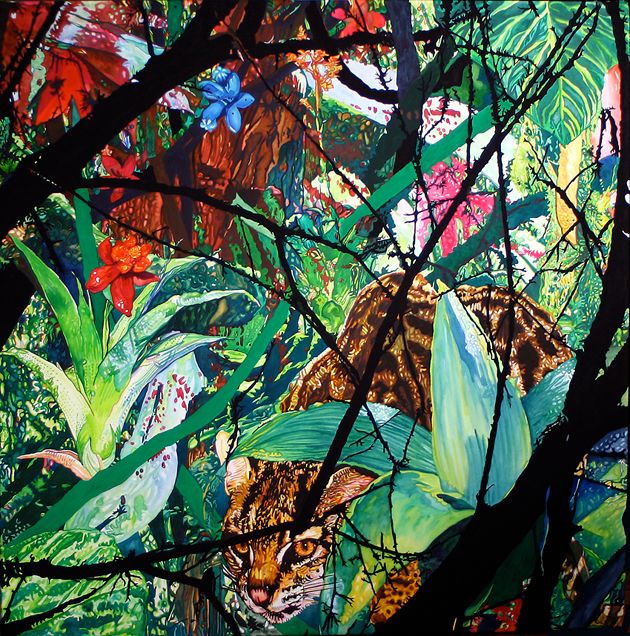
Ocelots at the Gate!


Christopher Reiger
"between meaning and material (h.H.R.)"
2007
Watercolor, gouache, graphite and marker on Arches paper
32 x 32 inches


Diminutive yet captivating, the ocelot (Leopardus pardalis) is my favorite cat species. I've only appreciated the beautiful feline on film and in photographs, but am nonetheless impressed to near reverence. I delight in the animal; I marvel at his dappled coat as he passes through dense foliage and I am humbled by her grace and cunning gaze.

Years ago, when working at a eco-tourism tent camp on Costa Rica's Osa Peninsula, I had the privilege of tracking an ocelot's nighttime doings along a Pacific beach that abuts a steep jungle mountain. I didn't discover the cat, but I took great pleasure in tracing the cat's movements, and I was deeply grateful for the opportunity to commune with the creature, even in so simple a fashion.

It is with great distress, then, that I consider the plight of the ocelot and other species in the Lennox Foundation Southmost Preserve, a 1,034-acre preserve located at the southern tip of Texas. As proposed by the United States Department of Homeland Security, the Mexico-U.S. border fence will pass through the center of this preserve, up to a mile-and-a-half north of the actual border. Three quarters of the preserve will thereafter be inaccessible by employees of the Nature Conservancy, the organization that currently manages the property. Because the Nature Conservancy refused the USDHS buy out, they are being sued by our federal government.

In her Nature Conservancy Magazine article "Don't Fence Me Out," Jennifer Winger writes:
"Once known as the Wild Horse Desert, south Texas may support more wildlife per acre than any other habitat in North America. And although the Rio Grande Valley itself has lost more than 95 percent of its wildlife habitat, Southmost Preserve is a shining exception: Its lands and waters provide habitat for endangered species such as jaguarundis and ocelots, as well as indigo snakes, Texas tortoises and migratory birds.

But recently, this valuable habitat has been threatened by an 18-foot-tall concrete and steel fence proposed by the Department of Homeland Security. Most of the proposed 670-mile-long border fence, with segments from California to West Texas, has already been constructed, but the section slated to cut through the Conservancy’s land is on hold, pending the outcome of a legal battle.

...If the fence is built, nearly 700 acres — 75 percent of the preserve — would be trapped in a no-man’s-land between the fence and the Rio Grande, including all preserve facilities and the home of the preserve manager. The proposed fence would effectively cut off access to the native plant nursery, which is critical to reforestation efforts throughout south Texas. Additionally, the fence would sever a critical corridor for wildlife, as it could block animals from accessing protected areas to the north and freshwater resources to the south."
Contemplating the myopic vision of the USDHS, I recalled an earlier HH post that questioned that morality of building a border fence. In light of this recent news from Texas, I've decided to republish "Border (Bio)diversity (of opinion)" today.

+++++


The Robert Smithson in me is bemused by international borders, particularly those boundaries that are not physically demarcated, lines that exist only in cartography and our collective political imagination. Last night, I contemplated a striking black-and-white photograph of the Mexico-U.S. border. The image was dominated by a rural "vehicle barrier" fence (similar to the one shown above), far removed from an official border checkpoint or crossing. In the desert of the American Southwest, this fence draws an arbitrary line in wire and steel.

It struck me as an emblem of humanity's absurdly tenuous existence, a reminder that our species is an insignificant mote in an incomprehensibly tremendous weave. As the artist Carl Buell wrote in the comments section of a recent HH post,
"With every change in sea level and shoreline, with the raising or eroding of every mountain range, with every changing weather pattern, life spreads out as it can and comes into contact with new environments, opportunities and hazards...As I get older (than dirt), I find myself starting to think like the hills themselves. Some day after eroding and washing out to sea, I’ll be a hill again."
Indeed, each of us (and, eventually, our species) will be reconstituted, and our arbitrary borders, those lines in the mud of space-time, will be erased. In this respect, the border fence is a healthy reminder of our existential folly, but it also reveals humanity's darker inclinations. We build fences, after all, to divide "us" from "them," the demonized "other."

The photograph that inspired this post was printed in the most recent issue of Wildlands Connection, the Wildlands Project newsletter. It accompanied an article about wildlife bottlenecks at the Mexico-U.S. border. The Wildlands Project's mission is to create vast, uninterrupted linkages, known as wildlife corridors, that will extend from Canada into Mexico (on the Rockies spine) and from Canada into Florida (on the Appalachian spine). The U.S.-Mexico border fence is a major obstacle to the organization's first goal.

Yet physical barricades are but one of the obstacles that ambitious conservationists face. Consider wildlife trade legislation that protects species in one country, but not another, adjacent nation. If strict laws prohibit the trapping or hunting of a species in China, for example, but not in neighboring Mongolia, is the Chinese legislation effectively addressing species welfare (particularly when Chinese citizens are paying top dollar to have the killed contraband imported)? Similar issues haunt conservation efforts the world over.

The humanitarian and social concerns that ethically-minded conservationists must take into account present a more nuanced hurdle. Environmental groups in the European Union are warring with one another about how best to create the legislative and physical infrastructure necessary for sustainable energy development. How can you raise thousands of wind turbines without hindering bird migration, ruining aesthetics, or plopping towers in the backyards of folks too poor and disenfranchised to protest?

If the various interest groups in the EU, one of the most environmentally progressive governing bodies in the world, are at odds, is it realistic to expect conservation to become a truly supra-national affair? After all, the EU's concerns are petty alongside those of the southern hemisphere. Whereas Europe is a sprawl of cultivated landscape relatively lacking in biodiversity, the "Third World" represents the usually disastrous meeting of remarkable biodiversity and an exploding human population. Impressed by our terrible example, the citizens of these nations emulate the unsustainable behavior of the "First World." In order to counter the detrimental environmental effects of Third World industrialization, international legislation will face increasingly substantial challenges. The supra-national bodies can create laws, but can we enforce these laws without wielding the colonial sceptre? More critically, can we conserve biodiversity and healthy ecosystems without subjugating the rights of the humans that call the Third World home?

These questions bring me to "Climate of Fear," a recent book by the eloquent Nigerian poet, essayist and Nobel Laureate, Wole Soyinka. Though Soyinka is writing about humanity's attempt to cope with terrorism, his political thrust is applicable to all realms, and his message is clarion.
"The gray zones of moral definitions where relativity reigns and remote cause are evoked to justify the abhorrent will continue to haunt certain casts of mind. The rest will insist on the primacy of an ethical will, one that dictates that some deeds demand to be judged within an identifiable and shared moral universe, however restricted...The ethical will is the redeeming assertion that, even when all other considerations of social conduct are subjected to the fortuitous, one, an ethical core, remains inviolate."
All of our fences fail. Perhaps we should recognize in that certainty both an entropic truth and an implicit morality. Within the context of this "shared moral universe," we are impelled to remove artificial barriers, whether they are constructed to stem the natural tide of human migrations or to protect us from our enemies. No matter the justification for the boundaries we draw, they are immoral inventions. And man, it is said, is the moral animal.

Photo credit: ripped from Kris Eggle's website

Friday, April 24, 2009

Of ideologues and pragmatists


Thomas Paine and Thomas Jefferson


A few months after the inauguration of President Barack Obama, many one-time "Yes we can" cheerleaders are grumbling and casting skeptical glances at Washington. Indeed, I've been disappointed by some of our new president's decisions, but I also accept his maneuvering as an unfortunate political reality.

Unlike his predecessor, Barack Obama realizes that the President of the United States should not operate as an ideologue. Of course, he (and some election year soon, she) could choose to embrace ideology over pragmatism but, in doing so, the Commander-in-Chief risks aligning himself with the sort of tyrannical autocracy that our leaders rhetorically (and routinely) condemn.

But political reality doesn't temper the poor reviews that Obama receives from many on the political left. Considering their critique of Obama's centrism, I recalled an earlier HH post. In "The Whiteness of the Whale," I wrote:
"Craig Nelson's recent biography of Thomas Paine serves as my subway reading these days, [and] I find the following observation relevant.
'Beginning with Franklin and Washington, every successful American leader would balance the pragmatic with the Utopian. Where Franklin the master politician would be almost entirely pragmatic, Paine would be too fervidly Utopian in ways that would not just damage him financially, but imperil him physically... Paine would...always be too ardent with his religion of the lights, a Savonarola of reason and liberty, and as inept a political operator as any fervid Christian saint...The success or failure of any leader in U.S. history can be judged through his or her successes or failures at reaching the pragmatic Utopian paradox that remains at the heart of the American experiment.'
Nelson's words ring true. 'The pragmatic Utopian paradox' is not uniquely American, but it is central to our American experience. For confirmation, we need look no further than the glut of contemporary, progressive American politicians striving to develop a decidedly centrist track record, even if they contradict themselves (and their conscience) in doing so. By contrast, it's easy to discard compromise and contradiction if you are a committed revolutionary or a monkish loner operating in an intellectual and philosophical vacuum."
Barack Obama qualifies as one of the "contemporary, progressive American politicians" I criticize in that excerpt. Yet, as I suggest in the same post, "outside the D.C. beltway, ideologues are a dime a dozen, but exceptionally gifted rhetoricians like Paine or King, Jr. emerge (and make [a legitimate political] impact) only rarely."

Yet even if the political impact of fringe ideology is negligible, those voices must be heard. Indeed, unpopular opinions are sometimes the most vital in a just democracy. There's a reason, after all, that liberals wring their hands when contemplating the censorship of bigoted hate speech. If you believe in the democratic fray, you're obligated to let all of society's individuals speak.

In a recent episode of the "The Thomas Jefferson Hour," historian and Jefferson impersonator Clay Jenkinson read and responded to the following Paine quotation.
'He that would make his own liberty secure, must guard even his enemy from oppression; for if he violates this duty, he establishes a precedent that will reach to himself.'
"This is how Paine would react to the Bush Administration for the past seven-and-a-half years. This is an answer to the Patriot Act, to the surveillances, to Guantanamo, to Abu Ghraib!"
Jenkinson's right. In fact, a great many of Paine's sentiments are as pertinent today as they were in the late 18th century, his abolitionist and proto-feminist writing especially so.

He may have made many political enemies in his day but, two hundred years after the turmoil of our nation's early ideological disputes, Thomas Paine's unwavering moralism aligns more closely with contemporary progressive attitudes than does Thomas Jefferson's political pragmatism. Compared to the public attitudes of the slave-owning and patriarchal Jefferson, Paine strikes the 21st century citizen as the more modern thinker and the more conscientious man.

Does it matter that Jefferson, in his private correspondence, agreed with Paine's abolitionist argument? From our vantage point (one of comfortable remove), no, it doesn't. What we consider, above all, is that Jefferson was a slave owner and that Paine was an outspoken abolitionist. 'Deeds, not creeds,' as the saying goes. But it's noteworthy that Paine was poor and unlanded, and therefore never in a position to own slaves. (Indeed, Paine was never in a position to give up slavery, power, or riches; essentially, his social standing cloistered him from temptation.) Nor was Paine a political figure; he could be strident because he didn't have to consider popular opinion or the practical effect of enacting reform.

Writing in his philosophical memoir An American Gospel: On Family, History, and the Kingdom of God, Erik Reece succinctly describes the democratic ideal to which I subscribe.
"Like [Walt] Whitman, John Dewey thought of the ideal American democracy as an 'organism,' a whole that is reflected in each of its parts - that is to say, in each individual citizen. ...As cells work together within an organism, Dewey believed individuals worked together within a good society to achieve 'a unity of will.' ...And because democracy is a social idea, it is also ethical by its very nature. Ethics, after all, begins with the realization that one is a social being and therefore part of a larger whole. A man living alone on an island requires no ethic. An aristocracy or a dictatorship could be run by only a few of its members. But the democratic organism needs all of its cells. And those cells must act simultaneously in their own interest and in the interest of the larger organism."
But Dewey was a pragmatist. Surely he realized that the democratic organism's ability to fight off infection of the malignant variety is not nuanced; the democratic immune system, if you will, acts to extinguish all radical cells. In other words, this organism is just as likely to rise up against outspoken abolitionists as it is against outspoken racists. And, indeed, history stands as a testament to this action.

Thomas Paine found an American and French populace eager to absorb his revolutionary and populist manifestos Common Sense and Rights of Man, but he was eventually ruined by his rational dismissal of Christian doctrine, The Age of Reason. His New York Citizen obituary read, "He had lived long, did some good and much harm." Much harm? Paine's progressive opinions about slavery and feminism didn't win him sustained popularity.

Jefferson, too, was a lightening rod in his day, provoking as much disdain as he did praise (especially from the Federalists and, in particular, Alexander Hamilton). But Jefferson was a savvy political operator, a master of Nelson's pragmatic Utopian paradox. Although he shared many of Paine's opinions, Jefferson did not draft legislation addressing those issues or even, because of his deism, allow his private correspondence to be made publicly available in his lifetime. Our third president carefully considered what the demos were and weren't ready to accept. Paine, the ideologue, simply didn't care.

So what will it be? Should an independent, liberal leaning citizen like myself wish for a revolutionary president, a Paine-like Obama less concerned with centrist politics, an Obama driven by moral conviction? Can I believe that such a president's radical agenda won't be consumed by the fires of reaction?

For my part, I trust that Obama is striving to foment as much progress as he safely can in our flawed, anti-intellectual democracy. I express my few disappointments by signing petitions for ads calling on Obama to address some of what I see as missteps but, above all, I'm proud of our country for electing an intelligent, disciplined and thoughtful man to the nation's highest office...and I remain optimistic.

Image credits: Thomas Paine portrait ripped from American History Guide and Thomas Jefferson portrait ripped from The World Union of Deists

Tuesday, November 11, 2008

Obama's Inheritance


Jehad Nga
"Operation Steel Curtain, Iraq 2006"


Art collector, patron, humanitarian advocate and all-around-great-guy James Wagner is also a longtime blogger. Every so often, he posts a short essay on JamesWagner.com that warrants wide distribution. (Lacking significant broadcast reach, I can only recommend those posts here.)

James' thoughts regarding the election of Barack Hussein Obama parallel my own, and he states the case much more succinctly than I could. I include some excerpts below.
"We endured eight disastrous years of a Bush presidency, years which saw both the haughty ascendancy and the ignoble collapse of the unmourned Late Capitalist, Neoconservative and Republican regime. Nothing of importance or worth in our own Republic or in much of the rest of the world has escaped the depredations of its arrogance, its sententiousness, its dominion and its greed. I had believed for years that no fundamental political change would occur until we had sunk into a genuine economic depression, and I had gloomily predicted the change would be toward some form of Fascism."

"I hadn't anticipated the confluence of the dramatic events of the last year and the exceptional capabilities of Barack Hussein Obama...But in order to rebuild institutions, restore well-being and a belief in the future, the new President will have to pull off something like a major revolution."

"Without that full recognition of the seriousness of our crisis, and with the continuing strength of contemporary skeptics, dinosaurs and reactionaries, including the fact that almost as many people didn't vote for him as did, Obama will almost certainly have to push through what must be, and almost certain will be, an extremely progressive agenda while not making it look too radical, and he will have to do it in a way that will disarm and even enlist on its behalf as many of its potential adversaries as possible."

"I know there will be mistakes, as FDR made mistakes, but, and call me Pollyanna again, I believe he will pull it off, partly because of what I have just written, but also because he will have so much help (both enthusiastic and skilled), and because we have come to such a pass that we all really want to see him to succeed: Regardless of our diversity, and despite the vast range in our individual conditions and current fortunes, none of us can afford the cost of failure. We'll have to be in there with him."
Pony up, people. We've got work to do.

Read the full post here.


Peter van Agtmael
"A teenager injured as his house is searched by US forces, Iraq 2006."


Also, I recommend James' post on the Battlespace project's unpublished photographs from our "three wars." I have included three of the images in this post, but I highly recommend readers visit Battlespace to view more of the profound images. Be forewarned that many of the images are deeply troubling. I feel cold and wretched looking at some; it's hard not to cry, and sometimes the only thing for it.


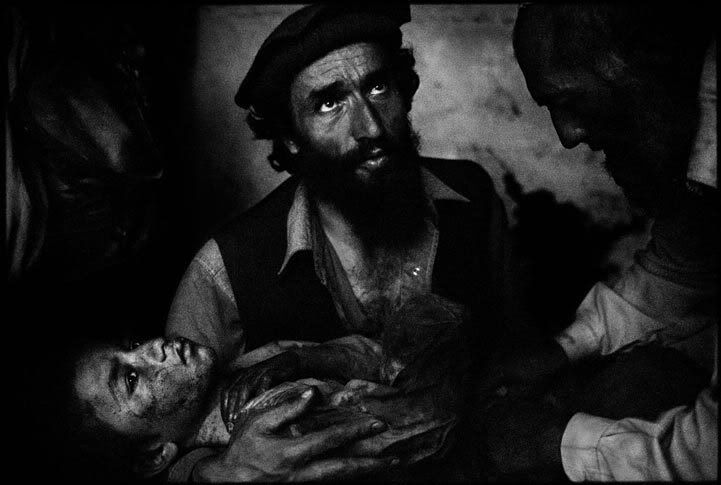
Balazs Gardi
"Kunar province, Afghanistan. Survivors of a US airstrike."


Photo credits: all pictures ripped from Battlespace website

Tuesday, February 05, 2008

Party Faithful

"If I could not go to heaven but with a party, I would not go there at all."
-Thomas Jefferson
A registered independent, I can't vote in New York State's closed primary today.

What sort of sense does this make in a democracy?

Wednesday, January 09, 2008

Same 'ol...

A co-worker orders me an Old Bushmills whiskey. When the bartender begins to pour a Jameson instead, my co-worker balks. "No, that's Catholic whiskey, Pat! We want the orange, the Protestant."

Behind us, on the television, a Rudy Giuliani campaign commercial features footage of gun-toting insurgents, explosions, and Iranian president Ahmadinejad. The voiceover: "Hate without boundaries. A people perverted. A religion betrayed."

Sunday, November 18, 2007

That Time of The Cycle

"And from that torment I will free myself,
Or hew my way out with a bloody axe.
Why, I can smile, and murder whiles I smile,
And cry 'Content!' to that that grieves my heart.
And wet my cheeks with artificial tears,
And frame my face to all occasions.
I'll drown more sailors than the Mermaid shall.
I'll slay more gazers than the basilisk.
I'll play the orator as well as Nestor.
Deceive more slily than Ulysses could,
And, like Simon, take another Troy.
Change shapes with Proteus for advantages,
And set the murderous Machiavel to school.
Can I do this, and cannot get a crown?"

- Act III, Scene ii; Shakespeare's "Henry the VI"
Photo credit: image ripped from AFSCME site

Thursday, October 04, 2007

Political Compass: Where Do You Land?

I learned of the Political Compass Test a month ago, while reading Bill Gusky's ArtBlog Comments. It isn't a perfect measure of one's political positioning, but it serves as a useful litmus test.

Interestingly, as Bill points out, many art blog readers land in the lower left quadrant (economically "left" and socially libertarian). Take my score of -8.50/-6.36, for example. The test makers consider me a little left of the Dalai Lama on both axises. While I find that result somewhat surprising, I'm honored to be in such good company.

Take the test. Tell me where you are placed.

Monday, November 06, 2006

Vote, baby, vote


Please, please, please vote!

Whatever your politics may be! Vote. However mired in cynicism you may sometimes feel! Vote.

(Especially if you're eligible in my home state.)

Photo credit: ripped from funnydog.net

Wednesday, July 19, 2006

Notes From Beirut

Zena el-Khalil, an artist friend of mine from graduate school days, lives and works in Beirut, Lebanon. This past week she has been sending regular email updates to family, friends and acquaintances. These missives are now being collected online at Beirut Update.

Whatever your feelings about the region's hellish situation, I recommend a read. Zena's voice vacillates from that of an anxious hysteric to a relatively calm observer. Any perspective or agenda, be it that of the BBC, ABC, NPR, the Jerusalem Post, or Addiyar, will be regarded as biased. Rightly so! Such subjectivity, then, demands vigilance on the part of the participating global citizen. The more sources considered, the more complete the picture, terrible and indistinct though it may still remain.

Let us hope that some sense is made of this mess, and that the killing ends soon. What's more, let us remember that faraway conflicts are, in this day and age, immediately relevant to each and every one of us.

Thursday, January 05, 2006

Jane Hammond's "Fallen"


Jane Hammond
"Fallen"
2005
Dimensions variable

I have a bias against political "protest art." Excepting Pablo Picasso's "Guernica," I am hard pressed to think of moving, successful artworks in this all-too-noisy stall of the political art stable. I don't mean to suggest that artists shouldn't bang a drum on behalf of causes near and dear to them, but doing so without looking like an ass is no mean task.

Thankfully, there are a number of artists who produce work that addresses contemporary political concerns without throwing a tantrum; I didn't realize that Jane Hammond was one of them. I like Hammond's collages - and some of her paintings - a great deal, so I was thrilled to read about her installation/sculpture, "Fallen," exhibited last year at Galerie Lelong. Unfortunately, I missed the show. I include below critic Eleanor Heartney's description of the work, printed in the September 2005 issue of Art in America.
"In the show's largest work...a pile of large, brilliantly colored autumn leaves spread[s] over a low platform in the center of a separate room. Actually, these remarkably real-looking leaves are artful reproductions of ones gathered by the artist and her friends...Hammond inscribed each of the roughly 1,500 leaves with the name of an American soldier killed in Iraq. (As the war goes on, she will continue to add leaves as more soldiers die.) Thus, what first appears to be a celebration of nature's beauty becomes a reminder of the mounting toll of war."
At the time of the exhibition, "Fallen" was comprised of more than 1,500 leaves. Presumably, Hammond has dutifully continued fashioning her paper leaves, which should now number just over 2,200. The process of shaping, inscribing and adding these leaves must be a very difficult one, but I am thankful for the project and ever more impressed with Hammond as an artist.

Read the 2010 follow-up to this post here.

Photo credit: image ripped from .nsimplexity

Tuesday, December 13, 2005

Border (Bio)diversity (of opinion)


The Robert Smithson in me is bemused by international borders, particularly those boundaries that are not physically demarcated, lines that exist only in cartography and our collective political imagination. Last night, I contemplated a striking black-and-white photograph of the Mexico-U.S. border. The image was dominated by a rural "vehicle barrier" fence (similar to the one shown above), far removed from an official border checkpoint or crossing. In the desert of the American Southwest, this fence draws an arbitrary line in wire and steel.

It struck me as an emblem of humanity's absurdly tenuous existence, a reminder that our species is an insignificant mote in an incomprehensibly tremendous weave. As the artist Carl Buell wrote in the comments section of a recent HH post,
"With every change in sea level and shoreline, with the raising or eroding of every mountain range, with every changing weather pattern, life spreads out as it can and comes into contact with new environments, opportunities and hazards...As I get older (than dirt), I find myself starting to think like the hills themselves. Some day after eroding and washing out to sea, I’ll be a hill again."
Indeed, each of us (and, eventually, our species) will be reconstituted, and our arbitrary borders, those lines in the mud of space-time, will be erased. In this respect, the border fence is a healthy reminder of our existential folly, but it also reveals humanity's darker inclinations. We build fences, after all, to divide "us" from "them," the demonized "other."

The photograph that inspired this post was printed in the most recent issue of Wildlands Connection, the Wildlands Project newsletter. It accompanied an article about wildlife bottlenecks at the Mexico-U.S. border. The Wildlands Project's mission is to create vast, uninterrupted linkages, known as wildlife corridors, that will extend from Canada into Mexico (on the Rockies spine) and from Canada into Florida (on the Appalachian spine). The U.S.-Mexico border fence is a major obstacle to the organization's first goal.

Yet physical barricades are but one of the obstacles that ambitious conservationists face. Consider wildlife trade legislation that protects species in one country, but not another, adjacent nation. If strict laws prohibit the trapping or hunting of a species in China, for example, but not in neighboring Mongolia, is the Chinese legislation effectively addressing species welfare (particularly when Chinese citizens are paying top dollar to have the killed contraband imported)? Similar issues haunt conservation efforts the world over.

The humanitarian and social concerns that ethically-minded conservationists must take into account present a more nuanced hurdle. Environmental groups in the European Union are warring with one another about how best to create the legislative and physical infrastructure necessary for sustainable energy development. How can you raise thousands of wind turbines without hindering bird migration, ruining aesthetics, or plopping towers in the backyards of folks too poor and disenfranchised to protest?

If the various interest groups in the EU, one of the most environmentally progressive governing bodies in the world, are at odds, is it realistic to expect conservation to become a truly supra-national affair? After all, the EU's concerns are petty alongside those of the southern hemisphere. Whereas Europe is a sprawl of cultivated landscape relatively lacking in biodiversity, the "Third World" represents the usually disastrous meeting of remarkable biodiversity and an exploding human population. Impressed by our terrible example, the citizens of these nations emulate the unsustainable behavior of the "First World." In order to counter the detrimental environmental effects of Third World industrialization, international legislation will face increasingly substantial challenges. The supra-national bodies can create laws, but can we enforce these laws without wielding the colonial sceptre? More critically, can we conserve biodiversity and healthy ecosystems without subjugating the rights of the humans that call the Third World home?

These questions bring me to "Climate of Fear," a recent book by the eloquent Nigerian poet, essayist and Nobel Laureate, Wole Soyinka. Though Soyinka is writing about humanity's attempt to cope with terrorism, his political thrust is applicable to all realms, and his message is clarion.
"The gray zones of moral definitions where relativity reigns and remote cause are evoked to justify the abhorrent will continue to haunt certain casts of mind. The rest will insist on the primacy of an ethical will, one that dictates that some deeds demand to be judged within an identifiable and shared moral universe, however restricted...The ethical will is the redeeming assertion that, even when all other considerations of social conduct are subjected to the fortuitous, one, an ethical core, remains inviolate."
All of our fences fail. Perhaps we should recognize in that certainty both an entropic truth and an implicit morality. Within the context of this "shared moral universe," we are impelled to remove artificial barriers, whether they are constructed to stem the natural tide of human migrations or to protect us from our enemies. No matter the justification for the boundaries we draw, they are immoral inventions. And man, it is said, is the moral animal.

Photo credit: ripped from Kris Eggle's website