Showing posts with label cynicism. Show all posts

Friday, May 21, 2010

Changes


View of Empire State Building; Manhattan, NYC; May 2009

As I prepare to move from New York City, my home for over a decade, to San Francisco, my home for at least a few years, I find myself viewing NYC through the eyes of a man in limbo. I'm still living in Queens, but my attention is already on the road.


Vacant lot; East Village, Manhattan; May 2008

A decade of NYC living makes me, by at least one standard, an official "New Yorker." How does that define me? New York, like all conurbations, is ever in flux. On my watch, it's changed in remarkable ways. What changes will come after I'm no longer a resident? Likewise, what changes are yet in store for me, a similarly adaptable organism?


Samuel Cohen Son graffiti; East Village, NYC; April 2010

I moved to New York City in October 1999, not long after I graduated from The College of William & Mary. I was then an ambitious twenty-one year old with a deeply cynical streak and an abiding love of beer and partying. My paintings and drawings featured naked people interacting in various ways with other animals, medical instruments, fossils, and, on occasion, Teletubbies. (If a reader knows what became of the big Tinky Winky sex painting, I'd love to see a photo of it!) Despite my apparent enthusiasm, I was steeped in melancholy. I spent hours each week brooding over "I," my pet novel project, a 1990s East Village vampire update of Hermann Hesse's Steppenwolf. I viewed humanity as a noxious species, religion as the most noxious of human inventions, and I not so secretly looked forward to our inevitable extinction.

Today, I'm an ambitious thirty-two year old who reacts against cynicism, drinks much less, and generally dislikes partying. Naked people sometimes appear in my paintings, but there aren't any Teletubbies. I'm a stubborn optimist. Each morning, I take twenty minutes to humbly celebrate a new day; if I wake in a funk, I fight through the fog to see anew just how marvelous life is. I recall my earlier character with some embarrassment. What was wrong with the arrogant kid who labored on a novel that painted such an ugly picture of humanity and religion? Perhaps he just needed to be more intellectually rigorous, and to open his eyes to the awesome fact of being? Or maybe that twenty-one year old also needed a good hug, which is no small thing?


Greenpoint, Brooklyn; May 2009

My time in New York City has seen me metamorphize from a hardened and cynical adolescent into an optimistic, joyful adult. The direction of this evolution runs counter to the standard assumption made about the effect of NYC living. As the columnist Mary Schmich warned (and director Baz Luhrmann popularized with his song "Everybody's Free (To Wear Sunscreen)"),
"Live in New York City once, but leave before it makes you hard; live in Northern California once, but leave before it makes you soft."
In my experience, however, NYC living sanded smooth the hard edges.


Wollman Rink; Central Park; Manhattan; June 2008

Perhaps, too, the mournful and nostalgic wails of NYC residents (myself included) are misguided? We should accept that "what will come, will come" without falling victim to fatalistic impotence. New York City (and Manhattan, in particular) is one of the most sustainable, environmentally responsible cities in the world, and its educated, informed residents should work with New York State and City representatives to make sure the city continues apace on that front. They should also do all they can to ensure that it remains a mecca for tolerance, the arts, and cultural pluralism. In what ways I can, I'll do the same from the Left coast; New York City is a part of me, and I will always feel a part of New York City.

Love and peace to all of my friends here. Thank you for everything. I'll be in touch. I'll visit. I hope that you'll visit me.


Upper New York Bay from Staten Island; May 2008

Image credits: all photography, Hungry Hyaena

Sunday, November 18, 2007

That Time of The Cycle

"And from that torment I will free myself,
Or hew my way out with a bloody axe.
Why, I can smile, and murder whiles I smile,
And cry 'Content!' to that that grieves my heart.
And wet my cheeks with artificial tears,
And frame my face to all occasions.
I'll drown more sailors than the Mermaid shall.
I'll slay more gazers than the basilisk.
I'll play the orator as well as Nestor.
Deceive more slily than Ulysses could,
And, like Simon, take another Troy.
Change shapes with Proteus for advantages,
And set the murderous Machiavel to school.
Can I do this, and cannot get a crown?"

- Act III, Scene ii; Shakespeare's "Henry the VI"
Photo credit: image ripped from AFSCME site

Sunday, September 09, 2007

A Scatological Parable

"The evil of automation. Never again will I sacrifice my shit to the sucking vortex. My God, there was no trace left. My shit disappeared like the plague or like an abortion. It's terrible to have abortions every day. Wake up you people, humanize yourselves. Don't reject your shit like you reject your parents."

-Lucas Samaras, "Crude Delights : Shitman"

Saturday, March 05, 2005

To Be Art Or Not To Be Art

Image hosted by Photobucket.com
As I approached the door of Matthew Marks Gallery this afternoon, three young women walked out, laughing. As they passed me, one of them exclaimed, "That was, without a doubt, the worst of the worst! I've never seen something that bad."

The gallery is currently exhibiting recent work by Robert Gober. Upon entering, the first "sculpture" I saw was rather simple. Resting on its side, on top of a simple concrete slab, was an unopened package of diapers. As I recall, they were Huggies brand. That was the artwork; Gober purchased a package of Huggies and placed it on a concrete slab in a New York art gallery.

In his recent review of "The Gates," The New Yorker art critic, Peter Schjeldahl, writes, "Art used to mean paintings and statues. Now it means practically anything human-made that is unclassifiable otherwise." Reading this, I recalled a comment I overheard a tourist make last year. He was looking at TRANSMOTION, a multi-media, roving installation constructed on the flatbed of a tractor-trailer, and he said to his wife, "Well, if you don't know what it is, it must be art."

This afternoon, looking at Gober's diapers, I considered both of those definitions. Because I could identify the object at my feet as diapers, Gober's "sculpture" failed to pass the tourist test. Gober doesn't make the diapers, but they are "human-made." Will this sculpture pass the Schjeldahl test? No. I'm looking at a package of Huggies, for God's sake! Huggies are classifiable as, well, diapers. They hold baby shit. They're not art.

In the rear of the gallery, I studied a lactating, crucified Christ. This Christ, though, has been beheaded or perhaps he never had a head. The water-milk coming from Christ's nipples fountains out away from his hanging body and enters a small, rough pit in the floor of the gallery. Now this, I'm sure, is art! I'm momentarily pleased, but then realize that it is bad art.

Gober gives me Huggies and a headless, lactating Christ. Feeling the same way the three young ladies had, I quickly exited the gallery.

Friday, March 04, 2005

Of Mice and Men

Image hosted by Photobucket.com
Searching for inspiration in one of my old commonplace books, I came upon the following text. I assume that it was composed in a fit of anger and pessimism but, reading it this evening, years after it was written, the bleak statement doesn't seem so extreme. In fact, despite the dramatic flourish, I feel that it is fairly accurate.
“If we are so linked to Nature, one might ask, why then do we continue to overlook environmental degradation? Why wouldn’t we, as the most powerful players present, do something to curtail our abuses?

The answer is simple, but troubling. Our exuberant abuse itself is natural. Like any other animal, we are driven to reproduce. If you put five mice (four females and one male) in a clean, large enclosure and take care to feed them and supply clean water, they will thrive. In a few months, you will have twenty or so mice on your hands and the cage cleaning will become increasingly challenging. Allow another few months to pass and you will be unable to count the mice without first removing them from the enclosure. Before long, the cage cleaning is a nightmarish chore. The enclosure must be cleaned daily, sometimes more often. As the mice become more overcrowded, the males begin to vie for females. They bully and bite one another, often targeting one individual and biting at his rump or lower back until they open a wound. The enclosure now becomes bloody. Adult males steal newborns from the squirming "nests," kill them and leave the dead bodies strewn, partially eaten, on the now filthy floor. The once clean coats of the rodents are now grimy and matted, their backbones seen easily under their sagging, unhealthy skin. Moments after giving birth, hungry mothers fall on their young, devouring them. If left as is, the urine stench will soon be mixed with the smell of rot and, within a year, all the animals will be dead. Humanity’s enclosure has afforded us more time and more transitions, but the situation is similar.”
In college, I bred mice in order to feed the snakes I kept. I was an irresponsible mouse owner - though a responsible snake owner - and the beginning stages of the above description were witnessed several times, though I never let things get so far out of hand.

While I accept the fatalistic text as an essentially fair assessment, it ignores humanity's potential. Our complex brains allow us to strive to balance nature with nurture. This desire, I believe, is what makes conservation a moral undertaking; good stewardship is good living.

Painting: detail of "untitled," by Boyce Cummings, 2003

Wednesday, March 02, 2005

Little Devils


In my late teens, when I explored the European hostel circuit with a good friend, I visited several museums expressly to see particular Hieronymous Bosch works. Unfortunately, no matter how long you spend with a painting in a museum collection, the piece will not communicate with the deep resonance that a lived with work might.

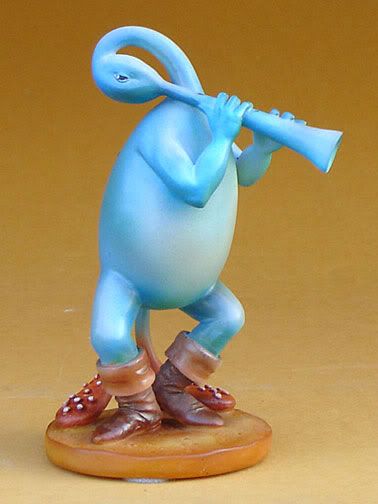
But all is not lost! At last I can bring a bit of Boschian flavor into my home! Although they're too expensive to buy as a gag, these minatures do make me chuckle. Imagine presenting your grandmother with one of these tchotchkes!

At any rate, I found the site's description of Bosch's subject matter amusing. For years, I've listened to my father bemoan what he describes as the return of the Dark Ages. Perhaps he isn't far off the mark?
"Bosch places visionary images in a hostile world full of mysticism, with the conviction that the human being, due to its own stupidity and sinfulness has become prey to the devil himself. He holds a mirror to the world with his cerebral irony and magical symbolism, sparing no one. He aims his mocking arrows equally well at the hypocrisy of the clergy as the extravagance of the nobility and the immorality of the people."
Granted, we're not performing stone operations in 2005, but the parallels between the close of Bosch's 15th century and the beginning of our 21st century are remarkable.

Photo credit: Talaria Enterprises website