Showing posts with label hope. Show all posts

Wednesday, June 26, 2013

Sci Foo On My Mind

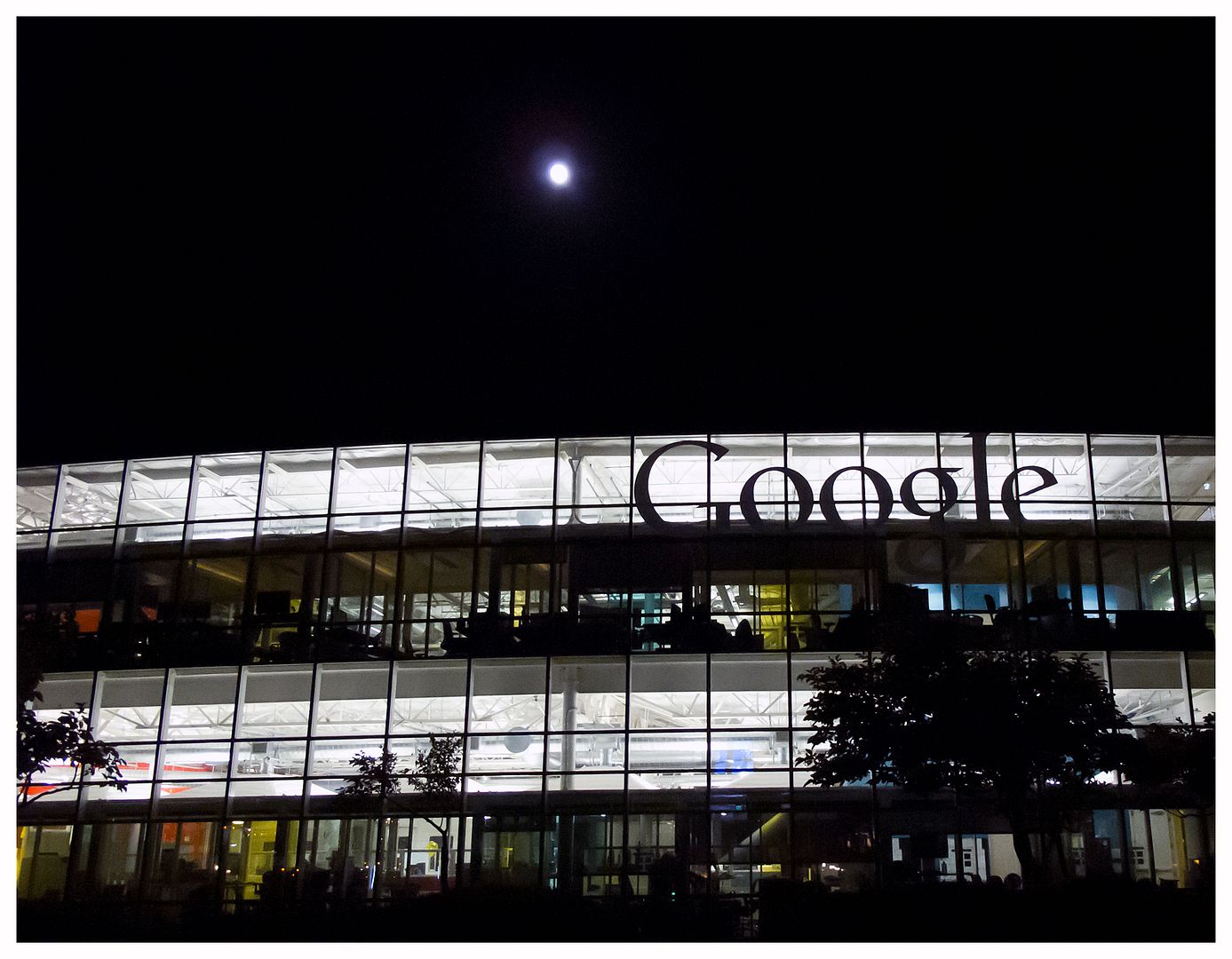
Summer solstice moon over the Googleplex; Mountain View, CA; June 2013

My father-in-law is a glass-half-full kinda guy. In the midst of any conversation about science, medicine, or technology, it's not uncommon for him to proclaim, "This is an exciting time to be alive." Indeed, it is. But when I fell into bed early on Sunday morning, my head giddy with ideas from the first full day of Sci Foo Camp, my father-in-law's optimism seemed understated. Spend 48 hours with -- to list just a few of the approximately 250 participants -- a computer scientist studying machine learning and music, a theoretical physicist turning the idea of gravity on its head, a marine biologist eager to solve the mysteries of whale sharks, a genomic epidemiologist intent on elucidating outbreak transmission dynamics, and a national security strategist currently implementing the White House's terrorism-related information sharing priorities and...well, you come away with much to ruminate on and a lot of notes to parse. In short, Sci Foo Camp made for an extraordinary weekend!

Monday, January 02, 2012

Keep the Flame Alive In 2012


2011 will be best remembered as a year of popular dissatisfaction and uprisings. Lacking a crystal ball, such instability -- especially the prospective political transitions from despotism to democracy in Egypt and Libya -- can cause acute anxiety.

As we enter 2012, it's useful to keep in mind that democracy is a pendulum that forever swings from equilibrium to imbalance and back. The uncertainty and tensions associated with the political and ideological landscape of today's Middle East are also endemic to established democracies. Lewis Lapham described the workings of a democratic government in "Democracy 101," an essay published in the April 2011 issue of Harper's Magazine.
"Democracy is a dangerous business; it allies itself with change, which engenders movement, which induces friction, which implies unhappiness, which assumes conflict not only as the normal but also as the necessary condition of its existence. The idea collapses unless countervailing stresses oppose one another with competing weight - unless enough people stand willing to sustain the argument between the governing and the governed, between city and town, capital and labor, men and women, matter and mind. [...It] is the freedoms of thought that rescue a democracy from its stupidities and crimes, the courage of its dissenting citizens that protects it against the despotism of wealth and power backed up with platitudes and billy clubs and subprime loans."
This description should ignite fire in the belly of all United States citizens, wherever they place themselves on the political spectrum.

In late January 2009, I wrote an essay titled "Eudamonia." The piece explored the possible causes of a "bout of optimism [that] seemed remarkable in both duration and degree." That optimism is tempered today, but it still burns, despite the growth of "triumphant pessimism" among our populace. I remain optimistic because I believe in long term improvement, in two steps forward for one step back.

Let us all be devoted, active citizens in 2012, realistic, but not cynical, hopeful, but not naive, critical, but not destructive.

Image credit: uncredited photograph ripped from Care2 Make A Difference website

Saturday, September 24, 2011

Acknowledging Exceptionality

"As glass office and condominium towers have proliferated in the last decade, so, too, have calls to make them less deadly to birds. The San Francisco Planning Commission adopted bird-safety standards for new buildings in July, and this month that city’s Board of Supervisors will vote on making it law. Legislation is pending in Washington that would require many federal buildings to incorporate bird-friendly designs. The United States Green Building Council, a nonprofit industry group that encourages the creation of environmentally conscious buildings, will introduce a bird-safety credit this fall as part of its environmental certification process, called LEED."
- "A City of Glass Towers, and a Hazard for Migratory Birds," New York Times, September 14, 2011
I enjoyed reading "A City of Glass Towers, and a Hazard for Migratory Birds," a recent New York Times article about bird-building collision mortality. Lisa Foderaro's piece is a hopeful account of how a confluence of activism, technology, and regulation can improve the lot of animals, especially in cases where a particular species has been adversely affected by human development.

The comments that follow the article, however, are predominated by doom-and-gloom attitudes. A representative survey follows:
All that matters are people and every little whim. We're a doomed species.
-Karma Every Moment, NY, NY

The people who tell us that evolution and climate change are just unproved theories have no idea how life formed this planet since its inception and no understanding whatsoever of the role of extinction in maintaining the climate within habitable bounds when any one plant or animal breaks the equilibrium. They convinced me long ago that there is no future for my own children.
-Steve Bolger, NY, NY

Yet another example of the consequences of man's selfish and destructive behavior. So sad.
-agetibi, Carrboro, NC
No wonder over 50% of Americans polled by The Nature Conservancy caricatured environmentalists as preachy reactionaries. In the words of the Conservancy's Chief Scientist, Peter Kareiva, most people see members of the environmental movement as "misanthropic, anti-technology, anti-growth, dogmatic, purist, zealous, exclusive pastoralists." Unsurprisingly, this negative stereotype has led to a dwindling of the movement's ranks.

I consider myself an environmentalist, but I distinguish between preservation and conservation (placing myself in the latter camp) and, more critically, I believe that environmentalism needs to embrace a "can do" attitude. If the majority of my fellow Times readers identify as environmentalists, their comments suggest that they're a well-intentioned pox. Wholesale condemnation of our species is as wrongheaded and malignant as exclusive glorification. In order to decry humanity as a "selfish and destructive" brute, one must stubbornly overlook all the evidence to the contrary. I wrote about such oversight in an essay included in the catalog for "A Live Animal," a group show that Selene Foster and I co-curated at Root Division.
"Although 'deep ecologists' and animal rights activists bemoan conservation approaches that prioritize human interests, the fact remains that human beings are exceptional animals. Skeptics and naysayers need only consider our species' biological and imaginative success to find evidence of our unprecedented faculty. But of all our remarkable features and feats, among the most notable examples of humanity's anomalous nature is our interest in and empathy for other species. Although there is growing scientific agreement that some other species possess self-awareness and even a capacity for empathy -- whales, dolphins, elephants, and our ape relatives are especially interesting in this regard -- humans are the only animal striving to learn about and better the lot of other creatures and environments. It's true that we often prioritize short-term, anthropocentric interests and it's also clear that reckless human activity has contributed to dramatic climate change and the ongoing Holocene extinction (our geological epoch's staggering loss of biodiversity), but conservation efforts and legislation, as well as our burgeoning interest in sustainability, speak to another, more hopeful human impulse; we possess an innate ability to see ourselves in other animals and, in turn, to recognize our capability as their stewards and representatives."
In short, we're not all bad. If you believe that we are, then you're guilty of sapping our species' potential. Christopher Cokinos is excellent on this point. I've quoted his terrific "Consolations of Extinction" essay before; I'll do it again.
"Too much grief for the world means less energy to help it along. [When] you find yourself free of the poisons that too much angst can cultivate, then something marvelous happens. You can sense how very old the planet is, how very old life and death are, and you can keep going on, you can keep doing the work you do in this universe, feeling despair when you feel despair, feeling - amazing - joy when you feel joy."

Friday, December 03, 2010

Red Wolf ESPP Prints Released!


Christopher Reiger
"Constellation (Canis rufus)"
2010
Pen and sumi ink, gouache, and watercolor on Arches paper
15 x 12 inches

My 2010 drawing "Constellation (Canis rufus)" has been made into a limited edition print for the Endangered Species Print Project (ESPP). The drawing features the red wolf (Canis rufus), a critically endangered wolf species.

I wrote the following description of the red wolf and its plight for the ESPP website:
"The Red Wolf (Canis rufus) is a medium-sized North American canid, generally larger than a coyote but smaller than the gray wolf. As the common name suggests, red wolves often have reddish fur on and around their ears, neck, and legs. Like other wolves, the Red Wolf is a social species that lives in packs, groups typically comprised of a mated pair and their offspring (of multiple generations). Red Wolves are crepuscular predators, most active at dusk and at dawn. They prey on white-tailed deer, raccoons, opossums, rabbits, and rodents, but are also known to scavenge.

The Red Wolf once occupied a range that extended over the forests, swamps, and coastal plains of the southern and eastern areas of the United States, as far west as Texas and as far north as New York. As with most non-domesticated canines, however, the Red Wolf was vilified as a dangerous competitor of man (and, erroneously, a "man-eater"). These entrenched, negative attitudes gave rise to aggressive predator control campaigns; wolves were poisoned, shot, and trapped. This persecution was compounded by habitat loss and disease, taking a terrible toll on red wolf populations. By 1980, the species was extinct in the wild.

Today, though, there is good news. Thanks to several focused preservation and reintroduction programs, and especially to the efforts of the Point Defiance Zoo & Aquarium (PDZA) and the United States Fish & Wildlife Service (USFWS), in conjunction with programs like that at Mill Mountain Zoo, the Red Wolf is staging a small, isolated recovery. There are now approximately 100 wolves living wild in eastern North Carolina and up to 250 individuals in zoo-based captive breeding programs."
As per the ESPP model, this is a limited edition of 100 prints, the number determined by the featured animal's current wild population. The print measures 8 x 10 inches, and costs a mere $50.00. ALL proceeds from sale of the prints will be donated to the Port Defiance Zoo & Aquarium Red Wolf Recovery Program.

As I explain in the ESPP artist notes, my fascination with taxonomy increased my interest in researching this particular species:
"Ecology, wildlife biology, and natural history are subjects that I'm passionate about, and I'm especially intrigued by taxonomy, the classification of different species. The ever-evolving field's binomial nomenclature is chock-a-block with curious etymological backstories and, more importantly, taxonomists are endlessly debating species classification. Names change, species become subspecies (and vice versa), and protected animals become unprotected animals on what seems to be a month-to-month basis! The red wolf is no exception. It's an honor to produce an artwork that may, in some small way, help save a keystone predator from extinction and genetic isolation; I must admit, however, that I also planned to use the print as an excuse to learn more about the particulars of the red wolf taxonomic debate.

Some wildlife biologists insist that the red wolf's scientific name is Canis lupus rufus and that the animal is a subspecies of gray wolf (Canis lupus). Another camp, one that the US Fish & Wildlife Service concurs with, believes the wolf to be a species distinct from the gray wolf. It is their classification, Canis rufus, that I use in the species description above. Frankly, both groups make valid arguments; the different verdicts depend on whether the red wolf is classified according to the biological classification rule (i.e., if Wolf A can make viable pups with Wolf B, the two wolves belong to the same species) or the phenotypic/phylogenetic approach to classification, based on distinct physiological or genetic characteristics. Because the phenotypic/phylogenetic approach leads to a great many more species, it remains a source of contention within wildlife biologist communities and complicates conservation politics, for better and for worse.

Of primary importance, though, are the animals. Whether red wolves are ultimately deemed their own species or a subspecies of gray wolf, they're on the brink of extinction. There is ample cause for hope, however, and you can make that hope a little more concrete by purchasing a print!"
Visit the ESPP site to learn more and, during this holiday season, please consider helping the species by buying a print as a gift.

Wednesday, September 22, 2010

The RSA's "21st Century Enlightenment"


Sure, the video is 11 minutes long, well over the too-long-to-watch mark for readers casually trolling the blogosphere, but it's worth bookmarking and saving for later. (In fact, I encourage you to watch it on YouTube or the RSA website, as the resolution is better than that of the above embed.)

The ideas articulated are vital and might provide some solace for those of you who, like so many of my friends, suffer from political apocalypse syndrome! Moreover, the animation is terrific and the narrator, like the Royal Society for the Encouragement of the Arts (RSA), is British, satisfying the Anglophile in all of us.

Enjoy.

(Thanks to Michael McDevitt for turning me on to this RSA video.)

Wednesday, July 21, 2010

ESPP Anniversary


Molly Schafer
"Moldavian Meadow Viper"
2010
Archival giclee print (Edition of 2000)
8 x 10 inches

The Endangered Species Print Project recently celebrated their one year anniversary! To mark it, they released three new prints.

I'm especially fond of the two newly available limited editions created by the project's co-founders, Molly Schafer and Jenny Kendler...and I'm most drawn to the Moldavian Meadow Viper (Vipera ursinii ssp. moldavica). This, for three reasons: Molly rendered the animal beautifully; I adore serpents, and Molly evidently does, too; I have an irrational attachment to Hungary, since my paternal great-grandparents hail from the country, and sales of the print benefit the Hungarian Meadow Viper Conservation Center, a conservation organization based there.

Visit the ESPP site to see the other prints.

Image credit: Courtesy the Endangered Species Print Project

Friday, May 21, 2010

Changes


View of Empire State Building; Manhattan, NYC; May 2009

As I prepare to move from New York City, my home for over a decade, to San Francisco, my home for at least a few years, I find myself viewing NYC through the eyes of a man in limbo. I'm still living in Queens, but my attention is already on the road.


Vacant lot; East Village, Manhattan; May 2008

A decade of NYC living makes me, by at least one standard, an official "New Yorker." How does that define me? New York, like all conurbations, is ever in flux. On my watch, it's changed in remarkable ways. What changes will come after I'm no longer a resident? Likewise, what changes are yet in store for me, a similarly adaptable organism?


Samuel Cohen Son graffiti; East Village, NYC; April 2010

I moved to New York City in October 1999, not long after I graduated from The College of William & Mary. I was then an ambitious twenty-one year old with a deeply cynical streak and an abiding love of beer and partying. My paintings and drawings featured naked people interacting in various ways with other animals, medical instruments, fossils, and, on occasion, Teletubbies. (If a reader knows what became of the big Tinky Winky sex painting, I'd love to see a photo of it!) Despite my apparent enthusiasm, I was steeped in melancholy. I spent hours each week brooding over "I," my pet novel project, a 1990s East Village vampire update of Hermann Hesse's Steppenwolf. I viewed humanity as a noxious species, religion as the most noxious of human inventions, and I not so secretly looked forward to our inevitable extinction.

Today, I'm an ambitious thirty-two year old who reacts against cynicism, drinks much less, and generally dislikes partying. Naked people sometimes appear in my paintings, but there aren't any Teletubbies. I'm a stubborn optimist. Each morning, I take twenty minutes to humbly celebrate a new day; if I wake in a funk, I fight through the fog to see anew just how marvelous life is. I recall my earlier character with some embarrassment. What was wrong with the arrogant kid who labored on a novel that painted such an ugly picture of humanity and religion? Perhaps he just needed to be more intellectually rigorous, and to open his eyes to the awesome fact of being? Or maybe that twenty-one year old also needed a good hug, which is no small thing?


Greenpoint, Brooklyn; May 2009

My time in New York City has seen me metamorphize from a hardened and cynical adolescent into an optimistic, joyful adult. The direction of this evolution runs counter to the standard assumption made about the effect of NYC living. As the columnist Mary Schmich warned (and director Baz Luhrmann popularized with his song "Everybody's Free (To Wear Sunscreen)"),
"Live in New York City once, but leave before it makes you hard; live in Northern California once, but leave before it makes you soft."
In my experience, however, NYC living sanded smooth the hard edges.


Wollman Rink; Central Park; Manhattan; June 2008

Perhaps, too, the mournful and nostalgic wails of NYC residents (myself included) are misguided? We should accept that "what will come, will come" without falling victim to fatalistic impotence. New York City (and Manhattan, in particular) is one of the most sustainable, environmentally responsible cities in the world, and its educated, informed residents should work with New York State and City representatives to make sure the city continues apace on that front. They should also do all they can to ensure that it remains a mecca for tolerance, the arts, and cultural pluralism. In what ways I can, I'll do the same from the Left coast; New York City is a part of me, and I will always feel a part of New York City.

Love and peace to all of my friends here. Thank you for everything. I'll be in touch. I'll visit. I hope that you'll visit me.


Upper New York Bay from Staten Island; May 2008

Image credits: all photography, Hungry Hyaena

Friday, April 23, 2010

My Favorite Things


While I agree that "raindrops on roses and whiskers on kittens" are wondrous, it is the "bright copper" Voyager 1 disc and Antikythera mechanism that I count among my favorite things, each a hopeful and beautiful item that manifests our species' exceptional capacity.

In January 2009, I wrote here that I'd been possessed of a curious "bout of optimism [that] seemed remarkable in both duration and degree." Over a year later, that eudaimonia hasn't let up. I'm beginning to believe that I've simply grown into an incredibly upbeat man. That, too, is a wondrous, happy thing, worthy of making my short list.

So here's hoping that, even in this era of relentless, up-to-the-minute news from around the globe (much of it depressing), we can keep our eye on the ball, so to speak. The possibilities are beyond reckoning. It isn't naive to think so; rather, it's naive to think otherwise.

Image credit: Antikythera mechanism image ripped from the New York Times, but was produced by the School of Physics and Astronomy, Cardiff University

Friday, April 09, 2010

Javan Rhinoceros ESPP Prints Available


Christopher Reiger
"diminishing returns"
2010
Pen and sumi ink, gouache and watercolor on Arches paper
15 x 12 inches

My 2010 drawing "diminishing returns" has been made into a limited edition print for the Endangered Species Print Project. The drawing features the Javan Rhinoceros (Rhinoceros sondaicus), a species on the very brink of extinction.

From the ESPP website:
"The Javan, or Sunda, Rhinoceros, is one of five extant rhinoceros species. The species was once widespread throughout Asia but is today critically endangered. There are currently between 37 and 44 Javan Rhinos in Ujung Kulon National Park, in West Java Indonesia, and no more than 5 in Cat Tien National Park, in Vietnam. Sadly, with only two known populations in the wild and none in captivity, this rhino species may be the rarest large mammals on our planet."
As per the ESPP model, this is a limited edition of 49 prints, the number determined by the featured animal's current population. The print measures 8 x 10 inches, and costs a mere $50.00. ALL proceeds from sale of the prints will be donated to the International Rhino Foundation.

The drawing was something of a first for me. As I explain for the ESPP artist notes,
"Animals figure prominently in my drawings and paintings. Usually, however, there is plenty of photographic art scrap to use as source material. In the case of the Javan Rhinoceros, this is definitely not the case!

In order to minimize stress for the critically endangered rhino, researchers study the species via fecal sampling and camera traps; the animals are rarely encountered or observed. As a general rule, the Javan Rhino is wary of humans and retreats into dense forests when they sense our presence. When humans do approach, whether intentionally or by mistake, the Javan Rhino becomes aggressive and will often attack, stabbing with the incisors of its lower jaw while thrusting upward with its head. Of course, such wariness and aggression are good survival tactics, but it makes the rhinos extremely difficult to study. (Interestingly, some researchers contend that these behaviors are a recent adaptation to population stresses. Historical records indicate that the species was once more gregarious.)

Because so little photographic documentation is available, this drawing marked the first time I've had to work from both images and written descriptions. It was a very curious process, and I hope that I've done the Javan Rhino justice!"
Visit the ESPP site to learn more.

Sunday, November 29, 2009

Picturing Alternative Futures


James Griffioen
From the "Feral Houses" series

Last week, Flavorpill's Flavorwire newsletter introduced me to James Griffioen's photography. "Feral Houses," the series featured by Flavorpill, focuses on abandoned houses in Detroit, Michigan. Griffioen writes,
"For a few beautiful months every summer, some of the tens of thousands of abandoned houses become feral in every sense: they disappear behind ivy or the untended shrubs and trees planted generations ago to decorate their yards. As the city of Detroit disappears, nature is flourishing."
Considered as a whole, the "Feral Houses" series is a record of our complicated relationship with the land upon which we live and depend, as well as of our ailing community roots.


James Griffioen
From the "Feral Houses" series

Detroit's Rust Belt era history is generally bleak. Today, much of the city is classified as a food desert. Sitting down for a hearty meal with friends and family this Thanksgiving evening, I recalled Rebecca Solnit's inspiring Harper's Magazine article, "Detroit Arcadia" (July 2007). Solnit writes,
"Detroit is a cautionary tale about one-industry towns: it shrank the way the old boomtowns of the gold and silver rushes did, as though it had been mining automobiles and the veins ran dry, but most of those mining towns were meant to be ephemeral. People thought Detroit would go on forever. [...] I took many pictures on my visits to Detroit, but back home they just looked like snapshots of abandoned Nebraska farmhouses or small towns farther west on the Great Plains. Sometimes a burned-out house would stand next to a carefully tended twin, a monument to random fate; sometimes the rectilinear nature of city planning was barely perceptible, just the slightest traces of a grid fading into grassy fields accented with the occasional fire hydrant. One day after a brief thunderstorm, when the rain had cleared away and chunky white clouds dotted the sky, I wandered into a neighborhood, or rather a former neighborhood, of at least a dozen square blocks where trees of heaven waved their branches in the balmy air. Approximately one tattered charred house still stood per block. I could hear the buzzing of crickets or cicadas, and I felt as if I had traveled a thousand years into the future."
Yet the central focus of Solnit's essay are the heroic, local reclamations of Detroit's abandoned lots for community gardens or small-scale farming enterprises.
"I also saw the lush three-acre Earth Works Garden, launched by Capuchin monks in 1999 and now growing organic produce for a local soup kitchen. I saw a 4-H garden in a fairly ravaged east-side neighborhood, and amid the utter abandonment of the west side, I saw the handsome tiled buildings of the Catherine Ferguson Academy for Young Women, a school for teenage mothers that opens on to a working farm, complete with apple orchard, horses, ducks, long rows of cauliflower and broccoli, and a red barn the girls built themselves. I met Ashley Atkinson, the young project manager for The Greening of Detroit, and heard about the hundred community gardens they support, and the thousands more food gardens that are not part of any network. The food they produce, Atkinson told me, provides food security for many Detroiters. 'Urban farming, dollar for dollar, is the most effective change agent you can ever have in a community,' she said. Everywhere I went, I saw the rich soil of Detroit and the hard work of the gardeners bringing forth an abundant harvest any organic farmer would envy."
Similar projects are gaining momentum in American cities that aren't suffering as acutely as Detroit. Community garden and farmer's market movements are thriving in many urban centers, and urbanite hunters are no longer unheard of. Last week, the New York Times reported on the growing number of locavores taking up hunting, but, unlike Charlottesville, Virginia's "Deer Hunting for Locavores" class and San Francisco's Bull Moose Hunting Society, ventures made possible by relative privilege and foresight, Detroit's repurposing and enterprise is born of pressing need.


James Griffioen
From the "Feral Houses" series

Contemplating Griffioen's handsome photographs, it's impossible not to think of Detroit's economic and health struggles. Still, his subjects, the "feral houses" themselves, don't strike this Eastern Shore boy as that unusual. All regions marked by poverty offer up monuments to the ceaseless action of Nature and time. Recent studies show that Accomack, the Virginia county that I was raised in and that my parents call home, is "the fattest" county in the state. It is also one of the poorest. Abandoned houses and overgrown automobiles figure as prominently in my mental portrait of the Shore as do salt marshes and the rich smell of freshly turned earth.

Unlike the citizens of Detroit's urban environment, Eastern Shore folks are not strangers to hunting, fishing, or farming. One might therefore assume that food desertification and obesity are unlikely. Unfortunately, access to fresh, healthy foods doesn't mean that locals won't instead opt for fast food! Furthermore, community ties might be even weaker on the Shore than they are in Detroit, eroded in part by an epidemic reliance on the automobile and big-box stores.

What does the future portend for Detroit and Virginia's Eastern Shore? Taking the long view, I'm optimistic. A decade hence, Detroit might well provide a more sustainable model for beleaguered urban communities. The Eastern Shore, however, is a different type of community, and one still on the decline; recovery will come more slowly.


Don Amadeo
House on White's Neck Road; Parksley, Virginia

Like Griffioen's pictures, Don Amadeo's photographs of the Eastern Shore remind us of the slow creep of geologic time, the long long view. Human communities may rise and fall and rise again, but all eventually succumb. So, too, with species. There is an ambivalent beauty in overgrown ruins; they celebrate the wonder of life's eternal striving even as they proclaim mortality.


Don Amadeo
Ole Rusty; Parksley, Virginia

Photo credit: "Feral Houses" photographs, courtesy James Griffioen; ShoreRebel photographs, courtesy Don Amadeo

Tuesday, November 24, 2009

Close Encounters

Three and a half months ago, I heralded the launch of The Endangered Species Print Project. Since then, the ESPP website has undergone a dramatic face lift and two new prints have been released.

Molly Schafer and Jenny Kendler, the project's founders, have also set up an ESPP blog. One of their recent ESPP blog posts intensified my already robust sense of wonder and reverence.

I'm fascinated by leopard seals (Hydrurga leptonyx). They're charismatic creatures, and beautiful, too. They are also brutal and fearsome. Their power, underwater grace, and remarkable jaws make them one of the world's supremely adapted predators. Watching documentary footage of a leopard seal hunting penguins, it's impossible not to marvel at the bloody ballet, even if you quietly mourn the death of the seal's popular and plump prey.

My "experience" of the leopard seal is all secondhand and mediated, yet I'm stricken with a quiet awe when I contemplate a film of the seal shadowing through its submarine realm. Imagine, then, how National Geographic photographer Paul Nicklen felt during his remarkable Antarctic encounter (and ensuing relationship) with a seal whose "head is twice as wide as a grizzly bear's head."

>

Please watch the video.

Oh, and think about investing in some ESPP prints for the holidays! If you do so, you'll be giving two gifts: a limited edition print to a happy recipient, and a financial boost to one of the worthy non-profit organizations working to protect endangered species and critical habitat.

Thursday, November 12, 2009

Tikkun Daily Art Gallery Feature


Christopher Reiger
"the bird opened its eyes as I did mine"
2009
Watercolor, gouache, acrylic, pencil, sumi ink and marker on Arches paper
27 x 32 inches

I'm happy to announce that my artwork is featured in Tikkun Daily Blog's art gallery.

Tikkun Daily introduces readers to contemporary art "that critiques the pretensions and cruelties of our materialistic and self-centered culture, as well as [... teaches] us something new about politics or spirituality."

From the site's art gallery mission statement:
"Why does so much art these days lack social, political, and spiritual depth? The idea for this gallery arose from our yearning for images that are deeply moving, nourishing, and provocative.

It often seems that 'realism' in any of the arts has come to mean painful realities: the things we would rather cover over, the rapes and violence and harshness, the dirt and poverty. We’d love to see uses of the term that also referred to love, empathy, wonder, beauty, recovery. Those are real too. They happen. But love and empathy [...] are often portrayed with Hallmark-card sentimentalism, or in some unreal way.

This art gallery is a space for images of peace, hope, and social transformation that are fully grounded in an awareness of the suffering that exists in our world."
Please visit Tikkun Daily to read Philip Barcio's "Beast's Burden: Paintings by Christopher Reiger." I encourage you to also check out the work of the other artists so far featured on the site, and to learn more about Tikkun Daily here.

Image credit: Christopher Reiger, 2009

Tuesday, August 25, 2009

The Most Fundamental Form of Passion


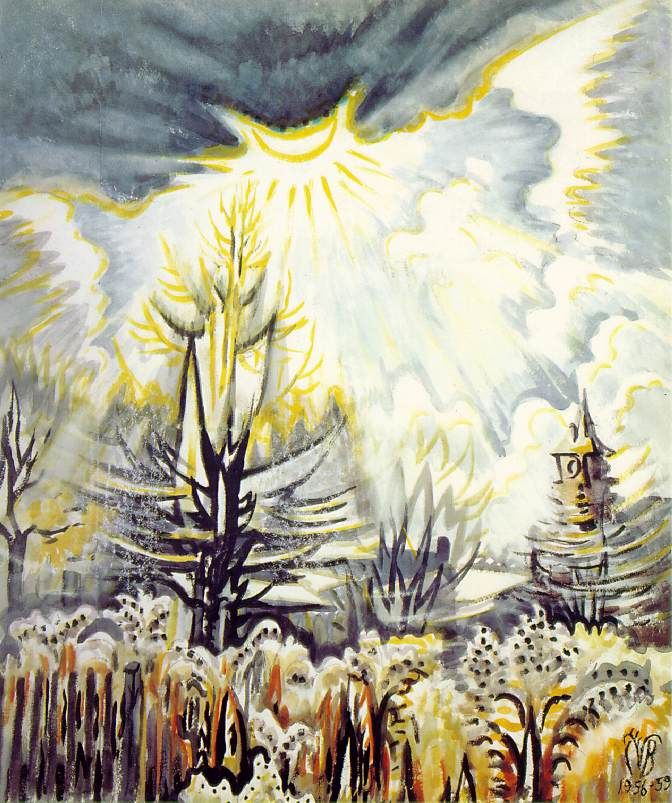
Charles Burchfield
"November Sun Emerging"
1956-59
Watercolor on paper
37 3/4 x 31 7/8 inches
"[How] can we account for that irresistible instinct in our hearts which leads us towards unity whenever and in whatever direction our passions are stirred? A sense of the universe, a sense of the all, the nostalgia which seizes us when confronted by nature, beauty, music - these seem to be an expectation and awareness of a Great Presence. [...] Resonance to the All - the keynote of pure poetry and pure religion. Once again: what does this phenomenon, which is born with thought and grows with it, reveal if not a deep accord between two realities which seek each other; the severed particle which trembles at the approach of 'the rest'?

We are often inclined to think that we have exhausted the various natural forms of love with a man's love for his wife, his children, his friends and to a certain extent for his country. Yet precisely the most fundamental form of passion is missing from this list, the one which, under the pressure of an involuting universe, precipitates the elements one upon the other in the Whole cosmic affinity and hence cosmic sense. A universal love is not only psychologically possible; it is the only complete and final way in which we are able to love."

- excerpt from The Phenomenon of Man, by paleontologist, geologist, philosopher, and Jesuit priest Pierre Teilhard de Chardin
Image credit:Burchfield image ripped from Mark Harden's Artchive

Saturday, August 01, 2009

The Endangered Species Print Project


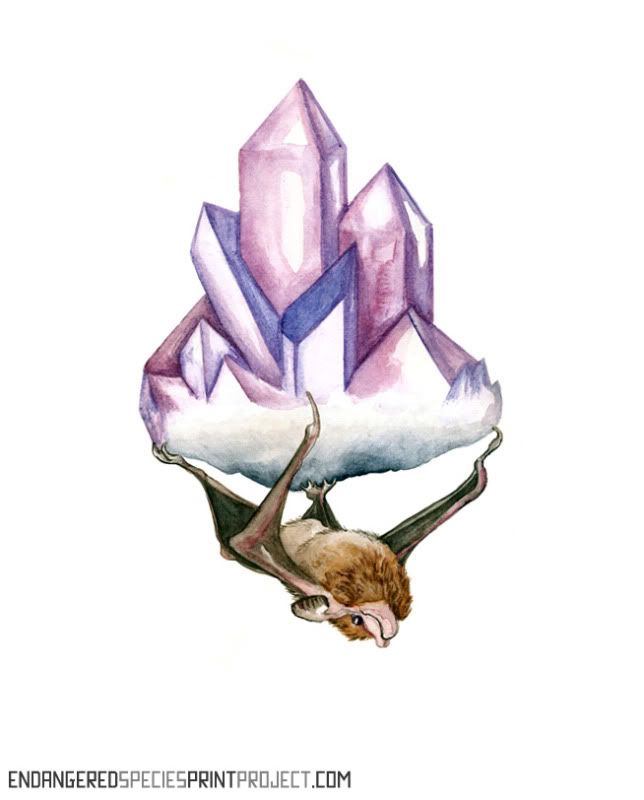
Molly Schafer
"The Seychelles Sheath-tailed Bat"
2009
Archival giclee print (Edition of 37)
8 x 10 inches

Chicago-based artists Jenny Kendler and Molly Schafer recently launched the Endangered Species Print Project. The ESPP offers limited edition prints of critically endangered species for sale to collectors, and ALL proceeds are donated to conservation programs working to perpetuate the featured species. For each print edition, the total number of prints corresponds to the featured animal's current population. For example, only 37 Seychelles Sheath-tailed bats remain in the wild, so for that edition, 37 prints will be produced.

The ESPP is already generating buzz. The Center for Biological Diversity and The Sierra Club are both promoting the project and have expressed interest in collaborating with Schafer and Kendler. I'm not surprised. The ESPP is a terrific undertaking, a fine example of the sort of environmentally and socially responsible efforts that I dearly wish more contemporary artists would involve themselves with.

As such, I'd promote ESPP even if I weren't planning to produce some prints for the project. I expect to produce two original drawings that will be turned into prints before the end of this year. My subjects will be the Javan, or Sunda, rhinoceros (Rhinoceros sondaicus) and the red wolf (Canis rufus). Also, in 2010, I hope to produce prints featuring other endangered species, including some birds, reptiles, and plants.

Prints of the following species are already available: the Panamanian Golden frog (Atelopus zeteki); the Vancouver Island Marmot (Marmota vancouverensis); the Seychelles Sheath-tailed bat (Coleura seychellensis); and the Indri lemur (Indri indri). Visit the ESPP site to learn more.

Tuesday, June 16, 2009

Passing on our gifts


Jason Middlebrook
"The Endless Outpouring Of Support"
2008
Acrylic, ink and pencil on paper
57 7/8 x 70 7/8 inches framed


For a number of years, friends have recommended that I read Lewis Hyde's The Gift. I'm finally getting around to doing so and, just forty pages into the text, I see why friends thought the book would so appeal to me. Hyde picks apart the contemporary market, particularly as it relates to commerce in art objects and other creative "commodities." In the introduction, he writes,
"A work of art is a gift, not a commodity. [...] Every modern artist who has chosen to labor with a gift must sooner or later wonder how he or she is to survive in a society dominated by market exchange. And if the fruits of a gift are gifts themselves, how is the artist to nourish himself, spiritually as well as materially, in a age whose values are market values and whose commerce consists almost exclusively in the purchase and sale of commodities?

Every culture offers its citizens an image of what it is to be a man or woman of substance. There have been times and places in which a person came into his or her social being through the dispersal of his gifts, the 'big man' or 'big woman' being the one through whom the most gifts flowed. The mythology of the market society reverses the picture: getting rather than giving is the mark of the substantial person, and the hero is 'self-possessed, 'self-made.' So long as these assumptions rule, a disquieting sense of triviality, of worthlessness even, will nag the man or woman who labors in the service of a gift and whose products are not adequately described as commodities.

[...]

A man in another tribe that [anthropologist] Wendy James has studied says, in speaking of the money he was given at the marriage of his daughter, that he will pass it on rather than spend it himself. Only, he puts it this way: 'If I receive money for the children that God has given me, I cannot eat it. I must give it to others.'"
Reading the last bit of the above excerpt, I couldn't help but think of my charitable sales model. The income that I receive from the sale of art objects I've produced is fundamentally no different from the tribe representative's "money for the children that God has given me." In this respect, it is not merely ethical, but also natural that some significant percentage of each sale be passed on, invested in turn in the good works of a non-profit organization or another conscientious individual.

Hyde points out that this pass-it-on approach is in keeping with the cycles of nature. Indeed, the words "ecology" and "economy" are etymologically connected for good reason. As I explained in an HH post in August of 2005,
"'Ecology' translates as 'study of the household' and 'economy' as 'management of the household.' Any good scientist (or thoughtful citizen, for that matter) should study the household before managing it. Thanks in no small part to my father's influence, I began to see many ecological issues as economic concerns (and vice versa). Given my environmentalist leanings, I suppose my [engagement] with economic theory was inevitable. It was also inevitable, or at least quite likely, that I would become disenchanted with our current boom-and-bust paradigm."
Moreover, Hyde points out that "the language of gift exchange has procreation at its root. Generosity comes from genere (Old Latin: beget, produce), and the generations are its consequence, as are the gens, the clans." Indeed, by damming wealth in concentrated pools, the demon market of our capitalistic culture halts the cycle of generations. The natural flow stopped, dispossessed peoples are condemned to hunger for physical nourishment and the wealthy are condemned to hunger for nourishment of the soul.

As Hyde stresses, "what is given away feeds again and again, while what is kept feeds only once and leaves us hungry." Or, as my mom always puts it, "Love and live with an open hand."

Image credit: Jason Middlebrook image ripped from the Sara Meltzer Gallery website

Thursday, May 14, 2009

A Thursday in the Holocene


Over dinner this Tuesday evening, a friend and I discussed our species' more homogeneous future. I suggested that miscegenation and intercultural activity will lead to future generations comprised of individuals that look and act more alike. In turn, violent conflict between human groups will decrease; in this world of mutts, superficial differences such as race and custom will be less visible and therefore less contentious.

My friend shares my hopeful outlook, but expressed skepticism. Citing the Rwandan genocide and the fractious political situation within Israel, he contended that greater physiological and sociological similarity are just as likely to increase conflict. Humans will always find some reason to fight, he believes, and superficial similarity will lead not to a peaceable kingdom, but instead to the exacerbation of subtle differences or the outright invention of philosophical or genetic justifications for the vilification of "the other." I can't dismiss his forecast, but if Homo sapiens sapiens survives long enough to witness that homogeneous era, our species will have learned a great deal more about cooperation. This, I feel, bodes well for the less violent prospect.

But what-if suppositions about the far distant future are of little practical value to the here-and-now. I have faith in teleological eudaimonia, but the lot of Earth's inhabitants won't gradually improve unless our policies and actions are informed principally by consideration of a more immediate future...say, one or two generations. And, although it will be a thousand years, at least, before miscegenation makes all humans mocha, our planet's ecology is right now undergoing drastic changes.

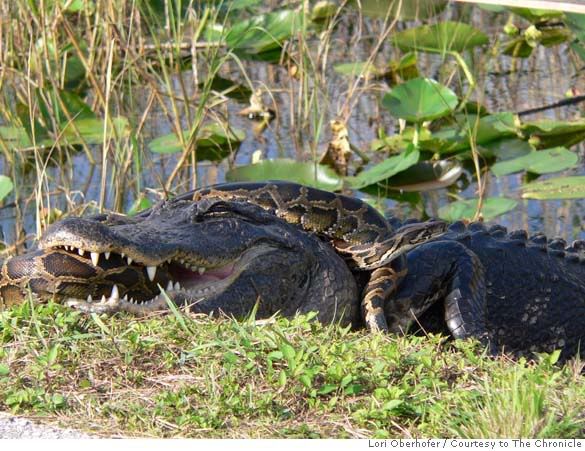
Burkhard Bilger's "Swamp Things" (The New Yorker, April 20, 2009) highlights the explosion of "invasive" species in Florida. Bilger focuses particularly on the success of the Burmese python (Python molurus bivittatus) in the Florida Everglades, but notes that a great variety of exotic species have gained toeholds in the state.
"Florida now has more exotic lizard species than there are natives in the entire [American] Southeast. On a single tree you could conceivably find plants and animals from six continents, including parrots from South America, mynah birds and Old World climbing ferns from Asia, vervet monkeys from Africa, ladybird beetles from Australia, and feral cats from Europe, via Africa and Asia. In some cases, the recent immigrants would be more genetically diverse than their cousins back home. The state's ecology is a kind of urban legend come true -- the old alligator-flushed-down-the-toilet story repeated a thousand times with a thousand species.

Some find all this thrilling. Florida has become an open-air zoo, richer in species than ever before. To others, it's the harbinger of a new and depressingly undifferentiated age, when the old biological borders begin to fade and every place starts to look like every other. Ecologists have even given it a name: the Homogecene."
Indeed, the Homogecene may soon overtake the Holocene.

Note: The post's title is a nod to Christopher Cokinos's terrific essay, "The Consolations of Extinction" (Orion Magazine, May/June 2007). In it, Cokinos
"[suggests] that our PalmPilots and DayMinders and Nature Conservancy calendars show not only year, month, date, and day of the week but also geologic epoch. It’s a Tuesday in the Holocene."
Photo credit: Burmese python and American alligator, copyright 2008, Lori Oberhofer, National Park Service

Saturday, May 09, 2009

Remembering Mother's Day


Happy Mother's Day!

The best moms (my own included) deserve much more than flowers and breakfast-in-bed for their devotion, patience and love. Yet, if they receive anything at all, most moms will today accept pesticide-smothered flowers or a store-bought card with some appropriately safe sentiment.

Our contemporary observance of Mother's Day is fairly dismissed as a Hallmark Holiday, a see-through excuse to feed our culture's unquestioning consumption of manufactured emotion. This commercial emphasis belies the holiday's courageous, feminist origins.

In 1870, when famed abolitionist and poet Julia Ward Howe made her Mother's Day Proclamation, she responded to the shocking violence of the American Civil War and Franco-Prussian War by calling for the establishment of a holiday dedicated to the cause of nonviolent conflict resolution and international solidarity. She wrote,
"Arise then...women of this day!
Arise, all women who have hearts!

...

Say firmly:
'Our sons shall not be taken from us to unlearn
All that we have been able to teach them of charity, mercy and patience.
We, the women of one country,
Will be too tender of those of another country
To allow our sons to be trained to injure theirs.'

From the voice of a devastated Earth a voice goes up with
Our own. It says: 'Disarm! Disarm!
The sword of murder is not the balance of justice.'
Blood does not wipe our dishonor,
Nor violence indicate possession.

...

Let women now leave all that may be left of home
For a great and earnest day of counsel.
Let them meet first, as women, to bewail and commemorate the dead.
Let them solemnly take counsel with each other as to the means
Whereby the great human family can live in peace...
Each bearing after his own time the sacred impress, not of Caesar,
But of God."
Amen to that.

Take the day back from the greeting card companies, moms.

Photo credit: photograph of Julia Ward Howe ripped from AmericanCivilWar.com

Friday, April 24, 2009

Of ideologues and pragmatists


Thomas Paine and Thomas Jefferson


A few months after the inauguration of President Barack Obama, many one-time "Yes we can" cheerleaders are grumbling and casting skeptical glances at Washington. Indeed, I've been disappointed by some of our new president's decisions, but I also accept his maneuvering as an unfortunate political reality.

Unlike his predecessor, Barack Obama realizes that the President of the United States should not operate as an ideologue. Of course, he (and some election year soon, she) could choose to embrace ideology over pragmatism but, in doing so, the Commander-in-Chief risks aligning himself with the sort of tyrannical autocracy that our leaders rhetorically (and routinely) condemn.

But political reality doesn't temper the poor reviews that Obama receives from many on the political left. Considering their critique of Obama's centrism, I recalled an earlier HH post. In "The Whiteness of the Whale," I wrote:
"Craig Nelson's recent biography of Thomas Paine serves as my subway reading these days, [and] I find the following observation relevant.
'Beginning with Franklin and Washington, every successful American leader would balance the pragmatic with the Utopian. Where Franklin the master politician would be almost entirely pragmatic, Paine would be too fervidly Utopian in ways that would not just damage him financially, but imperil him physically... Paine would...always be too ardent with his religion of the lights, a Savonarola of reason and liberty, and as inept a political operator as any fervid Christian saint...The success or failure of any leader in U.S. history can be judged through his or her successes or failures at reaching the pragmatic Utopian paradox that remains at the heart of the American experiment.'
Nelson's words ring true. 'The pragmatic Utopian paradox' is not uniquely American, but it is central to our American experience. For confirmation, we need look no further than the glut of contemporary, progressive American politicians striving to develop a decidedly centrist track record, even if they contradict themselves (and their conscience) in doing so. By contrast, it's easy to discard compromise and contradiction if you are a committed revolutionary or a monkish loner operating in an intellectual and philosophical vacuum."
Barack Obama qualifies as one of the "contemporary, progressive American politicians" I criticize in that excerpt. Yet, as I suggest in the same post, "outside the D.C. beltway, ideologues are a dime a dozen, but exceptionally gifted rhetoricians like Paine or King, Jr. emerge (and make [a legitimate political] impact) only rarely."

Yet even if the political impact of fringe ideology is negligible, those voices must be heard. Indeed, unpopular opinions are sometimes the most vital in a just democracy. There's a reason, after all, that liberals wring their hands when contemplating the censorship of bigoted hate speech. If you believe in the democratic fray, you're obligated to let all of society's individuals speak.

In a recent episode of the "The Thomas Jefferson Hour," historian and Jefferson impersonator Clay Jenkinson read and responded to the following Paine quotation.
'He that would make his own liberty secure, must guard even his enemy from oppression; for if he violates this duty, he establishes a precedent that will reach to himself.'
"This is how Paine would react to the Bush Administration for the past seven-and-a-half years. This is an answer to the Patriot Act, to the surveillances, to Guantanamo, to Abu Ghraib!"
Jenkinson's right. In fact, a great many of Paine's sentiments are as pertinent today as they were in the late 18th century, his abolitionist and proto-feminist writing especially so.

He may have made many political enemies in his day but, two hundred years after the turmoil of our nation's early ideological disputes, Thomas Paine's unwavering moralism aligns more closely with contemporary progressive attitudes than does Thomas Jefferson's political pragmatism. Compared to the public attitudes of the slave-owning and patriarchal Jefferson, Paine strikes the 21st century citizen as the more modern thinker and the more conscientious man.

Does it matter that Jefferson, in his private correspondence, agreed with Paine's abolitionist argument? From our vantage point (one of comfortable remove), no, it doesn't. What we consider, above all, is that Jefferson was a slave owner and that Paine was an outspoken abolitionist. 'Deeds, not creeds,' as the saying goes. But it's noteworthy that Paine was poor and unlanded, and therefore never in a position to own slaves. (Indeed, Paine was never in a position to give up slavery, power, or riches; essentially, his social standing cloistered him from temptation.) Nor was Paine a political figure; he could be strident because he didn't have to consider popular opinion or the practical effect of enacting reform.

Writing in his philosophical memoir An American Gospel: On Family, History, and the Kingdom of God, Erik Reece succinctly describes the democratic ideal to which I subscribe.
"Like [Walt] Whitman, John Dewey thought of the ideal American democracy as an 'organism,' a whole that is reflected in each of its parts - that is to say, in each individual citizen. ...As cells work together within an organism, Dewey believed individuals worked together within a good society to achieve 'a unity of will.' ...And because democracy is a social idea, it is also ethical by its very nature. Ethics, after all, begins with the realization that one is a social being and therefore part of a larger whole. A man living alone on an island requires no ethic. An aristocracy or a dictatorship could be run by only a few of its members. But the democratic organism needs all of its cells. And those cells must act simultaneously in their own interest and in the interest of the larger organism."
But Dewey was a pragmatist. Surely he realized that the democratic organism's ability to fight off infection of the malignant variety is not nuanced; the democratic immune system, if you will, acts to extinguish all radical cells. In other words, this organism is just as likely to rise up against outspoken abolitionists as it is against outspoken racists. And, indeed, history stands as a testament to this action.

Thomas Paine found an American and French populace eager to absorb his revolutionary and populist manifestos Common Sense and Rights of Man, but he was eventually ruined by his rational dismissal of Christian doctrine, The Age of Reason. His New York Citizen obituary read, "He had lived long, did some good and much harm." Much harm? Paine's progressive opinions about slavery and feminism didn't win him sustained popularity.

Jefferson, too, was a lightening rod in his day, provoking as much disdain as he did praise (especially from the Federalists and, in particular, Alexander Hamilton). But Jefferson was a savvy political operator, a master of Nelson's pragmatic Utopian paradox. Although he shared many of Paine's opinions, Jefferson did not draft legislation addressing those issues or even, because of his deism, allow his private correspondence to be made publicly available in his lifetime. Our third president carefully considered what the demos were and weren't ready to accept. Paine, the ideologue, simply didn't care.

So what will it be? Should an independent, liberal leaning citizen like myself wish for a revolutionary president, a Paine-like Obama less concerned with centrist politics, an Obama driven by moral conviction? Can I believe that such a president's radical agenda won't be consumed by the fires of reaction?

For my part, I trust that Obama is striving to foment as much progress as he safely can in our flawed, anti-intellectual democracy. I express my few disappointments by signing petitions for ads calling on Obama to address some of what I see as missteps but, above all, I'm proud of our country for electing an intelligent, disciplined and thoughtful man to the nation's highest office...and I remain optimistic.

Image credits: Thomas Paine portrait ripped from American History Guide and Thomas Jefferson portrait ripped from The World Union of Deists

Saturday, January 31, 2009

Eudaimonia

This past Saturday morning, I rode the N train into downtown Manhattan. Sitting across from me, a tired-looking father played with his young sons. Lowering my magazine for a minute, I watched the three of them. Although the boys' antics disturbed some of our fellow passengers, the father was unflappable, and cheerfully committed to the childrens' exuberance. He responded as he needed to, reining in a stray arm, hushing a piercing squeal, but also participating in the boys' adventure, pointing out curious subway details and posing fun questions about this, that and the other. When the father's eyes caught my considerate gaze, I smiled and slightly bowed my head in greeting. The man looked at me for an instant, then returned his attention to the boys. "Ours is the next stop, guys, so I want to see how you high you can jump as we get off." Each child grabbed one of their father's hands and, when the subway doors opened, they shrieked with delight as the father stepped out of the subway car and raised his arms up and out, lifting the young boys several feet off the ground. The doors closed behind them.

Thursday, June 28, 2007

Sustaining Hope


Sebastiao Salgado
Reindeer graze on Russia's Kamchatka Peninsula


After spending decades photographing the machinations of capitalism (and the resulting dereliction of places and peoples), Sebastiao Salgado "lived for about seven years in real desperation." When individuals face formidable adversity or witness untenable horrors, they often turn to religious fellowship for solace. Indeed, the tribal communion of shared faith is a principal reason for religion's evolutionary success. Salgado found hope, however, not in prayer meetings or the Eucharist but in the natural world, in particular the outlying, inhospitable places - the poles, the deserts, the deep rain forests - and the indigenous societies, human and non-human alike, which occupy these regions. His current, on-going series, entitled "Genesis," is a testament to the remarkable restorative powers of Nature.
"I believe that these very political issues are all tied together. When I go to make these Genesis pictures — it’s not that I wanted to become photographer of exotic animals, not that I wanted to do landscape. I worked a lot when I was considering this project with Conservation International, and from them I get [the figure] that 46 percent of the planet is there like the day of Genesis. It is for this that I’m looking. It’s fabulous, to show to the people that live in Los Angeles, San Francisco, New York, anywhere, who imagine that all the planet is destroyed. There is good news, very hopeful news: 46 percent is there yet, not including the oceans. Of course, that is not the majority, the majority we exploit."
Today, Salgado is a glass half-full kinda guy and the Genesis photography project helped rescue him from despair.


Sebastiao Salgado
Sun over Namib Desert


Salgado fortified his hope by turning his attention to the land. A cultivated appreciation of the world that birthed us and sustains us (cultivated, in this case, by shedding many of contemporary culture's prejudices and fears) allows us to more fully adopt an integrated worldview. To do so, we must be honest; we must include strip mines, genocide and industry, all products of our special exuberance, in this cultivated consideration. This is the first step in developing a philosophy that might lead to a fundamental restructuring of our globalized economic system. More importantly, the sort of experience one has when you connect to the whole, or as I call it, the Everything, reminds us that the promises of immortal salvation are irrelevant. This life - indeed, this very moment - is worth innumerable afterlives. If we, as a culture, awaken to that truth, sustainability might yet be, well, sustainable.


Sebastiao Salgado
Himbas mother and child with dog, Namib Desert


Photo credits: all images, Sebastiao Salgado; dates vary