Showing posts with label optimism. Show all posts

Wednesday, June 26, 2013

Sci Foo On My Mind

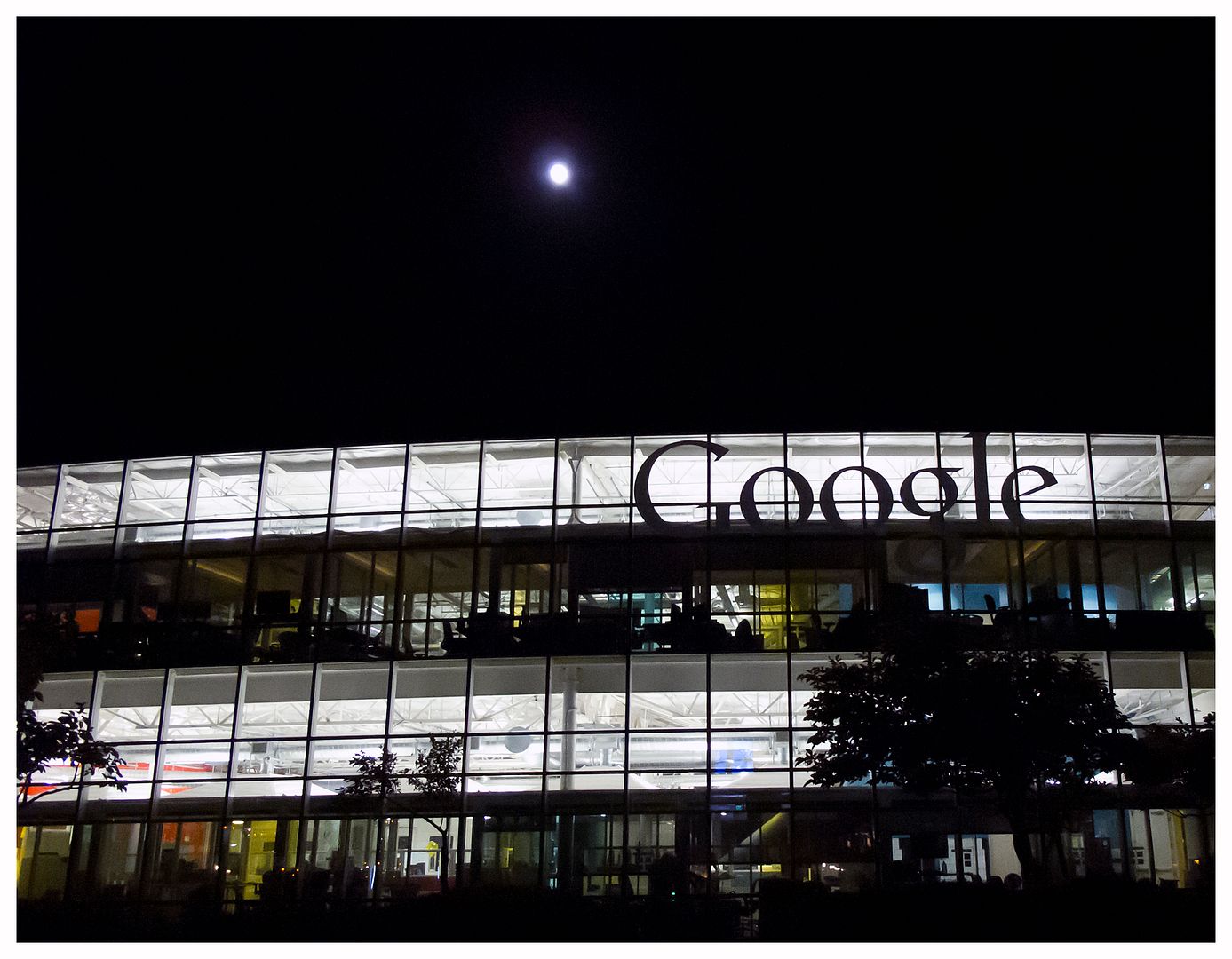
Summer solstice moon over the Googleplex; Mountain View, CA; June 2013

My father-in-law is a glass-half-full kinda guy. In the midst of any conversation about science, medicine, or technology, it's not uncommon for him to proclaim, "This is an exciting time to be alive." Indeed, it is. But when I fell into bed early on Sunday morning, my head giddy with ideas from the first full day of Sci Foo Camp, my father-in-law's optimism seemed understated. Spend 48 hours with -- to list just a few of the approximately 250 participants -- a computer scientist studying machine learning and music, a theoretical physicist turning the idea of gravity on its head, a marine biologist eager to solve the mysteries of whale sharks, a genomic epidemiologist intent on elucidating outbreak transmission dynamics, and a national security strategist currently implementing the White House's terrorism-related information sharing priorities and...well, you come away with much to ruminate on and a lot of notes to parse. In short, Sci Foo Camp made for an extraordinary weekend!

Monday, June 17, 2013

Off to Sci Foo this weekend!

I'm excited to head to the Googleplex this coming weekend for Science Foo Camp! Usually referred to as Sci Foo, the eight-year-old invitation-only "unconference" is organized by Google, the science journal, Nature, Digital Science, and O'Reilly Media. Sci Foo brings together "between 200 and 300 leading scientists, technologists, writers, and other thought-leaders at the Googleplex for a weekend of unbridled discussion, demonstration, and debate." (You can learn more about SciFoo here.)

Selene and I were invited because of the BAASICS mission, and I'm pleased to see that one of the proposed SciFoo sessions is titled "Building Better Art-Science Partnerships." Naturally, we're looking forward to engaging in lively, informative conversations with other participants about the art-science interface and to explaining what it is we aim to do with BAASICS and why we feel it's so important. That said, while BAASICS got me invited, I'm super jazzed about attending (and perhaps participating in) many of the other sessions that have been proposed. A few of my favorites:
- Using Emerging Technologies to Advance Conservation
- Science Advocacy
- Rethinking National Security
- Defragging Government (How Can Scientists and Engineers Help?)
- Science and Popular Skepticism
To my way of thinking, Sci Foo's interdisciplinary angle and relaxed format are outgrowths of Bay Area culture, a place where idealism, art, science, and technology commingle, often with exciting results. I'm encouraged to see sessions like "DeFragging Government" on the list, and I have the impression that many of the Sci Foo participants recognize our responsibility -- both that of the individual and the group -- to be active beyond our more particular spheres.

BAASICS will be live tweeting from the event and I'll provide a short update -- with photographs -- after my return.

Image credit: ripped from the Sci Foo Camp website

Wednesday, September 22, 2010

The RSA's "21st Century Enlightenment"


Sure, the video is 11 minutes long, well over the too-long-to-watch mark for readers casually trolling the blogosphere, but it's worth bookmarking and saving for later. (In fact, I encourage you to watch it on YouTube or the RSA website, as the resolution is better than that of the above embed.)

The ideas articulated are vital and might provide some solace for those of you who, like so many of my friends, suffer from political apocalypse syndrome! Moreover, the animation is terrific and the narrator, like the Royal Society for the Encouragement of the Arts (RSA), is British, satisfying the Anglophile in all of us.

Enjoy.

(Thanks to Michael McDevitt for turning me on to this RSA video.)

Sunday, September 05, 2010

ESPP at Chicago's Renegade Craft Fair


The Endangered Species Print Project will be exhibiting at the Renegade Craft Fair, taking place this September 11th and 12th, in Chicago.

Co-founders Jenny Kendler and Molly Schafer will be selling prints to raise funds for all of the fourteen species so far featured in ESPP prints, as well as some upcoming print subjects, including my red wolf (Canis rufus).

I'm pleased to report that, to date, the ESPP has raised $4,000 for critically endangered species, and hopes to raise another $6,000 at Renegade! If you're in or around the Windy City, please pay them a visit.

Friday, May 21, 2010

Changes


View of Empire State Building; Manhattan, NYC; May 2009

As I prepare to move from New York City, my home for over a decade, to San Francisco, my home for at least a few years, I find myself viewing NYC through the eyes of a man in limbo. I'm still living in Queens, but my attention is already on the road.


Vacant lot; East Village, Manhattan; May 2008

A decade of NYC living makes me, by at least one standard, an official "New Yorker." How does that define me? New York, like all conurbations, is ever in flux. On my watch, it's changed in remarkable ways. What changes will come after I'm no longer a resident? Likewise, what changes are yet in store for me, a similarly adaptable organism?


Samuel Cohen Son graffiti; East Village, NYC; April 2010

I moved to New York City in October 1999, not long after I graduated from The College of William & Mary. I was then an ambitious twenty-one year old with a deeply cynical streak and an abiding love of beer and partying. My paintings and drawings featured naked people interacting in various ways with other animals, medical instruments, fossils, and, on occasion, Teletubbies. (If a reader knows what became of the big Tinky Winky sex painting, I'd love to see a photo of it!) Despite my apparent enthusiasm, I was steeped in melancholy. I spent hours each week brooding over "I," my pet novel project, a 1990s East Village vampire update of Hermann Hesse's Steppenwolf. I viewed humanity as a noxious species, religion as the most noxious of human inventions, and I not so secretly looked forward to our inevitable extinction.

Today, I'm an ambitious thirty-two year old who reacts against cynicism, drinks much less, and generally dislikes partying. Naked people sometimes appear in my paintings, but there aren't any Teletubbies. I'm a stubborn optimist. Each morning, I take twenty minutes to humbly celebrate a new day; if I wake in a funk, I fight through the fog to see anew just how marvelous life is. I recall my earlier character with some embarrassment. What was wrong with the arrogant kid who labored on a novel that painted such an ugly picture of humanity and religion? Perhaps he just needed to be more intellectually rigorous, and to open his eyes to the awesome fact of being? Or maybe that twenty-one year old also needed a good hug, which is no small thing?


Greenpoint, Brooklyn; May 2009

My time in New York City has seen me metamorphize from a hardened and cynical adolescent into an optimistic, joyful adult. The direction of this evolution runs counter to the standard assumption made about the effect of NYC living. As the columnist Mary Schmich warned (and director Baz Luhrmann popularized with his song "Everybody's Free (To Wear Sunscreen)"),
"Live in New York City once, but leave before it makes you hard; live in Northern California once, but leave before it makes you soft."
In my experience, however, NYC living sanded smooth the hard edges.


Wollman Rink; Central Park; Manhattan; June 2008

Perhaps, too, the mournful and nostalgic wails of NYC residents (myself included) are misguided? We should accept that "what will come, will come" without falling victim to fatalistic impotence. New York City (and Manhattan, in particular) is one of the most sustainable, environmentally responsible cities in the world, and its educated, informed residents should work with New York State and City representatives to make sure the city continues apace on that front. They should also do all they can to ensure that it remains a mecca for tolerance, the arts, and cultural pluralism. In what ways I can, I'll do the same from the Left coast; New York City is a part of me, and I will always feel a part of New York City.

Love and peace to all of my friends here. Thank you for everything. I'll be in touch. I'll visit. I hope that you'll visit me.


Upper New York Bay from Staten Island; May 2008

Image credits: all photography, Hungry Hyaena

Sunday, May 16, 2010

Susan Silas' Heroic Living


Susan Silas
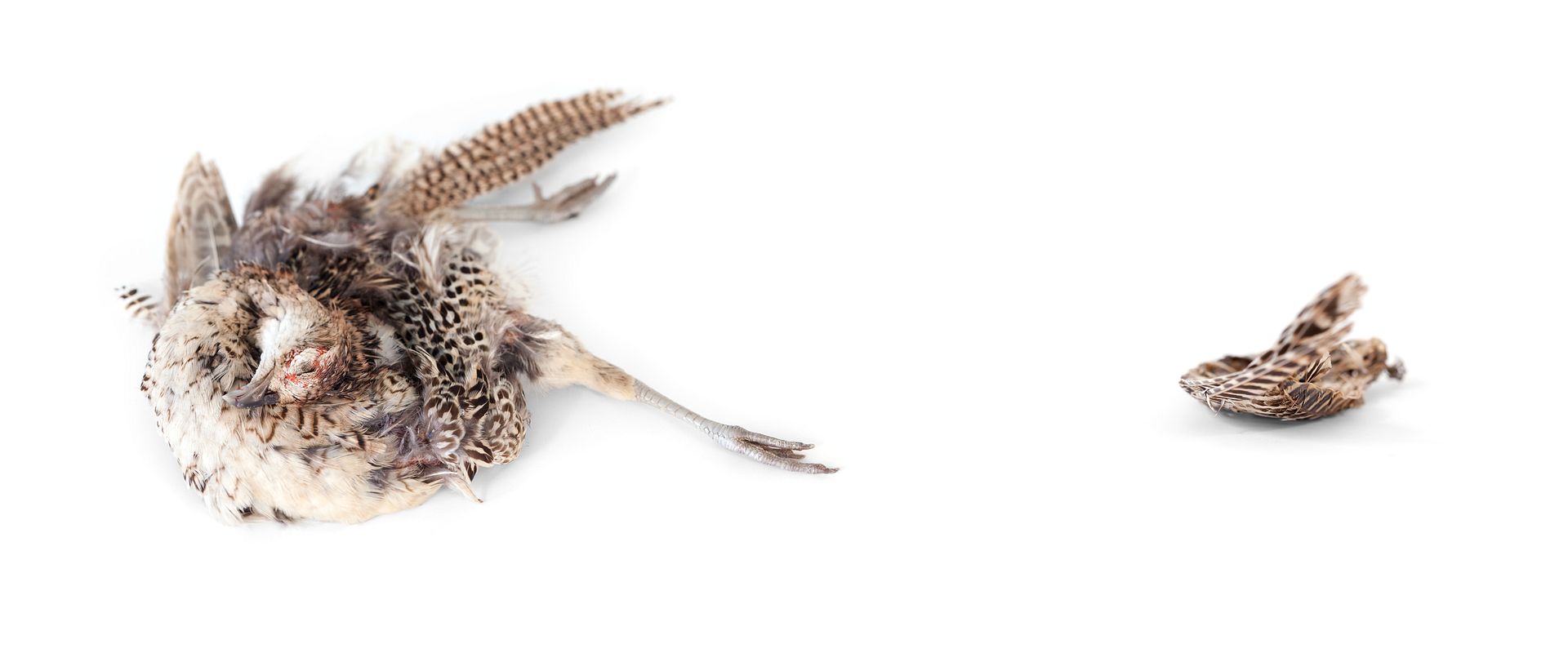
"found birds; 2000 - the present"
(Image 17 of 23 from the portfolio "eyes wide shut")
2010
Archival ink jet prints on Hahnemühle photo rag paper
22 x 17 inches

Until recently, I was unfamiliar with Susan Silas' artwork. She is perhaps best known for projects memorializing the Shoah, but it wasn't an awareness of her Holocaust work that led me to "Helmbrecht's Walk, 1998-2003." Instead, it was a photograph of a dead American kestrel that Silas emailed me in March.

I have only an inkling of what essay or artwork of mine inspired the artist to send me the image, but I'm grateful that she did. I shamelessly admit to being the sort who finds soulful beauty in images of death, and I was touched by the striking and contemplative photograph. A month after I received the picture, I visited Silas in her Brooklyn home, to look at prints from her "found birds" series. Still pondering her work a week after that visit, I headed to Hebrew Union College's Jewish Institute of Religion Museum, eager to compare what I saw and sensed in "found birds" to Susan's more easily classifiable (though by no means "easy") Shoah work.


Susan Silas
"found birds; 2000 - the present"
(Image 3 of 11 from the portfolio "what remains")
2010
Archival ink jet prints on Hahnemühle photo rag paper
20 x 48 inches

The HUC press release for "Helmbrecht's Walk" describes the project succinctly.
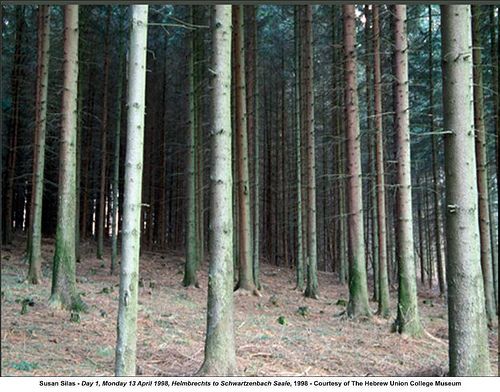
"On April 13, 1945, more than 700 women were forced to march 225 miles in 22 days from the Helmbrecht's Labor Camp, a small satellite unit of the Flossenburg Concentration Camp in Germany, to the Czech city of Volary. [...] During the course of this forced march the women were ill fed, inadequately clothed, denied shelter, and capriciously beaten. On the sixth day of the march, the non-Jewish prisoners were separated from the group, leaving the remaining 580 Jewish women to continue until May of 1945.

With determination and sensitivity, Silas traced the march in 1998 on the 53rd anniversary of the event by walking along the same path as the Helmbrecht's women for 22 days in Germany and the Czech Republic. She documented her journey in Helmbrecht's Walk, a collection of 48 archival color prints presented as an unbound book. [...] The images contextualized by Silas' daily commentary of her own experiences are coupled with news reports of event occurring elsewhere in the world on that same day in 1998. This juxtaposition, she says, functions 'to heighten our awareness of the fact that we are all presently witnesses to unspeakable events and extreme suffering for which we take no more responsibility than did many witnesses to the Holocaust.'"
Silas' project addresses the complicated relationship between place and time or, as cultural critic and historian Simon Schama's consideration of the topic framed it, "landscape and memory." When Silas conceived of the Helmbrecht's project, she believed (or maybe hoped) that walking the same path that the Helmbrecht's women had would allow her some intimate experience of or insight into the terrible march. In fact, this didn't prove so. Silas describes her walk as "relatively mundane and unexceptional." She continues, "My feet hurt. I get tired. [...] I found it more, rather than less difficult to understand how these women made this journey once I was out on the road."


Susan Silas
"Helmbrecht's Walk, 1998 - 2003"
(Day 1, Monday 13 April 1998, Helmbrechts to Schwartzenbach Saale, 1998)
Archival ink jet prints on Hahnemühle photo rag paper

Yet many of the captions she includes with the photographs reference artists and thinkers such as Werner Herzog, who understand "walking as a sacrament." Such language calls to mind the Australian Aborigines' songlines, mnemonic stories that are spoken or sung as the Aborigine walks over the referenced terrain. In his marvelous book Spell of the Sensuous, David Abram relates a striking, relevant anecdote.
"A similar tale is told by [Bruce] Chatwin. He was traveling in a Land Cruiser with several friends, including an Aboriginal man nicknamed Limpy whom they were driving to a particular place on his songline. Limpy, whose clan Ancestor was the Native Cat, or tjipla (a small marsupial with a long, banded tail), had never been to this place along the Native Cat songline, yet he now wished to go there in order to see some distant relatives who were dying there. During the course of seven hours driving through the back country, bumping across shallow rivers and under gum trees, the Aboriginal man sat motionless in the front seat, squeezed between the driver, Arkady, and another passenger, except for a short burst of action when the truck crossed part of his songline. Later,
'[w]e came to the confluence of two streams: that is, we met the stream we had crossed higher up on the main road. This lesser stream was the route of Tjilpa Men, and we were joining it at right angles. As Arkady turned the wheel to the left, Limpy bounced into action. Again he shoved his head through both windows. His eyes rolled wildly over the rocks, the cliffs, the palms, the water. His lips moved at the speed of a ventriloquist's and, though them, came a rustle: the sound of wind through branches.

Arkady knew at once what was happening. Limpy had learnt his Native Cat couplets for walking pace, at four miles an hour, and we were traveling at twenty-five. Arkady shifted into bottom gear, and we crawled along no faster than a walker. Instantly, Limpy matched his tempo to the new speed. He was smiling. His head swayed to and fro. The sound became a lovely melodious swishing; and you knew that, as far as he was concerned, he was the Native Cat.'"
I believe that what was missing for Silas was a story line, the narrative informed by the landscape (and vice versa) that, among indigenous groups such as the dwindling Aboriginal population of Australia, is traditionally passed from generation to generation. In some respects, "Helmbrecht's Walk" is an attempt to locate such a story, an earnest effort to discover in the landscape the marks of what happened decades before. In our postmodern, peripatetic culture, nations and traditions do not generally fare well. In some respects, this is a positive development, as our tribal perspectives and prejudices erode into some variety of tentative, liberal pluralism. On the other hand, it's ever more difficult to feel confident about one's identity and how it relates to landscape, vocation, and nation.

My time with "Helmbrecht's Walk" confirmed my supposition, however, that Susan's art is not primarily interested in cultural identity or particular histories. Instead, she is most concerned with "the big questions." To one degree or another, all art wrestles with or reacts to these existential imponderables, but Susan's exploration is more focused and urgent than most. Fortunately, even though her work is preoccupied with mortality and meaning, she manages to avoid the pitfalls of such terrain; her work is neither macabre nor aestheticized to the point of anesthetization.


Susan Silas
"found birds; 2000 - the present"
(Image 1 of 21 from the portfolio "blackbird")
2010
Archival ink jet prints on Hahnemühle photo rag paper
22 x 17 inches

Two days after I visited "Helmbrecht's Walk," I read "Eudaimonia, existentialism, and the practice of medicine," an essay by Dr. Andrew Radu included in the Spring 2010 issue of The Pharos of Alpha Omega Alpha Honor Medical Society. In his essay, Dr. Radu describes the existentialist ideal of tragic optimism. He writes of it, "even in the face of imminent death, we have the ability to reevaluate life." He goes on:
"A crucial concept held by many existentialist philosophers is that of heroic living. All humans have the ultimate freedom to live boldly in the face of tragedy. Living with this concept makes attaining a goal of eudaimonia less important than simply striving to do so. [...] The concept of tragic optimism proposes that in a life that can be circumscribed by pain, guilt, and death, one should say 'yes to life in spite of everything.'"
Indeed, as I wrote in "Eudaimonia," a January 2009 essay that explored my then nascent optimism,
"Acknowledging our species' precarious position is not defeatist; on the contrary, accepting the inevitable nourishes the individual's desire to contribute. Faced with an impossibly difficult prospect, only individual effort can sustain us. As Albert Camus concluded in The Myth of Sisyphus, 'The struggle itself is enough to fill a man's heart. One must imagine Sisyphus happy.'"
The Shoah is bleak history, a subject watered by the blood of millions, and it is fertile soil for such "big questions." Silas' "found birds" remind us that so, too, is the striving and passing of a blackbird. The artist's reckoning with death is her own form of "heroic living."

Image credits: all artwork, courtesy Susan Silas

Friday, April 23, 2010

My Favorite Things


While I agree that "raindrops on roses and whiskers on kittens" are wondrous, it is the "bright copper" Voyager 1 disc and Antikythera mechanism that I count among my favorite things, each a hopeful and beautiful item that manifests our species' exceptional capacity.

In January 2009, I wrote here that I'd been possessed of a curious "bout of optimism [that] seemed remarkable in both duration and degree." Over a year later, that eudaimonia hasn't let up. I'm beginning to believe that I've simply grown into an incredibly upbeat man. That, too, is a wondrous, happy thing, worthy of making my short list.

So here's hoping that, even in this era of relentless, up-to-the-minute news from around the globe (much of it depressing), we can keep our eye on the ball, so to speak. The possibilities are beyond reckoning. It isn't naive to think so; rather, it's naive to think otherwise.

Image credit: Antikythera mechanism image ripped from the New York Times, but was produced by the School of Physics and Astronomy, Cardiff University

Wednesday, February 03, 2010

"Inherited Purpose and Pattern"


William Kentridge
Still from "History of the Main Complaint"
Animation
1996

I enjoyed reading Calvin Tomkins' recent profile of William Kentridge ("Lines of Resistance," The New Yorker, January 18, 2010). Tomkins includes some fascinating details about Kentridge's background and family, and I especially appreciated some of the remarks made by the artist. The following quotation was particularly resonant.
"[Working in South Africa,] I was aware of Joseph Beuys - Beuys and his honey pump, which was supposed to be political art. But politics is not spreading honey around the main building at the Documenta art exhibition. It's putting electrodes on people's testicles, locking them up, putting them in fear of their lives."
Kentridge acknowledges his South African perspective (the artist was born into a state of apartheid and is today living through its often grim aftermath), but his observation also speaks to the general disconnect between so much 20th century fine art and "the real world."

Both modernism and postmodernism prioritize iconoclasm and individual achievement over "a system of inherited purpose and patterns."(1) It's thoughtless to dismiss the sibling -isms (both offer valuable insights and fundamentally inform our contemporary world), but the march of globalization is revealing the societal impotence of the philosophies. Absent "inherited purpose" and narrative, postmodern community is soulless, a mere facade. One of many casualties, the artist is but a mote in a vast and turbulent sea of competing sentiments and ideologies. Graphic design and advertising occupy the popular position once given to fine art, but, excellent though some of both may be, these are commodity driven disciplines; as such, they can make no genuine claim to political or moral coherence.

Still, I don't believe that we should bemoan our station as the end of the line. Globalization is in its infancy, and the 21st century will likely see a new concept of cosmopolitan citizen emerge, one that could usher in an era of shared mythos. Back to the future, so to speak.

(1) This definition of pre-modern art is drawn from Adam Gopnik's fantastic essay, "Van Gogh's Ear." (The New Yorker, January 4, 2010)

Thursday, November 12, 2009

Tikkun Daily Art Gallery Feature


Christopher Reiger
"the bird opened its eyes as I did mine"
2009
Watercolor, gouache, acrylic, pencil, sumi ink and marker on Arches paper
27 x 32 inches

I'm happy to announce that my artwork is featured in Tikkun Daily Blog's art gallery.

Tikkun Daily introduces readers to contemporary art "that critiques the pretensions and cruelties of our materialistic and self-centered culture, as well as [... teaches] us something new about politics or spirituality."

From the site's art gallery mission statement:
"Why does so much art these days lack social, political, and spiritual depth? The idea for this gallery arose from our yearning for images that are deeply moving, nourishing, and provocative.

It often seems that 'realism' in any of the arts has come to mean painful realities: the things we would rather cover over, the rapes and violence and harshness, the dirt and poverty. We’d love to see uses of the term that also referred to love, empathy, wonder, beauty, recovery. Those are real too. They happen. But love and empathy [...] are often portrayed with Hallmark-card sentimentalism, or in some unreal way.

This art gallery is a space for images of peace, hope, and social transformation that are fully grounded in an awareness of the suffering that exists in our world."
Please visit Tikkun Daily to read Philip Barcio's "Beast's Burden: Paintings by Christopher Reiger." I encourage you to also check out the work of the other artists so far featured on the site, and to learn more about Tikkun Daily here.

Image credit: Christopher Reiger, 2009

Wednesday, September 16, 2009

Kimmel Harding Nelson Residency: Day 10


Jefferson Sculpture
Lewis & Clark Visitors Center; Nebraska City

Naturalists, Puritans, and New Territories
"I think our governments will remain virtuous for many centuries; as long as there shall be vacant lands in any part of America. When they get piled upon one another in large cities, as in Europe, they will become corrupt."

- Thomas Jefferson, 1787
The American polymath Thomas Jefferson ranks highly in my pantheon of heroes. Yeoman farmer, architect, inventor, philosopher, naturalist, Virginia gentleman, and statesman, Jefferson defies easy classification. His political pragmatism and philosophy reflect his broad excavations, and the complex of sometimes contradictory ideas that Jefferson put down over the course of his long life allows his legacy to be fairly claimed by contemporary pundits of every stripe. His name and statements are marshaled to support causes across the political spectrum, including state's rights, internationalism, provincialism, gun control, the right to bear arms, unregulated capitalism, anarchy, secularism, and even the call for the United States to be officially deemed "a Christian nation." It is not, however, Jefferson's nuanced political philosophy that is responsible for his cultural ebb; he was a slave-owner and a patriarchal figure who decried "intellectual women." By today's standards, he was a deeply flawed man. But Jefferson died 183 years ago. It is wrongheaded to dismiss the whole of the man for latter-day sins. In any case, his accomplishments and legacy are profound.

Jefferson was irredeemably curious and hopeful. The man's hunger for knowledge and his faith that the human lot can forever be improved upon vitalize the Jeffersonian heritage. The Enlightenment-inspired, exuberant optimism of Benjamin Franklin, Joseph Priestley, Thomas Jefferson, and others in their mold watered the soil of American social, political, and technological revolution. And, as I wrote two days ago, "it's a happy wonder to contemplate [...] the maturation and proliferation of human technology." But at what price did so much "happy" change come?


Mandan Fort recreation
Lewis & Clark Visitors Center; Nebraska City

President Jefferson, in March of 1803, commissioned Captain Meriwether Lewis to lead the Corps of Discovery with William Clark. Jefferson obtained federal funding for the expedition on the grounds that, if successful, Lewis and Clark might "offer the most direct and practicable water communication across [the] continent for the purposes of commerce," but the president's principal interests were other. He wrote to Lewis,
"The object of your mission is to explore the Missouri River. [...] Objects worthy of notice will be the soil & face of the country, it's growth & vegetable productions, especially those not of the U.S.; the animals of the country generally, & especially those not known in the U.S., the remains or accounts of any which may be deemed rare or extinct; the mineral productions of every kind; but more particularly metals, limestone, pit coal, & saltpetre; salines & mineral waters, noting the temperature of the last, & such circumstances as may indicate their character; volcanic appearances; climate, as characterized by the thermometer, by the proportion of rainy, cloudy, & clear days, by lightening, hail, snow, ice, by the access & recess of frost, by the winds prevailing at different seasons, the dates at which particular plants put forth or lose their flower, or leaf, times of appearance of particular birds, reptiles or insects."
Historians suggest that the excitement Jefferson felt on the eve of this great expedition was quite real. His impetus was curiosity, not Puritan conquest.


Mt. Zion African Methodist Church yard
Mayhew Historic Village; Nebraska City

The Pilgrim settlers of this country had little curiosity about the natural history or native peoples of their "New World." William Bradford, five-time governor of Plymouth Colony from 1621 - 1657, described (what little he knew of) the North American continent as "a hideous and desolate wilderness." Jefferson, by contrast, wrote that "there is not a sprig of grass that shoots uninteresting to me." He saw the natural world as an Eden to be studied and, as author Erik Reece describes it, as "an antidote to the deadening forces" of civilization. For Jefferson, the notion of "God and country" was shaped by topography and the human place in it.

But Lewis and Clark's great voyage of discovery didn't simply educate Americans living east of the Appalachian spine about the continent's interior and western Edens. It paved the way for mass migration, mass slaughter, and mass industry. What happened on this vast continent parallels the greater history of mankind and, indeed, of all life.


Bison diorama
Lewis & Clark Visitors Center; Nebraska City

Historian Daniel Boorstin wrote in 1953 that, "the genius of American democracy comes not from any special virtue of the American people but from the unprecedented opportunities of this continent." Similarly, the remarkable evolution of the human ape, from tree-dweller, to hunter-gatherer, to agriculturist, to civilized man, comes from no special virtue of our species, but from the unprecedented opportunities of this Earth. One thing, as it were, led to another, and our species proved able and willing to exploit to the fullest extent. Loren Eiseley writes, in The Immense Journey,
"The stolen energy that would take man across the continents [as a hunter-gatherer] would fail him at last. The great Ice Age herds were destined to vanish. When they did so, another hand like the hand that grasped the stone by the river long ago would pluck a handful of grass seed and hold it contemplatively. In that moment, the golden towers of man, his swarming millions, his turning wheels, the vast learning of his packed libraries, would glimmer dimly there in the ancestor of wheat, a few seeds held in a muddy hand."
So it was with North America. The "meteoric, messy, and astonishing history" of the United States was fueled, above all, by a distinctly un-Jeffersonian conquest of the land's native peoples, animals, and resources.

Near the end of his sweeping ecological history of North America, The Eternal Frontier, Tim Flannery writes,
"During the nineteenth century, [...] the European Americans were developing a new economy. It was an economy based on systems of mass production and mass exploitation that needed enormous resources to operate. The key decade was 1880-90, for only then did European machinery become sophisticated enough to destroy the great herding and flocking species [the passenger pigeon, the American bison, and the Eskimo curlew]. Their enormous numbers provided an ideal teething rusk for an economic machine that would soon produce cars in the millions and hamburgers in the billions."
We devoured the continent.


Fake Prarie Dog burrows and mural
Lewis & Clark Visitors Center; Nebraska City

What allowed for this? What became of the Enlightened foresight of the founding minds? How did we move, in one hundred years, from Thomas Jefferson to Henry Ford? And could we have made such astounding, "happy" progress in human rights, suffrage, and science without surrendering to this demonic appetite? There is no tidy answer to these questions and, in any case, it's irresponsible to wade in what-might-have-been when you can instead strive toward what-yet-could-be. Still, the history perplexes.

Jefferson bemoaned the Christian scriptures' inclusion of miracles and the emphasis, in Christian doctrine, on the afterlife. Erik Reece explains in An American Gospel that Jefferson realized,
"the more Christian fundamentalism emphasizes that the kingdom of God awaits as a reward in the afterlife, the more it ignores [...] Jesus' teachings of how we should act while we inhabit this earthly realm. [...] The relevance of Christianity to most Americans has far more to do with the promise of eternal salvation from this world."
Jefferson's famous and sensible solution was to edit the Christian New Testament, deleting any and all miracles, including the Virgin Birth and the Resurrection. He called the result "The Life and Morals of Jesus of Nazareth." Today, the book is best known as "The Jefferson Bible." Perhaps, if more good Christians had followed their incarnate God's example and teachings in this life - the one that actually matters! - the west would have been settled in accord with the land. Unfortunately, most in our "Christian nation" don't know of Jefferson's earnest effort to save Christianity from other-worldly supernaturalism, from, as he called Puritanical ministers, "the soothsayers and necromancers."

Neither do most Americans know of Jefferson's effort to temper our faith in industrialism. Jefferson's agrarian dream for America was impossible; the United States was then and is now a burgeoning country, and true pastoralism can only ever be embraced on a small scale. But we would do well to remember Jefferson's vision, to remember that we are part of a greater system, and that the expiration date for America's frontier mentality, its faith in boldly going and exploiting, is past.

Despite our exceptionalist tendencies, our nation is like any other. Every nation is a tiny part of the greater superorganism, and every nation's story is a life cycle. The sprawling, arrogant United States is no longer an adolescent, and it can't afford to continue acting like one, to continue "lighting out for the territories." If we fail to mature, our reckless faith in what lies over the next mountain, in the future and in the afterlife, will prove our nation's undoing. It is faith in what exists here and now, in the place where we stand, that needs resurrection.


Missouri River Overlook
Lewis & Clark Visitors Center; Nebraska City

Most Americans are estranged from their own nature, as well as from the nature all around them. Reece writes,
"[We are estranged from] the sources of our food, the sources of our clothes, and the sources of the energy that run our homes. Beyond these basic needs, money and corporate influence have estranged us from our own government. Our isolation within suburban homes has estranged us from our neighbors and communities. [...] Cars have estranged us from our own bodies. [...] Our modern condition of estrangement has led us to live in ways that show a remarkable abdication of responsibility."
Reece proposes that Aldo Leopold's philosophy "carries us back into an ethic of responsibility." I agree.

Leopold, the godfather of modern conservation, inherited Jefferson's dream. Like Jefferson, he was a Romantic pragmatist, a type as well-suited to diplomacy as to conservation. Leopold acknowledged that resource use, like the economy, can be regulated thoughtfully, but the Romantic in Leopold was dismayed by the dark side of our equating land with money. He wrote,
"I suspect that the forces inherent in...economic evolution are not all beneficent. Like the forces inside our own bodies, they may become malignant, pathogenic. I believe that many of the economic forces inside the modern body-politic are pathogenic in respect to harmony with land."
He deemed his heroically optimistic response to the increasing pressures of population and market a "land ethic." Despite the difficulties of cultivating such an appreciation of the natural world in the twentieth century, Leopold persisted.
"That land is a community is the basic concept of ecology, but that land is to be loved and respected is an extension of ethics. [...] A land ethic, then, reflects the existence of an ecological conscience, and this in turn reflects a conviction of individual responsibility for the health of land. [...] We can be ethical only in relation to something we can see, feel, understand, love, or otherwise have faith in."
The American estrangement from land and from the rest of nature (including the dark, interior wilderness of the psyche) is redressed through cultivation of a land ethic. And, in so far as I am "happy" to contemplate the incredible rate of technological evolution, I am made happier still by the prospect of a mature, tempered America.


Vacant lot on Central Avenue; Nebraska City

This morning, I sat for a while and talked with an older gentleman in Long Home Coffee Shop, on Nebraska City's Central Avenue. A retired physicist, he expressed concern about the future of America and, more generally, of the human species. "It's all terribly depressing," he observed. "I have my good days and my bad," I concurred. "But the bleak pessimism is more rare than it was, just because it's unproductive." He nodded, and his heavy eyes seemed to say both, 'Thank goodness for the optimism of youth!' and 'Bloody damned fool!'

But I'm not a fool, and neither is he. An hour after we talked, as I sat at a table scribbling the notes that became this essay, he attended, in the back room of the coffee shop, a meeting regarding the construction of a community garden at the west end of town. The city has provided the group with a vacant lot, a local corporation will provide the initial revenue for construction, and the garden will be tended and managed by volunteers, providing food for those in need.

Now that, I contend, is positively Jeffersonian!

Photo credits: all photos, Hungry Hyaena, 2009

Friday, September 11, 2009

Kimmel Harding Nelson Residency: Day 5


Chicken coop breed variation display; River Center Nature Center; Nebraska City

What accounts for the amplified patriotism that I feel? This American ardor is not specific to my time in Nebraska City. Over the course of the last year, my national pride has swelled, even as I'm daily disappointed by the reactionary ignorance of so many fellow citizens. Still, in this smallish, midwestern town, I am acutely aware of my American identity.

Perhaps Nebraska City's abundant reminders of our nation's meteoric, messy, and astonishing history forefront my appreciation for my peoples' achievements? Or perhaps it is the love of place reflected in the town's twelve museums, each one a heartfelt labor?


Upstairs annex; River Center Nature Center; Nebraska City

Consider, for example, Joe Voges' River Country Nature Center. Voges, born 96 years ago in Nebraska City, began learning the craft of taxidermy in 1933, at 20 years of age. 47 years later, in 1975, he opened the Nature Center, a collection of mounted wildlife - 90 percent of the taxidermy on display is his handiwork - grouped into natural history dioramas and educational exhibits. In 2005, the museum expanded and moved from Nebraska City's old fire hall to a spacious, street level location nearby.

The taxidermy is by turns amateurish and professional, but the information presented is up-to-date and effectively communicated. The best of the Nature Center exhibits are of American Museum of Natural History quality, and, throughout, one senses Voges' driving desire to educate subsequent generations about the importance of preserving biodiversity and conserving natural resources.


Albinism display; River Center Nature Center; Nebraska City

Perhaps Voges' tellurian impetus is part of the reason I feel a particularly "American" pride in Nebraska City? Like our national history, we're a contradictory, complicated lot, but we fundamentally remain a people that identify the "great outdoors" as a reflection of our values and beliefs, and vice versa. Certainly, there is myth involved in that association, but there is some truth, too.

The contemporary character of this American identification with the land is both Romantic and Utilitarian; it incorporates a self-conscious brand of rugged individualism that, on the one hand, allows for George W. Bush's popular appeal, and, on the other, has made the United States an international wellspring of conservation efforts and environmental philosophy. Despite the previous presidential administration's willingness to bend to the will of extractive industry, the United States remains uniquely positioned to foster among the international community a conservation ethic. Indeed, an overwhelming number of internationally active organizations working for preservationist and conservationist causes are American in origin or base; we are yet the vanguard in the environmental arena.

But even - nay, especially - on the streets of Nebraska City, on the banks of the great Missouri River, at the head of the Oregon Trail, I must inoculate my healthy patriotism against the virus of nationalism. I sometimes wish that "America the Beautiful," Katherine Lee Bates' celebratory hymn, were our country's national anthem, instead of Francis Scott Key's "Star Spangled Banner."

Whereas the "Star Spangled Banner," set to the tune of a popular British drinking song, extols military valor and revolution in the name of freedom, Bates' "America" is both a celebration of our vast American landscape and a plea for social justice, pragmatic politics, and humility. Hers is the United States of America that fills my breast with pride; hers is the clay that I am made of.
"O beautiful for patriot dream
That sees beyond the years [...]
America! America!
God mend thine every flaw,
Confirm thy soul in self-control,
Thy liberty in law!"
In 1930, then Secretary of Agriculture Henry Wallace stated, "There is as much need today for a Declaration of Interdependence as there was for a Declaration of Independence in 1776." I agree, and we're overdue, but I'm starting with the anthem. The Brits can take back their drinking and fighting tune.


Missouri River display; River Center Nature Center; Nebraska City

Photo credits: all photos, Hungry Hyaena, 2009
Thursday, September 10, 2009

Kimmel Harding Nelson Residency: Day 4


Oregon Trail Marker; Nebraska City

Manifest Destiny

On the eastern edge of Nebraska City's Central Avenue stands a simple cairn with a plaque, a monument to the Oregon Trail. The plaque reads, in part,
"Official Oregon Trail Marker: [...] overlaid branch of the Oregon Trail, 1849, from the steamboat landing thousands started westward to Pike's Peak, Salt Lake, California and Oregon."
My gaze drifts from this humble memorial to Central Avenue, Nebraska City's main thoroughfare. Today, automobiles move east and west on the two-laned, paved drag. 160 years ago, families traveling by covered wagon set west on a dirt path, intent on making a better life for themselves.

Just think of it; that was 160 years ago! The territories of the western United States were then largely unsettled by immigrants of European extraction. The notion of Manifest Destiny, the Providential assumption that all of North America belonged to a white, male God and, in turn, to His European sons and daughters, was only introduced in 1845. At the time, the American Civil War had yet to be fought, electricity had yet to be harnessed as a popular power source, and human flight was only a hopeful diagram in a sketchbook. 160 years is just three human lifetimes, a drop in history's bucket, a nearly invisible mark on the geologic timeline.


Nebraska City, circa 1860

As I scribble down these thoughts, a small slug moves over the concrete by my left foot. 300 million years ago, our human face was not so dissimilar from the slug's. As Loren Eiseley describes it in The Immense Journey, the steady march of time, whether surveying a span of 300 million or 160 years, is "life reaching out, [...] that magnificent and agelong groping [...] still in progress. [...] Content is a word unknown to life; it is also a word unknown to man."


Oregon Trail Marker and Central Avenue view; Nebraska City

The Windmill Shop

Early this morning, fellow KHN resident Manya Fox and I were granted access to the now closed Kregel Windmill Company shop, located on Central Avenue. For the most part, the shop's interior is just as the employees left it, a time capsule testament to the labor and ingenuity that allowed for the settling of the American west. As our gracious host put it with a grin, "Some people say the six gun settled the west, but it was really the windmill."

Early explorers, Lewis and Clark included, characterized the land that would become the Nebraska Territory as the "Great American Desert," an area unfit for human habitation. But, because of windmills, the plains would soon become some of the most fertile farming land in the United States. Homesteaders needed water to survive, of course, and the windmill was the only efficient way to draw water up from wells 100 feet deep. Wood and, later, metal blades were cut, shaped, and hammered in the Nebraska City shop, an outfit run by the "taskmaster" Kregel brothers, immigrants from Germany.

The brothers are dead now, the Windmill Company is closed and in need of preservation, and water-pumping windmills have, in most places, been replaced by electric pumps. Technology and livelihoods gone with, as it were, the wind.


Accounting desk; Kregel Windmill Company; Nebraska City

Or are they? Today, towering windmills of steel and aluminum, better known as turbines, are being erected the world over. These turbines are an effective means of energy collection that also offer promise of a thriving, low impact industry. In the windmill shop, as I admired a lathe built in the early 1860s, Eiseley's words echoed; the "magnificent and agelong groping" continues.

Beyond Manifest Destiny

Nebraska City's Morton-James Public Library has a small NASA exhibition on display now. As I shuffled around the library gallery this morning, I marveled that the Space Shuttle Orbiter, the "vehicle that carries the crew and payloads to and from Earth orbit," must reenter Earth's atmosphere and land without power. It "glides back to Earth and lands on a runway. [...] Careful guidance control is needed to assure that it is properly positioned to reach the desired landing site." This astonishing feat of engineering and science is made that much more impressive if we consider that it was first realized just 130 years after the homesteaders and pioneers disembarked from Nebraska City's steamboat landing.

To those individuals who emphasize humanity's bloody excesses and potentially catastrophic exuberance above all else, I can only express my bafflement. Truly, to study evolution and the progress of history and science is to be necessarily possessed by eudaimonia. What great feats are forthcoming? The sun is shining; the crickets and katydids are singing; the world is electric with possibility.


Refurbished blades; Kregel Windmill Company; Nebraska City

Photo credits: all photos, Hungry Hyaena, 2009; Nebraska City illustration, ripped from Richard Gehling's "The Pike's Peak Gold Rush"

Tuesday, August 25, 2009
The Most Fundamental Form of Passion


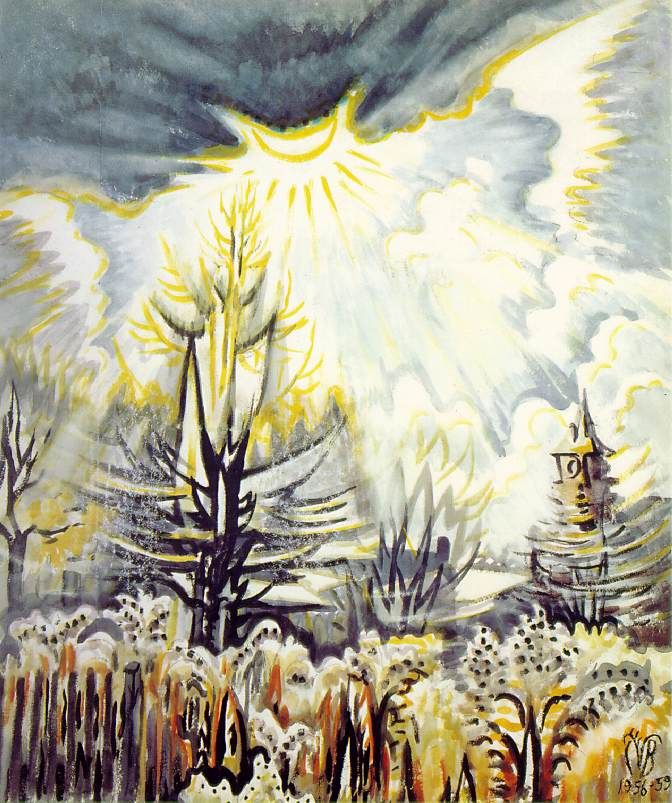
Charles Burchfield
"November Sun Emerging"
1956-59
Watercolor on paper
37 3/4 x 31 7/8 inches
"[How] can we account for that irresistible instinct in our hearts which leads us towards unity whenever and in whatever direction our passions are stirred? A sense of the universe, a sense of the all, the nostalgia which seizes us when confronted by nature, beauty, music - these seem to be an expectation and awareness of a Great Presence. [...] Resonance to the All - the keynote of pure poetry and pure religion. Once again: what does this phenomenon, which is born with thought and grows with it, reveal if not a deep accord between two realities which seek each other; the severed particle which trembles at the approach of 'the rest'?

We are often inclined to think that we have exhausted the various natural forms of love with a man's love for his wife, his children, his friends and to a certain extent for his country. Yet precisely the most fundamental form of passion is missing from this list, the one which, under the pressure of an involuting universe, precipitates the elements one upon the other in the Whole cosmic affinity and hence cosmic sense. A universal love is not only psychologically possible; it is the only complete and final way in which we are able to love."

- excerpt from The Phenomenon of Man, by paleontologist, geologist, philosopher, and Jesuit priest Pierre Teilhard de Chardin
Image credit:Burchfield image ripped from Mark Harden's Artchive

Saturday, August 01, 2009
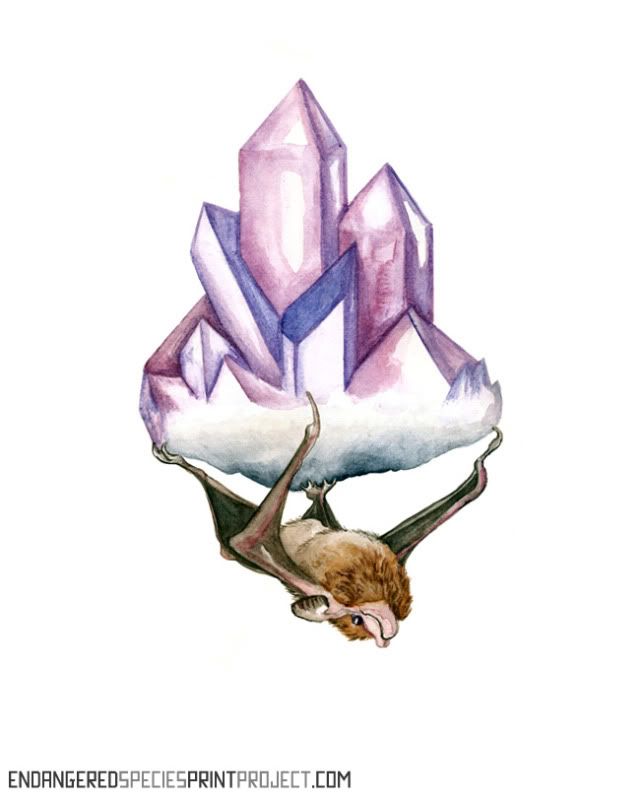
The Endangered Species Print Project


Molly Schafer
"The Seychelles Sheath-tailed Bat"
2009
Archival giclee print (Edition of 37)
8 x 10 inches

Chicago-based artists Jenny Kendler and Molly Schafer recently launched the Endangered Species Print Project. The ESPP offers limited edition prints of critically endangered species for sale to collectors, and ALL proceeds are donated to conservation programs working to perpetuate the featured species. For each print edition, the total number of prints corresponds to the featured animal's current population. For example, only 37 Seychelles Sheath-tailed bats remain in the wild, so for that edition, 37 prints will be produced.

The ESPP is already generating buzz. The Center for Biological Diversity and The Sierra Club are both promoting the project and have expressed interest in collaborating with Schafer and Kendler. I'm not surprised. The ESPP is a terrific undertaking, a fine example of the sort of environmentally and socially responsible efforts that I dearly wish more contemporary artists would involve themselves with.

As such, I'd promote ESPP even if I weren't planning to produce some prints for the project. I expect to produce two original drawings that will be turned into prints before the end of this year. My subjects will be the Javan, or Sunda, rhinoceros (Rhinoceros sondaicus) and the red wolf (Canis rufus). Also, in 2010, I hope to produce prints featuring other endangered species, including some birds, reptiles, and plants.

Prints of the following species are already available: the Panamanian Golden frog (Atelopus zeteki); the Vancouver Island Marmot (Marmota vancouverensis); the Seychelles Sheath-tailed bat (Coleura seychellensis); and the Indri lemur (Indri indri). Visit the ESPP site to learn more.

Thursday, May 14, 2009

A Thursday in the Holocene


Over dinner this Tuesday evening, a friend and I discussed our species' more homogeneous future. I suggested that miscegenation and intercultural activity will lead to future generations comprised of individuals that look and act more alike. In turn, violent conflict between human groups will decrease; in this world of mutts, superficial differences such as race and custom will be less visible and therefore less contentious.

My friend shares my hopeful outlook, but expressed skepticism. Citing the Rwandan genocide and the fractious political situation within Israel, he contended that greater physiological and sociological similarity are just as likely to increase conflict. Humans will always find some reason to fight, he believes, and superficial similarity will lead not to a peaceable kingdom, but instead to the exacerbation of subtle differences or the outright invention of philosophical or genetic justifications for the vilification of "the other." I can't dismiss his forecast, but if Homo sapiens sapiens survives long enough to witness that homogeneous era, our species will have learned a great deal more about cooperation. This, I feel, bodes well for the less violent prospect.

But what-if suppositions about the far distant future are of little practical value to the here-and-now. I have faith in teleological eudaimonia, but the lot of Earth's inhabitants won't gradually improve unless our policies and actions are informed principally by consideration of a more immediate future...say, one or two generations. And, although it will be a thousand years, at least, before miscegenation makes all humans mocha, our planet's ecology is right now undergoing drastic changes.

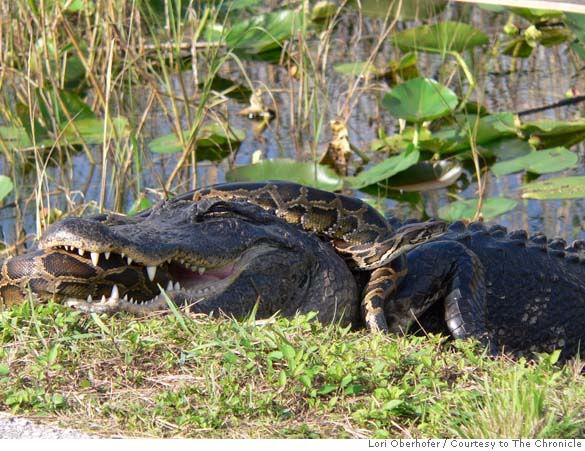
Burkhard Bilger's "Swamp Things" (The New Yorker, April 20, 2009) highlights the explosion of "invasive" species in Florida. Bilger focuses particularly on the success of the Burmese python (Python molurus bivittatus) in the Florida Everglades, but notes that a great variety of exotic species have gained toeholds in the state.
"Florida now has more exotic lizard species than there are natives in the entire [American] Southeast. On a single tree you could conceivably find plants and animals from six continents, including parrots from South America, mynah birds and Old World climbing ferns from Asia, vervet monkeys from Africa, ladybird beetles from Australia, and feral cats from Europe, via Africa and Asia. In some cases, the recent immigrants would be more genetically diverse than their cousins back home. The state's ecology is a kind of urban legend come true -- the old alligator-flushed-down-the-toilet story repeated a thousand times with a thousand species.

Some find all this thrilling. Florida has become an open-air zoo, richer in species than ever before. To others, it's the harbinger of a new and depressingly undifferentiated age, when the old biological borders begin to fade and every place starts to look like every other. Ecologists have even given it a name: the Homogecene."
Indeed, the Homogecene may soon overtake the Holocene.

Note: The post's title is a nod to Christopher Cokinos's terrific essay, "The Consolations of Extinction" (Orion Magazine, May/June 2007). In it, Cokinos
"[suggests] that our PalmPilots and DayMinders and Nature Conservancy calendars show not only year, month, date, and day of the week but also geologic epoch. It’s a Tuesday in the Holocene."
Photo credit: Burmese python and American alligator, copyright 2008, Lori Oberhofer, National Park Service

Sunday, March 22, 2009

Tree of Life


I learned of artist Tania Kovats' "TREE" project via RSA Arts & Ecology. Kovat's installation was commissioned by the British Natural History Museum to honor Charles Darwin's bicentenary. Her "cross section" of a 200-year-old oak tree was installed on an angled ceiling inside the museum. The work appears quite impressive.

Particularly magical, however, is Kovats' inspiration, Darwin's famous phylogenetic tree diagram, an early representation of the "tree of life" included in one of his notebooks. Just above the sketch, Darwin wrote, "I think." Given the cultural and scientific ramifications of Darwin's grand idea, the page would have the aura of sacred scripture even without the text, but the hastily written "I think" suggests, as Kovats puts it, "a moment of conception...an exchange between thought and the mark that [he] made." Thus, the moment of revolutionary conception is recorded, caught for contemplation.

Darwin's notebook page is, like the Voyager 1 record, both an artifact and a profoundly moving work of art, testament to the promise of humanity and Aristotle's eudamonia.

Photo credit: ripped from RSA Arts & Ecology

Monday, March 09, 2009

Revisiting reconstitution


Christopher Reiger
"Continuity"
2007
Sumi ink and watercolor on Arches paper
11 1/2 x 14 1/2 inches

In "Becoming phoebes," I described the satisfaction I feel when contemplating the giving over of contained corporeal energy to the rest of life. I dubbed this process "reconstitution" and, citing the essayist Edward Hoagland as a writer who "speaks to the magic of" this process, included an excerpt from his terrific book On Nature.

A week later, I picked up the most recent issue of Harper's Magazine and read Hoagland's essay "Curtain Calls," an inconsistent and rather bleak take on the contemporary state of things. I later debated the merits of Hoagland's rich pessimism with my father, and decided that older writers must be forgiven some of their bitter steepings; after all, it generally holds that older thinkers long for what once was and younger thinkers dream of what may be.

In any case, Hoagland again dedicated some lovely passages to the notion of reconstitution. In light of the recent, related post, I thought I should share them here.
"If this globe is the only heaven we have, I doubt the trip will be a long one. Downward into the seethe of soil and the sea, we landlubbers become marine again.

I believe in continuity through conductivity: that seething underpinnings of life's flash and filigree, its igniting chemistry, may, like fertilizer, appear temporarily dead, but spark across species like the electricity of empathy, or as though paralleling the posthumous alchemy of art.

Gazing out the window, I see nothing but motion, high and low - scudding clouds, swinging leaves, right down to the millipedes (if I step outside) seething in the soil. Death, be not proud. Plant me when I die so that I can seethe with them."

Friday, February 27, 2009

Environmental About-Face


Nancy Holt
"Sun Tunnels"
1973 - 1976


A supporter of many environmental non-profits, I'd grown accustomed to receiving distressing memos detailing the Bush administration's environmental transgressions, large and small. Reading these emails and letters, my disappointment was compounded by the knowledge that Bush's irresponsible environmental policy was no more reckless than his economic or geo-political program; the Bush presidency was for me, as for so many others, a long, sad eight years.

It is with great delight (and relief), then, that I receive so much positive environmental news in these, the first weeks of the Obama administration. I won't recount all of the progressive developments in this space, but I will share one happy turn around.

David Gessner's essay "Loving the West to Death: A Story of Drill Rigs, Mountain Bikes, and the Fight to Save Our Last Wild Lands" was published in the Winter 2009 issue of OnEarth magazine, a publication of the National Resources Defense Council. Gessner writes,
"At the moment the West is growing faster than any region in the country, and it's here that the cries of 'Drill, baby, drill!' resound most loudly. And drilling is just part of the picture. A few weeks before I boarded my plane, a 2,000-page document landed with a thud on the desks of environmentalists in Utah. This was an 11th-hour surprise from the Bush administration, courtesy of the Bureau of Land Management (BLM), the latest installment in a plan to open up millions of acres of public land, not just to the extractive industries but to off-road vehicles."
What a difference a few months can make! Gessner's spirit was surely buoyed four weeks ago, when President Obama cancelled "all oil drilling leases on more than 130,000 acres near two national parks and other protected areas in Utah." Robert Redford, speaking on behalf of the NRDC, said, "I see this announcement as a sign that after eight long years of rapacious greed and backdoor dealings, our government is returning a sense of balance to the way it manages our lands."

Yet there are countless Joe-Sixpack Americans (and many politicians in Washington, D.C.) that rankle at the notion of federal protection for our public lands. Their skepticism of "big government" interference is especially apparent in the West. The pursuit of freedom is high on the list of principal American virtues, and most contemporary Westerners fancy themselves members of a vanishing, but free pioneer tribe. No surprise, then, that George W. Bush's cowboy mentality is commonplace in big-sky country. Gessner writes,
"This, I thought, is the crux of it, the reason so many are resistant to restraint, to regulating and policing our public lands. 'Lawlessness, like wildness, is attractive, and we conceive the last remaining home of both to be the West,' wrote [Wallace] Stegner. Yes, we come West for that feeling of wildness, of lawlessness, the sense that we can do what we want and do it on our own."
But Gessner argues that this "Live Free Or Die" stance is no longer tenable; it has been rendered obsolete by our burgeoning population.
"[In] these days of crushing numbers, one person's freedom has an impact on the freedom of a hundred others...[With] greater numbers and greater use, it may just be that championing regulation and restraint, while not quite as sexy as championing freedom, is the key to preserving the smaller freedoms that are left...The larger reality is that it will require some restraint and some laws -- the legislative embodiment of restraint -- if we are to preserve these final wild patches, these final strands of hope in a diminished geography...And while old myths are hard to abandon, there is no reason why the cowboy myth of George W. Bush can't turn back into the cowboy myth of Teddy Roosevelt."
Well said, Mr. Gessner.

On a tangentially related note, resource extraction doesn't threaten "only" species and landscapes. Although artwork is by no means endangered, individual land works are. Michael Heizer's "City" and Nancy Holt's "Sun Tunnels" are just two of many land works threatened by BLM development in the western United States. For more on this subject, read "Land Art: here today, gone tomorrow?," in The Art Newspaper.

Photo credit: ripped from Utah Division of Arts and Museums

Tuesday, February 17, 2009

Holland Cotter's Unknowns


I enjoyed reading "The Boom Is Over. Long Live the Art!," Holland Cotter's sometimes scathing New York Times farewell to contemporary art's reckless past decade. Cotter describes the art world as a "full-service marketing industry [built] on the corporate model," and he sees art schools as a branch of this money-hungry industry. In his estimation, critics, curators and other art world operators are "public relations specialists who provide timely updates on what desirable means." With these stark observations in mind, Cotter asserts that "a financial scouring can only be good for American art."

"The Boom Is Over" likely raised the ire of many artists and dealers. A commenter on Edward Winkleman's blog characterized Cotter as "out of touch" and guilty of perpetuating a "fabled myth," and I wouldn't be surprised if more online dismissals and condemnations of Cotter's article appear in coming days. That's a shame. I don't believe that the article is intended to titillate or to offend.

Cotter's description of our prodigal art world brings to mind artist and critic Robert Morgan's caution not to mistake glamour for substantive beauty.
"Beauty is not glamour. Most of what the...art world has to offer is glamour. Glamour, like the art world itself, is a highly fickle and commercially driven enterprise that contributes to...the 'humdrum.' It appears and disappears...No one ever catches up to glamour."
Because I call on Morgan's rather romantic position, some readers will immediately decide that, like Cotter, I'm guilty of perpetuating a myth. If so, it is a vital myth. The beauty that Morgan exalts is complicated and profound. I have in mind philosopher poet John O'Donohue's conception of beauty.
"Beauty induces atmosphere and spirit: wonder, delicious turbulence, love, longing and a trembling delight....Beauty inhabits the cutting edge of creativity - mediating between the known and the unknown, light and darkness, masculine and feminine, visible and invisible, chaos and meaning, sound and silence, self and others."
O'Donohue defines a soulful beauty, a beauty that springs from generous attempts to be and to belong.

Although many of the artworks offered for sale at art fairs or on auction blocks are born of beautiful striving, art fairs and auctions are never, themselves, beautiful. And because fairs and auctions are the events most representative of the contemporary art world, Cotter's harsh language seems reasonable. He's right; "during the present decade [art] has become a diminished thing."

I sense that Cotter wants the Times article, a dismal record of a profligate art world, to serve as license for artists, dealers, curators and critics (Cotter's own tribe) to ruminate on their standing. He hopes that the result of that rumination would be an open-hearted embrace of the artist's vital social role (and the art world's part in facilitating that). It is edification, above all, that interests Cotter.
"With markets uncertain, possibly nonexistent, why not relax this mode, open up education? Why not make studio training an interdisciplinary experience, crossing over into sociology, anthropology, psychology, philosophy, poetry and theology? Why not build into your graduate program a work-study semester that takes students out of the art world entirely and places them in hospitals, schools and prisons, sometimes in in-extremis environments, i.e. real life?...Such changes would require new ways of thinking and writing about art, so critics would need to go back to school, miss a few parties and hit the books and the Internet....[If] there is a crisis, it is not a crisis of power; it's a crisis of knowledge. Simply put, we don't know enough..."
Amen.

But I think that Cotter should have included an addendum. Speaking in generalities can be valuable, but the excess and superficiality of the art world's recent history hasn't tainted all artists, dealers, curators and critics. Certainly, there are "thousands of groomed-for-success [art school] graduates" who have made contemporary art into something "proliferating but languishing," but there are also, as ever, many individuals pushing toward O'Donohue's complicated beauty. Some admirable artists and dealers experienced great success in the boom market of the late nineties and oughties. Perhaps they wouldn't have flourished without the opportunities afforded them by the fattened industry? Artists have always had an uneasy relationship with commodity, and there's little sense in championing lean times over relative abundance.

We're now living through an socio-economic upheaval that is quite nearly global. Such rapid and widespread change should, as Cotter expects, force a significant number of artists to conscientiously reexamine their ideals. But let's not delude ourselves. The opportunity for reflection and mindful action wasn't precluded by the excesses and superficialities of boom time. Although some artists, dealers, curators, critics and hangers-on acted improperly because the environment encouraged bad behavior, most did so because they wanted to. So even as I cheer Cotter's call for us to "[imagine] the unknown and the unknowable," to raise up "new ways of thinking and writing about art," and to see artists blazing unexpected paths, I remind myself that the burden of proof falls foremost on the individual.

Image credit: ripped from Daily Serving

Saturday, January 31, 2009

Eudaimonia

This past Saturday morning, I rode the N train into downtown Manhattan. Sitting across from me, a tired-looking father played with his young sons. Lowering my magazine for a minute, I watched the three of them. Although the boys' antics disturbed some of our fellow passengers, the father was unflappable, and cheerfully committed to the childrens' exuberance. He responded as he needed to, reining in a stray arm, hushing a piercing squeal, but also participating in the boys' adventure, pointing out curious subway details and posing fun questions about this, that and the other. When the father's eyes caught my considerate gaze, I smiled and slightly bowed my head in greeting. The man looked at me for an instant, then returned his attention to the boys. "Ours is the next stop, guys, so I want to see how you high you can jump as we get off." Each child grabbed one of their father's hands and, when the subway doors opened, they shrieked with delight as the father stepped out of the subway car and raised his arms up and out, lifting the young boys several feet off the ground. The doors closed behind them.