Showing posts with label spirituality. Show all posts

Tuesday, October 02, 2012

Picturing Awe

Frame from "Wind Map"
Martin Wattenberg and Fernanda Viegas

Last night, I attended the second presentation in this season's Art, Technology, and Culture Colloquium series at UC Berkeley. Martin Wattenberg and Fernanda Viegas, artists and researchers who often work as a team, presented "Visualization and the Joy of Revelation," an engaging survey of their greatest hits (to date) supplemented by tidbits about their process and working philosophy.

From the ATC listing:
"Fernanda Viegas and Martin Wattenberg explore the joy of revelation: the special electricity of seeing a city from the air, of hearing a secret, of watching a lover undress. Their medium is data visualization, a technology developed by computer scientists to extract insights from raw numbers. They'll show what happens when this technology is aimed at data sets that range from tropical storms to social networks, from arguments on Wikipedia to expressions of carnal desire."

Sunday, February 28, 2010

Art Questions


Installation view of #class, at Winkleman Gallery

Sculptor and performance artist Dominique Mazeaud recently proposed on her blog a "second round of 'Les Magiciens de la Terre,' an exhibition held at the Centre Pompidou in Paris in 1989, that asked one hundred artists to define art along with showing their work." Mazeaud, however, throws a curve ball: "I would simply change the question and ask artists to offer a definition of 'what is the spiritual in art.'"

Defining the spiritual in art is no mean task. The curators of Mazeaud's proposed show would likely receive as many different responses to the question as there were artists participating. Contemporary spirituality, after all, is understood to be an individual quality or experience. But a diverse field of responses doesn't make the question any less interesting, and I agree with Mazeaud that such an exhibition would be exciting and insightful, especially in light of recently reinvigorated conversations about the role of art, artists, and the art market.

Presently, at the Winkleman Gallery, artists Jennifer Dalton and William Powhida offer a platform for this conversation. They've created a temporary "think tank" for "guest artists, critics, academics, dealers, collectors, and anyone else who would like to participate to examine the way art is made and seen in our culture and to identify and propose alternatives and/or reforms to the current market system." I readily admit that I'm more interested in talking philosophy and "ultimate meaning" than I am in discussing practical approaches to the contemporary art market, and I believe that my charitable sales model implicitly announces my ambivalence about (and proposes a viable alternative to) our day's dominant system. That said, only naive artists truly believe that contemporary art can exist completely disconnected from the market (while still finding an audience).

Unfortunately, I arrived late to James Leonard's performance piece on Thursday night (thanks to the snowfall some news sensationalists dubbed "the snowicane"), and I had a conflict that kept me from attending the presentation by Barry Hoggard and James Wagner last night, but I hope to make at least a few more of the sessions that Dalton and Powhida have lined up. You can view the calendar at the exhibition/think tank blog, Hashtagclass."

Image credit: ripped from the Winkleman Gallery website

Saturday, December 12, 2009

Sunset, Sunrise


Heron Hope sunset; November 2009

"Our destiny, our being's heart and home,
Is with infinitude, and only there;
With hope it is, hope that can never die,
Effort and expectation, and desire,
And something evermore about to be."

- William Wordsworth, The Prelude


"Indeed, from within the murkiness of human knowledge and experience, we rightly wonder, is there any room for theology as such - or has it gone the way of all heavenly things? Perhaps all that remains is some mode of natural piety, such as the shudder before the mortal mysteries (with Goethe), or the felt ecstasies of springtime (with Wordsworth). Surely this is a lot, and unsettles the mind from its human habitudes. But is there more?

[...] Like all matters human, theology must be grounded in earthly experience and understood from within its forms. The phenomenal world is all that we have. This is the sphere that lies before us in our everyday existence; it conditions the products of aesthetic perception; and it provides the sphere for theological experience and reflection.

[...] As natural beings we are, in the most elemental sense, coextensive with this realm: our bodies are composed of it, our stomachs take in and digest its matter, and we traffic with this world all our days until we die and are decomposed into its elements. [...] To more properly sense [the] unfolding of the Godhead into world-being, so to speak, or to perceive or intuit its penetrations therein, we must first return to our ordinary experiences."

- Michael Fishbane, Sacred Attunement: A Jewish Theology


Sunrise at Heron Hope; November 2009

Happy Hanukkah, folks.

Photo credits: Hungry Hyaena, 2009

Thursday, November 12, 2009

Tikkun Daily Art Gallery Feature


Christopher Reiger
"the bird opened its eyes as I did mine"
2009
Watercolor, gouache, acrylic, pencil, sumi ink and marker on Arches paper
27 x 32 inches

I'm happy to announce that my artwork is featured in Tikkun Daily Blog's art gallery.

Tikkun Daily introduces readers to contemporary art "that critiques the pretensions and cruelties of our materialistic and self-centered culture, as well as [... teaches] us something new about politics or spirituality."

From the site's art gallery mission statement:
"Why does so much art these days lack social, political, and spiritual depth? The idea for this gallery arose from our yearning for images that are deeply moving, nourishing, and provocative.

It often seems that 'realism' in any of the arts has come to mean painful realities: the things we would rather cover over, the rapes and violence and harshness, the dirt and poverty. We’d love to see uses of the term that also referred to love, empathy, wonder, beauty, recovery. Those are real too. They happen. But love and empathy [...] are often portrayed with Hallmark-card sentimentalism, or in some unreal way.

This art gallery is a space for images of peace, hope, and social transformation that are fully grounded in an awareness of the suffering that exists in our world."
Please visit Tikkun Daily to read Philip Barcio's "Beast's Burden: Paintings by Christopher Reiger." I encourage you to also check out the work of the other artists so far featured on the site, and to learn more about Tikkun Daily here.

Image credit: Christopher Reiger, 2009

Sunday, September 13, 2009

Kimmel Harding Nelson Residency: Day 7


The Ten Commandments on the front lawn of Otoe County Courthouse; Nebraska City

Attunement on a Sunday Morning

I'm a generalist. As such, I'm inclined to connect the dots between purportedly distinct realms of inquiry. It's impossible, of course, to conduct a truly holistic survey, but my crude efforts have led me to conceive of life - what we know of it, at least - as a component part of a vast, even infinite superorganism. I freely admit to finding value in mysticism, and this superorganism notion is readily dismissed by some scientists and scholars as mystical metaphysics, but science itself speaks to an integrity beyond human comprehension.

As Loren Eiseley describes it,
"[This is] one of life's strangest qualities - it's eternal dissatisfaction with what is, its persistent habit of reaching out into new environments and, by degrees, adapting itself to the most fantastic circumstances."
Eiseley was an anthropologist, and he claimed to be a man of "no religion." That may be so, but Eiseley's writing offers humility, wonder, gratitude, and communion in abundance. As I see it, those are the four pillars of religious practice. The fourth of these vital practices, communion, is alluded to by the very word "religion," from the Latin religare, meaning "to bind" or "to tie." Religious action aims to bind the individual to society and, in turn, to the greater whole.

For a decade, I proudly identified as an atheist and, by the measure of most religious people, my cosmology and metaphysics still qualify me as such. It occurs to me, on this Sunday morning, with Nebraska City's church parking lots at capacity, that many of this town's good Christians would reject my claim of religiosity, and not only because my practice rests on a Jewish foundation. My doctrine-less faith appreciates the stories of the Hebrew Tanakh, the Christian New Testament, and the Muslim Koran as parables, poetry, and anthropological artifacts. I read these books in the same way that I do the Tao Te Ching or Herakleitos; they are annotated, analyzed, interpreted, digested, then, in the fullness of time, returned to for a new understanding. But these collections are not my sacred texts. In the eyes of most religious believers, that disqualifies me from tribal membership. Thank G-d.


First Baptist Church; Nebraska City; September 2009
Sign reads, "Faith Removes Mountains Or Tunnels Through"

Still, I am a religious believer, in my way. My holy books are written by biologists and physicists, naturalist poets and essayists, as well as rabbis, ministers, and theologians. None of them is the word of an interventionist, judging god, even though all of them are necessarily part of a greater, unknowable whole, the aforementioned superorganism.

It doesn't matter what you call this organism. As essayist and literature professor Doug Thorpe writes in Rapture of the Deep, "Call it the sublime, call it the Tao, Om, or I AM; still the names don't hold." I most often call it The All, The No-thing, or Hashem, literally "The Name." In the Tanakh, when Moses asks the name of the Presence he has discovered in the burning bush, It replies, "Ehyeh asher ehyeh." "I will be who I will be," or "I will be that I will be." You can call It whatever you will, for It is you. It is also me. It is the sidewalk; It is the grass of the Otoe County courthouse lawn, on which Nebraska City authorities have installed a carved monument to the Ten Commandments, an act that approaches violation of Thomas Jefferson's shrewd "separation of Church and State"; and It is the ether connecting all of these.


Lutheran Church facade; Nebraska City; September2009

If the faith that has grown in me is dogmatic in some way, it is in its insistence on universalism. Literally translated, "universe" means "one turning." Our universe is just that, one breath, one round, one cycle. All that we know and all that we don't know, everything that we can imagine, is but an infinitesimal sliver of The All, one note of an eternal symphony. Even Herakleitos, ancient proponent of reason and science, turned to poetics when he contemplated ultimate meaning; "Nature loves to hide," he wrote. Interestingly, the Hebrew word for universe is olam, a derivative of alam, meaning "to conceal." Jewish mystics, like many of their Hindu, Sufi, and Christian counterparts, believe that God is hidden in the universe, an ineffable force that pervades every dimension, known and unknown.

Theoretical astrophysicists
now suggest that our universe is but one component part of a multiverse, requiring of us another Copernican shift; yet again, the superorganism is re-conceived. In that stretch of the mind are humility, wonder, gratitude, and communion. Science and philosophy, it seems, can also be religious.


Water tower; Nebraska City

So, yes, I'm a religious believer. Paintings, sculptures, and other hand-crafted objects are among my adored icons, but I find occasion for worship in every place, in every form, in every moment. The Monarch butterfly that flapped yoyo-like this morning in front of the KHN Center's kitchen window is worthy of exaltation. I recognize that, for some other viewer, the insect may be ignorable or irrelevant. For others, it is an idol. So, too, might the weathered brick of a downtown Nebraska City building be deemed a clay calf by unimaginative or close-minded "believers." Placing my palm on this brick today, though, my thoughts range through eons of geologic time to consider the primeval mud from which, eventually, we emerged as a gasping fish thing.

Doubtless some of the folks singing inside the walls of the Lutheran, Episcopalian, Catholic, Baptist, Presbyterian, and Methodist churches this morning don't share my enthusiasm for our scaley ancestors. But I'm not concerned with their narrow definition of religion or their selfish understanding of "truth." Although I no longer consider myself a materialist, I'm an unremitting idolater. To those that would condemn that impulse as sacrilegious, I offer Eiseley's reaction.
"People have occasionally written me harsh letters and castigated me for a lack of faith in man when I have ventured to speak of [..] some greater unity that lay incalculably beyond us. [...] They distrust, it would seem, all shapes and thoughts but their own. They would bring God into the compass of a shopkeeper's understanding and confine Him to those limits, lest He proceed to some unimaginable and shocking act - create perhaps as a casual afterthought, a being more beautiful than man. As for me, I believe nature capable of this, and having been part of the flow of the river, I feel no envy."
And I feel no envy, either. There is only dumbfounding, smiling celebration.

Love is, I think, a bit like religion. Humility, wonder, gratitude, and communion are requisite in both, and, as Thorpe puts it, love "demands of us a new way of being in our old world." Religion might be construed as a love affair with The All. It's not always easy, but religious attunement can turn each day, each hour, or each instant, into "a new way of being." Every step is a psalm, every directed gaze is a prayer. Truly, on the streets of Nebraska City this morning, I am an exuberant, enthusiastic mystic.

Photo credits: all photos, Hungry Hyaena, 2009

Wednesday, September 09, 2009

Kimmel Harding Nelson Residency: Day 3


Grain Elevator; Nebraska City

Soundtrack

It's a treat to recognize voices that were once familiar enough to be taken for granted. After years of city living, my ears hunger for the soundtrack I knew in childhood.

Yesterday morning, the staccato lament of a mourning dove (Zenaida macroura) greeted me as I dressed. Later, standing beside an overgrown lot, I listened to the rasp-rattle-click of grasshoppers in the tall grass. Nearby, on the same block, the up-and-down whine of cicadas reverberated within me. At mid-day, as I explored the grassy fringes of a grain elevator operation on the western bank of the Missouri River, my progress scattered noisy grasshoppers, large and small, in every direction.

As I type this post, a male field cricket's (Gryllus pennsylvanicus) insistent plea sounds from a dark corner of the studio. I locate and playback a recording of the call on my laptop, hoping that the sound of another male suitor might draw the cricket out of the shadows for some Orthoptera fisticuffs. The aural lure fails, but I'm made happy by the attempt; the cricket cries for a mate and, with a keyboard click, I call back.

Life, I'm reminded by the persistent call of this cricket, and by the grasshoppers, the mourning dove, and the cicadas, is fleeting, yet rich and good. As Nebraska native, anthropologist, and author Loren Eiseley writes of "endlessly reiterated" frog calls,
"I suspect that to some greater ear than ours, man's optimistic pronouncements about his role and destiny may make a similar little ringing sound that travels a small way into the night."
Every creature's song is at once insignificant and grand. The middle school marching band is passing by my studio now, and the cricket and I are quiet.


Middle school marching band practice; Nebraska City

A Kettle of Vultures

Appropriately enough, as I walked past a mortuary two doors west of the KHN Center, I noticed seven turkey vultures circling low above the town. The night before, I'd read Lia Purpura's poetic essay "On Coming Back as a Buzzard" in the September/October issue of Orion. Given my dual love of natural history and language, I'm embarrassed to admit that, before reading Purpura's piece, I didn't realize that a group of vultures on the ground is called a "venue," and a group of vultures in flight is called a "kettle."

Watching the peaceful, unchoreographed aerial dance of this Nebraska City kettle, I recalled Mary Oliver's beautiful poem, "Vultures," as well as some of Purpura's essay, written from the perspective of a vulture.
"As a buzzard, I’d know the end of a thing is precisely not that. Things go on, in their way. My presence making the end a beginning, reinterpreting the idea of abundance, allowing for the ever-giving nature of Nature—I’d know these not as religious thoughts. It’s rather that, apportioned rightly, there’s always enough, more than enough. 'Nothing but gifts on this poor, poor earth,' says Milosz, who understood perfectly the resemblance between dissolve and increase. Rain scours and sun burns away excesses of form. And rain also seeds, and sun urges forth fuses of green."
"On Coming Back as a Buzzard" is a paean to reconstitution. How smart and satisfying to embrace the natural end as another corporeal beginning! I pray that my dead body will be saved from the poisonous excesses of a mortuary, that it will instead be wrapped in a simple cloth, laid in a simple wooden box, and buried without the insult of preserving chemicals and concealing makeup. I pray that the worms and the soil will consume me, will leech me and take me, so that my matter will become energy for other forms. I utter this prayer in silence as I look up at the dark birds.


Turkey vultures on roof; Harborton, VA

Elsewhere, Purpura writes,
"I'd love best the movement of stages and increments, to repeat 'this bank and shoal of time' while below me banks and shoals of a body went on welling/receding, rising and dropping. I'd be perched on a wire, waiting, ticking off not the meat reducing, but how what's left, like a dune, shifts and reconstitutes."
Even when alive, our bodies are forever in flux, forever "shift[ing] and reconstitut[ing]." After death, though, a profound reinterpretation and recycling of "self" takes place.

The biologists, writers, painters, and physicists who worship Nature are enthused by reconstitution because it is plain, profound truth. As the poet Galway Kinnell describes it in his terrific poem, "The Quick and the Dead," "the crawling of new life out of the old, which is what we have for eternity on earth."


St. Mary's Episcopal Church; Nebraska City
First Episcopal church in Nebraska; Founded 1857

But most folks, many of them good, kind people, don't share this enthusiasm for reconstitution. I presume, perhaps wrongly, that Nebraska City is home to many such individuals. On what grounds do I make this presumption? Firstly, it's a safe speculation anywhere in the world. Most humans prefer a supernatural view of afterlife. Secondly, Nebraska City is home to a good number of churches (nineteen, by my present count), and I make assumptions (sometimes wrong) about the stripe of belief held by the majority of American Christians. No doubt there are exceptions to the rule, but most of the religious Christians I know frown upon materialistic interpretations of life everlasting. Some go so far as to reject my panentheistic or panendeistic conceptions of morality and material being as heretical nonsense.

No matter; live and let die. I find the Christian notions of ascension and self-conscious afterlife ridiculous, and most Christians find my cherished reconstitution as a bit of larvae, a bit of root, a bit of this and that, grotesque and even offensive. Neither conception, though, prevents the individual from acting ethically, and that is, above all, what matters. As Purpura puts it,
"[The vulture] gets to reorder your thoughts about troves, to prove the spilled and shoveled-aside to be treasure. To reconfer notions of milk and honey, and how to approach the unbidden."
Put more explicitly, one man's materialistic mess is another man's milk and honey.

Photo credits: all photos, Hungry Hyaena, 2008, 2009

Tuesday, September 08, 2009

Kimmel Harding Nelson Residency: Day 2


Iowa corn field

The Flying Nun

As our plane approached Omaha, Nebraska, I surveyed the irregular grid of rectangles and squares formed by western Iowa's country roads. Cumulus clouds cast dark shadows of punctuation over the vibrant greens, yellows, and siennas of the state's corn and soybean harvest.

I tend to think of our nation's industrialized monoculture as a rigid corporation of hundreds of thousands of acres of symmetrical fields, but, in practice, even agribusiness can only bend the land so much. At an altitude, one sees that our fields are as shaped by the extant topography as they are by human manipulation. Indeed, some of Iowa's fields, with their rounded edges and calligraphic plow lines, could, from the air, be mistaken for southeast Asian rice paddies.


Aerial view of western Iowa agriculture

My neighbor on the plane was a pleasant Benedictine sister. Dressed in full habit, she was en route to Norfolk, Nebraska, for an assembly of the world's Benedictine Monastic Missionaries. She works and resides in Namibia, Africa, assisting with education and HIV/AIDS prevention. I deeply appreciate the charitable activity and lifelong devotion of such missionaries, but I remain wary of the proselytizing component.

At several points in my conversation with the sister, I felt as though she was soft-selling her faith. She commended me on my given name, Christopher, explaining that I was named after the Catholic saint that supposedly carried the young Yeshua of Nazareth across a river. (Of course, that isn't quite right. The saint, if the man in fact existed, was named for his deed; the Greek word Christophoros translates as "bearer of Christ.") She was also happy to learn that my vocation, my calling, was art, and encouraged me to use my artwork to "usher in Christ's love everlasting." I replied with a noncommital "um hmm," and left it at that.

Perhaps because my response was ambiguous, she persisted. Inspired by my affinity for art, she recollected a visit she made to the Norman Rockwell Museum, where she viewed a sculpture by Rockwell's son, Peter. According to the nun, the sculpture featured a crucifix crowned by devil horns. The piece sounds wholly adolescent, but it evidently upset one of the nun's companions, who couldn't understand why the "symbol of all that is good" would be paired with "the symbol of all that is evil." The nun reassured her friend by pointing out that "at least Peter Rockwell isn't an atheist." She weighted the last word, and shook her head as she pronounced it. I'm not sure what element of the sculpture informed her confident conclusion about Rockwell's metaphysics, but her story made clear her negative feelings for those who doubt or deny her particular faith.

Some minutes after the Rockwell anecdote, she expressed pleasure at Pope Benedict XVI's decision to expand contemporary Catholic use of the Tridentine Mass, a Latin text that vilifies Jews. Considering the nun's clear dislike of atheists and her implied disapproval of non-Christian religious beliefs, I'm happy that I dodged any questions that, squarely answered, would have revealed something of my personal path from a Christian baptism, to agnosticism, to atheism, to my current exploration of and identification with panentheistic or panendeistic Judaism. Part of me was disappointed in myself for not confronting her ecumenical failure, but, frankly, I was more interested in looking out of the plane's window.


Auto repair yard on Central Avenue; Nebraska City

First Impressions of Nebraska City

If you define "city" as a settlement with a large population, Nebraska City is a misnomer. Compared to New York City, my home for almost a decade, Nebraska City is a population blip. New York City's population, estimated at 8.5 million, is 1,200 times Nebraska City's roughly 7,000 residents.

Shortly after we loaded the minivan with our bags and left the Omaha airport, Ron, the owner (and sole employee) of Tree City Taxi Service, said that most Kimmel Harding Nelson Center residents that come to Nebraska City from big cities experience some degree of culture shock. But, although I now live in New York City, I originally hail from Locustville, Virginia. Locustville's population was just 99 when I lived there, and I don't believe that the number has significantly increased or decreased in the years since. Compared to my hometown, Nebraska City is, as its name suggests, a veritable metropolis!


Closed store on Central Avenue; Nebraska City

In conversation with Ron, I gathered that the largest employer in Nebraska City, the American Meter Company, has recently laid off a significant number of its employees. Two other companies that the townspeople depend upon, Cargill Meat Solutions and Diversified Foods & Seasonings, are also facing cutbacks. As a result, many of Nebraska City's citizens are struggling to make ends meet. The economic woes are apparent on the town's main street; it seems as though every block on Central Avenue is home to at least one vacant storefront.

Ron also confirmed my assumption that white-tailed deer, turkey, carp, and channel catfish are major focal points of the region's outdoor recreation. He proudly told me that two of his granddaughters, decked out head-to-toe in camouflage gear, already accompany their dad deer hunting. The image of the camouflaged little girls made me smile, perhaps because I fondly recall the too-big camouflage outfits of my childhood.

Along with hunting and fishing, the major pastimes in eastern Nebraska are high school and college football. This afternoon, from the kitchen window of my residency apartment, I watched the middle school football team practice. I wondered if, compared to their coastal peers, a greater percentage of Nebraska's teenage athletes bank on athletic scholarships and dream of going pro. Many of the players' parents arrived early and watched them from the edge of the practice field.


View on 6th Street; Nebraska City

Photo credits: image of Iowa corn field, ripped from Iowa State website; image of western Iowa fields, ripped from Legacy By Design blog; all photographs of Nebraska City, Hungry Hyaena, 2009

Monday, September 07, 2009

Kimmel Harding Nelson Residency: Day 1


Historical Map of Nebraska City, Nebraska


I subscribe to the Whitmanesque belief that place is presence, that our individual minds are shaped and informed by the ecology, the rhythms, and the atmosphere of our environment. But what can you learn of a place, any place, in just two weeks?

My stay in Nebraska City amounts to a prolonged layover. During this short time, what might I intuit from the town's style and voice, or from the steady push of the great, brown river that draws the town's eastern edge? Certainly, I can look thoughtfully at the people I meet and the birds I encounter; I can listen, as I do now, to the calling of crickets underneath my window; I can contemplate the regional topography and the land's history; I can ask lots of questions and take lots of notes; still, I will not know Nebraska City.

As David Abram writes in "The Air Aware," an essay published in the September/October 2009 issue of Orion,
"Only by living for many moons in one place, my peripheral senses tracking seasonal changes in the local plants while the scents of the soil steadily seep in through my pores, only over time can the intelligence of a place lay claim upon my person."
And what does this notion of place as state-of-mind intimate about my current choice of home? I'm fond of New York City, but how strange that a boy shaped by the salt marshes and fields of the Virginia's coastal plain, and informed by the fishing and farming communities that hold on there, should, as an adult, call home a metropolis with a dominant culture that is almost entirely detached from seasonal turnings of the soil!

Even if I am unable to locate the quintessence of Nebraska City in these two weeks, or to locate myself in it, I look forward to the time away from New York City. I'm eager to look, to listen, and, as David Abram would put it, to breathe in what I can.

Image credit: image ripped, appropriately enough, from Epodunk: The Power of Place website

Tuesday, August 25, 2009

The Most Fundamental Form of Passion


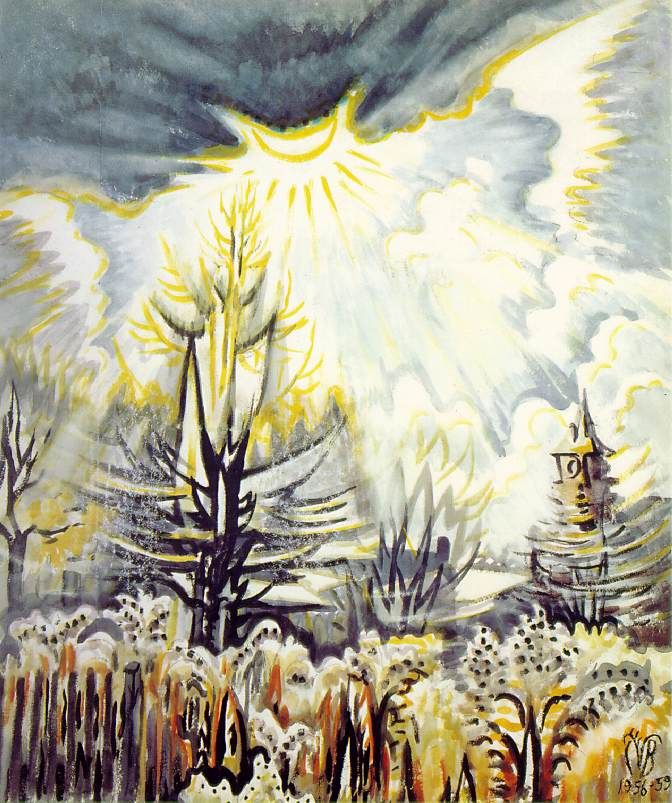
Charles Burchfield
"November Sun Emerging"
1956-59
Watercolor on paper
37 3/4 x 31 7/8 inches
"[How] can we account for that irresistible instinct in our hearts which leads us towards unity whenever and in whatever direction our passions are stirred? A sense of the universe, a sense of the all, the nostalgia which seizes us when confronted by nature, beauty, music - these seem to be an expectation and awareness of a Great Presence. [...] Resonance to the All - the keynote of pure poetry and pure religion. Once again: what does this phenomenon, which is born with thought and grows with it, reveal if not a deep accord between two realities which seek each other; the severed particle which trembles at the approach of 'the rest'?

We are often inclined to think that we have exhausted the various natural forms of love with a man's love for his wife, his children, his friends and to a certain extent for his country. Yet precisely the most fundamental form of passion is missing from this list, the one which, under the pressure of an involuting universe, precipitates the elements one upon the other in the Whole cosmic affinity and hence cosmic sense. A universal love is not only psychologically possible; it is the only complete and final way in which we are able to love."

- excerpt from The Phenomenon of Man, by paleontologist, geologist, philosopher, and Jesuit priest Pierre Teilhard de Chardin
Image credit:Burchfield image ripped from Mark Harden's Artchive

Saturday, July 25, 2009

At Dawn I Have Birds


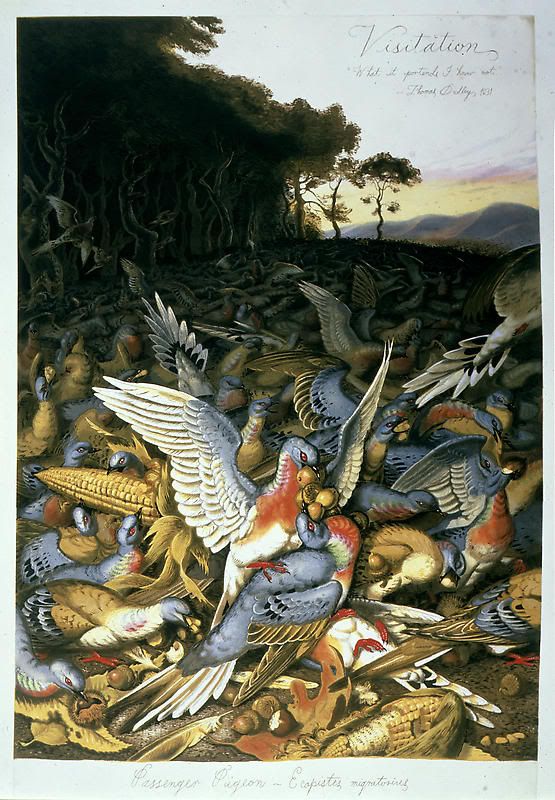
Walton Ford
"Visitation"
2004
Six color hardground and softground etching, aquatint, spit-bite aquatint, drypoint on Somerset Satin paper
44 x 30 7/8 inches


"Often, lately, the night is a cold maw
and stars the scattered white teeth of the gods,
which spare none of us. At dawn I have birds,
clearly divine messengers that I don't understand
yet day by day feel the grace of their intentions."

— from "Age Sixty-nine," by Jim Harrison

Image credit: ripped from the Paul Kasmin Gallery website

Monday, November 19, 2007

Lenore Malen and Jose Alvarez

Link over to the Artcal Zine to read an essay of mine, "Representations of the Occult: On Jose Alvarez and Lenore Malen."

I feel that both artists deserve more critical consideration. Visit Lenore Malen's site here, and learn more about Jose Alvarez here.

Tuesday, July 03, 2007

Gallery Report: June 27, 2007

Part Two : Totemic Art


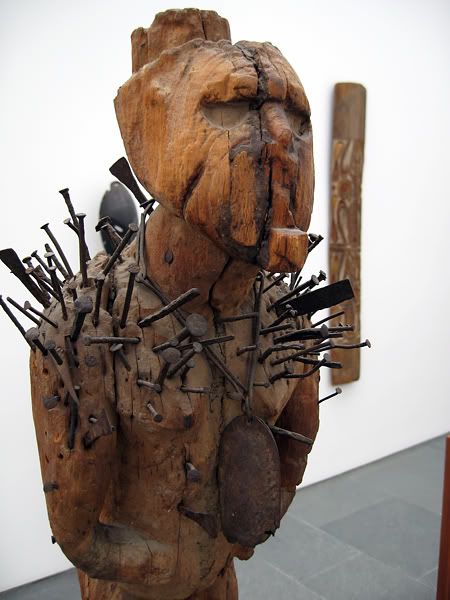
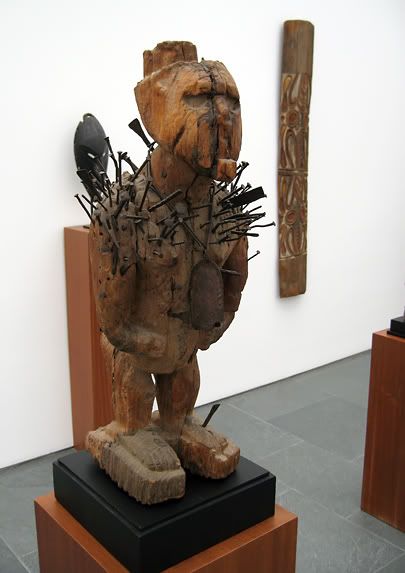
"Power Figure: Nkondi" (detail)
Wood and metal
approx. 24 3/4 x 8 x 8 inches

* * * * *


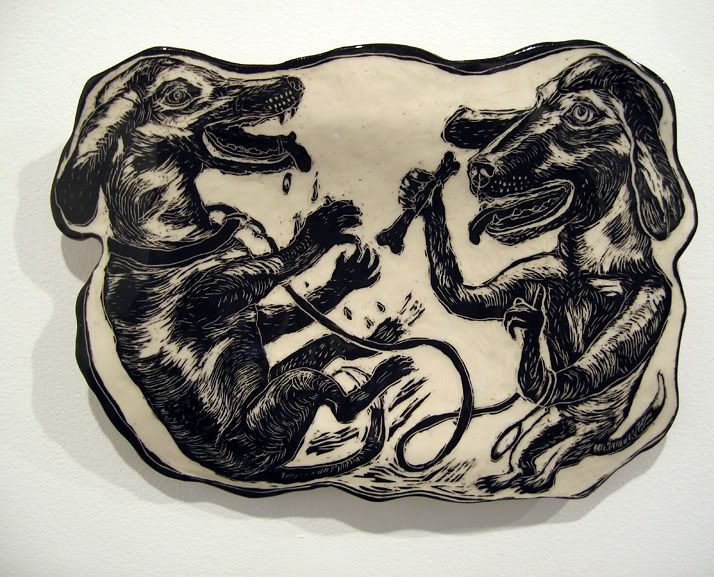
Kate Horne
"The Escape"
2006
Glazed porcelain & mason stain
9 x 12 x 1 inches

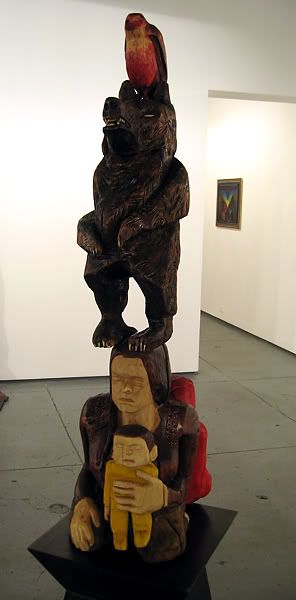
RARE: Artist collectives are a curious affair. The creative communion offered by a collective is appealing to many artists, yet so many of us would just as soon close the studio door and be left to our own devices. But that isolationist inclination makes the concept of a collective more valuable, particularly when the group concerns itself with a set of values or ideas, whether abstract or rigidly delineated, rather than some stylistic mode.


Amie Cunningham
"The Steadfast Warrior (Totem)"
2007
Maple wood, stain
78 x 17 1/2 x 20 inches

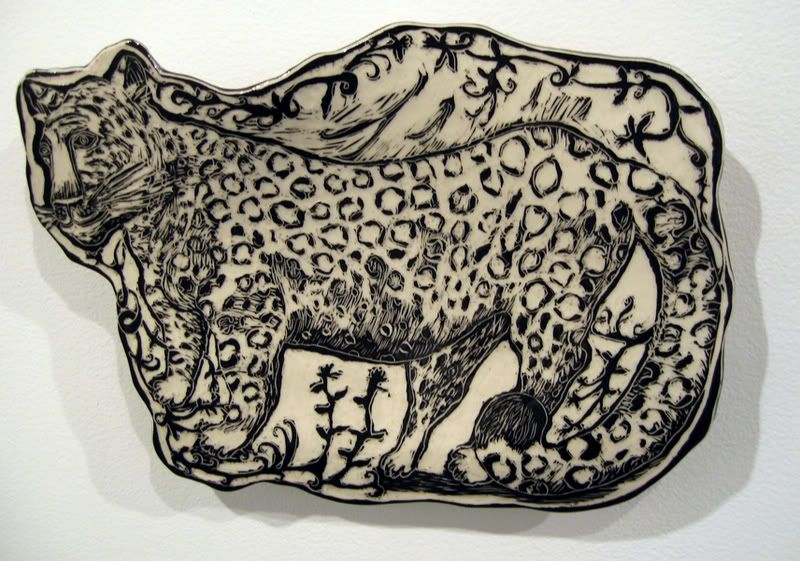
The Orchestra does just that. Pat Berran, Amie Cunningham, Candice Hoeflinger, and Kate Horne "[explore] the creation of modern-ray relics with a sensitivity to history, craft, and humans' precarious relationship with nature." An increasing number of young artists, myself among them, are setting up shop in this territory, an unsurprising migration given the complicated, fractured interdependency of modern man and the rest of it. The exemplary pieces in the RARE exhibition, "The Steadfast Warrior (Totem)," by Cunningham, and a series of porcelain relief paintings by Kate Horne, return to a totemic representation of Nature to "search for modern spiritual significance."


Kate Horne
"No Cookie"
2007
Glazed porcelain & mason stain
9 x 12 1/2 x 1 inches

Several months ago, I wrote about the paintings of Tom Uttech, a painter central to my pantheon. In that essay, I described totemic Nature as "a world of symbol and ecstatic interpretation" borne of sensual experience. That may seem a fanciful description to attach to Cunningham's totem or Horne's plates, but their work seems driven in part by a desire for natural reciprocity, a wanting to be alive as part of the greater weave. So many of us today yearn for this forgotten language, straining to apprehend the words despite our tongue's unfamiliarity. A rural childhood attunes the ear more than one spent in suburbia or the city; as we become an increasingly urban species, will we hear our history or taste our present without technological mediation?

* * * * *


"Bamana, Kore Hyena Mask, Mali, Africa"
Late 19th century
Wood, metal and leather
approx. 17 x 9 x 8 inches

Betty Cuningham: I can not say for sure whether or not the members of The Orchestra spent a lot of time outdoors as youngsters, but the artists responsible for the masks, clubs, statues, daggers, shields, and blankets included in "It's All Spiritual: Art from Tribal Cultures" definitely did. The show's curator, Alan Steele, writes, "The title...reflects the belief that all great art - to some degree or another - has a spiritual component and that nowhere is this seen better than in the tribal arts from remote cultures."

The spiritual component of these works - which, by the way, would be vetted even by the likes of John Dewey, as they are beautiful and utilitarian - removes the need for dressy conceptual underpinning. (Discouragingly, the reverse is also true; an alarming majority of contemporary art is largely short on "spirit." As contemporary humanity's relationship to Nature has become more clouded and distressed, so too has our awareness of the immediate, animating forces been thoroughly abstracted. We are no longer, then, satisfied with what is, and we develop a greater dependency on the theatre of possibility and promises of progress, in turn denying the present and the social body, and so exhibiting more pretense, anxiety, and depression. But this is a whole 'nother can of worms.)


"Power Figure: Nkondi"
Wood and metal
approx. 24 3/4 x 8 x 8 inches

One could argue, however, that the tribal works are conceptual in that they draw on the myths and magical narratives central to each culture, but those narratives are themselves the product of a local hunter-gatherer lifestyle, and the iconography is rooted in direct involvement with the resources and ecosystems from which the materials are drawn. I've long felt that the "primitive" works from the Africa, Oceania, and Americas collection at the Metropolitan Museum of Art are among the most inspiring under that roof. But seen in the context of so impressive and vast a hoard, those objects are most easily read as artifacts, as historical channel markers; the education offered by the museum presentation, while valuable, can distract from direct experience of the work, making it less edifying. This is one reason why we hear so much griping about the museum as mausoleum(1), and why the Betty Cuningham Gallery exhibition, smaller and more random in organization, allows viewers to experience the objects in much the same way they would contemporary works of art. Their vitality and relevance is immediately clear.

"It's All Spiritual" is a hopeful show. On the W train back to Queens I wondered if museums shouldn't start partnering with galleries on a more regular basis. Contemporary artists - indeed, all gallery goers - would be well served by it.


"Human/Prairie Dog Fetish, Southern Plains"
Last quarter of 19th century
Wood, green pigment, brass tacks
approx. 9 1/2 x 5 x 4 inches

* * * * *

Photo credit: all images, Hungry Hyaena

(1) Mausoleum or not, the Met is a true marvel. If you stop and think for a moment about what is housed inside...you gotta pinch yourself. Frankly, I don't spend nearly enough time there.

Monday, August 21, 2006

Although I second Bill Gusky's observation that these sorts of psychology "quizzes" are little more than fun time wasters, I did enjoy this one. Somehow, it's nice to know that I'm a "spiritual" person, if only because I so shrink and hiss at the mere mention of the modifier.
You scored as Cultural Creative. Cultural Creatives are probably the newest group to enter this realm. You are a modern thinker who tends to shy away from organized religion but still feels as if there is something greater than ourselves. You are very spiritual, even if you are not religious. Life has a meaning outside of the rational.

Cultural Creative

94%

Postmodernist

75%

Romanticist

56%

Idealist

50%

Modernist

44%

Fundamentalist

38%

Materialist

38%

Existentialist

38%

What is Your World View?
created with QuizFarm.com

Tuesday, April 26, 2005

The End Is Here?


Living in New York City, one quickly grows accustomed to "architectural advertising." Advertisements for gyms, perfumes, record labels, clothing, books, radio stations, television programs, and movies are plastered on subway station walls, phone kiosks, city buses, taxi cabs, and many building facades. In the course of my five years here, I've come to view this colorful assault as a less offensive version of the billboarding of America's highways. The integration of product placement into the urban landscape not only makes more sense, it is also more easily ignored.

With so much visual competition, an ad agency has to come up with a good pitch to standout. For the past month, the new NBC series "Revelations" has been heavily promoted via architectural advertising. Most noticeable are the Metropolitan Transit Authority buses covered (excepting the windows) in an apocalyptic sunset. "The End Is Here," the text proclaims as an evening flight of ravens lifts above a stoic Bill Pullman and Natasha McElhone. The first time I saw one of the "Revelations" buses, I stared after it as it groaned north up Third Avenue. Several times, over the course of the next week, I caught myself involuntarily shaking my head as I passed a "Revelations" poster in a subway station or audibly "tsk-tsking" when I opened a newspaper and was confronted by an advertising spread heralding the mini-series.

What was it that so unsettled me? As a science fiction fan who, for the most part, has a deep respect for thoughtful religiosity, I was surprised by my negative reaction. Upon watching the (disappointing) first episode of "Revelations," though, I realized that it wasn't so much the program's concept that bothered me as it was the advertising itself. After all, a growing number of evangelical Christians believe that the Rapture is imminent. Visit RaptureReady.com and you'll learn that increases in drug abuse, unemployment, environmental degradation, inflation, natural disasters, starvation, and sloth are all desired, even promoted, by Rapturists! The more of these terrible abuses and tragic events, the more the stage is set for Christ's triumphant return. This may be good for the blindly religious Christians among us, but it is not a good thing for a secular democracy, especially the one in which Thomas Jefferson's "wall of separation" protects those of us who are atheistic, agnostic, or members of a religious minority from the tyranny of theocratic nationalism. So why is NBC promoting the tribal apathy associated with Rapturist belief? The bottom line.

Folks who troll the "eco-blogosphere" have likely read a transcript of Bill Moyers' remarks upon accepting the Harvard Medical School's Global Environmental Citizen Award. It makes for troubling reading and, though I do my best to concentrate on environmental success stories, the doom and gloom is difficult to ignore, no matter what "The Death of Environmentalism" authors prescribe.

From Moyers' address:
"Google it and you will find that the best-selling books in America today are the twelve volumes of the "Left-Behind" series written by the Christian fundamentalist and religious right warrior, Timothy LaHaye. These true believers subscribe to a fantastical theology concocted in the 19th century by a couple of immigrant preachers who took disparate passages from the Bible and wove them into a narrative that has captivated the imagination of millions of Americans.

[...] I've reported on these people, following some of them from Texas to the West Bank. They are sincere, serious, and polite as they tell you they feel called to help bring the rapture on as fulfillment of biblical prophecy. [...] Go to Grist to read a remarkable work of reporting by the journalist, Glenn Scherer - the road to environmental apocalypse. Read it and you will see how millions of Christian fundamentalists may believe that environmental destruction is not only to be disregarded but actually welcomed - even hastened - as a sign of the coming apocalypse.

[...] As Grist makes clear, we're not talking about a handful of fringe lawmakers who hold or are beholden to these beliefs. Nearly half the U.S. Congress before the recent election - 231 legislators in total - more since the election - are backed by the religious right. Forty-five senators and 186 members of the 108th congress earned 80 to 100 percent approval ratings from the three most influential Christian right advocacy groups."
Moyers feels strongly about what he is witnessing and his tone is reactionary and not without hyperbole. As a result, some readers, particularly those predisposed to disagree, will write off his statement as the rant of a now impotent journalist. This is unfortunate. Although I think the political influence of evangelical Rapture-types may be slightly exaggerated in Moyers's address, it should not be ignored. More critically, what of the popular element? With the box office success of Mel Gibson's "Passion of the Christ," some media critics have begun to call this the "religious entertainment era." Religious entertainment? Upon first hearing this label I immediately thought of the Middle Ages, when religious entertainment was at its pinnacle. It is difficult to imagine 21st century America regressing to such a degree. Or is it?

Jonathan Storm writes in The Philadelphia Inquirer, "lavish and well-made, 'Revelations' sadly seems little more than a cynical grab for the zeitgeist, exploiting the popularity of 'The Passion of the Christ' and 'The Da Vinci Code.' It may attract a big initial audience, curious to see a TV blockbuster pushing the idea that the end is near."

That there exists a "big initial audience" for books, films or television programs "pushing the idea that the end is near" is frightening! It highlights the importance of Moyers's question, "What has happened to our moral imagination?" Are we truly a nation content to be force-fed apathy while participating in an orgy of narcotic consumption? Is there really, as Moyers suggests, an absence of "hocma - the science of the heart?" (The hocma Moyers references is one of Kabbalah's ten Sephirot; it is more often spelled chokhmah, or chochmah, and the best translation is "wisdom.")

I'm presently rereading my father's 1983 Pulitzer Prize nominee, Wanderer on My Native Shore. At the end of the first chapter, which focuses on coastal Maine, he writes,
"...as I contemplate the purple majesty of Cadillac Mountain, I feel an awe for its origins mingled with wonder for human optimism. On one hand, our capacity for hope has created marvelous machinery for drilling through the sea floor. On the other hand, this same optimism has generated laws to protect the eagles soaring over Cadillac Mountain.

Life may, indeed, be a dream, and the best efforts of all mankind may be nothing more than brief shadows on a granite dome. Yet isn't our persistent stretching for perfection in the face of inevitable death what touches humanity with divinity?

Our greatness lies not in our sense of humor or intelligence, for other creatures besides man exhibit humor and intelligence. Our greatness lies in our knowing that, although we are doomed, we still want to fashion a better arrowhead or drill bit, and that men may devote themselves to preserving a hard, but productive, way of life as well as eagles drifting on the winds of time."
Well said, Dad. What worries me, though, is the sense that we seem to care less and less about that stretching. Overwhelmed by consumer choices and our slavish routines, apathy has become pandemic. Rather than try to shake the blues, we proclaim the sickness a sign of the apocalypse and, content to wait, pop pills and watch the TV...'cuz Jesus gonna be here, gonna be here soon.

Photo credit: image ripped from inetours.com