|
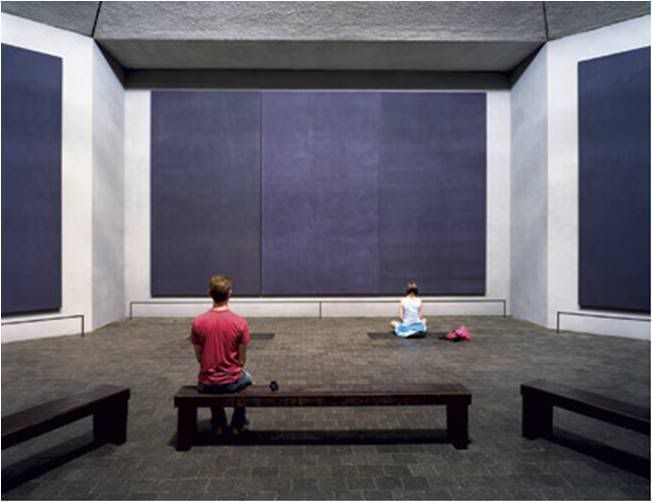
Interior photograph of Rothko Chapel, Houston, Texas
Completed 1971 |
"It is at once a reduction of the whole of the universe to the infinitesimal point of the anxious self and an absorption of the self in the eternal calm of the sea of being."
-Rabbi Jacob B. Agus
In the September 26th edition of
The Guardian Weekly, the opinionated British art critic
Jonathan Jones describes his visit to
Mark Rothko's
chapel in Houston, Texas, as "a pilgrimage to the greatest marriage of art and architecture in the US." Jones worries, though, if the chapel is misunderstood, or even misused, by American visitors.
For the British critic, the
Rothko chapel is "one of America's greatest and strangest monuments: a chapel created by a modern artist who had no religious beliefs." Jones is dismayed, then, to find that many visitors to the chapel are anything but irreligious.
Inside Rothko's master work, a fellow chapel-goer asks the critic if he sees in one of the over-sized paintings "the figure of Jesus Christ our Lord on the Cross?" Jones writes, "I look into the gigantic abstract work. It contains no images, Christian or otherwise."
Jones is clearly bemused that the chapel is today regarded by so many as a sacred space, and he chalks this interpretation up to our American religiosity.
"Locals use this place. They love it. They come not as tourists but to meditate, pray and talk sombrely. They see it as a religious place and the art as spiritual. It is called a chapel, and most Americans believe in God."
Jones feels Rothko would be similarly befuddled by the religious interpretation. The critic explains that Rothko designed the chapel to take "his pursuit of...the 'tragic' to its ultimate extreme" and that the artist "believed that all serious art was about death." Undoubtedly, Rothko had a fatalistic, deeply melancholic streak - he killed himself in 1970, one year before the chapel opened - but I'm not sure that the artist would, like Jones, bemoan the religious significance of his chapel.
A Russian Jewish immigrant, Rothko (originally named Marcus Rothkowitz) certainly didn't intend visitors to see Jesus Christ in his large canvases, but he was not, as Jones contends, a man "who had no religious beliefs." In fact, Rothko's father was an Orthodox Jew and the young Rothko spent time in Russian
cheders before his 1913 emigration to the United States. After his family settled in Portland, Oregon, Rothko became active in the local Jewish community. Whether the future artist's connection to Judaism was principally cultural or spiritual, I do not know, but later in life he frequently described the making of his paintings as a religious experience.
 |
Interior photograph of Rothko Chapel, Houston, Texas
Completed 1971 |
So what was Rothko thinking when he undertook the chapel project, and what did he intend the space to be? We can only speculate.
For his part, Jones asserts that the paintings act as doorways or portals. I agree, but the British critic insists that they are "portals
of death." Jones sees the blackness of Rothko's chapel paintings as "utter desolation," blackness that shatters "any illusion of paradise." The chapel overall Jones describes as a "theatre of emptiness, death's antechamber, the self-expression of a suicide." He dismisses other interpretations, claiming that, if the Texas oil barons who commissioned the project understood more fully Rothko's deathly intentions, the chapel would not have been built.
But the blackness in Rothko's late works can also be understood as nothingness.
Negative theology, more commonly referred to by the Latin
via negativa, breaks down the word "nothingness" into "no-thing-ness." God, according to negative theology, is ineffable; literally, It, that is to say, God, is No Thing. As
Lao tzu, author of the
Tao Te Ching, wrote in that essential text, "The unnamable is the eternally real...Darkness within darkness. The gateway to all understanding."
This mystical conception of God or Being would be familiar to an educated Jew like Rothko. The
Jewish Kabbalist notion of
Ein Sof springs from a medieval Spanish Jew's exposure to Eastern philosophy. (Most historians agree that
Moses de Leon, a prominent Spanish rabbi, composed the Zohar, the central text of Kabbalah, in the late 13th century. Some of these scholars argue that de Leon's work is a syncretic project, injecting tantra and other Eastern thought into the ever-evolving Jewish tradition.)
Ein Sof, translated from Hebrew to English, literally means "there is no end." It is the unquantifiable, ambivalent and infinite energy that exists before, within and after the more mundane conception of God. The kabbalists, though, take their negative theology one step further.
Ein Sof is the ineffable All, but
Ayin, or "nothingness," is
Ein Sof rendered finite. Some Jews consider
Ayin the cosmic potential extant prior to the
Big Bang.
Daniel Matt, a leading scholar of Kabbalah, writes in "
God and the Big Bang":
"The paradox is that ayin embraces 'nothing' and 'everything.' This nothingness is oneness: undifferentiated, overwhelming the distinctions between things....This mystical nothingness is neither empty nor barren; it is fertile and overflowing, engendering the myriad forms of life. Medieval philosophers - Jewish, Christian and Muslim - had taught that God created the world 'out of nothing.' The mystics turn this formula on its head, reinterpreting it to mean that the universe emanated from divine nothingness."
For some religious individuals, concepts like
Ayin and
Ein Sof allow a point of entry. Rabbi
Richard Rubenstein, a Jewish scholar and writer, speaks of God "as the Holy Nothingness." Detailing his turn from secularism to faith, he writes, I "replaced my atheistic nihilism with a mystical nihilism. To be all that there is, as God was in the beginning and will be in the end, is equivalent to being, so to speak, absolutely nothing. In the beginning, God dwelt in the womb of his own omnipotent nothingness." I love the contradictory nature of such a God!
Likewise, religious mystics of all persuasions believe that individuals must embrace darkness in order to find spiritual integrity. They must, as the prominent Rabbi
Arthur A. Cohen put it, "...[surrender] to unknowing, [enter] the 'dark night' of which all mystics speak - a metaphor for the condition of desperate ignorance - and there [identify] a frail connection between the emptying of the self of all knowledge, the abandonment of knowledge, the perfect unknowing which enables the process of knowing to be renewed and the being whose existence renews. It is the passion of thought and the desire to know which presses us to the limit where thought cannibalizes itself in despair, where knowing ceases, where the emptying of the self is undergone and the fullness of God may commence."
Those chapel-goers who claim to see in Rothko's paintings Jesus Christ, Muhammad, Buddha, or any other religious hero are guilty of unimaginative literalism but, if their experiences are real, they are "seeing" through darkness into spirit. I believe that Rothko, an artist much invested in mythology and mysticism, would respect and even commend that.
Jones writes in
The Guardian, "[The chapel] is not an austere, dead, modernist monument. It's a living chapel. People sing and play music. But maybe they should look around a bit more - because this is one of the most compelling rooms I have ever been in."
But why should these religious visitors have to stop worshipping, singing or otherwise participating in the work to take (what Jones considers) due notice of the room's quality? Given the power of the space, might not the room
compel their behavior? Rothko insisted that he was no mere maker of abstract paintings. "If you are moved only by their color," the artist said of his mature works, "then you miss the point."
Photo credits: images ripped from
HASTAC on Ning