Showing posts with label Iraq. Show all posts

Tuesday, July 16, 2013

Commonplace Book Time Machine #1:
Novus Ordo Seclorum


One of the two chapbooks I initially proposed creating in conjunction with my Aggregate Space & Featherboard Writing Series writing residency will not be produced. Because the residency is only five weeks long, I've decided I must devote the lion's share of the period to the more substantial of the two projects, a meditation on my childhood comprehension of death and killing. Still, rather than let the preliminary work I'd done for the commonplace book chapbook go to waste, I thought I'd share a few of the scanned pages here, on Hungry Hyaena, along with some editorializing. The first of these posts follows.

+++++
2-page spread from one of my commonplace books, 2000

Just after my twenty-second birthday, I began a new commonplace book. At the time, I was living in the basement bedroom of an Alphabet City apartment in Manhattan, laboring five days a week at a Soho art gallery and, nights and weekends, drawing and painting in my bedroom or working on a solipsistic vampire novel titled, appropriately, Me. My income was meagre; I'd grown used to dinners of white rice (generously seasoned with soy sauce) and I socialized just one night a week (not counting too many hours spent watching recorded episodes of Mr. Show with my roommates). Necessarily thrifty, then, I elected not to purchase a new journal to use for the commonplace book; instead, I picked up a journal that I'd cast aside a couple of years prior after filling its early pages with adolescent agitation.

Saturday, March 21, 2009

The Fertile Crescent


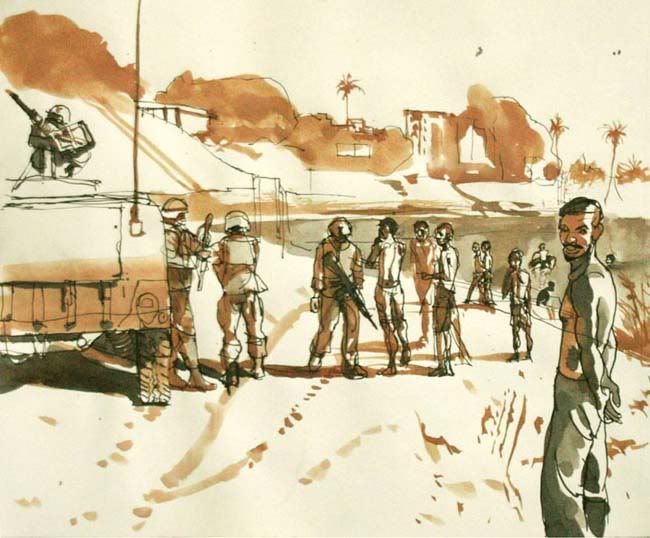
Steve Mumford
"Soldiers and Bathers, Tigris River, 2003"
2003
Ink on paper
From Mumford's Baghdad Journal


What a marvel to consider the historical and global reverberations of human activity in the Fertile Crescent! Few regions of the globe remain untouched by the profound ideologies and prejudices birthed between the rivers...

...and still the fighting continues.

Photo credit: Artwork reproduction ripped from artnet

Tuesday, November 11, 2008

Obama's Inheritance


Jehad Nga
"Operation Steel Curtain, Iraq 2006"


Art collector, patron, humanitarian advocate and all-around-great-guy James Wagner is also a longtime blogger. Every so often, he posts a short essay on JamesWagner.com that warrants wide distribution. (Lacking significant broadcast reach, I can only recommend those posts here.)

James' thoughts regarding the election of Barack Hussein Obama parallel my own, and he states the case much more succinctly than I could. I include some excerpts below.
"We endured eight disastrous years of a Bush presidency, years which saw both the haughty ascendancy and the ignoble collapse of the unmourned Late Capitalist, Neoconservative and Republican regime. Nothing of importance or worth in our own Republic or in much of the rest of the world has escaped the depredations of its arrogance, its sententiousness, its dominion and its greed. I had believed for years that no fundamental political change would occur until we had sunk into a genuine economic depression, and I had gloomily predicted the change would be toward some form of Fascism."

"I hadn't anticipated the confluence of the dramatic events of the last year and the exceptional capabilities of Barack Hussein Obama...But in order to rebuild institutions, restore well-being and a belief in the future, the new President will have to pull off something like a major revolution."

"Without that full recognition of the seriousness of our crisis, and with the continuing strength of contemporary skeptics, dinosaurs and reactionaries, including the fact that almost as many people didn't vote for him as did, Obama will almost certainly have to push through what must be, and almost certain will be, an extremely progressive agenda while not making it look too radical, and he will have to do it in a way that will disarm and even enlist on its behalf as many of its potential adversaries as possible."

"I know there will be mistakes, as FDR made mistakes, but, and call me Pollyanna again, I believe he will pull it off, partly because of what I have just written, but also because he will have so much help (both enthusiastic and skilled), and because we have come to such a pass that we all really want to see him to succeed: Regardless of our diversity, and despite the vast range in our individual conditions and current fortunes, none of us can afford the cost of failure. We'll have to be in there with him."
Pony up, people. We've got work to do.

Read the full post here.


Peter van Agtmael
"A teenager injured as his house is searched by US forces, Iraq 2006."


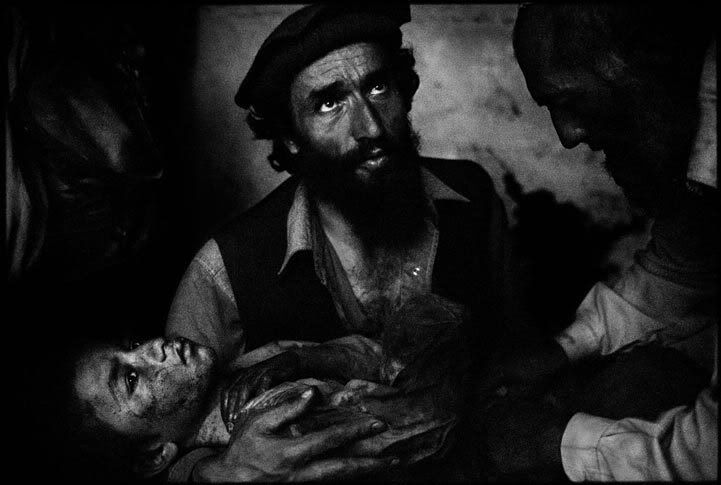
Also, I recommend James' post on the Battlespace project's unpublished photographs from our "three wars." I have included three of the images in this post, but I highly recommend readers visit Battlespace to view more of the profound images. Be forewarned that many of the images are deeply troubling. I feel cold and wretched looking at some; it's hard not to cry, and sometimes the only thing for it.


Balazs Gardi
"Kunar province, Afghanistan. Survivors of a US airstrike."


Photo credits: all pictures ripped from Battlespace website

Sunday, November 12, 2006

Rummy

Since his resignation this past Wednesday, one day after the fateful mid-term elections, former Secretary of Defense Donald Rumsfeld has been the subject of innumerable reports in both the mainstream and alternative news. Not surprisingly, most of the articles describe Rumsfeld as "the architect" of the Iraq War and give the impression that Americans are glad to see him go, even if his doing so promises little in the way of real reconciliation in the Middle East.

Only a few of the pieces, however, touched on the many similarities between Rummy and one of his predecessors, Robert McNamara, the eighth Secretary of Defense, who served under Presidents Kennedy and Johnson and approached the war in Vietnam in much the same way Rumsfeld did our interference in Iraq. Strategy is mere number-crunching for a businessman turned warlord, and the many miscalculations of these banker-commanders are rooted in a fundamental moral misunderstanding: war is not an equation and human lives are not variables.

There are apparent differences between the two men, however. Whereas McNamara now bemoans his mistakes and searches in vain for some explanation of what went wrong (he still doesn't seem capable of accepting direct responsibility), Rumsfeld waves off any hint of contrition. Instead he insists that history will frame our efforts in Iraq as a great success. I do hope he's right, but my Magic 8 Ball and the lessons of past colonial powers suggest otherwise.

At any rate, none of this is any more interesting than the spiels about Rummy on every other blog out there, but the painting below is a more unusual send-off! Kurt Weinhold painted this portrait of Rumsfeld - "Man with Radio (Homo sapiens)" - in 1929, three years before his subject was born. As a good friend of mine wrote when he first sent me this image, in November of 2005, "this might actually be proof that members of this administration are, in fact, inhuman minions of evil." That's right, kids...no matter what country you live in, or what year, Rummy will be listening. Sweet dreams.

Thursday, November 10, 2005

Dreaming of Release


Steve Mumford
"The AK-47 Round, Squad from Bravo Company takes cover during a nighttime patrol after a shot is fired nearby"
2003
Watercolor wash


Last night I dreamt that I was listening to dispatches from Iraq on the radio. By now we're all familiar with such reports: "A car bomb exploded in Fallujah today, killing three marines and injuring twelve civilians." But in my dream, I wasn't painting in my studio or cooking dinner in my kitchen while listening to the unhappy news. I was instead sitting on a second-story porch in Baghdad, with three Iraqis and an American soldier for company. In front of me, on the floor of the porch, rested a helmet. Instead of the standard steel pot, this helmet was formed from frosted glass. Realizing that it belonged to me, I anxiously wondered if all my body armor was equally delicate.

The radio reports of bombings and fire fights ran together endlessly. The Iraqi man to my right whittled at a bit of wood and one of his friends savored tea from a pot that sat on a small stool. From our elevated vantage point, I watched the bustle of Baghdad street life. Over the radio and the murmur of the people below, we could hear the crackle of approaching gun fire.

The dream was soaked in yellows, browns and whites, the muted colors of our western conception of the Middle East. Gradually, this monochromatic scheme clued me in to the unreality of the scene. This, I realized just before I awoke, isn't war. This is only me dreaming of reclaimed immediacy, a longing for direct engagement with my surroundings and the associated stretching of time experienced when the conscious being is forgotten and the animal acts alone.

I believe that the dream was inspired by three things. In the hour before I went to sleep, I admired a photograph of sculptor Joseph Zito's glass helmet in Art in America and, in the same magazine, read artist Dawn DeDeaux's account of her return to New Orleans one month after Hurricane Katrina. DeDeaux writes,
"Katrina is the indifferent manifestation of a weather pattern to be measured in centuries, not seasons. Thinking in such meteorological time, biblical scale and mythic proportion, contemporary art is the smallest speck of time, and I am wiped off the map."
I also spent some time yesterday thinking about my father's struggles with his current book project, an account of his two tours in Vietnam, his wartime work for the RAND corporation, and his experiences as a key translator of Vietnamese at the Paris Peace Talks. My father is the author of over thirty books, the majority of which deal with conservation and natural history. Some of these earlier books were long in coming, but none seemed so difficult as the current one. I'm convinced that the shift in subject matter is responsible.

I've rarely seen my father cry. Excusing tears brought on by the Hollywood dream machine, his recollections of Vietnam are usually responsible. "Over there," he sometimes found himself "in the shit," as Max Fisher would put it. Details are only reluctantly shared, but he saw some terrible things, both "on the ground" and in the control room. I've never pressed him for the whole truth, but I look forward to reading his story when the book is completed.

My father's negative experiences in Vietnam and his relatively leftist political leanings didn't stop him from encouraging me to enter the military, however. When I came of age, I gave the Army some thought - even though my father was a Navy man, I believed that I could more quickly become a trained helicopter pilot by entering the larger force - but ultimately decided service was not for me. I was not adrift; I knew that I wanted to be an artist and so concluded that the military would just delay my vocation. I finished undergraduate schooling never having joined ROTC, and I rarely second guess that decision.

But last night's dream points to an experiential void, one that sometimes haunts me in the city. In the country, at least, time spent outdoors, observing animal behavior and other natural phenomena, sustains my desire for immediacy. Furthermore, hunting, infrequent though the practice has become in my life, confirms that I am still alive, that I am still connected to the animal I murder, butcher and consume. (The move from country to city was added motivation to give up meat and fish - except that for which I am personally responsible.) Here in the city I am coddled, things feel "taken care of" and life becomes routine, punctuated only by late nights of inebriation. Silly errands take on unwarranted import in such a setting. Self importance is the order of the day and any sense of interconnectedness that one has cultivated evaporates, forcing many urbanites to turn to yoga or some other activity that might enable them to reconnect with real time.

I'm grateful that my day job is in a building which overlooks the East River. I can watch the wakes of passing ships slap at the reinforced perimeter of Roosevelt Island, pushing imperceptibly at the foundation, while the herring gulls circle and dip above, their predatory eyes on the look out for some scrap of thoughtlessly discarded food. This scene allows me a glimpse of the time scale that DeDeaux described, what she calls "meteorological time" or "mythic proportion." This moment is connected with the vast expanse.

When young men dream of war, they are entertaining thoughts of self destruction; more precisely, they dream of destroying the ego, wishing for it to be replaced by the group experience, by the animal drive, by the eyes of the hungry herring gull. This same erasure is achieved in times of crisis. That which is not of immediate relevance falls away, and the individual's decisions are dominated by the lower and mid brain, the portion residing at the top of the brain stem (including the amygdala, pons and medulla oblongata).

Recent events along the Gulf Coast of the United States and in Pakistan remind us of this reality. In her essay, "The Uses of Disaster," (published in Harper's Magazine) Rebecca Solnit addresses this precedence.
"This joy - this unspoken and perhaps unspeakable relief in disaster - also hints at an unfamiliar version of human nature...In his 1961 study, 'Disasters and Mental Health: Therapeutic Principles Drawn from Disaster Studies,' sociologist Charles Fritz asks an interesting question: 'Why do large-scale disasters produce such mentally healthy conditions?' One of the answers is that a disaster shakes us loose of ordinary time. 'In everyday life many human problems stem from people's preoccupation with the past and the future, rather than the present,' Fritz wrote. 'Disasters provide a temporary liberation from the worries, inhibitions, and anxieties associated with the past and the future because they force people to concentrate their full attention on immediate moment-to-moment, day-to-day needs.' This shift in awareness, he added, 'speeds the process of decision-making' and 'facilitates the acceptance of change.'"
I need not fight in a war - especially one that I am opposed to - to achieve such a shift in awareness, but living in the city does prioritize ego over the live animal.

I'm happy to be heading home for Thanksgiving this year. I look forward to taking a long walk and to being outside at first and last light.

Photo credit: reproduction of Steve Mumford's artwork ripped from Artnet.com

Friday, August 12, 2005

Random Quotes and Stuff: Installment #3

"Last summer, the F.D.A. approved the leech for use as a medical device, making this only the second time that the agency has authorized such a use for a live animal. (Maggots, which can be applied to wounds to consume infected tissue, were approved in January, 2004.)"

-John Colapinto, "Blood Suckers," The New Yorker, July 25, 2005
I find this news exciting. When I first read about the maggots-as-medicine approval last year, I was elated. I hoped that more people would realize how interconnected everything is if doctors dumped maggots into their festering wounds. Unfortunately, most people feel very differently about composter species and the idea of squirming, white grubs eating their flesh - even dead, dying or inflamed flesh - will likely disturb them. Whatever...I'll just go sit in the corner and play with my leeches.

++++++++++++++++++++++++++++++++++++++++++
"It makes no difference what men think of war, said the judge. War endures. As well ask men what they think of stone. War was always here. Before man was, war waited for him. The ultimate trade awaiting its ultimate practitioner. That is the way it was and will be. That way and not some other way….It endures because young men love it and old men love it in them."

-Judge Holden speaking in Cormac McCarthy's novel, Blood Meridian
In the early nineties, Operation Desert Storm was featured prominently on network television and in department stores. My Virginian neighbors proudly wore T-shirts emblazoned with the mission name, as though it was a World Series commemorative; to be without one was unusual or, worse, unpatriotic.

I was thirteen years old in 1991. I remember watching the green-tinted, "night vision" films of Baghdad air raids as I lay on the floor of my parents' living room, drawing pictures. I wondered, naively, why we still fought wars. After World War II, after the horror of the atomic bomb, I thought, we should know better.

And yet, five quick years later, I seriously considered military service. Being a good patriot requires some service to the country, I told myself, and, more importantly, I would not be "truly alive" until I had charged into harms way, guns blazing. I'm no longer so naive or bloodthirsty, but I think Judge Holden's answer accurate, no matter how damned distressing it may be.

++++++++++++++++++++++++++++++++++++++++++
"Children need the dark materials of fairy tales because they need to make sense - in a symbolic, displaced way - of their own feelings of anger, resentment, and powerlessness. Children also benefit from learning about violence and brutishness in fairy tales, Bettelheim writes, for it counters the 'widespread refusal to let children know that the source of much that goes wrong in our life is due to our natures - the propensity of all men for acting aggressively, asocially, selfishly.'"

-Margaret Talbot, 'The Candy Man," The New Yorker, July 11 & 18, 2005
I recently met a young girl - I believe she was six or seven years of age - whom I found especially intriguing. At a Long Island dinner party, the several children present announced that they intended to "put on a show" for the adults, mostly Long Island married couples and a few odd men and women out, myself among them. A few minutes later, this particular girl emerged with a wand, a vaguely ethereal tutu bottom and a wide, toothy grin to announce the name of her segment. "Evil Always Wins," she said, proudly. She proceeded to make her way around the room, lightly touching the heads of all in attendance with her wand, announcing, "Now you have been made evil."

I took an instant liking to the precocious girl and found myself pondering her performance for much of the party. I believe she intended to protect the adults from the cruel realities of the world. Because "evil always wins," she magically transformed each of us into evil beings, thereby saving us from future defeat.

Examining this logic from an adult perspective, it stinks of "selling out," an "if you can't beat 'em, join 'em" attitude, but children don't necessarily view the world in this way. For example, when I was ten or eleven, I once longed to be a werewolf or vampire, not so I could surf down Main Street on the roof of a van, but so I could "infect" people I liked, creating an eternal community of kindred spirits. Sure, at twenty-seven this scenario seems dangerously cultish, but I also used to fantasize about tearing away the throats of my "enemies," and if I'm not going to condemn my childhood wants and desires for their violent content, I certainly won't do so for their lack of philosophical foresight. Besides, there are worse fates than lycanthropy or vampirism.

When I later recounted the story of this "evil," little girl, most listeners shook their head and said things like, "Wow, something is sure wrong with her" or "That's disturbing. She's a troubled kid, huh?" I wouldn't be surprised to learn that there is something amiss in the child's life, but most children wrestle with real world nightmares. It's a vital part of growing up. Scars, mental and physical, stay with us, an important part of who we are. An increasingly protective approach to child rearing, though, has taken hold. Disney, as far as I'm concerned, is the embodiment of popular parenting, making formulaic movies to entertain unimaginative children and adults alike. The animation is spectacular, certainly, but the plots are hollow and repetitive alongside those found in, say, Grimms' Fairy Tales.

I brought this up with a parent I know and she told me she would never give Grimms' to her daughter "because they are too frightening." But I agree with G.K. Chesterton, author of "The Ethic of Elfland," who writes that fairytales inspire in children a sense that life "is not only a pleasure but an eccentric privilege." What a marvelous way of putting it!

Tuesday, March 08, 2005

Hunting JFK


I occasionally irritate friends by highlighting their environmental transgressions. It's only fair, then, that they should return the favor by challenging me to defend hunting.

I consider myself a conscientious hunter. I eat no meat, including fish, unless I catch it or kill it myself. I kill only a few animals a year and catch fewer than ten fish. Otherwise, I live on a vegetarian diet, aiming to minimize my contribution to the environmental degradation wrought by the meat industry. Moreover, I hunt only species biologists deem to have "surplus" populations, such as white-tailed deer (and, then, only does), mallard ducks (only drakes), cottontail rabbits, and some species of squirrel.

Unfortunately, there are also surplus "trash hunters," and I will defend neither their ignorance nor their abuse of the hunter's ethical contract (see my post on the New Jersey black bear season). For me, hunting is a reasonable and thoughtful activity, not at all at odds with being "green."

Laughing, drinking beer, telling dirty jokes and tall tales - all of these things are associated with the "hunting tradition," but I wince when I witness such self-consciously masculine behavior in the field. The dealing of death is no laughing matter. I will gladly share "good times" over the resulting meat meal, but the activity of hunting is, for me, a time of inner quiet and outer awareness. The camaraderie should take place before or after the hunt; save the stories for the grill or a winter evening football broadcast, but do not offend the sanctity (and gravity) of the hunt with such boorish behavior.

I'm therefore disturbed by the word "sport" when it is applied to hunting or fishing. "An active pastime or endeavor" is one of the given definitions of "sport" and, in this application, it accurately describes a range of activities, including hunting, fishing, rock climbing, or basketball. But "sport" is more closely associated with balls and strikes than with bag limits. In my own (undistinguished) athletic career, more than one coach told me to "have fun out there" and reminded me that "to excel at the game, you gotta enjoy it." But the killing of an animal is no "game" and, though the hunt can be considered enjoyable, "fun" isn't the word I would use. In fact, the experience is often deeply emotional and distressing.

But let's be honest, I could give up meat altogether and never again have to convince anti-hunters that white-tailed deer hunting benefits the environment or that I honor and admire the creatures that I kill. Why do I continue to do it, then? I must admit that a significant part of the appeal of hunting is existential. Those first difficult moments after you execute a large ungulate are transfiguring; your own mortality is highlighted and a sense of oneness with the natural world preoccupies you. Your intimate connection to the brutal deed, and to the slain animal, reduces the ego, opening you to a more universal experience of the universe. To use Dr. Morris Berman's analogy, the experience removes the respectful hunter from the vertical worldview and allows him to reside as part of the horizontal stretch, if only for a few hours. My love and respect for the natural world is rooted in the time I have spent outdoors, but particularly in the time that I've spent hunting. Birdwatching, a pastime I enjoy a great deal, might afford me an encounter with wonder, but hunting always seizes and wraps me in the beautiful, ambivalent mess that is the Everything. It is hunting, above all, that humbles my spirit, and makes me profoundly grateful for life, in every sense.

Three news items have me thinking about hunting and death today. SWORDS, robotic killing machines, have made headlines recently. The United States military will begin using these death toys in Iraq later this year. Last week, reading an issue of Outdoor Life Magazine, I came across this article on remote-control hunting. This morning, on my subway ride to work, I read that the makers of the videogame, "JFK Reloaded", are offering a $100,000 prize to the gamer that can most convincingly re-create the 1963 Dallas assassination of President John Kennedy.

There is a common thread. "JFK Reloaded" allows us to kill a digital Kennedy as often as we like, trying to make that "perfect shot." To enjoy such a game, where the target is not a faceless "enemy" but instead a well-known person who was assassinated relatively recently, the gamer must abstract (or even debase) his or her sense of morality. Our culture, as any religious zealot will tell you, is experiencing a moral schism. Murder, even for our soldiers in Iraq, is becoming an abstraction. From fist to blade, blade to spear, spear to arrow, arrow to bullet, bullet to...what? How can you describe a system whereby the man-boy assassinating a digital JFK on the computer screen might as well be gunning down Iraqis with a SWORD or slaughtering a big buck on a Texas game farm? For that matter, is not the murder of the pixel proxy similar to the pricking of a Voodoo doll? A clear association is made by the gamer; the digitized image on the screen - your quarry - represents a flesh-and-blood human. But when you pull the plastic trigger and assassinate JFK, that's that. You can turn off the gaming console and hit the sack. No police will show up at your door. No posttraumatic stress disorder will accompany your return to civilian life. No bang. Just a click.

The disconnect between animal and meat on the plate is but part of the problem; with every passing month, the disconnect between hand and killing becomes more ingrained in our culture and, as I see it, such a trend does not bode well for empathy. With less empathy and compassion in the world, abstraction of the "other," already a natural inclination, becomes that much more easy. Terribly, this leads to more violence.

Photo credit: Titled Forum Project