Showing posts with label ignorance. Show all posts

Thursday, January 20, 2011

Surprise! Cats kill!


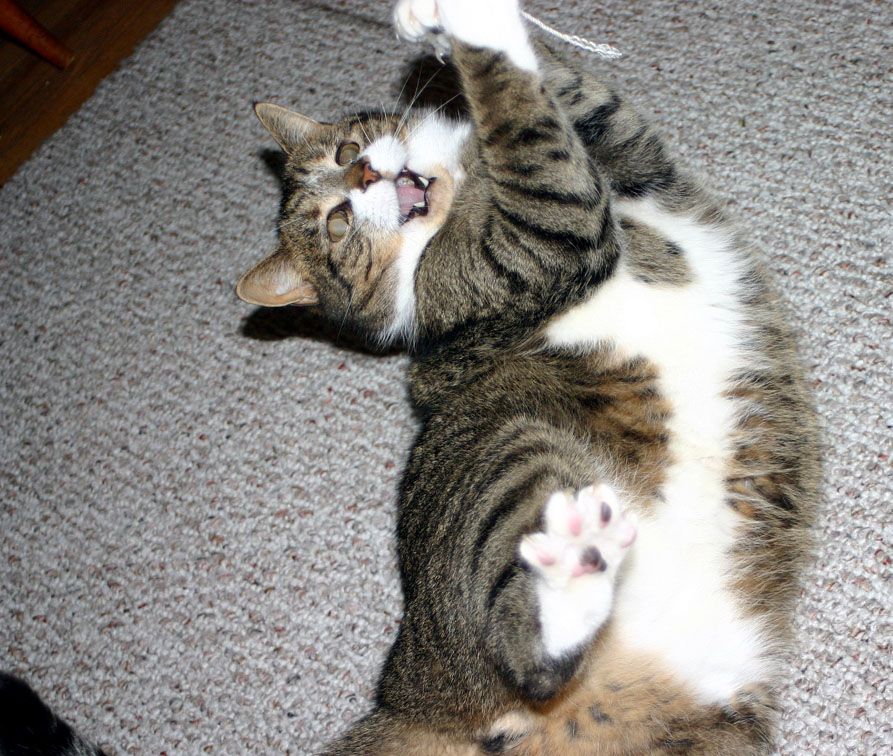
My cat, Mr. Misi, displays his inner killer

"Conspiracies Don't Kill Birds. People, However, Do.," the title of a recent piece in the New York Times declares. The article reports that US Fish & Wildlife research shows that "some of the biggest death traps" for songbirds in the United States are the jaws and claws of domestic and feral cats. The author dubs the USFWS finding "surprising," but it shouldn't be. Folks surprised by this report are either innocently ignorant of wildlife (and of the wild within the lives we've tenuously domesticated) or they willfully deny the ambivalent violence that animates so much life, cat, bird, and human included.

Read the NY Times piece, then revisit "i taut i taw a putty tat," an HH post from April 13, 2005, in which I discuss some of the realities of cat predation and make it clear that, though I'm a cat lover par excellence, our nation's songbirds, small mammals, and reptiles need us to stop playing favorites.

Photo credit: Hungry Hyaena, 2004

Thursday, July 02, 2009

Repairing America (and beyond)


Micanopy, Florida


While visiting central Florida last month, an acquaintance told me that all of her Gainesville co-workers are fans of Rush Limbaugh's radio punditry. On the highways around the small city, I saw countless pro-life billboards and a good number of "NObama" bumper stickers on passing pickup trucks. Although the city's populace supported Obama in the 2008 presidential election (as did the state), it was very clear that the city represents a blue dot in a red region.

Contemplating this red state mentality, I recalled Thomas Frank's "Lie Down for America," an excellent, if depressing article published in the April 2004 issue of Harper's Magazine. Frank dissected, in his words, "how the Republican Party sows ruin on the Great Plains."
"Whereas earlier forms of conservatism emphasized fiscal sobriety, the backlash mobilizes voters with explosive social issues - summoning public outrage over everything from busing to un-Christian art - which it then marries to pro-business economic policies. Cultural anger is marshaled to achieve economic ends.

[...] 'Rural America is pissed,' a small-town Pennsylvania man told a reporter from Newsweek. Explaining why he and his neighbors voted for George Bush, he said: 'These people are tired of moral decay. They're tired of everything being wonderful on Wall Street and terrible on Main Street.'"
The same Wall Street-Main Street dichotomy was trotted out by campaigning Republicans four years later, in 2008, to cast the GOP as the party of the people. But did the tactic really work? After all, Obama won the 2008 election. Aren't rural and Middle America coming around, realizing that the Republican party doesn't have their best interests in mind, even in those cases where the social issues of the Right more closely align with their values?

I hope so, but I wouldn't bet on it. Middle America will jab an angry finger at someone, and faithful Rush can't be the enemy. Our country is already waging a war against Islam, so we know that the Muslims are "against us," but they're not pulling America's economic strings. And, as a general rule, black folks don't have too much power, Obama not withstanding. But, wait a second...aren't there a lot of socialist Jews whispering in Obama's ear? Hell, isn't he related to a rabbi!?

The July 2009 issue of Harper's includes two disturbing poll results.
Chance that an American thinks 'the Jews' were moderately or very much to blame for the financial crisis: 1 in 4

Chance he or she thinks they were 'a little' to blame: 1 in 7
This is a shocking statistic! I wonder what percentage of Americans believe that "the Jews" are no more culpable than any other ethnic or religious group?

Oh, but that's a silly question! After all, "the Jews" are the denizens of Wall Street, and Main Street folk like Dubya and Rush don't like that sinful, unAmerican place. It should be clear to me that the current recession - when should we start calling it a depression? - is not the result of the unsustainable, myopic economic policies of the last sixty years (amped up by Ronald Reagan, but embraced by both Democrat and Republican administrations). It's instead the vast Zionist conspiracy! The socialist Jews have teamed up with the capitalist Jews to forge an unholy alliance, and they're running the global economy into the ground!

Would that I could laugh off such frightening ignorance. Unfortunately, the bigotry is not evidenced only on the Right. In fact, the same study cited in Harper's showed that the registered Democrat respondents were 12% more likely than responding Republicans to blame "the Jews" at moderate or higher levels. There is a time-tested, inverse relationship between economic performance and anti-Semitism, and this correlation isn't affected, evidently, by political affiliation.

The New York Times reports today that "U.S. Job Losses Rise and Unemployment Reaches 9.5%."
"The American economy lost 467,000 jobs in June [2009] and the unemployment rate edged up to 9.5 percent in a sobering indication that the most painful downturn since the Great Depression has yet to release its hold."
Things are going to get a lot worse for Middle America. Finger pointing does none of us any good (and certainly not the tiny Jewish minority in the United States).

Still, I remain optimistic. As I wrote in January,
"Call it Obamatism, call it naive idealism, call it what you will...but it's time to participate, to put aside our generation's infantilism and get to Aristotle's happy work. [...] We will pass through our challenging stage of human social development but, fraught as it is, the need for an active and immediate commitment to bettering our world's future is great."
Jews call that tikkun olam, repairing the world. Get to it, people!


Photo credit: Hungry Hyaena, 2009

Saturday, May 23, 2009

Inside the Yankees' Compost


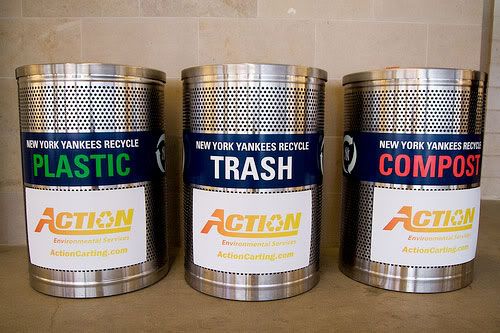
Although this Cubbies fan isn't fond of the New York Yankees, I spent an enjoyable May afternoon at a ball game in the new Bronx stadium. I was pleased to see that the stadium management team is making an earnest effort to be environmentally progressive. The stadium's food containers are bio-degradable, and separate waste bins for trash, plastic and compost are stationed throughout the ballpark. These bins are labelled clearly and usually positioned next to one another.

Unfortunately, your average baseball fan doesn't know what "compost" is. I snapped the below picture of a Yankees fan throwing balled-up napkins into a "compost" receptacle, and witnessed similar mistakes all afternoon. Depressingly, the "plastic" bins fared little better.

Perhaps Yankee Stadium management needs to station waste educators near the bins? The ticket prices are surely high enough to cover the cost!


Photo credits: Yankees waste bins image, ripped from SeriousSeats.com; fan abusing compost picture, Hungry Hyaena

Tuesday, April 21, 2009

Bring out your dead!


Walking to work this morning, I noticed for the first time that the Department of Sanitation New York City (DSNYC) logo features the caduceus, a symbol that depicts two snakes entwined about a staff. The DSNYC website explains that the caduceus, "the traditional medical symbol," is incorporated "to promote the idea that sanitation can affect the health of the City."

Indeed, sanitation is one of the most revolutionary inventions of mankind, but somebody at the DSNYC didn't do their homework. The "traditional medical symbol" is not the caduceus, but the rod of Aesculapius, an image that features just one snake wrapped around a staff or branch.

As I wrote here (almost exactly) four years ago,
"No bastardization of a symbol, however, is so glaring as the misuse of the caduceus by medical professionals. The familiar image of two snakes entwined about a winged staff is used by a slight majority of medical practitioners and groups. The caduceus, though, has nothing to do with medicine! It is the staff of Hermes.

'…Hermes was also considered to be the god of commerce and wealth, which in turn implies a sense of personal self-interest along with the possibility of stretching the truth to meet one’s own needs. Hermes was known as the patron god of thieves due to his many tricks and lies. The quality of dishonesty is not one that most people want to see in their physician, therefore a symbol that is traced back to representing trickery and deceit should not be used to represent a profession as highly regarded in trust as medicine. Additionally, Hermes is also said to have used his caduceus staff to lead the souls of those who passed away to the underworld, which is the opposite idea than that stated in the Hippocratic Oath that a physician is charged with.'

The symbol of medicine is actually Aesculapius’s staff...Aesculapius, appropriately, was the God of Medicine.

'The son of Apollo, god of health, Aesculapius is said to have been pulled from the womb as his mortal mother was dying, which came to symbolize a physician’s ability to turn death into life. Throughout his life, Aesculapius used medicinal herbs and surgical procedures to heal the sick and dying, with his culmination of the art being the ability to bring the dead back to life. In one episode of mythology, Aesculapius was said to have been inside a temple when a serpent came to him and wound itself up and around his walking staff. He killed the serpent, only to have a second slither in and use an herb to bring its dead comrade back to life. This brings forth the explanation for the revered symbol of Aesculapius’s staff, with this herb being the major discovery of his life. The snake was seen as a servant to Aesculapius in his healing, and was worshiped as such.'

Clearly, the two symbols became confused at some point. Kim Scott wrote a short history of the confusion, 'The History and Confusion of the Caduceus symbol and the Staff of Aesculapius in Medicine,' from which the above selections [in italics] are drawn. Scott dates the initial mix-up to circa 1500. Apparently, the symbolic SNAFU led to twentieth century medical [professionals regularly using the wrong staff.]"
And the DSNYC, too, made the same mistake.

But perhaps I'm too quick to condemn the DSNYC decision to adopt the caduceus? Maybe the folks behind the logo intended to reference the popular maxim, "One man's trash is another man's treasure." With that in mind, the DSNYC workers might be understood as Hermetic treasure thieves. Or, if that's too much of a stretch, we can consider Hermes' role as a conveyor of the dead to Hades. NYC's trashmen, then, can be thought of as leading the souls of the discarded to the Underworld. The latter interpretation gets my vote!

Thursday, September 07, 2006

March of the Chaplinesque Lovebirds

Photobucket - Video and Image Hosting
Made cautious by all the fuss surrounding Luc Jacquet's 2005 documentary, "March of the Penguins," I elected to avoid the film during its theatrical run. Even the assurances of my co-workers - "Oh, you'll absolutely love it! It's right up your alley since you're so into animals." - only served to strengthen my sanction. When a film generates excessive buzz, especially of a vaguely politicized variety - in this case, much ink was spilled debating the socially conservative subtext of the documentary - I prefer to wait out the media storm, to let the reviews fade from my mind before heading to the rental store.

And so, on a blustery, wet Saturday, over a year after the film's release, I scanned the shelves of Astoria Video Express and settled on the image of an Emperor penguin looking down at its hungry chick. I sighed, thought about it for a moment and decided that I'd waited long enough. I did want to the see the film, after all, and even the blurbs boldly printed on the DVD case, snippets I usually ignore as creative collage work on the part of the studio, further whet my appetite. "Astonishing!," proclaimed David Ansen in Newsweek. "Riveting!," promised Stephen Holden, of the New York Times. And so, that evening, as Ernesto soaked the Tri-State area, I popped in "March of the Penguins," turned up the volume on my home stereo, and prepared to be riveted, astonished, and generally engaged.

Encouragingly, the film opens with some stunning aerial photography of Antartica's otherworldly landscape. (In fact, the film work throughout "March of the Penguins" is exceptional and cinematographers Laurent Chalet and Jerome Maison have been justly lauded.)

But then, not two minutes in, the first sign of trouble: "Based Upon the Story by Luc Jacquet," the credits read. Wait. Isn't this a documentary? What "story" are the credits referring to? There is, after all, a significant difference between documentary and fiction, even fiction inspired by real events. Shortly thereafter, Morgan Freeman's dulcet voice begins to describe the harsh conditions at the bottom of the world. After hearing only a few lines of Freeman's narration, I realize this is a film best suited to children. Freeman's genial reading brings to mind the cliche of the old, patriarch storyteller. There isn't necessarily anything wrong with this, but Freeman's lilting delivery too often sounds condescending.

But these issues are forgivable, minor faults. If National Geographic and Jacquet can produce an intelligent nature documentary that engages young viewers by framing the penguins' annual journey as a children's epic, then so be it. The world needs more children interested in the well-being of other species and the health of ecosystems at large.

Unfortunately, "March of the Penguins" is not an intelligent story pitched at a young audience. Jacquet supplies Freeman with an appalling script, one that manages to patronize both viewers of the film and the bird it ostensibly celebrates. A minute or so into the narration, Freeman says, "So, in some ways, this is a story of survival, a tale of life over death, but it's more than that really. This is a story about love." Sentimental clap-trap of this stripe is a staple of Disney-style animal documentaries(1), but I am surprised to see National Geographic associated with it. Why must so much natural history writing, particularly film narration, reduce the wonders of the natural world to cartoon significance, clumsy or cute approximations of human behavior? Whatever their reasons, the team behind "March of the Penguins" feeds viewers a canned narrative, replete with emotive musical selections and conservative film editing, tricks and techniques not foreign to an editor of daytime television or Hollywood romances. If we were to transplant ourselves to Antarctica and, in person, observe the mating ritual of an Emperor penguin pair, would we find the vaguely violent frenzy romantic? Would we "see it" in slow-motion, accompanied by a soothing a New Age soundtrack? When the chicks take their first, tentative steps, would we giggle as they stumble about the ice and hear in our heads some sweet, doodling tune? Probably not. These actions aren't funny or romantic for the participants and, unedited, they would not likely be so for us. Why not honor the arduous, annual journey of Aptenodytes forsteri and the marvel of the chick's birth and maturation without attaching our own assumptions and moral framework?

Before I'm written off by some readers as one more proponent of cold, hard science, I should point out that I am no less guilty of anthropomorphizing animals than anyone else.(2) The attribution of human characteristics and emotions to other species is an altogether natural activity. What's more, it is an important, even vital one. Zoomorphism and animal-human relationships, often sexual, are central to the myths of many cultures and religions, and, for time immemorial, we've understood the world via other animals just as we understand those species through ourselves. Lest we forget, we too are animals, and the words we use to describe our more abstract and profound emotions - love and grief, for example - are merely qualifications of deeply rooted drives, behavior observed in different measure throughout the animal kingdom. In other words, the temporary bond experienced by a mated Emperor penguin pair may not be entirely irrelevant to human marriage (or any other romantic union), but we should take care not to confuse the two. It's well and good to talk of love when considering a human couple - if not always accurate - but to project this word, our word, and all that we associate with it, onto another species is problematic. Firstly, it confuses viewers who know no better. Secondly, doing so is no different than projecting the assumptions and practices of one culture onto another. In short, it's ignorant, and reflects a laziness or a woeful lack of curiosity.

Again, I'm not advocating a prohibition of anthropomorphism. Disney - and other studios, particularly those specializing in animated features - has made a fortune appealing to our desire to anthropomorphize, both for laughs and pathos. Clearly, most people appreciate these sentimental takes and, although I feel such fictions more often reduce than celebrate, I don't want to get sidetracked attacking Disney. Disney doesn't claim that "Bambi" is an accurate portrayal of white-tailed deer (Odocoileus virginianus) behavior, nor do they argue that "The Lion King" provides a lesson in lion (Panthera leo) pride dynamics. Luc Jacquet, however, does claim that Emperor penguins are in love.

Curiously, when asked about the "family values" subtext of the film, the director balked, telling the San Diego Union Tribune that he intended no such message and that "it [is] intellectually dishonest to impose this viewpoint on something that's part of nature....You have to let penguins be penguins and humans be humans." I agree completely, but "March of the Penguins," whatever its stance on family values and gay marriage, does not "let penguins be penguins." In fact, the French version of the film - the original script Jacquet produced - goes so far as to include "dubbed" voices for different penguin characters. Charles Berling, Romane Bohringer, and Jules Sitruk speak as if they are father penguin, mother penguin, and chick. Instead of attaching Morgan Freeman's soothing narration about "family time" to a shot of a mated pair huddled about a young chick, Jacquet prefers to present the adult penguins whispering sweet nothings to one another and cooing approvingly of the product of their "lovemaking." That certainly isn't my idea of letting penguins be penguins!

As I sat through the closing credits of "March of the Penguins," I found myself recalling the emotional reaction I had to Werner Herzog's "Grizzly Man," a powerful film that wrestles with man's complicated relationship to other species and our own species' coping mechanisms. "Grizzly Man" was overlooked by the Academy Awards - indeed, the documentary was not even nominated - the same year "March of the Penguins" was awarded the golden statue. In fact, in terms of revenue, the French production is the second most popular documentary ever made. But I suppose I shouldn't be entirely surprised by the Academy's choice or any of the excessive praise lauded on Jacquet's "documentary." Most people prefer animals as cartoon proxies and are uncomfortable understanding them as flesh-and-blood relatives. Luc Jacquet threw out the slop - he is guilty of making a weak, if pretty film - but the rest of us marched to the trough to feed.

Photo credit: image ripped from the homepage of South African scientist, Neil Malan

(1) The most notable of these series, and the one most often subjected to academic consideration, is Disney's True-Life Adventure Series, which aired in the late 1940s.

(2) If you were a fly on the wall of my studio or apartment, you would witness lengthy conversations - note the word choice, as though they are two-sided - between my cat, Mister Misi, and myself. The same is true for my three snakes, Zuri, Sefu, and Kali. Given the rudimentary brain of a snake, the pythons certainly aren't engaged in any way with my rambling, but what matters is my involvement with them and my interpretation of their movements. The exchange is only as valuable as I make it, the communication abstract at best, but not absent. The relationship between pets and caretakers is largely defined by human projection and is one of many examples of healthy anthropomorphism. Lines can be crossed, however. When humans begin to clothe their dogs, for example, they cease relating to the animal as a fundamentally different creature and, in my opinion, do it a great disrespect. Each to his or her own, I suppose.

Thursday, April 20, 2006

Undoing The Gordian Knot

Michael Pollan, Hunting, and The Rest Of It

Image hosting by Photobucket
"The fact that you cannot come out of hunting feeling unambiguously good about it is perhaps what should commend the practice to us....If I've learned anything about hunting and eating meat, it's that it's even messier than the moralist thinks. Having killed a pig and...now looking forward (if that's the word) to eating that pig, I have to say there is a part of me that envies the moral clarity of the vegetarian, the blamelessness of the tofu eater. Yet part of me pities him too. Dreams of innocence are just that; they usually depend on a denial of reality that can be its own form of hubris."
-Michael Pollan, "The Modern Hunter-Gatherer"
I'm always pleased when I come across an article that clearly conveys a concept I have been striving to articulate with limited success, so I'm indebted to a co-worker for bringing to my attention Michael Pollan's (relatively) recent essay, "The Modern Hunter-Gatherer," in The New York Times Magazine (March 26, 2006). Pollan, the author of The Botany of Desire, Second Nature, and, most recently, The Omnivore's Dilemma, is a sensitive, thoughtful proponent of hunting. But whereas most writers who wax poetic about the hunt are guilty of romanticizing and simplifying what is, in fact, quite messy(1), Pollan argues that the hunter can not be a moralist. Rather "the grown-up hunter, the uneasy hunter...recognizes the truth" that resides in contradiction, or, as Robert Kimber put it in his excellent Living Wild & Domestic, "the uncompromising romantic has to compromise with the realist."

Image hosting by Photobucket

Before I continue, however, let me provide some background explanation of why Pollan's piece strikes a chord. As I wrote in my March 2005 essay, "Hunting JFK,"
"I consider myself a conscientious hunter. I eat no meat, including fish, unless I catch it or kill it myself. I kill only a few animals a year and catch only ten or so fish. I live on a vegetarian diet otherwise, aiming to minimize my contribution to the environmental degradation wrought by the meat [and fishing] industr[ies]. I will hunt only those species biologists deem to have 'surplus' populations, such as white-tailed deer (does only), mallard ducks (drakes only), cottontail rabbits."
Environmental degradation was not Pollan's principal motivation, but his reasons for picking up a rifle and heading into the woods of northern California to stalk and kill a feral pig (Sus scrofa), an introduced species descended from the European wild hog, are no less significant. The son of "one of the world's great indoorsmen," Pollan had never hunted. He "had long felt that, as a meat eater, [he] should, at least once, take responsibility for the killing that eating meat entails. [He] wanted, for once in [his] life, to pay the full karmic price of a meal." That Pollan should feel this way is admirable. Most well-educated Westerners are now too timid, too cloaked in denial, to address such base issues. Turning again to Kimber, "If the step from hunter to herdsman-plowman was the first great step in the process of alienation from nature and self, then surely the step from herdsman-plowman to city dweller, driver of combines, and feedlot engineer has all but completed that process."

All contemporary omnivores - the vast majority of humans - are necessarily implicated in the grisly business of meat "manufacture." The pork chop on the plate is more than a tasty entree; it was recently a living animal. After stunning, assuming that process goes smoothly, the pig's throat is slit by machine (or man) and the viscera is spilt before meat preparation begins. Every pig-eater who prefers to cast such realities from her mind is afraid of more than blood and gore or even the potential for undue suffering on the part of the animal. She is, above all else, afraid of confronting her own mortality. If, on the other hand, you know what it's like to kill a fellow creature, you consume flesh with full knowledge of what brings the food to the table: execution. Pollan suspects as much, even if he remains suspicious of the "ecstatic" language used by the likes of Ortega y Gasset and Hemingway.(1)

Pollan's account of the boar hunt makes for good reading, but his consideration of the aftermath is especially excellent. He struggles with his confused, intense reaction to the shooting and dressing, a polite term for gutting, of the large animal.
"...the rest of the organs tumbled out onto the ground in a heap, up from which rose a stench so awful it made me gag. This was not just the stink of pig wastes but those comparatively benign smells compounded by an odor so wretched and ancient that death alone could release it. I felt a wave of nausea begin to build in my gut. The clinical disinterest with which I had approached the whole process of cleaning my pig collapsed all at once: this was disgusting."
My upbringing was very different from Pollan's. I grew up assisting in the gutting and preparation of dove, quail, duck, deer, rabbit, squirrel, and other animals. As I told a Scrawled correspondent in a recent interview,
"Some of my early memories are, quite literally, bloody...As a child pondering the blood of a slain animal, I was deeply moved, at once overwhelmed with sorrow, and energized by the realization that the neon red glowing on my trembling hands was spilt life. The more familiar I became with death, the more tied to life I felt. It was an introduction to 'the Circle of Life,' even if it wasn't at all what Disney force-fed us."
Pollan draws similar conclusions, but because his is a new experience, he searches for an explanation where those us accustomed to death do not. This search begins with an examination of his nausea.
"...[W]hat was this attack of revulsion all about, anyway? Disgust, I understood, is one of the the tools humans have evolved to navigate the omnivore's dilemma - the elemental question of what we should and should not eat. The emotion alerts us to things we should not ingest, like rotten meat or feces. And surely that protective reflex figured in what I was feeling as I beheld these viscera, which no doubt did contain microbes that could sicken me. Our sense of disgust, as Steven Pinker has written, is 'intuitive microbiology.'"
Pollan's revulsion is the product of our animal hard-wiring. Routine killing and butchering may arrest or weaken this disgust - repetition dulls all sensation - but it remains an inevitable reaction. Like it or not, we are genetically adapted to the Pleistocene lifestyle Hemingway pined for. Pollan may cope well enough in modern-day California, making a living from selling words, but he still becomes ill at the sight of undesirable innards and, when hunting, turns into what he calls "alert man"(2), a more aware animal, one making full use of its senses. Ever conscientious, though, Pollan probes further and discovers something more than genetic coding in his violent revulsion.
"...there had to be more to it than that, and later, when I did some reading on disgust, I acquired a better idea what else might underlie my revulsion. Paul Rozin, a cultural psychologist at the University of Pennsylvania, points out that many of the things that disgust people do come from animals — bodily fluids and secretions, decaying flesh, corpses. Beyond the sanitary reasons for avoiding certain parts and products of animals, these things disgust us, Rozin suggests, because they confront us with the reality of our own animal nature. So much of the human project is concerned with distinguishing ourselves from beasts that we seem strenuously to avoid things that remind us that we are beasts, too — animals that urinate, defecate, copulate, bleed, die, stink and decompose...Exactly why we would strive so hard to distance ourselves from our animality is a large question, but surely the human fear of death figures in the answer."
Ah, yes, and so we arrive again at existential fear and the reason most folks prefer to distance themselves from the killing of the animals they consume. To "[pay] the full karmic price of a meal," Pollan must not only execute the pig, but also own up to the deed. Coming to terms with killing is far more challenging than pulling a trigger.
"What disgusted me about 'cleaning' the animal was just how messy — in every sense of the word — the process really was, how it forced me to look at and smell and touch and even to taste the death, at my hands, of a creature my size that, on the inside at least, had all the same parts and probably looked very much like me. The line between human and animal I could discern here, gazing into that carcass, was nowhere near sharp...In this, I decided, was one of the signal virtues of hunting: it puts large questions about who we and the animals are, and the nature of our respective deaths, squarely before the hunter, and while I'm sure there are many hunters who manage to avoid their gaze, that must take some doing."
For years I've tried to express as much so simply, but I tend to talk around the core of the matter, relying heavily on co-opted constructs and borrowed phrases. Even when I do feel I'm in the ballpark, most folks still willing to listen dismiss my attempts as little more than morbid rambling. After all, I live in New York City and, as far as most people know, eat a strict vegetarian diet. Why am I interested in championing hunting? What sense does that make? Pollan's remarks on the "signal virtues of hunting," particularly the difficult questions raised by the killing of other animals, suggest an answer.

One sometimes hears hunters - the more literary among them, anyway - say, "I kill to have hunted; I do not hunt to kill." This hackneyed comment refers principally to the heightened sense of immediacy and awareness alluded to earlier. Pollan likens this sense to a marijuana high; in fact, it is merely our inborn predatory instinct at work. But while there is certainly much to be said for the act of hunting itself, it is the killing that for me remains the essential existential experience. The hunt allows us to access our rarely used programming, to make full use of our special abilities, but the kill is like a Zen koan, a Gordian knot undone only by willful ignorance or reliance on moral certitude.

As Pollan suggests, avoiding the animal gaze "must take some doing." To approach a fallen animal, a creature you have just killed, is difficult but transfiguring. In the glazing eyes of the dead beast, you confront your own mortality. Terrifying though this may seem, I associate these moments with a profound sense of oneness with the natural world. In accepting responsibility for the brutal deed and recognizing my connection to the slain animal, my ego is reduced. There is an exhalation of the isolated, confused experience of contemporary life, and an inhalation of the universal(3). Dr. Morris Berman's analogy is pertinent: the experience removes the respectful hunter from the vertical, hierarchical world view and allows him to reside as part of the horizontal stretch, if only for a spell.

Unfortunately, I'm no stranger to the so-called "hero shot," the photograph of a hunter standing or kneeling behind a freshly killed animal. (In the case of smaller game, like rabbit or duck, the hunter proudly displays the creature in his hands.) It's a simple enough composition, dull and undistinguished: hunter, weapon, and prey. Usually the hunter smiles broadly. Open any contemporary "hooks-and-bullets" magazine and you'll find these images on most every page. I've never cared for these photos but, because my father is an outdoor writer, I've grown accustomed to his requests for such pictures. These days, article sales depend on the quality of the accompanying photographs as much as they do the writing, so I dutifully pose and do my best to muster a smile. Judging by my father's regular appeal - "C'mon, Christopher. Let's see a happy face. Look like you're enjoying yourself." - I don't often succeed. Why should I smile? I've just killed an animal. I'm spacey and contemplative. I'd prefer to be left alone, given adequate time to commune with the creature I have killed, minus the backslapping and the misdirected camaraderie. The experience is special, certainly, but not celebratory or joyous.

Image hosting by Photobucket


Apparently, most hunters do not suffer such brooding thoughts. Even Pollan, despite describing his emotions in the first moments after killing his boar as "surging and confused," admits to feeling proud and "unambiguously happy." It isn't until he sees the photograph of himself "kneeling on the ground behind a pig the side of whose head has erupted in blood," "one proprietary hand" placed "on the dead animal's flank," that he realizes how strange his happiness is.
"The man is looking into the camera with an expression of unbounded pride, wearing an ear-to-ear grin that might have been winning, if perhaps incomprehensible, had the bloodied carcass sprawled beneath him been cropped out of the frame. But the bloodied carcass was right there, front and center, and it rendered that grin - there's no other word for it - obscene. I felt as if I had stumbled on some stranger's pornography....No one should ever see this."
Some of the more seasoned hunters I know will write off Pollan's reaction as silly, indicative of a weakness borne of liberal ("sissified") elitism and a life removed from the realities of nature. There is some truth to that, surely, but what of their own unwillingness to consider the situation completely? They are just as guilty of ignoring the knot's complexity; they opt to "undo" it with denial's blade. As I see it, the ignorance of the prideful "sport" hunter is equivalent to that of the staunch anti-hunter(4).

And that brings me to an obvious distinction; Michael Pollan and I are not typical hunters. In fact, the more used to the predominantly vegetarian diet I become - it's been several years since I ate meat regularly - the less often I will hunt or fish in the future; maybe one day I will stop altogether, instead concentrating on a backyard vegetable garden. I am familiar already with the gravity of killing and the associated ego erasure. Given the power of that experience, it will always inform my art making, my writing, and the way I live my life. The insight may, like a tattoo, fade with time, but it will not disappear. Pollan, too, is unsure if he will hunt again, despite only having done so once. I am sympathetic, even if I feel he should try other forms of hunting before abandoning the practice altogether. We - and I mean all of us, not just hunters - need more voices like his, voices that challenge the intellectual hegemony of dullardism, on both the Left and Right. There are no simple answers to complex questions, and there are only so many times the Gordian knot can be cleaved by ignorance or denail.

For more, visit this interview with Michael Pollan.

Photo credits: Gordian Knot image ripped from homepage of Matthew Cadwallader; boar hunt photos ripped from Southeastern Outdoors and Suwannee River Ranch websites

+++++

(1) "I recognize this kind of prose: hunter porn. And whenever I've read it in the past, in Hemingway and Ortega y Gasset and all those hard-bitten, big-bearded American wilderness writers who still pine for the Pleistocene, it never failed to roll my eyes. I never could stomach the straight-faced reveling in primitivism, the barely concealed bloodlust, the whole macho conceit that the most authentic encounter with nature is the one that comes through the sight of a gun and ends with a large mammal dead on the ground..." ("The Modern Hunter-Gatherer," The New York Times Magazine, March 26, 2006)

(2) "Nothing in my experience has prepared me for the quality of this attention. I notice how the day's first breezes comb the needles in the pines, producing a sotto voce whistle and an undulation in the pattern of light and shadow tattooing the tree trunks and the ground. I notice the specific density of the air. But this is not a passive or aesthetic attention; it is a hungry attention, reaching out into its surroundings like fingers, or nerves. My eyes venture deep into thickets my body could never penetrate, picking their way among the tangled branches, sliding over rocks and around stumps to bring back the slenderest hint of movement. In the places too deeply shadowed to admit my eyes, my ears roam at will, returning with the report of a branch cracking at the bottom of a ravine, or the snuffling of a. . .wait: what was that? Just a bird. Everything is amplified. Even my skin is alert, so that when the shadow launched by the sudden ascent of a turkey vulture passes overhead I swear I can feel the temperature momentarily fall." ("The Modern Hunter-Gatherer," The New York Times Magazine, March 26, 2006)

(3)Although some friends tell me they have achieved a similar sensation while practicing yoga, I have not. There have been instances of immediacy, moments when, while in the midst of a yoga session, I feel a vital connection to the world around me, but these experiences are exceptional and, what's more, absent any sense of mortality. Yoga has granted me a connection, but it hasn't erased all sense of self.

(4)"I've looked at Angelo's pictures again, trying to figure out why they should have shamed me so. I realize it isn't the killing it records that I felt ashamed of, not exactly, but the manifest joy I seemed to be feeling about what I'd done. This for many people is what is most offensive about hunting - to some, disgusting: that it encourages, or allows, us not only to kill but also to take a certain pleasure in killing. It's not as if the rest of us don't countenance the killing of tens of millions of animals every year. Yet for some reason we feel more comfortable with the mechanical killing practices, out of view and without emotion, by industrial agriculture." ("The Modern Hunter-Gatherer," The New York Times Magazine, March 26, 2006)

Wednesday, December 07, 2005

Banging My Head Against The Wall

This Sphere post provides yet another example of animal rights proponents getting their science wrong and, in doing so, giving their legitimate concerns a bad name.

Monk parakeets (Myiopsitta monachus) are not native to Long Island and, though I have some reservations about our war on alien/introduced animal species, any respectable wildlife biologist will tell you that the birds represent a threat to Long Island's biodiversity. Apparently, Friends of Animals doesn't care about the other species that may be adversely affected.

But even if you excuse the wrong-headed scientific stance of the group, their leader's absurd claim of "victory" is a classic example of dumb-dumb under-achievement.

Just click on over to be baffled.

Monday, November 14, 2005

Sarah Silverman's Racism


Chris Clarke is a writer that I respect a great deal. Clarke's observational skills are keen and his narrative ability is exceptional. Initially, his thoughtful appreciation of natural history attracted me to his blog, but I soon realized that his is a much wider focus.

Last week, however, when he responded angrily to a racist cartoon by John McPherson, I protested. Although I agree with Clarke that the cartoon is profoundly stupid and regressive, I argued that his attack on McPherson's racism is a mugging of the coded human inclination to categorize and label.

The tendency to generalize, fraught with complications though it may be, extends to all realms of human endeavor, be it art criticism with its many "movements," scientific nomenclature (Kings Play Chess On Fragile Glass Stairs), police profiling or political decisions (*cough* Katrina relief efforts; *cough* habeas corpus).

But the comments section of Clarke's post made it clear that we each have different ways of coping with racism. For example, I find comedian Sarah Silverman's propensity to pillory racism by highlighting it's outrageousness very funny, whereas Clarke thinks her routines are racist and "quite offensive."

Because of the varied response to his post about the cartoon, Clarke followed up with remarks that explore the definition of "racism." I detest political correctness as much as I do racism, but Chris's take on the term is insightful. He points out that the definition of "racism" has evolved; whereas it once referred to unrefined prejudice - the categorizations and stereotypes borne of "innocent" ignorance - today it is more clearly equated with immoral or chosen bigotry. Racists aren't, in other words, merely naive.

This lexigraphic shift accounts for much of our liberal handwringing. If we assume that an agreeable definition of "racism" centers on mere prejudice and not on wrongheaded notions of racial or ethnic superiority, then almost everyone can be fairly labelled a racist! Identification and classification are natural inclinations, encoded into our very being. Moreover, these inborn skills helped Homo sapiens sapiens outcompete the Neanderthals and survive the lions, tigers and bears! Effectively, we're naturally racist; this being the case, miscegenation is among the only viable hopes.

John X, the father of one of my best friends growing up, was ostracized by the local community when he impregnated a co-worker. John was a white man, his paramour was a black woman. As much as I'd like to believe that John was despised because of his infidelity (and his familial thoughtlessness) and not because he fathered a mulatto, I know that this was not the case.

I was young when this "scandal" occurred, but I remember well debating the matter with my mom in the pickup truck on the way home from school one afternoon. As we passed John's house, she "explained" that his actions were "wrong because the child will never be accepted in society." She continued, "It's just a terrible mistake to bring a person of mixed heritage into the world." Talk about a text book example of "innocent" prejudice! I shocked her southern-Victorian sensibility by insisting that it was only "wrong" because the rest of us couldn't accept the superficial difference. Make enough "mixed heritage" babies, I insisted, and the problem will no longer exist.

Even so young, I had embraced the "Make me mocha" approach to ending racism. Unfortunately, this blending won't yet happen overnight - thousands of years of racial mixing are necessary - but it will happen. Sadly, humanity, mocha or not, will always find something - religion, hand washing technique, culinary preferences - to fight about.

Chris Clarke has proposed that this December 1st be "Blog Against Racism Day." I'm not sure how many people will participate, but I think it a worthwhile proposal and Hungry Hyaena will definitely jump into the fray. Pass on the word if you're a blogger yourself, whether or not you enjoy Sarah Silverman.

Photo credit: www.digitalhit.com

Thursday, October 27, 2005

Considering Excavations


On Tuesday night I attended a cocktail reception at Mixed Greens' new Chelsea digs, a nice, contemporary space with a comfortable flow. The reception was billed as a private affair and there were only twenty to thirty people in attendance, making art viewing and navigation easy.

The affair was pleasant enough; I sipped white wine and shuffled about the room, chatting with an artist friend of mine who had spent the day studying for the Graduate Record Exam (GRE). When I applied to art graduate programs in 1999, no schools requested GRE scores, so I was surprised to learn that Stanford, a program on my friend's list, does so. In most respects, I feel that the requirement is a good one; too many artists lack a liberal arts grounding. My friend, however, but pointed out that the GRE isn't a reliable measure of general knowledge, even if it does provide review committees with some sense of an applicant's aptitude. We moved to the bar area, refilled our empty plastic cups and the conversation moved in some other direction.

Still, this is a concern that I return to regularly. Many contemporary artists, despite the impressive sums they (or their family) have spend on graduate schooling, are un(der)educated, ignorant especially of literature, science, and history. This cultural and intellectual illiteracy compromises their work. Little wonder so many artists draw only on their immediate experience or the events of the day without regard to context beyond art world borders!

Some of the onus for this failure must be placed on the art world itself. When applying to art graduate programs, prospective students have a better chance of being accepted if they are familiar with "the system." Attending an undergraduate program with a "fine arts" focus, rather than a general liberal arts college with multi-disciplinary requirements, makes the applicant more art world savvy. These fine arts undergrad programs are essentially high-priced trade schools; the young artist is an apprentice. Their time in these stepping stone institutions prepares them well for many aspects of the art world - whether graduate school applications, grant writing, or mastery of art speak - but it leaves them unable to discuss the similarity between Shakespeare and H. L. Mencken or the political factors which led to the twentieth century's European nationalism. In fact, some of the artists I know deride such knowledge as esoteric (or "nerdy") and conversations about these subjects as self-consciously "heady." (Last week's "The Significance of Pluto to the Waterboy" essay addresses this anti-intellectual posturing.)

But what serious artist wouldn't want to learn as much as possible and, more importantly, apply it? T.H. White's Merlin, in "The Once and Future King," puts it well.
“You may grow old and trembling in your anatomies, you may lie awake at night listening to the disorder of your veins, you may miss your only love, you may see the world about you devastated by evil lunatics, or know your honour trampled in the sewers of baser minds. There is only one thing for it then—to learn. Learn why the world wags and what wags it. That is the only thing that the mind can never exhaust, never alienate, never be tortured by, never fear or distrust, and never dream of regretting.”
Personally, I agree with the wizard's prescription, but it doesn't apply universally. A great many ignorant people are perfectly happy! Still, the work of even the happiest, un(der)educated artist risks cultural irrelevance because it is too tied to art world insularity.

The celebrated art critic Donald Kuspit insists that most contemporary art "reifies innovation into novelty and upsets the balance, leaving a disspirited intellectuality in its wake." Indeed, the art world's decision to prioritize innovation is an imaginative failure. Moreover, the work produced in the quest for novelty is usually (and paradoxically) unoriginal, overly indebted to art world and auction house trade winds.

The variety of art world artist that I'm critiquing might be characterized as Archilochus's hedgehog, the creature that knows only one "big thing." The hedgehog is a specialist, in the context of the art world, shaped by trade school and the market. The fox, according the Archilochus, is a generalist, an animal that knows many things, but nothing so well as the hedgehog knows his or her one. Not surprisingly, I gravitate toward artwork made by foxes whose excavations are broad, even if their digs are more shallow. Digging deeply in just one spot will eventually make your work irrelevant to all but those who share your particular focus.

Bear in mind that, compared to most contemporary artists, I'm an intellectual conservative. I might even be labelled something of a traditionalist. Although I champion cultural relativism, I detest postmodern approaches to philosophy or morality; I'm as much a realistic pragmatist as I am a progressive dreamer, and I'm often out of step with contemporary aesthetic thinking. When I find a work of art frivolous, cloying or stupid, it's likely that other artists and critics will agree that it is superior, possibly even historically important!

Alvin Lustig, the twentieth century designer, believed that
"modernism reflected larger social goals of integrating art and life, blurring the boundaries that had separated high art and utilitarian object. As he put it, 'If I seem to place a heavy mantle of responsibility on the shoulders of those who are really only expected to make nice shapes and colors, it is because history demands it. Every act that allows productive facilities to serve only itself, contributes inevitably to the threat of destruction that already looms on the horizon.'"
That a work engages the intellect or is truly utilitarian is important to me. Lustig may have considered only architecture and graphic design capable of fulfilling these requirements, but I feel strongly that the best contemporary painting, drawing and sculpture can communicate in as vital a way as the walls of Lascaux. Centuries have complicated our interpretation of images, and necessitated that we process a great deal more information than our forebears, but we remain the essential ape.

Photo credit: ripped from mathscareers.org

Thursday, October 20, 2005

The Significance of Pluto to the Waterboy

Image hosted by Photobucket.com
Reading the science section of a recent edition of The Manchester Guardian, I learned that Pluto, the ninth planet from the sun, is "about to lose [planet] status." In light of new revelations regarding "the 10th object" (what an Orwellian name!), astronomers are reconsidering Pluto's classification, and many have decided that it should be deemed a "trans-Neptunian" or "minor" planet. Duncan Steel, an astronomer and comet researcher, thinks such a designation ridiculous.
"[Using] the term planet should be by public acclaim and not through the arrogant arguments of scientists. The nine planets are planets because the public thinks so."
I'm inclined to agree, but reading the Guardian article, I found myself thinking not about the heavens but about the state of American intellectualism.

The word "intellectual" makes most people groan; often I am no exception. Years ago, my father explained to me the important distinction between an intellectual thinker and an Intellectual with a capital "I.". When the word is used as a noun, he cautioned me, it points to pretension and hubris. In this form, it is most often employed by groups of over-educated urbanites sharing similar curriculum vitae. As an adjective, however, the word is to be cherished, for it suggests thoughtfulness, a willingness to engage complexity and more fully examine the dirty details. Most people do not distinguish between these two different uses of the word. Indeed, today it is most often used as a pejorative. (The spread of American anti-intellectualism has been discussed at great length in any number of papers, magazines and journals and I don't aspire to - nor am I equipped to - add anything original here.)

With respect to the lower-case meaning of "intellectual," Duncan Steel's comment warrants more attention. "The nine planets are planets because the public thinks so." True. No matter how many scientists rally behind the reclassification, the populace at large will still believe that there are nine planets, at least until another generation has been educated to think differently. After all, "Mary's Violet Eyes Make John Stay Up Nights Period." That's the mnemonic that we were taught as wee star-gazers and what is a solar system without the period?

Even though I now know better, Pluto will remain a planet in my mind. My thinking is mainstream, an example of the popular catchphrase, the tyranny of the majority. That Pluto is not a true planet is irrelevant because I stubbornly choose to ignore the facts. I admit to willful ignorance.

In "The Waterboy," Adam Sandler's character denies the teachings of his Colonel Sanders-esque biology professor. "Well, my momma says alligators is ornery cuz they got all them teeth and no toothbrush," he insists. When the professor corrects the misinformed student, the waterboy becomes enraged. The dynamic of the scene is extreme - the proud professor talks down to the imbecile, publicly mocking him for his faith in all things Momma - but it remains a fair reflection of contemporary American attitudes toward science, in particular, and intelligence more generally. Viewers aren't supposed to side with the informed professor, with his degree(s) and his knowledge. Instead, we are expected to champion the ignorant, but well-intentioned, boob because we are the waterboy, each and every one of us, and we won't be told how things are, certainly not by any "ivory-tower" intellectual. In other words, we refuse to be educated.

In such a climate, is it any wonder that the thoughtful practitioners of intellectual thinking have fled center stage? No longer do we celebrate the brooding, intelligent Hamlet. These days we consider the Prince of Denmark clinically depressed, in need of Zoloft and some faith in the afterlife. After all, there's no time for melancholy when everyone should be celebrating how wonderful they are. The intellectual thinkers have been reduced to the role of Iago, slipping in and out of the shadows, whispering nasty half-truths into the ears of the powerful. These arrogant scientists tell us what to think, or not think, of our planets and the deceitful bookworms of the patrician northeast insist on referencing ancient history to bemoan the current state of geo-political affairs. The majority, it would seem, no longer finds Hamlet's hand-wringing commendable or even acceptable. As the Electric Light Orchestra put it in their 1980s anthem,
"Don’t bring me down,no no no no,
I’ll tell you once more before I get off the floor
Don’t bring me down."
Another article in the same edition of The Guardian addresses this issue as a peculiarly American one, but anti-intellectualism, infectious and easy, can't remain confined within our borders. Peter Preston's book review, "What a superiority complex," critiques Lewis Lapham's recent collection of essays, "Theatre of War." Lapham, the editor of Harper's Magazine, is a remarkable verbal pugilist but his stylistic flourishes, encyclopedic knowledge and strident opinions don't always attract fanfare. As I wrote in "Lewis Lapham and the Evangelicals,"
"A year ago a co-worker told me he wouldn’t read Harper’s Magazine because 'it was just another liberal rag' edited by an 'insufferable egotist.' While I won’t deny the first charge, I am less inclined to accept the latter. Admittedly, Lewis Lapham’s monthly contribution ('Notebook'), typically three or four pages of rhetoric following the reader letters, ranges from excellent to unreadable. Lapham is a gifted wordsmith enamored of his craftsmanship; such writers can make splendid editors, but with their own work are as prone to failure as they are eloquence."
Despite his faults, Lapham's is a vital voice. I consider his magazine - and Harper's clearly belongs to Lapham - one of the best publications in circulation today. Preston shares my high regard for Lapham.
"The editor of Harper's magazine writes like a dream, researches like a punctilious professor of classical history and finds his lonely judgments vindicated time and again...Is Lapham an adornment to American journalism? Absolutely. Is his critique of wars not worth the fighting perceptive and exhilarating? Often better than that."
Yet Preston realizes Lapham is part of a tiny minority, one that "if not silent, [exists] only in a few small corners of intellectual refinement." In Preston's eyes, Lapham is a victim of American anti-intellectualism and he identifies with the man - it often seems most of Europe feels this way - but Preston moves beyond mere admiration by smartly analyzing the failures of the American intellectual elite.
"The difficulty - and it is a difficulty - is that the good side comes with a greyer side that readers outside America can't ignore, a built-in impotence verging on tragic irrelevance....[Lapham] and his fellow sages sit on the peripheries...because, in part, they choose to; because the sidelines fit their sense of rectitude and superior self better. It's a terrible shame."
It is a shame. It's a shame that the thoughtful folks don't emerge from stage left to take charge of the country. Less than a century ago, the United States was still guided by thinkers - rather than populists like George W. Bush or shrewd schmoozers like Bill Clinton - and the now familiar lament that intellectual individuals are weak-willed and incapable of decision-making is disproven by the likes of Franklin Roosevelt and, long before him, Abraham Lincoln. Perhaps if we were offered better role models the hostility and defensiveness would fade.

As things stand, the only popular refuge for intellectual thinkers is satire, a haven for sharp-tongued wits trading in melancholia. John Stewart and Stephen Colbert succeed by disguising their thoughtfulness; their exasperated looks and smarmy monologues have found favor with an audience idealistic enough to be disturbed by contemporary doings, but too cautious to raise their own voices. No one wants to be called out.

A girl walks down the street with several friends. Reacting to something another of the group says, she responds,

"Actually, Pluto isn't considered a planet anymore."

"What? Are you serious?"

"Yeah, it doesn't really qualify...it never did, but they've officially demoted it now."

"You are such a dork!" (wrinkling up his face and speaking in an uptight tone, a friend continues) "Um...act-u-ally, you guys...Pluto isn't technically a planet."

The group all breaks out in laughter and the girl sheepishly smiles. After all, it was a pretty dorky thing to point out.

And so it goes.

Photo credit: Touchstone still from "The Waterboy"

Tuesday, August 16, 2005

Pardon Me...Spare An Indulgence?


Last week, Organic Matter highlighted a few "carbon mitigation tools" previously unknown to me. For those unfamiliar with the concept of Renewable Energy Certificates (RECs), the PV USA Solar site provides an excellent introduction.

An arm of Renewable Ventures, LLC, a San Francisco based company which finances and operates renewable energy power plants, PV USA Solar offers a comprehensive list of RECs. Their website "allows you to calculate the amount of CO2 produced by your home, your business, your commute, or your travel, and then purchase renewable energy certificates to offset those emissions." Over the last year, similar programs have been adopted by foreign governments. Official air travel by United Kingdom civil servants, for example, is tracked by a government agency that calculates "the amount of globe-warming carbon dioxide emitted during each flight." The agency then "offsets a commensurate amount of CO2 by investing money in clean-energy projects in developing countries."

I'm not content to wait for the United States government to act on my behalf. In less than three weeks, I depart New York City for Japan. After months of price comparisons and phone calls to booking agencies, I secured a relatively inexpensive, round-trip flight on American Airlines. The total cost, including gas surcharges and all taxes, is $850.00. But wait. A quick visit to PV USA Solar informs me of the following.
"Your travel will generate an estimated 5713.6 pounds of CO2. By purchasing 7142.0 kilowatt-hours of Renewable Energy Certificates, you will offset an equivalent amount of pollution generated by California power plants. Your cost for these RECs will be $214.26."
$1,064.26 no longer seems like such a "steal," but I will rationalize the extra expense by reminding myself that, had I purchased the ticket a month or two earlier, I would have paid over $1,000.00 before the REC fee.

Still, $214.26 isn't peanuts. Why do I feel compelled to pay the surcharge? I could, of course, choose not to. I mean, RECs are really for more "settled" people, right?

Wrong. No matter what the cost, cosmopolitan individuals - "citizens of the world" - are obligated to buy RECs for any traveling they do. To be aware of a problem and still choose to ignore it is, simply put, selfish. Ignorance is inexpensive bliss, but buying the REC is a pro-active gesture; my absolution will result in funding for alternative energy development, something I can ultimately be proud of.

But hold on! Did I just write "absolution?"

At fourteen, I hadn't yet to hear the romance of history's song. As a result, much of what my Western Civ professor taught remained unlearned. I do, however, remember discussing Martin Luther, the 16th Century theologian. Luther stuck in my mind for two reasons. 1) His name is shared by a 20th Century American hero. 2) He led the crusade against the sale of indulgences, also known as the Protestant Reformation.

As defined by the Roman Catholic Church, an indulgence is "The remission of temporal punishment still due for a sin that has been sacramentally absolved." In other words, you can buy your way out of purgatory by paying the church a repentance fee.

It is one thing to sin and later claim to have repented, but medieval citizens felt obliged to demonstrate their sincerity via external actions. (After all, it isn't God that frightens most people, but the possibility of being held in contempt by your peers.) While these public displays began as charitable acts - helping to feed the poor, for example - mercantilism allowed the church to generate revenue by banking on guilt. Because a medieval peasant didn't always have time to pursue charitable acts, opting to atone for misdeeds by paying the local church representative was an attractive alternative.

But it wasn't long before Rome realized how lucrative indulgences were. Already the most powerful governing body in Europe, the Catholic church now stood to become the most wealthy. Martin Luther crusaded against such corruption, but he also worried that "his parishoners were beginning to rely upon indulgences for their salvation more than repentance and satisfaction."

The first time I read about RECs, I recalled Luther's watchdog mission. An REC, after all, is an indulgence. Indulgences became popular only once the Catholic church embraced mercantilism and RECs are becoming popular at a time when market-based environmentalism is on the rise.

Philosophically speaking, RECs might be considered equally problematic as medieval indulgences. Many a well-intentioned citizen will purchase TerraPass, for example, and feel they have "done their part" for the environment, stopping short of a real contribution. More troubling still is the flagellation granted by RECs; realizing that most Americans couldn't care less about offsetting emissions, those of us who do purchase them will act as martyrs for the cause and little good can come of such a complex.

Fortunately, those of us who buy RECs know how the money is being used - at least, each of us should be responsible enough to check out these groups before cutting a check - and the more conscientious among us will recognize RECs as but one responsibility among many.

Photo credit: Copyright © 1997-1998 Concordia Historical Institute

Thursday, August 04, 2005

Let the kids decide

Evolution-oriented blogs like The Loom and Panda's Thumb are providing thoughtful reactions to recent comments made by our nation's fearless leader.

I don't feel the need to add anything to their thoroughly depressing commentary, but I though I should share the below cartoon, sent to me by a friend earlier this afternoon.

Image hosted by Photobucket.com

Monday, August 01, 2005

Zoo Time


This past Sunday afternoon, I visited the Bronx Zoo with a friend and his wife. 4 1/2 hours of animal observation should energize and excite someone so passionate about conservation and ethology, but I sat sapped in a diner that evening, absently watching traffic merge onto the expressway.

What is it about zoos that so depresses me? Although a strong case can be made that zoos are unethical, this high-minded charge doesn't unsettle me. In fact, animal care has improved at a remarkable rate. In the 19th century, the zoological garden didn't exist. Their forebears, private menageries assembled to display wealth and influence, and side-shows designed as profitable entertainment, generally provided the caged animals with only basic needs. Fortunately, as the study of natural history flowered, so too did the zoological garden. Early zoos served two purposes; they provided the public with entertaining education and scientists with first-hand access to exotic species. Thus, the groundwork was laid for influential conservation organizations like the Wildlife Conservation Society.

Certainly, I sometimes feel that zoo enclosures are too small, too dirty, too damp, or too dry but, as a general rule, the care received by contemporary zoo animals ranges from good to excellent. The attention-grabbing headlines aside, most zoo keepers are diligent workers and conscientious stewards. Furthermore, zoo signage has improved greatly in recent decades. At the Bronx Zoo, signs provide visitors with general species information, but they also highlight curious animal behavior and pertinent environmental issues.

All of this is positive, so what is it that I find so objectionable? The answer, sadly, is the willful ignorance of the typical zoo goer. The bad behavior I observed on Sunday is routine. I watched people feed french fries and gold fish crackers to ducks and geese, and toss chunks of soft pretzel at Pere David deer (Elaphurus davidianus). Others banged on glass enclosures housing rodents, birds, reptiles, amphibians or monkeys. When I politely chided one young boy for striking several snake enclosures, he replied, "You're not my Dad," and ran off. Minutes later, I watched in shock as his father rapped on a turtle enclosure.

Some youngsters cursed at the animals while their parents stood nearby, saying things like, "Oh, that's gross" or "Yeah, you know that mother fu*ker is thinking about getting some frog pussy later tonight." One zoo goer approached a display and loudly asked, "What is that? Oh, my God. It's weird," then walked away. She never looked at the signage. A NASCAR fan (judging by his shirt and cap) was perplexed by the inclusion of a chainsaw in a rainforest vivarium. Leaning over a sign that detailed the negative impacts of logging in Central and South America, he shouted over his shoulder to his wife, "What is the hacksaw doing there?!"

Watching a group of gelada baboons (Theropithecus gelada) groom one another in the shade, I was startled by the booming voice of a middle-aged woman behind me. "Look at the gorillas. See the gorillas, everyone? You see 'em? Look at the Gorillas. Are these Gorillas? Yeah, these are the gorillas. See this one here? He's the father and he's cleaning the mother. Ain't that cute? Ain't that something? Damn! See over there. That's the babies of this mother and father gorilla. Umhmmm. Neat, huh? Look at those gorillas! That's something." I worried that the male baboon would be spooked by her soliloquy but, used to such noise and nonsense, he cast a few drowsy glances in our direction and continued grooming one of his harem. That the female he groomed was not pair-bonded, that the other females were not his offspring and that none of these monkeys were apes, much less gorillas, was of no interest to the woman. Rather than correct her, I watched to see if she would notice the large 2' x 8' sign in front of her, and thereby realize that these animals were not gorillas. She did not.

Zoo goers don't seem interested in learning. The zoo is, for most visitors, a place to kill some time with the kids. As a result, every animal is turned into a playtime caricature. All the species of toucan on display was either "Toucan Sam" or "Zazu from 'The Lion King.'" (No toucan species is native to Africa, and Zazu was a species of hornbill.) The Siberian tigers (Panthera tigris altaica) were "Tony the Tiger" or "Exxon." Every animal is also characterized as horny (see frog comments above) or lazy ("Yeah, see up in the shade? He's chillin' after a long night of drinkin' with the boys."). Rarely is a creature deemed a fascinating fellow inhabitant of Earth, a testament to the marvel of evolution that is deserving of respect, study and conservation. Instead, the animals are reduced to easy parody and dismissed. Treated so poorly, the zoo encounter will merit little more than a show-and-tell remark; a day at the zoo generates the variety of temporal titillation summer blockbusters aim for.

A zoo trip isn't only about laughing at the unusual, though. Lifetime memories are granted via the purchase of stuffed animals. These plush, minaturized representations of the animal kingdom are manufactured in the Philippines, and they are more tolerable and meaningful than any fenced or caged beast, especially when they are tastefully arranged on a made bed.

When I visit zoos, I invariably contend with a surge of misanthropic loathing. Had someone approached me on Sunday afternoon with Edward Hoagland's "new variety of neutron bomb," one that kills off humanity but spares the "rest of creation," the nihilistic temptation would have been great. Of course, even if such a weapon existed, I wouldn't use it. There is no sense in punishing humanity for its inherited prejudices, most of which are shared by all the beasts. Still, one wonders how so many humans assume scalae naturae superiority, yet lack moral idealism and curiosity.

Photo credit: ripped from Strategic Transitions

Monday, July 25, 2005

Monday Morning News Blues

- The Centers for Disease Control and Prevention (CDC) recently released a report stating that American citizens, particularly children, have high concentrations of pesticides and toxic compounds in their bodies. The report attributes the high toxicity levels to our indiscriminate use of pesticides and other hazardous chemicals.

- In a related, but separate report, scientists found that many mothers in Hong Kong have high DDT levels in their breast milk, even though the pesticide was banned in China over twenty years ago.

- An editorial in the Los Angeles Times addresses questions of genetic engineering, highlighting some alterations about to hit the market...and the moral questions attached to genetic "design."

- As I get dressed for work, I turn on NY1, a twenty-four hour local news channel. This morning, "on the street" New Yorkers are asked to weigh in on the increased security checks and random bag searches conducted by the NYPD in public transportation facilities.
"We're going to have to give up some of our freedom if we want to be safe."

"I feel more safe when they're monitoring us."
You feel more safe when Oceania is monitoring you, lady? Sanctioned surveillance always makes me a little uneasy, but excepting the legitimate questions of racial profiling, I'm not that concerned by the city's recent security measures. I do cringe, though, when I hear that people are so eager to trade "freedom" for safety. High school history books provide us with plenty of frightening precedents; states in which security is placed above freedom have a way of trending far to the right.

Friday, July 22, 2005

Spray-On Mud!

Image hosted by Photobucket.com
Are you worried about your soccer mom image? Do you want to make yourself appear more outdoorsy and adventurous without risking exposure to creepy-crawlies or horny rednecks? Well, Spray-On Mud is the answer for you!

And the absurd circus continues...

Friday, June 24, 2005

I've Got Some Explaining To Do

“Conservation is also about choices in our daily lives. It’s not only about how we commute to work but whether we choose to commute at all. It’s about what kind of fabrics we wear and what kind of beverage containers we buy. It’s even about the kind of heating we have in our homes.”

-George Reiger, “Heron Hill Chronicles”
My recent “Where’s the Beef?” post inspired a reader to send me an email that, using unnecessarily harsh language, made explicitly clear his opinion that my diet is nonsensical and unethical. Each to his or her own; I suppose I should turn the other cheek, so to speak, but the reader's invective makes me think that I should better elucidate my choices.

My diet's principal motivation is environmental and rational. I prohibit meat consumption unless I have hunted or fished the creature myself. The water and land use problems associated with industrial meat farming can not be ignored. More strict federal regulation of grazing, feeding and watering practices would no doubt ameliorate their negative impact, but such legislative salves can not eliminate the fundamental environmental challenges posed by large-scale, commercial meat production. According to the USDA, growing crops for farm animals requires nearly half of the U.S. water supply and 80% of its agricultural land! Those are astounding (and very troubling) numbers. The steep decline in offshore fish populations makes poorly regulated commercial fishing ecologically untenable, as well. Surf and turf consumption is therefore unethical. There's no other way to put it.

The ethical call may sound Sisyphean to many of us, but every individual should be compelled (by his or her conscience) to do what they can to mitigate our negative impact. Certainly, as my angry reader points out, plastics (made from oil) are ubiquitous, industrial dairy farms are responsible for environmental problems, and cotton, the base ingredient of my wardrobe, is the among the world's most environmentally destructive crops. While it is difficult for me to avoid consuming plastic products, cotton clothing and milk, I can (and do) take simple steps to avoid these items as much as possible. An increasing percentage of my wardrobe is now hemp or synthetic (also problematic, but not as bad as cotton) and I buy only soy or organic dairy products. If, however, I’m dining at a restaurant that doesn’t offer such alternatives, I won’t refuse the cheese that I'm served. Without retreating to ascetic life, each of us must pick our battles after considering the facts, and I believe that industrialized meat production is among the most serious threats to the world’s environment and to human rights.

Peter Singer, the Australian philosopher, ethicist, and author of “Animal Liberation,” sums up my dietary habits well.
The Peter Singer suggested diet:

- replace animal flesh with plant foods
- replace factory farm eggs with free-range eggs if you can get them; otherwise avoid eggs
- replace the milk and cheese you buy with soymilk, tofu, or other plant foods, but do not feel obliged to go to great lengths to avoid all food containing milk products
It may seem surprising that Singer, a father of the contemporary animal rights movement, should serve as a guideline for a hunter and fisherman. Though animal rights concerns wasn't the principal motivation for my shift to vegetarianism, I do consider such moral considerations integral to my mongrel philosophy.

A moral hunter aims to make every kill as humane as he (and, increasingly, she) possibly can. Unfortunately, even the best hunters will sometimes make a poor shot, and I am deeply disturbed by the long minutes spent tracking a wounded deer or the quiet, slow-motion gasps of a mourning dove as I squeeze the last breaths from its small breast.

Like humans, critically wounded animals go into shock. The endorphin rush associated with serious physical trauma prevents neurons from communicating normally and, as a result, one feels little, if any, pain. The dying animal enters a trance-like state in the final moments. This accounts for the military medical field practice of treating screaming soldiers before the wounded fighters that quietly stare off into space; if a wounded soldier is quiet, he or she has suffered only minor injury or is beyond medicine.

Crippled animals, like screaming, wounded soldiers, are often suffering a great deal. Their body is programmed for survival; the neurons let the pain “scream” to make sure that the animal knows where the source is. I used to believe that wounded non-human animals felt the same amount of pain as wounded humans, but I now fear they may feel more. Unable to reason what has happened to them, the stress of the experience must be that much greater. That I have been responsible for such awful moments in the life of another creature is a terrible reality, but I do feel better about facing such realities myself, rather than entrusting them to underpaid laborers half a continent away.

Even anti-hunters (many of whom continue to eat meat, a ludicrous fact!) sometimes find themselves in similarly distressing situations. A motorist that strikes an animal while driving is morally obligated to put the injured animal out of its misery or attempt to assist it.(1) Those drivers that opt to drive away, shirking responsibility and doing their best to evict the incident from their mind, are acting in a morally weak fashion. As I see it, it's no less irresponsible than a human "hit-and-run," for which convicted individuals often go to jail.

Simply put, it is immoral to allow a suffering animal a slow, perhaps agonizing death after having caused it direct harm. Increasingly, people I talk to claim that their benevolence prevents them from extinguishing the pained creature's life. In fact, they're often horrified by the suggestion that they kill it. My thinking that they should is, in their eyes, barbaric. These individuals are victims of their own good intentions, lies designed to make their little world more comfortable. I have no patience for such people; I disdain them as I do the “trophy hunter” or the violent environmental activist.

As Rien Poortvliet, the Dutch author and painter, wrote in his excellent picture book, “Dogs,”
“Some people would rather see you fool around with an animal than put it out of its misery…a little artificial leg here, a plastic duck bill there, and if necessary, wheels attached to it – anything is better than dead. ‘No, I couldn’t do that!’ Well, what good is that to a cat in pain, run over by a car? It is sometimes such an ‘animal lover with clean hands’ who drives on. I know those types who say, ‘How can you possibly shoot a roebuck?’ But where does that fur coat, that snakeskin bag, come from? She doesn’t care. You also mustn’t bother her with stories of where real cutlets and chicken breasts come from. She has never struck one animal.”
No matter how bloody and miserable the driver's responsibility to brain a raccoon with a tire iron, wringing the neck of bluebird, or snapping the spine of a house cat is, it must be done.

Doing so has left me shaken up for days. I once came upon an eastern box turtle (Terrapene carolina carolina) that someone had run over. The shell was cracked and internal organs had been forced out of the gaps, but the turtle struggled on, attempting to make it to the other side of the road. Familiar with basic turtle anatomy, I realized that this reptile was doomed. I did what had to be done. I cried while doing it. If that makes me less of a man, I could care less.

It may seem illogical to some readers that I can be a compassionate, ethical person and a hunter. Indeed, there is some conflict. As a result, I hunt less with each passing year (maybe seven times in the last two years) and I've become more interested in pursuing only those quarry I know that I am likely to kill cleanly. Deer and other ungulates, for example, are animals that I am comfortable continuing to hunt, as my rifle marksmanship is good. As my shotgun ability continues to decline (the less often you do it, the worse you become), bird hunting becomes less tenable. I loathe knowing that I may “knock down” a bird and be forced to chase the terrified duck, dove, quail, pheasant or goose to end its life in a brutal fashion. Yet I also realize that death via disease, starvation or “natural” predation is equally awful. Such is Nature’s way, but few of Nature’s actions contribute to real degradation of the environment, even if they can sometimes pose a threat to biodiversity.

(1) If the animal seems as though it is not seriously injured, please take it to your local veterinarian. Having worked in a veterinary clinic, I know that most good vets are excited to have curious patients brought to them. During my short time at the clinic, we received a hawk and an owl that had been struck by cars. Both recovered and were eventually released.

Photo credit: a.sanpal.co.jp; no credit given on site