Showing posts with label symbols. Show all posts

Friday, August 26, 2011

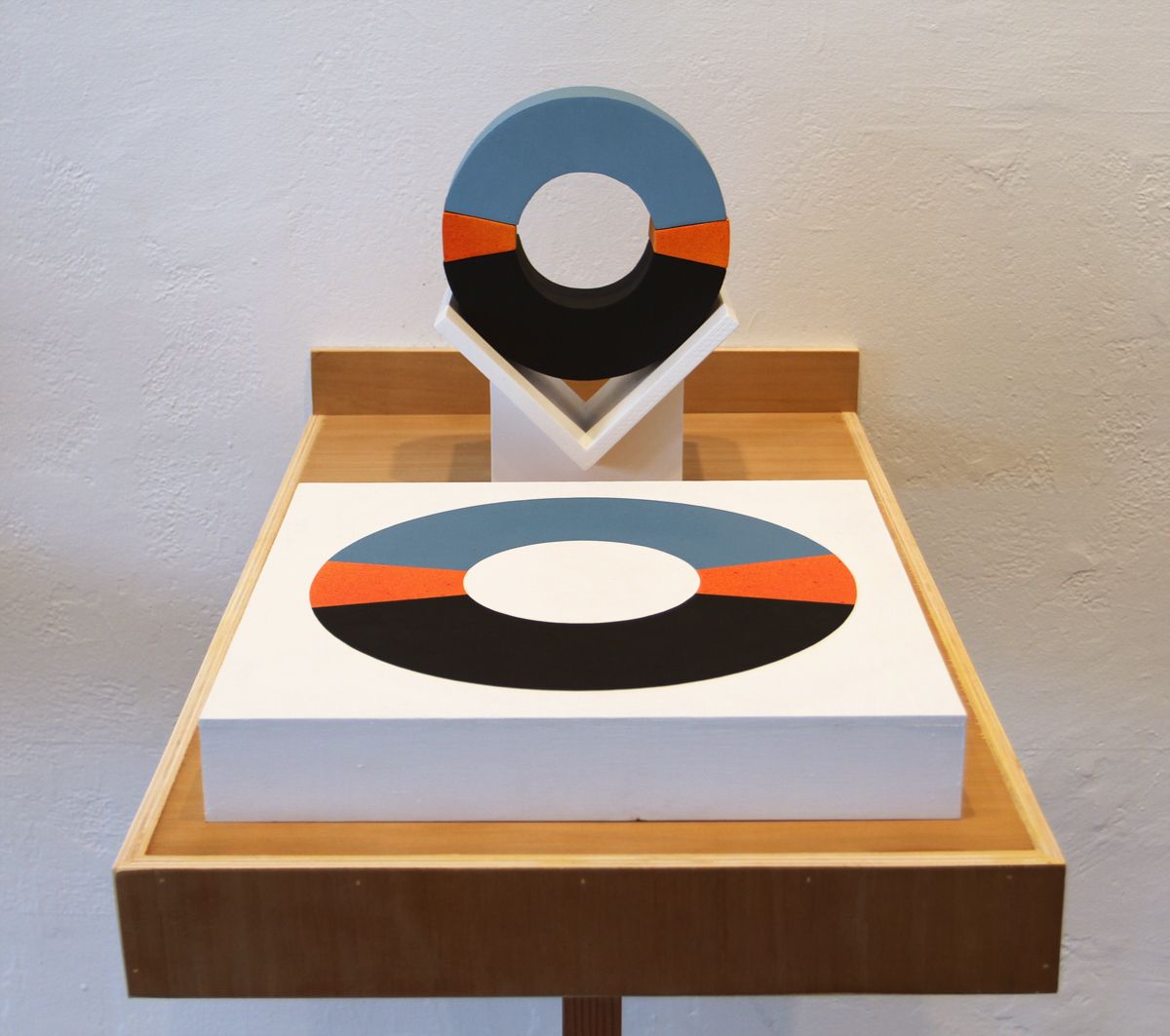
Gregory Ito's "Point of Vision"

Gregory Ito
"Untitled (Time Diagram Set B)"
2011
Acrylic and gouache on wood panel, acrylic on handmade wood object, and table

Like it or not, context informs our experience and interpretation of artworks. We generally think of context as a work's physical situation (e.g., how and where it is installed) or its social and art historical framework, but most important is the context provided by an individual viewer. What is the viewer's profession? What book is she reading? Who was she talking to an hour ago, and what about? Of course, artists can't control for these subjective factors, and many craft artist statements that provide viewers with what the artists believe is appropriate context for the artwork. Too often, though, these statements tell viewers what the "take away" should be, thereby forfeiting the most vital and collaborative element of the artistic enterprise, the creation of meaning by the viewer.

How refreshing, then, to find Gregory Ito's healthy twist on the artist statement in his terrific "Point of Vision" exhibition at Gallery Hijinks. While the artist and gallery provide a press release (usually an artist statement reworked and edited by the gallery staff), Ito also includes "Sources," a tidy stack of books on the floor, spines out so that the titles are easily read. Is "Sources" intended as a found object sculpture? Kinda sorta (after all, it's titled, is situated among Ito's other work, and is included on the exhibition price list, albeit "NFS"), but its principal valuable is as an alternative to the formal statement. It provides viewers with context without bullying them into a particular conclusion.
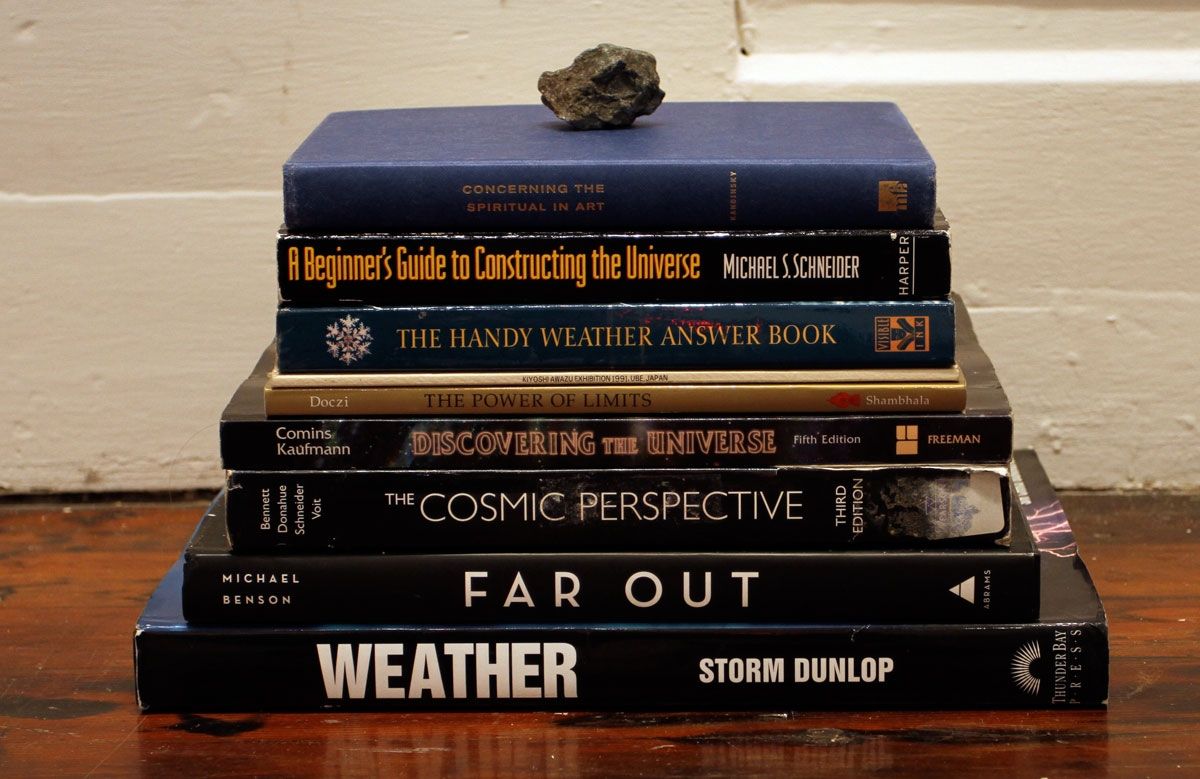
Gregory Ito
"Sources"
2011
Book collection

"Sources" is something of a companion piece to "Self Portrait (Object Collage)." Installed in one of the gallery windows, "Self Portrait" includes a beach chair, flip flops, a towel, a pile of diary-like journals, an ashtray, empty beer bottles, a candle, and 28 snapshots mounted on a board that faces the chair. One imagines the artist in his chair, sipping beer and smoking as he contemplates his collection of isolated observations. The photographs are mostly of clouds and sun-soaked skies, but there are also landscapes, some abstract imagery, a rainbow, and an illuminated light fixture. These pictures complement Ito's reading list. A Beginner's Guide to Constructing the Universe, by Michael Schneider, Concerning the Spiritual In Art, by Wassily Kandinsky, The Cosmic Perspective, Third Edition, by Bennett, Donahue, Schneider, and Voit, The Handy Weather Answer Book, and other titles included in Ito's book pile suggest that the artist is preoccupied with sublime, existential mysteries and celebrating our species' impulse to solve them.
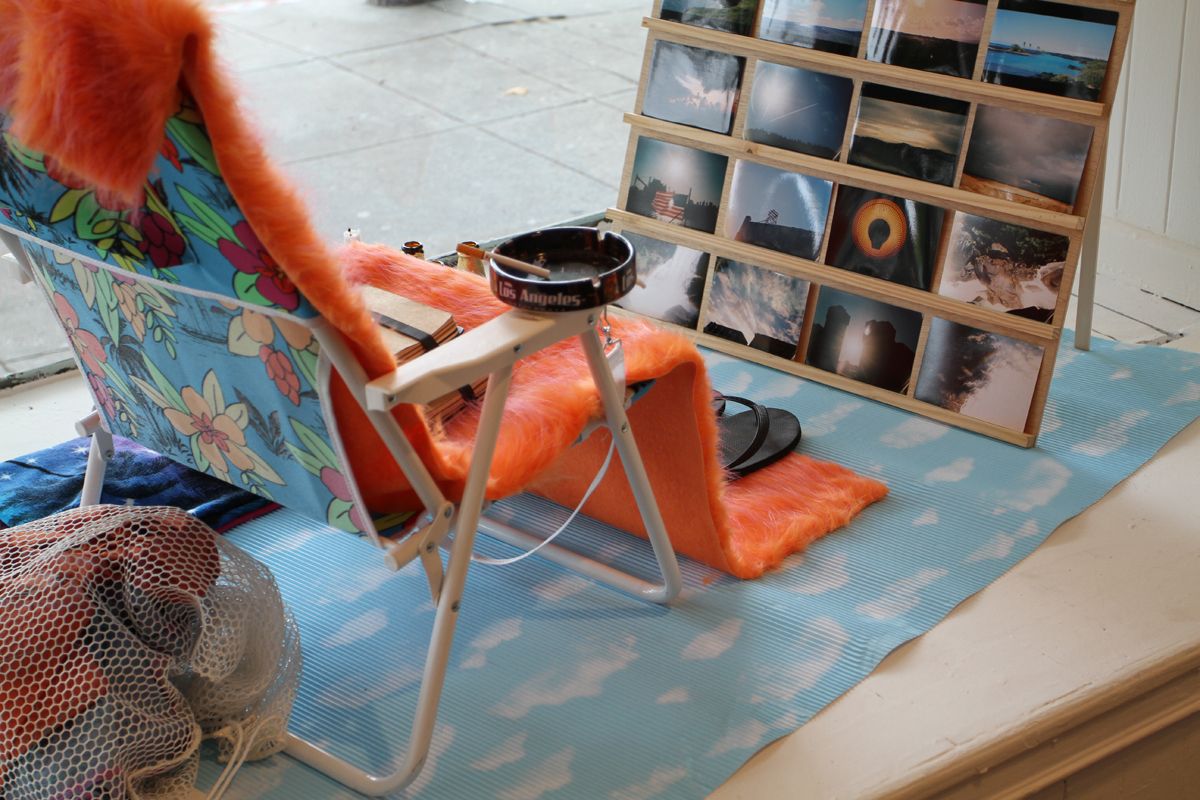
Gregory Ito
"Self Portrait (Object Collage)"
2011
Window installation with 28 photographs and wood display

Ito's sculptures, paintings, and installations reflect this focus. Especially in the gallery's "white cube" setting, they read as speculative objects and diagrams as much as they do aesthetic entities. The artist is well aware of this; he titles the two most compelling installations on view, "Untitled (Time Diagram Set A)" and "Untitled (Time Diagram Set B)." He pairs a painting with a sculpture in each. The paintings are straightforward illustrations of the sculptures, but, displayed in the gallery setting with the three-dimensional objects they depict, the images read as icons, potent stand-ins for the "real" or "true" object. Curiously, by virtue of having been depicted, the sculptures also gain in significance. The meaning of these pictures and objects remains somewhat esoteric. I infer, based on the works' titles and Ito's "Sources," that these are representations of space-time's nature or shape, but that's a rather general interpretation. Still, the sculptures resonate as totems and the paintings as their icons. This reciprocal dynamic is compelling, and serves as an oblique reminder that all artwork exists in relationship to the world and ideas outside of the gallery and studio, a fact too often overlooked since the advent of modernism.
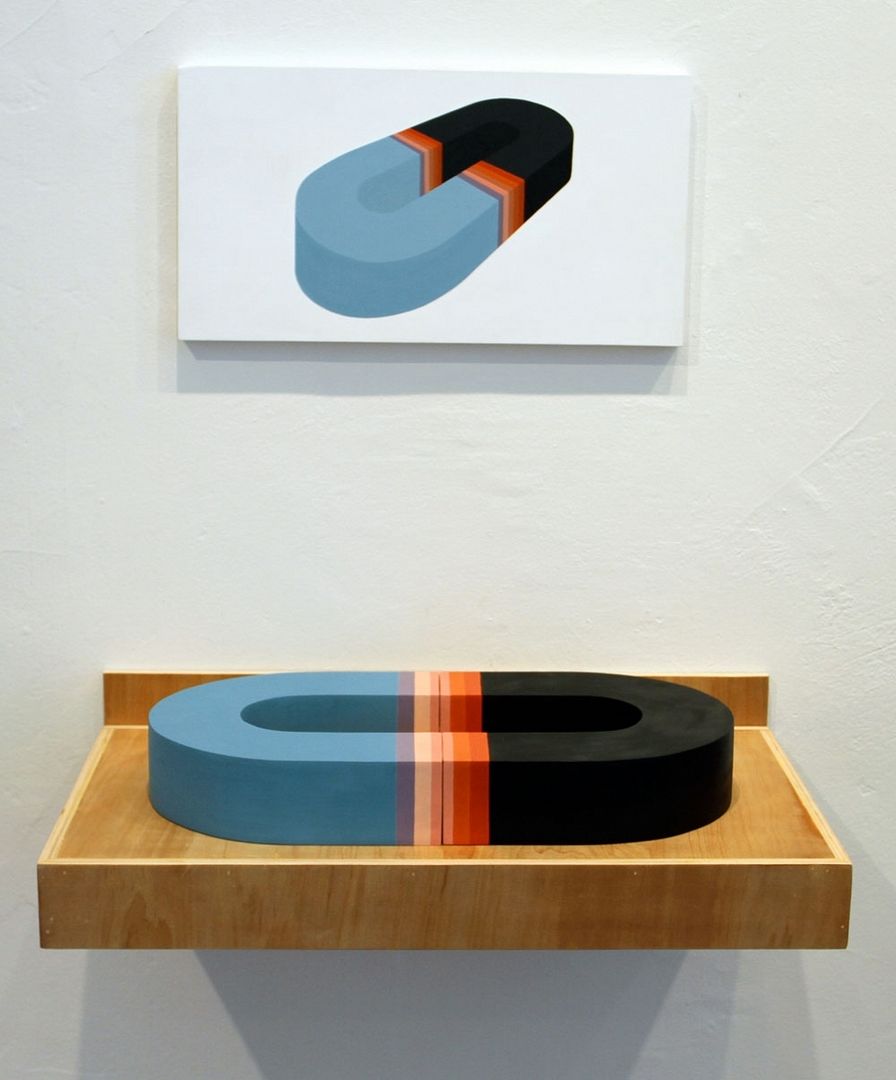
Gregory Ito
"Untitled (Time Diagram Set A)"
2011
Acrylic on wood panel, acrylic on handmade wood object, and shelf

In other works, Ito more directly highlights what I've elsewhere described as "the wonder current." In "Human Euphoria," a disembodied ceramic head of a girl in a big-brimmed, yellow hat rests on top of a block of adobe clay, apparently gazing at an ocean sunset. The piece is a winking, contemporary tribute to Caspar David Friedrich's Romantic masterpiece, "Wanderer above the Sea of Fog," but Ito's head is better-suited to contemplation than the vigorous morning constitutionals of Friedrich's dapper hero. Is this a comment on the continued dominance of conceptual concerns over aesthetic and material considerations in contemporary art? Perhaps; perhaps not. Ito's better pieces excel precisely because they can be interpreted as "art for art's sake" or, taking a hint from his "Sources," as art about the stupefying magnificence of being.

Gregory Ito
"The Embrace Installation"
2011
Acrylic and gouache on wood panel, found book with handmade page holders, and petrified object on shelf

Image credits: all images, courtesy Gallery Hijinks and Gregory Ito, 2011

Tuesday, April 21, 2009

Bring out your dead!


Walking to work this morning, I noticed for the first time that the Department of Sanitation New York City (DSNYC) logo features the caduceus, a symbol that depicts two snakes entwined about a staff. The DSNYC website explains that the caduceus, "the traditional medical symbol," is incorporated "to promote the idea that sanitation can affect the health of the City."

Indeed, sanitation is one of the most revolutionary inventions of mankind, but somebody at the DSNYC didn't do their homework. The "traditional medical symbol" is not the caduceus, but the rod of Aesculapius, an image that features just one snake wrapped around a staff or branch.

As I wrote here (almost exactly) four years ago,
"No bastardization of a symbol, however, is so glaring as the misuse of the caduceus by medical professionals. The familiar image of two snakes entwined about a winged staff is used by a slight majority of medical practitioners and groups. The caduceus, though, has nothing to do with medicine! It is the staff of Hermes.

'…Hermes was also considered to be the god of commerce and wealth, which in turn implies a sense of personal self-interest along with the possibility of stretching the truth to meet one’s own needs. Hermes was known as the patron god of thieves due to his many tricks and lies. The quality of dishonesty is not one that most people want to see in their physician, therefore a symbol that is traced back to representing trickery and deceit should not be used to represent a profession as highly regarded in trust as medicine. Additionally, Hermes is also said to have used his caduceus staff to lead the souls of those who passed away to the underworld, which is the opposite idea than that stated in the Hippocratic Oath that a physician is charged with.'

The symbol of medicine is actually Aesculapius’s staff...Aesculapius, appropriately, was the God of Medicine.

'The son of Apollo, god of health, Aesculapius is said to have been pulled from the womb as his mortal mother was dying, which came to symbolize a physician’s ability to turn death into life. Throughout his life, Aesculapius used medicinal herbs and surgical procedures to heal the sick and dying, with his culmination of the art being the ability to bring the dead back to life. In one episode of mythology, Aesculapius was said to have been inside a temple when a serpent came to him and wound itself up and around his walking staff. He killed the serpent, only to have a second slither in and use an herb to bring its dead comrade back to life. This brings forth the explanation for the revered symbol of Aesculapius’s staff, with this herb being the major discovery of his life. The snake was seen as a servant to Aesculapius in his healing, and was worshiped as such.'

Clearly, the two symbols became confused at some point. Kim Scott wrote a short history of the confusion, 'The History and Confusion of the Caduceus symbol and the Staff of Aesculapius in Medicine,' from which the above selections [in italics] are drawn. Scott dates the initial mix-up to circa 1500. Apparently, the symbolic SNAFU led to twentieth century medical [professionals regularly using the wrong staff.]"
And the DSNYC, too, made the same mistake.

But perhaps I'm too quick to condemn the DSNYC decision to adopt the caduceus? Maybe the folks behind the logo intended to reference the popular maxim, "One man's trash is another man's treasure." With that in mind, the DSNYC workers might be understood as Hermetic treasure thieves. Or, if that's too much of a stretch, we can consider Hermes' role as a conveyor of the dead to Hades. NYC's trashmen, then, can be thought of as leading the souls of the discarded to the Underworld. The latter interpretation gets my vote!

Wednesday, April 20, 2005

You Say Caduceus, I Say Aesculapius


I value symbols and language highly and, though I don't deny that both are subject to evolution, I do feel there should be a reasonable limit to the degree of abstraction or change. If anything goes, a great deal of the so-called evolution is instead de-evolution.

No one, to use a far-fetched example, would accept the word “sun” being used to denote the moon. The two celestial bodies are not opposites, but they are nonetheless distinct; the earth orbits the sun while the moon orbits the earth. If a lover were to gesture at the pale orb above and proclaim, “What a beautiful night.! The sun is full and the stars are bright,” you'd likely balk.

Some language picadillos are specific to our field or area of expertise. Few of my friends are galled by the catch-all term “seagull.” But birders and wildlife biologists recognize that there are 27 known species of gull in North America alone, and many of these gulls have little association with the “sea.” An equivalent misnomer, then, would be our calling all humans “watermen,” though only a small minority of Homo sapiens still eke out a living from the ocean.

Some vocabulary hang-ups of mine are, like "ATM machine," shared by many other people. Examples are the recently popular “irregardless” and the New York City MTA's “momentarily”/”in a moment” confusion. More extreme than I, my father has raged against the use of the word “bathroom” for years. He points out that most public restrooms contain no bath. He prefers “toilet,” “water closet” or “head.” Because I so frequently use the word “restroom,” he chides me by asking if I intend to sleep or lie down on the tile floor. Perhaps, then, a late night of drinking makes the term "restroom" accurate?

The meaning or significance of a symbol is more steadfast. A change in attributed meaning is most often due to outright misuse. Some hipsters wear East German military insignia as an ironic or “hip” gesture but, despite the changed context, the marking still retains its original meaning. Or does it? Typically, the teenagers and twenty-somethings that don military decoration do not know what the medals mean. Even Hollywood costume designers treat these medals and ribbons as general signifiers of military do-gooding. Rarely do they take the time to learn what each medal represents. As a result, Hollywood often presents audiences with an Army officer whose chest is covered in Navy and Air Force ribbons! To a certain segment of the movie-going audience, this is a major "Whoops!"

No bastardization of a symbol, however, is so glaring as the misuse of the caduceus by medical professionals. The familiar image of two snakes entwined about a winged staff is used by a slight majority of medical practitioners and groups. The caduceus, though, has nothing to do with medicine! It is the staff of Hermes.
“…Hermes was also considered to be the god of commerce and wealth, which in turn implies a sense of personal self-interest along with the possibility of stretching the truth to meet one’s own needs. Hermes was known as the patron god of thieves due to his many tricks and lies. The quality of dishonesty is not one that most people want to see in their physician, therefore a symbol that is traced back to representing trickery and deceit should not be used to represent a profession as highly regarded in trust as medicine. Additionally, Hermes is also said to have used his caduceus staff to lead the souls of those who passed away to the underworld, which is the opposite idea than that stated in the Hippocratic Oath that a physician is charged with.”
The symbol of medicine is actually Aesculapius’s staff, which features ONE snake curled around a rod. Aesculapius, appropriately, was the God of Medicine.
“The son of Apollo, god of health, Aesculapius is said to have been pulled from the womb as his mortal mother was dying, which came to symbolize a physician’s ability to turn death into life. Throughout his life, Aesculapius used medicinal herbs and surgical procedures to heal the sick and dying, with his culmination of the art being the ability to bring the dead back to life. In one episode of mythology, Aesculapius was said to have been inside a temple when a serpent came to him and wound itself up and around his walking staff. He killed the serpent, only to have a second slither in and use an herb to bring its dead comrade back to life. This brings forth the explanation for the revered symbol of Aesculapius’s staff, with this herb being the major discovery of his life. The snake was seen as a servant to Aesculapius in his healing, and was worshiped as such.”
Clearly, the two symbols became confused at some point. Kim Scott wrote a short history of the confusion, "The History and Confusion of the Caduceus symbol and the Staff of Aesculapius in Medicine," from which the above selections are drawn. Scott dates the initial mix-up to circa 1500. Apparently, the symbolic SNAFU led to twentieth century medical newsletters using the word caduceus in their titles!

The conservative commentator in me feels that our educational system is in need of a visit from Aesculapius, too.