Showing posts with label biology. Show all posts

Thursday, October 03, 2013

Knowing the Way To Your Heart

Elizabeth Alexander
"Song Sparrow"
2012
I was curiously heartened when I read the below blurb in the "Field Notes" section of the September/October 2013 issue of Audubon Magazine.
Silly Love Songs: Singing longer doesn't always mean you get the girl.

Among song sparrows, the most tuneful males often win over the females -- but their vocal expertise may come at a cost. Biologists at Duke University counted up songs in male song sparrows' repertoires and then tested the birds' memories. Every day for eight days the researchers hid a mealworm in one of several shallow wells, some of which had lids. The mealworms' location remained the same, so the scientists could observe how deftly the sparrows remembered where to find their treat. Over time all of the birds improved, but the males that sang the fewest songs learned the quickest, while the birds with more expansive repertoires struggled. Kendra Sewall, now at Virginia Polytechnic Institute and State University, explains that the difference could reflect a trade-off during mental development -- the birds develop one ability or the other. The finding also suggests that females may be able to detect a potential mate's weaknesses in his songs. Although many pick males that sing lots of songs, Sewall notes that every male in their study found a mate. It's possible, she says, that certain females are aware of the trade-off and prefer a partner with spatial smarts to pass on to their young. -- Daisy Yuhas
Maybe I was cheered by the report because I a) have a terrible singing voice, b) struggle to remember song lyrics (even simple tunes), c) am fond of poring over maps, and d) have an innately good sense of direction? Like the song sparrow test subjects, it seems I was afforded one ability and not the other.

Image credit: Elizabeth Alexander's mixed media song sparrow artwork found online at the Scholastic Alliance for Young Artists & Writers Blog

Wednesday, June 26, 2013

Sci Foo On My Mind

Summer solstice moon over the Googleplex; Mountain View, CA; June 2013

My father-in-law is a glass-half-full kinda guy. In the midst of any conversation about science, medicine, or technology, it's not uncommon for him to proclaim, "This is an exciting time to be alive." Indeed, it is. But when I fell into bed early on Sunday morning, my head giddy with ideas from the first full day of Sci Foo Camp, my father-in-law's optimism seemed understated. Spend 48 hours with -- to list just a few of the approximately 250 participants -- a computer scientist studying machine learning and music, a theoretical physicist turning the idea of gravity on its head, a marine biologist eager to solve the mysteries of whale sharks, a genomic epidemiologist intent on elucidating outbreak transmission dynamics, and a national security strategist currently implementing the White House's terrorism-related information sharing priorities and...well, you come away with much to ruminate on and a lot of notes to parse. In short, Sci Foo Camp made for an extraordinary weekend!

Sunday, October 10, 2010

Winner Take All?


My father recently sent me a clipping from the Hampton Roads Daily Press that highlighted some curious research presented at my alma mater, the College of William & Mary.

Biologists have determined that "the maximum length of a duck's penis depends not on genetics but rather [on] the males he keeps company with." Dr. Maydianne Andrade, of the University of Toronto Scarborough, explained that ducks "are essentially engineering their own phallus in response to social challenges." This is fascinating evolutionary biology, to be sure, but I find it remarkable that ducks have penises at all, given that most birds do not. (Apparently, a cloaca just won't cut it in duck world!) Dr. Patricia Brennan, of Yale University, believes that the heightened intensity of male-male competition among waterfowl has resulted in the development and size fluctuation of their sex organs.

The evolving duck penis battle came to mind when I read Ashley Mears' article about Coco Rocha, the popular fashion model. Early in his piece, Mears summed up the competitive dynamics of creative industries revealingly.
"Rocha is what economists would call a winner in a 'winner-take-all market,' prevalent in culture industries like art and music, where a handful of people reap very lucrative and visible rewards while the bulk of contestants scrape together meager livings before they fade into more stable and far less glamorous careers."
As with the bulk of would-be daddy (or uncle) ducks, most artists, designers, musicians, writers, and other creatives will not be prolific and celebrated. There are many intangibles in play, of course, but, like the drake duck whose penis twists to extraordinary lengths to impregnate a hen, "winning" in a creative industry often depends on who you're keeping company with.

Once vetted, however, the successful creative becomes, like Coco Rocha, a known label; his or her career is likely to be a fruitful one. That label is what the blog "Is It Art or Fart?" trades on. As the blog's co-founders explain,
"The blog began as a conversation between two friends living on opposite coasts who shared an undying passion for contemporary art. Both friends have the habit of seeing as much contemporary art as they possibly can, and this habit has uncontrollably spilled over into the recognition of 'fart'--coincidental moments in everyday life that, when isolated and [attached to the name of an] artist, bear uncanny resemblance to art seen in museums and galleries around the globe. Back and forth the two friends would point to the 'fart' that seemed to be just about everywhere. Now the humor of their findings is for all to enjoy. Remember, the world is your readymade!"
Part of the humor of their project is that the "fart" is often as good as or better than the "art" it might be confused with. Unfortunately, for the "fart," as for many drake ducks and coulda-been-a-contender creatives, it's a winner-take-all world.

Image credit: Scrooge McDuck, copyright Walt Disney Company

Monday, March 15, 2010

The 'Raw Stuff'...Discussed

I submitted a version of "Different Takes on the Raw Stuff," my posted response to Peter Gabel's "A Call For Sacred Biologists," to Tikkun Magazine, and I'm pleased to report that my comments engendered an edifying conversation with the article's author.

The editors of Tikkun have posted an abridged version of my correspondence with Peter on Tikkun's blog, Tikkun Daily. I encourage folks to check it out, but I've also included two excerpts of Peter's "voice" below.
"If I could sum it up in a phrase, I would say that Christopher is committed to the idea that science and religion are both valid ways of knowing but they are separate ways, whereas I believe we have to move towards a unified approach to knowledge (the nature of which I’ll take up in a forthcoming issue of the magazine). I was happy to have such a reasonable conversation about a topic that arouses such passion."

"It seems that [Christopher has] two selves and two worlds, the mystic and the materialist, side by side, each in its domain. I’m very much in agreement that [his] stand on this is possible; nothing about science excludes a mystical and religious reality within which material reality and scientific knowledge of that material reality unfolds.

However, for me there is only one world, the spiritual-material, spirit enlivening material form. To take this world as an object therefore is to act on it and impoverish it, although sometimes for a noble and valuable purpose (western medicine!). But ultimately I am for reuniting knowledge with spirit as manifested in form, including restoring meaning/desire/intention to evolution (but not some perfect intelligent design)."
When it comes down to it, then, I don't think that Peter and I are in stark disagreement. To a large extent, I share his belief that my "two selves" are actually of a piece (i.e., the division of logos and mythos, or rational and irrational, is artificial), but I also contend that there are different ways of knowing or approaching the Whole (the Everything), and that these distinct ways of knowing can and should coexist, each bringing to the conversation their unique perspective.

Read the full exchange here. The Tikkun Daily post also features two recent drawings that aren't yet on my website.

Thursday, March 11, 2010

Different Takes on the Raw Stuff


Christopher Reiger
"submerged in his erotic mystification"
2009
Watercolor, gouache, sumi ink and marker on Arches paper
32 x 32 inches

I'm pleased to announce that one of my 2009 paintings, "submerged in his erotic mystification," is reproduced in the March/April 2010 issue of Tikkun Magazine. If you're unfamiliar with Tikkun, it's a west coast-based magazine founded by Rabbi Michael Lerner and dedicated to exploring the intersection of politics, spirituality, and culture. While it has Jewish roots (hence the magazine's name), it is an inter-faith publication with a diverse group of secular and religious contributors. The March/April issue includes a special section entitled "God and the 21st Century," featuring articles by seventeen writers, including the esteemed Rabbi Arthur Green, a scholar whose stripe of mystical panentheism resonates with my theological convictions.

My artwork accompanies one of the many articles included in "God and the 21st Century." Respected law critic Peter Gabel's "A Call For Sacred Biologists" explores the gulf between a strictly rational, scientific world view and that of, for lack of a better description, holistic panentheism. I allude to this same schism in my artist statement.
"[I]ncidentally, we've realized that the divide between the imagination and reason is unnatural. The English poet and critic, John Ruskin, alluded to this schism when he wrote of 'the broken harmonies of fact and fancy, thought and feeling, and truth and faith.' Indeed, although we today learn an increasing number of facts about Nature, we understand ourselves to be apart from it, and our experience of it is therefore less complete. My artwork is born of this apparent opposition."
Gabel's subject is near and dear to me, but his language unfortunately suggests that he has a deep-seated mistrust of, as he puts it, "the so-called 'scientific method'." (Italics mine.)

In the myopic, yet much ballyhooed skirmish between science and religion, I reside in the middle, as frustrated by the rabidly anti-religious as I am disturbed by and opposed to religious literalists and fundamentalists. Gabel, while not a religious literalist, uses language that apparently misunderstands scientific endeavor. For example, he insists that we need evolutionary biologists "who connect the sacred within themselves to the sacred dimension of what they observe." If he means that we need more leading scientists to openly discuss the awe and wonder they experience through their observation of the material world, he needn't worry. Many scientists are more than happy to wax poetic about the wonders of life and the universe; stand outs include Loren Eiseley, Carl Sagan, E.O. Wilson, Thomas Eisner, and Janna Levin. If, however, Gabel is suggesting that evolutionary biologists should champion mysticism, orthogenesis (1), or notions of "a master plan," he is expressing an essentially irrational and anti-scientific bias. Biologists must be vigilant to not allow spirituality to cloud their work. By all means, biologists can be deeply religious or spiritual people, but, for science to remain legitimate, the method and its language must be materialist and reductionist. (If scientific endeavor is mixed with mysticism, it becomes pseudo-science or, put another way, bunk.)

At the article's close, Gabel writes that "the theory of evolution [must] align itself with the truth that spirit and matter form an indissoluble unity." To the contrary, the theory of evolution needn't make any attempt to "align itself" with spirituality; it is its own truth, a scientific truth. As Rabbi Green writes in the same special section,
"I recognize fully and without regret that theology is an art, not a science. We people of faith have nothing we can prove; attempts to do so only diminish what we have to offer. We can only testify, but never prove."
Exactly right!

As I wrote on this blog in late 2008, in an essay about the artwork of Matthew Day Jackson,
"At their respective best, both science and religion (re)awaken or invigorate our capacity for wonder. Each makes use of a different approach, but they are complementary. As Albert Einstein famously said, 'Science without religion is lame. Religion without science is blind.' The late evolutionary biologist Stephen Jay Gould called the two 'non-overlapping magisteria' because good science trades in facts to explain material phenomena, whereas religion traffics in the unverifiable and the unobservable. Where science seeks to demystify, and to build on each subsequent revelation to learn more, religion aims to make sacred that which is taken for granted, to make the ordinary again extraordinary. Both, however, offer frameworks of engaging our astonishing existence and experience. Both are compelled by curiosity and wonder. As Gotthold Ephraim Lessing, the Enlightenment writer-philosopher, argued, if God held in one hand the Entire Truth and in the other the Eternal Pursuit of Truth, a good man will choose the latter. The same is true of authentic scientists and religious thinkers. The methodology and particulars may differ, but both science and religion are realms of the question. Although the popular conception of the scientist is the white-coated statistician ready to provide any and all answers, the caricature is misleading. It is 'normative in science to be not sure,' as Jessica Palmer put it doing the ScienceBlogs panel. Science, like religion, is a matryoshka doll, a series of questions nested within questions.

Gould considered art and philosophy magisteria unto themselves, but, unlike religion and science, each overlaps the other. Where these two overlapping sections meet, we find ourselves in the realm of what the artist-writer Paul Laffoley calls the mesoteric. In Laffoley's cosmology, the circle of religion, dealing as it does with questions of ultimate meaning, is dubbed the esoteric realm. The circle of science, focused on material truths and the observable world, he labels the exoteric realm. The mesoteric realms. art and philosophy, bridge the esoteric and exoteric. Whereas Gould posits that the magisteria of religion and science are nonoverlapping, I would argue that, where their circles meet, the membrane is permeable. This bleeding of one into the other represents the pinnacle of art and philosophy."
Rather than demand that science couch its truths in the language of the sacred or demand that religion dress its Truth in the language of scientist, why not understand each as complementary, distinct practice of awe? In a recent post on NPR's "Cosmos and Culture" blog, astrophysicist Adam Frank writes,
"I believe it is possible, and necessary, to see science and human spiritual endeavor through an alternative perspective. That perspective would acknowledge the truths each can reveal and avoid jealous comparison of those truths. [...] Our elemental encounter with the world, the raw stuff of experience, was just as vivid and strange to our ancestors as it is to us now if we are willing to pay attention. They felt awe and wonder beneath the dark weight of the night sky, in the deep quiet at the forest's edge or in the shock of infant's birth wail. Those experiences drove our ancestors, as [they drive] us, to an all important aspiration, a desire to draw closer to the source of that tremendous awe. That aspiration - what I call the Constant Fire - contains the original and braided roots of science and religion. [...] That aspiration is, for me, a road less traveled in the discussions of science and religion. If we were to follow it and to ask what is common, not in results about the world but in the deeply felt response to it, who knows where we might be led?"
Beautifully stated, Dr. Frank!

My rather particular problems with Gabel's article aside, the March/April issue of Tikkun includes excellent pieces by Rabbi Arthur Green, David Loy, Shaul Magid, and others.

(1) Like Gabel, I'm warm to Pierre Teilhard de Chardin's concept of orthogenesis, the "hypothesis that life has an innate tendency to move in a unilinear fashion," increasing in complexity. When people speak of "the universe becoming aware of itself," they are expressing an essentially teleological sentiment and, while many contemporary scientists will acknowledge that such a notion is possible, it is wholly unquantifiable and therefore not legitimate science. It is best classified as theology. It is important to note, however, that de Chardin was a Jesuit priest as well as a serious paleontologist and geologist. He did not believe the scientific method to be at odds with a sense of belonging, wonder, or, in his words, "the within of things." Rather, de Chardin recognized science as kin to the arts, philosophy, and theology; it is another tool for our species' exploration of the evolving universe we inhabit.

Thursday, October 22, 2009

Acting Out (Peacefully) Against the Culture of Competition


Shizuishan Industrial district in Ningxia. Residents cover themselves against the falling dust when going outside.
April 22, 2006

This Saturday, October 24th, I'll join a mob of peaceful activists and march across the Brooklyn Bridge, from Manhattan to Brooklyn, in hopes of further raising public awareness about the reality of climate change and the need for a comprehensive international climate treaty. The march is associated with 350.org's Day of Action.
"350.org is an international campaign dedicated to building a movement to unite the world around solutions to the climate crisis--the solutions that science and justice demand. Our mission is to inspire the world to rise to the challenge of the climate crisis—to create a new sense of urgency and of possibility for our planet. Our focus is on the number 350--as in parts per million, the level scientists have identified as the safe upper limit for CO2 in our atmosphere. But 350 is more than a number--it's a symbol of where we need to head as a planet. [...] This December, world leaders will meet in Copenhagen, Denmark to craft a new global treaty on cutting emissions. The problem is, the treaty currently on the table doesn't meet the severity of the climate crisis—it doesn't pass the 350 test. In order to unite the public, media, and our political leaders behind the 350 goal, we're harnessing the power of the internet to coordinate a planetary day of action on October 24, 2009. We hope to have actions at hundreds of iconic places around the world - from the Taj Mahal to the Great Barrier Reef to your community - and clear message to world leaders: the solutions to climate change must be equitable, they must be grounded in science, and they must meet the scale of the crisis."
350.org was founded by author and environmentalist Bill McKibben and, although some legitimate philosophical criticisms of the project have been raised, I feel strongly that the organization's mission is vital.


Due to long-term consumption of water contaminated by industrial waste, 50 people have cancer and cerebral thrombosis in Kang village of Linfen City, Shanxi Province..
64-year-old Wang Baosheng has fester wounds all over his body, and must sleep sitting, face down on the edge of the bed each day.
July 10, 2005

Should you doubt the urgent need for an international climate treaty that demands accountability and systemic change, or should you remain skeptical of the human influence on atmospheric carbon levels, I encourage you to take a look at the distressing pictures that ChinaHush recently published. Photographer Lu Guang's series "Pollution in China" is a testament to the cruel realities of the international, industrial market.

In his book-length essay Life Is A Miracle, the author, poet, essayist, and critic Wendell Berry describes the global, capitalist world view as,
"one culture of division and dislocation, opposition and competition, which is to say the culture of colonialism and industrialism. This culture has steadily increased the dependence of individuals, regions, and nations upon larger and larger collective economies at the same time that is has thrown individuals, regions, and nations into a competitiveness with one another that is limitlessly destructive and demeaning."
The "collateral damage" caused by this monstrous steam engine is not limited to elevated carbon levels, and its poisons don't just affect the dispossessed or the politically and economically powerless.

Nicholas Kristoff reminds us, in a recent New York Times OpEd piece, that the staggering number of "deformed frogs and intersex fish [found in or near United States' waters] — not to mention the growing number of deformities in newborn boys — should jolt us."
"In the Potomac watershed near Washington, male smallmouth bass have rapidly transformed into 'intersex fish' that display female characteristics. This was discovered only in 2003, but the latest survey found that more than 80 percent of the male smallmouth bass in the Potomac are producing eggs. Now scientists are connecting the dots with evidence of increasing abnormalities among humans, particularly large increases in numbers of genital deformities among newborn boys. [...] Apprehension is growing among many scientists that the cause of all this may be a class of chemicals called endocrine disruptors. They are very widely used in agriculture, industry and consumer products. Some also enter the water supply when estrogens in human urine — compounded when a woman is on the pill — pass through sewage systems and then through water treatment plants."
Herpetologists have been sounding the alarm for years, but the policy makers are warm in the pockets of the immoral corporations and the populace, by and large, prefers to escape in celebrity pregnancy updates and corporate-owned sporting events. Amphibians were the ignored canary in the coal mine. Now many animal families (ours included) are paying a terrible price, one that we can not yet fully appreciate.


Henan Anyang iron and steel plant’s sewage flowed into Anyang River. March 25, 2008

Still, it's not too late to stand up to the "culture of colonialism and industrialism." Visit 350.org. Find out how to get involved in the effort. If global warming isn't appealing to your still, small voice, get involved with political activism, volunteer at your local homeless shelter, pledge financial support to non-profit activist organizations working for causes that you feel strongly about; it doesn't matter what you do, but it does matter that you do something. Turn off the television, put down the tabloid. I beg this of you.


Breathing large amounts of dust into their lungs, people become sick after working here for 1-2 years. Most of these migrant workers come from area of poverty.
April 10, 2005

Photo credits: all photographs, Lu Guang; ripped from ChinaHush

Monday, September 14, 2009

Kimmel Harding Nelson Residency: Day 8


1884 Button steam engine; Museum of FireFighting; Nebraska City

Appreciating Varieties of Evolution

"Life," writes Loren Eiseley, Nebraska's latter day Thoreau, "is multitudinous and emergent in the stream of time." Considering the evolution of flowering plants, Eiseley explains,
"The true flower - and the seed that it produced - was a profound innovation in the world of life. In a way, this event parallels, in the plant world, what happened among animals. Consider the relative chance for survival of the exteriorly deposited egg of a fish in contrast with the fertilized egg of a mammal, carefully retained for months in the mother's body until the young animal (or human being) is developed to a point where it may survive. The biological wastage is less - and so it is with the flowering plants. [...] The true flowering plants (angiosperm itself means 'encased seed') grew a seed in the heart of a flower, [...] but the seed, unlike the developing spore, is already a fully equipped embryonic plant packed in a little enclosed box stuffed full of nutritious food. [..] The ramifications of this biological invention were endless. Plants traveled as they had never traveled before. [...] The well-fed, carefully cherished little embryos raised their heads everywhere."
Reading Eiseley, I'm struck by how applicable the language he uses to elucidate plant evolution - innovation, wastage, development, invention - is to the maturation and proliferation of human technology. Our machines of steel and plastic are, like the angiosperms, natural and transient shapes of life's eternal striving; they are imperfect adaptations of the moment.


Antique Tractor; Mayhew Historical Village; Nebraska City

We humans are foolishly arrogant, and often conceive of ourselves as the zenith of physical evolution. The sacred books of our species' major religions claim that we are "made in God's image," and, because most folks are literal-minded, unimaginative, or loathe to admit their own cosmic insignificance, that claim is usually understood to mean that God looks like us, and that we look like God. That's a shame, because the claim's power is metaphorical; humanity is "made in God's image," as is the flower or the carpenter bee or the black bear. For all of these species and, indeed, for God, evolution rolls on.

Humans are unable to outwardly observe our continuing development because we are too close to it, and too short-lived a species. Nevertheless, it is happening. Our technological shifts are the most apparent evidence of this ceaseless process. And what technological transitions each modern human is witness to! Like the growth of a child to a parent, the metamorphosis appears a slow, steady progression, but a retrospective survey reveals an astonishing pace. I periodically marvel at the evolution of computer and video games in (roughly) my own lifetime, from the home version of "Pong" to "Halo," but what of the computers themselves or, for that matter, the Internet?

Consider, for a moment, the technological, political, and social revolutions undergone by our country during Mike Bauer's tenure with the Nebraska City Fire Company #1 and the Great Western Fire Company #1. Bauer joined the company in 1865, at the close of the American Civil War. At that time, "bucket brigades," lines of volunteers passing leather buckets from hand to hand, were the primary way of combating blazes. Bauer climbed the fire fighter ranks, from engineer, to foreman, to chief, and served the growing town through the Spanish-American War, the First World War, and the federal introduction of Prohibition and women's suffrage, in 1920. During this time, the fire department's methods evolved from the "bucket brigade," to horse-drawn pumps, to steam-powered pump engines (like the Button engine; pictured above), to, finally, gasoline-motor pumper trucks (like the 1926 Seagrave pumper; pictured below). All of this change, in Bauer's 67 years of active service! It's a happy wonder to contemplate!


1926 Seagrave Pumper Engine; Museum of FireFighting; Nebraska City

Photo credits: all photos, Hungry Hyaena, 2009

Thursday, September 10, 2009

Kimmel Harding Nelson Residency: Day 4


Oregon Trail Marker; Nebraska City

Manifest Destiny

On the eastern edge of Nebraska City's Central Avenue stands a simple cairn with a plaque, a monument to the Oregon Trail. The plaque reads, in part,
"Official Oregon Trail Marker: [...] overlaid branch of the Oregon Trail, 1849, from the steamboat landing thousands started westward to Pike's Peak, Salt Lake, California and Oregon."
My gaze drifts from this humble memorial to Central Avenue, Nebraska City's main thoroughfare. Today, automobiles move east and west on the two-laned, paved drag. 160 years ago, families traveling by covered wagon set west on a dirt path, intent on making a better life for themselves.

Just think of it; that was 160 years ago! The territories of the western United States were then largely unsettled by immigrants of European extraction. The notion of Manifest Destiny, the Providential assumption that all of North America belonged to a white, male God and, in turn, to His European sons and daughters, was only introduced in 1845. At the time, the American Civil War had yet to be fought, electricity had yet to be harnessed as a popular power source, and human flight was only a hopeful diagram in a sketchbook. 160 years is just three human lifetimes, a drop in history's bucket, a nearly invisible mark on the geologic timeline.


Nebraska City, circa 1860

As I scribble down these thoughts, a small slug moves over the concrete by my left foot. 300 million years ago, our human face was not so dissimilar from the slug's. As Loren Eiseley describes it in The Immense Journey, the steady march of time, whether surveying a span of 300 million or 160 years, is "life reaching out, [...] that magnificent and agelong groping [...] still in progress. [...] Content is a word unknown to life; it is also a word unknown to man."


Oregon Trail Marker and Central Avenue view; Nebraska City

The Windmill Shop

Early this morning, fellow KHN resident Manya Fox and I were granted access to the now closed Kregel Windmill Company shop, located on Central Avenue. For the most part, the shop's interior is just as the employees left it, a time capsule testament to the labor and ingenuity that allowed for the settling of the American west. As our gracious host put it with a grin, "Some people say the six gun settled the west, but it was really the windmill."

Early explorers, Lewis and Clark included, characterized the land that would become the Nebraska Territory as the "Great American Desert," an area unfit for human habitation. But, because of windmills, the plains would soon become some of the most fertile farming land in the United States. Homesteaders needed water to survive, of course, and the windmill was the only efficient way to draw water up from wells 100 feet deep. Wood and, later, metal blades were cut, shaped, and hammered in the Nebraska City shop, an outfit run by the "taskmaster" Kregel brothers, immigrants from Germany.

The brothers are dead now, the Windmill Company is closed and in need of preservation, and water-pumping windmills have, in most places, been replaced by electric pumps. Technology and livelihoods gone with, as it were, the wind.


Accounting desk; Kregel Windmill Company; Nebraska City

Or are they? Today, towering windmills of steel and aluminum, better known as turbines, are being erected the world over. These turbines are an effective means of energy collection that also offer promise of a thriving, low impact industry. In the windmill shop, as I admired a lathe built in the early 1860s, Eiseley's words echoed; the "magnificent and agelong groping" continues.

Beyond Manifest Destiny

Nebraska City's Morton-James Public Library has a small NASA exhibition on display now. As I shuffled around the library gallery this morning, I marveled that the Space Shuttle Orbiter, the "vehicle that carries the crew and payloads to and from Earth orbit," must reenter Earth's atmosphere and land without power. It "glides back to Earth and lands on a runway. [...] Careful guidance control is needed to assure that it is properly positioned to reach the desired landing site." This astonishing feat of engineering and science is made that much more impressive if we consider that it was first realized just 130 years after the homesteaders and pioneers disembarked from Nebraska City's steamboat landing.

To those individuals who emphasize humanity's bloody excesses and potentially catastrophic exuberance above all else, I can only express my bafflement. Truly, to study evolution and the progress of history and science is to be necessarily possessed by eudaimonia. What great feats are forthcoming? The sun is shining; the crickets and katydids are singing; the world is electric with possibility.


Refurbished blades; Kregel Windmill Company; Nebraska City

Photo credits: all photos, Hungry Hyaena, 2009; Nebraska City illustration, ripped from Richard Gehling's "The Pike's Peak Gold Rush"

Friday, August 21, 2009

A Practice of Naming


Christopher van Donkelaar
"Adam Naming the Animals"
Handmade pigments and mixed media
2008
"Praise to the first man who wrote down this joy clearly, for we cannot remain in love with what we cannot name."

- Robert Bly
A lover of etymology and taxonomy, one of my most cherished reference books is Arthur Frederick Gotch's Latin Names Explained: A Guide to the Scientific Classification of Reptiles, Birds and Mammals. In it, Gotch catalogs and dissects the scientific names of some 4,000 animal species. That number appears relatively insignificant when we consider that biologists estimate 25,000 species of bird, mammal, and reptile currently exist on Earth, but Gotch's record is so far unparalleled. Each entry provides the animal's common and scientific names, followed by an explication of the Latin and Greek and, sometimes, a blurb about the species' range and habitat.

For example, consider Gotch's entry on one of my very favorite North American snake species:
Copperhead Agkistrodon contortrix
agkistrodon (Gr) a fish-hook; odon (Gr) a tooth; a reference to the curved fangs, though of course they are not barbed; contorqueo (L) I twist, turn; contortus (L) full of turns, twisted; contortrix (L) one that is able to turn, twist. Inhabiting the south-eastern part of the USA including Florida. The top of the head is reddish brown.
Although the range information suggests that the copperhead is more confined to the southeastern United States than the species and subspecies actually are - they thrive in New York State, for example - Gotch's entry informs readers that the snake commonly called a copperhead is universally and technically named Fish-hook shaped tooth twister or, if you prefer, The Twisting One With Hook Shaped Teeth. Knowledge of this name allows me to appreciate the beautiful reptile from another angle.

But what's in a name, really?

Although I'm generally baffled by Biblical literalism, I appreciate the Genesis accounts of creation for their gratifying metaphor. In particular, I'm drawn to rabbinic and Jewish mystics' interpretations of the conjoined, aboriginal narratives. More so than their Christian counterparts, Jewish theologians and mystics endow language and names with ontological significance. The Hebrew alphabet is understood as a powerful code: the written word is creative potential, and the spoken word, procreative. The god of Genesis 1 creates neither with a wave of the hand nor by shaping raw material, but by speaking the world into being; annunciation and incantation are the means of creation. Because of the vocative nature of naming, observant Jews place great value on words and speech. (They are even prohibited utterance of the tetragrammaton, the four-letter Hebrew name of God, transliterated as Yahweh. Appropriately enough, the colloquial name for God is Hashem, or "the word.")

In Genesis 2, the creator god is anthropomorphized and physically involved with creation, shaping man and the other animals from earth. Yet the power of language and names remains significant in this account. God asks Adam, the first naked ape, to name all of the other animal species. That's no mean task, and apparently Adam died before he finished the job. His descendants, at least the taxonomists among them, are still working at the task of naming.

But even those individuals who do not share my affection for taxonomy will find value in a practice of observation and naming. As Carol Kaesuk Yoon writes in her recent New York Times paean to taxonomy, "Reviving the Lost Art of Naming the World,"
"Even when scads of insistent wildlife appear with a flourish right in front of us, and there is such life always — hawks migrating over the parking lot, great colorful moths banging up against the window at night — we barely seem to notice. We are so disconnected from the living world that we can live in the midst of a mass extinction, of the rapid invasion everywhere of new and noxious species, entirely unaware that anything is happening. Happily, changing all this turns out to be easy. Just find an organism, any organism, small, large, gaudy, subtle — anywhere, and they are everywhere — and get a sense of it, its shape, color, size, feel, smell, sound. Give a nod to Professor Franclemont and meditate, luxuriate in its beetle-ness, its daffodility. Then find a name for it. Learn science’s name, one of countless folk names, or make up your own. To do so is to change everything, including yourself. Because once you start noticing organisms, once you have a name for particular beasts, birds and flowers, you can’t help seeing life and the order in it, just where it has always been, all around you."
Beautiful. Let's name something.

See also "The Plant Whisperer," another brief HH essay considering similar ideas.

Image credit: van Donkelaar painting ripped from the Nurturing Faith website

Thursday, May 14, 2009

A Thursday in the Holocene


Over dinner this Tuesday evening, a friend and I discussed our species' more homogeneous future. I suggested that miscegenation and intercultural activity will lead to future generations comprised of individuals that look and act more alike. In turn, violent conflict between human groups will decrease; in this world of mutts, superficial differences such as race and custom will be less visible and therefore less contentious.

My friend shares my hopeful outlook, but expressed skepticism. Citing the Rwandan genocide and the fractious political situation within Israel, he contended that greater physiological and sociological similarity are just as likely to increase conflict. Humans will always find some reason to fight, he believes, and superficial similarity will lead not to a peaceable kingdom, but instead to the exacerbation of subtle differences or the outright invention of philosophical or genetic justifications for the vilification of "the other." I can't dismiss his forecast, but if Homo sapiens sapiens survives long enough to witness that homogeneous era, our species will have learned a great deal more about cooperation. This, I feel, bodes well for the less violent prospect.

But what-if suppositions about the far distant future are of little practical value to the here-and-now. I have faith in teleological eudaimonia, but the lot of Earth's inhabitants won't gradually improve unless our policies and actions are informed principally by consideration of a more immediate future...say, one or two generations. And, although it will be a thousand years, at least, before miscegenation makes all humans mocha, our planet's ecology is right now undergoing drastic changes.

Burkhard Bilger's "Swamp Things" (The New Yorker, April 20, 2009) highlights the explosion of "invasive" species in Florida. Bilger focuses particularly on the success of the Burmese python (Python molurus bivittatus) in the Florida Everglades, but notes that a great variety of exotic species have gained toeholds in the state.
"Florida now has more exotic lizard species than there are natives in the entire [American] Southeast. On a single tree you could conceivably find plants and animals from six continents, including parrots from South America, mynah birds and Old World climbing ferns from Asia, vervet monkeys from Africa, ladybird beetles from Australia, and feral cats from Europe, via Africa and Asia. In some cases, the recent immigrants would be more genetically diverse than their cousins back home. The state's ecology is a kind of urban legend come true -- the old alligator-flushed-down-the-toilet story repeated a thousand times with a thousand species.

Some find all this thrilling. Florida has become an open-air zoo, richer in species than ever before. To others, it's the harbinger of a new and depressingly undifferentiated age, when the old biological borders begin to fade and every place starts to look like every other. Ecologists have even given it a name: the Homogecene."
Indeed, the Homogecene may soon overtake the Holocene.

Note: The post's title is a nod to Christopher Cokinos's terrific essay, "The Consolations of Extinction" (Orion Magazine, May/June 2007). In it, Cokinos
"[suggests] that our PalmPilots and DayMinders and Nature Conservancy calendars show not only year, month, date, and day of the week but also geologic epoch. It’s a Tuesday in the Holocene."
Photo credit: Burmese python and American alligator, copyright 2008, Lori Oberhofer, National Park Service

Thursday, May 07, 2009

It's official...again!


The debate over the classification of Homo floresiensis as a new species was settled four years ago.....or so we thought.

Although The Guardian article I highlighted at the time (March 4, 2005) declared the "hobbit saga ended" and suggested that the small hominid was indeed a new species, today's Guardian announces that "new evidence has emerged to show that [the] extinct, diminutive people known as 'hobbits' from the Indonesian island of Flores belonged to a new species of primitive humans."

So the "new species" classification is official.....again? Did The Guardian and, along with it, most of the popular press jump the gun in 2005?

In all fairness, the recent headline's claim of finality is more true than that asserted by The Guardian in 2005. The new evidence is both anatomical and cerebral, prompting many previously skeptical scientists to accept Homo floresiensis as a distinct species. Still, some respected anthropological researchers remain unconvinced. Their skepticism is given fair due in leading scientific journals like Nature, but it doesn't receive much (if any) attention in the popular press.

In recent months, Bioephemera has been covering the often frustrating divide between scientific research and science reporting. Her posts are excellent; I encourage interested readers to check them out. (Here, here, and here.)

Tuesday, February 17, 2009

False Divisions

I recommend Bioephemera posts often enough to be mistaken for that blog's unofficial spokesperson, but I'll continue to do so, and without reservation. It's an exceptionally well-written and thoughtful blog...plus it has a lot of really cool things to look at!

I encourage HH readers that are interested in the ongoing debate between science and religion to read Jessica Palmer's recent essay, "Taking Darwin's name in vain." Jessica offers a reasonable take on a complicated, fraught issue. I include her particularly quotable conclusion below.
"There's danger in thinking that just because something is or was evolutionarily adaptive, it is good for us. Science can shed great light on why humans might perceive things as good or bad, but it can't tell us what is good or bad. That's a question with which we have to constantly struggle, just as Darwin struggled with the existence of God.

One of the difficult realities evolutionary theory has made clear to us is that the human mind is not optimized for truth. It's optimized for survival. We routinely embrace adaptive fictions. If we want to use our understanding of evolutionary processes to improve society, we must accept that evolution did not bestow upon us a dispassionate, non-spiritual, strictly evidence-based worldview. We're passionate, spiritual, emotional, irrational, subjective creatures who are poorly equipped to imagine incremental change taking place at an invisibly tiny scale over millions of years - because we evolved this way! Getting the human mind to run the scientific method as its primary OS is a bit like getting a Nintendo to run Linux: we should be impressed that it can be done, not complaining that it's hard. And when people express deep spiritual reservations or conflicted feelings about the religious implications of evolutionary theory, just as Darwin did, scientists have to understand that it's not just because they're ignorant or obstinate. It's because they're human."
Read the essay here.

Thursday, February 05, 2009

The Wonderful Worms


Jessica Palmer
is an artist, scientist and writer. Her blog Bioephemera combines these three vocations to consistently excellent effect. Her current series on the sometimes fractious relationship between art and science (or, more precisely, between artists and scientists) is worth checking out. (Part 1 is here. Part 2 is here. More posts in the series will follow.)

As regular HH readers know, I believe that the human animal depends on wonder and awe for psychological sustenance. These complicated, overlapping emotions impel curiosity, creativity and reverence and, in my estimation, science and religion "(re)awaken or invigorate our capacity [to experience] wonder."

Unfortunately, many thoughtful contemporaries disagree, often vehemently. They worry that we're losing wonder, and they accuse science (they often call it "scientism") of demystifying experience. These thinkers fear that science elucidates so thorough an explanation of the material world that scientists (and, in turn, society at large) believe only in the observable and the quantifiable. Metaphysics and transcendentalism are thus relegated to the intellectual dustbin, realms traveled only by the deranged, the fey or the weak-minded.

This worry is unfounded. Wonder can't be extinguished by revealing "the workings" of observed phenomena. Quite to the contrary! Even the most Cartesian of scientific explanations enhances our conception of the material world. In turn, that advanced understanding enriches our imaginative experience of both the material and the metaphysical.

To this point, a blurb in a recent issue of National Wildlife magazine entitled "The Science Behind 'Worm Grunting'" explains the once mysterious cause-and-effect relationship manipulated by "grunting."
"As recently as the 1960s, hundreds of people in the southeastern United States earned a living through a curious practice known as 'worm grunting': driving a stake into the ground, then rubbing the stake with a long piece of steel in order to produce a sound that, for reasons unknown, would drive hundreds of earthworms to the surface where they could be collected for bait. Now biologist Ken Catania of Vanderbilt University has found an explanation for the technique’s efficacy. Without realizing it, worm grunters were imitating the sounds made by worm-hungry moles digging through the earth. By observing both earthworms’ reactions to grunting and their response to the presence of eastern American moles, Catania found that the invertebrates rapidly pop to the surface when they detect the presence of a mole—or a grunter."
I've never gone grunting, but as a child of the southeastern United States, I've done my fair share of earthworm digging in preparation for afternoon pond fishing. I wish I'd known about grunting those years ago, and I'm very glad that I know about it now. I still fish every now and again, so I may yet have practical use for grunting. More importantly, I might also have occasion to educate children about grunting; a vital part of that teaching will be the astonishment the kids experience upon witnessing the worms' emergence. It ain't magic, but it's surefire enough to make this adult shake his head in believing disbelief. Another word for that? Wonder.

For more on grunting, check out this blog post.

Photo credit: Discovery blogs

Sunday, October 05, 2008

Matthew Day Jackson's Wonderful Artifacts


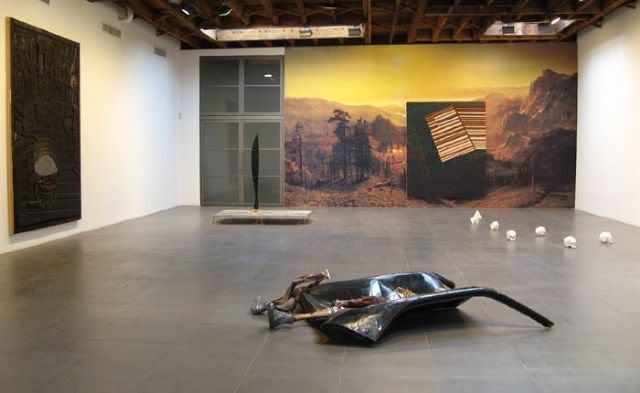
Installation shot of Matthew Day Jackson's "Terranaut," at Peter Blum, Chelsea
Courtesy of Peter Blum Gallery, New York


"The world will not perish for want of wonders,
but for want of wonder."
-J.B.S. Haldane


On the drizzly Wednesday evening past, I attended a ScienceBlogs panel at the SoHo Apple Store. ScienceBlogs bills itself as "a portal to...global dialogue, a digital salon featuring the leading bloggers from a wide array of scientific disciplines." I'm familiar with a number of the blogs hosted by the network; among them is one of my regular blogosphere stops, Bioephemera. Jessica Palmer, the writer, artist and scientist behind Bioephemera, participated in the panel, and I attended with lofty expectations. Unfortunately, the panelists were unable to delve deeply into any of the subjects that most excite them. Instead, they answered humdrum questions that ranged from 'How often do you upload new material?' to 'What was your most popular or controversial post?' (Generally, their responses were similarly unexciting, but they delivered them earnestly and with good humor.)

Addressing that second question, one panelist mentioned the popularity of Pharyngula, a blog written by evolutionary biologist P.Z. Myers. Every day, Myers' blog receives a great many visits, but a sizable minority (perhaps even the majority) of those visitors are religious fundamentalists, Creationists who beset the blog with nasty comments about Myers and the ideas he expounds. In fact, Myers has posted an ever-lengthening list of undesirables, readers now banned from Pharyngula's comment section.

It's no secret that evolutionary biologists and Creationists don't break bread together. Their enmity has a storied history. Yet many people understand the dispute to be more broad, as a fracas between scientists and the religious community at large. And it is not only bystanders that see it this way. Some scientists lend credence to the misconception by assuming that all religious individuals are skeptical of evolutionary biology, in particular, and, more generally, of science as a whole. This simply isn't true. The science/religion dichotomy is false. Only the ignorant, the unimaginative, the misguided or some combination thereof embrace religious fundamentalism, and among the ranks of the religious, there are countless educated, creative and thoughtful individuals. Within this latter group, science and evolution are accepted, even championed.


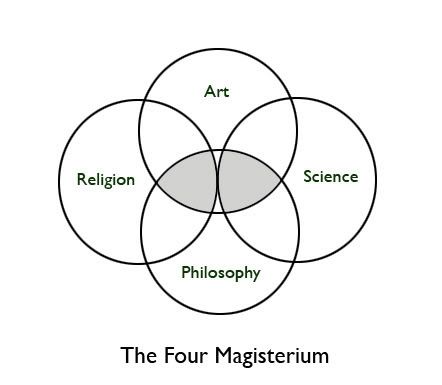
At their respective best, both science and religion (re)awaken or invigorate our capacity for wonder. Each makes use of a different approach, but they are complementary. As Albert Einstein famously said, "Science without religion is lame. Religion without science is blind." The late evolutionary biologist Stephen Jay Gould called the two "nonoverlapping magisteria" because good science trades in facts to explain material phenomena, whereas religion traffics in the unverifiable and the unobservable. Where science seeks to demystify, and to build on each subsequent revelation to learn more, religion aims to make sacred that which is taken for granted, to make the ordinary again extraordinary. Both, however, offer frameworks of engaging our astonishing existence and experience. Both are compelled by curiosity and wonder. As Gotthold Ephraim Lessing, the Enlightenment writer-philosopher, argued, if God held in one hand the Entire Truth and in the other the Eternal Pursuit of Truth, a good man will choose the latter. The same is true of authentic scientists and religious thinkers. The methodology and particulars may differ, but both science and religion are realms of the question. Although the popular conception of the scientist is the white-coated statistician ready to provide any and all answers, the caricature is misleading. It is "normative in science to be not sure," as Jessica Palmer put it doing the ScienceBlogs panel. Science, like religion, is a matryosha doll, a series of questions nested within questions.

Gould considered art and philosophy magisteria unto themselves, but, unlike religion and science, each overlaps the other. Where these two overlapping sections meet, we find ourselves in the realm of what the artist-writer Paul Laffoley calls the mesoteric. In Laffoley's cosmology, the circle of religion, dealing as it does with questions of ultimate meaning, is dubbed the esoteric realm. The circle of science, focused on material truths and the observable world, he labels the exoteric realm. The mesoteric realms. art and philosophy, bridge the esoteric and exoteric. Whereas Gould posits that the magisteria of religion and science are nonoverlapping, I would argue that, where their circles meet, the membrane is permeable. This bleeding of one into the other represents the pinnacle of art and philosophy.


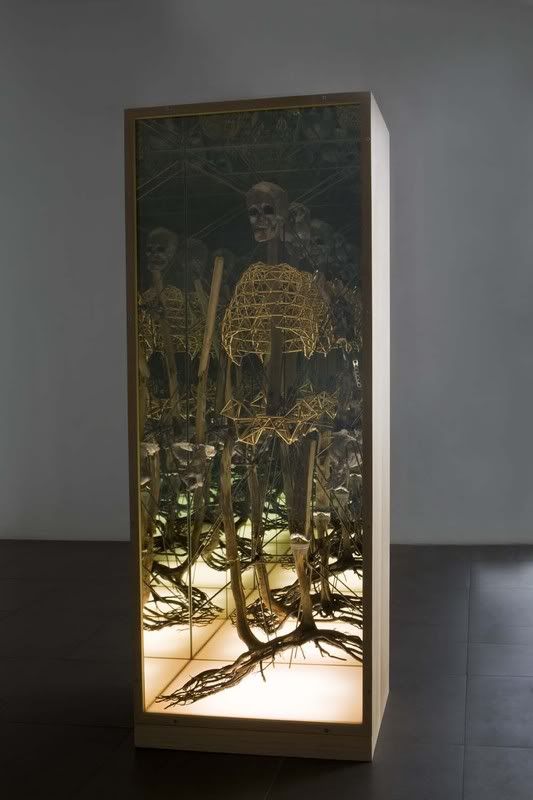
Matthew Day Jackson
"Dymaxion Skeleton"
2008
Wood, lead, Plexi-glas, light, glass mirror, steel
86 x 33 x 22 inches
Courtesy of Peter Blum Gallery, New York


Because Matthew Day Jackson's sculptures draw from this leak, inspired by (and responding to) both science and religion, the very best are imbued with (and exude) hope, curiosity and wonder. Two sculptures, "Dymaxion Skeleton" and "Against the Mythology of Linearity," both included in "Terranaut," Jackson's current exhibition at Peter Blum Gallery, are exceptional artifacts (literally, artful fact), notable for their humor, evocative power and awe-struck humility.

Presented within an illuminated, birch-paneled vitrine, "Dymaxion Skeleton" is a piece-meal assembly: the feet of this skeleton are tree roots; the legs, arms and spine are branches; the rib-cage and pelvis are geodesic triangle lattices (hence the Buckminster Fuller allusion in the work's title). To the guileless viewer, the skeleton could pass for a loan from the American Museum of Natural History, a relic of some lost people, but "Dymaxion" is no archaeological discovery. It, like everything Jackson produces, is a fiction.

But is it fair, really, to call it that? Because Jackson makes no claim that "Dymaxion Skeleton" is archaeology, it can not be dismissed as "junk science." It is contemporary art and, as such, is no less real than any relic released from the lower strata to be studied, interpreted and enshrined. And what can we surmise from Jackson's latter-day reliquary? To use Palmer's words, we're "not sure." "Dymaxion Skeleton" is cryptic and poetic. What are we to make of the connection between those root feet and the geodesic triangles? Or between Jackson's nod to Fuller, a half-baked scientist-engineer fascinated by Utopian machines, and this illuminated dead thing?

Admiring Jackson's skeletal creation, I think of the laudable efforts of David Wilson, the founder and curator of The Museum of Jurassic Technology in Los Angeles. Wilson's museum is an extension of the Wunderkammer, the sixteenth, seventeenth and eighteenth century rooms (or cabinets, as they were then called) devoted to displaying collections of natural specimens, artwork and other miscellany. Today we usually call collections of this sort curiosity cabinets (and, indeed, they more often occupy what we now think of as cabinets). The curator of "Wunderkammer: A Century of Curiosities," currently on exhibit at the Museum of Modern Art, points out that Wunderkammen are "precursors to museums." In the nineteenth century, these general interest collections were divided for display in separate art, natural history and technology museums. This breakup coincided with the shift from generalization to specialization, and although the latter approach allows for a more extensive body of knowledge, it is a less integrated one. An astrophysicist, for example, can tell you a great deal about astrophysics, but will likely contribute very little on the subject of crocodile anatomy. As John Walsh, former director of the Getty Museum, stresses, "in the earlier collections, you had the wonders of [the natural world] spread out there cheek-by-jowl with the wonders of man, both presented as aspects of the same thing, which is to say, the Wonder of God." Embracing the collage-remix instinct of the postmodern artist, Jackson shares much in common with his Wunderkammen forebears; he works to tap into the wonder current.


Matthew Day Jackson
"Against the Mythology of Linearity"
2008
Acrylic, abalone, mother-of-pearl
7 inches tall, dimension variable otherwise
Courtesy of Peter Blum Gallery, New York


"Against the Mythology of Linearity," a seven-stage transmutation, moves from a simple pyramid through five polyhedral forms before "becoming" a human skull. The increasing complexity of each stage seems to confirm linear progression rather than react against it, but Jackson has arrayed the forms on the gallery floor so that they constitute a question mark. The faceted shaping and abalone accents of these polyhedra allude to gem cutting and, with that craft in mind, I think of the Abrahamic Creation story, in which God makes Man and Woman on the sixth day, then puts down his chisel for a rest. By nodding to that story, is Jackson questioning the narrative that evolutionary biologists so vehemently defend? Perhaps, but with each additional facet, a polyhedron moves that much closer to a sphere, a "perfect" form that is emblematic of infinity. The skull, then, the seventh step, is not an end result. God can rest for a spell, but he should continue; his work is incomplete.

The economist and sociologist Max Weber said that the secularization of society and increasing specialization of methodological inquiry had led to a "disenchantment of the world." He was (and remains) correct. A world without magic is a meagre one. Jackson's best sculptures provide us with bread crumbs so that we might find our way back to wonder. They are redemptive works, and I eagerly anticipate more of them.

Photo credits: All Matthew Day Jackson images courtesy Peter Blum Gallery; Four Magisterium diagram, Christopher Reiger, 2008

Monday, September 29, 2008
"Implant" at UBS Art Gallery


Michael Pollan working his garden


Curator Jodie Vicenta Jacobson cites Michael Pollan's The Botany of Desire as inspiration for "Implant," a Horticultural Society of New York exhibition sponsored and hosted by the international financial firm UBS. Jacobson is especially interested in Pollan's assertion that plants "use us" to further their evolutionary objectives. Although the notion that "plants control humans" is simplistic spin on what is in fact a complex web of interdependence, I smile on attempts to shake up (or down) the Judeo-Christian scalae naturae and so was predisposed to Jacobson's conceptualization of "Implant."

Unfortunately, most of the work Jacobson includes is only tangentially relevant to Pollan's thesis. Perhaps she believes that a curator should avoid intellectual illustration, that it is better for viewers to ruminate on the art with a loose curatorial contention in mind. Even if this is her stance, however, the selections seem arbitrary. In an accompanying brochure, she states that "the personal artist/subject bond is forged within a larger context of each individual's intrinsic understanding of his/her place in nature." The statement is valid (if vague) but, even though all the paintings, drawings, sculptures and videos in "Implant" include floral or botanical imagery, with few exceptions they are not about flowers or vegetation. Considered as a whole, "Implant" reflects, at worst, an intrinsic misunderstanding of our place in nature and, at best, a disinterested remove from the rest of life. One senses that many of these artists do think seriously about the so-called natural world, but have little firsthand experience with it.


Ann Craven
Studio view, December 2003


What, really, do such "art about art" works as Simon Starling's flowery chaise lounge and Karen Kilimnik's photographs of her still-life paintings have to do with the show's conceit? Or Carol Bove's bookshelf and Ann Craven's stacked watercolors? Certainly, Craven paints pretty canaries and orchids, but she is less concerned with the behavior or anthropological significance of Serinus and Orchidaceae than she is with questions of reproduction and commodification. The critical insistence that Craven's paintings "undercut Disney-esque references" and "raise questions about domestication...[of] once wild species"(1) is a stretch. The paintings don't communicate these ideas, and a viewer should not take a leap of faith that the paintings do not themselves impel (no matter what the accompanying wall text prompts).

One of the volumes included in Bove's bookshelf arrangement is propped open to a lovely botanical illustration; Bove's other books are placed spine-out, so that their titles can be easily read. The viewer is meant to ponder the connections between the artist's selections, but when I scan the books included, I don't find myself thinking on horticulture or the human/plant relationship; the work is principally concerned with 1960s soul searching.

What are these works doing here? Did Jacobson cherry-pick artists she likes and then try to find a connection between their work and the notion that plants control humans? That's a bass-akwards way to curate, but Jacobson herself lends credence to the charge in a brochure accompanying "Implant." A section called "Artist Focus: Felix Gonzalez-Torres" begins,
"I have been thinking about the 'Implant' exhibition in relation to Felix Gonzalez-Torres from its very inception. I consider him a keystone artist, not only for this exhibition, but for my entire curatorial program, and moreover in the world view of contemporary art. Contemplating Gonzalez-Torres' work in relationship to this specific exhibition has led me to various ends, both specific and open. The context of the exhibition is determined by the relationship between the artists involved, who, like Gonzalez-Torres, are not artists that primarily work with plants, but artists that have in a sense collaborated with plants to further a more specific idea. Therefore, 'Implant' is not narrowly themed, but quite open..."
It seems as though Jacobson admits that her primary aim is to assemble a terrific group of artists in one exhibition, so why hem them in with an unsuitable theme? I suppose only Jacobson could answer the question (and I invite her to), but it's a shame that so many horticulture enthusiasts and botanists who visit the show will be at turns irritated and baffled by Ms. Jacobson's curation.

Granted, I'm more of a stickler for lucid curation than most. I assume that my grumbling about "Implant" will be shrugged off by many readers. Perhaps that's fair, but Jacobson's curatorial missteps might be more easily overlooked if they weren't a front-and-center distraction.


Tacita Dean
"Baobab III"
2001
Black & white photograph on fibre paper
26 1/2 x 41 inches


The exhibition overview ignored, many of the works in "Implant" are good to excellent: Darren Almond's long exposure photographs are meditative and beautiful; Zach Harris's otherworldly paintings descend from Charles Burchfield and Buddhist mandalas; Nick Cave's frantic flower tower mannequin is a playful delight; Tacita Dean's handsome photographs present the curious baobab tree, a species whose branches evoke neuronal dendrites. Yet none of these four artists contribute works that seem, as Jacobson put it, "rooted in a radical concept offered by horticultural author(2) Michael Pollan."

Curiously, it is often the more traditional work in "Implant" that best conveys her assertion that plants "choose" the artists to immortalize them. Carol Woodin's luminous watercolor on vellum paintings might even be dismissed as antique by contemporary art viewers. The works are more or less straightforward botanical undertakings, celebrating their subjects through careful observation, but they also reveal nature's amoral underbelly. Woodin's orchids all but drip with exotic sex, appealing to the voluptuary in each of us. Furthermore, Woodin's fine handling, unorthodox cropping and recessed presentation choices create an almost sacred experience for the viewer. In doing so, Woodin makes strange and wonderful that which we too often take for granted.(3)


Peter Coffin
"Untitled (Greenhouse)"
2002
Greenhouse, plants, speakers, instruments
96 x 96 x 120 inches


Peter Coffin's whimsical "Untitled (Greenhouse)" is a far cry from Woodin's work, but it is also succeeds with regard to Jacobson's theme. A small greenhouse is stocked with a variety of plants, but also with a drum kit, keyboard, guitars, microphones and amplifiers. Interested in musician-plant communication, Coffin booked several bands to play inside "Untitled (Greenhouse)" during the exhibition reception, and apparently intended that a soundtrack play whenever musicians were not performing. Distressingly, the greenhouse was quiet on the Friday morning of my visit. Not wanting the plants to go without aural stimulation, I entered the low-ceilinged structure to tap out a beat on the snare. (The plants, I'm sure, forgave my inadequacy.)

The feyness of Coffin's project makes it easy to like, but the artist is also riffing on the notion of pneuma, breath as vivifying force. As William Gass writes, "Language is born in the lungs and is shaped by the lips, palate, teeth, and tongue out of spent breath - that is, from carbon dioxide. That is why plants like being spoken to." Literally, our voice gives the plants breath. Taking this one step further, we can ask Proust's question of musical communication: "[Might music] not be the unique example of what might have been - if the invention of language had not intervened - the means of communication between souls?" If, as I mentioned earlier, Jacobson aims to make room for open-ended riffing on the part of the viewer, Coffin's greenhouse is her best pick.

By contrast, a photograph taken by Felix Gonzalez-Torres, the work (and artist) Jacobson had in mind since the inception of "Implant," is conceptually relevant, but aesthetically weak. The picture, "Untitled (Alice B. Toklas' & Gertrude Stein's Grave, Paris)," shows flowers planted and placed on the graves named in the title. The picture includes attractive flowers, but the photograph itself is unremarkable; it is not, as Jacobson contends, "a beautiful picture of flowers." Value is attributed by the viewer's knowing the specifics, namely that she is looking at flowers on the graves of two notables. Gonzalez-Torres is surely moved by the contemplation of displaced energy or reconstitution, by the realization that the flowers in a sense (and, in some respects, literally) feed on the break down of Toklas' and Stein's corpses. Although I share his appreciation for the contrast between individual mortality and communal integrity (or immortality), a poetic observation alone does not qualify as a work of visual art. Furthermore, the photograph highlights how very detached the industrialized imagination is from the natural world that shaped us. Though Gonzalez-Torres likely realized this, his picture reminds me that the mystical and holistic properties of plants, as part of an integrated worldview, are largely lost, the frame of reference fractured, secularized and compartamentalized. Plants placed atop a grave are mere signifiers of memorial; they no longer possess mana.

Yet I am hopeful. We are beginning to reconsider our relationship to the world around us. It is a good sign that, despite having very little practical experience with or knowledge of the outdoors, many of the artists included in "Implant" are inspired to incorporate floral imagery or ideas loosely connected to the plant world. Michael Pollan's is but one voice in a growing chorus encouraging urbanites and suburbanites to reconnect with the food chain by participating in community supported agriculture (CSA), reconsidering their usually negative opinion of hunting, and simply spending more time outdoors. Most importantly, however, plants are regaining a little of their mana among modern man.

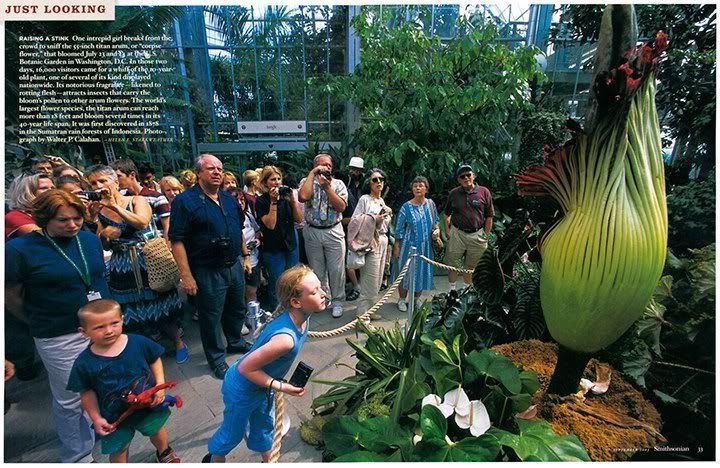
As I departed the UBS building, I thought of a photograph published in a magazine some years ago. When I returned to my apartment, I dug through my files and scrap books until I found it.

Man, meet plant!


Walter P. Calahan
2003
C-print for Smithsonian Magazine


(1) Jane Kallir, "The Animal in Contemporary Art"
(2) Horticultural author? Pollan is a now influential journalist and professor whose writing explores a range of issues related to moral and ethical stewardship and consumption, sustainability, anthropology, and psychology. Why pigeonhole him?
(3) Admiring her paintings, I recalled the experience of anticipatory wanting with Julia Randall's works at Jeff Bailey Gallery.

Photo credits: Michael Pollan working in his garden, ripped from The Sydney Morning Herald(via The New York Times); Ann Craven studio image, ripped from the artist's website; "Baobab III," ripped from Frith Street Gallery website; "Untitled (Greenhouse)," ripped from Phil Moore's Flickr collection; Corpse flower image ripped from Walter P. Calahan's website