Showing posts with label curation. Show all posts

Sunday, September 22, 2013

Navigating the Flood (Of Images)

I recently visited "A Sense of Place," Pier 24's current exhibition. It's a strong show with a broad purview that, typical of Pier 24 productions, is elegantly and thoughtfully installed. Long after I left the space, I found myself reflecting on the relationship between two of the "A Sense of Place" galleries.

Erik Kessels' installation, "24 HRS in Photos," a "room filled - floor to ceiling - with printed versions of every picture uploaded to Flickr during a 24-hour period," has generated some online buzz. The Pier 24 press release states that Kessels' provides the viewer with an opportunity "to both visually and physically experience the overwhelming number of photographs shared online." Indeed, he does.
Erik Kessels
"24 HRS in Photos"
Installation view at Pier 24
2013

I entered "24 HRS in Photos" a few minutes after leaving another room of the exhibition, one devoted to Stephen Shore's "Uncommon Places." The contrast between the spaces was jarring. The simple framing of Shore's work -- broad mats provide ample quiet space around the prints -- isolates each picture and draws the viewer in. Accordingly, I spent long minutes with each of Shore's photographs, pouring over details and "reading" the pictures like a short story. Every Main Street, bowling alley, parking lot, and road sign in Shore's photographs has a rich tale to tell.

My "read" of "24 HRS in Photos" couldn't have been more different. Upon entering Kessels' installation, I didn't know where to begin. I knew I was looking at an accumulation of individual photographs, but I could take in the work only as a whole, as a swell of blues, whites, and blacks with occasional bursts of yellow or red. As Ariel Rosen writes over at SFAQ, Kessels' "mountain of photos" is "antithetical to any careful choosing." The installation reminds us that the vast majority of images being produced today are neither intended nor received as pictures to be pondered; they are snapped, uploaded, shared, consumed, and forgotten.

Monday, June 27, 2011

Announcing "A Live Animal" Exhibition, Catalog, and Program

It's a thrill to announce that "A Live Animal," a large group exhibition that artist Selene Foster and I are co-curating, will be on view at San Francisco's Root Division in July 2011.

In addition to the opening reception for the exhibition (July 9), we will host an Evening of Presentation and Performance (July 19) in the new ODC Theater space, located just next door to Root Division. The EoPP features presentations relevant to the theme of "A Live Animal" by some of the participating artists, as well as scientists, dancers, and others.

I'm biased, of course, but "A.L.A." is a very strong show, and the sort of cross-disciplinary fare that I believe the art world needs more of. If you're in the Bay Area, please visit!
+++++


Detail of "Sharks," by Maria Lux

"A Live Animal" explores the relationship(s) between contemporary man and other animals, with a particular focus on the different lenses, be they mystical, scientific, or philosophical, through which we view other species.

ARTISTS:
Brandon Ballengee, Jeremiah Barber*, Joianne Bittle, Bethany Carlson, Karl Cronin, Donald Farnsworth, Todd Forsgren, Dana Harel, Nicole Jean Hill, Michael Kerbow, Anne Klint, Maria Lux, Jon Rappleye, Shelley Reed, Steven Rubin, Susan Silas, Deborah Simon, Sarah A. Smith, Kate Stirr*, Youngsuk Suh, Ryan Thompson, James Wendell, Gail Wight, and work from the Endangered Species Print Project
*Root Division Resident Artist

Opening Reception: Saturday, July 9, 7 to 10 pm
Exhibition Dates: July 7 - 30, 2011
Gallery Hours: Wednesdays - Saturdays, 2-6 pm (or by appointment)

AN EVENING OF PRESENTATION AND PERFORMANCE:
July 19, 2011, 7:30-9:30PM
ODC Theater, 3153 17th Street, SF, CA

EoPP PRESENTERS:
Chris Black: "Extinction Burst (last dance, last chance): A reanimation of lost movement"
Karl Cronin: "Kinetic Empathy"
Jeremiah Jenkins: "The Hunt"
Brian Null, Ph.D., "Examination of Animals, Examination of Self"
Georgeann O'Brien, Ph.D.: "Direct observation of sensory neuron regeneration in live zebrafish"
Christopher Reiger: "Introducing the Endangered Spcies Print Project"
Philip Ross: "Eating Bugs for Fun and For Profit"
Jon Sack, Ph.D.: "Bioelectric Venom"
Gail Wight: "Animal Animosity"

For more information about the "A Live Animal" EoPP, click here.

We're also producing a full-color exhibition catalog that includes original essays by Selene, me, and artist/writer Michael McDevitt.

Thursday, March 24, 2011

Communicating Art's Relevance (Or Not)


Science journalists have penned a profusion of articles about the scientific community's failure to communicate effectively with the general public. The articles bemoan how un- or misinformed Americans are about the science of vaccination, global climate change, mass extinction, and myriad other subjects. But the journalists don't blame the great unschooled for their ignorance; instead, they point the finger at scientists and, almost as often, at themselves. As a result, there are a growing number of journals, graduate programs, and institutions devoted to tackling the science literacy problem.

The aptly named Center for Communicating Science, at Stony Brook University, is one of these. It's mission is straightforward: "to enhance understanding of science by helping train the next generation of scientists and health professionals to communicate more effectively with the public." It's an uphill battle, but we must all hope that their efforts (and those of similar institutions or programs) succeed. Presuming (hopefully) that the majority of the world's states remain liberal democracies, the future health of the planet and our species may be contingent on a greater popular appreciation of science.

Although it is a matter of less urgency and consequence, the contemporary American art world should consider a comparable movement. We also need programs dedicated to training "the next generation of [curators and art] professionals to communicate more effectively with the public." I'm not being facetious. There are brilliant, sensitive art writers and curators working today, but they are a small minority who, despite their talents, generally fail to reach a popular audience. Just as so much good science is shrugged off (or even angrily rejected) by the public, so, too, with art. Most Americans see science as extraneous esoterica crafted by white-coated wonks. Similarly, contemporary art is seen as the province of effete Onanists devoid of "family values."

But the respective responses of the two realms to these ugly public perceptions is critically different. The scientific community has confronted the issue head-on, spilling ink, hosting panel discussions, and building programs. Whether or not this conscientious approach will change things for the better remains to be seen, but scientists and science academics can't be criticized for inaction. Should an art writer or organization assert, however, that negative popular sentiment indicates the art world is faltering, they won't receive donations for a new graduate program or institution dedicated to improving the art world's communication skills. In fact, many (if not most) professionals in the art world rankle at the suggestion that fine art should even consider appealing to the masses. They believe that popularity debases art because, in order to achieve it, the artist must cater to the interests and intellect of the lowest common denominator. This stance is obviously elitist but, more importantly, it's also defeatist. Shouldn't those of us who care about art's role in society strive to make it accessible to the general public? After all, unlike those skeptical of science, "Joe the Plumber" isn't the only one who dismisses contemporary art! The large majority of my college-educated friends -- scientific researchers, English professors, political journalists, doctors, lawyers, actors, musicians -- make no space for contemporary art in their lives. Contrary to the avant garde aspirations and claims of so many artists, curators, collectors, and critics, most of America views the contemporary art world as a cultural backwater; it has become functionally irrelevant (excepting its role as a luxury commodity market).

But the art world is not irrelevant; there is vital, inspiring contemporary artwork being produced, work that the public can be in dialogue with (and even without initiation into our art cult)! But the onus is on us, as representatives of the art world, to make a case for why fine art matters today. If curators and artists (or dealers writing press releases) can't express why an artwork or body of work is vital, then they need to ask themselves hard questions. Is this work really and truly meaningful? Is it made with intent to improve, in whatever way, the world (i.e., not intended merely as an exercise in critique)? Clinging to the myth of the avant garde is unacceptable unless the "vanguard" work is, in the view of the curator, artist, or dealer, essential. Art professionals shouldn't be making or promoting work that they can't make an impassioned case for and, in order to do so, they have to be able to speak about art intelligently and plainly.

I'm interested in hearing reader's thoughts on this subject. Barring the introduction of requisite communication courses in American art programs, what are some ways to begin to chip away at the wall between the art world and the rest of it? Can we be as relevant and respected as pop music or Hollywood, creative industries that produce both edifying brilliance and schlock, but that are not maligned by the general public? Can the American art world play as much of a role in the lives of citizens as does the European art world, an orbit in which the educated classes regularly visit galleries and recognize the names of prominent fine artists? What do you think?

Update: Jessica Palmer, ever erudite, remarks on this post at Bioephemera. I encourage readers to jump over to BioE for her take; Jessica is an artist, writer, and science communicator...though she wears other hats, too.

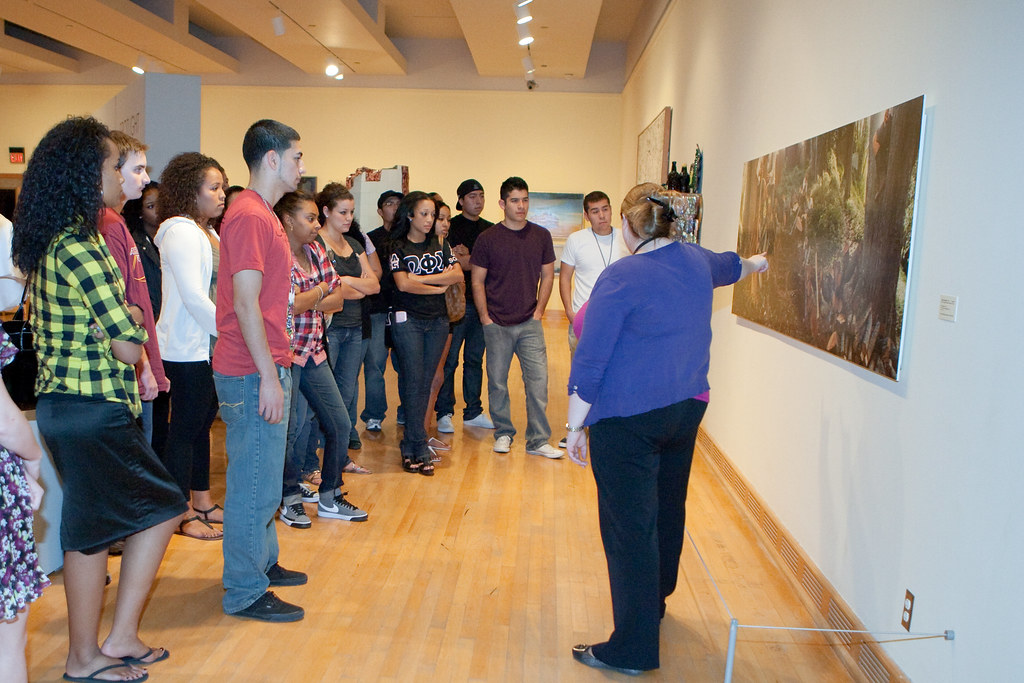
Photo credit: copyright 2009, Diane Wallace, ASU Art Museum

Saturday, January 09, 2010

The Art Community and Common Sense


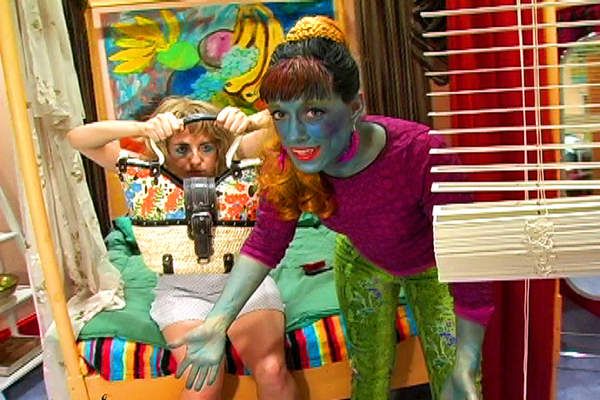
Ryan Trecartin
"I-BE AREA"
2007
"Everybody gets so much information all day long that they lose their common sense."

- Gertrude Stein
We're a week-and-a-half into 2010, and I'm hoping that the din produced by so much fin-de-decade media will soon die down. It's no secret that we citizens of the United States (and all other essentially "Americanized" peoples) are principally defined by our consumption. What's more, after decades of adaptation to the consumer role, we've become so fond of the talk surrounding our consumer products that the consumer reviews themselves have become another kind of consumable. Regrettably, this is no less true in the arts.

I've made a contrarian effort this year to avoid most of the "Top" lists and their Op-Ed equivalents, but I've not been totally chaste. The diviners of social, political, or cultural trends have been working furiously to meet their deadlines, and the surplus of art-related stock-taking is in large part responsible for the dearth of new HH content. Anything that I write here will only add to the pervasive and stupefying hubbub; it is further distraction from the business of life well-lived.

And yet, here I sit, writing this post. Like all the other commentators, I'm guilty of editorializing and contextualizing that which is better meditated upon individually or mulled over with our loved ones. And I'm guilty of adding one more perspective to the countless millions already vocalized, furthering the unfortunate and wrong-headed belief that subjectivity reigns. What I'm engaging in, then, is dangerous. While post-modern notions of relativism are valid and philosophically valuable, our globalized culture must strive to sort, such that we can, the wheat from the chaff. That is to say, in a time of increasing cross-cultural interaction, the need for some consensus, some agreed upon hierarchy of moral, ethical, and aesthetic value, is acute. It is a dangerous and exciting era; as such, it is a good time to be a artist.

I agree with Roberta Smith's contention that "the years 2000 to 2009 saw the emergence of a tremendous number of really good, interesting, promising artists." My list of "really good" artists, however, is very different from hers, and Ryan Trecartin, one of the artists that the New York Times' critic celebrates in her recent article, "Make Room for Video, Performance and Paint," is definitely not on it. I don't know Trecartin personally, and he may be a well-meaning, pleasant enough person, but his artwork is poisonously self-absorbed. In this respect, at least, Smith is right to assert that he is an important representative of the decade past. The art world, and especially that of New York City, the community to which I'm most attached, has seen an explosion of navel gazing.

To be fair, most artists engage in some level of narcissism. At the end of the 1990s, when I was in my early twenties, I had puerile aspirations to produce "art videos" of my ejaculating penis (paging Sterling Ruby), and my paintings were dominated by angst-ridden self-portraits and hyper-sexualized imagery. The few paintings of that period that survive are today stacked in my parents' Virginia garage, partly covered by a plastic tarpaulin and years of accumulated mouse shit and winter-killed wasp corpses. Such is the fate of personal history. Serpent-like, we periodically shed our skins and move on, hopefully a little more wise. Some of us, however, put our sheddings and bruises on display, mistaking personal exposure for bravery. Indeed, in some contexts it is brave, but when the sharing is marshalled in service of a cult of personality, it is a celebration of individual dysfunction. And when such exhibitionism is mistaken for art, it is an indication of critical and cultural dysfunction.

Believing that art is fundamental to humanity, and that it is transformative and sacred, I don't accept Freud's famous contention that the artist is a neurotic who seeks to attenuate or postpone confrontation of his or her mature psyche. In fact, for most of our species' tenure, the role of the artist was precisely the opposite; we were called upon to ground our brethren is real experience, be it material or metaphysical. Yet Freud's categorization accurately describes much of the juvenalia that passes for contemporary art. Certainly, we artists should be embarrassed by this trend, but you can't kill the messenger, as the saying has it; Trecartin and others creating hysterical or megalomaniacal artworks are reflections of the dominant (and apparently yet ascendant) iCulture. It is instead the critics and the gallerists, the purveyors of taste, that should be most ashamed of themselves.

Essayist, critic, and philosopher George Steiner is far more intelligent and incisive than I, so I include a pastiche of pertinent excerpts from his 1989 book, Real Presences.
"The usages and values predominant in the consumer societies of the West today [are] the secondary and the parasitic[...]. Literate humanity is solicited daily by millions of words, printed, broadcast, screened, about books which it will never open, music it will not hear, works of art it will never set eyes on. A perpetual hum of aesthetic commentary, of on-the-minute judgments, of pre-packaged pontifications, crowds the air. Presumably, the greater part of art-talk or literary reportage, of music reviews or ballet criticism, is skimmed rather than read, heard but not listened to. None the less, the effect is antithetical to that visceral, personal encounter[...]. There is little 'ingestion'; it is the 'digest' that prevails.

[...]

The journalistic vision sharpens to the point of maximum impact every event, every individual and social configuration; but the honing is uniform. Political enormity and the circus, the leaps of science and those of the athlete, apocalypse and indigestion, are given the same edge. Paradoxically, this monotone of graphic urgency anaesthetizes. The utmost beauty or terror are shredded at close of day. We are made whole again, and expectant, in time for the morning edition.

[...]

Two principal impulses energize the American spirit: immanence and egalitarianism. The crux of American time is now. The past matters in direct reference to its usability in and by the present. [...] No other culture has so dignified the immanent. [...] Poets, novelists, choreographers, painters of the most derivative or passing interest, are made the object of seminars and dissertations, of undergraduate lectures and post-doctoral research. The axioms of the transcendent in the arts of understanding and of judgment [...] are invested in the overnight."
Steiner, I presume, frowns on the Top Ten lists and "best of the decade" summaries as much as I do. I also believe that he would dismiss as "derivative or [of] passing interest" most (though not all) of the artists that Smith praises in her article. The cultural longevity of most on Smith's list is questionable, certainly alongside the likes of Alec Soth, Bill Viola, Matthew Day Jackson, Omer Fast, or Tom Uttech, all contemporary artists crafting intelligent and soulful artworks.

Smith writes, at the article's close, "In all, we are confronted with the distinct possibility that quantity and quality may not be so mutually exclusive after all. More means more better." That's very true. But more also means more bad, of course, which is why we today have an urgent need for critics, curators, and gallerists who, like Steiner and Donald Kuspit, are willing to reside outside the community, to avoid political entanglements, and to judge, sometimes harshly. To those critics, artists, and gallerists already plugged in, let's begin this decade, this arbitrary but useful marker in our human journey, with a renewed commitment (a resolution, if you prefer) to be more rigorous, contemplative, and socially committed. The art world, like the world at large, needs fixing, and responsible action is the only thing for it.

Happy Twenty-Ten. Here's hoping that it's healthy and auspicious.

Image credit: Ryan Trecartin, 2007

Monday, September 29, 2008

"Implant" at UBS Art Gallery


Michael Pollan working his garden


Curator Jodie Vicenta Jacobson cites Michael Pollan's The Botany of Desire as inspiration for "Implant," a Horticultural Society of New York exhibition sponsored and hosted by the international financial firm UBS. Jacobson is especially interested in Pollan's assertion that plants "use us" to further their evolutionary objectives. Although the notion that "plants control humans" is simplistic spin on what is in fact a complex web of interdependence, I smile on attempts to shake up (or down) the Judeo-Christian scalae naturae and so was predisposed to Jacobson's conceptualization of "Implant."

Unfortunately, most of the work Jacobson includes is only tangentially relevant to Pollan's thesis. Perhaps she believes that a curator should avoid intellectual illustration, that it is better for viewers to ruminate on the art with a loose curatorial contention in mind. Even if this is her stance, however, the selections seem arbitrary. In an accompanying brochure, she states that "the personal artist/subject bond is forged within a larger context of each individual's intrinsic understanding of his/her place in nature." The statement is valid (if vague) but, even though all the paintings, drawings, sculptures and videos in "Implant" include floral or botanical imagery, with few exceptions they are not about flowers or vegetation. Considered as a whole, "Implant" reflects, at worst, an intrinsic misunderstanding of our place in nature and, at best, a disinterested remove from the rest of life. One senses that many of these artists do think seriously about the so-called natural world, but have little firsthand experience with it.


Ann Craven
Studio view, December 2003


What, really, do such "art about art" works as Simon Starling's flowery chaise lounge and Karen Kilimnik's photographs of her still-life paintings have to do with the show's conceit? Or Carol Bove's bookshelf and Ann Craven's stacked watercolors? Certainly, Craven paints pretty canaries and orchids, but she is less concerned with the behavior or anthropological significance of Serinus and Orchidaceae than she is with questions of reproduction and commodification. The critical insistence that Craven's paintings "undercut Disney-esque references" and "raise questions about domestication...[of] once wild species"(1) is a stretch. The paintings don't communicate these ideas, and a viewer should not take a leap of faith that the paintings do not themselves impel (no matter what the accompanying wall text prompts).

One of the volumes included in Bove's bookshelf arrangement is propped open to a lovely botanical illustration; Bove's other books are placed spine-out, so that their titles can be easily read. The viewer is meant to ponder the connections between the artist's selections, but when I scan the books included, I don't find myself thinking on horticulture or the human/plant relationship; the work is principally concerned with 1960s soul searching.

What are these works doing here? Did Jacobson cherry-pick artists she likes and then try to find a connection between their work and the notion that plants control humans? That's a bass-akwards way to curate, but Jacobson herself lends credence to the charge in a brochure accompanying "Implant." A section called "Artist Focus: Felix Gonzalez-Torres" begins,
"I have been thinking about the 'Implant' exhibition in relation to Felix Gonzalez-Torres from its very inception. I consider him a keystone artist, not only for this exhibition, but for my entire curatorial program, and moreover in the world view of contemporary art. Contemplating Gonzalez-Torres' work in relationship to this specific exhibition has led me to various ends, both specific and open. The context of the exhibition is determined by the relationship between the artists involved, who, like Gonzalez-Torres, are not artists that primarily work with plants, but artists that have in a sense collaborated with plants to further a more specific idea. Therefore, 'Implant' is not narrowly themed, but quite open..."
It seems as though Jacobson admits that her primary aim is to assemble a terrific group of artists in one exhibition, so why hem them in with an unsuitable theme? I suppose only Jacobson could answer the question (and I invite her to), but it's a shame that so many horticulture enthusiasts and botanists who visit the show will be at turns irritated and baffled by Ms. Jacobson's curation.

Granted, I'm more of a stickler for lucid curation than most. I assume that my grumbling about "Implant" will be shrugged off by many readers. Perhaps that's fair, but Jacobson's curatorial missteps might be more easily overlooked if they weren't a front-and-center distraction.


Tacita Dean
"Baobab III"
2001
Black & white photograph on fibre paper
26 1/2 x 41 inches


The exhibition overview ignored, many of the works in "Implant" are good to excellent: Darren Almond's long exposure photographs are meditative and beautiful; Zach Harris's otherworldly paintings descend from Charles Burchfield and Buddhist mandalas; Nick Cave's frantic flower tower mannequin is a playful delight; Tacita Dean's handsome photographs present the curious baobab tree, a species whose branches evoke neuronal dendrites. Yet none of these four artists contribute works that seem, as Jacobson put it, "rooted in a radical concept offered by horticultural author(2) Michael Pollan."

Curiously, it is often the more traditional work in "Implant" that best conveys her assertion that plants "choose" the artists to immortalize them. Carol Woodin's luminous watercolor on vellum paintings might even be dismissed as antique by contemporary art viewers. The works are more or less straightforward botanical undertakings, celebrating their subjects through careful observation, but they also reveal nature's amoral underbelly. Woodin's orchids all but drip with exotic sex, appealing to the voluptuary in each of us. Furthermore, Woodin's fine handling, unorthodox cropping and recessed presentation choices create an almost sacred experience for the viewer. In doing so, Woodin makes strange and wonderful that which we too often take for granted.(3)


Peter Coffin
"Untitled (Greenhouse)"
2002
Greenhouse, plants, speakers, instruments
96 x 96 x 120 inches


Peter Coffin's whimsical "Untitled (Greenhouse)" is a far cry from Woodin's work, but it is also succeeds with regard to Jacobson's theme. A small greenhouse is stocked with a variety of plants, but also with a drum kit, keyboard, guitars, microphones and amplifiers. Interested in musician-plant communication, Coffin booked several bands to play inside "Untitled (Greenhouse)" during the exhibition reception, and apparently intended that a soundtrack play whenever musicians were not performing. Distressingly, the greenhouse was quiet on the Friday morning of my visit. Not wanting the plants to go without aural stimulation, I entered the low-ceilinged structure to tap out a beat on the snare. (The plants, I'm sure, forgave my inadequacy.)

The feyness of Coffin's project makes it easy to like, but the artist is also riffing on the notion of pneuma, breath as vivifying force. As William Gass writes, "Language is born in the lungs and is shaped by the lips, palate, teeth, and tongue out of spent breath - that is, from carbon dioxide. That is why plants like being spoken to." Literally, our voice gives the plants breath. Taking this one step further, we can ask Proust's question of musical communication: "[Might music] not be the unique example of what might have been - if the invention of language had not intervened - the means of communication between souls?" If, as I mentioned earlier, Jacobson aims to make room for open-ended riffing on the part of the viewer, Coffin's greenhouse is her best pick.

By contrast, a photograph taken by Felix Gonzalez-Torres, the work (and artist) Jacobson had in mind since the inception of "Implant," is conceptually relevant, but aesthetically weak. The picture, "Untitled (Alice B. Toklas' & Gertrude Stein's Grave, Paris)," shows flowers planted and placed on the graves named in the title. The picture includes attractive flowers, but the photograph itself is unremarkable; it is not, as Jacobson contends, "a beautiful picture of flowers." Value is attributed by the viewer's knowing the specifics, namely that she is looking at flowers on the graves of two notables. Gonzalez-Torres is surely moved by the contemplation of displaced energy or reconstitution, by the realization that the flowers in a sense (and, in some respects, literally) feed on the break down of Toklas' and Stein's corpses. Although I share his appreciation for the contrast between individual mortality and communal integrity (or immortality), a poetic observation alone does not qualify as a work of visual art. Furthermore, the photograph highlights how very detached the industrialized imagination is from the natural world that shaped us. Though Gonzalez-Torres likely realized this, his picture reminds me that the mystical and holistic properties of plants, as part of an integrated worldview, are largely lost, the frame of reference fractured, secularized and compartamentalized. Plants placed atop a grave are mere signifiers of memorial; they no longer possess mana.

Yet I am hopeful. We are beginning to reconsider our relationship to the world around us. It is a good sign that, despite having very little practical experience with or knowledge of the outdoors, many of the artists included in "Implant" are inspired to incorporate floral imagery or ideas loosely connected to the plant world. Michael Pollan's is but one voice in a growing chorus encouraging urbanites and suburbanites to reconnect with the food chain by participating in community supported agriculture (CSA), reconsidering their usually negative opinion of hunting, and simply spending more time outdoors. Most importantly, however, plants are regaining a little of their mana among modern man.

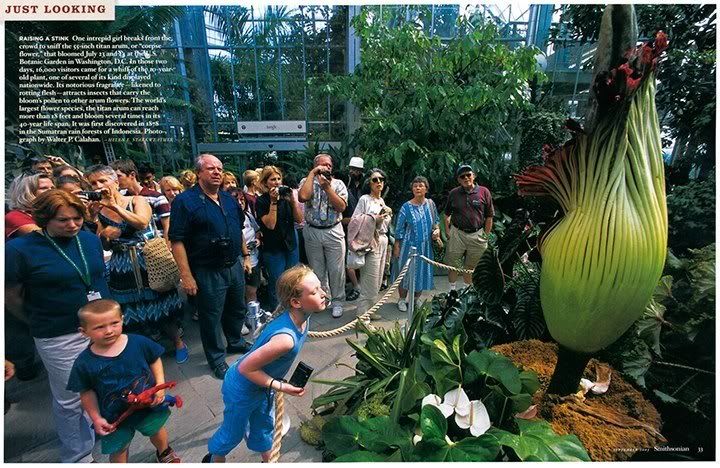
As I departed the UBS building, I thought of a photograph published in a magazine some years ago. When I returned to my apartment, I dug through my files and scrap books until I found it.

Man, meet plant!


Walter P. Calahan
2003
C-print for Smithsonian Magazine


(1) Jane Kallir, "The Animal in Contemporary Art"
(2) Horticultural author? Pollan is a now influential journalist and professor whose writing explores a range of issues related to moral and ethical stewardship and consumption, sustainability, anthropology, and psychology. Why pigeonhole him?
(3) Admiring her paintings, I recalled the experience of anticipatory wanting with Julia Randall's works at Jeff Bailey Gallery.

Photo credits: Michael Pollan working in his garden, ripped from The Sydney Morning Herald(via The New York Times); Ann Craven studio image, ripped from the artist's website; "Baobab III," ripped from Frith Street Gallery website; "Untitled (Greenhouse)," ripped from Phil Moore's Flickr collection; Corpse flower image ripped from Walter P. Calahan's website

Thursday, March 30, 2006

Rid Of The Candiru

Thoughts On Four Shows

Image hosting by Photobucket
I conceive of the creative process as a wave, a series of crests and troughs.  The fertile upslope is indicative of possession by a duende, but is invariably followed by a usually unproductive, even terrible downslope.  This representation accurately describes my painting activity, but isn't applicable to my writing. Writing, for me, rarely involves a duende. Lately, I've come to think of my lexicographic compulsion as a candiru (Vandellia cirrhosa), the tiny, Amazonian fish species infamous for swimming up the anus, vagina, or urethra, wherein it erects spines to hold it in place while it enjoys a hearty blood meal. (Yeah, ouch.  In fact, the candiru is one of a very few vertebrate parasites that targets humans.)

Each of the four shows reviewed below "stuck" with me, demanding ink or, in my case, keyboard. I've been planning to write about two of these exhibitions for several weeks, but one or another shiny, neat thing caught my eye and off I went, galloping clumsy in pursuit. The longer I ignore the writing impulse, though, the more the candiru's spines dig in, insistent and maddening. By broadcasting the thoughts I can temporarily rid myself of the fish, and it is with great relief that I finally get this bunch of reviews "out."

+++++

New York Center for Arts and Media Studies:  NYCAMS, the physical manifestation of a course credit program affiliated with Bethel University, a mid-sized school located in St. Paul, Minnesota, occupies a stunning, seventh floor space not far from the Flatiron District. Judging by what I read online and my visit to "Paramnesiac Landscape," the group exhibition currently on display in the gallery area, the nascent program is already noteworthy.

I'm a sucker for the show's clever title.  "Paramnesia" is defined by Webster's New World Dictionary as a "distortion of memory with confusion of fact and fantasy" or the "same as deja-vu."  The exhibition's curator, Robin Reisenfeld, selected the nine participating artists because each "create[s] imaginary landscape worlds through the interplay of memory, fantasy, and recent scientific trends."  With the recent art world brouhaha over the role of curators - are they artists, orchestrators, or what? - Reisenfeld's thematic selection may appear too tidy for some folks, but it works well enough.  All the work in the show is good, but standouts are Daniel Zeller's drawings and paintings by Sarah Trigg and Cristi Rinklin.

Image hosting by Photobucket
Daniel Zeller
"Skim Level" (detail)
Ink on paper

Zeller's work has generated a fair amount of ink in the past couple of years, deservedly so.  His fine line drawings represent the best of two contemporary art world trends: obsessive drawing and pseudo-science.  On hand at NYCAMS are four of his fantastic, topographic renderings.  "Resistance Factor," a small ink and acrylic work, is quite handsome, suggestive of internal workings - a mapping of capillaries, perhaps - but also of pipelines on the color-coded mish-mash that is a United States Geological Survey chart.  Across the room, "Remedial Disfunction," one of the largest wall-works in the show, at 44 x 54 inches, is also one of the best.  Comprised almost entirely of punctuated pencil marks, the resulting image can "be" many things.  Initially, I understood the drawing to be an aerial view of crop circles but, within moments, I dismissed that association.  This landscape is ambivalent, at once exploited and in some state of repair; are we looking at the beginnings of resource extraction or delicate sutures on some undefined organ?  It doesn't matter.  Such interpretive vacillations are accurately described by Reisenfeld as "conflating the microscopic with the telescopic" and "explor[ing] the confluence of shifting realities and multiple levels of spatial and temporal stratums."  (Note: Unfortunately, the works described were not available for reproduction.  I've pictured another of Zeller's works above. Due to their detail, the web is unable to do them justice. It's a shame.)

Image hosting by Photobucket
Sarah Trigg
"Unintended Sculptures with Natural Disasters"
2006
Acrylic on Panel
30 x 40 inches

Less ambiguous, but no less preoccupied with the connection of interior to exterior, are the paintings of Sarah Trigg.  I was most drawn to "Unintended Sculptures with Natural Disasters," a medium-sized picture that depicts an active, tectonic landscape.  Trigg describes her work as "a biopsy," and this recent painting, a combination of aerial survey and traditional, "window" perspective, is bioptic, indeed. Like scientific figures published in a research journal, Trigg's paintings represent the support or data of an ongoing investigation.  In fact, I think of her work as geologic dermatology.  Standing in front of "Unintended Sculptures with Natural Disasters," I admire the pores and pustules of a vast and violent panorama.  Viewing geology in this light effectively humanizes, or at least anthropomorphizes, that which otherwise remains difficult to fathom. Aiding this proportional shift is the combination of formations (and deformations) that Trigg corrals.  By depicting so much dynamism in a relatively small area, she presents the viewer with a condensed time frame, millions of years of seismic activity caught in a frozen time lapse, a blink of the geologic eye rather than the human.  That Trigg achieves this push-pull dynamic without painting more ambiguous imagery is unusual, and laudable.

Image hosting by Photobucket
Cristi Rinklin
"Apparition"
2006
Acrylic and Oil on Dibond
36 x 30 inches

Cristi Rinklin's paintings belong to a related, but distinct genealogy. Rather than chart or map her subject matter, Rinklin aestheticizes it. Although her imagery could belong to the "without" - some of her densely layered, colorful forms recall Hubble telescope photographs of distant celestial bodies and events - it feels more inspired by worlds "within." Occasionally, Rinklin even includes a red curtain or some heavy fabric, leading viewers to believe we are looking behind or under - in other words, inward - to discover further mystery and wonder. Rinklin's structures - ornate and organic - are almost Gothic in nature, but also indebted to graffiti and cartooning. I get the feeling she admires these out-lying genres from a critical distance, though, and I'm tempted to describe Rinklin as a younger, more current sibling of Phillip Taaffe and Ross Bleckner. (Note: The two paintings Rinklin included in the the NYCAMS exhibition, one of which is pictured above, were promising, but I wasn't really sold until I visited her website.)

+++++

Image hosting by Photobucket
Fernanda Brunet
"LAAL-LA"
2006
Acrylic on linen
39.37 x 31.5 inches

Galeria Ramis Barquet:  The work of Fernanda Brunet is undistinguished.  Her paintings belong to the now ubiquitous and often sexy super-flat aesthetic, but her floral explosions are so imminently digestable that, like fast food, viewers are apt to consume and forget.  Perhaps aware of this, Brunet has expanded her studio practice.  For her most recent solo effort at Galeria Ramis Barquet, "Happymania," she has included a number of bulbous fiberglass sculptures.  Occupying the gallery's main space, these forms resemble melting mushrooms and are covered with flowers of varying sizes and colors.  "Off the wall" they may be, but they suffer the same fate as Brunet's paintings.  (That said, it occurred to me that the sculptures would make great props in an uber-hip clothing store...for a month or so, anyway.  To sell to hipsters, you've got to "keep it fresh.")

Brunet's artwork aside, however, a line in the gallery's press release caught my eye.  "The artist has also incorporated typical Mexican kitsch decorative elements, such as pastel flowers made out of bread filling."  Reading the sentence, I stumbled over the writer's use of "Mexican kitsch."  In 2006, assigning specific examples of kitsch to one or another culture approaches meaninglessness.  Those rare holdouts not already absorbed into the global pastiche - and pastel flowers made of filling do not qualify - will soon be discovered by the All-Seeing Eye.  As a result, identifying the provenance of a kitsch element is a matter of cultural anthropology, useful only if the artist's intent is reclamation.

+++++

The Arsenal Gallery In Central Park: Somehow, I didn't know about this "gallery." (It's more of an open, institutional common room, crowded with cafeteria-like tables and surrounded by offices.) Given my love of all things natural history, I'm thrilled to learn of it, even belatedly. As the press release for "Rare Specimen: The Natural History Museum Show" explains, "the historic Arsenal building...was the first home of the American Museum of Natural History, from 1869 to 1877, before it moved to its current home on Manhattan's Upper West Side." (Happily, after poking about the Internets, I've learned that the NYC Department of Parks & Recreation accepts exhibition proposals. To that, I can only say, "WaWa WeWa!")

"Rare Specimen," curated by Clare Weiss, is an odd, almost arbitrary mix of nine artists, linked by a very general interest in natural history. For example, Mark Dion's "Cabinet of Curiosity" studies and Nicole Tschampel's brontosaurus project offer commentary on scientific subjectivity and the human desire to classify, while Karin Weiner's prosaic collages and Steve Mumford's oil painting of sleeping bears are more straightforward odes to the natural world. Eclectic exhibitions are fun, though, and this one coasts along well enough. "Rare Specimen" does, however, suffer for want of better examples of each artist's work; the show is filled with second-class citizens. "Bears," for example. is a good-looking painting, but alongside many of Mumford's other works, it leaves something to be desired. Other lesser works by established artists are on hand. Walton Ford's "Bangalore" etching is fine, but not outstanding - for the record, I still covet Ford's work, etching or otherwise, but barring an introduction and trade, this ain't in the cards - and Alexis Rockman's large "Hudson River" oil painting has outgrown the brush stroke - it falls apart at any distance. As a result, two of the lesser known artists steal the show.

Image hosting by Photobucket
Emilie Clark
"untitled (MT-P37)"
2005
Watercolor on paper
15 x 11 inches

Emilie Clark's work first appeared on my radar about a year ago. I wasn't sure what I thought of it, but after spending time with her small watercolors at the Arsenal, I'm sold. Individually, the pieces are hit-or-miss, but Clark's delicate touch is captivating; looking at the paintings, one senses her admiration for the plants she depicts. This is true even when her limnings flow into abstraction, a function, perhaps, of the medium, but also, seemingly, of her uncommon sincerity. Three works, in particular, are outstanding: "untitled (MT-P2)," "untitled (MT-P30)," and "untitled (MT-P37)," the last of which is pictured above.

Image hosting by Photobucket
Jeff Hoppa
"Captain Olson I"
2004
Graphite on paper
9 x 12.5 inches

Perhaps the most straightforward work included in the show, Jeff Hoppa's impressive graphite drawings of fossils are based on preliminary sketches he does at the American Museum of Natural History. After he has completed a number of these preparatory renderings, he returns to his studio to create finished drawings. Hoppa names the works after "the specimen's discoverer," but because he uses only his sketches as source material, filling in gaps "creatively," the end product is a mix of careful observation and invention, recalling the early days of natural history. The work - and Hoppa's process - reminds us of how interpretive our knowledge of the world is. Looking at the drawings, I think not just of specimen rooms, anthropology, and paleontology, but also of Albrecht Durer, unicorns, and mermaids. Hoppa's craft is well-honed and the results are beautiful.  I'm happy to have made the works' acquaintance.

Image hosting by Photobucket
Jeff Hoppa
"C. H. Sternberg I"
2004
Graphite on paper
12.5 x 9 inches

+++++

Image hosting by Photobucket
Simen Johan
"untitled #136"
2005
C-Print

Yossi Milo Gallery: I make a habit of filling small, hardcover sketchbooks with notes, cut-out images, and selected writings.  Every year or so, I exhaust the available space in one of these "commonplace books" and begin another.  Because so much tape and glue is used, the finished books sometimes burst at the seams.  I often return to swollen, earlier collections when I feel like taking a "thinking ramble."  One two-page spread might feature several quotations from an article about politics, more from an article on conservation, and the closing paragraph of a novel, along with random images from art magazines and a graffiti scribble of my own.  These apparently arbitrary arrangements lead to unexpected, curious associations (good grist for the mill), but they also offer a trip down memory lane.  What was I reading or preoccupied by six years ago?  What themes recur year after year?

Image hosting by Photobucket
Simen Johan
"untitled #86"
2000-2001
C-Print
44 x 44 inches

One of these sketchbooks features a stunning photograph on the inside cover, positioned just beneath a lovely Edward Hoagland quotation about the miracle of decomposition.  In the picture, a young boy, bicep bandaged as though he has just been immunized, inquisitively pokes at a pile of compost that is teeming with maggots, centipedes, and, strangely enough, Madagascar hissing cockroaches (Gromphadorhina portentosa).  I was immediately drawn to the photo when I came across it in the pages of Harper's Magazine.  It captures an essential part of my own early experience; time spent around the compost pile behind my dad's boat garage, contemplating the innumerable invertebrates that made their living there with a mixture of revulsion and fascination.  Carelessly, when I cut out the photograph and pasted it in the journal, I failed to note the photographer's name.  At the time, the image was important to me, but not the artist.

Image hosting by Photobucket
Simen Johan
"untitled #90"
2000-2001
C-Print
44 x 44 inches

But that's not the end of the story.  A year later, another image of a child, this one of a young, wild haired girl playing in the mud, was added to a different journal.  At the time, I didn't connect the two images, but I was drawn to them for the same reason.  I felt they were pieces of my past, representative of a late 20th century rural upbringing in which death and dirt are as formative as birthday cake and Nintendo.  Looking at the images, I felt the variety of melancholy joy that I described recently, the joy found in acceptance "of our inevitable decomposition."

Just last week, I learned that both photographs belong to a series entitled "Evidence of Things Unseen," by the young, Norwegian photographer, Simen Johan.  Only four or five years older than me, Johan has produced an impressive number of powerful, digitally-manipulated photographs.  His most recent body of work, "Until The Kingdom Comes," is uneven, but includes some work that I respond to viscerally.  This series of photographs foregrounds animals rather than children and childhood, appealing to our human longing for connections vanquished or ignored.  I spent a long while with the large prints at Yossi Milo Gallery.  Although the pictures work better with my glasses off - a function of my being too aware of the digital manipulation otherwise - the images are more emotionally resonant than most of what is on offer in Chelsea these days.  Johan is one step ahead of the digital photography pack.

Photo credit: Candiru line drawing via Queensland Department of Primary Industries website (uncredited); Daniel Zeller/Cristi Rinklin images, courtesy the respective artists and Robin Reisenfeld; Sarah Trigg image, courtesy the artist; Emilie Clark image, courtesy Artnet.com; Jeff Hoopa images via the artist's website; all Simen Johan images via the artist's website