Showing posts with label Michael Pollan. Show all posts

Monday, September 29, 2008

"Implant" at UBS Art Gallery


Michael Pollan working his garden


Curator Jodie Vicenta Jacobson cites Michael Pollan's The Botany of Desire as inspiration for "Implant," a Horticultural Society of New York exhibition sponsored and hosted by the international financial firm UBS. Jacobson is especially interested in Pollan's assertion that plants "use us" to further their evolutionary objectives. Although the notion that "plants control humans" is simplistic spin on what is in fact a complex web of interdependence, I smile on attempts to shake up (or down) the Judeo-Christian scalae naturae and so was predisposed to Jacobson's conceptualization of "Implant."

Unfortunately, most of the work Jacobson includes is only tangentially relevant to Pollan's thesis. Perhaps she believes that a curator should avoid intellectual illustration, that it is better for viewers to ruminate on the art with a loose curatorial contention in mind. Even if this is her stance, however, the selections seem arbitrary. In an accompanying brochure, she states that "the personal artist/subject bond is forged within a larger context of each individual's intrinsic understanding of his/her place in nature." The statement is valid (if vague) but, even though all the paintings, drawings, sculptures and videos in "Implant" include floral or botanical imagery, with few exceptions they are not about flowers or vegetation. Considered as a whole, "Implant" reflects, at worst, an intrinsic misunderstanding of our place in nature and, at best, a disinterested remove from the rest of life. One senses that many of these artists do think seriously about the so-called natural world, but have little firsthand experience with it.


Ann Craven
Studio view, December 2003


What, really, do such "art about art" works as Simon Starling's flowery chaise lounge and Karen Kilimnik's photographs of her still-life paintings have to do with the show's conceit? Or Carol Bove's bookshelf and Ann Craven's stacked watercolors? Certainly, Craven paints pretty canaries and orchids, but she is less concerned with the behavior or anthropological significance of Serinus and Orchidaceae than she is with questions of reproduction and commodification. The critical insistence that Craven's paintings "undercut Disney-esque references" and "raise questions about domestication...[of] once wild species"(1) is a stretch. The paintings don't communicate these ideas, and a viewer should not take a leap of faith that the paintings do not themselves impel (no matter what the accompanying wall text prompts).

One of the volumes included in Bove's bookshelf arrangement is propped open to a lovely botanical illustration; Bove's other books are placed spine-out, so that their titles can be easily read. The viewer is meant to ponder the connections between the artist's selections, but when I scan the books included, I don't find myself thinking on horticulture or the human/plant relationship; the work is principally concerned with 1960s soul searching.

What are these works doing here? Did Jacobson cherry-pick artists she likes and then try to find a connection between their work and the notion that plants control humans? That's a bass-akwards way to curate, but Jacobson herself lends credence to the charge in a brochure accompanying "Implant." A section called "Artist Focus: Felix Gonzalez-Torres" begins,
"I have been thinking about the 'Implant' exhibition in relation to Felix Gonzalez-Torres from its very inception. I consider him a keystone artist, not only for this exhibition, but for my entire curatorial program, and moreover in the world view of contemporary art. Contemplating Gonzalez-Torres' work in relationship to this specific exhibition has led me to various ends, both specific and open. The context of the exhibition is determined by the relationship between the artists involved, who, like Gonzalez-Torres, are not artists that primarily work with plants, but artists that have in a sense collaborated with plants to further a more specific idea. Therefore, 'Implant' is not narrowly themed, but quite open..."
It seems as though Jacobson admits that her primary aim is to assemble a terrific group of artists in one exhibition, so why hem them in with an unsuitable theme? I suppose only Jacobson could answer the question (and I invite her to), but it's a shame that so many horticulture enthusiasts and botanists who visit the show will be at turns irritated and baffled by Ms. Jacobson's curation.

Granted, I'm more of a stickler for lucid curation than most. I assume that my grumbling about "Implant" will be shrugged off by many readers. Perhaps that's fair, but Jacobson's curatorial missteps might be more easily overlooked if they weren't a front-and-center distraction.


Tacita Dean
"Baobab III"
2001
Black & white photograph on fibre paper
26 1/2 x 41 inches


The exhibition overview ignored, many of the works in "Implant" are good to excellent: Darren Almond's long exposure photographs are meditative and beautiful; Zach Harris's otherworldly paintings descend from Charles Burchfield and Buddhist mandalas; Nick Cave's frantic flower tower mannequin is a playful delight; Tacita Dean's handsome photographs present the curious baobab tree, a species whose branches evoke neuronal dendrites. Yet none of these four artists contribute works that seem, as Jacobson put it, "rooted in a radical concept offered by horticultural author(2) Michael Pollan."

Curiously, it is often the more traditional work in "Implant" that best conveys her assertion that plants "choose" the artists to immortalize them. Carol Woodin's luminous watercolor on vellum paintings might even be dismissed as antique by contemporary art viewers. The works are more or less straightforward botanical undertakings, celebrating their subjects through careful observation, but they also reveal nature's amoral underbelly. Woodin's orchids all but drip with exotic sex, appealing to the voluptuary in each of us. Furthermore, Woodin's fine handling, unorthodox cropping and recessed presentation choices create an almost sacred experience for the viewer. In doing so, Woodin makes strange and wonderful that which we too often take for granted.(3)


Peter Coffin
"Untitled (Greenhouse)"
2002
Greenhouse, plants, speakers, instruments
96 x 96 x 120 inches


Peter Coffin's whimsical "Untitled (Greenhouse)" is a far cry from Woodin's work, but it is also succeeds with regard to Jacobson's theme. A small greenhouse is stocked with a variety of plants, but also with a drum kit, keyboard, guitars, microphones and amplifiers. Interested in musician-plant communication, Coffin booked several bands to play inside "Untitled (Greenhouse)" during the exhibition reception, and apparently intended that a soundtrack play whenever musicians were not performing. Distressingly, the greenhouse was quiet on the Friday morning of my visit. Not wanting the plants to go without aural stimulation, I entered the low-ceilinged structure to tap out a beat on the snare. (The plants, I'm sure, forgave my inadequacy.)

The feyness of Coffin's project makes it easy to like, but the artist is also riffing on the notion of pneuma, breath as vivifying force. As William Gass writes, "Language is born in the lungs and is shaped by the lips, palate, teeth, and tongue out of spent breath - that is, from carbon dioxide. That is why plants like being spoken to." Literally, our voice gives the plants breath. Taking this one step further, we can ask Proust's question of musical communication: "[Might music] not be the unique example of what might have been - if the invention of language had not intervened - the means of communication between souls?" If, as I mentioned earlier, Jacobson aims to make room for open-ended riffing on the part of the viewer, Coffin's greenhouse is her best pick.

By contrast, a photograph taken by Felix Gonzalez-Torres, the work (and artist) Jacobson had in mind since the inception of "Implant," is conceptually relevant, but aesthetically weak. The picture, "Untitled (Alice B. Toklas' & Gertrude Stein's Grave, Paris)," shows flowers planted and placed on the graves named in the title. The picture includes attractive flowers, but the photograph itself is unremarkable; it is not, as Jacobson contends, "a beautiful picture of flowers." Value is attributed by the viewer's knowing the specifics, namely that she is looking at flowers on the graves of two notables. Gonzalez-Torres is surely moved by the contemplation of displaced energy or reconstitution, by the realization that the flowers in a sense (and, in some respects, literally) feed on the break down of Toklas' and Stein's corpses. Although I share his appreciation for the contrast between individual mortality and communal integrity (or immortality), a poetic observation alone does not qualify as a work of visual art. Furthermore, the photograph highlights how very detached the industrialized imagination is from the natural world that shaped us. Though Gonzalez-Torres likely realized this, his picture reminds me that the mystical and holistic properties of plants, as part of an integrated worldview, are largely lost, the frame of reference fractured, secularized and compartamentalized. Plants placed atop a grave are mere signifiers of memorial; they no longer possess mana.

Yet I am hopeful. We are beginning to reconsider our relationship to the world around us. It is a good sign that, despite having very little practical experience with or knowledge of the outdoors, many of the artists included in "Implant" are inspired to incorporate floral imagery or ideas loosely connected to the plant world. Michael Pollan's is but one voice in a growing chorus encouraging urbanites and suburbanites to reconnect with the food chain by participating in community supported agriculture (CSA), reconsidering their usually negative opinion of hunting, and simply spending more time outdoors. Most importantly, however, plants are regaining a little of their mana among modern man.

As I departed the UBS building, I thought of a photograph published in a magazine some years ago. When I returned to my apartment, I dug through my files and scrap books until I found it.

Man, meet plant!
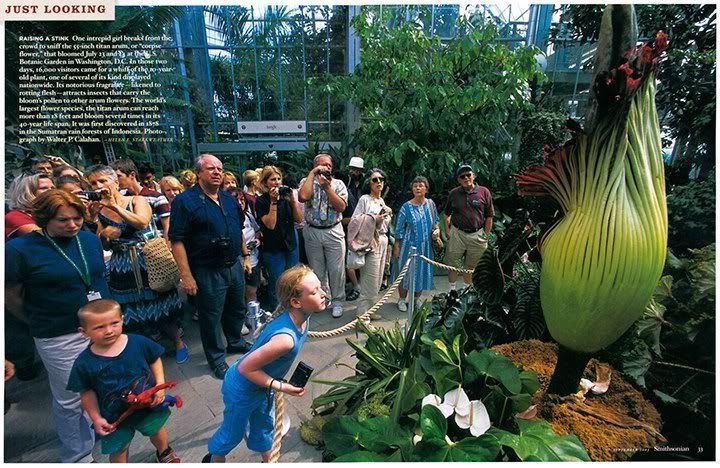

Walter P. Calahan
2003
C-print for Smithsonian Magazine


(1) Jane Kallir, "The Animal in Contemporary Art"
(2) Horticultural author? Pollan is a now influential journalist and professor whose writing explores a range of issues related to moral and ethical stewardship and consumption, sustainability, anthropology, and psychology. Why pigeonhole him?
(3) Admiring her paintings, I recalled the experience of anticipatory wanting with Julia Randall's works at Jeff Bailey Gallery.

Photo credits: Michael Pollan working in his garden, ripped from The Sydney Morning Herald(via The New York Times); Ann Craven studio image, ripped from the artist's website; "Baobab III," ripped from Frith Street Gallery website; "Untitled (Greenhouse)," ripped from Phil Moore's Flickr collection; Corpse flower image ripped from Walter P. Calahan's website

Thursday, April 20, 2006

Undoing The Gordian Knot

Michael Pollan, Hunting, and The Rest Of It

Image hosting by Photobucket
"The fact that you cannot come out of hunting feeling unambiguously good about it is perhaps what should commend the practice to us....If I've learned anything about hunting and eating meat, it's that it's even messier than the moralist thinks. Having killed a pig and...now looking forward (if that's the word) to eating that pig, I have to say there is a part of me that envies the moral clarity of the vegetarian, the blamelessness of the tofu eater. Yet part of me pities him too. Dreams of innocence are just that; they usually depend on a denial of reality that can be its own form of hubris."
-Michael Pollan, "The Modern Hunter-Gatherer"
I'm always pleased when I come across an article that clearly conveys a concept I have been striving to articulate with limited success, so I'm indebted to a co-worker for bringing to my attention Michael Pollan's (relatively) recent essay, "The Modern Hunter-Gatherer," in The New York Times Magazine (March 26, 2006). Pollan, the author of The Botany of Desire, Second Nature, and, most recently, The Omnivore's Dilemma, is a sensitive, thoughtful proponent of hunting. But whereas most writers who wax poetic about the hunt are guilty of romanticizing and simplifying what is, in fact, quite messy(1), Pollan argues that the hunter can not be a moralist. Rather "the grown-up hunter, the uneasy hunter...recognizes the truth" that resides in contradiction, or, as Robert Kimber put it in his excellent Living Wild & Domestic, "the uncompromising romantic has to compromise with the realist."

Image hosting by Photobucket

Before I continue, however, let me provide some background explanation of why Pollan's piece strikes a chord. As I wrote in my March 2005 essay, "Hunting JFK,"
"I consider myself a conscientious hunter. I eat no meat, including fish, unless I catch it or kill it myself. I kill only a few animals a year and catch only ten or so fish. I live on a vegetarian diet otherwise, aiming to minimize my contribution to the environmental degradation wrought by the meat [and fishing] industr[ies]. I will hunt only those species biologists deem to have 'surplus' populations, such as white-tailed deer (does only), mallard ducks (drakes only), cottontail rabbits."
Environmental degradation was not Pollan's principal motivation, but his reasons for picking up a rifle and heading into the woods of northern California to stalk and kill a feral pig (Sus scrofa), an introduced species descended from the European wild hog, are no less significant. The son of "one of the world's great indoorsmen," Pollan had never hunted. He "had long felt that, as a meat eater, [he] should, at least once, take responsibility for the killing that eating meat entails. [He] wanted, for once in [his] life, to pay the full karmic price of a meal." That Pollan should feel this way is admirable. Most well-educated Westerners are now too timid, too cloaked in denial, to address such base issues. Turning again to Kimber, "If the step from hunter to herdsman-plowman was the first great step in the process of alienation from nature and self, then surely the step from herdsman-plowman to city dweller, driver of combines, and feedlot engineer has all but completed that process."

All contemporary omnivores - the vast majority of humans - are necessarily implicated in the grisly business of meat "manufacture." The pork chop on the plate is more than a tasty entree; it was recently a living animal. After stunning, assuming that process goes smoothly, the pig's throat is slit by machine (or man) and the viscera is spilt before meat preparation begins. Every pig-eater who prefers to cast such realities from her mind is afraid of more than blood and gore or even the potential for undue suffering on the part of the animal. She is, above all else, afraid of confronting her own mortality. If, on the other hand, you know what it's like to kill a fellow creature, you consume flesh with full knowledge of what brings the food to the table: execution. Pollan suspects as much, even if he remains suspicious of the "ecstatic" language used by the likes of Ortega y Gasset and Hemingway.(1)

Pollan's account of the boar hunt makes for good reading, but his consideration of the aftermath is especially excellent. He struggles with his confused, intense reaction to the shooting and dressing, a polite term for gutting, of the large animal.
"...the rest of the organs tumbled out onto the ground in a heap, up from which rose a stench so awful it made me gag. This was not just the stink of pig wastes but those comparatively benign smells compounded by an odor so wretched and ancient that death alone could release it. I felt a wave of nausea begin to build in my gut. The clinical disinterest with which I had approached the whole process of cleaning my pig collapsed all at once: this was disgusting."
My upbringing was very different from Pollan's. I grew up assisting in the gutting and preparation of dove, quail, duck, deer, rabbit, squirrel, and other animals. As I told a Scrawled correspondent in a recent interview,
"Some of my early memories are, quite literally, bloody...As a child pondering the blood of a slain animal, I was deeply moved, at once overwhelmed with sorrow, and energized by the realization that the neon red glowing on my trembling hands was spilt life. The more familiar I became with death, the more tied to life I felt. It was an introduction to 'the Circle of Life,' even if it wasn't at all what Disney force-fed us."
Pollan draws similar conclusions, but because his is a new experience, he searches for an explanation where those us accustomed to death do not. This search begins with an examination of his nausea.
"...[W]hat was this attack of revulsion all about, anyway? Disgust, I understood, is one of the the tools humans have evolved to navigate the omnivore's dilemma - the elemental question of what we should and should not eat. The emotion alerts us to things we should not ingest, like rotten meat or feces. And surely that protective reflex figured in what I was feeling as I beheld these viscera, which no doubt did contain microbes that could sicken me. Our sense of disgust, as Steven Pinker has written, is 'intuitive microbiology.'"
Pollan's revulsion is the product of our animal hard-wiring. Routine killing and butchering may arrest or weaken this disgust - repetition dulls all sensation - but it remains an inevitable reaction. Like it or not, we are genetically adapted to the Pleistocene lifestyle Hemingway pined for. Pollan may cope well enough in modern-day California, making a living from selling words, but he still becomes ill at the sight of undesirable innards and, when hunting, turns into what he calls "alert man"(2), a more aware animal, one making full use of its senses. Ever conscientious, though, Pollan probes further and discovers something more than genetic coding in his violent revulsion.
"...there had to be more to it than that, and later, when I did some reading on disgust, I acquired a better idea what else might underlie my revulsion. Paul Rozin, a cultural psychologist at the University of Pennsylvania, points out that many of the things that disgust people do come from animals — bodily fluids and secretions, decaying flesh, corpses. Beyond the sanitary reasons for avoiding certain parts and products of animals, these things disgust us, Rozin suggests, because they confront us with the reality of our own animal nature. So much of the human project is concerned with distinguishing ourselves from beasts that we seem strenuously to avoid things that remind us that we are beasts, too — animals that urinate, defecate, copulate, bleed, die, stink and decompose...Exactly why we would strive so hard to distance ourselves from our animality is a large question, but surely the human fear of death figures in the answer."
Ah, yes, and so we arrive again at existential fear and the reason most folks prefer to distance themselves from the killing of the animals they consume. To "[pay] the full karmic price of a meal," Pollan must not only execute the pig, but also own up to the deed. Coming to terms with killing is far more challenging than pulling a trigger.
"What disgusted me about 'cleaning' the animal was just how messy — in every sense of the word — the process really was, how it forced me to look at and smell and touch and even to taste the death, at my hands, of a creature my size that, on the inside at least, had all the same parts and probably looked very much like me. The line between human and animal I could discern here, gazing into that carcass, was nowhere near sharp...In this, I decided, was one of the signal virtues of hunting: it puts large questions about who we and the animals are, and the nature of our respective deaths, squarely before the hunter, and while I'm sure there are many hunters who manage to avoid their gaze, that must take some doing."
For years I've tried to express as much so simply, but I tend to talk around the core of the matter, relying heavily on co-opted constructs and borrowed phrases. Even when I do feel I'm in the ballpark, most folks still willing to listen dismiss my attempts as little more than morbid rambling. After all, I live in New York City and, as far as most people know, eat a strict vegetarian diet. Why am I interested in championing hunting? What sense does that make? Pollan's remarks on the "signal virtues of hunting," particularly the difficult questions raised by the killing of other animals, suggest an answer.

One sometimes hears hunters - the more literary among them, anyway - say, "I kill to have hunted; I do not hunt to kill." This hackneyed comment refers principally to the heightened sense of immediacy and awareness alluded to earlier. Pollan likens this sense to a marijuana high; in fact, it is merely our inborn predatory instinct at work. But while there is certainly much to be said for the act of hunting itself, it is the killing that for me remains the essential existential experience. The hunt allows us to access our rarely used programming, to make full use of our special abilities, but the kill is like a Zen koan, a Gordian knot undone only by willful ignorance or reliance on moral certitude.

As Pollan suggests, avoiding the animal gaze "must take some doing." To approach a fallen animal, a creature you have just killed, is difficult but transfiguring. In the glazing eyes of the dead beast, you confront your own mortality. Terrifying though this may seem, I associate these moments with a profound sense of oneness with the natural world. In accepting responsibility for the brutal deed and recognizing my connection to the slain animal, my ego is reduced. There is an exhalation of the isolated, confused experience of contemporary life, and an inhalation of the universal(3). Dr. Morris Berman's analogy is pertinent: the experience removes the respectful hunter from the vertical, hierarchical world view and allows him to reside as part of the horizontal stretch, if only for a spell.

Unfortunately, I'm no stranger to the so-called "hero shot," the photograph of a hunter standing or kneeling behind a freshly killed animal. (In the case of smaller game, like rabbit or duck, the hunter proudly displays the creature in his hands.) It's a simple enough composition, dull and undistinguished: hunter, weapon, and prey. Usually the hunter smiles broadly. Open any contemporary "hooks-and-bullets" magazine and you'll find these images on most every page. I've never cared for these photos but, because my father is an outdoor writer, I've grown accustomed to his requests for such pictures. These days, article sales depend on the quality of the accompanying photographs as much as they do the writing, so I dutifully pose and do my best to muster a smile. Judging by my father's regular appeal - "C'mon, Christopher. Let's see a happy face. Look like you're enjoying yourself." - I don't often succeed. Why should I smile? I've just killed an animal. I'm spacey and contemplative. I'd prefer to be left alone, given adequate time to commune with the creature I have killed, minus the backslapping and the misdirected camaraderie. The experience is special, certainly, but not celebratory or joyous.

Image hosting by Photobucket


Apparently, most hunters do not suffer such brooding thoughts. Even Pollan, despite describing his emotions in the first moments after killing his boar as "surging and confused," admits to feeling proud and "unambiguously happy." It isn't until he sees the photograph of himself "kneeling on the ground behind a pig the side of whose head has erupted in blood," "one proprietary hand" placed "on the dead animal's flank," that he realizes how strange his happiness is.
"The man is looking into the camera with an expression of unbounded pride, wearing an ear-to-ear grin that might have been winning, if perhaps incomprehensible, had the bloodied carcass sprawled beneath him been cropped out of the frame. But the bloodied carcass was right there, front and center, and it rendered that grin - there's no other word for it - obscene. I felt as if I had stumbled on some stranger's pornography....No one should ever see this."
Some of the more seasoned hunters I know will write off Pollan's reaction as silly, indicative of a weakness borne of liberal ("sissified") elitism and a life removed from the realities of nature. There is some truth to that, surely, but what of their own unwillingness to consider the situation completely? They are just as guilty of ignoring the knot's complexity; they opt to "undo" it with denial's blade. As I see it, the ignorance of the prideful "sport" hunter is equivalent to that of the staunch anti-hunter(4).

And that brings me to an obvious distinction; Michael Pollan and I are not typical hunters. In fact, the more used to the predominantly vegetarian diet I become - it's been several years since I ate meat regularly - the less often I will hunt or fish in the future; maybe one day I will stop altogether, instead concentrating on a backyard vegetable garden. I am familiar already with the gravity of killing and the associated ego erasure. Given the power of that experience, it will always inform my art making, my writing, and the way I live my life. The insight may, like a tattoo, fade with time, but it will not disappear. Pollan, too, is unsure if he will hunt again, despite only having done so once. I am sympathetic, even if I feel he should try other forms of hunting before abandoning the practice altogether. We - and I mean all of us, not just hunters - need more voices like his, voices that challenge the intellectual hegemony of dullardism, on both the Left and Right. There are no simple answers to complex questions, and there are only so many times the Gordian knot can be cleaved by ignorance or denail.

For more, visit this interview with Michael Pollan.

Photo credits: Gordian Knot image ripped from homepage of Matthew Cadwallader; boar hunt photos ripped from Southeastern Outdoors and Suwannee River Ranch websites

+++++

(1) "I recognize this kind of prose: hunter porn. And whenever I've read it in the past, in Hemingway and Ortega y Gasset and all those hard-bitten, big-bearded American wilderness writers who still pine for the Pleistocene, it never failed to roll my eyes. I never could stomach the straight-faced reveling in primitivism, the barely concealed bloodlust, the whole macho conceit that the most authentic encounter with nature is the one that comes through the sight of a gun and ends with a large mammal dead on the ground..." ("The Modern Hunter-Gatherer," The New York Times Magazine, March 26, 2006)

(2) "Nothing in my experience has prepared me for the quality of this attention. I notice how the day's first breezes comb the needles in the pines, producing a sotto voce whistle and an undulation in the pattern of light and shadow tattooing the tree trunks and the ground. I notice the specific density of the air. But this is not a passive or aesthetic attention; it is a hungry attention, reaching out into its surroundings like fingers, or nerves. My eyes venture deep into thickets my body could never penetrate, picking their way among the tangled branches, sliding over rocks and around stumps to bring back the slenderest hint of movement. In the places too deeply shadowed to admit my eyes, my ears roam at will, returning with the report of a branch cracking at the bottom of a ravine, or the snuffling of a. . .wait: what was that? Just a bird. Everything is amplified. Even my skin is alert, so that when the shadow launched by the sudden ascent of a turkey vulture passes overhead I swear I can feel the temperature momentarily fall." ("The Modern Hunter-Gatherer," The New York Times Magazine, March 26, 2006)

(3)Although some friends tell me they have achieved a similar sensation while practicing yoga, I have not. There have been instances of immediacy, moments when, while in the midst of a yoga session, I feel a vital connection to the world around me, but these experiences are exceptional and, what's more, absent any sense of mortality. Yoga has granted me a connection, but it hasn't erased all sense of self.

(4)"I've looked at Angelo's pictures again, trying to figure out why they should have shamed me so. I realize it isn't the killing it records that I felt ashamed of, not exactly, but the manifest joy I seemed to be feeling about what I'd done. This for many people is what is most offensive about hunting - to some, disgusting: that it encourages, or allows, us not only to kill but also to take a certain pleasure in killing. It's not as if the rest of us don't countenance the killing of tens of millions of animals every year. Yet for some reason we feel more comfortable with the mechanical killing practices, out of view and without emotion, by industrial agriculture." ("The Modern Hunter-Gatherer," The New York Times Magazine, March 26, 2006)