 |
| Kota Ezawa Still from "City of Nature" 2011 DVD, 4 minutes Edition of 10 |

Showing posts with label video art. Show all posts
Showing posts with label video art. Show all posts
Tuesday, February 14, 2012
Review In Brief: Kota Ezawa at Haines Gallery

Thursday, November 10, 2011
Stretcher: Surabhi Saraf

"Fold {Live}"
2011
Photograph of site-specific performance in San Francisco
My write-up of new media artist Surabhi Saraf's "Fold {Live}," a series of site-specific performances in San Francisco, is published on Stretcher: Visual Culture in the San Francisco Bay Area and Beyond.
Read it here.
This month, Saraf's "Fold {Live}" is being performed in Australia.
Image credit: courtesy, Surabhi Saraf, 2011
Monday, January 03, 2011
Karl Cronin's Experiencing Forms
"Populus tremuloides (Aspen)"
2009
In late November, I visited "Ecoarchive: Meditations on Time and Nature," a group show on view at Intersection for the Arts 5M, in San Francisco. All of the work included in the exhibition (on view through January 22, 2011) is intelligent and commendable, but I most appreciated Matthew Moore's video, "Lifecycles," Sam Easterson's video, "The Museum of Animal Perspectives," and Karl Cronin's video sampler of his "Somatic Natural History Archive."
I spent most of my time with Cronin's project. For his "Somatic Natural History Archive," Cronin aims to "document with his own body representational expressions of 10,000 U.S. plants and animals," an undertaking that the artist estimates will take 50 years to complete. To date, Cronin has made "expeditions" to Nashville (TN), Santa Fe (NM), Yosemite (CA), Raleigh (NC), Plainfield (MA), and the Grand Canyon, and he's earned the well-deserved support of the Santa Fe Art Institute, Movement Research, and the Puffin Foundation. The documents of his "representational expressions" are archived in the SNHA Catalogue, each labeled with the observed species' Latin name and common name (e.g., "Populus tremuloides (Aspen)").
"Awaiting identification"
2009
With so very many plants and animals to imitate (only 66 of the 10,000 have so far been cataloged online), it's not surprising that Cronin's earnest attempts are uneven; generally, I find his embodiment of plants more intriguing and successful than his animals, but even the less-realized "expressions" made me smile, giddily impressed by the artist's wonderfully quixotic efforts.
Importantly, however, Cronin's endeavor is not mere whimsy. The project may seem simple enough, but I'm certain that it provides the artist with a fundamentally new understanding of (and relationship with) the creatures he studies. Cronin first observes the plant or animal subject, then he perceives it physically, with his body. Watching the artist sway and lean with the breeze in a stand of a grass (an as yet unidentified species, perhaps related to switchgrass), it occurred to me that Cronin is something of a latter-day shaman. "Shaman" is a term abused by new-age prophets and their ranks of well-intentioned, but ill-informed followers, but the philosopher and cultural ecologist David Abram is one of a handful of writers who have given shamanism the thoughtful consideration that it deserves. As I watched Cronin channel a heron, Abram's definition of magic came to mind.
"We are human only in contact, and conviviality, with what is not human. [..] Magic is participating in a world of multiple intelligences with the intuition that every form one perceives - from the swallow swooping overhead to the fly on a blade of grass, and indeed the blade of grass itself - is an experiencing form, an entity with its own predilections and sensations that are very different from our own."In essence, magic is empathy with other "experiencing forms"; it's communion with other facets of the animate world. Happily, by documenting his work with video, Cronin allows the viewer to participate in the magic. I'm grateful for that.
"Caelifera sp. (Grasshopper)"
2009
Note: As a proud natural history geek, I was disappointed that Cronin titled the last of the three videos above "Caelifera sp. (Grasshopper)." In fact, the insect that Cronin imitates in this video is actually a katydid, a species more closely related to crickets than to grasshoppers. Still, while I presume Cronin will make the correction when he adds this video to the SNHA Catalogue, I don't envy him the task of trying to secure a definitive ID on many of the species he works with. Without the help of a entomology expert, he'll be hard pressed to determine the species of katydid in the video above.)
Image/artwork credit: all videos, courtesy Karl Cronin
Saturday, April 03, 2010
"Ouroboros" at ISE Cultural Foundation

I'm intrigued by the many positive reviews of "Ouroborus: The History of the Universe," a six-screen, 3-D video installation by biochemist, philosopher, and video artist Ali Hossaini and the collaborative duo of Blake Shaw and Bruno Levy, aka SWEATSHOPPE, currently on view at the ISE Cultural Foundation. Many write-ups of the exhibition describe the installation as meditative, and excitedly relate the artists' intent to "[tell] the history of cosmic evolution - from the Big Bang to Lady Gaga - by animating over 30,000 images."
In fact, although "historical spiritual illustrations of the cosmos, from vedic yantras, buddhist mandalas, and sacred geometry," are prominently featured on three of the installation's six screens, the effect is less mindful (and certainly not meditative) than it is visually assaultive and superficial. And, though the triptypch "cosmic evolution" might incorporate over 30,000 images, it is best described as a pastiche of generally significant forms rendered insignificant in presentation. As a gallery companion remarked to me, "This isn't communicating anything; it's just a 'Clockwork Orange' brainwashing machine." It's a shame that's true, as Hossaini's accompanying artist statement is insightful and important. I include the full text of his statement below.
"Nowhere is the fragmentation of the human psyche more evident than in how we treat the environment. We know we're pillaging our habitat, but we can't make the leap from knowledge to right action. I attribute this disconnect, and many others, to the factionalizing of culture that began with modern science, industry and art.I agree completely, but Hossaini's collaboration with SWEATSHOPPE has neither shed "light on the complexities and responsibilities of being self-aware" nor integrated contradictions into new levels of experience. Their intent is laudable, but their effort lacking.
I'm not saying we should turn our backs on the Enlightenment. But neither should we take it as dogma - we need to rethink its foundation, integrating our psyche into the cosmos in a way that builds on premodern wisdoms as well as modern science. The Enlightenment freed physics, astronomy and eventually art - think 'art for art's sake' - from tradition, spawning remarkable advances along with deep alienation.
It's time to produce culture in a more holistic, organic way. For now science, art and religion - and I use 'religion' here to mean a generalized psychology - lie in private tracks, each requiring extensive knowledge for appreciation let alone practice. How can these disciplines work together more effectively?
The answer doesn't lie in the rejecting, merging or reconciling science and spirit. Instead we need to create a framework for integrating our experiences of these different realms, and this is precisely what artists can do. Art needs to step out of its self-referential confines, the safe house of galleries, museums and markets. It needs to be Saturday night and Sunday morning, be the new church, and it needs to invade pop culture. Mass appeal is critical.
Most of all art needs to rejoin itself to science. Both embody urges to explore, understand and create, and both have become specialized, mechanized and self-absorbed, given to destructive irony. Art cannot be science, but it can convey the sense of wonder that drives scientists. It can visualize the worlds of science while honoring our sense of self as beings that transcend the mundane.
Our experiences of spirit and matter cannot be reconciled, but they can be represented. And they can be represented in a way that sheds light on the complexities and responsibilities of being self-aware. Artists can rise above the dilemmas of modern life: they can comprehend the contradictions, integrating them into new levels of experience where knowledge, desire and energy meet the limits of human freedom."
Yet Hossaini's statement resonates and, as I left the ISE Cultural Foundation, I recalled Ron Fricke's tremendous film "Baraka." Hossaini and SWEATSHOPPE have inspired me to revisit Fricke's beautiful, moving tribute to transcendent oneness, and to eagerly await the long-awaited sequel, "Samsara." It's hopeful to recognize that sometimes art does step outside "its self-referential confines."
Saturday, January 09, 2010
The Art Community and Common Sense
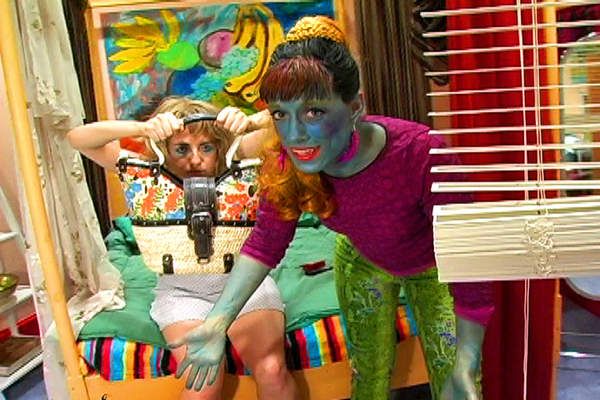
"I-BE AREA"
2007
"Everybody gets so much information all day long that they lose their common sense."We're a week-and-a-half into 2010, and I'm hoping that the din produced by so much fin-de-decade media will soon die down. It's no secret that we citizens of the United States (and all other essentially "Americanized" peoples) are principally defined by our consumption. What's more, after decades of adaptation to the consumer role, we've become so fond of the talk surrounding our consumer products that the consumer reviews themselves have become another kind of consumable. Regrettably, this is no less true in the arts.
- Gertrude Stein
I've made a contrarian effort this year to avoid most of the "Top" lists and their Op-Ed equivalents, but I've not been totally chaste. The diviners of social, political, or cultural trends have been working furiously to meet their deadlines, and the surplus of art-related stock-taking is in large part responsible for the dearth of new HH content. Anything that I write here will only add to the pervasive and stupefying hubbub; it is further distraction from the business of life well-lived.
And yet, here I sit, writing this post. Like all the other commentators, I'm guilty of editorializing and contextualizing that which is better meditated upon individually or mulled over with our loved ones. And I'm guilty of adding one more perspective to the countless millions already vocalized, furthering the unfortunate and wrong-headed belief that subjectivity reigns. What I'm engaging in, then, is dangerous. While post-modern notions of relativism are valid and philosophically valuable, our globalized culture must strive to sort, such that we can, the wheat from the chaff. That is to say, in a time of increasing cross-cultural interaction, the need for some consensus, some agreed upon hierarchy of moral, ethical, and aesthetic value, is acute. It is a dangerous and exciting era; as such, it is a good time to be a artist.
I agree with Roberta Smith's contention that "the years 2000 to 2009 saw the emergence of a tremendous number of really good, interesting, promising artists." My list of "really good" artists, however, is very different from hers, and Ryan Trecartin, one of the artists that the New York Times' critic celebrates in her recent article, "Make Room for Video, Performance and Paint," is definitely not on it. I don't know Trecartin personally, and he may be a well-meaning, pleasant enough person, but his artwork is poisonously self-absorbed. In this respect, at least, Smith is right to assert that he is an important representative of the decade past. The art world, and especially that of New York City, the community to which I'm most attached, has seen an explosion of navel gazing.
To be fair, most artists engage in some level of narcissism. At the end of the 1990s, when I was in my early twenties, I had puerile aspirations to produce "art videos" of my ejaculating penis (paging Sterling Ruby), and my paintings were dominated by angst-ridden self-portraits and hyper-sexualized imagery. The few paintings of that period that survive are today stacked in my parents' Virginia garage, partly covered by a plastic tarpaulin and years of accumulated mouse shit and winter-killed wasp corpses. Such is the fate of personal history. Serpent-like, we periodically shed our skins and move on, hopefully a little more wise. Some of us, however, put our sheddings and bruises on display, mistaking personal exposure for bravery. Indeed, in some contexts it is brave, but when the sharing is marshalled in service of a cult of personality, it is a celebration of individual dysfunction. And when such exhibitionism is mistaken for art, it is an indication of critical and cultural dysfunction.
Believing that art is fundamental to humanity, and that it is transformative and sacred, I don't accept Freud's famous contention that the artist is a neurotic who seeks to attenuate or postpone confrontation of his or her mature psyche. In fact, for most of our species' tenure, the role of the artist was precisely the opposite; we were called upon to ground our brethren is real experience, be it material or metaphysical. Yet Freud's categorization accurately describes much of the juvenalia that passes for contemporary art. Certainly, we artists should be embarrassed by this trend, but you can't kill the messenger, as the saying has it; Trecartin and others creating hysterical or megalomaniacal artworks are reflections of the dominant (and apparently yet ascendant) iCulture. It is instead the critics and the gallerists, the purveyors of taste, that should be most ashamed of themselves.
Essayist, critic, and philosopher George Steiner is far more intelligent and incisive than I, so I include a pastiche of pertinent excerpts from his 1989 book, Real Presences.
"The usages and values predominant in the consumer societies of the West today [are] the secondary and the parasitic[...]. Literate humanity is solicited daily by millions of words, printed, broadcast, screened, about books which it will never open, music it will not hear, works of art it will never set eyes on. A perpetual hum of aesthetic commentary, of on-the-minute judgments, of pre-packaged pontifications, crowds the air. Presumably, the greater part of art-talk or literary reportage, of music reviews or ballet criticism, is skimmed rather than read, heard but not listened to. None the less, the effect is antithetical to that visceral, personal encounter[...]. There is little 'ingestion'; it is the 'digest' that prevails.Steiner, I presume, frowns on the Top Ten lists and "best of the decade" summaries as much as I do. I also believe that he would dismiss as "derivative or [of] passing interest" most (though not all) of the artists that Smith praises in her article. The cultural longevity of most on Smith's list is questionable, certainly alongside the likes of Alec Soth, Bill Viola, Matthew Day Jackson, Omer Fast, or Tom Uttech, all contemporary artists crafting intelligent and soulful artworks.
[...]
The journalistic vision sharpens to the point of maximum impact every event, every individual and social configuration; but the honing is uniform. Political enormity and the circus, the leaps of science and those of the athlete, apocalypse and indigestion, are given the same edge. Paradoxically, this monotone of graphic urgency anaesthetizes. The utmost beauty or terror are shredded at close of day. We are made whole again, and expectant, in time for the morning edition.
[...]
Two principal impulses energize the American spirit: immanence and egalitarianism. The crux of American time is now. The past matters in direct reference to its usability in and by the present. [...] No other culture has so dignified the immanent. [...] Poets, novelists, choreographers, painters of the most derivative or passing interest, are made the object of seminars and dissertations, of undergraduate lectures and post-doctoral research. The axioms of the transcendent in the arts of understanding and of judgment [...] are invested in the overnight."
Smith writes, at the article's close, "In all, we are confronted with the distinct possibility that quantity and quality may not be so mutually exclusive after all. More means more better." That's very true. But more also means more bad, of course, which is why we today have an urgent need for critics, curators, and gallerists who, like Steiner and Donald Kuspit, are willing to reside outside the community, to avoid political entanglements, and to judge, sometimes harshly. To those critics, artists, and gallerists already plugged in, let's begin this decade, this arbitrary but useful marker in our human journey, with a renewed commitment (a resolution, if you prefer) to be more rigorous, contemplative, and socially committed. The art world, like the world at large, needs fixing, and responsible action is the only thing for it.
Happy Twenty-Ten. Here's hoping that it's healthy and auspicious.
Image credit: Ryan Trecartin, 2007
Sunday, May 03, 2009
Walking with the wind
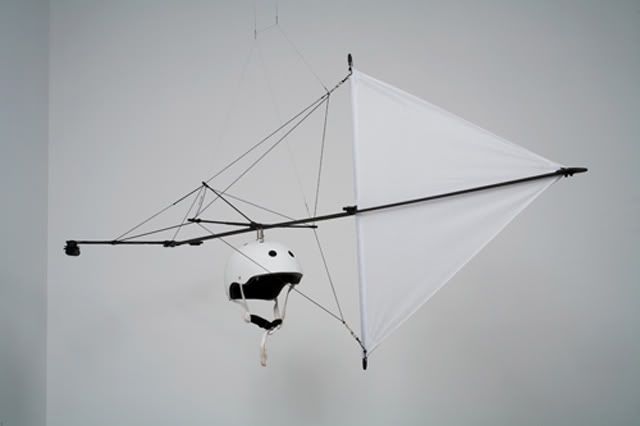
"Windwalk #2 - Charing Cross"
Helmet
2008
For his "Windwalk - 5 Walks from Charing Cross" project, artist Tim Knowles engineered a helmet with a sail-like wind vane, small video camera and GPS device, then wandered the streets of central London, his path determined solely by the wind. As Knowles crosses major thoroughfares, where the wind enters the wider channel via various tributaries, his path hitches and tacks erratically. If a gust of wind blows from the opposite direction, he spins about face, and he sometimes circles upon an earlier position.
In at least two of the videos that document his wind walks, Knowles is led into a cul de sac of swirling wind, where he finds himself temporarily trapped with light-weight street debris, including plastic bags and leaves. In these situations, or when he is directed into a wall, Knowles waits patiently for the wind to change direction and again grant him headway.
The artist Bernard Buffet wrote, "I prevent myself from thinking in order to be able to live." Although Buffet presumably referred to the particularly European struggle to persevere in a world shadowed by acute suffering and inhumane activity (he made the declaration in 1948, after an adolescence in occupied France), the statement can also be understood as an endorsement of Zen's "mind of no mind," or mushin no shin. Regardless of their geographic or religious provenance, meditative practices commonly encourage practitioners to banish thought from the mind so that they might experience transcendence or some heightened sense of being.
Similarly, the 20th century aesthetic theorists Alfred North Whitehead and John Dewey believed that there is a crucial distinction between the aesthetic and rational realms. Dewey argued that the aesthetic province is that of the "live animal" or unmediated, natural experience. In his landmark book Art As Experience, Dewey writes,
"Life goes on in an environment; not merely in it but because of it, through interaction with it. No creature lives merely under the skin; its subcutaneous organs are means of connection with what lies beyond its bodily frame, and to which, in order to live, it must adjust itself, by accommodation and defense but also by conquest. At every moment, the living creature is exposed to dangers from its surroundings, and at every moment, it must draw upon something in its surroundings to satisfy its needs. The career and destiny of a living being are bound up with its interchanges with its environment, not externally but in the most intimate way."Elsewhere, Dewey states more plainly, "to grasp the sources of aesthetic experience it is necessary to have recourse to animal life below the human scale." The life Dewey describes, the realm of the "live animal" and of true aesthetic experience, is akin to Zen's mushin no shin.
The late Irish philosopher and poet John O'Donohue described dance as a reclamation of our animal nature. He wrote,
"When you walk into the mood of wind, it cleanses your mind and invigorates your body. It feels as if the wind would love you to dance...The body gives itself away playfully to the rhythm of the music; the burden of consciousness becomes suspended. For a while the innocence of the dance claims you completely as the mind relents and the body becomes its own celebration."Knowles' "Windwalks" allow him access to the realm of Dewey's "live animal" and of O'Donohue's celebratory body; the artist relinquishes control by bypassing the brain's self-conscious helmsman. The wind meanders London's streets and Knowles follows; if he is the dancer, the wind is his choreographer. The artist is compelled by the wind's whim.
But, in allowing himself to be guided by an external force, Knowles doesn't simply provide viewers with an often humorous and poetic take on Dewey's philosophy of essential aesthetic experience. His "Wind Walks" resonate on several levels, and perhaps the most vital subtext is one of openness to new experience and new ideas.
Knowles provides us with a 21st century model of citizenship. He explores Charing Cross in a novel way; in doing so, he is provided with a fundamentally new appreciation for and knowledge of a seemingly familiar London neighborhood. In our rapidly globalizing world, we'd do well to emulate Knowles' willingness to look again for the first time. As T.S. Eliot wrote in his poem "Little Gidding,"
"We shall not cease from exploration"Windwalk - 5 Walks from Charing Cross" was seen in the Bitforms Gallery exhibition, "Tim Knowles and Pe Lang + Zimoun: Unpredictable Forms of Sound and Motion," recently on view in New York City.
And the end of all our exploring
Will be to arrive where we started
And know the place for the first time."
Photo credits: images ripped from The Cyborg's Picnic and VVVORK
Tuesday, March 03, 2009
Trusting Our Gut

Wood engraving, originally published in Harper's Weekly
September 1873
Nature teaches beasts to know their friends.Human beings are exceptional among the social beasts in that our moral and ethical values are forever evolving. Educated, progressive individuals today consider all humans inherently equal, irrespective of race, sex, religion or nationality. Unfortunately, prejudice doesn't die easy, and bitter conflict remains a fact of life. Still, cultural anthropologists note that humanity has with time extended its ethical embrace from family to tribe, tribe to region, region to nation, nation to race, and race to species. In other words, bigoted outliers excepted, humanity is becoming ever more compassionate. It is notable and lamentable, however, that our animal brethren remain largely ignored. Nevertheless, I remain hopeful that humanity will transcend anthropocentrism.
-"Coriolanus" (Act II, Scene I), William Shakespeare
My optimism is muddied, however, by articles like "Exhibition with Disturbing Videos of Animals Leads to Protests in Italy." This NY Times report deals with a controversial video installation by the French-Algerian artist Adel Abdessemed. In a matter of days, an Italian judge will determine whether or not the installation can be legally displayed in Turin. Abdessemed included two shocking videos in the installation: "Don't Trust Me," a loop documenting the sledgehammer slaughter of six Mexican farm animals; and "Usine," a video of scorpions, snakes, spiders, roosters and dogs fighting for human entertainment. Both videos were filmed in Mexico, where bludgeoning of "meat animals" is standard practice and animal fights are still legal.
Because Italian law prohibits animal fighting, the courts might fairly rule that "Usine" should not be shown to the public because it encourages illegal activity. But what of the bludgeoning in "Don't Trust Me"? Can a court rule that video documentation and display of a common practice violates the law?
In many countries, sledgehammers are still the primary method of stunning and killing an animal before it is butchered. The cow, horse, goat or other "meat animal" is roundly struck with the heavy hammer on the cranium. If the initial blow is misplaced, the animal will be struck again. In the United States, the Humane Slaughter Act stipulates that a captive bolt pistol is used to drive a pressurized bolt into the animal's brain. The pistol is more consistent than a sledgehammer, but the intended effect is the same.
Abdessemed's videos merely document a brutal step in the omnivore's food cycle. He is not, then, as so many activists assert, "someone who mistreats animals." Rather, he is someone who documents socially sanctioned mistreatment of animals.
Last year, vociferous protest from animal rights groups shut down a showing of "Don't Trust Me" at the San Francisco Art Institute. According to the San Francisco Chronicle, the "Art Institute canceled the panel discussion and the exhibition...[due to] unnumbered threats of violence from animal rights activists and possibly from others." Many of these outraged, threat-making individuals did not have all the facts; some of them even insisted that the artist killed the animals himself, in the name of art. But a comment by a reader of Ingrid's San Francisco Blog makes clear what most upset San Franciscans.
"I don’t want to see it (I prefer my meat in nice little packages in the store freezer), and if it is too disturbing or shocking to the sensibilities of the community, then the community should ask that the exhibit be removed."It comes as no surprise that people don't like to be disturbed or shocked, but the commenter's preference for "meat in nice little packages" is irrelevant; that nicely presented meat comes from a living animal that was killed for human consumption. By buying the packaged meat, the consumer is implicated in the "processing" of the animal. Moreover, if she denies her connection to the animal's life and death, the meat-eater engages in irrational and immoral thinking. Were the omnivores that called for the closing of Abdessemed's SFAI exhibition compelled by shame?
And what of the threat-making animal rights activists? Excluding the individuals that erroneously believed Abdessemed was "killing the animals for art," I don't see the sense in their wanting to close the SFAI exhibition. Shouldn't they want to promote it, instead? After all, "Don't Trust Me" is cousin to videos produced by People for the Ethical Treatment of Animals (PETA) and other animal rights groups that document inhumane slaughterhouse practices. PETA hopes that these videos will inspire outrage against the meat industry and encourage vegetarianism. Why should Abdessemed's videos upset this interest group?
My reaction to Abdessemed's work is like my response to Marco Evaristti's provocative installations and performances. I agree with their detractors: the work is generally "little more than a publicity stunt to generate buzz." But if buzz gets people talking about our contemporary moral dilemmas, is that cause enough to embrace the provocateur?
Image credit: ripped from Wikipedia
Tuesday, October 14, 2008
Aitken's not-so-migratory menagerie
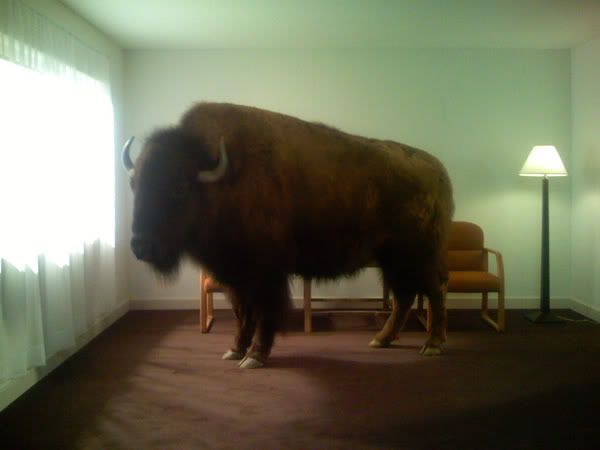
Doug Aitken
"Migration"
2008
Production still
25-minute video loop
Doug Aitken's haunting film "Migration," currently on view at 303 Gallery's 21st street space, focuses on the behavior of a number of North American animal species, each shown displaced in a banal motel room. "Migration" is a beautiful monument to our transient American existence. Indeed, whether moving homes or traveling for business, Americans are a peregrinating people; we move more often than citizens of any other industrialized nation. Aitken's decision to use wildlife to meditate on this phenomenon is affecting. The film is dream-like and hypnotic, and it was hard to pull myself away, even when the 25-minute loop began again.
But when I picked up the gallery press release, I noticed that it described the critters Aitken filmed as "wild North American migratory animals." This jarred me from any reverie. In fact, of the twelve species that I recall offhand, only three - the American bison (Bison bison), caribou (Rangifer tarandus) and hawk (unidentified sp.) - might be deemed migratory, and it requires an almost comical ignorance of wildlife to think that an American beaver (Castor canadensis) or raccoon (Procyon lotor) will trundle hundreds or thousands of miles in search of more hospitable temperatures. I don't know if the press release mistake is Aitken's doing or that of a gallery employee. Of course, I hope it's the latter, but I'm dismayed either way.
Artists are generally urban animals. We congregate in cities so that we might feel connected to other artists and novel ideas. (Certainly, there are many exceptions, and the rural, more solitary approach to art-making is no less valid or vital. Different strokes for different folks, as the expression goes.) Some of us, though, strive to straddle the urban-rural divide. But those artists who, like me, spent childhood in the country and now reside in the city (or vice versa) often come to feel uneasy in both environments.
In my case, that sense of alienation is felt most acutely when I am reminded of how ignorant most urbanites are of natural history. Even with their relatively impressive academic pedigree, artists and art enthusiasts are no exception. What's more, most city dwellers consider those individuals who do possess a knowledge of or curiosity about other species and ecosystems quaint; natural history is considered an esoteric and incidental subject. Among my friends, I'm the go-to-guy for questions about animal behavior or physiology, but these questions are cast as if the answers are more trivial than celebrity gossip. (My friends are often surprised that I can't name a fifteen-minute celebrity pictured on a newsstand rag, but don't think it odd that they can't identify but one or two of the city's most common bird species.)
Indeed, when I mentioned my fault with the 303 gallery press release, one artist friend chuckled and said, "Only you would even notice that." Sadly, that may be true. If so, it is proof of how divorced urbanites are from the lives and lifestyles outside the proverbial city walls. Such a dismissive urban attitude is not merely an unfortunate reality for natural history buffs; with an increasingly urban global populace, it bodes poorly for the future of ecological stewardship and, in turn, our human station.
Photo credit: image ripped from 303 Gallery website
+++++
Related post: Bioephemera discusses the same here.
Tuesday, May 20, 2008
BLU's "MUTO"

Michael McDevitt and Boyce Cummings both forwarded this brilliant video to me.
Michael described BLU, the Italian artist responsible for the film, as "a perfect example of a true graffiti artist... not a tagger or vandal, but an artist whose medium is paint on buildings. It's like William Kentridge rolled up a big joint of Bansky and smoked it while he worked." Indeed, and the joint was sprinkled with some of Keith Haring's sympathetic sensibility, too.
BLU's resulting film, "MUTO," is wonderfully surreal. Watching it, I consider time (with regard to the artist's process, and to the temporality of art, architecture and our species), scale and even magic.
"MUTO" is also uplifting; after a viewing, I feel good about urban living, and about the balance of humanity's prospects with all of our serious shortcomings. It ends, as all things must, in death...but there is joy even in that.
Were Voyager 1 launched today, I'd petition for the inclusion of the video.
(Personally, I prefer to watch "MUTO" without sound.)
Watch it here. Check out more work by BLU here. Read BLU's blog here.
Photo credit: image ripped from BLU's website
Thursday, June 14, 2007
Penises and art
Last night, I caught the last half of "Creature Comforts," the US spin-off of Aardman Animations' 1990 Best Animated Short Film winner (created by Nick Park, of "Wallace & Gromit" fame). The interview audio tracks are recorded with "real" Americans, then cast as the various animal characters. Not surprisingly, most of the comments are decidedly inexpert...and that much better for it.
The final segment of last night's episode was entitled "Art." It was delightful, and a welcome change from the often tedious musings of art bloggers. (Tedious is a strong word, but if you read through the long conversations generated by posts like Winkleman's "What's An Artist? Take 459" or Cognitive Daily's "Is Science Art?," you'll likely agree that sometimes even thoughtful dialogue can seem like so much noise.)
Saturday, March 17, 2007
More Spam Fun
Check out the two animated shorts below. A friend of mine drew my attention to these videos after reading the previous post. They're terrific, and certainly worth sharing.
+++++
Thursday, April 27, 2006
Marc Ecko's Admission
Anyone having watched the video of Ecko employees tagging Air Force One will be interested to learn that graffiti artist cum fashion mogul, Marc Ecko, admits the video was a hoax.
"I wanted to do something culturally significant, wanted to create a real pop-culture moment," said Marc Ecko of Marc Ecko Enterprises. "It's this completely irreverent, over-the-top thing that could really never happen: this five-dollar can of paint putting a pimple on this Goliath."I suspected as much, but enjoyed the documentation and dissemination all the same.
Wednesday, April 06, 2005
Oh, Beautiful Vapidity…
A friend sent me this music video today.
The song is composed and performed by Dennis Madalone, a New Jersey stuntman-cum-singer/songwriter who wants the listener to know that his
And this brings me to the video. Rarely do you have a chance to see so many clichés packed into a three-minute clip...unless you’re watching a spoof. The video opens with our blue-collar man, illustrated by his All-American, torn blue-jeans, strolling alone on the beach. Soon Dennis is joined by some twinkly special effects, otherwise known as angels. And, with these divine companions watching his back, Dennis breaks into full-throated, patriotic song.
The lyrics are thoughtless and mundane, belying the claim that Madalone is “truly an artist with power, passion and originality.” Canned passion, I'll grant him, but power and originality are not at all represented.
He stands defiant, holding, alternately, a small stars-and-stripes hanky or a large United States flag, while singing,
This worry may be in part due to the results of a Gallup Poll conducted November 7-10, 2004. When asked, “Which best describes your views of the origin of life?,” the responses were as follows:
The song is composed and performed by Dennis Madalone, a New Jersey stuntman-cum-singer/songwriter who wants the listener to know that his
“compassion for others inspires him to write lyrics and create melodies…to share his feelings so that it may be a reflective comfort in ‘your’ life.”The message of this single, entitled “America We Stand As One,” is to “carry on, hold on and stay strong for we all are truly one.” Apparently, Madalone’s “we” doesn’t apply to folks born outside our proud city walls. This here song, American brothers and sisters, is for us and us alone.
And this brings me to the video. Rarely do you have a chance to see so many clichés packed into a three-minute clip...unless you’re watching a spoof. The video opens with our blue-collar man, illustrated by his All-American, torn blue-jeans, strolling alone on the beach. Soon Dennis is joined by some twinkly special effects, otherwise known as angels. And, with these divine companions watching his back, Dennis breaks into full-throated, patriotic song.
The lyrics are thoughtless and mundane, belying the claim that Madalone is “truly an artist with power, passion and originality.” Canned passion, I'll grant him, but power and originality are not at all represented.
He stands defiant, holding, alternately, a small stars-and-stripes hanky or a large United States flag, while singing,
“I had to go, but it’s OK, You see I’m with you in a different way…America….USA, We stand as one…and we must carry on.”The homepage claims that “this new rock anthem fills you with hope and comforts you with a spiritual message from our Loved Ones." In fact, I presume that the majority of US citizens under forty years of age (and a great deal of those above) are too savvy to accept “A.W.S.A.O.” as anything other than the hackneyed crap it is. Yet still I find myself becoming worried about the percentage of the populous that will respond to Dennis Madalone’s “sincerity” and “moral integrity.”
This worry may be in part due to the results of a Gallup Poll conducted November 7-10, 2004. When asked, “Which best describes your views of the origin of life?,” the responses were as follows:
Man developed with God guiding, 38%45 percent? Dear God…I think I'll go pump up the volume on Mandalone's "America" and stick my hand in a fu*king blender.
Man developed with no help from God, 13%
God created man in present form, 45%
Subscribe to:
Posts (Atom)