Showing posts with label George Steinger. Show all posts

Friday, February 19, 2010

Originality and (Re)cognition


Xie Zhiliu (Chinese, 1910–1997)
"Ducks and Blossoming Branches"
Pencil and ink on paper
20 1/2 x 30 3/4 inches

In his recent review of the Metropolitan Museum of Art's exhibition of works on paper by the late Chinese artist Xie Zhiliu ("Tracing the Path to Chinese Finesse," New York Times, February 14, 2010), art critic Ken Johnson reminds readers that imitation is often a prerequisite for originality. Johnson's piece begins with a Western commonplace,
"Copying is bad; originality is good. That’s what we learn from toddlerdom on. In art as in life, be yourself. Don’t pretend. Nobody likes phonies, fakes or frauds. Forgery is illegal. Authenticity is holy.

But wait. Copying and imitating have been the rule for most of the history of human civilization. In the West artists from Raphael to Picasso have profited from copying the works of others. In art there is no such thing as pure originality."
Or is there?

I suppose it depends on one's definition of originality. Having recently come under the intellectual sway of George Steiner, I wholeheartedly endorse the philosopher-critic's distinction between originality and novelty, detailed in his book Real Presences.
"Originality is antithetical to novelty. The etymology of the word alerts us. It tells of 'inception' and of 'instauration,' of a return, in substance and in form, to beginnings. In exact relation to their originality, to their spiritual-formal force of innovation, aesthetic inventions are 'archaic.' They carry in them the pulse of the distant source."
Put another way, novelty is self-conscious invention or difference for the sake of invention or difference (that is, mere newness), whereas originality is an individual's expression of a primordial and universal resonance.

What better way to absorb the lessons of your predecessors (to better prepare yourself for originality) than by reproducing the work of those artists? More from Johnson's article:
"Maxwell K. Hearn, the exhibition’s organizer and a curator of Chinese painting and calligraphy at the Met, explained in an interview that the show’s main significance is in what it reveals about methods used by traditional artists. It turns out that the kind of graceful naturalism that Xie achieved in his best works came not from extensive study of nature but by tracing over and over the works of other artists on sheets of semitransparent paper. [...] Repeatedly tracing the works of old masters as Xie did might be compared to a pianist practicing a composition by Bach. This may sound suffocating for a modern artist, but it is not unlike how many young artists learn to draw: by copying their favorite comic-book characters over and over."
I was no exception. I spent countless teenage hours copying comic strips and, later, comic book characters. The graphic line and compositional sense that I learned from emulating those comic artists significantly informs my artwork today.

Johnson is correct, however; these ideas "may sound suffocating for a modern artist." That copying (a casual form of apprenticeship) might offend contemporary sensibilities is further evidence of the excesses of modernism and postmodernism. Too much was purged in the revolution of modern aesthetics; the rabble is today without coherence.

Fortunately, the art world is undergoing a sea change. The majority of artists under 40 years of age (and an increasing number of those over 40) do not mistake novelty of expression for originality, and they will readily acknowledge the value of copying, especially for the young artist. In fact, we realize the genuineness of Steiner's insistence that such activity is vital in all aesthetic disciplines.
"To learn by heart is to afford the text or music an indwelling clarity and life-force. Ben Johnson's term, 'ingestion,' is precisely right. What we know by heart becomes an agency in our consciousness, a 'pace-maker' in the growth and vital complication of our identity.

[...] Accurate recollection and resort in remembrance not only deepen our grasp of the work: they generate a shaping reciprocity between ourselves and that which the heart knows. As we change, so does the informing context of the internalized poem or sonata. In turn, remembrance becomes recognition and discovery (to re-cognize is to know anew)."
Image credit: Metropolitan Museum of Art

Sunday, January 31, 2010

The Logical Consequence

"'Art for art' is a tactical slogan, a necessary rebellion against philistine didacticism and political control. But pressed to its logical consequences, it is pure narcissism."

- George Steiner

Saturday, January 09, 2010

The Art Community and Common Sense


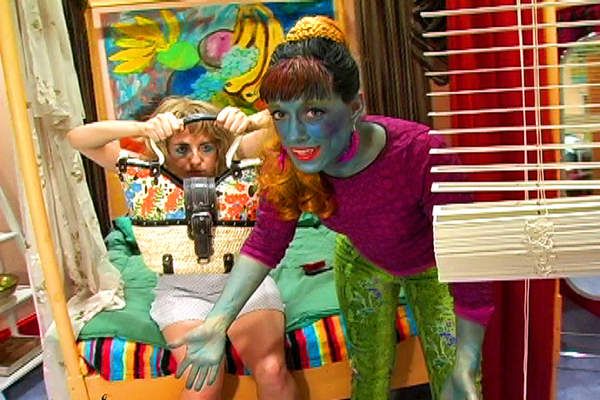
Ryan Trecartin
"I-BE AREA"
2007
"Everybody gets so much information all day long that they lose their common sense."

- Gertrude Stein
We're a week-and-a-half into 2010, and I'm hoping that the din produced by so much fin-de-decade media will soon die down. It's no secret that we citizens of the United States (and all other essentially "Americanized" peoples) are principally defined by our consumption. What's more, after decades of adaptation to the consumer role, we've become so fond of the talk surrounding our consumer products that the consumer reviews themselves have become another kind of consumable. Regrettably, this is no less true in the arts.

I've made a contrarian effort this year to avoid most of the "Top" lists and their Op-Ed equivalents, but I've not been totally chaste. The diviners of social, political, or cultural trends have been working furiously to meet their deadlines, and the surplus of art-related stock-taking is in large part responsible for the dearth of new HH content. Anything that I write here will only add to the pervasive and stupefying hubbub; it is further distraction from the business of life well-lived.

And yet, here I sit, writing this post. Like all the other commentators, I'm guilty of editorializing and contextualizing that which is better meditated upon individually or mulled over with our loved ones. And I'm guilty of adding one more perspective to the countless millions already vocalized, furthering the unfortunate and wrong-headed belief that subjectivity reigns. What I'm engaging in, then, is dangerous. While post-modern notions of relativism are valid and philosophically valuable, our globalized culture must strive to sort, such that we can, the wheat from the chaff. That is to say, in a time of increasing cross-cultural interaction, the need for some consensus, some agreed upon hierarchy of moral, ethical, and aesthetic value, is acute. It is a dangerous and exciting era; as such, it is a good time to be a artist.

I agree with Roberta Smith's contention that "the years 2000 to 2009 saw the emergence of a tremendous number of really good, interesting, promising artists." My list of "really good" artists, however, is very different from hers, and Ryan Trecartin, one of the artists that the New York Times' critic celebrates in her recent article, "Make Room for Video, Performance and Paint," is definitely not on it. I don't know Trecartin personally, and he may be a well-meaning, pleasant enough person, but his artwork is poisonously self-absorbed. In this respect, at least, Smith is right to assert that he is an important representative of the decade past. The art world, and especially that of New York City, the community to which I'm most attached, has seen an explosion of navel gazing.

To be fair, most artists engage in some level of narcissism. At the end of the 1990s, when I was in my early twenties, I had puerile aspirations to produce "art videos" of my ejaculating penis (paging Sterling Ruby), and my paintings were dominated by angst-ridden self-portraits and hyper-sexualized imagery. The few paintings of that period that survive are today stacked in my parents' Virginia garage, partly covered by a plastic tarpaulin and years of accumulated mouse shit and winter-killed wasp corpses. Such is the fate of personal history. Serpent-like, we periodically shed our skins and move on, hopefully a little more wise. Some of us, however, put our sheddings and bruises on display, mistaking personal exposure for bravery. Indeed, in some contexts it is brave, but when the sharing is marshalled in service of a cult of personality, it is a celebration of individual dysfunction. And when such exhibitionism is mistaken for art, it is an indication of critical and cultural dysfunction.

Believing that art is fundamental to humanity, and that it is transformative and sacred, I don't accept Freud's famous contention that the artist is a neurotic who seeks to attenuate or postpone confrontation of his or her mature psyche. In fact, for most of our species' tenure, the role of the artist was precisely the opposite; we were called upon to ground our brethren is real experience, be it material or metaphysical. Yet Freud's categorization accurately describes much of the juvenalia that passes for contemporary art. Certainly, we artists should be embarrassed by this trend, but you can't kill the messenger, as the saying has it; Trecartin and others creating hysterical or megalomaniacal artworks are reflections of the dominant (and apparently yet ascendant) iCulture. It is instead the critics and the gallerists, the purveyors of taste, that should be most ashamed of themselves.

Essayist, critic, and philosopher George Steiner is far more intelligent and incisive than I, so I include a pastiche of pertinent excerpts from his 1989 book, Real Presences.
"The usages and values predominant in the consumer societies of the West today [are] the secondary and the parasitic[...]. Literate humanity is solicited daily by millions of words, printed, broadcast, screened, about books which it will never open, music it will not hear, works of art it will never set eyes on. A perpetual hum of aesthetic commentary, of on-the-minute judgments, of pre-packaged pontifications, crowds the air. Presumably, the greater part of art-talk or literary reportage, of music reviews or ballet criticism, is skimmed rather than read, heard but not listened to. None the less, the effect is antithetical to that visceral, personal encounter[...]. There is little 'ingestion'; it is the 'digest' that prevails.

[...]

The journalistic vision sharpens to the point of maximum impact every event, every individual and social configuration; but the honing is uniform. Political enormity and the circus, the leaps of science and those of the athlete, apocalypse and indigestion, are given the same edge. Paradoxically, this monotone of graphic urgency anaesthetizes. The utmost beauty or terror are shredded at close of day. We are made whole again, and expectant, in time for the morning edition.

[...]

Two principal impulses energize the American spirit: immanence and egalitarianism. The crux of American time is now. The past matters in direct reference to its usability in and by the present. [...] No other culture has so dignified the immanent. [...] Poets, novelists, choreographers, painters of the most derivative or passing interest, are made the object of seminars and dissertations, of undergraduate lectures and post-doctoral research. The axioms of the transcendent in the arts of understanding and of judgment [...] are invested in the overnight."
Steiner, I presume, frowns on the Top Ten lists and "best of the decade" summaries as much as I do. I also believe that he would dismiss as "derivative or [of] passing interest" most (though not all) of the artists that Smith praises in her article. The cultural longevity of most on Smith's list is questionable, certainly alongside the likes of Alec Soth, Bill Viola, Matthew Day Jackson, Omer Fast, or Tom Uttech, all contemporary artists crafting intelligent and soulful artworks.

Smith writes, at the article's close, "In all, we are confronted with the distinct possibility that quantity and quality may not be so mutually exclusive after all. More means more better." That's very true. But more also means more bad, of course, which is why we today have an urgent need for critics, curators, and gallerists who, like Steiner and Donald Kuspit, are willing to reside outside the community, to avoid political entanglements, and to judge, sometimes harshly. To those critics, artists, and gallerists already plugged in, let's begin this decade, this arbitrary but useful marker in our human journey, with a renewed commitment (a resolution, if you prefer) to be more rigorous, contemplative, and socially committed. The art world, like the world at large, needs fixing, and responsible action is the only thing for it.

Happy Twenty-Ten. Here's hoping that it's healthy and auspicious.

Image credit: Ryan Trecartin, 2007