Showing posts with label urban nature. Show all posts

Thursday, October 13, 2011

ROA's Ark


ROA
2010
East Village, New York City

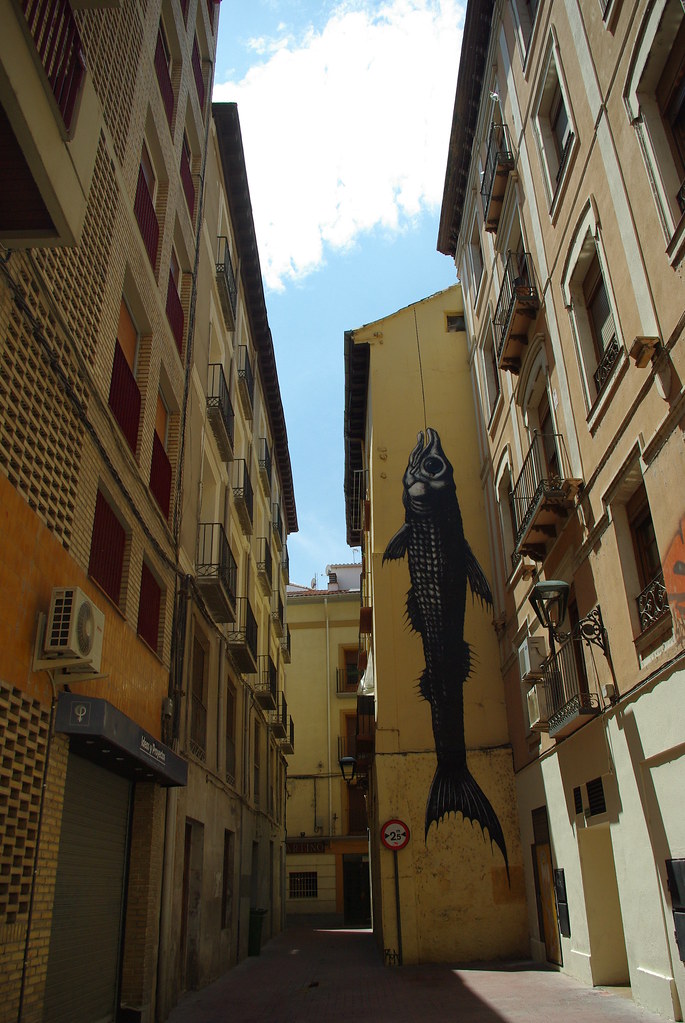
I admire skillful street art, but I rarely feel compelled to photograph it. In early 2010, however, when I came upon the starling mural pictured above, I immediately reached for my camera. At the time, I didn't know anything about the artist; months later, I recognized the muralist's hand in an image I came across online. ROA, a Belgian artist whose animals adorn structures on four continents, is a rising star among street art aficionados.


ROA
2010
London, England

Admittedly, my love of natural history and enthusiasm for animal imagery predispose me to ROA fandom, but the artist's bold, black-and-white technique is distinct and compelling, and most of his mural projects exhibit a clever site-specificity. This attention to location is most often compositional -- for example, the neck of a Limpkin-like bird passes between two windows on a building in Brooklyn, New York, with the bird's body below and the head above -- but ROA's strongest pieces are also conceptually playful: in Ancona, Italy, he painted a disheveled cormorant, a type of water bird, on the side of a large boat; elsewhere, a mole emerges from a pile of bricks; and a desiccated fish is painted on the side of a trailer near California's Salton Sea, a large salt lake in which most fish species are unable to survive. An enthusiastic amateur naturalist, I appreciate the context-appropriate nature of these works.


ROA
2010
Zaragoza, Spain

Unfortunately, ROA doesn't always paint his creatures in or near their natural habitat. I love his giant anteater, pictured trotting along the side of a single-story building in the Mexican state of Guanajuato, but I wonder if the artist realizes that the species is extirpated north of Honduras. Still, because giant anteater fossils have been found in northern Mexico, let's give the artist the benefit of the doubt and interpret this piece as an observation about ecological change. A stylized blue whale rising from a sea of grass outside an abandoned factory in Moscow, Russia, however, is too far from an ocean to be rationalized. Its incongruity is amusing and the image is beautifully crafted, but the piece lacks the impact of ROA's more considerate efforts. No worries. ROA's terrific Virginia opossum in downtown Los Angeles, its prehensile tail wrapped around a stretch of the building's brickwork, more than makes up for the misplaced whale!

While my fondness for natural history makes me an unusually nit-picky viewer, it also means that I'm especially excited by the urban and exurban placement of ROA's rats, squirrels, starlings, herons, raccoons, cormorants, and skunks. These animals are hardy and adaptable, and have proven able to thrive in ecosystems dominated by human habitation. Many people dismiss these creatures as pests, but their presence in our lives is of significant value. As we become an evermore urban species, they are our most immediate connection to the undomesticated, non-human world. In this respect, ROA's murals are portraits of our closest neighbors.


ROA
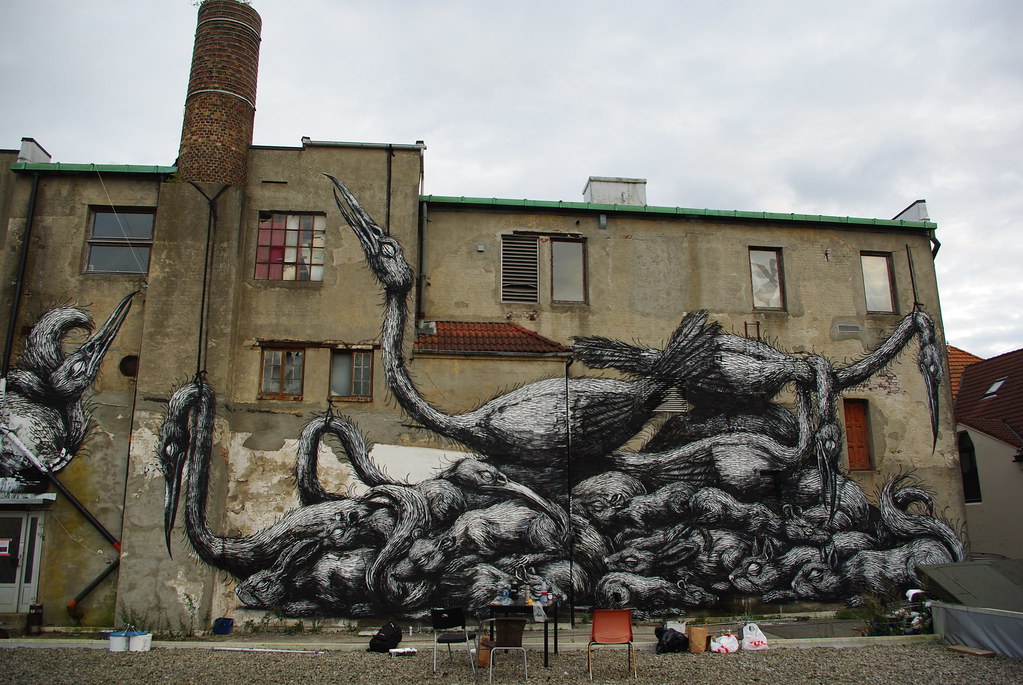
From the "NUART Landmark Series"
2010
Stavanger, Norway

Some of ROA's more elaborate murals depict great piles of dead animals. These call to mind the tables laden with rotting fruit, hunted game, and skulls that appear in many 15th century Northern European vanitas ("emptiness"), memento mori ("remember your mortality"), and ars moriendi ("art of dying") still life paintings. As their names suggest, all of these allegorical works were created as nods to death's inevitability. It seems these themes preoccupy ROA, too. One of his best memento mori works is located in Stavanger, Norway. Lifeless squirrels, rats, rabbits, and herons are heaped at the foot of an old warehouse, with the limp necks of the herons apparently tied to cords on the wall's face (should we call this reverse trompe l'oeil?) In Mexico City, ROA adds a raccoon, armadillo, and skunk.


ROA
2011
Mexico City, Mexico

These murals will seem grotesque and bleak to some viewers, but they aim to inspire by reminding us that life is transitory. The sentiment was expressed well by Steve Jobs during his 2005 Stanford University commencement address, a speech that, in the wake of Jobs' untimely death from cancer, has been making Internet rounds. Jobs said,
"Remembering that I'll be dead soon is the most important tool I've ever encountered to help me make the big choices in life. Because almost everything — all external expectations, all pride, all fear of embarrassment or failure - these things just fall away in the face of death, leaving only what is truly important. Remembering that you are going to die is the best way I know to avoid the trap of thinking you have something to lose."
In many respects, ROA's works are the less refined kin of Walton Ford's paintings. Both artists address mortality and the relationship of humanity to other animal species with humor and finesse, but ROA's pictures are less layered with art historical and natural history references; as a result, they're more accessible and immediately gratifying.

Based on the images he shares on his Flickr photostream, the talented 30-something has at least five murals in San Francisco. Let's hope that he returns to the Bay Area and contributes more of his handiwork to our landscape.

Saturday, September 24, 2011

Acknowledging Exceptionality

"As glass office and condominium towers have proliferated in the last decade, so, too, have calls to make them less deadly to birds. The San Francisco Planning Commission adopted bird-safety standards for new buildings in July, and this month that city’s Board of Supervisors will vote on making it law. Legislation is pending in Washington that would require many federal buildings to incorporate bird-friendly designs. The United States Green Building Council, a nonprofit industry group that encourages the creation of environmentally conscious buildings, will introduce a bird-safety credit this fall as part of its environmental certification process, called LEED."
- "A City of Glass Towers, and a Hazard for Migratory Birds," New York Times, September 14, 2011
I enjoyed reading "A City of Glass Towers, and a Hazard for Migratory Birds," a recent New York Times article about bird-building collision mortality. Lisa Foderaro's piece is a hopeful account of how a confluence of activism, technology, and regulation can improve the lot of animals, especially in cases where a particular species has been adversely affected by human development.

The comments that follow the article, however, are predominated by doom-and-gloom attitudes. A representative survey follows:
All that matters are people and every little whim. We're a doomed species.
-Karma Every Moment, NY, NY

The people who tell us that evolution and climate change are just unproved theories have no idea how life formed this planet since its inception and no understanding whatsoever of the role of extinction in maintaining the climate within habitable bounds when any one plant or animal breaks the equilibrium. They convinced me long ago that there is no future for my own children.
-Steve Bolger, NY, NY

Yet another example of the consequences of man's selfish and destructive behavior. So sad.
-agetibi, Carrboro, NC
No wonder over 50% of Americans polled by The Nature Conservancy caricatured environmentalists as preachy reactionaries. In the words of the Conservancy's Chief Scientist, Peter Kareiva, most people see members of the environmental movement as "misanthropic, anti-technology, anti-growth, dogmatic, purist, zealous, exclusive pastoralists." Unsurprisingly, this negative stereotype has led to a dwindling of the movement's ranks.

I consider myself an environmentalist, but I distinguish between preservation and conservation (placing myself in the latter camp) and, more critically, I believe that environmentalism needs to embrace a "can do" attitude. If the majority of my fellow Times readers identify as environmentalists, their comments suggest that they're a well-intentioned pox. Wholesale condemnation of our species is as wrongheaded and malignant as exclusive glorification. In order to decry humanity as a "selfish and destructive" brute, one must stubbornly overlook all the evidence to the contrary. I wrote about such oversight in an essay included in the catalog for "A Live Animal," a group show that Selene Foster and I co-curated at Root Division.
"Although 'deep ecologists' and animal rights activists bemoan conservation approaches that prioritize human interests, the fact remains that human beings are exceptional animals. Skeptics and naysayers need only consider our species' biological and imaginative success to find evidence of our unprecedented faculty. But of all our remarkable features and feats, among the most notable examples of humanity's anomalous nature is our interest in and empathy for other species. Although there is growing scientific agreement that some other species possess self-awareness and even a capacity for empathy -- whales, dolphins, elephants, and our ape relatives are especially interesting in this regard -- humans are the only animal striving to learn about and better the lot of other creatures and environments. It's true that we often prioritize short-term, anthropocentric interests and it's also clear that reckless human activity has contributed to dramatic climate change and the ongoing Holocene extinction (our geological epoch's staggering loss of biodiversity), but conservation efforts and legislation, as well as our burgeoning interest in sustainability, speak to another, more hopeful human impulse; we possess an innate ability to see ourselves in other animals and, in turn, to recognize our capability as their stewards and representatives."
In short, we're not all bad. If you believe that we are, then you're guilty of sapping our species' potential. Christopher Cokinos is excellent on this point. I've quoted his terrific "Consolations of Extinction" essay before; I'll do it again.
"Too much grief for the world means less energy to help it along. [When] you find yourself free of the poisons that too much angst can cultivate, then something marvelous happens. You can sense how very old the planet is, how very old life and death are, and you can keep going on, you can keep doing the work you do in this universe, feeling despair when you feel despair, feeling - amazing - joy when you feel joy."

Wednesday, December 29, 2010

Relative Birthday Abundance


Tundra (or Whistler) swans; Heron Hope; Locustville, VA; December 2010

As an enthusiastic amateur naturalist living in New York City, I grew fond of the hearty, adaptive species that populated the boroughs' streets, parks, and waterfronts: pigeons and gulls, rats and red-tailed hawks, starlings and squirrels. When I felt out of step with my urban friends and neighbors, as I occasionally did, I found that watching the animals helped. Chittering around the base of a corner garbage can, the sparrows and starlings chastised me for moping. The herring gull's shrill shout over the East River exhorted me to shake off my self-conscious alienation. All of these species were part of my urban wildlife support network. Watching them reminded me to get on with the business of grateful L-I-V-I-N', no matter where I might be. Now that I live in San Francisco, a town with greater biodiversity than NYC, I'm happy to have Steller's jays, Brewer's blackbirds, and ravens keeping me company, too.

Today, however, my girlfriend and I are visiting my parents on the Eastern Shore of Virginia. Dumped on by the latest "snowpocalypse," we've been locked in for most of our visit. Not that I mind. Yesterday morning, I trudged through the snow drifts around my home ground, eyes squinted in the dazzling winter light. In the space of an hour, I saw thousands of snow geese rise noisily from a partially exposed barley field; turkey vultures sweep across the sky, scenting for an unfortunate victim of the biting weather; a woodcock flush from a hedge; coyote tracks that skirted a small cemetery; mouse tracks that emerged from under a snow-covered plow and lightly skipped across the snowfall's surface to a patch of open grass; a yellow-rumped warbler and a Carolina wren vying for position atop a perch; two tundra (or whistling) swans flying low overhead; Canada geese and green-winged teal gathered in the open water of the estuary; a cottontail peer from a tangle of grasses. It occurred to me, as I contemplated such abundance and diversity, that my urban wildlife support network, whatever its personal value, is but a shadow of what I witnessed this December morning.


Sunset; Heron Hope; Locustville, VA; December 2010

Last year, at this time, I wrote, "32 years on this Earth, and still I feel like I am opening my eyes for the first time." Now 33, that statement is no less true. Given my stubborn optimism, I presume that it will be true at 43, 53, or 83 (should I survive so long). Still, I wish that I could open my eyes to greater species diversity in the cities that I call home. We humans are an increasingly urban species, and we must take care not to forget about the world's collapsing biodiversity. It isn't just the country folks that benefit from it; we all do, whether we appreciate that fact or not.

All the same, I'm looking forward to hearing the belated birthday croaks from the ravens above the Inner Sunset.

Happy 2011, friends. May it be a rich, sweet, and happy year!


Snow Geese; Heron Hope; Locustville, VA; December 2010

Photo credit: Hungry Hyaena, 2010

Wednesday, March 31, 2010

Monday, December 21, 2009

Or A Falcon


Peregrine falcon (Falco peregrinus); New York City

"I am no more lonely than a single mullein or dandelion in a pasture, or a bean leaf, or sorrel, or a horse-fly, or a bumblebee. I am no more lonely than the Mill Brook, or a weathercock, or the north star, or the south wind, or an April shower, or a January thaw, or the first spider in a new house."

- Henry David Thoreau
Image credit: ripped from Pete.Mac's Flickr photostream

Sunday, November 29, 2009

Picturing Alternative Futures


James Griffioen
From the "Feral Houses" series

Last week, Flavorpill's Flavorwire newsletter introduced me to James Griffioen's photography. "Feral Houses," the series featured by Flavorpill, focuses on abandoned houses in Detroit, Michigan. Griffioen writes,
"For a few beautiful months every summer, some of the tens of thousands of abandoned houses become feral in every sense: they disappear behind ivy or the untended shrubs and trees planted generations ago to decorate their yards. As the city of Detroit disappears, nature is flourishing."
Considered as a whole, the "Feral Houses" series is a record of our complicated relationship with the land upon which we live and depend, as well as of our ailing community roots.


James Griffioen
From the "Feral Houses" series

Detroit's Rust Belt era history is generally bleak. Today, much of the city is classified as a food desert. Sitting down for a hearty meal with friends and family this Thanksgiving evening, I recalled Rebecca Solnit's inspiring Harper's Magazine article, "Detroit Arcadia" (July 2007). Solnit writes,
"Detroit is a cautionary tale about one-industry towns: it shrank the way the old boomtowns of the gold and silver rushes did, as though it had been mining automobiles and the veins ran dry, but most of those mining towns were meant to be ephemeral. People thought Detroit would go on forever. [...] I took many pictures on my visits to Detroit, but back home they just looked like snapshots of abandoned Nebraska farmhouses or small towns farther west on the Great Plains. Sometimes a burned-out house would stand next to a carefully tended twin, a monument to random fate; sometimes the rectilinear nature of city planning was barely perceptible, just the slightest traces of a grid fading into grassy fields accented with the occasional fire hydrant. One day after a brief thunderstorm, when the rain had cleared away and chunky white clouds dotted the sky, I wandered into a neighborhood, or rather a former neighborhood, of at least a dozen square blocks where trees of heaven waved their branches in the balmy air. Approximately one tattered charred house still stood per block. I could hear the buzzing of crickets or cicadas, and I felt as if I had traveled a thousand years into the future."
Yet the central focus of Solnit's essay are the heroic, local reclamations of Detroit's abandoned lots for community gardens or small-scale farming enterprises.
"I also saw the lush three-acre Earth Works Garden, launched by Capuchin monks in 1999 and now growing organic produce for a local soup kitchen. I saw a 4-H garden in a fairly ravaged east-side neighborhood, and amid the utter abandonment of the west side, I saw the handsome tiled buildings of the Catherine Ferguson Academy for Young Women, a school for teenage mothers that opens on to a working farm, complete with apple orchard, horses, ducks, long rows of cauliflower and broccoli, and a red barn the girls built themselves. I met Ashley Atkinson, the young project manager for The Greening of Detroit, and heard about the hundred community gardens they support, and the thousands more food gardens that are not part of any network. The food they produce, Atkinson told me, provides food security for many Detroiters. 'Urban farming, dollar for dollar, is the most effective change agent you can ever have in a community,' she said. Everywhere I went, I saw the rich soil of Detroit and the hard work of the gardeners bringing forth an abundant harvest any organic farmer would envy."
Similar projects are gaining momentum in American cities that aren't suffering as acutely as Detroit. Community garden and farmer's market movements are thriving in many urban centers, and urbanite hunters are no longer unheard of. Last week, the New York Times reported on the growing number of locavores taking up hunting, but, unlike Charlottesville, Virginia's "Deer Hunting for Locavores" class and San Francisco's Bull Moose Hunting Society, ventures made possible by relative privilege and foresight, Detroit's repurposing and enterprise is born of pressing need.


James Griffioen
From the "Feral Houses" series

Contemplating Griffioen's handsome photographs, it's impossible not to think of Detroit's economic and health struggles. Still, his subjects, the "feral houses" themselves, don't strike this Eastern Shore boy as that unusual. All regions marked by poverty offer up monuments to the ceaseless action of Nature and time. Recent studies show that Accomack, the Virginia county that I was raised in and that my parents call home, is "the fattest" county in the state. It is also one of the poorest. Abandoned houses and overgrown automobiles figure as prominently in my mental portrait of the Shore as do salt marshes and the rich smell of freshly turned earth.

Unlike the citizens of Detroit's urban environment, Eastern Shore folks are not strangers to hunting, fishing, or farming. One might therefore assume that food desertification and obesity are unlikely. Unfortunately, access to fresh, healthy foods doesn't mean that locals won't instead opt for fast food! Furthermore, community ties might be even weaker on the Shore than they are in Detroit, eroded in part by an epidemic reliance on the automobile and big-box stores.

What does the future portend for Detroit and Virginia's Eastern Shore? Taking the long view, I'm optimistic. A decade hence, Detroit might well provide a more sustainable model for beleaguered urban communities. The Eastern Shore, however, is a different type of community, and one still on the decline; recovery will come more slowly.


Don Amadeo
House on White's Neck Road; Parksley, Virginia

Like Griffioen's pictures, Don Amadeo's photographs of the Eastern Shore remind us of the slow creep of geologic time, the long long view. Human communities may rise and fall and rise again, but all eventually succumb. So, too, with species. There is an ambivalent beauty in overgrown ruins; they celebrate the wonder of life's eternal striving even as they proclaim mortality.


Don Amadeo
Ole Rusty; Parksley, Virginia

Photo credit: "Feral Houses" photographs, courtesy James Griffioen; ShoreRebel photographs, courtesy Don Amadeo

Thursday, October 15, 2009

Autumn Birds and Birding


View of Manhattan skyline from Central Park, Manhattan

On my way to the gym Tuesday morning, on the corner of 64th Street and 1st Avenue, I discovered a dead American goldfinch (Carduelis tristis). Feathers askew, a pink wound was visible on the head of the small, yellow bird. The injury was likely sustained when the goldfinch crashed into a window of one of the nearby apartment towers. I said a quiet goodbye to the bird, and continued on my way. An hour-and-a-half later, while running a work errand, I came upon a dead red-bellied woodpecker (Melanerpes carolinus), crumpled on the corner of 68th Street and York Avenue. People gave the bird's body little attention.

It's the time of year when our avian brethren fall from the sky above Manhattan and land, sometimes dead, sometimes injured, sometimes merely confused, on the city's sidewalks. It is the time of autumn migration and restlessness. Neither the goldfinch nor the woodpecker are properly migratory species, but both birds will sometimes fly a short distance south when the temperature drops.

I can't say whether or not the individuals that I found on Tuesday morning were on the move when they met their respective ends. Still, their fate is a common one during New York City's autumn. As the NYC Audubon Society's Project Safe Flight mission statement explains,
"Located at the nexus of hundreds of bird species’ migratory routes, New York City’s tall buildings and reflective glass pose a serious threat to over 100 species of migratory birds, some of which are experiencing long-term population declines."
Resident species are also vulnerable, of course. Since Project Safe Flight's inception, in 1997, "over 4,000 dead and injured birds have been collected and documented in [Audubon's] database." That number is a fraction of the total bird deaths that Manhattan's buildings cause.

What can each of us do to help curb the buildings' toll? The easiest action involves turning off your office or apartment lights at night. Many office towers leave the lights on, needlessly wasting electricity and killing birds. As Project Safe Flight’s Lights Out New York initiative explains,
"Lights can distract birds from their migration path and cause them to collide with buildings during bad weather. Turning off the lights and drawing the blinds can help save thousands of birds from over 100 different species every year."
Let's help our feathered friends fly safely, folks.

+++++


Watching a Winter Wren on the wall of Belevedere Castle; Central Park, Manhattan

I rose earlier than usual on Wednesday morning, so that I could be at Central Park's Loeb Boathouse by 7:30 AM, where I met five other Nature Conservancy bird watchers. The six of us spent a very pleasant two and a quarter hours birding.

I love being outdoors in the early morning, and I greatly enjoyed observing even the familiar species as they foraged, fought, and flitted about. House finches (Carpodacus mexicanus) and European starlings (Sturnus vulgaris) are species taken for granted by most birders, but, illuminated by the morning sunlight, each is a marvel.

I was especially excited to see several Eastern phoebes, a relatively common species that, courtesy of Edward Hoagland, I associate with my beloved notion of reconstitution, and a winter wren (Troglodytes troglodytes), a dark, small relative of the more familiar Carolina wren (Thryothorus ludovicianus), a bird for which I was almost named. (Wren Reiger would have been a hard sell on the grade school playground, and I'm thankful that my parents elected to shelve the name.)


Belvedere Castle; Central Park, Manhattan

Photo credits: All images, Hungry Hyaena, 2009

Friday, July 10, 2009

Paradise: Here and Now (and To Come)


Steinbrener/Dempf
"Trouble in Paradise"

Alan Weisman's The World Without Us is an imaginative and engaging consideration of what a "post-human" Earth might look like. The popular success of Weisman's book suggests that a great many readers are willing to entertain an End Times quite unlike that forecast by eschatological messianism.

Still, in the United States, a significant percentage of the populace (maybe even a slim majority!) insist that dinosaurs coexisted with early man and that Judgment Day will involve supernatural intervention. For the rest of us, however, Weisman's predictions are more tenable than messianic adjudication and, because we're living through what scientists now dub the Sixth Great Extinction, his vision of mass extinction is also more pertinent.


Steinbrener/Dempf
"Trouble in Paradise"

I thought of The World Without Us when viewing photographic documentation of Steinbrener/Dempf's intervention at Vienna's Schonbrunn Zoo, an institution celebrated as "the oldest zoo in the world." Not all of the installation images impress me, but a few are coolly beautiful. The best of them serve as both a celebration of life's ambivalent persistence and a critique of our romantic notions of wilderness.


Steinbrener/Dempf
"Trouble in Paradise"

Note: Thanks to RSA Arts & Ecology blog for the heads up

Sunday, May 17, 2009

A Hermetically Sealed Worldview?


Alton L. Larsen
"Lewis and Clark"
Oil on canvas


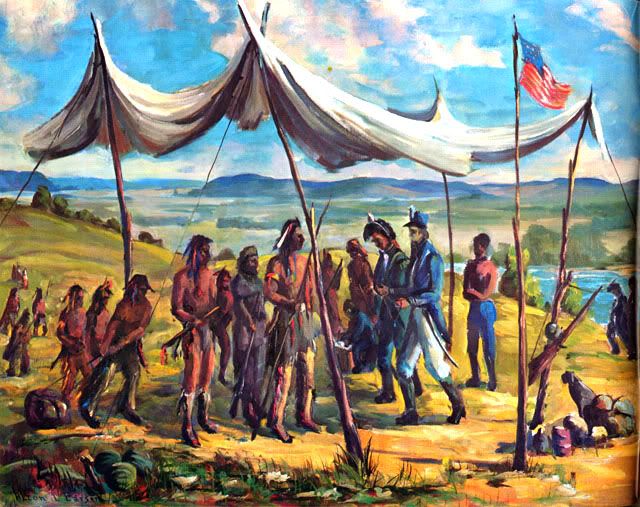
I'm thrilled to announce that I've been accepted to the Kimmel Harding Nelson Center Artist Residency in Nebraska City, Nebraska. During the two week, September term, I plan to explore Nebraska City and the surrounding land with an eye toward the region's natural history, focusing particularly on the Lewis and Clark Expedition and the legacy of 19th century westward expansion. Most of my time will be spent outdoors, biking and walking around the town's trails, parks and historical sites. In the evenings, I'll use the provided studio space to conduct research, work on painting studies and drawings, and write essays relevant to the residency. (The essays will be posted here.)

I'm very much looking forward to my time in Nebraska, just as I'm eagerly anticipating an upcoming week of birding, herping and bumming about in Florida with two friends. My usually vigorous city disposition has withered in recent weeks, and I long for time in the woods, marshes or mountains. Saturday afternoon, taking a break from helping my girlfriend move some of her belongings, I sat on a stoop, attuned my breathing and appreciated the pompous sidewalk display of a pigeon courtier. A few minutes later, I trembled with a renewed sense of well-being as a curiously bronze House sparrow contemplated me (contemplating it).

These simple encounters with urban wildlife are a joy. I'm grateful for them. This week, however, the sparrows, pigeons, squirrels, starlings and gulls have only whet my appetite for time away from urban and suburban environs.

My sense of urban exile was exacerbated this afternoon, when I listened to a podcast of "The Thomas Jefferson Hour." Historian and Jefferson impersonator Clay Jenkinson described contemporary man's changing relationship to Nature.
"I've been flying over North Dakota lately and North Dakota is just one tiny little place at the top of the continent, but [...] between the Mississippi River and the west coast there is still a gigantic amount of unspoiled land. [...] It's still a pretty light industrial footprint. [...] Of course, you can see human presence there: power lines, contrails from airplanes, mines, vanity houses, ridgeline developments. [...] But [...] there is still a large amount of America [...] in which there are literally hundreds of national and state parks and national monuments and national forests and wildlife refuges which are permanently protected against gross economic, extractive development. [...] We have an enormous amount of Nature which has been designated, officially, by the will of the American people to be off-limits to certain types of activities. [...] I feel that that moment - which begins really with Yellowstone in 1872, but got it's big push from Theodore Roosevelt - that moment kind of culminated around 1975 or 1980 and, since then, there's been a kind of pulling back of national commitment to these issues.

And now there's a generation of people who are growing up with no particular interest in this. They're detached from it. They're a little bored with Nature. They don't want to go camping; they don't even want to go hiking. They only want to be on their iPod and their [...] computer, the Internet, and Facebook, and Twitter. [...] That's their mediation. That's how they see the world, [...] and they're bored with sitting around that campfire. [...] So as this happens, as we move into [...] this incredibly electronically mediated, post-literate, post-natural world, it's frightening to people that still believe that that was the glory of America.

I'm one of them! I believe that the national park system is America's greatest contribution to the world, or at least it's one of the top handful of contributions we've made. [...] The point I'm trying to make is, if the population [of the United States] is 330 million, there are about 300 million who don't care one iota for this, and they're very, very happy to eat their chicken in a hermetically sealed container and not know the first thing about where their lights come from and not care how the natural world works."
I wish that I could claim urbane sophistication, thereby dismissing Jenkinson's melancholy perspective as misguided nostalgia. But I can not. Even though I proclaim a long view optimism (and therefore acknowledge the absurdity of wishing for what once was), I feel that the ignorance of most First World citizens of the natural world is unpardonable. It is an insult not only to my naturalist's sensibility, but also to the philosophical, biological and cultural ground on which thoughtful humans stand (and build).

Despite my fondness for cosmopolitan politics and culture, in at least this respect, I sympathize with Thomas Jefferson's belief that cities are "pestilential to the morals, the health and the liberties of man." By further insulating us from our animal antecedence and the brute realities of Nature, cities slowly erode our practical call to stewardship.

Shortly after Jenkinson's podcast ended, a familiar voice interrupted my painting. I wasn't sure that I'd heard rightly over my headphones, so I peered out of the studio window for confirmation. Sure enough, a mourning dove was perched on the fire escape above me. Periodically, it uttered a nesting call, an abridged version of the plaintive call that many Americans are familiar with (whether or not they can identify the species responsible). I could see no mate or nest, but I'm delighted to learn of this new neighbor.

Unfortunately, this week's creeping cynicism makes me doubt if my human neighbors notice the birds. I hope that this brooding will soon pass. Pessimism does no one good.

Photo credit: image ripped from Blair Congregational Church United Church of Christ website

Wednesday, April 22, 2009

Earth Day


Studebaker; Eastern Shore of Virginia


In time, all things - pants, refrigerators, Studebakers - succumb. The extinction of human civilization is likewise inevitable.

But one of the most wondrous faculties of the human animal is its capacity for heightened compassion. Working as a conscientious society, we strive to conserve the ecology we appreciate not simply because we have the means to do so, but because we recognize that doing so is just.

Photo credit: ShoreRebel

Thursday, October 30, 2008

A morning in Athens Square Park


I claim a slat bench in the northwest corner of Athens Square Park, place binoculars in my lap, and enjoy a sip of coffee, purchased at a nearby 7-Eleven. The Japanese-owned chain convenience store was introduced to New York City just three years ago and, despite its suburban associations, has quickly spread throughout Manhattan and the boroughs. The neighborhood bodegas must learn to compete, or they will soon go the way of the dodo.

Another "invasive" colonizes Athens Park. House sparrows (Passer domesticus) chitter tirelessly in the lower branches of the park's London Planetrees (Platanus x acerifolia). Like most Americans, these birds trace their origins to the Old World. The species was introduced to the United States from Britain in the mid-19th century. Also called English sparrows, the adaptable and hearty birds are now abundant over most of the globe, particularly in urban locales.

Thursday, May 08, 2008

Tagged, dammit!


Red-tailed hawk (Buteo jamaicensis)


I'm not fond of blog tags but, when tagged by a friend, I usually respond.

Tracey St. Peter, artist and The Hundred Dresses Project blogger, hit me up for this random game.

The Rules are simple:
1. pick up the nearest book
2. turn to page 123.
3. Find the fifth sentence.
4. Post the next three sentences
5. Tag five people and acknowledge who tagged you.

I received her email notification while working at the day gig. The picture window in my office looks east from Manhattan, over the East River, to Roosevelt Island and Queens. On slow days, I sneak in some casual birdwatching and, in case an unusual or unfamiliar species should make an appearance, I keep a copy of The Sibley Guide to Birds handy. Page 123 is within the Buteos section, and details Red-tailed hawk (Buteo jamaicensis) variants.

"[The Eastern red-tailed hawk is] slightly shorter-winged than Western; white throat, well-defined belly-band and whitish breast. Populations in Florida and eastern Canada show characteristics of Western. [Krider's red-tailed hawk is a] scarce, pale Prairie variant [that] is always outnumbered by normal light-morph birds."

Cheers, Tracey...but I'm not game enough to pass this one on.

Photo credit: image ripped from Zevotron's photostream

Tuesday, April 29, 2008

A Trip West

PART I : SEATTLE, THE CITY PROPER


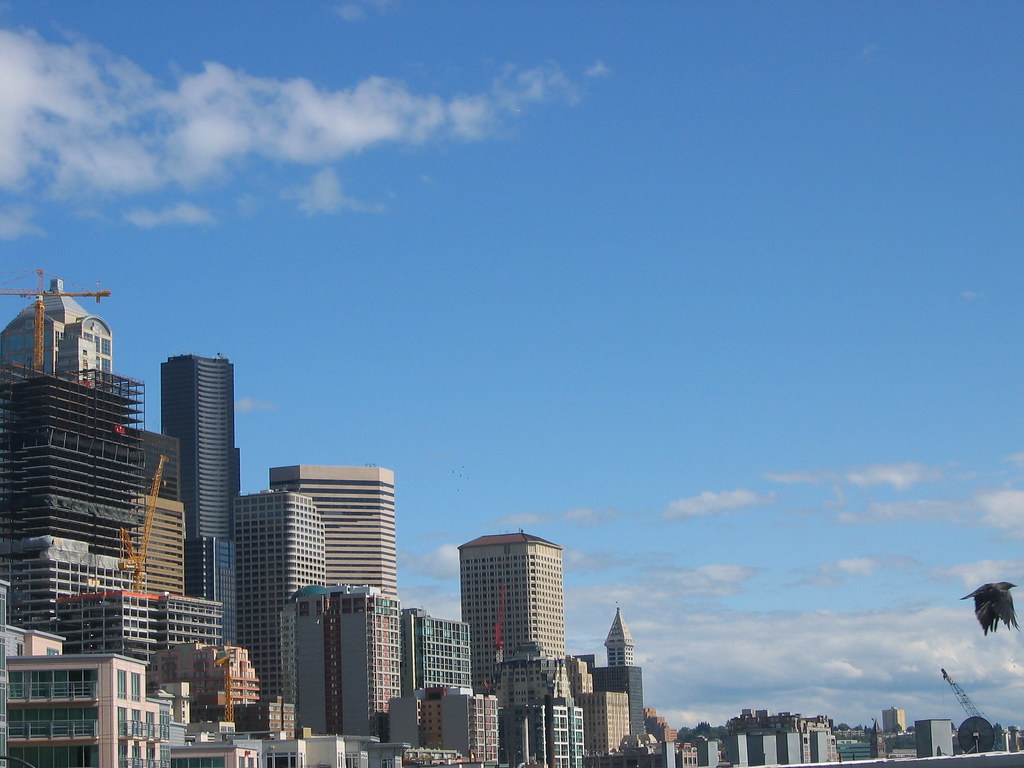
Growing downtown Seattle, Washington (with American crow)


The first thing I noticed about Seattle was the crows. The region has not yet been ravaged by West Nile virus, and the American crow (Corvus brachyrhynchos) population remains robust. The birds flapped heavily over Interstate 5 as Michael, Jocelyn and I headed north from Sea-Tac Airport. A lover of all things Corvidae, I interpreted the birds' greeting as a good omen.


Approaching Seattle on Interstate 5


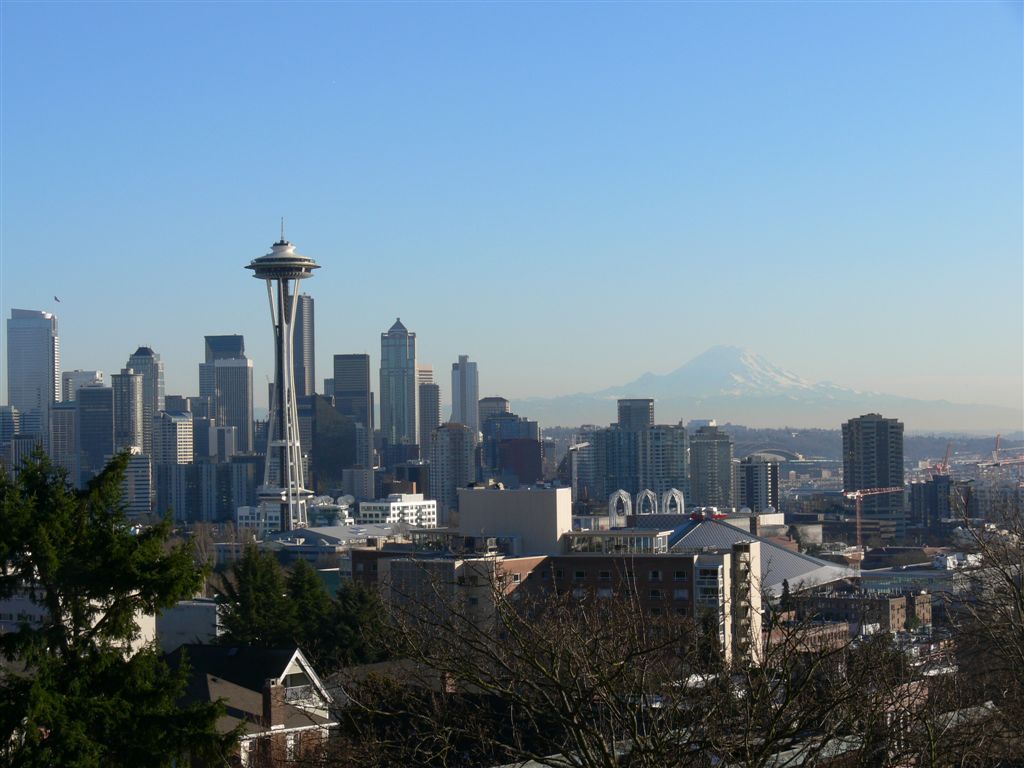
The red gods also granted me exceptional weather. The morning that I arrived in Washington, the low ceiling characteristic of Seattle's seven-month wet season dissipated. Even Mount Ranier, 54 miles southeast of the city, was visible from downtown. Clear skies, sunshine and mild temperatures are not uncommon during the summer months, but they are rare in early April, and the balmy conditions were the subject of much happy conversation among Seattlites.


View of downtown Seattle and Mt. Ranier


Another oft-raised topic was the supposedly passive-aggressive disposition of the Emerald City's residents. I don't doubt that it exists - few stereotypes are baseless - but either I happened upon a rare breed of Seattlite or the rumors of poor behavior are greatly exaggerated.

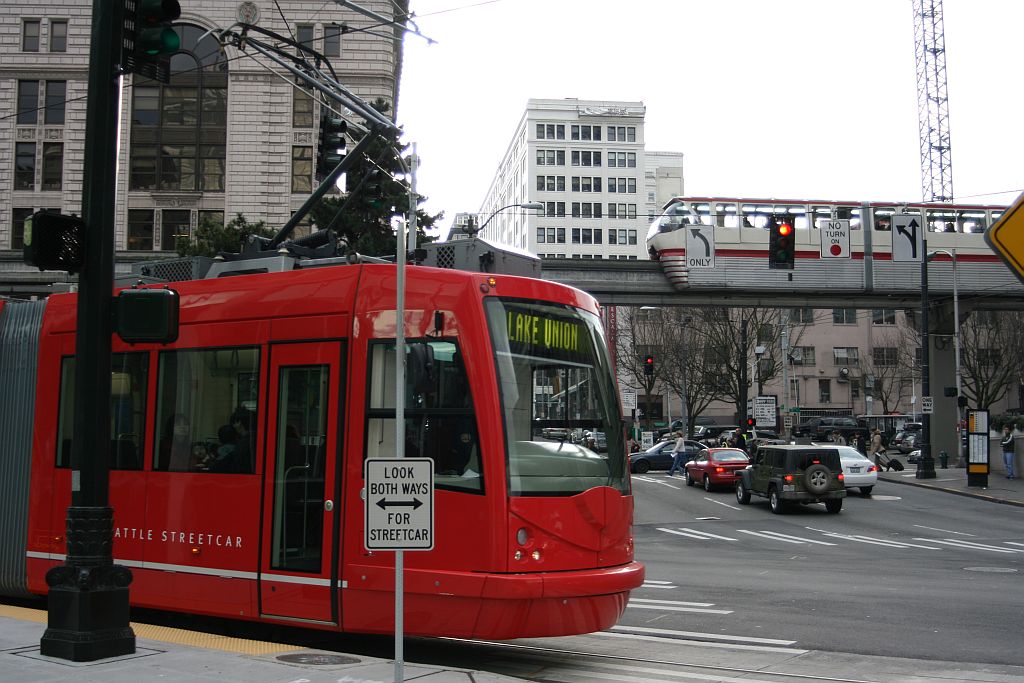
In fact, I found very little about Seattle unfavorable. The only notable drawback is a relative one; Metro Transit, Seattle's public transportation network, leaves much to be desired. (I've been spoiled by New York's first-rate transit options.) Seattle's bus routes are comprehensive enough, so the principal grievance regarding Metro Transit service is one of infrequency. Bus stops are visited at 30-minute intervals, on average, and a missed bus can mean a missed appointment. On the other hand, it's hard not to love the city's proposed streetcar system, especially since the completed, functioning section is called the South Lake Union Trolley, or S.L.U.T.. ("Ride the SLUT" t-shirts are a popular novelty item.)


S.L.U.T. line in foreground, with (little used) Seattle monorail behind


Generally, Seattle strikes me as a terrific place to live, and it now ranks at the top of my post-NYC shortlist. Not surprisingly, the viability of the local art community is an important criterion for any city on that ballot. Though I've heard some negative things Seattle's art scene - it isn't New York or Los Angeles, after all - I was generally impressed by what I saw. Gallery hopping during the First Thursday Art Walk, I visited several decent shows but, more importantly, observed ample (and good-natured) enthusiasm, a variety of work and a number of familiar names. The galleries that Michael, Jocelyn and I visited were all within easy walking distance of one another, and several were housed in Seattle's more interesting (because older) buildings, located in Pioneer Square. (The dominant architectural modes in the neighborhood are Victorian and Romanesque Revival, a result of the latter's popularity in the late 19th-century; the city was rebuilt following 1889's Great Seattle Fire.)


Pioneer Square, Seattle


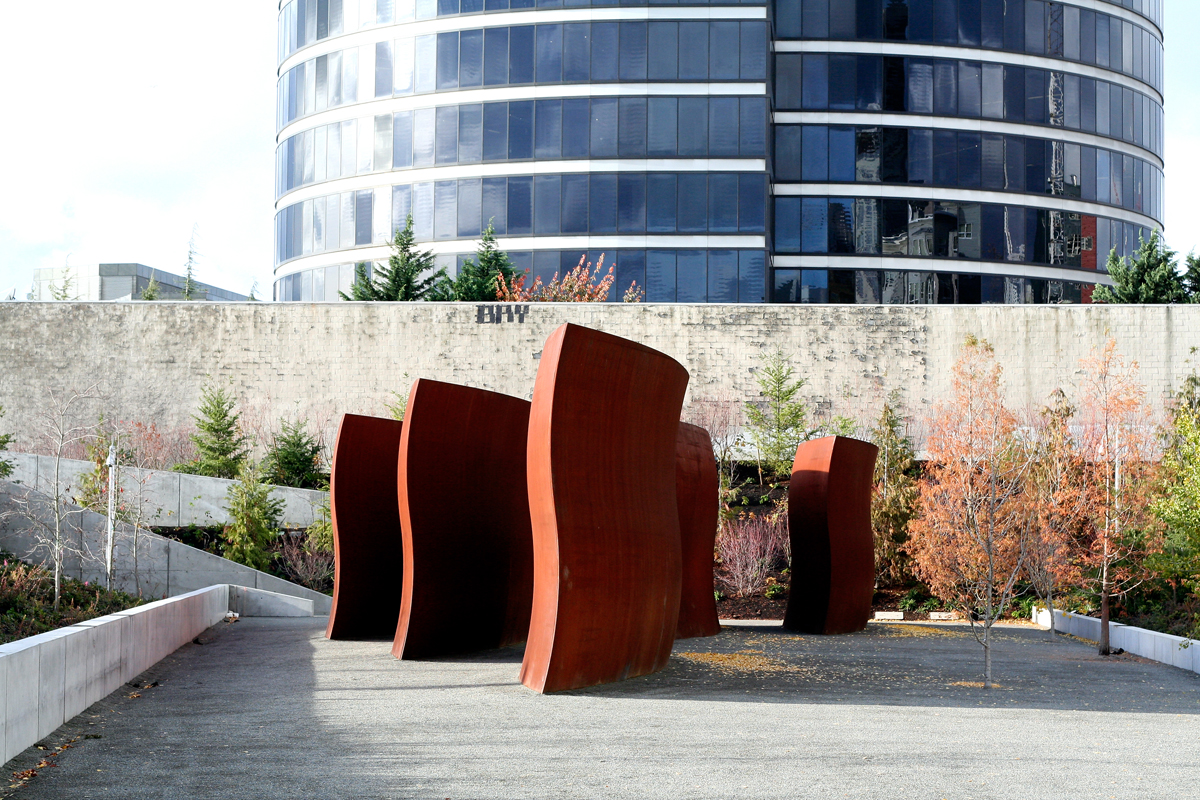
The city itself, like the Sea-Tac Airport, suffers no shortage of public art. I saw more such work during my three days in Seattle proper than I've noticed in almost a decade of NYC living. Mind you, I'm not usually excited by public sculpture. Most of it is insipid, but the "right" setting allows some works to thrive. It was a treat to see Richard Serra's "Wake" at the Olympic Sculpture Park, with the Space Needle rising to the east, Mount Ranier to the south, and Puget Sound behind me, to the west. (By contrast, Claes Oldenburg's "Typewriter Eraser, Scale X" looked as ridiculous in this context as his works do anywhere else.)


Serra's "Wake," at the Olympic Sculpture Park


(An art blogging aside: I finally met artist Amy Ross, after having corresponded with her for months and having a 3-person show, "Animus Botanica" - Amy, Boyce Cummings and myself - slated for this coming September, at Denise Bibro Gallery. She was participating in a 2-person show, "Animal Spell," with Justin Gibbens, at Punch Gallery. I'm happy to report that her collages and paintings looked fantastic.)

Photo credits: Seattle crow, PDX503; Interstate 5, Hungry Hyaena; Skyline with Ranier, Bill Rose; S.L.U.T., Brian Bundridge; Pioneer Square, Vincos; "Wake," Cascadeguy

(More pictures of my trip can be found here. Also, although none of the photographer's work was included in this post, Seattle Daily Photo is an excellent resource for terrific photos of the city. Finally, a thank you to the photographers who I've ripped from for this post. More posts about the trip will follow.)

Tuesday, October 09, 2007

"Natural Selections" Interview

When I'm not wearing my artist/writer hat, I'm earning steady income and health insurance working as a glorified secretary in a neuroscience laboratory at the Rockefeller University. This month, one of the Rockefeller publications, "Natural Selections," interviewed me for the "New York State of Mind" feature.

The short answers don't delve deeply into art or ecology, but enough so that I'm posting a link to it here.

Tuesday, September 11, 2007

The little things


Unidentified wolf spider species on stripe painting, Chelsea, NYC, 2007


Photo credit: Hungry Hyaena, 2007

Thursday, July 12, 2007

Gallery Report: June 27, 2007

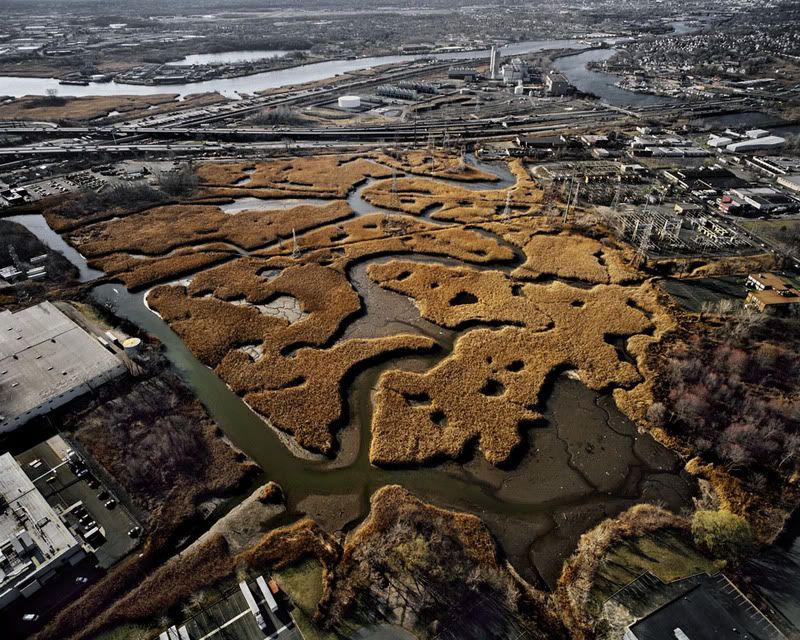
Part Three : The Absurd Whole


Michael Light
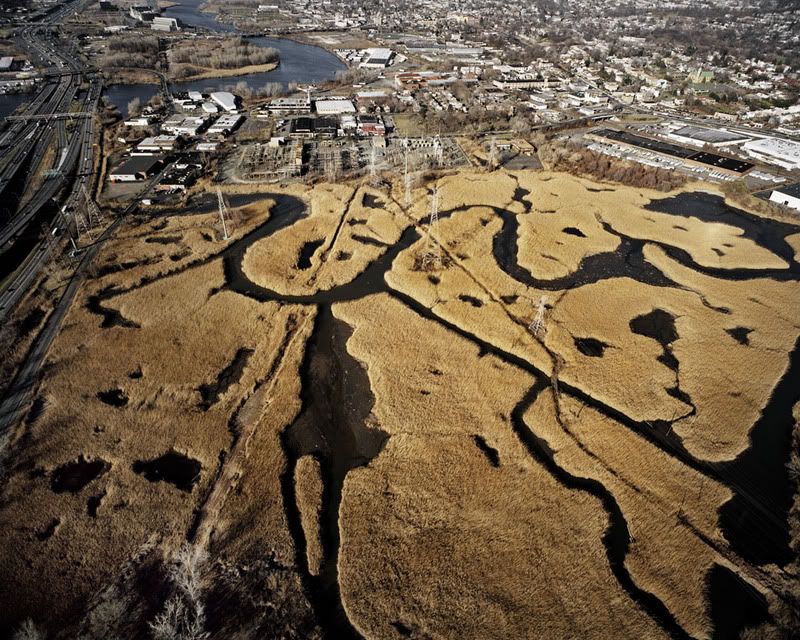
"Bellman's Creek Marsh in the Meadowlands, I-95 and Hackensack River Beyond, NJ, 2007"
2007
Pigment print on aluminum
24 x 30 inches (or 40 x 50 inches)


“The projects of human technology exist wholly within nature, evolving, like anthills, from a set of circumstances that they can neither invent nor transcend.”
-Lewis Lapham, Harper's Magazine (November 2000)

When an airline representative asks if I would prefer an aisle or window seat, I opt for the view. Cramped legs and bathroom trip niceties are a small price to pay. Peering through the reinforced panes as a young boy, I was afforded the perspective required to imaginatively connect a black-and-white aerial survey of my parents’ farm to my ground-level experience of those woods, fields, and marshes. I could at last identify the contours of a pond or stand of trees that I had explored on foot many times. This recognized correspondence thrilled me. A decade on, as a teenage pilot-in-training, I was too enamored of the panorama to mind the specifics of stall recovery procedure, and today all I really recall of the hours logged at the yoke is the exuberant joy I felt looking down on the thin peninsula of farmland separating the Chesapeake Bay from the Atlantic Ocean.

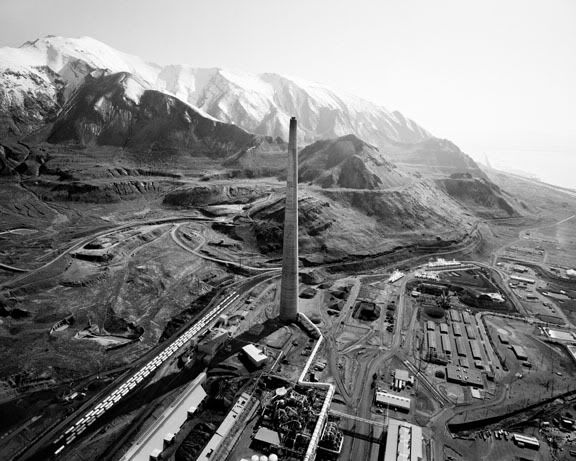
From above, we comprehend land as a cartographer; our mundane conceptions of scale and place are expanded. Michael Light's handsome, handmade Bookworks, on display at Hosfelt Gallery, celebrate this perspectival shift. The artist's books are comprised of aerial photographs shot "with a large-format camera from small, self-piloted aircraft and rented helicopters," each book a document of regional topography, settlement or industrialization. Many photographers aim to "[investigate] the complex landscapes of America," but the aerial aspect of Light's approach elevates his pictures; the images do provide an archaeological record of our culture's contemporary landscape, but the perspective - looking down or across the Earth's flesh from on high - nods to universal and geologic time.


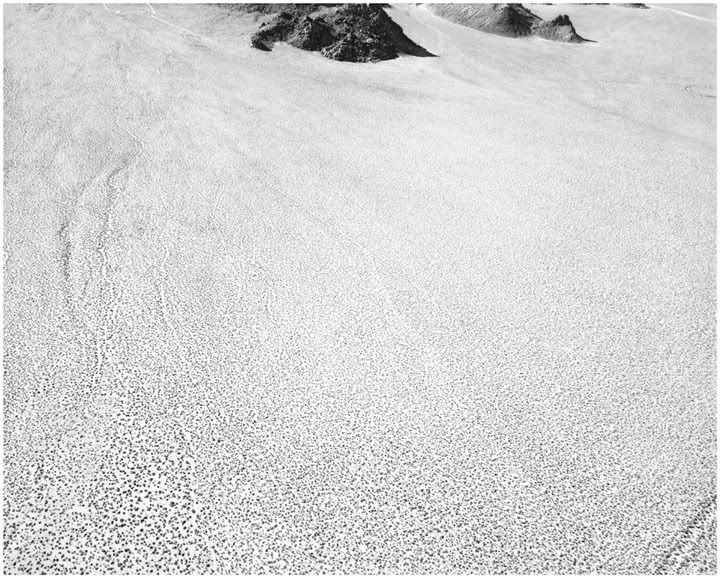
Michael Light
"Deep Springs Valley at 500', 1600 hours, Big Pine, CA
2000
Pigment print on aluminum
24 x 30 inches (or 40 x 50 inches)


The artist states that he is seeking "certain sublimities and timelessnesses and continuities amidst what might commonly otherwise be considered 'wastescapes' or 'nonscapes'" and this search has resulted in the six photographic surveys on display at Hosfelt: "New York Harbor, 03.29.07"; "Rancho San Pedro, 04.28.06"; "Los Angeles, 02.12.04"; "Bingham Mine/Garfield Stack, 04.21.06"; "Some Dry Space, 2003"; "Los Angeles, 07.27.05". His bookworks encourage us to question conventional notions of natural and artificial, and also to consider these environments with respect to the full sweep of time and scale.

"New York Harbor, 03.29.07" is of particular interest to me, and not only because I currently call New York City home. Figuring prominently in this collection is the vast marsh of phragmites, roadways, spartina, telephone poles, landfills, radio towers, and cargo trailers known as the Meadowlands. This is complex terrain, literally and metaphorically. The Meadowlands possess a torn grandeur unrivaled even by the "virgin Nature" we revere in literature and film, on postcards and calendars. Without having traveled to the Grand Canyon, most people have an idea of what they would (or should) "feel" there. They have already experienced it on television.(1) Virgin Nature is neatly labelled and classified, packaged, marketed, and sold. The mess of the Meadowlands, by contrast, resists classification. It reminds us that real Nature - the evolving, ambivalent, often brutal Nature - includes man. Artist and writer John R. Quinn describes the Meadowlands in his book, Fields of Sun and Grass.
"Whether or not the meadows fill any sort of primal need for nature in the eyes of travelers who view them from the Turnpike, wilderness these broad, grassy plains surely are. For though defiled nearly to the utmost, they are yet filled with life - a complex, living biomass that has simply made the best of the industrial juggernaut that has all but overwhelmed it. The meadows have adapted, and endured. And in their own unique way they possess a living beauty that has not been obliterated."

Michael Light
"Bellman's Creek Marsh Looking North, I-95 and Overpeck Creek at Left, Ridgefield, NJ, 2007"
2007
Pigment print on aluminum
24 x 30 inches (or 40 x 50 inches)

Robert Smithson, another artist who, like Quinn, spent his childhood in northern New Jersey and much of his adult life in New York City, wrote, "Even the most advanced tools and machines are made of the raw matter of the earth." Smithson’s statement comes to mind as we speed along the New Jersey Turnpike, passing the industrial detritus that rises up from the reeds or settles into the mud. The tired metal towers, the cinder blocks, the coke bottles, and the discarded tires, the intricate refinery pipeworks, the fat garbage bags, the used condoms, the plastic milk cartons, and the rusty trunks -–all of these things may not be separated from the phragmites, the egret, the turtle, the otter, and the tern. Our existence is woven into past and present, as are the products of our being, a weave which may be dissected only by arrogance or ignorance. To dismiss the Meadowlands as a wasted landscape is to deny humanity. Even though the landscape's relative dearth of biodiversity should distress us. An honest assessment of the region's postmodern ecology and significance requires acceptance of ambiguity and contradiction. Light turns his lens on this heterogeneous landscape and others similarly complex.


Michael Light
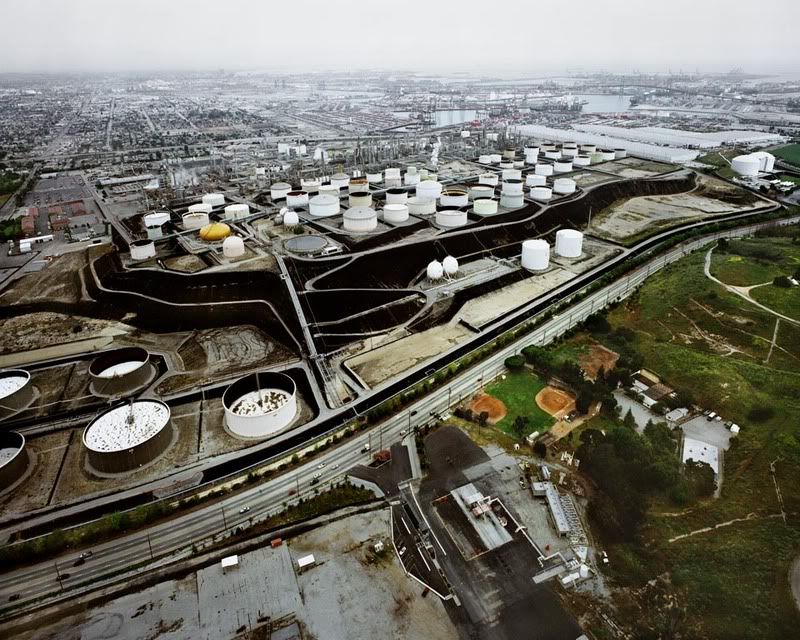
"Conoco Phillips Wilmington Refinery Looking South, 139,000 Daily Barrels, Terminal Island in Distance"
2006
Pigment print on aluminum
24 x 30 inches (or 40 x 50 inches)

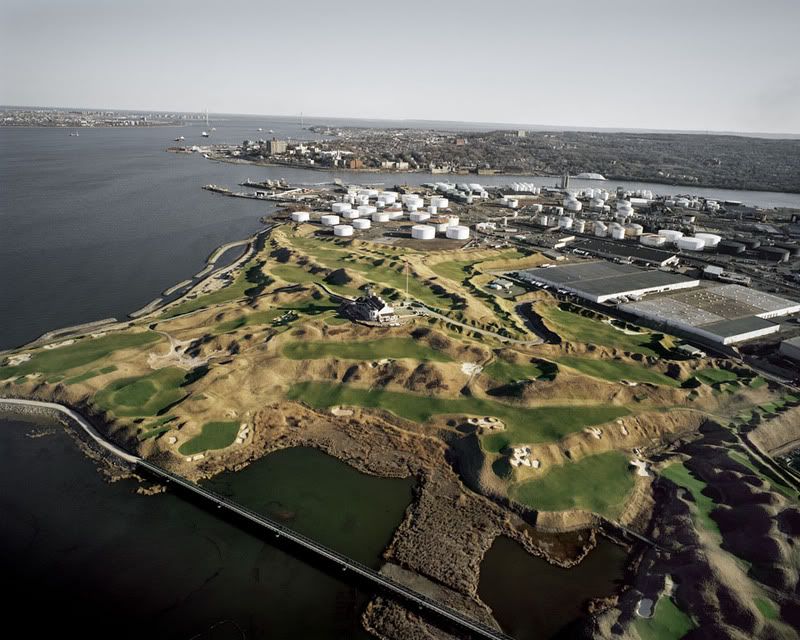
In "Conoco Phillips Wilmington Refinery Looking South, 139,000 Daily Barrels, Terminal Island in Distance," a photo included in the book, "Rancho San Pedro, 04.28.06," a community baseball diamond seems incongruous surrounded by the expansive industrial complex of the southern Los Angeles basin. "Bayonne Golf Club, Former Landfill With A $200,000 Initiation, Old Standard Oil Refinery Beyond, NJ, 2007" pictures one of the Meadowlands' many landfills, in this instance reclaimed as an exclusive club, a manufactured escape in a landscape dominated by what most of us would deem the more mean marks of manufacturing. But the relationship of one to the other is not so dual; this isn't merely attractive versus ugly, good versus bad, or natural versus artificial. Light's photographs remind us that, like the refinery, the golf course and, indeed, even the glacial channel, qualitative judgments are in forever in flux.


Michael Light
"Bayonne Golf Club, Former Landfill With a $200,000 Initiation, Old Standard Oil Refinery Beyond, NJ, 2007"
2007
Pigment print on aluminum
24 x 30 inches (or 40 x 50 inches)

Take, for example, my long-held presumption that Los Angeles is a town with no shared pulse or sense of community. "Los Angeles, 02.12.04" carries Light (and us with him) northward over the industrial sprawl of Long Beach to the grouping of towers that comprise the city's downtown. Monuments to things bought and sold, the tall buildings rise from the city's otherwise low profile, each labelled: BP, Citigroup, Paul Hastings. Moving northwest, Light flies by the hills of Hollywood, dotted with the precariously situated houses of the rich and famous. I've never had a particular urge to explore this city, but as I turned the substantial pages of Light's book, the seismic beauty, fragility, and violence of the landscape were readable. Los Angeles became a romantic notion, an ongoing, astonishing experiment. The prints highlight the tenuous hold humans have on the land and, more generally, on our fate.

There is something freeing in the contemplation of our inevitable annihilation. Christopher Cokinos wrote recently in Orion that viewing extinction as an inevitability (and, therefore, civilization as a temporary exception) "nurtures sanity." I agree. Some readers will undoubtedly feel that this attitude is pessimistic, even nihilistic, but, to the contrary, I believe acceptance of our absurd position nourishes a desire to contribute, to participate directly, even in small ways. Faced with an impossible prospect, it is individual effort and happiness that sustain us. As Albert Camus concluded in The Myth of Sisyphus, "The struggle itself is enough to fill a man's heart. One must imagine Sisyphus happy."


Michael Light
"Carson Sink at 1000', 1600 hours, Fallon, Nevada; July 2000"
2000
Pigment print on aluminum
24 x 30 inches (or 40 x 50 inches)

Each of us is part of a greater body. The rest of the material world is part of this body, too. I conceive of this corporate entity as a chaotic harmony. As I consider the pictures included in "Some Dry Space, 2003," serene portraits of one of the more severe, inhospitable ecosystems on our planet, I vacillate between macro and micro world interpretations. I recognize the desert landscape with its dunes, tracts, and other marks of the wind's work, yet the same photograph might also be seen as a cross section of a cell or a tissue slice. Contemplating this analogue, I find myself dusting off the childhood mindblower, “What if our universe, and everything we know, is contained within a marble in an alien universe?”(2)


Michael Light
"Bingham Mine/Garfield Stack, 04.21.06"
2006
Hand bound pigment prints, custom box
36 1/2 x 46 1/2 x 1 1/2 inches (open)

But such wonder shouldn't be limited to childhood. These desertscapes, like the spectacles within our bodies or the Hubble views of the vast beyond, present us with stunning beauty. For this reason, the scale of Light's bookworks is important. The viewer can take in the whole picture at once, thereby making it apprehensible and safe, but the book spreads are also large enough to be confrontational. The artist writes that he feels a "tempered awe" when taking these pictures. Remarkably, the bookworks succeed in translating that feeling.

I left Hosfelt Gallery thinking about the ultimate futility of the preservationist impulse. Time moves oblivious. Describing the tenuous state of Louisiana’s coastal wetlands, a civil engineer opined recently that many millions of dollars will be spent “to hold the line in the mud.” Indeed, our situation is literally and metaphorically futile, but Light's images remind us that our desire to hold that line, to preserve the landscape that shapes us (as we shape it in turn), is as natural as the change we react against. This absurd desire is itself part of the holistic landscape. As Howard Bloom wrote, "We are Nature incarnate."


Michael Light
"Garfield Stack, Oquirrh Mountains and Ancient Beach of Great Salt Lake"
2006
Pigment print on aluminum
24 x 30 inches (or 40 x 50 inches)

+++++

(1) And because people watch television indoors, the nature they witness becomes an irrelevant but entertaining outside experience, one external to or apart from contemporary living and ritual.

(2) This "deep thought" is presented well in the animated closing sequence of the comedy, "Men in Black." The camera draws back, out of our solar system and past countless others to reveal that the whole of our galaxy is contained within one marble. The marble is being used in an alien game of marbles, and each of the marbles used to play the game contains countless other solar systems and galaxies. Physically this makes little sense, but it nicely illustrates the scalar continuum.

Photo credits: All images courtesy the artist

Wednesday, June 27, 2007

Singing for the rains

A child of the South, I miss the fluctuating drone of cicadas during the spring and summer months. Yet I take some solace when a startling crush of thunder sets off all the car alarms in Astoria.

Monday, October 24, 2005

A Ski Vacation in Dubai

Image hosted by Photobucket.com
The October 17, 2005 issue of The New Yorker - the annual art/architecture special - includes some interesting articles. In the course of reading "Salesman," Nick Paumgarten's profile on New York dealer Leo Koenig, I was inspired (many times over) to write something reactionary. After allowing the reading to digest, however, I've decided to write very little. The Art World groupie in me enjoyed the elements of voyeurism - peeking in on other artist/dealer relationships is always intriguing - but such superficial thrills are temporal and, in the end, the piece was satisfying only as a guilty pleasure.

More exciting was Ian Parker's report about Dubai's rapid development ("The Mirage"). Parker describes this United Arab Emirates city as "a diagram of hormonally adolescent urban growth." His phrase evokes another, more familiar mess. With regard to thoughtless consumption, expansion and greed, Dubai paragons Las Vegas, Nevada. Passing through this latter city several years ago, my reaction against the town was so visceral that I almost forgave Theodore Kaczynski his transition from Luddite philosopher to terrorist - and, although I have never visited Dubai, photographs of the oil boom development(1) pique me. I suppose that garish displays of wealth or power generally offend my sensibility and when this variety of peacock trumpeting is coupled with a disregard for the environment, I am deeply saddened, even embittered.
Parker provides many examples of this unholy coupling. Reading the selection that follows, keep in mind that Dubai, like it's American sister city, is in the desert, an ecosystem short on water and long on heat.
"While I was in Dubai, I went to an early-evening meeting of the U.A.E.'s recently formed Green Building Council, held in the Grand Hyatt. I pushed open high double doors, and walked into a ballroom with a thirty-foot ceiling and multiple chandeliers, each with a hundred light bulbs. The outdoor temperature was more than a hundred degrees, but the air inside was almost uncomfortably cool. Although the room could easily have held a cocktail party for a thousand people, only twenty or so attended the meeting.
The environmental profligacy of Dubai is today most proudly expressed in the forthcoming indoor ski slope that is the defining feature of the new Mall of the Emirates. Encased inside a broad flattened tube that is visible for miles, it will be twelve hundred feet long: a steep, black diamond run of nine hundred feet, a forty-degree bend, then a gentler slope to the bottom. I went there before the refrigeration had begun: the snow-making machines had not yet been turned on. 'Obviously, it's going to be freezing here and a hundred and a twenty degrees outside, so we're going to be using a fair amount of electricity,' Phil Taylor, the chief executive of Ski Dubai...told me."
If the irresponsible construction craze isn't troubling enough, city officials and U.A.E. leaders are determined to turn Dubai into a disposable economy, one dependent on foreign tourism and stockholder petroleum wealth. (Hamza Mustafa, General Manager of The World, a luxury development being constructed on artificial islands, says of his city, "Dubai is to Europeans like Miami is to New Yorkers.") In order to support such an arrangement while maximizing profits, cheap labor is imported from outside the U.A.E., and these laborers are given second-class rights, poor benefits - if any - and required to depart the country before reaching retirement age.
"The invitation that Dubai sends out to professionals - to British airline pilots and German bankers - is quite different. These favored expatriates buy or rent apartments in the glass-plated towers on Sheikh Zayed Road, or find homes in the generously named developments that Emaar has built in the otherwise featureless desert: the Lakes, the Springs, the Meadows. In these neighborhoods, lawns are perpetually misted by sprinklers, and babies squint into the sun as they are wheeled along brand-new sidewalks by young Sri Lankan nannies. 'We live in Wonderland,' Rola Zaarour, a young Lebanese-Canadian woman, told me. Zaarour, who is single and works in public relations, has a red convertible and describes herself, smilingly, as 'shallow.' She came to Dubai three years ago, and admitted that she had never seen most of the city's old downtown, where the streets narrow to create a souk-like atmosphere, and where Indian and Pakistani workers, on their days off, shop for radios and alarm clocks that they will one day carry home. 'I didn't come to Dubai for anything "real",' she said. 'I've already lived in real places.'"
Rola Zaarour's escapist attitude, one shared by millions of people, risks undermining the now vulnerable supports of democracy and republicanism. Parker alludes to the conflict between the "real" and Zaarour's Wonderland with his article's title, "The Mirage." Too many of us prefer to believe in the illusory; the alternative, accepting that freedom and peace require substantial commitment and effort, was once a mainstream ideal, but today we market leisure in place of hard earned satisfaction. Las Vegas and Dubai are temples to this immoral tide; it pains me to look upon them, whether in photographs or in person.

(1) "In the seventies, oil production rose as global oil prices increased tenfold - to the country's spectacular advantage...Dubai International Airport was expanded on a scale that seemed preposterous at the the time, and, if for nothing else, the city soon became renowned as a glittering duty-free mall stumbled upon during 3 A.M. stopovers between East and West."

Photo credit: OmanVistas.org

Wednesday, May 18, 2005

Predators in Penang...and elsewhere


The short missive below was brought to my attention by HerpDigest, an email newsletter devoted to herpetology. Originally, the article was published in a newspaper printed in Penang, Malaysia (pictured above). I can find no link to the article, so I've pasted the text below.
“Breeding Ground For Snakes”
Monday, May 09, 2005, Penang, Malaysia

A vacant piece of land in Penang has turned into a breeding ground for pythons and cobras, endangering people's lives.

The site, at the junction of Perak Road and Macalister Road, is now covered with bushes and weeds and the residents nearby are now living in fear. Resident Teh Boon Seng, 42, said the owner who used to come yearly to clear the weeds failed to do so this time around. He said he had seen pythons and cobras in the area.

“Recently, I called the Fire and Rescue Services department to catch a huge python which crawled out from the site,” he said. “A few days ago, a cobra crawled into my house. We are now having sleepless nights,” he said at a press conference arranged by Komtar state assemblyman Lim Goon Soon recently. Lim said he had told the landowner four years ago to put up proper enclosures at the site, adding that the vacant land was once a haven for drug addicts.

“We want the landowner to clear up the mess fast before the snakes bite people,” he said.

There were at least 35 parcels of idle land in his constituency, he said. He urged the owners to rent out the land as parking lots.
Such situations are not uncommon in Southeast Asia, but the last sentence of this article set it apart. I’ve never been a big fan of Joni Mitchell’s song, “Big Yellow Taxi,” in which she suggests we will "pave over paradise to put up a parking lot," but the explicit parallel is jarring. (I prefer a more contemporary damning tribute to sprawl, Modest Mouse’s “Convenient Parking,” off their 1997 EP, Lonesome Crowded West.) What does an increasingly urban demographic mean for green space in our larger cities and towns? More to the point, what does such green space mean for the city's inhabitants, human and otherwise?

Yesterday, I received in the mail a plea for support from The Trust for Public Land. An attached questionnaire was comprised of questions designed to provoke ‘Yes’ replies, thereby encouraging you to pledge money. “Do you appreciate our national park system and wildlife refuges?” “Do you think it important to have wilderness areas in which you and your family can recreate?” “Do you feel our cities and towns should include more public parks and greenways?”

For the past three years, I have considered myself a champion of the wildlife corridor concept, a worldwide conservation measure trumpeted by the so-called “deep ecology” groups; the terrific Wildlands Project is an example. The “deep ecology” movement, and the wildlife corridor push with it, is often dismissed as a pipe dream but, as I see it, the only valid critique is one which focuses on the “inordinate” amount of time needed to construct this “network of networks.” Protecting and connecting all the ecosystems of the United States, much less the world at large, is an undertaking which promises to take years – perhaps centuries – of ugly courtroom battles and litigation. As Stephen Meyer writes in his excellent article, “The End of the Wild,”
“In theory this strategy could reduce the slide of ghosts and relics into oblivion if it could be implemented immediately and universally. It would be a form of global ecological zoning that would significantly lessen the influence of human selection in the excluded regions. Wildlands would enable species and populations to adapt to climate change. As an ecologically centered strategy it is most likely the only approach that could truly reduce the scale and scope of the biotic collapse that is already underway.

Yet the notion that upwards of seven billion people could live hobbit-like with nature is hard to accept. With the right social framework we might have been able to do it modestly in 1304, but not in 2004 and certainly not in 2104. Global society is moving rapidly and inexorably in the opposite direction.

To be fair, advocates of wildlands acknowledge that, owing to enormous social, political, and economic hurdles, their vision would be at minimum a 100-year undertaking. The problem, of course, is that the end of the wild will already be complete.”
There is a more specific and more interesting question, however. Where the towns and cities “touch” the wildlife corridors, how much connection is to be allowed? For example, if species are able to make their way from a designated wildland to a city park, we suddenly face potential threats from unknown invasive species and a surplus of prey species “hiding out” downtown.

I turn here to Reed F. Noss, a biologist closely associated with The Wildlands Project. The following excerpt is taken from his paper, “Can Urban Areas Have Ecological Integrity?” (I can no longer locate this paper online, but it was published in conjunction with the 4th International Symposium on Urban Wildlife.)
"There are 2 potential problems with this 'network of networks' design. One, corridors leading from the more developed zones of the network might funnel exotics and other opportunistic, weedy species into wildland areas. We know that roads and roadsides, for example, are frequent avenues for the invasion of these pests. I predict, however, that the wildlife corridor network is unlikely to facilitate weedy species invasion of wildlands beyond that already facilitated by roads. In fact, well-designed corridors, especially if wide, may provide habitat for predators of these weedy species. In addition, corridor bottlenecks could be used to trap weedy species and possibly reduce their spread.

A potentially more serious concern is that of corridors connected to wildlands or rural areas funneling problematic large mammals into suburban and urban areas. This is already a problem with deer....Following the deer into suburban areas, however, may be a natural predator of deer - mountain lions. Unfortunately, these predators sometimes also attack joggers and other people. Wildlife corridors have been implicated in bringing both deer and lions into Boulder, Colorado which has created some problems."
And so, at long last, I come back to the Lim Goon Soon comment about the need for more parking lots in Penang. Though Malaysian cities are not surrounded by anything resembling the wildlife corridors advocated by the deep ecology movement, the rural and the urban do butt up against one another in a more explicit fashion than they generally do in the western world. The boundaries blurred, predators passing through a town or city are that much more likely to take up residence in the vacant lots.

So what is to be done? Is their a solution that allows for all parties to be represented or must we “pave over paradise” to quell our fears? For my part, I feel that predators (whether lions, bears, or cobras), living in close proximity to humans need not be a problem. If people were more willing to live alongside other species – a tolerance developed over several generations – safety precautions and sensible behavior would result in less conflict between man and beast. If a mountain lion (Puma concolor) has been frequenting your backyard, bring your dog indoors at night rather than allowing Buster to romp unattended. If a large Great White shark (Carcharodon carcharias) has been repeatedly spotted just beyond the breakers, don’t paddle your board out. Unfortunately, less conflict doesn’t mean a cessation of mawlings or snakebites and so the primal fear of predators will remain an issue for many more generations of man. When and if it does vanish, odds are there will no longer be any predators remaining. Modern man continues to repeat the mistakes of the preceding generations: pave it, mine it, milk it, and propagate, propagate, propagate. The recent boom and bust seizures of the economy are merely a time-lapse film of human history.

Photo credit: Penang, Malaysia, Copyright Chris Rouch. 1999-2005

Tuesday, April 19, 2005

Friends & Neighbors


Spring is here and, for many people living in the warmer regions of the United States, the changing weather means reptile encounters. I subscribe to several email newsgroups that deal with reptile and amphibian conservation. I'm regularly directed to articles, most published in local newspapers, describing “dangerous” meetings of man and cold-blooded beast. Sadly these encounters do not represent an increase in reptile populations, but rather further encroachment into reptile rich habitat by our own species. Each year, as the warmth draws the randy, hungry reptiles out of brumation (cold-blooded animals' period of dormancy), humans encounter them in garages and houses…even, Heaven forbid!, in our gated communities.

This morning, two articles. First, a blurb from southern Florida’s Sun-Sentinel tells of a US Fish & Wildlife agent bitten by an American alligator (Alligator mississippiensis) while trying to capture the animal in a Pompano Beach neighborhood. Two weeks ago, I read an article in the same paper (unfortunately, the article is too old to be accessed online) telling of another aggressive alligator caught in Weston, Florida. This hungry gator killed and consumed a dog in a “posh Weston community.” Below, I’ve excerpted some of the text from the article. (“Dog-killing Gator Caught,” by Andrew Ryan, 03/30/2005)
“Once the animal is under control, the hunter takes it to a processing plant where it is killed and turned into gator nuggets, wallets and other products. Officials say if they were to release the animal in the middle of the Everglades it might simply come back…As development pushes further into the Everglades, clashes with gators have increased. Since the state began keeping statistics in 1948, there have been 342 alligator attacks, killing 15 people…Wildlife officers field 15,000 calls about nuisance alligators each year, and Weston, on the edge of the Everglades, is a hot spot.”
On the edge of the Everglades? Hmmm… It seems to me folks who want to live in such locales should consider their own transgressions and come to terms with their neighbors. Of course this is rarely the case. Whether dealing with wildlife and human settlement conflicts or the gentrification of minority neighborhoods in urban areas, development usually wins out over balance or integration. The one encouraging spot in Ryan’s Sun-Sentinel piece was a sensible comment made by Florida wildlife commission spokesman Jorge Pino. "We are standing in an area that used to be Everglades. We have to find a happy medium." Are we ready to do so?

The second article is pulled from the Desert Dispatch, in southern California. It describes a similar problem in the town of Victorville. Instead of alligators, though, the locals are plagued by snakes, Mojave rattlesnakes (Crotalus scutulatus scutulatus), in particular. Alligators may stumble into settlement on occasion, but snakes are often attracted to development as they follow their keen smell to an abundance of prey. This winter, good rains have contributed to a banner year for vegetation and, in turn, rodents and lizards. Complicating matters, Victorville is experiencing a development boom. "Within the next year there will be 15,000 new homes up here, and when they are breaking ground they are breaking habitat and the snakes are coming out," said Vicki Telford, an amateur herpetologist.

Unfortunately, wildlife/human conflicts are not restricted to warm regions and cold-blooded creatures. Our continued sprawl forces suburbanites into close proximity with mountain lions (Puma concolor), black bears (Ursus americanus), grey wolves (Canis lupus), and many other predatory species looking for an easy meal at the fringe of human settlement.

This brings me to this article (“The Cat Came Back: Alpha predators and the New Wilderness,” by Peter Canby, Harper’s Magazine, March 2005), which I have been meaning to post for some time. Ostensibly a book review, the piece does more than offer straightforward critique. It pries intelligently into the contradictions and blind Romanticism of “wilderness” concepts, while simultaneously raising fair questions about our own exuberance.

Though I find myself more in David Quammen’s camp – his book, Monster of God, is reviewed – than in David Baron’s, both arguments are valid. Baron, in his book, The Beast in the Garden, focuses on contemporary humanity’s misunderstanding of Nature, suggesting we need to become a keystone species once again, taking responsibility for the lands we occupy. While I agree with this assessment, I find Baron patronizes conservation-minded individuals. Canby seems similarly irked by Baron and turns, as I do myself, to a better, more thoughtful proponent of meaningful re-integration, Bill Cronon.
“The theme of the artificiality of the wilderness around Boulder runs throughout The Beast in the Garden, as does the idea that by romanticizing this artificial wilderness and its supposed ‘naturalness,’ Boulder's citizens were shirking their responsibility to manage it properly and were refusing to understand their role in creating the conditions that had led to the return of cougars. But Baron seems so intent on maintaining his contrarian tone, so intent on gaining points at the expense of Boulder's ‘stuck in the sixties’ lifestyle, that the reader is advised to turn to William Cronon, one of Baron's sources, where these ideas are better developed.”
As I have mentioned in the past, I have a great deal of respect for Dr. Cronon’s writing and conservation philosophy. Throwing grenades at mountain lions, beheading snakes, and shooting alligators that approach homes are temporary solutions that ignore the root cause of the conflict. As Cronon has repeatedly made clear, it is high-time we re-examine our priorities and consider what best balances the equation. Increasingly, zones of concentrated human settlement – urban, not suburban – and zones of well-managed, connected “wildlands” seem the best solution.

Photo credit: A. Yanosky