Showing posts with label melancholy. Show all posts

Sunday, September 26, 2010

Update: Jane Hammond's "Fallen"


Jane Hammond
"Fallen"
2010
Dimensions variable

In January 2006, I wrote a short post about Jane Hammond's mixed-media, evolving sculpture "Fallen," a melancholy and beautiful tribute to the lives lost during the (now sort-of-but-not-really-over) Iraq War.

When it was exhibited in 2005, the work consisted of 1,500 paper leaves, each meticulously crafted by the artist and inscribed with the name of an American soldier who met his or her end during the invasion or occupation of Iraq. At the time of my post, I wondered if Hammond had continued to add leaves to the work.

A couple of weeks ago, four-and-a-half years after I wrote about "Fallen," the artist sent me an email telling me more about the life of the sculpture. I share the bulk of her update below, along with some images of the piece as it was in 2005 (below) and as it looks more recently (above, and detail below).
"I make the leaves by hand and each is based on a real leaf which I gather and digitally scan, then there is cutting, hand-painting, a little fiberglassing and more hand-painting, then they are signed by me with sumi ink and a brush pen and molded into a three-dimensional form.

[...A]ll the leaves in the piece you saw at Lelong were from upstate Connecticut, gathered in the Fall of 2004—I have now gathered leaves in Hawaii. Washington State, California, Colorado, Texas, Arkansas, Missouri, Michigan, Mississippi, Alabama, Virginia, Maryland, Massachussetts, Vermont, New Hampshire, Maine and Rhode Island. And adding to the original group from 2004, I have gathered in the Autumns of 2005, 2006, 2007, 2008, 2009. And I am sure I will gather some in 2010 this Fall.

[...]This Fall, ["Fallen"] will [...] be shown at the Taubman Museum in Roanoke, Virginia from September 23rd until January 10th, 2011. It will open with 4,390 leaves."

Jane Hammond
"Fallen" detail
2010
Dimensions variable

Sadly, she does have more leaves yet to add.


Jane Hammond
"Fallen"
2005
Dimensions variable


Image credits: courtesy Jane Hammond

Friday, May 21, 2010

Changes


View of Empire State Building; Manhattan, NYC; May 2009

As I prepare to move from New York City, my home for over a decade, to San Francisco, my home for at least a few years, I find myself viewing NYC through the eyes of a man in limbo. I'm still living in Queens, but my attention is already on the road.


Vacant lot; East Village, Manhattan; May 2008

A decade of NYC living makes me, by at least one standard, an official "New Yorker." How does that define me? New York, like all conurbations, is ever in flux. On my watch, it's changed in remarkable ways. What changes will come after I'm no longer a resident? Likewise, what changes are yet in store for me, a similarly adaptable organism?


Samuel Cohen Son graffiti; East Village, NYC; April 2010

I moved to New York City in October 1999, not long after I graduated from The College of William & Mary. I was then an ambitious twenty-one year old with a deeply cynical streak and an abiding love of beer and partying. My paintings and drawings featured naked people interacting in various ways with other animals, medical instruments, fossils, and, on occasion, Teletubbies. (If a reader knows what became of the big Tinky Winky sex painting, I'd love to see a photo of it!) Despite my apparent enthusiasm, I was steeped in melancholy. I spent hours each week brooding over "I," my pet novel project, a 1990s East Village vampire update of Hermann Hesse's Steppenwolf. I viewed humanity as a noxious species, religion as the most noxious of human inventions, and I not so secretly looked forward to our inevitable extinction.

Today, I'm an ambitious thirty-two year old who reacts against cynicism, drinks much less, and generally dislikes partying. Naked people sometimes appear in my paintings, but there aren't any Teletubbies. I'm a stubborn optimist. Each morning, I take twenty minutes to humbly celebrate a new day; if I wake in a funk, I fight through the fog to see anew just how marvelous life is. I recall my earlier character with some embarrassment. What was wrong with the arrogant kid who labored on a novel that painted such an ugly picture of humanity and religion? Perhaps he just needed to be more intellectually rigorous, and to open his eyes to the awesome fact of being? Or maybe that twenty-one year old also needed a good hug, which is no small thing?


Greenpoint, Brooklyn; May 2009

My time in New York City has seen me metamorphize from a hardened and cynical adolescent into an optimistic, joyful adult. The direction of this evolution runs counter to the standard assumption made about the effect of NYC living. As the columnist Mary Schmich warned (and director Baz Luhrmann popularized with his song "Everybody's Free (To Wear Sunscreen)"),
"Live in New York City once, but leave before it makes you hard; live in Northern California once, but leave before it makes you soft."
In my experience, however, NYC living sanded smooth the hard edges.


Wollman Rink; Central Park; Manhattan; June 2008

Perhaps, too, the mournful and nostalgic wails of NYC residents (myself included) are misguided? We should accept that "what will come, will come" without falling victim to fatalistic impotence. New York City (and Manhattan, in particular) is one of the most sustainable, environmentally responsible cities in the world, and its educated, informed residents should work with New York State and City representatives to make sure the city continues apace on that front. They should also do all they can to ensure that it remains a mecca for tolerance, the arts, and cultural pluralism. In what ways I can, I'll do the same from the Left coast; New York City is a part of me, and I will always feel a part of New York City.

Love and peace to all of my friends here. Thank you for everything. I'll be in touch. I'll visit. I hope that you'll visit me.


Upper New York Bay from Staten Island; May 2008

Image credits: all photography, Hungry Hyaena

Tuesday, November 10, 2009

Falling Down


In the wake of last Thursday's tragic shooting at Fort Hood, the American media have made much of Major Nidal Malik Hasan's religious affiliation and, more specifically, of his connection to a radical Muslim cleric based in Yemen.

Many voices on the right have touted Hasan's heinous actions as the latest evidence of Islam's corrupt and violent core. Most of the commentators on the left, by contrast, insist that Major Hasan was a victim of circumstance, and that his murderous rampage was precipitated by external pressures. Considering the left's reasoning, Michael Douglas's defense contractor turned urban vigilante in the 1993 film "Falling Down" comes to mind. At the time of that film's release, critic Roger Ebert wrote of it,
"What is fascinating about the Douglas character, as written and played, is the core of sadness in his soul. [...] There is no exhilaration in his rampage, no release. He seems weary and confused, and in his actions he unconsciously follows scripts that he may have learned from the movies, or on the news, where other frustrated misfits vent their rage on innocent bystanders."
There is salient insight in the left's response, but generally assessments on both the political left and right are ideological and reductionistic. Media pundits are involved in a fraught game of Pin the Tail on the Donkey. While the right-wing strives to pin the tail on Islam, left-wing pundits do what they can to prevent that stigma from sticking. Precious intellectual and creative energy is expended in the process; these commentators could instead provide a full accounting of what causes people to turn to religious extremism, or to extremism of any sort.

I especially appreciated, then, Dave Belden's "How Do We Understand Major Hasan?," an OpEd-style post at Tikkun Daily. I encourage folks to read it. Belden writes,
"Given that in all of our lives personal pain intersects with cultural narratives, then it is surely no surprise that for the killers it’s rarely ever a simple question of either a sick individual or a follower of extremist ideas. Timothy McVeigh was surely both when he bombed the Oklahoma Federal Building. To mention his personal pain is not to excuse him, but should give pause to all those who demonize others."
In response, I wrote in the comment section of Belden's post,
"In the media frenzy that passes for much contemporary news and politics, the humane aspects of most events or socio-political dynamics are generally overlooked. So, too, are the individuals involved reduced to caricatures and concepts. I wish I had some ideas as to how we, as a community, might address this ugly, dangerous spin. Alas…

As for David Brooks and [those to his right], I frequently marvel at their incomplete assertion that Muslim extremism is the culprit (at Fort Hood, in particular, but globally, too). Why not continue the diagnosis, revealing the imbalanced, immoral global system that produces extreme poverty, social and political disenfranchisement, and national/ethnic resentment/competition as the source of the tsoris that drives so many young men and women to embrace extremism (or, at least, adds to the appeal of a black-and-white, reductionist world view)?

Certainly religious extremism should be condemned and confronted, but addressing the root cause (which is also to address social justice globally) seems more sensible. But, were the conservative commentators to finger that root, they would implicitly condemn their own condemnation, as it, too, is born of a naive, black-hat-versus-white-hat construction of our volatile, shrinking world."
Photo credit: image ripped from Voice of America News

Thursday, October 15, 2009

Autumn Birds and Birding


View of Manhattan skyline from Central Park, Manhattan

On my way to the gym Tuesday morning, on the corner of 64th Street and 1st Avenue, I discovered a dead American goldfinch (Carduelis tristis). Feathers askew, a pink wound was visible on the head of the small, yellow bird. The injury was likely sustained when the goldfinch crashed into a window of one of the nearby apartment towers. I said a quiet goodbye to the bird, and continued on my way. An hour-and-a-half later, while running a work errand, I came upon a dead red-bellied woodpecker (Melanerpes carolinus), crumpled on the corner of 68th Street and York Avenue. People gave the bird's body little attention.

It's the time of year when our avian brethren fall from the sky above Manhattan and land, sometimes dead, sometimes injured, sometimes merely confused, on the city's sidewalks. It is the time of autumn migration and restlessness. Neither the goldfinch nor the woodpecker are properly migratory species, but both birds will sometimes fly a short distance south when the temperature drops.

I can't say whether or not the individuals that I found on Tuesday morning were on the move when they met their respective ends. Still, their fate is a common one during New York City's autumn. As the NYC Audubon Society's Project Safe Flight mission statement explains,
"Located at the nexus of hundreds of bird species’ migratory routes, New York City’s tall buildings and reflective glass pose a serious threat to over 100 species of migratory birds, some of which are experiencing long-term population declines."
Resident species are also vulnerable, of course. Since Project Safe Flight's inception, in 1997, "over 4,000 dead and injured birds have been collected and documented in [Audubon's] database." That number is a fraction of the total bird deaths that Manhattan's buildings cause.

What can each of us do to help curb the buildings' toll? The easiest action involves turning off your office or apartment lights at night. Many office towers leave the lights on, needlessly wasting electricity and killing birds. As Project Safe Flight’s Lights Out New York initiative explains,
"Lights can distract birds from their migration path and cause them to collide with buildings during bad weather. Turning off the lights and drawing the blinds can help save thousands of birds from over 100 different species every year."
Let's help our feathered friends fly safely, folks.

+++++


Watching a Winter Wren on the wall of Belevedere Castle; Central Park, Manhattan

I rose earlier than usual on Wednesday morning, so that I could be at Central Park's Loeb Boathouse by 7:30 AM, where I met five other Nature Conservancy bird watchers. The six of us spent a very pleasant two and a quarter hours birding.

I love being outdoors in the early morning, and I greatly enjoyed observing even the familiar species as they foraged, fought, and flitted about. House finches (Carpodacus mexicanus) and European starlings (Sturnus vulgaris) are species taken for granted by most birders, but, illuminated by the morning sunlight, each is a marvel.

I was especially excited to see several Eastern phoebes, a relatively common species that, courtesy of Edward Hoagland, I associate with my beloved notion of reconstitution, and a winter wren (Troglodytes troglodytes), a dark, small relative of the more familiar Carolina wren (Thryothorus ludovicianus), a bird for which I was almost named. (Wren Reiger would have been a hard sell on the grade school playground, and I'm thankful that my parents elected to shelve the name.)


Belvedere Castle; Central Park, Manhattan

Photo credits: All images, Hungry Hyaena, 2009

Saturday, September 19, 2009

Again, into the gloaming

The spiral of time has come round on itself, slightly displaced from this point a year gone.

It is Rosh Hashanah today, the Jewish New Year, and I'm in a pensive mode. Below, I repost a selection from "Almost Twilight," last year's musing on autumn's advent, creative inspiration, twilight, crepuscular animals, hallucinogens, and reflection.

But, first, I'd like to highlight two projects relevant to the season.

- Yusuf Misdaq is an artist, poet, and musician who shares my universalistic mystical inclination. Almost a month ago, he began Palace Prayers, "the aim [of which] is to create a new work of art for every day of Ramadhan, 2009."

A blog-like site presents each day's original work. I encourage readers to visit. You can also listen to a National Public Radio interview with Yusuf here.

- New Yorker editor Ben Greenman has co-organized, with writer Nicola Behrman and Reboot's Amelia Klein, 10Q, a Yamim Noraim project for people of all faith (or lack of faith) backgrounds. From the website:
"10Q was inspired by the traditional ten days of reflection that occur between the Jewish holidays of Rosh Hashanah and Yom Kippur, a period of time that’s long been considered an opportunity to look at where you're at, where you've come from, and where you're heading. Whether you're Jewish or not, though, 10Q is a great way for anyone to look back at the year that’s past, look ahead at the year to come, and take stock. That’s a beautiful thing in any language."
Sign up here.

Shana tova!

+++++


"Darkness within darkness.
The gateway to all understanding."
-Lao tzu, "Tao Te Ching"

In New York, recent mornings have greeted us with a pleasant chilliness. Fall is almost here, and winter is just around the corner. For most folks, the prospect is daunting. Not so for me. Each year at this time, a bounce finds my step and I'm happily overwhelmed by a spate of ideas. I know, however, that the creative juices will before long transmute into keen brooding. Late fall and winter nurture a pensive mind.

When the afternoons darken and the mercury dips, I like to take bundled winter strolls through the streets of Manhattan or Queens. Other pedestrians hustle about, intent on achieving their respective indoor destinations, but I find my thoughts best served by a steady pace, one forgiving of some intentioned aimlessness. I spend these walks looking up to where the melancholic sky meets the buildings that scrape it, admiring the resilience of foraging House sparrows, taking note of the way traffic lights glow more brightly in crisp, cold air and marveling over the many lives that move around me. I like to think of this mindful meandering as a form of prayer, or perhaps a communion, and I treasure the insights that are sometimes happened upon.


Curious about the rites, beliefs, and texts of various religions (and particularly those of Judaism), I've been thinking this week about the coming high holy days. Next Monday is Rosh Hashanah, the first of Judaism's ten "days of awe," or Yamim Noraim. Like my winter walks, the Yamim Noraim are given over to contemplation. During the ten high holy days, an observant Jew should meditate on the actions of his last twelve months and, then, on Yom Kippur, the last of the "days of awe," fast and repent for any wrongdoing. In other words, a conscientious Jew begins the new year by reckoning with his past. Although Rosh Hashanah is only one of four Jewish New Years, each attached to a specific set of guidelines and meaning, I find the holiday's position with regard to the seasons of particular interest.

Considered the New Year for humans, animals, calendar calculation, and contracts, Rosh Hashanah arrives with the ploughing of summer into fall. If one considers fall equivalent to dusk and winter to night, then the Jewish New Year, like the Jewish day, begins at twilight in the northern hemisphere. The notion of a day extending from sunset to sunset runs slightly counter to the popular conception of morning time as a birthing, or spring, with the hours moving through summer at mid-day, fall in the evening, and finally into winter, night and death. But the Judeo-Christian tradition is pastoral, founded on an agricultural reckoning. It makes sense, then, that the day should end when the sun falls away. The new day begins with night; the beginning is darkness, a time when all man can do is rest and await the return of the sun's workable hours. In rural farming communities, this pattern holds today, though the blue glow of television has altered habits in even the most rustic counties. Still, the consummate urbanite Oscar Wilde's quip that "people in the country get up early because there's so much to do, [and] they go to bed early, because there's nothing to talk about" remains generally accurate.


Growing up in such a community, I learned early that if twilight is a conclusion for the farmer, it is a commencement for many other creatures. A patient hunter who remains in his deerstand as the final light retreats might see bats dart and dip in aerial pursuit of insects. He may also see an opossum, fox, raccoon, skunk, or even his intended quarry, deer, though it is not legal to shoot after the sun sets. Driving or biking on "backroads," these animals reveal themselves by reflecting light from a car's headlights or a bike's front beam. The tapetum lucidum, a layer of tissue behind the retina of crepuscular and nocturnal species, allows the animal to see better in near or total darkness, but this layer also produces eyeshine that discloses the creature's presence to human torch bearers. Depending on the species and the angle of approach, we can identify the animal by the color of its eyeshine: the white-yellow lights at knee height belong to the red fox; the orange orbs in the low branches of a tree are an opossum; the yellow beams tall over the road are white-tailed deer; the brilliant white spots that appear so near the ground expose a resting whippoorwill.

Imagine the shock of the early humans when they first noticed the glowing embers that moved just outside the reach of their warm firelight. The agricultural tribes that would become the people of the Torah, having abandoned much of their nomadic, hunter-gatherer roots, were particularly afraid of the dark, creeping world outside that circle of light. To be caught in the gloaming, away from a human settlement or encampment, was surely a terrifying possibility.

Indeed, the dark months, like those black, antediluvian nights, remain an ordeal for many people . But they can also be understood as a gateway opportunity. It is fitting, I think, that Jews begin their new year by taking stock, a formidable task if undertaken with thoroughness and honesty. I approached my experiences with hallucinogenic drugs in an analogous way; what most people would call a "bad trip," I viewed as an opportunity for introspection. 'Why has my brain created this awful idea?,' I asked myself. 'What does that tell me about my relationship to x or y, or about my fear of a, b, or c?' The cold, gloomy months, like bad trips, nightfall, and deep melancholy, can be challenging, even endangering, but in an increasingly mediated and accelerated world culture, the difficult passages are of premium value.


But whatever religious label I eventually pin to my lapel (or discard), periods of solemn self-examination are likely to remain a critical part of my identity and annual experience, and these have so far coincided with winter and come on the heels of a fall surge in the creative impulse. Although modernity misunderstands fall to be the beginning of an end, it is only another beginning. Shana tova umetukah, folks. My favorite season is moving in, and our shadows grow longer.

Photo credits: "Athens Park, Astoria," "Central Park, Manhattan," "Heron's Foot Moon, Virginia," "Branches," all by Christopher Reiger, 2007 and 2008

Monday, March 09, 2009

Revisiting reconstitution


Christopher Reiger
"Continuity"
2007
Sumi ink and watercolor on Arches paper
11 1/2 x 14 1/2 inches

In "Becoming phoebes," I described the satisfaction I feel when contemplating the giving over of contained corporeal energy to the rest of life. I dubbed this process "reconstitution" and, citing the essayist Edward Hoagland as a writer who "speaks to the magic of" this process, included an excerpt from his terrific book On Nature.

A week later, I picked up the most recent issue of Harper's Magazine and read Hoagland's essay "Curtain Calls," an inconsistent and rather bleak take on the contemporary state of things. I later debated the merits of Hoagland's rich pessimism with my father, and decided that older writers must be forgiven some of their bitter steepings; after all, it generally holds that older thinkers long for what once was and younger thinkers dream of what may be.

In any case, Hoagland again dedicated some lovely passages to the notion of reconstitution. In light of the recent, related post, I thought I should share them here.
"If this globe is the only heaven we have, I doubt the trip will be a long one. Downward into the seethe of soil and the sea, we landlubbers become marine again.

I believe in continuity through conductivity: that seething underpinnings of life's flash and filigree, its igniting chemistry, may, like fertilizer, appear temporarily dead, but spark across species like the electricity of empathy, or as though paralleling the posthumous alchemy of art.

Gazing out the window, I see nothing but motion, high and low - scudding clouds, swinging leaves, right down to the millipedes (if I step outside) seething in the soil. Death, be not proud. Plant me when I die so that I can seethe with them."

Tuesday, January 27, 2009

Dreamtime


Last night's fitful sleep granted me a remarkable number of dream vignettes. One of them haunts me.

+++

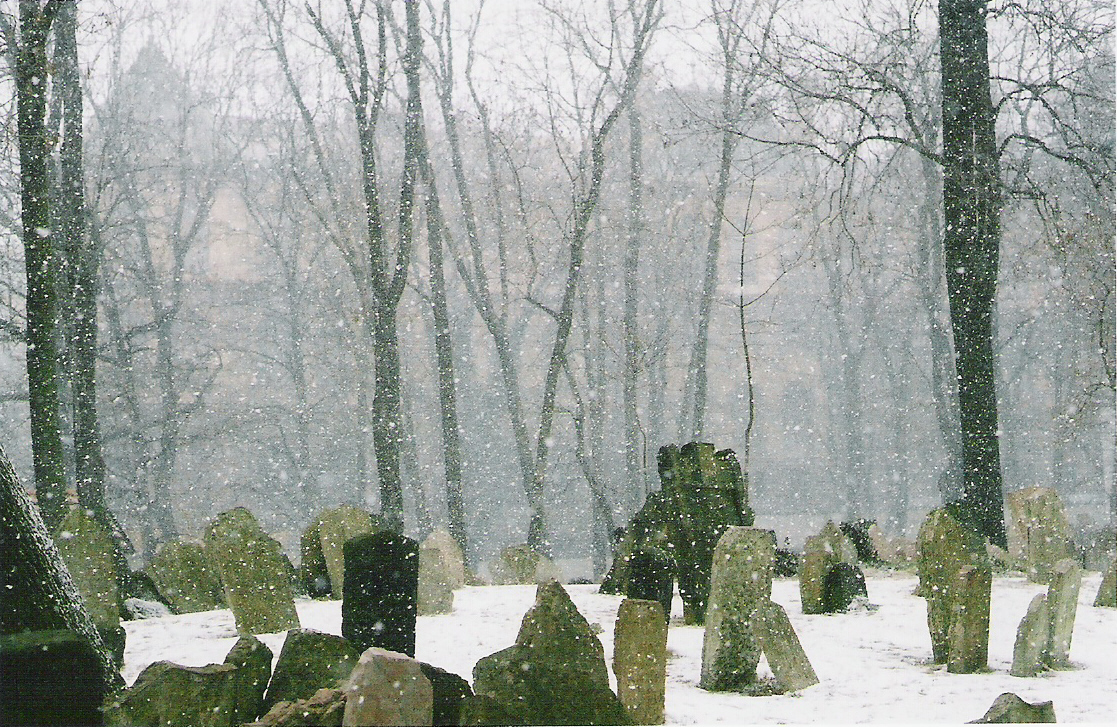
Dressed in a suit and standing alongside an unknown companion, I contemplated the soil at my feet, made hard by winter's bitter touch. I thought particularly about the difficulty of digging a grave in frost baked ground.

Looking up to survey the landscape, I realized that my macabre musing was only appropriate. My mysterious friend and I were in a vast cemetery; headstones freckled the gently rolling topography. My gaze returning to the hard soil in front of me, I recited the closing words of James Joyce's short story, "The Dead."
"It was falling, too, upon every part of the lonely churchyard on the hill where Michael Furey lay buried. It lay thickly drifted on the crooked crosses and headstones, on the spears of the little gate, on the barren thorns. His soul swooned slowly as he heard the snow falling faintly through the universe and faintly falling, like the descent of their last end, upon all the living and the dead."
As if the Joyce lines were an invocation, snow began to fall.

+++

Over the course of fifteen years, I've read "The Dead" several times. Never have I been especially moved by the story's mundane events, but the closing paragraphs stay with me. Even after reading my favorite of Joyce's works, "Portrait of the Artist as a Young Man," and later happily slogging through the rather self-conscious "Ulysses," it is the final words of the short story that first come to mind when someone mentions Joyce.

It's a curious thing that the art most significant to our unconscious is not always held in high regard in waking life.

Photo credits: Old Jewish cemetery from Bygning's Flickr photostream

Thursday, January 15, 2009

Coasts


Steep Ravine Trail, Mount Tamalpais, December 29th, 2009
"The deepest level of communication is not communication, but communion."
Elizabeth and I devoted the afternoon of my thirty-first birthday to striding down (and then huffing back up) the aptly named Steep Ravine Trail in Mount Tamalpais State Park. During our descent, we paused for a few minutes on a stocky wood footbridge spanning a shallow gully stream. I leaned against the bridge's handrail and appreciated the subtle play of sunlight on the forest's understory, then tilted my head far back to admire the towering canopy. A bird call punctuated the stream's casual susurration.

The impressive montane forest brought to mind a quotation I copied into one of my commonplace books some years ago. In his account of an interview with a Venezuelan native, the celebrated 19th century German naturalist Alexander von Humboldt claims that the Indian critiqued the Christian God of the European explorers and conquerors, observing, "Your god keeps himself shut up in a house as if he were old and infirm. Ours is in the forest and in the fields and on the mountains when the rain comes." Although no rain graced Mount Tamalpais this December 29th, the Indian's god was also mine.


Steep Ravine Trail, Mount Tamalpais, December 29th, 2009


Mount Tamalpais is located in southern Marin County, California, just north of San Francisco. The lush Douglas fir and redwood forests of the region are magical places. They served as inspiration for George Lucas's forested moon Endor and they call to mind the epic majesty of J.R.R. Tolkien's Middle-earth. (In fact, some "Star Wars" fans reasonably suggest that Lucas named his verdant moon in homage to Tolkien. Tolkien, a celebrated linguist and scholar, invented languages for his fantasy fiction and in the Quenya tongue, one of the elvish languages he created, the word for Middle-earth is Endor.)

Of all Tolkien's creatures, the elegant and noble elves of Lothlorien especially appealed to me when I first read "The Hobbit" and "The Lord of the Rings." The elves are wise, fair and gracious beings, but also wild, intimately attached to the world of the hunter and to Nature's ambivalent magic. Twenty years after my first reading of Tolkien's fantasy epic, I still proudly characterize myself as a Nature worshiper.

The economist and sociologist Max Weber famously said that the secularization of society and increasing specialization of methodological inquiry had led to a "disenchantment of the world." Indeed, they have, but Baruch Spinoza's brand of naturalistic pantheism allows for a happy marriage of the material and metaphysical worlds. The two spheres, like the taijitu's yin and yang, are complementary parts of a whole. Necessarily, then, exclusion or disparagement of one of these two realms is limiting.

Although the Enlightenment's separation of reason and imagination, and of science and religion, has yielded exemplary human achievements, it also alienates us from the integrated aggregate. We no longer conceive of the universe (or our experience of it) as coherent or unified; since at least the 17th century, the prevailing philosophical current is Cartesian, depicting the universe as a random assemblage of disparate parts. As a result, those individuals who, like the brilliant 19th century critic John Ruskin, strive to reconcile "the broken harmonies of fact and fancy, thought and feeling, and truth and faith" are considered naive or fey. Even Gershom Scholem, the renowned historian of Jewish mysticism, described his philosopher friend Walter Benjamin's work as "an often puzzling juxtaposition of the two modes of thought, the metaphysical-theological and the materialistic." I align myself with the philosophical dissidents because, like Ruskin and Benjamin, I feel that the material and metaphysical realms are locked in a harmonious, reciprocal relationship. Framed another way, I believe that the mundane is the sacred; I deny the divisive "and."
"My dear brothers and sisters, we are already one. But we imagine that we are not. So what we have to recover is our original unity."

Steep Ravine Trail, Mount Tamalpais, December 29th, 2009


That December evening, Elizabeth and I motored along Grizzly Peak's ridge line and, as the Pacific horizon took the sun, we admired the colorful strata deposited over San Francisco's hills, city lights and bay. Later, after a lovely dinner in Berkeley, we returned to Elizabeth's home and relaxed with her parents and brothers. It was a superlative day. Yet because I'm accustomed to spending my birthday in brooding solitude, it was also an exceptional one, and therefore I wasn't surprised when, driving to Grizzly Peak, I felt a twinge of regret.

To be sure, the day was nearly perfect, but I had to ignore the call issued by the deep blues and purples of twilight, an invitation to submerge myself in the gathering darkness. I remarked to Elizabeth that it felt very strange to observe my birthday without making space for rumination. We turned onto Grizzly Peak Boulevard. I watched the car's headlights rake across a stand of trees, frightening back the dark.


View of Berkeley and San Francisco Bay, December 29th, 2009


The Trappist monk Thomas Merton described his contemplative practice as "death for the sake of life." Merton may be guilty of rhetorical flourish, but one of contemplation's principal goals is the erasure of self or the death, if you will, of the self-conscious individual. I consider myself lucky; I once experienced release from the first-person, a rare gift in our culture of consumption and distraction. I consider those exceptional moments an ecstatic opening to The All, a glimpse of the integrated, infinite universe.

The word ecstasy is derived from the Greek word for "to stand out of place." On the dike at Heron's Foot, my conscious being was literally outside (or at least without) the self. For a time, the atoms, molecules, cells and organs that comprise "me" were undifferentiated from the greater web. Religious mystics usually refer to this variety of fundamental experience as "seeing God." That name bothers me less than it did in my militantly atheistic adolescence, but I prefer The All (or an apophatic counterpart, The Nothing) because the name possesses majesty and mystery but none of the unfortunate authoritarian baggage. Furthermore, the rituals of institutionalized religion and its "under God" subjects are no more or less valuable than the rituals of the heathen mystic. John Dewey's "live animal" might just as easily be awakened in the gropings of sex as in penitential prayer, and God is just as easily found in the forests of Mount Tamalpais as in the acolyte's cathedral. After all, there is nothing supernatural about ecstasy; it is only a mode of hyper awareness, a more immediate connection to the universe, or at least as much of one as our limited vessels can perceive.

Now, January already half gone, I sit at my day-job desk and look out on Manhattan's East River. The late afternoon sun's angled glow paints the 59th Street Bridge in peach-yellow and refracts off the west face of Citibank's glass obelisk in Queens. A herring gull flaps over Roosevelt Island and the river runs slack as it awaits the pull of outgoing tide. In "Rewriting Nature," an essay published in The New Yorker, Adam Gopnik wrote "[Charles] Darwin disenchanted believers in Heaven, but he reenchanted lovers of Earth."

I concur.
"What we have to be is what we are."

Office window view; East River, Roosevelt Island and Queens, January 2008


Note: all indented quotations, Thomas Merton

Photo credits: all images, Hungry Hyaena, 2008

Friday, December 12, 2008

December

Perhaps it is winter's bleached shadow light and contemplative spirit that keep me quietly aglow. Even some recent (and unfortunate) surprises haven't dimmed my mood. They have, however, resulted in little writing and less studio productivity, deficits I hope to address in short order.

Still, December is with me, and I am happy.

I wish you all a happy holiday season and beyond!

Wednesday, November 05, 2008

Rothko's Darkness

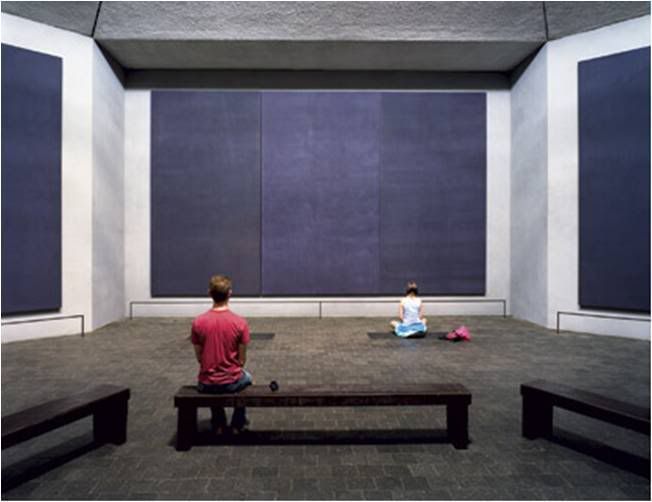
Interior photograph of Rothko Chapel, Houston, Texas
Completed 1971
"It is at once a reduction of the whole of the universe to the infinitesimal point of the anxious self and an absorption of the self in the eternal calm of the sea of being." 
-Rabbi Jacob B. Agus
In the September 26th edition of The Guardian Weekly, the opinionated British art critic Jonathan Jones describes his visit to Mark Rothko's chapel in Houston, Texas, as "a pilgrimage to the greatest marriage of art and architecture in the US." Jones worries, though, if the chapel is misunderstood, or even misused, by American visitors.

For the British critic, the Rothko chapel is "one of America's greatest and strangest monuments: a chapel created by a modern artist who had no religious beliefs." Jones is dismayed, then, to find that many visitors to the chapel are anything but irreligious.

Inside Rothko's master work, a fellow chapel-goer asks the critic if he sees in one of the over-sized paintings "the figure of Jesus Christ our Lord on the Cross?" Jones writes, "I look into the gigantic abstract work. It contains no images, Christian or otherwise."

Jones is clearly bemused that the chapel is today regarded by so many as a sacred space, and he chalks this interpretation up to our American religiosity.
"Locals use this place. They love it. They come not as tourists but to meditate, pray and talk sombrely. They see it as a religious place and the art as spiritual. It is called a chapel, and most Americans believe in God."
Jones feels Rothko would be similarly befuddled by the religious interpretation. The critic explains that Rothko designed the chapel to take "his pursuit of...the 'tragic' to its ultimate extreme" and that the artist "believed that all serious art was about death." Undoubtedly, Rothko had a fatalistic, deeply melancholic streak - he killed himself in 1970, one year before the chapel opened - but I'm not sure that the artist would, like Jones, bemoan the religious significance of his chapel.

A Russian Jewish immigrant, Rothko (originally named Marcus Rothkowitz) certainly didn't intend visitors to see Jesus Christ in his large canvases, but he was not, as Jones contends, a man "who had no religious beliefs." In fact, Rothko's father was an Orthodox Jew and the young Rothko spent time in Russian cheders before his 1913 emigration to the United States. After his family settled in Portland, Oregon, Rothko became active in the local Jewish community. Whether the future artist's connection to Judaism was principally cultural or spiritual, I do not know, but later in life he frequently described the making of his paintings as a religious experience.
Interior photograph of Rothko Chapel, Houston, Texas
Completed 1971

So what was Rothko thinking when he undertook the chapel project, and what did he intend the space to be? We can only speculate.

For his part, Jones asserts that the paintings act as doorways or portals. I agree, but the British critic insists that they are "portals of death." Jones sees the blackness of Rothko's chapel paintings as "utter desolation," blackness that shatters "any illusion of paradise." The chapel overall Jones describes as a "theatre of emptiness, death's antechamber, the self-expression of a suicide." He dismisses other interpretations, claiming that, if the Texas oil barons who commissioned the project understood more fully Rothko's deathly intentions, the chapel would not have been built.

But the blackness in Rothko's late works can also be understood as nothingness. Negative theology, more commonly referred to by the Latin via negativa, breaks down the word "nothingness" into "no-thing-ness." God, according to negative theology, is ineffable; literally, It, that is to say, God, is No Thing. As Lao tzu, author of the Tao Te Ching, wrote in that essential text, "The unnamable is the eternally real...Darkness within darkness. The gateway to all understanding."

This mystical conception of God or Being would be familiar to an educated Jew like Rothko. The Jewish Kabbalist notion of Ein Sof springs from a medieval Spanish Jew's exposure to Eastern philosophy. (Most historians agree that Moses de Leon, a prominent Spanish rabbi, composed the Zohar, the central text of Kabbalah, in the late 13th century. Some of these scholars argue that de Leon's work is a syncretic project, injecting tantra and other Eastern thought into the ever-evolving Jewish tradition.) Ein Sof, translated from Hebrew to English, literally means "there is no end." It is the unquantifiable, ambivalent and infinite energy that exists before, within and after the more mundane conception of God. The kabbalists, though, take their negative theology one step further. Ein Sof is the ineffable All, but Ayin, or "nothingness," is Ein Sof rendered finite. Some Jews consider Ayin the cosmic potential extant prior to the Big Bang.

Daniel Matt, a leading scholar of Kabbalah, writes in "God and the Big Bang":
"The paradox is that ayin embraces 'nothing' and 'everything.' This nothingness is oneness: undifferentiated, overwhelming the distinctions between things....This mystical nothingness is neither empty nor barren; it is fertile and overflowing, engendering the myriad forms of life. Medieval philosophers - Jewish, Christian and Muslim - had taught that God created the world 'out of nothing.' The mystics turn this formula on its head, reinterpreting it to mean that the universe emanated from divine nothingness."
For some religious individuals, concepts like Ayin and Ein Sof allow a point of entry. Rabbi Richard Rubenstein, a Jewish scholar and writer, speaks of God "as the Holy Nothingness." Detailing his turn from secularism to faith, he writes, I "replaced my atheistic nihilism with a mystical nihilism. To be all that there is, as God was in the beginning and will be in the end, is equivalent to being, so to speak, absolutely nothing. In the beginning, God dwelt in the womb of his own omnipotent nothingness." I love the contradictory nature of such a God!

Likewise, religious mystics of all persuasions believe that individuals must embrace darkness in order to find spiritual integrity. They must, as the prominent Rabbi Arthur A. Cohen put it, "...[surrender] to unknowing, [enter] the 'dark night' of which all mystics speak - a metaphor for the condition of desperate ignorance - and there [identify] a frail connection between the emptying of the self of all knowledge, the abandonment of knowledge, the perfect unknowing which enables the process of knowing to be renewed and the being whose existence renews. It is the passion of thought and the desire to know which presses us to the limit where thought cannibalizes itself in despair, where knowing ceases, where the emptying of the self is undergone and the fullness of God may commence."

Those chapel-goers who claim to see in Rothko's paintings Jesus Christ, Muhammad, Buddha, or any other religious hero are guilty of unimaginative literalism but, if their experiences are real, they are "seeing" through darkness into spirit. I believe that Rothko, an artist much invested in mythology and mysticism, would respect and even commend that.

Jones writes in The Guardian, "[The chapel] is not an austere, dead, modernist monument. It's a living chapel. People sing and play music. But maybe they should look around a bit more - because this is one of the most compelling rooms I have ever been in."

But why should these religious visitors have to stop worshipping, singing or otherwise participating in the work to take (what Jones considers) due notice of the room's quality? Given the power of the space, might not the room compel their behavior? Rothko insisted that he was no mere maker of abstract paintings. "If you are moved only by their color," the artist said of his mature works, "then you miss the point."

Photo credits: images ripped from HASTAC on Ning

Thursday, September 25, 2008

Almost Twilight


"Darkness within darkness.
The gateway to all understanding."
-Lao tzu, "Tao Te Ching"


In New York, recent mornings have greeted us with a pleasant chilliness. Fall is almost here, and winter is just around the corner. For most folks, the prospect is daunting. Not so for me. Each year at this time, a bounce finds my step and I'm happily overwhelmed by a spate of ideas. I know, however, that the creative juices will before long transmute into keen brooding. Late fall and winter nurture a pensive mind.

When the afternoons darken and the mercury dips, I like to take bundled winter strolls through the streets of Manhattan or Queens. Other pedestrians hustle about, intent on achieving their respective indoor destinations, but I find my thoughts best served by a steady pace, one forgiving of some intentioned aimlessness. I spend these walks looking up to where the melancholic sky meets the buildings that scrape it, admiring the resilience of foraging House sparrows, taking note of the way traffic lights glow more brightly in crisp, cold air and marveling over the many lives that move around me. I like to think of this mindful meandering as a form of prayer, or perhaps a communion, and I treasure the insights that are sometimes happened upon.


Curious about the rites, beliefs and texts of various religions (and particularly those of Judaism), I've been thinking this week about the coming high holy days. Next Monday is Rosh Hashanah, the first of Judaism's ten "days of awe," or Yamim Noraim. Like my winter walks, the Yamim Noraim are given over to contemplation. During the ten high holy days, an observant Jew should meditate on the actions of his last twelve months and, then, on Yom Kippur, the last of the "days of awe," fast and repent for any wrongdoing. In other words, a conscientious Jew begins the new year by reckoning with his past. Although Rosh Hashanah is only one of four Jewish New Years, each attached to a specific set of guidelines and meaning, I find the holiday's position with regard to the seasons of particular interest.

Considered the New Year for humans, animals, calendar calculation and contracts, Rosh Hashanah arrives with the ploughing of summer into fall. If one considers fall equivalent to dusk and winter to night, then the Jewish New Year, in the northern hemisphere, like the Jewish day, begins at twilight. This interpretation does not hold with regard to the geography and climate of the Torah's narrative; Palestine is (and was) a land with only two notable seasons, called in the Talmud "the days of sun" and "the days of rain," but our understanding of scripture, be it theological or scientific, must change with context if it is to remain relevant to our contemporary lives. The notion of a day extending from sunset to sunset runs slightly counter to the popular conception of morning time as a birthing, or spring, with the hours moving then through summer at mid-day, fall in the evening and finally into winter, night and death. But the Judeo-Christian tradition is pastoral, founded on an agricultural reckoning of the lunar and solar cycles. It makes sense, then, that the day should end as light fades or vanishes, and begin again while it remains dark. In rural farming communities, this pattern holds today, though the blue glow of television has altered habits in even the most rural of counties. Still, as Oscar Wilde, a consummate urbanite, quipped, "people in the country get up early because there's so much to do. They go to bed early, because there's nothing to talk about."


Growing up in such a community, I learned early that if twilight is a conclusion for the farmer, it is a commencement for many other creatures. A patient hunter who remains in his deerstand as the final light retreats might see bats dart and dip in aerial pursuit of insects. He may also see an opossum, fox, raccoon, skunk or even his intended quarry, deer, though it is not legal to shoot after the sun sets. Driving or biking on "backroads," these animals reveal themselves by reflecting light from a car's headlights or a bike's front beam. The tapetum lucidum, a layer of tissue behind the retina of crepuscular and nocturnal species, allows the animal to see better in near or total darkness, but this layer also produces eyeshine that discloses the creature's presence to human torch bearers. Depending on the species and the angle of approach, we can identify the animal by the color of its eyeshine: the white-yellow lights at knee height belong to the red fox; the orange orbs in the low branches of a tree are an opossum; the yellow beams tall over the road are white-tailed deer; the brilliant white spots that appear so near the ground expose a resting whippoorwill.

Imagine the shock of the early humans when they first noticed the glowing embers that moved just outside the reach of their warm firelight. The agricultural tribes that would become the people of the Torah, having abandoned much of their nomadic, hunter-gatherer roots, were particularly afraid of the dark, creeping world outside that circle of light. To be caught in the gloaming, away from a human settlement or encampment, was surely a terrifying possibility.

Indeed, the dark months, like those black, antediluvian nights, remain an ordeal for many people . But they can also be understood as a gateway opportunity. It is fitting, I think, that Jews begin their new year by taking stock, a formidable task if undertaken with thoroughness and honesty. I approached my experiences with hallucinogenic drugs in an analogous way; what most people would call a "bad trip," I viewed as an opportunity for introspection. 'Why has my brain created this awful idea?,' I asked myself. 'What does that tell me about my relationship to x or y, or about my fear of a, b or c?' The cold, gloomy months, like bad trips, nightfall and deep melancholy, can be challenging, even endangering, but in an increasingly mediated and accelerated world culture, the difficult passages are of premium value.


I'm neither Jewish nor properly Christian, despite an Episcopal baptism. I wouldn't describe myself as lapsed, either; from early adolescence, I proudly labelled myself an atheist. Today, however, I prefer the term pantheist, and I find my interest in faith choices and spirituality reinvigorated, though my conception of God is fundamentally unchanged from my Nietzsche-Nine Inch Nails days.

I've taken particular interest in Jewish practice, both historical and contemporary, although the concept of an omniscient, interventionist creator is anathema. Unitarian Universalism, a relatively young sect that grew out of Unitarianism, is also exciting to me, though it is so all-inclusive and plural - Christian, Muslim and Jewish believers sit in UU pews alongside Buddhists, atheists and agnostics - that it might be more fairly deemed an ethical community than a religious sect. But whatever label I eventually pin to my lapel (or discard), periods of solemn self-examination are likely to remain a critical part of my identity and annual experience, and these have so far coincided with winter and come on the heels of a fall surge in the creative impulse.

Although modernity misunderstands fall to be the beginning of an end, it is only another beginning. Shana tova umetukah, folks. My favorite season is moving in, and our shadows grow longer.

Photo credits: "Athens Park, Astoria," "Central Park, Manhattan," "Heron's Foot Moon, Virginia," "Branches," all by Christopher Reiger, 2007 and 2008

Friday, August 08, 2008

An Inner Untidiness Too Vast...

...to be tamed by secular means


Most professional art critics accept modernism's conceit that art progresses linearly, movement begetting movement. Their promulgation of this outmoded precept is surprising and disappointing.

Art, as with all other forms of cultural development, moves in random hiccups and circles. It resembles more the wanderings of a drunken homebody than modernism's straight line ideal.

In "Feeling Blue" (The New Yorker, August 4, 2008), Peter Schjeldahl's recent review of "After Nature," a group show currently installed at The New Museum, the critic observes "something...happening in artists' studios: a shift of emphasis, from surface to depth, and a shift of mood, from mania to melancholy, shrugging off the allures of the money-hypnotized market and the spectacle-bedizened biennials circuit." He goes on to declare that younger artists are assuming "a backward crouch preceding a forward leap" because "[a]bruptly, once-settled views and values have unsettled themselves and stalk the mind."

His suggestion that a loosely defined trend is indicative of imminent sea change is tidy and exciting but, like the notion that avant-gardism is central to a healthy culture, it is misguided. Many artists - including some of those participating in "After Nature" - have been making deep, melancholic work for years. The shift of emphasis is not in their studios, but instead on the curatorial front, where the administrators of the arts industry, themselves unable to shake off the modern canon and dreams of Life magazine covers, are responding to the media frenzy around all things "eco-": ecology and economy. How many open-calls for "green-themed" group shows have we seen of late? And how many new gallery or non-profit side-projects devoted to addressing "issues of the environment"? I'm buoyed by these developments, but the impetus is managerial and directorial; the artists embraced by these new shows and venues have, for the most part, been there all along.

Near the article's end, Schjeldahl calls for a hero. "What we want now is a major artist - a Manet, Picasso, Pollock, Warhol, or Beuys - who will manifest durable truths at the core of inevitable hypes and hyperboles. If none such appears, that will be a valuable datum. It will help us adjust to the happenstance that, once and finally, our particular civilization is spent." Ignoring the rhetorical overstatement, I appreciate the anxiety that Schjeldahl and other intellectuals feel. Amos Oz describes globalization as "a sort of infantilization of the entire human race." The prominent cultural historian Morris Berman argues in his book "The Twilight of American Culture" that most of what ails the contemporary world - social and economic inequality, xenophobia, declining resources and literacy, and a debilitating spiritual void - grows from our pandemic culture of superficiality and postmodern dullardism. Both Berman and Oz are right but they're also wrong. To characterize an inevitable process as infantile is itself infantile, and although the Enlightenment and it's fascist successor modernism both allowed for the championing of reason and so-called progress, the shrinking world is simply too complex for a strictly left-brained approach. It's proving difficult for our dualistic brains to accept that the good guys don't necessarily wear white.

But if Schjeldahl and the arts industry insist on a standard bearer for this flood of anxious melancholy, they needn't wait for one to appear. Werner Herzog, whose 1992 film "Lessons of Darkness" is included in "After Nature," is an influential hero to a great many younger artists, myself included. The German director and writer combines Manet's keen observation and social sensitivity with Pollock's violent, self-destructive embrace of the chthonian and Beuys' playful intellect and deep faith in the spiritual value of art. He is the "major artist" Schjeldahl calls for.

When I feel the poison mercury of misanthropy rise in me, I revisit this clip from the 1982 film "Burden of Dreams." Though Herzog's language is harsh, his observations are essentially celebratory. Sometimes, his comments are laughably bleak: "There is some sort of harmony; it is the harmony of overwhelming and collective murder." Even so, his tone, posture and face betray a wounded sensitivity.


Watching the excerpt, I'm reminded that other people are emotionally stirred by the terrible, indifferent beauty of nature's doings. I want to embrace Herzog and his complicated mess of a mind...and I'd wager that a great many other artists do, too.

Note: The title of the post is stolen from another contributor to The New Yorker: Don Chiasson wrote of T.S. Eliot possessing "an inner untidiness too vast to be tamed by ordinary secular means" in "Fire Down Below," a review of Les Murray's poetry in the June 11, 2007 issue.

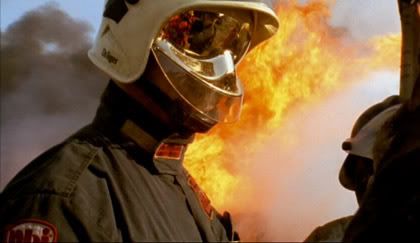
Photo credit: Still from "Lessons of Darkness," 1992, Werner Herzog; Excerpt from "Burden of Dreams," 1982, Les Blank

Friday, January 11, 2008

Where Has All The Strangeness Gone?


Roosevelt Island and Queensboro Bridge, October 2007


Before moving here in 1999, I romanticized New York City in my way, naively imagining it America's own Victorian London. I believed I would rub elbows with prostitutes and hustlers as often as artists, dancers and yuppies. I also believed - this correctly - that New York, Boston, Philadelphia and Baltimore belonged to a special group of American centers, settlements that proudly wear scars of their younger days and offer exciting local histories on every block. Sadly, even the latter assumption is proving false, or, at least, less true than it used to be.

Yesterday evening, I sat in a West Village pub named after a one-time London establishment. To my left was a hearth, on which a small pile of gas logs "burned" pleasantly. The pub's decor and wood paneling were also counterfeit; the Guinness, fortunately, was not. I divided my time between eavesdropping - on a conversation about the American tendency toward Bush/Clinton rule and, for comic relief, a movie trivia game involving an astoundingly clueless couple - and reading the excellent, but depressing "Mystery on Pearl Street," a piece by Burkhard Bilger included in the January 7th issue of The New Yorker. The article details the story of 211 Pearl Street, a building almost approved for protection by the NY Landmarks Preservation Commission, but instead demolished to make room for a(nother) high-rise condominium and office center.

Early on in the article, Bilger supplies readers with this distressing fact: "New York demolishes more old buildings every month than most American cities have standing...in an average year, about two thousand buildings are torn down." Later, Sean Wilentz, a professor of history at Princeton University, puts it to Bilger thus: "New York, to me, is becoming less and less mysterious. Its ghosts, its revenants, they don't have a place to walk anymore. They are being squeezed out....I don't mean to sound like an occultist, but a little bit of strangeness is important to Manhattan."

In the last six months - SIX MONTHS! - four new condos rose on my block in Astoria, Queens; the footprint of another has just been cleared. From my office on Manhattan's East Side, I look down on Roosevelt Island, once named Welfare Island, and see condo after condo ascending. The papers remind us each month of the "exodus of the creative class," a phenomenon attributed to escalating rents and the ever increasing cost of living, but those are not the only factors responsible.

Personally, I'd rather live in a place where the spirits linger. Is Europe the only refuge?


Roosevelt Island and Queensboro Bridge, January 2008

Tuesday, January 01, 2008

A(nother) New Year


Born shortly after the northern hemisphere's winter solstice, on one of the year's darkest days, I'm accustomed to quiet, contemplative birthdays, and my thirtieth was no exception.

After waking, I drove a short distance from my parents' house to a place where I'd several days before noticed a deer carcass dumped in a roadside ditch. My choice of subject intrigued the few motorists that passed. Their cars slowed to a crawl as they peered through rain-streaked windows, concerned eyes moving from the rotting mass of flesh, fur and bone to me, hunched over my camera in the cold drizzle. Hoping to allay any misgiving, I smiled cheerfully and waved.

Later, in fading afternoon light, I stood on the Heron Hope dock and surveyed the marsh and estuary while my father plucked and gutted three mourning dove he shot in a friend's field. The air was humid and chilly. I held open a bag and my father deposited the cleaned bodies of the little birds, one after the other. Some crows called from the southwest, and an impressive flight of black ducks passed overhead on squeaky wings.

After nightfall I shared a meal with my parents and a friend. We discussed presidential candidates, the increasing surreality of American elections, San Francisco's changing neighborhoods, and the ahistorical silliness of transplanting sports franchises without changing the team name. We bled two bottles of merlot before I switched to beer and watched some Dave Chapelle stand-up on television.

Pleasantly buzzed and heavy with holiday treats, I eventually lay down on the couch, another year older, but more happy than I've been in years.

It's a rare, curious thing when one's perception of life transitions from the regular line of past, present and future to an ambiguous cycle of individual moments. This mode is necessarily fleeting, so difficult is it to reconcile with contemporary life. We flip through scrapbooks and retell stories of our youth; the ball drops, the clock counts down and the crowd's vague, anticipatory energy crescendos; a mark is made, the number changed; the owl falls on the quivering chaff.

Ring in the year of the brown rat. I'll also ring in another decade.

Photo credit: Hungry Hyaena, 2007

Sunday, October 28, 2007

Nightwalks


"This is thy hour O Soul,
thy free flight into the wordless,
Away from books, away from art,
the day erased, the lesson done,
Thee fully forth emerging, silent, gazing,
pondering the themes thou lovest best,
Night, sleep, death and the stars."

-Walt Whitman (1819-1892), "A Clear Midnight"
(from "Leaves of Grass")

Photo credit: Hungry Hyaena, 2007

Thursday, September 27, 2007

A Ring-billed Gull

Sitting at my office desk this afternoon, I feel hollow.

A ring-billed gull catches my eye as it dips over the surface of the East River. Mesmerized by the bird's fluid flight, I recall a much pilloried line from the film, "American Beauty." "There's so much beauty in the world. Sometimes I feel like I'm seeing it all at once, and it's too much." Plastic bags, gulls, the little cactus sitting in my windowsill, the riot and filth of the subway platform; all of these things are extraordinary in their very ordinariness.

I learned yesterday afternoon that a friend of mine killed herself. She was a brilliant young philosopher and much sought after in her field. She was also insightful, an excellent observer and counselor of people. Not long ago, on a warm spring evening, she offered me her ear and thoughts when too many bottles of wine had me wrestling with some sad personal history.

Yesterday afternoon, just after I learned of her suicide, I fondly recalled a shared cigarette and conversation on an estuary dock. I also thought of her phobia of cameras, and my torturing her with surreptitious snapshot attempts, she half smiling, even if irritated by my childishness. I remember how fair her skin was, and her subtle smile and little girl's laugh and how I felt cheered by the sight of her curled up in a chair or at one end of a couch with a heavy-spined book and blanket for company.

Yet now there is more to think about. Sometime early Wednesday morning, unknown to so many who care deeply for her, she slipped away and drowned herself.

She was twenty-eight years old. She'd had twenty-eight years of taking in the extraordinary in the ordinary, and I just can't for the life of me understand why she didn't want at least that much more. Contemplating the 'whys' is baffling and sad.

In any case, there is her memory, but the pain she has caused for those who loved her dearly - her husband, her parents, her siblings - is difficult to fathom. I feel fucking sick.

I watch the gulls and the Roosevelt Island tram rocking gently as it carries a load of people from Manhattan.

Sunday, September 23, 2007

And so the Artist Arts


Matthew Offenbacher
"Recognizing the diligence with which death approaches, and trying to recognize also the desirability of her arrival, and to take advantage of such recognition"
2007
Oil, acrylic and pieced canvas on canvas
52 1/2 x 32 inches


Six years ago, a roommate's girlfriend brought home the following Frank Gehry quotation, drawn from his essay "The Relationship Between Art and Architecture."
"The true artist is like a drug addict; he dwells in a tight little dream world all his own, and the men about him, whom he observes obliviously spending their days pursuing money and power, genuinely puzzle him, as he doubtless does them. He prides himself on being an unbribed soul. So he is byway of being a philosopher, too, and sometimes he makes art not because he suspects that so many of the other concerns of men are equally unimportant. Under his smiling coat of tan there often lurks a layer of melancholy and disillusion, a quiet awareness - and acceptance - of the fugitive quality of man and all his enterprises. If he must chase a will-o'-the wisp he prefers that it be art. And so the artist arts. It is at once an act of humility and small rebellion. And it is something more. To him his art is an island of reality in a world of dream and shadow."
The girl remarked that, although most of the artists she knew didn't fill Gehry's bill, she'd thought of me when reading the quote. I was flattered. But rereading the passage with the two preceding posts in mind, I'm a bit ashamed.

Art became a commodity in 5th century BC Athens, when particular works by celebrated artisans sold for vaulted prices. Ever since that time, the responsible artist must doubt her calling. Working principally in the service of money, with frayed or broken connections to community, ritual and utilitarian purpose, is an unnerving affair.

It is true, as Gehry states, that the "true artist" is melancholic and disillusioned, but it is not only because he considers the absurdity of existence. He is also aware that art making is now divorced from its root impetus.

Photo credit: courtesy the artist

Monday, August 06, 2007

The Meaning Fetishist

Sitting at a slightly sticky table in Terminal H of the Miami International Airport, I take large bites of a Quiznos veggie sub sandwich. I'm exhausted.

A cancerously tanned woman with an ugly, unidentifiable accent passes by with her son, a pale long-haired kid in a NASCAR t-shirt, in tow. "They need to give Britney another chance," she says. "I mean, jeeeez." The boy doesn't appear to be listening.

Having just returned from Brazil, I hear snippets of conversation as I would an unfamiliar language; I focus more on tone and stress than specific meaning. Had I still been in Sao Paulo, I would have assumed that the mother was talking of something more significant. This habit probably explains why, at almost thirty-years of age, I hold on to the generally ridiculous assumption that people not American are better informed and more thoughtful.

A young black boy approaches. He's wearing a Miami Heat jersey. He throws a glance my way as I take too big a bite of the greasy mess Quiznos calls an Italian Caprese.

A fan of cliches, I assign a hunger to his eyes and, in doing so, recall my observations of Shawn Marion, small forward for the Phoenix Suns, who shared my flight from Sao Paulo to Miami. A muscular 6' 7", Marion nevertheless had a traveling companion, a small man with a tidy mustache, retrieve all of his luggage from the baggage carousel. As each bag appeared, Marion grunted and gestured in acknowledgment. In response, his companion, at least twenty years Marion's senior, removed the bags, neatly stacking them on an extra long cart. Five tall, teenage Brazilians milled about in gold chains and cock-eyed caps, speaking Portuguese and laughing. Marion kept his eyes on the carousel.

I take another bite of the Caprese.

A hugely obese white woman seated with an average sized fellow to my right holds up a nacho dripping with cheese. "Human beings," she says as she contemplates the loaded tortilla chip. Then she eats it.

I stare at her. What could that remark mean?, I wonder. What sort of profundity is she up to?

Then I realize that she actually said "Leave some beans."

I'm exhausted.

Friday, March 02, 2007

Gallery Report; February 23rd, 2007

With most of the New York art world flocking to one or all of the art fairs that opened in the city last week, I assumed that the Chelsea galleries would be relatively uncrowded. Such circumstances make for good art viewing; I can engage work for a longer period of time if I am undistracted by familiar faces or the appeal of people watching.

A chilly wind blew strong off the Hudson River, energizing me further, and I visited almost thirty shows. I had planned to mention more than the five below but, as I've written here often of late, "my energies are directed toward the studio," and writing about other artists' work only makes me want to work on mine that much more.

+ + + + +


Julia Randall
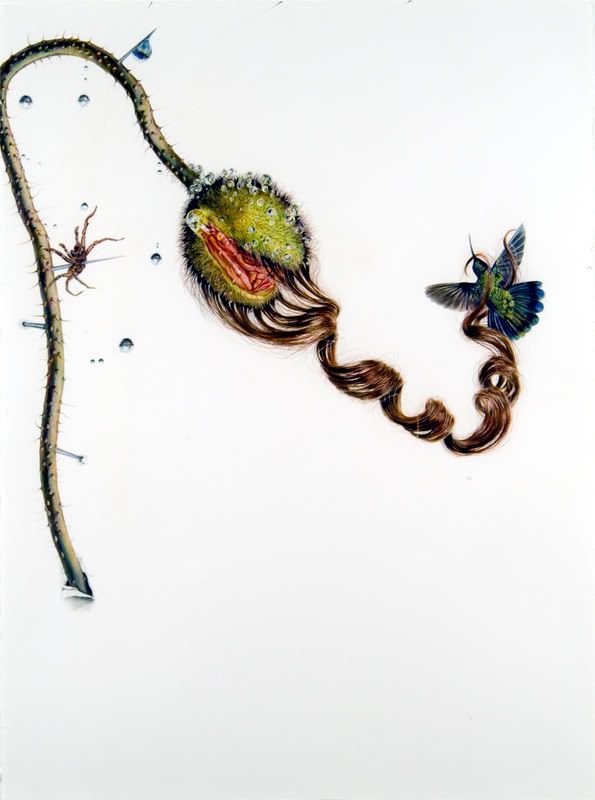
"Decoy #8"
2006
Colored pencil on paper
30 x 22 inches

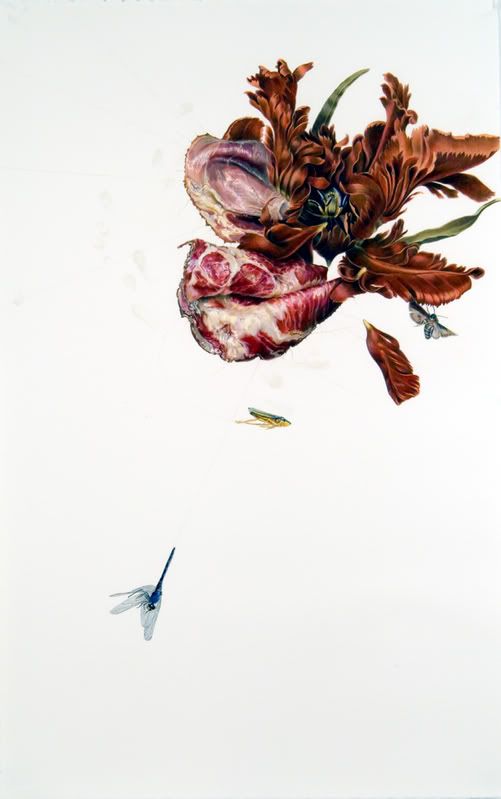
Jeff Bailey Gallery: "Decoys and Lures," Julia Randall's sophomore outing at Jeff Bailey Gallery, is impressive. Randall's works on paper showcase her sensitive technique. Her craft is impeccable, rivaling that of the finest botanical illustrators (of this or any other day), and she uses her superior skills to create contemporary artworks that are as beautiful as they are violent, and as whimsical as they are erotic.

Randall's "Lures" series is aptly titled; these sensuous colored pencil drawings focus on human lips. Viewers glimpse a bit of tongue here, some teeth there, but we're preoccupied with the moist flesh. It's generally difficult to take a long look at lips without becoming at least the slightest bit libidinous and, as I looked at "Lure #1," my own lips involuntarily parted in anticipatory wanting. That doesn't often happen when I contemplate artwork; for that matter, it doesn't usually happen when I look at fashion photography or any other medium that appeals to our id by focusing on organs associated with sexual signaling. Randall's "Lures," though, isolate the lips, making them a spectacle unto themselves. This is effective enough, but my appreciation of the "Lures" doesn't go much deeper, and I found myself considering the "Lures" conceptual studies for the "Decoys."


Julia Randall
"Decoy #4"
2006
Colored pencil on paper
41 x 26 inches

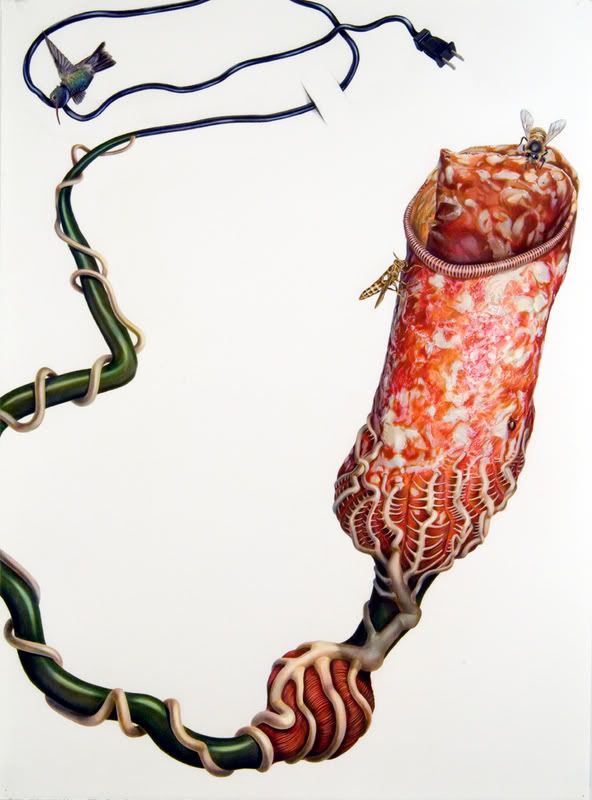
The "Decoys" are, as the gallery's press release states, drawings of "strange flowers and plants hybridized with human and animal traits." Indeed, many of Randall's creations are surreal riffs on carnivorous plants like the well known Venus Flytrap (Dionaea muscipula). The depicted hybrids are decoys in the sense that they bait or seduce other life forms into approach, and then devour or ensare them. Given the curious combinations seen in the series - pitcher plants meld with electrical cords; dental scrapers act as floral supports; belts and chains secure petals to stem - the work does, as the press release puts it, "hint at the perils of human meddling with the natural world," but there is still more visceral and complex content. The works warn of the practical, philosophical, and moral risk involved in genetic mutation and other biotechnology, but they also remind us that scientific exploration (indeed, our very curiosity) is instinctual and as natural as the rest of creation.

Randall's "Decoys" are celebrations of all Nature's orifices, physical and metaphysical, and of our natural desire to enter into and emerge from these orifices time and again. Viewers glimpse starry skies through several of Randall's flowers, an allusion to the scalar continuum. Further, the artist draws trompe l'oeil tears, holes, and sliced strips on her grounds, thus "implicating the viewer" in the ambivalent dissection and probing of her pictures. The human hand belts, cuts, pokes; it acts as an erotic investigator, at once involved in sex play, scientific exploration, and an ambivalent, feline violence. We can't help ourselves! The medical equipment and the metal thorns emerging from organic stems are fetish items and talismans of industrialized scientific inquiry. As Camille Paglia writes, "sex is probings, plumbing, secretions, gushings...the bloody open mouth of mother nature." But where Paglia would argue that science, the product of the male, or Apollonian mind, with its right angles and projections, is in opposition to sex, Randall's decoys remind viewers that things are rarely so dualistic. The lines drawn between male and female, man and animal, and science and art are increasingly indistinct.

Paglia has also written that "art is form struggling to wake from the nightmare of nature." Julia Randall's art, however, is form that embraces the "nightmare," celebrating the awesome sensuality of our apparently amoral universe. Paglia is correct to imply art's moral imperative, but moral and ethical actions are themselves an outgrowth of Nature, consciousness having evolved from morally blind, yet sensate material. Randall's works play with this ambivalent relationship. I left the gallery grinning, eager to find something to poke, in one way or another.


Julia Randall
"Decoy #6"
2006
Colored pencil on paper
46 x 34 inches

+ + + + +


Eva and Franco Mattes
"Harpo Jedburgh"
2006
Digital print on canvas
36 x 48 inches

Postmasters Gallery: Binary, the artist duo of Eva and Franco Mattes (aka 0100101110101101.org), is back. I was disappointed by their last outing at Postmasters. "United We Stand," a media campaign/send-up of "a Hollywood-style blockbuster," was, like most of Binary's work to date, an "incomplete, lazy affair that never really [got] off the ground." I was hopeful, though, when I learned the duo was working within (and presumably making work about) Second Life, the growing virtual community and market that is so much in the news these days.

Consider just a sampling of "real world" stories about Second Life in recent months.
- "First-Rate Art in Second Life" (Regarding the launch of the first "real world" magazine dedicated exclusively to the art scene in Second Life)

- "Second Life opens for business: Toyota, Circuit City, Dell, Sears and Adidas have set up shop in the S.L. virtual world"

- "Terrorists mock-bomb Second Life shops: Home-grown terror group wants democracy in the virtual world"
I assumed that after "living in the virtual world...for over a year" Binary would riff on some of these fascinating goings-on. Second Life, currently occupied by over 4 million inhabitants from all over the "first" globe, is a microcosm of our contemporary social and political geography. As such, it is a valuable mirror, ripe for rumination, dissection, or parody. Many of the artist groups and communities living and interacting in Second Life are aware of this. I salute them for it. (Second Life is the contemporary MUD (multi-user dungeon) and to better understand the value and psychological significance of these worlds, I recommend reading Julian Dibbell's terrific article "A Rape In Cyberspace: How an Evil Clown, a Haitian Trickster Spirit, Two Wizards, and a Cast of Dozens Turned a Database Into a Society," originally published in The Village Voice in 1993.)

So what does Binary bring back to us after a year's sojourn in Second Life? 13 portraits of the most popular and good looking Second Life celebrities. That's right, folks...surrounded as they must have been with so many fascinating socio-political happenings in that world, Binary opts to present gallery visitors with shots of Second Life's equivalent of Justin, Lindsey, and Paris! I suppose one could argue that rendering our culture of distraction and celebrity in this fashion is meritorious, but I fear the end result is as forgettable as the lion's share of our superstars.

Also irksome is the patronizing tone Binary takes in the gallery's press release. They refer to their time in Second Life as a "flanerie," and they (or the gallery) characterize the inhabitants of the virtual world as "peculiar." So once again, Binary, I thumb my chin and leave." This duo has a knack for turning promising ideas into stupid and vapid art. I have little hope left for these two. The art world should be embarrassed by Binary's lowest common denominator appeal.


Eva and Franco Mattes
"Nyla Cheeky"
2006
Digital print on canvas
36 x 48 inches

+ + + + +


Allison Hawkins
"Ink Blanket"
2006
Ink and graphite on paper
12 x 11 inches

The Proposition: "Spiderwort," Allison Hawkins' second solo effort at The Proposition, reads like an unfinished poem. One gets the sense that this accumulation of fragments will add up to something interesting (maybe even something powerful) as the artist matures. Hawkins' most potent ink and watercolor works - "Ink Blanket" or "Your Skin Is A Quilt," for example - hint at a rich interior universe of magic and essential mystery. Much of the artist's imagery seems born of our hypnagogic moments, those seconds immediately preceding sleep, when our thought processes are as defined by the denied, interior animal as by our conscious experience.


Allison Hawkins
"Your Skin Is A Quilt"
2006
Ink, watercolor and graphite on paper
30 x 22 inches

The gallery's press release suggests that Hawkins "[speaks] from a place where nostalgic memories and fanciful visions merge." True enough, but works like "Ink Blanket," celebrate a particular brand of nostalgia, one fundamental to the unabridged Homo sapien experience, one that spans millennia. Perhaps we could call it a longing for essential being, for the "live animal"? Hawkins doesn't merely reference the hands on the walls at Lascaux; she presents us with some of her own transfigurations. What the press release characterizes as "a youthful longing to retreat to...refuge, where one can explore quietly without taming," is not, in fact, a retreat at all, but rather a heroic attempt at the whole truth.

Unfortunately - at least in "Spiderwort" - the artist intersperses afterthoughts, unrealized experiments, and flights of fancy among her successes. I wouldn't encourage anyone to stop playing or to limit themselves to one clearly defined body of work, but I do wish Hawkins had been more selective in deciding what works to include in this show. The exhibition would be stronger, more of a piece, I feel, if half of the twenty-one works were excluded.


Allison Hawkins
"Goofball"
2007
Ink and watercolor on paper
41 x 60 inches

+ + + + +


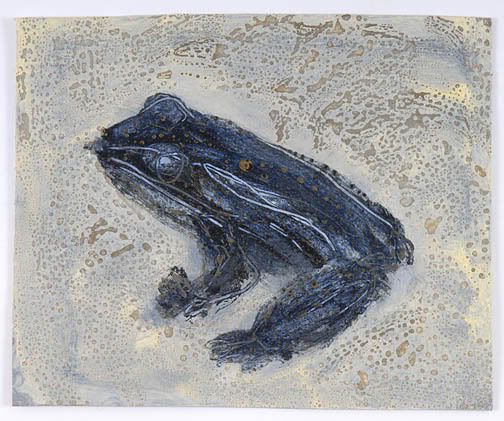
Colin Cochran
"Frog"
2006
Mixed media with oil on gessoed board
8 x 9 5/8 inches

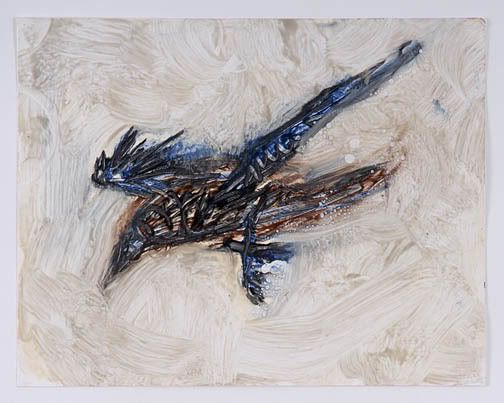
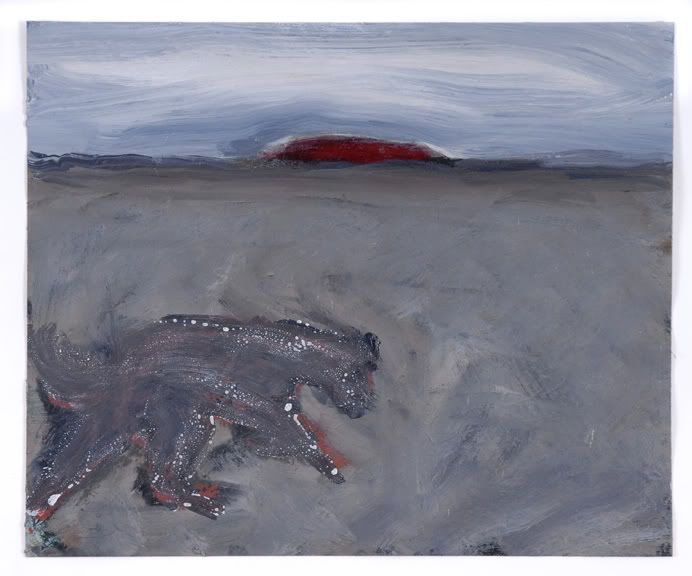
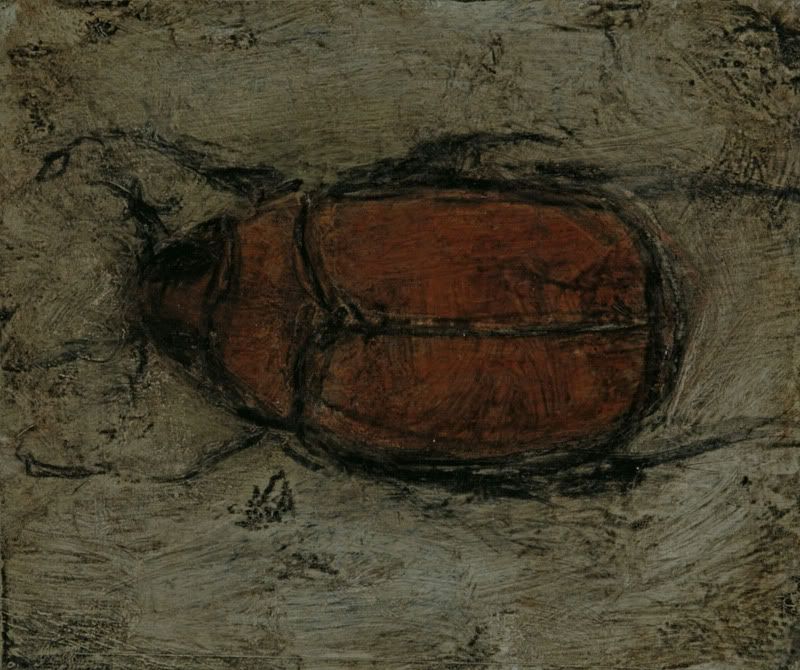
Andre Zarre Gallery: Two blocks south of The Proposition, at Andre Zarre Gallery, another artist has tapped into the same deep vein as Hawkins, drawing from the well of existential associations attached to the animal form. Colin Cochran's small mixed media paintings of crows, beetles, cows, dingos, and other animals are straightforward exercises in composition, contour, and color, but the artist's confidence and command of the medium(s) make these humble, even "primitive" paintings special. Indeed, in some cases the little works possess an air of monumentality.


Colin Cochran
"Crow Magnon"
2006
Mixed media with oil on gessoed paper
11 x 14 inches

Interestingly, Cochran's animal subjects are largely anonymous. Although the surfaces of his paintings are rich in texture, distinguishing markings are absent; viewers must recognize the cast of characters in silhouette. In the case of an elephant or even a raven, this process is unconscious and immediate, but what kind of mole or beetle are we looking at? Enthusiastic about wildlife biology as I am, such details are important.


Colin Cochran
"Dawn and the Dingo"
2006
Mixed media with oil on gessoed paper
14 x 17 inches

After spending a few minutes with Cochran's work, however, it occurs to me that his subjects do not want to be identified in this way. I recalled a conversation I had a few years ago while paddling down the Colorado River. I had become pleasantly frustrated in my efforts to determine if I had just spotted a female Wilson's Warbler (Wilsonia pusilla) or a male Yellow Warbler (Dendroica petechia), species which are almost identical, when a friend pointed out that many "primitive cultures" did not distinguish between species in a family. Coyote and Wolf were given separate billing, but often a hawk, no matter the species, is Hawk and a sparrow is just Sparrow, or maybe even just Bird. My friend feels that there is something to be said for this imprecise classification scheme. If behavior across a family is similar, why should we create distinctions based on our own criteria? Does it really matter that the back and head of the female Wilson's Warbler should be a bit more olive than that of her cousin, the Yellow Warbler? Of course, the wildlife biologist in me disagreed (and still does); after all, how can one comprehend or track adaptation and evolution unless some system is in place, albeit a system necessarily in constant flux? But this was beside the point for my friend. Essential experience of the other animal does not need classification or specificity, he insisted. In fact, the experience is likely that much more rich and immediate when the trimmings have been dispensed with. Bird, he felt, was good enough.

And so it is with Cochran's paintings. Beetle and Frog are good enough...and so they are.


Colin Cochran
"Beetle"
2006
Mixed media with oil on gessoed board
8 x 9 1/2 inches

+ + + + +


Robyn O'Neil
"The Fall"
2007
Graphite on paper
6 1/2 x 10 inches

Clementine Gallery: Since seeing her first solo show at Clementine in 2003, my admiration for Robyn O'Neil's drawings has been tentative. The spare, even desolate landscapes and lonely human figures (even when gathered in a group, O'Neil's cloaked nomads seem isolated and fearful) of her New York solo debut appealed to me, but I felt that the work was still gestating. The drawings she produced in 2004 and 2005 were more consistently satisfying. In many, the lonely humans were replaced by statuesque moose or humble pine trees; O'Neil seemed to be imbuing her world with more magic, but I still wasn't sold. Perhaps I resisted because O'Neil's vocabulary is so close to my own? Whatever the case, "This is a descending world," the artist's third solo show at Clementine, proves my initial supposition correct; O'Neil's work is now showing signs of real maturity and confidence, both with respect to technique and content.


Robyn O'Neil
"The Passing"
2006
Graphite on paper
66 x 66 inches

In the front gallery, O'Neil shows four large works on paper. "The Ruin" and "The Passing" are the strongest of these. The melancholic landscapes are less complex than those of O'Neil's previous outings, and their relative simplicity allows viewers to more easily appreciate the power of O'Neil's element (and elements). The ocean is rendered superbly in "The Ruin." Its unfathomable volume is majestic and frightening and, like the branch suspended above it, the sea seems sentient, a wise observer of time's passage. The owl that lays rigid in "The Passing" is as dead as its eyes suggest. While the spirit's energy seems to rise phantom-like away from the raptor's head, the ground gently settles as it prepares to take the corpse. These are the first of O'Neil's works I've seen that merit sustained meditation; they breathe with a mystical intensity that I associate with the work of Charles Burchfield.


Robyn O'Neil
"Masses and masses rove a darkened pool; never is there
laughter on this ship of fools"
2007
Graphite on paper
79 x 161 1/8 inches

Also hanging in the front room is the exhibition's centerpiece, "Masses and masses rove a darkened pool: never is there laughter on this ship of fools." Over six feet tall and thirteen feet wide, O'Neil's "...ship of fools" can not be ignored. It is impressive both in scale and technique. Any artist familiar with graphite immediately comprehends the feat of patience (and perhaps endurance) this picture represents. Unfortunately, the formality of the piece - the ocean and rafts read as a perspectival grid, effectively flattening the plane and reminding us of vanishing point exercises in high school art class - prevents it from being the show standout. It is worth noting, though, that O'Neil's interpretation of the old allegory is distinctly contemporary. The medieval understanding of the allegory was that each person has his or her vices and sins; from person to person these behaviors can be ignored or laughed at but when considered together, as symptoms of the whole, such individual folly becomes sinister and dangerous. Earlier artists who depicted the "Ship of Fools" - most notably those of the Northern European Reformation, such as Bosch or Durer - portrayed the "fools" as individuals on board one overfull craft. Each face was distinct, each pursuit ridiculous, self-serving, or plain stupid. O'Neil, however, draws faceless men, all clad in suits, clamoring about on so many rafts. The shared vessel is no longer one boat; here it has become the ocean (or even the world) itself, with the occupants not so much sinning as mooning after mirages. My minor quibbles with O'Neil's execution aside, it is an appropriately distressing work; considering the large drawing, I find myself reminded that we live in the Age of Ennui, Aimlessness, and Distraction. Even our sainted celebrities aren't safe for long.

The small works displayed in the back gallery make for a mixed bag, but are generally rewarding. Drawings like "The Silence" and "The Abandon" are forgettable, but "The Fall," "The Growth," "The Fade," and "The Loss" are lyrical, moving, or a bit of both. I'm biased by her subject matter, but I feel that O'Neil is capable of becoming one of our generation's important artists. I eagerly await more work.


Robyn O'Neil
"The Growth"
2007
Graphite on paper
6 1/2 x 10 inches

+ + + + +


Photo credits: Julia Randall images courtesy Jeff Bailey Gallery; Binary images ripped from the Postmasters website; Allison Hawkins images courtesy The Proposition Gallery; Colin Cochran images courtesy Andre Zarre Gallery and Joyce Goldstein Gallery; Robyn O'Neil images courtesy Clementine Gallery