Showing posts with label Islam. Show all posts

Thursday, September 15, 2011

The Beautiful / Palace Prayers

OLD MOONS

Old moons now are dried and crusty
Brittle and as uninteresting as history is
To my fingers and lips.

And yet also, it cannot be denied
That each man
King of his home-throne
Misses something of eternity
When he chomps down on lamb chops
(Which are his reward
For winning the bread)

Each of us misplace the universe
And lose the word
When we get our desires
On plates before us.

There is a grain of rice on the table.
Around it, oil has bled
And spreads

In this way does our egodeath
Halo around us
  And puncture the beauty
    Of clouds
- Yusuf Misdaq

Two years ago this month, I highlighted the poet, musician, artist, and author Yusuf Misdaq's Palace Prayers project. August 21st - September 19th, 2009, was Ramadhan, and Misdaq, a practicing Muslim who, as I noted at the time, "shares my universalistic mystical inclination," created a new work of art for every day of the month-long fast and period of Muslim introspection.

Some months later, Misdaq invited me to contribute a forward to a book of his poetry, prose, and lyrics. That book, The Beautiful / Palace Prayers, was published this year. Visit Misdaq's website for more information.

+++++
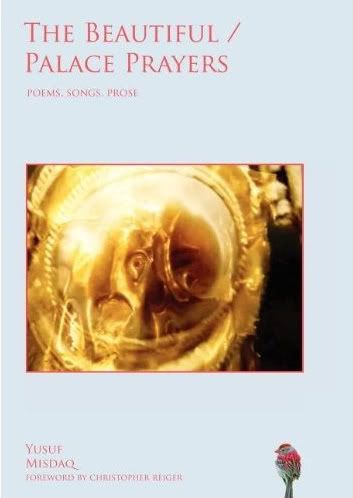
"Dissolution Is The Whole Show"

When Yusuf invited me to contribute a foreword to The Beautiful / Palace Prayers, I was at first surprised. Although I enjoy reading poetry, my education in literature is wanting, and my tastes run to work that most "serious" critics and scholars deem pedestrian. Who am I to comment on this young artist's latest collection? With characteristic enthusiasm, however, Yusuf's invitation quelled my self-doubt, insisting that The Beautiful is made up of poems "for normal people who do not normally read poetry." Well, in that case, it is a privilege and a joy for this normal person to introduce a collection of poems, verse, and prose written "for normal people"!

        They are a good species.
        Clean and caring;
        Made mostly of water and forgiveness
              - from "The Beautiful"

Normal people are very much in need of poetry, and perhaps especially so today, when the art is generally neglected. Words are powerful entities, every one an invocation, yet we too often use them carelessly. Poetry, like prayer, can serve as a corrective, reminding us that words conjure meaning and that they have a felt, physical component. As critic and philosopher George Steiner writes, "the meanings of poetry and the music of those meanings...are also of the human body." Appropriately, Yusuf refers to the italicized and apparently random words that he includes in some of his poems as "body echoes." "Carbunkle. Crellis. / Pulse-if. peaces." or "Que Que" are not intelligible formulations but, when read aloud, they aren’t exactly jibberish either. They supply somatic meaning, as do the poems’ rhythms. Yusuf's strongest poetry or verse has a perceptible pulse; in some cases, I notice my head slowly bobbing as I read. This is not insignificant. Beat and rhythm are primal properties, manifestations of the infinite, unfathomable being within which we reside and of which we are composed.

        Echoes
        of the original
        Voice
        From the original
        Breath
              - from "Ramadhan 26"

Ludwig Wittgenstein insisted that earnest philosophers should "descend into primeval chaos and feel at home there" if they expect to produce worthy work. I extend the same requisite to artists. Yusuf draws pictures, makes films, and writes poems, novels, and songs, but he is, above all, a mystic. And mysticism, in its quest to directly experience elemental truths, necessitates Wittgenstein's appreciation of the primeval and the chaotic; ancient disorder is at the root of everything. In most cases, the mystical perspective is merely an uncommon one; mystics survey and respond to the same earthly, material realm that the rest of us do. But they disregard accepted classifications and train themselves to mindfully observe and reinterpret their surroundings. They locate the extraordinary in the mundane. As Henry David Thoreau, a 19th century mystic, lamented, "All this [splendor] is perfectly distinct to an observant eye and yet could easily pass unnoticed by most." Mystics reawaken their capacity for reflective wonder and, in doing so, experience a kind of rebirth into a vaster dimension of human experience.

        On perfect Spring mornings
        God puts a clear blue sky in our pockets
        Pats us a few times and says
        'On your way!'
              - from "The Merciful Cheerful"

So reborn into sublime beauty, mystics strive toward the transcendent. Both Wittgenstein and Thoreau can be described as transcendentalists; Yusuf qualifies, too. Like the two philosophers, he finds in his observations of the world cause for a fundamental optimism. Unlike them, his writing is generally informal and devoid of pretension. His poems give readers the impression of a devout Sufi Muslim happy at play in our waking, sensual dream. In the collection's title poem, Yusuf writes "Awake in this dream / Where abstract clouds calmly keep us. / Where birds secretly make love in public and / Give voice to the current of joy which / Slices through us in a day." Again, in "Back Amongst Men (Drowned)," he references this dreamed life: "Or as I have also interpreted it / .God is a laughing dream." No doubt, the poems’ author, laughing, singing, eyes wide and sparkling, would appear mad to many of his fellows. This is to their discredit. They have forgotten (or failed to learn) how to look. Mystics, like many philosophers and artists, are too easily dismissed as lunatic or eccentric. Yusuf's ability to see through the veil of our cultural forgetfulness informs his aesthetic imagination and invigorates his art.

        Silk veils, dark and weightless
        Are being removed from her countenance
        Time after Time

        Each day I ready myself to know her better
        Each day, closer
              - from "Wahad"

But not all that Yusuf observes is felicitous. The most biting poem included in The Beautiful, "Ramadhan 23: Only To Be With You And No-one Else," is a reaction against the politicization of Islam and a celebration of his intimate relationship with Allah. After rejecting the "bloody bridge builders / Shmoozers or politicians" and others who "come to the Mosque smiling in your suit," Yusuf writes, "I wish to be alone / And serious / And deeper in love / With the only one who ever matters." The striking seriousness of his personal communion with G-d is important; discipline is one of the central currents running through the poems included in The Beautiful. In “Waiting (A Song for Guitar),” Yusuf writes, “I do believe in magic but first you gotta work at it.” Hope and love, he reminds readers, are nurtured through dedicated ritual and practice.

        Understand, thee
        That tenderness comes not of softness
        But of a firmness
        And of a discipline

        Understand that of discipline
        -Say, the discipline of prayer-
        Comes an enjoyment of that same thing.
        Discipline to run breeds a love for running
        Discipline to practice ones instrument brings forth a love
        for playing it
        Discipline to speak good breeds a love of horses
        And love of all refined things
        Whatever you may find them to be.
              - from "Ramadhan 12: The Vows Revolve"

A visual artist, I appreciate the centrality of discipline in a life committed to aesthetics. Like Yusuf, though, I am also mystically inclined. Paintings, sculptures, and other hand-crafted objects are among my adored icons but, if I work at it, I can find occasion for worship in every place, in every form, in every moment. The European starling that paraded on the sidewalk in front of me this morning warranted exaltation. In his iridescent dream coat and brilliant yellow bill, I see cause for startling, smiling celebration. For some other pedestrians, the bird, a representative of a despised species, may be ignorable or irrelevant. For others, my viewing the starling as a manifestation of the Divine amounts to idolatry. So, too, might the dirty, discolored Queens sidewalk be deemed a cement calf by unimaginative or close-minded "believers." Yet, striding on such a sidewalk today, my thoughts range through eons of geologic time to consider the ancient rock and mud, precursors to and components of the concrete that I now tread upon, from which our kind eventually emerged on crude limbs as a gasping, fish-reptile thing.

        The salt-pepper sugar mills on this table look like planets.
        I want to know the word for planet in as many different
        languages as possible.
              - from "Celestial"

Doubtless some of those who consider themselves religious don't share my enthusiasm for our scaled, long-snouted ancestors. But I'm not concerned with narrow definitions of religion. I believe that humility, wonder, gratitude, and communion are the four pillars of genuine religious practice, and the mental stretching engendered by the work of scientists, philosophers, and artists is an integral part of any intellectually rigorous, honest religious life. And, love, too, is a bit like religion. The same four pillars are fundamental to it. As Douglas Thorpe writes, "[love] demands of us a new way of being in our old world." Religious mysticism is a love affair with The All. It's not always easy, but religious attunement can turn each day, each hour, or each instant, into "a new way of being." Reading Yusuf's poetry, I'm reminded that every step is a psalm, every directed gaze is a prayer.

        Dot-Dot-Purple and Palaces
        Says the starling in approximate translation.
        Star-Star-Chandeliers and
        Bread on the wind-ind-ind.
              - from "The Beautiful"

I'm also reminded that we both enjoy watching starlings.

- Christopher Reiger, May 1, 2010

Tuesday, November 10, 2009

Falling Down


In the wake of last Thursday's tragic shooting at Fort Hood, the American media have made much of Major Nidal Malik Hasan's religious affiliation and, more specifically, of his connection to a radical Muslim cleric based in Yemen.

Many voices on the right have touted Hasan's heinous actions as the latest evidence of Islam's corrupt and violent core. Most of the commentators on the left, by contrast, insist that Major Hasan was a victim of circumstance, and that his murderous rampage was precipitated by external pressures. Considering the left's reasoning, Michael Douglas's defense contractor turned urban vigilante in the 1993 film "Falling Down" comes to mind. At the time of that film's release, critic Roger Ebert wrote of it,
"What is fascinating about the Douglas character, as written and played, is the core of sadness in his soul. [...] There is no exhilaration in his rampage, no release. He seems weary and confused, and in his actions he unconsciously follows scripts that he may have learned from the movies, or on the news, where other frustrated misfits vent their rage on innocent bystanders."
There is salient insight in the left's response, but generally assessments on both the political left and right are ideological and reductionistic. Media pundits are involved in a fraught game of Pin the Tail on the Donkey. While the right-wing strives to pin the tail on Islam, left-wing pundits do what they can to prevent that stigma from sticking. Precious intellectual and creative energy is expended in the process; these commentators could instead provide a full accounting of what causes people to turn to religious extremism, or to extremism of any sort.

I especially appreciated, then, Dave Belden's "How Do We Understand Major Hasan?," an OpEd-style post at Tikkun Daily. I encourage folks to read it. Belden writes,
"Given that in all of our lives personal pain intersects with cultural narratives, then it is surely no surprise that for the killers it’s rarely ever a simple question of either a sick individual or a follower of extremist ideas. Timothy McVeigh was surely both when he bombed the Oklahoma Federal Building. To mention his personal pain is not to excuse him, but should give pause to all those who demonize others."
In response, I wrote in the comment section of Belden's post,
"In the media frenzy that passes for much contemporary news and politics, the humane aspects of most events or socio-political dynamics are generally overlooked. So, too, are the individuals involved reduced to caricatures and concepts. I wish I had some ideas as to how we, as a community, might address this ugly, dangerous spin. Alas…

As for David Brooks and [those to his right], I frequently marvel at their incomplete assertion that Muslim extremism is the culprit (at Fort Hood, in particular, but globally, too). Why not continue the diagnosis, revealing the imbalanced, immoral global system that produces extreme poverty, social and political disenfranchisement, and national/ethnic resentment/competition as the source of the tsoris that drives so many young men and women to embrace extremism (or, at least, adds to the appeal of a black-and-white, reductionist world view)?

Certainly religious extremism should be condemned and confronted, but addressing the root cause (which is also to address social justice globally) seems more sensible. But, were the conservative commentators to finger that root, they would implicitly condemn their own condemnation, as it, too, is born of a naive, black-hat-versus-white-hat construction of our volatile, shrinking world."
Photo credit: image ripped from Voice of America News

Tuesday, May 10, 2005

Atheists, Naturalists, and Fundamentalists

This last week, I received a number of angry emails from religious fundamentalists. The writers of these notes were responding to some comments that I made on a conservation listserv. In my opinion, my comments were neither incendiary nor dismissive; in fact, alongside some of what I've written about religious literalists and the Christian right on this blog, the listserv remarks were tame. Happily, I also received a thoughtful letter from a devout Christian woman. The first selection below is taken from my response her email.
“Though I do label myself an atheist, my belief requires as much faith as that of a devout Christian, Muslim, or Jew. After all, what ‘proof’ do we have that there is NOT a God? I can think of nothing definitive. Agnosticism is the more honest choice, perhaps, as it resides in the question, more comfortable with uncertainty and contradiction. I considered myself agnostic for many years and my transition from agnosticism to atheism was in part the result of external pressures. The more ‘religious’ our country became, the more I felt the need to reside at the furthest pole in order to maintain balance. Is this irrational? Perhaps. More importantly, though, I believe there is no “higher power,” at least in the sovereign, interventionist sense – we are but a piece of the weave of universal energy, of the Over-soul – and, no matter how much I prefer questions to answers, this meant I could no longer consider myself agnostic.

I respect all three of the "sibling" religions for the core values and ethics each espouses; the overlaps and base similarities are obvious and numerous: Judaism spawned Christianity spawned Islam. Fundamentalism of any stripe, though, is untenable and given our contemporary global connectivity, that much more volatile. I do not mean to tread on Christianity at large when I rant about the growing influence of the far-right, evangelical community on US policy, but their words make the hairs of any sensible citizen stand at attention.

The text below is drawn from the National Association of Evangelicals' recent document, ‘For the Health of the Nations: An Evangelical Call to Civic Responsibility.’
’We make up fully one quarter of all voters in the most powerful nation in history...Disengagement is not an option...To restrict our stewardship to the private sphere would be to deny an important part of His dominion and to functionally abandon it to the Evil One. To restrict our political concerns to matters that touch only on the private and the domestic spheres is to deny the all-encompassing Lordship of Jesus.’
Little surprise then that this group, 30 million+ strong, vehemently supports Bush, Cheney, Delay and company. The agenda of the Rapturists has landed in the White House. Whereas once many powerful figures in the Republican party were vocal proponents of the conservation cause, now we see a partisan push for environmental action coming only from the Left (with a few notable exceptions, such as John McCain, US Senator, Arizona). I find this distressing and unfortunate.

I believe our greatest hope for environmental sustainability comes from a move toward social democracy, but I remain unsure whether such a system can work in a country as sprawling and asphalt-addicted as our own. Regardless, wildlife corridors, refuges, and reserves stand little chance when the powerful lobbyists emerging from Colorado Springs, the ‘training ground’ for God's ‘warriors,’ ‘harness the forces of free-market capitalism.’ As the celebrity evangelical Pastor Ted states,
‘I teach a strong ideology of the use of power of military might, as a public service...the Bible's bloody. There's a lot about Blood. Globalization is merely a vehicle for the spread of Christianity.’
Or, as one attendee of the New Life Church in Colorado Springs describes the recent tsunami in Indonesia, ‘[I'm] psyched about what God is doing with his ocean.’ (Psyched? Give me ten minutes in a parking lot and I'll show you how psyched I am about what God is doing with my fists.)

I also wish that the ‘Taliban wannabes’ would mind their own business, but their ranks are steadily growing. Whereas two years ago, I dismissed the articles and essays that warned of a coming ‘Christian conflict,’ I now am increasingly convinced that this country faces very difficult times. The twin burdens of racism and fundamentalism will prove substantial hurdles in the early 21st century, distracting us from more pressing matters of economy and environment. I just turned 27 and I feel as though I should still be idealistic and optimistic; instead, I am increasingly anxious. I have to hope that a minority of the evangelicals will interpret the scripture correctly, realizing that God called on us all to be good stewards; some evangelicals are, in fact, arguing for thoughtful environmental policy. Let us hope they are able to influence their leaders and let us hope that their leaders may find some use for sound science. After all, science gave them the radio and where would the contemporary evangelical be without the airwaves?”
My response was shared on the listserv. Afterwards, I received a more friendly response. Interestingly, I learned that the term “fundamentalist” is considered a positive label by many contemporary Christians. "Evangelicals” are the new “fundamentalists,” evidently, although some of the angry folks who emailed me are bad news no matter what they call themselves! Still, I'm bothered by the relativism of some American Christians. If an Islamic fundamentalist is thought of as a baddie, why then should a Christian fundamentalist be deemed a goodie? Oh, wait, I forgot…our nation's leaders are trying to start a Holy War.

I also received a short note from a biologist working in the southwest United States. I’ve had several exchanges with this gentleman and I have come to respect his opinions on a range of conservation issues. I very much like what he has to say about faith, and I include his note below.
“I understand your statement on positioning yourself towards the atheistic pole. I do the same.

For a while I preferred to call myself a ‘provisional atheist’ in the same sense that I'm a ‘provisional Darwinian’ ... unless and until new evidence comes along to make me change my philosophy, this is what I accept.

However, I decided that the term ‘atheist’, although not as evil a word as some theists would like to paint it, just didn't cut it for me. ‘Atheist’ says what one DOESN'T believe, but it doesn't say much about what one DOES believe. It's a negative response to another's position, not an affirmative statement of one's own position ... like calling myself a ‘non-conservative’ when I am unapologetically a liberal.

Nowadays, I prefer the term ‘naturalist’ (in the philosophical sense, although as a biologist I'm also a naturalist in the conventional sense). Naturalist simply says I accept the worldview of naturalism, that everything in the universe can be (or potentially can be) understood and explained by natural laws and processes.”
I may have to start calling myself a Naturalist!

Tuesday, March 22, 2005

Happy, Happy Day!!

This morning, lying in bed listening to news from my radio alarm, I learned that some religious figures are already blaming the school shootings in Minnesota on a lack of faith. Picking up a magazine as I make my way to the bathroom, I scan a brief editorial and learn that the National Park Service is stocking Grand Canyon bookstores with Creationist takes on geology. On the subway, I notice a newspaper headline with the words, "Creationism in the Classroom." Arriving at work, a friend emails to point me in the direction of Slate Magazine and today’s distressing article on the Terri Schiavo situation.

I have come to tolerate and, in some instances, respect religion. (This despite the fact that I believe morality is universal and that the tribalism inherent in religion too often increases the likelihood of immoral action, be it war, murder, or theft.) I am friends with several religious people and we are able to have thoughtful, warm debates without resorting to name-calling. In fact, my views on religion have undergone a dramatic, positive transformation in the last eight years.

This morning's news, though, makes me unsure whether the reconciliation was altogether warranted. Maybe I should still be dressing in black, listening to angst rock, and proclaiming God dead? At eighteen years of age, that seemed the appropriate response to religion and Christianity's authortarian rule. Maybe I should adopt such a posture again?

But I sometimes forget that the secular/fundamentalist divide is not a Christian issue alone. The three sibling religions, Christianity, Judaism, and Islam, all suffer from similar cancers; the growths accompany the maturation of any religion in contemporary society. (An article in the New York Times today touches on book banning in Jerusalem. Rabbi Nosson Slifkin, an accomplished young Orthodox thinker who seeks to "reconcile" religious texts with contemporary natural history, is being publicly denounced as a heretic.)

The Schiavo case is uniquely American, though, because the "religious" pressure is coming from the executive level, not from a minority of the public. The legislation being passed is unprecedented. (See the NY Times article , excerpted below.) I do not consider myself affiliated with either of our major political parties and, on some issues, I trend center-right, so to see the Republican party turned into a mockery of it's former self is more than discouraging. It's criminal.
"Republicans have traditionally championed respect for the delicate balance the founders created. But in the Schiavo case, and in the battle to stop the Democratic filibusters of judicial nominations, President Bush and his Congressional allies have begun to enunciate a new principle: the rules of government are worth respecting only if they produce the result we want. It may be a formula for short-term political success, but it is no way to preserve and protect a great republic."