Showing posts with label ethics. Show all posts

Thursday, September 12, 2013

The Sin of Being Realistic

In conjunction with the Jewish new year, I read a litany of "sins" we Jews must repent for on Yom Kippur. One of them had special resonance, both personally and universally.
"For the sin of being 'realistic' when our tradition calls upon us to transform reality."
I like the formulation, even if the "realist" in me balks at what remains unaddressed. After all, while it's certainly true that realism too often begets apathy and the maintenance of the status quo, it's also true that idealism sometimes begets rigid ideology and violence. Perhaps, then, tempered idealism is the best proposition, a virtue that will allow us to continue to struggle toward the horizon (and beyond)?

Whatever religion, philosophy, or ethic you subscribe to (or react against), our collective human aspiration calls on us to improve the lot of the whole. Here's to our keeping on keeping on, together.
View of Little Diamond Rim; Tonto National Forest; Arizona; August 2013

Photo credit: Christopher Reiger, 2013

Sunday, January 20, 2013

"Private Frontiers" at Hosfelt Gallery

Michael Light
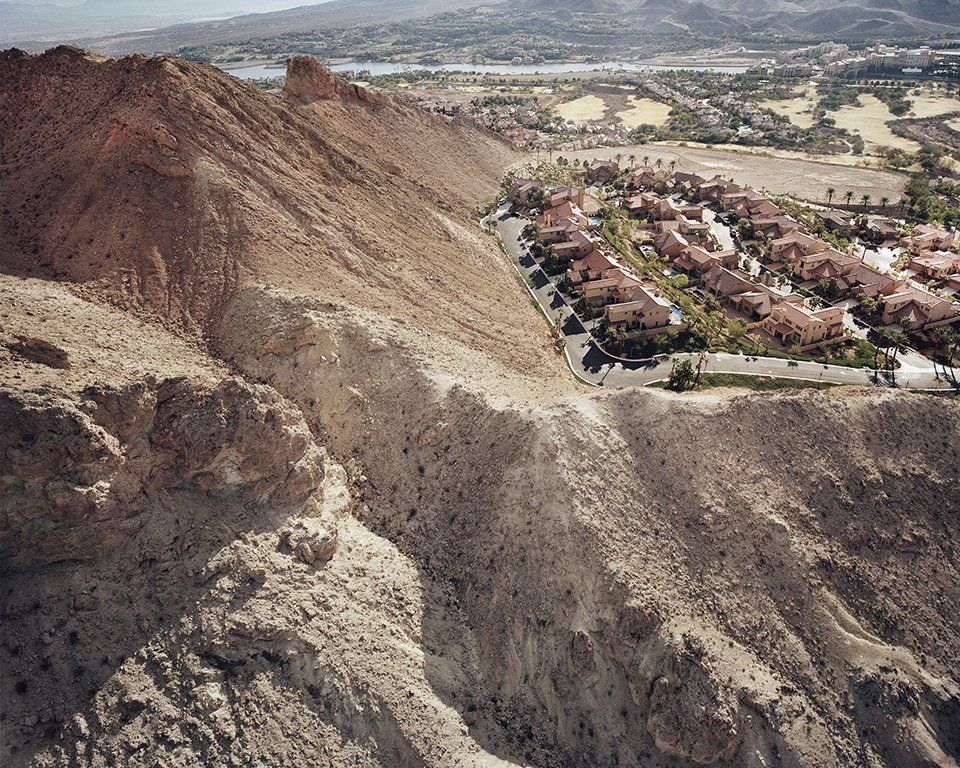
"Lake Las Vegas 2010-2012 20. 'Casa Palermo' Lake Las Vegas Homes Looking Southwest, Henderson, Nevada"
2010
Pigment print mounted on aluminum
40 x 50 inches
Edition of 5
I recently visited Hosfelt Gallery's impressive new space, currently home to "Private Frontiers," a two person show featuring works by Brooklyn-based painter Chris Ballantyne and San Francisco-based photographer Michael Light. According to the press release, the two artists "have been in dialogue for the past year to develop work that examines the human urge to stake territory and its more absurd manifestations on the American landscape." Whatever the specifics of the artists' conversation, Ballantyne's paintings are a terrific compliment to Light's large-format aerial photographs. Exhibited on their own in the expansive Hosfelt loft, Ballantyne's colorful and occasionally whimsical works would risk being swallowed up as bittersweet morsels. Hanging alongside Light's grand photographs, though, Ballantyne's modestly-sized pictures comport themselves especially well; their affability and humor endure, but undercurrents of earnestness and melancholy, too easily missed if exhibited on their own in so airy a space, are amply felt.

Monday, December 12, 2011

I Can See The Whole Emperor!


In a 2006 post titled "Lichtenstein the Ingrate," I bemoaned Roy Lichtenstein's elitism. I explained that I was bothered less by the famous artist's "questionable sampling" of newspaper and comic book artists' work than I was by his disregard for the skill of those he copied. In a 1963 interview, Lichtenstein distinguished between his source material and his paintings.
"What I do is form, whereas the comic strip is not formed in the sense I'm using the word; the comics have shapes but there has been no effort to make them intensely unified...The difference is often not great, but it is crucial."
Throughout my late teens and twenties, Lichtenstein's comic-inspired artworks inflamed my sense of righteous indignation. I don't get especially worked up about Lichtenstein's appropriation anymore, but I still believe the man was a charlatan. Had he acknowledged his indebtedness to the artists he imitated, his comic panel paintings could be interpreted as a cynical project highlighting the role of class and money in the appraisal of culture (i.e., it's not fine art if it's in a newspaper, but if it's in a gallery and the "right" person will pay a lot of money for it, it is). That still wouldn't make it particularly thoughtful artwork, but Lichtenstein could have been remembered as a winking champion of the comic artists that nourished him.


Left: William Overgard original
Right: Lichtenstein's rendition

In 2006, I believed that Lichtenstein was "turning into a cultural blip." I took comfort in that presumption, but it's no longer so clear to me that Lichtenstein will be forgotten. A recent ArtInfo article by Judd Tully compares last month's Christie's auction sales price of Lichtenstein's "I Can See The Whole Room!...And There's Nobody In It!" to the EBay auction sales price, last August, of the William Overgard artwork that was the source of Lichtenstein's painting. The former sold for $43,202,500; the latter, for $431. According to the art market, then, the Lichtenstein version is worth more than 100,000 times what the Overgard original is worth! Sure, Lichtenstein's is a bigger picture, but the enormity of the price difference is testament to the intangibles in play in the art market. I love looking at, writing about, and making art, but contemplation of the art market is a depressing affair.

Image credit: "The Emperor's New Clothes" illustration, ripped from My Fresh Plans site (illustrator uncredited); Overgard and Lichtenstein reproductions "appropriated" from The Daily Cartoonist

Friday, December 03, 2010

Red Wolf ESPP Prints Released!


Christopher Reiger
"Constellation (Canis rufus)"
2010
Pen and sumi ink, gouache, and watercolor on Arches paper
15 x 12 inches

My 2010 drawing "Constellation (Canis rufus)" has been made into a limited edition print for the Endangered Species Print Project (ESPP). The drawing features the red wolf (Canis rufus), a critically endangered wolf species.

I wrote the following description of the red wolf and its plight for the ESPP website:
"The Red Wolf (Canis rufus) is a medium-sized North American canid, generally larger than a coyote but smaller than the gray wolf. As the common name suggests, red wolves often have reddish fur on and around their ears, neck, and legs. Like other wolves, the Red Wolf is a social species that lives in packs, groups typically comprised of a mated pair and their offspring (of multiple generations). Red Wolves are crepuscular predators, most active at dusk and at dawn. They prey on white-tailed deer, raccoons, opossums, rabbits, and rodents, but are also known to scavenge.

The Red Wolf once occupied a range that extended over the forests, swamps, and coastal plains of the southern and eastern areas of the United States, as far west as Texas and as far north as New York. As with most non-domesticated canines, however, the Red Wolf was vilified as a dangerous competitor of man (and, erroneously, a "man-eater"). These entrenched, negative attitudes gave rise to aggressive predator control campaigns; wolves were poisoned, shot, and trapped. This persecution was compounded by habitat loss and disease, taking a terrible toll on red wolf populations. By 1980, the species was extinct in the wild.

Today, though, there is good news. Thanks to several focused preservation and reintroduction programs, and especially to the efforts of the Point Defiance Zoo & Aquarium (PDZA) and the United States Fish & Wildlife Service (USFWS), in conjunction with programs like that at Mill Mountain Zoo, the Red Wolf is staging a small, isolated recovery. There are now approximately 100 wolves living wild in eastern North Carolina and up to 250 individuals in zoo-based captive breeding programs."
As per the ESPP model, this is a limited edition of 100 prints, the number determined by the featured animal's current wild population. The print measures 8 x 10 inches, and costs a mere $50.00. ALL proceeds from sale of the prints will be donated to the Port Defiance Zoo & Aquarium Red Wolf Recovery Program.

As I explain in the ESPP artist notes, my fascination with taxonomy increased my interest in researching this particular species:
"Ecology, wildlife biology, and natural history are subjects that I'm passionate about, and I'm especially intrigued by taxonomy, the classification of different species. The ever-evolving field's binomial nomenclature is chock-a-block with curious etymological backstories and, more importantly, taxonomists are endlessly debating species classification. Names change, species become subspecies (and vice versa), and protected animals become unprotected animals on what seems to be a month-to-month basis! The red wolf is no exception. It's an honor to produce an artwork that may, in some small way, help save a keystone predator from extinction and genetic isolation; I must admit, however, that I also planned to use the print as an excuse to learn more about the particulars of the red wolf taxonomic debate.

Some wildlife biologists insist that the red wolf's scientific name is Canis lupus rufus and that the animal is a subspecies of gray wolf (Canis lupus). Another camp, one that the US Fish & Wildlife Service concurs with, believes the wolf to be a species distinct from the gray wolf. It is their classification, Canis rufus, that I use in the species description above. Frankly, both groups make valid arguments; the different verdicts depend on whether the red wolf is classified according to the biological classification rule (i.e., if Wolf A can make viable pups with Wolf B, the two wolves belong to the same species) or the phenotypic/phylogenetic approach to classification, based on distinct physiological or genetic characteristics. Because the phenotypic/phylogenetic approach leads to a great many more species, it remains a source of contention within wildlife biologist communities and complicates conservation politics, for better and for worse.

Of primary importance, though, are the animals. Whether red wolves are ultimately deemed their own species or a subspecies of gray wolf, they're on the brink of extinction. There is ample cause for hope, however, and you can make that hope a little more concrete by purchasing a print!"
Visit the ESPP site to learn more and, during this holiday season, please consider helping the species by buying a print as a gift.

Wednesday, September 22, 2010

The RSA's "21st Century Enlightenment"


Sure, the video is 11 minutes long, well over the too-long-to-watch mark for readers casually trolling the blogosphere, but it's worth bookmarking and saving for later. (In fact, I encourage you to watch it on YouTube or the RSA website, as the resolution is better than that of the above embed.)

The ideas articulated are vital and might provide some solace for those of you who, like so many of my friends, suffer from political apocalypse syndrome! Moreover, the animation is terrific and the narrator, like the Royal Society for the Encouragement of the Arts (RSA), is British, satisfying the Anglophile in all of us.

Enjoy.

(Thanks to Michael McDevitt for turning me on to this RSA video.)

Sunday, September 05, 2010

ESPP at Chicago's Renegade Craft Fair


The Endangered Species Print Project will be exhibiting at the Renegade Craft Fair, taking place this September 11th and 12th, in Chicago.

Co-founders Jenny Kendler and Molly Schafer will be selling prints to raise funds for all of the fourteen species so far featured in ESPP prints, as well as some upcoming print subjects, including my red wolf (Canis rufus).

I'm pleased to report that, to date, the ESPP has raised $4,000 for critically endangered species, and hopes to raise another $6,000 at Renegade! If you're in or around the Windy City, please pay them a visit.

Friday, June 11, 2010

Rescuing Hokget and Everybody Else


Several months ago, I read "The Problem With Human Compassion," an excerpt from Shankar Vedantam's book The Hidden Brain, printed in the February 19th issue of The Week. I include a lengthy selection here.
"On March 13, 2002, a fire broke out in the engine room of an oil tanker about 800 miles south of Hawaii. The fire moved so fast that the Taiwanese crew did not have time to radio for help. Eleven survivors and the captain’s dog, a terrier named Hokget, retreated to the tanker’s forward quarters with supplies of food and water.

[...] Drawn by wind and currents, the Insiko got within 220 miles of Hawaii. It was spotted by a cruise ship, which rescued the crew. But as the cruise ship pulled away, a few passengers heard the sound of barking.

The captain’s dog had been left behind on the tanker. A passenger who heard the barking dog called the Hawaiian Humane Society in Honolulu. [...] The Society alerted fishing boats about the lost tanker and soon media reports began appearing about Hokget.

[...] Money poured in to fund a rescue. Donations eventually arrived from 39 states and four foreign countries. One check was for $5,000. 'It was just about a dog,' Pamela Burns, president of the Hawaiian Humane Society, told me. 'This was an opportunity for people to feel good about rescuing a dog. People poured out their support. A handful of people were incensed. These people said, ‘You should be giving money to the homeless.’' But Burns thought the great thing about America was that people were free to give money to whatever cause they cared about, and people cared about Hokget.

The problem with a rescue was that no one knew where the Insiko was. The U.S. Coast Guard estimated it could be anywhere in an area measuring 360,000 square miles. Two Humane Society officers set off into the Pacific on a tugboat. The Society paid $48,000 to a private company called American Marine to look for the ship.

[...] The U.S. Coast Guard had said it could not use taxpayer money to save the dog, but under the guise of training exercises, the called the U.S. Navy began quietly hunting for the Insiko.

[...] Human beings from around the world came together to try to save a dog. The vast majority of people who sent in money would never personally see Hokget. It was, as Pamela Burns suggested to me, an act of pure altruism and a marker of the remarkable capacity human beings have to empathize with the plight of others.

There are a series of disturbing questions, however: Eight years before the Hokget saga began, the same world that showed extraordinary compassion for a dog sat on its hands as hundreds of thousands of human beings were killed in the Rwandan genocide.

The philosopher Peter Singer once devised a dilemma that highlights a central contradiction in our moral reasoning. If you see a child drowning in a pond—and you would ruin a fine pair of shoes worth $200 if you jumped into the water—would you save the child or save your shoes? Most people react incredulously to the question; obviously, a child’s life is worth more than a pair of shoes. But if this is the case, Singer asked, why do large numbers of people hesitate to write checks for $200 to a reputable charity that could save the life of a child halfway around the world—when there are millions of children who need our help?

The answer is that our moral responsibilities feel different in these situations; one situation feels visceral, the other abstract. We feel personally responsible for one child, whereas the other is one of millions who need help - there are many people who could write that check.

[...] The brain is simply not very good at grasping the implications of mass suffering. Americans would be far more likely to step forward if only a few people were suffering or a single person were in pain. Hokget did not draw our sympathies because we care more about dogs than people; she drew our sympathies because she was a single dog lost on the biggest ocean in the world. [...] We are best able to respond when we are focused on a single victim."
Vedantam and Singer are correct; we humans act more compassionately when we are able to put a face to a cause, yet too many faces dull our response.

I've noticed such a benumbing in myself recently, an unexpected consequence of my transitioning from New York City to San Francisco. Both cities have substantial homeless populations, but panhandling in San Francisco is far more common. My street charity policy, modeled on the approach of a rabbi I heard lecture, is simple enough: I give change to any panhandler who says that he or she will use the money for food (or cites hunger as their reason for begging). I don't give change to those individuals requesting money for any other reason. In New York City, confronted with a few beggars each day, I typically gave change two or three times every week. In San Francisco, however, beggars ask for handouts on every other block, and a good number of them say that they're hungry. If I hold to my standard, I'll give change two or three times a day, if not more often! Shamefully, I've noticed that I've almost ceased giving during my visits to San Francisco.

This is a personal failure that I must address. Each of those many faces is an individual, a single person in need, despite the fact that their larger numbers and concentration counter-intuitively make them relatively anonymous or invisible. The rabbi's rule should be no less applicable in San Francisco than it is in New York. I'm confronted, then, with more need, and I must respond in kind; a hungry person is a hungry person.

But what about a hungry dog? Is Vedantam right to suggest that the thousands of people who contributed money to the Hokget search did not "care more about dogs than people"? Not exactly.

Our species' evolved, inborn behaviors haven't made our adaptation to the globalized world easy. In fact, it seems that contemporary humans are increasingly suspicious of other humans, especially of those outside our respective tribe, whereas animals (and perhaps especially dogs) are seen as uncomprehending innocents. I don't mean to suggest that no one cares about miners trapped in a coal mine, but it's clear that the little girl trapped in a well sells more newspapers, and that the little dog trapped on an abandoned tanker not only sells newpapers, but also inspires a flood of unsolicited donations and generates public outcry.
"Facing intense public pressure to save Hokget, government officials concluded that asking the Navy to sink the tanker—750 miles from Hawaii and drifting away from the distant U.S. mainland—posed unacceptable environmental risks. The Coast Guard finally agreed to access $250,000 in U.S. taxpayer funds to recover the Insiko. It wasn’t officially called an animal-rescue effort. Instead it was authorized under the Oil Spill Liability Trust Fund, based on the argument that if the aimless Insiko managed to drift westward for 250 straight miles, it might run aground on Johnston Atoll and harm marine life.

[...] On April 26, nearly a month and a half after the dog’s ordeal began, the tugboat’s crew found the Insiko and boarded the tanker. Hokget was still alive, hiding in a pile of tires. [...] Hokget arrived in Honolulu on May 2 and was greeted by crowds of spectators, a news conference, banners welcoming her to America, and a red Hawaiian lei."
What a marvelously strange species we are!? I applaud our ability to extend compassion to other animals (we're one of handful of species that have demonstrated such empathic ability), but I wonder at our brains' curious moral calculus.

I suppose all I can do is begin with myself, and humbly pledge to keep my pockets filled with coins.

Image credit: ripped from Corbis Images

Sunday, May 09, 2010

What Remains


I've posted Chris Jordan's photographs on HH in years past, but I haven't before showcased his pictures of albatross remains. The images are powerful reminders of the too often unseen and unconsidered impacts of our species' prolific, reckless consumption.


On his website, Jordan writes of the series, "Midway: Message from the Gyre,
"These photographs of albatross chicks were made in September, 2009, on Midway Atoll, a tiny stretch of sand and coral near the middle of the North Pacific. The nesting babies are fed bellies-full of plastic by their parents, who soar out over the vast polluted ocean collecting what looks to them like food to bring back to their young. On this diet of human trash, every year tens of thousands of albatross chicks die on Midway from starvation, toxicity, and choking.

To document this phenomenon as faithfully as possible, not a single piece of plastic in any of these photographs was moved, placed, manipulated, arranged, or altered in any way. These images depict the actual stomach contents of baby birds in one of the world's most remote marine sanctuaries, more than 2000 miles from the nearest continent."
Today, as crude oil continues to spread over the Gulf of Mexico from the Deepwater Horizon rig, we'd do well to remember that one of the significant uses of crude oil is the production of petroleum-based plastics. Individually, we can help alleviate our reliance on offshore oil wells and imported oil by consuming less plastic and recycling what we must use.


Photo credits: all images, Chris Jordan

Saturday, May 01, 2010

Remix or Rip-off?


Last week, in need of an image of a 2001 painting of mine, I Googled the work's title, "being soon what you have always been becoming." It's a curious turn of phrase, and I rightly assumed that there wouldn't be many exact matches. One of the topmost Google finds read "Jansky Noise - Being Soon What You Have Always Been Becoming." Intrigued, I clicked it. This is what appeared on my screen.

The static image in the YouTube video player is a collage predominantly composed of elements taken from a number of different drawings and paintings made by me. The accompanying video description (located just below the player) by RaXham, the soundscape artist behind Jansky Noise, is a slightly - very slightly - edited version of one of my old artist statements. Nowhere is my art or writing credited.

I'm a proponent of remixing, collage, cut-and-paste, and other forms of creative riffing. I'm an opponent of unrestrained, crippling copyright laws and of selfish artists who prioritize the bottom-line over the creative commons. As such, I appreciate RaXham's description, found on his or her YouTube profile page:
"Creator and sound designer. Pirate of the seas. Plunging into the depths of the treasure trove, diving deeper to un-cover and expose hidden treasures and re-polished jewels!"
Well and good, RaXham, but in cases where the words that the re-mixer draws on are used in an essentially collaborative fashion (for example, RaXham has borrowed my hand and voice to illustrate and describe his or her aural creation), I feel that some acknowledgement is due.

RaXham, if you ever read this, please drop me a line. I'm honored that you made a collage of my works to accompany your soundscape, and that the words I put down to describe my artwork were also applicable to your sound experiments. But you should have asked for my permission. I would have assented...on the condition that you credit my work and provide a link to my portfolio website.

Wednesday, April 28, 2010

Revisiting the Steady State Economy

On the heels of not one, not two, but three Republican blockades of financial regulatory legislation in the U.S. Senate this week, I thought it worth reposting the below essay on the concept of a Steady State Economy. The essay was originally posted on HH in April 2005; five years later, there's only that much more reason for thoughtful, comprehensive reform.

+++


Environmentalism is becoming something of a religion. Those who subscribe to most or all of the tenants of the environmentalist doctrine are among the movement’s acolytes, composting and recycling, canvas bagging it and buying organic, living what they consider “healthier,” less “impactful” lives. A thoughtful environmentalist should recognize these actions to be sacraments grounded in a hybrid moral code. “I am doing my part to rectify the mess made by the sinners around me.” How persuasive is this feeling of self-worth and moral superiority? Like all religious conviction, it is undeniably powerful and fulfilling, but it comes at a cost. Too often this fetal “religion” ignores fact in favor of that which is deemed morally superior. For example, radical environmentalists demand a wilderness without humans, ignoring the fact that management (stewardship) is now an unfortunate necessity given our exuberant use of natural resources and our continued sprawl. Reason must enter into the equation. Thoughtful environmentalism of the secular variety is possible, as long as we don’t allow ourselves to become vain.

This brings me to the concept of the Steady State Economy.

I first heard wind of Brian Czech’s Center for the Advancement of the Steady State Economy (CASSE) project a year ago. My initial reaction was positive, though I feared support for the concept would be relegated to left-wing environmental groups of the “religious” variety. Surprisingly, I am hearing the term used with more frequency these days, sometimes by folks with little interest in preserving biodiversity or encouraging ecological sustainability.

I am a proponent of the philosophy (read this .pdf for an excellent summary). The front page of the CASSE website states:
“Economic growth is an increase in the production and consumption of goods and services. It entails increasing population, per capita consumption, or both. Economic growth leaves a larger ecological footprint, causing civil strife and bringing nations into conflict.”
This simplifies, for the sake of dramatic impact, the arguments made by the economists behind the SSE. For me, the heart of the matter is touched on in the following selection.
“…Wildlife biologists know that a wide variety of social structures may produce stable populations. The same holds true for a steady state economy. For example, a steady state economy with long human life spans entails low birth and death rates. In our opinion this is preferable, within reason, to a steady state economy with short life spans, high birth rates, and high death rates. The same concept applies to capital and durable goods such as automobiles. We opine that a relatively slow flow of high-quality, long-lasting goods is preferable to a fast flow of low-quality, short-lived goods.”
The SSE will not take hold in the United States anytime soon, but in more socially-minded democracies, like Sweden or England, the approach is not so alien. The truth is, however, such a transition from market-driven capitalism to stability-driven capitalism is unlikely to occur unless the populous desires as much. In the United States, our stock market would require overhaul, making it “less of a casino,” by decreasing its volatility and demand for liquidity. This seems unlikely, especially in the immediate future. In fact, were the transition to begin today, the market would likely hemorrhage. Making things even more unattractive for the “powers that be,” implementation of the Steady State Economy requires, for countries like the United States, a marked decrease in Gross Domestic Product. As a result, I believe the SSE can not become a concrete reality in the foreseeable future, but that we should strive for it no less.

As the selection below suggests, there is much to be gained from the sustainable lifestyle.
“Nor would any cultural stagnation result from a steady state economy. John Stuart Mill (1806-1873), one of the greatest economists and political philosophers in history, emphasized that an economy in which physical growth was no longer the goal would be more conducive to political, ethical, and spiritual improvements.”
Ah, yes, ethical and spiritual improvement… So we’re back to individual action and lifestyle choices, rubbing shoulders with the “religious” environmentalists. Where do I sign up to feel superior to the rest of the heathens? I already recycle, canvas bag it, and eat only meat that I have caught or killed myself. I’m a few sacraments shy of donning a robe and shuffling off to the commune. Why shouldn’t I begin buying everything carefully and, in my own way, push for the adoption of the SSE at a local level?

Well, the truth is I should.

I self-consciously poke fun at the problematic aspects of environmentalism only because it is so close to my heart. I am not a religious man in the popular or traditional understanding of the word. Biology, anthropology, paleontology, history: these are my holy tomes. Yet I firmly believe that through careful consideration, research, and political pressure we can arrive at a more complete conservation ethic, one which addresses not only biodiversity and “wilderness” (my principal areas of interest), but also global poverty and human rights.

Photo credit: ripped from the World Food Programme website

Friday, April 09, 2010

Javan Rhinoceros ESPP Prints Available


Christopher Reiger
"diminishing returns"
2010
Pen and sumi ink, gouache and watercolor on Arches paper
15 x 12 inches

My 2010 drawing "diminishing returns" has been made into a limited edition print for the Endangered Species Print Project. The drawing features the Javan Rhinoceros (Rhinoceros sondaicus), a species on the very brink of extinction.

From the ESPP website:
"The Javan, or Sunda, Rhinoceros, is one of five extant rhinoceros species. The species was once widespread throughout Asia but is today critically endangered. There are currently between 37 and 44 Javan Rhinos in Ujung Kulon National Park, in West Java Indonesia, and no more than 5 in Cat Tien National Park, in Vietnam. Sadly, with only two known populations in the wild and none in captivity, this rhino species may be the rarest large mammals on our planet."
As per the ESPP model, this is a limited edition of 49 prints, the number determined by the featured animal's current population. The print measures 8 x 10 inches, and costs a mere $50.00. ALL proceeds from sale of the prints will be donated to the International Rhino Foundation.

The drawing was something of a first for me. As I explain for the ESPP artist notes,
"Animals figure prominently in my drawings and paintings. Usually, however, there is plenty of photographic art scrap to use as source material. In the case of the Javan Rhinoceros, this is definitely not the case!

In order to minimize stress for the critically endangered rhino, researchers study the species via fecal sampling and camera traps; the animals are rarely encountered or observed. As a general rule, the Javan Rhino is wary of humans and retreats into dense forests when they sense our presence. When humans do approach, whether intentionally or by mistake, the Javan Rhino becomes aggressive and will often attack, stabbing with the incisors of its lower jaw while thrusting upward with its head. Of course, such wariness and aggression are good survival tactics, but it makes the rhinos extremely difficult to study. (Interestingly, some researchers contend that these behaviors are a recent adaptation to population stresses. Historical records indicate that the species was once more gregarious.)

Because so little photographic documentation is available, this drawing marked the first time I've had to work from both images and written descriptions. It was a very curious process, and I hope that I've done the Javan Rhino justice!"
Visit the ESPP site to learn more.

Tuesday, February 16, 2010

Endangered Species Condom Project


I'm happy to help spread word about The Center for Biological Diversity's terrific Endangered Species Condom Project. The organization is addressing human overpopulation in a novel, fun way.

Such approaches are vital to opening a floor for further discussion. Even though our species' population is a clear-and-present threat to hundreds of thousands of other species (as well as to the Earth's limited natural resources), population control remains a fiercely debated and sensitive subject.

From the CBD's press release:
"At 6.8 billion people, the human race is not only the most populous large mammal on Earth but the most populous large mammal that has ever existed. Providing for the needs and wants of this many people — especially those in high-consumption, first-world nations — has pushed Homo sapiens to absorb 50 percent of the planet’s freshwater and develop 50 percent of its landmass. As a result, other species are running out of places to live.

To help people understand the impact of overpopulation on other species, and to give them a chance to take action in their own life, the Center is distributing free packets of Endangered Species Condoms depicting six separate species: the polar bear, snail darter, spotted owl, American burying beetle, jaguar, and coquí guajón rock frog.

The beautifully designed packages, featuring clever slogans, are being distributed by a network of 3,000 volunteers ranging from ministers to grandmothers to healthcare providers to college students and biologists. The condoms will be handed out at concerts, bars, universities, spiritual groups, local events, and farmer’s markets. Along with two condoms, each package contains original artwork and information on the species, facts about overpopulation and the extinction crisis, and suggestions on how the human population can be stabilized."
I'm certainly no fan of the tribalistic and despicable practices of groups like Quiverfull, but the general population needs to be better educated about the dangers of overpopulation, too. I'll be distributing the condoms around New York City during the next two weeks.

If you know me, be sure to ask for one of the handsome packages, each of which is adorned with artwork by Molly Schafer or Jenny Kendler, of Endangered Species Print Project renown.

For more information on the Endangered Species Condom Project, please visit the website.

Friday, November 06, 2009

A Bitter Ode to Hermes

Anatomy of a Creative Funk


Christopher Reiger
"Mannequin"
2009
Pen and sumi ink, gouache, watercolor and marker on Arches paper
15 1/4 x 15 1/2 inches

I apologize for the lack of regular HH content. Writing is as much a part of my creative process as is art-making, and, for weeks now, I've been creatively out-of-sorts. Fairly or not, I attribute this bout of artistic malaise to my solo show.

Visual artists often speak of the funk that descends when a solo show is on view. My first solo exhibition, "Mongrel Truth," at Brooklyn's AG Gallery, gave rise to minimal tsoris, but "Some Species of Song" has played havoc with my head. I've little or no inclination to write, and I've had to force myself to work on studies for future paintings and drawings.

I've heard many explanations for the funk put forward. Most often, artists will say something along the lines of "the batteries need to recharge." That seems natural enough, but, why, I wonder, does this requisite recharge always seem to coincide with a solo show?

I discussed my condition with a writer friend, and her hypothetical explanation of the solo show funk is convincing, at least with respect to my experience of the malady. She contends that, before the solo show, the artist works happily in the studio because he is fully present in his creative labor. In this "process mode," the artist understands the artwork and the art-making as an extension of self, a soulful and intimate activity. Once the artwork is displayed in a commercial gallery, however, the artist must conceive of the artwork anew. In the "product mode," the art is commodified and abstracted, effectively reduced to paper currency, worthless without social consensus. In transitioning from studio space to market space, the artist has crossed over a Hermetic boundary, leaving behind the eroticism of Eros for the commercial quantification of Hermes.

I've quoted from and alluded to Lewis Hyde's fascinating book The Gift before; it's again pertinent. Hyde's foundational position is that all art is a ceremonial gift, that the creative act is part of a free and open dialogue of spiritually nourishing exchange. Once the market commodifies art, however, "a part of the [artist's] self is inhibited and restrained," and the greater community suffers for it. Sadly, this inhibition and incompleteness is, in our capitalistic world view, assumed to be natural; the artist's worth is counted in coinage rather than spirit. One manifestation of this corruption appears in notions of gender.
"[T]he nineteenth century saw a decline in faith coincide with the remarkable success of a secular, mercantile, and entrepreneurial spirit. The story has been told many times. By the end of the century, to be 'self-made' in the market, or to have successfully exploited the natural gifts of the New World, were the marks of a Big Man, while attention to inner life and the community (and to their subtle fluids - religion, art, and culture) was consigned to the female sphere. The division of commerce by gender still holds. As a character in Saul Bellow's novel Humboldt's Gift remarks in regard to creative artists, 'To be a poet is a school thing, a skirt thing, a church thing.' In a modern, capitalist nation, to labor with gifts (and to treat them as gifts, rather than exploit them) remains a mark of the female gender."
Considering muscular capitalism, Hyde calls Hermes the most contemporary of the Greek pantheon. He is the god of the self-made man, the trafficker in goods, pure and soiled.
"Hermes is an amoral connecting deity. When he's the messenger of the gods he's like the post office: he'll carry love letters, hate letters, stupid letters, or smart letters. His concern is the delivery, not what's in the envelope. He wants money to change hands, but he does not distinguish between the just price and a picked pocket. [...] Hermes can't be trusted, of course. The say 'he either leads the way or guides astray.' [...] In a Hermetic mood we will make a hundred intellectual connections only to find, when we check them with a less restless god, that ninety-nine of them are useless.

Homer tells us that Zeus gave Hermes 'an office...to establish deeds of barter amongst men throughout the fruitful earth,' and he has done his job well. He may be the twentieth century's healthiest Greek god. He is present wherever things move quickly without regard to specific moral content, in all electronic communication, for example, or in the mails, in computers and in the stock exchange (especially in international money markets)."
Indeed, the amorality of global capitalism was spectacularly revealed in the recent hemorrhaging of the financial markets. Still, as a people, we've given ourselves to the worship of Hermes, and we champion the good news that he carries over the bad. The art market is no exception. There are, of course, some very positive aspects of the contemporary art market, just as there are some wonderful individuals participating in it, but a dark cloud shadows all contemporary commerce...and luxury commerce, in particular.

In a short passage, mid-way through the book, Hyde offers readers a striking condemnation of the contemporary art market.
"The more we allow such commodity art to define and control our gifts, the less gifted we will become, as individuals and as a society. The true commerce of art is a gift exchange, and where that commerce can proceed on its own terms we shall be heirs to the fruits of gift exchange: in this case, to a creative spirit whose fertility is not exhausted in use, to the sense of plentitude which is the mark of all erotic exchange, to a storehouse of works that can serve as agents of transformation, and to a sense of an inhabitable world - an awareness, that is, of our solidarity with whatever we take to be the source of our gifts, be it the community or the race, nature, or the gods. But none of these fruits will come to us where we have converted our arts to pure commercial enterprises."
I hope that my charitable sales model can, in some small way, act as a corrective to the market's distortions, and serve as inspiration for other artists. We are empowered to change the system. We only need to become enthusiastic about doing so.

Image credit: Christopher Reiger, 2009

Thursday, October 15, 2009

Autumn Birds and Birding


View of Manhattan skyline from Central Park, Manhattan

On my way to the gym Tuesday morning, on the corner of 64th Street and 1st Avenue, I discovered a dead American goldfinch (Carduelis tristis). Feathers askew, a pink wound was visible on the head of the small, yellow bird. The injury was likely sustained when the goldfinch crashed into a window of one of the nearby apartment towers. I said a quiet goodbye to the bird, and continued on my way. An hour-and-a-half later, while running a work errand, I came upon a dead red-bellied woodpecker (Melanerpes carolinus), crumpled on the corner of 68th Street and York Avenue. People gave the bird's body little attention.

It's the time of year when our avian brethren fall from the sky above Manhattan and land, sometimes dead, sometimes injured, sometimes merely confused, on the city's sidewalks. It is the time of autumn migration and restlessness. Neither the goldfinch nor the woodpecker are properly migratory species, but both birds will sometimes fly a short distance south when the temperature drops.

I can't say whether or not the individuals that I found on Tuesday morning were on the move when they met their respective ends. Still, their fate is a common one during New York City's autumn. As the NYC Audubon Society's Project Safe Flight mission statement explains,
"Located at the nexus of hundreds of bird species’ migratory routes, New York City’s tall buildings and reflective glass pose a serious threat to over 100 species of migratory birds, some of which are experiencing long-term population declines."
Resident species are also vulnerable, of course. Since Project Safe Flight's inception, in 1997, "over 4,000 dead and injured birds have been collected and documented in [Audubon's] database." That number is a fraction of the total bird deaths that Manhattan's buildings cause.

What can each of us do to help curb the buildings' toll? The easiest action involves turning off your office or apartment lights at night. Many office towers leave the lights on, needlessly wasting electricity and killing birds. As Project Safe Flight’s Lights Out New York initiative explains,
"Lights can distract birds from their migration path and cause them to collide with buildings during bad weather. Turning off the lights and drawing the blinds can help save thousands of birds from over 100 different species every year."
Let's help our feathered friends fly safely, folks.

+++++


Watching a Winter Wren on the wall of Belevedere Castle; Central Park, Manhattan

I rose earlier than usual on Wednesday morning, so that I could be at Central Park's Loeb Boathouse by 7:30 AM, where I met five other Nature Conservancy bird watchers. The six of us spent a very pleasant two and a quarter hours birding.

I love being outdoors in the early morning, and I greatly enjoyed observing even the familiar species as they foraged, fought, and flitted about. House finches (Carpodacus mexicanus) and European starlings (Sturnus vulgaris) are species taken for granted by most birders, but, illuminated by the morning sunlight, each is a marvel.

I was especially excited to see several Eastern phoebes, a relatively common species that, courtesy of Edward Hoagland, I associate with my beloved notion of reconstitution, and a winter wren (Troglodytes troglodytes), a dark, small relative of the more familiar Carolina wren (Thryothorus ludovicianus), a bird for which I was almost named. (Wren Reiger would have been a hard sell on the grade school playground, and I'm thankful that my parents elected to shelve the name.)


Belvedere Castle; Central Park, Manhattan

Photo credits: All images, Hungry Hyaena, 2009

Saturday, August 01, 2009

The Endangered Species Print Project


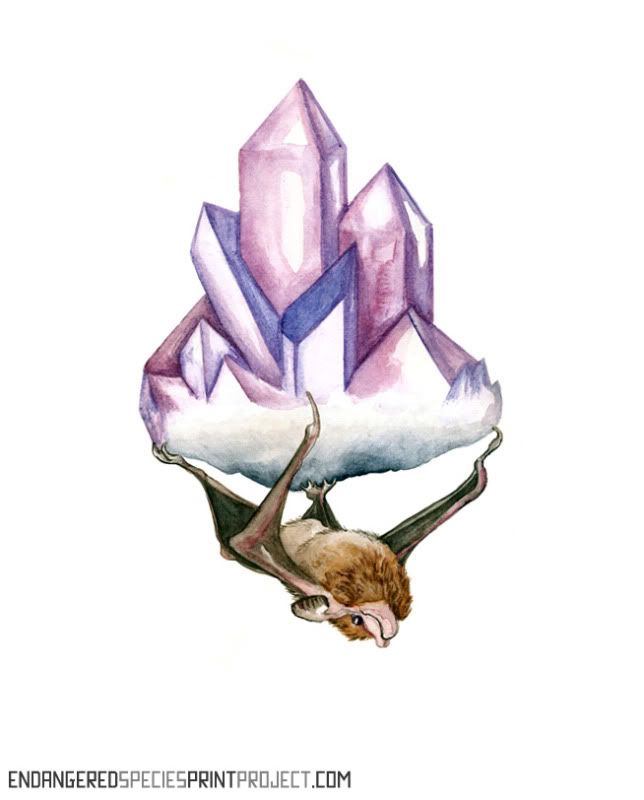
Molly Schafer
"The Seychelles Sheath-tailed Bat"
2009
Archival giclee print (Edition of 37)
8 x 10 inches

Chicago-based artists Jenny Kendler and Molly Schafer recently launched the Endangered Species Print Project. The ESPP offers limited edition prints of critically endangered species for sale to collectors, and ALL proceeds are donated to conservation programs working to perpetuate the featured species. For each print edition, the total number of prints corresponds to the featured animal's current population. For example, only 37 Seychelles Sheath-tailed bats remain in the wild, so for that edition, 37 prints will be produced.

The ESPP is already generating buzz. The Center for Biological Diversity and The Sierra Club are both promoting the project and have expressed interest in collaborating with Schafer and Kendler. I'm not surprised. The ESPP is a terrific undertaking, a fine example of the sort of environmentally and socially responsible efforts that I dearly wish more contemporary artists would involve themselves with.

As such, I'd promote ESPP even if I weren't planning to produce some prints for the project. I expect to produce two original drawings that will be turned into prints before the end of this year. My subjects will be the Javan, or Sunda, rhinoceros (Rhinoceros sondaicus) and the red wolf (Canis rufus). Also, in 2010, I hope to produce prints featuring other endangered species, including some birds, reptiles, and plants.

Prints of the following species are already available: the Panamanian Golden frog (Atelopus zeteki); the Vancouver Island Marmot (Marmota vancouverensis); the Seychelles Sheath-tailed bat (Coleura seychellensis); and the Indri lemur (Indri indri). Visit the ESPP site to learn more.

Tuesday, June 16, 2009

Passing on our gifts


Jason Middlebrook
"The Endless Outpouring Of Support"
2008
Acrylic, ink and pencil on paper
57 7/8 x 70 7/8 inches framed


For a number of years, friends have recommended that I read Lewis Hyde's The Gift. I'm finally getting around to doing so and, just forty pages into the text, I see why friends thought the book would so appeal to me. Hyde picks apart the contemporary market, particularly as it relates to commerce in art objects and other creative "commodities." In the introduction, he writes,
"A work of art is a gift, not a commodity. [...] Every modern artist who has chosen to labor with a gift must sooner or later wonder how he or she is to survive in a society dominated by market exchange. And if the fruits of a gift are gifts themselves, how is the artist to nourish himself, spiritually as well as materially, in a age whose values are market values and whose commerce consists almost exclusively in the purchase and sale of commodities?

Every culture offers its citizens an image of what it is to be a man or woman of substance. There have been times and places in which a person came into his or her social being through the dispersal of his gifts, the 'big man' or 'big woman' being the one through whom the most gifts flowed. The mythology of the market society reverses the picture: getting rather than giving is the mark of the substantial person, and the hero is 'self-possessed, 'self-made.' So long as these assumptions rule, a disquieting sense of triviality, of worthlessness even, will nag the man or woman who labors in the service of a gift and whose products are not adequately described as commodities.

[...]

A man in another tribe that [anthropologist] Wendy James has studied says, in speaking of the money he was given at the marriage of his daughter, that he will pass it on rather than spend it himself. Only, he puts it this way: 'If I receive money for the children that God has given me, I cannot eat it. I must give it to others.'"
Reading the last bit of the above excerpt, I couldn't help but think of my charitable sales model. The income that I receive from the sale of art objects I've produced is fundamentally no different from the tribe representative's "money for the children that God has given me." In this respect, it is not merely ethical, but also natural that some significant percentage of each sale be passed on, invested in turn in the good works of a non-profit organization or another conscientious individual.

Hyde points out that this pass-it-on approach is in keeping with the cycles of nature. Indeed, the words "ecology" and "economy" are etymologically connected for good reason. As I explained in an HH post in August of 2005,
"'Ecology' translates as 'study of the household' and 'economy' as 'management of the household.' Any good scientist (or thoughtful citizen, for that matter) should study the household before managing it. Thanks in no small part to my father's influence, I began to see many ecological issues as economic concerns (and vice versa). Given my environmentalist leanings, I suppose my [engagement] with economic theory was inevitable. It was also inevitable, or at least quite likely, that I would become disenchanted with our current boom-and-bust paradigm."
Moreover, Hyde points out that "the language of gift exchange has procreation at its root. Generosity comes from genere (Old Latin: beget, produce), and the generations are its consequence, as are the gens, the clans." Indeed, by damming wealth in concentrated pools, the demon market of our capitalistic culture halts the cycle of generations. The natural flow stopped, dispossessed peoples are condemned to hunger for physical nourishment and the wealthy are condemned to hunger for nourishment of the soul.

As Hyde stresses, "what is given away feeds again and again, while what is kept feeds only once and leaves us hungry." Or, as my mom always puts it, "Love and live with an open hand."

Image credit: Jason Middlebrook image ripped from the Sara Meltzer Gallery website

Friday, June 12, 2009

An Ocean Ethic


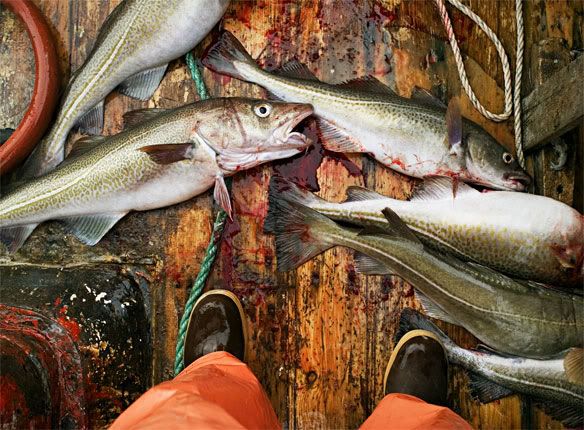
Corey Arnold
"Torsken"
2007
Chromira C-print

The son of an avid saltwater fisherman, many of my summer days were spent offshore. Departing the Wachapreague, Virginia, docks at 5 AM, the sky broke pink as my father carefully piloted his Boston Whaler through the salt marsh channels. Upon reaching the ocean inlet, we'd begin a thirty or forty mile run toward the sun-soaked eastern horizon. By 8 AM, we'd be trolling for yellowfin and bluefin tuna, dolphin ("mahimahi"), amberjack, or various mackerel species. If that technique proved unsuccessful (or if my father's fishy hunches proved wrongheaded), we'd move west, closer to shore, so that we could bottom-fish for black sea bass, spot, and weakfish over scuttled World War II ships and defeated German U-boats.

Compared to my father, I was unenthusiastic about salt-water fishing. I much preferred fishing on a pond, fly or spin casting into "honey holes," those storied pockets where the giant largemouth bass, perch and bluegill dwell. The relative solitude and meditative character of freshwater fishing appeals to my temperament. I associate the leisurely activity with the soft-spoken stroke of the canoe paddle; the rhythmic, almost ritualized casting of a fly or lure; the temperate spring breezes that lick my bare forearms as they do the banks' willow and maple trunks; the ecstatic chatter of a kingfisher. Above all, I associate it with a sense of universal benevolence. This, in stark contrast to fishing offshore, where Nature's benevolence is tempered by ambivalent and awesome forces.

Still, I enjoyed being on the open ocean. I loved the bounce and glide of my father's Whaler as it motored over the Atlantic chop, and I was delighted by the otherworldliness of ocean life: shadowy hammerheads passing through depth-piercing sun rays; dolphins propelling themselves skyward to get a better look at us; the surprising company of terns and gulls so far from land; loggerhead sea turtles basking on the ocean's surface; hundreds of cownose rays flying just beneath the water's surface. These images, and many others, stay with me. The ocean is a mysterious, thrilling place.

Sadly, it is also a threatened place. The most dire reports forecast that the ocean's fish species will be depleted by mid-century. If that should come to pass, the commercial seafood industry will no longer be viable and, more seriously, our world's biodiversity and ecological integrity will have been dealt an awful blow. Because of my latter day hunter-gatherer approach to fish and meat consumption, the only shellfish I consume are those few blue crabs and clams that I pull from the Eastern Shore's tidal estuaries. I rarely fish these days, so fish species are off my menu altogether.

Food writer Mark Bittman would likely approve of my vegetarian-unless-I-kill-or-catch-it ethic. In a recent New York Times article, "Loving Fish, This Time With the Fish in Mind" (June 9, 2009), Bittman argues for a more conscientious approach to seafood.
"In the meantime, I'm careful. I don’t make excuses, like 'There's cod in the market, so someone is catching it somewhere,' or 'If I don't buy it, someone else will,' or 'This chef serves local food, so he must serve sustainable fish.' If I’m going to eat fish, it must be consciously and thoughtfully.

My approach - which I readily admit is a work in progress and is as imperfect as my approach to all foods - goes something like this:

- I don’t buy or order the common fish I can easily keep in mind as being super-troubled — most cod, for example, or bluefin tuna, most species of shark and skate. When in doubt, I move on.

- With rare exceptions, I don't buy or order farm-raised fish, except clams and oysters. Farmed mussels and shrimp don’t seem to come with egregious environmental consequences, but neither tastes like much, either.

- I don’t eat fish as often as I once did. (I don’t promote eating it as I once did, either.)

- And I keep re-evaluating these 'rules,' and thinking about them. The 'safe' lists are difficult to understand, impossible to remember and change frequently. When the fishing of a species is well managed, it can recover and become sustainable. When it's not, the stocks of that fish disappear, sometimes quickly.

I’m probably not going to stop eating fish. And fortunately I don’t have to, since there are species that have never been depleted - squid and mackerel, for example - and those that have recovered, like haddock and Maine lobster.

It’s improbable that I’ll eat in a perfectly sustainable manner, even though I probably eat one-third as much fish as I did a few years ago. I’m trying not to let perfect become the enemy of good, and I’m trying to find a place that feels comfortable. That place is to see eating fish as a treat. I won’t eat it daily or in huge quantities, but occasionally, with appreciation. The days of 'see it/eat it' are gone."
Every educated eater should do the same, and each of us should strive to educate ourselves further. It's the ethical thing to do.

Time and evolution will march on, heedless of our nostalgic and preservationist impulses, but their ambivalence doesn't mean we've license to shrug and capitulate to the selfish wonts of the average consumer. Future generations should bear witness to the wonderful abundance that we have known and, to a lesser degree, still know. If we eat with an open mind and heart, perhaps that can be so.

Image credit: photograph by Corney Arnold; ripped from the artist's website

Friday, June 05, 2009

Ocelots at the Gate!


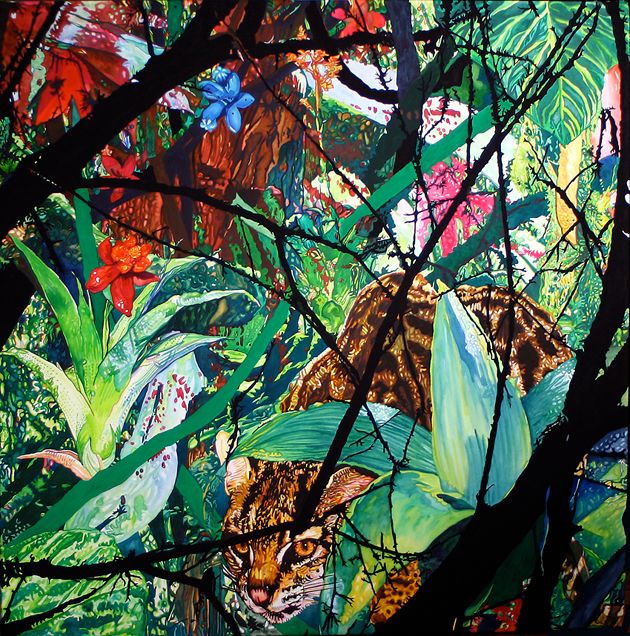
Christopher Reiger
"between meaning and material (h.H.R.)"
2007
Watercolor, gouache, graphite and marker on Arches paper
32 x 32 inches


Diminutive yet captivating, the ocelot (Leopardus pardalis) is my favorite cat species. I've only appreciated the beautiful feline on film and in photographs, but am nonetheless impressed to near reverence. I delight in the animal; I marvel at his dappled coat as he passes through dense foliage and I am humbled by her grace and cunning gaze.

Years ago, when working at a eco-tourism tent camp on Costa Rica's Osa Peninsula, I had the privilege of tracking an ocelot's nighttime doings along a Pacific beach that abuts a steep jungle mountain. I didn't discover the cat, but I took great pleasure in tracing the cat's movements, and I was deeply grateful for the opportunity to commune with the creature, even in so simple a fashion.

It is with great distress, then, that I consider the plight of the ocelot and other species in the Lennox Foundation Southmost Preserve, a 1,034-acre preserve located at the southern tip of Texas. As proposed by the United States Department of Homeland Security, the Mexico-U.S. border fence will pass through the center of this preserve, up to a mile-and-a-half north of the actual border. Three quarters of the preserve will thereafter be inaccessible by employees of the Nature Conservancy, the organization that currently manages the property. Because the Nature Conservancy refused the USDHS buy out, they are being sued by our federal government.

In her Nature Conservancy Magazine article "Don't Fence Me Out," Jennifer Winger writes:
"Once known as the Wild Horse Desert, south Texas may support more wildlife per acre than any other habitat in North America. And although the Rio Grande Valley itself has lost more than 95 percent of its wildlife habitat, Southmost Preserve is a shining exception: Its lands and waters provide habitat for endangered species such as jaguarundis and ocelots, as well as indigo snakes, Texas tortoises and migratory birds.

But recently, this valuable habitat has been threatened by an 18-foot-tall concrete and steel fence proposed by the Department of Homeland Security. Most of the proposed 670-mile-long border fence, with segments from California to West Texas, has already been constructed, but the section slated to cut through the Conservancy’s land is on hold, pending the outcome of a legal battle.

...If the fence is built, nearly 700 acres — 75 percent of the preserve — would be trapped in a no-man’s-land between the fence and the Rio Grande, including all preserve facilities and the home of the preserve manager. The proposed fence would effectively cut off access to the native plant nursery, which is critical to reforestation efforts throughout south Texas. Additionally, the fence would sever a critical corridor for wildlife, as it could block animals from accessing protected areas to the north and freshwater resources to the south."
Contemplating the myopic vision of the USDHS, I recalled an earlier HH post that questioned that morality of building a border fence. In light of this recent news from Texas, I've decided to republish "Border (Bio)diversity (of opinion)" today.

+++++


The Robert Smithson in me is bemused by international borders, particularly those boundaries that are not physically demarcated, lines that exist only in cartography and our collective political imagination. Last night, I contemplated a striking black-and-white photograph of the Mexico-U.S. border. The image was dominated by a rural "vehicle barrier" fence (similar to the one shown above), far removed from an official border checkpoint or crossing. In the desert of the American Southwest, this fence draws an arbitrary line in wire and steel.

It struck me as an emblem of humanity's absurdly tenuous existence, a reminder that our species is an insignificant mote in an incomprehensibly tremendous weave. As the artist Carl Buell wrote in the comments section of a recent HH post,
"With every change in sea level and shoreline, with the raising or eroding of every mountain range, with every changing weather pattern, life spreads out as it can and comes into contact with new environments, opportunities and hazards...As I get older (than dirt), I find myself starting to think like the hills themselves. Some day after eroding and washing out to sea, I’ll be a hill again."
Indeed, each of us (and, eventually, our species) will be reconstituted, and our arbitrary borders, those lines in the mud of space-time, will be erased. In this respect, the border fence is a healthy reminder of our existential folly, but it also reveals humanity's darker inclinations. We build fences, after all, to divide "us" from "them," the demonized "other."

The photograph that inspired this post was printed in the most recent issue of Wildlands Connection, the Wildlands Project newsletter. It accompanied an article about wildlife bottlenecks at the Mexico-U.S. border. The Wildlands Project's mission is to create vast, uninterrupted linkages, known as wildlife corridors, that will extend from Canada into Mexico (on the Rockies spine) and from Canada into Florida (on the Appalachian spine). The U.S.-Mexico border fence is a major obstacle to the organization's first goal.

Yet physical barricades are but one of the obstacles that ambitious conservationists face. Consider wildlife trade legislation that protects species in one country, but not another, adjacent nation. If strict laws prohibit the trapping or hunting of a species in China, for example, but not in neighboring Mongolia, is the Chinese legislation effectively addressing species welfare (particularly when Chinese citizens are paying top dollar to have the killed contraband imported)? Similar issues haunt conservation efforts the world over.

The humanitarian and social concerns that ethically-minded conservationists must take into account present a more nuanced hurdle. Environmental groups in the European Union are warring with one another about how best to create the legislative and physical infrastructure necessary for sustainable energy development. How can you raise thousands of wind turbines without hindering bird migration, ruining aesthetics, or plopping towers in the backyards of folks too poor and disenfranchised to protest?

If the various interest groups in the EU, one of the most environmentally progressive governing bodies in the world, are at odds, is it realistic to expect conservation to become a truly supra-national affair? After all, the EU's concerns are petty alongside those of the southern hemisphere. Whereas Europe is a sprawl of cultivated landscape relatively lacking in biodiversity, the "Third World" represents the usually disastrous meeting of remarkable biodiversity and an exploding human population. Impressed by our terrible example, the citizens of these nations emulate the unsustainable behavior of the "First World." In order to counter the detrimental environmental effects of Third World industrialization, international legislation will face increasingly substantial challenges. The supra-national bodies can create laws, but can we enforce these laws without wielding the colonial sceptre? More critically, can we conserve biodiversity and healthy ecosystems without subjugating the rights of the humans that call the Third World home?

These questions bring me to "Climate of Fear," a recent book by the eloquent Nigerian poet, essayist and Nobel Laureate, Wole Soyinka. Though Soyinka is writing about humanity's attempt to cope with terrorism, his political thrust is applicable to all realms, and his message is clarion.
"The gray zones of moral definitions where relativity reigns and remote cause are evoked to justify the abhorrent will continue to haunt certain casts of mind. The rest will insist on the primacy of an ethical will, one that dictates that some deeds demand to be judged within an identifiable and shared moral universe, however restricted...The ethical will is the redeeming assertion that, even when all other considerations of social conduct are subjected to the fortuitous, one, an ethical core, remains inviolate."
All of our fences fail. Perhaps we should recognize in that certainty both an entropic truth and an implicit morality. Within the context of this "shared moral universe," we are impelled to remove artificial barriers, whether they are constructed to stem the natural tide of human migrations or to protect us from our enemies. No matter the justification for the boundaries we draw, they are immoral inventions. And man, it is said, is the moral animal.

Photo credit: ripped from Kris Eggle's website

Wednesday, April 22, 2009

Earth Day


Studebaker; Eastern Shore of Virginia


In time, all things - pants, refrigerators, Studebakers - succumb. The extinction of human civilization is likewise inevitable.

But one of the most wondrous faculties of the human animal is its capacity for heightened compassion. Working as a conscientious society, we strive to conserve the ecology we appreciate not simply because we have the means to do so, but because we recognize that doing so is just.

Photo credit: ShoreRebel