Showing posts with label ecology. Show all posts

Tuesday, April 23, 2013

When It All Comes Together

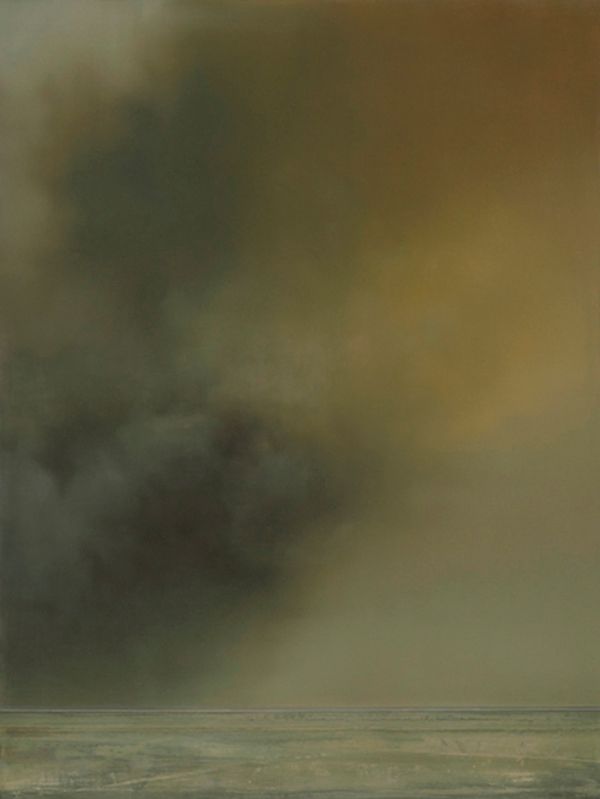
Christopher Reiger
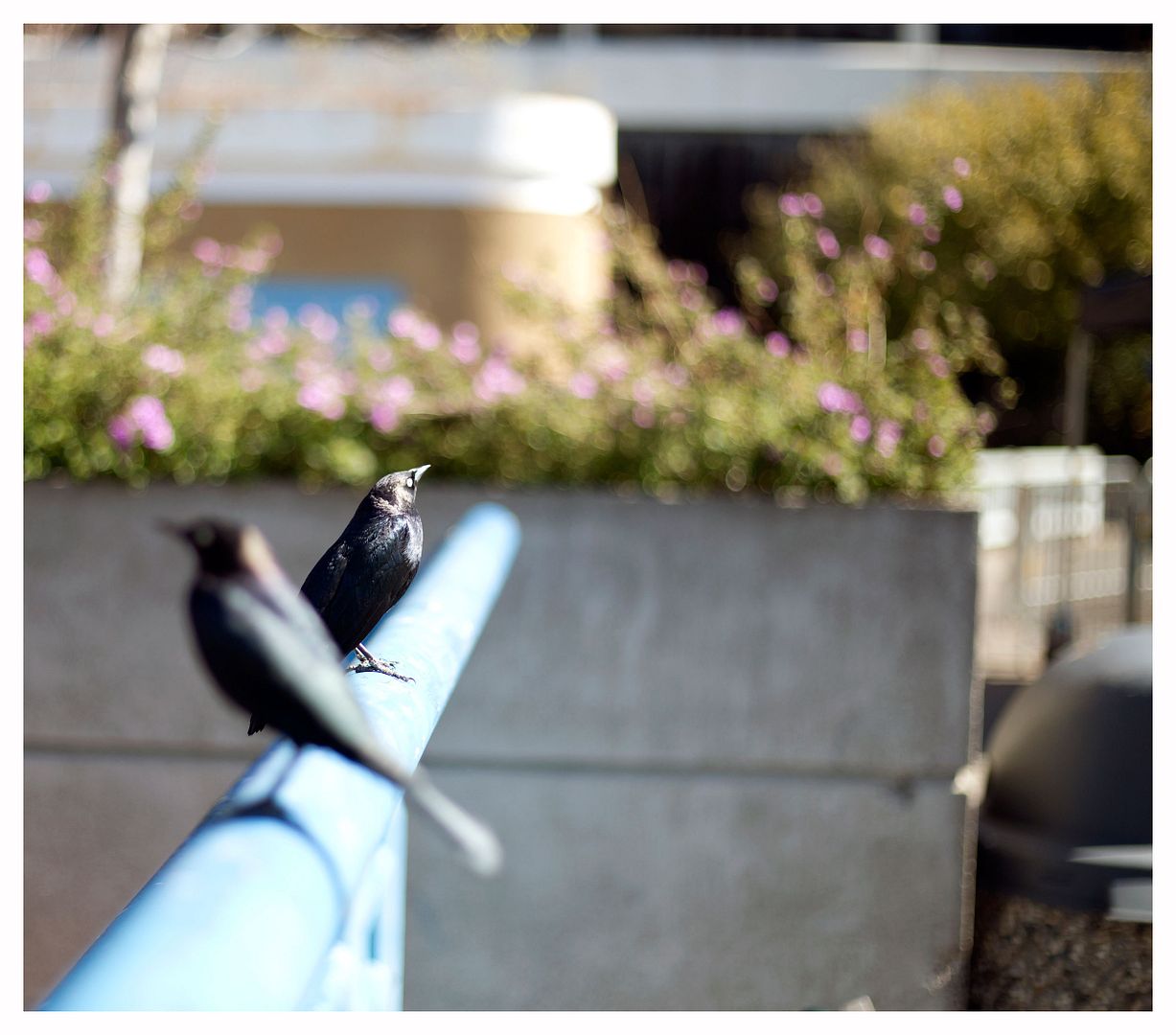
"Brewer's blackbirds"
2013
I recently promised this blog's monthly email digest subscribers that I would begin sharing updates about BAASICS (Bay Area Art & Science Interdisciplinary Collaborative Sessions), the non-profit organization that I co-founded and co-direct. Indeed, most of April's Hungry Hyaena posts are synopses of conversations had with some of the artists and scientists participating in BAASICS.3: The Deep End, our upcoming program on neurodiversities, mental illness, and creativity. (Readers can expect more of these vignettes in advance of the Monday, May 6 event.)

I've come to regard BAASICS as an important arm of my creative endeavor; it's a long-term project that provides me with a platform to help make contemporary art and science relevant and exciting to a broad audience. In many respects, BAASICS is a descendant of Synoddity, the cross-disciplinary organization I co-founded with my friend Michael McDevitt during our undergraduate years at The College of William & Mary. Synoddity made a case for conversation and interaction across professional boundaries and was, like BAASICS, animated by curiosity and wonder, something both Michael and Selene Foster, my BAASICS collaborator and co-founder, have in spades. Working on a project you're passionate about is invariably a good thing, but it's a particular pleasure when you team up with fantastic people.

Thursday, August 16, 2012

Platte Clove Residency: Coastal Differences

View of Devil's Path Trail; Catskills; NY; July 2012
Five years ago, while traveling in South America, I met a young woman from the West Coast of the United States. After the trip, we corresponded for a while, and she related news of her move from southern California to New England. An outdoorsy sort, she prioritized exploration of the parks in her new neck of the woods, but she wrote that the eastern forests unnerved her. During the summer months especially, they seemed dense and suffocating, a patchwork of green that closed in around her.

At the time, her observation amused me. Having grown up on the East Coast, I was at home in the mixed deciduous and pine forests of eastern North America. By contrast, the Endor-like redwood and sequoia forests of the Pacific coast and the mixed coniferous forests of the continental divide and the American Southwest, environments in which I'd had little or no experience but with which my friend was very familiar, seemed otherworldly to me.

Friday, October 14, 2011

AIRIE Residency: Prologue

Tomorrow night, I'll fly from San Francisco to Miami, Florida. Early on Sunday morning, I'll drive a rental car southwest into the Everglades National Park, the site of my 2-week-long Artists In Residence In the Everglades (AIRIE) writing and art residency. In my application to the National Park Service program, I touched on one of the many reasons I want to explore a park and region that I haven't visited in many years.
"Each fall and winter, when I travel to my childhood home on Virginia’s tip of the Delmarva Peninsula, I assist my father on the farm, and also hunt, fish, and walk the fields, woods, and salt marsh. The mid-Atlantic wetlands are my home ground. Although I've traveled to a range of ecosystems in many countries, I'm intimately tied to the ecology of my youth. The sawgrass marshes and swamps of the Everglades are a subtropical version of Virginia’s wetlands, and I am eager to become better acquainted with the ecosystem."
I was generalizing. The marshes, mangrove and cypress swamps, and hardwood hammocks of the Everglades are a far cry from the mid-Atlantic salt marshes I grew up alongside, but there are some similarities I intend to consider (and write about) while in Florida.

One unfortunate likeness: mosquitoes. October is the last month of the warm, wet season in the Everglades; water levels will be high and biting insects, plentiful. Fortunately, birds and reptiles also thrive thrive in the Everglades, and I hope to be too distracted by creatures I enjoy watching to notice the drone of the "skeeters."

Most of my 2-week term will be devoted to hiking, writing, reading, and photography, but I plan to work on some painting and drawing studies, too. I'll present one lecture on art and ecology to a class from Florida International University, after which I'll join them for a "slough slog," an off-trail hike through the Pa-Hay-Okee, the Seminole name for the Everglades (which translates as "grassy waters"). I've inquired about "shadowing" wildlife researchers in the field and/or assisting park rangers with their work. I was informed this should be possible, so my fingers are crossed.

While at the Kimmel Harding Nelson Residency in Nebraska City, Nebraska, I provided regular updates about my experiences. I'd planned to do the same during my time in "America's Subtropical Wonderland," but no Internet connection is available in the park and the closest coffee joint with WiFi access is a 20 minute drive outside of the park, in what I expect is Florida City's suburban sameness. As a result, I'm not yet sure how often updates will appear. More to come....at some point.

Wednesday, December 29, 2010

Relative Birthday Abundance


Tundra (or Whistler) swans; Heron Hope; Locustville, VA; December 2010

As an enthusiastic amateur naturalist living in New York City, I grew fond of the hearty, adaptive species that populated the boroughs' streets, parks, and waterfronts: pigeons and gulls, rats and red-tailed hawks, starlings and squirrels. When I felt out of step with my urban friends and neighbors, as I occasionally did, I found that watching the animals helped. Chittering around the base of a corner garbage can, the sparrows and starlings chastised me for moping. The herring gull's shrill shout over the East River exhorted me to shake off my self-conscious alienation. All of these species were part of my urban wildlife support network. Watching them reminded me to get on with the business of grateful L-I-V-I-N', no matter where I might be. Now that I live in San Francisco, a town with greater biodiversity than NYC, I'm happy to have Steller's jays, Brewer's blackbirds, and ravens keeping me company, too.

Today, however, my girlfriend and I are visiting my parents on the Eastern Shore of Virginia. Dumped on by the latest "snowpocalypse," we've been locked in for most of our visit. Not that I mind. Yesterday morning, I trudged through the snow drifts around my home ground, eyes squinted in the dazzling winter light. In the space of an hour, I saw thousands of snow geese rise noisily from a partially exposed barley field; turkey vultures sweep across the sky, scenting for an unfortunate victim of the biting weather; a woodcock flush from a hedge; coyote tracks that skirted a small cemetery; mouse tracks that emerged from under a snow-covered plow and lightly skipped across the snowfall's surface to a patch of open grass; a yellow-rumped warbler and a Carolina wren vying for position atop a perch; two tundra (or whistling) swans flying low overhead; Canada geese and green-winged teal gathered in the open water of the estuary; a cottontail peer from a tangle of grasses. It occurred to me, as I contemplated such abundance and diversity, that my urban wildlife support network, whatever its personal value, is but a shadow of what I witnessed this December morning.


Sunset; Heron Hope; Locustville, VA; December 2010

Last year, at this time, I wrote, "32 years on this Earth, and still I feel like I am opening my eyes for the first time." Now 33, that statement is no less true. Given my stubborn optimism, I presume that it will be true at 43, 53, or 83 (should I survive so long). Still, I wish that I could open my eyes to greater species diversity in the cities that I call home. We humans are an increasingly urban species, and we must take care not to forget about the world's collapsing biodiversity. It isn't just the country folks that benefit from it; we all do, whether we appreciate that fact or not.

All the same, I'm looking forward to hearing the belated birthday croaks from the ravens above the Inner Sunset.

Happy 2011, friends. May it be a rich, sweet, and happy year!


Snow Geese; Heron Hope; Locustville, VA; December 2010

Photo credit: Hungry Hyaena, 2010

Friday, December 03, 2010

Red Wolf ESPP Prints Released!


Christopher Reiger
"Constellation (Canis rufus)"
2010
Pen and sumi ink, gouache, and watercolor on Arches paper
15 x 12 inches

My 2010 drawing "Constellation (Canis rufus)" has been made into a limited edition print for the Endangered Species Print Project (ESPP). The drawing features the red wolf (Canis rufus), a critically endangered wolf species.

I wrote the following description of the red wolf and its plight for the ESPP website:
"The Red Wolf (Canis rufus) is a medium-sized North American canid, generally larger than a coyote but smaller than the gray wolf. As the common name suggests, red wolves often have reddish fur on and around their ears, neck, and legs. Like other wolves, the Red Wolf is a social species that lives in packs, groups typically comprised of a mated pair and their offspring (of multiple generations). Red Wolves are crepuscular predators, most active at dusk and at dawn. They prey on white-tailed deer, raccoons, opossums, rabbits, and rodents, but are also known to scavenge.

The Red Wolf once occupied a range that extended over the forests, swamps, and coastal plains of the southern and eastern areas of the United States, as far west as Texas and as far north as New York. As with most non-domesticated canines, however, the Red Wolf was vilified as a dangerous competitor of man (and, erroneously, a "man-eater"). These entrenched, negative attitudes gave rise to aggressive predator control campaigns; wolves were poisoned, shot, and trapped. This persecution was compounded by habitat loss and disease, taking a terrible toll on red wolf populations. By 1980, the species was extinct in the wild.

Today, though, there is good news. Thanks to several focused preservation and reintroduction programs, and especially to the efforts of the Point Defiance Zoo & Aquarium (PDZA) and the United States Fish & Wildlife Service (USFWS), in conjunction with programs like that at Mill Mountain Zoo, the Red Wolf is staging a small, isolated recovery. There are now approximately 100 wolves living wild in eastern North Carolina and up to 250 individuals in zoo-based captive breeding programs."
As per the ESPP model, this is a limited edition of 100 prints, the number determined by the featured animal's current wild population. The print measures 8 x 10 inches, and costs a mere $50.00. ALL proceeds from sale of the prints will be donated to the Port Defiance Zoo & Aquarium Red Wolf Recovery Program.

As I explain in the ESPP artist notes, my fascination with taxonomy increased my interest in researching this particular species:
"Ecology, wildlife biology, and natural history are subjects that I'm passionate about, and I'm especially intrigued by taxonomy, the classification of different species. The ever-evolving field's binomial nomenclature is chock-a-block with curious etymological backstories and, more importantly, taxonomists are endlessly debating species classification. Names change, species become subspecies (and vice versa), and protected animals become unprotected animals on what seems to be a month-to-month basis! The red wolf is no exception. It's an honor to produce an artwork that may, in some small way, help save a keystone predator from extinction and genetic isolation; I must admit, however, that I also planned to use the print as an excuse to learn more about the particulars of the red wolf taxonomic debate.

Some wildlife biologists insist that the red wolf's scientific name is Canis lupus rufus and that the animal is a subspecies of gray wolf (Canis lupus). Another camp, one that the US Fish & Wildlife Service concurs with, believes the wolf to be a species distinct from the gray wolf. It is their classification, Canis rufus, that I use in the species description above. Frankly, both groups make valid arguments; the different verdicts depend on whether the red wolf is classified according to the biological classification rule (i.e., if Wolf A can make viable pups with Wolf B, the two wolves belong to the same species) or the phenotypic/phylogenetic approach to classification, based on distinct physiological or genetic characteristics. Because the phenotypic/phylogenetic approach leads to a great many more species, it remains a source of contention within wildlife biologist communities and complicates conservation politics, for better and for worse.

Of primary importance, though, are the animals. Whether red wolves are ultimately deemed their own species or a subspecies of gray wolf, they're on the brink of extinction. There is ample cause for hope, however, and you can make that hope a little more concrete by purchasing a print!"
Visit the ESPP site to learn more and, during this holiday season, please consider helping the species by buying a print as a gift.

Sunday, September 05, 2010

ESPP at Chicago's Renegade Craft Fair


The Endangered Species Print Project will be exhibiting at the Renegade Craft Fair, taking place this September 11th and 12th, in Chicago.

Co-founders Jenny Kendler and Molly Schafer will be selling prints to raise funds for all of the fourteen species so far featured in ESPP prints, as well as some upcoming print subjects, including my red wolf (Canis rufus).

I'm pleased to report that, to date, the ESPP has raised $4,000 for critically endangered species, and hopes to raise another $6,000 at Renegade! If you're in or around the Windy City, please pay them a visit.

Wednesday, July 21, 2010

ESPP Anniversary


Molly Schafer
"Moldavian Meadow Viper"
2010
Archival giclee print (Edition of 2000)
8 x 10 inches

The Endangered Species Print Project recently celebrated their one year anniversary! To mark it, they released three new prints.

I'm especially fond of the two newly available limited editions created by the project's co-founders, Molly Schafer and Jenny Kendler...and I'm most drawn to the Moldavian Meadow Viper (Vipera ursinii ssp. moldavica). This, for three reasons: Molly rendered the animal beautifully; I adore serpents, and Molly evidently does, too; I have an irrational attachment to Hungary, since my paternal great-grandparents hail from the country, and sales of the print benefit the Hungarian Meadow Viper Conservation Center, a conservation organization based there.

Visit the ESPP site to see the other prints.

Image credit: Courtesy the Endangered Species Print Project

Sunday, May 09, 2010

What Remains


I've posted Chris Jordan's photographs on HH in years past, but I haven't before showcased his pictures of albatross remains. The images are powerful reminders of the too often unseen and unconsidered impacts of our species' prolific, reckless consumption.


On his website, Jordan writes of the series, "Midway: Message from the Gyre,
"These photographs of albatross chicks were made in September, 2009, on Midway Atoll, a tiny stretch of sand and coral near the middle of the North Pacific. The nesting babies are fed bellies-full of plastic by their parents, who soar out over the vast polluted ocean collecting what looks to them like food to bring back to their young. On this diet of human trash, every year tens of thousands of albatross chicks die on Midway from starvation, toxicity, and choking.

To document this phenomenon as faithfully as possible, not a single piece of plastic in any of these photographs was moved, placed, manipulated, arranged, or altered in any way. These images depict the actual stomach contents of baby birds in one of the world's most remote marine sanctuaries, more than 2000 miles from the nearest continent."
Today, as crude oil continues to spread over the Gulf of Mexico from the Deepwater Horizon rig, we'd do well to remember that one of the significant uses of crude oil is the production of petroleum-based plastics. Individually, we can help alleviate our reliance on offshore oil wells and imported oil by consuming less plastic and recycling what we must use.


Photo credits: all images, Chris Jordan

Friday, April 09, 2010

Javan Rhinoceros ESPP Prints Available


Christopher Reiger
"diminishing returns"
2010
Pen and sumi ink, gouache and watercolor on Arches paper
15 x 12 inches

My 2010 drawing "diminishing returns" has been made into a limited edition print for the Endangered Species Print Project. The drawing features the Javan Rhinoceros (Rhinoceros sondaicus), a species on the very brink of extinction.

From the ESPP website:
"The Javan, or Sunda, Rhinoceros, is one of five extant rhinoceros species. The species was once widespread throughout Asia but is today critically endangered. There are currently between 37 and 44 Javan Rhinos in Ujung Kulon National Park, in West Java Indonesia, and no more than 5 in Cat Tien National Park, in Vietnam. Sadly, with only two known populations in the wild and none in captivity, this rhino species may be the rarest large mammals on our planet."
As per the ESPP model, this is a limited edition of 49 prints, the number determined by the featured animal's current population. The print measures 8 x 10 inches, and costs a mere $50.00. ALL proceeds from sale of the prints will be donated to the International Rhino Foundation.

The drawing was something of a first for me. As I explain for the ESPP artist notes,
"Animals figure prominently in my drawings and paintings. Usually, however, there is plenty of photographic art scrap to use as source material. In the case of the Javan Rhinoceros, this is definitely not the case!

In order to minimize stress for the critically endangered rhino, researchers study the species via fecal sampling and camera traps; the animals are rarely encountered or observed. As a general rule, the Javan Rhino is wary of humans and retreats into dense forests when they sense our presence. When humans do approach, whether intentionally or by mistake, the Javan Rhino becomes aggressive and will often attack, stabbing with the incisors of its lower jaw while thrusting upward with its head. Of course, such wariness and aggression are good survival tactics, but it makes the rhinos extremely difficult to study. (Interestingly, some researchers contend that these behaviors are a recent adaptation to population stresses. Historical records indicate that the species was once more gregarious.)

Because so little photographic documentation is available, this drawing marked the first time I've had to work from both images and written descriptions. It was a very curious process, and I hope that I've done the Javan Rhino justice!"
Visit the ESPP site to learn more.

Saturday, January 23, 2010

Quantity or Quality?


Nathan Abels
"Passage"
2009
Acrylic on Panel
24 × 48 inches
"The world we inhabit is not, in this sense, a determinate set of objective processes. It is our larger flesh, a densely intertwined and improvisational tissue of experience. It is a sensitive sphere suspended in the solar wind, a round field of sentience sustained by the relationships between the myriad lives and sensibilities that compose it. We come to know more of this sphere not by detaching ourselves from our felt experience, but by inhabiting our bodily experience all the more richly and wakefully, feeling our way into deeper contact with other experiencing bodies, and hence with the wild, intercorporeal life of the Earth itself.

[...]

In truth, it’s likely that our solitary sense of inwardness (our experience of an interior mindscape to which we alone have access), is born of the forgetting, or repressing, of a much more ancient interiority that was once our common birthright: the ancestral sense of the surrounding earthly cosmos as the voluminous inside of an immense Body, or Tent, or Temple.

[...]

Experiential qualities once felt to be proper to the surrounding terrain—feeling-tones, moods, the animating spirits-of-place known to reside in particular wetlands and forests—all lost their home with the dissolution of the enclosing, wombish character of the pre-Copernican cosmos. Such qualities now had no place in the surrounding world, itself newly conceived as a set of objects connected by purely external, mechanical relationships: a world of quantities. Unlike quantities, qualities are fluid, mercurial realities arising from the internal, felt relations between beings. Qualities—these ephemeral and fluid powers—require at least a provisional sense of enclosure to hold them. When they could no longer be contained by the visible world (no longer encompassed and held within the curved embrace of the spheres), these ambiguous, ever-shifting qualities quit the open exteriority of the physical surroundings, taking refuge within the new interiority of each person’s 'inner world.' Henceforth they would be construed as merely subjective phenomena."

- David Abram, "The Air Aware", Orion Magazine, September/October 2009
David Abram's essay "The Air Aware" eloquently expands on ideas that I attempt to present succinctly in my artist statement. Brevity is difficult, however, for those of us who are preoccupied with the exciting interchange of anthropology, ecology, ethology, phenomenology, and theology.

It's interesting, then, that the work of visual artists who explore this conceptual terrain is often quietly awesome. Interesting...and yet so natural.


Christopher Saunders
"Whitenoise Suite no.6"
2009
Oil on linen
24 x 18 inches

Image credits: both painting reproductions, courtesy the artists

Wednesday, December 16, 2009

Global Climate Justice Fast


350 Candle Vigil; Washington Square Park, NYC; December 2009

"How well we control our numbers, our appetites, and the efficiency with which we satisfy those appetites will ordain just how desperate the situation becomes. They are the battles for our time, as morally compulsory as the battles for civil rights or against totalitarianism."

- Bill McKibben, The End of Nature

The group gathered at the northern entrance of Washington Square Park last Friday evening was smaller than I'd anticipated. We were assembled for a candle vigil in conjunction with the United Nations Climate Change Conference in Copenhagen, Denmark, and 350.org, environmental activist Bill McKibben's project to increase global awareness of the environmental (and status quo) threats posed by the exacerbation of climate change due to anthropogenic influence.

The New York City vigil was one of hundreds of similar events happening around the world on December 11th. Given the date, the vigil was also a satisfying way to bring in Hanukkah, a holiday that, despite its complicated history, is essentially about standing up for the causes that you feel most strongly about, even in the face of overwhelming odds. Small though our Washington Square Park group may have been, then, I was upbeat and hopeful.

Tomorrow (Thursday, December 17th), there is more cause for hope. I'll be one of thousands (hopefully one of many thousands) of true cosmopolitans forgoing food as part of the Global Climate Justice Fast. Bill McKibben's organization is trying to spread the word from Copenhagen, but the easiest place to sign up is at the Climate Justice Fast website. The official statement of the fast participants reads:
"We will fast voluntarily, for one day on Thursday, in solidarity with the millions who have and could lose their lives to preventable and involuntary hunger, disease and conflict resulting from climate change.

We call on world leaders for a real climate deal now--a deal grounded in science and strong enough to get us back to 350 [parts per million]."
I urge HH readers to take action this season. The specifics of your engagement matters less than its spirit. As I wrote not long ago,
"If global warming isn't appealing to your still, small voice, get involved with political activism, volunteer at your local homeless shelter, pledge financial support to non-profit activist organizations working for causes that you feel strongly about; it doesn't matter what you do, but it does matter that you do something. Turn off the television, put down the tabloid. I beg this of you."
If you have the energy and spirit to take action in multiple ways, so much the better, but every little bit helps. We're all in this marvelous mess together.

Thursday, October 22, 2009

Acting Out (Peacefully) Against the Culture of Competition


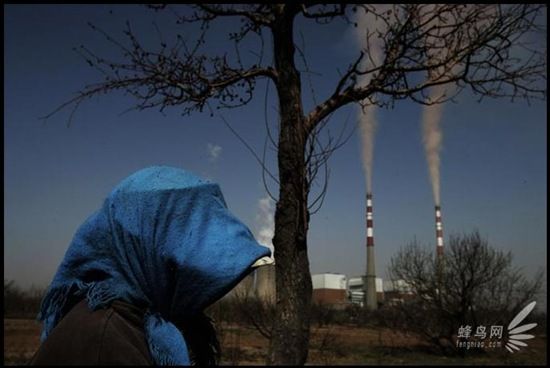
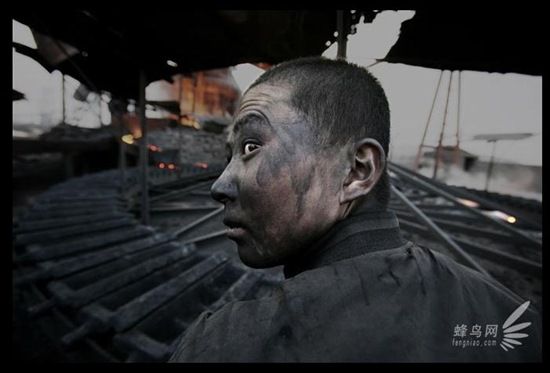
Shizuishan Industrial district in Ningxia. Residents cover themselves against the falling dust when going outside.
April 22, 2006

This Saturday, October 24th, I'll join a mob of peaceful activists and march across the Brooklyn Bridge, from Manhattan to Brooklyn, in hopes of further raising public awareness about the reality of climate change and the need for a comprehensive international climate treaty. The march is associated with 350.org's Day of Action.
"350.org is an international campaign dedicated to building a movement to unite the world around solutions to the climate crisis--the solutions that science and justice demand. Our mission is to inspire the world to rise to the challenge of the climate crisis—to create a new sense of urgency and of possibility for our planet. Our focus is on the number 350--as in parts per million, the level scientists have identified as the safe upper limit for CO2 in our atmosphere. But 350 is more than a number--it's a symbol of where we need to head as a planet. [...] This December, world leaders will meet in Copenhagen, Denmark to craft a new global treaty on cutting emissions. The problem is, the treaty currently on the table doesn't meet the severity of the climate crisis—it doesn't pass the 350 test. In order to unite the public, media, and our political leaders behind the 350 goal, we're harnessing the power of the internet to coordinate a planetary day of action on October 24, 2009. We hope to have actions at hundreds of iconic places around the world - from the Taj Mahal to the Great Barrier Reef to your community - and clear message to world leaders: the solutions to climate change must be equitable, they must be grounded in science, and they must meet the scale of the crisis."
350.org was founded by author and environmentalist Bill McKibben and, although some legitimate philosophical criticisms of the project have been raised, I feel strongly that the organization's mission is vital.


Due to long-term consumption of water contaminated by industrial waste, 50 people have cancer and cerebral thrombosis in Kang village of Linfen City, Shanxi Province..
64-year-old Wang Baosheng has fester wounds all over his body, and must sleep sitting, face down on the edge of the bed each day.
July 10, 2005

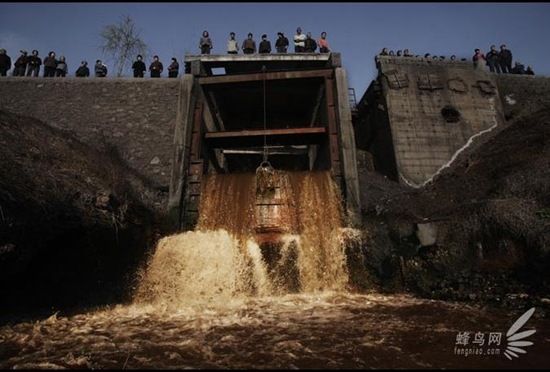
Should you doubt the urgent need for an international climate treaty that demands accountability and systemic change, or should you remain skeptical of the human influence on atmospheric carbon levels, I encourage you to take a look at the distressing pictures that ChinaHush recently published. Photographer Lu Guang's series "Pollution in China" is a testament to the cruel realities of the international, industrial market.

In his book-length essay Life Is A Miracle, the author, poet, essayist, and critic Wendell Berry describes the global, capitalist world view as,
"one culture of division and dislocation, opposition and competition, which is to say the culture of colonialism and industrialism. This culture has steadily increased the dependence of individuals, regions, and nations upon larger and larger collective economies at the same time that is has thrown individuals, regions, and nations into a competitiveness with one another that is limitlessly destructive and demeaning."
The "collateral damage" caused by this monstrous steam engine is not limited to elevated carbon levels, and its poisons don't just affect the dispossessed or the politically and economically powerless.

Nicholas Kristoff reminds us, in a recent New York Times OpEd piece, that the staggering number of "deformed frogs and intersex fish [found in or near United States' waters] — not to mention the growing number of deformities in newborn boys — should jolt us."
"In the Potomac watershed near Washington, male smallmouth bass have rapidly transformed into 'intersex fish' that display female characteristics. This was discovered only in 2003, but the latest survey found that more than 80 percent of the male smallmouth bass in the Potomac are producing eggs. Now scientists are connecting the dots with evidence of increasing abnormalities among humans, particularly large increases in numbers of genital deformities among newborn boys. [...] Apprehension is growing among many scientists that the cause of all this may be a class of chemicals called endocrine disruptors. They are very widely used in agriculture, industry and consumer products. Some also enter the water supply when estrogens in human urine — compounded when a woman is on the pill — pass through sewage systems and then through water treatment plants."
Herpetologists have been sounding the alarm for years, but the policy makers are warm in the pockets of the immoral corporations and the populace, by and large, prefers to escape in celebrity pregnancy updates and corporate-owned sporting events. Amphibians were the ignored canary in the coal mine. Now many animal families (ours included) are paying a terrible price, one that we can not yet fully appreciate.


Henan Anyang iron and steel plant’s sewage flowed into Anyang River. March 25, 2008

Still, it's not too late to stand up to the "culture of colonialism and industrialism." Visit 350.org. Find out how to get involved in the effort. If global warming isn't appealing to your still, small voice, get involved with political activism, volunteer at your local homeless shelter, pledge financial support to non-profit activist organizations working for causes that you feel strongly about; it doesn't matter what you do, but it does matter that you do something. Turn off the television, put down the tabloid. I beg this of you.


Breathing large amounts of dust into their lungs, people become sick after working here for 1-2 years. Most of these migrant workers come from area of poverty.
April 10, 2005

Photo credits: all photographs, Lu Guang; ripped from ChinaHush

Thursday, September 17, 2009

Kimmel Harding Nelson: Day 11

As I began jotting down notes this morning, it occurred to me that many of the ideas I've been ruminating on during my time in Nebraska City were nicely tied together in an essay almost a year old. "Eric Beltz and 'The Good Land'," a response to artist Eric Beltz's Fall 2008 solo exhibition at Morgan Lehman Gallery, in New York City, raises questions of American exceptionalism, conservation, religion, and human conceptions of "wilderness."

I subscribe to the notion that every artist or academic has just one big idea that, over a career, appears in a variety of forms or expressions. Why not, then, revisit the Beltz essay in the context of the writing I've done at the KHN residency? It follows nicely on yesterday's post, and connects our American ecological dilemma to the arts, or at least to two artists' considerations of the dilemma, namely Beltz's and my own.

+++++


Eric Beltz
"By this Axe I Rule"
2008
Graphite on Bristol
27 1/2 x 23 inches

"All conservation of wildness is self-defeating, for to cherish we must see and fondle, and when enough have seen and fondled, there is no wilderness left to cherish."
-Aldo Leopold

The exquisitely rendered graphite drawings included in "The Good Land," Eric Beltz's recent exhibition at Morgan Lehman Gallery, are sophisticated responses to our American folkways and myths. As darkly funny as they are disarmingly earnest, the graphic works are both exhortations and critiques of our nation's inborn exceptionalism and romanticism.

Of particular interest to Beltz is our American relationship to landscape. In "By This Axe I Rule," a contemplative outdoorsman sits on a tree stump, ax in hand. The bodies of a white-tailed deer, a moose, an opossum, a raccoon and other animals are partially concealed by snow drifts at his feet; a turkey vulture is perched above, wings spread. The man bears a striking resemblance to renowned ecologist Aldo Leopold. The likeness may be coincidental, but is nonetheless pertinent. 2008 is the 60th anniversary of Leopold's death. Like Henry David Thoreau and John Muir, Leopold is a lodestar for many contemporary environmentalists. His "A Sand County Almanac," published posthumously in 1949, remains a critical conservation text.

Unlike Rachel Carson's "Silent Spring," the 1962 bestseller that catalyzed the modern environmental movement, Leopold's "Almanac" is not a call for corporate and federal responsibility. Although Leopold would surely support such measures, his book is principally concerned with our reforging an intimate connection to the landscape we inhabit. "We can be ethical only in relation to something we can see, feel, understand, love, or otherwise have faith in," he wrote.

It's noteworthy that Leopold's faith is not of the starry-eyed variety; his "land ethic" includes hunting, controlled burns, and other practices typically condemned by preservationists. Contrary to the romantic conception of wilderness, Leopold's ethic acknowledges that the tools invented by humans (the saws, shovels, axes, picks, and pitchforks that figure prominently in Beltz's drawings) are not simply cruel agents of mastery. Humans are animals and, as such, we are not apart, but rather a part of a complicated, messy ecology. No matter how we manipulate our environment, dominion remains a comforting delusion.

Yet most of us do not conceive of Nature in this way. Just as we distinguish between the self and the group, so too do we draw a hard-line distinction between humanity and the “natural world.” William Cronon, a respected, if controversial environmental historian, argues that we must alienate ourselves from Nature before it can be understood as something pristine, virgin, or more wild than ourselves. In his celebrated 1983 book, “Changes in the Land”, Cronon reveals the quixotic quality of preservationist impulse.
"If the nature of Concord [Massachusetts] in the 1850s - a nature which many Americans now romanticize as the idyllic world of Thoreau's own Walden - was as 'maimed' and 'imperfect' as he said, what are we to make of the wholeness and perfection which he thought preceded it? It is tempting to believe that when the Europeans arrived in the New World they confronted Virgin Land, the Forest Primeval, a wilderness which had existed for eons uninfluenced by human hands. Nothing could be further from the truth....the land was less virgin than it was widowed. Indians had lived on the continent for thousands of years, and had to a significant extent modified the environment to their purposes…The choice is not between two landscapes, one with and one without a human influence; it is between two human ways of living, two ways of belonging to an ecosystem."
The preservationists' dualistic attitude (i.e., Humanity vs. Nature) provides only simple answers to our complex questions. By contrast, Beltz’s allegorical drawings shirk simplistic moralizing in favor of contradiction, ambivalence and multiplicity. His scenes speak to an active communion with Nature, albeit one that includes suffering, death and a melancholy nod to the essential absurdity of existence. By turns, Beltz eulogizes, champions and satirizes Thoreau's self-sufficiency and Andrew Wyeth's rural romanticism.


Eric Beltz
"Hysteria"
2008
Graphite on paper
17 x 13 3/4 inches

Beltz critiques America's religious and economic landscape, as well. Four of his drawings comprise a series entitled “Back to Eden.” In each, a headless body clothed in overalls, workman boots ,and a shirt with rolled up sleeves – the uniform of the outdoorsman-farmer - is slumped in or alongside a pile of cut logs and other vegetation. Above each of these tableaus, Beltz has written one word, in cursive: Asthma; Hysteria; Cancer; Delirium.

Considering the series, I recall Adam Smith’s ignored admonition concerning the dangers of loosely regulated capitalism. Smith, the 18th century Scottish philosopher best known for his influential treatise "The Wealth of Nations," is canonized by contemporary capitalists for laying down the principals of free market economics, but he entertained doubts about and acknowledged the shadows cast by such a system.

"Power and riches," Smith wrote, "are immense fabrics, which it requires the labor of a life to raise, which threaten every moment to overwhelm the person that dwells in them, and which, while they stand, can protect him from none of the severer inclemencies of the season. They keep off the summer shower, not the winter storm, but leave him always as much and sometimes more exposed than before to anxiety, to fear and to sorrow, to diseases, to danger and to death." Smith’s misgivings were warranted. Contemporary life is rife with social ailments and, in combination with our alienation from Nature, secular capitalism is a principal causative factor.

Curiously, free market capitalism is close kin to Manifest Destiny, the divine doctrine of conquest and consumption. Capitalism is exported with no less zeal than our cruel spread west from the colonies. Harriet Beecher Stowe, the 19th century novelist best remembered as an outspoken proponent of abolition, wrote that America is "a nation specifically raised up by God to advance a cause of liberty and religion." She did not say “liberty of religion.” America was founded by Protestant fundamentalists fleeing religious persecution in Europe. Arriving on these contested shores, they took names like Ezekiel, Jacob, and Issac, and likened their journey to the Jewish Exodus from Egypt. These religious settlers are the forebears of a great many contemporary Americans.

Appropriately, Beltz’s drawings incorporate Biblical texts and his subjects are recognizable as America's founding fathers and God-fearing, anonymous farmers. But Beltz draws from a peculiarly American well, the proverbial melting pot. Each drawing is suffused with currents of Eastern philosophy and shamanism. His farmers and historical figures are also mystics. American philosophy is more plural than we care to admit, and Beltz's admixture of East and West, allegory and history, supernatural and natural is a fair reckoning. (American transcendentalism, for example, the philosophy so vital to Thoreau and Ralph Waldo Emerson, was a hybrid of Protestant Unitarianism, Romanticism, Hinduism, and European intellectualism.)


Eric Beltz
"Tree of the Evil Eagle"
2008
Graphite on paper
40 x 30 inches

Still, the Bible is the first book of the United States, and many Americans regard the Constitution and founding fathers with astonishing reverence (to the extent that, in some circles, the former is sacrosanct). But documents and philosophies are of a particular time. Guarded by strict interpreters, the Constitution of the United States can become as regressively dogmatic as any primary religious text. Without thoughtful interpretation of Constitutional scripture, the significance and relevance of the founding fathers' enterprise will wane.

But most Americans (politicians and citizens alike) are in the business of denying the inevitable, be it the death of a loved one, an unregulated economy, or an ideology. Rather than confront our heavy history (and with it our future), the United States cloaks itself in exceptionalism. We remove ourselves from a fact-based historical narrative so that the road to future success is understood as an unyielding continuation of the present, divinely-ordained course. Like the empires that rose and fell before us, America's clarity of vision is obscured by global power and a history that privileges mythic glory over fact. Because we make history, many of our leaders feel strongly that we don't need to know it. Moreover, the history we make is irreproachable because it is consecrated.

Yet the secular capitalist world view strives to replace religion and the supernatural with consumerism. Manifest Destiny Version 3.0 is not ordained by God so much as by the Almighty dollar. And the replacement worked, more or less. The secular capitalist model is today the global standard. But sociologists, anthropologists, and, now, some neuroscientists agree that the substitution is inadequate. This deficiency is most apparent in a religious nation like the United States, where fundamentalism and cultism, reactionary responses to the secular world, are thriving. Despite our founding fathers' dismissal of the New Testament's Book of Revelation (Thomas Jefferson described it as "the ravings of a maniac"), a 2002 CNN/Time magazine poll found that 59 percent of Americans believe the prophecies therein are real and that the gruesome judgment of the Second Coming is imminent. James Watt, former President Reagan's Secretary of the Interior, is among that majority. He famously stated that protecting our nation's natural resources was not a priority because Jesus Christ would return only "after the last tree is felled."

Yet some evangelical fundamentalists are more fair-minded. They focus instead on the Bible's call for stewardship, and argue that the success or failure of the environmental movement depends on which interpretation gains the upper hand. Will we embrace a dominionist or stewardship theology?

The crux of that question is the American notion of wilderness. Cronon writes, "the flight from history that is very nearly the core of wilderness represents the false hope of an escape from responsibility, the illusion that we can somehow wipe clean the slate...and return to the tabula rasa that supposedly existed before we began to leave our marks on the world...Non-use is not an option: to live in nature is to use and change it by our presence. The choice we face is not to leave no marks - that is impossible - but rather to decide what kinds of marks we wish to leave."


Eric Beltz
"The Good Land"
2008
Graphite on paper
30 x 40 inches

Beltz's meticulously rendered works don't offer any answers, but neither do they shrug off the dilemma. With a richly ironic sensibility and a sensitivity to the complexities of our national character and (natural) history, Beltz embraces our clusterfuck approach even as he skewers it. "The Good Land" is sublimely ambivalent.

Photo credit: all images ripped from the artist's website

Monday, September 07, 2009

Kimmel Harding Nelson Residency: Day 1


Historical Map of Nebraska City, Nebraska


I subscribe to the Whitmanesque belief that place is presence, that our individual minds are shaped and informed by the ecology, the rhythms, and the atmosphere of our environment. But what can you learn of a place, any place, in just two weeks?

My stay in Nebraska City amounts to a prolonged layover. During this short time, what might I intuit from the town's style and voice, or from the steady push of the great, brown river that draws the town's eastern edge? Certainly, I can look thoughtfully at the people I meet and the birds I encounter; I can listen, as I do now, to the calling of crickets underneath my window; I can contemplate the regional topography and the land's history; I can ask lots of questions and take lots of notes; still, I will not know Nebraska City.

As David Abram writes in "The Air Aware," an essay published in the September/October 2009 issue of Orion,
"Only by living for many moons in one place, my peripheral senses tracking seasonal changes in the local plants while the scents of the soil steadily seep in through my pores, only over time can the intelligence of a place lay claim upon my person."
And what does this notion of place as state-of-mind intimate about my current choice of home? I'm fond of New York City, but how strange that a boy shaped by the salt marshes and fields of the Virginia's coastal plain, and informed by the fishing and farming communities that hold on there, should, as an adult, call home a metropolis with a dominant culture that is almost entirely detached from seasonal turnings of the soil!

Even if I am unable to locate the quintessence of Nebraska City in these two weeks, or to locate myself in it, I look forward to the time away from New York City. I'm eager to look, to listen, and, as David Abram would put it, to breathe in what I can.

Image credit: image ripped, appropriately enough, from Epodunk: The Power of Place website

Saturday, August 01, 2009

The Endangered Species Print Project


Molly Schafer
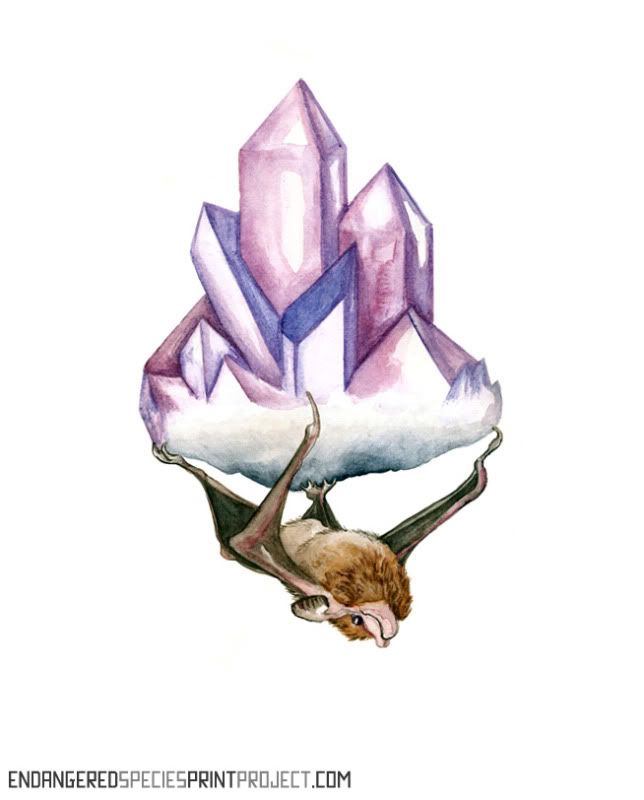
"The Seychelles Sheath-tailed Bat"
2009
Archival giclee print (Edition of 37)
8 x 10 inches

Chicago-based artists Jenny Kendler and Molly Schafer recently launched the Endangered Species Print Project. The ESPP offers limited edition prints of critically endangered species for sale to collectors, and ALL proceeds are donated to conservation programs working to perpetuate the featured species. For each print edition, the total number of prints corresponds to the featured animal's current population. For example, only 37 Seychelles Sheath-tailed bats remain in the wild, so for that edition, 37 prints will be produced.

The ESPP is already generating buzz. The Center for Biological Diversity and The Sierra Club are both promoting the project and have expressed interest in collaborating with Schafer and Kendler. I'm not surprised. The ESPP is a terrific undertaking, a fine example of the sort of environmentally and socially responsible efforts that I dearly wish more contemporary artists would involve themselves with.

As such, I'd promote ESPP even if I weren't planning to produce some prints for the project. I expect to produce two original drawings that will be turned into prints before the end of this year. My subjects will be the Javan, or Sunda, rhinoceros (Rhinoceros sondaicus) and the red wolf (Canis rufus). Also, in 2010, I hope to produce prints featuring other endangered species, including some birds, reptiles, and plants.

Prints of the following species are already available: the Panamanian Golden frog (Atelopus zeteki); the Vancouver Island Marmot (Marmota vancouverensis); the Seychelles Sheath-tailed bat (Coleura seychellensis); and the Indri lemur (Indri indri). Visit the ESPP site to learn more.

Tuesday, June 16, 2009

Passing on our gifts


Jason Middlebrook
"The Endless Outpouring Of Support"
2008
Acrylic, ink and pencil on paper
57 7/8 x 70 7/8 inches framed


For a number of years, friends have recommended that I read Lewis Hyde's The Gift. I'm finally getting around to doing so and, just forty pages into the text, I see why friends thought the book would so appeal to me. Hyde picks apart the contemporary market, particularly as it relates to commerce in art objects and other creative "commodities." In the introduction, he writes,
"A work of art is a gift, not a commodity. [...] Every modern artist who has chosen to labor with a gift must sooner or later wonder how he or she is to survive in a society dominated by market exchange. And if the fruits of a gift are gifts themselves, how is the artist to nourish himself, spiritually as well as materially, in a age whose values are market values and whose commerce consists almost exclusively in the purchase and sale of commodities?

Every culture offers its citizens an image of what it is to be a man or woman of substance. There have been times and places in which a person came into his or her social being through the dispersal of his gifts, the 'big man' or 'big woman' being the one through whom the most gifts flowed. The mythology of the market society reverses the picture: getting rather than giving is the mark of the substantial person, and the hero is 'self-possessed, 'self-made.' So long as these assumptions rule, a disquieting sense of triviality, of worthlessness even, will nag the man or woman who labors in the service of a gift and whose products are not adequately described as commodities.

[...]

A man in another tribe that [anthropologist] Wendy James has studied says, in speaking of the money he was given at the marriage of his daughter, that he will pass it on rather than spend it himself. Only, he puts it this way: 'If I receive money for the children that God has given me, I cannot eat it. I must give it to others.'"
Reading the last bit of the above excerpt, I couldn't help but think of my charitable sales model. The income that I receive from the sale of art objects I've produced is fundamentally no different from the tribe representative's "money for the children that God has given me." In this respect, it is not merely ethical, but also natural that some significant percentage of each sale be passed on, invested in turn in the good works of a non-profit organization or another conscientious individual.

Hyde points out that this pass-it-on approach is in keeping with the cycles of nature. Indeed, the words "ecology" and "economy" are etymologically connected for good reason. As I explained in an HH post in August of 2005,
"'Ecology' translates as 'study of the household' and 'economy' as 'management of the household.' Any good scientist (or thoughtful citizen, for that matter) should study the household before managing it. Thanks in no small part to my father's influence, I began to see many ecological issues as economic concerns (and vice versa). Given my environmentalist leanings, I suppose my [engagement] with economic theory was inevitable. It was also inevitable, or at least quite likely, that I would become disenchanted with our current boom-and-bust paradigm."
Moreover, Hyde points out that "the language of gift exchange has procreation at its root. Generosity comes from genere (Old Latin: beget, produce), and the generations are its consequence, as are the gens, the clans." Indeed, by damming wealth in concentrated pools, the demon market of our capitalistic culture halts the cycle of generations. The natural flow stopped, dispossessed peoples are condemned to hunger for physical nourishment and the wealthy are condemned to hunger for nourishment of the soul.

As Hyde stresses, "what is given away feeds again and again, while what is kept feeds only once and leaves us hungry." Or, as my mom always puts it, "Love and live with an open hand."

Image credit: Jason Middlebrook image ripped from the Sara Meltzer Gallery website

Friday, June 12, 2009

An Ocean Ethic


Corey Arnold
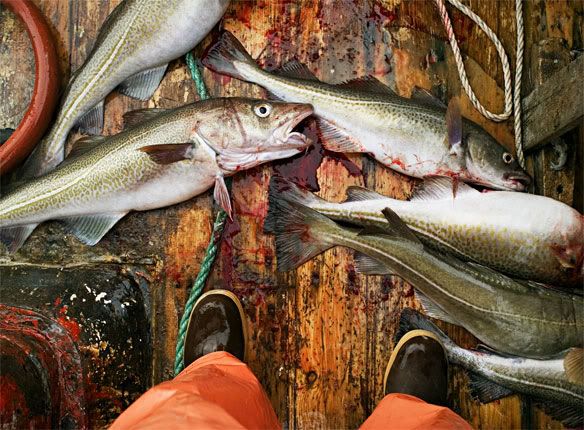
"Torsken"
2007
Chromira C-print

The son of an avid saltwater fisherman, many of my summer days were spent offshore. Departing the Wachapreague, Virginia, docks at 5 AM, the sky broke pink as my father carefully piloted his Boston Whaler through the salt marsh channels. Upon reaching the ocean inlet, we'd begin a thirty or forty mile run toward the sun-soaked eastern horizon. By 8 AM, we'd be trolling for yellowfin and bluefin tuna, dolphin ("mahimahi"), amberjack, or various mackerel species. If that technique proved unsuccessful (or if my father's fishy hunches proved wrongheaded), we'd move west, closer to shore, so that we could bottom-fish for black sea bass, spot, and weakfish over scuttled World War II ships and defeated German U-boats.

Compared to my father, I was unenthusiastic about salt-water fishing. I much preferred fishing on a pond, fly or spin casting into "honey holes," those storied pockets where the giant largemouth bass, perch and bluegill dwell. The relative solitude and meditative character of freshwater fishing appeals to my temperament. I associate the leisurely activity with the soft-spoken stroke of the canoe paddle; the rhythmic, almost ritualized casting of a fly or lure; the temperate spring breezes that lick my bare forearms as they do the banks' willow and maple trunks; the ecstatic chatter of a kingfisher. Above all, I associate it with a sense of universal benevolence. This, in stark contrast to fishing offshore, where Nature's benevolence is tempered by ambivalent and awesome forces.

Still, I enjoyed being on the open ocean. I loved the bounce and glide of my father's Whaler as it motored over the Atlantic chop, and I was delighted by the otherworldliness of ocean life: shadowy hammerheads passing through depth-piercing sun rays; dolphins propelling themselves skyward to get a better look at us; the surprising company of terns and gulls so far from land; loggerhead sea turtles basking on the ocean's surface; hundreds of cownose rays flying just beneath the water's surface. These images, and many others, stay with me. The ocean is a mysterious, thrilling place.

Sadly, it is also a threatened place. The most dire reports forecast that the ocean's fish species will be depleted by mid-century. If that should come to pass, the commercial seafood industry will no longer be viable and, more seriously, our world's biodiversity and ecological integrity will have been dealt an awful blow. Because of my latter day hunter-gatherer approach to fish and meat consumption, the only shellfish I consume are those few blue crabs and clams that I pull from the Eastern Shore's tidal estuaries. I rarely fish these days, so fish species are off my menu altogether.

Food writer Mark Bittman would likely approve of my vegetarian-unless-I-kill-or-catch-it ethic. In a recent New York Times article, "Loving Fish, This Time With the Fish in Mind" (June 9, 2009), Bittman argues for a more conscientious approach to seafood.
"In the meantime, I'm careful. I don’t make excuses, like 'There's cod in the market, so someone is catching it somewhere,' or 'If I don't buy it, someone else will,' or 'This chef serves local food, so he must serve sustainable fish.' If I’m going to eat fish, it must be consciously and thoughtfully.

My approach - which I readily admit is a work in progress and is as imperfect as my approach to all foods - goes something like this:

- I don’t buy or order the common fish I can easily keep in mind as being super-troubled — most cod, for example, or bluefin tuna, most species of shark and skate. When in doubt, I move on.

- With rare exceptions, I don't buy or order farm-raised fish, except clams and oysters. Farmed mussels and shrimp don’t seem to come with egregious environmental consequences, but neither tastes like much, either.

- I don’t eat fish as often as I once did. (I don’t promote eating it as I once did, either.)

- And I keep re-evaluating these 'rules,' and thinking about them. The 'safe' lists are difficult to understand, impossible to remember and change frequently. When the fishing of a species is well managed, it can recover and become sustainable. When it's not, the stocks of that fish disappear, sometimes quickly.

I’m probably not going to stop eating fish. And fortunately I don’t have to, since there are species that have never been depleted - squid and mackerel, for example - and those that have recovered, like haddock and Maine lobster.

It’s improbable that I’ll eat in a perfectly sustainable manner, even though I probably eat one-third as much fish as I did a few years ago. I’m trying not to let perfect become the enemy of good, and I’m trying to find a place that feels comfortable. That place is to see eating fish as a treat. I won’t eat it daily or in huge quantities, but occasionally, with appreciation. The days of 'see it/eat it' are gone."
Every educated eater should do the same, and each of us should strive to educate ourselves further. It's the ethical thing to do.

Time and evolution will march on, heedless of our nostalgic and preservationist impulses, but their ambivalence doesn't mean we've license to shrug and capitulate to the selfish wonts of the average consumer. Future generations should bear witness to the wonderful abundance that we have known and, to a lesser degree, still know. If we eat with an open mind and heart, perhaps that can be so.

Image credit: photograph by Corney Arnold; ripped from the artist's website

Friday, June 05, 2009

Ocelots at the Gate!


Christopher Reiger
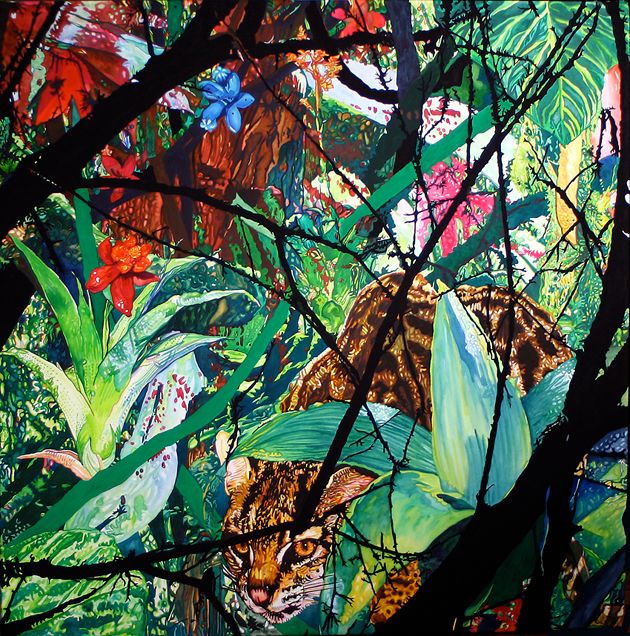
"between meaning and material (h.H.R.)"
2007
Watercolor, gouache, graphite and marker on Arches paper
32 x 32 inches


Diminutive yet captivating, the ocelot (Leopardus pardalis) is my favorite cat species. I've only appreciated the beautiful feline on film and in photographs, but am nonetheless impressed to near reverence. I delight in the animal; I marvel at his dappled coat as he passes through dense foliage and I am humbled by her grace and cunning gaze.

Years ago, when working at a eco-tourism tent camp on Costa Rica's Osa Peninsula, I had the privilege of tracking an ocelot's nighttime doings along a Pacific beach that abuts a steep jungle mountain. I didn't discover the cat, but I took great pleasure in tracing the cat's movements, and I was deeply grateful for the opportunity to commune with the creature, even in so simple a fashion.

It is with great distress, then, that I consider the plight of the ocelot and other species in the Lennox Foundation Southmost Preserve, a 1,034-acre preserve located at the southern tip of Texas. As proposed by the United States Department of Homeland Security, the Mexico-U.S. border fence will pass through the center of this preserve, up to a mile-and-a-half north of the actual border. Three quarters of the preserve will thereafter be inaccessible by employees of the Nature Conservancy, the organization that currently manages the property. Because the Nature Conservancy refused the USDHS buy out, they are being sued by our federal government.

In her Nature Conservancy Magazine article "Don't Fence Me Out," Jennifer Winger writes:
"Once known as the Wild Horse Desert, south Texas may support more wildlife per acre than any other habitat in North America. And although the Rio Grande Valley itself has lost more than 95 percent of its wildlife habitat, Southmost Preserve is a shining exception: Its lands and waters provide habitat for endangered species such as jaguarundis and ocelots, as well as indigo snakes, Texas tortoises and migratory birds.

But recently, this valuable habitat has been threatened by an 18-foot-tall concrete and steel fence proposed by the Department of Homeland Security. Most of the proposed 670-mile-long border fence, with segments from California to West Texas, has already been constructed, but the section slated to cut through the Conservancy’s land is on hold, pending the outcome of a legal battle.

...If the fence is built, nearly 700 acres — 75 percent of the preserve — would be trapped in a no-man’s-land between the fence and the Rio Grande, including all preserve facilities and the home of the preserve manager. The proposed fence would effectively cut off access to the native plant nursery, which is critical to reforestation efforts throughout south Texas. Additionally, the fence would sever a critical corridor for wildlife, as it could block animals from accessing protected areas to the north and freshwater resources to the south."
Contemplating the myopic vision of the USDHS, I recalled an earlier HH post that questioned that morality of building a border fence. In light of this recent news from Texas, I've decided to republish "Border (Bio)diversity (of opinion)" today.

+++++


The Robert Smithson in me is bemused by international borders, particularly those boundaries that are not physically demarcated, lines that exist only in cartography and our collective political imagination. Last night, I contemplated a striking black-and-white photograph of the Mexico-U.S. border. The image was dominated by a rural "vehicle barrier" fence (similar to the one shown above), far removed from an official border checkpoint or crossing. In the desert of the American Southwest, this fence draws an arbitrary line in wire and steel.

It struck me as an emblem of humanity's absurdly tenuous existence, a reminder that our species is an insignificant mote in an incomprehensibly tremendous weave. As the artist Carl Buell wrote in the comments section of a recent HH post,
"With every change in sea level and shoreline, with the raising or eroding of every mountain range, with every changing weather pattern, life spreads out as it can and comes into contact with new environments, opportunities and hazards...As I get older (than dirt), I find myself starting to think like the hills themselves. Some day after eroding and washing out to sea, I’ll be a hill again."
Indeed, each of us (and, eventually, our species) will be reconstituted, and our arbitrary borders, those lines in the mud of space-time, will be erased. In this respect, the border fence is a healthy reminder of our existential folly, but it also reveals humanity's darker inclinations. We build fences, after all, to divide "us" from "them," the demonized "other."

The photograph that inspired this post was printed in the most recent issue of Wildlands Connection, the Wildlands Project newsletter. It accompanied an article about wildlife bottlenecks at the Mexico-U.S. border. The Wildlands Project's mission is to create vast, uninterrupted linkages, known as wildlife corridors, that will extend from Canada into Mexico (on the Rockies spine) and from Canada into Florida (on the Appalachian spine). The U.S.-Mexico border fence is a major obstacle to the organization's first goal.

Yet physical barricades are but one of the obstacles that ambitious conservationists face. Consider wildlife trade legislation that protects species in one country, but not another, adjacent nation. If strict laws prohibit the trapping or hunting of a species in China, for example, but not in neighboring Mongolia, is the Chinese legislation effectively addressing species welfare (particularly when Chinese citizens are paying top dollar to have the killed contraband imported)? Similar issues haunt conservation efforts the world over.

The humanitarian and social concerns that ethically-minded conservationists must take into account present a more nuanced hurdle. Environmental groups in the European Union are warring with one another about how best to create the legislative and physical infrastructure necessary for sustainable energy development. How can you raise thousands of wind turbines without hindering bird migration, ruining aesthetics, or plopping towers in the backyards of folks too poor and disenfranchised to protest?

If the various interest groups in the EU, one of the most environmentally progressive governing bodies in the world, are at odds, is it realistic to expect conservation to become a truly supra-national affair? After all, the EU's concerns are petty alongside those of the southern hemisphere. Whereas Europe is a sprawl of cultivated landscape relatively lacking in biodiversity, the "Third World" represents the usually disastrous meeting of remarkable biodiversity and an exploding human population. Impressed by our terrible example, the citizens of these nations emulate the unsustainable behavior of the "First World." In order to counter the detrimental environmental effects of Third World industrialization, international legislation will face increasingly substantial challenges. The supra-national bodies can create laws, but can we enforce these laws without wielding the colonial sceptre? More critically, can we conserve biodiversity and healthy ecosystems without subjugating the rights of the humans that call the Third World home?

These questions bring me to "Climate of Fear," a recent book by the eloquent Nigerian poet, essayist and Nobel Laureate, Wole Soyinka. Though Soyinka is writing about humanity's attempt to cope with terrorism, his political thrust is applicable to all realms, and his message is clarion.
"The gray zones of moral definitions where relativity reigns and remote cause are evoked to justify the abhorrent will continue to haunt certain casts of mind. The rest will insist on the primacy of an ethical will, one that dictates that some deeds demand to be judged within an identifiable and shared moral universe, however restricted...The ethical will is the redeeming assertion that, even when all other considerations of social conduct are subjected to the fortuitous, one, an ethical core, remains inviolate."
All of our fences fail. Perhaps we should recognize in that certainty both an entropic truth and an implicit morality. Within the context of this "shared moral universe," we are impelled to remove artificial barriers, whether they are constructed to stem the natural tide of human migrations or to protect us from our enemies. No matter the justification for the boundaries we draw, they are immoral inventions. And man, it is said, is the moral animal.

Photo credit: ripped from Kris Eggle's website

Thursday, May 14, 2009

A Thursday in the Holocene


Over dinner this Tuesday evening, a friend and I discussed our species' more homogeneous future. I suggested that miscegenation and intercultural activity will lead to future generations comprised of individuals that look and act more alike. In turn, violent conflict between human groups will decrease; in this world of mutts, superficial differences such as race and custom will be less visible and therefore less contentious.

My friend shares my hopeful outlook, but expressed skepticism. Citing the Rwandan genocide and the fractious political situation within Israel, he contended that greater physiological and sociological similarity are just as likely to increase conflict. Humans will always find some reason to fight, he believes, and superficial similarity will lead not to a peaceable kingdom, but instead to the exacerbation of subtle differences or the outright invention of philosophical or genetic justifications for the vilification of "the other." I can't dismiss his forecast, but if Homo sapiens sapiens survives long enough to witness that homogeneous era, our species will have learned a great deal more about cooperation. This, I feel, bodes well for the less violent prospect.

But what-if suppositions about the far distant future are of little practical value to the here-and-now. I have faith in teleological eudaimonia, but the lot of Earth's inhabitants won't gradually improve unless our policies and actions are informed principally by consideration of a more immediate future...say, one or two generations. And, although it will be a thousand years, at least, before miscegenation makes all humans mocha, our planet's ecology is right now undergoing drastic changes.

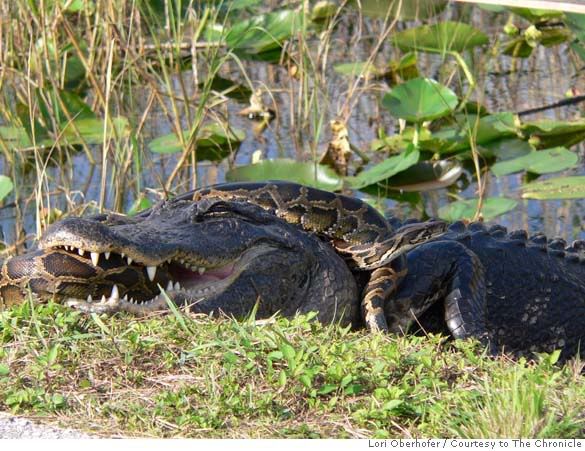
Burkhard Bilger's "Swamp Things" (The New Yorker, April 20, 2009) highlights the explosion of "invasive" species in Florida. Bilger focuses particularly on the success of the Burmese python (Python molurus bivittatus) in the Florida Everglades, but notes that a great variety of exotic species have gained toeholds in the state.
"Florida now has more exotic lizard species than there are natives in the entire [American] Southeast. On a single tree you could conceivably find plants and animals from six continents, including parrots from South America, mynah birds and Old World climbing ferns from Asia, vervet monkeys from Africa, ladybird beetles from Australia, and feral cats from Europe, via Africa and Asia. In some cases, the recent immigrants would be more genetically diverse than their cousins back home. The state's ecology is a kind of urban legend come true -- the old alligator-flushed-down-the-toilet story repeated a thousand times with a thousand species.

Some find all this thrilling. Florida has become an open-air zoo, richer in species than ever before. To others, it's the harbinger of a new and depressingly undifferentiated age, when the old biological borders begin to fade and every place starts to look like every other. Ecologists have even given it a name: the Homogecene."
Indeed, the Homogecene may soon overtake the Holocene.

Note: The post's title is a nod to Christopher Cokinos's terrific essay, "The Consolations of Extinction" (Orion Magazine, May/June 2007). In it, Cokinos
"[suggests] that our PalmPilots and DayMinders and Nature Conservancy calendars show not only year, month, date, and day of the week but also geologic epoch. It’s a Tuesday in the Holocene."
Photo credit: Burmese python and American alligator, copyright 2008, Lori Oberhofer, National Park Service