Showing posts with label racism. Show all posts

Thursday, July 02, 2009

Repairing America (and beyond)


Micanopy, Florida


While visiting central Florida last month, an acquaintance told me that all of her Gainesville co-workers are fans of Rush Limbaugh's radio punditry. On the highways around the small city, I saw countless pro-life billboards and a good number of "NObama" bumper stickers on passing pickup trucks. Although the city's populace supported Obama in the 2008 presidential election (as did the state), it was very clear that the city represents a blue dot in a red region.

Contemplating this red state mentality, I recalled Thomas Frank's "Lie Down for America," an excellent, if depressing article published in the April 2004 issue of Harper's Magazine. Frank dissected, in his words, "how the Republican Party sows ruin on the Great Plains."
"Whereas earlier forms of conservatism emphasized fiscal sobriety, the backlash mobilizes voters with explosive social issues - summoning public outrage over everything from busing to un-Christian art - which it then marries to pro-business economic policies. Cultural anger is marshaled to achieve economic ends.

[...] 'Rural America is pissed,' a small-town Pennsylvania man told a reporter from Newsweek. Explaining why he and his neighbors voted for George Bush, he said: 'These people are tired of moral decay. They're tired of everything being wonderful on Wall Street and terrible on Main Street.'"
The same Wall Street-Main Street dichotomy was trotted out by campaigning Republicans four years later, in 2008, to cast the GOP as the party of the people. But did the tactic really work? After all, Obama won the 2008 election. Aren't rural and Middle America coming around, realizing that the Republican party doesn't have their best interests in mind, even in those cases where the social issues of the Right more closely align with their values?

I hope so, but I wouldn't bet on it. Middle America will jab an angry finger at someone, and faithful Rush can't be the enemy. Our country is already waging a war against Islam, so we know that the Muslims are "against us," but they're not pulling America's economic strings. And, as a general rule, black folks don't have too much power, Obama not withstanding. But, wait a second...aren't there a lot of socialist Jews whispering in Obama's ear? Hell, isn't he related to a rabbi!?

The July 2009 issue of Harper's includes two disturbing poll results.
Chance that an American thinks 'the Jews' were moderately or very much to blame for the financial crisis: 1 in 4

Chance he or she thinks they were 'a little' to blame: 1 in 7
This is a shocking statistic! I wonder what percentage of Americans believe that "the Jews" are no more culpable than any other ethnic or religious group?

Oh, but that's a silly question! After all, "the Jews" are the denizens of Wall Street, and Main Street folk like Dubya and Rush don't like that sinful, unAmerican place. It should be clear to me that the current recession - when should we start calling it a depression? - is not the result of the unsustainable, myopic economic policies of the last sixty years (amped up by Ronald Reagan, but embraced by both Democrat and Republican administrations). It's instead the vast Zionist conspiracy! The socialist Jews have teamed up with the capitalist Jews to forge an unholy alliance, and they're running the global economy into the ground!

Would that I could laugh off such frightening ignorance. Unfortunately, the bigotry is not evidenced only on the Right. In fact, the same study cited in Harper's showed that the registered Democrat respondents were 12% more likely than responding Republicans to blame "the Jews" at moderate or higher levels. There is a time-tested, inverse relationship between economic performance and anti-Semitism, and this correlation isn't affected, evidently, by political affiliation.

The New York Times reports today that "U.S. Job Losses Rise and Unemployment Reaches 9.5%."
"The American economy lost 467,000 jobs in June [2009] and the unemployment rate edged up to 9.5 percent in a sobering indication that the most painful downturn since the Great Depression has yet to release its hold."
Things are going to get a lot worse for Middle America. Finger pointing does none of us any good (and certainly not the tiny Jewish minority in the United States).

Still, I remain optimistic. As I wrote in January,
"Call it Obamatism, call it naive idealism, call it what you will...but it's time to participate, to put aside our generation's infantilism and get to Aristotle's happy work. [...] We will pass through our challenging stage of human social development but, fraught as it is, the need for an active and immediate commitment to bettering our world's future is great."
Jews call that tikkun olam, repairing the world. Get to it, people!


Photo credit: Hungry Hyaena, 2009

Friday, June 05, 2009

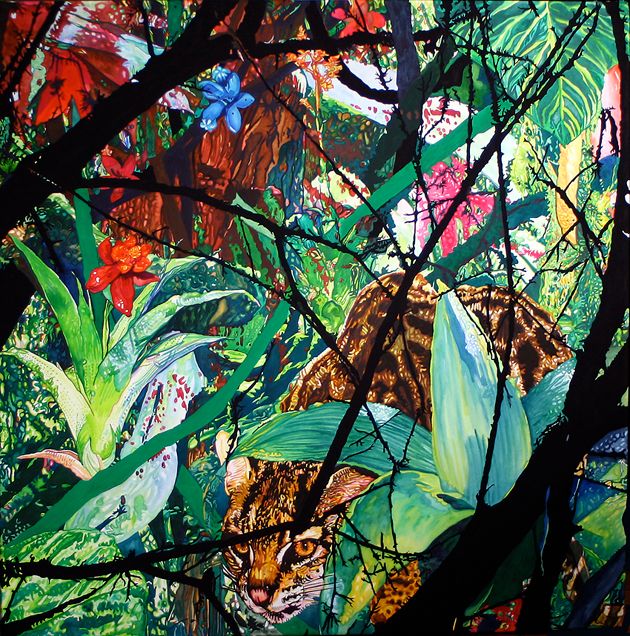
Ocelots at the Gate!


Christopher Reiger
"between meaning and material (h.H.R.)"
2007
Watercolor, gouache, graphite and marker on Arches paper
32 x 32 inches


Diminutive yet captivating, the ocelot (Leopardus pardalis) is my favorite cat species. I've only appreciated the beautiful feline on film and in photographs, but am nonetheless impressed to near reverence. I delight in the animal; I marvel at his dappled coat as he passes through dense foliage and I am humbled by her grace and cunning gaze.

Years ago, when working at a eco-tourism tent camp on Costa Rica's Osa Peninsula, I had the privilege of tracking an ocelot's nighttime doings along a Pacific beach that abuts a steep jungle mountain. I didn't discover the cat, but I took great pleasure in tracing the cat's movements, and I was deeply grateful for the opportunity to commune with the creature, even in so simple a fashion.

It is with great distress, then, that I consider the plight of the ocelot and other species in the Lennox Foundation Southmost Preserve, a 1,034-acre preserve located at the southern tip of Texas. As proposed by the United States Department of Homeland Security, the Mexico-U.S. border fence will pass through the center of this preserve, up to a mile-and-a-half north of the actual border. Three quarters of the preserve will thereafter be inaccessible by employees of the Nature Conservancy, the organization that currently manages the property. Because the Nature Conservancy refused the USDHS buy out, they are being sued by our federal government.

In her Nature Conservancy Magazine article "Don't Fence Me Out," Jennifer Winger writes:
"Once known as the Wild Horse Desert, south Texas may support more wildlife per acre than any other habitat in North America. And although the Rio Grande Valley itself has lost more than 95 percent of its wildlife habitat, Southmost Preserve is a shining exception: Its lands and waters provide habitat for endangered species such as jaguarundis and ocelots, as well as indigo snakes, Texas tortoises and migratory birds.

But recently, this valuable habitat has been threatened by an 18-foot-tall concrete and steel fence proposed by the Department of Homeland Security. Most of the proposed 670-mile-long border fence, with segments from California to West Texas, has already been constructed, but the section slated to cut through the Conservancy’s land is on hold, pending the outcome of a legal battle.

...If the fence is built, nearly 700 acres — 75 percent of the preserve — would be trapped in a no-man’s-land between the fence and the Rio Grande, including all preserve facilities and the home of the preserve manager. The proposed fence would effectively cut off access to the native plant nursery, which is critical to reforestation efforts throughout south Texas. Additionally, the fence would sever a critical corridor for wildlife, as it could block animals from accessing protected areas to the north and freshwater resources to the south."
Contemplating the myopic vision of the USDHS, I recalled an earlier HH post that questioned that morality of building a border fence. In light of this recent news from Texas, I've decided to republish "Border (Bio)diversity (of opinion)" today.

+++++


The Robert Smithson in me is bemused by international borders, particularly those boundaries that are not physically demarcated, lines that exist only in cartography and our collective political imagination. Last night, I contemplated a striking black-and-white photograph of the Mexico-U.S. border. The image was dominated by a rural "vehicle barrier" fence (similar to the one shown above), far removed from an official border checkpoint or crossing. In the desert of the American Southwest, this fence draws an arbitrary line in wire and steel.

It struck me as an emblem of humanity's absurdly tenuous existence, a reminder that our species is an insignificant mote in an incomprehensibly tremendous weave. As the artist Carl Buell wrote in the comments section of a recent HH post,
"With every change in sea level and shoreline, with the raising or eroding of every mountain range, with every changing weather pattern, life spreads out as it can and comes into contact with new environments, opportunities and hazards...As I get older (than dirt), I find myself starting to think like the hills themselves. Some day after eroding and washing out to sea, I’ll be a hill again."
Indeed, each of us (and, eventually, our species) will be reconstituted, and our arbitrary borders, those lines in the mud of space-time, will be erased. In this respect, the border fence is a healthy reminder of our existential folly, but it also reveals humanity's darker inclinations. We build fences, after all, to divide "us" from "them," the demonized "other."

The photograph that inspired this post was printed in the most recent issue of Wildlands Connection, the Wildlands Project newsletter. It accompanied an article about wildlife bottlenecks at the Mexico-U.S. border. The Wildlands Project's mission is to create vast, uninterrupted linkages, known as wildlife corridors, that will extend from Canada into Mexico (on the Rockies spine) and from Canada into Florida (on the Appalachian spine). The U.S.-Mexico border fence is a major obstacle to the organization's first goal.

Yet physical barricades are but one of the obstacles that ambitious conservationists face. Consider wildlife trade legislation that protects species in one country, but not another, adjacent nation. If strict laws prohibit the trapping or hunting of a species in China, for example, but not in neighboring Mongolia, is the Chinese legislation effectively addressing species welfare (particularly when Chinese citizens are paying top dollar to have the killed contraband imported)? Similar issues haunt conservation efforts the world over.

The humanitarian and social concerns that ethically-minded conservationists must take into account present a more nuanced hurdle. Environmental groups in the European Union are warring with one another about how best to create the legislative and physical infrastructure necessary for sustainable energy development. How can you raise thousands of wind turbines without hindering bird migration, ruining aesthetics, or plopping towers in the backyards of folks too poor and disenfranchised to protest?

If the various interest groups in the EU, one of the most environmentally progressive governing bodies in the world, are at odds, is it realistic to expect conservation to become a truly supra-national affair? After all, the EU's concerns are petty alongside those of the southern hemisphere. Whereas Europe is a sprawl of cultivated landscape relatively lacking in biodiversity, the "Third World" represents the usually disastrous meeting of remarkable biodiversity and an exploding human population. Impressed by our terrible example, the citizens of these nations emulate the unsustainable behavior of the "First World." In order to counter the detrimental environmental effects of Third World industrialization, international legislation will face increasingly substantial challenges. The supra-national bodies can create laws, but can we enforce these laws without wielding the colonial sceptre? More critically, can we conserve biodiversity and healthy ecosystems without subjugating the rights of the humans that call the Third World home?

These questions bring me to "Climate of Fear," a recent book by the eloquent Nigerian poet, essayist and Nobel Laureate, Wole Soyinka. Though Soyinka is writing about humanity's attempt to cope with terrorism, his political thrust is applicable to all realms, and his message is clarion.
"The gray zones of moral definitions where relativity reigns and remote cause are evoked to justify the abhorrent will continue to haunt certain casts of mind. The rest will insist on the primacy of an ethical will, one that dictates that some deeds demand to be judged within an identifiable and shared moral universe, however restricted...The ethical will is the redeeming assertion that, even when all other considerations of social conduct are subjected to the fortuitous, one, an ethical core, remains inviolate."
All of our fences fail. Perhaps we should recognize in that certainty both an entropic truth and an implicit morality. Within the context of this "shared moral universe," we are impelled to remove artificial barriers, whether they are constructed to stem the natural tide of human migrations or to protect us from our enemies. No matter the justification for the boundaries we draw, they are immoral inventions. And man, it is said, is the moral animal.

Photo credit: ripped from Kris Eggle's website

Monday, December 01, 2008

Blog Against Racism Day


Chris Clarke declared December 1st, 2005, Blog Against Racism Day because it marked the 50th anniversary of Rosa Parks' celebrated civic disobedience in Montgomery, Alabama. I don't believe Clarke intended the call to be observed annually but, four years later, on the heels of a successful "post-race" presidential bid, I'm compelled to touch again on the subject of black-white prejudice in the United States.

This Thanksgiving, my family and friends pondered the possible cultural benefits of Barack Obama's election. Will African American youth have a more positive role model? Will well-educated black men be celebrated by their community rather than labelled an Uncle Tom? Will racial tension decrease? The scene itself - a group of educated white professionals discussing race in between bites of pecan and pumpkin pie - proves that the "post-race" claim is misguided.

Like most liberal whites, I fancy myself free of the prejudice that drives genocide, hate crime and careless discrimination. Indeed, relative to an openly racist individual, I am a tolerant pluralist and hopeful progressive. Nonetheless, biases remain that need to be addressed and, I hope, corrected.

Bill Wilson and Dr. Bob Smith, the co-founders of Alcoholics Anonymous, believed that an addict must admit his shortcomings before he can confront them. In 1939, the two men formulated the original twelve steps of recovery; the fourth step enjoins AA members to make a "searching and fearless moral inventory." Below, I've used such an "inventory" to address my latent bigotry.

Some readers will doubtless consider the exercise an impotent confessional, but by acknowledging the embarrassing biases and feelings, I become more conscious of them and, in turn, better able to erode them. If any of what I've written offends you, please comment.
- When I read reports of the world's happiest nations, I expect the more racially homogeneous countries to top the list. The assumption is wrong-headed. Low levels of poverty/unemployment, freedom of choice, gender equality, and social tolerance are all significant contributing factors to the overall happiness of a given populace, but racial make-up does not figure prominently. Nevertheless, my assumption persists.

- I'm occasionally guilty of beginning a statement "Well, my black friends...," as though, because a sizable portion of my circle is African American, I am better able to speak on cultural differences. In fact, I have only two friends who identify as "black," and both are inter-racial, having one Caucasian and one African or African American parent. I do have a number of black acquaintances and professional contacts, but these tenuous connections certainly don't qualify me to speak on the American "black experience."

- When I travel to predominantly African American neighborhoods, I become anxious. I'm not fearful of violence, but I am made uncomfortable by the sense that I represent the oppressor ("the man") and, as such, am a target for resentful stares and verbal harassment. Indeed, I've been spit at, shoulder-checked and called names; my worries may not be unfounded, but they feed a poisonous anger directed both at myself and our American legacy. I am frustrated that, by virtue of my ancestry, I am the face of oppression.

- As a general rule, I assume that black Africans are more optimistic and harder-working than African Americans.

- Although I believe that social decorum is more closely linked to socio-economic class and education, I also assume that African American teens are louder, more physically expressive and less considerate of others than their white counterparts.

- For years I've believed that African Americans comprised the majority population of the Virginia counties I grew up in. I was certain that Accomack, where my hometown is located, had a narrow white majority, but that Northampton, where I attended public school, was predominantly black. In fact, according to the 2006 census, Accomack County is 60% white/non-Hispanic, 30% black and 9% Hispanic. (For those keeping score, that's a 2-to-1 white-black ratio.) Northampton County is 54% white/non-Hispanic, 40% black and 6% Hispanic. To be fair, both counties are home to proportionately more blacks than the United States at large, but my belief, so long held, is undeniably wrong. Furthermore, the only explanation for my inaccurate reckoning is that I noticed the black individuals more, suggesting that I weighted "otherness" heavily.
Barack Obama's election to the highest political office in our country is a hopeful victory over base ignorance and reactionary thinking, but it is also a clarion call for renewed commitment to civil rights. I feel strongly that the best way to begin working for that renewal is a thorough self-assessment. I've assessed, but now I've got work to do.

Photo credit: BBC

Tuesday, December 13, 2005

Border (Bio)diversity (of opinion)


The Robert Smithson in me is bemused by international borders, particularly those boundaries that are not physically demarcated, lines that exist only in cartography and our collective political imagination. Last night, I contemplated a striking black-and-white photograph of the Mexico-U.S. border. The image was dominated by a rural "vehicle barrier" fence (similar to the one shown above), far removed from an official border checkpoint or crossing. In the desert of the American Southwest, this fence draws an arbitrary line in wire and steel.

It struck me as an emblem of humanity's absurdly tenuous existence, a reminder that our species is an insignificant mote in an incomprehensibly tremendous weave. As the artist Carl Buell wrote in the comments section of a recent HH post,
"With every change in sea level and shoreline, with the raising or eroding of every mountain range, with every changing weather pattern, life spreads out as it can and comes into contact with new environments, opportunities and hazards...As I get older (than dirt), I find myself starting to think like the hills themselves. Some day after eroding and washing out to sea, I’ll be a hill again."
Indeed, each of us (and, eventually, our species) will be reconstituted, and our arbitrary borders, those lines in the mud of space-time, will be erased. In this respect, the border fence is a healthy reminder of our existential folly, but it also reveals humanity's darker inclinations. We build fences, after all, to divide "us" from "them," the demonized "other."

The photograph that inspired this post was printed in the most recent issue of Wildlands Connection, the Wildlands Project newsletter. It accompanied an article about wildlife bottlenecks at the Mexico-U.S. border. The Wildlands Project's mission is to create vast, uninterrupted linkages, known as wildlife corridors, that will extend from Canada into Mexico (on the Rockies spine) and from Canada into Florida (on the Appalachian spine). The U.S.-Mexico border fence is a major obstacle to the organization's first goal.

Yet physical barricades are but one of the obstacles that ambitious conservationists face. Consider wildlife trade legislation that protects species in one country, but not another, adjacent nation. If strict laws prohibit the trapping or hunting of a species in China, for example, but not in neighboring Mongolia, is the Chinese legislation effectively addressing species welfare (particularly when Chinese citizens are paying top dollar to have the killed contraband imported)? Similar issues haunt conservation efforts the world over.

The humanitarian and social concerns that ethically-minded conservationists must take into account present a more nuanced hurdle. Environmental groups in the European Union are warring with one another about how best to create the legislative and physical infrastructure necessary for sustainable energy development. How can you raise thousands of wind turbines without hindering bird migration, ruining aesthetics, or plopping towers in the backyards of folks too poor and disenfranchised to protest?

If the various interest groups in the EU, one of the most environmentally progressive governing bodies in the world, are at odds, is it realistic to expect conservation to become a truly supra-national affair? After all, the EU's concerns are petty alongside those of the southern hemisphere. Whereas Europe is a sprawl of cultivated landscape relatively lacking in biodiversity, the "Third World" represents the usually disastrous meeting of remarkable biodiversity and an exploding human population. Impressed by our terrible example, the citizens of these nations emulate the unsustainable behavior of the "First World." In order to counter the detrimental environmental effects of Third World industrialization, international legislation will face increasingly substantial challenges. The supra-national bodies can create laws, but can we enforce these laws without wielding the colonial sceptre? More critically, can we conserve biodiversity and healthy ecosystems without subjugating the rights of the humans that call the Third World home?

These questions bring me to "Climate of Fear," a recent book by the eloquent Nigerian poet, essayist and Nobel Laureate, Wole Soyinka. Though Soyinka is writing about humanity's attempt to cope with terrorism, his political thrust is applicable to all realms, and his message is clarion.
"The gray zones of moral definitions where relativity reigns and remote cause are evoked to justify the abhorrent will continue to haunt certain casts of mind. The rest will insist on the primacy of an ethical will, one that dictates that some deeds demand to be judged within an identifiable and shared moral universe, however restricted...The ethical will is the redeeming assertion that, even when all other considerations of social conduct are subjected to the fortuitous, one, an ethical core, remains inviolate."
All of our fences fail. Perhaps we should recognize in that certainty both an entropic truth and an implicit morality. Within the context of this "shared moral universe," we are impelled to remove artificial barriers, whether they are constructed to stem the natural tide of human migrations or to protect us from our enemies. No matter the justification for the boundaries we draw, they are immoral inventions. And man, it is said, is the moral animal.

Photo credit: ripped from Kris Eggle's website

Thursday, December 01, 2005

Blog Against Racism Day


Racial prejudice is an unfortunate reality. Fortunately, like the action of a river on course stone, fair-minded people can wear down and smooth away racist inclinations. But doing so is no mean task. Catchy slogans - I'm reminded of t-shirts that demand, "ERASE HATE!," a command that does little to assuage tension - and awareness campaigns are not enough. Humans are programmed to classify; we segregate our world into a hierarchy of Us and Them. To "Beat Racism" we must overcome a genetic predisposition, thoughtless and unimaginative though it may be, and, as I see it, this can happen in two ways.

The long term solution relies on multi-generational, social evolution, the "wearing down" I already mentioned. Alternatively, increased "interbreeding," or miscegenation, offers some hope. But what of the middle path, the one we will likely walk? And what exactly does "racist" mean in an increasingly plural world? These questions (coupled with my interest in wildlife) led me to the topic of my B.A.R.D. post.

I am a member of many environmental groups, some large (The Sierra Club, Natural Resources Defense Council) and others small (The Greater Yellowstone Coalition, American Wildlands, The Wildlands Project). All of these groups rely on and trust in the veracity of wildlife biologists. But because taxonomy, the classification of species, is a hotly debated subject, uncertainty creeps into the equation whenever environmental groups rally to protect a frog, duck or bear that is closely related to a healthy population. Personally, I enjoy the ever increasing complexity of phylogenetic trees, but the furor surrounding such issues can lead to practical disaster.

For example, in the Fall 2005 issue of "On The Wild Side," the quarterly publication of American Wildlands, Lauren Oechsli (AW's GIS Water Specialist) writes the following.
"Two hundred years after Lewis and Clark first encountered the species in Montana, genetically pure westslope cutthroat trout inhabit only 2 to 4 percent of their historic range in the U.S. Northern Rockies. In May 2005, American Wildlands and its conservation partners filed its fourth lawsuit against the U.S. Fish & Wildlife Service (FWS), seeking protection for the westslope cutthroat under the Endangered Species Act.

The FWS contends that the westslope cutthroat is widely distributed and does not warrant listing as a threatened species under the Endangered Species Act. Included in the assessment were all westslope cutthroat populations that were at least 80 percent genetically pure despite crossbreeding with other trout species. American Wildlands contends that a westslope cutthroat trout is only a westslope cutthroat when it is genetically pure, not hybridized with rainbow trout, Yellowstone cutthroat trout or any other trout subspecies."
Understandably, readers unfamiliar with the language of wildlife biology may be surprised by the xenophobic slant of the excerpt. The championing of genetic purity runs counter to things educated liberals hold dear. Unfortunately, such a black-and-white response - "Me moral, xenophobic biologist bad." - is inappropriate.

To address the issue more completely, one needs to understand the current divide within taxonomy. The established system of classification, called the biological species concept (BSC), distinguishes species by their ability, or inability, to breed. As a result, a mute swan (Cygnus olor) is distinct from the tundra swan (Cygnus columbianus), despite their belonging to the same genus, Cygnus. A rottweiler, on the other hand, belongs to the same species as the chihuahua, both Canis familiaris. A coupling of these two dog breeds might be awkward, but it will usually be successful. The BSC is widely accepted.

The new kid on the block, the phylogenetic species construct (PSC), has fewer cheerleaders, but is rapidly growing in popularity and application. The PSC classifies species not based on reproductive compatibility, but on distinct physical or genetic characteristics. According to the PSC, the mallard duck (Anas platyrhynchos) and the American black duck (Anas rubripes) are distinct species, even though they regularly interbreed. Furthermore, by PSc standards, their offspring, the mottled duck (Anas fulvigula), represents another species; I've read several papers suggesting the mottled duck should be further subdivided based on genetic and regional variation.

I believe that, in time, the PSC will replace the BSC as the dominant taxonomic system, resulting in innumerable battles between environmentalists and developers, corporations and property owners. Some biologists fear that taxonomy will ultimately become the enemy of conservation, particularly because, as a group of distinguished biologists wrote in their paper, "The Impact of Species Concept on Biodiversity Studies," the PSC is "subjective and possibly inconsistent." (Relativism may be the essential ingredient in postmodern thought, but there is little room for it in scientific methodology.) Moreover, there are worries that the PSC will simply lead to too much diversity.
"The increasing use of the PSC could thus lead to an apparent increase in extant species numbers, producing 'new' groups with more restricted geographic ranges and decreased abundance....[Therefore,] reclassification under the PSC will lead to an apparent rise in the number of endangered species. This is due not only to the detection of 'new' species but also to an increase in the proportion that are endangered due to a reduction in the distributional area of the inferred species range."
But what about the more wide-ranging implications of the PSC? If we're ready to apply it to every other species, shouldn't we turn the lenses round? By PSC standards, humans and domestic dogs would be further divided. Just as the westslope cutthroat trout (Oncorhynchus clarki lewisi) is separated from the coastal cutthroat trout (Oncorhynchus clarki clarkii), so too would I be deemed a species distinct from Allen Iverson. More dramatically, I would likely be classified apart from a contemporary Spaniard; we are both Caucasian, but there exists sufficient genetic (and perhaps physiological) difference for us to be divided. At the very least, I would be considered a different subspecies.

Clearly, such distinctions conflict with politically correct perspectives. Where morality meets science, it is important to consult philosophy and ethics. I've addressed similar issues before, so I won't waste space reiterating my concerns, but Timothy Burke's thoughts on alien/invasive species are equally applicable to the recent taxonomic shifts.
"...its rhetoric and tropes sometimes seem uncannily familiar, reminding me very much of ideas about race, miscegenation and nativism in modern colonialism, in post-colonial nationalism, and in identity politics. There’s some similar desire to stop the forward motion of change, to fix environments (human or natural) in their tracks, the same suspicion of dynamism."
Evolution is a remarkable process. Species change and mix in unexpected ways; flora and fauna are breathing as one, forever reinventing themselves as do the cells of our bodies. My appreciation of contemporary taxonomic craziness is linked to my faith in dynamism and my tolerance for uncertainty. For me, the arguments of waterfowl biologists regarding the relationship of mallards, black ducks and mottled ducks are as volatile as those about the relationship of African American, Native American, and Asian American. BSC simplification gives us one species of duck, one species of human, and one species of dog. Distinction via the PSC would lead to three (or more) species of duck and many species and sub species, maybe hundreds, of humans and dogs.

As I see it, all this confusion proves racial prejudice absurd. Sure, we're all different on some level. Some racial stereotypes are based in fact. It's true that, for example, that white men can't jump (relative to their black counterparts); African Americans and Caucasian Americans have significantly different physiologies, particularly noticeable when comparing bone and muscle structure in the leg.

I see no reason why we can't acknowledge these differences as phylogenetic moments, individual points on the infinite time line. These points are erased when one pans out from the present, electing instead to survey the mess at the geologic or universal level. At such a distance, distinctions between black and white or red and yellow become irrelevant. Even the separation between dog and cat appear insignificant. The whole universe just breathes.

Photo credit: Mottled duck image, CLPhotoDesign.com

Monday, November 14, 2005

Sarah Silverman's Racism


Chris Clarke is a writer that I respect a great deal. Clarke's observational skills are keen and his narrative ability is exceptional. Initially, his thoughtful appreciation of natural history attracted me to his blog, but I soon realized that his is a much wider focus.

Last week, however, when he responded angrily to a racist cartoon by John McPherson, I protested. Although I agree with Clarke that the cartoon is profoundly stupid and regressive, I argued that his attack on McPherson's racism is a mugging of the coded human inclination to categorize and label.

The tendency to generalize, fraught with complications though it may be, extends to all realms of human endeavor, be it art criticism with its many "movements," scientific nomenclature (Kings Play Chess On Fragile Glass Stairs), police profiling or political decisions (*cough* Katrina relief efforts; *cough* habeas corpus).

But the comments section of Clarke's post made it clear that we each have different ways of coping with racism. For example, I find comedian Sarah Silverman's propensity to pillory racism by highlighting it's outrageousness very funny, whereas Clarke thinks her routines are racist and "quite offensive."

Because of the varied response to his post about the cartoon, Clarke followed up with remarks that explore the definition of "racism." I detest political correctness as much as I do racism, but Chris's take on the term is insightful. He points out that the definition of "racism" has evolved; whereas it once referred to unrefined prejudice - the categorizations and stereotypes borne of "innocent" ignorance - today it is more clearly equated with immoral or chosen bigotry. Racists aren't, in other words, merely naive.

This lexigraphic shift accounts for much of our liberal handwringing. If we assume that an agreeable definition of "racism" centers on mere prejudice and not on wrongheaded notions of racial or ethnic superiority, then almost everyone can be fairly labelled a racist! Identification and classification are natural inclinations, encoded into our very being. Moreover, these inborn skills helped Homo sapiens sapiens outcompete the Neanderthals and survive the lions, tigers and bears! Effectively, we're naturally racist; this being the case, miscegenation is among the only viable hopes.

John X, the father of one of my best friends growing up, was ostracized by the local community when he impregnated a co-worker. John was a white man, his paramour was a black woman. As much as I'd like to believe that John was despised because of his infidelity (and his familial thoughtlessness) and not because he fathered a mulatto, I know that this was not the case.

I was young when this "scandal" occurred, but I remember well debating the matter with my mom in the pickup truck on the way home from school one afternoon. As we passed John's house, she "explained" that his actions were "wrong because the child will never be accepted in society." She continued, "It's just a terrible mistake to bring a person of mixed heritage into the world." Talk about a text book example of "innocent" prejudice! I shocked her southern-Victorian sensibility by insisting that it was only "wrong" because the rest of us couldn't accept the superficial difference. Make enough "mixed heritage" babies, I insisted, and the problem will no longer exist.

Even so young, I had embraced the "Make me mocha" approach to ending racism. Unfortunately, this blending won't yet happen overnight - thousands of years of racial mixing are necessary - but it will happen. Sadly, humanity, mocha or not, will always find something - religion, hand washing technique, culinary preferences - to fight about.

Chris Clarke has proposed that this December 1st be "Blog Against Racism Day." I'm not sure how many people will participate, but I think it a worthwhile proposal and Hungry Hyaena will definitely jump into the fray. Pass on the word if you're a blogger yourself, whether or not you enjoy Sarah Silverman.

Photo credit: www.digitalhit.com

Wednesday, June 22, 2005

The Vague Division

The following text is taken from a review of Ed Kienholz’s retrospective at the Baltic Centre for Contemporary Art, in Gateshead, England. The review is written by Guardian art critic, Adrian Searle. The selection speaks for itself.
“Another of these Conceptual Tableaux, which are among the most impressive 'unmade' works of the 1960s, deserves recording in full. This is The Black Leather Chair, from 1966: ‘This is a tableau about the Negro in America. The piece is simply a black leather chair completely covered in a block of lucite plastic and mounted on a suitable base. On the left side is a tunnel in the plastic where the viewer can reach in and touch one small portion of the chair.

‘It is possible that I will never be able to make this tableau as I do not have the chair in my possession at this time. It is stored in an attic in Texas and is the property of a Negro family there. I am told by a friend that although the family is reluctant to part with it, he will be able to get it for me some time in the future.

‘The leather on the chair is made from the skin of his great-grandfather.’

Some works don't need to be made, and exist best (if that's the word) in the imagination. Once read, this terrifying and haunting statement, and the possible existence of the chair itself, are fixed in the memory. At the foot of the statement, Kienholz stipulates that payment for this work is to be made to the American Civil Liberties Union. This is as sorrowful as art gets, and as much of an indictment as art can make.”

Thursday, May 26, 2005

Player Haters?


Last Sunday, sick and frustrated, I watched the deciding game of the May "Subway Series" on television. Some weeks earlier, a friend had offered me a ticket to the game and I had eagerly anticipated the afternoon ever since. But instead of animatedly talking baseball on a beautiful Sunday at Shea Stadium, I was feverish and pouting on my bedroom floor in a sweat-drenched t-shirt and boxer shorts. That the afternoon had turned rainy and cold, thereby making things less than ideal for those fans who were able to make the game, did little to make me feel better; I'd been betrayed by my immune system. Even the run of unfortunate errors by the young Mets' players, and the resulting Yankees rally (which whipped me into a frenxy of anguish despite my fugue-like state) could not quell my frustration at having not been able to be there.

Fortune sometimes smiles on all of us, though, and another friend offered me a ticket to a Wednesday night Yankees/Tigers game in the Bronx. So yesterday, in now familiar cold and rainy New York weather, I headed up to the Bronx after work. Despite having lived in New York City for nearly six years, this would be my first game in Yankee Stadium! The seats were the best I have had since attending a Baltimore Orioles/Cleveland Indians game at Camden Yards in the early 1990s. Directly behind home plate, just this side of the "gated" boxes, I found my spot moments after the first out of the game. I love baseball stadiums almost as much as I love the game, and I spent the better part of the first inning studying the stadium itself. By the end of the third inning, though, it was neither the game nor the stadium that demanded the bulk of my attention, but the fans. One pair, sitting four rows behind my left shoulder, was especially difficult to ignore. Early in the evening, during a relatively quiet moment in the stands, one of them yelled out, very loudly, "F*ck you, Detroit! You f*ckin' suck, you pieces of sh*t!" Unfortunately, this was only a warm-up.

I've been to a number of baseball games in the last decade - though only a small number of cities: Baltimore, MD; Philadelphia, PA; New York, NY - but I have never before heard such hateful taunting. Granted, I have a chip on my shoulder. I don't hate the Yankees, as a team, but I do loathe most Yankees fans. They represent the worst kind of spoiled royalty. As I see it, the fans who support the richest and winningest team in all of American sport should be proud and charitable. To point fingers and scream "You suck" at the rest of the field is akin to a member of the aristocracy leaning out of his carriage to call a toiling peasant a loser. But my desire for the average Yankees fan to inherit some humility and grace is not the matter at hand.

While watching that Sunday "Subway Series" television broadcast, I could hear New York Mets fans boo Kaz Matsui, the struggling Japanese import, when he approached home plate to bat up. Each time I heard these jeers, I shook my head; after all, the Mets are one of my favorite teams (second only to the Chicago Cubs) and the heckling that Matsui was dealt incensed me. The commentators noticed the booing, too, and mentioned how difficult such treatment had proven for Matsui. In the Japanese equivalent of our major league (Puro Yakyu), fans never heckle their own players. In fact, they don't boo or berate players on opposing teams either! Kaz Matsui (not to be confused with the more successful Hideki Matsui, currently playing across town for the New York Yankees) emerged a superstar from a league in which players receive only support. Today, he finds himself centerstage in a much tougher arena, one in which fan regard is fickle and their bite is often terrible.

The friend who had given me the ticket is married to a Japanese man and I decided to ask him, as we quietly sat among the ruckus at Yankees Stadium, what he made of Major League Baseball. While he isn't a big baseball fan, he immediately commented on the difference in the stadium experience. In Japan, he explained, each player has a song or a dance associated with them and Puro Yakyu stadiums are filled with fans ritualistically celebrating their team, even when they lose. The whole experience, he said, "is about having fun."

When the Yankees next scored on a two RBI double by Jorge Posada, the fans in our area went crazy. The first few seconds were fun, with lots of high fives and wild cheering, but then the chorus of, "F*ck you, Detroit!" and "Who's your Daddy?" began anew. A crippled man seated in front of me grabbed at his wrist crutches and struggled to his feet. He attempted an awkward high five with a buddy of his who was screaming something to the effect of, "We own you, Detroit!" Perhaps wrongly giving him the benefit of the doubt, I imagined that this crippled fellow, a casualty of genetics or circumstance, couldn't move quickly enough to ditch his sh*thead friends. I suppose he, too, could have been slandering the mothers of the Detroit Tigers, but I couldn't hear his more quiet ejaculations over the rest of the din. The crowd "celebration" was a curious mix of happy excitement, vitriolic fervor, and entitlement. I turned back to Koh and said with a smile, "Just like Japan, huh?" He shrugged and shook his head, half laughing. He appeared bemused. We sat in our seats among the standing, screaming Yankee fans and tried to take it all in.

By the time that exchange took place, the Yankee duo sitting behind us had elected to up the ante. Below are just a few of the many things screamed over my shoulder. Some of these were repeated many times.

"F*ck you, you f*ckin' f*ggots!"
"Hit the mother f*cker in the face with the pitch....Yeah, hurt 'em!"
"You fat piece of sh*t, there's a cheeseburger on second...can you make it, fatboy?"
"Detroit sucks! Boston sucks, too! F*ggots live in Boston!"
"Let's Go Jankees! Yeah....Jankees!"
"You suck, Detroit! Why bother trying?"

Occasionally, these fans even opted for a little abuse of their own boys.

"Hey, Giambi, you f*ckin' juice head! You're a potato head, you sh*t!"
"Hey, Matsui, hit the ball to China or wherever you come from!"
"Hey, Posada, if you had good knees you could run better! Shoulda been on second with that hit, you putz!"

In between such outbursts, the pair talked about beer, cell phones, and their pursuit of women. On beer, for example, one announced, "I don't drink Heineken...it's just too dark and thick, ya know?" Heineken is way too dark and thick? Um...okay.

Anyway, while these two "characters" were certainly the loudest around, they were not alone. Cries of "Detroit sucks!" could be heard anywhere you moved and every time a Yankee player failed to make a play or get a hit, no matter how difficult, the fans voiced their displeasure. Most distressing of all, though, was the encouragement given the loudest idiots in the stadium. Even those folks who seemed more inclined to clap and cheer than berate and boo egged on Tweedledum and Tweedledee. A girl noticed me staring over my shoulder at the pair of jackasses and she laughed. "They're awesome, aren't they?," she asked, with a smile. No, they're reprehensible and offensive, in fact. Shamefully, I said nothing.

I don't want to give the impression that I never cheer on my teams - I've jumped up and down at games and screamed obscenities at the television more than once - and I can't claim to be above booing a bad call. (A clear bad call is legitimately angering, but I won't boo close ones, even if disappointed in the result; after all, I'd hate to make a judgment mistake on the field, and I trust that the referees and umpires want to do as good a job as they can.) Yet I have absolutely no urge to call anyone on the other team a "piece of sh*t," even if I dislike them. What little I know of Alex Rodriguez, for example, makes me disinclined to like him, but I've never booed him (though I have wished for a strike-out or a botched bit of fielding). Shaquille O'Neal drives me mad with his dominating play and arrogant attitude, but I don't hope for a broken knee or a torn ACL.

The point is, I'm distressed by the prevalence of negativity in American sports. I'd like to think that it hasn't always been this way, but the truth is I'm not so sure. The nostalgia one feels for "the good ol' days" is largely a result of edited history; Ken Burns need only add a sepia tint and a banjo track to his "Baseball" footage and everything seems that much better. Even Barry Levinson's "The Natural," considered by many to be the pinnacle of "sports movies," hints at the venomous sting of the fan base. Is our culture really this willing to become the ignorant mob? If, as many folks say, contemporary athletes and celebrities are elevated to sainthood, their experience is equal parts transcendence and martyrdom. We love 'em, we hate 'em. We love to hate 'em, we hate to love 'em. It all seems a little schizophrenic to me. While I champion complexity, I guess I just prefer Southern hospitality and reserve at the ball park.

Making my way out of the stadium, a few drunken Yanks fans decided to make comments about my Cubs hat. Fortunately, they were not particularly nasty. "Look at this guy with the Cubs hat. What the f*ck is that about?," and "Hey, a Cubbies fan is here tonight, bro," weren't intended to insult. These drunks just wondered what I was "all about," and there's nothing wrong with that. Nevertheless, I left the stadium thinking highly of baseball, but none too highly of the species that showed so much promise back when games were first being invented, when we were discovering ways of channeling our competitive aggression into an afternoon of fun.

Photo credit: unknown source; image of Freddy, an old-timer who attends every Yankees home game and bangs on his pot with a spoon. On Wednesday night, his spoon and pot were so abused by some fans that he reclaimed them, then opted to hold them out of reach for a while.

Monday, April 25, 2005

Aborigines and the Evil, White Man

The conservation community frequently butts heads with human rights organizations (or, at least, pro-development organizations that manage to worm their way into bed with human rights activists). The most familiar contemporary cases involve conservation groups calling for a moratorium on oil drilling in the Arctic or mineral mining in Africa despite protests from the residents of these regions. Poor and increasingly unable to compete in the rapidly developing “Third World,” many locals view natural resources as untapped potential revenue.

This April 18th, 2005, Vancouver Sun article points to a conflict that involves a different sort of natural resource: wildlife. Recent court decisions in British Columbia affirm the right of “aboriginal” populations to hunt and fish year-round without limits. Aboriginal groups are accorded such rights because they exhibit, according to the judges, a “substantial” and “sufficient connection to the…relevant geographic area which entitles [them] to exercise a territorially based hunting right.” The implication is that aboriginal groups have hunted and fished these lands for centuries, therefore proving their competence as continued stewards.

While this stewardship claim is marginally merited, most anthropologists will tell you that once one looks past the romance of the hunter-gatherer lifestyle, you will realize that aborigines the world over hunt and fish in unsustainable ways. (This is a generalization, but one based on much anthropological reading.) A "balance" is maintained only because of the relatively small local populations of such groups, resulting in limited pressure on area wildlife stocks. Thus, unlimited hunting and fishing allowances for aboriginal groups in the Amazon Basin are less likely to result in excessive pressure than are similar allowances in British Columbia. In Canada, both aboriginal groups and licensed non-aboriginals will be “harvesting” the wildlife. The pressure on “game” species will be that much greater and the business of establishing limits (for non-aboriginals) will be that much more difficult. Finally, resentment or jealousy on the part of the license holders may encourage profligate behavior on their part, the result of a, “If they can do it, why can’t I?” attitude.

Not surprisingly, conservation groups have only reluctantly accepted such "no limit" rulings. Recently, however, the courts took such legislation one step further. The Metis population of B.C. is demanding a furthering of a court ruling granting them the same privileges that aboriginal groups receive. Trouble is the Metis population is only nominally “aboriginal.” Metis are Canadians of mixed European and aboriginal heritage. The Metis are guilty of the exuberant and unethical hunting practices (examples include the hunting of bighorn sheep (Ovis canadensis) just for the horns) more commonly associated with the “evil, white man.” Further extension of the “no limit” legislation means even more pressure on B.C. wildlife and worries conservationists for good reason.

Raise these concerns, however, and you can expect to be savaged by groups representing aboriginal communities, either in the court room or in the popular press. Their argument is straightforward and not entirely without merit: To suggest that aborigines should abide by the same hunting and fishing laws that we white men must is racist, yet another example of the colonial powers subjugating and starving the American natives. By contrast, I believe that it is racist to grant the exception. Affirmative action is another racist practice (in the sense that it “discriminates” between races), but it benefits the whole (I know quite a few people who will hound me for this opinion, but I am an advocate for affirmative action despite any philosophical problems with it) whereas this unlimited hunting legislation benefits only the aboriginal groups and harms the whole.

In such a case, where can conservationists and aborigines find common ground? How can traditional cultural values be respected and preserved without threatening ecosystem integrity? Is it time we look past the sins of our fathers and approach the issue as Americans? My gut tells me this is the case. But then again, I’m just an evil, white man.

Check out the Metis Harvester’s Guide for more information.

Wednesday, March 30, 2005

Protect Native Species...Or Die!


“Once caught never returned” is the motto of the Exotic Fishing Tournament hosted by the Native Fish Conservancy (NFC). Participating anglers are encouraged to keep all the "invasive" fish species they catch. The team with the greatest number of exotics wins the $200.00 grand prize. How the angler opts to use the fish is of no interest to the NFC. The organization's press release reads,
“We encourage everyone to treat exotics with reckless, fishing exuberance. If you catch exotics, aquarium-keep them, grill them, feed them to your pets, turn them into fertilizer. Do anything except return them to their former homes.”
Wow.

I believe that the human contribution to the contemporary, epic loss of biodiversity is a sin (of a decidedly secular variety). Fewer species translates into less genetic, dietary and behavioral variety, making it that much more difficult for Nature to adapt in the future.

Nevertheless, when I first read about the Exotic Fishing Tournament, I cast nervous glances at my fellow subway commuters, worried that they might notice the, um, "material" in my hands.

As Timothy Burke (Easily Distracted) writes,
“I do wonder about that attitude a bit, not just in the context of fishing, but as a whole. When I read some of the material on the dangers of invasive species, its rhetoric and tropes sometimes seem uncannily familiar, reminding me very much of ideas about race, miscegenation and nativism in modern colonialism, in post-colonial nationalism, and in identity politics. There’s some similar desire to stop the forward motion of change, to fix environments (human or natural) in their tracks, the same suspicion of dynamism. What is particularly striking to me is that the arguments against 'invasive species' even from scientists sometimes seem not so much technical or scientific (when they are, they usually rest on the relatively weak assertion that there is a burning necessity for general biodiversity that trumps all other possible principles of ecological stewardship) but mostly aesthetic.”
Excepting my belief that greater biodiversity does make for a healthier ecosystem, I am in total agreement. Strangely, I do not find it uncomfortable to occupy such an ambivalent position. I argue stridently for both sides of the coin, perfectly content in my hypocrisy. To better explain myself, I turn to the conclusion of an old artist statement.
“My own opinions and arguments are flawed, of course. Nature is not a comprehensible entity; she is indifferent to humanity. Given the burgeoning world population and our reluctance to consider serious action, it is naïve of me to think it possible for humanity to live in a truly sustainable fashion. Simply because an ideal is unattainable, however, one need not abandon it. In fact, acknowledging contradiction can better serve the individual; in a world increasingly consumed by ambivalence and captivated by cleverly marketed distractions, we must accept some degree of contradiction in order to further progress. We can aim for sustainability only if we accept the complexity of the task. In essence, this is the stuff of art – a flawed platform with no up or down, no east or west, on which to build the self and, in turn, shape objects to explain the proposed self. Art reveals the private obsessions of the psyche and better expresses the individual’s inner fragmentation, a consequence of the ideal being at odds with the real.”
As the quote suggests, the flawed platform is as applicable to conservation as it is to art making. Some degree of relativism is necessary when considering invasive species. For example, zebra mussels (Dreissena polymorph) and European carp (Cyprinus carpio) are greater threats to biodiversity than multiflora rose (Rosa multiflora). All three are exotic/invasive species, but we need not raise an uproar about the latter species.

I hope many of the anglers participating in the Exotic Fishing Tournament treat their quarry with respect. Throwing away or otherwise mistreating fish of any species is wrong but, given the nature of this affair, the celebrated waste would be that much more unsettling.

Photo credit: WorldWar2History.info