Showing posts with label nostalgia. Show all posts

Sunday, November 27, 2011

Elisheva Biernoff's "Inheritance"


Elisheva Biernoff
"Inheritance"
2010
80 slides of endangered wilderness areas projected onto mist from a humidifier housed in a plywood and fabric enclosure

Environmental historian William Cronon argues that "only people whose relation to the land was already so alienated could hold up wilderness as a model for human life in nature, for the romantic ideology of wilderness leaves precisely nowhere for human beings actually to make their living from the land." I recalled Cronon's incisive critique of wilderness ideology as I pondered artist Elisheva Biernoff's "Inheritance," a compelling installation included in Eli Ridgway Gallery's recent group show, "Better A Live Ass Than A Dead Lion."

"Inheritance" was installed in a dark side gallery on Ridgway's lower level. A wall-mounted, carousel slide projector cast images of "endangered wilderness areas [...] onto mist from a humidifier housed in a plywood and fabric enclosure." The humidifier's fog billowed out of a television-sized opening cut into the plywood, and the projected photographs reflected by the haze were sometimes -- for an instant, when the mist was just so -- recognizable as landscapes, but rarely as specific environments or locations. Without the artist's accompanying list of "disappearing places," viewers couldn't know they were looking at Alaska's Tongass National Forest, Florida's Everglades, Brazil's Pantanal, China's Gobi Desert, or another of nearly 80 imperiled landscapes.


Elisheva Biernoff
"Inheritance"
2010
80 slides of endangered wilderness areas projected onto mist from a humidifier housed in a plywood and fabric enclosure

Biernoff's installation, which was also included in ProArts Gallery's 2010 "2 X 2 Solos" exhibition program (and, by virtue of its strength, will likely be a part of future exhibitions), is luminous and its effect almost ethereal, but unlike the meditative Light and Space works of James Turrell or Doug Wheeler, Biernoff's installation doesn't provide opportunity for reverie. The transitions between the images are abrupt, and marked by the noisy, mechanical advance of the slide carousel. Ka-jenk, Ka-jenk. Just as we begin to discern the vision roiling in the mist -- 'Is that a jungle? Perhaps a swamp?' -- we're jarred from our musing. Ka-jenk, Ka-jenk. Again, we endeavor to interpret the play of light and color in the vapor, and again: Ka-jenk, Ka-jenk! A contemplative inclination is foiled by the machine's relentless progress, and there's sly humor in Biernoff's frustration of our stubborn need to identify and classify; viewers can see the specters in the mist, but can't make much (if any) sense of them. Even so, we'll continue to plumb the rolling fog for clues.

Our ancestors assigned supernatural qualities to fluid media. They scried smoke to portend future events and viewed it as a vehicle of conveyance, capable of carrying the essence of a sacrifice to the god or spirits of a people. In "The Wizard of Oz," the face of the eponymous wizard appears to the protagonists in a cloud of reddish smoke, causing them to tremble in awe. Seeking a similar experience of wonder, many of the people who visit wilderness areas do so to behold nature's majesty. Their language is often reverent; they speak of the sublime and the transcendent. But what is a wilderness area, exactly? According to the United States Wilderness Act of 1964, wilderness is land that "generally appears to have been affected primarily by the forces of nature, with the imprint of man's work substantially unnoticeable [...that is] designated for preservation and protection in [its] natural condition." Unfortunately, the "imprint of man" is not always readily observable (consider the nuanced affects of climate change or the irradiated, if picturesque Red Forest that surrounds the decommissioned Chernobyl Nuclear Power Plant). More problematically, as Cronon makes clear, the Wilderness Act definition sets man apart from "the forces of nature." This latter move is a Romantic, naive impulse. All habitats are interconnected; even protected landscapes are affected by activities outside their boundaries. Moreover, because many refuges, parks, and wilderness areas are disconnected from other undeveloped lands, the flora and fauna living in these protected areas risk genetic isolation and face an increased risk of local extinction (e.g., the Florida panther and many other critically endangered species). Outside of the Wilderness Act and our collective imagination, then, there is no "original" or "virgin" landscape.

The dreamlike quality of Biernoff's installation is therefore appropriate. The notion of "wilderness" is as indefinite as the mirages the artist creates for us with light and vapor. Some fictions, though, are useful. If the dream of Eden compels us to be better stewards, it's all for the good. Yet Biernoff reminds us that we're more likely to avoid the pitfalls of ideology if we recognize wilderness is an illusion, that the specter before us is manufactured using a humidifier and an outmoded piece of technology. The artist presents us with the wizard's face, but also reminds us of the man behind the curtain.

Elisheva Biernoff's "Inheritance" was on view October 8 - November 5, 2011, at Eli Ridgway Gallery (172 Minna Street, San Francisco).


Elisheva Biernoff
"Inheritance"
2010
80 slides of endangered wilderness areas projected onto mist from a humidifier housed in a plywood and fabric enclosure

Image credits: "Inheritance" installation photographs, courtesy Eli Ridgway Gallery

Note: Due to carelessness, this write-up was originally published as a "Review In Brief." It's longer than the pieces in that series, however, and is no longer associated with it.

Friday, January 14, 2011

Artifacts


Butt Johnson
"Various Video Game Controllers, Maps, and a Robotic Accessory"
2007
Ballpoint pen on paper
15 X 19 inches

It's been five years since I owned a video game console. It's been even longer since I abandoned myself to a game, a happy pastime (read: addiction) of my teens and early twenties. Just as I made a teenaged vow that I would always be knowledgeable about new music -- Damn it, I wouldn't be the adult who plays the same John Denver tape on the car stereo, day after day! -- I also promised myself that I'd always own a technologically sophisticated gaming system. Although I accepted the cruel fact that my body would age and degrade, I believed that I'd remain young at heart if I remained a serious gamer. In retrospect, this latter, already broken vow seems laughably naive. If I were still gaming (even casually), I'd be hard-pressed to juggle my art-making with my writing, my volunteer commitments with earning a living, my solitary "thinking time" with my relationship; where would gaming fit!?

In any case, artist Butt Johnson's drawing "Various Video Game Controllers, Maps, and a Robotic Accessory" strikes a nostalgic chord. Over the years, I've owned or used all of the controllers depicted (with the exception of the unfamiliar robot). Today, a little more than twenty-five years after the release of the tremendously popular Nintendo Entertainment System (NES) console, we consider the system's controller (top row, third from the right) an artifact of a bygone gaming era. And the Atari joystick? A fossil! It's curious to feel wistful about technology so recently outmoded.

On a tangentially related note, I recommend Nick Paumgarten's New Yorker profile of Shigero Miyamoto, one of the creative minds behind Nintendo's success and the creator of revolutionary games like Super Mario Bros., The Legend of Zelda, and Star Fox. He's also one of the idea men behind the industry-dominating Wii console. Like Paumgarten, I find it revealing that Miyamoto cites his active imagination and the outdoors as the foundation of his creative success.
"When Shigeru Miyamoto was a child, he didn’t really have any toys, so he made his own, out of wood and string. He put on performances with homemade puppets and made cartoon flip-books. He pretended that there were magical realms hidden behind the sliding shoji screens in his family’s little house. There was no television. His parents were of modest means but hardly poor. This was in the late nineteen-fifties and early nineteen-sixties, in the rural village of Sonobe, about thirty miles northwest of Kyoto, in a river valley surrounded by wooded mountains. As he got older, he wandered farther afield, on foot or by bike. He explored a bamboo forest behind the town’s ancient Shinto shrine and bushwhacked through the cedars and pines on a small mountain near the junior high school. One day, when he was seven or eight, he came across a hole in the ground. He peered inside and saw nothing but darkness. He came back the next day with a lantern and shimmied through the hole and found himself in a small cavern. He could see that passageways led to other chambers. Over the summer, he kept returning to the cave to marvel at the dance of the shadows on the walls.

Miyamoto has told variations on the cave story a few times over the years, in order to emphasize the extent to which he was surrounded by nature, as a child, and also to claim his youthful explorations as a source of his aptitude and enthusiasm for inventing and designing video games. The cave has become a misty but indispensable part of his legend, to Miyamoto what the cherry tree was to George Washington, or what LSD is to Steve Jobs. It is also a prototype, an analogue, and an apology -- an illuminating and propitious way to consider his games, or, for that matter, anyone else’s. It flatters a vacant-eyed kid with a joystick (to say nothing of the grownups who have bought it for him or sold it to him) to think of himself, spiritually, as an intrepid spelunker. The cave, certainly, is an occasion for easy irony: the man who has perhaps done more than any other person to entice generations of children to spend their playtime indoors, in front of a video screen, happened to develop his peculiar talent while playing outdoors, at whatever amusements or mischief he could muster. Of course, no one in the first wave of video-game designers could have learned the craft by playing video games, since video games didn’t exist until people like Miyamoto invented them. Still, there may be no starker example of the conversion of primitive improvisations into structured, commodified, and stationary technological simulation than that of Miyamoto, the rural explorer turned ludic mastermind."
My solitary, television-deprived childhood was akin to Miyamoto's, an enchanted, wondrous world of books and nature. That changed during my sixth grade year, when my parents purchased a television. A few years later, they presented me with a Nintendo console. For years after that purchase, I spent more time with a console controller in my hand than I did exploring or contemplating the world around me.

It's misguided to dismiss video games as artless or to condemn them as escapism, but I wonder whether my connection to natural history and my investment in ecology would be so concrete had my early, formative years included television and gaming. What if I'd been born eight years later, after the introduction of the NES and home computers?

I have a positive view
of humanity; an overview of our species' short history reveals a social animal that takes two steps forward for every step back. Technology is an essential part of this gradual and steady improvement. Psychologically, however, we're growing ever more distant from our fellow species; our contemporary songlines resonate more in the virtual world than in natural history. Technology is no less a part of that unfortunate development.

Image credit: ripped from Butt Johnson's website

Friday, May 21, 2010

Changes


View of Empire State Building; Manhattan, NYC; May 2009

As I prepare to move from New York City, my home for over a decade, to San Francisco, my home for at least a few years, I find myself viewing NYC through the eyes of a man in limbo. I'm still living in Queens, but my attention is already on the road.


Vacant lot; East Village, Manhattan; May 2008

A decade of NYC living makes me, by at least one standard, an official "New Yorker." How does that define me? New York, like all conurbations, is ever in flux. On my watch, it's changed in remarkable ways. What changes will come after I'm no longer a resident? Likewise, what changes are yet in store for me, a similarly adaptable organism?


Samuel Cohen Son graffiti; East Village, NYC; April 2010

I moved to New York City in October 1999, not long after I graduated from The College of William & Mary. I was then an ambitious twenty-one year old with a deeply cynical streak and an abiding love of beer and partying. My paintings and drawings featured naked people interacting in various ways with other animals, medical instruments, fossils, and, on occasion, Teletubbies. (If a reader knows what became of the big Tinky Winky sex painting, I'd love to see a photo of it!) Despite my apparent enthusiasm, I was steeped in melancholy. I spent hours each week brooding over "I," my pet novel project, a 1990s East Village vampire update of Hermann Hesse's Steppenwolf. I viewed humanity as a noxious species, religion as the most noxious of human inventions, and I not so secretly looked forward to our inevitable extinction.

Today, I'm an ambitious thirty-two year old who reacts against cynicism, drinks much less, and generally dislikes partying. Naked people sometimes appear in my paintings, but there aren't any Teletubbies. I'm a stubborn optimist. Each morning, I take twenty minutes to humbly celebrate a new day; if I wake in a funk, I fight through the fog to see anew just how marvelous life is. I recall my earlier character with some embarrassment. What was wrong with the arrogant kid who labored on a novel that painted such an ugly picture of humanity and religion? Perhaps he just needed to be more intellectually rigorous, and to open his eyes to the awesome fact of being? Or maybe that twenty-one year old also needed a good hug, which is no small thing?


Greenpoint, Brooklyn; May 2009

My time in New York City has seen me metamorphize from a hardened and cynical adolescent into an optimistic, joyful adult. The direction of this evolution runs counter to the standard assumption made about the effect of NYC living. As the columnist Mary Schmich warned (and director Baz Luhrmann popularized with his song "Everybody's Free (To Wear Sunscreen)"),
"Live in New York City once, but leave before it makes you hard; live in Northern California once, but leave before it makes you soft."
In my experience, however, NYC living sanded smooth the hard edges.


Wollman Rink; Central Park; Manhattan; June 2008

Perhaps, too, the mournful and nostalgic wails of NYC residents (myself included) are misguided? We should accept that "what will come, will come" without falling victim to fatalistic impotence. New York City (and Manhattan, in particular) is one of the most sustainable, environmentally responsible cities in the world, and its educated, informed residents should work with New York State and City representatives to make sure the city continues apace on that front. They should also do all they can to ensure that it remains a mecca for tolerance, the arts, and cultural pluralism. In what ways I can, I'll do the same from the Left coast; New York City is a part of me, and I will always feel a part of New York City.

Love and peace to all of my friends here. Thank you for everything. I'll be in touch. I'll visit. I hope that you'll visit me.


Upper New York Bay from Staten Island; May 2008

Image credits: all photography, Hungry Hyaena

Sunday, July 12, 2009

Barry Bruce, waterman


Smith Island, 2008


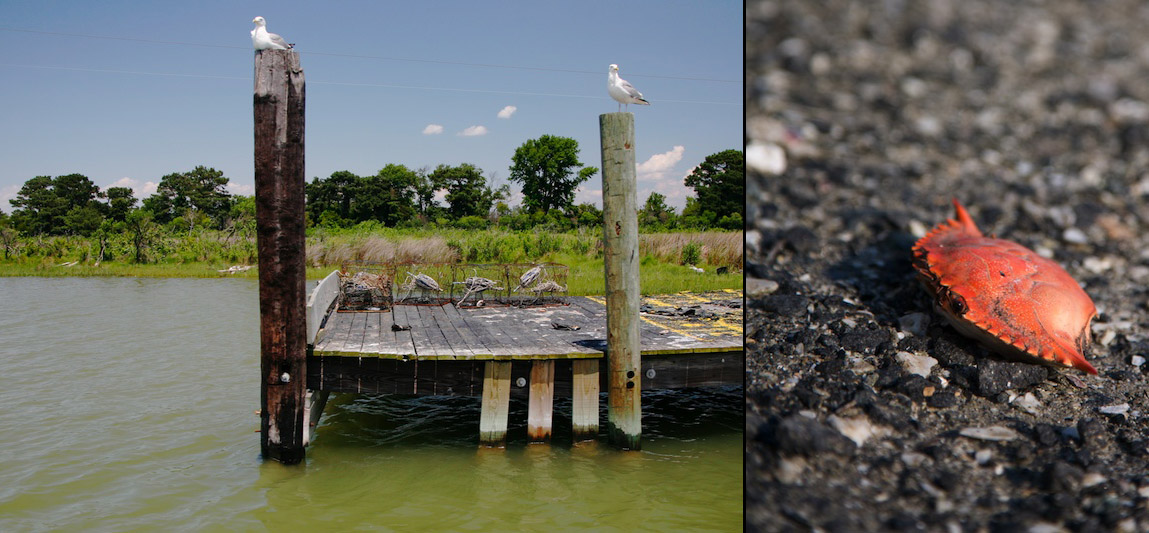
This short New York Times Audio Slideshow with Chesapeake Bay waterman Barry Bruce offers a lovely portrait of a man and a place.

Although I don't know Bruce personally, I recognize him as the hardworking, "salt of the earth" type that crowds the interior of Wachapreague's bait and tackle shop. Around and in Bruce, I also recognize my home ground: the salt marsh and bay landscapes, the docks and crabshacks, the marbles-in-your-mouth accent, the unquestioned appreciation of a providing God tethered to an overarching melancholy of things irrevocably changed.

It's easy to romanticize the sun-baked, hard life of a waterman, but I harbor no illusions. Crabbing is exhausting and painful work. The slideshow provides a sweet aural backdrop of lapping water and muted laughing gulls, but, in life, those pleasant sounds are marred by the irritating whine of the motor, just as the rich smell of the marsh is cut with the stench of gasoline. I don't intend, then, to sentimentalize Bruce's position, but having grown up around folks like him, the farmers and fishermen of the mid-Atlantic, it saddens me to recognize that their kind is nearing extinction. The Shore that shaped me goes with them.

Note: The Bruce slideshow is associated with a New York Times travel piece, "The Crab Houses of Maryland's Eastern Shore." This article is fine, but the slideshow, produced by Miki Meek with photographs by Karen Kasmauski, is the real gem. Watch it here.

Photo credit: Smith Island image ripped from texterella's Flickr photostream

Thursday, June 04, 2009

A Decade On

"My friend told me that story about waiting in line for the Village Voice to come out so he could see what jobs were available. I thought that was really striking because it really wasn’t that long ago, and it’s so different from the way we do things today."
- Elizabeth Goodman
I moved to New York City in October of 1999. Through a friend, I'd secured a basement bedroom on East 7th Street, but I hadn't found a job. Like many other unemployed New Yorkers, on Wednesday mornings, the day of the paper's weekly printing, I poured over the classifieds section of the Village Voice, circling any interesting job listings in red or green ink. Three weeks after I arrived in the East Village, I enthusiastically accepted a position as an art gallery preparator.

This morning, while reading Rachel Brodsky's Flavorpill interview with Elizabeth Goodman, I recalled those uncertain, early weeks in NYC. I also marveled, like Goodman, at how very differently we conduct job searches a decade later.

Photo credit: ripped from WhoIsStan's Flickr photostream

Wednesday, June 27, 2007

Singing for the rains

A child of the South, I miss the fluctuating drone of cicadas during the spring and summer months. Yet I take some solace when a startling crush of thunder sets off all the car alarms in Astoria.

Tuesday, October 24, 2006

"Out of This World" at PS122 Gallery


Amy Talluto
"Silver Pond/Montana"
2006
Oil on canvas
44 x 32 inches


"Out of This World," currently on view at PS122 Gallery, is a two-person exhibition featuring sculptures and photographs by Diane Carr and paintings by Amy Talluto. Although landscape is a principal subject matter for both Carr and Talluto, their approaches are distinct.


Diane Carr
"Forest Floor"
2006
Ink, paper, plastic, foam, resin
14 x 24 x 22 inches


Carr's sculptural vignettes depict woodland glades, starry ponds, icy slopes, or tree covered hillsides, but these pleasant scenics are fashioned of foam, plastic, resin, and painted paper. The brilliant, even startling colors Carr uses are at once poisonous and magical, acidic and jewel-like. Initially, viewers may want to plunge into these cartoon worlds just as they did their childhood day dreams, but there is an air of toxicity about Carr's sculptures. Like the beautiful poison dart frog, the works' vivid coloring seems to say, "Look, but don't touch."

The opening line of the poem "Son," by Brad Leithauser, states that "Memory buries its own." I recall this line as I consider Carr's landscapes. Her body of work is as concerned with memory and longing - otherwise known as nostalgia - as it is with the juxtaposition of natural and unnatural. How do we treat our buried memories? How do we fashion our memories to suit our purposes, or to fit our desired narrative? Likewise, how will we remember this moment? Carr's sculptures are elegies for moments past, but also for the present, reminders that what is will not be. Time, so far as we know, is unremitting.


Amy Talluto
"Pond"
2006
Oil on canvas
60 x 74 inches


Talluto's accomplished oil paintings can be deemed "traditional landscapes," but her choices suggest she is less interested in painting a pond per se, than she is in unfolding and interpreting that pond. Where one expects space to recede, for example, it might suddenly flatten, or perhaps the contour of a reflection lifts, causing the foreground to recede as our brain tries to force the imagery back where we feel it "should" reside. In some passages, the effect is vertiginous; if Talluto's paintings are a window onto another world, they frame a domain in which our brain and senses will are addled. By focusing on the riot of color and form, Talluto strives to reveal the animating force, that invisible weave that ties together all things.


Diane Carr
"Winter Forest"
2006
Ink, paper, foam, resin
24 x 22 x 16 inches


Admiring the work in "Out of This World," I think about the increasing number of artists who are returning to landscape. The reappearance of wild scenery in the contemporary gallery is a nod to our ever more domestic culture, one desperately in need of outside pictures for inside walls. What's more, the language many of these contemporary landscape artists use to describe their work is strikingly similar. I've described my recent paintings as "hallucinatory landscapes, sometimes foreboding, sometimes joyous, always ambivalent." In the press release for "Out of This World," Carr writes of her work, "the environments are sometimes peaceful and sometimes ominous in feeling and are a combination of what exists around us." Talluto states that her work is "sometimes bright, lush and flowering...sometimes dissonant, murky and foreboding." Elsewhere, Talluto says, "a shifting psychological mood pervades the group as a whole, moving between realms of magical fantasy, sparkling beauty, anxiety, and the sinister and mysterious." And that's just three of us! I've read many variations on this theme.

On the one hand, it's unremarkable. After all, Nature is ambivalent. Of course it will be "sometimes foreboding" and "sometimes peaceful." Duh. But the ambivalent language used by so many artists, myself included, signals the sublime. It describes landscape that "subverts order, coherence...bypasses the rational mind and concentrates directly on the emotions."(1) For most of the twentieth century, sublime landscape was deemed a goat, an unworthy cliche. Indeed, with a few notable exceptions, landscape artists of all persuasions have been held in low regard by the art world establishment for decades.

These are turbulent times, however, marked by anxiety and uncertainty. The promise of progress is now viewed with much skepticism and people again recognize the inevitability of cycles, and of growth and decay. Moreover, landscape art has a history of flourishing in countries during periods of intense colonialism. This proved true in China, Japan, and Rome many centuries past, and, within the last five hundred years, in Holland, France, Britain, and the United States. Perhaps today, as wars wage on, as nuclear weapons again proliferate, and as global, corporate colonialism becomes the zeitgeist, artists are returning to sublime landscape, to depictions of an ambivalent world that delights and inspires as surely as it destroys and awes.

"You lose yourself in boundless spaces, your whole being experiences a silent cleansing and clarification, your I vanishes, you are nothing, God is everything." That was written by Carl Gustav Carus, in his 1824 "Nine Letters on Landscape Painting." How the pendulum swings!

(1) Malcolm Andrews, Landscape and Western Art, Oxford University Press, 1999

Photo credit: all images courtesy the artists (unfortunately, the reproductions can not do justice to the luminosity of Carr's sculpture)

Thursday, May 26, 2005

Player Haters?


Last Sunday, sick and frustrated, I watched the deciding game of the May "Subway Series" on television. Some weeks earlier, a friend had offered me a ticket to the game and I had eagerly anticipated the afternoon ever since. But instead of animatedly talking baseball on a beautiful Sunday at Shea Stadium, I was feverish and pouting on my bedroom floor in a sweat-drenched t-shirt and boxer shorts. That the afternoon had turned rainy and cold, thereby making things less than ideal for those fans who were able to make the game, did little to make me feel better; I'd been betrayed by my immune system. Even the run of unfortunate errors by the young Mets' players, and the resulting Yankees rally (which whipped me into a frenxy of anguish despite my fugue-like state) could not quell my frustration at having not been able to be there.

Fortune sometimes smiles on all of us, though, and another friend offered me a ticket to a Wednesday night Yankees/Tigers game in the Bronx. So yesterday, in now familiar cold and rainy New York weather, I headed up to the Bronx after work. Despite having lived in New York City for nearly six years, this would be my first game in Yankee Stadium! The seats were the best I have had since attending a Baltimore Orioles/Cleveland Indians game at Camden Yards in the early 1990s. Directly behind home plate, just this side of the "gated" boxes, I found my spot moments after the first out of the game. I love baseball stadiums almost as much as I love the game, and I spent the better part of the first inning studying the stadium itself. By the end of the third inning, though, it was neither the game nor the stadium that demanded the bulk of my attention, but the fans. One pair, sitting four rows behind my left shoulder, was especially difficult to ignore. Early in the evening, during a relatively quiet moment in the stands, one of them yelled out, very loudly, "F*ck you, Detroit! You f*ckin' suck, you pieces of sh*t!" Unfortunately, this was only a warm-up.

I've been to a number of baseball games in the last decade - though only a small number of cities: Baltimore, MD; Philadelphia, PA; New York, NY - but I have never before heard such hateful taunting. Granted, I have a chip on my shoulder. I don't hate the Yankees, as a team, but I do loathe most Yankees fans. They represent the worst kind of spoiled royalty. As I see it, the fans who support the richest and winningest team in all of American sport should be proud and charitable. To point fingers and scream "You suck" at the rest of the field is akin to a member of the aristocracy leaning out of his carriage to call a toiling peasant a loser. But my desire for the average Yankees fan to inherit some humility and grace is not the matter at hand.

While watching that Sunday "Subway Series" television broadcast, I could hear New York Mets fans boo Kaz Matsui, the struggling Japanese import, when he approached home plate to bat up. Each time I heard these jeers, I shook my head; after all, the Mets are one of my favorite teams (second only to the Chicago Cubs) and the heckling that Matsui was dealt incensed me. The commentators noticed the booing, too, and mentioned how difficult such treatment had proven for Matsui. In the Japanese equivalent of our major league (Puro Yakyu), fans never heckle their own players. In fact, they don't boo or berate players on opposing teams either! Kaz Matsui (not to be confused with the more successful Hideki Matsui, currently playing across town for the New York Yankees) emerged a superstar from a league in which players receive only support. Today, he finds himself centerstage in a much tougher arena, one in which fan regard is fickle and their bite is often terrible.

The friend who had given me the ticket is married to a Japanese man and I decided to ask him, as we quietly sat among the ruckus at Yankees Stadium, what he made of Major League Baseball. While he isn't a big baseball fan, he immediately commented on the difference in the stadium experience. In Japan, he explained, each player has a song or a dance associated with them and Puro Yakyu stadiums are filled with fans ritualistically celebrating their team, even when they lose. The whole experience, he said, "is about having fun."

When the Yankees next scored on a two RBI double by Jorge Posada, the fans in our area went crazy. The first few seconds were fun, with lots of high fives and wild cheering, but then the chorus of, "F*ck you, Detroit!" and "Who's your Daddy?" began anew. A crippled man seated in front of me grabbed at his wrist crutches and struggled to his feet. He attempted an awkward high five with a buddy of his who was screaming something to the effect of, "We own you, Detroit!" Perhaps wrongly giving him the benefit of the doubt, I imagined that this crippled fellow, a casualty of genetics or circumstance, couldn't move quickly enough to ditch his sh*thead friends. I suppose he, too, could have been slandering the mothers of the Detroit Tigers, but I couldn't hear his more quiet ejaculations over the rest of the din. The crowd "celebration" was a curious mix of happy excitement, vitriolic fervor, and entitlement. I turned back to Koh and said with a smile, "Just like Japan, huh?" He shrugged and shook his head, half laughing. He appeared bemused. We sat in our seats among the standing, screaming Yankee fans and tried to take it all in.

By the time that exchange took place, the Yankee duo sitting behind us had elected to up the ante. Below are just a few of the many things screamed over my shoulder. Some of these were repeated many times.

"F*ck you, you f*ckin' f*ggots!"
"Hit the mother f*cker in the face with the pitch....Yeah, hurt 'em!"
"You fat piece of sh*t, there's a cheeseburger on second...can you make it, fatboy?"
"Detroit sucks! Boston sucks, too! F*ggots live in Boston!"
"Let's Go Jankees! Yeah....Jankees!"
"You suck, Detroit! Why bother trying?"

Occasionally, these fans even opted for a little abuse of their own boys.

"Hey, Giambi, you f*ckin' juice head! You're a potato head, you sh*t!"
"Hey, Matsui, hit the ball to China or wherever you come from!"
"Hey, Posada, if you had good knees you could run better! Shoulda been on second with that hit, you putz!"

In between such outbursts, the pair talked about beer, cell phones, and their pursuit of women. On beer, for example, one announced, "I don't drink Heineken...it's just too dark and thick, ya know?" Heineken is way too dark and thick? Um...okay.

Anyway, while these two "characters" were certainly the loudest around, they were not alone. Cries of "Detroit sucks!" could be heard anywhere you moved and every time a Yankee player failed to make a play or get a hit, no matter how difficult, the fans voiced their displeasure. Most distressing of all, though, was the encouragement given the loudest idiots in the stadium. Even those folks who seemed more inclined to clap and cheer than berate and boo egged on Tweedledum and Tweedledee. A girl noticed me staring over my shoulder at the pair of jackasses and she laughed. "They're awesome, aren't they?," she asked, with a smile. No, they're reprehensible and offensive, in fact. Shamefully, I said nothing.

I don't want to give the impression that I never cheer on my teams - I've jumped up and down at games and screamed obscenities at the television more than once - and I can't claim to be above booing a bad call. (A clear bad call is legitimately angering, but I won't boo close ones, even if disappointed in the result; after all, I'd hate to make a judgment mistake on the field, and I trust that the referees and umpires want to do as good a job as they can.) Yet I have absolutely no urge to call anyone on the other team a "piece of sh*t," even if I dislike them. What little I know of Alex Rodriguez, for example, makes me disinclined to like him, but I've never booed him (though I have wished for a strike-out or a botched bit of fielding). Shaquille O'Neal drives me mad with his dominating play and arrogant attitude, but I don't hope for a broken knee or a torn ACL.

The point is, I'm distressed by the prevalence of negativity in American sports. I'd like to think that it hasn't always been this way, but the truth is I'm not so sure. The nostalgia one feels for "the good ol' days" is largely a result of edited history; Ken Burns need only add a sepia tint and a banjo track to his "Baseball" footage and everything seems that much better. Even Barry Levinson's "The Natural," considered by many to be the pinnacle of "sports movies," hints at the venomous sting of the fan base. Is our culture really this willing to become the ignorant mob? If, as many folks say, contemporary athletes and celebrities are elevated to sainthood, their experience is equal parts transcendence and martyrdom. We love 'em, we hate 'em. We love to hate 'em, we hate to love 'em. It all seems a little schizophrenic to me. While I champion complexity, I guess I just prefer Southern hospitality and reserve at the ball park.

Making my way out of the stadium, a few drunken Yanks fans decided to make comments about my Cubs hat. Fortunately, they were not particularly nasty. "Look at this guy with the Cubs hat. What the f*ck is that about?," and "Hey, a Cubbies fan is here tonight, bro," weren't intended to insult. These drunks just wondered what I was "all about," and there's nothing wrong with that. Nevertheless, I left the stadium thinking highly of baseball, but none too highly of the species that showed so much promise back when games were first being invented, when we were discovering ways of channeling our competitive aggression into an afternoon of fun.

Photo credit: unknown source; image of Freddy, an old-timer who attends every Yankees home game and bangs on his pot with a spoon. On Wednesday night, his spoon and pot were so abused by some fans that he reclaimed them, then opted to hold them out of reach for a while.