Showing posts with label evolution. Show all posts

Thursday, October 03, 2013

Knowing the Way To Your Heart

Elizabeth Alexander
"Song Sparrow"
2012
I was curiously heartened when I read the below blurb in the "Field Notes" section of the September/October 2013 issue of Audubon Magazine.
Silly Love Songs: Singing longer doesn't always mean you get the girl.

Among song sparrows, the most tuneful males often win over the females -- but their vocal expertise may come at a cost. Biologists at Duke University counted up songs in male song sparrows' repertoires and then tested the birds' memories. Every day for eight days the researchers hid a mealworm in one of several shallow wells, some of which had lids. The mealworms' location remained the same, so the scientists could observe how deftly the sparrows remembered where to find their treat. Over time all of the birds improved, but the males that sang the fewest songs learned the quickest, while the birds with more expansive repertoires struggled. Kendra Sewall, now at Virginia Polytechnic Institute and State University, explains that the difference could reflect a trade-off during mental development -- the birds develop one ability or the other. The finding also suggests that females may be able to detect a potential mate's weaknesses in his songs. Although many pick males that sing lots of songs, Sewall notes that every male in their study found a mate. It's possible, she says, that certain females are aware of the trade-off and prefer a partner with spatial smarts to pass on to their young. -- Daisy Yuhas
Maybe I was cheered by the report because I a) have a terrible singing voice, b) struggle to remember song lyrics (even simple tunes), c) am fond of poring over maps, and d) have an innately good sense of direction? Like the song sparrow test subjects, it seems I was afforded one ability and not the other.

Image credit: Elizabeth Alexander's mixed media song sparrow artwork found online at the Scholastic Alliance for Young Artists & Writers Blog

Thursday, April 11, 2013

Dr. Walter Freeman III's chaos and creativity

Dr. Walter J. Freeman
"One profound advantage chaos may confer on the brain is that chaotic systems continually produce novel activity patterns. We propose that such patterns are crucial to the development of nerve cell assemblies that differ from established assemblies. More generally, the ability to create activity patterns may underlie the brain's ability to generate insight and the 'trials' of trial-and-error problem solving."

- Walter J. Freeman

On a sunny Tuesday morning when most of the University of California, Berkeley student body was away from campus for Spring Break, Selene and I had the pleasure of visiting Dr. Walter Freeman in his Donner Lab office. He provided us with a simple introduction to neurodynamics -- brain waves are a "special kind of noise," he explained -- before expounding on the theoretical outgrowth of his neuroscience research. Many of Walter's conclusions about the workings of the brain have an unexpected antecedent, the philosophy of the 13th century theologian, St. Thomas of Aquinas (Walter prefers the Italian formulation, Tommaso, so I will use it here).

Tuesday, November 27, 2012

Heide Hatry's Provocative Flowers

Heide Hatry is not a household name, but the New York-based German artist's reputation is blossoming. She has smartly positioned herself at the intersection of the art world and popular culture and, as a result, is of particular interest to me, convinced as I am that the fine arts need mass reach (if not necessarily mass appeal -- see Thomas Kinkade) in order to play the vital cultural role they're intended to.

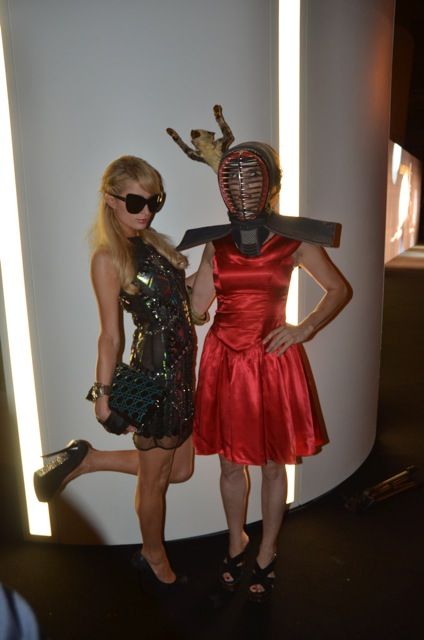
Heide Hatry, right, with Paris Hilton at the Guggenheim Museum
In September, Hatry performed "Schrodinger's Cat" at Lady Gaga's Guggenheim Museum perfume launch. Although Gaga's arty public appearances and carefully cultivated persona evidence how readily pop culture co-opts and/or draws inspiration from the fine arts, most people view Gaga as a pop star, not an artist. Hatry, on the other hand, is always identified as the latter, so when she is photographed rubbing shoulders with the likes of Paris Hilton or her work is written about by the scientist and popular writer Steven Pinker, I'm heartened. The art world isn't usually so accessible.

Naysayers might dismiss Hatry as the art world equivalent of a shock jock, insisting the popular attention she has received is only the result of her pushing our buttons. Certainly provocation plays a part, but Hatry has so far managed to balance titillation with thoughtful questions. (Arguably, Damien Hirst managed to do the same for a time...before he jumped the preserved shark.)

Friday, February 10, 2012

Chris McCaw: Drawing Time

Chris McCaw
"Sunburned GSP#420 (Arctic Circle, Alaska)"
2010
Unique gelatin silver paper negative
12 x 20 inches
Chris McCaw created the arresting pictures on view in "Ride Into the Sun," the artist's winter 2011 solo show at Stephen Wirtz Gallery (San Francisco, CA), using an unconventional technique. The artist loads handcrafted view cameras as large as 30 x 40 inches with expired silver gelatin photographic paper, tilts the camera lenses skyward, and opens the shutters for hours. Even on cloudy days, the photo paper is soon overexposed. As time wears on, however, the light-sensitive chemicals that coat the paper are solarized, and the prints' tones are transmuted in curious ways. In many of McCaw's works, the sun appears as a dark, arcing streak and the landscape and sky as shades of grey. During some of McCaw's longer exposures, the sun's brilliance, laser-like, burns through the paper, tracing its progress as a charred tear.

Thursday, September 15, 2011

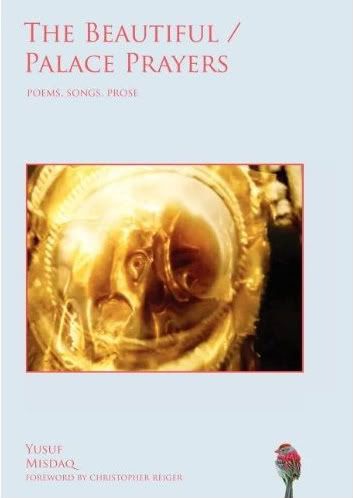
The Beautiful / Palace Prayers

OLD MOONS

Old moons now are dried and crusty
Brittle and as uninteresting as history is
To my fingers and lips.

And yet also, it cannot be denied
That each man
King of his home-throne
Misses something of eternity
When he chomps down on lamb chops
(Which are his reward
For winning the bread)

Each of us misplace the universe
And lose the word
When we get our desires
On plates before us.

There is a grain of rice on the table.
Around it, oil has bled
And spreads

In this way does our egodeath
Halo around us
  And puncture the beauty
    Of clouds
- Yusuf Misdaq

Two years ago this month, I highlighted the poet, musician, artist, and author Yusuf Misdaq's Palace Prayers project. August 21st - September 19th, 2009, was Ramadhan, and Misdaq, a practicing Muslim who, as I noted at the time, "shares my universalistic mystical inclination," created a new work of art for every day of the month-long fast and period of Muslim introspection.

Some months later, Misdaq invited me to contribute a forward to a book of his poetry, prose, and lyrics. That book, The Beautiful / Palace Prayers, was published this year. Visit Misdaq's website for more information.

+++++

"Dissolution Is The Whole Show"

When Yusuf invited me to contribute a foreword to The Beautiful / Palace Prayers, I was at first surprised. Although I enjoy reading poetry, my education in literature is wanting, and my tastes run to work that most "serious" critics and scholars deem pedestrian. Who am I to comment on this young artist's latest collection? With characteristic enthusiasm, however, Yusuf's invitation quelled my self-doubt, insisting that The Beautiful is made up of poems "for normal people who do not normally read poetry." Well, in that case, it is a privilege and a joy for this normal person to introduce a collection of poems, verse, and prose written "for normal people"!

        They are a good species.
        Clean and caring;
        Made mostly of water and forgiveness
              - from "The Beautiful"

Normal people are very much in need of poetry, and perhaps especially so today, when the art is generally neglected. Words are powerful entities, every one an invocation, yet we too often use them carelessly. Poetry, like prayer, can serve as a corrective, reminding us that words conjure meaning and that they have a felt, physical component. As critic and philosopher George Steiner writes, "the meanings of poetry and the music of those meanings...are also of the human body." Appropriately, Yusuf refers to the italicized and apparently random words that he includes in some of his poems as "body echoes." "Carbunkle. Crellis. / Pulse-if. peaces." or "Que Que" are not intelligible formulations but, when read aloud, they aren’t exactly jibberish either. They supply somatic meaning, as do the poems’ rhythms. Yusuf's strongest poetry or verse has a perceptible pulse; in some cases, I notice my head slowly bobbing as I read. This is not insignificant. Beat and rhythm are primal properties, manifestations of the infinite, unfathomable being within which we reside and of which we are composed.

        Echoes
        of the original
        Voice
        From the original
        Breath
              - from "Ramadhan 26"

Ludwig Wittgenstein insisted that earnest philosophers should "descend into primeval chaos and feel at home there" if they expect to produce worthy work. I extend the same requisite to artists. Yusuf draws pictures, makes films, and writes poems, novels, and songs, but he is, above all, a mystic. And mysticism, in its quest to directly experience elemental truths, necessitates Wittgenstein's appreciation of the primeval and the chaotic; ancient disorder is at the root of everything. In most cases, the mystical perspective is merely an uncommon one; mystics survey and respond to the same earthly, material realm that the rest of us do. But they disregard accepted classifications and train themselves to mindfully observe and reinterpret their surroundings. They locate the extraordinary in the mundane. As Henry David Thoreau, a 19th century mystic, lamented, "All this [splendor] is perfectly distinct to an observant eye and yet could easily pass unnoticed by most." Mystics reawaken their capacity for reflective wonder and, in doing so, experience a kind of rebirth into a vaster dimension of human experience.

        On perfect Spring mornings
        God puts a clear blue sky in our pockets
        Pats us a few times and says
        'On your way!'
              - from "The Merciful Cheerful"

So reborn into sublime beauty, mystics strive toward the transcendent. Both Wittgenstein and Thoreau can be described as transcendentalists; Yusuf qualifies, too. Like the two philosophers, he finds in his observations of the world cause for a fundamental optimism. Unlike them, his writing is generally informal and devoid of pretension. His poems give readers the impression of a devout Sufi Muslim happy at play in our waking, sensual dream. In the collection's title poem, Yusuf writes "Awake in this dream / Where abstract clouds calmly keep us. / Where birds secretly make love in public and / Give voice to the current of joy which / Slices through us in a day." Again, in "Back Amongst Men (Drowned)," he references this dreamed life: "Or as I have also interpreted it / .God is a laughing dream." No doubt, the poems’ author, laughing, singing, eyes wide and sparkling, would appear mad to many of his fellows. This is to their discredit. They have forgotten (or failed to learn) how to look. Mystics, like many philosophers and artists, are too easily dismissed as lunatic or eccentric. Yusuf's ability to see through the veil of our cultural forgetfulness informs his aesthetic imagination and invigorates his art.

        Silk veils, dark and weightless
        Are being removed from her countenance
        Time after Time

        Each day I ready myself to know her better
        Each day, closer
              - from "Wahad"

But not all that Yusuf observes is felicitous. The most biting poem included in The Beautiful, "Ramadhan 23: Only To Be With You And No-one Else," is a reaction against the politicization of Islam and a celebration of his intimate relationship with Allah. After rejecting the "bloody bridge builders / Shmoozers or politicians" and others who "come to the Mosque smiling in your suit," Yusuf writes, "I wish to be alone / And serious / And deeper in love / With the only one who ever matters." The striking seriousness of his personal communion with G-d is important; discipline is one of the central currents running through the poems included in The Beautiful. In “Waiting (A Song for Guitar),” Yusuf writes, “I do believe in magic but first you gotta work at it.” Hope and love, he reminds readers, are nurtured through dedicated ritual and practice.

        Understand, thee
        That tenderness comes not of softness
        But of a firmness
        And of a discipline

        Understand that of discipline
        -Say, the discipline of prayer-
        Comes an enjoyment of that same thing.
        Discipline to run breeds a love for running
        Discipline to practice ones instrument brings forth a love
        for playing it
        Discipline to speak good breeds a love of horses
        And love of all refined things
        Whatever you may find them to be.
              - from "Ramadhan 12: The Vows Revolve"

A visual artist, I appreciate the centrality of discipline in a life committed to aesthetics. Like Yusuf, though, I am also mystically inclined. Paintings, sculptures, and other hand-crafted objects are among my adored icons but, if I work at it, I can find occasion for worship in every place, in every form, in every moment. The European starling that paraded on the sidewalk in front of me this morning warranted exaltation. In his iridescent dream coat and brilliant yellow bill, I see cause for startling, smiling celebration. For some other pedestrians, the bird, a representative of a despised species, may be ignorable or irrelevant. For others, my viewing the starling as a manifestation of the Divine amounts to idolatry. So, too, might the dirty, discolored Queens sidewalk be deemed a cement calf by unimaginative or close-minded "believers." Yet, striding on such a sidewalk today, my thoughts range through eons of geologic time to consider the ancient rock and mud, precursors to and components of the concrete that I now tread upon, from which our kind eventually emerged on crude limbs as a gasping, fish-reptile thing.

        The salt-pepper sugar mills on this table look like planets.
        I want to know the word for planet in as many different
        languages as possible.
              - from "Celestial"

Doubtless some of those who consider themselves religious don't share my enthusiasm for our scaled, long-snouted ancestors. But I'm not concerned with narrow definitions of religion. I believe that humility, wonder, gratitude, and communion are the four pillars of genuine religious practice, and the mental stretching engendered by the work of scientists, philosophers, and artists is an integral part of any intellectually rigorous, honest religious life. And, love, too, is a bit like religion. The same four pillars are fundamental to it. As Douglas Thorpe writes, "[love] demands of us a new way of being in our old world." Religious mysticism is a love affair with The All. It's not always easy, but religious attunement can turn each day, each hour, or each instant, into "a new way of being." Reading Yusuf's poetry, I'm reminded that every step is a psalm, every directed gaze is a prayer.

        Dot-Dot-Purple and Palaces
        Says the starling in approximate translation.
        Star-Star-Chandeliers and
        Bread on the wind-ind-ind.
              - from "The Beautiful"

I'm also reminded that we both enjoy watching starlings.

- Christopher Reiger, May 1, 2010

Sunday, October 10, 2010

Winner Take All?


My father recently sent me a clipping from the Hampton Roads Daily Press that highlighted some curious research presented at my alma mater, the College of William & Mary.

Biologists have determined that "the maximum length of a duck's penis depends not on genetics but rather [on] the males he keeps company with." Dr. Maydianne Andrade, of the University of Toronto Scarborough, explained that ducks "are essentially engineering their own phallus in response to social challenges." This is fascinating evolutionary biology, to be sure, but I find it remarkable that ducks have penises at all, given that most birds do not. (Apparently, a cloaca just won't cut it in duck world!) Dr. Patricia Brennan, of Yale University, believes that the heightened intensity of male-male competition among waterfowl has resulted in the development and size fluctuation of their sex organs.

The evolving duck penis battle came to mind when I read Ashley Mears' article about Coco Rocha, the popular fashion model. Early in his piece, Mears summed up the competitive dynamics of creative industries revealingly.
"Rocha is what economists would call a winner in a 'winner-take-all market,' prevalent in culture industries like art and music, where a handful of people reap very lucrative and visible rewards while the bulk of contestants scrape together meager livings before they fade into more stable and far less glamorous careers."
As with the bulk of would-be daddy (or uncle) ducks, most artists, designers, musicians, writers, and other creatives will not be prolific and celebrated. There are many intangibles in play, of course, but, like the drake duck whose penis twists to extraordinary lengths to impregnate a hen, "winning" in a creative industry often depends on who you're keeping company with.

Once vetted, however, the successful creative becomes, like Coco Rocha, a known label; his or her career is likely to be a fruitful one. That label is what the blog "Is It Art or Fart?" trades on. As the blog's co-founders explain,
"The blog began as a conversation between two friends living on opposite coasts who shared an undying passion for contemporary art. Both friends have the habit of seeing as much contemporary art as they possibly can, and this habit has uncontrollably spilled over into the recognition of 'fart'--coincidental moments in everyday life that, when isolated and [attached to the name of an] artist, bear uncanny resemblance to art seen in museums and galleries around the globe. Back and forth the two friends would point to the 'fart' that seemed to be just about everywhere. Now the humor of their findings is for all to enjoy. Remember, the world is your readymade!"
Part of the humor of their project is that the "fart" is often as good as or better than the "art" it might be confused with. Unfortunately, for the "fart," as for many drake ducks and coulda-been-a-contender creatives, it's a winner-take-all world.

Image credit: Scrooge McDuck, copyright Walt Disney Company

Friday, June 11, 2010

Rescuing Hokget and Everybody Else


Several months ago, I read "The Problem With Human Compassion," an excerpt from Shankar Vedantam's book The Hidden Brain, printed in the February 19th issue of The Week. I include a lengthy selection here.
"On March 13, 2002, a fire broke out in the engine room of an oil tanker about 800 miles south of Hawaii. The fire moved so fast that the Taiwanese crew did not have time to radio for help. Eleven survivors and the captain’s dog, a terrier named Hokget, retreated to the tanker’s forward quarters with supplies of food and water.

[...] Drawn by wind and currents, the Insiko got within 220 miles of Hawaii. It was spotted by a cruise ship, which rescued the crew. But as the cruise ship pulled away, a few passengers heard the sound of barking.

The captain’s dog had been left behind on the tanker. A passenger who heard the barking dog called the Hawaiian Humane Society in Honolulu. [...] The Society alerted fishing boats about the lost tanker and soon media reports began appearing about Hokget.

[...] Money poured in to fund a rescue. Donations eventually arrived from 39 states and four foreign countries. One check was for $5,000. 'It was just about a dog,' Pamela Burns, president of the Hawaiian Humane Society, told me. 'This was an opportunity for people to feel good about rescuing a dog. People poured out their support. A handful of people were incensed. These people said, ‘You should be giving money to the homeless.’' But Burns thought the great thing about America was that people were free to give money to whatever cause they cared about, and people cared about Hokget.

The problem with a rescue was that no one knew where the Insiko was. The U.S. Coast Guard estimated it could be anywhere in an area measuring 360,000 square miles. Two Humane Society officers set off into the Pacific on a tugboat. The Society paid $48,000 to a private company called American Marine to look for the ship.

[...] The U.S. Coast Guard had said it could not use taxpayer money to save the dog, but under the guise of training exercises, the called the U.S. Navy began quietly hunting for the Insiko.

[...] Human beings from around the world came together to try to save a dog. The vast majority of people who sent in money would never personally see Hokget. It was, as Pamela Burns suggested to me, an act of pure altruism and a marker of the remarkable capacity human beings have to empathize with the plight of others.

There are a series of disturbing questions, however: Eight years before the Hokget saga began, the same world that showed extraordinary compassion for a dog sat on its hands as hundreds of thousands of human beings were killed in the Rwandan genocide.

The philosopher Peter Singer once devised a dilemma that highlights a central contradiction in our moral reasoning. If you see a child drowning in a pond—and you would ruin a fine pair of shoes worth $200 if you jumped into the water—would you save the child or save your shoes? Most people react incredulously to the question; obviously, a child’s life is worth more than a pair of shoes. But if this is the case, Singer asked, why do large numbers of people hesitate to write checks for $200 to a reputable charity that could save the life of a child halfway around the world—when there are millions of children who need our help?

The answer is that our moral responsibilities feel different in these situations; one situation feels visceral, the other abstract. We feel personally responsible for one child, whereas the other is one of millions who need help - there are many people who could write that check.

[...] The brain is simply not very good at grasping the implications of mass suffering. Americans would be far more likely to step forward if only a few people were suffering or a single person were in pain. Hokget did not draw our sympathies because we care more about dogs than people; she drew our sympathies because she was a single dog lost on the biggest ocean in the world. [...] We are best able to respond when we are focused on a single victim."
Vedantam and Singer are correct; we humans act more compassionately when we are able to put a face to a cause, yet too many faces dull our response.

I've noticed such a benumbing in myself recently, an unexpected consequence of my transitioning from New York City to San Francisco. Both cities have substantial homeless populations, but panhandling in San Francisco is far more common. My street charity policy, modeled on the approach of a rabbi I heard lecture, is simple enough: I give change to any panhandler who says that he or she will use the money for food (or cites hunger as their reason for begging). I don't give change to those individuals requesting money for any other reason. In New York City, confronted with a few beggars each day, I typically gave change two or three times every week. In San Francisco, however, beggars ask for handouts on every other block, and a good number of them say that they're hungry. If I hold to my standard, I'll give change two or three times a day, if not more often! Shamefully, I've noticed that I've almost ceased giving during my visits to San Francisco.

This is a personal failure that I must address. Each of those many faces is an individual, a single person in need, despite the fact that their larger numbers and concentration counter-intuitively make them relatively anonymous or invisible. The rabbi's rule should be no less applicable in San Francisco than it is in New York. I'm confronted, then, with more need, and I must respond in kind; a hungry person is a hungry person.

But what about a hungry dog? Is Vedantam right to suggest that the thousands of people who contributed money to the Hokget search did not "care more about dogs than people"? Not exactly.

Our species' evolved, inborn behaviors haven't made our adaptation to the globalized world easy. In fact, it seems that contemporary humans are increasingly suspicious of other humans, especially of those outside our respective tribe, whereas animals (and perhaps especially dogs) are seen as uncomprehending innocents. I don't mean to suggest that no one cares about miners trapped in a coal mine, but it's clear that the little girl trapped in a well sells more newspapers, and that the little dog trapped on an abandoned tanker not only sells newpapers, but also inspires a flood of unsolicited donations and generates public outcry.
"Facing intense public pressure to save Hokget, government officials concluded that asking the Navy to sink the tanker—750 miles from Hawaii and drifting away from the distant U.S. mainland—posed unacceptable environmental risks. The Coast Guard finally agreed to access $250,000 in U.S. taxpayer funds to recover the Insiko. It wasn’t officially called an animal-rescue effort. Instead it was authorized under the Oil Spill Liability Trust Fund, based on the argument that if the aimless Insiko managed to drift westward for 250 straight miles, it might run aground on Johnston Atoll and harm marine life.

[...] On April 26, nearly a month and a half after the dog’s ordeal began, the tugboat’s crew found the Insiko and boarded the tanker. Hokget was still alive, hiding in a pile of tires. [...] Hokget arrived in Honolulu on May 2 and was greeted by crowds of spectators, a news conference, banners welcoming her to America, and a red Hawaiian lei."
What a marvelously strange species we are!? I applaud our ability to extend compassion to other animals (we're one of handful of species that have demonstrated such empathic ability), but I wonder at our brains' curious moral calculus.

I suppose all I can do is begin with myself, and humbly pledge to keep my pockets filled with coins.

Image credit: ripped from Corbis Images

Thursday, March 11, 2010

Different Takes on the Raw Stuff


Christopher Reiger
"submerged in his erotic mystification"
2009
Watercolor, gouache, sumi ink and marker on Arches paper
32 x 32 inches

I'm pleased to announce that one of my 2009 paintings, "submerged in his erotic mystification," is reproduced in the March/April 2010 issue of Tikkun Magazine. If you're unfamiliar with Tikkun, it's a west coast-based magazine founded by Rabbi Michael Lerner and dedicated to exploring the intersection of politics, spirituality, and culture. While it has Jewish roots (hence the magazine's name), it is an inter-faith publication with a diverse group of secular and religious contributors. The March/April issue includes a special section entitled "God and the 21st Century," featuring articles by seventeen writers, including the esteemed Rabbi Arthur Green, a scholar whose stripe of mystical panentheism resonates with my theological convictions.

My artwork accompanies one of the many articles included in "God and the 21st Century." Respected law critic Peter Gabel's "A Call For Sacred Biologists" explores the gulf between a strictly rational, scientific world view and that of, for lack of a better description, holistic panentheism. I allude to this same schism in my artist statement.
"[I]ncidentally, we've realized that the divide between the imagination and reason is unnatural. The English poet and critic, John Ruskin, alluded to this schism when he wrote of 'the broken harmonies of fact and fancy, thought and feeling, and truth and faith.' Indeed, although we today learn an increasing number of facts about Nature, we understand ourselves to be apart from it, and our experience of it is therefore less complete. My artwork is born of this apparent opposition."
Gabel's subject is near and dear to me, but his language unfortunately suggests that he has a deep-seated mistrust of, as he puts it, "the so-called 'scientific method'." (Italics mine.)

In the myopic, yet much ballyhooed skirmish between science and religion, I reside in the middle, as frustrated by the rabidly anti-religious as I am disturbed by and opposed to religious literalists and fundamentalists. Gabel, while not a religious literalist, uses language that apparently misunderstands scientific endeavor. For example, he insists that we need evolutionary biologists "who connect the sacred within themselves to the sacred dimension of what they observe." If he means that we need more leading scientists to openly discuss the awe and wonder they experience through their observation of the material world, he needn't worry. Many scientists are more than happy to wax poetic about the wonders of life and the universe; stand outs include Loren Eiseley, Carl Sagan, E.O. Wilson, Thomas Eisner, and Janna Levin. If, however, Gabel is suggesting that evolutionary biologists should champion mysticism, orthogenesis (1), or notions of "a master plan," he is expressing an essentially irrational and anti-scientific bias. Biologists must be vigilant to not allow spirituality to cloud their work. By all means, biologists can be deeply religious or spiritual people, but, for science to remain legitimate, the method and its language must be materialist and reductionist. (If scientific endeavor is mixed with mysticism, it becomes pseudo-science or, put another way, bunk.)

At the article's close, Gabel writes that "the theory of evolution [must] align itself with the truth that spirit and matter form an indissoluble unity." To the contrary, the theory of evolution needn't make any attempt to "align itself" with spirituality; it is its own truth, a scientific truth. As Rabbi Green writes in the same special section,
"I recognize fully and without regret that theology is an art, not a science. We people of faith have nothing we can prove; attempts to do so only diminish what we have to offer. We can only testify, but never prove."
Exactly right!

As I wrote on this blog in late 2008, in an essay about the artwork of Matthew Day Jackson,
"At their respective best, both science and religion (re)awaken or invigorate our capacity for wonder. Each makes use of a different approach, but they are complementary. As Albert Einstein famously said, 'Science without religion is lame. Religion without science is blind.' The late evolutionary biologist Stephen Jay Gould called the two 'non-overlapping magisteria' because good science trades in facts to explain material phenomena, whereas religion traffics in the unverifiable and the unobservable. Where science seeks to demystify, and to build on each subsequent revelation to learn more, religion aims to make sacred that which is taken for granted, to make the ordinary again extraordinary. Both, however, offer frameworks of engaging our astonishing existence and experience. Both are compelled by curiosity and wonder. As Gotthold Ephraim Lessing, the Enlightenment writer-philosopher, argued, if God held in one hand the Entire Truth and in the other the Eternal Pursuit of Truth, a good man will choose the latter. The same is true of authentic scientists and religious thinkers. The methodology and particulars may differ, but both science and religion are realms of the question. Although the popular conception of the scientist is the white-coated statistician ready to provide any and all answers, the caricature is misleading. It is 'normative in science to be not sure,' as Jessica Palmer put it doing the ScienceBlogs panel. Science, like religion, is a matryoshka doll, a series of questions nested within questions.

Gould considered art and philosophy magisteria unto themselves, but, unlike religion and science, each overlaps the other. Where these two overlapping sections meet, we find ourselves in the realm of what the artist-writer Paul Laffoley calls the mesoteric. In Laffoley's cosmology, the circle of religion, dealing as it does with questions of ultimate meaning, is dubbed the esoteric realm. The circle of science, focused on material truths and the observable world, he labels the exoteric realm. The mesoteric realms. art and philosophy, bridge the esoteric and exoteric. Whereas Gould posits that the magisteria of religion and science are nonoverlapping, I would argue that, where their circles meet, the membrane is permeable. This bleeding of one into the other represents the pinnacle of art and philosophy."
Rather than demand that science couch its truths in the language of the sacred or demand that religion dress its Truth in the language of scientist, why not understand each as complementary, distinct practice of awe? In a recent post on NPR's "Cosmos and Culture" blog, astrophysicist Adam Frank writes,
"I believe it is possible, and necessary, to see science and human spiritual endeavor through an alternative perspective. That perspective would acknowledge the truths each can reveal and avoid jealous comparison of those truths. [...] Our elemental encounter with the world, the raw stuff of experience, was just as vivid and strange to our ancestors as it is to us now if we are willing to pay attention. They felt awe and wonder beneath the dark weight of the night sky, in the deep quiet at the forest's edge or in the shock of infant's birth wail. Those experiences drove our ancestors, as [they drive] us, to an all important aspiration, a desire to draw closer to the source of that tremendous awe. That aspiration - what I call the Constant Fire - contains the original and braided roots of science and religion. [...] That aspiration is, for me, a road less traveled in the discussions of science and religion. If we were to follow it and to ask what is common, not in results about the world but in the deeply felt response to it, who knows where we might be led?"
Beautifully stated, Dr. Frank!

My rather particular problems with Gabel's article aside, the March/April issue of Tikkun includes excellent pieces by Rabbi Arthur Green, David Loy, Shaul Magid, and others.

(1) Like Gabel, I'm warm to Pierre Teilhard de Chardin's concept of orthogenesis, the "hypothesis that life has an innate tendency to move in a unilinear fashion," increasing in complexity. When people speak of "the universe becoming aware of itself," they are expressing an essentially teleological sentiment and, while many contemporary scientists will acknowledge that such a notion is possible, it is wholly unquantifiable and therefore not legitimate science. It is best classified as theology. It is important to note, however, that de Chardin was a Jesuit priest as well as a serious paleontologist and geologist. He did not believe the scientific method to be at odds with a sense of belonging, wonder, or, in his words, "the within of things." Rather, de Chardin recognized science as kin to the arts, philosophy, and theology; it is another tool for our species' exploration of the evolving universe we inhabit.

Wednesday, February 17, 2010

Evolution Weekend


This past weekend, countless couples the world over celebrated Valentine's Day. Far fewer, however, marked Evolution Weekend 2010 on our calendars. I did not participate in any Evolution Weekend events this year; I hope to rectify that oversight next year, as the goals of the project are worthy and important.

From the project's website:
"Evolution Weekend is an opportunity for serious discussion and reflection on the relationship between religion and science. One important goal is to elevate the quality of the discussion on this critical topic - to move beyond sound bites. A second critical goal is to demonstrate that religious people from many faiths and locations understand that evolution is sound science and poses no problems for their faith. Finally, [...] Evolution Weekend makes it clear that those claiming that people must choose between religion and science are creating a false dichotomy. Through sermons, discussion groups, meaningful conversations and seminars, the leaders [of this effort] will show that religion and science are not adversaries."
To date, roughly 13,000 American Christian, Jewish, and Unitarian Universalist clergy have signed letters stating that evolution and religion are compatible. To some of us, this compatibility is a no-brainer, but for many intractable anti-religionists and literal-minded religious Americans, there can be no comfortable cohabitation. Both extremes are guilty of arrogance, thoughtlessness, or both.

Yet those of us in the middle might do well to take a lesson from the activist extremes. As Rabbi Robert Barr, of Congregation Beth Adam in Loveland, Ohio, said recently,
"It is amazing and disturbing that biblical literalists have been able to successfully challenge the concept of evolution and in doing so change how science is taught in school and [require] congregations and clergy to stand up and endorse an idea that is 150 years old. [...] Perhaps what has made the anti-evolution crowd most successful is their passion. While I disagree with them, I appreciate their energy and their commitment, and I want those of us who embrace science, modernity, and religion to be equally committed to our beliefs."
It's not enough to know that there needn't be conflict between the material and metaphysical. We must also speak truth to bigotry and ignorance.

Image credit: ripped from C95 FM website

Wednesday, September 16, 2009

Kimmel Harding Nelson Residency: Day 10


Jefferson Sculpture
Lewis & Clark Visitors Center; Nebraska City

Naturalists, Puritans, and New Territories
"I think our governments will remain virtuous for many centuries; as long as there shall be vacant lands in any part of America. When they get piled upon one another in large cities, as in Europe, they will become corrupt."

- Thomas Jefferson, 1787
The American polymath Thomas Jefferson ranks highly in my pantheon of heroes. Yeoman farmer, architect, inventor, philosopher, naturalist, Virginia gentleman, and statesman, Jefferson defies easy classification. His political pragmatism and philosophy reflect his broad excavations, and the complex of sometimes contradictory ideas that Jefferson put down over the course of his long life allows his legacy to be fairly claimed by contemporary pundits of every stripe. His name and statements are marshaled to support causes across the political spectrum, including state's rights, internationalism, provincialism, gun control, the right to bear arms, unregulated capitalism, anarchy, secularism, and even the call for the United States to be officially deemed "a Christian nation." It is not, however, Jefferson's nuanced political philosophy that is responsible for his cultural ebb; he was a slave-owner and a patriarchal figure who decried "intellectual women." By today's standards, he was a deeply flawed man. But Jefferson died 183 years ago. It is wrongheaded to dismiss the whole of the man for latter-day sins. In any case, his accomplishments and legacy are profound.

Jefferson was irredeemably curious and hopeful. The man's hunger for knowledge and his faith that the human lot can forever be improved upon vitalize the Jeffersonian heritage. The Enlightenment-inspired, exuberant optimism of Benjamin Franklin, Joseph Priestley, Thomas Jefferson, and others in their mold watered the soil of American social, political, and technological revolution. And, as I wrote two days ago, "it's a happy wonder to contemplate [...] the maturation and proliferation of human technology." But at what price did so much "happy" change come?


Mandan Fort recreation
Lewis & Clark Visitors Center; Nebraska City

President Jefferson, in March of 1803, commissioned Captain Meriwether Lewis to lead the Corps of Discovery with William Clark. Jefferson obtained federal funding for the expedition on the grounds that, if successful, Lewis and Clark might "offer the most direct and practicable water communication across [the] continent for the purposes of commerce," but the president's principal interests were other. He wrote to Lewis,
"The object of your mission is to explore the Missouri River. [...] Objects worthy of notice will be the soil & face of the country, it's growth & vegetable productions, especially those not of the U.S.; the animals of the country generally, & especially those not known in the U.S., the remains or accounts of any which may be deemed rare or extinct; the mineral productions of every kind; but more particularly metals, limestone, pit coal, & saltpetre; salines & mineral waters, noting the temperature of the last, & such circumstances as may indicate their character; volcanic appearances; climate, as characterized by the thermometer, by the proportion of rainy, cloudy, & clear days, by lightening, hail, snow, ice, by the access & recess of frost, by the winds prevailing at different seasons, the dates at which particular plants put forth or lose their flower, or leaf, times of appearance of particular birds, reptiles or insects."
Historians suggest that the excitement Jefferson felt on the eve of this great expedition was quite real. His impetus was curiosity, not Puritan conquest.


Mt. Zion African Methodist Church yard
Mayhew Historic Village; Nebraska City

The Pilgrim settlers of this country had little curiosity about the natural history or native peoples of their "New World." William Bradford, five-time governor of Plymouth Colony from 1621 - 1657, described (what little he knew of) the North American continent as "a hideous and desolate wilderness." Jefferson, by contrast, wrote that "there is not a sprig of grass that shoots uninteresting to me." He saw the natural world as an Eden to be studied and, as author Erik Reece describes it, as "an antidote to the deadening forces" of civilization. For Jefferson, the notion of "God and country" was shaped by topography and the human place in it.

But Lewis and Clark's great voyage of discovery didn't simply educate Americans living east of the Appalachian spine about the continent's interior and western Edens. It paved the way for mass migration, mass slaughter, and mass industry. What happened on this vast continent parallels the greater history of mankind and, indeed, of all life.


Bison diorama
Lewis & Clark Visitors Center; Nebraska City

Historian Daniel Boorstin wrote in 1953 that, "the genius of American democracy comes not from any special virtue of the American people but from the unprecedented opportunities of this continent." Similarly, the remarkable evolution of the human ape, from tree-dweller, to hunter-gatherer, to agriculturist, to civilized man, comes from no special virtue of our species, but from the unprecedented opportunities of this Earth. One thing, as it were, led to another, and our species proved able and willing to exploit to the fullest extent. Loren Eiseley writes, in The Immense Journey,
"The stolen energy that would take man across the continents [as a hunter-gatherer] would fail him at last. The great Ice Age herds were destined to vanish. When they did so, another hand like the hand that grasped the stone by the river long ago would pluck a handful of grass seed and hold it contemplatively. In that moment, the golden towers of man, his swarming millions, his turning wheels, the vast learning of his packed libraries, would glimmer dimly there in the ancestor of wheat, a few seeds held in a muddy hand."
So it was with North America. The "meteoric, messy, and astonishing history" of the United States was fueled, above all, by a distinctly un-Jeffersonian conquest of the land's native peoples, animals, and resources.

Near the end of his sweeping ecological history of North America, The Eternal Frontier, Tim Flannery writes,
"During the nineteenth century, [...] the European Americans were developing a new economy. It was an economy based on systems of mass production and mass exploitation that needed enormous resources to operate. The key decade was 1880-90, for only then did European machinery become sophisticated enough to destroy the great herding and flocking species [the passenger pigeon, the American bison, and the Eskimo curlew]. Their enormous numbers provided an ideal teething rusk for an economic machine that would soon produce cars in the millions and hamburgers in the billions."
We devoured the continent.


Fake Prarie Dog burrows and mural
Lewis & Clark Visitors Center; Nebraska City

What allowed for this? What became of the Enlightened foresight of the founding minds? How did we move, in one hundred years, from Thomas Jefferson to Henry Ford? And could we have made such astounding, "happy" progress in human rights, suffrage, and science without surrendering to this demonic appetite? There is no tidy answer to these questions and, in any case, it's irresponsible to wade in what-might-have-been when you can instead strive toward what-yet-could-be. Still, the history perplexes.

Jefferson bemoaned the Christian scriptures' inclusion of miracles and the emphasis, in Christian doctrine, on the afterlife. Erik Reece explains in An American Gospel that Jefferson realized,
"the more Christian fundamentalism emphasizes that the kingdom of God awaits as a reward in the afterlife, the more it ignores [...] Jesus' teachings of how we should act while we inhabit this earthly realm. [...] The relevance of Christianity to most Americans has far more to do with the promise of eternal salvation from this world."
Jefferson's famous and sensible solution was to edit the Christian New Testament, deleting any and all miracles, including the Virgin Birth and the Resurrection. He called the result "The Life and Morals of Jesus of Nazareth." Today, the book is best known as "The Jefferson Bible." Perhaps, if more good Christians had followed their incarnate God's example and teachings in this life - the one that actually matters! - the west would have been settled in accord with the land. Unfortunately, most in our "Christian nation" don't know of Jefferson's earnest effort to save Christianity from other-worldly supernaturalism, from, as he called Puritanical ministers, "the soothsayers and necromancers."

Neither do most Americans know of Jefferson's effort to temper our faith in industrialism. Jefferson's agrarian dream for America was impossible; the United States was then and is now a burgeoning country, and true pastoralism can only ever be embraced on a small scale. But we would do well to remember Jefferson's vision, to remember that we are part of a greater system, and that the expiration date for America's frontier mentality, its faith in boldly going and exploiting, is past.

Despite our exceptionalist tendencies, our nation is like any other. Every nation is a tiny part of the greater superorganism, and every nation's story is a life cycle. The sprawling, arrogant United States is no longer an adolescent, and it can't afford to continue acting like one, to continue "lighting out for the territories." If we fail to mature, our reckless faith in what lies over the next mountain, in the future and in the afterlife, will prove our nation's undoing. It is faith in what exists here and now, in the place where we stand, that needs resurrection.


Missouri River Overlook
Lewis & Clark Visitors Center; Nebraska City

Most Americans are estranged from their own nature, as well as from the nature all around them. Reece writes,
"[We are estranged from] the sources of our food, the sources of our clothes, and the sources of the energy that run our homes. Beyond these basic needs, money and corporate influence have estranged us from our own government. Our isolation within suburban homes has estranged us from our neighbors and communities. [...] Cars have estranged us from our own bodies. [...] Our modern condition of estrangement has led us to live in ways that show a remarkable abdication of responsibility."
Reece proposes that Aldo Leopold's philosophy "carries us back into an ethic of responsibility." I agree.

Leopold, the godfather of modern conservation, inherited Jefferson's dream. Like Jefferson, he was a Romantic pragmatist, a type as well-suited to diplomacy as to conservation. Leopold acknowledged that resource use, like the economy, can be regulated thoughtfully, but the Romantic in Leopold was dismayed by the dark side of our equating land with money. He wrote,
"I suspect that the forces inherent in...economic evolution are not all beneficent. Like the forces inside our own bodies, they may become malignant, pathogenic. I believe that many of the economic forces inside the modern body-politic are pathogenic in respect to harmony with land."
He deemed his heroically optimistic response to the increasing pressures of population and market a "land ethic." Despite the difficulties of cultivating such an appreciation of the natural world in the twentieth century, Leopold persisted.
"That land is a community is the basic concept of ecology, but that land is to be loved and respected is an extension of ethics. [...] A land ethic, then, reflects the existence of an ecological conscience, and this in turn reflects a conviction of individual responsibility for the health of land. [...] We can be ethical only in relation to something we can see, feel, understand, love, or otherwise have faith in."
The American estrangement from land and from the rest of nature (including the dark, interior wilderness of the psyche) is redressed through cultivation of a land ethic. And, in so far as I am "happy" to contemplate the incredible rate of technological evolution, I am made happier still by the prospect of a mature, tempered America.


Vacant lot on Central Avenue; Nebraska City

This morning, I sat for a while and talked with an older gentleman in Long Home Coffee Shop, on Nebraska City's Central Avenue. A retired physicist, he expressed concern about the future of America and, more generally, of the human species. "It's all terribly depressing," he observed. "I have my good days and my bad," I concurred. "But the bleak pessimism is more rare than it was, just because it's unproductive." He nodded, and his heavy eyes seemed to say both, 'Thank goodness for the optimism of youth!' and 'Bloody damned fool!'

But I'm not a fool, and neither is he. An hour after we talked, as I sat at a table scribbling the notes that became this essay, he attended, in the back room of the coffee shop, a meeting regarding the construction of a community garden at the west end of town. The city has provided the group with a vacant lot, a local corporation will provide the initial revenue for construction, and the garden will be tended and managed by volunteers, providing food for those in need.

Now that, I contend, is positively Jeffersonian!

Photo credits: all photos, Hungry Hyaena, 2009

Monday, September 14, 2009

Kimmel Harding Nelson Residency: Day 8


1884 Button steam engine; Museum of FireFighting; Nebraska City

Appreciating Varieties of Evolution

"Life," writes Loren Eiseley, Nebraska's latter day Thoreau, "is multitudinous and emergent in the stream of time." Considering the evolution of flowering plants, Eiseley explains,
"The true flower - and the seed that it produced - was a profound innovation in the world of life. In a way, this event parallels, in the plant world, what happened among animals. Consider the relative chance for survival of the exteriorly deposited egg of a fish in contrast with the fertilized egg of a mammal, carefully retained for months in the mother's body until the young animal (or human being) is developed to a point where it may survive. The biological wastage is less - and so it is with the flowering plants. [...] The true flowering plants (angiosperm itself means 'encased seed') grew a seed in the heart of a flower, [...] but the seed, unlike the developing spore, is already a fully equipped embryonic plant packed in a little enclosed box stuffed full of nutritious food. [..] The ramifications of this biological invention were endless. Plants traveled as they had never traveled before. [...] The well-fed, carefully cherished little embryos raised their heads everywhere."
Reading Eiseley, I'm struck by how applicable the language he uses to elucidate plant evolution - innovation, wastage, development, invention - is to the maturation and proliferation of human technology. Our machines of steel and plastic are, like the angiosperms, natural and transient shapes of life's eternal striving; they are imperfect adaptations of the moment.


Antique Tractor; Mayhew Historical Village; Nebraska City

We humans are foolishly arrogant, and often conceive of ourselves as the zenith of physical evolution. The sacred books of our species' major religions claim that we are "made in God's image," and, because most folks are literal-minded, unimaginative, or loathe to admit their own cosmic insignificance, that claim is usually understood to mean that God looks like us, and that we look like God. That's a shame, because the claim's power is metaphorical; humanity is "made in God's image," as is the flower or the carpenter bee or the black bear. For all of these species and, indeed, for God, evolution rolls on.

Humans are unable to outwardly observe our continuing development because we are too close to it, and too short-lived a species. Nevertheless, it is happening. Our technological shifts are the most apparent evidence of this ceaseless process. And what technological transitions each modern human is witness to! Like the growth of a child to a parent, the metamorphosis appears a slow, steady progression, but a retrospective survey reveals an astonishing pace. I periodically marvel at the evolution of computer and video games in (roughly) my own lifetime, from the home version of "Pong" to "Halo," but what of the computers themselves or, for that matter, the Internet?

Consider, for a moment, the technological, political, and social revolutions undergone by our country during Mike Bauer's tenure with the Nebraska City Fire Company #1 and the Great Western Fire Company #1. Bauer joined the company in 1865, at the close of the American Civil War. At that time, "bucket brigades," lines of volunteers passing leather buckets from hand to hand, were the primary way of combating blazes. Bauer climbed the fire fighter ranks, from engineer, to foreman, to chief, and served the growing town through the Spanish-American War, the First World War, and the federal introduction of Prohibition and women's suffrage, in 1920. During this time, the fire department's methods evolved from the "bucket brigade," to horse-drawn pumps, to steam-powered pump engines (like the Button engine; pictured above), to, finally, gasoline-motor pumper trucks (like the 1926 Seagrave pumper; pictured below). All of this change, in Bauer's 67 years of active service! It's a happy wonder to contemplate!


1926 Seagrave Pumper Engine; Museum of FireFighting; Nebraska City

Photo credits: all photos, Hungry Hyaena, 2009

Thursday, September 10, 2009

Kimmel Harding Nelson Residency: Day 4


Oregon Trail Marker; Nebraska City

Manifest Destiny

On the eastern edge of Nebraska City's Central Avenue stands a simple cairn with a plaque, a monument to the Oregon Trail. The plaque reads, in part,
"Official Oregon Trail Marker: [...] overlaid branch of the Oregon Trail, 1849, from the steamboat landing thousands started westward to Pike's Peak, Salt Lake, California and Oregon."
My gaze drifts from this humble memorial to Central Avenue, Nebraska City's main thoroughfare. Today, automobiles move east and west on the two-laned, paved drag. 160 years ago, families traveling by covered wagon set west on a dirt path, intent on making a better life for themselves.

Just think of it; that was 160 years ago! The territories of the western United States were then largely unsettled by immigrants of European extraction. The notion of Manifest Destiny, the Providential assumption that all of North America belonged to a white, male God and, in turn, to His European sons and daughters, was only introduced in 1845. At the time, the American Civil War had yet to be fought, electricity had yet to be harnessed as a popular power source, and human flight was only a hopeful diagram in a sketchbook. 160 years is just three human lifetimes, a drop in history's bucket, a nearly invisible mark on the geologic timeline.


Nebraska City, circa 1860

As I scribble down these thoughts, a small slug moves over the concrete by my left foot. 300 million years ago, our human face was not so dissimilar from the slug's. As Loren Eiseley describes it in The Immense Journey, the steady march of time, whether surveying a span of 300 million or 160 years, is "life reaching out, [...] that magnificent and agelong groping [...] still in progress. [...] Content is a word unknown to life; it is also a word unknown to man."


Oregon Trail Marker and Central Avenue view; Nebraska City

The Windmill Shop

Early this morning, fellow KHN resident Manya Fox and I were granted access to the now closed Kregel Windmill Company shop, located on Central Avenue. For the most part, the shop's interior is just as the employees left it, a time capsule testament to the labor and ingenuity that allowed for the settling of the American west. As our gracious host put it with a grin, "Some people say the six gun settled the west, but it was really the windmill."

Early explorers, Lewis and Clark included, characterized the land that would become the Nebraska Territory as the "Great American Desert," an area unfit for human habitation. But, because of windmills, the plains would soon become some of the most fertile farming land in the United States. Homesteaders needed water to survive, of course, and the windmill was the only efficient way to draw water up from wells 100 feet deep. Wood and, later, metal blades were cut, shaped, and hammered in the Nebraska City shop, an outfit run by the "taskmaster" Kregel brothers, immigrants from Germany.

The brothers are dead now, the Windmill Company is closed and in need of preservation, and water-pumping windmills have, in most places, been replaced by electric pumps. Technology and livelihoods gone with, as it were, the wind.


Accounting desk; Kregel Windmill Company; Nebraska City

Or are they? Today, towering windmills of steel and aluminum, better known as turbines, are being erected the world over. These turbines are an effective means of energy collection that also offer promise of a thriving, low impact industry. In the windmill shop, as I admired a lathe built in the early 1860s, Eiseley's words echoed; the "magnificent and agelong groping" continues.

Beyond Manifest Destiny

Nebraska City's Morton-James Public Library has a small NASA exhibition on display now. As I shuffled around the library gallery this morning, I marveled that the Space Shuttle Orbiter, the "vehicle that carries the crew and payloads to and from Earth orbit," must reenter Earth's atmosphere and land without power. It "glides back to Earth and lands on a runway. [...] Careful guidance control is needed to assure that it is properly positioned to reach the desired landing site." This astonishing feat of engineering and science is made that much more impressive if we consider that it was first realized just 130 years after the homesteaders and pioneers disembarked from Nebraska City's steamboat landing.

To those individuals who emphasize humanity's bloody excesses and potentially catastrophic exuberance above all else, I can only express my bafflement. Truly, to study evolution and the progress of history and science is to be necessarily possessed by eudaimonia. What great feats are forthcoming? The sun is shining; the crickets and katydids are singing; the world is electric with possibility.


Refurbished blades; Kregel Windmill Company; Nebraska City

Photo credits: all photos, Hungry Hyaena, 2009; Nebraska City illustration, ripped from Richard Gehling's "The Pike's Peak Gold Rush"

Thursday, May 14, 2009

A Thursday in the Holocene


Over dinner this Tuesday evening, a friend and I discussed our species' more homogeneous future. I suggested that miscegenation and intercultural activity will lead to future generations comprised of individuals that look and act more alike. In turn, violent conflict between human groups will decrease; in this world of mutts, superficial differences such as race and custom will be less visible and therefore less contentious.

My friend shares my hopeful outlook, but expressed skepticism. Citing the Rwandan genocide and the fractious political situation within Israel, he contended that greater physiological and sociological similarity are just as likely to increase conflict. Humans will always find some reason to fight, he believes, and superficial similarity will lead not to a peaceable kingdom, but instead to the exacerbation of subtle differences or the outright invention of philosophical or genetic justifications for the vilification of "the other." I can't dismiss his forecast, but if Homo sapiens sapiens survives long enough to witness that homogeneous era, our species will have learned a great deal more about cooperation. This, I feel, bodes well for the less violent prospect.

But what-if suppositions about the far distant future are of little practical value to the here-and-now. I have faith in teleological eudaimonia, but the lot of Earth's inhabitants won't gradually improve unless our policies and actions are informed principally by consideration of a more immediate future...say, one or two generations. And, although it will be a thousand years, at least, before miscegenation makes all humans mocha, our planet's ecology is right now undergoing drastic changes.

Burkhard Bilger's "Swamp Things" (The New Yorker, April 20, 2009) highlights the explosion of "invasive" species in Florida. Bilger focuses particularly on the success of the Burmese python (Python molurus bivittatus) in the Florida Everglades, but notes that a great variety of exotic species have gained toeholds in the state.
"Florida now has more exotic lizard species than there are natives in the entire [American] Southeast. On a single tree you could conceivably find plants and animals from six continents, including parrots from South America, mynah birds and Old World climbing ferns from Asia, vervet monkeys from Africa, ladybird beetles from Australia, and feral cats from Europe, via Africa and Asia. In some cases, the recent immigrants would be more genetically diverse than their cousins back home. The state's ecology is a kind of urban legend come true -- the old alligator-flushed-down-the-toilet story repeated a thousand times with a thousand species.

Some find all this thrilling. Florida has become an open-air zoo, richer in species than ever before. To others, it's the harbinger of a new and depressingly undifferentiated age, when the old biological borders begin to fade and every place starts to look like every other. Ecologists have even given it a name: the Homogecene."
Indeed, the Homogecene may soon overtake the Holocene.

Note: The post's title is a nod to Christopher Cokinos's terrific essay, "The Consolations of Extinction" (Orion Magazine, May/June 2007). In it, Cokinos
"[suggests] that our PalmPilots and DayMinders and Nature Conservancy calendars show not only year, month, date, and day of the week but also geologic epoch. It’s a Tuesday in the Holocene."
Photo credit: Burmese python and American alligator, copyright 2008, Lori Oberhofer, National Park Service

Thursday, May 07, 2009

It's official...again!


The debate over the classification of Homo floresiensis as a new species was settled four years ago.....or so we thought.

Although The Guardian article I highlighted at the time (March 4, 2005) declared the "hobbit saga ended" and suggested that the small hominid was indeed a new species, today's Guardian announces that "new evidence has emerged to show that [the] extinct, diminutive people known as 'hobbits' from the Indonesian island of Flores belonged to a new species of primitive humans."

So the "new species" classification is official.....again? Did The Guardian and, along with it, most of the popular press jump the gun in 2005?

In all fairness, the recent headline's claim of finality is more true than that asserted by The Guardian in 2005. The new evidence is both anatomical and cerebral, prompting many previously skeptical scientists to accept Homo floresiensis as a distinct species. Still, some respected anthropological researchers remain unconvinced. Their skepticism is given fair due in leading scientific journals like Nature, but it doesn't receive much (if any) attention in the popular press.

In recent months, Bioephemera has been covering the often frustrating divide between scientific research and science reporting. Her posts are excellent; I encourage interested readers to check them out. (Here, here, and here.)

Sunday, March 22, 2009

Tree of Life


I learned of artist Tania Kovats' "TREE" project via RSA Arts & Ecology. Kovat's installation was commissioned by the British Natural History Museum to honor Charles Darwin's bicentenary. Her "cross section" of a 200-year-old oak tree was installed on an angled ceiling inside the museum. The work appears quite impressive.

Particularly magical, however, is Kovats' inspiration, Darwin's famous phylogenetic tree diagram, an early representation of the "tree of life" included in one of his notebooks. Just above the sketch, Darwin wrote, "I think." Given the cultural and scientific ramifications of Darwin's grand idea, the page would have the aura of sacred scripture even without the text, but the hastily written "I think" suggests, as Kovats puts it, "a moment of conception...an exchange between thought and the mark that [he] made." Thus, the moment of revolutionary conception is recorded, caught for contemplation.

Darwin's notebook page is, like the Voyager 1 record, both an artifact and a profoundly moving work of art, testament to the promise of humanity and Aristotle's eudamonia.

Photo credit: ripped from RSA Arts & Ecology

Tuesday, February 17, 2009

False Divisions

I recommend Bioephemera posts often enough to be mistaken for that blog's unofficial spokesperson, but I'll continue to do so, and without reservation. It's an exceptionally well-written and thoughtful blog...plus it has a lot of really cool things to look at!

I encourage HH readers that are interested in the ongoing debate between science and religion to read Jessica Palmer's recent essay, "Taking Darwin's name in vain." Jessica offers a reasonable take on a complicated, fraught issue. I include her particularly quotable conclusion below.
"There's danger in thinking that just because something is or was evolutionarily adaptive, it is good for us. Science can shed great light on why humans might perceive things as good or bad, but it can't tell us what is good or bad. That's a question with which we have to constantly struggle, just as Darwin struggled with the existence of God.

One of the difficult realities evolutionary theory has made clear to us is that the human mind is not optimized for truth. It's optimized for survival. We routinely embrace adaptive fictions. If we want to use our understanding of evolutionary processes to improve society, we must accept that evolution did not bestow upon us a dispassionate, non-spiritual, strictly evidence-based worldview. We're passionate, spiritual, emotional, irrational, subjective creatures who are poorly equipped to imagine incremental change taking place at an invisibly tiny scale over millions of years - because we evolved this way! Getting the human mind to run the scientific method as its primary OS is a bit like getting a Nintendo to run Linux: we should be impressed that it can be done, not complaining that it's hard. And when people express deep spiritual reservations or conflicted feelings about the religious implications of evolutionary theory, just as Darwin did, scientists have to understand that it's not just because they're ignorant or obstinate. It's because they're human."
Read the essay here.