Showing posts with label the south. Show all posts

Sunday, July 12, 2009

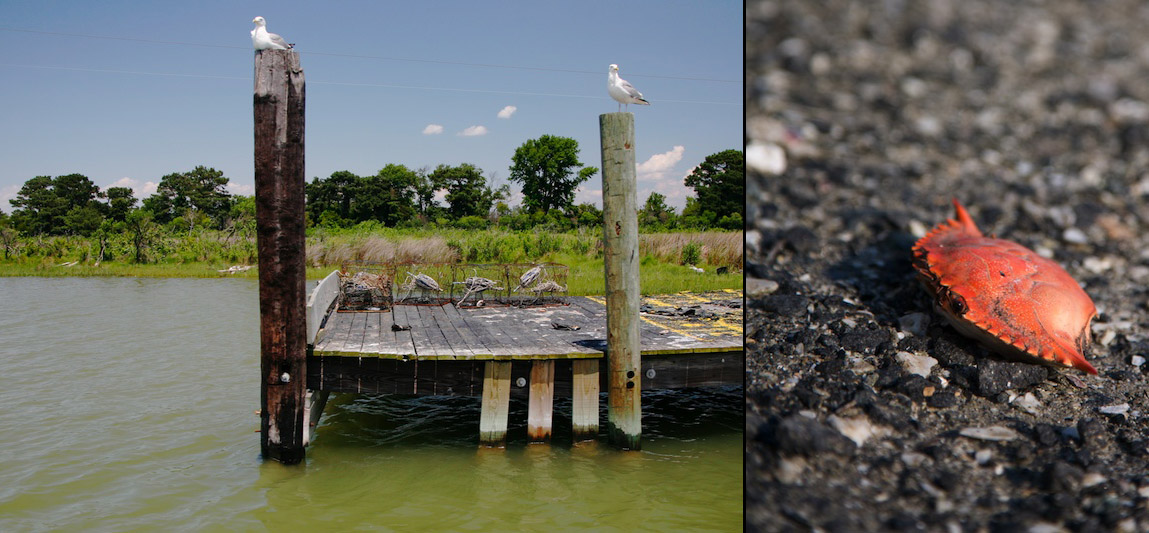
Barry Bruce, waterman


Smith Island, 2008


This short New York Times Audio Slideshow with Chesapeake Bay waterman Barry Bruce offers a lovely portrait of a man and a place.

Although I don't know Bruce personally, I recognize him as the hardworking, "salt of the earth" type that crowds the interior of Wachapreague's bait and tackle shop. Around and in Bruce, I also recognize my home ground: the salt marsh and bay landscapes, the docks and crabshacks, the marbles-in-your-mouth accent, the unquestioned appreciation of a providing God tethered to an overarching melancholy of things irrevocably changed.

It's easy to romanticize the sun-baked, hard life of a waterman, but I harbor no illusions. Crabbing is exhausting and painful work. The slideshow provides a sweet aural backdrop of lapping water and muted laughing gulls, but, in life, those pleasant sounds are marred by the irritating whine of the motor, just as the rich smell of the marsh is cut with the stench of gasoline. I don't intend, then, to sentimentalize Bruce's position, but having grown up around folks like him, the farmers and fishermen of the mid-Atlantic, it saddens me to recognize that their kind is nearing extinction. The Shore that shaped me goes with them.

Note: The Bruce slideshow is associated with a New York Times travel piece, "The Crab Houses of Maryland's Eastern Shore." This article is fine, but the slideshow, produced by Miki Meek with photographs by Karen Kasmauski, is the real gem. Watch it here.

Photo credit: Smith Island image ripped from texterella's Flickr photostream

Thursday, July 02, 2009

Repairing America (and beyond)


Micanopy, Florida


While visiting central Florida last month, an acquaintance told me that all of her Gainesville co-workers are fans of Rush Limbaugh's radio punditry. On the highways around the small city, I saw countless pro-life billboards and a good number of "NObama" bumper stickers on passing pickup trucks. Although the city's populace supported Obama in the 2008 presidential election (as did the state), it was very clear that the city represents a blue dot in a red region.

Contemplating this red state mentality, I recalled Thomas Frank's "Lie Down for America," an excellent, if depressing article published in the April 2004 issue of Harper's Magazine. Frank dissected, in his words, "how the Republican Party sows ruin on the Great Plains."
"Whereas earlier forms of conservatism emphasized fiscal sobriety, the backlash mobilizes voters with explosive social issues - summoning public outrage over everything from busing to un-Christian art - which it then marries to pro-business economic policies. Cultural anger is marshaled to achieve economic ends.

[...] 'Rural America is pissed,' a small-town Pennsylvania man told a reporter from Newsweek. Explaining why he and his neighbors voted for George Bush, he said: 'These people are tired of moral decay. They're tired of everything being wonderful on Wall Street and terrible on Main Street.'"
The same Wall Street-Main Street dichotomy was trotted out by campaigning Republicans four years later, in 2008, to cast the GOP as the party of the people. But did the tactic really work? After all, Obama won the 2008 election. Aren't rural and Middle America coming around, realizing that the Republican party doesn't have their best interests in mind, even in those cases where the social issues of the Right more closely align with their values?

I hope so, but I wouldn't bet on it. Middle America will jab an angry finger at someone, and faithful Rush can't be the enemy. Our country is already waging a war against Islam, so we know that the Muslims are "against us," but they're not pulling America's economic strings. And, as a general rule, black folks don't have too much power, Obama not withstanding. But, wait a second...aren't there a lot of socialist Jews whispering in Obama's ear? Hell, isn't he related to a rabbi!?

The July 2009 issue of Harper's includes two disturbing poll results.
Chance that an American thinks 'the Jews' were moderately or very much to blame for the financial crisis: 1 in 4

Chance he or she thinks they were 'a little' to blame: 1 in 7
This is a shocking statistic! I wonder what percentage of Americans believe that "the Jews" are no more culpable than any other ethnic or religious group?

Oh, but that's a silly question! After all, "the Jews" are the denizens of Wall Street, and Main Street folk like Dubya and Rush don't like that sinful, unAmerican place. It should be clear to me that the current recession - when should we start calling it a depression? - is not the result of the unsustainable, myopic economic policies of the last sixty years (amped up by Ronald Reagan, but embraced by both Democrat and Republican administrations). It's instead the vast Zionist conspiracy! The socialist Jews have teamed up with the capitalist Jews to forge an unholy alliance, and they're running the global economy into the ground!

Would that I could laugh off such frightening ignorance. Unfortunately, the bigotry is not evidenced only on the Right. In fact, the same study cited in Harper's showed that the registered Democrat respondents were 12% more likely than responding Republicans to blame "the Jews" at moderate or higher levels. There is a time-tested, inverse relationship between economic performance and anti-Semitism, and this correlation isn't affected, evidently, by political affiliation.

The New York Times reports today that "U.S. Job Losses Rise and Unemployment Reaches 9.5%."
"The American economy lost 467,000 jobs in June [2009] and the unemployment rate edged up to 9.5 percent in a sobering indication that the most painful downturn since the Great Depression has yet to release its hold."
Things are going to get a lot worse for Middle America. Finger pointing does none of us any good (and certainly not the tiny Jewish minority in the United States).

Still, I remain optimistic. As I wrote in January,
"Call it Obamatism, call it naive idealism, call it what you will...but it's time to participate, to put aside our generation's infantilism and get to Aristotle's happy work. [...] We will pass through our challenging stage of human social development but, fraught as it is, the need for an active and immediate commitment to bettering our world's future is great."
Jews call that tikkun olam, repairing the world. Get to it, people!


Photo credit: Hungry Hyaena, 2009

Friday, June 20, 2008

Southern Spaces


A friend of mine works as an editorial associate for the Emory University-based Southern Spaces, an interdisciplinary, online academic journal. The journal features essays, photography, short films and more, all exploring "the spaces and places of the U.S. South."

An erstwhile Southerner, I find Southern Spaces especially edifying, but most folks, no matter their provenance, will find the content of interest.

Thus far, I've contributed only two photographs to the site, one a snapshot of the marsh edging my family's Virginia home (for use in the journal's scroller credits) and another of a decaying love seat, abandoned in a seaside marsh near Bull's Landing, thirty or so miles south of Heron Hope. (A sibling photo is displayed above.) Both images capture some of the Eastern Shore's flavor.

If you want to receive e-alerts when Southern Spaces publishes new work, visit the the website and click on "E-Alerts," in the lower right.

Photo credit: Hungry Hyaena, 2005

Sunday, August 19, 2007

Routine Passing


Looking northeast from the dike rim at Heron's Foot, December 2006

"Spitz-spop, Christopher. Rise and shine." My father's familiar refrain. He opens the bedroom door and flicks on the light.

I groan and stagger from my bed to the middle of the room, where my clothes are laid out on the floor like a fallen scarecrow. Sleeves spread out to the side, an undershirt is placed on a thermal top that rests, in turn, on two sweaters and a camouflage button down. Likewise, a pair of tightie-whities rests atop long johns and a pair of camouflage pants. A pair of folded athletic socks is stacked on two heavy, woolen pair.

Absent-minded, I dress.

In the bathroom, I fight through the two undergarment layers before I can relieve myself, reminding myself that, next time, I should remember to visit the toilet before I dress. I wash my hands, splash some water on my face and decide not to brush my teeth.

Downstairs, my father is almost ready, his oatmeal and peeled banana half eaten. I pour milk on a bowl of cereal and eat quickly. Nothing is said. Outside it is still black.

On the dining room table are two shotguns, two boxes of shells (one .20 gauge and one .12), two pairs of wool gloves and two camouflage, wool face masks. My father is already in his boots when I finish my cereal. He is by the backdoor, double-checking the canvas decoy bag and his necklace of duck calls.

"All set?"

"Yes," I reply.

I carry the guns, gloves, shells and face masks to him, then slip on my own boots.

Once outside, my eyes adjust. It isn't black, not really. The moon's blueish glare reveals more than you might expect. My father and I walk in silence down the long clamshell drive, then cross quiet Seaside Road. We move through an opening in the roadside hedge that you'd overlook were it not for a solitary holly planted among the cedar and pine. A stout wooden footbridge spans a deep ditch inside. Another twenty steps and we crest the dike, moving east along the rim.

The decoys shift and bounce in their bag and the duck calls jostle on my father's chest. I can hear his breathing; his footsteps fall heavier than mine. I resent him for this.

At the dike's northeast corner we descend the left bank into the upper marsh, where a cedar tree island ekes out a life drinking brackish water. Around this island the cordgrass lays down in gentle waves. I want to stop, to remain for the morning in this spot, to shed these layers and lay like the cordgrass, to be part of the marsh, part of something not me, something greater. This is what I wanted at ten years of age.

Instead, I followed my father to the duck blind, where he put out the decoys and we awaited the morning flight. Now, almost twenty years later, I lay alongside the island most every time I visit Heron's Foot. It is a good place to lie.

Photo credit: Hungry Hyaena, 2006

Wednesday, June 27, 2007

Singing for the rains

A child of the South, I miss the fluctuating drone of cicadas during the spring and summer months. Yet I take some solace when a startling crush of thunder sets off all the car alarms in Astoria.

Monday, January 01, 2007

Happy (warm) new year!

I'm a cold weather man. Winter days and nights possess an obscure magic that buoys my spirit and heartens my constitution. I'm particularly sensitive to this variety of dark enchantment when I'm alone in winter woods. We humans have grown complacent in our throne atop the food chain, and I enjoy my body's reaction to harsh conditions as I also appreciate occasional haunting by the specter of predation. Both are humbling, gratifying reminders of what we've come from, and of what we are.

But this winter has been unseasonably warm. As always, I traveled south to Virginia to visit my parents. The temperature on the morning of my birthday, December 29th, was 52 degrees Fahrenheit; by late afternoon, it was over 60. Yet still the talking heads on the local news speak of global warming as if it may be a fiction! Skepticism serves its purpose in science, and shouldn't be dismissed offhand, but whether we're attributing warming to human activity or to natural fluctuations, an examination of the data shows that the general trend is all too apparent.

Snow Geese Beyond Morning Trees
A flock of about 800 snows departs the estuary in search of morning food

Because of the warm temperatures, the travels of migratory species are unusual this year. Last Thanksgiving, I watched four or five thousand snow geese (Chen caerulescens) pitch into the salt water estuary alongside my parents' house. The birds arrive in last light to roost, and they depart just after dawn, moving on to feed in the fields of winter wheat.

This year, by contrast, the late December roosts were limited to one thousand birds, give or take a couple hundred. The weather is warm enough that the geese, heading south from their Arctic breeding grounds, don't need to fly so far to find food and refuge. The spectacular flocks that I watched in the fall of 2005 probably took up winter residence this year in Delaware and New Jersey, or points farther north.

+++++

Great Blue Heron Feet Bound 2
Photo of the heron's feet; monofilament already cut away

Walking my Virginia prpoerty two days before my birthday, my father and I came upon the decapitated body of a great blue heron (Ardea herodias). The beheading was likely the work of a fox or raccoon, but the predator was not responsible for the bird's death. The heron's legs and feet were knotted with monofilament fishing line. Two "toes" on the right foot were tied together. More serious was the mass of line that bound the left leg to the knot on the right foot. The bird had eked out a living by hop hunting. This is handicap enough for any animal, but, for a heron, a creature that specializes in water stalking, hopping surely cost the bird a great many meals.

Apparently this individual was tough. Just as a tree grows around a collar left on too long, so had the heron's flesh swollen around the fishing line as the bird continued to grow. I'm not knowledgeable enough to estimate the heron's age with any accuracy, but, by the looks of it, the line had bound the bird for at least a year. My father cut the monofilament away and we placed the heron's body in the middle of a trail, hoping that the vultures already circling above would descend once the two humans moved on.

Oddly, when I returned to check on the progress the following afternoon, the heron's body remained untouched. No raccoon or fox had returned to finish what they began, and the vultures had apprently elected to pass up this meal in favor of more filling options. (This winter's warm weather has left scavengers at ease and relatively heavy-bellied. As a result, they are less thorough in their clean-up efforts.)

Great Blue Heron Foot w/ My Hand
Photo of heron's left foot w/ my hand, for scale


I examined the heron again, this time photographing the bird's marvelous feet. As far as I'm concerned, anyone familiar with both reptiles and birds must accept their common ancestry. The great blue's long toes and legs share much with those of some lizard species. As a friend remarked upon seeing the bird, "It reminds me of an alligator." Indeed. Ain't evolution wondrous?

Great Blue Heron
Photo of heron's left foot w/ my hand, for scale

Photo credits: all by Hungry Hyaena

Tuesday, April 11, 2006

Richmond Weekend

Art, Neighborhoods, and Michael McDevitt's Solo Show

I spent New Year's Eve 2003 in Richmond, Virginia, toasting the arrival of mid-winter and catching up with a few college buddies.  Over the course of that rainy, celebratory evening, a number of proud locals raved about the Richmond art scene.  At times, their exaltation was extreme. Two artists proclaimed Richmond's cultural milieu superior to that of New York or Los Angeles.  I recall one particularly drunk young man telling me that Richmond was the best place to be making art and that, even if money were no object, he wouldn't want to work anywhere else.  All of this self-congratulation seemed inflated and defensive and, although I only listened that night, I returned to New York feeling certain the Richmonders were deluding themselves.

This past Thursday, I returned to Virginia's capital. I'm happy to report that my impression of the city's art community is much improved.  The upbeat energy and sense of camaraderie enthused me.  Walking down Broad Street on Friday night felt little different than a Thursday in Chelsea: throngs of gallery goers crowded the sidewalks and mingled in gallery spaces sipping wine, eating crackers, and generally having a grand ol' time.  Gone completely is the sense that the Richmond art community has a chip on its shoulder.

My earlier, negative assessment was colored by the insecurity underlying the claims made that New Year's Eve, but it was also influenced by the naive notion that the art universe revolves around New York City.  Three years ago that was easier for me to believe.  I was just out of graduate school, at the time, and full of beans.  More importantly, though, I better recognize now just how fluid and subjective the art world is.  It isn't a question of what city is "the best place to be making art," but rather, what city, town, or deserted island is the best place for you to make art and, apparently, Richmond suits a lot of folks just fine.


The Chinatown Bus arrives in Richmond around midnight and local bars close at 2:00 AM, so after a couple of quick drinks on Thursday night, we returned to my friend's house in Oregon Hill, the neighborhood pictured above.  Most of Friday was spent wandering around Oregon Hill and The Fan, both attractive neighborhoods on the northern bank of the picturesque James River.  Oregon Hill is celebrated as one of the few surviving working class neighborhoods in the United States, but it might not be deserving of this mantle any longer.  Virginia Commonwealth University, a college known for its excellent art program, has campus buildings scattered throughout the area and, as a result, the one-time working class stronghold is now "up-and-coming."  A growing population of college students and artists is displacing those working class families that remain; soon, Oregon Hill will be thoroughly gentrified, like The Fan before it.  Working class or not, however, I saw no black folks, young or old, in the area.  Apparently, this is not a recent phenomenon.  Oregon Hill has been considered the domain of "white trash" for some time.

High real estate prices (by Richmond standards) aside, The Fan is a beautiful area.  The architecture is lovely and the back alleys are inviting.  It's also nice to see so many bikes; Richmond is considered a very bike-friendly town and there are many trails in the city's plentiful parks.  Like Williamsburg, Brooklyn, trucker hats and tattoos abound in these neighborhoods.  I have no problem with caps or tats, but an "essential mass of human sameness" always bothers me, whether you're considering suburban sprawl or hipster havens.  Here, too, I was aware of how segregated Richmond is; no black hipsters made an appearance.  (In fact, with the exception of the Friday night gallery scene, I don't recall seeing many black folks on the north side of town.  On Saturday morning, however, when we drove to the south side to pick up a painting, I realized the James River serves as an unofficial race/class divide.)

On Friday afternoon, I took a nap on the floor of my friend's studio and enjoyed watching trees sway in the wind through the window.  If it didn't get so damned hot and muggy in the summer, I mused, this wouldn't be such a terrible place to live.


That night, I attended the solo debut of Michael McDevitt.  Michael is an energetic and prolific artist.  At any one time, a dozen or more paintings are strewn about his studio, in various states of completion. His willingness to experiment is unconscious; should he ruin a painting in the process, so be it.  Given the demands of the flooded art market these days, Michael's incautious approach is rare and commendable.  (I look forward to his putting up a proper website soon - one is rumored to be in the works - but for the time being, you can see some of his wide-ranging work at Feel Free To Wander, a blog where he posts images of recent prints, drawings, and paintings.)


Michael's solo show at Cornerstone Gallery, "Lost In The Park: Tiny Tales of Stasis and Apocalypse," is comprised of nineteen acrylic paintings, all measuring 23 1/2 inches by 11 1/2 inches. The majority of these relatively small works are vertical in orientation and, although I heard other viewers describe them as landscapes, I see them as allegorical vignettes. The viewer is presented with the principal player (or players) - a figure, usually a child, is fore-grounded in most of the pieces - and is then left to draw his own conclusions. For example, "Is One Feather Enough?" pictures an adolescent boy holding an enormous feather in his left hand. He sits at the edge of what appears to be a playground, but the grass is dry and yellow and the boy's right arm ends in a stump. His face is sorrowful, imploring. Wallflowering near this painting, I sipped my wine and listened to the reactions of gallery goers. Invariably, they created a back-story or explanation for the picture. For some, the boy is Icarus, post sun exposure. For others, he is a zombie or a "mechanical boy." My personal favorite: upon noticing the arm stump, one young lady said, "Oh, my God...he's a freak. That's just depressing." (War heros and survivors of thresher accidents everywhere, do you love it?)

Despite Michael's use of bold, bright color - the intense yellow of the grass in "Is One Feather Enough?," for example - the prevailing mood of "Lost In The Park" is foreboding, even apprehensive. The humans and animals featured in the series are isolated and frail, if not physically, then emotionally. Even when characters confront or embrace one another, a melancholy remains. In "A Great Deal Of Time Passed While They Established The Rules," a wolf stares down a determined little boy. Between them, a ball rests on the ground. Initially I found the scenario - and the title - funny, but the ambivalence of the painting complicated my reaction. There is no moral point of view; there is only time passing; there are only rule changes. This conclusion may sound bleak, but given the contemporary state of things, it is perfectly fair. (What's more, it makes sense that Michael is concurrently exhibiting work in "Richmond Represents: Grimm Fairytales," at the Richmond Public Library.)


Michael McDevitt
"Autohagiography"
2006
Acrylic on Panel
23 1/2 x 11 1/2 inches

For personal reasons, I'm also fond of "Autohagiography," a painting of a boy hugging a hyena in a Hellish setting. Ignoring technicalities - like the number of included heads - one of my friends said, "This one could have been titled, 'Even Cerberus Needs A Hug.'" Indeed. Both of these animals, boy and hyena, are in need of affection, but the boy seems to go through the motions. His eyes are narrowed, his mouth tight and his posture nonchalant; there is nothing committed about his embrace. On the other hand, the hyena seems to relish the contact, leaning into the boy's shoulder. Again, we are left unsettled. What is their relationship? What is this green-eyed heathen planning to do to the affectionate hyena? Considering the painting's title, I fear the worst.


Michael McDevitt
"Samsara"
2006
Acrylic on Panel
23 1/2 x 11 1/2 inches

But I know Michael to be someone who puts a great deal of stock in the magic of both imagination and nature. Where, then, is the hope in this series? Granted, these are dark times, but my spirits are always buoyed by the sheer wonder of the universe, whether at the micro or macro level, and I know Michael also accesses this variety of joy. There are two paintings in "Lost In The Park" that reveal as much, that offer viewers some optimism. The stronger of these two is titled "Samsara," the Buddhist term for the infinite cycle of birth, suffering, death, and rebirth. In the painting, a young girl strolls away from us, hands casually linked behind her back. She approaches an opening in a wooden fence, beyond which lies a riot of experience. There's the hope: Take a walk. Look around.

Photo credit: Oregon Hill photograph, Cornerstone hanging w/ artist photograph, Hungry Hyaena, 2006; Photographs of original acrylic paintings by Michael McDevitt, 2005, 2006 by artist and Hungry Hyaena, 2006

Monday, January 09, 2006

A Rose For Emily


A duck, cooked rare and partially carved, sat on the oval serving platter in front of me. Underneath the bird, blood mingled with the yellow-white fatty oils released during the roasting. As I half listened to my parents' conversation, the two secretions danced a slow-motion Rorschach ballet. I was intrigued, content to admire the interplay for what it was, the meeting of two immiscible liquids, when suddenly the interaction ceased abstraction.

There, under the dark stump of the drake mallard's neck, the blood and oil limned a perfect silhouette...of a duck. I was rendered speechless. This is more incredible than a moldy Wonderbread Elvis or some dust bunny Jesus!, I thought excitedly. The initial shock absorbed, I brought the minor miracle to the attention of my parents. They didn't share in my enthusiasm. My mother was disgusted - "Oh, for goodness sake!" - and my father, baffled - "Ummmmm." They resumed eating.

A few minutes later, the three of us discussed my need to drive to a friend's house to pick up my digital camera, forgotten there the night before, following a lengthy battle with some delicious mulled wine. Thinking it likely that my friends - or their parents - would check out the pictures saved in the camera's memory, I winced. Along with some shots of their Christmas party - happy, mother-daughter poses - they would find some photographs of dead rat pups; not your standard Yuletide fare. (I had obtained the rat pups, already dead, to feed one of my snakes, but upon opening the cloth they were wrapped in, I found their arrangement curious and decided to treat the tiny rodents as a peaceful, rolling landscape; the pictures may or may not work their way into a painting.) I told my parents about the possibility of these photos being discovered. My father looked up from his plate. I swear I could almost read his mind: Duck blood silhouettes...Dead rat pup portraiture....Duck blood silhouettes...Dead rat pup portraiture.

"You know," he finally said. "You seem to be fascinated by death."

"I am," I replied.

"I wonder where that comes from. For me, death is inevitable...so there's no reason to think about it. The end comes and that's that. Why waste time worrying about that which you can't control?"

"Alright, sure...but I don't worry about death...and it isn't the end in my estimation. I don't mean that in a supernatural sense...just that when our bodies rot, our energy continues. E=MC2. Nothing can be subtracted from the weave...only reconstituted. That's exciting, and that's why I'm fascinated by death. It's nothing to be afraid of. It's release from one form...a changing of vessels and a loss of consciousness."

I paused, realizing this wasn't the whole truth. I also find death calming, even beautiful, when it is unencumbered by ceremony or histrionics. I didn't know how to explain such a notion, though, so I didn't continue.

"Hmmm....it seems you have a little Latin in you," my father finally said.


Whatever you want to call it - morbid, macabre, melancholy - I am charmed by that which many folks find grotesque. In my case, though, this quality is certainly not a product of Latin blood; rather, I believe it is closely linked to the region and climate of my childhood. It's difficult to grow up in a small, southern town and not become acquainted, even comfortable, with death and decay. The stereotypes are well established: cars resting on cinder blocks alongside occupied houses with rotting porches and peeling paint; toppled headstones, uncut grass, and strewn beer bottles in backyard cemeteries; butchered deer carcasses and full garbage bags dumped on the road berm; abandoned furniture and household appliances in the middle of the woods (how do they get there?); the derelict house with kudzu, raccoons, and snakes in residence.

Many American scholars and authors have considered the Southerner's cozy relationship with decline and decay, trying to better understand its genesis. Some folks suggest it is the product of a deep-seated, defeatist attitude, borne of the Civil War - alternatively known as The War of Northern Aggression - while others feel it has more to do with the southern climate, an often oppressive blend of high humidity and heat. As with most anything, a combination of factors is responsible, but I believe that climate is the critical component. The Southern Gothic literary tradition, for example, shares much in common with the magic realism of Mexico and Central America. Texans of European ancestry may not celebrate Dia De Los Muertos, but most of them appreciate it; the holiday finds even more advocates in the bayous of Louisiana and the bald cypress swamps of Arkansas. The "Latin blood" that my father referenced may, in fact, have little to do with blood. Dia De Los Muertos is of Latin American origin, not Spanish; its history is indigenous to the region, and the Spanish colonizers were horrified by the macabre ceremonies of the pagan natives. They did manage to force Catholicism upon this indigenous population, but they could not replace the established rituals entirely.

Centuries later, those mores continue to inform the culture of the American South, Mexico, and Central America. Inhabitants are caricatured as moving more slowly than their northern neighbors - "laid back" on a good day, "lazy" on a bad - and caring a great deal less about progress and modernization, usually to a fault. Family and religion are central to daily life in these parts, and marriage and death captivate the Southern/Latin American imagination. Having grown up in the rural, American South, I view the Northeastern (and Midwestern), tight-lipped approach to blood-and-guts reality with suspicion - this despite my deep appreciation of New England's landscape and culture. Returning to Virginia's Eastern Shore this Christmas, I saw much that touched me and reminded me that, at heart, I remain relatively Southern, even though the accent and the religion were long ago discarded.


Photo credit: "Love Seat in Marsh, Bull's Landing, 2005," "Deer Carcass and Dryer, 2005," "Vultures on Deer Carcass, Burton's Shore, 2005," all photos, Christopher Reiger, 2005

Wednesday, November 30, 2005

Peninsular: Almost (Long) Island


I've been reading Sphere for several months. I find it increasingly enjoyable. Actually, given the blog's focus, the environmental and developmental challenges of Long Island Sound and the surrounding region, "enjoyable" isn't always a fitting modifier, even if Tom Andersen's writing is generally excellent.

Most of the Long Island that my father knew as a child in the early 1940s is today gone, replaced by suburban sprawl. As human population increases, so too do the environmental pressures. Consider this laundry list of proposals and other local issues collected over the long weekend by Andersen. He describes proposed private condominium development on land that is presently owned by the state of Connecticut, boaters who are regularly pumping their heads (toilet holds) into the waters of the Sound, health officials closing some shellfish beds due to recent rainwater runoff, and threats of retribution levied (and some actual vandalism) on churches and mayors by anti-hunters intent on halting deer hunting. The only glimmer of hope in this otherwise ugly report is a University of Connecticut study that suggests communities in the region suffer for having too many parking lots, "thus increasing development costs, wasting land, deadening our urban centers, discouraging walking and riding, and adding to the runoff into our streams and rivers." The study itself points to discouraging truths, but perhaps the implicated towns will elect to reverse the trend, dubious though that outcome seems.

Having just returned from the Eastern Shore of Virginia, a peninsula on the brink of "discovery," I can't help but think that Long Island's environmental woes presage a similar future for my childhood home. Route 13 runs the length of "the Shore" and is situated more or less in the center of the narrow peninsula. Naturally, the highway is also the central artery for development. Along this stretch of road - two northbound lanes separated from two southbound lanes by a wide median - shopping centers, fast food joints, and gas stations have long been features. I was excited when the first Pizza Hut opened in Accomack County (in the early 1990s) because I was then naive enough to view the restaurant's arrival as a sign of progress. Fifteen years later, Wal-Mart(1) has proposed a store in the county, wealthy urbanites are prospecting property at outrageous rates, and Route 13 is a mess of billboards and chain stores. In short, "growth" has arrived.

The local reaction to these changes is understandable, but it makes for a troubling dynamic. Long time Shore residents discourage "come heres" - anyone who moves to the Shore from somewhere else - and resent them if they do settle in the area. On the one hand, I think this is as it should be, that locals should be resistant to development of any sort. Boycotting Wal-Mart while simultaneously embracing wealthy "come heres" will still result in a growing demand for amenities and commercial options that the Shore could do without. Transplants from the city want perks like central air, gourmet food stores and restaurants, "authentic" harbors and improved sailboat docks. What they find instead are wood stoves and chimneys, Food Lion and fast food, and working waterman standing on blood stained docks. This isn't exactly the idyllic retreat most urbanites have in mind. It's the rural south.

On the other hand, I sympathize with some of the urbanite wants. I'd love to see an organic food store open on the Shore, for example. Moreover, I accept that, given the world's burgeoning population, development of one kind or another is inevitable. With that in mind, why shouldn't locals fight back the Waltons while inviting the Rockefellers to dinner?

Of course, by courting outside money, the Shore runs the risk of establishing class ghettos and further corroding the already tenuous race relations. The Eastern Shore of Virginia is home to significant African American and Latin American minority populations. As more and more mansions spring up along the waterfront, I've also noticed more decrepit shacks in the fractured villages that line Route 13. Some of these residences are little more than 10' by 10' tarred boxes resting on cinderblocks. On the estates, "come heres" host cocktail parties and laugh about escaping the rat race. In the poverty stricken hovels a mile away, crack abuse is rampant and skinny kids play hoops with bushel baskets nailed to tired looking poles. Whether or not these children are oblivious to their worsening lot, the social dynamic is worrisome.

(1) If you are interested in reading more about WalMart's recent attempts to green their corporate practice, I suggest linking over to this Grist article. As Jeff writes over at Sustainablog, "Wal-Mart's business model makes genuine sustainability (or even a mere imitation of it) a pipe dream..."

Monday, November 28, 2005

Home on the Sho'


Gnarled Loblolly pine at Heron Hope


Shore Snows

We arrived home on Thanksgiving, just after midnight. Outside, the racket surprised me and, at first, I wasn't sure what I was hearing. City living has retarded my ear but, like a foreign language left unspoken for a time, the sounds of rural life are not forgotten and can be quickly relearned.

"Isn't that wonderful to hear?," my father asked as he quietly shut the door of the pickup truck. "There must be over a thousand out there."

I stared into the darkness beyond the reach of the garages light, at last recognizing the sound's source. A hundred yards away, in the estuary alongside Heron Hope, geese were conversing excitedly. These were not Canada geese (Branta canadensis), the species with which I am most familiar, but snow geese (Chen caerulescens). The species' voices are distinct. As I stood in the fall chill, listening to the birds, I smiled involuntarily. It's good to appreciate your mother tongue anew.

The next morning, my father called down to me a little after sunrise. "Look outside, Christopher! Quickly."

Bleary eyed, I rolled off the couch and stumbled onto the porch. Thousands of snow geese traded about over the estuary. Their white bodies reflected the brilliant morning sun so that the sky seemed full of diamonds.

"I'd say there are around three thousand of them," my father yelled from upstairs. "What a flight!"

The birds' chatted, gossiped, and argued as they rose in great swirls, preparing to move to their inland feeding grounds. They would return at sundown, to once again take refuge in the estuary. I watched the spectacle in silence, duly thankful to be home.

+++++


Heron Hill


Ned Smith
"Heron Hill Farm, through a Canada goose's eye"
c. 1983
Acrylic on canvas


My parents purchased land on the Eastern Shore of Virginia in 1970, seven years before my delivery in a Washington, D.C., hospital. They paid $25,000 for sixty-seven acres and a farmhouse that dated to around 1770. ($25,000 in 1970 is the equivalent of $125,000 today. Unfortunately, my parents hit a rough spot shortly after making the purchase. For a time, they adapted to food stamps and the lean life.

Because the house was situated on a rise of land - 10 feet above sea level - in an otherwise low-lying region, my father named the farm Heron Hill. Over the next thirty years he would buy adjoining property as it became available, eventually creating a 280 acre contiguous farm, the bulk of which was managed for wildlife and put into conservation easement.

I grew up on Heron Hill. In fact, looking at the Ned Smith painting featured on the dust jacket of The Heron Hill Chronicle, a book my father wrote about his experiences on the farm, viewers might notice my mother and me picking pecans in the front yard (see below). (My father is also depicted, returning from a morning hunt in the marsh.)

As I grew older, I helped my father plant many thousands of trees, build islands, dig ponds, plant crops, and generally shape the ecology of the farm to maximize biodiversity. Given my father's intimate connection to the land, I was surprised when my parents sold the property four years ago. They didn't move far, however, and Heron Hope, a compact, five acre property overlooking a beautiful salt marsh and estuary, is less than a mile from Heron Hill.


+++++


Branch abstract at Heron Hope


Hot Tubs and Parking Lots

After a filling Thanksgiving meal, some friends and I made our way to a vacant house that one of my friends was house sitting. We climbed into an outdoor hot tub on the back deck. The air temperature was in the upper 30s, but the bubbling water was over 100 degrees Fahrenheit; the contrast felt great.

Cool steam dampened my face as I stared up at the heavens, admiring constellations and the occasional passing satellite or airplane. I have long used Orion as a locater, because the three stars of his "belt" are so easy to identify. Contemplating the celestial hunter, my thoughts turned to early humans' perception of the night sky. How very natural the early creation myths are! How could one not believe in God (or gods) in 3000 BCE? How very sensible the cosmology of Plato and Aristotle two thousand years later? How attractive Intelligent Design (as a notion, not a reality) today? One sometimes forgets about these questions living in the city. Flora and fauna aside, one of the most noticeable differences between New York City and the Eastern Shore of Virginia is the night sky.

I returned to Earth and joined the hot tub conversation already in progress. A Japanese girl, three weeks into her first ever visit to the United States, asked why so many Americans lived in such big houses. No one had a good answer, but I did point out that I planned to live in a small house when I finally leave New York.

The next day, the girl excitedly photographed some of the guns in my house. Rather sheepishly, I agreed to pose with one of my shotguns; I imagine this picture will prompt laughter back in Japan. What else is to be made of the scary American with the boom stick?

+++++


Eastern view from the porch at Heron Hope


Semipalmated Sandpipers

On Saturday morning at low tide, my father and I carried four ducks to the dock for plucking and gutting. As we pulled the feathers from the still warm bodies, a large flock of semipalmated sandpipers (Calidris pusilla) pitched onto an exposed mud flat nearby. Preoccupied with their feeding, they seemed oblivious to our activities. They skittered about, their legs a blur, and stabbed at the mud with their long bills, presumably grabbing invertebrates and other edible material from the flat. In warmer weather, mummichogs (Fundulus heteroclitus) would have nibbled at the duck intestines we dropped into the now narrow stream near the dock, but the cool weather had made these fat little fish inactive. Instead, raccoons and foxes will recycle these guts come sundown.

We carefully removed the duck hearts and placed them on a tray to be cooked that night. As we cleaned up the plucking area and prepared to head indoors, the tide changed and the stream began to expand. The sandpipers rose in unison and moved north a hundred yards to higher ground.

+++++


The Big Flight


Snow geese on the estuary at Heron Hope


By Saturday afternoon, I was exhausted. My excessive Thanksgiving eating had taken its toll; I was lazy and groggy. My father headed to the deer stand while I walked around our property, photographing anything that caught my eye. Afterwards, I headed inside and lay down on the porch couch. I belched and felt a little better about life. I'm come to prefer hunger to satiation, and I reminded myself that I should swear off excess, even on holidays.

As I lay there, feeling awful, the sky turned purple and pink. The sun fell behind distant pine stands. Then I heard them. The sound was initially faint, but the volume grew steadily until they were over the house and then everywhere at once. How many thousands, I can not say.

My father, a few miles away in a makeshift tree stand, watched the same flight. He estimated that there were around ten thousand. For the next hour, I lay on the couch and watched the birds pour in, filling the estuary beyond capacity. Packed shoulder to shoulder, the geese hid the water from view. The landscape resembled more a stretch of dirty cotton balls than a small wetland bay.

There were Canadas among the snows, but not many. Apparently, 2005 was a good year for snow goose breeding in the Arctic. Maybe increasing temperatures are adversely affecting their predators? Whatever the cause, the flight was a magical sight. These days we rarely witness such abundance in wildlife populations and, like the vast curtain of stars overhead, a deafening flight of geese can properly humble a human.

Note: The picture above is of a much smaller group of birds in the Heron Hope estuary. In the photograph, there are only about one thousand geese.

Photo credit: all photos, Hungry Hyaena, 2005

Wednesday, March 02, 2005

What's Your Dialect, Boy?

I found the intriguing link below on Pharyngula.

A rural Virginia boy transplanted to New York City in my early twenties, I was curious what the results would be. Apparently, I am "barely into the Yankee category," with a score of 44%.

It's a fun, quick little test for anyone, no matter where you've spent most of your life.