Showing posts with label activism. Show all posts

Saturday, September 24, 2011

Acknowledging Exceptionality

"As glass office and condominium towers have proliferated in the last decade, so, too, have calls to make them less deadly to birds. The San Francisco Planning Commission adopted bird-safety standards for new buildings in July, and this month that city’s Board of Supervisors will vote on making it law. Legislation is pending in Washington that would require many federal buildings to incorporate bird-friendly designs. The United States Green Building Council, a nonprofit industry group that encourages the creation of environmentally conscious buildings, will introduce a bird-safety credit this fall as part of its environmental certification process, called LEED."
- "A City of Glass Towers, and a Hazard for Migratory Birds," New York Times, September 14, 2011
I enjoyed reading "A City of Glass Towers, and a Hazard for Migratory Birds," a recent New York Times article about bird-building collision mortality. Lisa Foderaro's piece is a hopeful account of how a confluence of activism, technology, and regulation can improve the lot of animals, especially in cases where a particular species has been adversely affected by human development.

The comments that follow the article, however, are predominated by doom-and-gloom attitudes. A representative survey follows:
All that matters are people and every little whim. We're a doomed species.
-Karma Every Moment, NY, NY

The people who tell us that evolution and climate change are just unproved theories have no idea how life formed this planet since its inception and no understanding whatsoever of the role of extinction in maintaining the climate within habitable bounds when any one plant or animal breaks the equilibrium. They convinced me long ago that there is no future for my own children.
-Steve Bolger, NY, NY

Yet another example of the consequences of man's selfish and destructive behavior. So sad.
-agetibi, Carrboro, NC
No wonder over 50% of Americans polled by The Nature Conservancy caricatured environmentalists as preachy reactionaries. In the words of the Conservancy's Chief Scientist, Peter Kareiva, most people see members of the environmental movement as "misanthropic, anti-technology, anti-growth, dogmatic, purist, zealous, exclusive pastoralists." Unsurprisingly, this negative stereotype has led to a dwindling of the movement's ranks.

I consider myself an environmentalist, but I distinguish between preservation and conservation (placing myself in the latter camp) and, more critically, I believe that environmentalism needs to embrace a "can do" attitude. If the majority of my fellow Times readers identify as environmentalists, their comments suggest that they're a well-intentioned pox. Wholesale condemnation of our species is as wrongheaded and malignant as exclusive glorification. In order to decry humanity as a "selfish and destructive" brute, one must stubbornly overlook all the evidence to the contrary. I wrote about such oversight in an essay included in the catalog for "A Live Animal," a group show that Selene Foster and I co-curated at Root Division.
"Although 'deep ecologists' and animal rights activists bemoan conservation approaches that prioritize human interests, the fact remains that human beings are exceptional animals. Skeptics and naysayers need only consider our species' biological and imaginative success to find evidence of our unprecedented faculty. But of all our remarkable features and feats, among the most notable examples of humanity's anomalous nature is our interest in and empathy for other species. Although there is growing scientific agreement that some other species possess self-awareness and even a capacity for empathy -- whales, dolphins, elephants, and our ape relatives are especially interesting in this regard -- humans are the only animal striving to learn about and better the lot of other creatures and environments. It's true that we often prioritize short-term, anthropocentric interests and it's also clear that reckless human activity has contributed to dramatic climate change and the ongoing Holocene extinction (our geological epoch's staggering loss of biodiversity), but conservation efforts and legislation, as well as our burgeoning interest in sustainability, speak to another, more hopeful human impulse; we possess an innate ability to see ourselves in other animals and, in turn, to recognize our capability as their stewards and representatives."
In short, we're not all bad. If you believe that we are, then you're guilty of sapping our species' potential. Christopher Cokinos is excellent on this point. I've quoted his terrific "Consolations of Extinction" essay before; I'll do it again.
"Too much grief for the world means less energy to help it along. [When] you find yourself free of the poisons that too much angst can cultivate, then something marvelous happens. You can sense how very old the planet is, how very old life and death are, and you can keep going on, you can keep doing the work you do in this universe, feeling despair when you feel despair, feeling - amazing - joy when you feel joy."

Sunday, September 26, 2010

Update: Jane Hammond's "Fallen"


Jane Hammond
"Fallen"
2010
Dimensions variable

In January 2006, I wrote a short post about Jane Hammond's mixed-media, evolving sculpture "Fallen," a melancholy and beautiful tribute to the lives lost during the (now sort-of-but-not-really-over) Iraq War.

When it was exhibited in 2005, the work consisted of 1,500 paper leaves, each meticulously crafted by the artist and inscribed with the name of an American soldier who met his or her end during the invasion or occupation of Iraq. At the time of my post, I wondered if Hammond had continued to add leaves to the work.

A couple of weeks ago, four-and-a-half years after I wrote about "Fallen," the artist sent me an email telling me more about the life of the sculpture. I share the bulk of her update below, along with some images of the piece as it was in 2005 (below) and as it looks more recently (above, and detail below).
"I make the leaves by hand and each is based on a real leaf which I gather and digitally scan, then there is cutting, hand-painting, a little fiberglassing and more hand-painting, then they are signed by me with sumi ink and a brush pen and molded into a three-dimensional form.

[...A]ll the leaves in the piece you saw at Lelong were from upstate Connecticut, gathered in the Fall of 2004—I have now gathered leaves in Hawaii. Washington State, California, Colorado, Texas, Arkansas, Missouri, Michigan, Mississippi, Alabama, Virginia, Maryland, Massachussetts, Vermont, New Hampshire, Maine and Rhode Island. And adding to the original group from 2004, I have gathered in the Autumns of 2005, 2006, 2007, 2008, 2009. And I am sure I will gather some in 2010 this Fall.

[...]This Fall, ["Fallen"] will [...] be shown at the Taubman Museum in Roanoke, Virginia from September 23rd until January 10th, 2011. It will open with 4,390 leaves."

Jane Hammond
"Fallen" detail
2010
Dimensions variable

Sadly, she does have more leaves yet to add.


Jane Hammond
"Fallen"
2005
Dimensions variable


Image credits: courtesy Jane Hammond

Monday, January 18, 2010

MLK Jr. Day: Prayer As Action


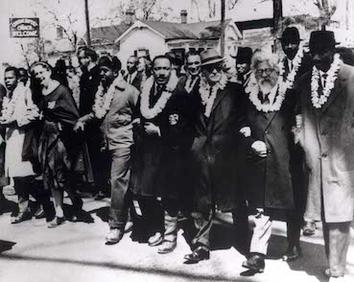
In March 1965, after marching alongside Reverend Martin Luther King, Jr. in Selma, Alabama, the celebrated theologian and rabbi Abraham Joshua Heschel wrote, "When I marched in Selma, my feet were praying."

Heschel's formulation explicitly equates righteous action (or activism) with prayer. In this time of increased fundamentalist agitation and violence, Heschel's notion is vital to both contemporary religion and secular humanism; that is to say, it is vital to every human being.

It seems very appropriate, then, that King, Jr. Day is observed by many in the United States as the King Day of Service, a day in which we honor the message and aspirations of Martin Luther King, Jr. by volunteering our time and effort for humanitarian causes (or, as I've also done this year, signing up for forthcoming volunteer projects and donating money to important aid efforts).

It is also a day, of course, to remember the man and the many he inspired to act or speak out against prejudice and oppression. May there be many more such prophets.

Wednesday, December 16, 2009

Global Climate Justice Fast


350 Candle Vigil; Washington Square Park, NYC; December 2009

"How well we control our numbers, our appetites, and the efficiency with which we satisfy those appetites will ordain just how desperate the situation becomes. They are the battles for our time, as morally compulsory as the battles for civil rights or against totalitarianism."

- Bill McKibben, The End of Nature

The group gathered at the northern entrance of Washington Square Park last Friday evening was smaller than I'd anticipated. We were assembled for a candle vigil in conjunction with the United Nations Climate Change Conference in Copenhagen, Denmark, and 350.org, environmental activist Bill McKibben's project to increase global awareness of the environmental (and status quo) threats posed by the exacerbation of climate change due to anthropogenic influence.

The New York City vigil was one of hundreds of similar events happening around the world on December 11th. Given the date, the vigil was also a satisfying way to bring in Hanukkah, a holiday that, despite its complicated history, is essentially about standing up for the causes that you feel most strongly about, even in the face of overwhelming odds. Small though our Washington Square Park group may have been, then, I was upbeat and hopeful.

Tomorrow (Thursday, December 17th), there is more cause for hope. I'll be one of thousands (hopefully one of many thousands) of true cosmopolitans forgoing food as part of the Global Climate Justice Fast. Bill McKibben's organization is trying to spread the word from Copenhagen, but the easiest place to sign up is at the Climate Justice Fast website. The official statement of the fast participants reads:
"We will fast voluntarily, for one day on Thursday, in solidarity with the millions who have and could lose their lives to preventable and involuntary hunger, disease and conflict resulting from climate change.

We call on world leaders for a real climate deal now--a deal grounded in science and strong enough to get us back to 350 [parts per million]."
I urge HH readers to take action this season. The specifics of your engagement matters less than its spirit. As I wrote not long ago,
"If global warming isn't appealing to your still, small voice, get involved with political activism, volunteer at your local homeless shelter, pledge financial support to non-profit activist organizations working for causes that you feel strongly about; it doesn't matter what you do, but it does matter that you do something. Turn off the television, put down the tabloid. I beg this of you."
If you have the energy and spirit to take action in multiple ways, so much the better, but every little bit helps. We're all in this marvelous mess together.

Friday, October 23, 2009

Imagine


"On October 24th, Israelis, Palestinians, and Jordanians will gather around the Dead Sea to form giant human numbers: Israelis will form a 3, Palestinians a 5, and Jordanians a 0. An aerial photograph will link them together to form the number 350."
Cynics and "realists" will dismiss some of the international events taking place tomorrow as naive, idealistic flights of fancy. I suggest that we instead celebrate them as exactly that!

Human imagination is a marvelous adaptive development, one that grants us "flights of fancy" that can, in fact, change the world. The naive, idealistic innovation of one age is the accepted reality of the following age.

This morning, I repeat yesterday's appeal. Get involved, however and wherever you can!

Photo credit: Photo ripped from the 350.org Flickr photostream

Thursday, October 22, 2009

Acting Out (Peacefully) Against the Culture of Competition


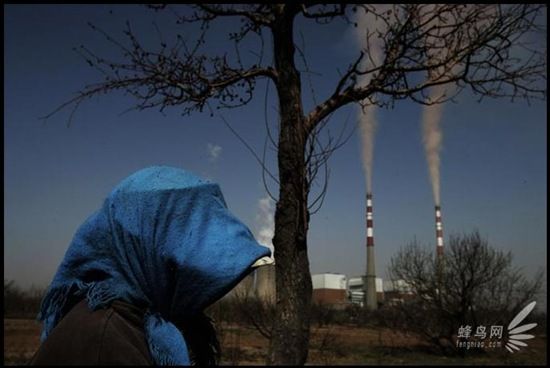
Shizuishan Industrial district in Ningxia. Residents cover themselves against the falling dust when going outside.
April 22, 2006

This Saturday, October 24th, I'll join a mob of peaceful activists and march across the Brooklyn Bridge, from Manhattan to Brooklyn, in hopes of further raising public awareness about the reality of climate change and the need for a comprehensive international climate treaty. The march is associated with 350.org's Day of Action.
"350.org is an international campaign dedicated to building a movement to unite the world around solutions to the climate crisis--the solutions that science and justice demand. Our mission is to inspire the world to rise to the challenge of the climate crisis—to create a new sense of urgency and of possibility for our planet. Our focus is on the number 350--as in parts per million, the level scientists have identified as the safe upper limit for CO2 in our atmosphere. But 350 is more than a number--it's a symbol of where we need to head as a planet. [...] This December, world leaders will meet in Copenhagen, Denmark to craft a new global treaty on cutting emissions. The problem is, the treaty currently on the table doesn't meet the severity of the climate crisis—it doesn't pass the 350 test. In order to unite the public, media, and our political leaders behind the 350 goal, we're harnessing the power of the internet to coordinate a planetary day of action on October 24, 2009. We hope to have actions at hundreds of iconic places around the world - from the Taj Mahal to the Great Barrier Reef to your community - and clear message to world leaders: the solutions to climate change must be equitable, they must be grounded in science, and they must meet the scale of the crisis."
350.org was founded by author and environmentalist Bill McKibben and, although some legitimate philosophical criticisms of the project have been raised, I feel strongly that the organization's mission is vital.


Due to long-term consumption of water contaminated by industrial waste, 50 people have cancer and cerebral thrombosis in Kang village of Linfen City, Shanxi Province..
64-year-old Wang Baosheng has fester wounds all over his body, and must sleep sitting, face down on the edge of the bed each day.
July 10, 2005

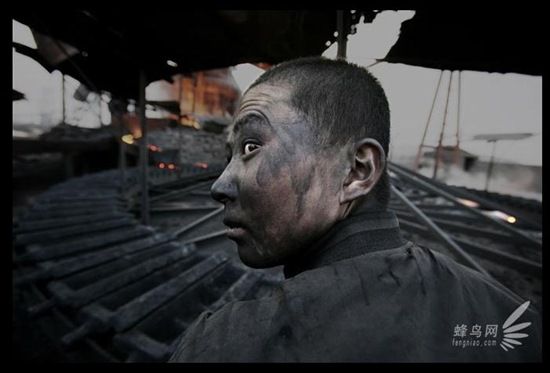
Should you doubt the urgent need for an international climate treaty that demands accountability and systemic change, or should you remain skeptical of the human influence on atmospheric carbon levels, I encourage you to take a look at the distressing pictures that ChinaHush recently published. Photographer Lu Guang's series "Pollution in China" is a testament to the cruel realities of the international, industrial market.

In his book-length essay Life Is A Miracle, the author, poet, essayist, and critic Wendell Berry describes the global, capitalist world view as,
"one culture of division and dislocation, opposition and competition, which is to say the culture of colonialism and industrialism. This culture has steadily increased the dependence of individuals, regions, and nations upon larger and larger collective economies at the same time that is has thrown individuals, regions, and nations into a competitiveness with one another that is limitlessly destructive and demeaning."
The "collateral damage" caused by this monstrous steam engine is not limited to elevated carbon levels, and its poisons don't just affect the dispossessed or the politically and economically powerless.

Nicholas Kristoff reminds us, in a recent New York Times OpEd piece, that the staggering number of "deformed frogs and intersex fish [found in or near United States' waters] — not to mention the growing number of deformities in newborn boys — should jolt us."
"In the Potomac watershed near Washington, male smallmouth bass have rapidly transformed into 'intersex fish' that display female characteristics. This was discovered only in 2003, but the latest survey found that more than 80 percent of the male smallmouth bass in the Potomac are producing eggs. Now scientists are connecting the dots with evidence of increasing abnormalities among humans, particularly large increases in numbers of genital deformities among newborn boys. [...] Apprehension is growing among many scientists that the cause of all this may be a class of chemicals called endocrine disruptors. They are very widely used in agriculture, industry and consumer products. Some also enter the water supply when estrogens in human urine — compounded when a woman is on the pill — pass through sewage systems and then through water treatment plants."
Herpetologists have been sounding the alarm for years, but the policy makers are warm in the pockets of the immoral corporations and the populace, by and large, prefers to escape in celebrity pregnancy updates and corporate-owned sporting events. Amphibians were the ignored canary in the coal mine. Now many animal families (ours included) are paying a terrible price, one that we can not yet fully appreciate.


Henan Anyang iron and steel plant’s sewage flowed into Anyang River. March 25, 2008

Still, it's not too late to stand up to the "culture of colonialism and industrialism." Visit 350.org. Find out how to get involved in the effort. If global warming isn't appealing to your still, small voice, get involved with political activism, volunteer at your local homeless shelter, pledge financial support to non-profit activist organizations working for causes that you feel strongly about; it doesn't matter what you do, but it does matter that you do something. Turn off the television, put down the tabloid. I beg this of you.


Breathing large amounts of dust into their lungs, people become sick after working here for 1-2 years. Most of these migrant workers come from area of poverty.
April 10, 2005

Photo credits: all photographs, Lu Guang; ripped from ChinaHush

Wednesday, July 29, 2009

What is the Prophetic Ideal?


Gustave Dore
"The Prophet Amos"
1891
Engraving
"Let justice roll down like waters, and righteousness like an ever-flowing stream."

-Amos 5:24
In the Hebrew Tanakh, the colorful collection of history, anthropology, and mythology better known to Christians as the Old Testament, a number of the prominent prophets decry the institutionalization of Israelite religion. Elijah, Amos, Hosea, Isaiah, and Jeremiah proclaim instead the communal and, in some cases, individual experience of the one, true God. They maintain that God can be best experienced (and, as the ancient Israelites believed, best appeased) through one's devotion to those moral laws, or mitzvot, concerned with righteousness and social justice. These courageous and outspoken men also possess an enmity for the organized priesthood. They insist that the Israelites needn't centralize their worship at Solomon's Temple in Jerusalem, or at any of the other state worship shrines constructed within the kingdoms of Israel and Judah.

Not surprisingly, excepting the rare case when a prophet's ideology was deemed politically expedient, Israelite state leaders frowned on religious populism and the theocracy ignored the prophet's pleas. Typically, the trouble-making prophets were ostracized, expelled, or hunted as fugitives. Yet, ultimately, the prophets' voices proved appropriately prophetic.

For most of their history, Jews have lived in diaspora, their religious faith and identity rooted in a universalist foundation of scripture, theory, and law rather than any centralized site or body. In fact, most contemporary religious historians believe that the flowering of the relatively archaic and essentially polytheistic Israelite religion into Judaism follows the fall of Jerusalem to the Babylonians, in 587 BCE, and that this early, exilic manifestation of Judaism would undergo another upheaval and transformation after the destruction of the Second Temple by the Romans, in 70 CE. In essence, these scholars suggest that the Israelites (and, later, the Jews) had to forgo state power before the moral idealism of their religion could be actualized.

Accordingly, then, the muscular, modern state of Israel poses challenges to Jewish moral idealism. But contemporary Israeli Jews aren't alone in their wrestling with this challenge. Almost 2,500 years after the Hebrew prophets condemned top-down involvement in spiritual matters, liberal-minded, religious individuals of all stripes continue to struggle against blindly restrictive doctrinal authority.

I do not intend to suggest that adherence to dogma is necessarily a bad thing. Moral hand-wringing is a natural component of ethical decision-making, and traditional values of the sort upheld by religious authorities offer each of us a valuable point of reference. But what of contemporary conflicts between religious action and the religious institution? What of those cases in which the civil and moral codes of a religion suggest that the adherent to those codes should act in some way other than that dictated by the religious institution?

Laura Goodstein's recent New York Times article, "U.S. Nuns Facing Vatican Scrutiny" provides an excellent example. Goodstein writes,
"In the last four decades since the reforms of the Second Vatican Council, many American nuns stopped wearing religious habits, left convents to live independently and went into new lines of work: academia and other professions, social and political advocacy and grass-roots organizations that serve the poor or promote spirituality. A few nuns have also been active in organizations that advocate changes in the church like ordaining women and married men as priests."
What could possibly be wrong with nuns advocating for progressive social change!? While I respect those individuals who dedicate their life to religious contemplation, aren't the monks and nuns that work for God outside of monastery and convent walls the most exemplary of all religious adherents? Aren't those individuals striving for Thomas Merton's brand of religiously-inspired activism representative of the 13th century theologian and mystic Meister Eckhart's call for believers to "gratefully [return] all that God has bestowed [...] and, by that act of donation, enter the Godhead"? In the eyes of the Vatican, apparently not.
"The investigation was ordered by Cardinal Franc Rodé, head of the Vatican office that deals with religious orders. In a speech in Massachusetts last year, Cardinal Rodé offered barbed criticism of some American nuns 'who have opted for ways that take them outside' the church. [...] The [Vatcian's investigation] focuses only on nuns actively engaged in working in society and the church, not cloistered, contemplative nuns."
If the Vatican has spearheaded the investigation only because the Church seeks confirmation that American activist nuns are "attending Mass and keeping the sacraments," all well and good. After all, attending Mass and keeping the sacraments are obligations of religiously observant Catholics, and an individual who has devoted his or her life to the church should certainly be upholding these traditions. If, however, the Church intends to castigate or defrock otherwise devout, responsible nuns for pursuing religious behavior outside of the church, the Vatican officials should be ashamed of themselves.

As the Catholic theologian Walter Brueggemann wrote in The Prophetic Imagination, "The task of prophetic ministry is to nurture, nourish, and evoke a consciousness and perception alternative to the consciousness and perception of the dominant culture around us." For the Catholic nuns, as for the Hebrew prophets millennia before them, the dominant culture is that of their respective religious institutions, one of staid and comfortable orthodoxy. I'm not a Christian, but were I one, and especially if I were Catholic, I would be up in arms over the Vatican's sanctimonious oppression of those exceptional nuns and monks who actually paid attention to the substance of Jesus of Nazareth's memo.

Photo credit: ripped from Wikipedia

Saturday, May 09, 2009

Remembering Mother's Day


Happy Mother's Day!

The best moms (my own included) deserve much more than flowers and breakfast-in-bed for their devotion, patience and love. Yet, if they receive anything at all, most moms will today accept pesticide-smothered flowers or a store-bought card with some appropriately safe sentiment.

Our contemporary observance of Mother's Day is fairly dismissed as a Hallmark Holiday, a see-through excuse to feed our culture's unquestioning consumption of manufactured emotion. This commercial emphasis belies the holiday's courageous, feminist origins.

In 1870, when famed abolitionist and poet Julia Ward Howe made her Mother's Day Proclamation, she responded to the shocking violence of the American Civil War and Franco-Prussian War by calling for the establishment of a holiday dedicated to the cause of nonviolent conflict resolution and international solidarity. She wrote,
"Arise then...women of this day!
Arise, all women who have hearts!

...

Say firmly:
'Our sons shall not be taken from us to unlearn
All that we have been able to teach them of charity, mercy and patience.
We, the women of one country,
Will be too tender of those of another country
To allow our sons to be trained to injure theirs.'

From the voice of a devastated Earth a voice goes up with
Our own. It says: 'Disarm! Disarm!
The sword of murder is not the balance of justice.'
Blood does not wipe our dishonor,
Nor violence indicate possession.

...

Let women now leave all that may be left of home
For a great and earnest day of counsel.
Let them meet first, as women, to bewail and commemorate the dead.
Let them solemnly take counsel with each other as to the means
Whereby the great human family can live in peace...
Each bearing after his own time the sacred impress, not of Caesar,
But of God."
Amen to that.

Take the day back from the greeting card companies, moms.

Photo credit: photograph of Julia Ward Howe ripped from AmericanCivilWar.com

Friday, February 15, 2008

Christy Rupp at Frederieke Taylor


Christy Rupp
"Carolina Parakeet, last seen in the wild, 1913"
2004-2007
Mixed media and fast food poultry bones
6 x 6 x 6 inches


Frederieke Taylor: Sometimes I appreciate a solo exhibition not because it succeeds wholly, but because the artist's intent is admirable. Christy Rupp's current outing at Frederieke Taylor, "Extinct Birds Previously Consumed by Humans (From the Brink of Extinction to the Supermarket)," is one such case.

The sculptures that comprise the exhibition's centerpiece and provide the title - skeletons of extinct bird species, including a dodo, moa and great auk, fabricated primarily from fast food chicken bones - are gimmicky in their one-liner cleverness. The life-size reconstructions are striking enough, and certainly well-crafted, but devoid of nuance. They are incisive totems to extinction and would make for vivid additions to a natural history display chronicling our species' impact on other animals, but edification, in an art gallery, is a weakness; lacking ambiguity, the sculptures are merely "neat" here.


Christy Rupp
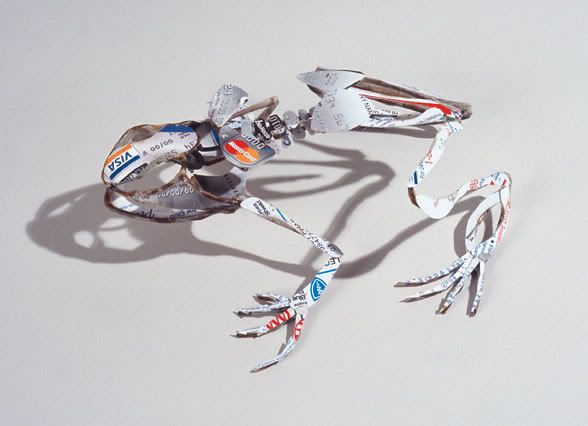
"Zero Balance - Frog made from credit cards"
2007
Mixed media and cut credit cards
10 x 10 x 3 inches


Although so much contemporary art is didactic in effect, few viewers have the stomach for second-hand instruction. We look at art principally to feel and discover, not to reconfirm or debate. Yet I can not reject Rupp's exhibition, which also includes an uneven series of collages and five wall-mounted, mixed media sculptures.

Rupp is engaged with activism, and has been for almost forty years. Even her statement is coded for our sloganeered age: "putting the stain back in sustainability since the 1970s." She aims to "make people confront their anxiety and create dialogue," and this is a worthy goal. The works may not resonate individually, but Rupp's engagament with this important subject matter is appreciable, and I would be pleased to see her sculptures and collages pictured in Orion or Harper's, alongside relevant essays.

The question remains, though: how does an artist of Rupp's ilk address the gallery context? I'm afraid there is no easy answer. Her work may be best delivered (and absorbed) in conjunction with the ideas that compel her; I see nothing wrong with that approach. I do wish, however, that there were more outlets for such alliance.


Christy Rupp
"Ivory Billed Woodpecker, Arkansas, believed extinct but in dispute"
2004-2007
Mixed media and fast food poultry bones
14 x 8 x 11 inches


Photo credit: images ripped from Rupp's website

Thursday, October 05, 2006

Questions of gender as content


Jennifer Dalton
"Art Guide"
2006
Map, colored pins, painted wooden frame
9 1/2 x 10 1/2 x 1 1/4 inches


Of late, there's been a lot of protest, commentary, and debate concerning the shamefully low percentage of women showing in the art world. It's true; the contemporary art world is dominated by men. Furthermore, I'm assuming that the majority of these men are heterosexual Caucasians, meaning the art world, reflecting the 20th century American teenagers read about in their high school textbooks, is white, male, and straight.

The art blogging community, ever expanding, has fed well on a steady diet of relevant posts, especially following the publication of Jerry Saltz's recent "Where The Girls Aren't" piece in The Village Voice. I generally enjoy Saltz's writing, and this piece is no exception. Saltz writes, "According to the fall exhibition schedules for 125 well-known New York galleries—42 percent of which are owned or co-owned by women—of 297 one-person shows by living artists taking place between now and December 31, just 23 percent are solos by women." Wow; that's astonishing and embarrassing, especially when I note that 60 percent or more of my artist friends are women, and I feel this number representative of the working artist population in New York, if not the United States at large. We have reason to take stock of the situation; there is no ignoring the numbers.

And yet, I can't help but feel the subject itself a bit, well, dated. Is the sex (or sexual preference) of an artist still so important? I mean, sure, most folks across our great, prudish nation are very concerned with sex and sexuality. Debates rage about female golfers on the PGA tour and the sexuality of politicians. But we're not talking about the general public here (no matter how much I'd like the art world to expand it's reach). The voices involved belong to a relatively small, very progressive group of educated individuals.

The question may sound a bit naive, but why are we still "seeing" skin, sex, or sexuality in art that doesn't focus on these issues? Frankly, most art that does take on these issues is didactic, a breed of intellectual illustration which, while worthy of consideration, fades from memory and relevance in much the same way an excellent piece of journalism does. By contrast, most artwork I see these days, whatever the medium, lacks an overt agenda. Until I see the name or, in some cases, until I read the press release, I don't know much about the maker's makeup. Frankly, I don't care to. The art will either ring my bell or it won't. If I later learn about the artist's background and find that these details inform the work further, hooray, but until I want to peel back that layer, I don't need to know hooey. Art, I feel, is a beast best viewed apart from the artist.

At times I feel like shrugging off the issue. Shouldn't we be concerned with the product as opposed to the personality or biography? Yet the imbalance of the sexes is real, and it mustn't go ignored. I'm proud to be friends with ambitious artists and curators who are devoting energy and thought to addressing and, hopefully, rectifying the problem. Still, I can't shake the longing for that day, a millennium or more on, when miscegenation and a dissatisfaction with ol' time fundamentalism will result in our wearing one skin and being more tolerant of varied beliefs. Maybe then we can set to the business of real - meaning global - humanitarian and environmental progress...and artists can expend more energy thinking about art rather than who made what and why.

Photo credit: ripped from Winkleman Gallery; Normally, I would have asked Edward for permission, but he's out of the country and without frequent Internets access...and I'm compulsive.

Thursday, January 05, 2006

Jane Hammond's "Fallen"


Jane Hammond
"Fallen"
2005
Dimensions variable

I have a bias against political "protest art." Excepting Pablo Picasso's "Guernica," I am hard pressed to think of moving, successful artworks in this all-too-noisy stall of the political art stable. I don't mean to suggest that artists shouldn't bang a drum on behalf of causes near and dear to them, but doing so without looking like an ass is no mean task.

Thankfully, there are a number of artists who produce work that addresses contemporary political concerns without throwing a tantrum; I didn't realize that Jane Hammond was one of them. I like Hammond's collages - and some of her paintings - a great deal, so I was thrilled to read about her installation/sculpture, "Fallen," exhibited last year at Galerie Lelong. Unfortunately, I missed the show. I include below critic Eleanor Heartney's description of the work, printed in the September 2005 issue of Art in America.
"In the show's largest work...a pile of large, brilliantly colored autumn leaves spread[s] over a low platform in the center of a separate room. Actually, these remarkably real-looking leaves are artful reproductions of ones gathered by the artist and her friends...Hammond inscribed each of the roughly 1,500 leaves with the name of an American soldier killed in Iraq. (As the war goes on, she will continue to add leaves as more soldiers die.) Thus, what first appears to be a celebration of nature's beauty becomes a reminder of the mounting toll of war."
At the time of the exhibition, "Fallen" was comprised of more than 1,500 leaves. Presumably, Hammond has dutifully continued fashioning her paper leaves, which should now number just over 2,200. The process of shaping, inscribing and adding these leaves must be a very difficult one, but I am thankful for the project and ever more impressed with Hammond as an artist.

Read the 2010 follow-up to this post here.

Photo credit: image ripped from .nsimplexity

Wednesday, November 02, 2005

Take one down, pass it around...


The New Yorker's recent Art & Architecture issue includes a profile of the artist Rirkrit Tiravanija. In Calvin Tompkins' "Shall We Dance?," the artist comes off as a thoughtful, sensitive man, but I struggle to appreciate Tiravanija's artwork.

Tiravanija rightly champions direct action/interaction as a way of "making a difference" in the world. Most of his work deals with community or shared experience, and performative aspects are simultaneously highlighted and dismissed. While I grasp the conceptual underpinning and moral imperative of his projects, they are almost devoid of aesthetic appeal. More problematically (for a post-aesthetics artist like Tiravanija), judged alongside the heroic efforts of citizen activists or humanitarian lobbyists, his projects are superficial and uninspiring.

Although I run the risk of constructing a straw man by focusing on an artwork some readers will deem uncharacteristic of Tiravanija, I'll highlight an early installation described in the Tompkins' article.
"[Randy] Alexander served Rolling Rock beer at the opening, because he could get it at a discount. 'Rirkrit liked the bottles,' he remembers. 'I stacked them up in their original cartons and we made a piece out of it.' The effect that Rirkrit and his work have on some people is not easily explicable. Gavin Brown, who came in one day, was working then for Lisa Spellman at the increasingly influential 303 Gallery, but he thought of himself as an artist - he had gone to art school in London. Something about the four cases of stacked green bottles pierced his soul. 'It irritated me so much!' he remembers. 'Beer bottles in their cardboard cases, all empty, tops off. It wasn't like a found object - there was so much more to it than that. I could feel this in waves, even though there almost nothing to it. It was an object that seemed to say, 'You don't realize how little everything else matters.' I couldn't get it out of my head.'"
I laughed when I read the above, finding the beer bottle enterprise absurd, s revelation of head-up-ass art world pretensions. To be fair, Tiravanija might have intended to at once skewer the art world's skeptical nature and the art world's credulousness, two seemingly contradictory, but inextricably linked impulses. Many art viewers harbor an unfortunate closed-mindedness that results in their thinking, "Hey, a beer bottle is a beer bottle and art is art," while others are readily willing to accept any work in a gallery as "high art."

But I don't think that way, and I don't believe that most people do. Like the laconic photographer in "American Beauty," I'm often overwhelmed by the mundane (even if plastic bags are now considered terribly passe!). As hackneyed a notion as it may be, it's no less true that the smallest of gestures can offer profound epiphanies; nothing should be easily dismissed.

Reminding myself of this, I try to imagine my own, unbiased reaction to Tiravanija's beer bottle stack. I enter the gallery and stand before the Rolling Rocks "in their cardboard cases, all empty, tops off," and I feel......very little, excepting a formal appreciation (and some fond recollections of college binge drinking). This viewer needs more substance.

Formalism
alone is never enough to satisfy a hungry mind. Minimalism, the "movement" most art historians consider the very pinnacle of formalism, is associated with transcendence. Consider the accepted criticism on Mark Rothko, for example. Purely aesthetic or formal experience can more easily allow for a turning off of the brain machine, a halting of the buzzing undercurrent. A convincing argument can therefore be made that formalism is pragmatic in the same way that advanced meditation is.

Surely this explains the quiet pleasure I experience when contemplating a good Barnett Newman painting. When conscious consideration is applied to the same Newman, however, I'm no longer wholly satisfied. After all, I can achieve the same sort of bliss, if it's fair to call it that, staring at a tree, an etched subway window or, occasionally, practicing yoga; more importantly, all of these non-art activities are more enjoyable ways for me to "transcend."

Complicating matters further, Tiravanija's beer bottle piece, like all readymades, relies on the context provided by a gallery or museum. Once Duchamp reminded us that "anything" could be art, we, as a culture, should have learned that lesson.

Honest artists will agree that the construction site across the street from the Chelsea warehouse is no less exciting, beautiful or intellectually stimulating than the objects on display inside. The whole world is a web of intricate artworks, from the used urinal to the non-coding protein. Why should Tiravanija's Rolling Rock bottles be more significant, or more beautiful, when stacked in the gallery than they are when stacked in the corner of a frat house? How many Sunday mornings have you spent long minutes watching the play of light off an empty beer bottle on the coffee table, following the refracted beam to the wall, colored now a pale brown, lime green or urine yellow? Tiravanija's bottles don't say, "You don't realize how little everything else matters" any more than do innumerable other objects and moments!

It strikes me as curious that Gavin Brown used the word "irritated" to describe his reaction to the Rolling Rock stack. Have we reached a point where we need to be reminded how to look at things from outside of ourselves, how to exist in the moment, whether via contextualized readymades or horrible natural disasters?

The Rolling Rock bottles are, in the end, impotent; the same can be said of most of Tiravanija's work. His gesture and intent are pure enough, but outside of the insulated - some would say "padded" - walls of the art community, his work communicates little of substance. Tiravanija succeeds, in my mind, only when he removes himself from such a context, as he does in Thailand, by working with the existing, local structures to build better safety nets and generate support for the arts and education. This localized, less celebrated effort is certain to be his legacy.

Wednesday, August 10, 2005

Links: Green Building, Sustainablog and Burtynsky

I want to encourage participation in this National Resources Defense Council action alert. Follow this link to send an email voicing your support for the New York City Green Buildings Bill. Though many readers do not live in New York City or the region, I believe all comments are significant, especially since NYC fancies itself the country's cultural leader.

Also, Sustainablog has been on a roll lately, offering some informative tidbits for folks interested in sustainable development and environmentalism. Initially, I responded well to the information communicated on Sustainablog, but didn't take to the "blurb" approach. Over time, however, I've realized that it one of the best sources for links and updates pertaining to the field.

Jeff, Sustainablog's founder, also has a post up about the work of Edward Burtynsky, one of my favorite contemporary photographers. Visit Burtynsky's site.

Monday, August 08, 2005

Live 8 and Surowiecki


In late July, several bloggers critiqued Bob Geldof's most recent humanitarian circus, Live 8. Blogging buddy Devo, at Vitriolic Monkey, wrote,
"If, twenty years hence, we still see Malaria, AIDS and Tuberculosis running rampant [in Africa], and if at that point we still see photos of hunger-fattened youths with flies around their eyes, and we still see Sally Struthers waddling through the dirt-paved streets urging all of us to send her and her little poverty stricken urchins more Chocolate Yum Yum Bars, I will turn to Bob Geldof and friends, who will undoubtedly be lying on their death beds, from the look of him, and tell them 'I told you so.'"
Such Live 8 disillusionment was common, though there were also plenty of starry eyed youths eager to explain how Geldof's concert series had opened their eyes to the world's ills. One can only hope.

That said, I was troubled by the posts or comments that moved beyond a dismissal of Live 8 to attack international aid at large. Hector Vex, commenting at Vitriolic Monkey, wrote,
"I'm not saying fu*k the world completely, but it's time we realize that Africa is FU*KED. It's a backwards continent that hasn't gotten out of the tribal age. Let's pack up and get out of there and let them evolve on their own. Let's feed the children here before those distended little fly bags over there."
In late June, James Surowiecki wrote the following in an issue of The New Yorker.
"...many critics of foreign aid...mounted a lively backlash against both Live 8 and the G-8 summit. For them, continuing to give money to Africa is simply 'pouring billions more down the same old ratholes,' as columnist Max Boot put it. At best, these critics say, it's money wasted; at worst, it turns countries into aid junkies, clinging to the World Bank for their next fix."
This rhetoric is familiar stuff; we read it in the pages of the Wall Street Journal and hear it on Fox News broadcasts. It would be unfair, though, to suggest that such feelings are endemic to neo-conservatism; people from across the political spectrum are guilty of it.

To some extent, it's only natural. If you give a dollar bill to the same homeless man every morning for ten years and, all those years later, he's still spending your money on malt liquor, you'll likely feel cheated or frustrated. This is true of everyone, no matter how generous.

But what if you'd opted to give your money to a different person? Two blocks west is a teenage girl who fled an abusive household. You couldn't have known that she only spent her charitable handouts on food and the occasional shelter fee. Nor could you have known that giving her one dollar each morning for just ten months would have helped her find a part-time job. The point is, to let one discouraging situation cause you to write off charity at large is unfortunate and, frankly, immoral.

Again, I turn to Surowiecki,
"Skepticism about the usefulness of alms to the Third World is certainly in order. Billions of dollars have ended up in the pockets of kleptocratic rulers - in Zaire alone, Mobutu Sese Soko stole at least four billion - and still more has been misspent on massive infrastructure boondoggles, like the twelve-billion-dollar Yacyreta Dam...which Argentina's former President called 'a monument to corruption.' And historically there has been little correlation between aid and economic growth.

This checkered record notwithstanding, it's a myth that aid is doomed to failure."
Sure, that particular "bum" drank your generosity, but perhaps you should have chosen more wisely. Botswana, Mozambique and Uganda, for example, have all been using their aid to jump start their economies (though AIDS continues to ravage the populations). Costa Rica, now the gem of Central America, was once an aid recipient as were Ireland, South Korea and Taiwan, now wealthy countries on the move.

Surowiecki analyzes the aid situation further. He writes,
"during the Cold War aid was more often a geopolitical tool than a well-considered economic strategy, so it's not surprising that much of the money was wasted. And we now understand that the kind of aid you give, and the policies of the countries you give it to, makes a real difference."
Surowiecki is not a Utopian dreamer. He notes the many problems with post-Cold War aid programs, citing the unknown variables as the biggest concern. In other words, even an educated guess can turn out poorly. You could pick the homeless teenage girl as the beneficiary of your generosity...but she might become a heroin addict with no desire to get sober. The bad result can (and often does) happen. Sho'nuff, that stinks.

Every year, I donate hundreds of dollars to conservation groups from around the country. Some years they accomplish little of note. Does this mean that I should stop supporting them? Absolutely not, and neither should the First World abandon its commitment to the rest of the globe.

Geldof's Live 8 is a drop in the bucket; I've no doubt that most concert goers have already forgotten about the "dark continent" and are thinking ahead to Fall clothing sales and the latest album releases. Fortunately, the apathy and ignorance of the American populace doesn't determine our international aid policy. Unfortunately, this administration appears to approach aid with the same "What? Me worry?" attitude.
"In 2002, President Bush created the Millennium Challenge Account, which is designed to target assistance to countries that adopt smart policies, and said that the U.S. would give five billion dollars in aid by 2006. Three years later, a grand total of $117,500 has been handed out. [Note: That's just over 2%.] By all means, let's be tough-minded about aid. But let's not be hardheaded about it."

Tuesday, July 05, 2005

Perpetually Lost

I feel a twinge of shame when reacting negatively to an animal rights mailing. After all, I generally find the perspective agreeable and think that some of the movement’s voices are exceptionally articulate and sensible. The fact remains, however, that most animal rights activists and environmental extremists are young, confused idealists. There is nothing wrong with youth or idealism, but when one combines such naive energy with an ignorance of reality, the result is senseless noise. The “manifestos” written by kids who count themselves among the movement’s disciples are often troubling documents.

Recently, an animal rights advocate, who is also a member of a conservation group I support, sent out a group email detailing the plight of Chris McIntosh, a twenty-two year old activist who set fire to a McDonald’s restaurant in Seattle. The action was jointly “claimed by” the Animal Liberation Front and the Earth Liberation Front. The email sent to me included a note written by McIntosh, excerpted below.
“I am a Green Anarchist who believes in freedom for all life, by any means necessary, and a return to the "old way". There should be no compromise with a system that has no respect for nature, that worships shiny metal and green paper instead of the mother from whose womb we are sustained. I no longer see the use or satisfying results of petitions and demonstrations. The truth is the crunch has come, and it's time for a feral rampage in everyone's heart! Whether its wreaking drunken havoc upon the civilized pillars of society or some other way that gets you off, we are the barbarian hordes. Let's sack Rome!

When I was 16, I dropped out of and took off into the unknown to discover a life of freedom (until the pigs interfered). It had its hardships, but the good outweighed the bad. I have been educating myself with real knowledge since then.”

“What I'm into reading is anti-civilization theory, stuff about early european pagan beliefs. Anything along those lines or a simple letter goes a long way too.

Thank you and no compromise in the fight for the earth and animals!”
Reading this pedestrian rhetoric, I recall “Notes From Underground: Among the radicals of the Pacific Northwest,” an article by David Samuels, published in the May 2000 issue of Harper’s Magazine. Samuels addresses the surreal combination of energetic commitment, disillusionment and boredom endemic in extremist groups. How can we take seriously the well-intentioned kids dressed in Adidas track suits and Nike sneakers as they pry off the sign at Seattle’s Niketown to protest capitalism's cruel dominion?
“What the pictures from Seattle captured was an anger whose true sources had less to do with Nike’s treatment of its labor force or other objectionable practices than with a broader, more unreasoning sense of being trapped in a net…the more general principle that someone should be held responsible for the feelings of absence and compulsion that overwhelm us all at some point or another in our lives and that are not our fault, or even the fault of our parents, but are rather the products of the addictive vacuum that has manifested itself through the combined karmic energies of millions of cathode-ray tubes and digital cables.”
The “objectionable practices” do provoke anger, but I think that what separates the quiet activists – those that concentrate on changing their own lifestyles to lessen impact – from the Chris McIntosh variety is the ability to consider one’s actions thoughtfully, recognizing that personal choices do matter and that arson attacks, for example, only further misunderstanding and backlash.

Thursday, March 17, 2005

Canada Culling, Paris Protesting


Many environmentalists and animal rights activists are up in arms over the Canadian government's decision to allow for the culling of up to 350,000 harp seals (Pagophilus groenlandicus). From a conservationist's perspective, I'm not sure how to feel about the decision. Some biologists claim that harp seals are over-populated and, as a result, are adversely affecting regional cod populations. Others suggest that the seal population isn't any larger than it should be, and that the commercial fishing industry is the primary culprit in the cod population plummet. Both sides of the debate cite contrary data while pointing to apparently valid studies. As a result, outside observers intent on gathering the facts before making up their minds face a challenge.

So, I suppose I have to go with my gut reaction. Death by clubbing and sticking is not an attractive option. Line me up in your sights and put one through my heart or between my eyes, but, please, if you must shoot me, don't be on a moving platform or boat when you pull the trigger. I'd prefer not to have my lung punctured or my jaw torn asunder because of the rolling action under your feet. If, even on steady ground, you still make a bad shot, crippling instead of killing me, please do not skin me while I'm conscious. Instead, approach and put a bullet through my brain. Then wait until I've ceased struggling (even if it's just my nerves firing) before you begin to cut my flesh away from fat and muscle. While you're at it, I'd appreciate it if you take a few moments to say a prayer of gratitude for my flesh.

According to animal rights groups and activist environmental groups like Greenpeace, many of the seals are harvested in the tortuous way described above. "Harvest," when applied to an animal, is a term I do not care for. While it may be accurate, it has the effect of turning the animal population or species in question into a crop, allowing us more psychological distance from the killing involved. I do not consider the single, doe deer that I hunt to be a crop. She is a white-tailed deer (Odocoileus virginianus), beautiful and alert (high-strung, even, by our human standards). For that matter, I do not consider the tomatoes or the squash grown in one's backyard a crop. I associate the term with industrial agriculture, the great, wasteful, polluting machine that so many of us today depend on.

Because of the manner in which most of the harp seals will be killed, and because of the misuse (disrespect) of the slaughtered animal, I am opposed to the authorized market hunting of harp seals.

Yet, I'm still irritated when I read that Paris Hilton has signed on to protest with the millions of urbanites around the world who are banding together to make their dissatisfaction known. At first, I believe my reaction has more to do with my rural roots, but this is the easy answer. In fact, the reaction has more to do with my fear that the majority of these protestors, Paris included, are involved for selfish reasons. They want to feel good about "saving cute animals." Rarely do these kind of casual activists demonstrate real curiosity about and or grasp of "their cause." Would Paris Hilton ever think to sit down with a harp seal biologist and learn about the species? While I can not say with any certainty, my Magic 8 Ball says, "All Signs Point To 'No.'"


Photo credit: Associated Press, 2004

Tuesday, March 15, 2005

A Series of Unfortunate Events (with a curious ending)

1) Mad-cow disease leads to increased demand for Brazilian open-range cattle and soybeans. The soybeans are to be used as safe animal feed in Europe.

2) The increased demand encourages deforestation and a "continued push" into the Amazon.

3) An activist American nun determined to help protect Brazilian peasants while encouraging sustainable farming practices is executed by armed men working for the soybean farmers and loggers, who are moving peasants off land deemed suitable for cattle or soybeans.

4) The international outrage generated by her murder is largely responsible for the Brazilian government pushing through an order for the creation of two conservation areas in the Amazon, totaling 10 million acres. These areas have been coveted by environmentalists and industry alike.

Now the lines have been drawn. See the relevant article here.

Note: View the description of new conservation area at World Wildlife Fund website.

Sunday, March 13, 2005

Make Me A Mutt


Every blogger with an interest in sustainability and conservation will certainly be making some reference to Nicholas Kristof’s March 12th op-ed piece in the New York Times. I’m no exception.

Kristof’s conclusion that Michael Shellenberger and Ted Nordhaus, co-authors of “The Death of Environmentalism,” are right, that “modern environmentalism…must die so that something new can live,” is bound to provoke vitriolic response from many folks with “greening” on their mind. (Dave Roberts, the usually thoughtful assistant editor of Grist Magazine, calls Kristof’s article a “lazy, risible piece of sh*t.”)

I’m electing to take the middle road on this one. For every informed environmentalist, there are at least three ignorant screamers. Both sides (if the situation must be reduced to such black-and-white perspectives) know this to be true, and, more importantly, we have all been one of these screamers at some point, no matter how informed we may be otherwise.

Allow me to use myself as an example. I used to rant about the urgent need for blanket prohibitions on the importation of any wild-caught exotic reptiles and amphibians. Further, I insisted that states should require permits, obtained upon completion of a basic training course, for private reptile or amphibian ownership. My reasons were valid: I had grown tired of seeing “pet” reptiles and amphibians improperly cared for and exotic introduction (consider the Burmese pythons currently thriving in Florida’s Everglades) is more likely when dealing with “fad” herp owners, those that think a snake or lizard will be a “cool pet” but soon become bored by a relatively sedentary animal.

Yet, after considering the issue for several years, I no longer think prohibition a wise idea. Economic incentives overseas, in the form of local breeder farms and conservation projects in heavily pressured areas, and restricted foreign breeder partnerships seem a more sound response to the problems caused by the burgeoning interest in herpetoculture. (Of course, this won't prevent a negligent owner from releasing an exotic locally and I still favor a permit system for large or venomous herp ownership.)

So I changed my mind; I still want the same end result, but the means I now think best are notably different. This wouldn’t be a problem if I hadn’t been so eager to hop on the soapbox when I was calling for prohibition. Now, despite my current attitudes being more nuanced and informed, I am what some dub a “flip-flopper.” But flip-flopping is not always bad. It proves one is engaged and considerate. Unfortunately, it can also be cited as a weakness.

What does my flip-flopping have to do with Kristof’s criticism of the environmental movement? In his editorial, Kristof writes,
“The fundamental problem, as I see it, is that environmental groups are too often alarmists. They have an awful track record, so they've lost credibility with the public. Some do great work, but others can be the left's equivalents of the neo-cons: brimming with moral clarity and ideological zeal, but empty of nuance.”
He is right. Too often we opt to bang the table and throw a tantrum, presumably operating on the maxim, “Make enough noise, and they will come.” Jared Diamond, a contemporary hero of mine, correctly suggests that being an alarmist is better than not alerting others to the burning building, but the fact remains, alarmists are annoying. Taking the extreme position - the championing of wind power and denial of related criticism, for example – virtually guarantees you will be deemed wrong in the end. If you tell someone that drunk driving will surely result in their death and they drive off a bridge and nearly drown, they’ve proved you wrong by surviving the terrible accident. Your ultimate point, that drunk driving is stupid, dangerous, and wrongheaded, is true...but, technically, um, you said he would die.

Don’t think for a minute that the “other side” won’t hold us to our word. “Global cooling” is still pilloried by the neo-cons and energy industry spokesmen. If you try to explain that “global cooling” and “global warming” are essentially descriptions of the same phenomenon, you’ll get nowhere fast. The dire forecasts made by meteorologists in the 1970s didn’t materialize. Neither did Paul Ehrlich’s population predictions. Now Kristof cites these as examples of environmentalists crying wolf. Technically, he is correct, but global climate change and population pressures remain serious threats to the health of society and biodiversity.

The challenge that the environmental movement faces now, just as it did thirty years ago, is one of image. The Pew Research Center statistic Kristof cites is encouraging; 3/4 of Americans polled agree that environmental protection is vital. With that sizable majority in mind, it may not be necessary to throw tantrums. Reasonable, determined methods will serve the movement well. In environmentalism, like anything else, contradictions abound. Rather than dogmatically championing every device or idea that comes out of the green camp, we should fully consider each and push for thoughtful action as a diplomat would.

As Garret Keizer writes in his recent essay, “Life Everlasting,”
“We can dare to walk on this ground of dubious footing, because we are holding one another up as best we can, and because it is we ourselves and not some deterministic logic that writes our civil laws…We can sniff out our options and pick and choose among them, a birthright generally less appreciated by a dogmatist than by a dog.”
Photo credit: Superdog Inc, copyright 2003

Monday, March 07, 2005

Do-gooder Bono


Whenever I see Bono, the famous front-man for the rock group U2, I flush with angry resentment. I sometimes spew invective and berate nearby Bono fans.

All this focused rage begs the question, “What do you have against Bono?” To tell the truth, I’m not exactly sure. I usually cite his ubiquitous, ridiculous sunglasses or his holier-than-thou attitude, but these complaints only explain so much. The fact is, Bono’s interest in humanitarian projects is sincere and, unlike most celebrity spokesmen, he actually leads the charge to beat back that which he deems wrong and unfortunate.

In fact, he's so devoted to humane economic development that he was recently nominated for the Nobel Peace Prize. Now, the Bush Administration may nominate him to be the next president of the World Bank. Given the vast impact of World Bank policy and initiatives, I imagine I wouldn’t be so red in the face were Bono to be selected for the job…assuming he’s made to take off those bloody sunglasses.

(Bono is also sure to thoughtfully consider environmental measures and, as the relationship between a sustainable economy and a sustainable ecosystem becomes more clear, having such an individual at the top of the World Bank should do some good.)

Photo credit: Dave Hogan, Getty Images

Wednesday, March 02, 2005

Brad Pitt's CO2 dues

In this month's (March 2005) Harper's Index:
Number of saplings that Brad Pitt paid to have planted in Bhutan last year to counteract his personal CO2 production: 1,700
That's one of the more bizarre ways of minimizing an individual ecological footprint, but it still deserves attention (and praise).