Showing posts with label Mark Rothko. Show all posts

Tuesday, March 24, 2009

Subjective Takes

On Paul Klee and Ali Banisadr

Paul Klee
"Ancient Sound, Abstract on Black"
1925
Oil on cardboard
15 x 15 inches
"The work probes me, reads me, asks me questions, makes demands. If we see and acknowledge this connection between ourselves and works of art, art isn't merely a distraction, it is a means by which we begin to understand ourselves. Marcel Proust wrote, 'In reality, every reader is, while he is reading, the reader of his own self.'"

-Dr. Alan Jones, Reimagining Christianity
This weekend, I pulled G. Di San Lazzaro's biography of Paul Klee off my bookshelf, hoping to draw some inspiration from reproductions of the artist's paintings and drawings. As I thumbed through the book, however, various passages caught my eye, and I ended up reading much of Lazzaro's account.

Lazzaro stresses Klee's desire to achieve a "purity of expression." The artist apparently characterized his art-making as a relationship with "the very heart of the Universe," and Lazzaro provides quotations from art historians and personal associates of Klee that further elucidate the artist's mystical motivation.
"For Klee art was always cast 'in the image of creation'...The artist rummages in Creation's property box. There is nothing which does not serve him, nothing which does not come into his game - art and its oldest remnants such as inscriptions, mosaics, Assyrian tablets, cracked pottery, imaginary ideograms, graffiti; nature with its various processes and chance effects - its striations, strata and maculations, the slow wear of time which in the thinnest fragment of rock imitates the work of the human hand. The hand, in its turn, Klee said, must be 'the instrument of a distant past.'"
-Pierre Volboudt, Kandinsky

"Klee's world is [not] grotesque but mystical...For Klee, as he said to me in 1919, art was not there to reproduce the visible but to render visible what lay hidden beyond the visual world. He remained faithful to this doctrine and brought its deep meaning to fruition until, after passing through many intermediary stages, he achieved in his pictorial world...essential beauty."
-Carola Giedion-Walker
Yet, of the many 20th century artists that heroically championed the unconscious and the archaic, Paul Klee is perhaps the only one that your grandmother loves. Why? Because his paintings are colorful and inoffensive and, when not abstract, feature charming hieroglyphs, animals and stick figures.

Art writers most often describe Klee's work as "whimsical," "precious," even "child-like," but Klee disdained such mundane interpretations of his work. He dismissed "the legend of the childishness of my drawings" as the result of his attempts to "show man [not] as he is but as he might be."
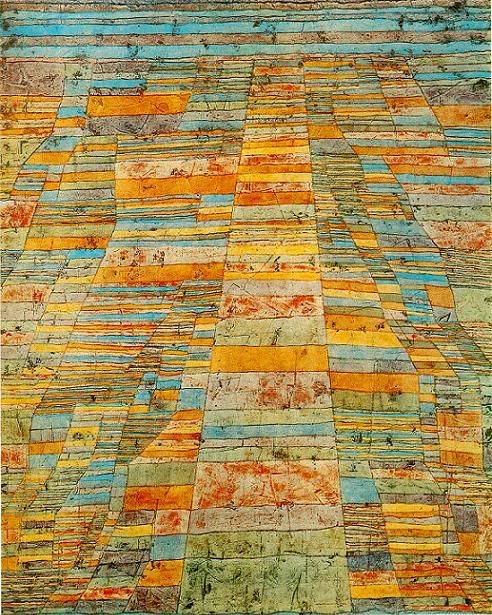

Paul Klee
"Highways and Byways"
1929
Oil on canvas
32 5/8 x 26 3/8 inches


Contemplating the disparity between Klee's stated intention and the general reaction of his viewers, I recalled something that I wrote in the comments section of a recent post.
"Art is subjective...and I feel that a viewer's experience and interpretation of an artwork is as informative and vital as the intention and creation of the artist. It's a conversation."
In short, the viewer plays a substantiative role in the life of an artwork.

Does this mean that Klee was wrong to assert his mystical motivation in the face of popular resistance? Not necessarily. Many artists sense Klee's profound striving. Undoubtedly, Klee would have approved of Bridget Riley's assessment of his paintings as "the process of things coming into being" and, in my art taxonomy, he is more closely related to the mythically-inclined Mark Rothko than he is to the playful Alex Calder.

Nevertheless, the popular response to Klee's work can not be overlooked. Art is a conversation and, in the dialogue generated by Klee, the perspective of artists like myself or Riley is representative of a small minority.
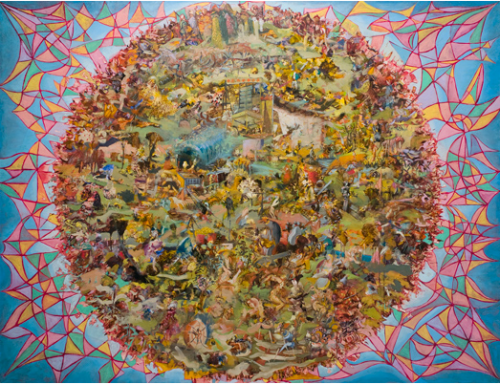

Ali Banisadr
"Target"
2008
Oil on linen
60 x 78 inches


A few months ago, I encountered the young painter Ali Banisadr's artwork for the first time. His riotous pseudo-abstractions compellingly communicate the distortions of violent conflict, yet the artist's all-over compositions also manage to effect a meditative state. Indeed, some of the works are mournfully elegiac. (His 2008 painting "Target" is perhaps the most obvious example; the picture acts as a Yantric focal point despite being dominated by a feral garden scene.)

Banisadr was born in Tehran, Iran, in 1976. His family lived in the city during the Iran-Iraq War and he states that "vivid memories of the bombings that...regularly occurred throughout his childhood" are a principal inspiration for the recent paintings. Banisadr's 2008 solo exhibition at Leslie Tonkonow Gallery received critical praise in a number of outlets, including The Brooklyn Rail, The New York Times, and jameswagner.com. Reviewers usually cited the same forebears and inspirations that the artist lists in the exhibition catalog.
"I want the viewers of my paintings to see history and human behavior at a macro level, by combining a great variety of influences that you can see close-up. Bosch, Brueghel, Persian minatures, memories, literature, history - I want to combine all of these things in my work. When you put all of this in the pot and stir, you create your own mythology."
Indeed, Banisadr combines these ingredients to excellent effect. Looking at the paintings, Banisadr's indebtedness to and admiration for the Dutch masters is immediately apparent, but so, too, is a great heave of ideological love and madness.

But one of Banisadr's paintings provoked an unexpectedly powerful association in this viewer, one that I'm sure Banisadr did not intend to stir into his eclectic pot. I'm fortunate to have neither fought in nor lived in the midst of war. Yet having grown up in the American South, I still identify the American Civil War as "my family's war." That association may seem disingenuous - the war was fought 150 years ago - but my homeground is marked by that terrible conflict in a way that the rest of the country is not. Gravestones in the small cemetery in the front yard of my childhood home speak to the pride Southerners had in their cause. Stonewall Jackson Kellam is among the dead buried in that cemetery. Kellam was a five-month-old baby when he died on October 3, 1868, just a few years after the close of the Civil War. His name honored Thomas "Stonewall" Jackson, the prominent Confederate general.

The Civil War colors Southern identity, and I am not immune. Although my paternal great-grandparents were a Hungarian Jew and Catholic seeking refuge and opportunity in Brooklyn, New York, the other seven branches of my family tree have deep roots in the United States, mostly Scots and Brits who immigrated in the 1600s. At least two of my great-great-grandfathers fought in the Civil War (one for the Confederacy, one for the Union), along with several of their brothers, and the records of their service are rather stirring. My great-great-grandfather Wesley Mayes Dance was fatally wounded several hundred yards away from the site of the "Crater" at Petersburg, Virginia. Wesley fought with The South of Dan Rebels, one of two Virginia regiments that held the Union advance at Petersburg until Southern reinforcements arrived. With bitter pride, I consider the fact that he and his fellow Confederates sealed the defeat of the Union attack on that day, thereby prolonging the war for many months.
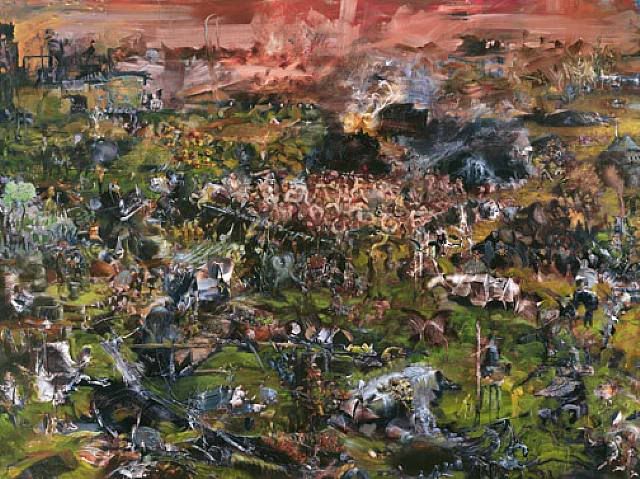

Ali Banisadr
"Amen"
2008
Oil on linen
50 x 66 inches


I don't often think about the Civil War, or even about my Southern identity, but in Leslie Tonkonow's gallery space, Ali Banisadr's painting "Amen" resonated for me, above all, as a picture of that history. I conceived of Banisadr's picture as a depiction of the Battle of Chancellorsville, one of the bloodiest, most frenzied contests in the war. The painting hums with electric life, yet is also a sad testament to our darker inclinations. I responded to the work with unsettling emotion; taking it in, my eyes stung with restrained tears.

As I departed the gallery, it occurred to me that I would be unable to write about the exhibition without raising my Civil War associations. I worried that this was too personal an experience to discuss, too private an interpretation to inform Banisadr's paintings for readers. If the artist didn't intend his paintings to conjure up Chancellorsville, how could I, in good faith, write about storied recollections of my great-great-grandfathers?

But as Proust reminds us, "in reality, every reader is, while he is reading, the reader of his own self." Artworks compel every viewer differently. More vitally, each individual comprehension of the artwork completes the piece anew. Klee's mystical intentions and Banisadr's Iranian memories are only part of the exchange. Art is, after all, a conversation, and a deeply satisfying one at that.

Image credits: Paul Klee reproductions ripped from Peplum and WebMuseum; Ali Banisadr reproductions ripped from artnet and Joann Kim's UpDownAcross

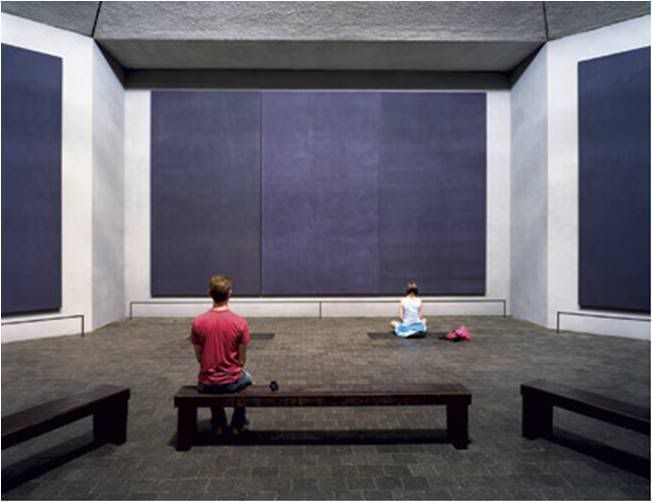
Wednesday, November 05, 2008

Rothko's Darkness

Interior photograph of Rothko Chapel, Houston, Texas
Completed 1971
"It is at once a reduction of the whole of the universe to the infinitesimal point of the anxious self and an absorption of the self in the eternal calm of the sea of being." 
-Rabbi Jacob B. Agus
In the September 26th edition of The Guardian Weekly, the opinionated British art critic Jonathan Jones describes his visit to Mark Rothko's chapel in Houston, Texas, as "a pilgrimage to the greatest marriage of art and architecture in the US." Jones worries, though, if the chapel is misunderstood, or even misused, by American visitors.

For the British critic, the Rothko chapel is "one of America's greatest and strangest monuments: a chapel created by a modern artist who had no religious beliefs." Jones is dismayed, then, to find that many visitors to the chapel are anything but irreligious.

Inside Rothko's master work, a fellow chapel-goer asks the critic if he sees in one of the over-sized paintings "the figure of Jesus Christ our Lord on the Cross?" Jones writes, "I look into the gigantic abstract work. It contains no images, Christian or otherwise."

Jones is clearly bemused that the chapel is today regarded by so many as a sacred space, and he chalks this interpretation up to our American religiosity.
"Locals use this place. They love it. They come not as tourists but to meditate, pray and talk sombrely. They see it as a religious place and the art as spiritual. It is called a chapel, and most Americans believe in God."
Jones feels Rothko would be similarly befuddled by the religious interpretation. The critic explains that Rothko designed the chapel to take "his pursuit of...the 'tragic' to its ultimate extreme" and that the artist "believed that all serious art was about death." Undoubtedly, Rothko had a fatalistic, deeply melancholic streak - he killed himself in 1970, one year before the chapel opened - but I'm not sure that the artist would, like Jones, bemoan the religious significance of his chapel.

A Russian Jewish immigrant, Rothko (originally named Marcus Rothkowitz) certainly didn't intend visitors to see Jesus Christ in his large canvases, but he was not, as Jones contends, a man "who had no religious beliefs." In fact, Rothko's father was an Orthodox Jew and the young Rothko spent time in Russian cheders before his 1913 emigration to the United States. After his family settled in Portland, Oregon, Rothko became active in the local Jewish community. Whether the future artist's connection to Judaism was principally cultural or spiritual, I do not know, but later in life he frequently described the making of his paintings as a religious experience.
Interior photograph of Rothko Chapel, Houston, Texas
Completed 1971

So what was Rothko thinking when he undertook the chapel project, and what did he intend the space to be? We can only speculate.

For his part, Jones asserts that the paintings act as doorways or portals. I agree, but the British critic insists that they are "portals of death." Jones sees the blackness of Rothko's chapel paintings as "utter desolation," blackness that shatters "any illusion of paradise." The chapel overall Jones describes as a "theatre of emptiness, death's antechamber, the self-expression of a suicide." He dismisses other interpretations, claiming that, if the Texas oil barons who commissioned the project understood more fully Rothko's deathly intentions, the chapel would not have been built.

But the blackness in Rothko's late works can also be understood as nothingness. Negative theology, more commonly referred to by the Latin via negativa, breaks down the word "nothingness" into "no-thing-ness." God, according to negative theology, is ineffable; literally, It, that is to say, God, is No Thing. As Lao tzu, author of the Tao Te Ching, wrote in that essential text, "The unnamable is the eternally real...Darkness within darkness. The gateway to all understanding."

This mystical conception of God or Being would be familiar to an educated Jew like Rothko. The Jewish Kabbalist notion of Ein Sof springs from a medieval Spanish Jew's exposure to Eastern philosophy. (Most historians agree that Moses de Leon, a prominent Spanish rabbi, composed the Zohar, the central text of Kabbalah, in the late 13th century. Some of these scholars argue that de Leon's work is a syncretic project, injecting tantra and other Eastern thought into the ever-evolving Jewish tradition.) Ein Sof, translated from Hebrew to English, literally means "there is no end." It is the unquantifiable, ambivalent and infinite energy that exists before, within and after the more mundane conception of God. The kabbalists, though, take their negative theology one step further. Ein Sof is the ineffable All, but Ayin, or "nothingness," is Ein Sof rendered finite. Some Jews consider Ayin the cosmic potential extant prior to the Big Bang.

Daniel Matt, a leading scholar of Kabbalah, writes in "God and the Big Bang":
"The paradox is that ayin embraces 'nothing' and 'everything.' This nothingness is oneness: undifferentiated, overwhelming the distinctions between things....This mystical nothingness is neither empty nor barren; it is fertile and overflowing, engendering the myriad forms of life. Medieval philosophers - Jewish, Christian and Muslim - had taught that God created the world 'out of nothing.' The mystics turn this formula on its head, reinterpreting it to mean that the universe emanated from divine nothingness."
For some religious individuals, concepts like Ayin and Ein Sof allow a point of entry. Rabbi Richard Rubenstein, a Jewish scholar and writer, speaks of God "as the Holy Nothingness." Detailing his turn from secularism to faith, he writes, I "replaced my atheistic nihilism with a mystical nihilism. To be all that there is, as God was in the beginning and will be in the end, is equivalent to being, so to speak, absolutely nothing. In the beginning, God dwelt in the womb of his own omnipotent nothingness." I love the contradictory nature of such a God!

Likewise, religious mystics of all persuasions believe that individuals must embrace darkness in order to find spiritual integrity. They must, as the prominent Rabbi Arthur A. Cohen put it, "...[surrender] to unknowing, [enter] the 'dark night' of which all mystics speak - a metaphor for the condition of desperate ignorance - and there [identify] a frail connection between the emptying of the self of all knowledge, the abandonment of knowledge, the perfect unknowing which enables the process of knowing to be renewed and the being whose existence renews. It is the passion of thought and the desire to know which presses us to the limit where thought cannibalizes itself in despair, where knowing ceases, where the emptying of the self is undergone and the fullness of God may commence."

Those chapel-goers who claim to see in Rothko's paintings Jesus Christ, Muhammad, Buddha, or any other religious hero are guilty of unimaginative literalism but, if their experiences are real, they are "seeing" through darkness into spirit. I believe that Rothko, an artist much invested in mythology and mysticism, would respect and even commend that.

Jones writes in The Guardian, "[The chapel] is not an austere, dead, modernist monument. It's a living chapel. People sing and play music. But maybe they should look around a bit more - because this is one of the most compelling rooms I have ever been in."

But why should these religious visitors have to stop worshipping, singing or otherwise participating in the work to take (what Jones considers) due notice of the room's quality? Given the power of the space, might not the room compel their behavior? Rothko insisted that he was no mere maker of abstract paintings. "If you are moved only by their color," the artist said of his mature works, "then you miss the point."

Photo credits: images ripped from HASTAC on Ning

Wednesday, November 02, 2005

Take one down, pass it around...


The New Yorker's recent Art & Architecture issue includes a profile of the artist Rirkrit Tiravanija. In Calvin Tompkins' "Shall We Dance?," the artist comes off as a thoughtful, sensitive man, but I struggle to appreciate Tiravanija's artwork.

Tiravanija rightly champions direct action/interaction as a way of "making a difference" in the world. Most of his work deals with community or shared experience, and performative aspects are simultaneously highlighted and dismissed. While I grasp the conceptual underpinning and moral imperative of his projects, they are almost devoid of aesthetic appeal. More problematically (for a post-aesthetics artist like Tiravanija), judged alongside the heroic efforts of citizen activists or humanitarian lobbyists, his projects are superficial and uninspiring.

Although I run the risk of constructing a straw man by focusing on an artwork some readers will deem uncharacteristic of Tiravanija, I'll highlight an early installation described in the Tompkins' article.
"[Randy] Alexander served Rolling Rock beer at the opening, because he could get it at a discount. 'Rirkrit liked the bottles,' he remembers. 'I stacked them up in their original cartons and we made a piece out of it.' The effect that Rirkrit and his work have on some people is not easily explicable. Gavin Brown, who came in one day, was working then for Lisa Spellman at the increasingly influential 303 Gallery, but he thought of himself as an artist - he had gone to art school in London. Something about the four cases of stacked green bottles pierced his soul. 'It irritated me so much!' he remembers. 'Beer bottles in their cardboard cases, all empty, tops off. It wasn't like a found object - there was so much more to it than that. I could feel this in waves, even though there almost nothing to it. It was an object that seemed to say, 'You don't realize how little everything else matters.' I couldn't get it out of my head.'"
I laughed when I read the above, finding the beer bottle enterprise absurd, s revelation of head-up-ass art world pretensions. To be fair, Tiravanija might have intended to at once skewer the art world's skeptical nature and the art world's credulousness, two seemingly contradictory, but inextricably linked impulses. Many art viewers harbor an unfortunate closed-mindedness that results in their thinking, "Hey, a beer bottle is a beer bottle and art is art," while others are readily willing to accept any work in a gallery as "high art."

But I don't think that way, and I don't believe that most people do. Like the laconic photographer in "American Beauty," I'm often overwhelmed by the mundane (even if plastic bags are now considered terribly passe!). As hackneyed a notion as it may be, it's no less true that the smallest of gestures can offer profound epiphanies; nothing should be easily dismissed.

Reminding myself of this, I try to imagine my own, unbiased reaction to Tiravanija's beer bottle stack. I enter the gallery and stand before the Rolling Rocks "in their cardboard cases, all empty, tops off," and I feel......very little, excepting a formal appreciation (and some fond recollections of college binge drinking). This viewer needs more substance.

Formalism
alone is never enough to satisfy a hungry mind. Minimalism, the "movement" most art historians consider the very pinnacle of formalism, is associated with transcendence. Consider the accepted criticism on Mark Rothko, for example. Purely aesthetic or formal experience can more easily allow for a turning off of the brain machine, a halting of the buzzing undercurrent. A convincing argument can therefore be made that formalism is pragmatic in the same way that advanced meditation is.

Surely this explains the quiet pleasure I experience when contemplating a good Barnett Newman painting. When conscious consideration is applied to the same Newman, however, I'm no longer wholly satisfied. After all, I can achieve the same sort of bliss, if it's fair to call it that, staring at a tree, an etched subway window or, occasionally, practicing yoga; more importantly, all of these non-art activities are more enjoyable ways for me to "transcend."

Complicating matters further, Tiravanija's beer bottle piece, like all readymades, relies on the context provided by a gallery or museum. Once Duchamp reminded us that "anything" could be art, we, as a culture, should have learned that lesson.

Honest artists will agree that the construction site across the street from the Chelsea warehouse is no less exciting, beautiful or intellectually stimulating than the objects on display inside. The whole world is a web of intricate artworks, from the used urinal to the non-coding protein. Why should Tiravanija's Rolling Rock bottles be more significant, or more beautiful, when stacked in the gallery than they are when stacked in the corner of a frat house? How many Sunday mornings have you spent long minutes watching the play of light off an empty beer bottle on the coffee table, following the refracted beam to the wall, colored now a pale brown, lime green or urine yellow? Tiravanija's bottles don't say, "You don't realize how little everything else matters" any more than do innumerable other objects and moments!

It strikes me as curious that Gavin Brown used the word "irritated" to describe his reaction to the Rolling Rock stack. Have we reached a point where we need to be reminded how to look at things from outside of ourselves, how to exist in the moment, whether via contextualized readymades or horrible natural disasters?

The Rolling Rock bottles are, in the end, impotent; the same can be said of most of Tiravanija's work. His gesture and intent are pure enough, but outside of the insulated - some would say "padded" - walls of the art community, his work communicates little of substance. Tiravanija succeeds, in my mind, only when he removes himself from such a context, as he does in Thailand, by working with the existing, local structures to build better safety nets and generate support for the arts and education. This localized, less celebrated effort is certain to be his legacy.

Wednesday, October 05, 2005

Selling Atheism and Myth

Image hosted by Photobucket.com
When transferring from the A/C/E subway line to the N/R/W at 42nd Street in Manhattan, passengers must walk down a long, underground tunnel. If they happen to look up at the tunnel's low ceiling, they'll notice three or four word excerpts on signs mounted to the ceiling reinforcements. If one reads the signs as he walks the length of the tunnel, he'll realize that each sign is a "piece" of a poem. The subject matter is mundane, literally, and the poem rather bleak. In short, the uncredited writer asks why we wake and go to work, day after day, our lives spiritually empty and dull. In the context of the smelly, humid subway tunnel, crowded with commuters, the poem resonates.

This past Saturday afternoon, as I made the E to W transfer, a group of teenage girls walked just behind me. Half listening to their conversation, I realized they were discussing the poem. They mocked it. "It's so stupid," one of them giggled. "What the fuck? I mean...," another girl trailed off. To some extent, I can sympathize with their reaction; the poem doesn't convey the most original sentiment. "You know what I don't get?," said a third girl. "What's it even advertising?"

Oh...my...God.

What is it advertising?! What is this MTA commissioned public poetry advertising?! Burma Shave, this ain't, babe.

I should know better than to be surprised. These girls, roughly seventeen years of age, are plugged into consumer culture. Theirs is the generation of the spectacle and the billboard. They were thirteen when the World Trade Center fell (on television, again and again and again) and they represented America's youngest consumer demographic, parental parasites, during the economic bubble of the late nineties. The third girl's question is, from their perspective, a fair one. Why isn't this poem an advertisement?

I didn't know whether to laugh or shudder. I slipped into a brooding mood. These are dark times, I thought.

But it's not enough to criticize, break down, and dismiss. Even constructive criticism, that much celebrated will-o-the-wisp, which can be invaluable to the artist, politician, and athlete, provides little reward for the critic himself. He may be able to pinpoint a conceptual contradiction, a fatal weakness in policy, or an unfortunate quirk in form, but how useful is his ability to notice the negative? Is the critic able to turn his judgment inward to correct his own failings?

I enjoy reading good criticism, be it social, literary, or aesthetic, but even the most capable wordsmiths can't make criticism complete unless they prescribe some balm. A batter who has fallen into a slump will not be helped by a coach who only cites what the batter does wrong. The good coach - the complete coach - recognizes the failing and attempts to correct it, explaining to his player not just what is wrong, but also what might work.

Incomplete though most criticism may be, negative noise must be made before there exists any serious striving for improvement. I regularly talk with people who share my sense of disillusionment and betrayal. I see folks shake their heads when reading the day's newspaper headlines and I often hear folks complaining about the administration or about the passing of a particular bill, but our overall complacency is noteworthy. There is some noise being made, of course, but the majority of protests lack focus - people shout 'No blood for oil!' while wearing PETA sweatshirts - and the political plays made by those brave politicians - republicans, in the traditional sense of the word - resisting the red tide are far too esoteric for most of America to rally behind. (Thoughtful, politically savvy bloggers may seem ubiquitous, but they remain a tiny fraction of the general populace.)

Why are we so quiet? Has the barrage of bad news made toadies of us all? When I do get worked up about the "general state of things," I feel as though my outrage is excessive. Perhaps vehement rants about the current administration are considered passe, but does this make them any less vital? Is resistance possible in the current culture of distraction and fear? What does it take to reach "every man" in the era of spectacle?

Ronald Aronson has a good review in the most recent Bookforum, entitled, "Faith No More? Against the Rising Tide of Rejuvenated Religion, A Number of Writers Make the Case for Disbelief." In it, he suggests our contemporary apathy results from the unrealized promises of a better future.
"It's safe to say that the future didn't turn out as anyone expected. Scientific and technological progress has been relentless, but its promises of liberation have gone flat. Few still believe that their children's world will be better than theirs. We live after Marxism, after progress, after the Holocaust - and few imaginations are stirred, few hopes raised by our world's long-range tendencies. Indeed, the opposite is happening as terrorism becomes the West's main preoccupation. In countries like the United States, Britain, and France, there has been a turning away from improving societies and toward improving the self."
Aronson, reviewing seven recent books dealing with the decline of atheism, convincingly argues that the return to God and otherworldly authority figures increases the power of those who already hold the reins, and therefore represents a weakening of The Republic, a collapse of democratic ideals. Near the end of his piece, he writes,
"The rational and constantly self-questioning and self-correcting world view is essential to democracy and its ongoing public discussion about everything under the sun. Those disasters of history not explicitly tied to religion in fact still reflect starting points of authority and unquestionable dogma. Democracy, after all, is congruent with freedom, which is in turn congruent with the world view that presupposes little and questions everything. 'Democracy proceeds by one set of principles. Religion by the opposite.' Atheism is 'one of the natural allies' of democratic societies."
As an atheist, I agree with Aronson and the writers of most of the books he reviews. (To feel as I do, you must believe that moral living is better served by non-believers who recognize that an ethical core is "part of the furniture of the universe," as Plato put it. Moral acts or laws - the Ten Commandments, for example - designed to ingratiate a believer to their respective God or gods are necessarily less virtuous and, above all, self-serving.) However, Aronson needs to ask himself why so many atheists are content to revile religion without offering a thoughtful alternative. Such alternatives do exist, but atheists have a hard time making them attractive to the majority because the absence of an afterlife is too troubling for most people to accept. Unhappy in their own narrative, disappointed by the once promising future, they place their trust in a different sort of "future," an altogether supernatural one.

The recent surge in popular interest in aliens, ghosts, supernatural storms, elementals, and any number of other vaguely mystical beings - check the local TV listings if you don't know what I'm referring to - is proof enough that we are a culture living in fear of ourselves. As Pogo, Walt Kelly's philosophical cartoon opossum, said decades ago, "We have met the enemy and he is us." Aronson, trying to salvage some sense of hope, concludes his review with a recipe for a happy, secular society.
"A new atheism must absorb the experience of the twentieth century and the issues of the twenty-first. It must answer questions about living without God, face issues concerning forces beyond our control as well as our own responsibility, find a satisfying way of thinking about what we may know and what we cannot know, affirm a secular basis for morality, point to ways of coming to terms with death, and explore what hope might mean today."
Given the current climate, accomplishment of the goals set forth by Aronson seems highly unlikely at the societal level, though it remains possible for individuals. More importantly, listing what must be done without addressing how it can be done is, like negative criticism, altogether easy and almost pointless.

Underlying the fear and the increasingly fascist feel of the United States is an absence of myth. This is not new. Mark Rothko, the twentieth century painter, wrote extensively on our search for a "master narrative." He was convinced that the loss of myth, so much a part of the Middle Ages and the Renaissance, was responsible for the violence and break-down that led to both World Wars. Though Rothko glossed over some of the more repugnant realities of both these eras - and ugly they could be - the loss of myth, of a central story and purpose - did contribute to what so many have deemed the "decline of Western civilization." Religious fundamentalists argue that this decline occurred as a result of loosening morals and a "turning away" from god worship, but the corruption and violence of the first half of the twentieth century is more accurately moored to the industrial revolution and the myriad temptations of free-market capitalism, both of which forced societies to become more focused on the individual good. I agree with Rothko; a myth is needed where a god is not. Star Wars is a myth - this is only true of the first trilogy, before Lucas introduced the idea of genetic superiority via metachlorion count - and so is The Lord of the Rings. Both sagas weave together the universal myths, those elements that can be found in all theology and everyday life, to create timeless narratives of self-worth and social obligation, reminding us that the little man can make a difference and that good can and will triumph over evil, but not without a lot of heart and courage. The philosophical problems with the concept of "good" and "evil" aside - postmodernism and relativism must take a back seat here - myths rarely grant power to a very few and, when this does occur, the powerful are inevitably overthrown and made examples of.

Without livable myths, most of us turn to the Abrahamic God, abandoning mythical narrative to the realms of science fiction and fantasy. But that god, at least as it is usually conceived of, is a pale shadow of myth for "He" is without practice, only ritual and faith. Faith is a virtue, but it is too easily coopted and dubbed loyalty. Scared by the world we inhabit, we turn to television in the hopes of being frightened further by spectres, aliens, and possessed girls. Dissatisfied with our "little" lives, we celebrate garish displays of wealth, influence, and sexuality, turning all three into absurd caricatures of themselves - reducing them in the process, which ultimately makes them that much more easily abused. But wait! There exists a narrative we can all identify with, a truth all contemporary Americans can rally behind.

"Overworked
So Tired.
If Late
Get Fired.
Why Bother?
Why the Pain?
Just Go Home
Do It Again."

But I don't get it. What's it selling?

Photo credit: 1971, Walt Kelly, "Pogo"

Wednesday, June 15, 2005

Journal Scraps: Punk Wigs and Prom Dresses

"Those who think that the world of today is more gentle and graceful than the primeval and predatory passions from which [the great] myths spring are either not aware of reality or do not wish to see it in art."

- Adolph Gottlieb and Mark Rothko in a statement attempting to explain abstract expressionism, June 7, 1943

+++

"The more modern and technological we become - the more our lives become a mechanized routine against instinct - the more the most instinctual forces within us rebel. And in those places that fail to compete technologically, many young men may become ancient warriors, raping and pillaging and wearing tribal insignia rather than uniforms..."

- Robert D. Kaplan, "The Return of Ancient Times"

+++

"My casual routine ended on the fourth day, when Lendu warriors first appeared on the streets. I saw them walking down Lumumba Boulevard with a sickening swagger, drinking beer outside the gates of the Hotel Musafira and getting stoned on the milky potions contained in ampoules that dangled from their bandoliers. They carried taped-up Kalashnikovs across their shoulders and slid their fingers across their throats as they passed young Hema girls. Some wore clear-plastic masks on their faces, sequined prom dresses that glittered in the sun, and punked-out yellow wigs on their heads.

Little by little, they took a piece of Bunia each time the sun went down. After it was all over, they would own a small piece of everyone who had been there, or leave what they had taken on the boulevard to rot in the equatorial sun. They had taken a piece of my interpreter, Johnny, when they murdered his father two years ago; they shot him in the back as he tried to run away during a raid north of town. His body had lain in the street for three days while Johnny hid in the bush."

- Bryan Mealer, "In the Valley of the Gun: A Massacre Unfolds in Eastern Congo"


Image hosted by Photobucket.com


Photo credit: "The Porcelain War Museum Project," guns made of porcelain by artist Charles Krafft; UPC child soldier in Bunia, Congo; Karel Prinsloo, AP (Ostensibly, the UPC fights against the Lendu and protects the Hema, but as with so many other ethnic battles, boundaries are blurred; everyone seems to kill everyone else.)