 |
Christopher Reiger
"Barrel cactus species; Fire Road 1170; Tonto National Forest; Arizona; August 2013"
|

Showing posts with label landscape. Show all posts
Showing posts with label landscape. Show all posts
Tuesday, September 24, 2013
Photographs From Tonto National Forest, AZ
As promised, I'm posting a sampling of the many photographs I took during my August trip to Tonto National Forest. If you'd like to read more about the various animal species encountered on the trip, click here.

Sunday, September 08, 2013
Bad Ideas For "America's Best Idea"
"In a soul-searching, head-scratching journey of its own, the agency that manages some of the most awe-inspiring public places is scrambling to rethink and redefine itself to the growing number of Americans who do not use the parks in the way that previous — mostly white — generations did. Only about one in five visitors to a national park site is nonwhite, according to a 2011 University of Wyoming report commissioned by the Park Service, and only about 1 in 10 is Hispanic — a particularly lackluster embrace by the nation’s fastest-growing demographic group.
View of Ruby Beach, Olympic National Park
April 2008[…] But the new effort goes further, to the question of how, and how much, the parks themselves must change to attract a fundamentally different audience. Wireless access, for example — still nonexistent in much of the Park Service universe — could divide older park visitors from minorities and young people, the so-called millennial generation, who want to share the experience live in social media with their peers.'Boomers maybe want to get away, and millennials want to be connected; that changes how you use the space,' said Laura Swapp, REI’s director of diversity and inclusion. Music events could be another potential generational dividing line — peace and quiet versus entertainment — but would also draw the demographic the Park Service is after, Ms. Swapp said."
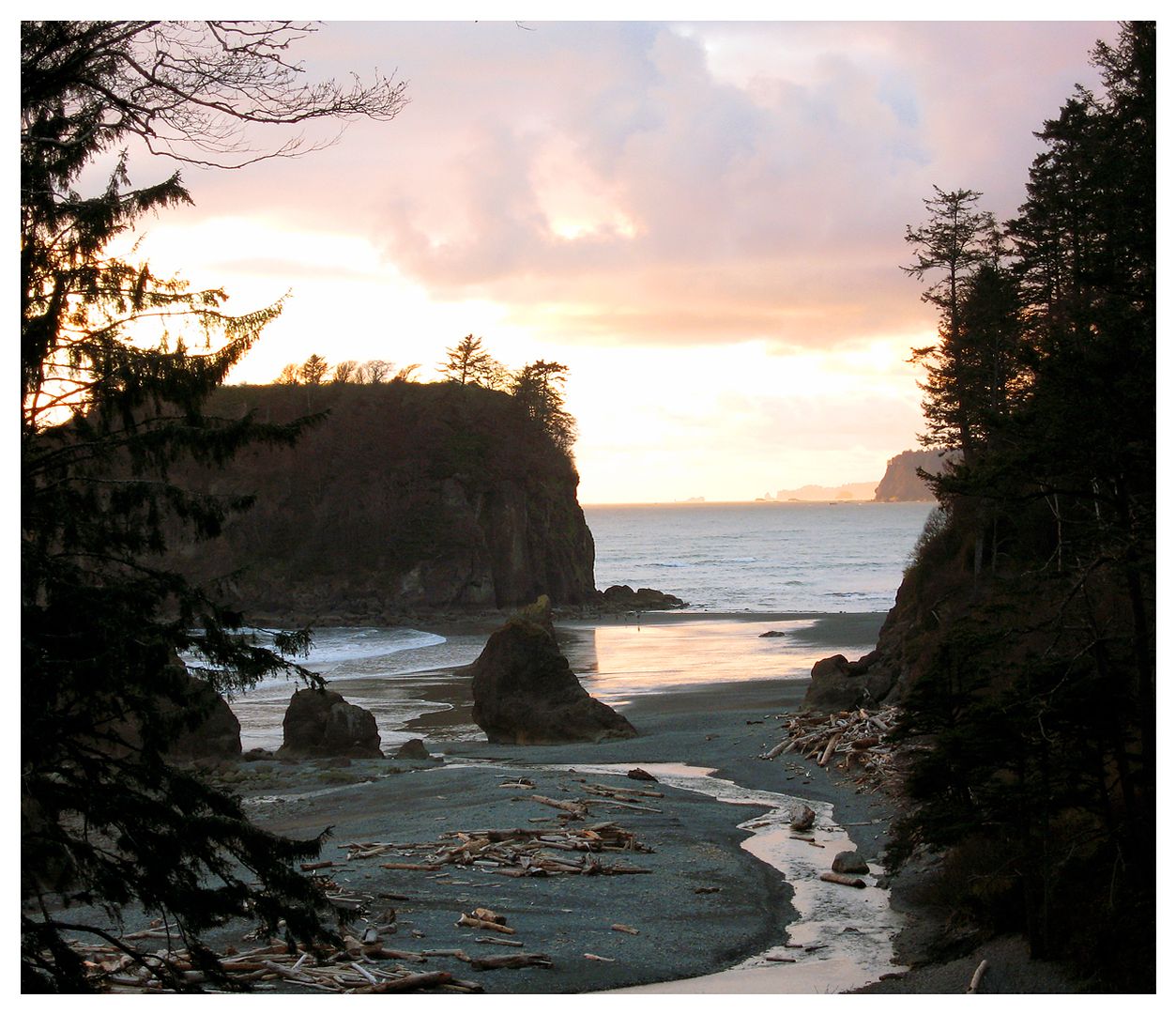
Although I, too, would like to see more cultural and racial variety on our parks' trails, further developing the parks with WiFi towers and concert venues would be a myopic and ultimately fruitless move. Few areas of the American landscape afford us with the opportunity to "tune in" by tuning out, and the National Park Service should not fundamentally alter its mission in an effort to appeal to younger and more diverse demographics.
Instead, the NPS needs to celebrate the conservation heroes of color -- Majora Carter and Van Jones, for example, as well as the growing number of African American and Latino NPS rangers -- thereby providing role models for today's youth. Most importantly, we need more programs that get urban kids into our parks, encouraging them to recognize that these tracts belong to them. It's possible that their time afield without phone calls, Facebook, and Reddit will stay with them, appreciated, even if they're less than enthusiastic about the mosquito bites.
Photo credit: Christopher Reiger, 2008
Monday, August 19, 2013
A Tonto Inventory
During the summer of 2003, I spent a week rafting on the Colorado River. Our flotilla bounced, rolled, and cheered its way down the river's major rapids, but there was also ample time for floating on the current and letting the Grand Canyon's magnificence wash over us. At night, we cooked and camped on the river's beaches. A few memories of the trip are especially clear: I recall encouraging the youngest members of our party to avoid harming the spiny lizards they chased around camp; rejoicing when I encountered rattlesnakes and scorpions during side hikes; and, on the last night of the trip, listening to a passionate talk by one of our guides about the Colorado's dwindling water flow. Above all, though, I remember the sublime beauty of the landscape.
Until this summer, ten years after that unforgettable trip, the river week was my only experience of the American Southwest, and I've wanted to return to the region for some time. When a good friend (and fellow natural history nerd) called me earlier this year and suggested we carve out some time to visit Arizona's Tonto National Forest, I was easily persuaded.
We spent most of our weeklong visit exploring the high desert trails and fire roads of Tonto's north central tract, but we also had an opportunity to spend a little time in the National Forest's southern reach, at the edge of the Sonoran Desert. It was a treat to meet so many species new to me and to have intimate encounters with other animals, like elk, that I'd previously seen in habitats very different from that of the high desert.
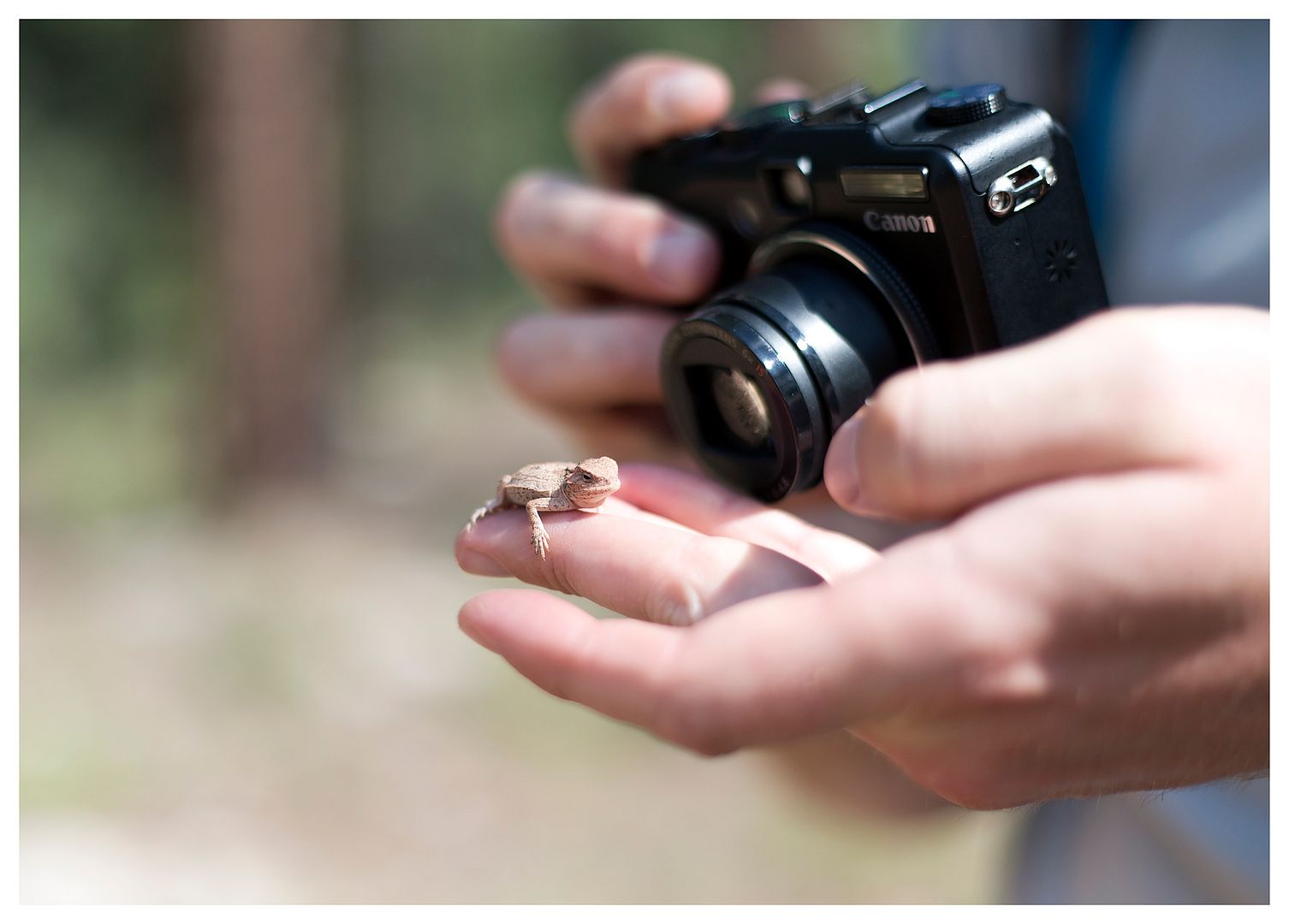 |
| Christopher Reiger "Greater short-horned lizard; Fire Road 1170; Tonto National Forest, AZ; August 2013" |
Until this summer, ten years after that unforgettable trip, the river week was my only experience of the American Southwest, and I've wanted to return to the region for some time. When a good friend (and fellow natural history nerd) called me earlier this year and suggested we carve out some time to visit Arizona's Tonto National Forest, I was easily persuaded.
We spent most of our weeklong visit exploring the high desert trails and fire roads of Tonto's north central tract, but we also had an opportunity to spend a little time in the National Forest's southern reach, at the edge of the Sonoran Desert. It was a treat to meet so many species new to me and to have intimate encounters with other animals, like elk, that I'd previously seen in habitats very different from that of the high desert.
Sunday, January 20, 2013
"Private Frontiers" at Hosfelt Gallery
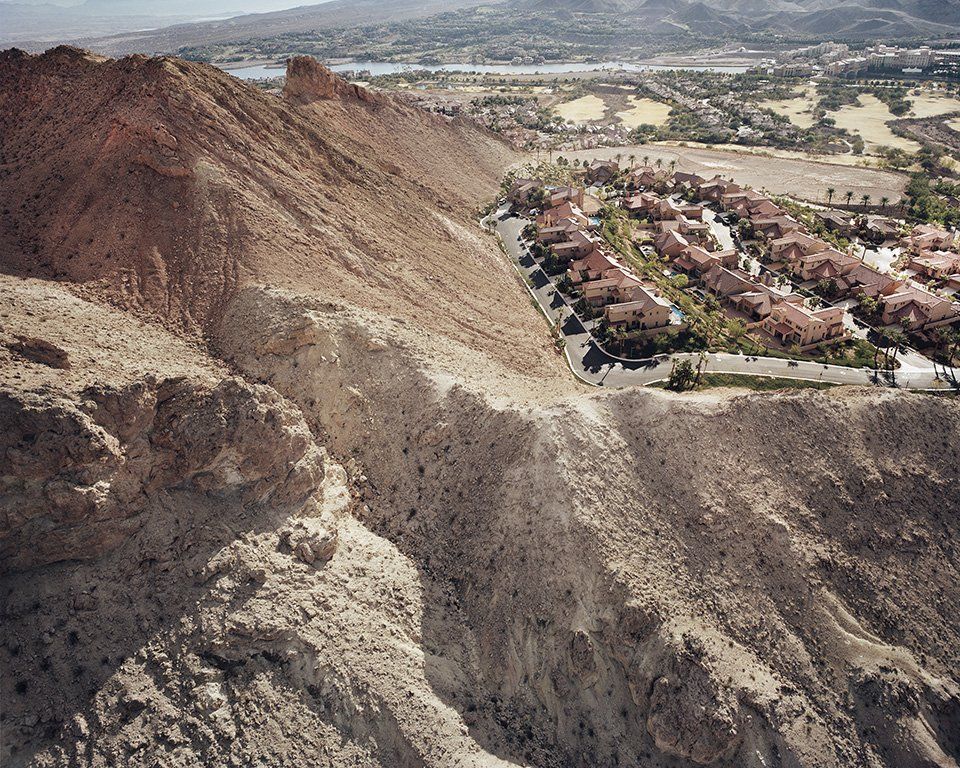 |
| Michael Light "Lake Las Vegas 2010-2012 20. 'Casa Palermo' Lake Las Vegas Homes Looking Southwest, Henderson, Nevada" 2010 Pigment print mounted on aluminum 40 x 50 inches Edition of 5 |
I recently visited Hosfelt Gallery's impressive new space, currently home to "Private Frontiers," a two person show featuring works by Brooklyn-based painter Chris Ballantyne and San Francisco-based photographer Michael Light. According to the press release, the two artists "have been in dialogue for the past year to develop work that examines the human urge to stake territory and its more absurd manifestations on the American landscape." Whatever the specifics of the artists' conversation, Ballantyne's paintings are a terrific compliment to Light's large-format aerial photographs. Exhibited on their own in the expansive Hosfelt loft, Ballantyne's colorful and occasionally whimsical works would risk being swallowed up as bittersweet morsels. Hanging alongside Light's grand photographs, though, Ballantyne's modestly-sized pictures comport themselves especially well; their affability and humor endure, but undercurrents of earnestness and melancholy, too easily missed if exhibited on their own in so airy a space, are amply felt.
Thursday, August 16, 2012
Platte Clove Residency: Coastal Differences
 |
| View of Devil's Path Trail; Catskills; NY; July 2012 |
Five years ago, while traveling in South America, I met a young woman from the West Coast of the United States. After the trip, we corresponded for a while, and she related news of her move from southern California to New England. An outdoorsy sort, she prioritized exploration of the parks in her new neck of the woods, but she wrote that the eastern forests unnerved her. During the summer months especially, they seemed dense and suffocating, a patchwork of green that closed in around her.
At the time, her observation amused me. Having grown up on the East Coast, I was at home in the mixed deciduous and pine forests of eastern North America. By contrast, the Endor-like redwood and sequoia forests of the Pacific coast and the mixed coniferous forests of the continental divide and the American Southwest, environments in which I'd had little or no experience but with which my friend was very familiar, seemed otherworldly to me.
Friday, August 10, 2012
Platte Clove Residency: John Muir and the View From the Precipice
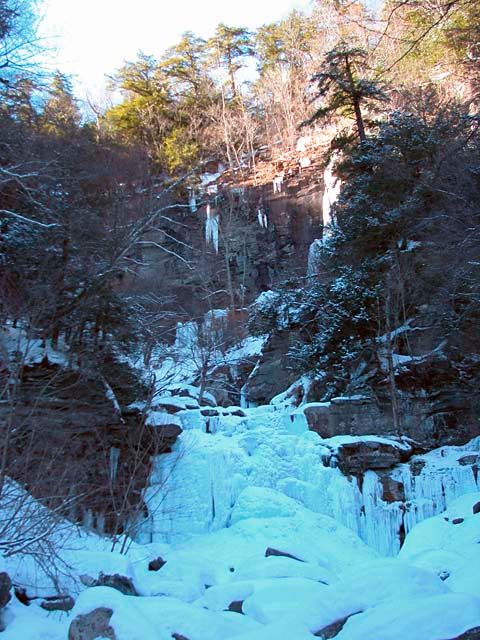 |
| Winter view of Platte Clove's Bridal Veil Falls; Catskills; NY |
“Many people have been killed after falling and sliding off the edge. Especially in areas where there are pine needles. Dangerous conditions exist in many locations. The number of deaths over the years is staggering. Be overly cautious when in this region, and do not take un-necessary risk.”I hesitated before deciding to investigate the unmarked spur of the Platte Clove Nature Preserve's Plattekill Falls Trail. Having recently read a bit about the geology and topography of the Catskill Escarpment, I knew that the preserve is located near the top of a deep ravine that tumbles suddenly down and eastward to meet the Hudson Valley (clove is the Dutch word for a mountain gorge). I’d also learned that each year a handful of foolhardy or unlucky hikers fall to their deaths on Platte Clove area trails. An online trail guide I’d browsed prior to the residency urged hikers to be “overly cautious.” Nevertheless, once I’d stepped off the main path and advanced a few steps down the spur, I was self-assured; I wouldn’t be one of 2012’s casualties. Prudent types like me don’t fall off cliffs.
- “Upper Platte Clove” page of Catskill Mountaineer website
Friday, February 10, 2012
Chris McCaw: Drawing Time
 |
| Chris McCaw "Sunburned GSP#420 (Arctic Circle, Alaska)" 2010 Unique gelatin silver paper negative 12 x 20 inches |
Friday, January 13, 2012
Big Sky Country
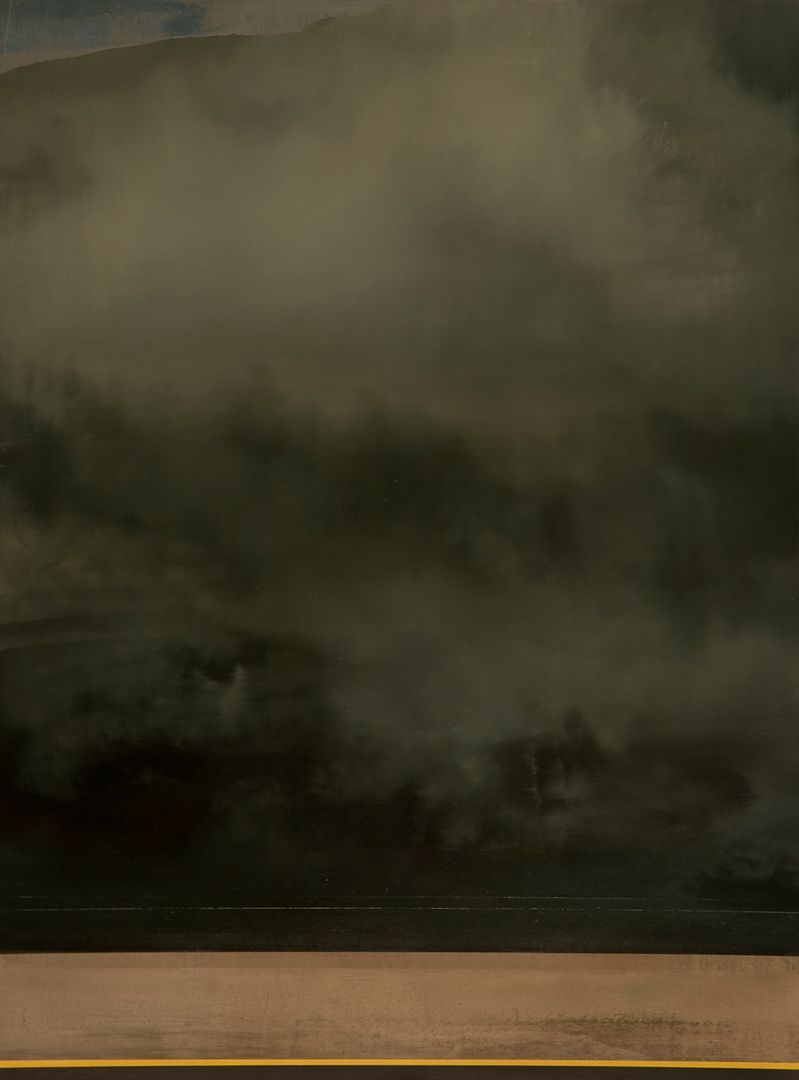 |
| Christopher Saunders "Whitenoise no. 1" 2008 Oil on linen 24 x 18 inches |
In a 2009 post about painter Christopher Saunders' "Whitenoise" series, I recounted philosopher Arthur Schopenhauer's hierarchy of aesthetic experience and connected it to Saunders' work.
"In his volume The World As Will and Representation (1818), Schopenhauer elucidated a scale of aesthetic experience. At one end of this spectrum, he described the 'Feeling of Beauty' as 'Light...reflected off a flower. (Pleasure from a mere perception of an object that cannot hurt [the] observer.)' At the other end of the spectrum, the philosopher positioned the 'Full Feeling of Sublime' and the 'Fullest Feeling of Sublime.' These categories are described, respectively, as 'Overpowering turbulent Nature. (Pleasure from beholding very violent, destructive objects.),' and 'Immensity of Universe's extent or duration. (Pleasure from knowledge of observer's nothingness and oneness with Nature.)'
Sunday, November 27, 2011
Elisheva Biernoff's "Inheritance"

"Inheritance"
2010
80 slides of endangered wilderness areas projected onto mist from a humidifier housed in a plywood and fabric enclosure
Environmental historian William Cronon argues that "only people whose relation to the land was already so alienated could hold up wilderness as a model for human life in nature, for the romantic ideology of wilderness leaves precisely nowhere for human beings actually to make their living from the land." I recalled Cronon's incisive critique of wilderness ideology as I pondered artist Elisheva Biernoff's "Inheritance," a compelling installation included in Eli Ridgway Gallery's recent group show, "Better A Live Ass Than A Dead Lion."
"Inheritance" was installed in a dark side gallery on Ridgway's lower level. A wall-mounted, carousel slide projector cast images of "endangered wilderness areas [...] onto mist from a humidifier housed in a plywood and fabric enclosure." The humidifier's fog billowed out of a television-sized opening cut into the plywood, and the projected photographs reflected by the haze were sometimes -- for an instant, when the mist was just so -- recognizable as landscapes, but rarely as specific environments or locations. Without the artist's accompanying list of "disappearing places," viewers couldn't know they were looking at Alaska's Tongass National Forest, Florida's Everglades, Brazil's Pantanal, China's Gobi Desert, or another of nearly 80 imperiled landscapes.

"Inheritance"
2010
80 slides of endangered wilderness areas projected onto mist from a humidifier housed in a plywood and fabric enclosure
Biernoff's installation, which was also included in ProArts Gallery's 2010 "2 X 2 Solos" exhibition program (and, by virtue of its strength, will likely be a part of future exhibitions), is luminous and its effect almost ethereal, but unlike the meditative Light and Space works of James Turrell or Doug Wheeler, Biernoff's installation doesn't provide opportunity for reverie. The transitions between the images are abrupt, and marked by the noisy, mechanical advance of the slide carousel. Ka-jenk, Ka-jenk. Just as we begin to discern the vision roiling in the mist -- 'Is that a jungle? Perhaps a swamp?' -- we're jarred from our musing. Ka-jenk, Ka-jenk. Again, we endeavor to interpret the play of light and color in the vapor, and again: Ka-jenk, Ka-jenk! A contemplative inclination is foiled by the machine's relentless progress, and there's sly humor in Biernoff's frustration of our stubborn need to identify and classify; viewers can see the specters in the mist, but can't make much (if any) sense of them. Even so, we'll continue to plumb the rolling fog for clues.
Our ancestors assigned supernatural qualities to fluid media. They scried smoke to portend future events and viewed it as a vehicle of conveyance, capable of carrying the essence of a sacrifice to the god or spirits of a people. In "The Wizard of Oz," the face of the eponymous wizard appears to the protagonists in a cloud of reddish smoke, causing them to tremble in awe. Seeking a similar experience of wonder, many of the people who visit wilderness areas do so to behold nature's majesty. Their language is often reverent; they speak of the sublime and the transcendent. But what is a wilderness area, exactly? According to the United States Wilderness Act of 1964, wilderness is land that "generally appears to have been affected primarily by the forces of nature, with the imprint of man's work substantially unnoticeable [...that is] designated for preservation and protection in [its] natural condition." Unfortunately, the "imprint of man" is not always readily observable (consider the nuanced affects of climate change or the irradiated, if picturesque Red Forest that surrounds the decommissioned Chernobyl Nuclear Power Plant). More problematically, as Cronon makes clear, the Wilderness Act definition sets man apart from "the forces of nature." This latter move is a Romantic, naive impulse. All habitats are interconnected; even protected landscapes are affected by activities outside their boundaries. Moreover, because many refuges, parks, and wilderness areas are disconnected from other undeveloped lands, the flora and fauna living in these protected areas risk genetic isolation and face an increased risk of local extinction (e.g., the Florida panther and many other critically endangered species). Outside of the Wilderness Act and our collective imagination, then, there is no "original" or "virgin" landscape.
The dreamlike quality of Biernoff's installation is therefore appropriate. The notion of "wilderness" is as indefinite as the mirages the artist creates for us with light and vapor. Some fictions, though, are useful. If the dream of Eden compels us to be better stewards, it's all for the good. Yet Biernoff reminds us that we're more likely to avoid the pitfalls of ideology if we recognize wilderness is an illusion, that the specter before us is manufactured using a humidifier and an outmoded piece of technology. The artist presents us with the wizard's face, but also reminds us of the man behind the curtain.
Elisheva Biernoff's "Inheritance" was on view October 8 - November 5, 2011, at Eli Ridgway Gallery (172 Minna Street, San Francisco).

"Inheritance"
2010
80 slides of endangered wilderness areas projected onto mist from a humidifier housed in a plywood and fabric enclosure
Image credits: "Inheritance" installation photographs, courtesy Eli Ridgway Gallery
Note: Due to carelessness, this write-up was originally published as a "Review In Brief." It's longer than the pieces in that series, however, and is no longer associated with it.
Monday, October 24, 2011
Art Practical: Michelle Fleck

"Picket Fence"
2011
Acrylic on panel
18 x 24 inches
My write-up of artist Michelle Fleck's "Somewhere," her solo exhibition at Park Life Gallery, is included in the most recent issue of Art Practical. The review appears in AP's Shotgun Reviews department. Read it here.
"Landscape in art," writes the English academic Malcolm Andrews, "tells us, or asks us to think about, where we belong." Fleck's paintings are part of this vital tradition, and are on view at Park Life through October 30th.
Image credit: courtesy Park Life Gallery and Michelle Fleck
Sunday, September 04, 2011
"Secret Garden"

"living, moving, in the space between"
2009
Gouache, watercolor, and marker on Arches paper
15 x 14 7/8 inches
Four paintings and drawings of mine from 2010 and 2009 are included in "Secret Garden," a group exhibition opening later this week at Denise Bibro Gallery, in New York City.
From the exhibition's press release:
"Nature plays the perpetual muse for the six contemporary artists in this exhibition. Featuring work by Roberley Bell, Peter Bynum, Sara Crisp, Erica-Lynn Huberty, Ysabel Le May, and Christopher Reiger, each artist offers their own innovative, distinctive response to the sublime wonder of the landscape, flora, and fauna, inviting the viewer into their own secret garden. [...] Contemplating man's mutable conception of nature and our place in it, Christopher Reiger's works on paper incorporate scientific and mathematical symbols, hieroglyphs, animals, and plant life. Mysterious equations are drawn, creatures peer out from unlikely vegetation, and the garden becomes curiouser and curiouser."I won't be in NYC for the exhibition, unfortunately, but if you're in that neck of the woods, please visit the show.
Denise Bibro Fine Art
529 West 20th Street, #4W
New York, NY 10011
Exhibition dates: September 8 - October 8, 2011
Opening reception: September 15, 2011; 6-8pm
Sunday, May 16, 2010
Susan Silas' Heroic Living

"found birds; 2000 - the present"
(Image 17 of 23 from the portfolio "eyes wide shut")
2010
Archival ink jet prints on Hahnemühle photo rag paper
22 x 17 inches
Until recently, I was unfamiliar with Susan Silas' artwork. She is perhaps best known for projects memorializing the Shoah, but it wasn't an awareness of her Holocaust work that led me to "Helmbrecht's Walk, 1998-2003." Instead, it was a photograph of a dead American kestrel that Silas emailed me in March.
I have only an inkling of what essay or artwork of mine inspired the artist to send me the image, but I'm grateful that she did. I shamelessly admit to being the sort who finds soulful beauty in images of death, and I was touched by the striking and contemplative photograph. A month after I received the picture, I visited Silas in her Brooklyn home, to look at prints from her "found birds" series. Still pondering her work a week after that visit, I headed to Hebrew Union College's Jewish Institute of Religion Museum, eager to compare what I saw and sensed in "found birds" to Susan's more easily classifiable (though by no means "easy") Shoah work.
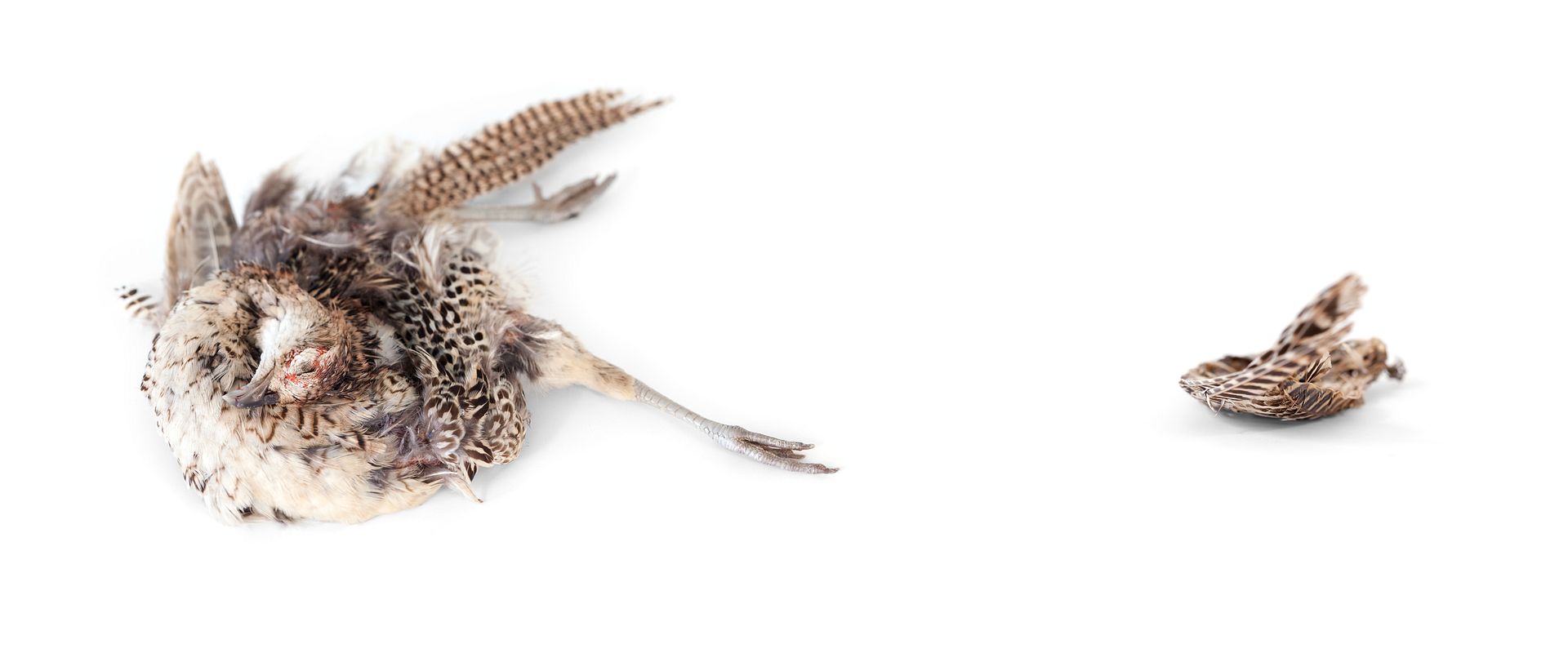
"found birds; 2000 - the present"
(Image 3 of 11 from the portfolio "what remains")
2010
Archival ink jet prints on Hahnemühle photo rag paper
20 x 48 inches
The HUC press release for "Helmbrecht's Walk" describes the project succinctly.
"On April 13, 1945, more than 700 women were forced to march 225 miles in 22 days from the Helmbrecht's Labor Camp, a small satellite unit of the Flossenburg Concentration Camp in Germany, to the Czech city of Volary. [...] During the course of this forced march the women were ill fed, inadequately clothed, denied shelter, and capriciously beaten. On the sixth day of the march, the non-Jewish prisoners were separated from the group, leaving the remaining 580 Jewish women to continue until May of 1945.Silas' project addresses the complicated relationship between place and time or, as cultural critic and historian Simon Schama's consideration of the topic framed it, "landscape and memory." When Silas conceived of the Helmbrecht's project, she believed (or maybe hoped) that walking the same path that the Helmbrecht's women had would allow her some intimate experience of or insight into the terrible march. In fact, this didn't prove so. Silas describes her walk as "relatively mundane and unexceptional." She continues, "My feet hurt. I get tired. [...] I found it more, rather than less difficult to understand how these women made this journey once I was out on the road."
With determination and sensitivity, Silas traced the march in 1998 on the 53rd anniversary of the event by walking along the same path as the Helmbrecht's women for 22 days in Germany and the Czech Republic. She documented her journey in Helmbrecht's Walk, a collection of 48 archival color prints presented as an unbound book. [...] The images contextualized by Silas' daily commentary of her own experiences are coupled with news reports of event occurring elsewhere in the world on that same day in 1998. This juxtaposition, she says, functions 'to heighten our awareness of the fact that we are all presently witnesses to unspeakable events and extreme suffering for which we take no more responsibility than did many witnesses to the Holocaust.'"
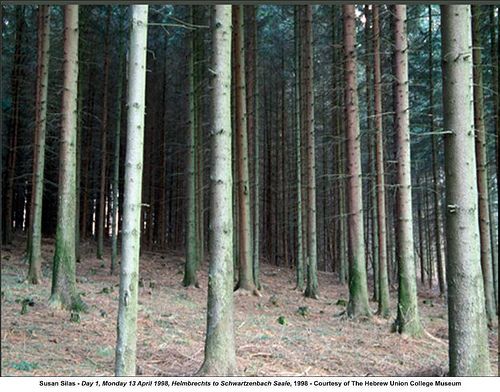
"Helmbrecht's Walk, 1998 - 2003"
(Day 1, Monday 13 April 1998, Helmbrechts to Schwartzenbach Saale, 1998)
Archival ink jet prints on Hahnemühle photo rag paper
Yet many of the captions she includes with the photographs reference artists and thinkers such as Werner Herzog, who understand "walking as a sacrament." Such language calls to mind the Australian Aborigines' songlines, mnemonic stories that are spoken or sung as the Aborigine walks over the referenced terrain. In his marvelous book Spell of the Sensuous, David Abram relates a striking, relevant anecdote.
"A similar tale is told by [Bruce] Chatwin. He was traveling in a Land Cruiser with several friends, including an Aboriginal man nicknamed Limpy whom they were driving to a particular place on his songline. Limpy, whose clan Ancestor was the Native Cat, or tjipla (a small marsupial with a long, banded tail), had never been to this place along the Native Cat songline, yet he now wished to go there in order to see some distant relatives who were dying there. During the course of seven hours driving through the back country, bumping across shallow rivers and under gum trees, the Aboriginal man sat motionless in the front seat, squeezed between the driver, Arkady, and another passenger, except for a short burst of action when the truck crossed part of his songline. Later,I believe that what was missing for Silas was a story line, the narrative informed by the landscape (and vice versa) that, among indigenous groups such as the dwindling Aboriginal population of Australia, is traditionally passed from generation to generation. In some respects, "Helmbrecht's Walk" is an attempt to locate such a story, an earnest effort to discover in the landscape the marks of what happened decades before. In our postmodern, peripatetic culture, nations and traditions do not generally fare well. In some respects, this is a positive development, as our tribal perspectives and prejudices erode into some variety of tentative, liberal pluralism. On the other hand, it's ever more difficult to feel confident about one's identity and how it relates to landscape, vocation, and nation.'[w]e came to the confluence of two streams: that is, we met the stream we had crossed higher up on the main road. This lesser stream was the route of Tjilpa Men, and we were joining it at right angles. As Arkady turned the wheel to the left, Limpy bounced into action. Again he shoved his head through both windows. His eyes rolled wildly over the rocks, the cliffs, the palms, the water. His lips moved at the speed of a ventriloquist's and, though them, came a rustle: the sound of wind through branches.
Arkady knew at once what was happening. Limpy had learnt his Native Cat couplets for walking pace, at four miles an hour, and we were traveling at twenty-five. Arkady shifted into bottom gear, and we crawled along no faster than a walker. Instantly, Limpy matched his tempo to the new speed. He was smiling. His head swayed to and fro. The sound became a lovely melodious swishing; and you knew that, as far as he was concerned, he was the Native Cat.'"
My time with "Helmbrecht's Walk" confirmed my supposition, however, that Susan's art is not primarily interested in cultural identity or particular histories. Instead, she is most concerned with "the big questions." To one degree or another, all art wrestles with or reacts to these existential imponderables, but Susan's exploration is more focused and urgent than most. Fortunately, even though her work is preoccupied with mortality and meaning, she manages to avoid the pitfalls of such terrain; her work is neither macabre nor aestheticized to the point of anesthetization.

"found birds; 2000 - the present"
(Image 1 of 21 from the portfolio "blackbird")
2010
Archival ink jet prints on Hahnemühle photo rag paper
22 x 17 inches
Two days after I visited "Helmbrecht's Walk," I read "Eudaimonia, existentialism, and the practice of medicine," an essay by Dr. Andrew Radu included in the Spring 2010 issue of The Pharos of Alpha Omega Alpha Honor Medical Society. In his essay, Dr. Radu describes the existentialist ideal of tragic optimism. He writes of it, "even in the face of imminent death, we have the ability to reevaluate life." He goes on:
"A crucial concept held by many existentialist philosophers is that of heroic living. All humans have the ultimate freedom to live boldly in the face of tragedy. Living with this concept makes attaining a goal of eudaimonia less important than simply striving to do so. [...] The concept of tragic optimism proposes that in a life that can be circumscribed by pain, guilt, and death, one should say 'yes to life in spite of everything.'"Indeed, as I wrote in "Eudaimonia," a January 2009 essay that explored my then nascent optimism,
"Acknowledging our species' precarious position is not defeatist; on the contrary, accepting the inevitable nourishes the individual's desire to contribute. Faced with an impossibly difficult prospect, only individual effort can sustain us. As Albert Camus concluded in The Myth of Sisyphus, 'The struggle itself is enough to fill a man's heart. One must imagine Sisyphus happy.'"The Shoah is bleak history, a subject watered by the blood of millions, and it is fertile soil for such "big questions." Silas' "found birds" remind us that so, too, is the striving and passing of a blackbird. The artist's reckoning with death is her own form of "heroic living."
Image credits: all artwork, courtesy Susan Silas
Wednesday, May 12, 2010
More Amy Talluto

"Sweet William"
2008
Oil on canvas
60 x 74 inches
I've written about or otherwise featured Amy Talluto's dramatic landscape paintings on HH several times before...and for good reason. She's one of the best contemporary landscape painters working.

"Maple Forest"
2008
Oil on canvas
80 x 60 inches
Saturday, January 23, 2010
Quantity or Quality?

"Passage"
2009
Acrylic on Panel
24 × 48 inches
"The world we inhabit is not, in this sense, a determinate set of objective processes. It is our larger flesh, a densely intertwined and improvisational tissue of experience. It is a sensitive sphere suspended in the solar wind, a round field of sentience sustained by the relationships between the myriad lives and sensibilities that compose it. We come to know more of this sphere not by detaching ourselves from our felt experience, but by inhabiting our bodily experience all the more richly and wakefully, feeling our way into deeper contact with other experiencing bodies, and hence with the wild, intercorporeal life of the Earth itself.David Abram's essay "The Air Aware" eloquently expands on ideas that I attempt to present succinctly in my artist statement. Brevity is difficult, however, for those of us who are preoccupied with the exciting interchange of anthropology, ecology, ethology, phenomenology, and theology.
[...]
In truth, it’s likely that our solitary sense of inwardness (our experience of an interior mindscape to which we alone have access), is born of the forgetting, or repressing, of a much more ancient interiority that was once our common birthright: the ancestral sense of the surrounding earthly cosmos as the voluminous inside of an immense Body, or Tent, or Temple.
[...]
Experiential qualities once felt to be proper to the surrounding terrain—feeling-tones, moods, the animating spirits-of-place known to reside in particular wetlands and forests—all lost their home with the dissolution of the enclosing, wombish character of the pre-Copernican cosmos. Such qualities now had no place in the surrounding world, itself newly conceived as a set of objects connected by purely external, mechanical relationships: a world of quantities. Unlike quantities, qualities are fluid, mercurial realities arising from the internal, felt relations between beings. Qualities—these ephemeral and fluid powers—require at least a provisional sense of enclosure to hold them. When they could no longer be contained by the visible world (no longer encompassed and held within the curved embrace of the spheres), these ambiguous, ever-shifting qualities quit the open exteriority of the physical surroundings, taking refuge within the new interiority of each person’s 'inner world.' Henceforth they would be construed as merely subjective phenomena."
- David Abram, "The Air Aware", Orion Magazine, September/October 2009
It's interesting, then, that the work of visual artists who explore this conceptual terrain is often quietly awesome. Interesting...and yet so natural.
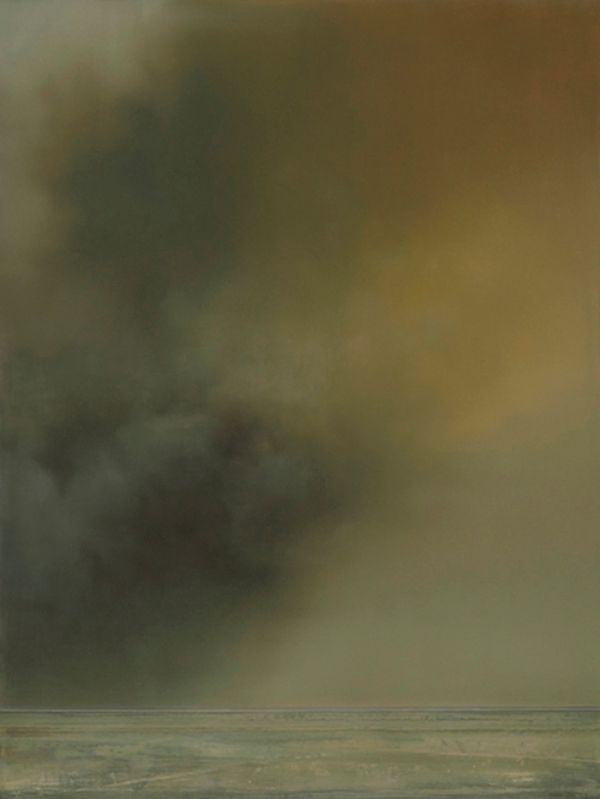
"Whitenoise Suite no.6"
2009
Oil on linen
24 x 18 inches
Image credits: both painting reproductions, courtesy the artists
Wednesday, December 02, 2009
Christopher Saunders' "Whitenoise"
"Whitenoise no.8"
2009
Oil on linen
24 x 18 inches
A regular passenger on New York City's subway system, I'm grateful for the Metropolitan Transit Authority's "Poetry in Motion" and "Train of Thought" programs, efforts that repurpose subway advertising space as a showcase for poetry or significant quotations. This week, I noticed the German philosopher Arthur Schopenhauer's quotation, "Every man takes the limits of his own field of vision for the limits of the world." I appreciate the substance of Schopenhauer's cynical observation, but I would amend his statement. Certainly, too many men do take the limits of their field of vision for the limits of the world, but the truly reverent man does not mistake the two for the same. As the critic, author, poet, and essayist Wendell Berry describes it, "to feel reverence, to be reverent, is exactly to surrender the 'precious self.'" In surrendering the self, we accept our insignificance, we recognize the infinitesimal reach of our individual vision. And yet, counter intuitively, this same surrender of self also opens our field of vision to the infinite variety and scope of being; through negation, liberation.
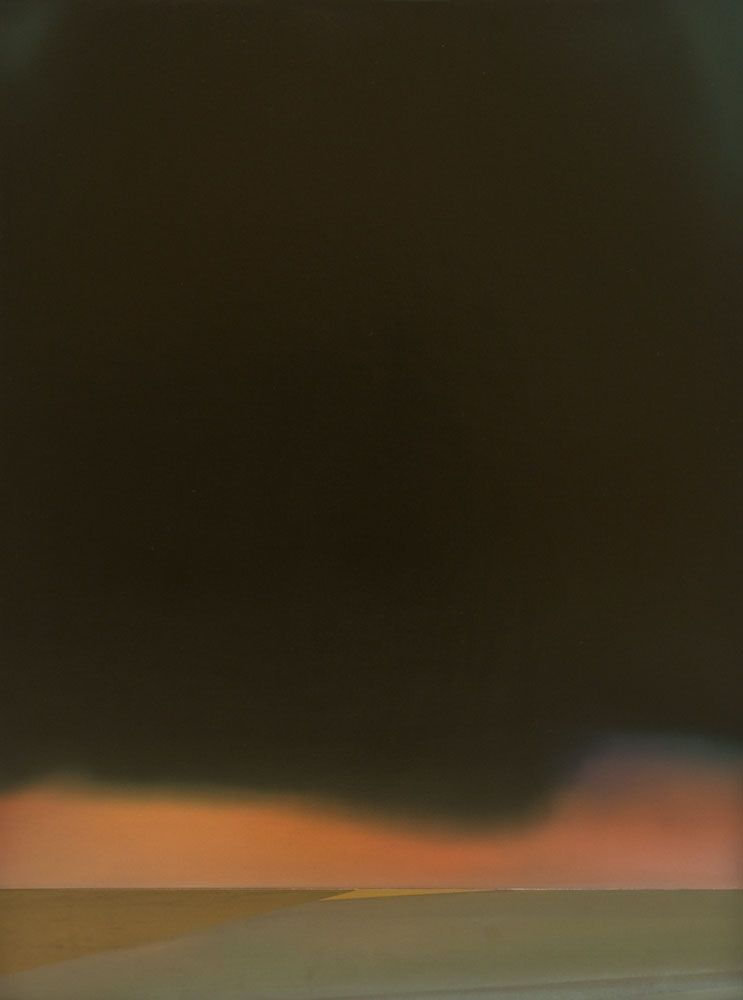
Schopenhauer and Berry again came to mind as I contemplated Christopher Saunders' "Whitenoise" paintings in LaViolaBank Gallery's group exhibition "Outside In." (1) Dark and cloudy skies dominate Saunders' vistas, and the horizon in these flatland pictures draws a conspicuous boundary between sky and earth. In "Whitenoise Suite no.4," an ominous storm front moves over a lonely stretch of highway; a pitch veil chases away a sunset in "Whitenoise Suite no.8"; and in "Whitenoise Suite no.9," a brooding twilight settles above a tarmac. There are echoes of Mark Rothko's luminous melancholy in Saunders' work, but his atmospheric paintings seem most akin to the Romantic landscapes of the 17th, 18th, and early 19th centuries.
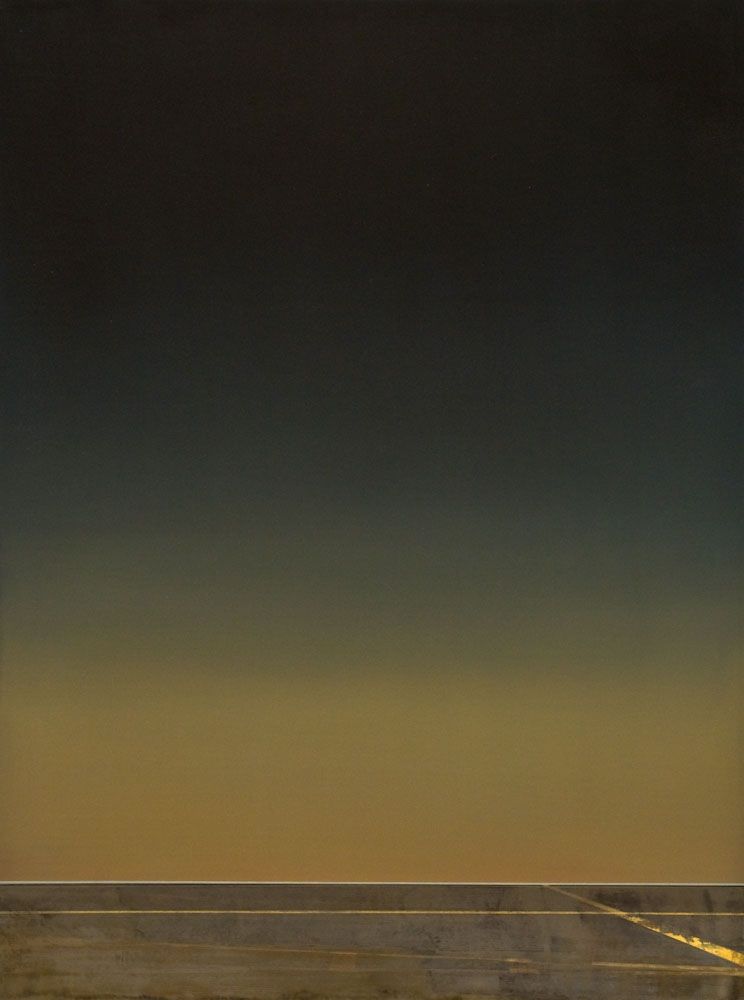
"Whitenoise no.9"
2009
Oil on linen
24 x 18 inches
Caspar David Friedrich is perhaps the most celebrated painter of the Sublime, and his "Wanderer above the Sea of Mist" (1818) is among the best known examples. The work pictures a well-dressed, solitary gentleman, his back to the viewer, positioned confidently atop a rocky crag as he surveys a vast, mountainous landscape that is mostly obscured by fog. Concurrent with Friedrich's work on the famous painting, his friend Carl Gustav Carus described Sublime experience in a passage that could well have been written in response to "Wanderer."
"Stand then upon the summit of the mountain, and gaze over the long rows of hills. Observe the passage of streams and all the magnificence that opens up before your eyes; and what feeling grips you? It is a silent devotion within you. You lose yourself in the boundless spaces, your whole being experiences a silent cleansing and clarification, your I vanishes, you are nothing. God is everything."Carus' experience of the Sublime is, like Berry's reverence, a reduction or erasure of the self-conscious individual and a simultaneous opening of the individual to the wilderness within. His dramatic description brings us back to the moody Schopenhauer, who prescribed the Sublime as a remedy to his every man limits. In his volume The World As Will and Representation (1818), Schopenhauer elucidated a scale of aesthetic experience. At one end of this spectrum, he described the "Feeling of Beauty" as "Light...reflected off a flower. (Pleasure from a mere perception of an object that cannot hurt [the] observer.)" At the other end of the spectrum, the philosopher positioned the "Full Feeling of Sublime" and the "Fullest Feeling of Sublime." These categories are described, respectively, as "Overpowering turbulent Nature. (Pleasure from beholding very violent, destructive objects.)," and "Immensity of Universe's extent or duration. (Pleasure from knowledge of observer's nothingness and oneness with Nature.)" At the amplitude of "Fullest Feeling," then, Schopenhauer's aesthetic philosophy is reconciled with that of Carus and Berry.
Most modern humans (especially modern humans in the First World) are insulated from inclement weather. We fret over a rained-out ball game or beach party, but we rarely tremble before dark cloud heads; our appreciation of the elements is principally one of admiration, an aesthetic experience that resides near the middle of Schopenhauer's scale. But Saunders' landscapes provide viewers with a vantage point that repairs the reverent awe that we once felt before the expansive firmament. He does not include the rugged, mountainous imagery familiar to most artistic depictions of the Sublime. Instead he portrays clouds pushing over a featureless land, the violent potential of atmospheric flux readily observable at a distance. The clouds, vast, magnificent, menacing, dominate Saunders' compositions; they are the rough mountains of our inner wilderness. Despite the "Whitenoise" paintings' relatively small size, their effect is formidable. Before the strongest in the series, I stood quiet.
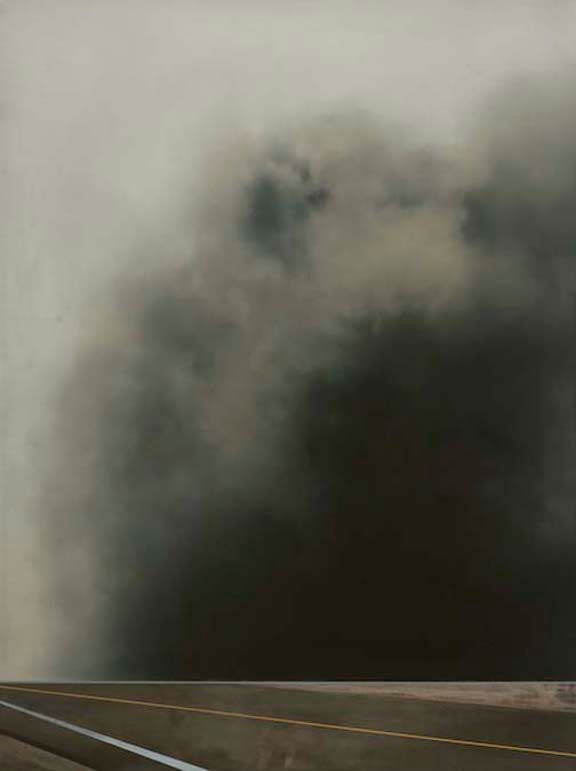
"Whitenoise no.4"
2008
Oil on linen
24 x 18 inches
(1) Although Saunder's oil paintings preoccupied my imagination, related ideas are addressed by the work of other artists included in the "Outside In" exhibition. I also admired Diane Carr's fluid and evocative landscape paintings, Leighton Pierce's hypnotic video of a woman underwater, and Mira O'Brien's photographic floor installation.
Imaged credits: all Christopher Saunders' works, courtesy of the artist
Thursday, August 09, 2007
Back From The Pantanal
Some Pictures and Thoughts

Bird's eye view of the Pantanal (Pantanal, Brasil)
I'm sun burnt, marked by half-healed tick and mosquito bites, and still nursing a few infected cuts on my feet, but I'm back in the New York City harness. Part of me is happy to be home, but I already feel the burden of our frivolous "first-world" pressures and distractions. I've been confirming studio visits and dinner dates, dragging my feet through two weeks of unattended email, catching up with piles of paperwork at the day job, and stressing over how few paintings I've so far completed in '07. By contrast, in the Pantanal my worries were limited to hydration, securely taping shut my pant legs (to discourage ticks), and accurately recording census data. My time there was stress free and I was therefore better able to fully appreciate the experience.

Anchored water hyacinth (Eichhornia azurea) flower near shore of bahia at Pousada Ararauna
It helped, of course, that I was surrounded by people who share my enthusiasm for wildlife and ecology. I was one of eleven volunteers hailing from Ireland, California, Colorado, Ohio, and New York. The researchers we assisted in the Pantanal work on three different projects. "Amphibians and Reptiles of the Southern Pantanal" is headed by Ellen Wang, a Ph.D. candidate at Sao Paulo State University. "Birds and Dynamic Habitat Mosaics" is led by Dr. Reginaldo Jose Donatelli (Sao Paulo State University) and Gustavo Rosa. "Ecology and Conservation of Pantanal Otters" is led by Dr. Helen Waldemarin, but I worked with Manoel Muanis, a M.Sc. candidate at Federal University of Rio de Janeiro. All three projects were of interest to me but, as those familiar with my affection for serpents would assume, I was most excited by the herpetology work.

Clemuso holding cat-eyed snake (Leptophis annulata); this fellow was captured inside Frank and Nicki's toilet; very calm. non-venomous colubrid species, but often mistaken for the venemous and much maligned Fer-de-lance (Bothrops asper) (Pousada Ararauna, Pantanal, Brasil)
The official project abstract describes the Pantanal as follows. "The Middle Rio Negro region of the Brazilian Pantanal, where this research takes place, is a relatively pristine area with high conservation status. Deforestation has been minimal, access via roads is difficult and the main commercial activity is low-impact cattle ranching using native pastures." I don't find that description entirely accurate. Although the Panatal is a UNESCO World Heritage Site and is considered the world's largest tropical wetland, it is not what most of us would deem "pristine." Cattle are ubiquitous, and although the Pantaneiros, the longtime residents and cowboys of the Pantanal, have restricted their cattle-related deforestation, the large herds have a visible impact on the ecology of the wetlands. There are 55 cattle for every 1 person in the Pantanal, an estimated 4.5 million cattle in all.

Contrast of defrested cattle land and "natural" makeup of the Pantanal, as seen from air on flight out to research site
Prior to traveling to Brazil, I imagined the Pantanal to be a relatively virgin area, with few visible human marks. In fact, it more closely resembles a Texas ranch. Barbed wire fences are ubiquitous (fortunately, excepting some large deer, all wildlife species can pass through them without problem) and sandy roads crosshatch the landscape when viewed from above. Horses and canoes are still used as the primary modes of transport on the fazendas, but trucks, tractors, and motorboats are just as, if not more, popular.

Ellen closing one of the many fence gates in the Pantanal; the fences are installed by Pantaneiros to regulate cattle movement (Pantanal, Brasil)
But it behooves us to appreciate that the impacts of ranching are not all negative. Because 95% of the Pantanal, which covers an area comparable to the state of Nebraska, is privately owned (the land is divided among the various ranchers) the fazendas protect the ecology of the region. Industry can not so easily move in on private holdings and, better still, some landowners are now opting to set aside small portions of their land for conservation (in return for tax credits and stipends from the Brazilian government). Florida's tropical cattle ranches are similarly valuable to conservation, preventing residential and industrial development from encroaching on critical habitat and fragile ecosystems.
A more serious threat to the Pantanal is the growing global demand for ethanol. With do-gooder "first-worlders" like myself calling for alternative fuels, cash poor countries see a window of opportunity. Sugarcane is among the most popular crops for ethanol production and Pantaneiros must clear-cut before they can plant cane. The fact that biofuel production isn't a Utopian solution shouldn't come as a surprise. Scientists unaffiliated with industry have criticized biofuels for years. David Pimentel, professor of ecology and agriculture at Cornell University, explains, "Ethanol production requires large fossil energy input...Further, its production and use contribute to air, water and soil pollution and global warming." The Sierra Club's Mr. Green adds emphasis, "If you think the industrialized monoculture that fattens livestock is scary, ponder the gloomy prospect of a couple hundred million automobiles feeding off the land." And, if ranching and agriculture in the Pantanal don't take their toll, pesticide and fertilizer runoff from the surrounding highlands may pick up the slack.

One of the adult spectacled caiman (Caiman crocodilus) disturbed by my wading in pousada bahia (Pousada Ararauna, Pantanal, Brasil)
It's difficult to protect a unique ecosystem like the Pantanal when economic development is the Holy Grail. Brazilian environmental agencies talk of "balancing economic sustainability with conservation." Indeed, given our fanatical embrace of neo-classical economics and the neoliberal paradigm, we must try to balance the equation, but I see no reason why we shouldn't also strive to reeducate ourselves, to find viable alternatives to industrial capitalism. Rebecca Solnit writes,

Manoel and John in canoes on river during afternoon otter census (Pantanal, Brasil)
Pousada Ararauna, the lodge where my team of volunteers stayed, is owned by a private university and is dedicated to ecotourism and ecological research; it is located on Santa Emilia Farm, a 6,450 acre property in the southeastern Pantanal. The details (and focus subjects) of the three projects vary, but they all seek to ascertain how tourism, agriculture, and other developments are impacting the biodiversity of the region. The hope of all such research is that the findings will bring more attention to the ecosystem in question and result in more federal protections and environmental awareness on the part of the local landowners.

A pair of Hyacinth macaws (Anodorhynchus hyacinthinus) perched in "para todos" tree in early morning, with moon behind (Pousada Ararauna, Pantanal, Brasil)
My time in Brazil flew by, as it often does when I find myself physically engaged with (and thinking about) ecology. Rather than write a detailed account of the trip, I've listed a few highlights below and I'll post more captioned pictures in coming days. You can also visit my Flickr Brazil set to view more photos.

Pantanal at dusk (Pantanal, Brasil)
Also, for those readers who are wildlife geeks like myself, identification of some of the spiders, insects, fish, amphibians, and reptiles I came across is challenging. Any help would be greatly appreciated.

Hyla alba treefrog species found by Manoel in kitchen bathroom; no common name I can find (Pousada Ararauna, Pantanal, Brasil)
Pantanal Highlights:

A giant armadillo (Priodontes maximus) - the species is threatened or endangered - near bahia at Pousada Ararauna
- Common though they are in the Pantanal (globally, they are endangered), I was thrilled to see giant armadillos (Priodontes maximus). I fancied myself quite the stalker after I managed to move within a few feet of one during my first afternoon at the pousada, but soon learned that the animals are rather mellow and, in fact, easy to catch. (Oh, my bruised ego.) Still, they're charismatic little guys and I was cheered whenever I saw them bumbling along. (FYI: The "giant" in their name is relative; they're not imposing critters.)

Holding a small Red belly piranha (Pygocentrus nattereri) (Pantanal, Brasil)
- I enjoyed catching piranha. The fishing itself is not challenging; you bait a hook with raw meat, toss it over, feel the tugs, and pull up a fish. The Pantaneiros use either a line with no rod (called handlining, which I've done once before, for sharks in Costa Rica) or a reel-less rod with the line attached to the end. You must use a wire leader to prevent the fish from biting off the hook. Needless to say, you must take care when releasing piranha; their teeth and jaws are truly remarkable. We caught two morphological variants of the Red-bellied piranha (Pygocentrus nattereri), as well as several pitanga (Sp?).
Most of the piranha we caught were released, but a few of the larger ones were kept for piranha soup, a Pantaneiro favorite believed to be an aphrodisiac. Because I caught the fish, my dietary restrictions allowed me to eat some of the soup. It tasted like a very salty lentil soup; I couldn't detect the fish flavor at all (and sadly I didn't have an opportunity to see if the recipe made me particularly virile).
- We only saw four species of snake during my time in the Pantanal, but each of them were a thrill. I love to see and handle snakes; they're magical animals in my estimation. The four species we came upon were all diminutive, and we saw nothing of their enormous relative, the yellow anaconda (Eunectes notaeus). I was disappointed by this conspicuous absence but, after years of looking for snakes, I know well that each and every find is a treat.

Holding young spectacled caiman (Caiman crocodilus) used in Lucio's mosquito vector experiment; mouth is taped to prevent unfortunate nips (Pousada Ararauna, Pantanal, Brasil)
- I enjoyed interacting with the spectacled caiman (Caiman crocodilus). I handled a juvenile (being used in a mosquito vector experiment conducted by a researcher at the pousada), and I swam and waded with the reptiles a couple of times, determined to see how close I could get before spooking them. They are alligators, not crocodiles, and are therefore unlikely to mistake a human for a potential meal, especially given their relatively small size (5 to 7 feet). They were most numerous on the river banks, where they rested during the day, absorbing the sun's energy before heading to the water again for evening hunting.

Teri swimming in the caiman pool (Pousada Ararauna, Pantanal, Brasil)
- One night, while walking the small runway near the pousada (the best way to reach most areas of the Pantanal is by plane) with a headlamp, my beam blinded two orange eyes. Unable to see, the creature remained motionless while I steadily advanced on it. Moments later, I was standing a foot from a resting pauraque (Nyctidromus albicollis), a member of the nightjar family (Caprimulgidae). The nightjars rank just behind the corvids (crows, ravens, and jays) as far as my favorite bird families go, and I was stoked to be so close to the curious fellow (or lady). I learned later that I might have reached down and picked the bird up...if only I'd kept my headlamp trained on those big eyes. Instead, I turned my head to call some other volunteers over and, no longer blinded by my light, the bird was soundlessly gone.

Part of the family group of eleven giant river otter (Pteronura brasiliensis) near den as we drift by; marks on chest are individual (Pantanal, Brasil)
- The giant river otter (Pteronura brasiliensis) family groups were particularly impressive. The largest group we came upon numbered 17 individuals, each distinguished by unique, white markings on their chest. They are inquisitive animals, and when our boat or canoe approached, they repeatedly reared from the water to take a look at the human trespassers, all the while coughing, huffing, and otherwise vocalizing. Sadly, this species is also endangered.

Giant anteater (Myrmecophaga tridactyla) approaches at night; because they do not see or hear well, if you sit very still they sometimes come very close; this individual came within ten feet (Pantanal, Brasil)
- Walking around the pousada grounds at night was always a trat. Giant-anteaters (Myrmecophaga tridactyla), crab-eating foxes (Cerdocyon thous), feral pigs (Sus scrofa), and a grey brocket deer (Mazama gouazoubira) were all seen on these little adventures. Furthermore, tropical nighttime sounds are beautiful and, if I turned off the light and stood still, the marsh and fringe woodland came alive for my ears. It's wondrous.
One evening I walked to the end of the runway, away from the lights of the pousada, and, having had a little too much to drink, sat down to do some half-thinking. Leaves crunched and birds called from the tropical forest to my right and, in front of me, the marsh was alive with frog conversation and the sporadic beacons of fireflies. I sat there in dumb bliss for some minutes...until some of the crunching sounds became more pronounced than I was comfortable with. Imagining an ambitious jaguar, I walked double-time back to the pousada, feeling ridiculously urban and silly. I'm sure that the little armadillo or anteater in the woods was happy to see me depart.
- A few of us were lucky enough to witness a collared forest falcon (Micrastor semitorquatus) as it attempted, twice, to take a grey-necked wood rail (Aramides cajanea). The falcon tore from the trees and swooped on the sprinting rail. It missed, perhaps startled by the presence of four humans so nearby. The rail panicked; rather than flee into the safety of the marsh, it attempted to return to the woods for cover. The falcon took note and attacked again as the rail made the fringe. Again, failure. At last the rail wised up and veered away from the trees, vanishing into the marsh reeds.
The falcon perched in the top of a dead tree and looked down at us contemptuously. Were it not for our being there, the rail may have been the falcon's dinner. I was at once happy for the rail and disappointed for the falcon. Having evolved as predators ourselves, it's only natural that we identify with the hunters.

Ellen showing two different color variations of Paradoxical frog (Pseudis paradoxa); this is the only species to appear with malformation in the Pantanal to date (Pousada Ararauna, Pantanal, Brasil)
- Tedious though it can sometimes be, I thoroughly enjoyed all the herpetology laboratory work. We weighed, measured, and identified all captured individuals before readying them for release. We identified and labelled any "Dead In Trap" specimens that we had retrieved. Unfortunately, there were a great many of the latter, casualties of dehydration or insect attack. (Many ants fall into the pitfall traps and, if they become irked with a fellow inmate, that frog, cockroach, or lizard is likely a goner.)

Leaf-cutter ants at work in evening hours; uncertain of species (Pantanal, Brasil)
- Finally, I very much enjoyed the company of the volunteers and all of the folks at the pousada, researchers, cooks, bridge builders, and Pantaneiros alike. A little music, dancing, and too much cachaca. Puxe meo dedo!

Gino, Gustavo and Ernaldo playing into the night (Pousada Ararauna, Pantanal, Brasil)
Anyway, that's all I'll write for the moment. As always, it takes time to digest a big trip and I'm sure there will be related posts to follow.

Rockstar shades and "safari" garb = ecotourist a$$hole
Late afternoon on the river(Pantanal, Brasil)
Photo credits: all photos this post, Hungry Hyaena

Bird's eye view of the Pantanal (Pantanal, Brasil)
I'm sun burnt, marked by half-healed tick and mosquito bites, and still nursing a few infected cuts on my feet, but I'm back in the New York City harness. Part of me is happy to be home, but I already feel the burden of our frivolous "first-world" pressures and distractions. I've been confirming studio visits and dinner dates, dragging my feet through two weeks of unattended email, catching up with piles of paperwork at the day job, and stressing over how few paintings I've so far completed in '07. By contrast, in the Pantanal my worries were limited to hydration, securely taping shut my pant legs (to discourage ticks), and accurately recording census data. My time there was stress free and I was therefore better able to fully appreciate the experience.

Anchored water hyacinth (Eichhornia azurea) flower near shore of bahia at Pousada Ararauna
It helped, of course, that I was surrounded by people who share my enthusiasm for wildlife and ecology. I was one of eleven volunteers hailing from Ireland, California, Colorado, Ohio, and New York. The researchers we assisted in the Pantanal work on three different projects. "Amphibians and Reptiles of the Southern Pantanal" is headed by Ellen Wang, a Ph.D. candidate at Sao Paulo State University. "Birds and Dynamic Habitat Mosaics" is led by Dr. Reginaldo Jose Donatelli (Sao Paulo State University) and Gustavo Rosa. "Ecology and Conservation of Pantanal Otters" is led by Dr. Helen Waldemarin, but I worked with Manoel Muanis, a M.Sc. candidate at Federal University of Rio de Janeiro. All three projects were of interest to me but, as those familiar with my affection for serpents would assume, I was most excited by the herpetology work.

Clemuso holding cat-eyed snake (Leptophis annulata); this fellow was captured inside Frank and Nicki's toilet; very calm. non-venomous colubrid species, but often mistaken for the venemous and much maligned Fer-de-lance (Bothrops asper) (Pousada Ararauna, Pantanal, Brasil)
The official project abstract describes the Pantanal as follows. "The Middle Rio Negro region of the Brazilian Pantanal, where this research takes place, is a relatively pristine area with high conservation status. Deforestation has been minimal, access via roads is difficult and the main commercial activity is low-impact cattle ranching using native pastures." I don't find that description entirely accurate. Although the Panatal is a UNESCO World Heritage Site and is considered the world's largest tropical wetland, it is not what most of us would deem "pristine." Cattle are ubiquitous, and although the Pantaneiros, the longtime residents and cowboys of the Pantanal, have restricted their cattle-related deforestation, the large herds have a visible impact on the ecology of the wetlands. There are 55 cattle for every 1 person in the Pantanal, an estimated 4.5 million cattle in all.

Contrast of defrested cattle land and "natural" makeup of the Pantanal, as seen from air on flight out to research site
Prior to traveling to Brazil, I imagined the Pantanal to be a relatively virgin area, with few visible human marks. In fact, it more closely resembles a Texas ranch. Barbed wire fences are ubiquitous (fortunately, excepting some large deer, all wildlife species can pass through them without problem) and sandy roads crosshatch the landscape when viewed from above. Horses and canoes are still used as the primary modes of transport on the fazendas, but trucks, tractors, and motorboats are just as, if not more, popular.

Ellen closing one of the many fence gates in the Pantanal; the fences are installed by Pantaneiros to regulate cattle movement (Pantanal, Brasil)
But it behooves us to appreciate that the impacts of ranching are not all negative. Because 95% of the Pantanal, which covers an area comparable to the state of Nebraska, is privately owned (the land is divided among the various ranchers) the fazendas protect the ecology of the region. Industry can not so easily move in on private holdings and, better still, some landowners are now opting to set aside small portions of their land for conservation (in return for tax credits and stipends from the Brazilian government). Florida's tropical cattle ranches are similarly valuable to conservation, preventing residential and industrial development from encroaching on critical habitat and fragile ecosystems.
A more serious threat to the Pantanal is the growing global demand for ethanol. With do-gooder "first-worlders" like myself calling for alternative fuels, cash poor countries see a window of opportunity. Sugarcane is among the most popular crops for ethanol production and Pantaneiros must clear-cut before they can plant cane. The fact that biofuel production isn't a Utopian solution shouldn't come as a surprise. Scientists unaffiliated with industry have criticized biofuels for years. David Pimentel, professor of ecology and agriculture at Cornell University, explains, "Ethanol production requires large fossil energy input...Further, its production and use contribute to air, water and soil pollution and global warming." The Sierra Club's Mr. Green adds emphasis, "If you think the industrialized monoculture that fattens livestock is scary, ponder the gloomy prospect of a couple hundred million automobiles feeding off the land." And, if ranching and agriculture in the Pantanal don't take their toll, pesticide and fertilizer runoff from the surrounding highlands may pick up the slack.

One of the adult spectacled caiman (Caiman crocodilus) disturbed by my wading in pousada bahia (Pousada Ararauna, Pantanal, Brasil)
It's difficult to protect a unique ecosystem like the Pantanal when economic development is the Holy Grail. Brazilian environmental agencies talk of "balancing economic sustainability with conservation." Indeed, given our fanatical embrace of neo-classical economics and the neoliberal paradigm, we must try to balance the equation, but I see no reason why we shouldn't also strive to reeducate ourselves, to find viable alternatives to industrial capitalism. Rebecca Solnit writes,
"we have all been trained as torturers of a sort in this economy and nation that generate a huge array of atrocities while training us not to see or feel them. Enormous violence is all around us, in the brutality of capitalism as it devastates for profit rural landscapes, from Amazon rainforests to Wyoming ranches, produces poverty for more profit, and consigns the resultant poor to incarceration, illness, homelessness, and dead-end jobs."All "First worlders" are guilty to one degree or another, but this doesn't mean we should throw up our hands and surrender to thoughtless greed and willful ignorance. Individual and local resistance efforts can and do make a difference, especially in terms of cultivating awareness and restructuring value systems.

Manoel and John in canoes on river during afternoon otter census (Pantanal, Brasil)
Pousada Ararauna, the lodge where my team of volunteers stayed, is owned by a private university and is dedicated to ecotourism and ecological research; it is located on Santa Emilia Farm, a 6,450 acre property in the southeastern Pantanal. The details (and focus subjects) of the three projects vary, but they all seek to ascertain how tourism, agriculture, and other developments are impacting the biodiversity of the region. The hope of all such research is that the findings will bring more attention to the ecosystem in question and result in more federal protections and environmental awareness on the part of the local landowners.

A pair of Hyacinth macaws (Anodorhynchus hyacinthinus) perched in "para todos" tree in early morning, with moon behind (Pousada Ararauna, Pantanal, Brasil)
My time in Brazil flew by, as it often does when I find myself physically engaged with (and thinking about) ecology. Rather than write a detailed account of the trip, I've listed a few highlights below and I'll post more captioned pictures in coming days. You can also visit my Flickr Brazil set to view more photos.

Pantanal at dusk (Pantanal, Brasil)
Also, for those readers who are wildlife geeks like myself, identification of some of the spiders, insects, fish, amphibians, and reptiles I came across is challenging. Any help would be greatly appreciated.

Hyla alba treefrog species found by Manoel in kitchen bathroom; no common name I can find (Pousada Ararauna, Pantanal, Brasil)
Pantanal Highlights:

A giant armadillo (Priodontes maximus) - the species is threatened or endangered - near bahia at Pousada Ararauna
- Common though they are in the Pantanal (globally, they are endangered), I was thrilled to see giant armadillos (Priodontes maximus). I fancied myself quite the stalker after I managed to move within a few feet of one during my first afternoon at the pousada, but soon learned that the animals are rather mellow and, in fact, easy to catch. (Oh, my bruised ego.) Still, they're charismatic little guys and I was cheered whenever I saw them bumbling along. (FYI: The "giant" in their name is relative; they're not imposing critters.)

Holding a small Red belly piranha (Pygocentrus nattereri) (Pantanal, Brasil)
- I enjoyed catching piranha. The fishing itself is not challenging; you bait a hook with raw meat, toss it over, feel the tugs, and pull up a fish. The Pantaneiros use either a line with no rod (called handlining, which I've done once before, for sharks in Costa Rica) or a reel-less rod with the line attached to the end. You must use a wire leader to prevent the fish from biting off the hook. Needless to say, you must take care when releasing piranha; their teeth and jaws are truly remarkable. We caught two morphological variants of the Red-bellied piranha (Pygocentrus nattereri), as well as several pitanga (Sp?).
Most of the piranha we caught were released, but a few of the larger ones were kept for piranha soup, a Pantaneiro favorite believed to be an aphrodisiac. Because I caught the fish, my dietary restrictions allowed me to eat some of the soup. It tasted like a very salty lentil soup; I couldn't detect the fish flavor at all (and sadly I didn't have an opportunity to see if the recipe made me particularly virile).
- We only saw four species of snake during my time in the Pantanal, but each of them were a thrill. I love to see and handle snakes; they're magical animals in my estimation. The four species we came upon were all diminutive, and we saw nothing of their enormous relative, the yellow anaconda (Eunectes notaeus). I was disappointed by this conspicuous absence but, after years of looking for snakes, I know well that each and every find is a treat.

Holding young spectacled caiman (Caiman crocodilus) used in Lucio's mosquito vector experiment; mouth is taped to prevent unfortunate nips (Pousada Ararauna, Pantanal, Brasil)
- I enjoyed interacting with the spectacled caiman (Caiman crocodilus). I handled a juvenile (being used in a mosquito vector experiment conducted by a researcher at the pousada), and I swam and waded with the reptiles a couple of times, determined to see how close I could get before spooking them. They are alligators, not crocodiles, and are therefore unlikely to mistake a human for a potential meal, especially given their relatively small size (5 to 7 feet). They were most numerous on the river banks, where they rested during the day, absorbing the sun's energy before heading to the water again for evening hunting.

Teri swimming in the caiman pool (Pousada Ararauna, Pantanal, Brasil)
- One night, while walking the small runway near the pousada (the best way to reach most areas of the Pantanal is by plane) with a headlamp, my beam blinded two orange eyes. Unable to see, the creature remained motionless while I steadily advanced on it. Moments later, I was standing a foot from a resting pauraque (Nyctidromus albicollis), a member of the nightjar family (Caprimulgidae). The nightjars rank just behind the corvids (crows, ravens, and jays) as far as my favorite bird families go, and I was stoked to be so close to the curious fellow (or lady). I learned later that I might have reached down and picked the bird up...if only I'd kept my headlamp trained on those big eyes. Instead, I turned my head to call some other volunteers over and, no longer blinded by my light, the bird was soundlessly gone.

Part of the family group of eleven giant river otter (Pteronura brasiliensis) near den as we drift by; marks on chest are individual (Pantanal, Brasil)
- The giant river otter (Pteronura brasiliensis) family groups were particularly impressive. The largest group we came upon numbered 17 individuals, each distinguished by unique, white markings on their chest. They are inquisitive animals, and when our boat or canoe approached, they repeatedly reared from the water to take a look at the human trespassers, all the while coughing, huffing, and otherwise vocalizing. Sadly, this species is also endangered.

Giant anteater (Myrmecophaga tridactyla) approaches at night; because they do not see or hear well, if you sit very still they sometimes come very close; this individual came within ten feet (Pantanal, Brasil)
- Walking around the pousada grounds at night was always a trat. Giant-anteaters (Myrmecophaga tridactyla), crab-eating foxes (Cerdocyon thous), feral pigs (Sus scrofa), and a grey brocket deer (Mazama gouazoubira) were all seen on these little adventures. Furthermore, tropical nighttime sounds are beautiful and, if I turned off the light and stood still, the marsh and fringe woodland came alive for my ears. It's wondrous.
One evening I walked to the end of the runway, away from the lights of the pousada, and, having had a little too much to drink, sat down to do some half-thinking. Leaves crunched and birds called from the tropical forest to my right and, in front of me, the marsh was alive with frog conversation and the sporadic beacons of fireflies. I sat there in dumb bliss for some minutes...until some of the crunching sounds became more pronounced than I was comfortable with. Imagining an ambitious jaguar, I walked double-time back to the pousada, feeling ridiculously urban and silly. I'm sure that the little armadillo or anteater in the woods was happy to see me depart.
- A few of us were lucky enough to witness a collared forest falcon (Micrastor semitorquatus) as it attempted, twice, to take a grey-necked wood rail (Aramides cajanea). The falcon tore from the trees and swooped on the sprinting rail. It missed, perhaps startled by the presence of four humans so nearby. The rail panicked; rather than flee into the safety of the marsh, it attempted to return to the woods for cover. The falcon took note and attacked again as the rail made the fringe. Again, failure. At last the rail wised up and veered away from the trees, vanishing into the marsh reeds.
The falcon perched in the top of a dead tree and looked down at us contemptuously. Were it not for our being there, the rail may have been the falcon's dinner. I was at once happy for the rail and disappointed for the falcon. Having evolved as predators ourselves, it's only natural that we identify with the hunters.

Ellen showing two different color variations of Paradoxical frog (Pseudis paradoxa); this is the only species to appear with malformation in the Pantanal to date (Pousada Ararauna, Pantanal, Brasil)
- Tedious though it can sometimes be, I thoroughly enjoyed all the herpetology laboratory work. We weighed, measured, and identified all captured individuals before readying them for release. We identified and labelled any "Dead In Trap" specimens that we had retrieved. Unfortunately, there were a great many of the latter, casualties of dehydration or insect attack. (Many ants fall into the pitfall traps and, if they become irked with a fellow inmate, that frog, cockroach, or lizard is likely a goner.)

Leaf-cutter ants at work in evening hours; uncertain of species (Pantanal, Brasil)
- Finally, I very much enjoyed the company of the volunteers and all of the folks at the pousada, researchers, cooks, bridge builders, and Pantaneiros alike. A little music, dancing, and too much cachaca. Puxe meo dedo!

Gino, Gustavo and Ernaldo playing into the night (Pousada Ararauna, Pantanal, Brasil)
Anyway, that's all I'll write for the moment. As always, it takes time to digest a big trip and I'm sure there will be related posts to follow.

Rockstar shades and "safari" garb = ecotourist a$$hole
Late afternoon on the river(Pantanal, Brasil)
Photo credits: all photos this post, Hungry Hyaena
Saturday, June 30, 2007
Gallery Report: June 27, 2007
Part One
This Gallery Report will be posted in several parts, appearing separately over the next couple of weeks.
The first installment, below, deals with four shows that, for one reason or another (or one artist or another), I liked. The forthcoming posts will discuss a group show at RARE, a tribal art exhibition at Betty Cuningham, and Michael Light's exceptional aerial photographs and bookworks on display at Hosfelt Gallery.
Note: In the interest of full disclosure, I went to graduate school with two of the artists highlighted here. I've been able to see the work of Amy Talluto and Doug Morris develop over the last five or six years, but I don't believe I allow these personal associations to bias my opinion of their work, dubious though the claim may seem.
+ + + + +

David Kennedy-Cutler
"Dying of Not Dying"
2005
Bubble gum, tree branch, wood
42 x 19 x 9 inches
Morgan Lehman Gallery: This being summertime, New York's galleries are predominantly occupied by half-baked group shows, and so "Promised Land," curated by Elizabeth M. Grady of the Whitney Museum, stood out on paper. The exhibition "[addresses] the recent upsurge in art dealing with 'American' imagery" and "the invention of a national identity." This should be exciting, complex stuff!

Kimi Weart
"untitled"
2006
Graphite and neon paint on paper
51 1/2 x 89 inches
The strongest pieces in the show are the most iconoclastic, even though their critique is also the most general. Perhaps they work because the artists' broad stroke approach allows the viewer some wiggle room? If artists offer too pointed an allegory or critique, the work becomes almost pedantic. Indeed, the more "clever" works in "Promised Land" suffer for this very reason. Instead, it is the artworks that take advantage of more obvious imagery -- those that, were I to have them described to me before having seen the show, would sound almost trite -- that are the most successful. In this group I would include pieces by Kimi Weart, Aaron Morse, and David Kennedy-Cutler.
+ + + + +

Marcia Kure
"012"
2006
Kolanut pigment, watercolor, pencil on paper
15 x 11 inches
BravinLee programs: Aptly called the "Vogue Series," Marcia Kure's works on paper are as chic as they are charming. Frankly, it's a bit surprising to see these whimsical, freely handled kolanut pigment, watercolor, and pencil drawings in Chelsea. They aren't a far cry from some steampunk costume design, the sort of thing you might find under the Extras menu on a DVD. Kure presents us with space cowboys, Victorian walrus men, and robed birds vaguely reminiscent of Henson's Skeksis. Personally, I love it, but a slew of my arty friends, the same bunch that uses "illustration" as a four-letter word, would shrug the show off. It's their loss.

Marcia Kure
"0.5 Tons II"
2006
Kolanut pigment, watercolor, pencil on paper
15 x 11 inches
My favorite drawings on display - there were at least forty works included - were Kure's most original creations, or at least those most unfamiliar to me. "0.5 Tons II" pictures a brainy she-male, and could be interpreted as an allegory of the tortured artist as Tiresias, and "012" seems to be the product of a menage a trois involving Marvin the Martian, a long-legged sparrow, and a hot dog. When I visit a show like Kure's, I pity those art viewers who are unable to appreciate whimsy; these small works are a joy to look at.
+ + + + +

Doug Morris
"untitled"
2002
Ribbon, foam, paper
approx. 24 x 30 x 18 inches
David Krut Projects: I very much like Renee Ricardo's curatorial impetus for HOMEGROWN. "18 emerging artists and art collectives from Boston, Los Angeles, Miami, New York, and Seattle" are included, all of whom "[take] cues from such homegrown practices as collage, quilting, crochet, embroidery, cross-stitch, and assemblage." Unfortunately much of the work on hand seems gestative yet, as though these artists might wow me five years out. But Margaret Lee, Jon Rosenbaum, Anne-Francoise Potterat, Doug Morris, and Erika Somogyi are exceptions and, of this group, Morris's work is the strongest.

Doug Morris
"untitled"
2006
Ribbon, foam, paper
approx. 18 x 16 x 8 inches
The gallery press release states that Morris "[pulls] imagery from many sources - ranging from Mexican folk art to a vacuum cover made by his grandmother." To my eye these brightly colored, impish creations are as closely related to molecular structure diagrams, Bosch's demons, and Hentai as they are pinatas. But whatever Morris's sources, the sculptures are playfully lewd and aesthetically seductive.
+ + + + +

Amy Talluto
"Burn 2"
2006
Pencil on paper
11 x 14 inches
Black & White: On the whole "En Plein Air RELOADED," a promising group show at Black & White Gallery's Chelsea location, falls flat, the result of concept trumping execution. Each of these artists is invested in their work, but as a viewer I struggle to establish the sort of connection I have come to expect from successful investigations of landscape.

Amy Talluto
"Blue"
2006
Oil on canvas
48 x 36 inches
The best landscape art, broad and ambiguous though the classification may be, shows more than it tells, granting the viewer an opportunity to experience land anew or in a heightened state - as in works by Caspar David Friedrich, Thomas Cole, or Robert Smithson - or offering us glimpses of worlds we may not know or haven't had a chance to contemplate - an Edward Burtynsky photograph, for example. Most of the work included in "En Plein Air" "subverts the traditional genre of landscape," as the press release puts it, by foregrounding the sub-text. The experiential aspect of these landscapes is largely erased in the process (or made artificially alien and off-putting in the case of Fiona Gardner's ultra-sharp photographs of Southern belles in a Florida theme park).

Amy Talluto
"Burn 3"
2007
Pencil on paper
10 x 13 inches
Amy Talluto's inclusions are an exception. Regular readers know that I very much like Talluto's paintings - even Art Fag City referenced my affection for her work - but I didn't realize just how accomplished Talluto's drawing has become. As far as I'm concerned, "Burn 2," "Burn 3," and "Blue" stole the show. I'm eager to see Amy's next solo outing, whenever it may come.
+ + + + +
Photo credits: David Kennedy-Cutler and Kimi Weart images ripped from Morgan Lehman webiste; Marcia Kure images courtesy BravinLee; Doug Morris images taken by Hungry Hyaena; Amy Talluto images courtesy artist
This Gallery Report will be posted in several parts, appearing separately over the next couple of weeks.
The first installment, below, deals with four shows that, for one reason or another (or one artist or another), I liked. The forthcoming posts will discuss a group show at RARE, a tribal art exhibition at Betty Cuningham, and Michael Light's exceptional aerial photographs and bookworks on display at Hosfelt Gallery.
Note: In the interest of full disclosure, I went to graduate school with two of the artists highlighted here. I've been able to see the work of Amy Talluto and Doug Morris develop over the last five or six years, but I don't believe I allow these personal associations to bias my opinion of their work, dubious though the claim may seem.
David Kennedy-Cutler
"Dying of Not Dying"
2005
Bubble gum, tree branch, wood
42 x 19 x 9 inches
Morgan Lehman Gallery: This being summertime, New York's galleries are predominantly occupied by half-baked group shows, and so "Promised Land," curated by Elizabeth M. Grady of the Whitney Museum, stood out on paper. The exhibition "[addresses] the recent upsurge in art dealing with 'American' imagery" and "the invention of a national identity." This should be exciting, complex stuff!
Kimi Weart
"untitled"
2006
Graphite and neon paint on paper
51 1/2 x 89 inches
The strongest pieces in the show are the most iconoclastic, even though their critique is also the most general. Perhaps they work because the artists' broad stroke approach allows the viewer some wiggle room? If artists offer too pointed an allegory or critique, the work becomes almost pedantic. Indeed, the more "clever" works in "Promised Land" suffer for this very reason. Instead, it is the artworks that take advantage of more obvious imagery -- those that, were I to have them described to me before having seen the show, would sound almost trite -- that are the most successful. In this group I would include pieces by Kimi Weart, Aaron Morse, and David Kennedy-Cutler.
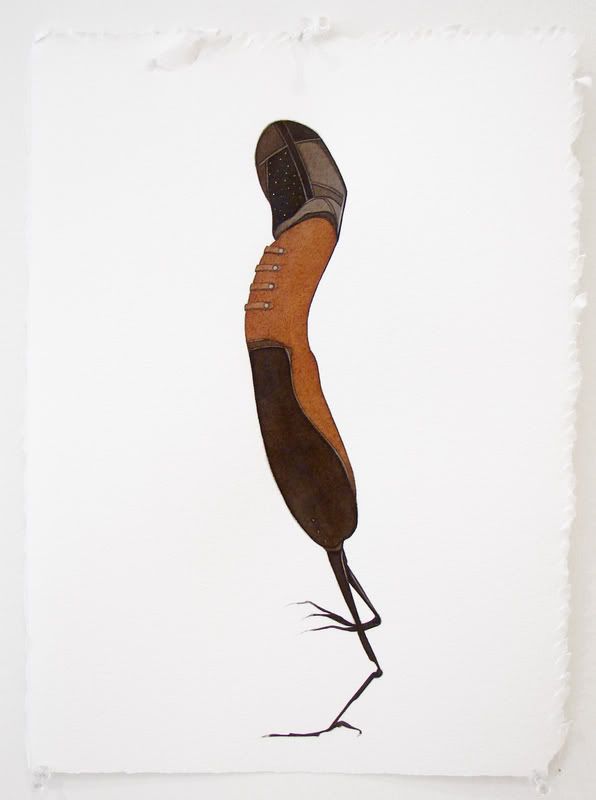
Marcia Kure
"012"
2006
Kolanut pigment, watercolor, pencil on paper
15 x 11 inches
BravinLee programs: Aptly called the "Vogue Series," Marcia Kure's works on paper are as chic as they are charming. Frankly, it's a bit surprising to see these whimsical, freely handled kolanut pigment, watercolor, and pencil drawings in Chelsea. They aren't a far cry from some steampunk costume design, the sort of thing you might find under the Extras menu on a DVD. Kure presents us with space cowboys, Victorian walrus men, and robed birds vaguely reminiscent of Henson's Skeksis. Personally, I love it, but a slew of my arty friends, the same bunch that uses "illustration" as a four-letter word, would shrug the show off. It's their loss.

Marcia Kure
"0.5 Tons II"
2006
Kolanut pigment, watercolor, pencil on paper
15 x 11 inches
My favorite drawings on display - there were at least forty works included - were Kure's most original creations, or at least those most unfamiliar to me. "0.5 Tons II" pictures a brainy she-male, and could be interpreted as an allegory of the tortured artist as Tiresias, and "012" seems to be the product of a menage a trois involving Marvin the Martian, a long-legged sparrow, and a hot dog. When I visit a show like Kure's, I pity those art viewers who are unable to appreciate whimsy; these small works are a joy to look at.
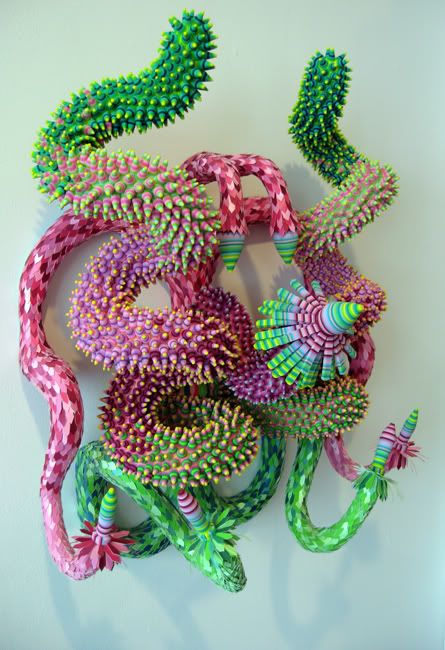
Doug Morris
"untitled"
2002
Ribbon, foam, paper
approx. 24 x 30 x 18 inches
David Krut Projects: I very much like Renee Ricardo's curatorial impetus for HOMEGROWN. "18 emerging artists and art collectives from Boston, Los Angeles, Miami, New York, and Seattle" are included, all of whom "[take] cues from such homegrown practices as collage, quilting, crochet, embroidery, cross-stitch, and assemblage." Unfortunately much of the work on hand seems gestative yet, as though these artists might wow me five years out. But Margaret Lee, Jon Rosenbaum, Anne-Francoise Potterat, Doug Morris, and Erika Somogyi are exceptions and, of this group, Morris's work is the strongest.
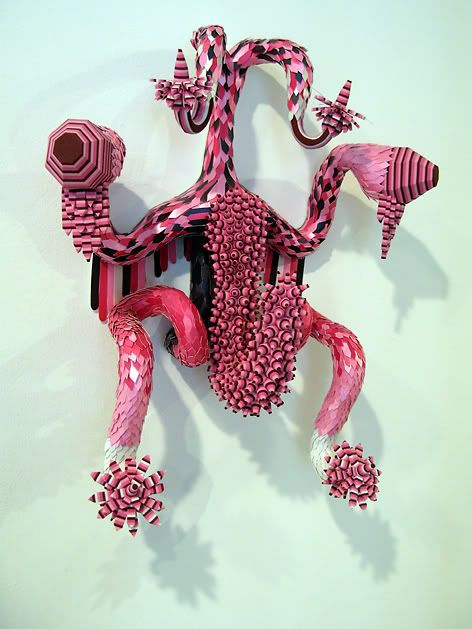
Doug Morris
"untitled"
2006
Ribbon, foam, paper
approx. 18 x 16 x 8 inches
The gallery press release states that Morris "[pulls] imagery from many sources - ranging from Mexican folk art to a vacuum cover made by his grandmother." To my eye these brightly colored, impish creations are as closely related to molecular structure diagrams, Bosch's demons, and Hentai as they are pinatas. But whatever Morris's sources, the sculptures are playfully lewd and aesthetically seductive.

Amy Talluto
"Burn 2"
2006
Pencil on paper
11 x 14 inches
Black & White: On the whole "En Plein Air RELOADED," a promising group show at Black & White Gallery's Chelsea location, falls flat, the result of concept trumping execution. Each of these artists is invested in their work, but as a viewer I struggle to establish the sort of connection I have come to expect from successful investigations of landscape.

Amy Talluto
"Blue"
2006
Oil on canvas
48 x 36 inches
The best landscape art, broad and ambiguous though the classification may be, shows more than it tells, granting the viewer an opportunity to experience land anew or in a heightened state - as in works by Caspar David Friedrich, Thomas Cole, or Robert Smithson - or offering us glimpses of worlds we may not know or haven't had a chance to contemplate - an Edward Burtynsky photograph, for example. Most of the work included in "En Plein Air" "subverts the traditional genre of landscape," as the press release puts it, by foregrounding the sub-text. The experiential aspect of these landscapes is largely erased in the process (or made artificially alien and off-putting in the case of Fiona Gardner's ultra-sharp photographs of Southern belles in a Florida theme park).


Amy Talluto
"Burn 3"
2007
Pencil on paper
10 x 13 inches
Amy Talluto's inclusions are an exception. Regular readers know that I very much like Talluto's paintings - even Art Fag City referenced my affection for her work - but I didn't realize just how accomplished Talluto's drawing has become. As far as I'm concerned, "Burn 2," "Burn 3," and "Blue" stole the show. I'm eager to see Amy's next solo outing, whenever it may come.
Photo credits: David Kennedy-Cutler and Kimi Weart images ripped from Morgan Lehman webiste; Marcia Kure images courtesy BravinLee; Doug Morris images taken by Hungry Hyaena; Amy Talluto images courtesy artist
Subscribe to:
Posts (Atom)