Showing posts with label ecological footprint. Show all posts

Sunday, January 20, 2013

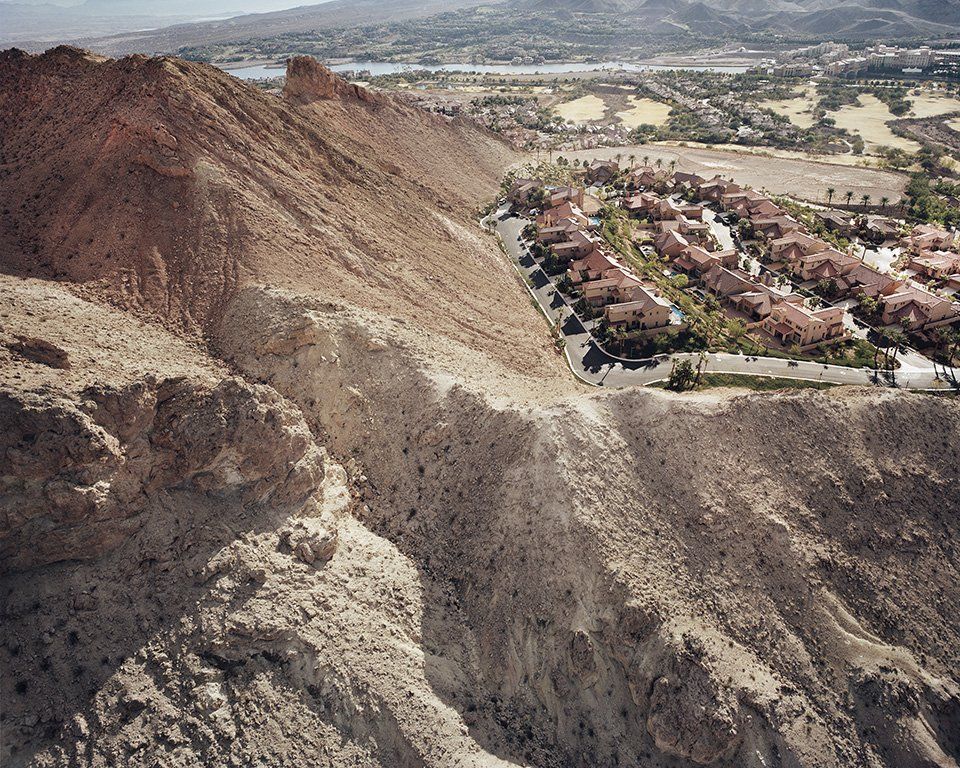
"Private Frontiers" at Hosfelt Gallery

Michael Light
"Lake Las Vegas 2010-2012 20. 'Casa Palermo' Lake Las Vegas Homes Looking Southwest, Henderson, Nevada"
2010
Pigment print mounted on aluminum
40 x 50 inches
Edition of 5
I recently visited Hosfelt Gallery's impressive new space, currently home to "Private Frontiers," a two person show featuring works by Brooklyn-based painter Chris Ballantyne and San Francisco-based photographer Michael Light. According to the press release, the two artists "have been in dialogue for the past year to develop work that examines the human urge to stake territory and its more absurd manifestations on the American landscape." Whatever the specifics of the artists' conversation, Ballantyne's paintings are a terrific compliment to Light's large-format aerial photographs. Exhibited on their own in the expansive Hosfelt loft, Ballantyne's colorful and occasionally whimsical works would risk being swallowed up as bittersweet morsels. Hanging alongside Light's grand photographs, though, Ballantyne's modestly-sized pictures comport themselves especially well; their affability and humor endure, but undercurrents of earnestness and melancholy, too easily missed if exhibited on their own in so airy a space, are amply felt.

Thursday, November 01, 2007

A Belated Sermon


A few days before I flew south to Brazil, an acquaintance asked me why I would choose to use my limited vacation time volunteering for manual labor. I was distracted by last minute travel preparations, and my answer was inadequate and perfunctory, but I recalled her question this week and decided that I should address it.

We live, as we're so often reminded, in an age of global interconnectivity. Every year, millions of people (of a certain means) visit far flung places. Recreation and relaxation are their priorities. Excluding work-related trips, contemporary travel is less about the destination than it is escape; we flee our mundane existence. Although this attitude is an indication of pervasive ennui, there's nothing wrong with taking a break from the hectic schedules and frivolous intrigues of contemporary living. Indeed, it's essential that we find time to enjoy life, but we needn't travel to do so; we can center our lives without leaving home. This approach is sometimes called a "stay-cation."

Furthermore, although most people think of a vacation as an opportunity to take stock and de-stress, it's usually anything but. We travel to places where the local "recreation" feeds our consumer impulses, and "relaxation" is centered around food and drink. After all, we associate the word "vacation" with overfull shopping bags on the Champs-Elysees or mojitos on the beach. The vacation is, above all else, a recess from guilt. We sleep too much, eat too much, spend too much...and revel in the excess. Away from our community, we discard our moral compass. What happens in Costa Rica stays in Costa Rica.

Yet some of us insist, sincerely, that we don't travel for escapist reasons and, furthermore, that it is irresponsible to do so. We cite as our impetus the geography and culture of the chosen destination. The trouble is, you don't "know" a place by sight-seeing. A guided stroll away from the cruise ship or a double-decker bus tour only superficially acquaint the tourist with the place they visit. To be fair, you don't really know a place until you live there, and for some years at that.

Unfortunately, none of us has enough years to live in all the places we'd like to "know," so visits have to suffice. The best way to make the visit (and the place) memorable is to participate more fully in local life. And what better way to participate than to work alongside people who do live there?

Consider, too, that the infrastructure international travel requires - the true price, if you will - necessitates that the conscientious traveler give something back to the destination community. In other words, travel isn't just about your having fun or relaxing (again, you can do this at home), but about being exposed to a new place, new people, and new ideas.

Groups like the Sierra Club, Earthwatch, Global Volunteers, and others(1) offer travel/work opportunities. More people should take advantage of these trips. Volunteers interact directly with the local culture and assist with valuable work. As a result, the trip is more meaningful (and, as an added bonus, it costs less than conventional tourism).

(1) Visit the travel page at idealist.org for an impressive list of volunteer travel opportunities.

Photo credit: Hungry Hyaena, 2007

Friday, April 14, 2006

Old Cranky Brewers


I've eulogized the Eastern Shore of Virginia before, and with good reason. It's a special place and one on the brink of massive change. My recent trips home - and I do still think of the Shore as home, even though I don't plan to return as a resident - leave me ambivalent.

A principal virtue of life at the end of a peninsula is isolation. The southern reach of the Delmarva Peninsula remained relatively "undiscovered" by developers through the middle of the 1980s. Even in the early 1990s, the majority of the "come-heres," as they are called, relocated from elsewhere in the mid-Atlantic region, many of them wealthy businessmen from Virginia Beach or the Eastern Shore of Maryland. Most of these upwardly mobile types moved to the Shore for the hunting and fishing, and, more importantly, to escape the spreading sprawl to the north, in southern Delaware and eastern Maryland, and west, across the Chesapeake Bay. Breaking from this mold, a small minority of the transplants, my parents among them (they moved to the Shore in the mid 1970s), were middle class folks from more distant locales, but they, too, immersed themselves in the local community and achieved an uneasy rapport with their neighbors. In some cases, the "come-heres" even earned a begrudging respect from the Shore's established families, although it was made abundantly clear that two generations of "come-here" children had to be raised on the peninsula before the pejorative label would be removed, a rather endogamous policy.

The last decade, though, has seen an influx of urbanites, mostly from Washington, D.C. and New York City, buying land and building weekend retreats. These developments, estates, and cottages are picturesque enough, but they disrupt the local ecosystems, both that of the "natural" world - new houses, artificial lighting, and human activity increase the ecological footprint - and the country lifestyle. Gourmet restaurants, impossible to imagine ten years past, and boutiques are opening in the larger towns and alongside Route 13, the highway artery on the Shore. Most distressingly, the radiant eye of Sam's Club/WalMart has settled on the region. The Gates of Walton have been opened and the tractor trailers are emerging.

Mind you, not every change heralded by this imminent development will be for the worse. The Shore can expect to see growth in arts and culture, more calls for improved education (i.e., money from the state), and a heightened awareness of the long-standing racial inequality, hopefully leading to stronger social programs. (Of course, as I've suggested previously, the opposite could result, too.) Furthermore, dinner parties won't all revolve around "big buck" stories, litter collection will be encouraged, and the growing "come-here" population, with their discerning tastes, will likely demand an increased variety of food and beverages.

Enter Old Cranky, the brewery brainchild of two brothers, both of whom were childhood friends who remain important to me today. Although the brewery is still gestating, a blog, Old Cranky Brewers, details the trials and tribulations of this nascent beer operation. Rarely will readers find product promotion here at Hungry Hyaena, but I think this is a fair exception and, despite my ambivalence regarding the Shore's future, I'm eager to see Old Cranky take off.

Take off, by the way, is an apt phrase. The beer is named after the Great Blue Heron (Ardea herodias), a common, even ubiquitous species in the region. When this handsome bird is irritated, usually by one or another of us bumbling apes, he hefts his awkward frame into the air and makes known his displeasure with a grating squawk, much as a rankled old man would do -- hence the nickname.

At any rate, the blog makes for interesting reading, especially if you have an interest in brewing, marketing, or small business start-ups. Plus, if all goes well, Old Cranky blog readers can one day sip the brew and say, "I remember when this beer was still a blog."

Photo credit: copyright 2006, Old Cranky Brewers

Monday, December 05, 2005

A Cup Of Joe

Image hosted by Photobucket.com
I'd grown accustomed to waking early on Saturday and Sunday mornings, going for a run, and then heading to the neighborhood Dunkin' Donuts for a medium vanilla hazelnut coffee, black. It was an essential part of my pre-studio ritual and, as Jake Berthot told me in graduate school, "without ritual, [artmaking] is only prayer." The Dunkin' Donuts ritual, though, will have to be replaced with another: brewing coffee at home.

In my continuing quest to mitigate negative environmental impact - thus, my shift to an unusual brand of hunter-gatherer vegetarianism, "green" household products, renewable energy credits and organic foods - I am now forced to swear off the double D, not only because they don't offer shade-grown, organic coffee, but also because the chain refuses to adopt paper cups. Instead, Dunkin' Donuts insists on sticking with cups of the Styrofoam variety, serving 2.7 million of these non-biodegradable vessels a day.

Of course, it's best to avoid disposable cups altogether. Using ceramic or reusable plastic mugs is not only environmentally friendly, but potentially cheaper. Some chains, Starbucks included, offer discounts to customers who carry their own beverage container.

If you're shrugging and thinking, "Come on, this is more granola than using canvas sacks at the grocery store," keep the following statement from the Environmental Protection Agency (EPA) in mind. "Even 500 years from now, the foam coffee cup you used this morning will be sitting in a landfill." That just ain't cool.

Photo credit: "Mobil Dunkin' Donuts," Oil on canvas, 2002, by Bruce Mitchell

Tuesday, August 30, 2005

Wrestling With Eco-Guilt

Following yesterday's "Ecological Economics 101" post, I feel I should take a few paragraphs to paint a picture of my own pathology. Like many environmentalists - though I prefer the term conservationist, given my acceptance of management's role in stewardship - my "green" decisions allay some personal guilt. Such "guilt motivation" isn't always healthy, even if I do right by my choices.

Case in point, I still haven't forgiven myself a recent purchase of three pairs of jeans. Despite buying the pants during a sale - each pair cost just $25.00 - I worried about their origin and the environmental track record of their manufacturer, Levi's. Weeks after I folded the jeans into my canvas tote bags and walked out of the store, I continue to beat myself up...this despite the fact that I needed new pants.

But did I really need them? In the eyes of my upper middle-class, white-collar co-workers, I was wearing "stained, old" clothes and shoes that "had long ago seen their day." When I first wore the new jeans to work, they complimented me excessively. "See how much better you feel when you wear clean clothes that fit you?," one of them asked. Um...not really. My old pants were still wearable and the shoes still comfortable.

Is there a soundly ethical rationale that allows one to buy more than he or she needs? The answer, of course, is 'No.' But self-control can too easily transmute into anorexia. This begs the question, is a superior anorexic any more ethically entitled than a compulsive liquidator?

In my quest for sustainability, I often purchase "certified organic" food, paying a premium for this privilege. But some of these foods are not grown locally and the money I spend on organic products feeds the bloated economy no less than any other, less "sustainable" expenditure. To help alleviate my worrying, I remind myself that I no longer order delivery or eat at restaurants when dining alone, but is this enough? After all, I still go out to eat with friends and, though my principal motivation for doing so is the preservation of those relationships, should I feel any less guilty about doing so?

Similarly nagging thoughts are with me every morning when I pull my iPod, the most popular icon of conspicuous consumption, from my backpack. My consumerist tendencies, relatively inoffensive though they may be, are putting undue pressure on our already over-extended natural resources. I may be less culpable than most Americans, but very few (perhaps freegans?) can wash their hands of the situation with a clean conscience.

Yet most Americans ignore eco-guilt, thereby avoiding the potential complications of sustainable pursuits - they don't risk being ostracized by their peers or, worse, developing a martyr complex. But how can an educated individual disregard her environmental and social impact? As one co-worker put it when she learned I had purchased a Renewable Energy Certificate (REC) to mitigate the carbon emissions generated by my upcoming trip to Japan, "I really couldn't care less about CO2 emissions or the rain forests but I do care about my 401K, health insurance and vacation time." What a horrifyingly perfect example of "iCulture."

Certainly, self-interest is a vital part of being human, but social responsibility distinguishes us from most other species. My co-worker's statement is appalling, but nonetheless representative of the majority perspective. In such a climate (and economy) the risks of wrestling with eco-guilt, as I see it, are well worth it.

Tuesday, August 16, 2005

Pardon Me...Spare An Indulgence?


Last week, Organic Matter highlighted a few "carbon mitigation tools" previously unknown to me. For those unfamiliar with the concept of Renewable Energy Certificates (RECs), the PV USA Solar site provides an excellent introduction.

An arm of Renewable Ventures, LLC, a San Francisco based company which finances and operates renewable energy power plants, PV USA Solar offers a comprehensive list of RECs. Their website "allows you to calculate the amount of CO2 produced by your home, your business, your commute, or your travel, and then purchase renewable energy certificates to offset those emissions." Over the last year, similar programs have been adopted by foreign governments. Official air travel by United Kingdom civil servants, for example, is tracked by a government agency that calculates "the amount of globe-warming carbon dioxide emitted during each flight." The agency then "offsets a commensurate amount of CO2 by investing money in clean-energy projects in developing countries."

I'm not content to wait for the United States government to act on my behalf. In less than three weeks, I depart New York City for Japan. After months of price comparisons and phone calls to booking agencies, I secured a relatively inexpensive, round-trip flight on American Airlines. The total cost, including gas surcharges and all taxes, is $850.00. But wait. A quick visit to PV USA Solar informs me of the following.
"Your travel will generate an estimated 5713.6 pounds of CO2. By purchasing 7142.0 kilowatt-hours of Renewable Energy Certificates, you will offset an equivalent amount of pollution generated by California power plants. Your cost for these RECs will be $214.26."
$1,064.26 no longer seems like such a "steal," but I will rationalize the extra expense by reminding myself that, had I purchased the ticket a month or two earlier, I would have paid over $1,000.00 before the REC fee.

Still, $214.26 isn't peanuts. Why do I feel compelled to pay the surcharge? I could, of course, choose not to. I mean, RECs are really for more "settled" people, right?

Wrong. No matter what the cost, cosmopolitan individuals - "citizens of the world" - are obligated to buy RECs for any traveling they do. To be aware of a problem and still choose to ignore it is, simply put, selfish. Ignorance is inexpensive bliss, but buying the REC is a pro-active gesture; my absolution will result in funding for alternative energy development, something I can ultimately be proud of.

But hold on! Did I just write "absolution?"

At fourteen, I hadn't yet to hear the romance of history's song. As a result, much of what my Western Civ professor taught remained unlearned. I do, however, remember discussing Martin Luther, the 16th Century theologian. Luther stuck in my mind for two reasons. 1) His name is shared by a 20th Century American hero. 2) He led the crusade against the sale of indulgences, also known as the Protestant Reformation.

As defined by the Roman Catholic Church, an indulgence is "The remission of temporal punishment still due for a sin that has been sacramentally absolved." In other words, you can buy your way out of purgatory by paying the church a repentance fee.

It is one thing to sin and later claim to have repented, but medieval citizens felt obliged to demonstrate their sincerity via external actions. (After all, it isn't God that frightens most people, but the possibility of being held in contempt by your peers.) While these public displays began as charitable acts - helping to feed the poor, for example - mercantilism allowed the church to generate revenue by banking on guilt. Because a medieval peasant didn't always have time to pursue charitable acts, opting to atone for misdeeds by paying the local church representative was an attractive alternative.

But it wasn't long before Rome realized how lucrative indulgences were. Already the most powerful governing body in Europe, the Catholic church now stood to become the most wealthy. Martin Luther crusaded against such corruption, but he also worried that "his parishoners were beginning to rely upon indulgences for their salvation more than repentance and satisfaction."

The first time I read about RECs, I recalled Luther's watchdog mission. An REC, after all, is an indulgence. Indulgences became popular only once the Catholic church embraced mercantilism and RECs are becoming popular at a time when market-based environmentalism is on the rise.

Philosophically speaking, RECs might be considered equally problematic as medieval indulgences. Many a well-intentioned citizen will purchase TerraPass, for example, and feel they have "done their part" for the environment, stopping short of a real contribution. More troubling still is the flagellation granted by RECs; realizing that most Americans couldn't care less about offsetting emissions, those of us who do purchase them will act as martyrs for the cause and little good can come of such a complex.

Fortunately, those of us who buy RECs know how the money is being used - at least, each of us should be responsible enough to check out these groups before cutting a check - and the more conscientious among us will recognize RECs as but one responsibility among many.

Photo credit: Copyright © 1997-1998 Concordia Historical Institute

Monday, August 15, 2005

New Toys, Old Toys


I post the above cartoon not because I find it particularly funny (I don’t), but because it frustrates and depresses me. This office dork need not part with his action figures. He should instead keep his monitor until it stops working. In the background, we see other office employees admiring the newly requisitioned flat-panel monitors. The older, boxy models are carelessly piled on the bottom shelf of the cart.

Similar scenes are all too common in "real world" offices. In fact, it seems as though many offices “update” their computer hardware every few years (at least)! The employees usually love it (new toys!), so it’s good for morale. The hardware manufacturers love it (more money!), so it’s good for the economy. What’s there to lose?
“A Carnegie Mellon University study estimated that in 2002 the United States sent about 10 million computer units to Asia for recycling….As long as computer users and the computer industry refuse to clean up after themselves, people in [Indian villages] will pay the price instead.”

-“Hazards of High Tech,” Mike McPhate, Sierra Magazine
Calling this variety of outsourcing “recycling” is misleading. The computer parts are broken down by hand, “picked clean of metal,” and burnt or doused with acids by Indian women and children. For their labors, these “recyclers” are paid $1 a day, a nominal sum even by Indian standards. More troubling still is the host of medical problems these workers develop, the eventual result of working with “leads, dioxins and other pollutants.”

The lifecycle of computer hardware is a fine example of trickle-down economics. Way to go, Gipper. Way to go.

Photo credit: The New Yorker

Thursday, August 11, 2005

Baggin' It

Sometimes the world can get you down. That's my hackneyed observation for Thursday, August 11th, 2005.

This morning, I read bad news in the papers and received bad news from friends. The happy anecdote that follows serves as something of an antidote on this dim morning, and I hope that it will bolster the spirits of a few readers.

On Saturday afternoon, I took a break from the studio to do some food shopping. The local grocery store may not be much to look at, but it is surprisingly well-stocked and offers an impressive selection of organic foods. I often spend too long wandering the aisles, studying labels and comparing prices, but I find the routine enjoyable. Depending on my mood, it provides me with a good opportunity to refocus, to stop worrying about the state of the world or the progress of my painting.

This Saturday, I over-loaded my red, plastic basket and proceeded to the registers. The lines were short and I stepped in behind a young lady. I skimmed the magazine rack offerings. (For the record, Jennifer still loves Brad, and the Hilton sisters, American paragons of virtue and social conscience, are reportedly involved in a feud with various Hollywood A-list celebrities.) Lost in a world of photo re-touching and conspicuous consumption, I was startled to notice the cashier scanning the first of my items.

"I don't need you to bag anything. I'll just throw it in these," I said, gesturing toward the three canvas tote bags slung over my shoulder. Almost always, it seems that this statement is greeted with disdain. When I first started carrying tote bags to stores, I decided that I was imagining the dirty looks. Unfortunately, that isn't the case. Though I bag my own items, thereby saving clerks' time and energy, my tote bags typically baffle or annoy the store employees. Go figure.

I began packing my bags while the cashier continued to scan my items. A few moments later, I heard her curse quietly. She'd inadvertently hit the register's power button. "This might take a few minutes," she told me, anxiously. I used to have little patience for such situations, but I've grown more tolerant of brief delays and I also felt sorry for her, recalling my own Food Lion days.

While I waited, a couple stuck in line behind me talked about their dinner plans. I stood and stared out the window, half listening. My interest was piqued, however, when they began to talk about my bags.

"Look at the bags he uses, honey. That's a good idea."

"Yeah, we should use our tote bags. I have, like, three at home just getting dusty."

Then the register came back on line. I paid my bill, shouldered the tote bags and made my way home feeling pretty good, all in all.

Sometimes the little things can seem so satisfying. That was my hackneyed observation for Saturday, August 6th, 2005.

Wednesday, July 13, 2005

Individual and Collective

Reading through the posts at Sustainablog's "Blogging Round the Clock" event, I came across this entry by Dave Roberts, of Gristmill renown. "Hold the Misanthropy" is worth a read; Roberts rightly highlights some of the weaknesses inherent in the ecological footprint concept.

The concept of an ecological footprint is most useful as just that, a concept. Roberts reminds us that the "science" of determining an individual's score is vague, but as a general marker the score will serve its purpose, giving each of us an idea of where we stand relative to the world at large. Like Dave Roberts, my score is a 16 and, barring cessation of plane travel and my swearing off any packaged food products, I doubt I could lower it. (When I last took the ecological footprint quiz, my score was 9, but I have since discovered that my apartment is over 500 square feet; that makes my score jump significantly.) But so what? The fact that I am conscious of my footprint and approaching life with sustainability in mind is a good beginning. If I can become more involved in local conservation projects, I will be well on my way to making a difference, however small it may be.

I find the thrust of Roberts's post agreeable, but one statement didn't ring true.

"Matter of fact, as I'm fond of arguing, individual environmental virtue is at best a curiosity, at worst a distraction."


Most of us have come across at least one loud-mouth egomaniac on a Napoleononic eco-crusade. This breed of environmentalist is a distraction and, though there are not many of them, they garner a disproportionate amount of news time. When I see such people on television or read something they have written, "individual environmental virtue" doesn't spring to mind so much as "insecure publicity hound."

On the other hand, I know plenty of folks who are taking simple, quiet steps to lessen their negative impact. Is the individual who uses canvas tote bags at the grocery store really missing the point? What about the person who swears off automobiles and relies on public transportation or my own vegetarian-unless-I-kill-it-myself diet? I believe such choices should be celebrated; they give individuals something to do other than cheerlead by sending money to conservation and environmental organizations.

Roberts's statement is not entirely inaccurate, though. Individual choices can be (and often are) deemed overly important by those who wish to feel better about themselves. How many times have I left the grocery store feeling superior to the "plastic baggers" all around me? Such a feeling is regrettable, but not uncommon given the "inklings of the divine," as writer Jack Hitt puts it, associated with the environmental movement. Furthermore, the environmental impact of one individual is, as Roberts makes clear, relatively minimal.
"If I could remove my ecological footprint entirely, the earth would endure 0.000000000000167% less insult (or assuming I have five times the average footprint, 0.000000000000667%)....Big whoop."

"Despite the near-obsessive focus of some environmentalists on "what you can do," it is collective action that will make or break our future. Changing group behavior -- through advocacy, activism, politics, research, however -- is our calling."
Taking these considerations into account, the personal choices can seem vain, even irrelevant, when compared to "deep structural changes in our material and social milieu," but individuals can and do change/lead by example. If Seinfeld taught me anything, it's that eating a candy bar with a fork and knife can become the socially accepted norm, even a sign of sophistication. The structural changes that Roberts calls for are aided by "individual environmental virtue," not hindered.

Friday, June 24, 2005

I've Got Some Explaining To Do

“Conservation is also about choices in our daily lives. It’s not only about how we commute to work but whether we choose to commute at all. It’s about what kind of fabrics we wear and what kind of beverage containers we buy. It’s even about the kind of heating we have in our homes.”

-George Reiger, “Heron Hill Chronicles”
My recent “Where’s the Beef?” post inspired a reader to send me an email that, using unnecessarily harsh language, made explicitly clear his opinion that my diet is nonsensical and unethical. Each to his or her own; I suppose I should turn the other cheek, so to speak, but the reader's invective makes me think that I should better elucidate my choices.

My diet's principal motivation is environmental and rational. I prohibit meat consumption unless I have hunted or fished the creature myself. The water and land use problems associated with industrial meat farming can not be ignored. More strict federal regulation of grazing, feeding and watering practices would no doubt ameliorate their negative impact, but such legislative salves can not eliminate the fundamental environmental challenges posed by large-scale, commercial meat production. According to the USDA, growing crops for farm animals requires nearly half of the U.S. water supply and 80% of its agricultural land! Those are astounding (and very troubling) numbers. The steep decline in offshore fish populations makes poorly regulated commercial fishing ecologically untenable, as well. Surf and turf consumption is therefore unethical. There's no other way to put it.

The ethical call may sound Sisyphean to many of us, but every individual should be compelled (by his or her conscience) to do what they can to mitigate our negative impact. Certainly, as my angry reader points out, plastics (made from oil) are ubiquitous, industrial dairy farms are responsible for environmental problems, and cotton, the base ingredient of my wardrobe, is the among the world's most environmentally destructive crops. While it is difficult for me to avoid consuming plastic products, cotton clothing and milk, I can (and do) take simple steps to avoid these items as much as possible. An increasing percentage of my wardrobe is now hemp or synthetic (also problematic, but not as bad as cotton) and I buy only soy or organic dairy products. If, however, I’m dining at a restaurant that doesn’t offer such alternatives, I won’t refuse the cheese that I'm served. Without retreating to ascetic life, each of us must pick our battles after considering the facts, and I believe that industrialized meat production is among the most serious threats to the world’s environment and to human rights.

Peter Singer, the Australian philosopher, ethicist, and author of “Animal Liberation,” sums up my dietary habits well.
The Peter Singer suggested diet:

- replace animal flesh with plant foods
- replace factory farm eggs with free-range eggs if you can get them; otherwise avoid eggs
- replace the milk and cheese you buy with soymilk, tofu, or other plant foods, but do not feel obliged to go to great lengths to avoid all food containing milk products
It may seem surprising that Singer, a father of the contemporary animal rights movement, should serve as a guideline for a hunter and fisherman. Though animal rights concerns wasn't the principal motivation for my shift to vegetarianism, I do consider such moral considerations integral to my mongrel philosophy.

A moral hunter aims to make every kill as humane as he (and, increasingly, she) possibly can. Unfortunately, even the best hunters will sometimes make a poor shot, and I am deeply disturbed by the long minutes spent tracking a wounded deer or the quiet, slow-motion gasps of a mourning dove as I squeeze the last breaths from its small breast.

Like humans, critically wounded animals go into shock. The endorphin rush associated with serious physical trauma prevents neurons from communicating normally and, as a result, one feels little, if any, pain. The dying animal enters a trance-like state in the final moments. This accounts for the military medical field practice of treating screaming soldiers before the wounded fighters that quietly stare off into space; if a wounded soldier is quiet, he or she has suffered only minor injury or is beyond medicine.

Crippled animals, like screaming, wounded soldiers, are often suffering a great deal. Their body is programmed for survival; the neurons let the pain “scream” to make sure that the animal knows where the source is. I used to believe that wounded non-human animals felt the same amount of pain as wounded humans, but I now fear they may feel more. Unable to reason what has happened to them, the stress of the experience must be that much greater. That I have been responsible for such awful moments in the life of another creature is a terrible reality, but I do feel better about facing such realities myself, rather than entrusting them to underpaid laborers half a continent away.

Even anti-hunters (many of whom continue to eat meat, a ludicrous fact!) sometimes find themselves in similarly distressing situations. A motorist that strikes an animal while driving is morally obligated to put the injured animal out of its misery or attempt to assist it.(1) Those drivers that opt to drive away, shirking responsibility and doing their best to evict the incident from their mind, are acting in a morally weak fashion. As I see it, it's no less irresponsible than a human "hit-and-run," for which convicted individuals often go to jail.

Simply put, it is immoral to allow a suffering animal a slow, perhaps agonizing death after having caused it direct harm. Increasingly, people I talk to claim that their benevolence prevents them from extinguishing the pained creature's life. In fact, they're often horrified by the suggestion that they kill it. My thinking that they should is, in their eyes, barbaric. These individuals are victims of their own good intentions, lies designed to make their little world more comfortable. I have no patience for such people; I disdain them as I do the “trophy hunter” or the violent environmental activist.

As Rien Poortvliet, the Dutch author and painter, wrote in his excellent picture book, “Dogs,”
“Some people would rather see you fool around with an animal than put it out of its misery…a little artificial leg here, a plastic duck bill there, and if necessary, wheels attached to it – anything is better than dead. ‘No, I couldn’t do that!’ Well, what good is that to a cat in pain, run over by a car? It is sometimes such an ‘animal lover with clean hands’ who drives on. I know those types who say, ‘How can you possibly shoot a roebuck?’ But where does that fur coat, that snakeskin bag, come from? She doesn’t care. You also mustn’t bother her with stories of where real cutlets and chicken breasts come from. She has never struck one animal.”
No matter how bloody and miserable the driver's responsibility to brain a raccoon with a tire iron, wringing the neck of bluebird, or snapping the spine of a house cat is, it must be done.

Doing so has left me shaken up for days. I once came upon an eastern box turtle (Terrapene carolina carolina) that someone had run over. The shell was cracked and internal organs had been forced out of the gaps, but the turtle struggled on, attempting to make it to the other side of the road. Familiar with basic turtle anatomy, I realized that this reptile was doomed. I did what had to be done. I cried while doing it. If that makes me less of a man, I could care less.

It may seem illogical to some readers that I can be a compassionate, ethical person and a hunter. Indeed, there is some conflict. As a result, I hunt less with each passing year (maybe seven times in the last two years) and I've become more interested in pursuing only those quarry I know that I am likely to kill cleanly. Deer and other ungulates, for example, are animals that I am comfortable continuing to hunt, as my rifle marksmanship is good. As my shotgun ability continues to decline (the less often you do it, the worse you become), bird hunting becomes less tenable. I loathe knowing that I may “knock down” a bird and be forced to chase the terrified duck, dove, quail, pheasant or goose to end its life in a brutal fashion. Yet I also realize that death via disease, starvation or “natural” predation is equally awful. Such is Nature’s way, but few of Nature’s actions contribute to real degradation of the environment, even if they can sometimes pose a threat to biodiversity.

(1) If the animal seems as though it is not seriously injured, please take it to your local veterinarian. Having worked in a veterinary clinic, I know that most good vets are excited to have curious patients brought to them. During my short time at the clinic, we received a hawk and an owl that had been struck by cars. Both recovered and were eventually released.

Photo credit: a.sanpal.co.jp; no credit given on site

Friday, May 06, 2005

The Ripple Effect

Reading an article this week about the Argentine evangelical preacher, Luis Palau, I came across an interesting quote. He stated,
“I believe that change comes from personal conviction, from leading a more biblical lifestyle, not by Christianizing a nation. If we become called to Christ, we will build an effective nation through personal ethics. When you lead a life of purity, when you respect your wife and are good to your family, when you don’t waste money gambling and womanizing, you begin to work for better schools, for more protection and safety for your community. All change, historically, comes from the bottom up.”
Palau's quote struck me not for its evangelical message (although its worth noting that his “old-school” evangelical approach is rapidly disappearing in today’s increasingly reactionary evangelical community) but because I heard myself in the approach. I, too, believe that change comes from personal conviction, from leading a more sustainable lifestyle, not by forcibly “greening” a nation. Self-improvement and local impact will eventually ripple out to affect policy at the national level.

Given this “begin with yourself” approach, I am always on the look out for ways to minimize my ecological impact. Unfortunately, for those of us living in the United States, Europe, or much of Southeast Asia, some of the positive lifestyle changes are very difficult to implement. I have yet to give up all my cell phone or computer, for example, or to better insulate my windows. I don’t really need a phone or a computer; in New York City there are plenty of public payphones and “cyber cafes” where I can purchase time. Yet despite my best intentions, I remain unwilling to sacrifice these modern conveniences.

At any rate, I came across this very straight forward list of ways you can help be a more environmentally friendly consumer and thought its simplicity merited a link. The base message: buy less and keep it for longer.

Friday, April 15, 2005

Calculate Your Ecological Footprint


If you would like to have your ecological footprint calculated, click here.

Interestingly, New York City living makes my footprint much smaller than were I to live on a small farm in the rural northeast United States. This latter situation is my ideal, and I have long assumed that the rural lifestyle – eating only local or organic fruits and vegetables, hunting the occasional white-tailed deer (Odocoileus virginianus), and engaging in local conservation efforts - would reduce my negative environmental impact.

Not so. In fact, despite my now eating mostly non-organic, shipped vegetables – I eat Chinese or Mexican takeout too often to claim otherwise – my lifestyle here in New York City is relatively environmental friendly. This is a result of my walking or taking public transportation everywhere, but is also affected by my living in a large apartment building, and, most importantly, by the population of New York City itself.

If I were to transplant myself to the outskirts of a small New England town, my ecological footprint would balloon. In fact, even if I opted to live in a city such as Burlington, Vermont, one known for its eco-friendly attitude and policy, my footprint, while under the national average, would still be much larger than at present.

The average ecological footprint of a United States citizen is 24. My no car/vegetarian lifestyle here in NYC adds up to a score of just 9. The equivalent lifestyle (with the addition of a car) in a Burlington, Vermont, apartment building equals 22. Finally, the small farmhouse/studio somewhere in New England equals an astounding 39.

Being a subscriber to the no pain-no gain approach, I think I have to compromise. I imagine I will end up shelving the small farm idea, instead opting for an apartment in a New England city like Burlington, someplace with proximity to unsettled areas and numerous parks. I still believe private land ownership and conservation easements are of vital importance, so if my finances allow for it I would like to purchase a plot of land, roughly 30 acres, to manage for wildlife and leave undeveloped.

Thursday, March 03, 2005

TDP: Feces to Fuel

I first heard about TDP (Thermal depolymerization process) in 2002. At the time, I was excited by a process whereby waste, be it computers, animal manure, dead bodies, or syringes, can be turned into oil, water and gas. TDP is the technological curative we’ve been waiting for, I thought. It doesn’t address the problem of nuclear waste disposal, but it will certainly help us decide where to put our household trash.

Now, with two active plants proving that the process works, I’m no longer as eager a cheerleader. When I first learned about TDP, I neglected to consider two details, one minor, one major.

1) If the process proves effective and becomes widely used, trash itself will become a commodity. Savvy municipal waste managers will profit from sales of their waste to TDP companies. This isn't a serious concern, but there is something inherently depressing about trash bidding wars.

2) Because oil and gas are the two principal outputs of the TDP, society and, in turn, the federal government are less likely to transition away from fossil fuels.

Ideally, we can have the best of both worlds. If TDP takes off, our trash will have a valuable purpose. Also, the oil produced via TDP can be used for plastics rather than internal combustion engines.

But how often do we environmentalists see our ideology made manifest?