Showing posts with label romantic inclination. Show all posts

Friday, October 26, 2012

The Mystics Downtown

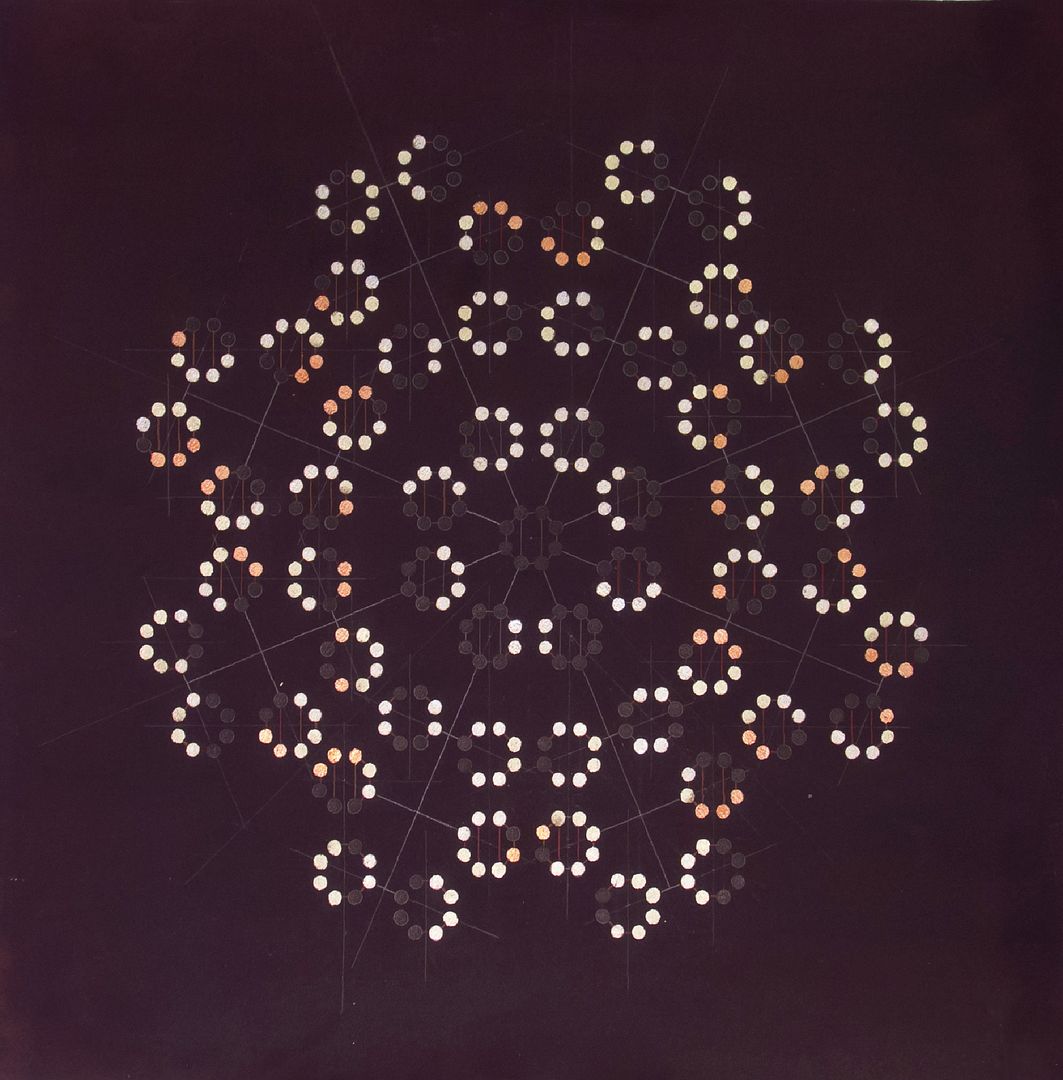
Owen Schuh
"Two Folds"
2012
Graphite, gold copper and silver leaf, and sumi ink on paper
32 x 32 inches
Due to time constraints, I've provided only brief remarks about three terrific, tangentially related downtown shows. All three are on view for just one more day, so rush out to see them, if you can.

+++++

"Uncharted," a handsome group show of works on paper at Cain Schulte Gallery, "explore[s] the concept of mapping as the visual and conceptual categorization and organization of relationships, systems, and interactions." Remarkably, the works included in "Uncharted" all relate well to one another (rare for a group show with such a broad theme), and the exhibition is compelling both visually and conceptually, but a few artists' contributions stand out.

Owen Schuh's "Two Folds" is an elegant diagram illustrating all of the possible ways a piece of paper can be folded in two. Schuh is a precise craftsman, and his circles and lines add up to a kind of mathematical sublime. Without the aid of the press release, I wouldn't have recognized what it is that Schuh has mapped, but that isn't necessarily a problem. "Two Folds" also works as an arcane design, calling to mind the complicated but specific hierarchies of, say, a Kabbalist. That Schuh has produced an image that is as readily associated with mathematics as it is esoteric mysticism shouldn't surprise; just ask your neighborhood theoretical astrophysicist to discuss notions of beauty.

Friday, August 10, 2012

Platte Clove Residency: John Muir and the View From the Precipice

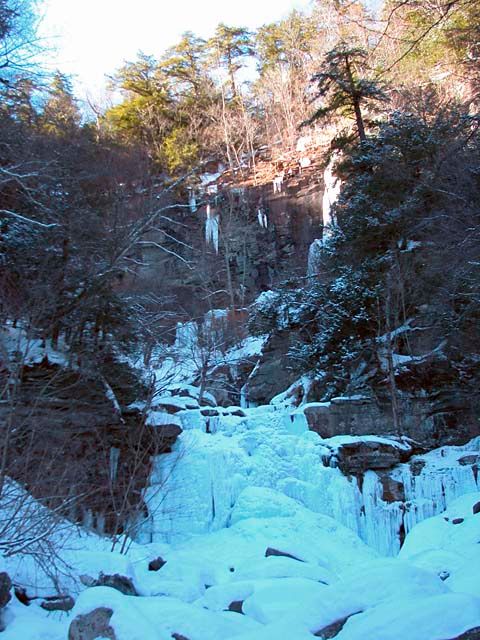
Winter view of Platte Clove's Bridal Veil Falls;
Catskills; NY
“Many people have been killed after falling and sliding off the edge. Especially in areas where there are pine needles. Dangerous conditions exist in many locations. The number of deaths over the years is staggering. Be overly cautious when in this region, and do not take un-necessary risk.”

- “Upper Platte Clove” page of Catskill Mountaineer website
I hesitated before deciding to investigate the unmarked spur of the Platte Clove Nature Preserve's Plattekill Falls Trail. Having recently read a bit about the geology and topography of the Catskill Escarpment, I knew that the preserve is located near the top of a deep ravine that tumbles suddenly down and eastward to meet the Hudson Valley (clove is the Dutch word for a mountain gorge). I’d also learned that each year a handful of foolhardy or unlucky hikers fall to their deaths on Platte Clove area trails. An online trail guide I’d browsed prior to the residency urged hikers to be “overly cautious.” Nevertheless, once I’d stepped off the main path and advanced a few steps down the spur, I was self-assured; I wouldn’t be one of 2012’s casualties. Prudent types like me don’t fall off cliffs.

Friday, January 13, 2012

Big Sky Country

Christopher Saunders
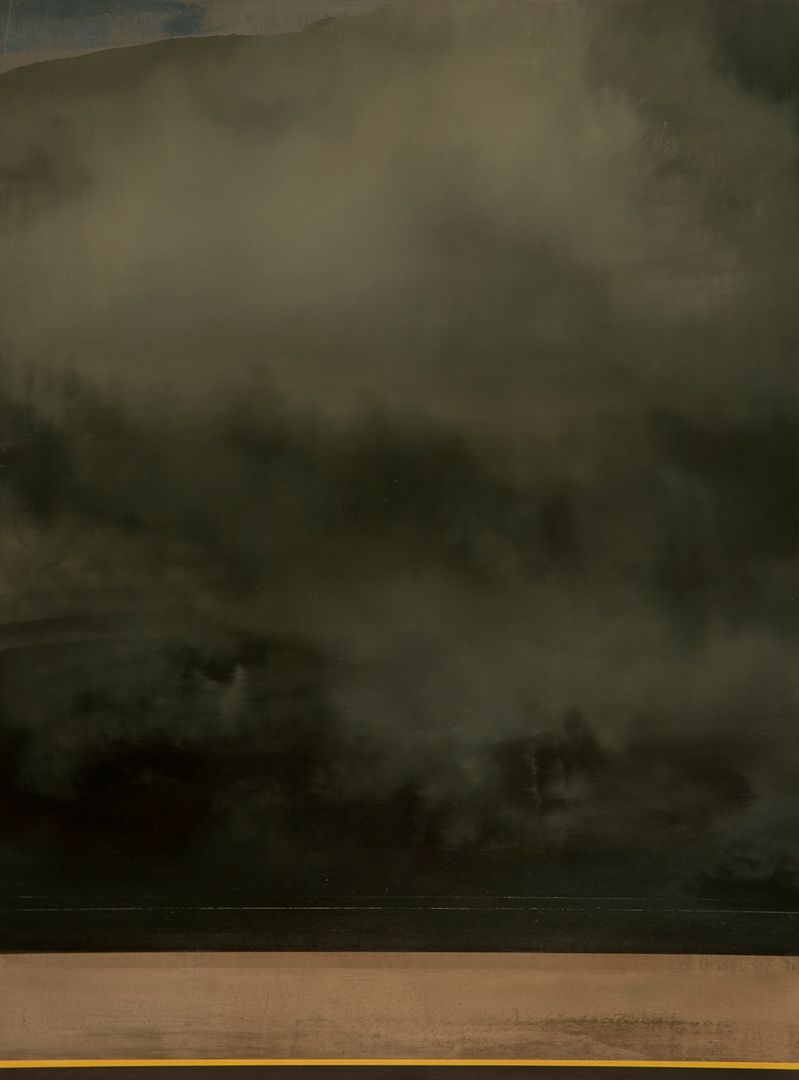
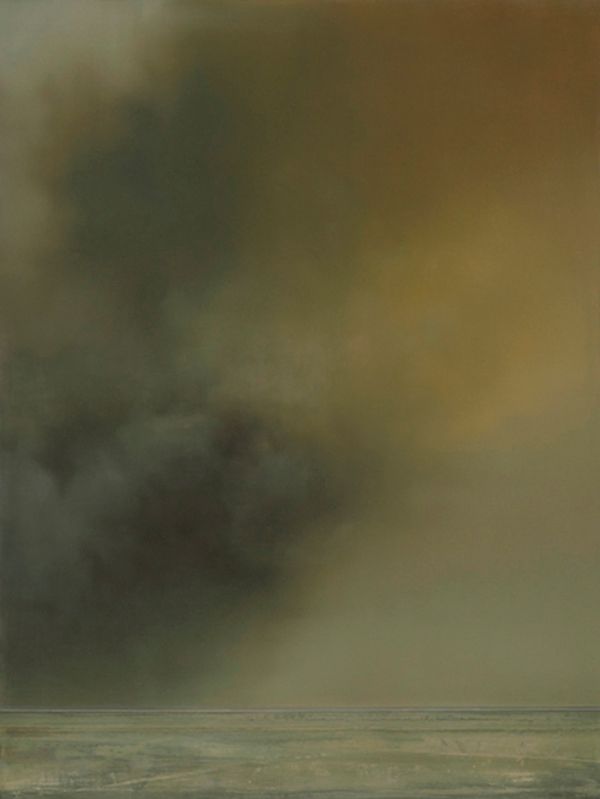
"Whitenoise no. 1"
2008
Oil on linen
24 x 18 inches

In a 2009 post about painter Christopher Saunders' "Whitenoise" series, I recounted philosopher Arthur Schopenhauer's hierarchy of aesthetic experience and connected it to Saunders' work.
"In his volume The World As Will and Representation (1818), Schopenhauer elucidated a scale of aesthetic experience. At one end of this spectrum, he described the 'Feeling of Beauty' as 'Light...reflected off a flower. (Pleasure from a mere perception of an object that cannot hurt [the] observer.)' At the other end of the spectrum, the philosopher positioned the 'Full Feeling of Sublime' and the 'Fullest Feeling of Sublime.' These categories are described, respectively, as 'Overpowering turbulent Nature. (Pleasure from beholding very violent, destructive objects.),' and 'Immensity of Universe's extent or duration. (Pleasure from knowledge of observer's nothingness and oneness with Nature.)'

Sunday, November 27, 2011

Elisheva Biernoff's "Inheritance"


Elisheva Biernoff
"Inheritance"
2010
80 slides of endangered wilderness areas projected onto mist from a humidifier housed in a plywood and fabric enclosure

Environmental historian William Cronon argues that "only people whose relation to the land was already so alienated could hold up wilderness as a model for human life in nature, for the romantic ideology of wilderness leaves precisely nowhere for human beings actually to make their living from the land." I recalled Cronon's incisive critique of wilderness ideology as I pondered artist Elisheva Biernoff's "Inheritance," a compelling installation included in Eli Ridgway Gallery's recent group show, "Better A Live Ass Than A Dead Lion."

"Inheritance" was installed in a dark side gallery on Ridgway's lower level. A wall-mounted, carousel slide projector cast images of "endangered wilderness areas [...] onto mist from a humidifier housed in a plywood and fabric enclosure." The humidifier's fog billowed out of a television-sized opening cut into the plywood, and the projected photographs reflected by the haze were sometimes -- for an instant, when the mist was just so -- recognizable as landscapes, but rarely as specific environments or locations. Without the artist's accompanying list of "disappearing places," viewers couldn't know they were looking at Alaska's Tongass National Forest, Florida's Everglades, Brazil's Pantanal, China's Gobi Desert, or another of nearly 80 imperiled landscapes.


Elisheva Biernoff
"Inheritance"
2010
80 slides of endangered wilderness areas projected onto mist from a humidifier housed in a plywood and fabric enclosure

Biernoff's installation, which was also included in ProArts Gallery's 2010 "2 X 2 Solos" exhibition program (and, by virtue of its strength, will likely be a part of future exhibitions), is luminous and its effect almost ethereal, but unlike the meditative Light and Space works of James Turrell or Doug Wheeler, Biernoff's installation doesn't provide opportunity for reverie. The transitions between the images are abrupt, and marked by the noisy, mechanical advance of the slide carousel. Ka-jenk, Ka-jenk. Just as we begin to discern the vision roiling in the mist -- 'Is that a jungle? Perhaps a swamp?' -- we're jarred from our musing. Ka-jenk, Ka-jenk. Again, we endeavor to interpret the play of light and color in the vapor, and again: Ka-jenk, Ka-jenk! A contemplative inclination is foiled by the machine's relentless progress, and there's sly humor in Biernoff's frustration of our stubborn need to identify and classify; viewers can see the specters in the mist, but can't make much (if any) sense of them. Even so, we'll continue to plumb the rolling fog for clues.

Our ancestors assigned supernatural qualities to fluid media. They scried smoke to portend future events and viewed it as a vehicle of conveyance, capable of carrying the essence of a sacrifice to the god or spirits of a people. In "The Wizard of Oz," the face of the eponymous wizard appears to the protagonists in a cloud of reddish smoke, causing them to tremble in awe. Seeking a similar experience of wonder, many of the people who visit wilderness areas do so to behold nature's majesty. Their language is often reverent; they speak of the sublime and the transcendent. But what is a wilderness area, exactly? According to the United States Wilderness Act of 1964, wilderness is land that "generally appears to have been affected primarily by the forces of nature, with the imprint of man's work substantially unnoticeable [...that is] designated for preservation and protection in [its] natural condition." Unfortunately, the "imprint of man" is not always readily observable (consider the nuanced affects of climate change or the irradiated, if picturesque Red Forest that surrounds the decommissioned Chernobyl Nuclear Power Plant). More problematically, as Cronon makes clear, the Wilderness Act definition sets man apart from "the forces of nature." This latter move is a Romantic, naive impulse. All habitats are interconnected; even protected landscapes are affected by activities outside their boundaries. Moreover, because many refuges, parks, and wilderness areas are disconnected from other undeveloped lands, the flora and fauna living in these protected areas risk genetic isolation and face an increased risk of local extinction (e.g., the Florida panther and many other critically endangered species). Outside of the Wilderness Act and our collective imagination, then, there is no "original" or "virgin" landscape.

The dreamlike quality of Biernoff's installation is therefore appropriate. The notion of "wilderness" is as indefinite as the mirages the artist creates for us with light and vapor. Some fictions, though, are useful. If the dream of Eden compels us to be better stewards, it's all for the good. Yet Biernoff reminds us that we're more likely to avoid the pitfalls of ideology if we recognize wilderness is an illusion, that the specter before us is manufactured using a humidifier and an outmoded piece of technology. The artist presents us with the wizard's face, but also reminds us of the man behind the curtain.

Elisheva Biernoff's "Inheritance" was on view October 8 - November 5, 2011, at Eli Ridgway Gallery (172 Minna Street, San Francisco).


Elisheva Biernoff
"Inheritance"
2010
80 slides of endangered wilderness areas projected onto mist from a humidifier housed in a plywood and fabric enclosure

Image credits: "Inheritance" installation photographs, courtesy Eli Ridgway Gallery

Note: Due to carelessness, this write-up was originally published as a "Review In Brief." It's longer than the pieces in that series, however, and is no longer associated with it.

Friday, August 26, 2011

Gregory Ito's "Point of Vision"

Gregory Ito
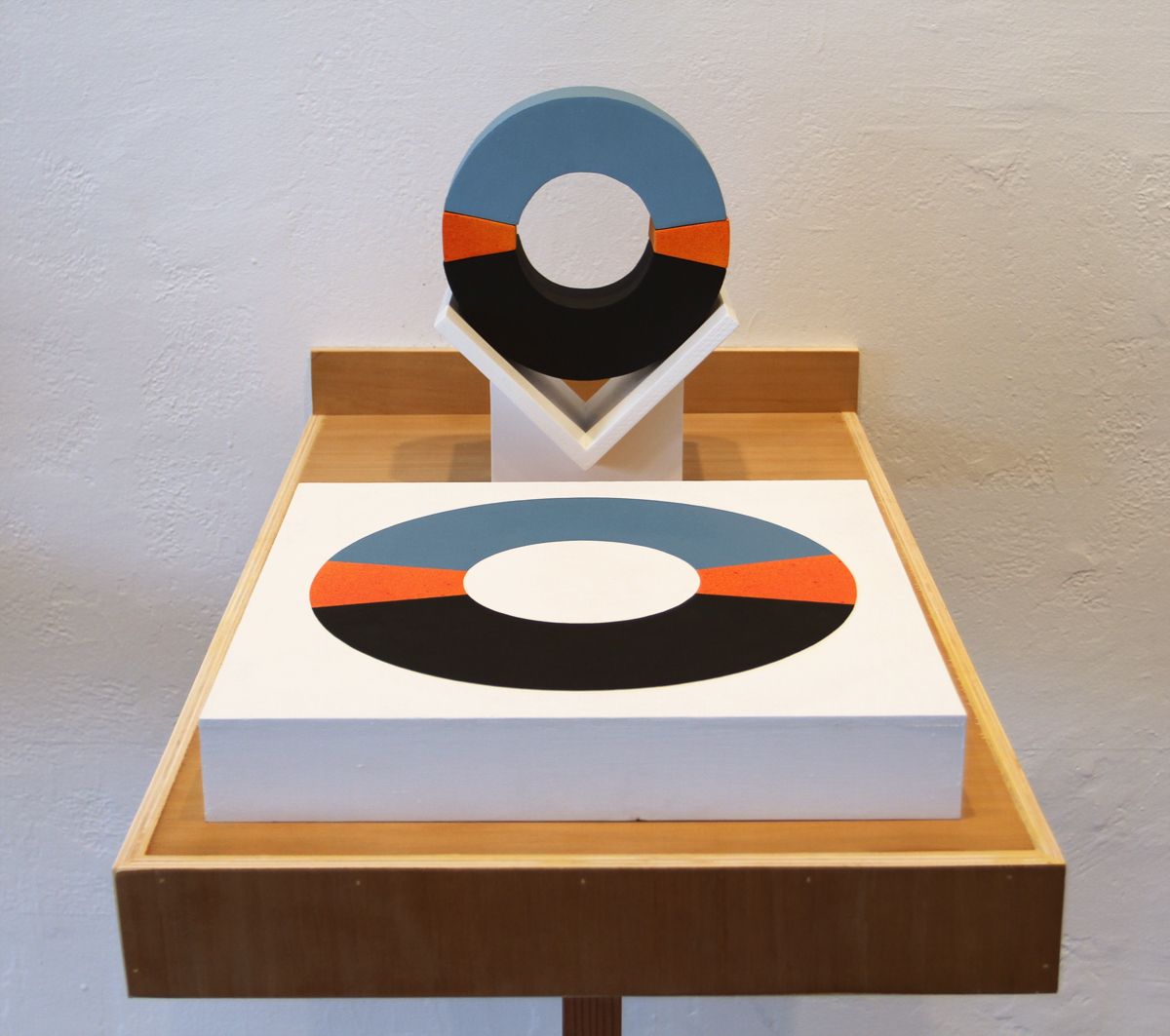
"Untitled (Time Diagram Set B)"
2011
Acrylic and gouache on wood panel, acrylic on handmade wood object, and table

Like it or not, context informs our experience and interpretation of artworks. We generally think of context as a work's physical situation (e.g., how and where it is installed) or its social and art historical framework, but most important is the context provided by an individual viewer. What is the viewer's profession? What book is she reading? Who was she talking to an hour ago, and what about? Of course, artists can't control for these subjective factors, and many craft artist statements that provide viewers with what the artists believe is appropriate context for the artwork. Too often, though, these statements tell viewers what the "take away" should be, thereby forfeiting the most vital and collaborative element of the artistic enterprise, the creation of meaning by the viewer.

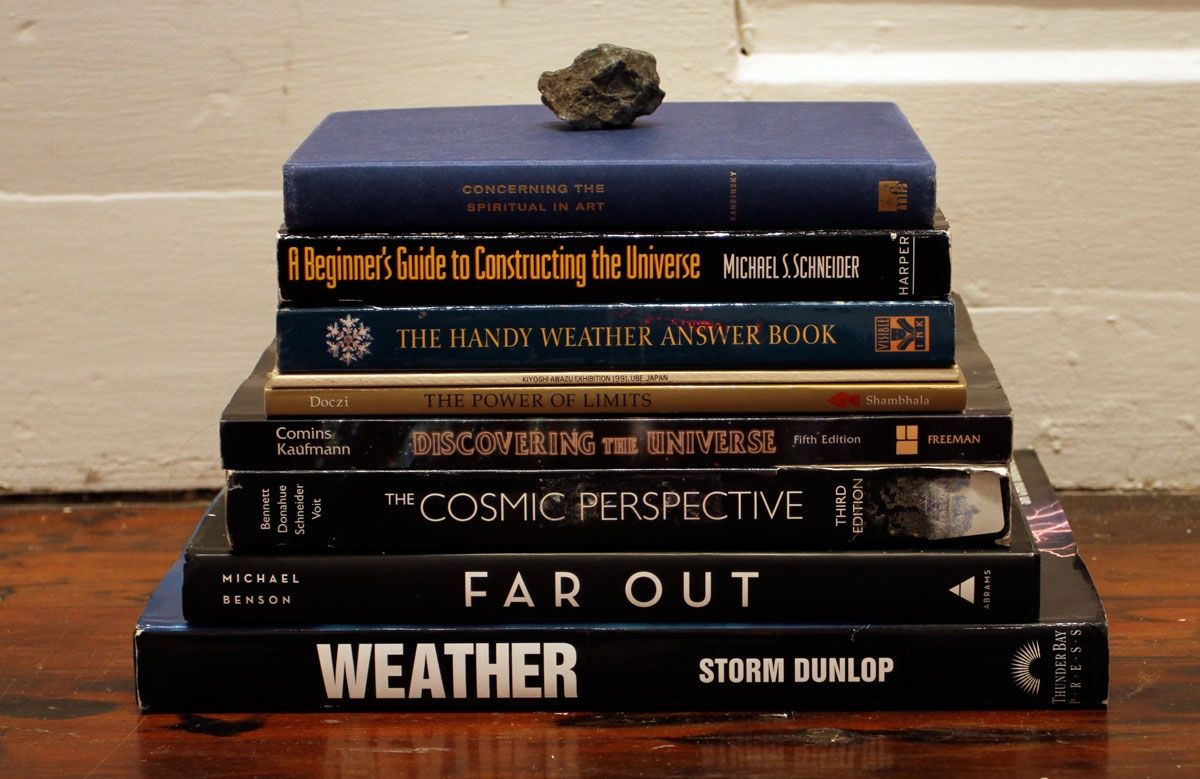
How refreshing, then, to find Gregory Ito's healthy twist on the artist statement in his terrific "Point of Vision" exhibition at Gallery Hijinks. While the artist and gallery provide a press release (usually an artist statement reworked and edited by the gallery staff), Ito also includes "Sources," a tidy stack of books on the floor, spines out so that the titles are easily read. Is "Sources" intended as a found object sculpture? Kinda sorta (after all, it's titled, is situated among Ito's other work, and is included on the exhibition price list, albeit "NFS"), but its principal valuable is as an alternative to the formal statement. It provides viewers with context without bullying them into a particular conclusion.

Gregory Ito
"Sources"
2011
Book collection

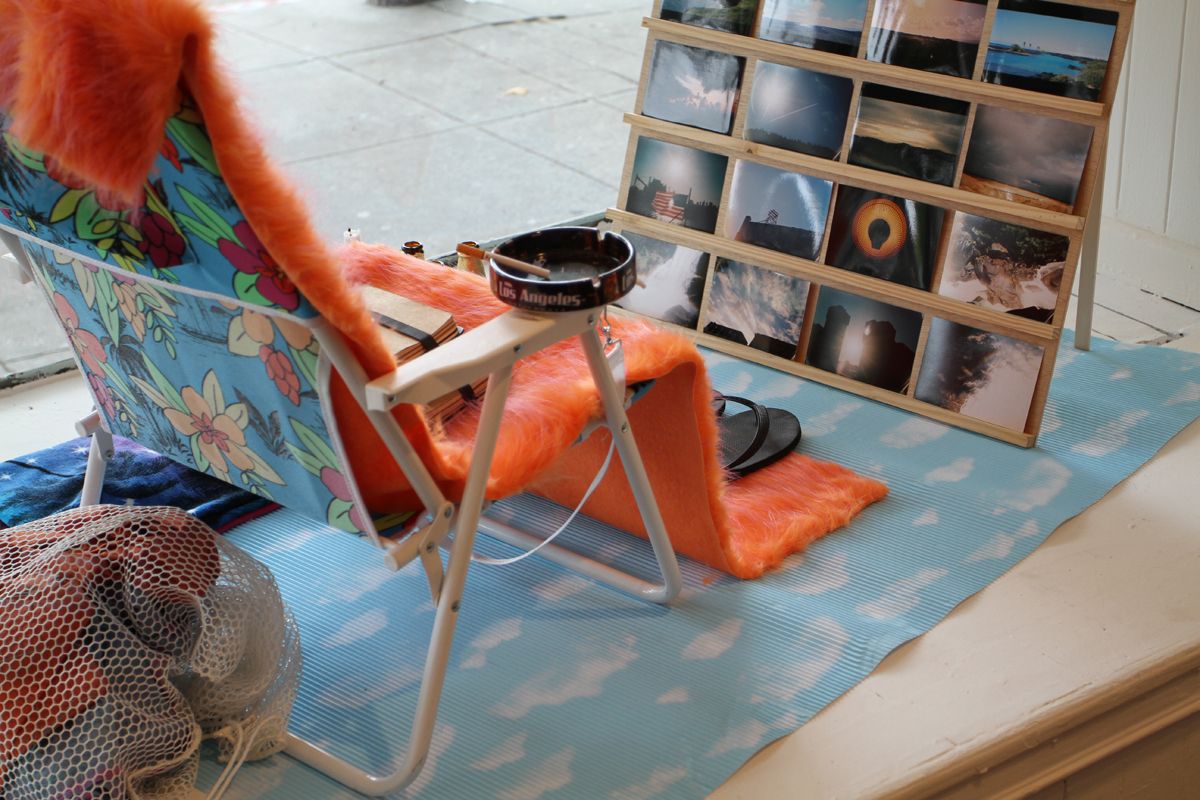
"Sources" is something of a companion piece to "Self Portrait (Object Collage)." Installed in one of the gallery windows, "Self Portrait" includes a beach chair, flip flops, a towel, a pile of diary-like journals, an ashtray, empty beer bottles, a candle, and 28 snapshots mounted on a board that faces the chair. One imagines the artist in his chair, sipping beer and smoking as he contemplates his collection of isolated observations. The photographs are mostly of clouds and sun-soaked skies, but there are also landscapes, some abstract imagery, a rainbow, and an illuminated light fixture. These pictures complement Ito's reading list. A Beginner's Guide to Constructing the Universe, by Michael Schneider, Concerning the Spiritual In Art, by Wassily Kandinsky, The Cosmic Perspective, Third Edition, by Bennett, Donahue, Schneider, and Voit, The Handy Weather Answer Book, and other titles included in Ito's book pile suggest that the artist is preoccupied with sublime, existential mysteries and celebrating our species' impulse to solve them.

Gregory Ito
"Self Portrait (Object Collage)"
2011
Window installation with 28 photographs and wood display

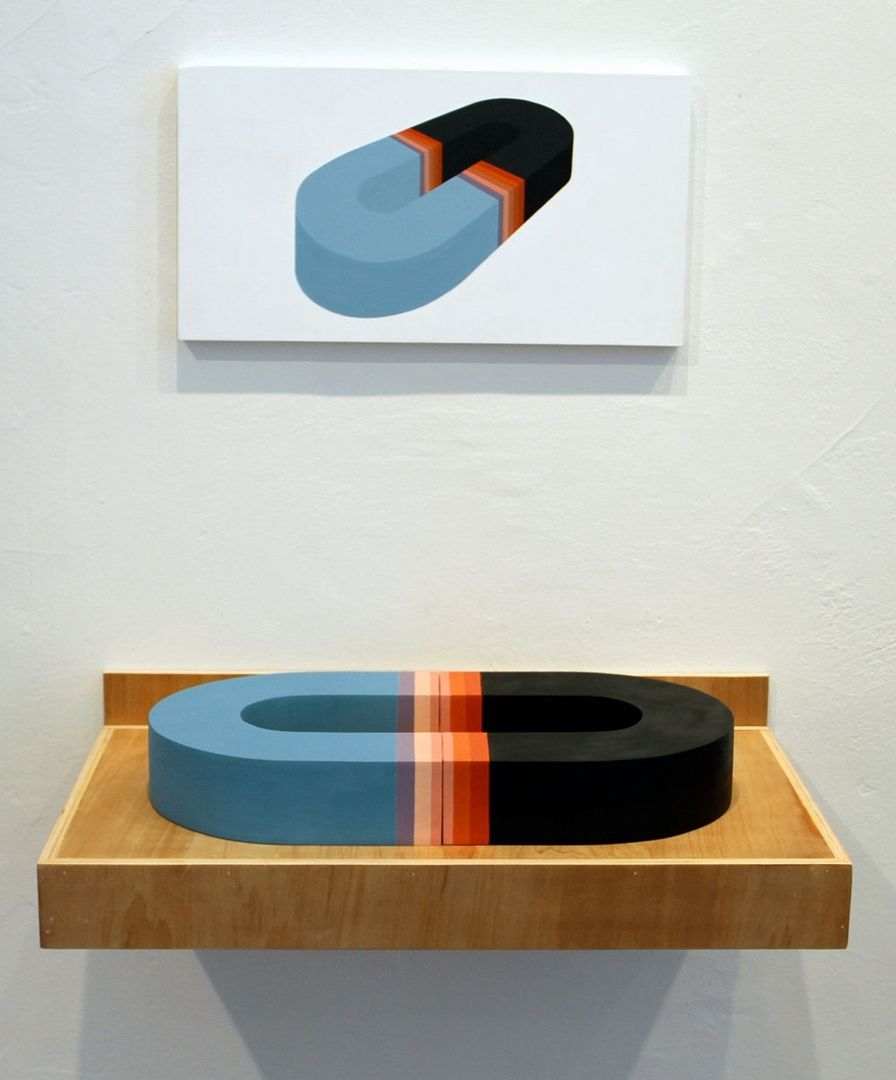
Ito's sculptures, paintings, and installations reflect this focus. Especially in the gallery's "white cube" setting, they read as speculative objects and diagrams as much as they do aesthetic entities. The artist is well aware of this; he titles the two most compelling installations on view, "Untitled (Time Diagram Set A)" and "Untitled (Time Diagram Set B)." He pairs a painting with a sculpture in each. The paintings are straightforward illustrations of the sculptures, but, displayed in the gallery setting with the three-dimensional objects they depict, the images read as icons, potent stand-ins for the "real" or "true" object. Curiously, by virtue of having been depicted, the sculptures also gain in significance. The meaning of these pictures and objects remains somewhat esoteric. I infer, based on the works' titles and Ito's "Sources," that these are representations of space-time's nature or shape, but that's a rather general interpretation. Still, the sculptures resonate as totems and the paintings as their icons. This reciprocal dynamic is compelling, and serves as an oblique reminder that all artwork exists in relationship to the world and ideas outside of the gallery and studio, a fact too often overlooked since the advent of modernism.

Gregory Ito
"Untitled (Time Diagram Set A)"
2011
Acrylic on wood panel, acrylic on handmade wood object, and shelf

In other works, Ito more directly highlights what I've elsewhere described as "the wonder current." In "Human Euphoria," a disembodied ceramic head of a girl in a big-brimmed, yellow hat rests on top of a block of adobe clay, apparently gazing at an ocean sunset. The piece is a winking, contemporary tribute to Caspar David Friedrich's Romantic masterpiece, "Wanderer above the Sea of Fog," but Ito's head is better-suited to contemplation than the vigorous morning constitutionals of Friedrich's dapper hero. Is this a comment on the continued dominance of conceptual concerns over aesthetic and material considerations in contemporary art? Perhaps; perhaps not. Ito's better pieces excel precisely because they can be interpreted as "art for art's sake" or, taking a hint from his "Sources," as art about the stupefying magnificence of being.

Gregory Ito
"The Embrace Installation"
2011
Acrylic and gouache on wood panel, found book with handmade page holders, and petrified object on shelf

Image credits: all images, courtesy Gallery Hijinks and Gregory Ito, 2011

Thursday, February 24, 2011

Art Practical: Richard Baker


Richard Baker
"The Air-Conditioned Nightmare"
2010
Gouache on paper
12 x 10.5 inches

My write-up of artist Richard Baker's gouache portraits of books is included in the most recent issue of Art Practical, an online magazine focused on the Bay Area's visual arts. The short piece appears in AP's Shotgun Reviews department. Read it here.

An element of Baker's work that I don't mention in the AP review is its special relevance to San Francisco; the artist's selection of titles and authors highlights the city's rich literary history. Happily, the town remains chock-a-block with neighborhood bookstores and reader-friendly cafes. Yet Kindles, iPads, and conversations about "the death of print media" abound. Indeed, even we bibliophiles find ourselves doing more (if not most) of our reading on electronic devices. Soon, our cherished libraries and bookstores may be considered the equivalent of charnel houses. If so, I'll still retreat to those tombs to touch, smell, and otherwise be with books. I'm guessing Baker will, too.

Baker's book portraits are on view at Gregory Lind Gallery through February 26th.

Image credit: courtesy Gregory Lind Gallery

Saturday, February 19, 2011

"The Air That Touched Things"


Claude Monet
"La Pie (The Magpie)"
1868-69
Oil on canvas
35 x 51 inches
"Monet once revealed that he wanted to paint not things in themselves but the air that touched things - the enveloping air. The enveloping air offers continuity and infinite expansion. If Monet can paint the air, he can follow it like following a thought. Except that the air operates wordlessly and, when painted, is visibly present only in colors, touches, layers, palimpsests, shades, caresses, scratches."

- John Berger, "The Enveloping Air," Harper's Magazine, January 2011
I'm not sure which I like more, Monet's wonderfully quixotic desire to paint "the air that touched things" or Berger's evocative prose. In any case, Monet nailed the light in his magpie painting.

Image credit: ripped from SeineValley.com

Monday, January 03, 2011

Karl Cronin's Experiencing Forms


Karl Cronin
"Populus tremuloides (Aspen)"
2009

In late November, I visited "Ecoarchive: Meditations on Time and Nature," a group show on view at Intersection for the Arts 5M, in San Francisco. All of the work included in the exhibition (on view through January 22, 2011) is intelligent and commendable, but I most appreciated Matthew Moore's video, "Lifecycles," Sam Easterson's video, "The Museum of Animal Perspectives," and Karl Cronin's video sampler of his "Somatic Natural History Archive."

I spent most of my time with Cronin's project. For his "Somatic Natural History Archive," Cronin aims to "document with his own body representational expressions of 10,000 U.S. plants and animals," an undertaking that the artist estimates will take 50 years to complete. To date, Cronin has made "expeditions" to Nashville (TN), Santa Fe (NM), Yosemite (CA), Raleigh (NC), Plainfield (MA), and the Grand Canyon, and he's earned the well-deserved support of the Santa Fe Art Institute, Movement Research, and the Puffin Foundation. The documents of his "representational expressions" are archived in the SNHA Catalogue, each labeled with the observed species' Latin name and common name (e.g., "Populus tremuloides (Aspen)").


Karl Cronin
"Awaiting identification"
2009

With so very many plants and animals to imitate (only 66 of the 10,000 have so far been cataloged online), it's not surprising that Cronin's earnest attempts are uneven; generally, I find his embodiment of plants more intriguing and successful than his animals, but even the less-realized "expressions" made me smile, giddily impressed by the artist's wonderfully quixotic efforts.

Importantly, however, Cronin's endeavor is not mere whimsy. The project may seem simple enough, but I'm certain that it provides the artist with a fundamentally new understanding of (and relationship with) the creatures he studies. Cronin first observes the plant or animal subject, then he perceives it physically, with his body. Watching the artist sway and lean with the breeze in a stand of a grass (an as yet unidentified species, perhaps related to switchgrass), it occurred to me that Cronin is something of a latter-day shaman. "Shaman" is a term abused by new-age prophets and their ranks of well-intentioned, but ill-informed followers, but the philosopher and cultural ecologist David Abram is one of a handful of writers who have given shamanism the thoughtful consideration that it deserves. As I watched Cronin channel a heron, Abram's definition of magic came to mind.
"We are human only in contact, and conviviality, with what is not human. [..] Magic is participating in a world of multiple intelligences with the intuition that every form one perceives - from the swallow swooping overhead to the fly on a blade of grass, and indeed the blade of grass itself - is an experiencing form, an entity with its own predilections and sensations that are very different from our own."
In essence, magic is empathy with other "experiencing forms"; it's communion with other facets of the animate world. Happily, by documenting his work with video, Cronin allows the viewer to participate in the magic. I'm grateful for that.


Karl Cronin
"Caelifera sp. (Grasshopper)"
2009

Note: As a proud natural history geek, I was disappointed that Cronin titled the last of the three videos above "Caelifera sp. (Grasshopper)." In fact, the insect that Cronin imitates in this video is actually a katydid, a species more closely related to crickets than to grasshoppers. Still, while I presume Cronin will make the correction when he adds this video to the SNHA Catalogue, I don't envy him the task of trying to secure a definitive ID on many of the species he works with. Without the help of a entomology expert, he'll be hard pressed to determine the species of katydid in the video above.)

Image/artwork credit: all videos, courtesy Karl Cronin

Sunday, November 14, 2010

Gallery Report, November 6th, 2010

On a beautiful fall Saturday, I visited a number of San Francisco's downtown galleries with Brian Friedman, a good friend and artist who was visiting the Bay Area from New York City. Although I'm very happily installed on the west coast, I haven't lived here long enough to establish close friendships, and I was impressed by how much I appreciated spending time with a friend with whom I'm so comfortable. Maybe I'm getting prematurely sentimental? Sentimental or not, I'm still a harsh judge of artwork, and most of what Brian and I viewed was unremarkable. Fortunately, there were a few exceptions.

+++++
"Narwhellian"
Seth Koen at Gregory Lind Gallery


Seth Koen
"Djiril"
2010
Wood
43.25 x 72 x 8.25 inches

Sculptor Seth Koen produces work that appeals in equal measure to my formal sensibility and my imagination. Viewers who prioritize craft will delight in Koen's refined and sensuous surfaces and formalists will applaud the forms' casual elegance. As playful as they are soulful, some wear knitted contraceptives or melt impossibly while others limn space's transcendental properties almost as effectively as a James Turrell light work.

My principal pleasure, though, is considering what the esoteric objects might represent or be. The artist avoids didacticism -- he shows instead of telling -- and the sculptures are more open-ended and interesting as a result. Are they abstracted totem animals, as the exhibition's title, "Narwhellian," might suggest? Are they instead the tools or ritual objects of some unknown, aboriginal population? Or are they sophisticated, conceptual responses to our contemporary political predicaments, another reading of the show's title? The answers, of course, are supplied by each viewer.


Seth Koen
"Medusa" and "Arachne"
2010
Wood / Wood and thread
63.5 x 5 x 7.75 inches
69 x 6 x 6 inches


+++++
"Incidental Objects"
Andy Goldsworthy at Haines Gallery


Andy Goldsworthy
"Hand hit site dust, Presidio Spire, October 2008"
2008
6 unique C-prints
16 x 16 inches, each

Could it be that Andy Goldsworthy is at last taken seriously? These days, I don't receive as much grief as I used to when I admit that I admire much of Goldsworthy's effort. Perhaps the self-conscious, punishing cool of conceptualism is finally beginning to wane, making room for artists who aspire to the sublime and wear their Romantic and mystical impulses like badges of honor? Whether or not Goldsworthy's work is taken seriously by his contemporaries, however, it is no less important. That's not to suggest that all (or even most) of the artist's output is particularly notable; nevertheless, when Goldsworthy connects, he produces profound and potent work.

A few gems are included in "Incidental Objects," his current show at Haines Gallery. The strongest work in the show is a series of photographs titled, "Hand hit site dust, Presidio Spire, October 2008." The photos document an unremarkable gesture captured in six frames; the artist smacks dry, dusty ground at the site where his "Presidio Spire" sculpture would later be constructed. By presenting the action in a Muybridge-style sequence, Goldsworthy invites the viewer to ruminate on the significance of the crude, abrupt mark-making; in so doing, he invests the unremarkable with significance or, as the exhibition's title terms it, the "incidental" is rendered radically full of meaning.

Few artists are so interested in getting dirty. Playing in the mud, Goldsworthy asks vital questions about our contemporary relationship to terrain, ritual, time, and natural processes. It's interesting, then, that video and photography, mediums we associate with an anthropological remove and even sterility, are the artist's most effective means of documentation and presentation.

+++++
"Recent Paintings"
Stephen Beal at George Lawson Gallery


Stephen Beal
"untitled"
2010
Acrylic, gouache, and graphite on wood panel
31.75 x 31.75 inches

In the Bay Area art community, Stephen Beal might be better known for his regional academic and managerial activity than for his artwork. Like many other working artists, Beal is a college professor, but he's also the active President of the California College of the Arts (CCA), a Board member of the Yerba Buena Center for the Arts, and Board President of the Creative Growth Art Center. Impressive and laudable though his contribution to Bay Area arts is, I'm pleased to report that his show of recent paintings at George Lawson Gallery proves he's an artist who "sunlights" as an arts administrator rather than an arts administrator who moonlights as an artist.

All of Beal's paintings hum and vibrate, and his brightly colored works crackle with energy; generally, however, his strongest pieces are understated, more Om than bug zapper. Admiring "untitled" (pictured above), Beal's repetitive, paced process calls to mind the meditative work of Agnes Martin. The finished, undulating picture, however, relates more to Mark Rothko's transcendental canvases. (Tweeting contemporary benefactors: "21st Century Chapel, Anyone?" But, until Daddy or Momma Warbucks steps forward to give Beal a permanent space to transform with his pictures, his work will transform one collector's wall at a time...and that's no incidental thing.)


Stephen Beal
"untitled (sb03)"
2010
Acrylic and graphite on wood panel
8 x 9 inches


Image credits: all images, courtesy the respective gallery websites

Friday, May 21, 2010

Changes


View of Empire State Building; Manhattan, NYC; May 2009

As I prepare to move from New York City, my home for over a decade, to San Francisco, my home for at least a few years, I find myself viewing NYC through the eyes of a man in limbo. I'm still living in Queens, but my attention is already on the road.


Vacant lot; East Village, Manhattan; May 2008

A decade of NYC living makes me, by at least one standard, an official "New Yorker." How does that define me? New York, like all conurbations, is ever in flux. On my watch, it's changed in remarkable ways. What changes will come after I'm no longer a resident? Likewise, what changes are yet in store for me, a similarly adaptable organism?


Samuel Cohen Son graffiti; East Village, NYC; April 2010

I moved to New York City in October 1999, not long after I graduated from The College of William & Mary. I was then an ambitious twenty-one year old with a deeply cynical streak and an abiding love of beer and partying. My paintings and drawings featured naked people interacting in various ways with other animals, medical instruments, fossils, and, on occasion, Teletubbies. (If a reader knows what became of the big Tinky Winky sex painting, I'd love to see a photo of it!) Despite my apparent enthusiasm, I was steeped in melancholy. I spent hours each week brooding over "I," my pet novel project, a 1990s East Village vampire update of Hermann Hesse's Steppenwolf. I viewed humanity as a noxious species, religion as the most noxious of human inventions, and I not so secretly looked forward to our inevitable extinction.

Today, I'm an ambitious thirty-two year old who reacts against cynicism, drinks much less, and generally dislikes partying. Naked people sometimes appear in my paintings, but there aren't any Teletubbies. I'm a stubborn optimist. Each morning, I take twenty minutes to humbly celebrate a new day; if I wake in a funk, I fight through the fog to see anew just how marvelous life is. I recall my earlier character with some embarrassment. What was wrong with the arrogant kid who labored on a novel that painted such an ugly picture of humanity and religion? Perhaps he just needed to be more intellectually rigorous, and to open his eyes to the awesome fact of being? Or maybe that twenty-one year old also needed a good hug, which is no small thing?


Greenpoint, Brooklyn; May 2009

My time in New York City has seen me metamorphize from a hardened and cynical adolescent into an optimistic, joyful adult. The direction of this evolution runs counter to the standard assumption made about the effect of NYC living. As the columnist Mary Schmich warned (and director Baz Luhrmann popularized with his song "Everybody's Free (To Wear Sunscreen)"),
"Live in New York City once, but leave before it makes you hard; live in Northern California once, but leave before it makes you soft."
In my experience, however, NYC living sanded smooth the hard edges.


Wollman Rink; Central Park; Manhattan; June 2008

Perhaps, too, the mournful and nostalgic wails of NYC residents (myself included) are misguided? We should accept that "what will come, will come" without falling victim to fatalistic impotence. New York City (and Manhattan, in particular) is one of the most sustainable, environmentally responsible cities in the world, and its educated, informed residents should work with New York State and City representatives to make sure the city continues apace on that front. They should also do all they can to ensure that it remains a mecca for tolerance, the arts, and cultural pluralism. In what ways I can, I'll do the same from the Left coast; New York City is a part of me, and I will always feel a part of New York City.

Love and peace to all of my friends here. Thank you for everything. I'll be in touch. I'll visit. I hope that you'll visit me.


Upper New York Bay from Staten Island; May 2008

Image credits: all photography, Hungry Hyaena

Sunday, May 16, 2010

Susan Silas' Heroic Living


Susan Silas
"found birds; 2000 - the present"
(Image 17 of 23 from the portfolio "eyes wide shut")
2010
Archival ink jet prints on Hahnemühle photo rag paper
22 x 17 inches

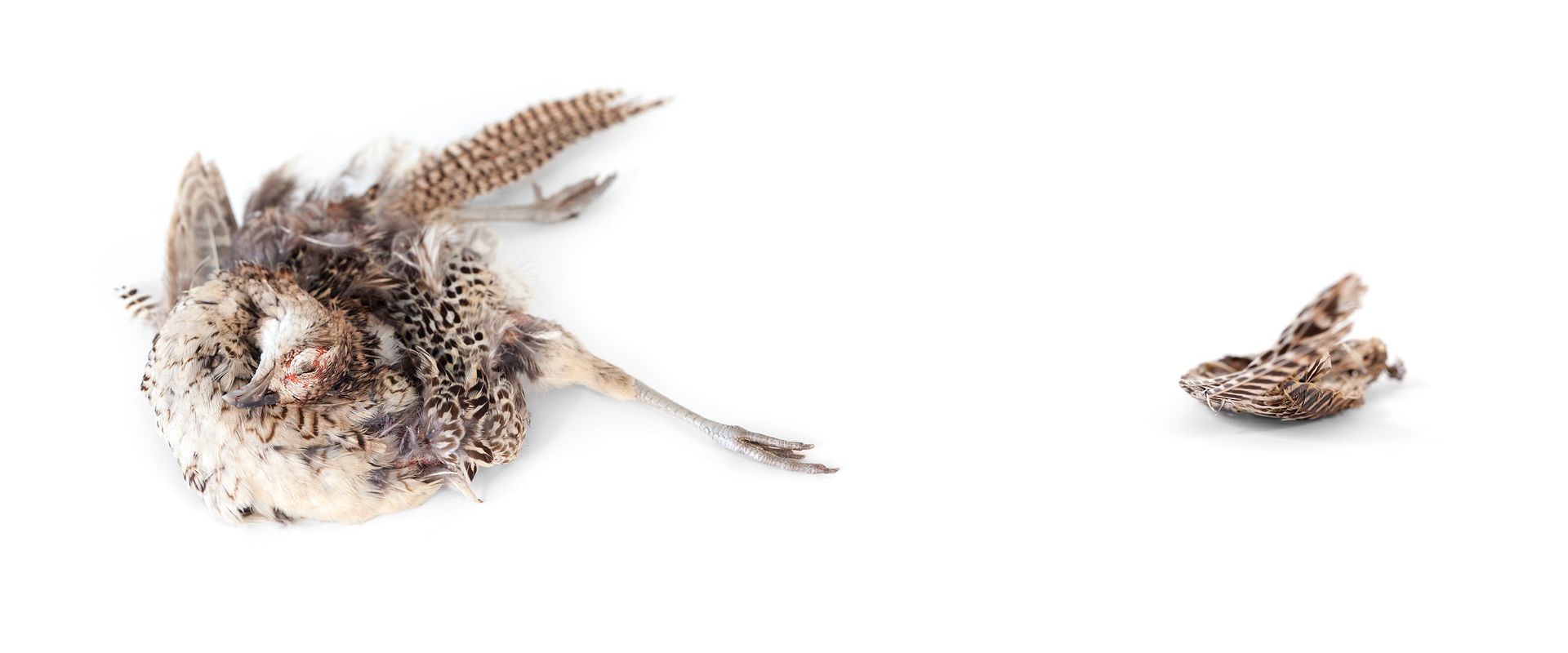
Until recently, I was unfamiliar with Susan Silas' artwork. She is perhaps best known for projects memorializing the Shoah, but it wasn't an awareness of her Holocaust work that led me to "Helmbrecht's Walk, 1998-2003." Instead, it was a photograph of a dead American kestrel that Silas emailed me in March.

I have only an inkling of what essay or artwork of mine inspired the artist to send me the image, but I'm grateful that she did. I shamelessly admit to being the sort who finds soulful beauty in images of death, and I was touched by the striking and contemplative photograph. A month after I received the picture, I visited Silas in her Brooklyn home, to look at prints from her "found birds" series. Still pondering her work a week after that visit, I headed to Hebrew Union College's Jewish Institute of Religion Museum, eager to compare what I saw and sensed in "found birds" to Susan's more easily classifiable (though by no means "easy") Shoah work.


Susan Silas
"found birds; 2000 - the present"
(Image 3 of 11 from the portfolio "what remains")
2010
Archival ink jet prints on Hahnemühle photo rag paper
20 x 48 inches

The HUC press release for "Helmbrecht's Walk" describes the project succinctly.
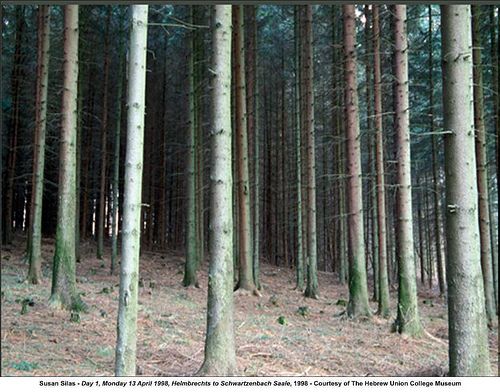
"On April 13, 1945, more than 700 women were forced to march 225 miles in 22 days from the Helmbrecht's Labor Camp, a small satellite unit of the Flossenburg Concentration Camp in Germany, to the Czech city of Volary. [...] During the course of this forced march the women were ill fed, inadequately clothed, denied shelter, and capriciously beaten. On the sixth day of the march, the non-Jewish prisoners were separated from the group, leaving the remaining 580 Jewish women to continue until May of 1945.

With determination and sensitivity, Silas traced the march in 1998 on the 53rd anniversary of the event by walking along the same path as the Helmbrecht's women for 22 days in Germany and the Czech Republic. She documented her journey in Helmbrecht's Walk, a collection of 48 archival color prints presented as an unbound book. [...] The images contextualized by Silas' daily commentary of her own experiences are coupled with news reports of event occurring elsewhere in the world on that same day in 1998. This juxtaposition, she says, functions 'to heighten our awareness of the fact that we are all presently witnesses to unspeakable events and extreme suffering for which we take no more responsibility than did many witnesses to the Holocaust.'"
Silas' project addresses the complicated relationship between place and time or, as cultural critic and historian Simon Schama's consideration of the topic framed it, "landscape and memory." When Silas conceived of the Helmbrecht's project, she believed (or maybe hoped) that walking the same path that the Helmbrecht's women had would allow her some intimate experience of or insight into the terrible march. In fact, this didn't prove so. Silas describes her walk as "relatively mundane and unexceptional." She continues, "My feet hurt. I get tired. [...] I found it more, rather than less difficult to understand how these women made this journey once I was out on the road."


Susan Silas
"Helmbrecht's Walk, 1998 - 2003"
(Day 1, Monday 13 April 1998, Helmbrechts to Schwartzenbach Saale, 1998)
Archival ink jet prints on Hahnemühle photo rag paper

Yet many of the captions she includes with the photographs reference artists and thinkers such as Werner Herzog, who understand "walking as a sacrament." Such language calls to mind the Australian Aborigines' songlines, mnemonic stories that are spoken or sung as the Aborigine walks over the referenced terrain. In his marvelous book Spell of the Sensuous, David Abram relates a striking, relevant anecdote.
"A similar tale is told by [Bruce] Chatwin. He was traveling in a Land Cruiser with several friends, including an Aboriginal man nicknamed Limpy whom they were driving to a particular place on his songline. Limpy, whose clan Ancestor was the Native Cat, or tjipla (a small marsupial with a long, banded tail), had never been to this place along the Native Cat songline, yet he now wished to go there in order to see some distant relatives who were dying there. During the course of seven hours driving through the back country, bumping across shallow rivers and under gum trees, the Aboriginal man sat motionless in the front seat, squeezed between the driver, Arkady, and another passenger, except for a short burst of action when the truck crossed part of his songline. Later,
'[w]e came to the confluence of two streams: that is, we met the stream we had crossed higher up on the main road. This lesser stream was the route of Tjilpa Men, and we were joining it at right angles. As Arkady turned the wheel to the left, Limpy bounced into action. Again he shoved his head through both windows. His eyes rolled wildly over the rocks, the cliffs, the palms, the water. His lips moved at the speed of a ventriloquist's and, though them, came a rustle: the sound of wind through branches.

Arkady knew at once what was happening. Limpy had learnt his Native Cat couplets for walking pace, at four miles an hour, and we were traveling at twenty-five. Arkady shifted into bottom gear, and we crawled along no faster than a walker. Instantly, Limpy matched his tempo to the new speed. He was smiling. His head swayed to and fro. The sound became a lovely melodious swishing; and you knew that, as far as he was concerned, he was the Native Cat.'"
I believe that what was missing for Silas was a story line, the narrative informed by the landscape (and vice versa) that, among indigenous groups such as the dwindling Aboriginal population of Australia, is traditionally passed from generation to generation. In some respects, "Helmbrecht's Walk" is an attempt to locate such a story, an earnest effort to discover in the landscape the marks of what happened decades before. In our postmodern, peripatetic culture, nations and traditions do not generally fare well. In some respects, this is a positive development, as our tribal perspectives and prejudices erode into some variety of tentative, liberal pluralism. On the other hand, it's ever more difficult to feel confident about one's identity and how it relates to landscape, vocation, and nation.

My time with "Helmbrecht's Walk" confirmed my supposition, however, that Susan's art is not primarily interested in cultural identity or particular histories. Instead, she is most concerned with "the big questions." To one degree or another, all art wrestles with or reacts to these existential imponderables, but Susan's exploration is more focused and urgent than most. Fortunately, even though her work is preoccupied with mortality and meaning, she manages to avoid the pitfalls of such terrain; her work is neither macabre nor aestheticized to the point of anesthetization.


Susan Silas
"found birds; 2000 - the present"
(Image 1 of 21 from the portfolio "blackbird")
2010
Archival ink jet prints on Hahnemühle photo rag paper
22 x 17 inches

Two days after I visited "Helmbrecht's Walk," I read "Eudaimonia, existentialism, and the practice of medicine," an essay by Dr. Andrew Radu included in the Spring 2010 issue of The Pharos of Alpha Omega Alpha Honor Medical Society. In his essay, Dr. Radu describes the existentialist ideal of tragic optimism. He writes of it, "even in the face of imminent death, we have the ability to reevaluate life." He goes on:
"A crucial concept held by many existentialist philosophers is that of heroic living. All humans have the ultimate freedom to live boldly in the face of tragedy. Living with this concept makes attaining a goal of eudaimonia less important than simply striving to do so. [...] The concept of tragic optimism proposes that in a life that can be circumscribed by pain, guilt, and death, one should say 'yes to life in spite of everything.'"
Indeed, as I wrote in "Eudaimonia," a January 2009 essay that explored my then nascent optimism,
"Acknowledging our species' precarious position is not defeatist; on the contrary, accepting the inevitable nourishes the individual's desire to contribute. Faced with an impossibly difficult prospect, only individual effort can sustain us. As Albert Camus concluded in The Myth of Sisyphus, 'The struggle itself is enough to fill a man's heart. One must imagine Sisyphus happy.'"
The Shoah is bleak history, a subject watered by the blood of millions, and it is fertile soil for such "big questions." Silas' "found birds" remind us that so, too, is the striving and passing of a blackbird. The artist's reckoning with death is her own form of "heroic living."

Image credits: all artwork, courtesy Susan Silas

Saturday, April 03, 2010

"Ouroboros" at ISE Cultural Foundation


I'm intrigued by the many positive reviews of "Ouroborus: The History of the Universe," a six-screen, 3-D video installation by biochemist, philosopher, and video artist Ali Hossaini and the collaborative duo of Blake Shaw and Bruno Levy, aka SWEATSHOPPE, currently on view at the ISE Cultural Foundation. Many write-ups of the exhibition describe the installation as meditative, and excitedly relate the artists' intent to "[tell] the history of cosmic evolution - from the Big Bang to Lady Gaga - by animating over 30,000 images."

In fact, although "historical spiritual illustrations of the cosmos, from vedic yantras, buddhist mandalas, and sacred geometry," are prominently featured on three of the installation's six screens, the effect is less mindful (and certainly not meditative) than it is visually assaultive and superficial. And, though the triptypch "cosmic evolution" might incorporate over 30,000 images, it is best described as a pastiche of generally significant forms rendered insignificant in presentation. As a gallery companion remarked to me, "This isn't communicating anything; it's just a 'Clockwork Orange' brainwashing machine." It's a shame that's true, as Hossaini's accompanying artist statement is insightful and important. I include the full text of his statement below.
"Nowhere is the fragmentation of the human psyche more evident than in how we treat the environment. We know we're pillaging our habitat, but we can't make the leap from knowledge to right action. I attribute this disconnect, and many others, to the factionalizing of culture that began with modern science, industry and art.
I'm not saying we should turn our backs on the Enlightenment. But neither should we take it as dogma - we need to rethink its foundation, integrating our psyche into the cosmos in a way that builds on premodern wisdoms as well as modern science. The Enlightenment freed physics, astronomy and eventually art - think 'art for art's sake' - from tradition, spawning remarkable advances along with deep alienation.

It's time to produce culture in a more holistic, organic way. For now science, art and religion - and I use 'religion' here to mean a generalized psychology - lie in private tracks, each requiring extensive knowledge for appreciation let alone practice. How can these disciplines work together more effectively?

The answer doesn't lie in the rejecting, merging or reconciling science and spirit. Instead we need to create a framework for integrating our experiences of these different realms, and this is precisely what artists can do. Art needs to step out of its self-referential confines, the safe house of galleries, museums and markets. It needs to be Saturday night and Sunday morning, be the new church, and it needs to invade pop culture. Mass appeal is critical.

Most of all art needs to rejoin itself to science. Both embody urges to explore, understand and create, and both have become specialized, mechanized and self-absorbed, given to destructive irony. Art cannot be science, but it can convey the sense of wonder that drives scientists. It can visualize the worlds of science while honoring our sense of self as beings that transcend the mundane.

Our experiences of spirit and matter cannot be reconciled, but they can be represented. And they can be represented in a way that sheds light on the complexities and responsibilities of being self-aware. Artists can rise above the dilemmas of modern life: they can comprehend the contradictions, integrating them into new levels of experience where knowledge, desire and energy meet the limits of human freedom."
I agree completely, but Hossaini's collaboration with SWEATSHOPPE has neither shed "light on the complexities and responsibilities of being self-aware" nor integrated contradictions into new levels of experience. Their intent is laudable, but their effort lacking.

Yet Hossaini's statement resonates and, as I left the ISE Cultural Foundation, I recalled Ron Fricke's tremendous film "Baraka." Hossaini and SWEATSHOPPE have inspired me to revisit Fricke's beautiful, moving tribute to transcendent oneness, and to eagerly await the long-awaited sequel, "Samsara." It's hopeful to recognize that sometimes art does step outside "its self-referential confines."

Monday, March 15, 2010

The 'Raw Stuff'...Discussed

I submitted a version of "Different Takes on the Raw Stuff," my posted response to Peter Gabel's "A Call For Sacred Biologists," to Tikkun Magazine, and I'm pleased to report that my comments engendered an edifying conversation with the article's author.

The editors of Tikkun have posted an abridged version of my correspondence with Peter on Tikkun's blog, Tikkun Daily. I encourage folks to check it out, but I've also included two excerpts of Peter's "voice" below.
"If I could sum it up in a phrase, I would say that Christopher is committed to the idea that science and religion are both valid ways of knowing but they are separate ways, whereas I believe we have to move towards a unified approach to knowledge (the nature of which I’ll take up in a forthcoming issue of the magazine). I was happy to have such a reasonable conversation about a topic that arouses such passion."

"It seems that [Christopher has] two selves and two worlds, the mystic and the materialist, side by side, each in its domain. I’m very much in agreement that [his] stand on this is possible; nothing about science excludes a mystical and religious reality within which material reality and scientific knowledge of that material reality unfolds.

However, for me there is only one world, the spiritual-material, spirit enlivening material form. To take this world as an object therefore is to act on it and impoverish it, although sometimes for a noble and valuable purpose (western medicine!). But ultimately I am for reuniting knowledge with spirit as manifested in form, including restoring meaning/desire/intention to evolution (but not some perfect intelligent design)."
When it comes down to it, then, I don't think that Peter and I are in stark disagreement. To a large extent, I share his belief that my "two selves" are actually of a piece (i.e., the division of logos and mythos, or rational and irrational, is artificial), but I also contend that there are different ways of knowing or approaching the Whole (the Everything), and that these distinct ways of knowing can and should coexist, each bringing to the conversation their unique perspective.

Read the full exchange here. The Tikkun Daily post also features two recent drawings that aren't yet on my website.

Thursday, March 11, 2010

Different Takes on the Raw Stuff


Christopher Reiger
"submerged in his erotic mystification"
2009
Watercolor, gouache, sumi ink and marker on Arches paper
32 x 32 inches

I'm pleased to announce that one of my 2009 paintings, "submerged in his erotic mystification," is reproduced in the March/April 2010 issue of Tikkun Magazine. If you're unfamiliar with Tikkun, it's a west coast-based magazine founded by Rabbi Michael Lerner and dedicated to exploring the intersection of politics, spirituality, and culture. While it has Jewish roots (hence the magazine's name), it is an inter-faith publication with a diverse group of secular and religious contributors. The March/April issue includes a special section entitled "God and the 21st Century," featuring articles by seventeen writers, including the esteemed Rabbi Arthur Green, a scholar whose stripe of mystical panentheism resonates with my theological convictions.

My artwork accompanies one of the many articles included in "God and the 21st Century." Respected law critic Peter Gabel's "A Call For Sacred Biologists" explores the gulf between a strictly rational, scientific world view and that of, for lack of a better description, holistic panentheism. I allude to this same schism in my artist statement.
"[I]ncidentally, we've realized that the divide between the imagination and reason is unnatural. The English poet and critic, John Ruskin, alluded to this schism when he wrote of 'the broken harmonies of fact and fancy, thought and feeling, and truth and faith.' Indeed, although we today learn an increasing number of facts about Nature, we understand ourselves to be apart from it, and our experience of it is therefore less complete. My artwork is born of this apparent opposition."
Gabel's subject is near and dear to me, but his language unfortunately suggests that he has a deep-seated mistrust of, as he puts it, "the so-called 'scientific method'." (Italics mine.)

In the myopic, yet much ballyhooed skirmish between science and religion, I reside in the middle, as frustrated by the rabidly anti-religious as I am disturbed by and opposed to religious literalists and fundamentalists. Gabel, while not a religious literalist, uses language that apparently misunderstands scientific endeavor. For example, he insists that we need evolutionary biologists "who connect the sacred within themselves to the sacred dimension of what they observe." If he means that we need more leading scientists to openly discuss the awe and wonder they experience through their observation of the material world, he needn't worry. Many scientists are more than happy to wax poetic about the wonders of life and the universe; stand outs include Loren Eiseley, Carl Sagan, E.O. Wilson, Thomas Eisner, and Janna Levin. If, however, Gabel is suggesting that evolutionary biologists should champion mysticism, orthogenesis (1), or notions of "a master plan," he is expressing an essentially irrational and anti-scientific bias. Biologists must be vigilant to not allow spirituality to cloud their work. By all means, biologists can be deeply religious or spiritual people, but, for science to remain legitimate, the method and its language must be materialist and reductionist. (If scientific endeavor is mixed with mysticism, it becomes pseudo-science or, put another way, bunk.)

At the article's close, Gabel writes that "the theory of evolution [must] align itself with the truth that spirit and matter form an indissoluble unity." To the contrary, the theory of evolution needn't make any attempt to "align itself" with spirituality; it is its own truth, a scientific truth. As Rabbi Green writes in the same special section,
"I recognize fully and without regret that theology is an art, not a science. We people of faith have nothing we can prove; attempts to do so only diminish what we have to offer. We can only testify, but never prove."
Exactly right!

As I wrote on this blog in late 2008, in an essay about the artwork of Matthew Day Jackson,
"At their respective best, both science and religion (re)awaken or invigorate our capacity for wonder. Each makes use of a different approach, but they are complementary. As Albert Einstein famously said, 'Science without religion is lame. Religion without science is blind.' The late evolutionary biologist Stephen Jay Gould called the two 'non-overlapping magisteria' because good science trades in facts to explain material phenomena, whereas religion traffics in the unverifiable and the unobservable. Where science seeks to demystify, and to build on each subsequent revelation to learn more, religion aims to make sacred that which is taken for granted, to make the ordinary again extraordinary. Both, however, offer frameworks of engaging our astonishing existence and experience. Both are compelled by curiosity and wonder. As Gotthold Ephraim Lessing, the Enlightenment writer-philosopher, argued, if God held in one hand the Entire Truth and in the other the Eternal Pursuit of Truth, a good man will choose the latter. The same is true of authentic scientists and religious thinkers. The methodology and particulars may differ, but both science and religion are realms of the question. Although the popular conception of the scientist is the white-coated statistician ready to provide any and all answers, the caricature is misleading. It is 'normative in science to be not sure,' as Jessica Palmer put it doing the ScienceBlogs panel. Science, like religion, is a matryoshka doll, a series of questions nested within questions.

Gould considered art and philosophy magisteria unto themselves, but, unlike religion and science, each overlaps the other. Where these two overlapping sections meet, we find ourselves in the realm of what the artist-writer Paul Laffoley calls the mesoteric. In Laffoley's cosmology, the circle of religion, dealing as it does with questions of ultimate meaning, is dubbed the esoteric realm. The circle of science, focused on material truths and the observable world, he labels the exoteric realm. The mesoteric realms. art and philosophy, bridge the esoteric and exoteric. Whereas Gould posits that the magisteria of religion and science are nonoverlapping, I would argue that, where their circles meet, the membrane is permeable. This bleeding of one into the other represents the pinnacle of art and philosophy."
Rather than demand that science couch its truths in the language of the sacred or demand that religion dress its Truth in the language of scientist, why not understand each as complementary, distinct practice of awe? In a recent post on NPR's "Cosmos and Culture" blog, astrophysicist Adam Frank writes,
"I believe it is possible, and necessary, to see science and human spiritual endeavor through an alternative perspective. That perspective would acknowledge the truths each can reveal and avoid jealous comparison of those truths. [...] Our elemental encounter with the world, the raw stuff of experience, was just as vivid and strange to our ancestors as it is to us now if we are willing to pay attention. They felt awe and wonder beneath the dark weight of the night sky, in the deep quiet at the forest's edge or in the shock of infant's birth wail. Those experiences drove our ancestors, as [they drive] us, to an all important aspiration, a desire to draw closer to the source of that tremendous awe. That aspiration - what I call the Constant Fire - contains the original and braided roots of science and religion. [...] That aspiration is, for me, a road less traveled in the discussions of science and religion. If we were to follow it and to ask what is common, not in results about the world but in the deeply felt response to it, who knows where we might be led?"
Beautifully stated, Dr. Frank!

My rather particular problems with Gabel's article aside, the March/April issue of Tikkun includes excellent pieces by Rabbi Arthur Green, David Loy, Shaul Magid, and others.

(1) Like Gabel, I'm warm to Pierre Teilhard de Chardin's concept of orthogenesis, the "hypothesis that life has an innate tendency to move in a unilinear fashion," increasing in complexity. When people speak of "the universe becoming aware of itself," they are expressing an essentially teleological sentiment and, while many contemporary scientists will acknowledge that such a notion is possible, it is wholly unquantifiable and therefore not legitimate science. It is best classified as theology. It is important to note, however, that de Chardin was a Jesuit priest as well as a serious paleontologist and geologist. He did not believe the scientific method to be at odds with a sense of belonging, wonder, or, in his words, "the within of things." Rather, de Chardin recognized science as kin to the arts, philosophy, and theology; it is another tool for our species' exploration of the evolving universe we inhabit.

Saturday, February 20, 2010

Saturday, January 23, 2010

Quantity or Quality?


Nathan Abels
"Passage"
2009
Acrylic on Panel
24 × 48 inches
"The world we inhabit is not, in this sense, a determinate set of objective processes. It is our larger flesh, a densely intertwined and improvisational tissue of experience. It is a sensitive sphere suspended in the solar wind, a round field of sentience sustained by the relationships between the myriad lives and sensibilities that compose it. We come to know more of this sphere not by detaching ourselves from our felt experience, but by inhabiting our bodily experience all the more richly and wakefully, feeling our way into deeper contact with other experiencing bodies, and hence with the wild, intercorporeal life of the Earth itself.

[...]

In truth, it’s likely that our solitary sense of inwardness (our experience of an interior mindscape to which we alone have access), is born of the forgetting, or repressing, of a much more ancient interiority that was once our common birthright: the ancestral sense of the surrounding earthly cosmos as the voluminous inside of an immense Body, or Tent, or Temple.

[...]

Experiential qualities once felt to be proper to the surrounding terrain—feeling-tones, moods, the animating spirits-of-place known to reside in particular wetlands and forests—all lost their home with the dissolution of the enclosing, wombish character of the pre-Copernican cosmos. Such qualities now had no place in the surrounding world, itself newly conceived as a set of objects connected by purely external, mechanical relationships: a world of quantities. Unlike quantities, qualities are fluid, mercurial realities arising from the internal, felt relations between beings. Qualities—these ephemeral and fluid powers—require at least a provisional sense of enclosure to hold them. When they could no longer be contained by the visible world (no longer encompassed and held within the curved embrace of the spheres), these ambiguous, ever-shifting qualities quit the open exteriority of the physical surroundings, taking refuge within the new interiority of each person’s 'inner world.' Henceforth they would be construed as merely subjective phenomena."

- David Abram, "The Air Aware", Orion Magazine, September/October 2009
David Abram's essay "The Air Aware" eloquently expands on ideas that I attempt to present succinctly in my artist statement. Brevity is difficult, however, for those of us who are preoccupied with the exciting interchange of anthropology, ecology, ethology, phenomenology, and theology.

It's interesting, then, that the work of visual artists who explore this conceptual terrain is often quietly awesome. Interesting...and yet so natural.


Christopher Saunders
"Whitenoise Suite no.6"
2009
Oil on linen
24 x 18 inches

Image credits: both painting reproductions, courtesy the artists

Wednesday, January 13, 2010

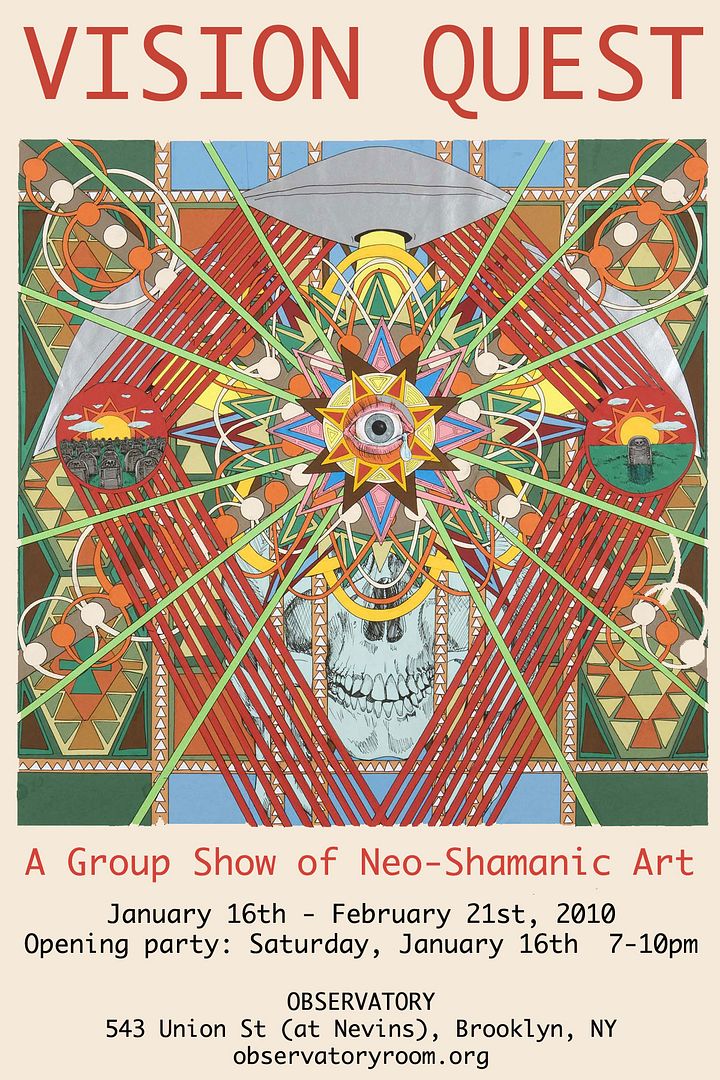
"Vision Quest"


I am delighted to announce that one of my 2007 paintings, "a cruel and beautiful faraway place," is included in "Vision Quest,' a group show curated by the celebrated artist/art blogger/musician Pam Grossman. The exhibition will be on view at Observatory, in Gowanus, Brooklyn, NY.

The opening is this coming Saturday, January 16th, from 7-10pm. The reception will surely be a lovely way to start your Saturday evening, but if you can't make it, I hope that you'll have an opportunity to visit the show while it's on view (through February 21st). Full exhibition details and the press release follow.

+++++

"VISION QUEST – A Group Show of Neo-Shamanic Art"

Observatory
543 Union Street (at Nevins)
Brooklyn, NY 11215

On View: January 17th– February 21st, 2010
Opening: Saturday, January 16th, 2010, 7-10pm

Gallery Hours: Thursdays & Fridays 3-6pm; Saturdays & Sundays 12-6pm

OBSERVATORY and Phantasmaphile's Pam Grossman are proud to kick off 2010 with VISION QUEST, a group show of neo-shamanic art, on view from January 16th through February 21st.

A healer, a medicine (wo)man, a guide: the shaman is a figure who interfaces with nature magic and the invisible world at large, for the betterment of the tribe. Fluent in the language of symbols, and a perennial student of plant wisdom, the shaman is also a translator – bringing back messages from a place veiled thick with leaves, bones, smoke, ghosts.

This journey to the other side – to the innerside – is not just a flowery promenade of song and trance; of friendly animal spirits and ancestral reunions. For while this land is rife with vibrant, variegated beauty, it can also be a danger zone. Images of decapitation and dismemberment abound - though ultimately act as portents for personal transformation and rebirth. This shadowy terrain is trod only by those brave enough to encounter whatever may be found along the way, as each sojourn is mysterious, thoroughly unpredictable, and entirely individual. However, the results of the trip often prove invaluable, as the traveler returns armed with knowledge that will in turn illuminate and repair the community, and fortify his or her own soul.

While the role of the shaman has traditionally been fulfilled by experienced elders in indigenous groups spanning culture and time, VISION QUEST posits that our artists fit the bill as well. Today, with more of us living in an urban jungle rather than a real one, it has become all the more important to figure out ways to internalize the lessons of nature: its growth, its brilliant bloom, its death. And in an age of digitization and distraction, of wire vines and humming screens, it’s no wonder we long for deeper, more sensory experiences of self - with all of its darkness and divinity.

As such, each piece in VISION QUEST explores the archetype of the shamanic voyage, using the tools of paint, pencil, or paper in lieu of fire, flower, feather. Taken together this work represents a full spectrum of what it means to go underground and out of body; to go there and come back again, perhaps just a little bit wiser or, at the very least, more wide awake.

PARTICIPATING ARTISTS
Jesse Bransford
William Crump
Scott Gursky
Juliet Jacobsen
Ashley Lande
Adela Leibowitz
Jason Leinwand
Christopher Mir
Joe Newton
Herbert Pfostl
Christopher Reiger
Christine Shields
Erika Somogyi
Jessie Rose Vala

Image credit: Jason Leinwand "Accepting Fear Rather Than Trying to Understand It"

Monday, December 21, 2009

Or A Falcon


Peregrine falcon (Falco peregrinus); New York City

"I am no more lonely than a single mullein or dandelion in a pasture, or a bean leaf, or sorrel, or a horse-fly, or a bumblebee. I am no more lonely than the Mill Brook, or a weathercock, or the north star, or the south wind, or an April shower, or a January thaw, or the first spider in a new house."

- Henry David Thoreau
Image credit: ripped from Pete.Mac's Flickr photostream

Saturday, December 12, 2009

Sunset, Sunrise


Heron Hope sunset; November 2009

"Our destiny, our being's heart and home,
Is with infinitude, and only there;
With hope it is, hope that can never die,
Effort and expectation, and desire,
And something evermore about to be."

- William Wordsworth, The Prelude


"Indeed, from within the murkiness of human knowledge and experience, we rightly wonder, is there any room for theology as such - or has it gone the way of all heavenly things? Perhaps all that remains is some mode of natural piety, such as the shudder before the mortal mysteries (with Goethe), or the felt ecstasies of springtime (with Wordsworth). Surely this is a lot, and unsettles the mind from its human habitudes. But is there more?

[...] Like all matters human, theology must be grounded in earthly experience and understood from within its forms. The phenomenal world is all that we have. This is the sphere that lies before us in our everyday existence; it conditions the products of aesthetic perception; and it provides the sphere for theological experience and reflection.

[...] As natural beings we are, in the most elemental sense, coextensive with this realm: our bodies are composed of it, our stomachs take in and digest its matter, and we traffic with this world all our days until we die and are decomposed into its elements. [...] To more properly sense [the] unfolding of the Godhead into world-being, so to speak, or to perceive or intuit its penetrations therein, we must first return to our ordinary experiences."

- Michael Fishbane, Sacred Attunement: A Jewish Theology


Sunrise at Heron Hope; November 2009

Happy Hanukkah, folks.

Photo credits: Hungry Hyaena, 2009