Showing posts with label mystery. Show all posts

Friday, August 26, 2011

Gregory Ito's "Point of Vision"

Gregory Ito
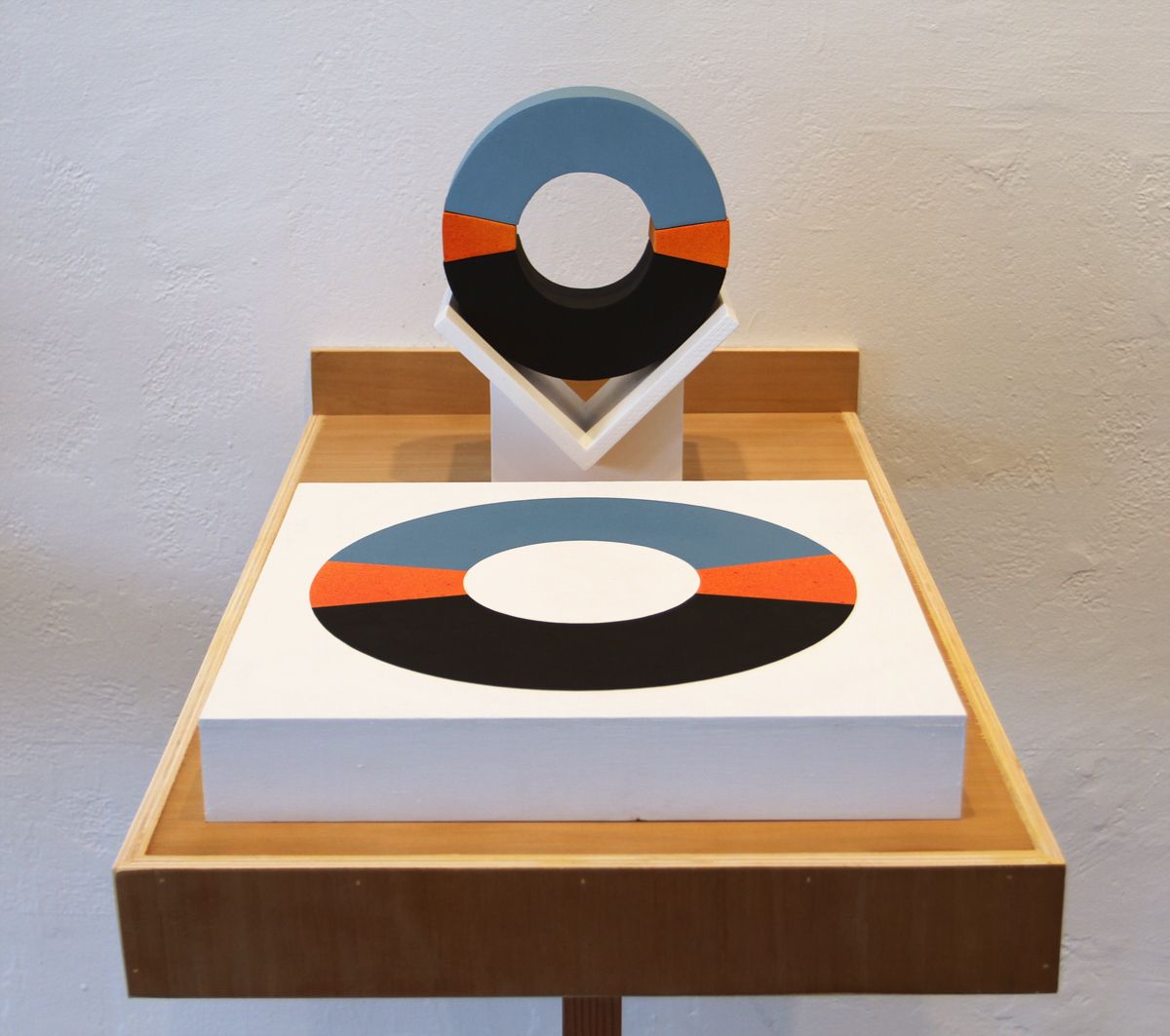
"Untitled (Time Diagram Set B)"
2011
Acrylic and gouache on wood panel, acrylic on handmade wood object, and table

Like it or not, context informs our experience and interpretation of artworks. We generally think of context as a work's physical situation (e.g., how and where it is installed) or its social and art historical framework, but most important is the context provided by an individual viewer. What is the viewer's profession? What book is she reading? Who was she talking to an hour ago, and what about? Of course, artists can't control for these subjective factors, and many craft artist statements that provide viewers with what the artists believe is appropriate context for the artwork. Too often, though, these statements tell viewers what the "take away" should be, thereby forfeiting the most vital and collaborative element of the artistic enterprise, the creation of meaning by the viewer.

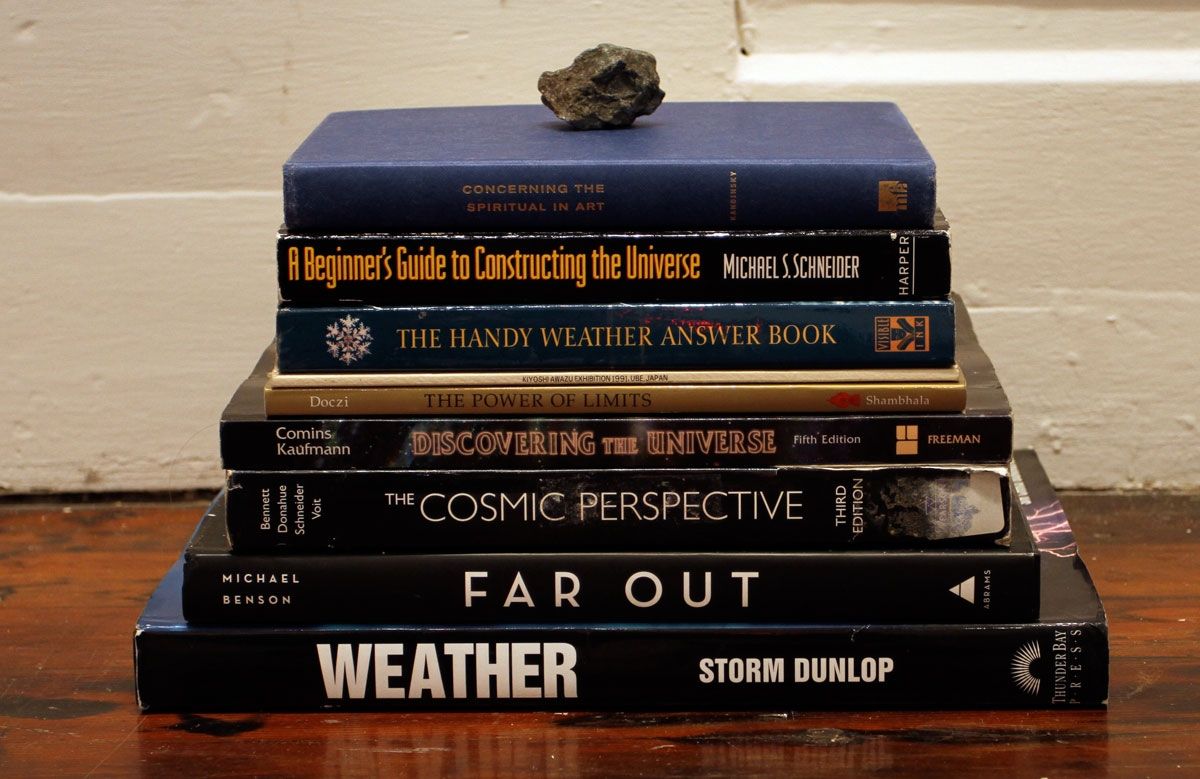
How refreshing, then, to find Gregory Ito's healthy twist on the artist statement in his terrific "Point of Vision" exhibition at Gallery Hijinks. While the artist and gallery provide a press release (usually an artist statement reworked and edited by the gallery staff), Ito also includes "Sources," a tidy stack of books on the floor, spines out so that the titles are easily read. Is "Sources" intended as a found object sculpture? Kinda sorta (after all, it's titled, is situated among Ito's other work, and is included on the exhibition price list, albeit "NFS"), but its principal valuable is as an alternative to the formal statement. It provides viewers with context without bullying them into a particular conclusion.
Gregory Ito
"Sources"
2011
Book collection

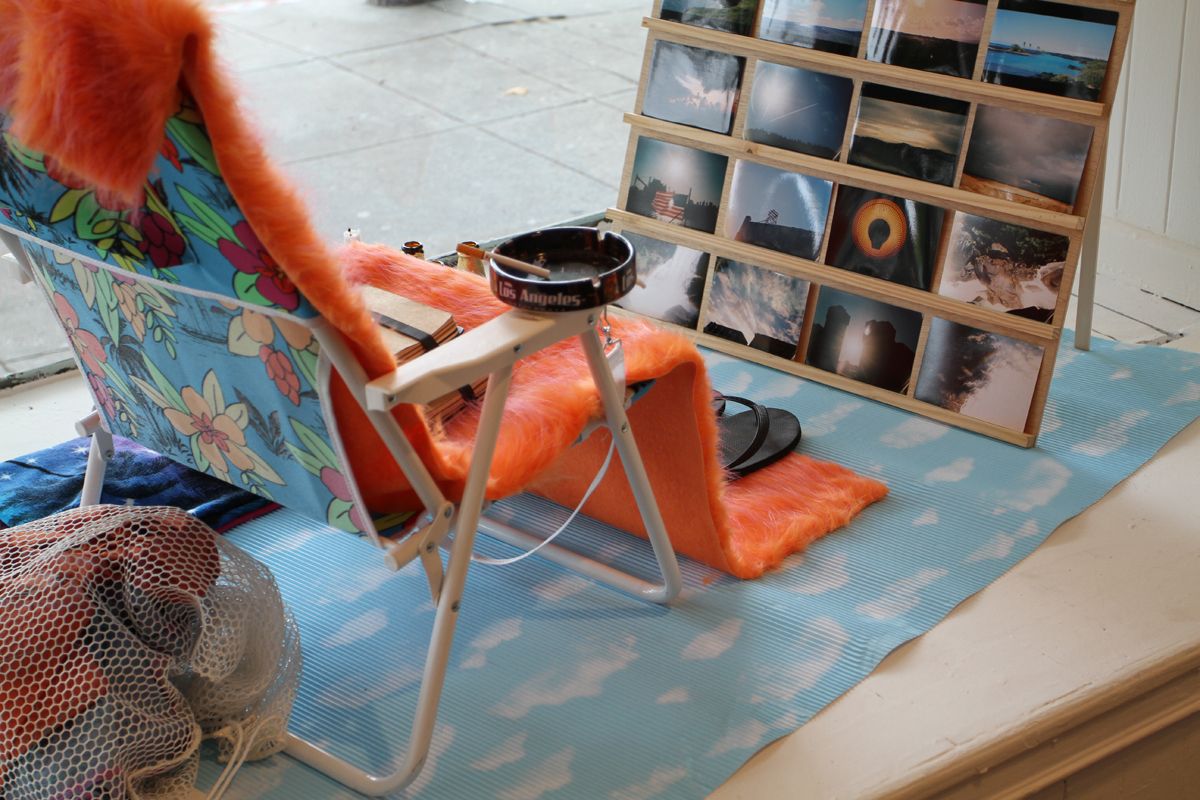
"Sources" is something of a companion piece to "Self Portrait (Object Collage)." Installed in one of the gallery windows, "Self Portrait" includes a beach chair, flip flops, a towel, a pile of diary-like journals, an ashtray, empty beer bottles, a candle, and 28 snapshots mounted on a board that faces the chair. One imagines the artist in his chair, sipping beer and smoking as he contemplates his collection of isolated observations. The photographs are mostly of clouds and sun-soaked skies, but there are also landscapes, some abstract imagery, a rainbow, and an illuminated light fixture. These pictures complement Ito's reading list. A Beginner's Guide to Constructing the Universe, by Michael Schneider, Concerning the Spiritual In Art, by Wassily Kandinsky, The Cosmic Perspective, Third Edition, by Bennett, Donahue, Schneider, and Voit, The Handy Weather Answer Book, and other titles included in Ito's book pile suggest that the artist is preoccupied with sublime, existential mysteries and celebrating our species' impulse to solve them.
Gregory Ito
"Self Portrait (Object Collage)"
2011
Window installation with 28 photographs and wood display

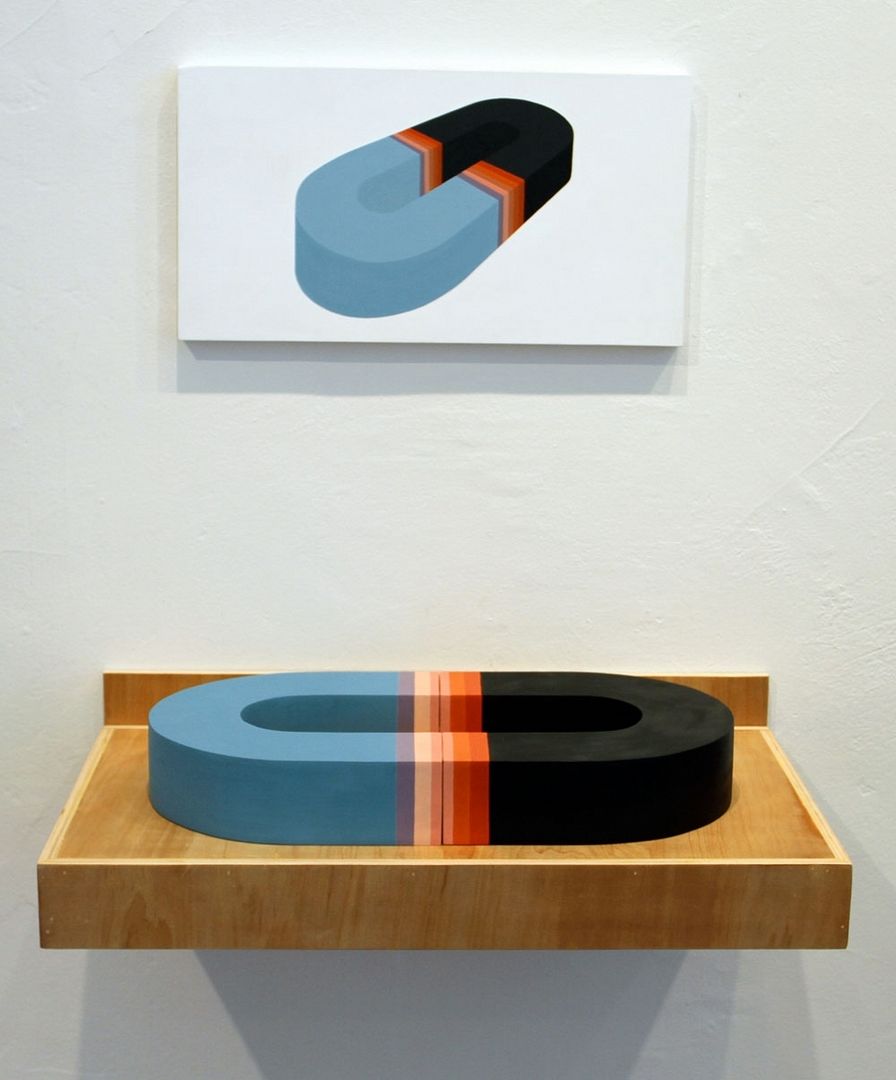
Ito's sculptures, paintings, and installations reflect this focus. Especially in the gallery's "white cube" setting, they read as speculative objects and diagrams as much as they do aesthetic entities. The artist is well aware of this; he titles the two most compelling installations on view, "Untitled (Time Diagram Set A)" and "Untitled (Time Diagram Set B)." He pairs a painting with a sculpture in each. The paintings are straightforward illustrations of the sculptures, but, displayed in the gallery setting with the three-dimensional objects they depict, the images read as icons, potent stand-ins for the "real" or "true" object. Curiously, by virtue of having been depicted, the sculptures also gain in significance. The meaning of these pictures and objects remains somewhat esoteric. I infer, based on the works' titles and Ito's "Sources," that these are representations of space-time's nature or shape, but that's a rather general interpretation. Still, the sculptures resonate as totems and the paintings as their icons. This reciprocal dynamic is compelling, and serves as an oblique reminder that all artwork exists in relationship to the world and ideas outside of the gallery and studio, a fact too often overlooked since the advent of modernism.
Gregory Ito
"Untitled (Time Diagram Set A)"
2011
Acrylic on wood panel, acrylic on handmade wood object, and shelf

In other works, Ito more directly highlights what I've elsewhere described as "the wonder current." In "Human Euphoria," a disembodied ceramic head of a girl in a big-brimmed, yellow hat rests on top of a block of adobe clay, apparently gazing at an ocean sunset. The piece is a winking, contemporary tribute to Caspar David Friedrich's Romantic masterpiece, "Wanderer above the Sea of Fog," but Ito's head is better-suited to contemplation than the vigorous morning constitutionals of Friedrich's dapper hero. Is this a comment on the continued dominance of conceptual concerns over aesthetic and material considerations in contemporary art? Perhaps; perhaps not. Ito's better pieces excel precisely because they can be interpreted as "art for art's sake" or, taking a hint from his "Sources," as art about the stupefying magnificence of being.

Gregory Ito
"The Embrace Installation"
2011
Acrylic and gouache on wood panel, found book with handmade page holders, and petrified object on shelf

Image credits: all images, courtesy Gallery Hijinks and Gregory Ito, 2011

Monday, February 08, 2010

Nathan Abels' "Natural Causes"

I wrote the following short essay for the exhibition catalog that accompanies Nathan Abels' "Natural Causes," currently on display at Rule Gallery, in Denver, Colorado.

+++++


Nathan Abels
"Sullen Roar"
Acrylic on panel
36 x 48 inches
2009

At the extent of the campfire's reach, we glimpse a shadowed form. Then it is gone. What is it that we saw there, at the light's limit? In that instant of vague apprehension, before our mind has had time to interpret the stimulus, we are John Dewey's "live animal," a creature "fully present, all there, in all of its actions: in its wary glances, its sharp sniffings, its abrupt cocking of ears." The "live animal" mode is often awakened by an alarming sight or sound, but it can also be brought on by a rush of emotion or any substantial sensual experience. If we remain attuned, "fully present," our nurtured sense of self may be blurred, even surrendered, and the scrim of conventional, acculturated understanding is ruptured. We recognize that transcendental mysteries and primordial presences are located in ordinary experience, and that our mundane perception of the material world is incomplete. We see the world anew, boundless and beautiful.

Nathan Abels' artwork is concerned with such transformative breakthroughs. Many of his works juxtapose the primeval with the temporal. "Wildfire" pictures the moon, our planet's celestial companion, serene above a raging forest fire, a violent agent of ecological transformation, both destructive and renewing. In "Sullen Roar," the lights of human infrastructure glow like our aforementioned campfire, but the riverside outpost is surrounded by an opaque darkness. Abels reminds us that the hum and pulse of human civilization amounts only to a footnote when considered within a more holistic context. Other works, such as "Passage" or "Half-Seeing," picture moments of potential rupture, opportunities for personal transfiguration. In "Passage," a spelunker slides on his back through a narrow section of cave. His headlamp illuminates the low ceiling. The confined space would make even the least claustrophobic among us uncomfortable, and the viewer senses the spelunker's powerlessness. Such an experience, like the wildfire, can be at once annihilative and regenerative. It is a subjugation of the self, a recognition of the infinitesimal reach of our individual vision, yet also an expansion of our vision to include the infinite variety and scope of being.


Nathan Abels
"Half-Seeing"
Acrylic on panel
36 x 48 inches
2010

Abels refers to his paintings and drawings as "visual pauses" in an otherwise "persistent turbulence." To be sure, our contemporary landscape is a turbulent one: industrialized, globalized, and digitized for maximal efficiency and consumption. We are so burdened by stimulation as to be deadened to the underlying reality of each moment and every place. Abels' "visual pauses" are a response to our routine mindlessness; the artist provides the viewer with opportunities to regain focus, to intuit the unfathomable in the worldly. His drawings and paintings are pictures of transitional experiences at the edge of known and unknown.


Nathan Abels
"Denouement"
Acrylic on panel
36 x 48 inches
2009

Image credits: courtesy the artist

Saturday, January 23, 2010

Quantity or Quality?


Nathan Abels
"Passage"
2009
Acrylic on Panel
24 × 48 inches
"The world we inhabit is not, in this sense, a determinate set of objective processes. It is our larger flesh, a densely intertwined and improvisational tissue of experience. It is a sensitive sphere suspended in the solar wind, a round field of sentience sustained by the relationships between the myriad lives and sensibilities that compose it. We come to know more of this sphere not by detaching ourselves from our felt experience, but by inhabiting our bodily experience all the more richly and wakefully, feeling our way into deeper contact with other experiencing bodies, and hence with the wild, intercorporeal life of the Earth itself.

[...]

In truth, it’s likely that our solitary sense of inwardness (our experience of an interior mindscape to which we alone have access), is born of the forgetting, or repressing, of a much more ancient interiority that was once our common birthright: the ancestral sense of the surrounding earthly cosmos as the voluminous inside of an immense Body, or Tent, or Temple.

[...]

Experiential qualities once felt to be proper to the surrounding terrain—feeling-tones, moods, the animating spirits-of-place known to reside in particular wetlands and forests—all lost their home with the dissolution of the enclosing, wombish character of the pre-Copernican cosmos. Such qualities now had no place in the surrounding world, itself newly conceived as a set of objects connected by purely external, mechanical relationships: a world of quantities. Unlike quantities, qualities are fluid, mercurial realities arising from the internal, felt relations between beings. Qualities—these ephemeral and fluid powers—require at least a provisional sense of enclosure to hold them. When they could no longer be contained by the visible world (no longer encompassed and held within the curved embrace of the spheres), these ambiguous, ever-shifting qualities quit the open exteriority of the physical surroundings, taking refuge within the new interiority of each person’s 'inner world.' Henceforth they would be construed as merely subjective phenomena."

- David Abram, "The Air Aware", Orion Magazine, September/October 2009
David Abram's essay "The Air Aware" eloquently expands on ideas that I attempt to present succinctly in my artist statement. Brevity is difficult, however, for those of us who are preoccupied with the exciting interchange of anthropology, ecology, ethology, phenomenology, and theology.

It's interesting, then, that the work of visual artists who explore this conceptual terrain is often quietly awesome. Interesting...and yet so natural.


Christopher Saunders
"Whitenoise Suite no.6"
2009
Oil on linen
24 x 18 inches

Image credits: both painting reproductions, courtesy the artists

Saturday, December 12, 2009

Sunset, Sunrise


Heron Hope sunset; November 2009

"Our destiny, our being's heart and home,
Is with infinitude, and only there;
With hope it is, hope that can never die,
Effort and expectation, and desire,
And something evermore about to be."

- William Wordsworth, The Prelude


"Indeed, from within the murkiness of human knowledge and experience, we rightly wonder, is there any room for theology as such - or has it gone the way of all heavenly things? Perhaps all that remains is some mode of natural piety, such as the shudder before the mortal mysteries (with Goethe), or the felt ecstasies of springtime (with Wordsworth). Surely this is a lot, and unsettles the mind from its human habitudes. But is there more?

[...] Like all matters human, theology must be grounded in earthly experience and understood from within its forms. The phenomenal world is all that we have. This is the sphere that lies before us in our everyday existence; it conditions the products of aesthetic perception; and it provides the sphere for theological experience and reflection.

[...] As natural beings we are, in the most elemental sense, coextensive with this realm: our bodies are composed of it, our stomachs take in and digest its matter, and we traffic with this world all our days until we die and are decomposed into its elements. [...] To more properly sense [the] unfolding of the Godhead into world-being, so to speak, or to perceive or intuit its penetrations therein, we must first return to our ordinary experiences."

- Michael Fishbane, Sacred Attunement: A Jewish Theology


Sunrise at Heron Hope; November 2009

Happy Hanukkah, folks.

Photo credits: Hungry Hyaena, 2009

Sunday, September 13, 2009

Kimmel Harding Nelson Residency: Day 7


The Ten Commandments on the front lawn of Otoe County Courthouse; Nebraska City

Attunement on a Sunday Morning

I'm a generalist. As such, I'm inclined to connect the dots between purportedly distinct realms of inquiry. It's impossible, of course, to conduct a truly holistic survey, but my crude efforts have led me to conceive of life - what we know of it, at least - as a component part of a vast, even infinite superorganism. I freely admit to finding value in mysticism, and this superorganism notion is readily dismissed by some scientists and scholars as mystical metaphysics, but science itself speaks to an integrity beyond human comprehension.

As Loren Eiseley describes it,
"[This is] one of life's strangest qualities - it's eternal dissatisfaction with what is, its persistent habit of reaching out into new environments and, by degrees, adapting itself to the most fantastic circumstances."
Eiseley was an anthropologist, and he claimed to be a man of "no religion." That may be so, but Eiseley's writing offers humility, wonder, gratitude, and communion in abundance. As I see it, those are the four pillars of religious practice. The fourth of these vital practices, communion, is alluded to by the very word "religion," from the Latin religare, meaning "to bind" or "to tie." Religious action aims to bind the individual to society and, in turn, to the greater whole.

For a decade, I proudly identified as an atheist and, by the measure of most religious people, my cosmology and metaphysics still qualify me as such. It occurs to me, on this Sunday morning, with Nebraska City's church parking lots at capacity, that many of this town's good Christians would reject my claim of religiosity, and not only because my practice rests on a Jewish foundation. My doctrine-less faith appreciates the stories of the Hebrew Tanakh, the Christian New Testament, and the Muslim Koran as parables, poetry, and anthropological artifacts. I read these books in the same way that I do the Tao Te Ching or Herakleitos; they are annotated, analyzed, interpreted, digested, then, in the fullness of time, returned to for a new understanding. But these collections are not my sacred texts. In the eyes of most religious believers, that disqualifies me from tribal membership. Thank G-d.


First Baptist Church; Nebraska City; September 2009
Sign reads, "Faith Removes Mountains Or Tunnels Through"

Still, I am a religious believer, in my way. My holy books are written by biologists and physicists, naturalist poets and essayists, as well as rabbis, ministers, and theologians. None of them is the word of an interventionist, judging god, even though all of them are necessarily part of a greater, unknowable whole, the aforementioned superorganism.

It doesn't matter what you call this organism. As essayist and literature professor Doug Thorpe writes in Rapture of the Deep, "Call it the sublime, call it the Tao, Om, or I AM; still the names don't hold." I most often call it The All, The No-thing, or Hashem, literally "The Name." In the Tanakh, when Moses asks the name of the Presence he has discovered in the burning bush, It replies, "Ehyeh asher ehyeh." "I will be who I will be," or "I will be that I will be." You can call It whatever you will, for It is you. It is also me. It is the sidewalk; It is the grass of the Otoe County courthouse lawn, on which Nebraska City authorities have installed a carved monument to the Ten Commandments, an act that approaches violation of Thomas Jefferson's shrewd "separation of Church and State"; and It is the ether connecting all of these.


Lutheran Church facade; Nebraska City; September2009

If the faith that has grown in me is dogmatic in some way, it is in its insistence on universalism. Literally translated, "universe" means "one turning." Our universe is just that, one breath, one round, one cycle. All that we know and all that we don't know, everything that we can imagine, is but an infinitesimal sliver of The All, one note of an eternal symphony. Even Herakleitos, ancient proponent of reason and science, turned to poetics when he contemplated ultimate meaning; "Nature loves to hide," he wrote. Interestingly, the Hebrew word for universe is olam, a derivative of alam, meaning "to conceal." Jewish mystics, like many of their Hindu, Sufi, and Christian counterparts, believe that God is hidden in the universe, an ineffable force that pervades every dimension, known and unknown.

Theoretical astrophysicists
now suggest that our universe is but one component part of a multiverse, requiring of us another Copernican shift; yet again, the superorganism is re-conceived. In that stretch of the mind are humility, wonder, gratitude, and communion. Science and philosophy, it seems, can also be religious.


Water tower; Nebraska City

So, yes, I'm a religious believer. Paintings, sculptures, and other hand-crafted objects are among my adored icons, but I find occasion for worship in every place, in every form, in every moment. The Monarch butterfly that flapped yoyo-like this morning in front of the KHN Center's kitchen window is worthy of exaltation. I recognize that, for some other viewer, the insect may be ignorable or irrelevant. For others, it is an idol. So, too, might the weathered brick of a downtown Nebraska City building be deemed a clay calf by unimaginative or close-minded "believers." Placing my palm on this brick today, though, my thoughts range through eons of geologic time to consider the primeval mud from which, eventually, we emerged as a gasping fish thing.

Doubtless some of the folks singing inside the walls of the Lutheran, Episcopalian, Catholic, Baptist, Presbyterian, and Methodist churches this morning don't share my enthusiasm for our scaley ancestors. But I'm not concerned with their narrow definition of religion or their selfish understanding of "truth." Although I no longer consider myself a materialist, I'm an unremitting idolater. To those that would condemn that impulse as sacrilegious, I offer Eiseley's reaction.
"People have occasionally written me harsh letters and castigated me for a lack of faith in man when I have ventured to speak of [..] some greater unity that lay incalculably beyond us. [...] They distrust, it would seem, all shapes and thoughts but their own. They would bring God into the compass of a shopkeeper's understanding and confine Him to those limits, lest He proceed to some unimaginable and shocking act - create perhaps as a casual afterthought, a being more beautiful than man. As for me, I believe nature capable of this, and having been part of the flow of the river, I feel no envy."
And I feel no envy, either. There is only dumbfounding, smiling celebration.

Love is, I think, a bit like religion. Humility, wonder, gratitude, and communion are requisite in both, and, as Thorpe puts it, love "demands of us a new way of being in our old world." Religion might be construed as a love affair with The All. It's not always easy, but religious attunement can turn each day, each hour, or each instant, into "a new way of being." Every step is a psalm, every directed gaze is a prayer. Truly, on the streets of Nebraska City this morning, I am an exuberant, enthusiastic mystic.

Photo credits: all photos, Hungry Hyaena, 2009

Tuesday, August 25, 2009

The Most Fundamental Form of Passion


Charles Burchfield
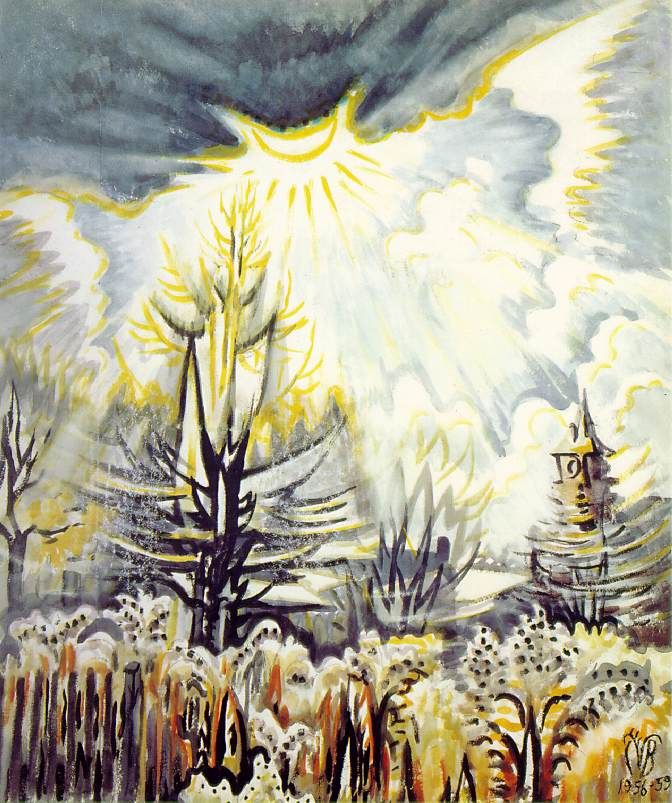
"November Sun Emerging"
1956-59
Watercolor on paper
37 3/4 x 31 7/8 inches
"[How] can we account for that irresistible instinct in our hearts which leads us towards unity whenever and in whatever direction our passions are stirred? A sense of the universe, a sense of the all, the nostalgia which seizes us when confronted by nature, beauty, music - these seem to be an expectation and awareness of a Great Presence. [...] Resonance to the All - the keynote of pure poetry and pure religion. Once again: what does this phenomenon, which is born with thought and grows with it, reveal if not a deep accord between two realities which seek each other; the severed particle which trembles at the approach of 'the rest'?

We are often inclined to think that we have exhausted the various natural forms of love with a man's love for his wife, his children, his friends and to a certain extent for his country. Yet precisely the most fundamental form of passion is missing from this list, the one which, under the pressure of an involuting universe, precipitates the elements one upon the other in the Whole cosmic affinity and hence cosmic sense. A universal love is not only psychologically possible; it is the only complete and final way in which we are able to love."

- excerpt from The Phenomenon of Man, by paleontologist, geologist, philosopher, and Jesuit priest Pierre Teilhard de Chardin
Image credit:Burchfield image ripped from Mark Harden's Artchive

Friday, June 12, 2009

An Ocean Ethic


Corey Arnold
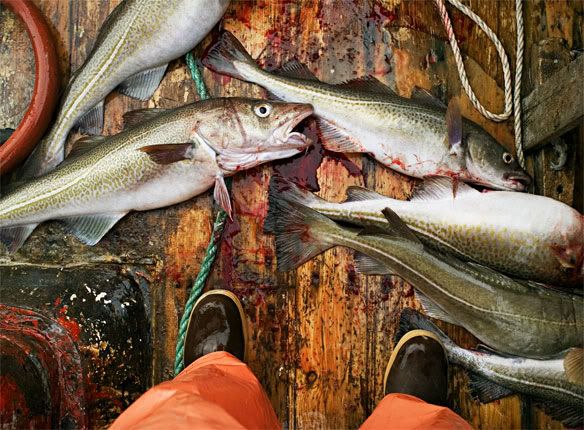
"Torsken"
2007
Chromira C-print

The son of an avid saltwater fisherman, many of my summer days were spent offshore. Departing the Wachapreague, Virginia, docks at 5 AM, the sky broke pink as my father carefully piloted his Boston Whaler through the salt marsh channels. Upon reaching the ocean inlet, we'd begin a thirty or forty mile run toward the sun-soaked eastern horizon. By 8 AM, we'd be trolling for yellowfin and bluefin tuna, dolphin ("mahimahi"), amberjack, or various mackerel species. If that technique proved unsuccessful (or if my father's fishy hunches proved wrongheaded), we'd move west, closer to shore, so that we could bottom-fish for black sea bass, spot, and weakfish over scuttled World War II ships and defeated German U-boats.

Compared to my father, I was unenthusiastic about salt-water fishing. I much preferred fishing on a pond, fly or spin casting into "honey holes," those storied pockets where the giant largemouth bass, perch and bluegill dwell. The relative solitude and meditative character of freshwater fishing appeals to my temperament. I associate the leisurely activity with the soft-spoken stroke of the canoe paddle; the rhythmic, almost ritualized casting of a fly or lure; the temperate spring breezes that lick my bare forearms as they do the banks' willow and maple trunks; the ecstatic chatter of a kingfisher. Above all, I associate it with a sense of universal benevolence. This, in stark contrast to fishing offshore, where Nature's benevolence is tempered by ambivalent and awesome forces.

Still, I enjoyed being on the open ocean. I loved the bounce and glide of my father's Whaler as it motored over the Atlantic chop, and I was delighted by the otherworldliness of ocean life: shadowy hammerheads passing through depth-piercing sun rays; dolphins propelling themselves skyward to get a better look at us; the surprising company of terns and gulls so far from land; loggerhead sea turtles basking on the ocean's surface; hundreds of cownose rays flying just beneath the water's surface. These images, and many others, stay with me. The ocean is a mysterious, thrilling place.

Sadly, it is also a threatened place. The most dire reports forecast that the ocean's fish species will be depleted by mid-century. If that should come to pass, the commercial seafood industry will no longer be viable and, more seriously, our world's biodiversity and ecological integrity will have been dealt an awful blow. Because of my latter day hunter-gatherer approach to fish and meat consumption, the only shellfish I consume are those few blue crabs and clams that I pull from the Eastern Shore's tidal estuaries. I rarely fish these days, so fish species are off my menu altogether.

Food writer Mark Bittman would likely approve of my vegetarian-unless-I-kill-or-catch-it ethic. In a recent New York Times article, "Loving Fish, This Time With the Fish in Mind" (June 9, 2009), Bittman argues for a more conscientious approach to seafood.
"In the meantime, I'm careful. I don’t make excuses, like 'There's cod in the market, so someone is catching it somewhere,' or 'If I don't buy it, someone else will,' or 'This chef serves local food, so he must serve sustainable fish.' If I’m going to eat fish, it must be consciously and thoughtfully.

My approach - which I readily admit is a work in progress and is as imperfect as my approach to all foods - goes something like this:

- I don’t buy or order the common fish I can easily keep in mind as being super-troubled — most cod, for example, or bluefin tuna, most species of shark and skate. When in doubt, I move on.

- With rare exceptions, I don't buy or order farm-raised fish, except clams and oysters. Farmed mussels and shrimp don’t seem to come with egregious environmental consequences, but neither tastes like much, either.

- I don’t eat fish as often as I once did. (I don’t promote eating it as I once did, either.)

- And I keep re-evaluating these 'rules,' and thinking about them. The 'safe' lists are difficult to understand, impossible to remember and change frequently. When the fishing of a species is well managed, it can recover and become sustainable. When it's not, the stocks of that fish disappear, sometimes quickly.

I’m probably not going to stop eating fish. And fortunately I don’t have to, since there are species that have never been depleted - squid and mackerel, for example - and those that have recovered, like haddock and Maine lobster.

It’s improbable that I’ll eat in a perfectly sustainable manner, even though I probably eat one-third as much fish as I did a few years ago. I’m trying not to let perfect become the enemy of good, and I’m trying to find a place that feels comfortable. That place is to see eating fish as a treat. I won’t eat it daily or in huge quantities, but occasionally, with appreciation. The days of 'see it/eat it' are gone."
Every educated eater should do the same, and each of us should strive to educate ourselves further. It's the ethical thing to do.

Time and evolution will march on, heedless of our nostalgic and preservationist impulses, but their ambivalence doesn't mean we've license to shrug and capitulate to the selfish wonts of the average consumer. Future generations should bear witness to the wonderful abundance that we have known and, to a lesser degree, still know. If we eat with an open mind and heart, perhaps that can be so.

Image credit: photograph by Corney Arnold; ripped from the artist's website

Tuesday, June 09, 2009

Offerings, Tallies, Records


Christopher Reiger
"cost benefit analysis"
2008
Pen and sumi ink, gouache, watercolor and marker on Arches paper
12 x 12 inches
"What if, while you read the last few paragraphs, something in the world has changed? What if, during the past five minutes, someone, somewhere, sent you a text? Shouldn’t you go and check?

Being addicted to the wired universe might be perfectly healthy, of course, and it’s certainly defensible beneath the triumvirate of technology, curiosity, and progress. I’m the first to admit that there’s something enchanting and invigorating about my computer. There’s magic in reading a note from a friend in Rome and clicking through Halloween pictures from New Jersey and verifying John Steinbeck’s birth date in two clicks. The Internet is indeed its own strange, blessed fountain of light.

[...I'm] not the first to wonder about all this, [...] not the first to sense that maybe our shared life is rushing by too quickly, too feverishly. [I'm] not the first to feel as if [I'm] scrambling to make [my voice] heard against an infinite and obliterating silence.

During the five days [...] I spent in the mountains, [I] saw lots of Shoshone pictographs, paintings made in caves mostly, and under overhangs: finger-painted elk and owls and dogs and triangle-bodied hunters with bows. Many of the pictographs in that area include hash marks, like rows of fence posts scratched downhill, but it’s anyone’s guess as to what these marks originally meant. Maybe they were offerings to the spirit world, or tallies of successful hunts, or records of vision quests. Maybe they were the consequence of someone sitting beside a fire and thinking happily away.

Whatever they once meant, they mean something else now. They mean memories are fragile, beliefs are tenuous, contexts are temporary. They mean nothing is stable—not mountains, not species, not cultures, not e-mail."

- Anthony Doerr, "Am I Still Here?" (from the January/February issue of Orion Magazine)

Monday, May 25, 2009

To Philosophize


Christopher Reiger
"a mode of becoming"
2008
Watercolor, gouache, pen and sumi ink on Arches paper
16 x 12 inches


"To philosophize is to articulate and express our personal reactions to the mystery which we call life, both with regard to the nature of that mystery and with regard to its meaning and purpose.

My answer to the question 'Why do we philosophize?' is as follows. We philosophize for the same reason that we move and speak and laugh and eat and love. In other words, we philosophize because man is a philosophical animal. We breathe because we cannot help breathing and we philosophize because we cannot help philosophizing. We may be as sceptical as we please. Our very scepticism is the confession of an implicit philosophy. To suppress the activity of philosophizing is as impossible as to suppress the activity of breathing."

-John Cowper Powys, "The Complex Vision"

Monday, May 11, 2009

Jon Rappleye's "Forgotten Planet"


Jon Rappleye
"Where In This Land of Lively Beasts Scatters the Darkness Thin"
2009
Acrylic and spray enamel on paper
42 1/4 x 72 inches


Jon Rappleye's work springs from a teeming imagination and, because he also shares my interest in the messy overlap of natural history and fantastical narrative, it comes as no surprise that I so respond to his mixed media paintings.

Reviewing "Awakened In The Peaceable Kingdom," his 2007 solo exhibition at Jeff Bailey Gallery, I noted that "the relationships between Rappleye's animal subjects have grown more complex and the ambivalent cycle of life and death is more readily observable" than in his earlier mixed media works.

"Forgotten Planet," Rappleye's current show, evidences still more growth. The best of the new paintings are the most nuanced, compelling compositions Rappleye has so far produced. Of course, it doesn't hurt that he includes plenty of snakes and owls, two of my favorite animal icons.


Jon Rappleye
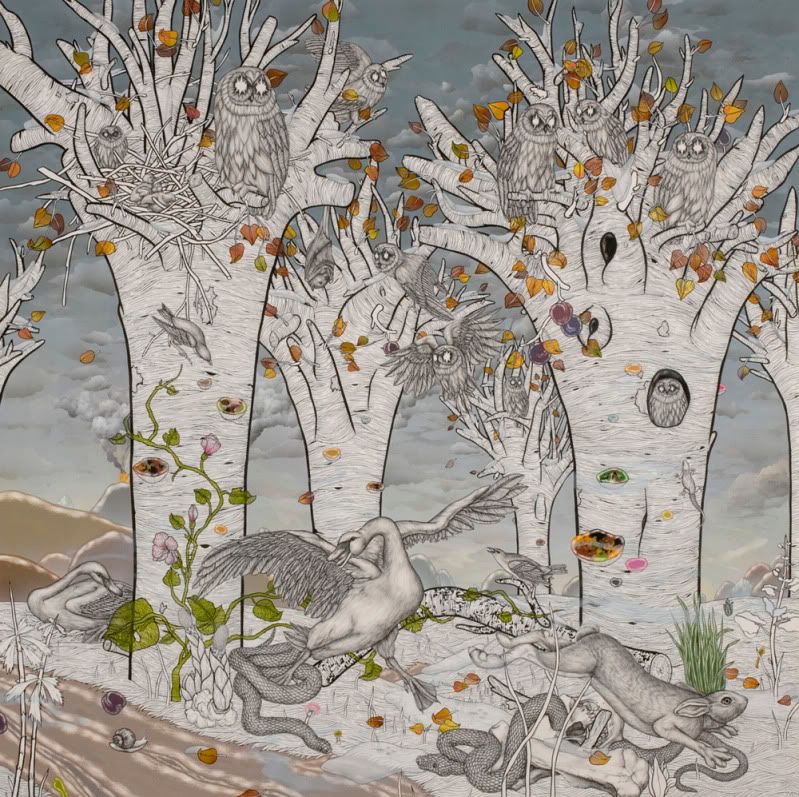
"Awakened From Winter's Tranquil Slumber"
2009
Acrylic and spray enamel on paper
51 x 51 inches


Photo credits: Jon Rappleye images courtesy of Jeff Bailey Gallery

Sunday, May 03, 2009

Walking with the wind


Tim Knowles
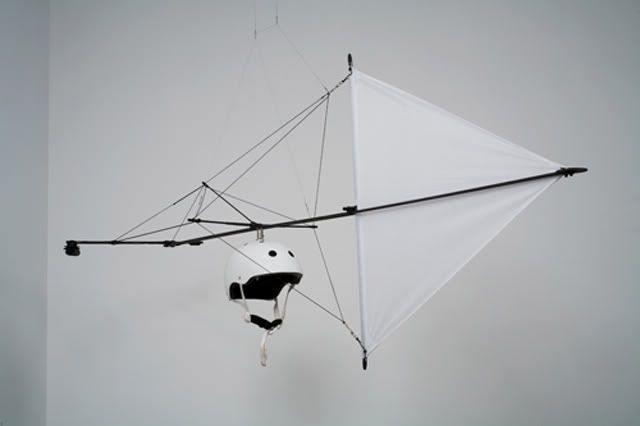
"Windwalk #2 - Charing Cross"
Helmet
2008


For his "Windwalk - 5 Walks from Charing Cross" project, artist Tim Knowles engineered a helmet with a sail-like wind vane, small video camera and GPS device, then wandered the streets of central London, his path determined solely by the wind. As Knowles crosses major thoroughfares, where the wind enters the wider channel via various tributaries, his path hitches and tacks erratically. If a gust of wind blows from the opposite direction, he spins about face, and he sometimes circles upon an earlier position.

In at least two of the videos that document his wind walks, Knowles is led into a cul de sac of swirling wind, where he finds himself temporarily trapped with light-weight street debris, including plastic bags and leaves. In these situations, or when he is directed into a wall, Knowles waits patiently for the wind to change direction and again grant him headway.

The artist Bernard Buffet wrote, "I prevent myself from thinking in order to be able to live." Although Buffet presumably referred to the particularly European struggle to persevere in a world shadowed by acute suffering and inhumane activity (he made the declaration in 1948, after an adolescence in occupied France), the statement can also be understood as an endorsement of Zen's "mind of no mind," or mushin no shin. Regardless of their geographic or religious provenance, meditative practices commonly encourage practitioners to banish thought from the mind so that they might experience transcendence or some heightened sense of being.

Similarly, the 20th century aesthetic theorists Alfred North Whitehead and John Dewey believed that there is a crucial distinction between the aesthetic and rational realms. Dewey argued that the aesthetic province is that of the "live animal" or unmediated, natural experience. In his landmark book Art As Experience, Dewey writes,
"Life goes on in an environment; not merely in it but because of it, through interaction with it. No creature lives merely under the skin; its subcutaneous organs are means of connection with what lies beyond its bodily frame, and to which, in order to live, it must adjust itself, by accommodation and defense but also by conquest. At every moment, the living creature is exposed to dangers from its surroundings, and at every moment, it must draw upon something in its surroundings to satisfy its needs. The career and destiny of a living being are bound up with its interchanges with its environment, not externally but in the most intimate way."
Elsewhere, Dewey states more plainly, "to grasp the sources of aesthetic experience it is necessary to have recourse to animal life below the human scale." The life Dewey describes, the realm of the "live animal" and of true aesthetic experience, is akin to Zen's mushin no shin.

The late Irish philosopher and poet John O'Donohue described dance as a reclamation of our animal nature. He wrote,
"When you walk into the mood of wind, it cleanses your mind and invigorates your body. It feels as if the wind would love you to dance...The body gives itself away playfully to the rhythm of the music; the burden of consciousness becomes suspended. For a while the innocence of the dance claims you completely as the mind relents and the body becomes its own celebration."
Knowles' "Windwalks" allow him access to the realm of Dewey's "live animal" and of O'Donohue's celebratory body; the artist relinquishes control by bypassing the brain's self-conscious helmsman. The wind meanders London's streets and Knowles follows; if he is the dancer, the wind is his choreographer. The artist is compelled by the wind's whim.

But, in allowing himself to be guided by an external force, Knowles doesn't simply provide viewers with an often humorous and poetic take on Dewey's philosophy of essential aesthetic experience. His "Wind Walks" resonate on several levels, and perhaps the most vital subtext is one of openness to new experience and new ideas.

Knowles provides us with a 21st century model of citizenship. He explores Charing Cross in a novel way; in doing so, he is provided with a fundamentally new appreciation for and knowledge of a seemingly familiar London neighborhood. In our rapidly globalizing world, we'd do well to emulate Knowles' willingness to look again for the first time. As T.S. Eliot wrote in his poem "Little Gidding,"
"We shall not cease from exploration
And the end of all our exploring
Will be to arrive where we started
And know the place for the first time."
"Windwalk - 5 Walks from Charing Cross" was seen in the Bitforms Gallery exhibition, "Tim Knowles and Pe Lang + Zimoun: Unpredictable Forms of Sound and Motion," recently on view in New York City.

Photo credits: images ripped from The Cyborg's Picnic and VVVORK

Tuesday, February 24, 2009

Becoming phoebes


Eastern phoebe (Sayornis phoebe)


The renowned naturalist, entomologist and sociobiologist Edward O. Wilson maintains that belief in the afterlife developed as a human coping mechanism, as a way for our enlarged brains to contend with mortality. He writes,
"Our conscious minds hunger for a permanent existence. If we cannot have everlasting life of the body, then absorption into some immortal whole will serve. Anything will serve, as long as it gives the individual meaning and somehow stretches into eternity that swift passage of the mind and spirit lamented by Saint Augustine as the short day of time."
Today, religious literalists look forward to Pearly gates or seventy-two virgins while most rational secularists, frightened of death's finality, strive to reject it. The first perspective is delusional, the second, incomplete; both are fearful.

Yet there is at least one sensible and beautiful conception of the afterlife, and it is not at all fearful: reconstitution. Most people find contemplation of the body's posthumous decomposition uncomfortable. But the knowledge that my corporeal substance will rot and, in doing so, release energy for use by the rest of things is deeply satisfying.

Poet Galway Kinnell describes reconstitution in his poem "The Quick and the Dead" as "the crawling of new life out of the old, which is what we have for eternity on earth." But beyond the biological, death remains a mystery.

I can not, one way or the other, speak to supernatural transference, though I feel that metaphysical notions of self or soul preservation are misguided. The "me," I think, will rot with my body, but the flow keeps on keeping on, until the end of time.

The author and essayist Edward Hoagland, the writer that inspired this blog's first post, speaks to the magic of reconstitution in his book On Nature.
"In my stint in the army, working at the hospital morgue, I'd noticed how commonly the dead had managed at the last moment a benign or temperate sort of smile. This circularity is neither alarming nor incongruous, but rather seems to make things whole and complete. In the summer, dancing butterflies of pretty colors will congregate where I've gone outside to piss in the grass. The glint of tiger yellow or cobalt blue in their beautiful wings may be enhanced by the minerals that they so crave and that my body has declared surplus. And if a nesting phoebe soon grabs one, she is going to profit also -- which is a foretaste of the myriad uses that more extensive portions of me will be put to eventually."
We are all, then, becoming phoebes, butterflies, mud and gas. I find so much joy in the thought.

Image credit: ripped from Photographs From Virginia section of Kirk Rogers' site

Wednesday, November 05, 2008

Rothko's Darkness

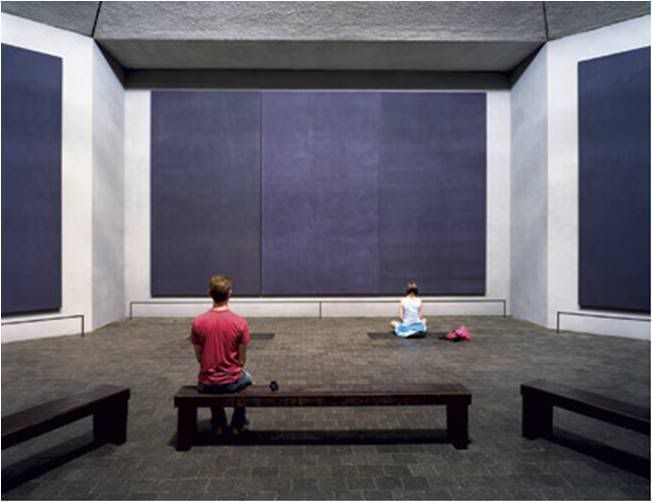
Interior photograph of Rothko Chapel, Houston, Texas
Completed 1971
"It is at once a reduction of the whole of the universe to the infinitesimal point of the anxious self and an absorption of the self in the eternal calm of the sea of being." 
-Rabbi Jacob B. Agus
In the September 26th edition of The Guardian Weekly, the opinionated British art critic Jonathan Jones describes his visit to Mark Rothko's chapel in Houston, Texas, as "a pilgrimage to the greatest marriage of art and architecture in the US." Jones worries, though, if the chapel is misunderstood, or even misused, by American visitors.

For the British critic, the Rothko chapel is "one of America's greatest and strangest monuments: a chapel created by a modern artist who had no religious beliefs." Jones is dismayed, then, to find that many visitors to the chapel are anything but irreligious.

Inside Rothko's master work, a fellow chapel-goer asks the critic if he sees in one of the over-sized paintings "the figure of Jesus Christ our Lord on the Cross?" Jones writes, "I look into the gigantic abstract work. It contains no images, Christian or otherwise."

Jones is clearly bemused that the chapel is today regarded by so many as a sacred space, and he chalks this interpretation up to our American religiosity.
"Locals use this place. They love it. They come not as tourists but to meditate, pray and talk sombrely. They see it as a religious place and the art as spiritual. It is called a chapel, and most Americans believe in God."
Jones feels Rothko would be similarly befuddled by the religious interpretation. The critic explains that Rothko designed the chapel to take "his pursuit of...the 'tragic' to its ultimate extreme" and that the artist "believed that all serious art was about death." Undoubtedly, Rothko had a fatalistic, deeply melancholic streak - he killed himself in 1970, one year before the chapel opened - but I'm not sure that the artist would, like Jones, bemoan the religious significance of his chapel.

A Russian Jewish immigrant, Rothko (originally named Marcus Rothkowitz) certainly didn't intend visitors to see Jesus Christ in his large canvases, but he was not, as Jones contends, a man "who had no religious beliefs." In fact, Rothko's father was an Orthodox Jew and the young Rothko spent time in Russian cheders before his 1913 emigration to the United States. After his family settled in Portland, Oregon, Rothko became active in the local Jewish community. Whether the future artist's connection to Judaism was principally cultural or spiritual, I do not know, but later in life he frequently described the making of his paintings as a religious experience.
Interior photograph of Rothko Chapel, Houston, Texas
Completed 1971

So what was Rothko thinking when he undertook the chapel project, and what did he intend the space to be? We can only speculate.

For his part, Jones asserts that the paintings act as doorways or portals. I agree, but the British critic insists that they are "portals of death." Jones sees the blackness of Rothko's chapel paintings as "utter desolation," blackness that shatters "any illusion of paradise." The chapel overall Jones describes as a "theatre of emptiness, death's antechamber, the self-expression of a suicide." He dismisses other interpretations, claiming that, if the Texas oil barons who commissioned the project understood more fully Rothko's deathly intentions, the chapel would not have been built.

But the blackness in Rothko's late works can also be understood as nothingness. Negative theology, more commonly referred to by the Latin via negativa, breaks down the word "nothingness" into "no-thing-ness." God, according to negative theology, is ineffable; literally, It, that is to say, God, is No Thing. As Lao tzu, author of the Tao Te Ching, wrote in that essential text, "The unnamable is the eternally real...Darkness within darkness. The gateway to all understanding."

This mystical conception of God or Being would be familiar to an educated Jew like Rothko. The Jewish Kabbalist notion of Ein Sof springs from a medieval Spanish Jew's exposure to Eastern philosophy. (Most historians agree that Moses de Leon, a prominent Spanish rabbi, composed the Zohar, the central text of Kabbalah, in the late 13th century. Some of these scholars argue that de Leon's work is a syncretic project, injecting tantra and other Eastern thought into the ever-evolving Jewish tradition.) Ein Sof, translated from Hebrew to English, literally means "there is no end." It is the unquantifiable, ambivalent and infinite energy that exists before, within and after the more mundane conception of God. The kabbalists, though, take their negative theology one step further. Ein Sof is the ineffable All, but Ayin, or "nothingness," is Ein Sof rendered finite. Some Jews consider Ayin the cosmic potential extant prior to the Big Bang.

Daniel Matt, a leading scholar of Kabbalah, writes in "God and the Big Bang":
"The paradox is that ayin embraces 'nothing' and 'everything.' This nothingness is oneness: undifferentiated, overwhelming the distinctions between things....This mystical nothingness is neither empty nor barren; it is fertile and overflowing, engendering the myriad forms of life. Medieval philosophers - Jewish, Christian and Muslim - had taught that God created the world 'out of nothing.' The mystics turn this formula on its head, reinterpreting it to mean that the universe emanated from divine nothingness."
For some religious individuals, concepts like Ayin and Ein Sof allow a point of entry. Rabbi Richard Rubenstein, a Jewish scholar and writer, speaks of God "as the Holy Nothingness." Detailing his turn from secularism to faith, he writes, I "replaced my atheistic nihilism with a mystical nihilism. To be all that there is, as God was in the beginning and will be in the end, is equivalent to being, so to speak, absolutely nothing. In the beginning, God dwelt in the womb of his own omnipotent nothingness." I love the contradictory nature of such a God!

Likewise, religious mystics of all persuasions believe that individuals must embrace darkness in order to find spiritual integrity. They must, as the prominent Rabbi Arthur A. Cohen put it, "...[surrender] to unknowing, [enter] the 'dark night' of which all mystics speak - a metaphor for the condition of desperate ignorance - and there [identify] a frail connection between the emptying of the self of all knowledge, the abandonment of knowledge, the perfect unknowing which enables the process of knowing to be renewed and the being whose existence renews. It is the passion of thought and the desire to know which presses us to the limit where thought cannibalizes itself in despair, where knowing ceases, where the emptying of the self is undergone and the fullness of God may commence."

Those chapel-goers who claim to see in Rothko's paintings Jesus Christ, Muhammad, Buddha, or any other religious hero are guilty of unimaginative literalism but, if their experiences are real, they are "seeing" through darkness into spirit. I believe that Rothko, an artist much invested in mythology and mysticism, would respect and even commend that.

Jones writes in The Guardian, "[The chapel] is not an austere, dead, modernist monument. It's a living chapel. People sing and play music. But maybe they should look around a bit more - because this is one of the most compelling rooms I have ever been in."

But why should these religious visitors have to stop worshipping, singing or otherwise participating in the work to take (what Jones considers) due notice of the room's quality? Given the power of the space, might not the room compel their behavior? Rothko insisted that he was no mere maker of abstract paintings. "If you are moved only by their color," the artist said of his mature works, "then you miss the point."

Photo credits: images ripped from HASTAC on Ning

Friday, January 11, 2008

Where Has All The Strangeness Gone?


Roosevelt Island and Queensboro Bridge, October 2007


Before moving here in 1999, I romanticized New York City in my way, naively imagining it America's own Victorian London. I believed I would rub elbows with prostitutes and hustlers as often as artists, dancers and yuppies. I also believed - this correctly - that New York, Boston, Philadelphia and Baltimore belonged to a special group of American centers, settlements that proudly wear scars of their younger days and offer exciting local histories on every block. Sadly, even the latter assumption is proving false, or, at least, less true than it used to be.

Yesterday evening, I sat in a West Village pub named after a one-time London establishment. To my left was a hearth, on which a small pile of gas logs "burned" pleasantly. The pub's decor and wood paneling were also counterfeit; the Guinness, fortunately, was not. I divided my time between eavesdropping - on a conversation about the American tendency toward Bush/Clinton rule and, for comic relief, a movie trivia game involving an astoundingly clueless couple - and reading the excellent, but depressing "Mystery on Pearl Street," a piece by Burkhard Bilger included in the January 7th issue of The New Yorker. The article details the story of 211 Pearl Street, a building almost approved for protection by the NY Landmarks Preservation Commission, but instead demolished to make room for a(nother) high-rise condominium and office center.

Early on in the article, Bilger supplies readers with this distressing fact: "New York demolishes more old buildings every month than most American cities have standing...in an average year, about two thousand buildings are torn down." Later, Sean Wilentz, a professor of history at Princeton University, puts it to Bilger thus: "New York, to me, is becoming less and less mysterious. Its ghosts, its revenants, they don't have a place to walk anymore. They are being squeezed out....I don't mean to sound like an occultist, but a little bit of strangeness is important to Manhattan."

In the last six months - SIX MONTHS! - four new condos rose on my block in Astoria, Queens; the footprint of another has just been cleared. From my office on Manhattan's East Side, I look down on Roosevelt Island, once named Welfare Island, and see condo after condo ascending. The papers remind us each month of the "exodus of the creative class," a phenomenon attributed to escalating rents and the ever increasing cost of living, but those are not the only factors responsible.

Personally, I'd rather live in a place where the spirits linger. Is Europe the only refuge?


Roosevelt Island and Queensboro Bridge, January 2008

Tuesday, August 28, 2007

Jon Rappleye at Jeff Bailey Gallery


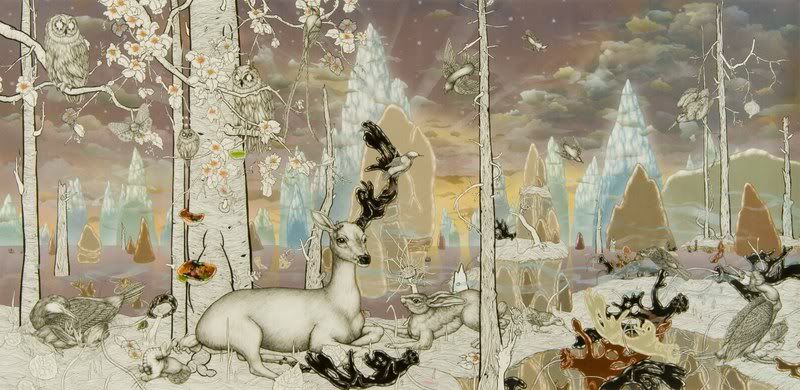
Jon Rappleye
"Nightwood Bloom"
2007
Acrylic on paper
42 1/2 x 87 inches


Because our creative siblings produce work that explores overlapping formal or conceptual territory, we tend to judge their output with more rigor than we might otherwise apply. As a result, I hold Jon Rappleye's mixed media paintings to a very high standard.

Like me, Rappleye draws his imagery from the indistinct intersection of natural history, animism, anthropomorphism and magic. I was introduced to his work in 2002; a smallish black-and-white painting hung in the Jeff Bailey Gallery office space. Set against a deep, black ground, owls and padlocks floated in an undefined space. Rappleye's execution was skillful and I responded to the imagery but, at the time, I was still struggling to find my own voice and I was therefore as skeptical of Rappleye's painting as I was excited by it. Does he really know these animal players?, I wondered. Does he fathom the world he depicts? Is he someone who truly appreciates being enveloped by that world? These may seem like strange questions but, for me, they were intrinsic to the spirit of the work.


Jon Rappleye
"In the Quiuver of the Kingdom"
2007
Acrylic on paper
40 x 51 inches


Both Jon and I have grown as artists in the intervening five years and Jon's recent solo show, "Awakened In The Peaceable Kingdom," also at Jeff Bailey, puts those questions to rest. I'd like to believe that the questions fade from relevance and that I can therefore fully appreciate Rappleye's work because I'm secure in my own doings. Perhaps that plays a part, but Rappleye has carefully honed his craft and defined his invented world; the works he produced in 2007 are not only his best to date, several are among the best paintings I've seen this year.

The cast of characters in this new work - hybrid amphibians, woodcocks, cormorants, ravens, poorwills, antlered owls, mushrooms, dead songbirds - is familiar, but the relationships between Rappleye's animal subjects have grown more complex and the ambivalent cycle of life and death is more readily observable. Whereas three years ago his pictures read as pastiche - every crow, owl or rabbit a distinct vignette - a painting like "Awakened In The Peaceable Kingdom" presents the viewer with a viable, if fanciful ecosystem.


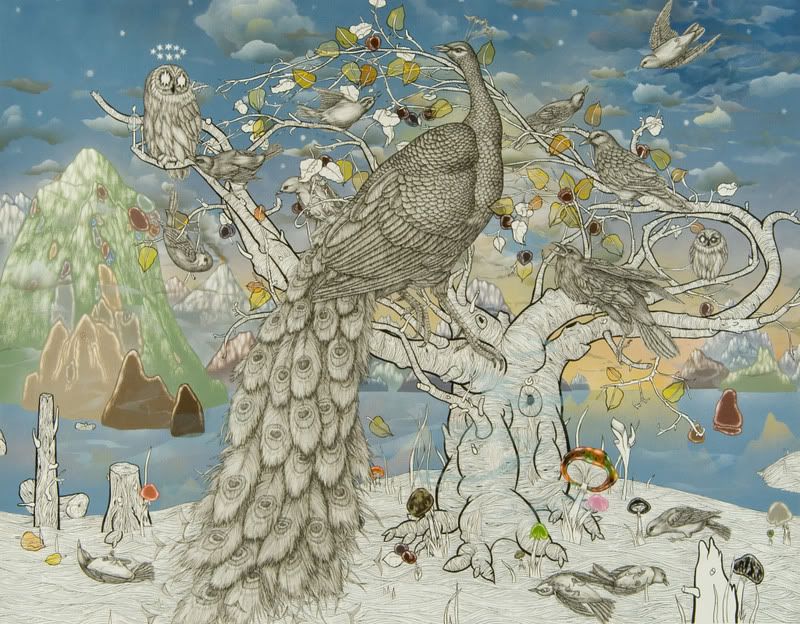
Jon Rappleye
"Awakened In The Peaceable Kingdom"
2007
Acrylic on paper
38 x 50 inches


The biomorphic landscapes in this work, too, feel more attended to; alternately bulbous and elongated, Rappleye's trees, stumps and slopes are as cartoony and sexualized as ever, but they take on a more nurturing character, in part because they are more convincingly occupied. Rappleye's fine line work, already notable in 2002, is ever more masterful; I spent long minutes admiring his economical rendering of a mammal's fur and the lustrous detail included in the feathers of a peacock's tail.

Rappleye also includes two sculptures in the exhibition, both cast in china. The new technique is a nice addition to Rappleye's output, and his blind - eyeless, actually - yet watchful owl, perched on a branch in the corner of the gallery, had me wondering if Rappleye might not produce installations one day and, if so, how they would inform the paintings (and vice versa).

Photo credits: all images courtesy Jeff Bailey Gallery

Thursday, March 16, 2006

The Human Face: Ambivalence As Objectivity

"Gaiety and glee are usually twinned with misery, however, which sneaks up on you like an ocean wave, filling your mouth with seawater, and can almost take you under, like a nether beast risen from below."
-Edward Hoagland, Compass Points

Image hosting by Photobucket
Woody Allen and the Voyager 1 disc

In moments of profound sorrow, my chest collapses, as if compressed by some exterior force. Air escapes my lungs and a temporal vertigo consumes me. Such absolute heartache is, thankfully, extremely rare. In my twenty-eight years, it has been summoned twice by women and, on several occasions, by the realization that, though all existence is fleeting, humanity must continue to strive. Contemplation of this proposition has, in the extreme, led to sobbing, but the tears are ambivalent, like the sentiment itself, simultaneously borne of intense joy and pathos.

Most recently, I was thus overcome while contemplating an image of the Voyager 1 disc in the pages of National Geographic. The gold-plated, copper record, placed on board the interstellar bound spacecraft in 1977, is, to my mind, the culmination of modern art. NASA's Jet Propulsion Laboratory describes the record as follows:
"...a phonograph record...containing sounds and images selected to portray the diversity of life and culture on Earth. The contents of the record were selected for NASA by a committee chaired by Carl Sagan of Cornell University. Dr. Sagan and his associates assembled 115 images and a variety of natural sounds, such as those made by surf, wind and thunder, birds, whales, and other animals. To this they added musical selections from different cultures and eras, and spoken greetings from Earth-people in fifty-five languages, and printed messages from President Carter and U.N. Secretary General Waldheim.

Each record is encased in a protective aluminum jacket, together with a cartridge and a needle. Instructions, in symbolic language, explain the origin of the spacecraft and indicate how the record is to be played. The 115 images are encoded in analog form. The remainder of the record is in audio, designed to be played at 16-2/3 revolutions per minute. It contains the spoken greetings, beginning with Akkadian, which was spoken in Sumer about six thousand years ago, and ending with Wu, a modern Chinese dialect. Following the section on the sounds of Earth, there is an eclectic 90-minute selection of music, including both Eastern and Western classics and a variety of ethnic music.

Once...Voyager...leave[s] the solar system (by 1990, [it] will be beyond the orbit of Pluto), [it] will find [itself] in empty space. It will be forty thousand years before [it] makes a close approach to any other planetary system. As Carl Sagan has noted, 'The spacecraft will be encountered and the record played only if there are advanced spacefaring civilizations in interstellar space. But the launching of this bottle into the cosmic ocean says something very hopeful about life on this planet.'"
If aliens should happen upon the Voyager 1 spacecraft and discover the disc, they are expected to play the record and learn something of our species' history. In this sense, the engraved disc is a tool and, as such, it will one day be considered an artifact, if it isn't already. (A reproduction will more likely find a home at the Smithsonian Institution than the Metropolitan Museum of Art.) But the disc is an object of abstract utility, a symbol representative of modern philosophy's crest. It was manufactured moments before the Enlightenment wave began to break: part Scientific Revolution, part postmodern doubt. Given this transitional moment of conception, the record is an embodiment of contradiction. It is a leap of faith taken by the faithless - the late twentieth century being the pinnacle of secularism - and a tool, crafted with aesthetics in mind, that is unlikely to be put to use. But, above all, the contradictory power of the Voyager 1 disc resides in the recorded content. An attempt to limn a collective portrait of humanity, the disc is at once a gesture of hopeful optimism and naive hubris.

Image hosting by Photobucket
The Necker Cube

I'm preoccupied by such ambivalence. Most people think of the word, ambivalent, as a pejorative. Without question, it can be used in a disparaging way, especially when interpreted only to mean indecision, but what of the word's other meaning, "the coexistence of opposing attitudes or feelings"? This latter usage accurately describes the balance sought by yogis, the Chinese yin-yang symbol, and the quantitative and qualitative possibilities figured in E=MC2. Contradiction, in this sense, is an altogether natural, even positive, phenomenon.

From my late teens on, I've been obsessed with another symbol of contradiction and ambivalence, the Necker Cube. The drawing figured prominently in the margins of my undergrad notebooks and throughout old sketchbooks; it was of particular interest to me during the peak of my drug experimentation. Flipping through an old "trip journal," I came across the hallucinogen-inspired rant below, proof that, if you keep pen and paper handy, not everything flashing through a chemically-addled mind is worthless (even if poor motor control makes it nearly illegible).
"A good idea will always contradict itself or, at least, the person exploring this idea will accept the reverse to be true as well. There are always multiple truths (2 symbolically, many more literally). It is the impossible middle-ground that is important. This is the yearning chasm, the heart, the Meadowlands. The yearning chasm must never be achievable, but does provide something to aim for. This target is our quaquaversal. At the peak of this quaquaversal - at the point of slope's origin - is the ylem. We can never reach the ylem; we can not even claim to know of it's existence, except on faith. Therefore, I have already arrived at a prime contradiction, making my logic sublimely impotent."
Unfortunately, when sober, humans are not programmed to readily accept such ambivalence; we prefer "empirical" truth, assigning meaning, often moral in nature, to our observations. Our data gathering can be objective, but our interpretation and the resulting intellectual constructs are rarely so. As a species, we are reluctant to give ourselves over to ambivalence. When faced with doing so, our bodies react in unusual, sometimes surprising ways; hence, my involuntary sobbing while contemplating the Voyager 1 disc. To contemplate the ambivalent universe is to be simultaneously overcome by wonder and mired in tragedy.
"...the idiosyncratic surfaces of the other orbs floating serenely in space; the pristine interstellar vacuum; the inscrutable emptiness of intergalactic space, that immense, echoing, absolutely featureless void enveloping the spinning galaxies: it all serves as a perfect philosophical mirror image, reflecting back the quandry of the species, the limitations of human knowledge. The frail architecture defined by our distant tools, which places the human race at the center of 'what's known,' is actually our own map of ourselves - a chart that we'll hand down to successive generations, who one day may see a charming primitivism, or even an prescience, in our view of all that."

-Michael Benson, "A Space In Time" (Atlantic Monthly, July/August 2002)
Many artists vacillate between the poles of glee and misery, of joy and sorrow, but one of my favorites, Woody Allen, is firmly entrenched in the tragic camp. In a recent Manchester Guardian profile ("Master of Neurosis," Guardian Weekly, Jan. 6-12, 2006), Allen tells Emma Brockes that, although he wouldn't trade his sense of humor for physical beauty, he "would've exchanged being funny for being a tragedian." He continues, "I always would've done that, from day one, to now, I mean, I always would have preferred that. [...] I wish my career could have been one in which film after film has not been comedies, but been dramas and tragedies." Reading the profile, one gets a sense of Allen's general melancholy; as he describes it, "I'm almost burning on a low flame of depression." I used to associate such a temperament with keen intelligence - and there is no denying Allen's brilliance, whether or not you like his films - but, lately, I feel depressives, like Allen, are denying the opposing pull, choosing the one-directional shrug of apathy over the contradiction of ambivalence.

Near the end of the piece, Brockes asks Allen, after having listened to him bemoan the pointlessness of it all, "Isn't having children a consolation of some sort?"
"No. There's no sense of continuity. No sense of, no sense of...I always used to think that art is the intellectual's Catholicism. You think that because your work may be seen after your death, or read, after your death, that it's compensation. But it's not. Not kids, or art or anything. There is nothing compensating about your own death."
Allen's bleak world view reminds me of a character I created for a screenplay I never completed, an angst-ridden twenty-something with a penchant for drug-fueled conversation and navel gazing - a thinly veiled reflection of myself at twenty-one. At one point, early on in the action, this character stands in a salt marsh with a friend and delivers a rambling monologue. Near the end of it, he says,
"I don't know...I think our answers - if you can call them that - are no more sensible than...I don't know...a mole. I mean, sometimes I like to think about...you know....'future man,' like, poking his fingers around in a human skull, my skull. But then I realize how far fetched that is. I mean, I won't be lucky enough to be a fossil. I've never even won at Bingo."
Presumably, this character would share Allen's feeling about children and art. With good reason: the idea that immortality may be achieved via lineage or the leavings of a creative career is short-sighted, as both, eventually, will be buried and forgotten, long before humanity vanishes. But Allen and my unfinished proxy are wrong to believe death offers nothing in the way of compensation. As our bodies rot, the contained energy - your concentrated mass - is released into the humus and the ether. Again, E=MC2 or, as Galway Kinnell, my favorite contemporary poet, puts it in "The Quick and the Dead," "the crawling of new life out of the old, which is what we have for eternity on earth." In this sense, even after our species is gone and other lifeforms populate the planet, each of us remains an essential piece of the weave, recycled and reconstituted.

Contrary to Woody, I feel there is much joy in accepting our inevitable decomposition, even if our conscious minds yearn for permanence, making eulogistic joy rather wistful. Meanwhile, Voyager 1 continues it's interstellar journey to boldly go where no man has gone before.

Photo credits: images ripped from Nature Publishing Group, lnx.indajaus.com, and The Focusing Institute website

Tuesday, April 05, 2005

The Nihilistic Science Guy

“As a child, I would stand with my father on the beach in Delaware and stare at my shadow as the sun went down, watching it get longer and longer, infinitely long. When you understand how many stars are out there, more stars than there are grains of sand on the beach, you can think you’re just a speck orbiting a speck in the middle of specklessness. But there’s another way to look at it, which is that we have brains, and can use them to understand the universe. And I thought then that if I were out in space I could look back and see my shadow, the long shadow of little Bill.”

- Bill Nye, The New Yorker “Talk of the Town” (January 5, 2004)
I grew up two states south of Bill Nye, “The Science Guy,” and I less often considered sand on beaches than water molecules in the ocean, but I did spend many hours contemplating little things, real or imagined, awed by my relative enormity and, in turn, by my relationship to the greater, infinite expanse.

Some professional scientists poo-poo Nye. If pressed, these scientists admit that their disregard is rooted in his popular appeal and his “dumbing down” of science for mass consumption. I prefer to celebrate Nye for the same reasons.

My parents didn’t have a television when I was growing up, but when I visited a neighbor’s house and saw shows like "Sesame Street" or the "Electric Company," I was enthralled. Had “Bill Nye, The Science Guy" been aired when I was young, I'm sure that I would have loved it, and I'm sure that he would have further inflamed my love of science.

Interestingly, underneath Nye’s infectious excitement, he seems complicated. I find myself wondering what he thinks about after the studio lights are turned off. Is he defensively optimistic? Deeply pessimistic? What questions does he ask of himself? Of others? Does he avoid questions of personality or psychology, concentrating instead on that which he can safely externalize?

In the most recent issue of Wired, Nye is featured in "The Science Guy Grows Up," a short, five-question interview. When asked, "Science and comedy seem like strange bedfellows. How do you make serious science funny?," Nye responds:
“How can you make it not funny? Humor is everywhere, in that there’s irony in just about anything a human does. There’s all this PB&J: passion, beauty, and joy. But there’s also the futility of the whole thing. We’re just humans on this dying planet, and it doesn’t much matter what we do. We’re always setting up expectations, whether scientific or otherwise, and failing to meet them. That creates comedic tension. The more you find out about the world, the more opportunities there are to laugh it.”
Underneath all of his infectious excitement, then, Nye is something of a nihilist. Perhaps the lessons of science always reduce the human by presenting us relative to the rest of the mess. Maybe this, in part, contributes to the trend towards scientific specialization over generalism, allowing the scientist to avoid looking at the whole and thereby protecting her from potential crackup.

Photo credit: homepage of Zachary Alex Samuels, Cornell University

Tuesday, March 01, 2005

Night Gates


In the February 28, 2005 issue of The New Yorker, Peter Schjeldahl writes that Christo and Jeanne-Claude's "The Gates" project offers little aesthetic value. Excepting fleeting seconds of "beauty" when the late afternoon sun backlit the orange hangings, Schjeldahl finds the work "charm-free, synthetic...something you would wear only in the woods during deer season."

The critic does, however, notice a "drowsy contentment" on the faces of his fellow Central Park visitors and he "give[s himself] a nice scare imagining 'The Gates' magically removed, and leaving the people looking as they looked - a goofball 'Night of the Living Dead.'"

If I consider only my daytime "Gates" experience, I agree with Schjeldahl, but my “Night of the Living Dead” moment occurred, appropriately enough, at night. After dark, the sunny backlight Schjeldahl describes is similarly effected by bright spotlights and park lamps.

On the second Saturday night of the installation, gusting wind worked in combination with the lighting to create an eerie, magical feel, one augmented by the relative emptiness of the park and the three glasses of red wine I'd just consumed.

Photo credit: Hungry Hyaena, 2005