"Gaiety and glee are usually twinned with misery, however, which sneaks up on you like an ocean wave, filling your mouth with seawater, and can almost take you under, like a nether beast risen from below."
-Edward Hoagland, Compass Points

Woody Allen and the Voyager 1 discIn moments of profound sorrow, my chest collapses, as if compressed by some exterior force. Air escapes my lungs and a temporal
vertigo consumes me. Such absolute heartache is, thankfully, extremely rare. In my twenty-eight years, it has been summoned twice by women and, on several occasions, by the realization that, though all existence is fleeting, humanity must continue to strive. Contemplation of this proposition has, in the extreme, led to sobbing, but the tears are ambivalent, like the sentiment itself, simultaneously borne of intense joy and pathos.
Most recently, I was thus overcome while contemplating an image of the
Voyager 1 disc in the pages of
National Geographic. The gold-plated, copper record, placed on board the interstellar bound spacecraft in 1977, is, to my mind, the culmination of modern art.
NASA's
Jet Propulsion Laboratory describes the record as follows:
"...a phonograph record...containing sounds and images selected to portray the diversity of life and culture on Earth. The contents of the record were selected for NASA by a committee chaired by Carl Sagan of Cornell University. Dr. Sagan and his associates assembled 115 images and a variety of natural sounds, such as those made by surf, wind and thunder, birds, whales, and other animals. To this they added musical selections from different cultures and eras, and spoken greetings from Earth-people in fifty-five languages, and printed messages from President Carter and U.N. Secretary General Waldheim.
Each record is encased in a protective aluminum jacket, together with a cartridge and a needle. Instructions, in symbolic language, explain the origin of the spacecraft and indicate how the record is to be played. The 115 images are encoded in analog form. The remainder of the record is in audio, designed to be played at 16-2/3 revolutions per minute. It contains the spoken greetings, beginning with Akkadian, which was spoken in Sumer about six thousand years ago, and ending with Wu, a modern Chinese dialect. Following the section on the sounds of Earth, there is an eclectic 90-minute selection of music, including both Eastern and Western classics and a variety of ethnic music.
Once...Voyager...leave[s] the solar system (by 1990, [it] will be beyond the orbit of Pluto), [it] will find [itself] in empty space. It will be forty thousand years before [it] makes a close approach to any other planetary system. As Carl Sagan has noted, 'The spacecraft will be encountered and the record played only if there are advanced spacefaring civilizations in interstellar space. But the launching of this bottle into the cosmic ocean says something very hopeful about life on this planet.'"
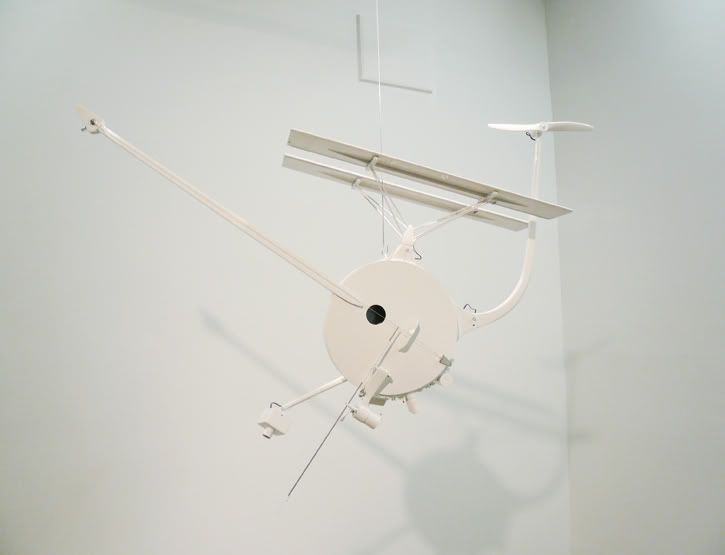
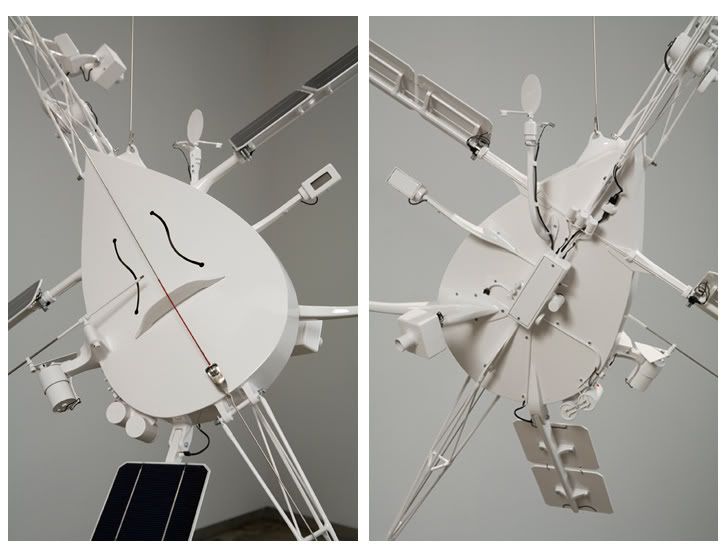
If aliens should happen upon the Voyager 1 spacecraft and discover the disc, they are expected to play the record and learn something of our species' history. In this sense, the engraved disc is a tool and, as such, it will one day be considered an artifact, if it isn't already. (A reproduction will more likely find a home at the
Smithsonian Institution than the
Metropolitan Museum of Art.) But the disc is an object of abstract utility, a symbol representative of modern philosophy's crest. It was manufactured moments before the
Enlightenment wave began to break: part
Scientific Revolution, part
postmodern doubt. Given this transitional moment of conception, the record is an embodiment of contradiction. It is a leap of faith taken by the faithless - the late twentieth century being the pinnacle of secularism - and a tool, crafted with aesthetics in mind, that is unlikely to be put to use. But, above all, the contradictory power of the Voyager 1 disc resides in the
recorded content. An attempt to limn a collective portrait of humanity, the disc is at once a gesture of hopeful optimism and naive hubris.

The Necker CubeI'm preoccupied by such ambivalence. Most people think of the word, ambivalent, as a pejorative. Without question, it can be used in a disparaging way, especially when interpreted only to mean indecision, but what of the word's other meaning, "the coexistence of opposing attitudes or feelings"? This latter usage accurately describes the balance sought by
yogis, the Chinese
yin-yang symbol, and the quantitative and qualitative possibilities figured in
E=MC2. Contradiction, in this sense, is an altogether natural, even positive, phenomenon.
From my late teens on, I've been obsessed with another symbol of contradiction and ambivalence, the
Necker Cube. The drawing figured prominently in the margins of my undergrad notebooks and throughout old sketchbooks; it was of particular interest to me during the peak of my drug experimentation. Flipping through an old "trip journal," I came across the
hallucinogen-inspired rant below, proof that, if you keep pen and paper handy, not everything flashing through a chemically-addled mind is worthless (even if poor motor control makes it nearly illegible).
"A good idea will always contradict itself or, at least, the person exploring this idea will accept the reverse to be true as well. There are always multiple truths (2 symbolically, many more literally). It is the impossible middle-ground that is important. This is the yearning chasm, the heart, the Meadowlands. The yearning chasm must never be achievable, but does provide something to aim for. This target is our quaquaversal. At the peak of this quaquaversal - at the point of slope's origin - is the ylem. We can never reach the ylem; we can not even claim to know of it's existence, except on faith. Therefore, I have already arrived at a prime contradiction, making my logic sublimely impotent."
Unfortunately, when sober, humans are not programmed to readily accept such ambivalence; we prefer "empirical" truth, assigning meaning, often moral in nature, to our observations. Our data gathering can be objective, but our interpretation and the resulting intellectual constructs are rarely so. As a species, we are reluctant to give ourselves over to ambivalence. When faced with doing so, our bodies react in unusual, sometimes surprising ways; hence, my involuntary sobbing while contemplating the Voyager 1 disc. To contemplate the ambivalent universe is to be simultaneously overcome by wonder and mired in tragedy.
"...the idiosyncratic surfaces of the other orbs floating serenely in space; the pristine interstellar vacuum; the inscrutable emptiness of intergalactic space, that immense, echoing, absolutely featureless void enveloping the spinning galaxies: it all serves as a perfect philosophical mirror image, reflecting back the quandry of the species, the limitations of human knowledge. The frail architecture defined by our distant tools, which places the human race at the center of 'what's known,' is actually our own map of ourselves - a chart that we'll hand down to successive generations, who one day may see a charming primitivism, or even an prescience, in our view of all that."
-Michael Benson, "A Space In Time" (Atlantic Monthly, July/August 2002)
Many artists vacillate between the poles of glee and misery, of joy and sorrow, but one of my favorites,
Woody Allen, is firmly entrenched in the tragic camp. In a recent
Manchester Guardian profile ("Master of Neurosis,"
Guardian Weekly, Jan. 6-12, 2006), Allen tells
Emma Brockes that, although he wouldn't trade his sense of humor for physical beauty, he "would've exchanged being funny for being a tragedian." He continues, "I always would've done that, from day one, to now, I mean, I always would have preferred that. [...] I wish my career could have been one in which film after film has not been comedies, but been dramas and tragedies." Reading the profile, one gets a sense of Allen's general melancholy; as he describes it, "I'm almost burning on a low flame of depression." I used to associate such a temperament with keen intelligence - and there is no denying Allen's brilliance, whether or not you like his films - but, lately, I feel depressives, like Allen, are denying the opposing pull, choosing the one-directional shrug of apathy over the contradiction of ambivalence.
Near the end of the piece, Brockes asks Allen, after having listened to him bemoan the pointlessness of it all, "Isn't having children a consolation of some sort?"
"No. There's no sense of continuity. No sense of, no sense of...I always used to think that art is the intellectual's Catholicism. You think that because your work may be seen after your death, or read, after your death, that it's compensation. But it's not. Not kids, or art or anything. There is nothing compensating about your own death."
Allen's bleak world view reminds me of a character I created for a screenplay I never completed, an angst-ridden twenty-something with a penchant for drug-fueled conversation and navel gazing - a thinly veiled reflection of myself at twenty-one. At one point, early on in the action, this character stands in a
salt marsh with a friend and delivers a rambling monologue. Near the end of it, he says,
"I don't know...I think our answers - if you can call them that - are no more sensible than...I don't know...a mole. I mean, sometimes I like to think about...you know....'future man,' like, poking his fingers around in a human skull, my skull. But then I realize how far fetched that is. I mean, I won't be lucky enough to be a fossil. I've never even won at Bingo."
Presumably, this character would share Allen's feeling about children and art. With good reason: the idea that immortality may be achieved via lineage or the leavings of a creative career is short-sighted, as both, eventually, will be buried and forgotten, long before humanity vanishes. But Allen and my unfinished proxy are wrong to believe death offers nothing in the way of compensation. As our bodies rot, the contained energy - your concentrated mass - is released into the humus and the ether. Again, E=MC2 or, as
Galway Kinnell, my favorite contemporary poet, puts it in "
The Quick and the Dead," "the crawling of new life out of the old, which is what we have for eternity on earth." In this sense, even after our species is gone and other lifeforms populate the planet, each of us remains an essential piece of the weave, recycled and reconstituted.
Contrary to Woody, I feel there is much joy in accepting our inevitable decomposition, even if our conscious minds yearn for permanence, making eulogistic joy rather wistful. Meanwhile, Voyager 1 continues it's interstellar journey to boldly go where no man has gone before.
Photo credits: images ripped from
Nature Publishing Group, lnx.indajaus.com, and
The Focusing Institute website