Showing posts with label capitalism. Show all posts

Monday, February 28, 2011

So Many True Colors


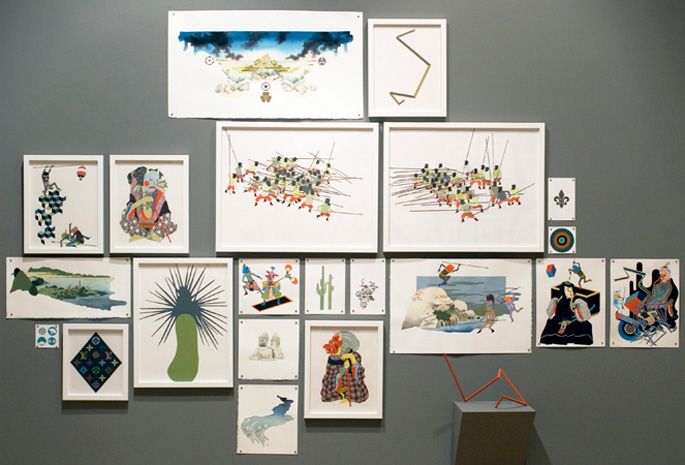
Installation at Haines Gallery
"Studies for La Destitution de la Jeune Fille"
2010
Gouache on paper and wood
Dimensions Variable

French artist Katya Bonnenfant has adopted the moniker The Old Boys' Club. TOBC's current exhibition at Haines Gallery - a scaled-down version of the recent wallpaper and sculptural installation at the Yerba Buena Center for the Arts - is titled "La Destitution de al Jeune Fille (The Deposition of the Young Girl)." According to the gallery's press release, the title references a "post-Situationist theory [...] initially put forth by the anonymous collective, Tiqqun." Apparently, Tiqqun "advances the notion of the young girl as embodiment of the capitalist machine and the meaninglessness of modern life." Further research reveals that the preponderance of content published in Tiqqun's now defunct journal is jejune and impotent pseudo-philosophy, the sort of tripe that too many artists mistake for genuine thoughtfulness. Happily, despite her meager inspiration, TOBC puts on a good show.


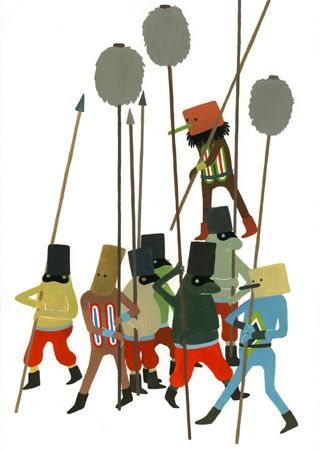
"Study for La Destitution de la Jeune Fille #41"
2010
Gouache on paper
12 x 9 inches

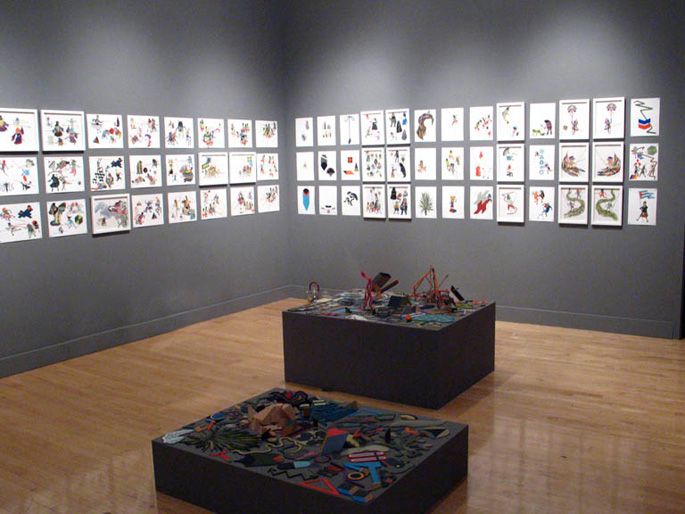
The back gallery at Haines is pleasantly crowded with TOBC's colorful and riotous gouache drawings and sculptures. Bonnenfant's cast of cartoon characters is diverse; celebrities like Darth Vader and Waldo appear, but most of the artist's spear-wielding insurgents are humble and unfamiliar. What treasure or ideology are they fighting over, exactly? Narrative particulars are few and no critical players or turning points are obviously apparent; it's a ceaseless and meaningless melee (like Tiqqun's conception of modern life!).

The opaque, vivid colors of TOBC's gouaches call to mind the advertising industry's heraldry and, in combination with the masks and costumes of Bonnenfant's characters, emphasize the combatants' ethnic or cultural differences. The effect is gestalt; Bonnenfant's oddball cast of warrior mascots is a manifestation of the physical and economic violence of globalization. That's also what Tiqqun aimed to communicate but, where they failed, TOBC succeeds artfully and without pretension.


Installation at Haines Gallery
"Studies for La Destitution de la Jeune Fille"
2010
Gouache on paper and wood
Dimensions Variable

Image credits: all images from the artist's website and Haines Gallery website

Wednesday, April 28, 2010

Revisiting the Steady State Economy

On the heels of not one, not two, but three Republican blockades of financial regulatory legislation in the U.S. Senate this week, I thought it worth reposting the below essay on the concept of a Steady State Economy. The essay was originally posted on HH in April 2005; five years later, there's only that much more reason for thoughtful, comprehensive reform.

+++


Environmentalism is becoming something of a religion. Those who subscribe to most or all of the tenants of the environmentalist doctrine are among the movement’s acolytes, composting and recycling, canvas bagging it and buying organic, living what they consider “healthier,” less “impactful” lives. A thoughtful environmentalist should recognize these actions to be sacraments grounded in a hybrid moral code. “I am doing my part to rectify the mess made by the sinners around me.” How persuasive is this feeling of self-worth and moral superiority? Like all religious conviction, it is undeniably powerful and fulfilling, but it comes at a cost. Too often this fetal “religion” ignores fact in favor of that which is deemed morally superior. For example, radical environmentalists demand a wilderness without humans, ignoring the fact that management (stewardship) is now an unfortunate necessity given our exuberant use of natural resources and our continued sprawl. Reason must enter into the equation. Thoughtful environmentalism of the secular variety is possible, as long as we don’t allow ourselves to become vain.

This brings me to the concept of the Steady State Economy.

I first heard wind of Brian Czech’s Center for the Advancement of the Steady State Economy (CASSE) project a year ago. My initial reaction was positive, though I feared support for the concept would be relegated to left-wing environmental groups of the “religious” variety. Surprisingly, I am hearing the term used with more frequency these days, sometimes by folks with little interest in preserving biodiversity or encouraging ecological sustainability.

I am a proponent of the philosophy (read this .pdf for an excellent summary). The front page of the CASSE website states:
“Economic growth is an increase in the production and consumption of goods and services. It entails increasing population, per capita consumption, or both. Economic growth leaves a larger ecological footprint, causing civil strife and bringing nations into conflict.”
This simplifies, for the sake of dramatic impact, the arguments made by the economists behind the SSE. For me, the heart of the matter is touched on in the following selection.
“…Wildlife biologists know that a wide variety of social structures may produce stable populations. The same holds true for a steady state economy. For example, a steady state economy with long human life spans entails low birth and death rates. In our opinion this is preferable, within reason, to a steady state economy with short life spans, high birth rates, and high death rates. The same concept applies to capital and durable goods such as automobiles. We opine that a relatively slow flow of high-quality, long-lasting goods is preferable to a fast flow of low-quality, short-lived goods.”
The SSE will not take hold in the United States anytime soon, but in more socially-minded democracies, like Sweden or England, the approach is not so alien. The truth is, however, such a transition from market-driven capitalism to stability-driven capitalism is unlikely to occur unless the populous desires as much. In the United States, our stock market would require overhaul, making it “less of a casino,” by decreasing its volatility and demand for liquidity. This seems unlikely, especially in the immediate future. In fact, were the transition to begin today, the market would likely hemorrhage. Making things even more unattractive for the “powers that be,” implementation of the Steady State Economy requires, for countries like the United States, a marked decrease in Gross Domestic Product. As a result, I believe the SSE can not become a concrete reality in the foreseeable future, but that we should strive for it no less.

As the selection below suggests, there is much to be gained from the sustainable lifestyle.
“Nor would any cultural stagnation result from a steady state economy. John Stuart Mill (1806-1873), one of the greatest economists and political philosophers in history, emphasized that an economy in which physical growth was no longer the goal would be more conducive to political, ethical, and spiritual improvements.”
Ah, yes, ethical and spiritual improvement… So we’re back to individual action and lifestyle choices, rubbing shoulders with the “religious” environmentalists. Where do I sign up to feel superior to the rest of the heathens? I already recycle, canvas bag it, and eat only meat that I have caught or killed myself. I’m a few sacraments shy of donning a robe and shuffling off to the commune. Why shouldn’t I begin buying everything carefully and, in my own way, push for the adoption of the SSE at a local level?

Well, the truth is I should.

I self-consciously poke fun at the problematic aspects of environmentalism only because it is so close to my heart. I am not a religious man in the popular or traditional understanding of the word. Biology, anthropology, paleontology, history: these are my holy tomes. Yet I firmly believe that through careful consideration, research, and political pressure we can arrive at a more complete conservation ethic, one which addresses not only biodiversity and “wilderness” (my principal areas of interest), but also global poverty and human rights.

Photo credit: ripped from the World Food Programme website

Sunday, November 29, 2009

Picturing Alternative Futures


James Griffioen
From the "Feral Houses" series

Last week, Flavorpill's Flavorwire newsletter introduced me to James Griffioen's photography. "Feral Houses," the series featured by Flavorpill, focuses on abandoned houses in Detroit, Michigan. Griffioen writes,
"For a few beautiful months every summer, some of the tens of thousands of abandoned houses become feral in every sense: they disappear behind ivy or the untended shrubs and trees planted generations ago to decorate their yards. As the city of Detroit disappears, nature is flourishing."
Considered as a whole, the "Feral Houses" series is a record of our complicated relationship with the land upon which we live and depend, as well as of our ailing community roots.


James Griffioen
From the "Feral Houses" series

Detroit's Rust Belt era history is generally bleak. Today, much of the city is classified as a food desert. Sitting down for a hearty meal with friends and family this Thanksgiving evening, I recalled Rebecca Solnit's inspiring Harper's Magazine article, "Detroit Arcadia" (July 2007). Solnit writes,
"Detroit is a cautionary tale about one-industry towns: it shrank the way the old boomtowns of the gold and silver rushes did, as though it had been mining automobiles and the veins ran dry, but most of those mining towns were meant to be ephemeral. People thought Detroit would go on forever. [...] I took many pictures on my visits to Detroit, but back home they just looked like snapshots of abandoned Nebraska farmhouses or small towns farther west on the Great Plains. Sometimes a burned-out house would stand next to a carefully tended twin, a monument to random fate; sometimes the rectilinear nature of city planning was barely perceptible, just the slightest traces of a grid fading into grassy fields accented with the occasional fire hydrant. One day after a brief thunderstorm, when the rain had cleared away and chunky white clouds dotted the sky, I wandered into a neighborhood, or rather a former neighborhood, of at least a dozen square blocks where trees of heaven waved their branches in the balmy air. Approximately one tattered charred house still stood per block. I could hear the buzzing of crickets or cicadas, and I felt as if I had traveled a thousand years into the future."
Yet the central focus of Solnit's essay are the heroic, local reclamations of Detroit's abandoned lots for community gardens or small-scale farming enterprises.
"I also saw the lush three-acre Earth Works Garden, launched by Capuchin monks in 1999 and now growing organic produce for a local soup kitchen. I saw a 4-H garden in a fairly ravaged east-side neighborhood, and amid the utter abandonment of the west side, I saw the handsome tiled buildings of the Catherine Ferguson Academy for Young Women, a school for teenage mothers that opens on to a working farm, complete with apple orchard, horses, ducks, long rows of cauliflower and broccoli, and a red barn the girls built themselves. I met Ashley Atkinson, the young project manager for The Greening of Detroit, and heard about the hundred community gardens they support, and the thousands more food gardens that are not part of any network. The food they produce, Atkinson told me, provides food security for many Detroiters. 'Urban farming, dollar for dollar, is the most effective change agent you can ever have in a community,' she said. Everywhere I went, I saw the rich soil of Detroit and the hard work of the gardeners bringing forth an abundant harvest any organic farmer would envy."
Similar projects are gaining momentum in American cities that aren't suffering as acutely as Detroit. Community garden and farmer's market movements are thriving in many urban centers, and urbanite hunters are no longer unheard of. Last week, the New York Times reported on the growing number of locavores taking up hunting, but, unlike Charlottesville, Virginia's "Deer Hunting for Locavores" class and San Francisco's Bull Moose Hunting Society, ventures made possible by relative privilege and foresight, Detroit's repurposing and enterprise is born of pressing need.


James Griffioen
From the "Feral Houses" series

Contemplating Griffioen's handsome photographs, it's impossible not to think of Detroit's economic and health struggles. Still, his subjects, the "feral houses" themselves, don't strike this Eastern Shore boy as that unusual. All regions marked by poverty offer up monuments to the ceaseless action of Nature and time. Recent studies show that Accomack, the Virginia county that I was raised in and that my parents call home, is "the fattest" county in the state. It is also one of the poorest. Abandoned houses and overgrown automobiles figure as prominently in my mental portrait of the Shore as do salt marshes and the rich smell of freshly turned earth.

Unlike the citizens of Detroit's urban environment, Eastern Shore folks are not strangers to hunting, fishing, or farming. One might therefore assume that food desertification and obesity are unlikely. Unfortunately, access to fresh, healthy foods doesn't mean that locals won't instead opt for fast food! Furthermore, community ties might be even weaker on the Shore than they are in Detroit, eroded in part by an epidemic reliance on the automobile and big-box stores.

What does the future portend for Detroit and Virginia's Eastern Shore? Taking the long view, I'm optimistic. A decade hence, Detroit might well provide a more sustainable model for beleaguered urban communities. The Eastern Shore, however, is a different type of community, and one still on the decline; recovery will come more slowly.


Don Amadeo
House on White's Neck Road; Parksley, Virginia

Like Griffioen's pictures, Don Amadeo's photographs of the Eastern Shore remind us of the slow creep of geologic time, the long long view. Human communities may rise and fall and rise again, but all eventually succumb. So, too, with species. There is an ambivalent beauty in overgrown ruins; they celebrate the wonder of life's eternal striving even as they proclaim mortality.


Don Amadeo
Ole Rusty; Parksley, Virginia

Photo credit: "Feral Houses" photographs, courtesy James Griffioen; ShoreRebel photographs, courtesy Don Amadeo

Friday, November 06, 2009

A Bitter Ode to Hermes

Anatomy of a Creative Funk


Christopher Reiger
"Mannequin"
2009
Pen and sumi ink, gouache, watercolor and marker on Arches paper
15 1/4 x 15 1/2 inches

I apologize for the lack of regular HH content. Writing is as much a part of my creative process as is art-making, and, for weeks now, I've been creatively out-of-sorts. Fairly or not, I attribute this bout of artistic malaise to my solo show.

Visual artists often speak of the funk that descends when a solo show is on view. My first solo exhibition, "Mongrel Truth," at Brooklyn's AG Gallery, gave rise to minimal tsoris, but "Some Species of Song" has played havoc with my head. I've little or no inclination to write, and I've had to force myself to work on studies for future paintings and drawings.

I've heard many explanations for the funk put forward. Most often, artists will say something along the lines of "the batteries need to recharge." That seems natural enough, but, why, I wonder, does this requisite recharge always seem to coincide with a solo show?

I discussed my condition with a writer friend, and her hypothetical explanation of the solo show funk is convincing, at least with respect to my experience of the malady. She contends that, before the solo show, the artist works happily in the studio because he is fully present in his creative labor. In this "process mode," the artist understands the artwork and the art-making as an extension of self, a soulful and intimate activity. Once the artwork is displayed in a commercial gallery, however, the artist must conceive of the artwork anew. In the "product mode," the art is commodified and abstracted, effectively reduced to paper currency, worthless without social consensus. In transitioning from studio space to market space, the artist has crossed over a Hermetic boundary, leaving behind the eroticism of Eros for the commercial quantification of Hermes.

I've quoted from and alluded to Lewis Hyde's fascinating book The Gift before; it's again pertinent. Hyde's foundational position is that all art is a ceremonial gift, that the creative act is part of a free and open dialogue of spiritually nourishing exchange. Once the market commodifies art, however, "a part of the [artist's] self is inhibited and restrained," and the greater community suffers for it. Sadly, this inhibition and incompleteness is, in our capitalistic world view, assumed to be natural; the artist's worth is counted in coinage rather than spirit. One manifestation of this corruption appears in notions of gender.
"[T]he nineteenth century saw a decline in faith coincide with the remarkable success of a secular, mercantile, and entrepreneurial spirit. The story has been told many times. By the end of the century, to be 'self-made' in the market, or to have successfully exploited the natural gifts of the New World, were the marks of a Big Man, while attention to inner life and the community (and to their subtle fluids - religion, art, and culture) was consigned to the female sphere. The division of commerce by gender still holds. As a character in Saul Bellow's novel Humboldt's Gift remarks in regard to creative artists, 'To be a poet is a school thing, a skirt thing, a church thing.' In a modern, capitalist nation, to labor with gifts (and to treat them as gifts, rather than exploit them) remains a mark of the female gender."
Considering muscular capitalism, Hyde calls Hermes the most contemporary of the Greek pantheon. He is the god of the self-made man, the trafficker in goods, pure and soiled.
"Hermes is an amoral connecting deity. When he's the messenger of the gods he's like the post office: he'll carry love letters, hate letters, stupid letters, or smart letters. His concern is the delivery, not what's in the envelope. He wants money to change hands, but he does not distinguish between the just price and a picked pocket. [...] Hermes can't be trusted, of course. The say 'he either leads the way or guides astray.' [...] In a Hermetic mood we will make a hundred intellectual connections only to find, when we check them with a less restless god, that ninety-nine of them are useless.

Homer tells us that Zeus gave Hermes 'an office...to establish deeds of barter amongst men throughout the fruitful earth,' and he has done his job well. He may be the twentieth century's healthiest Greek god. He is present wherever things move quickly without regard to specific moral content, in all electronic communication, for example, or in the mails, in computers and in the stock exchange (especially in international money markets)."
Indeed, the amorality of global capitalism was spectacularly revealed in the recent hemorrhaging of the financial markets. Still, as a people, we've given ourselves to the worship of Hermes, and we champion the good news that he carries over the bad. The art market is no exception. There are, of course, some very positive aspects of the contemporary art market, just as there are some wonderful individuals participating in it, but a dark cloud shadows all contemporary commerce...and luxury commerce, in particular.

In a short passage, mid-way through the book, Hyde offers readers a striking condemnation of the contemporary art market.
"The more we allow such commodity art to define and control our gifts, the less gifted we will become, as individuals and as a society. The true commerce of art is a gift exchange, and where that commerce can proceed on its own terms we shall be heirs to the fruits of gift exchange: in this case, to a creative spirit whose fertility is not exhausted in use, to the sense of plentitude which is the mark of all erotic exchange, to a storehouse of works that can serve as agents of transformation, and to a sense of an inhabitable world - an awareness, that is, of our solidarity with whatever we take to be the source of our gifts, be it the community or the race, nature, or the gods. But none of these fruits will come to us where we have converted our arts to pure commercial enterprises."
I hope that my charitable sales model can, in some small way, act as a corrective to the market's distortions, and serve as inspiration for other artists. We are empowered to change the system. We only need to become enthusiastic about doing so.

Image credit: Christopher Reiger, 2009

Thursday, October 22, 2009

Acting Out (Peacefully) Against the Culture of Competition


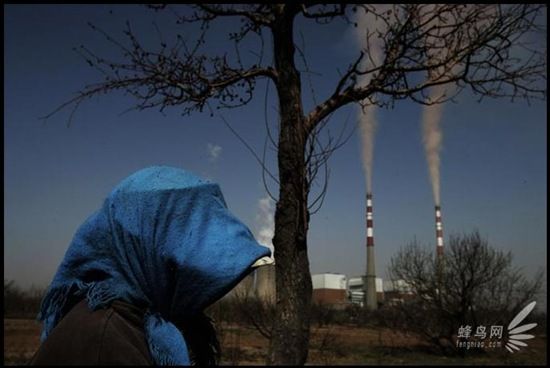
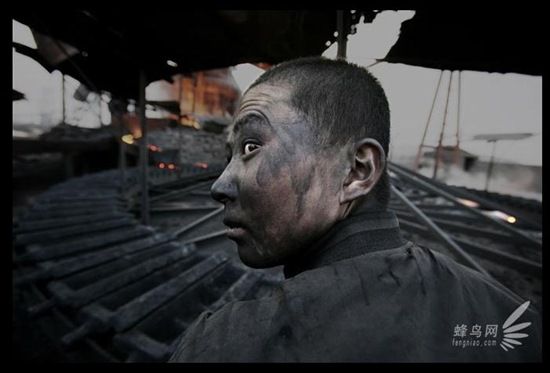
Shizuishan Industrial district in Ningxia. Residents cover themselves against the falling dust when going outside.
April 22, 2006

This Saturday, October 24th, I'll join a mob of peaceful activists and march across the Brooklyn Bridge, from Manhattan to Brooklyn, in hopes of further raising public awareness about the reality of climate change and the need for a comprehensive international climate treaty. The march is associated with 350.org's Day of Action.
"350.org is an international campaign dedicated to building a movement to unite the world around solutions to the climate crisis--the solutions that science and justice demand. Our mission is to inspire the world to rise to the challenge of the climate crisis—to create a new sense of urgency and of possibility for our planet. Our focus is on the number 350--as in parts per million, the level scientists have identified as the safe upper limit for CO2 in our atmosphere. But 350 is more than a number--it's a symbol of where we need to head as a planet. [...] This December, world leaders will meet in Copenhagen, Denmark to craft a new global treaty on cutting emissions. The problem is, the treaty currently on the table doesn't meet the severity of the climate crisis—it doesn't pass the 350 test. In order to unite the public, media, and our political leaders behind the 350 goal, we're harnessing the power of the internet to coordinate a planetary day of action on October 24, 2009. We hope to have actions at hundreds of iconic places around the world - from the Taj Mahal to the Great Barrier Reef to your community - and clear message to world leaders: the solutions to climate change must be equitable, they must be grounded in science, and they must meet the scale of the crisis."
350.org was founded by author and environmentalist Bill McKibben and, although some legitimate philosophical criticisms of the project have been raised, I feel strongly that the organization's mission is vital.


Due to long-term consumption of water contaminated by industrial waste, 50 people have cancer and cerebral thrombosis in Kang village of Linfen City, Shanxi Province..
64-year-old Wang Baosheng has fester wounds all over his body, and must sleep sitting, face down on the edge of the bed each day.
July 10, 2005

Should you doubt the urgent need for an international climate treaty that demands accountability and systemic change, or should you remain skeptical of the human influence on atmospheric carbon levels, I encourage you to take a look at the distressing pictures that ChinaHush recently published. Photographer Lu Guang's series "Pollution in China" is a testament to the cruel realities of the international, industrial market.

In his book-length essay Life Is A Miracle, the author, poet, essayist, and critic Wendell Berry describes the global, capitalist world view as,
"one culture of division and dislocation, opposition and competition, which is to say the culture of colonialism and industrialism. This culture has steadily increased the dependence of individuals, regions, and nations upon larger and larger collective economies at the same time that is has thrown individuals, regions, and nations into a competitiveness with one another that is limitlessly destructive and demeaning."
The "collateral damage" caused by this monstrous steam engine is not limited to elevated carbon levels, and its poisons don't just affect the dispossessed or the politically and economically powerless.

Nicholas Kristoff reminds us, in a recent New York Times OpEd piece, that the staggering number of "deformed frogs and intersex fish [found in or near United States' waters] — not to mention the growing number of deformities in newborn boys — should jolt us."
"In the Potomac watershed near Washington, male smallmouth bass have rapidly transformed into 'intersex fish' that display female characteristics. This was discovered only in 2003, but the latest survey found that more than 80 percent of the male smallmouth bass in the Potomac are producing eggs. Now scientists are connecting the dots with evidence of increasing abnormalities among humans, particularly large increases in numbers of genital deformities among newborn boys. [...] Apprehension is growing among many scientists that the cause of all this may be a class of chemicals called endocrine disruptors. They are very widely used in agriculture, industry and consumer products. Some also enter the water supply when estrogens in human urine — compounded when a woman is on the pill — pass through sewage systems and then through water treatment plants."
Herpetologists have been sounding the alarm for years, but the policy makers are warm in the pockets of the immoral corporations and the populace, by and large, prefers to escape in celebrity pregnancy updates and corporate-owned sporting events. Amphibians were the ignored canary in the coal mine. Now many animal families (ours included) are paying a terrible price, one that we can not yet fully appreciate.


Henan Anyang iron and steel plant’s sewage flowed into Anyang River. March 25, 2008

Still, it's not too late to stand up to the "culture of colonialism and industrialism." Visit 350.org. Find out how to get involved in the effort. If global warming isn't appealing to your still, small voice, get involved with political activism, volunteer at your local homeless shelter, pledge financial support to non-profit activist organizations working for causes that you feel strongly about; it doesn't matter what you do, but it does matter that you do something. Turn off the television, put down the tabloid. I beg this of you.


Breathing large amounts of dust into their lungs, people become sick after working here for 1-2 years. Most of these migrant workers come from area of poverty.
April 10, 2005

Photo credits: all photographs, Lu Guang; ripped from ChinaHush

Thursday, September 17, 2009

Kimmel Harding Nelson: Day 11

As I began jotting down notes this morning, it occurred to me that many of the ideas I've been ruminating on during my time in Nebraska City were nicely tied together in an essay almost a year old. "Eric Beltz and 'The Good Land'," a response to artist Eric Beltz's Fall 2008 solo exhibition at Morgan Lehman Gallery, in New York City, raises questions of American exceptionalism, conservation, religion, and human conceptions of "wilderness."

I subscribe to the notion that every artist or academic has just one big idea that, over a career, appears in a variety of forms or expressions. Why not, then, revisit the Beltz essay in the context of the writing I've done at the KHN residency? It follows nicely on yesterday's post, and connects our American ecological dilemma to the arts, or at least to two artists' considerations of the dilemma, namely Beltz's and my own.

+++++


Eric Beltz
"By this Axe I Rule"
2008
Graphite on Bristol
27 1/2 x 23 inches

"All conservation of wildness is self-defeating, for to cherish we must see and fondle, and when enough have seen and fondled, there is no wilderness left to cherish."
-Aldo Leopold

The exquisitely rendered graphite drawings included in "The Good Land," Eric Beltz's recent exhibition at Morgan Lehman Gallery, are sophisticated responses to our American folkways and myths. As darkly funny as they are disarmingly earnest, the graphic works are both exhortations and critiques of our nation's inborn exceptionalism and romanticism.

Of particular interest to Beltz is our American relationship to landscape. In "By This Axe I Rule," a contemplative outdoorsman sits on a tree stump, ax in hand. The bodies of a white-tailed deer, a moose, an opossum, a raccoon and other animals are partially concealed by snow drifts at his feet; a turkey vulture is perched above, wings spread. The man bears a striking resemblance to renowned ecologist Aldo Leopold. The likeness may be coincidental, but is nonetheless pertinent. 2008 is the 60th anniversary of Leopold's death. Like Henry David Thoreau and John Muir, Leopold is a lodestar for many contemporary environmentalists. His "A Sand County Almanac," published posthumously in 1949, remains a critical conservation text.

Unlike Rachel Carson's "Silent Spring," the 1962 bestseller that catalyzed the modern environmental movement, Leopold's "Almanac" is not a call for corporate and federal responsibility. Although Leopold would surely support such measures, his book is principally concerned with our reforging an intimate connection to the landscape we inhabit. "We can be ethical only in relation to something we can see, feel, understand, love, or otherwise have faith in," he wrote.

It's noteworthy that Leopold's faith is not of the starry-eyed variety; his "land ethic" includes hunting, controlled burns, and other practices typically condemned by preservationists. Contrary to the romantic conception of wilderness, Leopold's ethic acknowledges that the tools invented by humans (the saws, shovels, axes, picks, and pitchforks that figure prominently in Beltz's drawings) are not simply cruel agents of mastery. Humans are animals and, as such, we are not apart, but rather a part of a complicated, messy ecology. No matter how we manipulate our environment, dominion remains a comforting delusion.

Yet most of us do not conceive of Nature in this way. Just as we distinguish between the self and the group, so too do we draw a hard-line distinction between humanity and the “natural world.” William Cronon, a respected, if controversial environmental historian, argues that we must alienate ourselves from Nature before it can be understood as something pristine, virgin, or more wild than ourselves. In his celebrated 1983 book, “Changes in the Land”, Cronon reveals the quixotic quality of preservationist impulse.
"If the nature of Concord [Massachusetts] in the 1850s - a nature which many Americans now romanticize as the idyllic world of Thoreau's own Walden - was as 'maimed' and 'imperfect' as he said, what are we to make of the wholeness and perfection which he thought preceded it? It is tempting to believe that when the Europeans arrived in the New World they confronted Virgin Land, the Forest Primeval, a wilderness which had existed for eons uninfluenced by human hands. Nothing could be further from the truth....the land was less virgin than it was widowed. Indians had lived on the continent for thousands of years, and had to a significant extent modified the environment to their purposes…The choice is not between two landscapes, one with and one without a human influence; it is between two human ways of living, two ways of belonging to an ecosystem."
The preservationists' dualistic attitude (i.e., Humanity vs. Nature) provides only simple answers to our complex questions. By contrast, Beltz’s allegorical drawings shirk simplistic moralizing in favor of contradiction, ambivalence and multiplicity. His scenes speak to an active communion with Nature, albeit one that includes suffering, death and a melancholy nod to the essential absurdity of existence. By turns, Beltz eulogizes, champions and satirizes Thoreau's self-sufficiency and Andrew Wyeth's rural romanticism.


Eric Beltz
"Hysteria"
2008
Graphite on paper
17 x 13 3/4 inches

Beltz critiques America's religious and economic landscape, as well. Four of his drawings comprise a series entitled “Back to Eden.” In each, a headless body clothed in overalls, workman boots ,and a shirt with rolled up sleeves – the uniform of the outdoorsman-farmer - is slumped in or alongside a pile of cut logs and other vegetation. Above each of these tableaus, Beltz has written one word, in cursive: Asthma; Hysteria; Cancer; Delirium.

Considering the series, I recall Adam Smith’s ignored admonition concerning the dangers of loosely regulated capitalism. Smith, the 18th century Scottish philosopher best known for his influential treatise "The Wealth of Nations," is canonized by contemporary capitalists for laying down the principals of free market economics, but he entertained doubts about and acknowledged the shadows cast by such a system.

"Power and riches," Smith wrote, "are immense fabrics, which it requires the labor of a life to raise, which threaten every moment to overwhelm the person that dwells in them, and which, while they stand, can protect him from none of the severer inclemencies of the season. They keep off the summer shower, not the winter storm, but leave him always as much and sometimes more exposed than before to anxiety, to fear and to sorrow, to diseases, to danger and to death." Smith’s misgivings were warranted. Contemporary life is rife with social ailments and, in combination with our alienation from Nature, secular capitalism is a principal causative factor.

Curiously, free market capitalism is close kin to Manifest Destiny, the divine doctrine of conquest and consumption. Capitalism is exported with no less zeal than our cruel spread west from the colonies. Harriet Beecher Stowe, the 19th century novelist best remembered as an outspoken proponent of abolition, wrote that America is "a nation specifically raised up by God to advance a cause of liberty and religion." She did not say “liberty of religion.” America was founded by Protestant fundamentalists fleeing religious persecution in Europe. Arriving on these contested shores, they took names like Ezekiel, Jacob, and Issac, and likened their journey to the Jewish Exodus from Egypt. These religious settlers are the forebears of a great many contemporary Americans.

Appropriately, Beltz’s drawings incorporate Biblical texts and his subjects are recognizable as America's founding fathers and God-fearing, anonymous farmers. But Beltz draws from a peculiarly American well, the proverbial melting pot. Each drawing is suffused with currents of Eastern philosophy and shamanism. His farmers and historical figures are also mystics. American philosophy is more plural than we care to admit, and Beltz's admixture of East and West, allegory and history, supernatural and natural is a fair reckoning. (American transcendentalism, for example, the philosophy so vital to Thoreau and Ralph Waldo Emerson, was a hybrid of Protestant Unitarianism, Romanticism, Hinduism, and European intellectualism.)


Eric Beltz
"Tree of the Evil Eagle"
2008
Graphite on paper
40 x 30 inches

Still, the Bible is the first book of the United States, and many Americans regard the Constitution and founding fathers with astonishing reverence (to the extent that, in some circles, the former is sacrosanct). But documents and philosophies are of a particular time. Guarded by strict interpreters, the Constitution of the United States can become as regressively dogmatic as any primary religious text. Without thoughtful interpretation of Constitutional scripture, the significance and relevance of the founding fathers' enterprise will wane.

But most Americans (politicians and citizens alike) are in the business of denying the inevitable, be it the death of a loved one, an unregulated economy, or an ideology. Rather than confront our heavy history (and with it our future), the United States cloaks itself in exceptionalism. We remove ourselves from a fact-based historical narrative so that the road to future success is understood as an unyielding continuation of the present, divinely-ordained course. Like the empires that rose and fell before us, America's clarity of vision is obscured by global power and a history that privileges mythic glory over fact. Because we make history, many of our leaders feel strongly that we don't need to know it. Moreover, the history we make is irreproachable because it is consecrated.

Yet the secular capitalist world view strives to replace religion and the supernatural with consumerism. Manifest Destiny Version 3.0 is not ordained by God so much as by the Almighty dollar. And the replacement worked, more or less. The secular capitalist model is today the global standard. But sociologists, anthropologists, and, now, some neuroscientists agree that the substitution is inadequate. This deficiency is most apparent in a religious nation like the United States, where fundamentalism and cultism, reactionary responses to the secular world, are thriving. Despite our founding fathers' dismissal of the New Testament's Book of Revelation (Thomas Jefferson described it as "the ravings of a maniac"), a 2002 CNN/Time magazine poll found that 59 percent of Americans believe the prophecies therein are real and that the gruesome judgment of the Second Coming is imminent. James Watt, former President Reagan's Secretary of the Interior, is among that majority. He famously stated that protecting our nation's natural resources was not a priority because Jesus Christ would return only "after the last tree is felled."

Yet some evangelical fundamentalists are more fair-minded. They focus instead on the Bible's call for stewardship, and argue that the success or failure of the environmental movement depends on which interpretation gains the upper hand. Will we embrace a dominionist or stewardship theology?

The crux of that question is the American notion of wilderness. Cronon writes, "the flight from history that is very nearly the core of wilderness represents the false hope of an escape from responsibility, the illusion that we can somehow wipe clean the slate...and return to the tabula rasa that supposedly existed before we began to leave our marks on the world...Non-use is not an option: to live in nature is to use and change it by our presence. The choice we face is not to leave no marks - that is impossible - but rather to decide what kinds of marks we wish to leave."


Eric Beltz
"The Good Land"
2008
Graphite on paper
30 x 40 inches

Beltz's meticulously rendered works don't offer any answers, but neither do they shrug off the dilemma. With a richly ironic sensibility and a sensitivity to the complexities of our national character and (natural) history, Beltz embraces our clusterfuck approach even as he skewers it. "The Good Land" is sublimely ambivalent.

Photo credit: all images ripped from the artist's website

Thursday, July 02, 2009

Repairing America (and beyond)


Micanopy, Florida


While visiting central Florida last month, an acquaintance told me that all of her Gainesville co-workers are fans of Rush Limbaugh's radio punditry. On the highways around the small city, I saw countless pro-life billboards and a good number of "NObama" bumper stickers on passing pickup trucks. Although the city's populace supported Obama in the 2008 presidential election (as did the state), it was very clear that the city represents a blue dot in a red region.

Contemplating this red state mentality, I recalled Thomas Frank's "Lie Down for America," an excellent, if depressing article published in the April 2004 issue of Harper's Magazine. Frank dissected, in his words, "how the Republican Party sows ruin on the Great Plains."
"Whereas earlier forms of conservatism emphasized fiscal sobriety, the backlash mobilizes voters with explosive social issues - summoning public outrage over everything from busing to un-Christian art - which it then marries to pro-business economic policies. Cultural anger is marshaled to achieve economic ends.

[...] 'Rural America is pissed,' a small-town Pennsylvania man told a reporter from Newsweek. Explaining why he and his neighbors voted for George Bush, he said: 'These people are tired of moral decay. They're tired of everything being wonderful on Wall Street and terrible on Main Street.'"
The same Wall Street-Main Street dichotomy was trotted out by campaigning Republicans four years later, in 2008, to cast the GOP as the party of the people. But did the tactic really work? After all, Obama won the 2008 election. Aren't rural and Middle America coming around, realizing that the Republican party doesn't have their best interests in mind, even in those cases where the social issues of the Right more closely align with their values?

I hope so, but I wouldn't bet on it. Middle America will jab an angry finger at someone, and faithful Rush can't be the enemy. Our country is already waging a war against Islam, so we know that the Muslims are "against us," but they're not pulling America's economic strings. And, as a general rule, black folks don't have too much power, Obama not withstanding. But, wait a second...aren't there a lot of socialist Jews whispering in Obama's ear? Hell, isn't he related to a rabbi!?

The July 2009 issue of Harper's includes two disturbing poll results.
Chance that an American thinks 'the Jews' were moderately or very much to blame for the financial crisis: 1 in 4

Chance he or she thinks they were 'a little' to blame: 1 in 7
This is a shocking statistic! I wonder what percentage of Americans believe that "the Jews" are no more culpable than any other ethnic or religious group?

Oh, but that's a silly question! After all, "the Jews" are the denizens of Wall Street, and Main Street folk like Dubya and Rush don't like that sinful, unAmerican place. It should be clear to me that the current recession - when should we start calling it a depression? - is not the result of the unsustainable, myopic economic policies of the last sixty years (amped up by Ronald Reagan, but embraced by both Democrat and Republican administrations). It's instead the vast Zionist conspiracy! The socialist Jews have teamed up with the capitalist Jews to forge an unholy alliance, and they're running the global economy into the ground!

Would that I could laugh off such frightening ignorance. Unfortunately, the bigotry is not evidenced only on the Right. In fact, the same study cited in Harper's showed that the registered Democrat respondents were 12% more likely than responding Republicans to blame "the Jews" at moderate or higher levels. There is a time-tested, inverse relationship between economic performance and anti-Semitism, and this correlation isn't affected, evidently, by political affiliation.

The New York Times reports today that "U.S. Job Losses Rise and Unemployment Reaches 9.5%."
"The American economy lost 467,000 jobs in June [2009] and the unemployment rate edged up to 9.5 percent in a sobering indication that the most painful downturn since the Great Depression has yet to release its hold."
Things are going to get a lot worse for Middle America. Finger pointing does none of us any good (and certainly not the tiny Jewish minority in the United States).

Still, I remain optimistic. As I wrote in January,
"Call it Obamatism, call it naive idealism, call it what you will...but it's time to participate, to put aside our generation's infantilism and get to Aristotle's happy work. [...] We will pass through our challenging stage of human social development but, fraught as it is, the need for an active and immediate commitment to bettering our world's future is great."
Jews call that tikkun olam, repairing the world. Get to it, people!


Photo credit: Hungry Hyaena, 2009

Tuesday, June 30, 2009

Is it art?


Ceal Floyer
"Monochrome Till Receipt (White)"
2009
Supermarket receipt
Dimensions variable


London's Tate Britain recently purchased a curious piece of conceptual art for the Tate's permanent collection. Artist Ceal Floyer's work is, in fact, a grocery receipt, and the museum's acquisition of the piece is generating a wide range of response from the greater art community.

From The Daily Mail:
"Pakistani-born Miss Floyer, 41, who graduated from Goldsmith's art college in London in 1994, describes the work as a modern still life where objects are imagined rather than shown.

[...] Exhibition curator Andrew Wilson [...] called the piece 'an imaginative leap of faith from the daily drudge of going to the supermarket to the idea of the domestic still life painting, but also with the supposed purity of Modernist monochrome abstract painting'."
Read the full article here.

In our celebrity-obsessed world, any press, as the saying goes, is good press...but is Ceal Floyer's receipt art? And, if so, is it good art?

You make the call.

Photo credit: photograph, copyright CA; ripped from The Daily Mail website

Tuesday, June 16, 2009

Passing on our gifts


Jason Middlebrook
"The Endless Outpouring Of Support"
2008
Acrylic, ink and pencil on paper
57 7/8 x 70 7/8 inches framed


For a number of years, friends have recommended that I read Lewis Hyde's The Gift. I'm finally getting around to doing so and, just forty pages into the text, I see why friends thought the book would so appeal to me. Hyde picks apart the contemporary market, particularly as it relates to commerce in art objects and other creative "commodities." In the introduction, he writes,
"A work of art is a gift, not a commodity. [...] Every modern artist who has chosen to labor with a gift must sooner or later wonder how he or she is to survive in a society dominated by market exchange. And if the fruits of a gift are gifts themselves, how is the artist to nourish himself, spiritually as well as materially, in a age whose values are market values and whose commerce consists almost exclusively in the purchase and sale of commodities?

Every culture offers its citizens an image of what it is to be a man or woman of substance. There have been times and places in which a person came into his or her social being through the dispersal of his gifts, the 'big man' or 'big woman' being the one through whom the most gifts flowed. The mythology of the market society reverses the picture: getting rather than giving is the mark of the substantial person, and the hero is 'self-possessed, 'self-made.' So long as these assumptions rule, a disquieting sense of triviality, of worthlessness even, will nag the man or woman who labors in the service of a gift and whose products are not adequately described as commodities.

[...]

A man in another tribe that [anthropologist] Wendy James has studied says, in speaking of the money he was given at the marriage of his daughter, that he will pass it on rather than spend it himself. Only, he puts it this way: 'If I receive money for the children that God has given me, I cannot eat it. I must give it to others.'"
Reading the last bit of the above excerpt, I couldn't help but think of my charitable sales model. The income that I receive from the sale of art objects I've produced is fundamentally no different from the tribe representative's "money for the children that God has given me." In this respect, it is not merely ethical, but also natural that some significant percentage of each sale be passed on, invested in turn in the good works of a non-profit organization or another conscientious individual.

Hyde points out that this pass-it-on approach is in keeping with the cycles of nature. Indeed, the words "ecology" and "economy" are etymologically connected for good reason. As I explained in an HH post in August of 2005,
"'Ecology' translates as 'study of the household' and 'economy' as 'management of the household.' Any good scientist (or thoughtful citizen, for that matter) should study the household before managing it. Thanks in no small part to my father's influence, I began to see many ecological issues as economic concerns (and vice versa). Given my environmentalist leanings, I suppose my [engagement] with economic theory was inevitable. It was also inevitable, or at least quite likely, that I would become disenchanted with our current boom-and-bust paradigm."
Moreover, Hyde points out that "the language of gift exchange has procreation at its root. Generosity comes from genere (Old Latin: beget, produce), and the generations are its consequence, as are the gens, the clans." Indeed, by damming wealth in concentrated pools, the demon market of our capitalistic culture halts the cycle of generations. The natural flow stopped, dispossessed peoples are condemned to hunger for physical nourishment and the wealthy are condemned to hunger for nourishment of the soul.

As Hyde stresses, "what is given away feeds again and again, while what is kept feeds only once and leaves us hungry." Or, as my mom always puts it, "Love and live with an open hand."

Image credit: Jason Middlebrook image ripped from the Sara Meltzer Gallery website

Saturday, November 22, 2008

Eric Beltz and "The Good Land"


Eric Beltz
"By this Axe I Rule"
2008
Graphite on Bristol
27 1/2 x 23 inches


"All conservation of wildness is self-defeating, for to cherish we must see and fondle, and when enough have seen and fondled, there is no wilderness left to cherish."
-Aldo Leopold


The exquisitely rendered graphite drawings included in "The Good Land," Eric Beltz's recent exhibition at Morgan Lehman Gallery, are sophisticated responses to our American folkways and myths. As darkly funny as they are disarmingly earnest, the graphic works are both exhortations and critiques of our nation's inborn exceptionalism and romanticism.

Of particular interest to Beltz is our American relationship to landscape. In "By This Axe I Rule," a contemplative outdoorsman sits on a tree stump, ax in hand. The bodies of a white-tailed deer, a moose, an opossum, a raccoon and other animals are partially concealed by snow drifts at his feet; a turkey vulture is perched above, wings spread. The man bears a striking resemblance to renowned ecologist Aldo Leopold. The likeness may be coincidental, but is nonetheless pertinent. 2008 is the 60th anniversary of Leopold's death. Like Henry David Thoreau and John Muir, Leopold is a lodestar for many contemporary environmentalists. His "A Sand County Almanac," published posthumously in 1949, remains a critical conservation text.

Unlike Rachel Carson's "Silent Spring," the 1962 bestseller that catalyzed the modern environmental movement, Leopold's "Almanac" is not a call for corporate and federal responsibility. Although Leopold would surely support such measures, his book is principally concerned with our reforging an intimate connection to the landscape we inhabit. "We can be ethical only in relation to something we can see, feel, understand, love, or otherwise have faith in," he wrote.

It's noteworthy that Leopold's faith is not of the starry-eyed variety; his "land ethic" includes hunting, controlled burns, and other practices typically condemned by preservationists. Contrary to the romantic conception of wilderness, Leopold's ethic acknowledges that the tools invented by humans (the saws, shovels, axes, picks, and pitchforks that figure prominently in Beltz's drawings) are not simply cruel agents of mastery. Humans are animals and, as such, we are not apart, but rather a part of a complicated, messy ecology. No matter how we manipulate our environment, dominion remains a comforting delusion.

Yet most of us do not conceive of Nature in this way. Just as we distinguish between the self and the group, so too do we draw a hard-line distinction between humanity and the “natural world.” William Cronon, a respected, if controversial environmental historian, argues that we must alienate ourselves from Nature before it can be understood as something pristine, virgin, or more wild than ourselves. In his celebrated 1983 book, “Changes in the Land”, Cronon reveals the quixotic quality of preservationist impulse.
"If the nature of Concord [Massachusetts] in the 1850s - a nature which many Americans now romanticize as the idyllic world of Thoreau's own Walden - was as 'maimed' and 'imperfect' as he said, what are we to make of the wholeness and perfection which he thought preceded it? It is tempting to believe that when the Europeans arrived in the New World they confronted Virgin Land, the Forest Primeval, a wilderness which had existed for eons uninfluenced by human hands. Nothing could be further from the truth....the land was less virgin than it was widowed. Indians had lived on the continent for thousands of years, and had to a significant extent modified the environment to their purposes…The choice is not between two landscapes, one with and one without a human influence; it is between two human ways of living, two ways of belonging to an ecosystem."
The preservationists' dualistic attitude (i.e., Humanity vs. Nature) provides only simple answers to our complex questions. By contrast, Beltz’s allegorical drawings shirk simplistic moralizing in favor of contradiction, ambivalence and multiplicity. His scenes speak to an active communion with Nature, albeit one that includes suffering, death and a melancholy nod to the essential absurdity of existence. By turns, Beltz eulogizes, champions and satirizes Thoreau's self-sufficiency and Andrew Wyeth's rural romanticism.


Eric Beltz
"Hysteria"
2008
Graphite on paper
17 x 13 3/4 inches


Beltz critiques America's religious and economic landscape, as well. Four of his drawings comprise a series entitled “Back to Eden.” In each, a headless body clothed in overalls, workman boots ,and a shirt with rolled up sleeves – the uniform of the outdoorsman-farmer - is slumped in or alongside a pile of cut logs and other vegetation. Above each of these tableaus, Beltz has written one word, in cursive: Asthma; Hysteria; Cancer; Delirium.

Considering the series, I recall Adam Smith’s ignored admonition concerning the dangers of loosely regulated capitalism. Smith, the 18th century Scottish philosopher best known for his influential treatise "The Wealth of Nations," is canonized by contemporary capitalists for laying down the principals of free market economics, but he entertained doubts about and acknowledged the shadows cast by such a system.

"Power and riches," Smith wrote, "are immense fabrics, which it requires the labor of a life to raise, which threaten every moment to overwhelm the person that dwells in them, and which, while they stand, can protect him from none of the severer inclemencies of the season. They keep off the summer shower, not the winter storm, but leave him always as much and sometimes more exposed than before to anxiety, to fear and to sorrow, to diseases, to danger and to death." Smith’s misgivings were warranted. Contemporary life is rife with social ailments and, in combination with our alienation from Nature, secular capitalism is a principal causative factor.

Curiously, free market capitalism is close kin to Manifest Destiny, the divine doctrine of conquest and consumption. Capitalism is exported with no less zeal than our cruel spread west from the colonies. Harriet Beecher Stowe, the 19th century novelist best remembered as an outspoken proponent of abolition, wrote that America is "a nation specifically raised up by God to advance a cause of liberty and religion." She did not say “liberty of religion.” America was founded by Protestant fundamentalists fleeing religious persecution in Europe. Arriving on these contested shores, they took names like Ezekiel, Jacob, and Issac, and likened their journey to the Jewish Exodus from Egypt. These religious settlers are the forebears of a great many contemporary Americans.

Appropriately, Beltz’s drawings incorporate Biblical texts and his subjects are recognizable as America's founding fathers and God-fearing, anonymous farmers. But Beltz draws from a peculiarly American well, the proverbial melting pot. Each drawing is suffused with currents of Eastern philosophy and shamanism. His farmers and historical figures are also mystics. American philosophy is more plural than we care to admit, and Beltz's admixture of East and West, allegory and history, supernatural and natural is a fair reckoning. (American transcendentalism, for example, the philosophy so vital to Thoreau and Ralph Waldo Emerson, was a hybrid of Protestant Unitarianism, Romanticism, Hinduism, and European intellectualism.)


Eric Beltz
"Tree of the Evil Eagle"
2008
Graphite on paper
40 x 30 inches


Still, the Bible is the first book of the United States, and many Americans regard the Constitution and founding fathers with astonishing reverence (to the extent that, in some circles, the former is sacrosanct). But documents and philosophies are of a particular time. Guarded by strict interpreters, the Constitution of the United States can become as regressively dogmatic as any primary religious text. Without thoughtful interpretation of Constitutional scripture, the significance and relevance of the founding fathers' enterprise will wane.

But most Americans (politicians and citizens alike) are in the business of denying the inevitable, be it the death of a loved one, an unregulated economy, or an ideology. Rather than confront our heavy history (and with it our future), the United States cloaks itself in exceptionalism. We remove ourselves from a fact-based historical narrative so that the road to future success is understood as an unyielding continuation of the present, divinely-ordained course. Like the empires that rose and fell before us, America's clarity of vision is obscured by global power and a history that privileges mythic glory over fact. Because we make history, many of our leaders feel strongly that we don't need to know it. Moreover, the history we make is irreproachable because it is consecrated.

Yet the secular capitalist world view strives to replace religion and the supernatural with consumerism. Manifest Destiny Version 3.0 is not ordained by God so much as by the Almighty dollar. And the replacement worked, more or less. The secular capitalist model is today the global standard. But sociologists, anthropologists, and, now, some neuroscientists agree that the substitution is inadequate. This deficiency is most apparent in a religious nation like the United States, where fundamentalism and cultism, reactionary responses to the secular world, are thriving. Despite our founding fathers' dismissal of the New Testament's Book of Revelation (Thomas Jefferson described it as "the ravings of a maniac"), a 2002 CNN/Time magazine poll found that 59 percent of Americans believe the prophecies therein are real and that the gruesome judgment of the Second Coming is imminent. James Watt, former President Reagan's Secretary of the Interior, is among that majority. He famously stated that protecting our nation's natural resources was not a priority because Jesus Christ would return only "after the last tree is felled."

Yet some evangelical fundamentalists are more fair-minded. They focus instead on the Bible's call for stewardship, and argue that the success or failure of the environmental movement depends on which interpretation gains the upper hand. Will we embrace a dominionist or stewardship theology?

The crux of that question is the American notion of wilderness. Cronon writes, "the flight from history that is very nearly the core of wilderness represents the false hope of an escape from responsibility, the illusion that we can somehow wipe clean the slate...and return to the tabula rasa that supposedly existed before we began to leave our marks on the world...Non-use is not an option: to live in nature is to use and change it by our presence. The choice we face is not to leave no marks - that is impossible - but rather to decide what kinds of marks we wish to leave."


Eric Beltz
"The Good Land"
2008
Graphite on paper
30 x 40 inches


Beltz's meticulously rendered works don't offer any answers, but neither do they shrug off the dilemma. With a richly ironic sensibility and a sensitivity to the complexities of our national character and (natural) history, Beltz embraces our clusterfuck approach even as he skewers it. "The Good Land" is sublimely ambivalent.

Photo credit: all images ripped from the artist's website

Friday, September 19, 2008

Everybody's talking about it...

...but few folks have anything this worthy to contribute.

Bosko Blagojevic
's "Hard to See, Harder to Imagine" post at ArtCal Zine is only a modest taking-stock, but it reads like a prose poem. It isn't just our ailing economy that needs examination; indeed, the capitalistic economic machine always operates in a fugue.
"Financial journalism, and economics since around the mid 17th century, has increasingly been about abstractions: intricate movements of people, money and material described and occasionally visualized, but remaining essentially invisible. They endure, like climate change and remote international conflicts, as that which might inspire excitement, worry, fear, or action - and yet necessarily demand a kind of belief in order to do so. Belief in the economy, as belief in anything else, becomes a certain emotional temperature that elevates a thing from an idea to a fact. It cannot be anything but this. So it may be with a sense of puzzled anxiety, an anxiety without an image or a face, that one reads in today's Times of the $85 billion Federal loan to save A.I.G., the capsizing international insurance giant. Equal puzzlement or slightly chastened awe, perhaps, might be inspired on the same day upon reading, on top of Artforum.com's news page, of Damien Hirst's potentially precedent-setting 2-day primary market auction sale, collecting for the artist $200.8 million in the sale of all but three of the 167 works to see the auction block. These numbers in their excess, of profits or deficits, seem to become less real with each shift in the order of magnitude, or move of the decimal point."

Note: This post follows an auction announcement, albeit a benefit auction. As Alanis would say, isn't it ironic?

Friday, December 14, 2007

Gallery Report: December 5th, 2007

Banksy at Vanina Holasek


Banksy
"Because I'm Worthless"
Limited edition print


Vanina Holasek
: If you don't know who Banksy is, you're out of touch with contemporary art and popular culture. The British graffiti artist and provocateur straddles the divide between high and low art and, not surprisingly, his doing so is not to everybody's liking. In the July 5, 2007 edition of The Guardian, critic Jonathan Jones asks if Banksy is "really much more than a prankster with a spray can?" 1,000 words later, Jones concludes that Banksy "is a background artist," making "art for people who think that artists are charlatans." I disagree...to an extent. I like a lot of Banksy's graffiti and sculpture projects and I genuinely admire the anti-commodification philosophy of "street art." But street art is a movement and aesthetic that, as the name suggests, relies heavily on context.

Banksy's public interventions are often clever and poignant, but pithy sayings that work well on alley walls can seem inappropriate and shallow in the gallery. A street artist's reputation, like his or her work, is a product for and of the public. As such, is it possible to pass over into the private realm? If Banksy plans to continue displaying work in the world of financiers and socialites, he must address that question responsibly. After all, the best works produced by Jean-Michel Basquiat and Keith Haring, the Art World's hallowed representatives of graffiti culture, are seen in photographs of New York City streets, not in auction house catalogs or museums. Collectors, academics and appraisers will balk, but the Basquiat/Haring gambit is plain enough; all of those over-priced paintings are but trumped-up vestiges of the few early works that mattered.

Indeed, the limited edition Banksy prints hanging in Vanina Holasek gallery are more disappointing than I expected (or feared). Hung chaotically - crooked and, in some cases, only partially unwrapped - the prints are tokens of Banksy's work but not, as I see it, the art itself.

What does this tell us about the artist? Perhaps not much; this exhibition is not officially sanctioned. For his 2006 "Barely Legal" installation in Los Angeles, Banksy sought the cooperation of business partners and their associates to assemble an exhibit suitable for the work and the audience. Now the darling of Hollywood celebrities and thousands of young, monied collectors, the artist has the wealth and the influence to take control of the entire enterprise so that his original, guerilla intentions remain true.

But context didn't much bother the group of British girls that shared Vanina Holasek gallery with me last week. They tromped up and down the gallery's three flights, dutifully documenting the exhibition in photographs. Indeed, the anonymous satirist from Bristol that so often pillories celebrity and consumerism is a hot commodity himself. It's time for him to accept as much...and then turn his populist canons on those that would feed him.

+ + + + +

"Out of the Box" at Elga Wimmer


Heide Hatry
"Expectations" (still)
2007
DVD, 2 min., 47 sec.


Elga Wimmer: A karma police fearing liberal, I entered Elga Wimmer gallery apprehensive. How would I respond to "Out of the Box," an all female group show concerned with gender and corporeality? Because I'm usually bored by thematically curated exhibitions - they make neat that which should remain untidy - and I'm sometimes guilty of playing the reactionary SWM, I worried that my response would be "inappropriate."

Video and nudity predominate in "Out of the Box," and both Heide Hatry's "Expectations" and Regina Jose Galindo's "Piel," the two strongest works, involve young, attractive women exposing themselves on film.

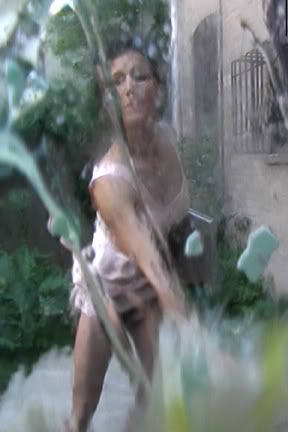
The video component of Hatry's "Expectations" installation is straightforward enough. Dressed provocatively, Hatry approaches the camera, pauses in center frame, feels the pangs of another presence, hikes her skirt and "births" a chicken egg. She then throws the egg at the camera lens. Through a film of embryonic mess, we watch as the artist adjusts her skirt and walks away, unfazed.

A heterosexual male with healthy, if sometimes deviant sexual appetites, I am vaguely aroused by Hatry's video. I assume she intended as much. Her outfit, complete with laptop on hip and secretarial glasses, is pulled from the fantasy rack of point-and-click porn cliche. Furthermore, the egg production is as much a reference to the pornographic objectification of women as it is to the menstrual cycle, birth or Hatry's artistic forebears (one of whom, Carolee Schneemann, is included in the exhibition). The oft discussed "male gaze" is encouraged - of all viewers, whatever their gender or sexuality - then shamed. We're left with egg on our face. I watched "Expectations" sheepishly. I felt as though Hatry had indirectly cast me in the role of dumb, male ape and I resented her for it.

Six years ago, I lived in a predominantly African-American and Hispanic neighborhood. One Sunday morning, as I carried my laundry down the block, a group of local teenagers approached, directing unpleasant epithets my way. The teen closest to me spat at my feet, stared me down and snarled, "Get outta our hood, mericon." I became enraged. I wanted to make it clear to the teenagers that I was not who they thought. But my reaction was irrational; by virtue of my skin color and my rent, I was exactly who they thought. I deserved their scorn, yet I remained frustrated and angry. Watching 'Expectations," I was similarly vexed and defensive. Why does Hatry feel it necessary to turn me into a sexist, possessive thug? Anyway, that's not me; what should I have to be embarrassed about? It isn't me that she intends to egg.

Yeah, right.


Regina Jose Galindo
"Piel" (still)
2005
DVD, 47 minutes


Galindo's more hopeful "Piel" absolved me of some male guilt. The artist is filmed as she publicly removes her clothing, methodically shaves off all of her hair (scalp, eyebrows, body), and then walks confidently down a busy Venetian side street and onto a canal bridge. Making the private public is by no means new, but it remains as liberating and exalting today as it was centuries ago. The artist's performance is a ritualistic reclamation of her body. But Galindo's shaving complicates matters. Her comfortable public nudity is progressive, but the shaving is dual; it speaks both to new beginnings and to regression, whether forced, as by a government or society, or resorted to under duress.

James Wagner
, writing about the exhibition, wonders if heterosexual and bisexual men "get a head start in understanding gender." I can't confirm this notion. Personally, I left "Out of the Box" flummoxed. I very much liked the works by Hatry and Galindo, but my response to Hatry's keen, even aggressive criticism and Galindo's vaguely masochistic absolution is lugubrious.

Does this reaction suggest that even (self-proclaimed) progressive males are inherently sexist? Probably. As long as there are penises and vaginas, there will be finger pointing. Humans continue to prove that we are foolish animals; misunderstanding and biases are the result of any perceived difference. The important thing for us all to remember, regardless of race, sexual preference or religion (though this last one is more tricky), is to be happy in our flesh and to accept that the distinctions are trivial and the similarities profound. If we can accept that truism, trite though it is, it logically follows that candid reactions are more valuable than appropriate ones.


Heide Hatry
"Expectations" (still)
2007
DVD, 2 min., 47 sec.


+ + + + +

Adam Parker Smith at Priska Juschka


Adam Parker Smith
"Bold As Love" (installation view)
2007
Felt, wood, pins
Dimensions variable


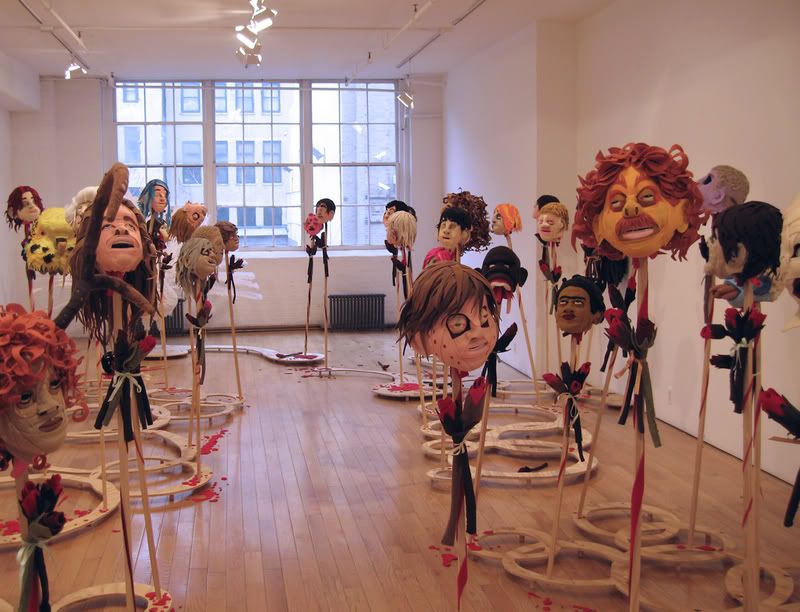
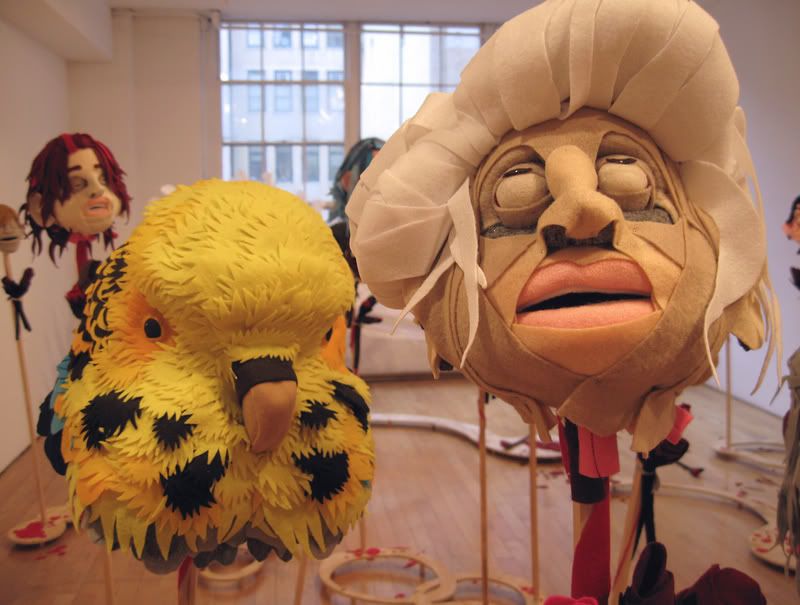
Priska Juschka: The gallery press release describes "Bold as Love," Adam Parker Smith's collection of piked cartoon heads at Priska Juschka Fine Art, as "an illustrative tableau [exploring] consumerist addiction to violence." Packaged thus, the installation risks being a one-liner, but the project's exuberance and sincerity are beguiling. Smith's principal materials are felt and wood, a handicraft combination that counters the gory imagery (apparently inspired by Hemingway's "For Whom The Bell Tolls"); the effect is both comic and tragic.

The first of my two visits to "Bold as Love" was the afternoon before the opening. Packing material was strewn near the gallery door and a young man worked alone in the space, making final adjustments to the installation. I tentatively inspected several of the skewered heads, then asked the man if he was responsible for them. "Yes," he replied, enthusiastically. "The opening is tonight. You should come by." His manner and carriage struck me; I immediately liked him. Working in the Art World, I'm wary of mistaking charisma for quality, but Smith seemed genuine.

With that encounter in mind, the second, longer visit to the installation left me convinced that Smith's gesture, a product of the MTV generation, is intended to rouse us hipster shits from our reverie. "Bold as Love" reminds us that violence is not a cartoon and that love is not the stuff of pop songs.


Adam Parker Smith
"Bold As Love" (installation view detail)
2007
Felt, wood, pins
Dimensions variable


+ + + + +

Will Yackulic at Jeff Bailey


Will Yackulic
"Invocation 2nd"
2007
Gouache, watercolor, India ink and typewriter on paper
16 x 14 3/8 inches


Jeff Bailey: Through my early twenties, I equated the words "hermetic" and "hermitic." In fact, "hermetic" is a more technical term, meaning airtight or vacuum sealed, whereas "hermitic" describes a reclusive person. The two words are etymologically related, however, and both are applicable to Will Yackulic's works on paper, currently on view at Jeff Bailey gallery.

Admiring these images, depictions of St. Jerome, the patron saint of translators, librarians and encyclopedists, come to mind. (What a pertinent saint for the contemporary artist, too! So many of us are archivists, collagists and interpretors.) Yackulic's pictures would hang well above a writing desk or adorning the walls of an appreciated library or study.

Essentially abstract, the precise meaning of Yackulic's pictures is inaccessible, but the geodesic spheres, poetic fragments and typewriter key strikes evoke a furiously romantic temperament, hopeful, obsessive and likely withdrawn. Imponderable and poetic, the images might pass for artifacts of a forgotten alchemical metaphysics.

+ + + + +

"Observing the Edge" at Kentler International Drawing Space


Beverly Ress
"Wound Leaves"
2007
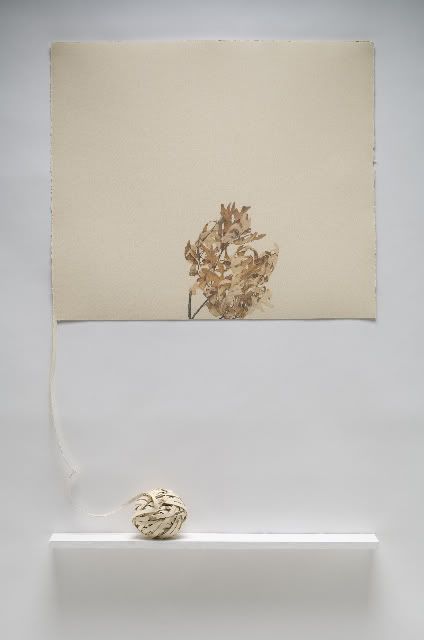
Pencil on paper, mounted on gessoed canvas, cut and wound, painted wood shelf
33 x 22 x 5 inches


Kentler International Drawing Space: The Kentler International Drawing Space, an ample, welcoming gallery located in Red Hook, was heretofore unknown to me. When I received an invitation to the opening of "Observing the Edge," a group show curated by Jennifer McGregor, I decided I should take the bus ride to south Brooklyn.

McGregor also serves as senior curator for Wave Hill, the Bronx public garden and cultural center dedicated to "[exploring] human connections to the natural world," and her artist selections lend Wave Hill's sensibility to the K.I.D.S.. "The exhibit [focuses] on artists who examine natural growth in the edges and interstices of the urban landscape through drawings and watercolors." Although I appreciate all of the work included, three artists - Kevin Duggan, Beverly Ress, and Amy Talluto - and one collaborating pair - Bob Braine and Leslie Reed - are of particular interest.


Amy Talluto
"Cadman Plaza Tree Portrait I"
2006
Pencil on paper
18 x 14 inches


Braine and Reed catalog the 59 species of urban flora they collect in an empty Bronx lot and assemble the account in "Bronx Lot Florilegium." While their project begins as a standard biological sample, the presentation harks back to an era in which natural history illustration awakened wonder in the minds of the masses. Amy Talluto's drawings and paintings usually depict rustic, woodland settings, but the two drawings included in "Observing the Edge" are exactly that, observations of the edge of Brooklyn's Cadman Plaza. Her remarkable mechanical pencil technique animates these pictures; the bark is rich and flesh-like, the branches dance and twist like neurons.

"Wound Leaves," one of two works by Beverly Ress, is termed a "sculptural drawing." A masterly colored pencil drawing of dying leaves on a branch is mounted on gessoed canvas, then partially cut and wound into a yarn-like ball that rests on a shelf below. The press release alludes to Ress' interest in "[conveying] the disjointed connection that we have to the natural world." The work hangs as a forgotten standard but the wound material, still connected to the drawing, reminds us that the union is permanent.


Kevin Duggan
"Turf I: Disturbed Land, 2006"
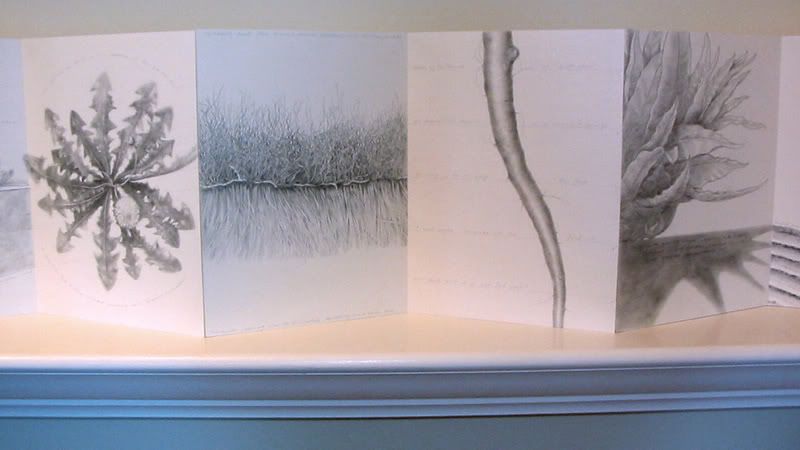
Graphite on paper
12 x 72 x 4 inches


For his "Turf" series, Kevin Duggan considers the "feral botany" of Albrecht Durer's well known watercolor and gouache work, "The Large Turf." Each of the nine plant species depicted by Durer is presented by Duggan in a suite of "accordion books." The species central to "Turf I: Disturbed Land," the strongest of the suite, is the common dandelion (Taraxacum officinale). This weedy European and Asian native was brought to the New World by European settlers and, like the human colonizers, the dandelion spread vigorously westward. Some Native Americans even referred to the plant as "white man's footprint." Duggan's striking "books" pair anecdotal and informational text with his accomplished drawing and watercolor technique.

Such handsome marriages of art and natural history are rare in contemporary art galleries...and welcome. Let's hope that Wave Hill continues to be so generous with its sensibility.

+++++

Photo credits: Image of Banksy print ripped from resale site; Heide Hatry stills, courtesy the artist; Regina Jose Galindo still ripped from Elga Wimmer website; Photographs of Adam Parker Smith's "Bold as Love," Hungry Hyaena; Will Yackulic image, courtesy Jeff Bailey Gallery; Beverly Ress, Amy Talluto and Kevin Duggan images, courtesy the artists