Showing posts with label Banksy. Show all posts

Thursday, August 13, 2009

Lowbrow Meets Highbrow


Issue of Juxtapoz Magazine
Cover art by Shepard Fairy
"A frog is either lowbrow or highbrow.

If you catch it, it's low. If you order it in a French restaurant, it's high."

-Unidentified chef, from Burkhard Bilger's Noodling for Flatheads
In 2007, commenting on the blog PaintersNYC, artist Kelli Williams observed that it's hard to be a Juxtapoz artist "in an ArtForum world." Juxtapoz is a popular magazine dedicated to showcasing contemporary "lowbrow art." It was founded by the artist Robert Williams in 1994. The "ArtForum world" of Kelli William's statement references the magazine of that name, but also the "high art" scene it covers, of which New York City, for the time being, remains an - if not the - epicenter. Until recently, the artwork featured in ArtForum was very different from that seen in the pages of Juxtapoz. Juxtapoz is representative of the Los Angeles art scene, and the U.S. west coast scene more generally, where the aesthetics of pop surrealism, folk art, post-graffiti, or street art are wholly embraced.

But artwork infused by Juxtapoz's colorful spirit is no longer uncommon in New York galleries. Andrew Schoultz, Tim Biskup, and Jeff Soto, talented west coast artists regularly lauded in the pages of Juxtapoz, today exhibit with the Morgan Lehman and Jonathan Levine galleries, and influential post-graffiti artist Barry "Twist" McGee is represented by the renowned Deitch Projects. Jonathan Levine makes plain his dedication to the post-graffiti aesthetic; his gallery's website states that its mission is to exhibit "work influenced by illustration, comic books, graffiti art and pop imagery." Perhaps it's no longer so hard, then, to be a Juxtapoz artist "in an ArtForum world"?

But, more importantly, does lowbrow art require the affirmation of the "high art" world - for easy contrast, let's call it highbrow art - in order to be considered mainstream or legitimate? If so, what exactly is the cultural significance of highbrow art to the world at large?


Jeff Soto
"Purple Heart"
2007
Acrylic on wood
12 x 12 inches

The commercial success of books like Beautiful Losers: Contemporary Art and Street Culture and Wall and Piece, the latest offering from the infamous British artist, Banksy, suggest that pop surrealism, post-graffiti, and street art succeed in connecting with the multitudes. On the other hand, it's an uncontroversial fact that highbrow art generally doesn't move the masses (with the exception of its remarkable ability to offend the religious sensibilities of the Christian Right and certain mayors). But highbrow art doesn't simply fail to connect with the general population; the fact is, most folks sneer at, mistrust, or resent ArtForum's world.

Perhaps because they feel beleaguered by popular tastes, many players in the world of highbrow art - artists, gallerists, critics, and curators alike - reject the influx of pop surrealism and post-graffiti flavor. But their objections will inevitably prove inconsequential; as the Borg of "Star Trek" put it, "resistance is futile." Even if some of the more esoteric subcultures of the Juxtapoz arena - Tiki culture, for example - are unlikely to find a toehold in the world of "high art," the graphic influences common to post-graffiti work already inform the paintings of contemporary art world darlings like Dana Schutz, Marcel Dzama, Trenton Doyle Hancock, Ryan McGuinness, Lisa Yuskavage, Yoshitomo Nara, and Jules de Balincourt. (In fact, Dzama and McGuinness have been featured in Juxtapoz; it won't be long before other celebrated highbrow artists are, too. One wonders if the lowbrow label will be applicable for much longer.) And then there are artists like Judith Schaechter, whose stained glass works were lauded in the pages of Juxtapoz years before her work hung in the Whitney Museum or before she received Guggenheim and National Endowment for the Arts Fellowships.
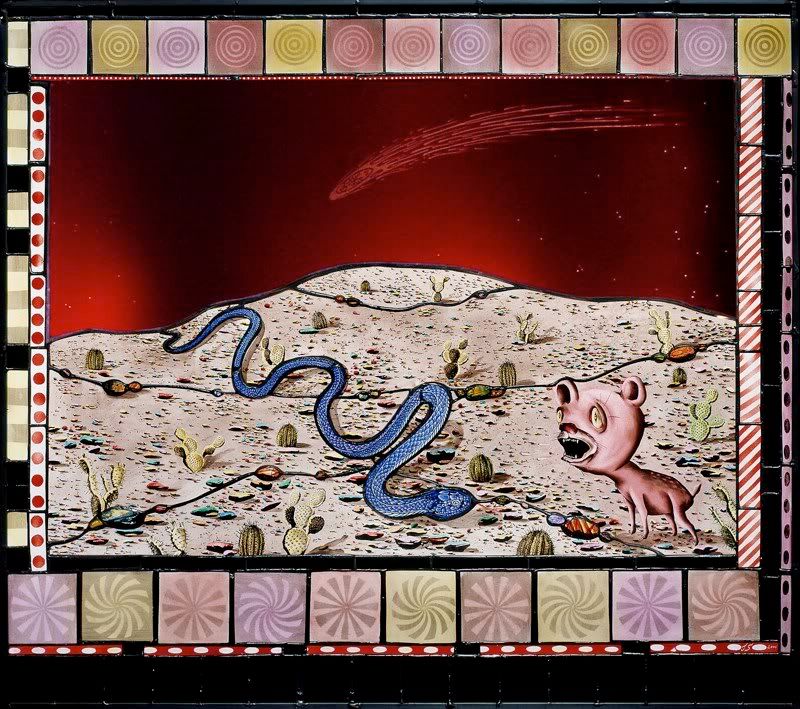

Judith Schaechter
"Hyena Snake Comet"
2004-2008
Stained glass
30 x 33 inches

Much of the highbrow resistance to pop surrealism and post-graffiti is rooted in the self-identified elites' distrust of populism. Comic books and strips are intended for mass consumption, but graffiti is unquestionably the most populist of the lowbrow tributaries. No art form has fewer barriers to entry; all you need is a can of spray paint and a little chutzpah. Ask someone knowledgeable about the subject to relate the history of modern graffiti, and you'll likely hear an abridged version, one that begins in the 1970s, in and around New York City's Bronx River Houses, and runs parallel to the development of hip hop. City funding for arts and culture programs was pitifully low at the time, and enterprising teens looked for new ways to entertain and express themselves. As Lady Pink, an influential graffiti artist of the late 1970s and 1980s, explains, graffiti was the most available "forum for free speech."

Of course, the human urge to make marks predates the Bronx River Houses by millennia. Our ancestors depicted their quarry on cave walls and, more recently, citizens of ancient Rome scribbled their political opinions on market stalls (hence the word's etymology, from the Italian graffiare, meaning "to scratch or scribble.") But during the early days of modern graffiti's ascendancy, practitioners prioritized ego over observation or socio-political commentary. The pioneers of the 1970s and 1980s graffiti scenes in New York City and Philadelphia - Taki 183, StayHigh 149, Cat 161, and Cornbread, among others - were primarily known for their "tags," stylized monikers spray painted on walls and subway cars. They vied for renown by tagging as many surfaces as they could, and walls that were difficult to access had a special cache. The competitive behavior of these early graffiti "artists" might be best described as base scent marking, activity essentially indistinguishable from the industry of the bored high school student who scratches "(x) was here" on the wall of the bathroom stall. Fortunately, as more artists entered the nascent graffiti scene, such adolescent "battling" became insufficient impetus; soon, the egotistical tag evolved into something more colorful and complex. Artists added characters, often comic in nature, a result of their limited palettes and time frame, and, before long, these characters evolved into "pieces" (short for masterpieces). The best graffiti artists came to value style and artistry as much as placement.

The conceptual and social strengths of graffiti and street art are rooted in the artists' acceptance of temporality and his or her desire to engage the environment and citizenry directly. As Simon Hattenstone, a features writer for The Manchester Guardian, writes, "Since spotting my first few Banksies I have been desperately seeking out more. They make me smile and feel optimistic about the possibilities of shared dreams and common ownership." Insofar as it is truly democratic, the street artist's approach is fundamentally distinct from that of those who aspire to "high art" success. "Fine artists" are essentially aristocratic in inclination. They are the elites who operate within the context of "high art" institutions; their work is most often viewed in semi-sacred, unlived in spaces, by people who talk about the work in reverent whispers. Street art, by contrast, is viewed by everybody who happens past the artwork. But, today, as the post-graffiti movement sees many of its more celebrated artists entering the "high art" sphere, the populist flavoring of the culture is eroding.


Banksy
"Balloongirl"
Artwork on West Bank barrier between Israel and the West Bank
2005

Is the aesthetic melting pot a bad thing? The answer depends on your perspective, of course; personally, I'm all for it. Like many contemporary artists, I'm not alone in feeling that my artwork and aesthetic inclinations plant a standard somewhere between the poles of Juxtapoz and ArtForum. Just as I feel torn between my rural roots and the creative community and energy of city life, so too am I drawn to elements of both art orbits, east and west, highbrow and lowbrow. I live and work in New York, so I've cultivated an appreciation for the importance of conceptual heft. But I'm also an erstwhile subscriber to Juxtapoz who, in my youth, eagerly thumbed through the pages of the Advanced Dungeons & Dragons Monster Manual, read fantasy novels and comic books, and honed my drawing chops by copying from comic strips. Perhaps I'm biased, then, but it seems that aesthetic commingling introduces hybrid vigor into otherwise "inbred" scenes.

Too many circles of the "high art" world are poisoned by intellectual pretension, obscurantism, and exclusivity. The ArtForum world is principally concerned with auction results and art historical significance. In east coast MFA programs, the mills of the contemporary "high art" world, a common question asked of students is, "Where does your work fit in the historical trajectory?" Indeed, at great cost to social legitimacy, the "high art" world has prioritized originality and artistic genealogy.

Much of the "lowbrow" scene, by contrast, is blighted by the artists' focus on disposable pop culture, their willingness to cozy up to the marketing machine, and their populist posturing. In an interview with Juxtapoz, one young artist said,
"When it comes right down to it, I draw the stuff I like, and people can take it all for whatever they want. I would say that 95 percent is liking big boobs and butts, the other five percent is brain farts that end up in a sketchbook that later ends up as a painting or whatever."
Although I wrote down this quotation without recording the artist's name, I do recall appreciating some of his graphic skill. Still, when I'm confronted with such a thoughtless statement, I can appreciate the animus that brooding, theory-oriented types have for lowbrow art. Where is the evidence of this young artist's vocational mindfulness, his rigorous passion, his poetic sensibility? Of course, his defenders would likely praise his candor, but, in truth, he's posturing as much as the bespectacled, black-clad fellow who insists in his jargon-laden artist statement that Jacques Derrida informs all of his output.
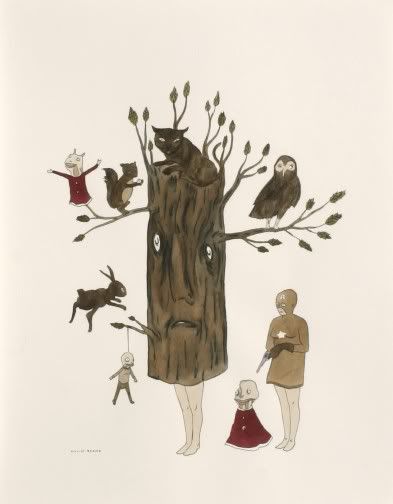

Marcel Dzama
"Untitled"
2005
Watercolor on paper
14 x 11 inches

Despite haughty sneers from individuals on both sides, it seems to me that the transition that so many post-graffiti artists are making, from the streets to the galleries, could (and should) help create a less sectarian art world. The selfish pretensions of the highbrow art world could be tempered by an influx of no-nonsense, illustrative exuberance, and the lowbrow art world could jettison some of their conceptual superficiality by taking the philosophical and moral obligations of their vocation more seriously. That is, in any case, my hope.

Image credits: Juxtapoz cover image ripped from Rotofugi.com;; Jeff Soto image ripped from the Jonathan Levine Gallery website; Judith Schaechter image ripped from the artist's website; Banksy image ripped from the Brian Sewell Art Directory; Marcel Dzama image ripped from David Zwirner website

Friday, December 14, 2007

Gallery Report: December 5th, 2007

Banksy at Vanina Holasek


Banksy
"Because I'm Worthless"
Limited edition print


Vanina Holasek
: If you don't know who Banksy is, you're out of touch with contemporary art and popular culture. The British graffiti artist and provocateur straddles the divide between high and low art and, not surprisingly, his doing so is not to everybody's liking. In the July 5, 2007 edition of The Guardian, critic Jonathan Jones asks if Banksy is "really much more than a prankster with a spray can?" 1,000 words later, Jones concludes that Banksy "is a background artist," making "art for people who think that artists are charlatans." I disagree...to an extent. I like a lot of Banksy's graffiti and sculpture projects and I genuinely admire the anti-commodification philosophy of "street art." But street art is a movement and aesthetic that, as the name suggests, relies heavily on context.

Banksy's public interventions are often clever and poignant, but pithy sayings that work well on alley walls can seem inappropriate and shallow in the gallery. A street artist's reputation, like his or her work, is a product for and of the public. As such, is it possible to pass over into the private realm? If Banksy plans to continue displaying work in the world of financiers and socialites, he must address that question responsibly. After all, the best works produced by Jean-Michel Basquiat and Keith Haring, the Art World's hallowed representatives of graffiti culture, are seen in photographs of New York City streets, not in auction house catalogs or museums. Collectors, academics and appraisers will balk, but the Basquiat/Haring gambit is plain enough; all of those over-priced paintings are but trumped-up vestiges of the few early works that mattered.

Indeed, the limited edition Banksy prints hanging in Vanina Holasek gallery are more disappointing than I expected (or feared). Hung chaotically - crooked and, in some cases, only partially unwrapped - the prints are tokens of Banksy's work but not, as I see it, the art itself.

What does this tell us about the artist? Perhaps not much; this exhibition is not officially sanctioned. For his 2006 "Barely Legal" installation in Los Angeles, Banksy sought the cooperation of business partners and their associates to assemble an exhibit suitable for the work and the audience. Now the darling of Hollywood celebrities and thousands of young, monied collectors, the artist has the wealth and the influence to take control of the entire enterprise so that his original, guerilla intentions remain true.

But context didn't much bother the group of British girls that shared Vanina Holasek gallery with me last week. They tromped up and down the gallery's three flights, dutifully documenting the exhibition in photographs. Indeed, the anonymous satirist from Bristol that so often pillories celebrity and consumerism is a hot commodity himself. It's time for him to accept as much...and then turn his populist canons on those that would feed him.

+ + + + +

"Out of the Box" at Elga Wimmer


Heide Hatry
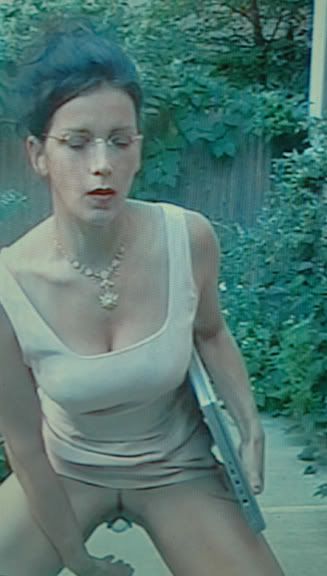
"Expectations" (still)
2007
DVD, 2 min., 47 sec.


Elga Wimmer: A karma police fearing liberal, I entered Elga Wimmer gallery apprehensive. How would I respond to "Out of the Box," an all female group show concerned with gender and corporeality? Because I'm usually bored by thematically curated exhibitions - they make neat that which should remain untidy - and I'm sometimes guilty of playing the reactionary SWM, I worried that my response would be "inappropriate."

Video and nudity predominate in "Out of the Box," and both Heide Hatry's "Expectations" and Regina Jose Galindo's "Piel," the two strongest works, involve young, attractive women exposing themselves on film.

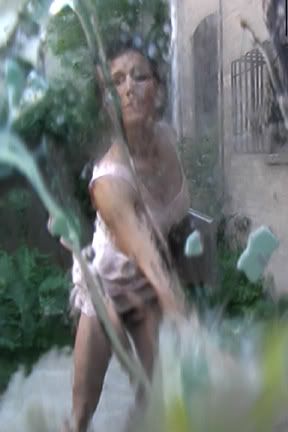
The video component of Hatry's "Expectations" installation is straightforward enough. Dressed provocatively, Hatry approaches the camera, pauses in center frame, feels the pangs of another presence, hikes her skirt and "births" a chicken egg. She then throws the egg at the camera lens. Through a film of embryonic mess, we watch as the artist adjusts her skirt and walks away, unfazed.

A heterosexual male with healthy, if sometimes deviant sexual appetites, I am vaguely aroused by Hatry's video. I assume she intended as much. Her outfit, complete with laptop on hip and secretarial glasses, is pulled from the fantasy rack of point-and-click porn cliche. Furthermore, the egg production is as much a reference to the pornographic objectification of women as it is to the menstrual cycle, birth or Hatry's artistic forebears (one of whom, Carolee Schneemann, is included in the exhibition). The oft discussed "male gaze" is encouraged - of all viewers, whatever their gender or sexuality - then shamed. We're left with egg on our face. I watched "Expectations" sheepishly. I felt as though Hatry had indirectly cast me in the role of dumb, male ape and I resented her for it.

Six years ago, I lived in a predominantly African-American and Hispanic neighborhood. One Sunday morning, as I carried my laundry down the block, a group of local teenagers approached, directing unpleasant epithets my way. The teen closest to me spat at my feet, stared me down and snarled, "Get outta our hood, mericon." I became enraged. I wanted to make it clear to the teenagers that I was not who they thought. But my reaction was irrational; by virtue of my skin color and my rent, I was exactly who they thought. I deserved their scorn, yet I remained frustrated and angry. Watching 'Expectations," I was similarly vexed and defensive. Why does Hatry feel it necessary to turn me into a sexist, possessive thug? Anyway, that's not me; what should I have to be embarrassed about? It isn't me that she intends to egg.

Yeah, right.


Regina Jose Galindo
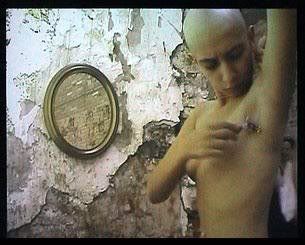
"Piel" (still)
2005
DVD, 47 minutes


Galindo's more hopeful "Piel" absolved me of some male guilt. The artist is filmed as she publicly removes her clothing, methodically shaves off all of her hair (scalp, eyebrows, body), and then walks confidently down a busy Venetian side street and onto a canal bridge. Making the private public is by no means new, but it remains as liberating and exalting today as it was centuries ago. The artist's performance is a ritualistic reclamation of her body. But Galindo's shaving complicates matters. Her comfortable public nudity is progressive, but the shaving is dual; it speaks both to new beginnings and to regression, whether forced, as by a government or society, or resorted to under duress.

James Wagner
, writing about the exhibition, wonders if heterosexual and bisexual men "get a head start in understanding gender." I can't confirm this notion. Personally, I left "Out of the Box" flummoxed. I very much liked the works by Hatry and Galindo, but my response to Hatry's keen, even aggressive criticism and Galindo's vaguely masochistic absolution is lugubrious.

Does this reaction suggest that even (self-proclaimed) progressive males are inherently sexist? Probably. As long as there are penises and vaginas, there will be finger pointing. Humans continue to prove that we are foolish animals; misunderstanding and biases are the result of any perceived difference. The important thing for us all to remember, regardless of race, sexual preference or religion (though this last one is more tricky), is to be happy in our flesh and to accept that the distinctions are trivial and the similarities profound. If we can accept that truism, trite though it is, it logically follows that candid reactions are more valuable than appropriate ones.


Heide Hatry
"Expectations" (still)
2007
DVD, 2 min., 47 sec.


+ + + + +

Adam Parker Smith at Priska Juschka


Adam Parker Smith
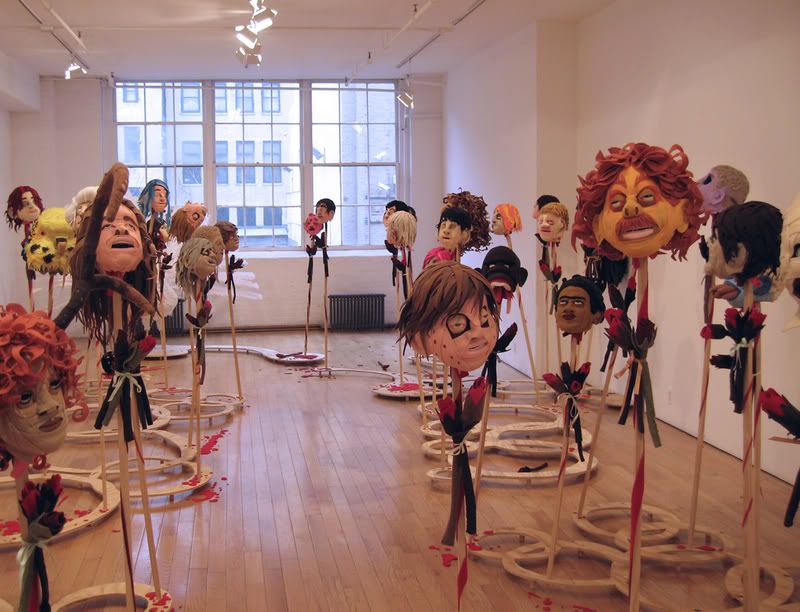
"Bold As Love" (installation view)
2007
Felt, wood, pins
Dimensions variable


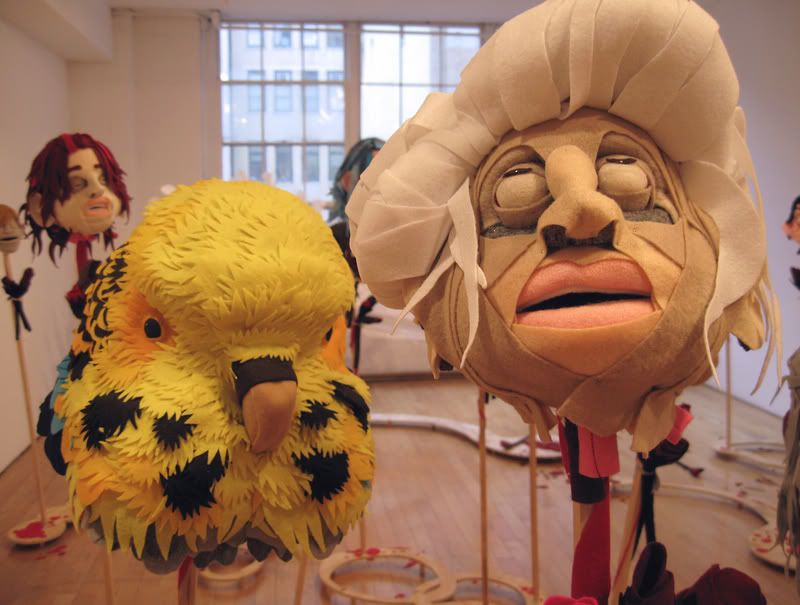
Priska Juschka: The gallery press release describes "Bold as Love," Adam Parker Smith's collection of piked cartoon heads at Priska Juschka Fine Art, as "an illustrative tableau [exploring] consumerist addiction to violence." Packaged thus, the installation risks being a one-liner, but the project's exuberance and sincerity are beguiling. Smith's principal materials are felt and wood, a handicraft combination that counters the gory imagery (apparently inspired by Hemingway's "For Whom The Bell Tolls"); the effect is both comic and tragic.

The first of my two visits to "Bold as Love" was the afternoon before the opening. Packing material was strewn near the gallery door and a young man worked alone in the space, making final adjustments to the installation. I tentatively inspected several of the skewered heads, then asked the man if he was responsible for them. "Yes," he replied, enthusiastically. "The opening is tonight. You should come by." His manner and carriage struck me; I immediately liked him. Working in the Art World, I'm wary of mistaking charisma for quality, but Smith seemed genuine.

With that encounter in mind, the second, longer visit to the installation left me convinced that Smith's gesture, a product of the MTV generation, is intended to rouse us hipster shits from our reverie. "Bold as Love" reminds us that violence is not a cartoon and that love is not the stuff of pop songs.


Adam Parker Smith
"Bold As Love" (installation view detail)
2007
Felt, wood, pins
Dimensions variable


+ + + + +

Will Yackulic at Jeff Bailey


Will Yackulic
"Invocation 2nd"
2007
Gouache, watercolor, India ink and typewriter on paper
16 x 14 3/8 inches


Jeff Bailey: Through my early twenties, I equated the words "hermetic" and "hermitic." In fact, "hermetic" is a more technical term, meaning airtight or vacuum sealed, whereas "hermitic" describes a reclusive person. The two words are etymologically related, however, and both are applicable to Will Yackulic's works on paper, currently on view at Jeff Bailey gallery.

Admiring these images, depictions of St. Jerome, the patron saint of translators, librarians and encyclopedists, come to mind. (What a pertinent saint for the contemporary artist, too! So many of us are archivists, collagists and interpretors.) Yackulic's pictures would hang well above a writing desk or adorning the walls of an appreciated library or study.

Essentially abstract, the precise meaning of Yackulic's pictures is inaccessible, but the geodesic spheres, poetic fragments and typewriter key strikes evoke a furiously romantic temperament, hopeful, obsessive and likely withdrawn. Imponderable and poetic, the images might pass for artifacts of a forgotten alchemical metaphysics.

+ + + + +

"Observing the Edge" at Kentler International Drawing Space


Beverly Ress
"Wound Leaves"
2007
Pencil on paper, mounted on gessoed canvas, cut and wound, painted wood shelf
33 x 22 x 5 inches


Kentler International Drawing Space: The Kentler International Drawing Space, an ample, welcoming gallery located in Red Hook, was heretofore unknown to me. When I received an invitation to the opening of "Observing the Edge," a group show curated by Jennifer McGregor, I decided I should take the bus ride to south Brooklyn.

McGregor also serves as senior curator for Wave Hill, the Bronx public garden and cultural center dedicated to "[exploring] human connections to the natural world," and her artist selections lend Wave Hill's sensibility to the K.I.D.S.. "The exhibit [focuses] on artists who examine natural growth in the edges and interstices of the urban landscape through drawings and watercolors." Although I appreciate all of the work included, three artists - Kevin Duggan, Beverly Ress, and Amy Talluto - and one collaborating pair - Bob Braine and Leslie Reed - are of particular interest.


Amy Talluto
"Cadman Plaza Tree Portrait I"
2006
Pencil on paper
18 x 14 inches


Braine and Reed catalog the 59 species of urban flora they collect in an empty Bronx lot and assemble the account in "Bronx Lot Florilegium." While their project begins as a standard biological sample, the presentation harks back to an era in which natural history illustration awakened wonder in the minds of the masses. Amy Talluto's drawings and paintings usually depict rustic, woodland settings, but the two drawings included in "Observing the Edge" are exactly that, observations of the edge of Brooklyn's Cadman Plaza. Her remarkable mechanical pencil technique animates these pictures; the bark is rich and flesh-like, the branches dance and twist like neurons.

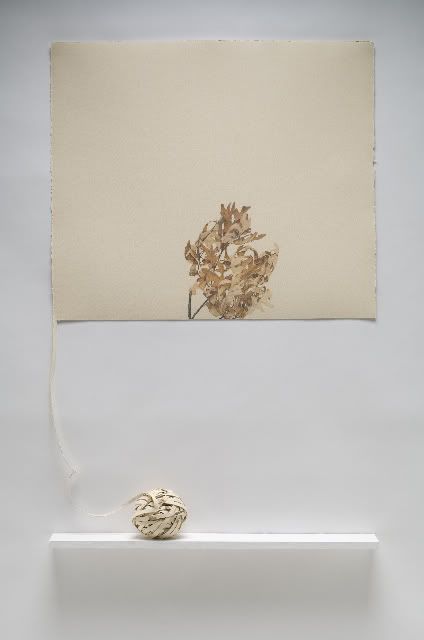
"Wound Leaves," one of two works by Beverly Ress, is termed a "sculptural drawing." A masterly colored pencil drawing of dying leaves on a branch is mounted on gessoed canvas, then partially cut and wound into a yarn-like ball that rests on a shelf below. The press release alludes to Ress' interest in "[conveying] the disjointed connection that we have to the natural world." The work hangs as a forgotten standard but the wound material, still connected to the drawing, reminds us that the union is permanent.


Kevin Duggan
"Turf I: Disturbed Land, 2006"
Graphite on paper
12 x 72 x 4 inches


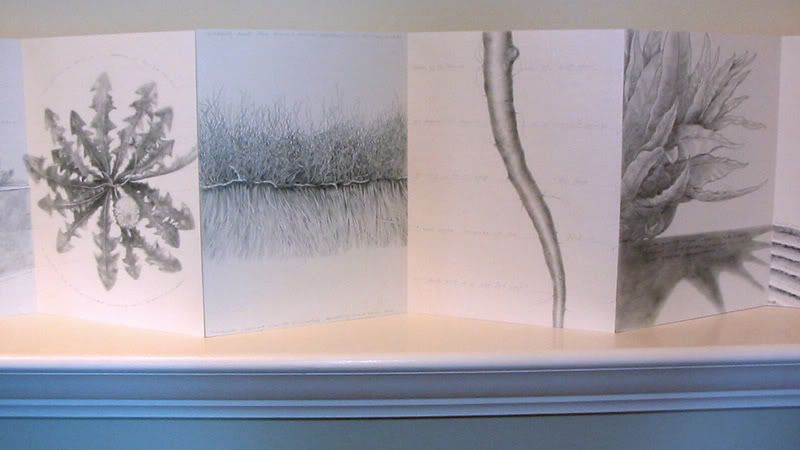
For his "Turf" series, Kevin Duggan considers the "feral botany" of Albrecht Durer's well known watercolor and gouache work, "The Large Turf." Each of the nine plant species depicted by Durer is presented by Duggan in a suite of "accordion books." The species central to "Turf I: Disturbed Land," the strongest of the suite, is the common dandelion (Taraxacum officinale). This weedy European and Asian native was brought to the New World by European settlers and, like the human colonizers, the dandelion spread vigorously westward. Some Native Americans even referred to the plant as "white man's footprint." Duggan's striking "books" pair anecdotal and informational text with his accomplished drawing and watercolor technique.

Such handsome marriages of art and natural history are rare in contemporary art galleries...and welcome. Let's hope that Wave Hill continues to be so generous with its sensibility.

+++++

Photo credits: Image of Banksy print ripped from resale site; Heide Hatry stills, courtesy the artist; Regina Jose Galindo still ripped from Elga Wimmer website; Photographs of Adam Parker Smith's "Bold as Love," Hungry Hyaena; Will Yackulic image, courtesy Jeff Bailey Gallery; Beverly Ress, Amy Talluto and Kevin Duggan images, courtesy the artists