Showing posts with label history. Show all posts

Tuesday, June 11, 2013

Aggregate Space Summer Writer-In-Residence

Miscellaneous chapbooks

I'm delighted to announce that I'll be the Aggregate Space Writer-In-Residence this summer. I'm honored to be the first participant in the artist-run space's new program and I'm looking forward to my time in West Oakland! (For readers unfamiliar with Aggregate Space, I recommend reading Kelly Inouye's interview with Conrad Meyers II and SD Willis in SFAQ. As Inoyue writes, Meyers and Willis "basically created a gallery, artist studios, metal and wood fabrication shop, small theater, and office space out of an empty warehouse.")

Thursday, February 16, 2012

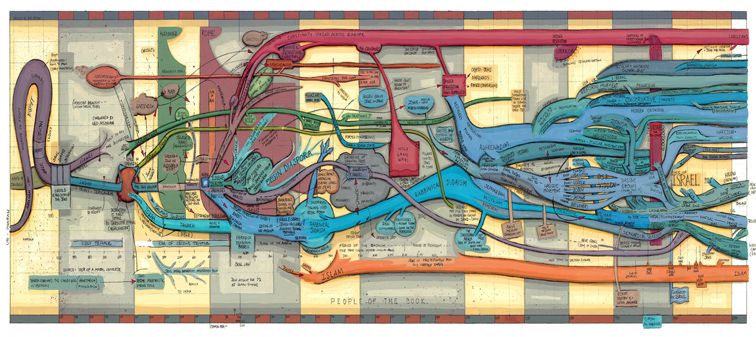
"Unreliable Narrator": Ward Shelley at Pierogi

Ward Shelley
"People of the Book"
2012
Oil and toner on mylar
36 x 75.5 inches
Writing about Ward Shelley's 2009 Pierogi Gallery exhibition, "Who Invented the Avant Garde - and other half-truths," I compared his colorful schematic paintings to taxonomic trees.
"[Shelley's] striking [...] paintings anatomize the development of intellectual and social streams within the humanities. The artist describes them as 'attempts to use real information to depict our understandings of how things evolve and relate to one another, and how this develops over time.'

In spirit as well as in appearance, then, Shelley's paintings are cousin to phylogenetic trees, the taxonomic diagrams that biologists use to denote evolutionary relationships among species. But, though Shelley's genealogies look like mappings of biological exuberance, the subjects of his brightly colored, illustrative works are not so scientific: Frank Zappa; Beat Generation writers; nodes of postmodern philosophy; modern art movements."
Aesthetically speaking, I liked every piece in the show, but the most edifying works were those that considered "significant, sweeping lineages," and I concluded the write-up with the hope that Shelley's lens would broaden.

Saturday, February 04, 2012

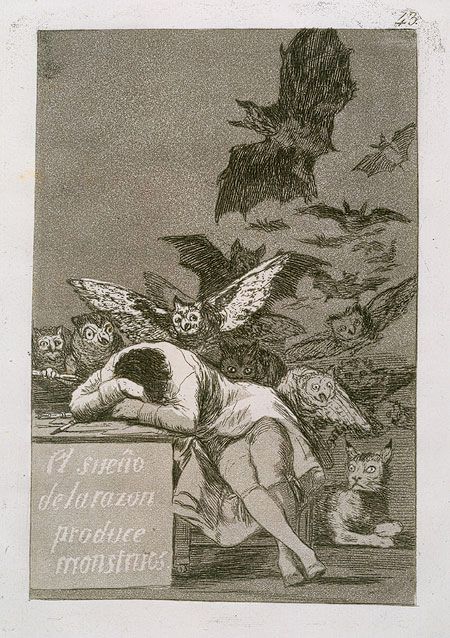
Choosing Past and Future

Francisco Goya
"The Sleep of Reason Produces Monsters"
1797
Etching, aquatint, drypoint, and burin
"It is the reviving wine of history that defends the future against the past."

- Lewis Lapham, "Democracy 101"
(Harper's Magazine, April 2011)
As high school students, we're often told that history repeats itself, the implication being that a sound education in history will allow us to avoid repeating past mistakes. I think of this as the "Groundhog Day" school of thought. It's true, despite the fact that most people (and states) tend to trip over the same stumbling blocks time and again.

Still, I prefer Lapham's formulation above because his statement implies that the study of history provides us with the necessary confidence to continue and to hope, to view our progress as two steps forward for one step back. Moreover, it's important for us to choose the bottle of wine that we drink from. As President Obama articulated in his brilliant inaugural address,
"the time has come to reaffirm our enduring spirit; to choose our better history; to carry forward that precious gift, that noble idea, passed on from generation to generation."
May we choose wisely, and drink deep.

Wednesday, September 22, 2010

The RSA's "21st Century Enlightenment"


Sure, the video is 11 minutes long, well over the too-long-to-watch mark for readers casually trolling the blogosphere, but it's worth bookmarking and saving for later. (In fact, I encourage you to watch it on YouTube or the RSA website, as the resolution is better than that of the above embed.)

The ideas articulated are vital and might provide some solace for those of you who, like so many of my friends, suffer from political apocalypse syndrome! Moreover, the animation is terrific and the narrator, like the Royal Society for the Encouragement of the Arts (RSA), is British, satisfying the Anglophile in all of us.

Enjoy.

(Thanks to Michael McDevitt for turning me on to this RSA video.)

Sunday, May 16, 2010

Susan Silas' Heroic Living


Susan Silas
"found birds; 2000 - the present"
(Image 17 of 23 from the portfolio "eyes wide shut")
2010
Archival ink jet prints on Hahnemühle photo rag paper
22 x 17 inches

Until recently, I was unfamiliar with Susan Silas' artwork. She is perhaps best known for projects memorializing the Shoah, but it wasn't an awareness of her Holocaust work that led me to "Helmbrecht's Walk, 1998-2003." Instead, it was a photograph of a dead American kestrel that Silas emailed me in March.

I have only an inkling of what essay or artwork of mine inspired the artist to send me the image, but I'm grateful that she did. I shamelessly admit to being the sort who finds soulful beauty in images of death, and I was touched by the striking and contemplative photograph. A month after I received the picture, I visited Silas in her Brooklyn home, to look at prints from her "found birds" series. Still pondering her work a week after that visit, I headed to Hebrew Union College's Jewish Institute of Religion Museum, eager to compare what I saw and sensed in "found birds" to Susan's more easily classifiable (though by no means "easy") Shoah work.


Susan Silas
"found birds; 2000 - the present"
(Image 3 of 11 from the portfolio "what remains")
2010
Archival ink jet prints on Hahnemühle photo rag paper
20 x 48 inches

The HUC press release for "Helmbrecht's Walk" describes the project succinctly.
"On April 13, 1945, more than 700 women were forced to march 225 miles in 22 days from the Helmbrecht's Labor Camp, a small satellite unit of the Flossenburg Concentration Camp in Germany, to the Czech city of Volary. [...] During the course of this forced march the women were ill fed, inadequately clothed, denied shelter, and capriciously beaten. On the sixth day of the march, the non-Jewish prisoners were separated from the group, leaving the remaining 580 Jewish women to continue until May of 1945.

With determination and sensitivity, Silas traced the march in 1998 on the 53rd anniversary of the event by walking along the same path as the Helmbrecht's women for 22 days in Germany and the Czech Republic. She documented her journey in Helmbrecht's Walk, a collection of 48 archival color prints presented as an unbound book. [...] The images contextualized by Silas' daily commentary of her own experiences are coupled with news reports of event occurring elsewhere in the world on that same day in 1998. This juxtaposition, she says, functions 'to heighten our awareness of the fact that we are all presently witnesses to unspeakable events and extreme suffering for which we take no more responsibility than did many witnesses to the Holocaust.'"
Silas' project addresses the complicated relationship between place and time or, as cultural critic and historian Simon Schama's consideration of the topic framed it, "landscape and memory." When Silas conceived of the Helmbrecht's project, she believed (or maybe hoped) that walking the same path that the Helmbrecht's women had would allow her some intimate experience of or insight into the terrible march. In fact, this didn't prove so. Silas describes her walk as "relatively mundane and unexceptional." She continues, "My feet hurt. I get tired. [...] I found it more, rather than less difficult to understand how these women made this journey once I was out on the road."


Susan Silas
"Helmbrecht's Walk, 1998 - 2003"
(Day 1, Monday 13 April 1998, Helmbrechts to Schwartzenbach Saale, 1998)
Archival ink jet prints on Hahnemühle photo rag paper

Yet many of the captions she includes with the photographs reference artists and thinkers such as Werner Herzog, who understand "walking as a sacrament." Such language calls to mind the Australian Aborigines' songlines, mnemonic stories that are spoken or sung as the Aborigine walks over the referenced terrain. In his marvelous book Spell of the Sensuous, David Abram relates a striking, relevant anecdote.
"A similar tale is told by [Bruce] Chatwin. He was traveling in a Land Cruiser with several friends, including an Aboriginal man nicknamed Limpy whom they were driving to a particular place on his songline. Limpy, whose clan Ancestor was the Native Cat, or tjipla (a small marsupial with a long, banded tail), had never been to this place along the Native Cat songline, yet he now wished to go there in order to see some distant relatives who were dying there. During the course of seven hours driving through the back country, bumping across shallow rivers and under gum trees, the Aboriginal man sat motionless in the front seat, squeezed between the driver, Arkady, and another passenger, except for a short burst of action when the truck crossed part of his songline. Later,
'[w]e came to the confluence of two streams: that is, we met the stream we had crossed higher up on the main road. This lesser stream was the route of Tjilpa Men, and we were joining it at right angles. As Arkady turned the wheel to the left, Limpy bounced into action. Again he shoved his head through both windows. His eyes rolled wildly over the rocks, the cliffs, the palms, the water. His lips moved at the speed of a ventriloquist's and, though them, came a rustle: the sound of wind through branches.

Arkady knew at once what was happening. Limpy had learnt his Native Cat couplets for walking pace, at four miles an hour, and we were traveling at twenty-five. Arkady shifted into bottom gear, and we crawled along no faster than a walker. Instantly, Limpy matched his tempo to the new speed. He was smiling. His head swayed to and fro. The sound became a lovely melodious swishing; and you knew that, as far as he was concerned, he was the Native Cat.'"
I believe that what was missing for Silas was a story line, the narrative informed by the landscape (and vice versa) that, among indigenous groups such as the dwindling Aboriginal population of Australia, is traditionally passed from generation to generation. In some respects, "Helmbrecht's Walk" is an attempt to locate such a story, an earnest effort to discover in the landscape the marks of what happened decades before. In our postmodern, peripatetic culture, nations and traditions do not generally fare well. In some respects, this is a positive development, as our tribal perspectives and prejudices erode into some variety of tentative, liberal pluralism. On the other hand, it's ever more difficult to feel confident about one's identity and how it relates to landscape, vocation, and nation.

My time with "Helmbrecht's Walk" confirmed my supposition, however, that Susan's art is not primarily interested in cultural identity or particular histories. Instead, she is most concerned with "the big questions." To one degree or another, all art wrestles with or reacts to these existential imponderables, but Susan's exploration is more focused and urgent than most. Fortunately, even though her work is preoccupied with mortality and meaning, she manages to avoid the pitfalls of such terrain; her work is neither macabre nor aestheticized to the point of anesthetization.


Susan Silas
"found birds; 2000 - the present"
(Image 1 of 21 from the portfolio "blackbird")
2010
Archival ink jet prints on Hahnemühle photo rag paper
22 x 17 inches

Two days after I visited "Helmbrecht's Walk," I read "Eudaimonia, existentialism, and the practice of medicine," an essay by Dr. Andrew Radu included in the Spring 2010 issue of The Pharos of Alpha Omega Alpha Honor Medical Society. In his essay, Dr. Radu describes the existentialist ideal of tragic optimism. He writes of it, "even in the face of imminent death, we have the ability to reevaluate life." He goes on:
"A crucial concept held by many existentialist philosophers is that of heroic living. All humans have the ultimate freedom to live boldly in the face of tragedy. Living with this concept makes attaining a goal of eudaimonia less important than simply striving to do so. [...] The concept of tragic optimism proposes that in a life that can be circumscribed by pain, guilt, and death, one should say 'yes to life in spite of everything.'"
Indeed, as I wrote in "Eudaimonia," a January 2009 essay that explored my then nascent optimism,
"Acknowledging our species' precarious position is not defeatist; on the contrary, accepting the inevitable nourishes the individual's desire to contribute. Faced with an impossibly difficult prospect, only individual effort can sustain us. As Albert Camus concluded in The Myth of Sisyphus, 'The struggle itself is enough to fill a man's heart. One must imagine Sisyphus happy.'"
The Shoah is bleak history, a subject watered by the blood of millions, and it is fertile soil for such "big questions." Silas' "found birds" remind us that so, too, is the striving and passing of a blackbird. The artist's reckoning with death is her own form of "heroic living."

Image credits: all artwork, courtesy Susan Silas

Friday, April 23, 2010

My Favorite Things


While I agree that "raindrops on roses and whiskers on kittens" are wondrous, it is the "bright copper" Voyager 1 disc and Antikythera mechanism that I count among my favorite things, each a hopeful and beautiful item that manifests our species' exceptional capacity.

In January 2009, I wrote here that I'd been possessed of a curious "bout of optimism [that] seemed remarkable in both duration and degree." Over a year later, that eudaimonia hasn't let up. I'm beginning to believe that I've simply grown into an incredibly upbeat man. That, too, is a wondrous, happy thing, worthy of making my short list.

So here's hoping that, even in this era of relentless, up-to-the-minute news from around the globe (much of it depressing), we can keep our eye on the ball, so to speak. The possibilities are beyond reckoning. It isn't naive to think so; rather, it's naive to think otherwise.

Image credit: Antikythera mechanism image ripped from the New York Times, but was produced by the School of Physics and Astronomy, Cardiff University

Saturday, April 03, 2010

"Ouroboros" at ISE Cultural Foundation


I'm intrigued by the many positive reviews of "Ouroborus: The History of the Universe," a six-screen, 3-D video installation by biochemist, philosopher, and video artist Ali Hossaini and the collaborative duo of Blake Shaw and Bruno Levy, aka SWEATSHOPPE, currently on view at the ISE Cultural Foundation. Many write-ups of the exhibition describe the installation as meditative, and excitedly relate the artists' intent to "[tell] the history of cosmic evolution - from the Big Bang to Lady Gaga - by animating over 30,000 images."

In fact, although "historical spiritual illustrations of the cosmos, from vedic yantras, buddhist mandalas, and sacred geometry," are prominently featured on three of the installation's six screens, the effect is less mindful (and certainly not meditative) than it is visually assaultive and superficial. And, though the triptypch "cosmic evolution" might incorporate over 30,000 images, it is best described as a pastiche of generally significant forms rendered insignificant in presentation. As a gallery companion remarked to me, "This isn't communicating anything; it's just a 'Clockwork Orange' brainwashing machine." It's a shame that's true, as Hossaini's accompanying artist statement is insightful and important. I include the full text of his statement below.
"Nowhere is the fragmentation of the human psyche more evident than in how we treat the environment. We know we're pillaging our habitat, but we can't make the leap from knowledge to right action. I attribute this disconnect, and many others, to the factionalizing of culture that began with modern science, industry and art.
I'm not saying we should turn our backs on the Enlightenment. But neither should we take it as dogma - we need to rethink its foundation, integrating our psyche into the cosmos in a way that builds on premodern wisdoms as well as modern science. The Enlightenment freed physics, astronomy and eventually art - think 'art for art's sake' - from tradition, spawning remarkable advances along with deep alienation.

It's time to produce culture in a more holistic, organic way. For now science, art and religion - and I use 'religion' here to mean a generalized psychology - lie in private tracks, each requiring extensive knowledge for appreciation let alone practice. How can these disciplines work together more effectively?

The answer doesn't lie in the rejecting, merging or reconciling science and spirit. Instead we need to create a framework for integrating our experiences of these different realms, and this is precisely what artists can do. Art needs to step out of its self-referential confines, the safe house of galleries, museums and markets. It needs to be Saturday night and Sunday morning, be the new church, and it needs to invade pop culture. Mass appeal is critical.

Most of all art needs to rejoin itself to science. Both embody urges to explore, understand and create, and both have become specialized, mechanized and self-absorbed, given to destructive irony. Art cannot be science, but it can convey the sense of wonder that drives scientists. It can visualize the worlds of science while honoring our sense of self as beings that transcend the mundane.

Our experiences of spirit and matter cannot be reconciled, but they can be represented. And they can be represented in a way that sheds light on the complexities and responsibilities of being self-aware. Artists can rise above the dilemmas of modern life: they can comprehend the contradictions, integrating them into new levels of experience where knowledge, desire and energy meet the limits of human freedom."
I agree completely, but Hossaini's collaboration with SWEATSHOPPE has neither shed "light on the complexities and responsibilities of being self-aware" nor integrated contradictions into new levels of experience. Their intent is laudable, but their effort lacking.

Yet Hossaini's statement resonates and, as I left the ISE Cultural Foundation, I recalled Ron Fricke's tremendous film "Baraka." Hossaini and SWEATSHOPPE have inspired me to revisit Fricke's beautiful, moving tribute to transcendent oneness, and to eagerly await the long-awaited sequel, "Samsara." It's hopeful to recognize that sometimes art does step outside "its self-referential confines."

Wednesday, February 03, 2010

"Inherited Purpose and Pattern"


William Kentridge
Still from "History of the Main Complaint"
Animation
1996

I enjoyed reading Calvin Tomkins' recent profile of William Kentridge ("Lines of Resistance," The New Yorker, January 18, 2010). Tomkins includes some fascinating details about Kentridge's background and family, and I especially appreciated some of the remarks made by the artist. The following quotation was particularly resonant.
"[Working in South Africa,] I was aware of Joseph Beuys - Beuys and his honey pump, which was supposed to be political art. But politics is not spreading honey around the main building at the Documenta art exhibition. It's putting electrodes on people's testicles, locking them up, putting them in fear of their lives."
Kentridge acknowledges his South African perspective (the artist was born into a state of apartheid and is today living through its often grim aftermath), but his observation also speaks to the general disconnect between so much 20th century fine art and "the real world."

Both modernism and postmodernism prioritize iconoclasm and individual achievement over "a system of inherited purpose and patterns."(1) It's thoughtless to dismiss the sibling -isms (both offer valuable insights and fundamentally inform our contemporary world), but the march of globalization is revealing the societal impotence of the philosophies. Absent "inherited purpose" and narrative, postmodern community is soulless, a mere facade. One of many casualties, the artist is but a mote in a vast and turbulent sea of competing sentiments and ideologies. Graphic design and advertising occupy the popular position once given to fine art, but, excellent though some of both may be, these are commodity driven disciplines; as such, they can make no genuine claim to political or moral coherence.

Still, I don't believe that we should bemoan our station as the end of the line. Globalization is in its infancy, and the 21st century will likely see a new concept of cosmopolitan citizen emerge, one that could usher in an era of shared mythos. Back to the future, so to speak.

(1) This definition of pre-modern art is drawn from Adam Gopnik's fantastic essay, "Van Gogh's Ear." (The New Yorker, January 4, 2010)

Saturday, January 09, 2010

The Art Community and Common Sense


Ryan Trecartin
"I-BE AREA"
2007
"Everybody gets so much information all day long that they lose their common sense."

- Gertrude Stein
We're a week-and-a-half into 2010, and I'm hoping that the din produced by so much fin-de-decade media will soon die down. It's no secret that we citizens of the United States (and all other essentially "Americanized" peoples) are principally defined by our consumption. What's more, after decades of adaptation to the consumer role, we've become so fond of the talk surrounding our consumer products that the consumer reviews themselves have become another kind of consumable. Regrettably, this is no less true in the arts.

I've made a contrarian effort this year to avoid most of the "Top" lists and their Op-Ed equivalents, but I've not been totally chaste. The diviners of social, political, or cultural trends have been working furiously to meet their deadlines, and the surplus of art-related stock-taking is in large part responsible for the dearth of new HH content. Anything that I write here will only add to the pervasive and stupefying hubbub; it is further distraction from the business of life well-lived.

And yet, here I sit, writing this post. Like all the other commentators, I'm guilty of editorializing and contextualizing that which is better meditated upon individually or mulled over with our loved ones. And I'm guilty of adding one more perspective to the countless millions already vocalized, furthering the unfortunate and wrong-headed belief that subjectivity reigns. What I'm engaging in, then, is dangerous. While post-modern notions of relativism are valid and philosophically valuable, our globalized culture must strive to sort, such that we can, the wheat from the chaff. That is to say, in a time of increasing cross-cultural interaction, the need for some consensus, some agreed upon hierarchy of moral, ethical, and aesthetic value, is acute. It is a dangerous and exciting era; as such, it is a good time to be a artist.

I agree with Roberta Smith's contention that "the years 2000 to 2009 saw the emergence of a tremendous number of really good, interesting, promising artists." My list of "really good" artists, however, is very different from hers, and Ryan Trecartin, one of the artists that the New York Times' critic celebrates in her recent article, "Make Room for Video, Performance and Paint," is definitely not on it. I don't know Trecartin personally, and he may be a well-meaning, pleasant enough person, but his artwork is poisonously self-absorbed. In this respect, at least, Smith is right to assert that he is an important representative of the decade past. The art world, and especially that of New York City, the community to which I'm most attached, has seen an explosion of navel gazing.

To be fair, most artists engage in some level of narcissism. At the end of the 1990s, when I was in my early twenties, I had puerile aspirations to produce "art videos" of my ejaculating penis (paging Sterling Ruby), and my paintings were dominated by angst-ridden self-portraits and hyper-sexualized imagery. The few paintings of that period that survive are today stacked in my parents' Virginia garage, partly covered by a plastic tarpaulin and years of accumulated mouse shit and winter-killed wasp corpses. Such is the fate of personal history. Serpent-like, we periodically shed our skins and move on, hopefully a little more wise. Some of us, however, put our sheddings and bruises on display, mistaking personal exposure for bravery. Indeed, in some contexts it is brave, but when the sharing is marshalled in service of a cult of personality, it is a celebration of individual dysfunction. And when such exhibitionism is mistaken for art, it is an indication of critical and cultural dysfunction.

Believing that art is fundamental to humanity, and that it is transformative and sacred, I don't accept Freud's famous contention that the artist is a neurotic who seeks to attenuate or postpone confrontation of his or her mature psyche. In fact, for most of our species' tenure, the role of the artist was precisely the opposite; we were called upon to ground our brethren is real experience, be it material or metaphysical. Yet Freud's categorization accurately describes much of the juvenalia that passes for contemporary art. Certainly, we artists should be embarrassed by this trend, but you can't kill the messenger, as the saying has it; Trecartin and others creating hysterical or megalomaniacal artworks are reflections of the dominant (and apparently yet ascendant) iCulture. It is instead the critics and the gallerists, the purveyors of taste, that should be most ashamed of themselves.

Essayist, critic, and philosopher George Steiner is far more intelligent and incisive than I, so I include a pastiche of pertinent excerpts from his 1989 book, Real Presences.
"The usages and values predominant in the consumer societies of the West today [are] the secondary and the parasitic[...]. Literate humanity is solicited daily by millions of words, printed, broadcast, screened, about books which it will never open, music it will not hear, works of art it will never set eyes on. A perpetual hum of aesthetic commentary, of on-the-minute judgments, of pre-packaged pontifications, crowds the air. Presumably, the greater part of art-talk or literary reportage, of music reviews or ballet criticism, is skimmed rather than read, heard but not listened to. None the less, the effect is antithetical to that visceral, personal encounter[...]. There is little 'ingestion'; it is the 'digest' that prevails.

[...]

The journalistic vision sharpens to the point of maximum impact every event, every individual and social configuration; but the honing is uniform. Political enormity and the circus, the leaps of science and those of the athlete, apocalypse and indigestion, are given the same edge. Paradoxically, this monotone of graphic urgency anaesthetizes. The utmost beauty or terror are shredded at close of day. We are made whole again, and expectant, in time for the morning edition.

[...]

Two principal impulses energize the American spirit: immanence and egalitarianism. The crux of American time is now. The past matters in direct reference to its usability in and by the present. [...] No other culture has so dignified the immanent. [...] Poets, novelists, choreographers, painters of the most derivative or passing interest, are made the object of seminars and dissertations, of undergraduate lectures and post-doctoral research. The axioms of the transcendent in the arts of understanding and of judgment [...] are invested in the overnight."
Steiner, I presume, frowns on the Top Ten lists and "best of the decade" summaries as much as I do. I also believe that he would dismiss as "derivative or [of] passing interest" most (though not all) of the artists that Smith praises in her article. The cultural longevity of most on Smith's list is questionable, certainly alongside the likes of Alec Soth, Bill Viola, Matthew Day Jackson, Omer Fast, or Tom Uttech, all contemporary artists crafting intelligent and soulful artworks.

Smith writes, at the article's close, "In all, we are confronted with the distinct possibility that quantity and quality may not be so mutually exclusive after all. More means more better." That's very true. But more also means more bad, of course, which is why we today have an urgent need for critics, curators, and gallerists who, like Steiner and Donald Kuspit, are willing to reside outside the community, to avoid political entanglements, and to judge, sometimes harshly. To those critics, artists, and gallerists already plugged in, let's begin this decade, this arbitrary but useful marker in our human journey, with a renewed commitment (a resolution, if you prefer) to be more rigorous, contemplative, and socially committed. The art world, like the world at large, needs fixing, and responsible action is the only thing for it.

Happy Twenty-Ten. Here's hoping that it's healthy and auspicious.

Image credit: Ryan Trecartin, 2007

Thursday, September 17, 2009

Kimmel Harding Nelson: Day 11

As I began jotting down notes this morning, it occurred to me that many of the ideas I've been ruminating on during my time in Nebraska City were nicely tied together in an essay almost a year old. "Eric Beltz and 'The Good Land'," a response to artist Eric Beltz's Fall 2008 solo exhibition at Morgan Lehman Gallery, in New York City, raises questions of American exceptionalism, conservation, religion, and human conceptions of "wilderness."

I subscribe to the notion that every artist or academic has just one big idea that, over a career, appears in a variety of forms or expressions. Why not, then, revisit the Beltz essay in the context of the writing I've done at the KHN residency? It follows nicely on yesterday's post, and connects our American ecological dilemma to the arts, or at least to two artists' considerations of the dilemma, namely Beltz's and my own.

+++++


Eric Beltz
"By this Axe I Rule"
2008
Graphite on Bristol
27 1/2 x 23 inches

"All conservation of wildness is self-defeating, for to cherish we must see and fondle, and when enough have seen and fondled, there is no wilderness left to cherish."
-Aldo Leopold

The exquisitely rendered graphite drawings included in "The Good Land," Eric Beltz's recent exhibition at Morgan Lehman Gallery, are sophisticated responses to our American folkways and myths. As darkly funny as they are disarmingly earnest, the graphic works are both exhortations and critiques of our nation's inborn exceptionalism and romanticism.

Of particular interest to Beltz is our American relationship to landscape. In "By This Axe I Rule," a contemplative outdoorsman sits on a tree stump, ax in hand. The bodies of a white-tailed deer, a moose, an opossum, a raccoon and other animals are partially concealed by snow drifts at his feet; a turkey vulture is perched above, wings spread. The man bears a striking resemblance to renowned ecologist Aldo Leopold. The likeness may be coincidental, but is nonetheless pertinent. 2008 is the 60th anniversary of Leopold's death. Like Henry David Thoreau and John Muir, Leopold is a lodestar for many contemporary environmentalists. His "A Sand County Almanac," published posthumously in 1949, remains a critical conservation text.

Unlike Rachel Carson's "Silent Spring," the 1962 bestseller that catalyzed the modern environmental movement, Leopold's "Almanac" is not a call for corporate and federal responsibility. Although Leopold would surely support such measures, his book is principally concerned with our reforging an intimate connection to the landscape we inhabit. "We can be ethical only in relation to something we can see, feel, understand, love, or otherwise have faith in," he wrote.

It's noteworthy that Leopold's faith is not of the starry-eyed variety; his "land ethic" includes hunting, controlled burns, and other practices typically condemned by preservationists. Contrary to the romantic conception of wilderness, Leopold's ethic acknowledges that the tools invented by humans (the saws, shovels, axes, picks, and pitchforks that figure prominently in Beltz's drawings) are not simply cruel agents of mastery. Humans are animals and, as such, we are not apart, but rather a part of a complicated, messy ecology. No matter how we manipulate our environment, dominion remains a comforting delusion.

Yet most of us do not conceive of Nature in this way. Just as we distinguish between the self and the group, so too do we draw a hard-line distinction between humanity and the “natural world.” William Cronon, a respected, if controversial environmental historian, argues that we must alienate ourselves from Nature before it can be understood as something pristine, virgin, or more wild than ourselves. In his celebrated 1983 book, “Changes in the Land”, Cronon reveals the quixotic quality of preservationist impulse.
"If the nature of Concord [Massachusetts] in the 1850s - a nature which many Americans now romanticize as the idyllic world of Thoreau's own Walden - was as 'maimed' and 'imperfect' as he said, what are we to make of the wholeness and perfection which he thought preceded it? It is tempting to believe that when the Europeans arrived in the New World they confronted Virgin Land, the Forest Primeval, a wilderness which had existed for eons uninfluenced by human hands. Nothing could be further from the truth....the land was less virgin than it was widowed. Indians had lived on the continent for thousands of years, and had to a significant extent modified the environment to their purposes…The choice is not between two landscapes, one with and one without a human influence; it is between two human ways of living, two ways of belonging to an ecosystem."
The preservationists' dualistic attitude (i.e., Humanity vs. Nature) provides only simple answers to our complex questions. By contrast, Beltz’s allegorical drawings shirk simplistic moralizing in favor of contradiction, ambivalence and multiplicity. His scenes speak to an active communion with Nature, albeit one that includes suffering, death and a melancholy nod to the essential absurdity of existence. By turns, Beltz eulogizes, champions and satirizes Thoreau's self-sufficiency and Andrew Wyeth's rural romanticism.


Eric Beltz
"Hysteria"
2008
Graphite on paper
17 x 13 3/4 inches

Beltz critiques America's religious and economic landscape, as well. Four of his drawings comprise a series entitled “Back to Eden.” In each, a headless body clothed in overalls, workman boots ,and a shirt with rolled up sleeves – the uniform of the outdoorsman-farmer - is slumped in or alongside a pile of cut logs and other vegetation. Above each of these tableaus, Beltz has written one word, in cursive: Asthma; Hysteria; Cancer; Delirium.

Considering the series, I recall Adam Smith’s ignored admonition concerning the dangers of loosely regulated capitalism. Smith, the 18th century Scottish philosopher best known for his influential treatise "The Wealth of Nations," is canonized by contemporary capitalists for laying down the principals of free market economics, but he entertained doubts about and acknowledged the shadows cast by such a system.

"Power and riches," Smith wrote, "are immense fabrics, which it requires the labor of a life to raise, which threaten every moment to overwhelm the person that dwells in them, and which, while they stand, can protect him from none of the severer inclemencies of the season. They keep off the summer shower, not the winter storm, but leave him always as much and sometimes more exposed than before to anxiety, to fear and to sorrow, to diseases, to danger and to death." Smith’s misgivings were warranted. Contemporary life is rife with social ailments and, in combination with our alienation from Nature, secular capitalism is a principal causative factor.

Curiously, free market capitalism is close kin to Manifest Destiny, the divine doctrine of conquest and consumption. Capitalism is exported with no less zeal than our cruel spread west from the colonies. Harriet Beecher Stowe, the 19th century novelist best remembered as an outspoken proponent of abolition, wrote that America is "a nation specifically raised up by God to advance a cause of liberty and religion." She did not say “liberty of religion.” America was founded by Protestant fundamentalists fleeing religious persecution in Europe. Arriving on these contested shores, they took names like Ezekiel, Jacob, and Issac, and likened their journey to the Jewish Exodus from Egypt. These religious settlers are the forebears of a great many contemporary Americans.

Appropriately, Beltz’s drawings incorporate Biblical texts and his subjects are recognizable as America's founding fathers and God-fearing, anonymous farmers. But Beltz draws from a peculiarly American well, the proverbial melting pot. Each drawing is suffused with currents of Eastern philosophy and shamanism. His farmers and historical figures are also mystics. American philosophy is more plural than we care to admit, and Beltz's admixture of East and West, allegory and history, supernatural and natural is a fair reckoning. (American transcendentalism, for example, the philosophy so vital to Thoreau and Ralph Waldo Emerson, was a hybrid of Protestant Unitarianism, Romanticism, Hinduism, and European intellectualism.)


Eric Beltz
"Tree of the Evil Eagle"
2008
Graphite on paper
40 x 30 inches

Still, the Bible is the first book of the United States, and many Americans regard the Constitution and founding fathers with astonishing reverence (to the extent that, in some circles, the former is sacrosanct). But documents and philosophies are of a particular time. Guarded by strict interpreters, the Constitution of the United States can become as regressively dogmatic as any primary religious text. Without thoughtful interpretation of Constitutional scripture, the significance and relevance of the founding fathers' enterprise will wane.

But most Americans (politicians and citizens alike) are in the business of denying the inevitable, be it the death of a loved one, an unregulated economy, or an ideology. Rather than confront our heavy history (and with it our future), the United States cloaks itself in exceptionalism. We remove ourselves from a fact-based historical narrative so that the road to future success is understood as an unyielding continuation of the present, divinely-ordained course. Like the empires that rose and fell before us, America's clarity of vision is obscured by global power and a history that privileges mythic glory over fact. Because we make history, many of our leaders feel strongly that we don't need to know it. Moreover, the history we make is irreproachable because it is consecrated.

Yet the secular capitalist world view strives to replace religion and the supernatural with consumerism. Manifest Destiny Version 3.0 is not ordained by God so much as by the Almighty dollar. And the replacement worked, more or less. The secular capitalist model is today the global standard. But sociologists, anthropologists, and, now, some neuroscientists agree that the substitution is inadequate. This deficiency is most apparent in a religious nation like the United States, where fundamentalism and cultism, reactionary responses to the secular world, are thriving. Despite our founding fathers' dismissal of the New Testament's Book of Revelation (Thomas Jefferson described it as "the ravings of a maniac"), a 2002 CNN/Time magazine poll found that 59 percent of Americans believe the prophecies therein are real and that the gruesome judgment of the Second Coming is imminent. James Watt, former President Reagan's Secretary of the Interior, is among that majority. He famously stated that protecting our nation's natural resources was not a priority because Jesus Christ would return only "after the last tree is felled."

Yet some evangelical fundamentalists are more fair-minded. They focus instead on the Bible's call for stewardship, and argue that the success or failure of the environmental movement depends on which interpretation gains the upper hand. Will we embrace a dominionist or stewardship theology?

The crux of that question is the American notion of wilderness. Cronon writes, "the flight from history that is very nearly the core of wilderness represents the false hope of an escape from responsibility, the illusion that we can somehow wipe clean the slate...and return to the tabula rasa that supposedly existed before we began to leave our marks on the world...Non-use is not an option: to live in nature is to use and change it by our presence. The choice we face is not to leave no marks - that is impossible - but rather to decide what kinds of marks we wish to leave."


Eric Beltz
"The Good Land"
2008
Graphite on paper
30 x 40 inches

Beltz's meticulously rendered works don't offer any answers, but neither do they shrug off the dilemma. With a richly ironic sensibility and a sensitivity to the complexities of our national character and (natural) history, Beltz embraces our clusterfuck approach even as he skewers it. "The Good Land" is sublimely ambivalent.

Photo credit: all images ripped from the artist's website

Wednesday, September 16, 2009

Kimmel Harding Nelson Residency: Day 10


Jefferson Sculpture
Lewis & Clark Visitors Center; Nebraska City

Naturalists, Puritans, and New Territories
"I think our governments will remain virtuous for many centuries; as long as there shall be vacant lands in any part of America. When they get piled upon one another in large cities, as in Europe, they will become corrupt."

- Thomas Jefferson, 1787
The American polymath Thomas Jefferson ranks highly in my pantheon of heroes. Yeoman farmer, architect, inventor, philosopher, naturalist, Virginia gentleman, and statesman, Jefferson defies easy classification. His political pragmatism and philosophy reflect his broad excavations, and the complex of sometimes contradictory ideas that Jefferson put down over the course of his long life allows his legacy to be fairly claimed by contemporary pundits of every stripe. His name and statements are marshaled to support causes across the political spectrum, including state's rights, internationalism, provincialism, gun control, the right to bear arms, unregulated capitalism, anarchy, secularism, and even the call for the United States to be officially deemed "a Christian nation." It is not, however, Jefferson's nuanced political philosophy that is responsible for his cultural ebb; he was a slave-owner and a patriarchal figure who decried "intellectual women." By today's standards, he was a deeply flawed man. But Jefferson died 183 years ago. It is wrongheaded to dismiss the whole of the man for latter-day sins. In any case, his accomplishments and legacy are profound.

Jefferson was irredeemably curious and hopeful. The man's hunger for knowledge and his faith that the human lot can forever be improved upon vitalize the Jeffersonian heritage. The Enlightenment-inspired, exuberant optimism of Benjamin Franklin, Joseph Priestley, Thomas Jefferson, and others in their mold watered the soil of American social, political, and technological revolution. And, as I wrote two days ago, "it's a happy wonder to contemplate [...] the maturation and proliferation of human technology." But at what price did so much "happy" change come?


Mandan Fort recreation
Lewis & Clark Visitors Center; Nebraska City

President Jefferson, in March of 1803, commissioned Captain Meriwether Lewis to lead the Corps of Discovery with William Clark. Jefferson obtained federal funding for the expedition on the grounds that, if successful, Lewis and Clark might "offer the most direct and practicable water communication across [the] continent for the purposes of commerce," but the president's principal interests were other. He wrote to Lewis,
"The object of your mission is to explore the Missouri River. [...] Objects worthy of notice will be the soil & face of the country, it's growth & vegetable productions, especially those not of the U.S.; the animals of the country generally, & especially those not known in the U.S., the remains or accounts of any which may be deemed rare or extinct; the mineral productions of every kind; but more particularly metals, limestone, pit coal, & saltpetre; salines & mineral waters, noting the temperature of the last, & such circumstances as may indicate their character; volcanic appearances; climate, as characterized by the thermometer, by the proportion of rainy, cloudy, & clear days, by lightening, hail, snow, ice, by the access & recess of frost, by the winds prevailing at different seasons, the dates at which particular plants put forth or lose their flower, or leaf, times of appearance of particular birds, reptiles or insects."
Historians suggest that the excitement Jefferson felt on the eve of this great expedition was quite real. His impetus was curiosity, not Puritan conquest.


Mt. Zion African Methodist Church yard
Mayhew Historic Village; Nebraska City

The Pilgrim settlers of this country had little curiosity about the natural history or native peoples of their "New World." William Bradford, five-time governor of Plymouth Colony from 1621 - 1657, described (what little he knew of) the North American continent as "a hideous and desolate wilderness." Jefferson, by contrast, wrote that "there is not a sprig of grass that shoots uninteresting to me." He saw the natural world as an Eden to be studied and, as author Erik Reece describes it, as "an antidote to the deadening forces" of civilization. For Jefferson, the notion of "God and country" was shaped by topography and the human place in it.

But Lewis and Clark's great voyage of discovery didn't simply educate Americans living east of the Appalachian spine about the continent's interior and western Edens. It paved the way for mass migration, mass slaughter, and mass industry. What happened on this vast continent parallels the greater history of mankind and, indeed, of all life.


Bison diorama
Lewis & Clark Visitors Center; Nebraska City

Historian Daniel Boorstin wrote in 1953 that, "the genius of American democracy comes not from any special virtue of the American people but from the unprecedented opportunities of this continent." Similarly, the remarkable evolution of the human ape, from tree-dweller, to hunter-gatherer, to agriculturist, to civilized man, comes from no special virtue of our species, but from the unprecedented opportunities of this Earth. One thing, as it were, led to another, and our species proved able and willing to exploit to the fullest extent. Loren Eiseley writes, in The Immense Journey,
"The stolen energy that would take man across the continents [as a hunter-gatherer] would fail him at last. The great Ice Age herds were destined to vanish. When they did so, another hand like the hand that grasped the stone by the river long ago would pluck a handful of grass seed and hold it contemplatively. In that moment, the golden towers of man, his swarming millions, his turning wheels, the vast learning of his packed libraries, would glimmer dimly there in the ancestor of wheat, a few seeds held in a muddy hand."
So it was with North America. The "meteoric, messy, and astonishing history" of the United States was fueled, above all, by a distinctly un-Jeffersonian conquest of the land's native peoples, animals, and resources.

Near the end of his sweeping ecological history of North America, The Eternal Frontier, Tim Flannery writes,
"During the nineteenth century, [...] the European Americans were developing a new economy. It was an economy based on systems of mass production and mass exploitation that needed enormous resources to operate. The key decade was 1880-90, for only then did European machinery become sophisticated enough to destroy the great herding and flocking species [the passenger pigeon, the American bison, and the Eskimo curlew]. Their enormous numbers provided an ideal teething rusk for an economic machine that would soon produce cars in the millions and hamburgers in the billions."
We devoured the continent.


Fake Prarie Dog burrows and mural
Lewis & Clark Visitors Center; Nebraska City

What allowed for this? What became of the Enlightened foresight of the founding minds? How did we move, in one hundred years, from Thomas Jefferson to Henry Ford? And could we have made such astounding, "happy" progress in human rights, suffrage, and science without surrendering to this demonic appetite? There is no tidy answer to these questions and, in any case, it's irresponsible to wade in what-might-have-been when you can instead strive toward what-yet-could-be. Still, the history perplexes.

Jefferson bemoaned the Christian scriptures' inclusion of miracles and the emphasis, in Christian doctrine, on the afterlife. Erik Reece explains in An American Gospel that Jefferson realized,
"the more Christian fundamentalism emphasizes that the kingdom of God awaits as a reward in the afterlife, the more it ignores [...] Jesus' teachings of how we should act while we inhabit this earthly realm. [...] The relevance of Christianity to most Americans has far more to do with the promise of eternal salvation from this world."
Jefferson's famous and sensible solution was to edit the Christian New Testament, deleting any and all miracles, including the Virgin Birth and the Resurrection. He called the result "The Life and Morals of Jesus of Nazareth." Today, the book is best known as "The Jefferson Bible." Perhaps, if more good Christians had followed their incarnate God's example and teachings in this life - the one that actually matters! - the west would have been settled in accord with the land. Unfortunately, most in our "Christian nation" don't know of Jefferson's earnest effort to save Christianity from other-worldly supernaturalism, from, as he called Puritanical ministers, "the soothsayers and necromancers."

Neither do most Americans know of Jefferson's effort to temper our faith in industrialism. Jefferson's agrarian dream for America was impossible; the United States was then and is now a burgeoning country, and true pastoralism can only ever be embraced on a small scale. But we would do well to remember Jefferson's vision, to remember that we are part of a greater system, and that the expiration date for America's frontier mentality, its faith in boldly going and exploiting, is past.

Despite our exceptionalist tendencies, our nation is like any other. Every nation is a tiny part of the greater superorganism, and every nation's story is a life cycle. The sprawling, arrogant United States is no longer an adolescent, and it can't afford to continue acting like one, to continue "lighting out for the territories." If we fail to mature, our reckless faith in what lies over the next mountain, in the future and in the afterlife, will prove our nation's undoing. It is faith in what exists here and now, in the place where we stand, that needs resurrection.


Missouri River Overlook
Lewis & Clark Visitors Center; Nebraska City

Most Americans are estranged from their own nature, as well as from the nature all around them. Reece writes,
"[We are estranged from] the sources of our food, the sources of our clothes, and the sources of the energy that run our homes. Beyond these basic needs, money and corporate influence have estranged us from our own government. Our isolation within suburban homes has estranged us from our neighbors and communities. [...] Cars have estranged us from our own bodies. [...] Our modern condition of estrangement has led us to live in ways that show a remarkable abdication of responsibility."
Reece proposes that Aldo Leopold's philosophy "carries us back into an ethic of responsibility." I agree.

Leopold, the godfather of modern conservation, inherited Jefferson's dream. Like Jefferson, he was a Romantic pragmatist, a type as well-suited to diplomacy as to conservation. Leopold acknowledged that resource use, like the economy, can be regulated thoughtfully, but the Romantic in Leopold was dismayed by the dark side of our equating land with money. He wrote,
"I suspect that the forces inherent in...economic evolution are not all beneficent. Like the forces inside our own bodies, they may become malignant, pathogenic. I believe that many of the economic forces inside the modern body-politic are pathogenic in respect to harmony with land."
He deemed his heroically optimistic response to the increasing pressures of population and market a "land ethic." Despite the difficulties of cultivating such an appreciation of the natural world in the twentieth century, Leopold persisted.
"That land is a community is the basic concept of ecology, but that land is to be loved and respected is an extension of ethics. [...] A land ethic, then, reflects the existence of an ecological conscience, and this in turn reflects a conviction of individual responsibility for the health of land. [...] We can be ethical only in relation to something we can see, feel, understand, love, or otherwise have faith in."
The American estrangement from land and from the rest of nature (including the dark, interior wilderness of the psyche) is redressed through cultivation of a land ethic. And, in so far as I am "happy" to contemplate the incredible rate of technological evolution, I am made happier still by the prospect of a mature, tempered America.


Vacant lot on Central Avenue; Nebraska City

This morning, I sat for a while and talked with an older gentleman in Long Home Coffee Shop, on Nebraska City's Central Avenue. A retired physicist, he expressed concern about the future of America and, more generally, of the human species. "It's all terribly depressing," he observed. "I have my good days and my bad," I concurred. "But the bleak pessimism is more rare than it was, just because it's unproductive." He nodded, and his heavy eyes seemed to say both, 'Thank goodness for the optimism of youth!' and 'Bloody damned fool!'

But I'm not a fool, and neither is he. An hour after we talked, as I sat at a table scribbling the notes that became this essay, he attended, in the back room of the coffee shop, a meeting regarding the construction of a community garden at the west end of town. The city has provided the group with a vacant lot, a local corporation will provide the initial revenue for construction, and the garden will be tended and managed by volunteers, providing food for those in need.

Now that, I contend, is positively Jeffersonian!

Photo credits: all photos, Hungry Hyaena, 2009

Monday, September 14, 2009

Kimmel Harding Nelson Residency: Day 8


1884 Button steam engine; Museum of FireFighting; Nebraska City

Appreciating Varieties of Evolution

"Life," writes Loren Eiseley, Nebraska's latter day Thoreau, "is multitudinous and emergent in the stream of time." Considering the evolution of flowering plants, Eiseley explains,
"The true flower - and the seed that it produced - was a profound innovation in the world of life. In a way, this event parallels, in the plant world, what happened among animals. Consider the relative chance for survival of the exteriorly deposited egg of a fish in contrast with the fertilized egg of a mammal, carefully retained for months in the mother's body until the young animal (or human being) is developed to a point where it may survive. The biological wastage is less - and so it is with the flowering plants. [...] The true flowering plants (angiosperm itself means 'encased seed') grew a seed in the heart of a flower, [...] but the seed, unlike the developing spore, is already a fully equipped embryonic plant packed in a little enclosed box stuffed full of nutritious food. [..] The ramifications of this biological invention were endless. Plants traveled as they had never traveled before. [...] The well-fed, carefully cherished little embryos raised their heads everywhere."
Reading Eiseley, I'm struck by how applicable the language he uses to elucidate plant evolution - innovation, wastage, development, invention - is to the maturation and proliferation of human technology. Our machines of steel and plastic are, like the angiosperms, natural and transient shapes of life's eternal striving; they are imperfect adaptations of the moment.


Antique Tractor; Mayhew Historical Village; Nebraska City

We humans are foolishly arrogant, and often conceive of ourselves as the zenith of physical evolution. The sacred books of our species' major religions claim that we are "made in God's image," and, because most folks are literal-minded, unimaginative, or loathe to admit their own cosmic insignificance, that claim is usually understood to mean that God looks like us, and that we look like God. That's a shame, because the claim's power is metaphorical; humanity is "made in God's image," as is the flower or the carpenter bee or the black bear. For all of these species and, indeed, for God, evolution rolls on.

Humans are unable to outwardly observe our continuing development because we are too close to it, and too short-lived a species. Nevertheless, it is happening. Our technological shifts are the most apparent evidence of this ceaseless process. And what technological transitions each modern human is witness to! Like the growth of a child to a parent, the metamorphosis appears a slow, steady progression, but a retrospective survey reveals an astonishing pace. I periodically marvel at the evolution of computer and video games in (roughly) my own lifetime, from the home version of "Pong" to "Halo," but what of the computers themselves or, for that matter, the Internet?

Consider, for a moment, the technological, political, and social revolutions undergone by our country during Mike Bauer's tenure with the Nebraska City Fire Company #1 and the Great Western Fire Company #1. Bauer joined the company in 1865, at the close of the American Civil War. At that time, "bucket brigades," lines of volunteers passing leather buckets from hand to hand, were the primary way of combating blazes. Bauer climbed the fire fighter ranks, from engineer, to foreman, to chief, and served the growing town through the Spanish-American War, the First World War, and the federal introduction of Prohibition and women's suffrage, in 1920. During this time, the fire department's methods evolved from the "bucket brigade," to horse-drawn pumps, to steam-powered pump engines (like the Button engine; pictured above), to, finally, gasoline-motor pumper trucks (like the 1926 Seagrave pumper; pictured below). All of this change, in Bauer's 67 years of active service! It's a happy wonder to contemplate!


1926 Seagrave Pumper Engine; Museum of FireFighting; Nebraska City

Photo credits: all photos, Hungry Hyaena, 2009

Saturday, September 12, 2009

Kimmel Harding Nelson Residency: Day 6


Cincinnati House; Nebraska City

Working Papers

The Cincinnati House is a charming craft, candle, and home goods store, located not far from the KHN Center. On Friday afternoon, I purchased some Nebraska City postcards there and, at the register, struck up a pleasant conversation with the proprietress. She moved to Nebraska City and opened the boutique after retiring from a career in Omaha.

Upon learning that my time at the residency is principally given to musings on American and natural history, she announced with a smile, "If you're interested in history, you might like to know that this building used to be a brothel." I allowed as how, yes, I would like to know more about that history, and she provided me with the abridged version.

Although the narrative's specifics were not especially titillating, the Cincinnati House story did cause me to wonder why historical prostitution, unlike its present day trade or the institution of slavery, is so often romanticized or discussed with a wink and a smile? This fact seems especially odd considering that, were genealogical records better kept and people more honest, a significant percentage of European Americans would have one or more "working girls" in their family tree.

After bidding the owner a good afternoon, I made my way to the door. Hung on the wall nearby the exit, I noticed a framed license for prostitution, an artifact of the building's 19th century function.


Soybean field; Nebraska City

Suspicious Activity

Living in New York City, I sometimes forget that my not owning a vehicle is patently un-American. New York City's exemplary public transportation system makes carlessness possible (even preferable), and I'm fond of long walks, in any case.

Most Nebraska City residents, by contrast, aren't fond of walking and the town's plentiful dogs aren't accustomed to walkers. I was hounded, yesterday afternoon, as I tramped about the town's eastern edge in search of attractive river views. I walked on city streets or, where it exists, the lonely sidewalk, and I didn't trespass on private property. Still, although dogs failed to chase or bark at any of the passing cars or pickup trucks, they accosted me with sometimes intimidating territorial displays. At least one of the other KHN residents has experienced similar canine antagonism, and I've concluded that the dogs are alarmed, above all, by our unorthodox mode of locomotion.

Similarly, the town's human residents seem a bit suspicious of walkers. I feel, making my way from place to place, as though I shouldn't let my eyes linger on an open garage door or lawn ornament, lest I appear to be "casing the joint." If not burglary, what other reason would I have for walking?


Missouri River landing; Nebraska City

Photo credits: all photos, Hungry Hyaena, 2009

Thursday, September 10, 2009

Kimmel Harding Nelson Residency: Day 4


Oregon Trail Marker; Nebraska City

Manifest Destiny

On the eastern edge of Nebraska City's Central Avenue stands a simple cairn with a plaque, a monument to the Oregon Trail. The plaque reads, in part,
"Official Oregon Trail Marker: [...] overlaid branch of the Oregon Trail, 1849, from the steamboat landing thousands started westward to Pike's Peak, Salt Lake, California and Oregon."
My gaze drifts from this humble memorial to Central Avenue, Nebraska City's main thoroughfare. Today, automobiles move east and west on the two-laned, paved drag. 160 years ago, families traveling by covered wagon set west on a dirt path, intent on making a better life for themselves.

Just think of it; that was 160 years ago! The territories of the western United States were then largely unsettled by immigrants of European extraction. The notion of Manifest Destiny, the Providential assumption that all of North America belonged to a white, male God and, in turn, to His European sons and daughters, was only introduced in 1845. At the time, the American Civil War had yet to be fought, electricity had yet to be harnessed as a popular power source, and human flight was only a hopeful diagram in a sketchbook. 160 years is just three human lifetimes, a drop in history's bucket, a nearly invisible mark on the geologic timeline.


Nebraska City, circa 1860

As I scribble down these thoughts, a small slug moves over the concrete by my left foot. 300 million years ago, our human face was not so dissimilar from the slug's. As Loren Eiseley describes it in The Immense Journey, the steady march of time, whether surveying a span of 300 million or 160 years, is "life reaching out, [...] that magnificent and agelong groping [...] still in progress. [...] Content is a word unknown to life; it is also a word unknown to man."


Oregon Trail Marker and Central Avenue view; Nebraska City

The Windmill Shop

Early this morning, fellow KHN resident Manya Fox and I were granted access to the now closed Kregel Windmill Company shop, located on Central Avenue. For the most part, the shop's interior is just as the employees left it, a time capsule testament to the labor and ingenuity that allowed for the settling of the American west. As our gracious host put it with a grin, "Some people say the six gun settled the west, but it was really the windmill."

Early explorers, Lewis and Clark included, characterized the land that would become the Nebraska Territory as the "Great American Desert," an area unfit for human habitation. But, because of windmills, the plains would soon become some of the most fertile farming land in the United States. Homesteaders needed water to survive, of course, and the windmill was the only efficient way to draw water up from wells 100 feet deep. Wood and, later, metal blades were cut, shaped, and hammered in the Nebraska City shop, an outfit run by the "taskmaster" Kregel brothers, immigrants from Germany.

The brothers are dead now, the Windmill Company is closed and in need of preservation, and water-pumping windmills have, in most places, been replaced by electric pumps. Technology and livelihoods gone with, as it were, the wind.


Accounting desk; Kregel Windmill Company; Nebraska City

Or are they? Today, towering windmills of steel and aluminum, better known as turbines, are being erected the world over. These turbines are an effective means of energy collection that also offer promise of a thriving, low impact industry. In the windmill shop, as I admired a lathe built in the early 1860s, Eiseley's words echoed; the "magnificent and agelong groping" continues.

Beyond Manifest Destiny

Nebraska City's Morton-James Public Library has a small NASA exhibition on display now. As I shuffled around the library gallery this morning, I marveled that the Space Shuttle Orbiter, the "vehicle that carries the crew and payloads to and from Earth orbit," must reenter Earth's atmosphere and land without power. It "glides back to Earth and lands on a runway. [...] Careful guidance control is needed to assure that it is properly positioned to reach the desired landing site." This astonishing feat of engineering and science is made that much more impressive if we consider that it was first realized just 130 years after the homesteaders and pioneers disembarked from Nebraska City's steamboat landing.

To those individuals who emphasize humanity's bloody excesses and potentially catastrophic exuberance above all else, I can only express my bafflement. Truly, to study evolution and the progress of history and science is to be necessarily possessed by eudaimonia. What great feats are forthcoming? The sun is shining; the crickets and katydids are singing; the world is electric with possibility.


Refurbished blades; Kregel Windmill Company; Nebraska City

Photo credits: all photos, Hungry Hyaena, 2009; Nebraska City illustration, ripped from Richard Gehling's "The Pike's Peak Gold Rush"

Wednesday, July 29, 2009

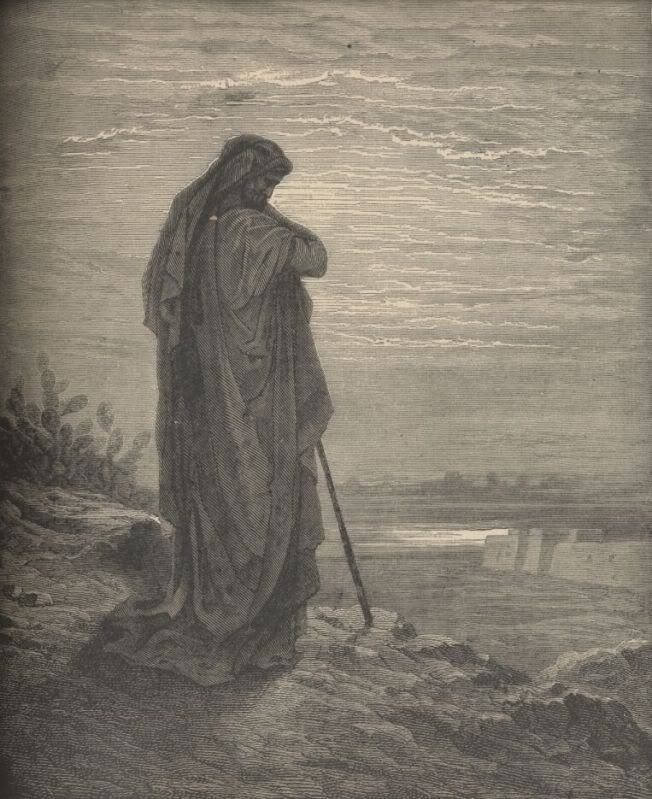
What is the Prophetic Ideal?


Gustave Dore
"The Prophet Amos"
1891
Engraving
"Let justice roll down like waters, and righteousness like an ever-flowing stream."

-Amos 5:24
In the Hebrew Tanakh, the colorful collection of history, anthropology, and mythology better known to Christians as the Old Testament, a number of the prominent prophets decry the institutionalization of Israelite religion. Elijah, Amos, Hosea, Isaiah, and Jeremiah proclaim instead the communal and, in some cases, individual experience of the one, true God. They maintain that God can be best experienced (and, as the ancient Israelites believed, best appeased) through one's devotion to those moral laws, or mitzvot, concerned with righteousness and social justice. These courageous and outspoken men also possess an enmity for the organized priesthood. They insist that the Israelites needn't centralize their worship at Solomon's Temple in Jerusalem, or at any of the other state worship shrines constructed within the kingdoms of Israel and Judah.

Not surprisingly, excepting the rare case when a prophet's ideology was deemed politically expedient, Israelite state leaders frowned on religious populism and the theocracy ignored the prophet's pleas. Typically, the trouble-making prophets were ostracized, expelled, or hunted as fugitives. Yet, ultimately, the prophets' voices proved appropriately prophetic.

For most of their history, Jews have lived in diaspora, their religious faith and identity rooted in a universalist foundation of scripture, theory, and law rather than any centralized site or body. In fact, most contemporary religious historians believe that the flowering of the relatively archaic and essentially polytheistic Israelite religion into Judaism follows the fall of Jerusalem to the Babylonians, in 587 BCE, and that this early, exilic manifestation of Judaism would undergo another upheaval and transformation after the destruction of the Second Temple by the Romans, in 70 CE. In essence, these scholars suggest that the Israelites (and, later, the Jews) had to forgo state power before the moral idealism of their religion could be actualized.

Accordingly, then, the muscular, modern state of Israel poses challenges to Jewish moral idealism. But contemporary Israeli Jews aren't alone in their wrestling with this challenge. Almost 2,500 years after the Hebrew prophets condemned top-down involvement in spiritual matters, liberal-minded, religious individuals of all stripes continue to struggle against blindly restrictive doctrinal authority.

I do not intend to suggest that adherence to dogma is necessarily a bad thing. Moral hand-wringing is a natural component of ethical decision-making, and traditional values of the sort upheld by religious authorities offer each of us a valuable point of reference. But what of contemporary conflicts between religious action and the religious institution? What of those cases in which the civil and moral codes of a religion suggest that the adherent to those codes should act in some way other than that dictated by the religious institution?

Laura Goodstein's recent New York Times article, "U.S. Nuns Facing Vatican Scrutiny" provides an excellent example. Goodstein writes,
"In the last four decades since the reforms of the Second Vatican Council, many American nuns stopped wearing religious habits, left convents to live independently and went into new lines of work: academia and other professions, social and political advocacy and grass-roots organizations that serve the poor or promote spirituality. A few nuns have also been active in organizations that advocate changes in the church like ordaining women and married men as priests."
What could possibly be wrong with nuns advocating for progressive social change!? While I respect those individuals who dedicate their life to religious contemplation, aren't the monks and nuns that work for God outside of monastery and convent walls the most exemplary of all religious adherents? Aren't those individuals striving for Thomas Merton's brand of religiously-inspired activism representative of the 13th century theologian and mystic Meister Eckhart's call for believers to "gratefully [return] all that God has bestowed [...] and, by that act of donation, enter the Godhead"? In the eyes of the Vatican, apparently not.
"The investigation was ordered by Cardinal Franc Rodé, head of the Vatican office that deals with religious orders. In a speech in Massachusetts last year, Cardinal Rodé offered barbed criticism of some American nuns 'who have opted for ways that take them outside' the church. [...] The [Vatcian's investigation] focuses only on nuns actively engaged in working in society and the church, not cloistered, contemplative nuns."
If the Vatican has spearheaded the investigation only because the Church seeks confirmation that American activist nuns are "attending Mass and keeping the sacraments," all well and good. After all, attending Mass and keeping the sacraments are obligations of religiously observant Catholics, and an individual who has devoted his or her life to the church should certainly be upholding these traditions. If, however, the Church intends to castigate or defrock otherwise devout, responsible nuns for pursuing religious behavior outside of the church, the Vatican officials should be ashamed of themselves.

As the Catholic theologian Walter Brueggemann wrote in The Prophetic Imagination, "The task of prophetic ministry is to nurture, nourish, and evoke a consciousness and perception alternative to the consciousness and perception of the dominant culture around us." For the Catholic nuns, as for the Hebrew prophets millennia before them, the dominant culture is that of their respective religious institutions, one of staid and comfortable orthodoxy. I'm not a Christian, but were I one, and especially if I were Catholic, I would be up in arms over the Vatican's sanctimonious oppression of those exceptional nuns and monks who actually paid attention to the substance of Jesus of Nazareth's memo.

Photo credit: ripped from Wikipedia