Showing posts with label Lewis Lapham. Show all posts

Saturday, February 04, 2012

Choosing Past and Future

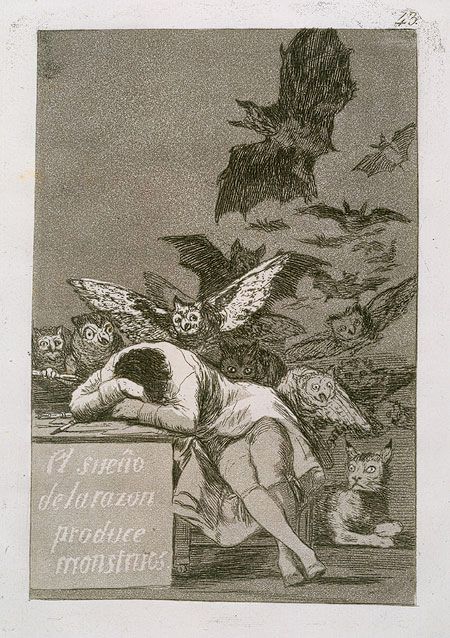
Francisco Goya
"The Sleep of Reason Produces Monsters"
1797
Etching, aquatint, drypoint, and burin
"It is the reviving wine of history that defends the future against the past."

- Lewis Lapham, "Democracy 101"
(Harper's Magazine, April 2011)
As high school students, we're often told that history repeats itself, the implication being that a sound education in history will allow us to avoid repeating past mistakes. I think of this as the "Groundhog Day" school of thought. It's true, despite the fact that most people (and states) tend to trip over the same stumbling blocks time and again.

Still, I prefer Lapham's formulation above because his statement implies that the study of history provides us with the necessary confidence to continue and to hope, to view our progress as two steps forward for one step back. Moreover, it's important for us to choose the bottle of wine that we drink from. As President Obama articulated in his brilliant inaugural address,
"the time has come to reaffirm our enduring spirit; to choose our better history; to carry forward that precious gift, that noble idea, passed on from generation to generation."
May we choose wisely, and drink deep.

Monday, January 02, 2012

Keep the Flame Alive In 2012


2011 will be best remembered as a year of popular dissatisfaction and uprisings. Lacking a crystal ball, such instability -- especially the prospective political transitions from despotism to democracy in Egypt and Libya -- can cause acute anxiety.

As we enter 2012, it's useful to keep in mind that democracy is a pendulum that forever swings from equilibrium to imbalance and back. The uncertainty and tensions associated with the political and ideological landscape of today's Middle East are also endemic to established democracies. Lewis Lapham described the workings of a democratic government in "Democracy 101," an essay published in the April 2011 issue of Harper's Magazine.
"Democracy is a dangerous business; it allies itself with change, which engenders movement, which induces friction, which implies unhappiness, which assumes conflict not only as the normal but also as the necessary condition of its existence. The idea collapses unless countervailing stresses oppose one another with competing weight - unless enough people stand willing to sustain the argument between the governing and the governed, between city and town, capital and labor, men and women, matter and mind. [...It] is the freedoms of thought that rescue a democracy from its stupidities and crimes, the courage of its dissenting citizens that protects it against the despotism of wealth and power backed up with platitudes and billy clubs and subprime loans."
This description should ignite fire in the belly of all United States citizens, wherever they place themselves on the political spectrum.

In late January 2009, I wrote an essay titled "Eudamonia." The piece explored the possible causes of a "bout of optimism [that] seemed remarkable in both duration and degree." That optimism is tempered today, but it still burns, despite the growth of "triumphant pessimism" among our populace. I remain optimistic because I believe in long term improvement, in two steps forward for one step back.

Let us all be devoted, active citizens in 2012, realistic, but not cynical, hopeful, but not naive, critical, but not destructive.

Image credit: uncredited photograph ripped from Care2 Make A Difference website

Thursday, October 20, 2005

The Significance of Pluto to the Waterboy

Image hosted by Photobucket.com
Reading the science section of a recent edition of The Manchester Guardian, I learned that Pluto, the ninth planet from the sun, is "about to lose [planet] status." In light of new revelations regarding "the 10th object" (what an Orwellian name!), astronomers are reconsidering Pluto's classification, and many have decided that it should be deemed a "trans-Neptunian" or "minor" planet. Duncan Steel, an astronomer and comet researcher, thinks such a designation ridiculous.
"[Using] the term planet should be by public acclaim and not through the arrogant arguments of scientists. The nine planets are planets because the public thinks so."
I'm inclined to agree, but reading the Guardian article, I found myself thinking not about the heavens but about the state of American intellectualism.

The word "intellectual" makes most people groan; often I am no exception. Years ago, my father explained to me the important distinction between an intellectual thinker and an Intellectual with a capital "I.". When the word is used as a noun, he cautioned me, it points to pretension and hubris. In this form, it is most often employed by groups of over-educated urbanites sharing similar curriculum vitae. As an adjective, however, the word is to be cherished, for it suggests thoughtfulness, a willingness to engage complexity and more fully examine the dirty details. Most people do not distinguish between these two different uses of the word. Indeed, today it is most often used as a pejorative. (The spread of American anti-intellectualism has been discussed at great length in any number of papers, magazines and journals and I don't aspire to - nor am I equipped to - add anything original here.)

With respect to the lower-case meaning of "intellectual," Duncan Steel's comment warrants more attention. "The nine planets are planets because the public thinks so." True. No matter how many scientists rally behind the reclassification, the populace at large will still believe that there are nine planets, at least until another generation has been educated to think differently. After all, "Mary's Violet Eyes Make John Stay Up Nights Period." That's the mnemonic that we were taught as wee star-gazers and what is a solar system without the period?

Even though I now know better, Pluto will remain a planet in my mind. My thinking is mainstream, an example of the popular catchphrase, the tyranny of the majority. That Pluto is not a true planet is irrelevant because I stubbornly choose to ignore the facts. I admit to willful ignorance.

In "The Waterboy," Adam Sandler's character denies the teachings of his Colonel Sanders-esque biology professor. "Well, my momma says alligators is ornery cuz they got all them teeth and no toothbrush," he insists. When the professor corrects the misinformed student, the waterboy becomes enraged. The dynamic of the scene is extreme - the proud professor talks down to the imbecile, publicly mocking him for his faith in all things Momma - but it remains a fair reflection of contemporary American attitudes toward science, in particular, and intelligence more generally. Viewers aren't supposed to side with the informed professor, with his degree(s) and his knowledge. Instead, we are expected to champion the ignorant, but well-intentioned, boob because we are the waterboy, each and every one of us, and we won't be told how things are, certainly not by any "ivory-tower" intellectual. In other words, we refuse to be educated.

In such a climate, is it any wonder that the thoughtful practitioners of intellectual thinking have fled center stage? No longer do we celebrate the brooding, intelligent Hamlet. These days we consider the Prince of Denmark clinically depressed, in need of Zoloft and some faith in the afterlife. After all, there's no time for melancholy when everyone should be celebrating how wonderful they are. The intellectual thinkers have been reduced to the role of Iago, slipping in and out of the shadows, whispering nasty half-truths into the ears of the powerful. These arrogant scientists tell us what to think, or not think, of our planets and the deceitful bookworms of the patrician northeast insist on referencing ancient history to bemoan the current state of geo-political affairs. The majority, it would seem, no longer finds Hamlet's hand-wringing commendable or even acceptable. As the Electric Light Orchestra put it in their 1980s anthem,
"Don’t bring me down,no no no no,
I’ll tell you once more before I get off the floor
Don’t bring me down."
Another article in the same edition of The Guardian addresses this issue as a peculiarly American one, but anti-intellectualism, infectious and easy, can't remain confined within our borders. Peter Preston's book review, "What a superiority complex," critiques Lewis Lapham's recent collection of essays, "Theatre of War." Lapham, the editor of Harper's Magazine, is a remarkable verbal pugilist but his stylistic flourishes, encyclopedic knowledge and strident opinions don't always attract fanfare. As I wrote in "Lewis Lapham and the Evangelicals,"
"A year ago a co-worker told me he wouldn’t read Harper’s Magazine because 'it was just another liberal rag' edited by an 'insufferable egotist.' While I won’t deny the first charge, I am less inclined to accept the latter. Admittedly, Lewis Lapham’s monthly contribution ('Notebook'), typically three or four pages of rhetoric following the reader letters, ranges from excellent to unreadable. Lapham is a gifted wordsmith enamored of his craftsmanship; such writers can make splendid editors, but with their own work are as prone to failure as they are eloquence."
Despite his faults, Lapham's is a vital voice. I consider his magazine - and Harper's clearly belongs to Lapham - one of the best publications in circulation today. Preston shares my high regard for Lapham.
"The editor of Harper's magazine writes like a dream, researches like a punctilious professor of classical history and finds his lonely judgments vindicated time and again...Is Lapham an adornment to American journalism? Absolutely. Is his critique of wars not worth the fighting perceptive and exhilarating? Often better than that."
Yet Preston realizes Lapham is part of a tiny minority, one that "if not silent, [exists] only in a few small corners of intellectual refinement." In Preston's eyes, Lapham is a victim of American anti-intellectualism and he identifies with the man - it often seems most of Europe feels this way - but Preston moves beyond mere admiration by smartly analyzing the failures of the American intellectual elite.
"The difficulty - and it is a difficulty - is that the good side comes with a greyer side that readers outside America can't ignore, a built-in impotence verging on tragic irrelevance....[Lapham] and his fellow sages sit on the peripheries...because, in part, they choose to; because the sidelines fit their sense of rectitude and superior self better. It's a terrible shame."
It is a shame. It's a shame that the thoughtful folks don't emerge from stage left to take charge of the country. Less than a century ago, the United States was still guided by thinkers - rather than populists like George W. Bush or shrewd schmoozers like Bill Clinton - and the now familiar lament that intellectual individuals are weak-willed and incapable of decision-making is disproven by the likes of Franklin Roosevelt and, long before him, Abraham Lincoln. Perhaps if we were offered better role models the hostility and defensiveness would fade.

As things stand, the only popular refuge for intellectual thinkers is satire, a haven for sharp-tongued wits trading in melancholia. John Stewart and Stephen Colbert succeed by disguising their thoughtfulness; their exasperated looks and smarmy monologues have found favor with an audience idealistic enough to be disturbed by contemporary doings, but too cautious to raise their own voices. No one wants to be called out.

A girl walks down the street with several friends. Reacting to something another of the group says, she responds,

"Actually, Pluto isn't considered a planet anymore."

"What? Are you serious?"

"Yeah, it doesn't really qualify...it never did, but they've officially demoted it now."

"You are such a dork!" (wrinkling up his face and speaking in an uptight tone, a friend continues) "Um...act-u-ally, you guys...Pluto isn't technically a planet."

The group all breaks out in laughter and the girl sheepishly smiles. After all, it was a pretty dorky thing to point out.

And so it goes.

Photo credit: Touchstone still from "The Waterboy"

Thursday, April 28, 2005

Lewis Lapham and the Evangelicals


A year ago a co-worker told me he wouldn’t read Harper’s Magazine because “it was just another liberal rag” edited by an “insufferable egotist.” Admittedly, the quality of Lewis Lapham’s monthly contribution (“Notebook”), typically three or four pages of rhetoric following the reader letters, varies wildly. Lapham is a gifted wordsmith, but he is enamored of his craftsmanship; such writers can make splendid editors, but with their own work they are as prone to failure as they are eloquence. Whatever his overall batting average, Lapham’s May 2005 “Notebook,” entitled “The wrath of the Lamb,” is exemplary.

In “The wrath of the Lamb,” Lapham attacks the “faith-based initiative” that surfaced in the 1980s and now, with the reelection of George W. Bush, grows in strength. At a recent meeting of the National Association of Evangelicals in Washington, D.C., the group “declared [their] intent to lend a hand in the making of an American politics faithful to the will…of God.” After describing his early experiences with religion – he grew up in a secular household; “an unbaptised child raised in a family that went to church only for weddings and funerals” – in a time when secular philosophy ruled, Lapham moves on to his experiences as a young man observing the turning of the tide. God went from being dead – all that “remained to be discussed was the autopsy report” – to “[rising] from the graves of skepticism and science.” At the beginning of the 21st century, the “twin pillars of fear and intimidation” provided further insurance for the evangelicals; many people now flock to God, powerful elected officials included. As Lapham reminds us, “On the day after the 2004 election, Bush received a note from Bob Jones III, president of the eponymously named university in South Carolina: ‘…if you have weaklings around you who do not share your biblical values, shed yourself of them…’”

Not surprisingly, Lapham, like Bill Moyers, is troubled by the twelve volumes of the Tim Lahaye/Jerry Jenkins “Left-behind” series. (New York City is usually characterized as a secular fortress, but hardly a day passes when I don’t see one of these books being read on the subway or, more noticeable still, sold on the street by starry-eyed acolytes offering a “Free Stress Test.”) I have not read any of these books, but Lapham offers a small sampling, drawn from the twelfth book in the series, in which the writers describe the fate of secular types like myself.
”Their innards and entrails gushed to the desert floor, and as those around them turned to run, they too were slain, their blood pooling and rising in the unforgiving brightness of the glory of Christ.”
Little wonder that environmental stewardship and human rights are deemed unimportant by so many contemporary evangelicals! As he nears the conclusion, Lapham writes,
“The delusional is no longer marginal, and we err on the side of folly if we continue to grant the boon of tolerance to people who mean to do us harm in the conviction that they receive from Genesis the command ‘to take dominion over the earth,’ to build the Kingdom of God, to create the Christian Nation. The proposition is as murderous as it is absurd…”
I try to remain optimistic. Perhaps those evangelicals who absorbed Christ’s core teachings - those groups promoting stewardship and brotherhood, regardless of race or religion – will grow in number, adding volume to their message and overcoming their reactionary, bloodthirsty comrades. This is the best hope as I see it, for the evangelical hawks and Rapturists will not listen to reason. Reason, after all, is their enemy.

My “Strange Bedfellows” post in early March trumpeted the National Association of Evangelicals document, "For the Health of the Nation: An Evangelical Call to Civic Responsibility." The New York Times suggested the NAE platform was focused on caring for God’s creation via thoughtful environmental policy. This filled me with hope. Upon reading the article, I wrote:
“There will be some head-butting, but I would rather have the green evangelicals pushing against the tide of fundamentalists ushering in The Rapture, than have to deal with them myself. Secular environmentalists don't have to speak the language, but they must be willing to sit down at a table and draw up plans with groups like the NAE. Even if we all differ on some critical issues, our shared commitment to protecting the ecosystems that sustain us means enough to allow for a firm handshake and some hard work. Grudgingly, we can work alongside one another.”
Sadly, excerpts from the actual document suggest a more sinister goal, the injection of Christian “values” into government. Lapham highlights the following selection in his piece.
“We also engage in public life because Jesus is Lord over every area of life…to restrict our stewardship to the private sphere would be to deny an important part of his dominion and to functionally abandon it to the Evil One. To restrict our political concerns to matters that touch only on the private and the domestic spheres is to deny the all-encompassing Lordship of Jesus.”
Download the full text here. I have read the document in its entirety now. The declaration is more frightening than inspiring, but what I notice most is the inherent contradiction. For example, in one paragraph the NAE declares religious freedom essential while, further on, they call on Christians the world over to proselytize and save the damned. I don’t see much room for environmental policy if one is preoccupied with bible beating.

Photo credit: painting of Lewis Lapham by Robert Shetterly