Showing posts with label birding. Show all posts

Monday, October 14, 2013

Rock Dove On A Rock

Christopher Reiger
"Pigeon (Rock dove); Mountain Lake; Presidio, San Francisco, CA; August 2013"
Because so many people think of pigeons as "sky rats," I like to emphasis their more "proper" common name, rock dove (Columba livia). They're fascinating birds and, although ubiquitous in urban landscapes, shouldn't be viewed with such disgust.

Photo credit: © Christopher Reiger, 2013

Thursday, October 03, 2013

Knowing the Way To Your Heart

Elizabeth Alexander
"Song Sparrow"
2012
I was curiously heartened when I read the below blurb in the "Field Notes" section of the September/October 2013 issue of Audubon Magazine.
Silly Love Songs: Singing longer doesn't always mean you get the girl.

Among song sparrows, the most tuneful males often win over the females -- but their vocal expertise may come at a cost. Biologists at Duke University counted up songs in male song sparrows' repertoires and then tested the birds' memories. Every day for eight days the researchers hid a mealworm in one of several shallow wells, some of which had lids. The mealworms' location remained the same, so the scientists could observe how deftly the sparrows remembered where to find their treat. Over time all of the birds improved, but the males that sang the fewest songs learned the quickest, while the birds with more expansive repertoires struggled. Kendra Sewall, now at Virginia Polytechnic Institute and State University, explains that the difference could reflect a trade-off during mental development -- the birds develop one ability or the other. The finding also suggests that females may be able to detect a potential mate's weaknesses in his songs. Although many pick males that sing lots of songs, Sewall notes that every male in their study found a mate. It's possible, she says, that certain females are aware of the trade-off and prefer a partner with spatial smarts to pass on to their young. -- Daisy Yuhas
Maybe I was cheered by the report because I a) have a terrible singing voice, b) struggle to remember song lyrics (even simple tunes), c) am fond of poring over maps, and d) have an innately good sense of direction? Like the song sparrow test subjects, it seems I was afforded one ability and not the other.

Image credit: Elizabeth Alexander's mixed media song sparrow artwork found online at the Scholastic Alliance for Young Artists & Writers Blog

Monday, August 19, 2013

A Tonto Inventory

During the summer of 2003, I spent a week rafting on the Colorado River. Our flotilla bounced, rolled, and cheered its way down the river's major rapids, but there was also ample time for floating on the current and letting the Grand Canyon's magnificence wash over us. At night, we cooked and camped on the river's beaches. A few memories of the trip are especially clear: I recall encouraging the youngest members of our party to avoid harming the spiny lizards they chased around camp; rejoicing when I encountered rattlesnakes and scorpions during side hikes; and, on the last night of the trip, listening to a passionate talk by one of our guides about the Colorado's dwindling water flow. Above all, though, I remember the sublime beauty of the landscape.
Christopher Reiger
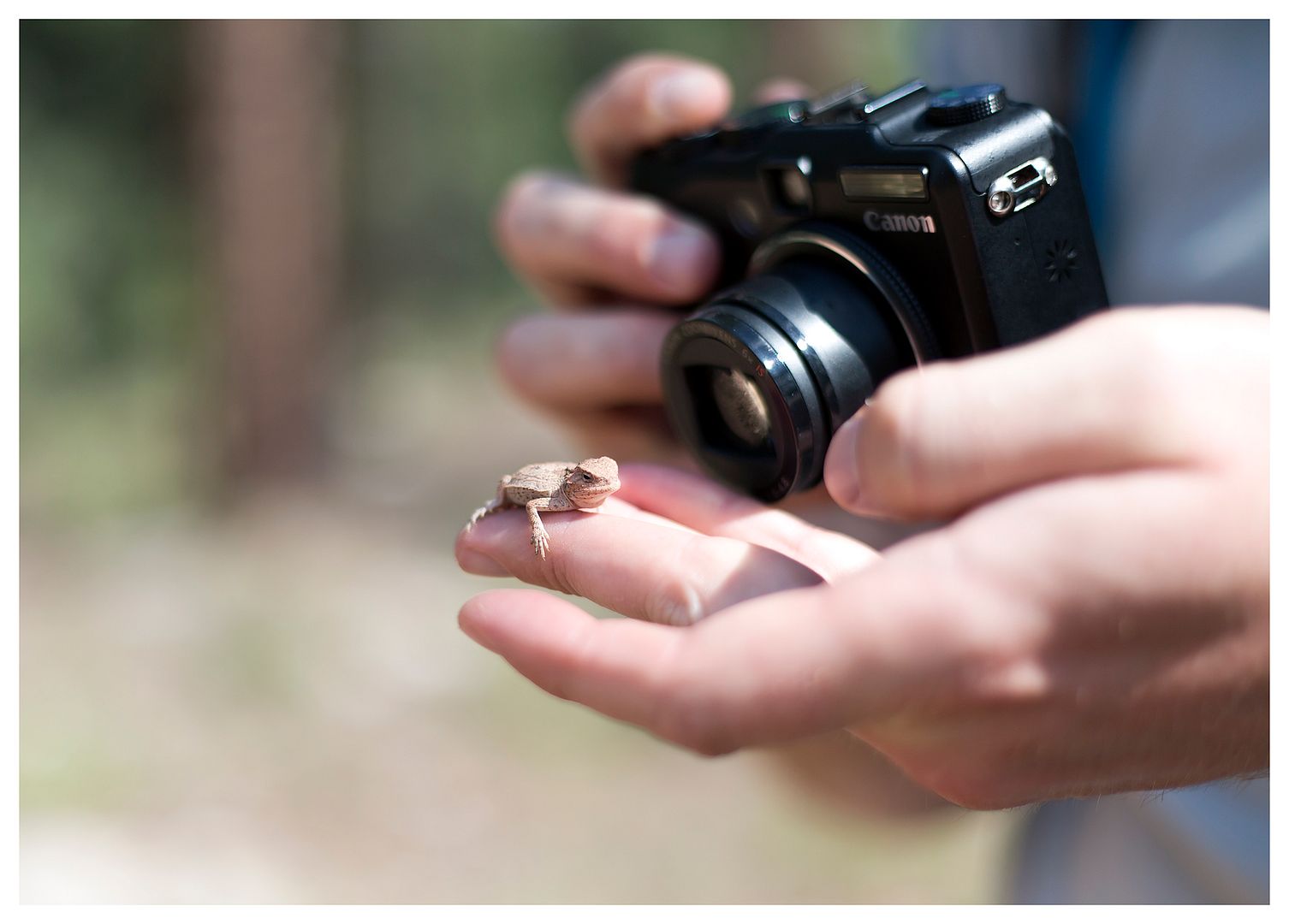
"Greater short-horned lizard; Fire Road 1170;
Tonto National Forest, AZ; August 2013"

Until this summer, ten years after that unforgettable trip, the river week was my only experience of the American Southwest, and I've wanted to return to the region for some time. When a good friend (and fellow natural history nerd) called me earlier this year and suggested we carve out some time to visit Arizona's Tonto National Forest, I was easily persuaded.

We spent most of our weeklong visit exploring the high desert trails and fire roads of Tonto's north central tract, but we also had an opportunity to spend a little time in the National Forest's southern reach, at the edge of the Sonoran Desert. It was a treat to meet so many species new to me and to have intimate encounters with other animals, like elk, that I'd previously seen in habitats very different from that of the high desert.

Wednesday, October 17, 2012

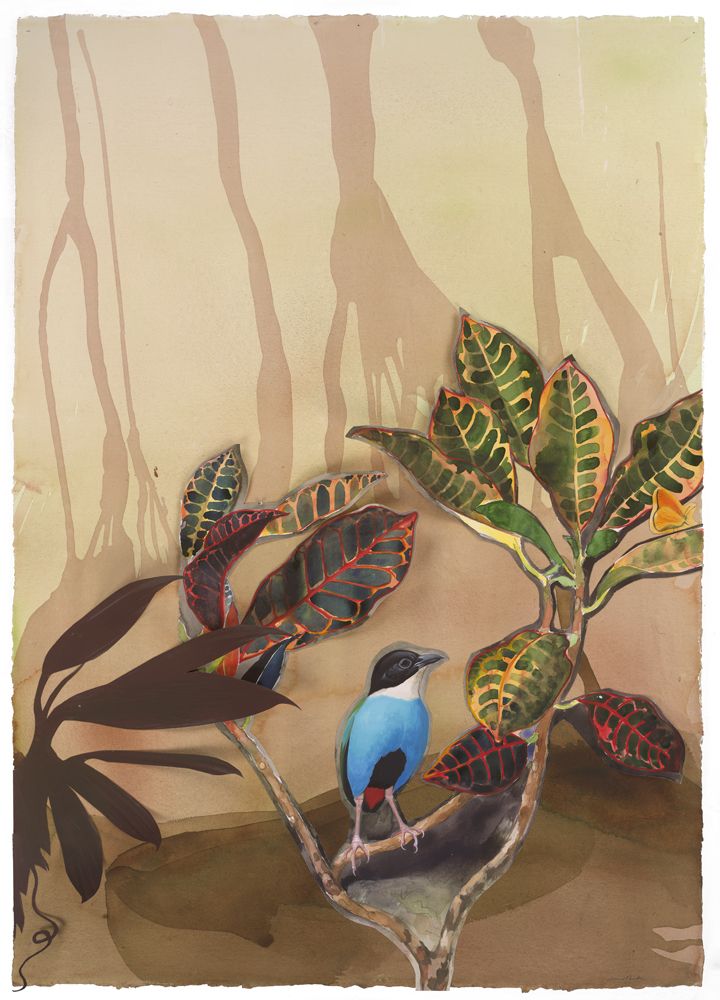
David Tomb's "Grand Birds"

David Tomb
"Azure-breasted Pitta"
2012
Painted papers with mixed media and partially pasted and or completely pasted on paper with mixed media
42 x 30 inches
"Grand Birds of the Philippines," David Tomb's current solo show at Electric Works, is deserving of a thoughtful review. Disappointingly, my writing time is limited this month and I can provide only a few observations.

Thursday, August 16, 2012

Platte Clove Residency: Coastal Differences

View of Devil's Path Trail; Catskills; NY; July 2012
Five years ago, while traveling in South America, I met a young woman from the West Coast of the United States. After the trip, we corresponded for a while, and she related news of her move from southern California to New England. An outdoorsy sort, she prioritized exploration of the parks in her new neck of the woods, but she wrote that the eastern forests unnerved her. During the summer months especially, they seemed dense and suffocating, a patchwork of green that closed in around her.

At the time, her observation amused me. Having grown up on the East Coast, I was at home in the mixed deciduous and pine forests of eastern North America. By contrast, the Endor-like redwood and sequoia forests of the Pacific coast and the mixed coniferous forests of the continental divide and the American Southwest, environments in which I'd had little or no experience but with which my friend was very familiar, seemed otherworldly to me.

Wednesday, July 25, 2012

Platte Clove Residency: Some Remove

Plattekill Falls; Platte Clove Nature Preserve;
Catskills; NY; July 2012
On the first afternoon of my residency at Platte Clove, after settling into the cabin and familiarizing myself with local trail maps, I decided to explore a short path that begins a few steps from the cabin's porch and winds its way down one of the valley's uppermost gorges to Plattekill Falls. It was a lovely reintroduction to the Catskills. Late afternoon sunlight filtered through the mixed forest's overstory, unevenly illuminating a floor decorated with eastern hemlock cones. Hidden from view in the canopy above, red-eyed vireos ceaselessly repeated their lilting questions.

Tuesday, January 24, 2012

Oh, Starlings!


A few months ago, a friend shared the above video with me. You might have seen or read about it before; it went "viral" late last year. The two friends who appear in the clip are treated to an intimate encounter with a large murmuration, or flock of European starlings. Murmurations of such substantial size are natural phenomena that, no matter how familiar, retain their capacity to inspire wonder, even awe. As one, the birds sweep and dance in an astonishing and fluid choreography; the rush of their wingbeats and many bodies pushing through the air produces a sound that accounts for the name. Because the audible component of a murmuration is impressive in its own right, I wish a version of the video were available without the hokey music, but the giddy joy that the canoeing friends experience is palpable, especially near the short film's end, when one of the women looks at the camera with marveling, wide eyes, and they both begin to laugh.

Saturday, October 29, 2011

AIRIE Residency: Update #5

This update is associated with my 2-week-long Artists In Residence In the Everglades (AIRIE) writing and art residency.


AIRIE Housing; Everglades National Park; October 2011

Notes from Days 12, 13, & 14:
- I had the privilege of joining Florida International University Honors College professors Peter Machonis and Devon Graham as they led their "Everglades: From beginning to end?" seminar class on a slough slog. Before we waded into the river of grass, I presented a short lecture on my artwork, the importance of biodiversity, and the Endangered Species Print Project (ESPP).

I wrapped up the talk by highlighting the Endangered Species Condom project, an ESPP collaboration with the Center for Biological Diversity that aims to raise public awareness of the environmental impact of a burgeoning human population on natural resources, habitats, and thousands of critically endangered species around the world...and, of course, I distributed the Endangered Species Condoms to all in attendance.

The real fun started about an hour later, when we stepped into the water. As regular readers of HH know, I've seen plenty of flora and fauna from the roads and trails in my two weeks in Everglades National Park, but sloshing through sawgrass marshes and into two bald cypress stands provided another, more sensual prespective. We met countless spiders (all species unidentified, unfortunately), diminutive American green tree frogs, and Halloween pennant dragonflies (as well as other, unidentified dragonfly species) on our way to the cypress dome.

Once inside the dome's shaded, cooler, and humid environment, most of the students found seats on a hurricane-felled tree and the rest of us took up positions nearby. We ate lunch while the class described some of what they'd seen during our slog to the cypress stand. Afterwards, Peter led a discussion of Their Eyes Were Watching God, the novel by Zora Neale Hurston, which the class recently read. As students offered their insights, a curious, juvenile American alligator swam close to our group, provoking some "ooo"s and "aww"s (admittedly, tyke gators are cute).

I kept my eyes peeled for the flow of a Burmese python through the water. The python population in the Everglades is one of the most celebrated invasive species concerns in the United States. The week before I arrived, rangers caught a python crossing Anhinga Trail, a popular park destination. The rangers killed and dissected the large reptile to learn what it had been preying on. The pythons aren't picky eaters and they grow to nearly 20 feet in length; the recent capture had only birds and water rats in its belly, but these invaders have been known to feed on fish, raccoons, river otters, bobcats, deer, and even the occasional alligator. One ranger remarked to me that he rarely sees small mammals in the park anymore. A decade ago, he told me, visitors were guaranteed to see marsh rabbits, Eastern cottontail rabbits, Eastern grey squirrels, and nine-banded armadillos along the park's roads, but I haven't seen even one of these animals during my two weeks here.

"Do you think the pythons are responsible?," I asked the ranger. He shrugged and said, "Well, it could be a coincidence. Rabbits have population boom-and-bust cycles." "What about the armadillos?," I asked. He raised his eyebrows and shrugged. "I'm not really sure about their populations. We can't prove anything yet." Some researchers now estimate that the established, breeding population of Burmese pythons in the Everglades is in the thousands.

Highlights of the slog (besides talking with some of the students and the professors) included seeing 2 American bitterns, a bird that I'm particularly fond of, and watching (and feeling) the mandibles of a grasshopper (unidentified as of yet) work on the the upper layer of my index finger's skin, scraping away little flecks of it, which the insect appeared to eat. It didn't hurt; it felt like a cross between being tickled and rubbed with a small piece of sandpaper. Had it been a larger grasshopper, I may not have been so obliging, but I enjoyed watching the insect at work.

Finally, I tip my hat to the aims of Peter and Devon. Their class curriculum is designed to introduce students to Everglades' natural history and "the political nature of local and regional environmental issues," but also to "read critically, to understand the interconnectedness of art, literature, and other disciplines." Amen! Its exactly the sort of generalist class I'd like to take....and the type of class I hope to one day teach. I hope that most of the students realize how fortunate they are to be a part of it.

- During the early days of my stay in the park, I didn't hear any cicadas. Now that the rain has become infrequent, however, I hear their clicking whine all day long. It reminds me of the Eastern Shore of Virginia, my home ground.


Tricolored Heron and Anhinga; Anhinga Trail; Everglades National Park; October 2011

- While I watched, a male anhinga caught a bluegill in the flooded borrow pit by Anhinga Trail. The fish was at least 3 inches in length, and the anhinga decided that he'd better not attempt to eat the fish while still in the water. Unlike most fish-eating birds, anhingas have to throw the fish they catch up into the air, open their beak wide, and swallow the fish as it descends. It's quite a trick to see, especially when the fish, as in the case of this bluegill, is of a fair size. The anhinga waddled (like penguins, anhingas are evolved for diving and swimming, and they're graceless on land) up the grass slope at the borrow pit's edge, his catch held tight in his bill. He moved onto the paved trail and, surrounded by a small group of excited German tourists (and me), pulled off the fish tossing feat with aplomb.


Common Snapping Turtle; Main Road; Everglades National Park; October 2011

- I stopped for 2 more common snapping turtles crossing park roads. One of these was an especially fine model. I also rescued a Florida box turtle from harassment by two American crows. Whether the crows would have eventually gotten past the turtle's shell defense, I don't know, but corvids are clever birds and, though I'm very fond of them, I opted to spoil their fun and potential meal by moving the turtle off the road and into the undergrowth at the forest's edge. The crows clucked and rattled at me in disapproval.


Florida Box Turtle with American Crows; Everglades National Park; October 2011

- I had an on-the-move photo shoot with another road-crosser, an Eastern diamondback rattlesnake. As it continued to move across the road and through the grass on the far side, it kept its head and one s-curve of its body angled toward me, prepared to strike were I to molest it. The encounter was a treat; I've long wanted to meet an Eastern diamondback outside of an enclosure and now I have! Like the cottonmouth I met earlier in my visit, this is a snake that I have no inclination to handle and examine more closely, so I don't know it's gender.


Eastern Diamondback Rattlesnake; Everglades National Park; October 2011

- Sadly, not far from where I came upon the rattler, I found a dead, partially crushed and ant-consumed rough green snake, a beautiful species that, when alive, is a radiant emerald; even dead, they are pretty snakes. Not counting insects or the dead dog wasting away on the roadside outside of park land (there are many dogs with apparently negligent owners living near the park), this is the 3rd dead-on-road (DOR) critter I've found. A red-shouldered hawk and a great blue heron also lost their lives to cars during my time here. There are almost certainly others that I didn't happen to discover.


DOR Rough Green Snake; Everglades National Park; October 2011

Photo credits: all photos, Hungry Hyaena (Christopher Reiger), 2011

Related post: "ESPP and an Everglades Slough Slog," at The Endangered Species Print Project Blog

Thursday, October 27, 2011

AIRIE Residency: Update #4


Pinelands; Everglades National Park; October 2011

This update is associated with my 2-week-long Artists In Residence In the Everglades (AIRIE) writing and art residency.


American Alligator; Long Pine Key Lake; Everglades National Park; October 2011

Notes from Days 9, 10, & 11:
- I danced a slow-motion tango with the American alligator pictured above. The animal was only about 6 feet long (which I presume is too small to view a full-grown human as a potential meal), but this gator's eyes may have been bigger than its stomach, so to speak.

When I initially approached the lake, the alligator was about 15 yards from the shore. I squatted at the water's edge to take some photos of periphyton, spongy masses of algae and microorganisms that play a critical role in the Everglades food web. Although I focused on the periphyton, I occasionally glanced at the alligator; in so doing, I realized that it was slowly, almost imperceptibly nearing my position. When it was about 10 yards away, it submerged. From where I crouched, I could see the dark shape of its body moving more rapidly toward me. I hopped up and retreated to a safe distance. The reptile moved within 8 feet of the shoreline and surfaced, its third eyelids retracting. It stared at me; I stared back. "Are you serious?," I asked, as though it understood. "Are you eyeing me, buddy?"

After a few minutes, the alligator submerged and moved away, to a spot near its original position. I approached the water, checking carefully to make sure I wasn't overlooking any other gators in the area, and again squatted. Moments after I did so, my cold-blooded friend sunk beneath the water's surface and moved toward me, as before.

This dance was repeated several times: the gator approaching, me retreating, the animal moving away, me approaching and crouching, repeat. I have to conclude that, when hunkered down, I appeared to be of a size that a hungry, 6-foot gator could take. The animal was moving into a position from which it could strike. While I doubt that it could kill me easily, I've no doubt that it could do me serious harm.

I decided to leave the area. As the old adage has it, no photo of periphyton is worth loosing a hand.


Periphyton; Everglades National Park; October 2011

- Birds of special interest these three days: a peregrine falcon hunting at a field's edge, just outside the park; a common ground dove; and a barred owl that calls most evenings from a tree outside of my dormitory.


Rain Cloud Opening; Anhinga Trail; Everglades National Park; October 2011

Photo credits: all photos, Hungry Hyaena (Christopher Reiger), 2011

Monday, October 24, 2011

AIRIE Residency: Update #3


Mahagony Hammock; Everglades National Park; October 2011

This update is associated with my 2-week-long Artists In Residence In the Everglades (AIRIE) writing and art residency.

Notes from Days 6, 7, & 8:
- Before this residency, I knew that the Everglades is a birder's paradise. I didn't really know this until I found myself excitedly fumbling with my binoculars as I threw the car into reverse, craned my neck out the window, and attempted to drive-by identify a fast-moving raptor...only to realize that there were also two curious-looking warblers in the pineland understory to my immediate right (and what IS that bizarre call I'm hearing)?!

To stay sane, you learn to focus on one bird (or flock) at a time. That means, of course, that you have to let many birds go unidentified, but the primary pleasure is watching, not cataloging.


Wood Storks; Pa-Hay-Ohee Overlook; Everglades National Park; October 2011

Still, every bird watching enthusiast suffers from some degree of census pathology. I've inherited my father's disdain for "ticket punchers," birders who prioritize a day- or lifelist over observation and the experience itself. By no means, however, am I immune to the compulsion. I scold myself when I catch myself frantically estimating numbers in a faraway flock -- "Is it 52 or 53? Damn it! I can't &@^$% tell for sure!" -- or fretting over the unidentified animal that may have been a notable rarity. (On a related note, I haven't seen "The Big Year" yet, but I'm looking forward to it.)

Since my last update, some of the avian highlights include 3 snail kites, wood storks aplenty, a solitary sandpiper, 2 groups of American avocets, and a great white heron (a bird that is cause of much ornithological debate: is it a species, subspecies, or simple color morph?).


Cottonmouth; Main Road; Everglades National Park; October 2011

- And my herpetophilia -- I use this term in a decidedly non-sexual sense! -- has been sated, too. At the western edge of the park's pinelands, I came upon a handsome cottonmouth basking on the warmth of the main road.

The Agkistrodon genus is among my favorites and, in my excitement, I took disappointing photos of the snake's shockingly white mouth lining, its namesake, which the species displays as a defensive threat. Not all of the photos were unusable, however; above, you can see the cottonmouth moments after it flashed me a warning. I enjoy handling snakes, but I harbor no impulse to pick up cottonmouths; their hemotoxic venom attacks tissue and can lead to necrosis at the bite site.


Eastern Racer; Ecopond; Everglades National Park; October 2011

An Eastern racer, on the other hand, I'll want to catch, sex (i.e., determine its gender), and inspect for parasites. I found a racer hunting anoles in the vegetation surrounding the Flamingo Eco Pond, but moments after I crouched and pushed my way into the bushes, I was forced to abort my mission by a mosquito assault the likes of which I haven't before contended with.

- The below photo, taken at the Flamingo Ranger Station, explains why I was so impressed by the mosquitoes. Hysterical, indeed! The ranger stationed there told me to avoid a number of the trails I'd intended to explore. She suggested I instead cruise the campground roads in my rental car.


Mosquito Meter; Flamingo Ranger Station; Everglades National Park; October 2011

- Perhaps all that driving was partly responsible for the tire blow-out on Day 8? I was driving west on Tamiami Trail, heading to Naples to visit a high school classmate and go on a hike in the Corkscrew Swamp Sanctuary, when the tire gave out. A female red-bellied woodpecker tapped out some consolation as I changed the tire.

A pleasant highway patrol officer pulled over to check on me. I'm grateful that he did. The spare I'd put on was one of the mini tires that you don't want to limp along on for more than a few hours, and the policeman told me where the closest two tire shops open on a Sunday were located. I appreciated his advice to go to the farther of the two (in the suburbs of Miami) because it would be considerably cheaper, but his word choice -- "Don't go to the shop on the Indian reservation. They'll rape you." -- was, at best, poor.


Green Heron; Anhinga Trail; Everglades National Park; October 2011

Photo credits: all photos, Hungry Hyaena (Christopher Reiger), 2011

Friday, October 21, 2011

AIRIE Residency: Update #2


American Alligator Under Water; Anhinga Trail; Everglades National Park; October 2011

This update is associated with my 2-week-long Artists In Residence In the Everglades (AIRIE) writing and art residency.

Notes From Days 4 & 5:
- The sun came out on Day 5! Southern Florida is beautiful now...bright, but not too hot because of a merciful breeze from the Gulf of Mexico.

- The birding continues to be tremendous. In addition to the "firsts" I mentioned in my previous update, I've now added an immature Northern parula, a group of blue-grey gnatcatchers, whose aerial acrobatics delighted me for a long while, and countless palm warblers. While Northern mockingbirds are by no means new to me, I did have an opportunity to watch a young mockingbird hunt an anole, kill and eat it, then meticulously clean his bill on a branch. Watching birds hunt, it's hard to understand why it took biologists so long to elucidate the relationship between dinosaurs, reptiles, and our feathered friends.


Great Egret; Anhinga Trail; Everglades National Park; October 2011

- Speaking of reptiles, my 5th day in the Everglades was made notable by 3 turtles. A juvenile common snapping turtle, an adult of the same species, and a Florida softshell turtle were all crossing the park's main road at different locations. I moved the juvenile snapper off the road, but elected to leave the adult to its own pace, hoping that its large size would compel drivers to slow down. Having watched a snapper peel the flesh off my father's index finger, I was reluctant to face the challenge of moving the testy reptile without assistance. The softshell turtle, however, didn't need my help. It lumbered with determination, and I simply escorted it across the road.


Florida Softshell Turtle; Main Road; Everglades National Park; October 2011

- Thinking about roads, though, I was disappointed that two passing vehicles failed to slow, blowing by me -- and the softshell turtle -- at 50 miles per hour (the speed limit on the main road is 55 mph). One wonders why folks come to a national park if they only intend to race across it. Some death toll is inevitable. I generally drive well under the speed limit (35-40 mph) and strive to be alert for flying critters; still, I've killed countless insects (most especially butterflies that seem to suddenly materialize in front of the car's grill) and very nearly knocked off two palm warblers that jumped from the shoulder.

- Tomorrow, I head to Florida Bay to look for American crocodiles.


Common Snapping Turtle; Main Road; Everglades National Park; October 2011

Photo credits: all photos, Hungry Hyaena (Christopher Reiger), 2011

Tuesday, October 18, 2011

AIRIE Residency: Update #1


Tricolored Heron; Anhinga Trail; Everglades National Park; October 2011

As expected, my WiFi access is limited to Florida City's Starbucks. Rather than spend too much of my two weeks in Florida driving between my dormitory in Everglades National Park and this too-cold coffee chain so that I can regularly check email and provide HH updates, I'll post sparingly. Following the residency, I'll write a substantial essay about my experiences here. I've having a terrific time, despite my catching a cold on the airplane and contending with near constant rain these first four days.


Tropical House Gecko; AIRIE Dorm Room View; Everglades National Park; October 2011

Notes From Days 1, 2, & 3:
- A sign at the park's entrance gate informs visitors that the mosquito level is "high." A friendly park employee told me there are many more mosquitoes than normal for mid-October and explained that the number is a result of above average rainfall. In two days, I've been bitten over a dozen times. I dislike the itching, of course, but I don't particularly mind being a critical part of the Everglades food chain (see the sign below).

Willingness to be fed upon aside, I'm also happy that I have a tropical house gecko as my roommate. Mosquitos may be small snacks for a gecko, but I like to think the lizard will prey on them as eagerly as it will larger insects (like cockroaches). Everglades biologists might appreciate having an insect eater in their homes, too, but they probably wouldn't smile on this particular species; the house gecko is one of three invasive gecko species in the Everglades.


Food Web Sign; Anhinga Trail; Everglades National Park; October 2011

- There's been no sun since I arrived. The silver lining is that the park trails and roads are relatively uncrowded. On Anhinga Trail's "boardwalk," I sat for 15-20 minutes without another park visitor passing. In a nearby corkwood tree, I observed a female American redstart, an immature female black-and-white warbler, and a male black-throated blue warbler. All three of these bird species were "firsts" for me.


Stalking Great Egret; Anhinga Trail; Everglades National Park; October 2011

- I also watched two red-winged blackbirds hunt for insects by hopping from lily pad to lily pad on the surface of a flooded ditch, behavior I'd not seen before.


Water Lily; Taylor Slough; Everglades National Park; October 2011

Photo credits: all photos, Hungry Hyaena (Christopher Reiger), 2011

Saturday, September 24, 2011

Acknowledging Exceptionality

"As glass office and condominium towers have proliferated in the last decade, so, too, have calls to make them less deadly to birds. The San Francisco Planning Commission adopted bird-safety standards for new buildings in July, and this month that city’s Board of Supervisors will vote on making it law. Legislation is pending in Washington that would require many federal buildings to incorporate bird-friendly designs. The United States Green Building Council, a nonprofit industry group that encourages the creation of environmentally conscious buildings, will introduce a bird-safety credit this fall as part of its environmental certification process, called LEED."
- "A City of Glass Towers, and a Hazard for Migratory Birds," New York Times, September 14, 2011
I enjoyed reading "A City of Glass Towers, and a Hazard for Migratory Birds," a recent New York Times article about bird-building collision mortality. Lisa Foderaro's piece is a hopeful account of how a confluence of activism, technology, and regulation can improve the lot of animals, especially in cases where a particular species has been adversely affected by human development.

The comments that follow the article, however, are predominated by doom-and-gloom attitudes. A representative survey follows:
All that matters are people and every little whim. We're a doomed species.
-Karma Every Moment, NY, NY

The people who tell us that evolution and climate change are just unproved theories have no idea how life formed this planet since its inception and no understanding whatsoever of the role of extinction in maintaining the climate within habitable bounds when any one plant or animal breaks the equilibrium. They convinced me long ago that there is no future for my own children.
-Steve Bolger, NY, NY

Yet another example of the consequences of man's selfish and destructive behavior. So sad.
-agetibi, Carrboro, NC
No wonder over 50% of Americans polled by The Nature Conservancy caricatured environmentalists as preachy reactionaries. In the words of the Conservancy's Chief Scientist, Peter Kareiva, most people see members of the environmental movement as "misanthropic, anti-technology, anti-growth, dogmatic, purist, zealous, exclusive pastoralists." Unsurprisingly, this negative stereotype has led to a dwindling of the movement's ranks.

I consider myself an environmentalist, but I distinguish between preservation and conservation (placing myself in the latter camp) and, more critically, I believe that environmentalism needs to embrace a "can do" attitude. If the majority of my fellow Times readers identify as environmentalists, their comments suggest that they're a well-intentioned pox. Wholesale condemnation of our species is as wrongheaded and malignant as exclusive glorification. In order to decry humanity as a "selfish and destructive" brute, one must stubbornly overlook all the evidence to the contrary. I wrote about such oversight in an essay included in the catalog for "A Live Animal," a group show that Selene Foster and I co-curated at Root Division.
"Although 'deep ecologists' and animal rights activists bemoan conservation approaches that prioritize human interests, the fact remains that human beings are exceptional animals. Skeptics and naysayers need only consider our species' biological and imaginative success to find evidence of our unprecedented faculty. But of all our remarkable features and feats, among the most notable examples of humanity's anomalous nature is our interest in and empathy for other species. Although there is growing scientific agreement that some other species possess self-awareness and even a capacity for empathy -- whales, dolphins, elephants, and our ape relatives are especially interesting in this regard -- humans are the only animal striving to learn about and better the lot of other creatures and environments. It's true that we often prioritize short-term, anthropocentric interests and it's also clear that reckless human activity has contributed to dramatic climate change and the ongoing Holocene extinction (our geological epoch's staggering loss of biodiversity), but conservation efforts and legislation, as well as our burgeoning interest in sustainability, speak to another, more hopeful human impulse; we possess an innate ability to see ourselves in other animals and, in turn, to recognize our capability as their stewards and representatives."
In short, we're not all bad. If you believe that we are, then you're guilty of sapping our species' potential. Christopher Cokinos is excellent on this point. I've quoted his terrific "Consolations of Extinction" essay before; I'll do it again.
"Too much grief for the world means less energy to help it along. [When] you find yourself free of the poisons that too much angst can cultivate, then something marvelous happens. You can sense how very old the planet is, how very old life and death are, and you can keep going on, you can keep doing the work you do in this universe, feeling despair when you feel despair, feeling - amazing - joy when you feel joy."

Thursday, January 20, 2011

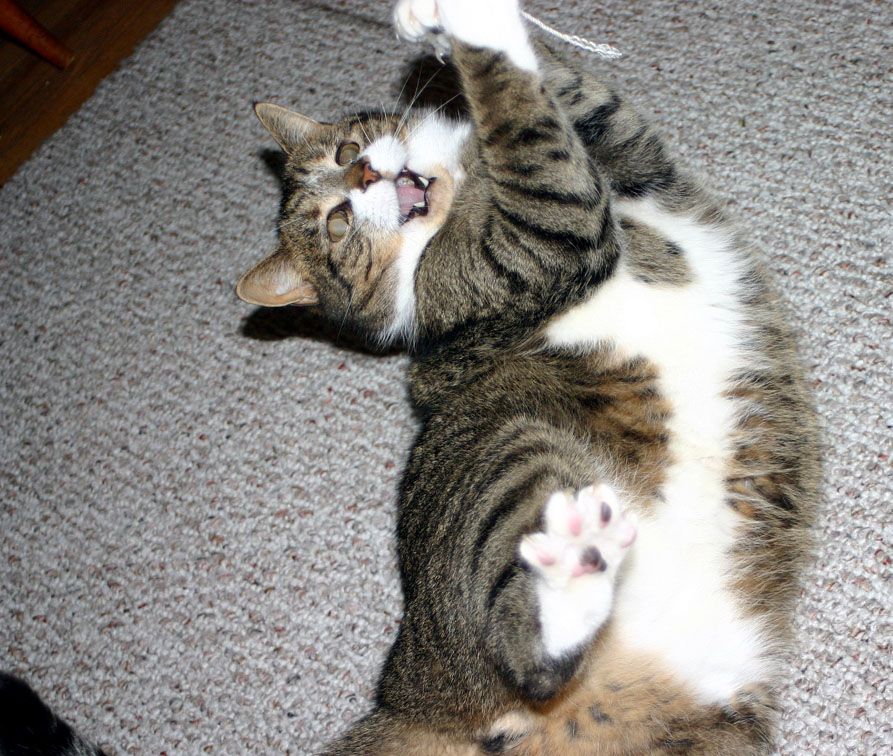
Surprise! Cats kill!


My cat, Mr. Misi, displays his inner killer

"Conspiracies Don't Kill Birds. People, However, Do.," the title of a recent piece in the New York Times declares. The article reports that US Fish & Wildlife research shows that "some of the biggest death traps" for songbirds in the United States are the jaws and claws of domestic and feral cats. The author dubs the USFWS finding "surprising," but it shouldn't be. Folks surprised by this report are either innocently ignorant of wildlife (and of the wild within the lives we've tenuously domesticated) or they willfully deny the ambivalent violence that animates so much life, cat, bird, and human included.

Read the NY Times piece, then revisit "i taut i taw a putty tat," an HH post from April 13, 2005, in which I discuss some of the realities of cat predation and make it clear that, though I'm a cat lover par excellence, our nation's songbirds, small mammals, and reptiles need us to stop playing favorites.

Photo credit: Hungry Hyaena, 2004

Tuesday, December 29, 2009

A Birthday Gift


Shell Beach; Sea Ranch, CA

On the morning of my 32nd birthday, I am sitting on the northern California coast, watching a great egret balance on a raft of dead sea grass. The grasses are held in suspension on the Pacific Ocean's surface by submerged kelp beds, and the white bird rises and falls atop the coastal surge, otherwise motionless as it awaits potential prey. A pair of brown pelicans glides north, just over the waves.

32 years on this Earth, and still I feel like I am opening my eyes for the first time.

Photo credit: Hungry Hyaena, 2009

Monday, December 21, 2009

Or A Falcon


Peregrine falcon (Falco peregrinus); New York City

"I am no more lonely than a single mullein or dandelion in a pasture, or a bean leaf, or sorrel, or a horse-fly, or a bumblebee. I am no more lonely than the Mill Brook, or a weathercock, or the north star, or the south wind, or an April shower, or a January thaw, or the first spider in a new house."

- Henry David Thoreau
Image credit: ripped from Pete.Mac's Flickr photostream

Thursday, October 15, 2009

Autumn Birds and Birding


View of Manhattan skyline from Central Park, Manhattan

On my way to the gym Tuesday morning, on the corner of 64th Street and 1st Avenue, I discovered a dead American goldfinch (Carduelis tristis). Feathers askew, a pink wound was visible on the head of the small, yellow bird. The injury was likely sustained when the goldfinch crashed into a window of one of the nearby apartment towers. I said a quiet goodbye to the bird, and continued on my way. An hour-and-a-half later, while running a work errand, I came upon a dead red-bellied woodpecker (Melanerpes carolinus), crumpled on the corner of 68th Street and York Avenue. People gave the bird's body little attention.

It's the time of year when our avian brethren fall from the sky above Manhattan and land, sometimes dead, sometimes injured, sometimes merely confused, on the city's sidewalks. It is the time of autumn migration and restlessness. Neither the goldfinch nor the woodpecker are properly migratory species, but both birds will sometimes fly a short distance south when the temperature drops.

I can't say whether or not the individuals that I found on Tuesday morning were on the move when they met their respective ends. Still, their fate is a common one during New York City's autumn. As the NYC Audubon Society's Project Safe Flight mission statement explains,
"Located at the nexus of hundreds of bird species’ migratory routes, New York City’s tall buildings and reflective glass pose a serious threat to over 100 species of migratory birds, some of which are experiencing long-term population declines."
Resident species are also vulnerable, of course. Since Project Safe Flight's inception, in 1997, "over 4,000 dead and injured birds have been collected and documented in [Audubon's] database." That number is a fraction of the total bird deaths that Manhattan's buildings cause.

What can each of us do to help curb the buildings' toll? The easiest action involves turning off your office or apartment lights at night. Many office towers leave the lights on, needlessly wasting electricity and killing birds. As Project Safe Flight’s Lights Out New York initiative explains,
"Lights can distract birds from their migration path and cause them to collide with buildings during bad weather. Turning off the lights and drawing the blinds can help save thousands of birds from over 100 different species every year."
Let's help our feathered friends fly safely, folks.

+++++


Watching a Winter Wren on the wall of Belevedere Castle; Central Park, Manhattan

I rose earlier than usual on Wednesday morning, so that I could be at Central Park's Loeb Boathouse by 7:30 AM, where I met five other Nature Conservancy bird watchers. The six of us spent a very pleasant two and a quarter hours birding.

I love being outdoors in the early morning, and I greatly enjoyed observing even the familiar species as they foraged, fought, and flitted about. House finches (Carpodacus mexicanus) and European starlings (Sturnus vulgaris) are species taken for granted by most birders, but, illuminated by the morning sunlight, each is a marvel.

I was especially excited to see several Eastern phoebes, a relatively common species that, courtesy of Edward Hoagland, I associate with my beloved notion of reconstitution, and a winter wren (Troglodytes troglodytes), a dark, small relative of the more familiar Carolina wren (Thryothorus ludovicianus), a bird for which I was almost named. (Wren Reiger would have been a hard sell on the grade school playground, and I'm thankful that my parents elected to shelve the name.)


Belvedere Castle; Central Park, Manhattan

Photo credits: All images, Hungry Hyaena, 2009

Tuesday, July 11, 2006

Thinking Like A Mountain?


Erik Reece's eloquent essay, "Death Of A Mountain: Radical Strip Mining and the Leveling of Appalachia," was included in the April 2005 issue of Harper's Magazine. The piece examines and responds to environmentally devastating coal mining practices in eastern Kentucky. Appropriately enough, I read the work while standing in an abominably long line at the World Expo, in Aichi, Japan, the first World's Fair dedicated to "green" thinking or, as the Japanese organizers dubbed it, "Nature's Wisdom."

Every pavilion in the Aichi Expo was sponsored by either a nation or a corporation (a sign o' the times), and they all forecast a happy, healthy, and sustainable future for humanity and for the planet. Reece's melancholy report provided a sobering counterpoint. A "green future" is tenable only if the necessary changes in technology and lifestyle generate an altogether different kind of green: cash money. As the wife of a Kentucky coal miner asks Reece, "What use are the mountains to us other than coal? When are you going to start thinking about us instead of the environment?" Until alternative energy cheerleaders assuage the concerns of those citizens dependent on income provided by companies like Leslie Resources Inc., one of the mining outfits indicted in Reece's article, America's hard-working, blue-collar folks will remain united in opposition to the relatively privileged mouthpieces of environmentalism.

In "Death of a Mountain," Reece describes the minutes of a Kentucky hearing addressing an Environmental Impact Statement on mountaintop removal, the principal method of tapping into buried coal seams. The local coalfield citizens in attendance, many of them employed by the region's energy companies, reacted against "outsiders" telling them what was best for them and for their land. They even hinted "at a conspiracy afoot by the rest of the state to keep eastern Kentucky poor." Not surprisingly, such vehement antagonism to "greening" measures were not highlighted at the Aichi Expo. Likewise, they receive scant attention in environmental publications, even those produced by more thoughtful organizations,including The Sierra Club, Natural Resources Defense Council and EarthJustice. It's clear that most environmentalists don't consider the lives of those people displaced by expanding parkland or laid off by companies under siege from environmental legislation. It's little wonder that "Third World" countries and blue-collar workers like the Kentucky miners or the fishermen of the Galapagos islands object to what they consider do-gooder meddling.

In Aichi, I looked up from the magazine and noticed a Japanese teenager in line not far behind me. He was wilting under a sun umbrella, wearing a t-shirt emblazoned with a picture of the popular American hip-hop duo, Outkast. Fond of connecting seemingly unrelated strands, I thought of the Outkast song, "Return of the G." The lyrics of the song begin, "Every time I try to get peace of mind, niggas try to get a piece of mine, so I gotta grab my piece." The song concisely describes an ugly, myopic cycle, but how much easier for me to characterize it as such when I can afford a plane ticket to Japan and enough over-priced, organic vegetables to fill my canvas grocery sacks?

As a proponent of conservation and environmental protection, I'm necessarily guilty of prioritizing the sustainable long-view over the millions of people vying to put food on their plate. I considered this distressing reality as I entered the air-conditioned Hitachi Pavilion in Aichi to watch an animated feature about the catastrophic - nay, apocalyptic - events brought on by humanity's cavalier approach to natural resource consumption.


A mushroom cap raises a mossy roof

Similar considerations were on my mind this past week, when I traveled to the Monongahela National Forest, in eastern West Virginia, for some camping, hiking, and herping. I know very little about West Virginia, despite having spent several summers at Camp Greenbrier, situated just outside Alderson, in the southern part of the state. During those summers I learned about kayaking, archery, riflery, rock climbing, and the cruel conduct of boys left unsupervised, but I was too young - just nine or ten years of age - to absorb much about the region save the scenic beauty.

Following those camp years, John Denver's song "Country Roads," a particular favorite of my mother, acquired new significance for me. "West Virginia, mountain momma...take me home," Denver sings. Having appreciated the lush splendor of the Appalachian range for myself, Denver's lyrics imparted an aesthetic association as well as the allusion to a mother's buxom embrace. But Denver's paean doesn't only acknowledge West Virginia's awesome landscape. He refers to the state as the "miner's lady...dark and dusty." Even the state's coat of arms, central on the state flag, pictures a miner, pickaxe slung over his shoulder, standing alongside a farmer. But modern miners have largely abandoned the pickaxe in favor of cranes and bulldozers, and evidence of mountain top removal can be seen from the state's highways. Treeless plateaus neighbor intact peaks and, although geologic time will see these scars support trees and other vegetation anew, one can not help but wonder what has become of the once healthy water supply fed by the decapitated mountain streams.

Happily - some might even say selfishly - I was able to avoid despair during my time in Monongahela. Unlike so much of the state, the mountains of the National Forest have been spared extensive surgery. All the same, the park map is peppered with mine sites, demarcated by a pick and shovel. The stream water I drank - after an iodine pill dosing - seemed safe enough (I didn't get sick), but I couldn't quite shake worries about mercury or heavy metal content. Encouragingly, we found plenty of amphibians in the streams, and this suggests that the water is clean.


Salamander hunting near Cheat Mountain Camp

* * * * *

Amphibians: We identified four species of salamander; one example of each is pictured below.


Mountain Dusky Salamander (Desmognathus ochrophaeus)

The Mountain Dusky Salamander (Desmognathus ochrophaeus) was the most common, at least according to our crude census. They seemed to flourish alongside streams, under partially submerged rocks, and on the mountain's face, under woodland detritus - bits of rotten limbs or clumps of moss. The coloration of this species is wide-ranging. Some of the individuals we came upon could have passed for the unrelated redback (Plethodon cinereus), while others appeared more yellow, tan, or even chocolate. Fortunately, one of my companions is an avid herper and he was readily able to distinguish the two species by examining the head and nostrils. When in doubt, I defer to his expertise.


Redback Salamander (Plethodon cinereus)

Comparatively scarce was the redback salamander and, if I'm recalling accurately, we only discovered this species near woodland vernal ponds. Unfortunately, all my photographs of the species turned out poorly. The models, this one included, didn't much take to posing, forcing me to hurry the shots.


Spotted Dusky Salamander (Desmognathus fuscus conanti)

The most unusual discovery of the trip was a Spotted Dusky Salamander (Desmognathus fuscus conanti). The species is not known to live in the region - according to field guide range maps, anyway - but, nevertheless, we encountered this individual under a flat rock in an insignificant stream and spent some time confirming the ID. Proof, once again, that nature is always throwing curve balls, particularly in this time of accelerating climate change. The patterned salamander was strikingly colored and appeared almost translucent, it's distinctive markings discernible beneath a superficial layer of clear skin.


Red-spotted Newt (Notophthalmus viridescens viridescens)

Just up the hill from the Spotted Dusky discovery, we noticed a Red-spotted Newt (Notophthalmus viridescens viridescens) in a puddle of standing water. I was thrilled to see one up close, as it had been the better part of a decade since I last admired this species in person. As it turned out, almost anywhere water pooled in Monongahela, the newts were present. By the time we departed, we'd seen close to a hundred.

Before transitioning into its principally aquatic adulthood, however, the newt spends time on land, as the terrestrial red eft. These attractive little amphibians are perhaps the most charismatic of salamanders. Their stunning outfit is complimented by their not being as retiring as other species. If you find yourself in prime habitat, a keen eye will spot the efts crawling on logs or over leaves, seemingly unperturbed by exposure.


Red-spotted Newt in Red Eft stage (Notophthalmus viridescens viridescens)

Tadpoles, like the newts, could be found in almost every pond or puddle. Although we could not ID the species with certainty, we believe most to be the aquatic larvae of the wood frog (Rana sylvatica), though we did notice a few American bullfrog (Rana catesbeiana) tadpoles. The bullfrog is something of a bully, infamous for out-competing other amphibians and adapting to a wide range of habitats. Biologists designate such a species a trophic generalist. Despite the potential threat to biodiversity, a piece of me admires the pluck of the bullfrog, just as I grudgingly take my hat off to the European starling (Sturnis vulgaris) and the raccoon (Procyon lotor).

Although we saw countless tadpoles, we saw only three adult frogs. One bullfrog, one wood frog, and one upland chorus frog (Pseudacris triseriata feriarum). The upland chorus frog is closely related to, but distinct from, the eastern (or New Jersey) chorus frog (Pseudacris ferairum kalmi), with which I am familiar from my childhood on the Eastern Shore of Virginia.


A Monongahela stream

Reptiles: Our snake hunting forays proved less successful. We shined flashlights into crevices and carefully examined sun-lit leaf litter in hopes of revealing a timber rattlesnake (Crotalus horridus) or a northern copperhead (Agkistrodon contortrix), but neither species graced us with an appearance. I was discouraged, but not surprised. Snake hunting is usually a kettle watching exercise and the animals seem to materialize only once you cease searching.

We found two snakes in Monongahela. Sadly, one of these was a DOR (dead on road) eastern garter snake (Thamnophis sirtalis sirtalis), a victim of the automobile. Given the infrequent use of this remote forest road, I decided the unfortunate snake must have accrued some very shitty karma. At least an unidentified land snail was feeding on the dead snake, a welcome reminder of our shared mortality and interdependence.

The identity of the other snake we observed remains in question, but I'm almost certain it was a juvenile eastern milk snake (Lampropeltis triangulum triangulum). It was a very slender snake, not even pencil-thick, wearing alternating bands of red and white. We noticed the snake on the bottom of a shallow, water-filled ditch. It was attempting to feed on small tadpoles. When we clumsily hurried over for a closer look, it retreated into submerged grasses lining the ditch. After a wait of about fifteen minutes, it emerged from hiding and I attempted to ID it as it zigged and zagged across the bottom. I failed, unfortunately, and we did not see the little reptile again. According to field guides, eastern milk snakes are no stranger to stream bottoms. This knowledge, combined with the distinctive markings, leaves me with little doubt of the species, but, as I say, the verdict it still out.


Snake hunting on the southern exposure

Mammals: I hoped to see a black bear (Ursus americanus) or two, but I had to settle for a smattering of tracks. Because we arrived in Monongahela at the tail end of a long wet spell, the trails and back country were muddy and soft. Although the rain made the first night miserable - we rigged a tarp and pitched the tents after dark, in hard rain - the saturation made spotting animal tracks easy, although in some cases the ground was so wet that fresh prints were already partially obscured. White-tailed deer (Odocoileus virgianus) tracks were plentiful, but we saw more deer in the backyards of the houses fringing the National Forest than we did in Monongahela proper. This isn't surprising, as deer are harder to spot in dense forest and, what's more, they thrive in and around human settlement, as so many suburbanites know. Also abundant was the bouncy eastern chipmunk (Tamias striatus).

Birds: We were ill-prepared for bird watching. Although we were careful to pack everything needed for a camping trip - right down to the campfire utensil sets - we somehow neglected to include binoculars. I'm not sure how this oversight occurred, but none of us had a pair in hand, making anything beyond guessing difficult, especially since most of Monongahela's bird species are relatively small. In the shadowed forests, identification is all but hopeless without ocular assistance. Fortunately, one of my friends has a competent ear and some species were identified by their call.

Slate-colored juncos (Junco hyemalis) were innumerable. It seems spring comes late to the upper elevations, as the rhododendrons had yet to bloom and, on the final afternoon, we were scolded by two adult juncos as we hustled past a fledgling perched on a low-hanging branch. The prize for Most Handsome Bird goes to the Blackburnian warbler (Dendroica fusca), a fire-headed fellow with a striking voice. We thought we heard this bird's song in the woods, and our supposition was verified when an individual landed just above us, in the branches of a spruce tree.

Most exciting for me, however, was the family of American woodcock (Philohela minor) that we startled into awkward flight. I'm used to the jump, flutter, and glide behavior of the woodcock in the open, flat fields of coastal Virginia, but in the mountain woods of Monongahela, the woodcocks' comical eruption from among the leaves and ferns betrayed the provenance of the species nickname, the timber doodle. The first bird to take off flapped and jerked and reared and leaned as it moved all of twenty feet in the air, before pitching hard and vanishing into a mess of fallen limbs. Realizing we had disturbed a family group, we made our way downhill at a good clip, so as to allow the birds to regroup.

Plenty of common ravens (Corvus corvax) and cedar waxwings (Bombycilla cedrorum) were about, but we saw only one American blue jay (Cyanocitta cristata) and one turkey vulture (Cathartes aura), species I certainly expected to see more of. Had we been properly equipped (read: not forgotten the $@*&%!! binoculars), I would have more to report, but I was all too happy to concentrate on reptiles and amphibians, as they are particularly exciting to me.

* * * * *

Rising with dawn's birdsong on the final morning, we quickly packed our gear, lowered the bear bag, and began the five hour drive to Washington, D.C., where I was to catch the Chinatown Bus back to New York City. As we headed east, I slouched in the cramped back seat and admired the mountains of West Virginia, even as I again noted signs of resource extraction. My thoughts returned to Reece's "Death of a Mountain" and I made a mental note to reread it upon returning to New York.

Near the end of the article, Reece quotes Aldo Leopold, the famous American ecologist and conservationist. Leopold bemoaned the fact that "one of the penalties of an ecological education is that one lives alone in a world of wounds." I'm not sure that this is still the case. Those of us who are environmentally conscious do not live alone, even if we do remain surrounded by wounds. More than ever before, "green" sentiments are also popular sentiments; many folks share a penchant for preservation. Leopold would argue, however, that most contemporary environmentalists remain blissfully ignorant of ecological pragmatism. He was a conservationist, not a preservationist, and he understood that protectionism alone rarely leads to long-term sustainability.

Keeping this conservation/preservation dynamic in mind, I think it noteworthy that my companions in the forests of Monongahela were a biology professor and a writer. For our purposes here, the biologist might be characterized as a biological determinist and the writer, as a moral idealist. Though these two characterizations are by no means mutually exclusive, it makes for an interesting contrast in perspective, even though both appreciate the outdoors equally. Rereading "Death of a Mountain," I was surprised to find this divide touched on in the closing paragraphs.
"If our species is to make it through [the 21st] century, the forces of science and technology must be tempered by two other forces - ethics and aesthetics. All ethical philosophies, from Aristotle on down, are based on this ecological principle as stated by Leopold: 'The individual is a member of a community of interdependent parts.' And as the cave art at Lascaux makes brilliantly clear, we are a species that has evolved to find beauty in the natural world. This trait serves - or should serve - an evolutionary purpose: we love what we find beautiful, and we do not destroy what we love. A strip job is more than a moral failure; it is a failure of the imagination. It is time we stopped thinking like those who conquer a mountain and started thinking like the mountain itself."
A strip job, as Reece writes, is a moral and imaginative failure, but what does it mean to think like a mountain? It would seem to me that to think like a mountain requires us to abandon morality and imagination, both exceptional human virtues. Is my ambivalence concerning invasive species control an example of mountainous thinking? Moral ambivalence - that is, amorality - is Nature's way. But isn't ambivalence, too, problematic? Is it not cousin to apathy? Humans, at their best, are moral animals; morality necessitates choice and action. Strict environmental controls, then, are moral, pragmatic, and rational, flailing efforts in our human time scale not at all like the geologic contemplation of a mountain. We humans consider a skewed equation and strive to balance it. This calculus comes at some cost. For the sensitive aesthete, slavishly devoted to what Reece calls beauty, the dualistic thinking of a moral pragmatist - right or wrong, good or evil - can seem an ugly, even unnecessary evolutionary holdover. Where, then, can the conscientious among us stand? It's an impossible question, really, more of a koan than a query, but it nags nonetheless.

Something approaching an answer is wrapped up in the lyrics of Denver's "Country Roads," in the fight bruised arms of young boys, in the remarkable persistence of trophic generalists, in the determined antagonism of the coal miner's wife, in the scarred plateaus, and in the slurried bear tracks. Thankfully, when I'm painting, or when I'm appreciating back country settings like Monongahela, I'm reminded that contentment, for me, requires acceptance of a messy, mongrel truth. For my part, it's both necessary and natural to be both an idealistic aesthete and a moralistic number cruncher.


Fungi thrive in the moist, dense forests

Photo credit: all photos, Hungry Hyaena, 2006

Tuesday, October 18, 2005

The Natural History of Japan

How's that for a title? It sounds rather all encompassing, as though this blog entry will be the definitive reference for suburban/exurban Japanese natural history queries. In fact, it's little more than a listing of the few species I observed and identified while visiting Japan for two weeks. I promised this post weeks ago and I apologize for the delay; too many other things caught my eye. Below you will find the common name, scientific name, and a brief description of my encounter with the creature(s). For some species, I've included a photograph.

Image hosted by Photobucket.com
Gray Heron (Ardea cinerea):
These familiar looking herons were plentiful in the numerous rivers and streams of Japan. It made little difference to them if the stream bed had been coated in concrete - a common practice in Japan - or if apartments lined the banks; there they stood, looking remarkably like the Great Blue Heron (Ardea herodias) so well known in the Americas. Interestingly, it seems Ardea cinerea has been even more successful than A. herodias, having populated three continents: Europe, Asia, and Africa. (By the way, why is Europe considered a continent again?)

Rufous Turtle-Dove (Streptopelia orientalis):
This bird superficially resembles the mourning dove (Zenaida macroura), a handsome species I hunted in the harvested fields of Virginia every fall of my youth. As the name suggests, the rufous turtle-dove has browns and reds in the plumage. It is also more heavy-bodied than many other dove species, though still smaller than the rock dove (Columba livia), better known to most urban folks as the pigeon.

Image hosted by Photobucket.com
Carrion Crow (Corvus corone orientalis):
As I have mentioned before, I have a soft spot for the corvid family. Jays, crows, ravens...oh, my! The Carrion Crow stands out because of the terrific name and its alarming size. My friend Ben contends that these large crows are the inspiration for the giant corvids populating so many video games (“Resident Evil,” for example). I believe it. They seem to be half again as large as your average American crow (Corvus brachyrhynchos) or Fish crow (Corvus ossifragus) and their scratchy squawk is a staple of Buddhist cemeteries and Shinto shrines. The irridescent quality of their plumage is readily apparent, particularly around the neck.

Unfortunately, I was unable to get very close to any of the carrion crows; they are a skiddish bunch. To get the picture above, I had to approach the bird without making eye contact, taking care to keep my gaze directed at the ground until I was within six feet. As soon as I raised the camera, the bird began shifting about, taking flight just moments after I snapped the slightly blurry photograph. Situations like this one had me cursing my decision not to bring my wildlife lens, the 280mm big boy or, as I like to call it, the Sweaty Butcher.

Insects (and spiders) Galore:
If I were a more knowledgeable amateur entomologist, or if I had a really good insect field guide handy while in country, I could have filled pages with the names of insect species I encountered. Katydids in the shower, cicadas whining in the trees, cranefly-like creatures hovering alongside trails, millipedes on fallen tree trunks, many species of ants rushing about their business, mosquitoes in the bedroom... Japan is an insect haven. The rainforests of Central and South America are teeming with insect life, almost certainly without compare, but I was nevertheless impressed by the sheer abundance found on Honshu. Below I give more detail about one spider species which I was able to identify. (Check out “Encounter With The Giant Asian Hornet (Vespa mandarinia)” for information about another frequently encountered species.)

Image hosted by Photobucket.com
Giant Wood Spider (Nephila maculata):
A member of the orb web spider family, the giant wood spider provided me with repeated frights. I admire spiders a great deal as predators and find them to be generally fascinating creatures, but I still act irrationally when I believe a large spider might be on me. Several times I yelped and frantically brushed webbing from my face and hair, convinced I was about to be bitten by one of these hulking arachnids. Of course, I never was. In fact, I never even had a spider on me, though I did destroy quite a few webs with my hystrionics. In any event, my antics provided Ben with much mirth, so some good came of it.

The female wood spiders are quite large, and rather striking, especially when compared to the smaller, dull-colored males. As with many orb weaver spiders, the male Nephila maculate searches out a female and takes up residence at the edge of her web. He courts her over time, usually by plucking the web to express his intentions. When the female finally responds, she might elect to kill the male and, should she instead be receptive to his advances, she will kill and devour the male after they mate. All in all, a pretty sour deal for the guy; his only purpose is to provide the sperm. In the picture above, you can see the male in the upper left of the frame. The image below shows a female quieting an unlucky cicada.
Image hosted by Photobucket.com
+++++++++++++++++++++++
Image hosted by Photobucket.com
Turtle Feeding:
In Kyoto's Imperial Park, Ben and I came upon a man feeding turtles on the shore of a coy pond. Though his English was basic, he did manage to explain what species we were seeing, though the common names he gave were notably different than those accepted in herpetological communities. For example, he called the Chinese softshell turtle (Pelodiscus sinensis) a "pig nosed turtle," which is a perfectly accurate description of this large species. In fact, the turtle was so much bigger than the other species vying for the man's bread handouts that several turtles would be pushed up and away from the feeding by the larger turtle's carapace whenever it surfaced. In the picture below, you can see the head of this beast, alongside one of the smaller, common species, a Reeve's pond turtle (Chinemys reevesii).
Image hosted by Photobucket.com
The Reeve's pond turtle is evidently quite common in Japan, along with an introduced, or alien, species that we in the west are quite familiar with, the red-eared slider (Trachemys scripta elegans). I spotted at least three of these prolific, adaptable turtles clawing at the rock on which the turtle man perched. Whether intentional or not, the turtle man repeatedly ignored the sliders in favor of the other species. Given the xenophobia of the Japanese, I wondered if this wasn't a considered act.

The fourth species at the feeding site was a darker colored turtle, the Japanese pond turtle (Mauremys japonica). Though smaller than any of the other species present, these guys seemed the most successful feeders. They heaved themselves out of the water onto the rock and collected bread bits directly from the turtle man's fingers, as you can see above. Below, both M. japonica and C. reevesii crowd the edge of the rock awaiting service.

After ten minutes or so, Ben and I moved on, leaving the turtle man with his friends as dusk settled in and the players' shadows on the nearby baseball diamond stretched long.
Image hosted by Photobucket.com

Photo credit: Gray Heron, copyright www.aves.be; all others, Hungry Hyaena, 2005